It’s Zugzwang for Biden in Ukraine
BY M. K. BHADRAKUMAR | INDIAN PUNCHLINE | MARCH 8, 2023
There is a cardinal difference between the Washington Post report of June 18, 1972 by Alfred Lewis breaking the news of the Watergate burglary and the sensational claim by the New York Times on Tuesday — per a CNN report — that “intelligence suggests that a pro-Ukrainian group” sabotaged the Nord Stream gas pipelines.
The WaPo reported on Watergate several months after Richard Nixon’s thumping victory for a second term as president, while the Times’ claim has been advanced even before Joe Biden has announced his candidacy for the November 2024 election.
A common thread, though, could be that while the Lewis story was followed up a day later by two young Post reporters Bob Woodward and Carl Bernstein, the Times report also hopes to be a developing story but with a contrarian purpose.
If Watergate wiretapping forced Nixon to resign eventually, the big question is whether the Nord Stream sabotage will also be the undoing of the Biden presidency?
These are early days. But the reverberations of the Times’ claim are already being felt in Europe — Ukraine and Germany — although the report was carefully worded to keep Ukrainian leaders outside its purview.
But the bottom line is the caveat that the Times report was not made with high confidence and is apparently not the predominant view of the US intelligence community, and that the Biden Administration has not yet identified a culprit for the attack — succinctly put, this isn’t necessarily the last word on the subject!
That’s smart thinking — with an eye on Seymour Hersh, perhaps? Meanwhile, Ukraine has flatly denied involvement and German media reports stressed that there’s no proof that Ukrainian authorities ordered the attack or were involved in it. Evidently, Kiev and Berlin (and Washington) prioritise that the business of war must continue as before. And neither is in a position to hit back in defence.
But Moscow is plainly derisive. Kremlin spokesman Dmitry Peskov told RIA Novosti, “Clearly, the authors of the terrorist attack want to distract attention. Obviously, this is a coordinated stuffing in the media.”
Indeed, when asked about the Times report, the highly opinionated US National Security Council coordinator for strategic communications, John Kirby referred questions to investigating European authorities and excused himself saying he was “not going to get ahead of that investigative work.” Kirby played it safe.
So, as Lenin would have asked: ‘Who stands to gain?’ To be sure, what we have here is a high level leak planted in the Times by the US intelligence, which is non-attributable but probably serves as kite flying to see how far it will travel, especially in Europe, or, equally, it could just be, as Peskov put it, the stuff of an “obvious misinformation campaign coordinated by the media.”
Either way, someone high up in the Biden Administration is playing for high stakes. This is taking place at a time when Biden himself has been implicated by Seymour Hersh for ordering the destruction of Nord Stream — an act of international terrorism — and of course Biden is yet to announce his candidacy for the 2024 election.
As things stand, candidate Biden will not want the Nord Stream scandal to be another Albatross around his neck. The point is, if he stands for election, which he likely intends to, Biden can be sure that the scandalous Ukraine stories concerning him and his son Hunter Biden, dating back to his time as vice-president, will roar back to centrestage.
The questioning that the US ambassador to Estonia Senator George Kent was subjected to by Senator Tom Cruz at the hearings on his appointment in Tallinn in December suggested that the Republicans have a lot of dope on Hunter Biden’s activities in Ukraine and are waiting for the right moment to strike.
Kent, a career diplomat and former deputy assistant secretary of state for European and Eurasian Affairs with three stints in Kiev — the second time as DCM from 2015 to 2018 and the third as Charge d’Affaires a.i, in 2021 during Biden presidency— is in Senator Cruz’s crosshairs.
Last week, again, Sen. Cruz returned to the topic. This time around, he tore into attorney general Merrick Garland accusing the Justice Department of leaking uncontrollably in a calibrated bid to save Biden’s reputation.
Conceivably, the implication by the Times report that a “pro-Ukrainian group” may have been behind the Nord Stream attack can be seen as a veiled threat to the powers that be in Kiev to understand which side of their bread is buttered if push comes to the shove.
So far, Zelensky has played ball. Biden is bending over backward to appease Zelensky, if the manner in which the move to sack the Ukrainian Defence Minister Oleksiy Reznikov, a close ally of the president, was summarily shelved is any indication.
The western media was copiously reporting on a purge under way in Kiev but when the trail came to Reznikov and Zelensky dug in, the US inspectors deputed from Washington to investigate the corruption scandal in the defence ministry simply disappeared.
Indeed, Biden must willy-nilly remain in power beyond 2024 or else he becomes extremely vulnerable. Therefore, Biden desperately needs a second term. He cannot be too sure even if some other Democratic candidate wins in 2024. God forbid, if the Republicans seize the presidency, Biden and his family members will be fighting with their backs against the wall.
But there is also the flip side. Biden’s candidacy will bring Nord Stream, Hunter Biden, Ukraine war, et al, to the centre stage of the election campaign. Is it worth the risk?
Frankly, it is a ‘zugzwang’ for Biden. It is his turn to move, but all of his moves are so bad that having to move can lose the game — and in chess, there is nothing like “pass,” either.
The sabotage of the Nord Stream forms part of the Ukraine issue. Whoever destroyed that pipeline did it with the intention to eliminate any residual prospect left of a revival of the post-cold war Russian-German alliance in Europe built around the two countries’ energy cooperation and interdependency.
The Biden team in sheer naïveté thought that sabotage of the Nord Stream would be a geopolitical masterstroke to humiliate Germany and make it a vassal state, destroy all bridges leading from Russia to Europe, and consolidate the US’ transatlantic leadership. They overlooked, out of sheer hubris, that it still remained a cowardly criminal act.
To compound matters, the war in Ukraine flowed out of Biden’s decision to destroy the Nord Stream (which, according to Hersh, dated back to September 2021.) Today, Biden cannot easily end his war as he is also beholden to Zelensky (who knows far too much about Hunter Biden’s escapades in Kiev.)
Will Biden Administration succeed in hushing up the Nord Stream scandal? Hersh is sure to revisit the topic. Biden cannot walk away from the crime now. But it doesn’t cease to be a crime.
Biden’s remaining option may be to announce he’s going to contest the 2024 election because Build Back Better Framework is still a work in progress.
Ukraine responds to Nord Stream claims
RT | March 8, 2023
Kiev had nothing to do with the sabotage of the Nord Stream pipelines, the Ukrainian defense minister has said in response to media reports blaming last September’s explosions in the Baltic Sea on a “pro-Ukraine” group.
“For me, it’s a little bit strange story,” Aleksey Reznikov replied when asked about the issue after his arrival at an informal meeting of EU defense ministers in Stockholm on Wednesday.
“This story has nothing [to do] with us,” he said, expressing confidence that “the investigation [by] the official authorities will describe every detail” of what had happened.
The claims of Ukrainian involvement in the sabotage are “like a complement for our special forces, but this is not our activity,” the minister added.
Journalists asked Reznikov if he was concerned that the latest media reports could lead to a reduction in EU support for Kiev amid the conflict with Moscow. “No, I’m not concerned. Everything would be OK,” he said.
On Tuesday, the New York Times reported, citing US officials and unspecified new intelligence, that a “pro-Ukrainian group” may have been behind the September attack that disabled the Nord Stream 1 and 2 pipelines, which were built to deliver Russian gas to Europe via Germany. The US paper’s anonymous sources stressed that “no American or British nationals were involved” in the sabotage.
A few hours later, several German outlets claimed the country’s investigators looking into the Nord Stream blasts had found that a yacht reportedly used in the attack belonged to a Polish-based firm, owned by two Ukrainians.
Kremlin press-secretary Dmitry Peskov described the reports in the US and German media as “a coordinated media hoax campaign,” aimed at diverting attention from the actual “masterminds” of the sabotage.
Last month, veteran American investigative journalist Seymour Hersh released a bombshell report blaming Washington for destroying the Nord Stream pipelines. According to an informed source who talked to Hersh, explosives were planted on the pipelines in the Baltic Sea back in June 2022 by US Navy divers under the guise of a NATO exercise, and detonated remotely two months later. The White House has denied the report by the Pulitzer Prize-winning reporter, calling it “utterly false and complete fiction.”
CDC’s Attempt Get Mainstream Media to Spread False Information
CDC Falsely Claims To Major Media Outlet That the 7.7% Medical Care Figure Was Wrong!
By Aaron Siri | Injecting Freedom | March 6, 2023
After ICAN obtained the v-safe data and published to the world that 7.7% of v-safe users sought medical care (and that the CDC hid this number from the public for two years), Reuters reached out to my firm stating it had received comment from the CDC regarding this figure.
Incredibly, CDC told Reuters that the 7.7% figure was grossly inflated because it claimed there were 10 million records in v-safe, not 10 million users. Here is the exact email I received from Reuters:
“CDC says v-safe has 10 million records, not 10 million users, and that one person could submit multiple records of seeking medical care for the same adverse event. Which makes the 7.7% statistic problematic… Is that something ICAN was aware of or able to adjust for?”
Based on the CDC’s claim, the major news outlet asked if ICAN would be modifying its claim of 7.7%. But it was the CDC’s claim that was categorically false!
ICAN was correct: there were 10 million v-safe users, not 10 million records; and the 7.7% also did not double-count because it was the number of unique v-users who submitted one or more reports of seeking medical care.
The CDC was plainly pushing the major news to declare ICAN’s claim false and, hence, characterize it as misinformation.
Had Reuters just accepted the CDC’s claim, as typically occurs, it likely would have published a story declaring ICAN’s 7.7% figure to be false information.
Luckily, to its credit and because one of its reporters proceeded objectively and with integrity, this news outlet did not just take the CDC’s word for its claim. It actually gave us an opportunity to respond to this claim. (Albeit not by asking if ICAN believed it was wrong but by asking if it would adjust the figure it published.)
CDC Proven Wrong
Showing that the CDC was wrong was simple. All we had to do was use the CDC’s own data it provided to ICAN!
The data the CDC provided to ICAN clearly and without any doubt showed that ICAN was using the precise and correct number of v-safe users and the number of unique v-safe users who reported needing medical care. Meaning, the 7.7% was absolutely accurate – without any doubt.
We sent this proof and asked Reuters to please ask that CDC substantiate with actual proof, not just conclusory assertions, how ICAN was supposedly wrong and spreading misinformation. And again, to Reuter’s credit, because it demanded proof from the CDC, the CDC eventually relented!
The CDC finally conceded that v-safe did in fact have approximately 10 million users and, hence, the 7.7% figure of those who reported seeking medical care was accurate.
With that, I expected that interaction would be one heck of a story in and of itself! I foresaw a Reuters story that disclosed this CDC behavior – here was the CDC trying to get a major news outlet to publish false information! It was trying to get it to write that the 7.7% figure was incorrect.
That should have been its own major story. And although Reuters did publish a story about v-safe, thus far, these behind-the-scenes communications have not been published. I expect they never will, other than in this article.
CDC Asks Reuters to Ask ICAN for a Copy of CDC’s V-Safe Data
It gets even worse. Making plain that the CDC officials communicating with Reuters were not concerned about the facts, and instead were focused solely on pushing their “safe and effective” mantra which is typically not questioned, they further revealed the agency’s disfunction: the CDC officials asked Reuters if it could get a copy of the v-safe data from ICAN and send it back to the CDC representatives Reuters were dealing with so they can review that data. If that sounds nutty, it is because it is.
Just so you don’t think you misread the foregoing, let me repeat: CDC asked Reuters to get the v-safe data that CDC had given to ICAN days before, and then send that data back to the CDC to review.
You can’t make this stuff up. Mind you, the data had already all been made public on ICAN’s website.
What this shows is that these CDC officials were driving forward to push a major news outlet to claim to the world that ICAN’s claim of 7.7% was false without actually looking at the data to assure their claim was accurate. It also shows an incredible level of disfunction at the CDC; instead of getting the data internally, they had to ask a news outlet to get its own data produced to ICAN to then send it back to CDC.
And these are the folk that have effectively dictated what level of civil and individual rights most Americans would have over the last three years!
CDC Seeks to Deceive Again
When the foregoing gambit by the CDC did not work, it had a new gambit. It tried to get Reuters to publish that the 7.7% figure was misleading by claiming to Reuters that “[i]n the first week after vaccination, reports of seeking any medical care … range from 1-3% (depending on vaccine, age group and dose).”
But as we explained to Reuters, even this is not true. For example, 3.36% of those younger than 3 years old reported receiving medical care within one week of receiving the Moderna vaccine.
Even if all combinations of vaccine, age group, and dose resulted in between 1% to 3% of infants, children, or adults seeking medical care within one week, that is not necessarily an insignificant figure! Why is this somehow comforting? Especially in the context of vaccinating the entire country.
And why should the reports of medical care on days 14 or 21 or 28 be ignored? Is it because the CDC thought it was not relevant information? And, if so, why in the world ask v-safe users to submit this information on these days? Or is it because the CDC did not like what the numbers showed? I will let you be the judge.
As noted above, and a sad irony, when medical care is sought during the first seven days, the CDC presumably attributes that to expected reactogenicity and tells the public to not be concerned. And if it occurs beyond seven days, it pretends as if that data does not exist – even though harms from COVID-19 vaccines, as the CDC well knows, can occur well after the first seven days, as discussed in depth in part 7 of this v-safe substack series.
Also, here, we are talking about a novel medical product, hence heightening the need for assessing its long-term safety – certainly beyond 7 days post-vaccination.
This shows how the sausage is made in mainstream media. But for the actual tenacity – I would even say courageous – pushback from a Reuters reporter, the story around ICAN’s v-safe claims could have ended very differently.
The real story I can only imagine this reporter would have liked to publish, the one I told above, however, would no doubt be a step too far for Reuters as an organization – at least for now, until brave journalists become the typical journalist.
How Could Western Intelligence Have Got It Wrong, Again? They Didn’t. They Had Other Purposes
By Alastair Crooke | Strategic Culture Foundation | March 6, 2023
Larry Johnson, an ex-CIA analyst, writes “I no longer hold clearances and have not had access to the classified intelligence assessments. However, I have heard that the finished intelligence being supplied to U.S. policymakers continues to declare that Russia is on the ropes – and their economy is crumbling. Also, analysts insist that the Ukrainians are beating the Russians”.
Johnson responds that – lacking valid human sources – “western agencies are almost wholly dependent today on ‘liaison reporting’” (i.e., from ‘friendly’ foreign intelligence services), without doing ‘due diligence’ by cross-checking discrepancies with other reporting.
In practice, this largely means western reporting simply replicates Kiev’s PR line. But there does occur a huge problem when marrying Kiev’s output (as Johnson says) to UK reports – for ‘corroboration’.
The reality is UK reporting itself is also based on what Ukraine is saying. This is known as false collateral – i.e., when that which is used for corroboration and validation actually derives from the same single source. It becomes – deliberately – a propaganda multiplier.
In plain words however, all these points are ‘red herrings’. Bluntly, so-called western ‘Intelligence’ is no longer the sincere attempt to understand a complex reality, but rather, it has become the tool to falsify a nuanced reality in order to attempt to manipulate the Russian psyche towards a collective defeatism (in respect not just to the Ukraine, but to the idea that Russia should remain as a sovereign whole).
And – to the extent that ‘lies’ are fabricated to accustom the Russian public to inevitable defeat – the obverse edge clearly is intended to train the western public towards the ‘groupthink’ that victory is inevitable. And that Russia is an ‘unreformed evil Empire’ which threatens all Europe.
This is no accident. It is highly purposeful. It is behavioural psychology at work. The ‘head-spinning’ disorientation created throughout the Covid pandemic; the constant rain of ‘data-driven’ model analysis, the labelling of anything critical of the ‘uniform messaging’ as anti-social disinformation – enabled western governments to persuade their citizens that ‘lockdown’ was the only rational answer to the virus. It was not true (as we now know), but the ‘pilot’ behavioural nudge-psychology trial worked better – better even than its own architects had imagined.
Professor of Clinical Psychology, Mattias Desmet, has explained that mass disorientation does not form in a vacuum. It arises, throughout history, from a collective psychosis that has followed a predictable script:
Just as with lockdown, governments have used behavioural psychology to instil fear and isolation to mass large groups of people into herds, where toxic sneering at any contrariness cold-shoulders all critical thinking or analysis. It is more comfortable being inside the herd, than out.
The dominant characteristic here is remaining loyal to the group – even when the policy is working badly and its consequences disturb the conscience of members. Loyalty to the group becomes the highest form of morality. That loyalty requires each member to avoid raising controversial issues, questioning weak arguments, or calling a halt to wishful thinking.
The ‘Groupthink’ allows some self-imagined reality to detach; to drift further and further from any connection to reality, and then to transit into delusion – always drawing on like-minded peer cheerleaders for its validation and extended radicalisation.
So, it’s ‘goodbye’ to traditional Intelligence! And ‘welcome’ to western Intelligence 101: Geo-Politics no longer revolves around a grasp on Reality. It is about the installation of ideological pseudo-realism – which is the universal installation of a singular groupthink, such that everyone lives passively by it, until it is far too late to change course.
Superficially, this may seem clever new psyops – even ‘cool’. It is not. It is dangerous. By deliberately working on deeply ingrained fears and trauma (i.e. the Great Patriotic War for Russians (WW2)), it awakens a type of multi-generational existential plight within the collective unconscious – that of total annihilation – which is a danger that America has never faced, and towards which there is zero American empathetic understanding.
Perhaps, by resurrecting long, collective memories of plague in European countries (such as Italy) western governments have found that they were able to mobilise their citizens around a policy of coercion, that otherwise ran wholly against their own interests. But nations have their own distinct myths and civilisational mores.
If that were the purpose (to acclimatise Russians to defeat and ultimate Balkanisation), Western propaganda has not only failed, but it has achieved the converse. Russians have coalesced closely together against an existential western threat – and are prepared to ‘go to the wall’, if necessary, in defeating it. (Let those implications sink in.)
On the other hand, falsely promoting a picture of inevitable success for the West inevitably has raised expectations of a political outcome that is not only not feasible, but which recedes further into the far horizon, as these fantastical claims of Russian setbacks persuade European leaders that Russia can accept an outcome in line with their constructed false reality.
Another ‘own goal’: The West now faces the task of de-fusing the landmine of their own electorate’s conviction of a Ukraine ‘win’, and of Russian humiliation and decomposition. There will be anger and further distrust for the Élites in the West to follow. Existential risk ensues when people believe nothing the élites say.
Plainly put, this resort to clever ‘nudge theories’ has succeeded only in toxifying the prospect for political discourse. Neither the U.S. nor Russia can now move directly to pure political discourse :
Firstly, the parties inevitably must come to some tacit psychological assimilation of two quite dis-connected realities, now hyped into palpable, vital beings through these psychological ‘Intelligence’ techniques. There will be no acceptance by either side of the validity or moral rightness of the Other Reality’s, yet its emotive contents must be acknowledged psychically – together with the traumas underlying them – if politics is to be unlocked.
In short, this western exaggerated psyops perversely is likely to lengthen the war until facts-on-the ground finally grind the contrasting expectations closer to what may be the ‘new possible’. Ultimately, when perceived realities cannot be ‘matched’ and nuanced, war rubs one or the other into more emollient form.
The degeneracy in western intelligence did not start with the recent collective ‘excitement’ at the possibilities of ‘nudge-psychology’. The first steps in this direction began with a shift in ethos reaching back to the Clinton/Thatcher era in which the intelligence services were ‘neo-liberalised’.
No longer was the role of ‘devil’s advocate’ – of bringing ‘bad news’ (i.e. hard-edged Realism) to the relevant political leadership valued; instead what was inserted was a radical shift towards ‘Business School’ practice of services being tasked with ‘adding value’ to existing government policies, and (even) of creating ‘a market’ system in Intelligence!
The politician-managers demanded ‘good news’. And to make ‘it stick’, funding was tied to the ‘value added’ – with administrators skilled at managing bureaucracy moved into leadership jobs. It marked the end to classical Intelligence – which always was an art, rather than science.
In short, it was the outset to fixing the intelligence around policies (to add value), rather than the traditional function of shaping policies to sound analysis.
In the U.S., the politicisation of intelligence reached its apex with Dick Cheney’s initiation of a Team ‘B’ intelligence unit reporting personally to him. It was intended to furnish the anti-intelligence to combat the intelligence service output. Of course, the Team ‘B’ initiative shook confidence amongst the analysts, and by-passed the work of the traditional cadre – just as Cheney had intended. (He had a war (the Iraq war) to justify).
But there were separately other structural shifts. Firstly, by 2000, woke narcissism had begun to eclipse strategic thought –creating its own novel groupthink. The West just could not shake off the sense of itself at the centre of the Universe (albeit no longer in a racial sense, but via its awakening to ‘victim politics’ – requiring endless redress and reparations – and such woke values serendipitously seemed to anoint the West with a renewed global ‘moral primacy’).
In a parallel shift, U.S. neo-cons piggy-backed on this new woke universalism to cement the meme of ‘Empire matters primordially’. The unspoken corollary to this, of course, is that original values of the American Republic or of Europe, cannot be re-conceived and brought forward into the present, as long as ‘liberal’ Empire groupthink configures them as a threat to western security. This conundrum and struggle lies at the heart of U.S. politics today.
Yet the question remains just how can the intelligence being supplied to U.S. policymakers insist that Russia is imploding economically, and that Ukraine is winning – against what can be easily observed facts on the ground?
Well, no problem; Washington think-tanks have big, big finance from the Military Industrial World, with the preponderance of these funds going to the neo-cons – and their insistence that Russia is a small ‘gas-station’ posing as a state, and not a power to be taken seriously.
Neo-con claws tear at anyone gain-saying their ‘line’ – and think-tanks employ an army of ‘analysts’ to turn out ‘academic’ reports suggesting that Russia’s industry – to the extent it exists at all – is imploding. Since last March, western military and economic experts have been regularly-as-clockwork, predicting that Russia has run out of missiles, drones, tanks and artillery shells – and is expending its manpower throwing human-waves of untrained troops upon the Ukrainian siege lines.
The logic is plain, but again flawed. If a combined NATO struggles to supply artillery shells, Russia with the economy the size of a small EU state (logically) must be worse off. And if only we (the U.S.) threaten China hard enough against supplying Russia, then the latter will ultimately run out of munitions – and NATO supported Ukraine ‘will win’.
The logic then is that a war prolonged (until the money runs out) must deliver a Russia bereft of munitions, and NATO-supplied Ukraine ‘wins’.
This framing is entirely wrong because of conceptual differences: Russian history is one of Total War that is fought in a long, ‘all-out’, uncompromising engagement against an overwhelming peer force. But inherent to this idea, is its all-important grounding in the conviction that such wars are fought over the course of years, with their outcomes conditioned by the capacity to surge military production.
Conceptually, the U.S. shifted in the 1980s away from its post-war military-industrial paradigm, to off-shore manufacturing to Asia and to ‘just-in-time’ supply lines. Effectively, the U.S. (and the West) shifted in the opposite direction to ‘surge capacity’, whereas Russia did not: It kept alive the notion of sustainment which had contributed to saving Russia during the Great Patriotic War.
So, western intelligence services again got it wrong; they misread the reality? No, they didn’t get it ‘wrong’. Their purpose was different.
The few who got it right were mercilessly caricatured as stooges to make them seem absurd. And Intelligence 101 was re-conceived as the purposeful denialism of all off-Team thinking, whilst the majority of western citizens would live passively in the embrace the groupthink – until too late for them to awaken, and to change the dangerous course on which their societies were embarked.
Unverified Ukrainian reports (liaison reporting) served up to western leaders therefore is not a ‘glitch’ – it is a ‘feature’ of the new Intelligence 101 paradigm intended to confuse and dull its electorate.
War and Propaganda in the Russia-Ukraine Conflict
BY RON UNZ • UNZ REVIEW • MARCH 6, 2023
We recently passed the first anniversary of the Russia-Ukraine war and the Wall Street Journal published a lengthy review of the twelve months of the conflict, summarizing what had happened and describing future prospects, an article that attracted more than 2,500 comments.
- Ukraine Is the West’s War Now
The initial reluctance of the U.S. and its allies to help Kyiv fight Russia has turned into a massive program of military assistance, which carries risks of its own
Yaroslav Trofimov • The Wall Street Journal • February 25, 2023 • 2,800 Words
Although hardly critical of our involvement, the writer noted that America and its allies had already provided Ukraine with an astonishing $120 billion in military equipment and money, a figure far larger than Russia’s entire defense budget, with further massive outlays still to come.
As the title of the piece indicated, the West had effectively now taken over control of the war, and if the effort to defeat Russian President Vladimir Putin failed, American global influence might be undermined and the future of the NATO alliance called into question. Indeed, such notable foreign policy luminaries as John Mearsheimer, Jeffrey Sachs, Douglas Macgregor, and Lawrence Wilkinson have all recently raised the possibility that NATO risks disintegration, especially in the wake of Seymour Hersh’s bombshell disclosure that President Biden had illegally destroyed the Nord Stream pipelines, some of Europe’s most important civilian energy infrastructure.
So in effect, America is at war with Russia on Russia’s own border, and if we lose that war, the era of our global dominance that followed the 1991 collapse of the Soviet Union might come to an end. Since the earliest days of the fighting, our electronic and social media have functioned as unrestrained cheerleaders, hailing Ukrainian victories and Russian defeats, but this WSJ article could not avoid providing a much more sobering perspective.
Although this war has been of enormous world importance, I’ve actually written very little about the details of the conflict.
I lack any military expertise and doubted that I could contribute anything useful about the fighting, which was anyway obscured by the fog of war. America’s reigning Neocon establishment totally controls the Western mainstream media and over the last few decades they have made propaganda, dishonest or otherwise, one of their most frequently deployed political weapons. Indeed, no sooner had the war broken out than social media was awash with the heroic exploits of “the Ghost of Kyiv” and “the Martyrs of Snake Island,” outright hoaxes that were widely disseminated and believed at the time.
We live in the era of smartphones, so video clips showing Russian tanks destroyed or Russian troops defeated and retreating were widely promoted by partisans of the Ukrainian side. But such anecdotal evidence seemed totally meaningless to me. In 1940 the French army suffered one of history’s most lop-sided defeats at the hands of the Germans, yet if smartphones had been around at the time, it would have been easy for pro-French activists to provide hundreds of clips showing destroyed German panzers or small German units suffering defeat. Such war-porn seems more like entertainment for political partisans than anything having serious value.
This obvious problem soon led some observers to search out a means of more objectively determining combat losses. Many of them began relying upon the Oryx website, run by a purportedly independent “open source” organization that organized and displayed images of destroyed tanks and other military vehicles, thereby allowing analysts to total up the losses suffered by each side in the conflict. Journalists and others soon used this photographic evidence to conclude that the Russians had suffered enormous, almost catastrophic losses, with the under-gunned but highly-motivated Ukrainian defenders destroying huge numbers of Russian tanks and other military vehicles, a result that also suggested very high Russian casualties.
The alleged loss of Russian hardware documented by Oryx seems absolutely staggering. One of the main website pages itemizes nearly 9,500 Russian armored vehicles lost, of which 6,000 were destroyed and nearly 2,800 captured. Those losses included nearly 1,800 tanks, with well over 500 of these captured by the plucky Ukrainians. Each of these listed items is linked to a photograph, most of them either being uploaded separately or contained within a Tweet. For example, 244 destroyed or captured T-72B tanks are listed, all individually numbered and linked to the photographic evidence. Obviously, not all destroyed Russian vehicles would have been swept up, so the true scale of Russia’s apparent losses must surely have been considerably greater. Ukraine’s hardware losses were also cataloged, but they only totaled about 3,000 armored vehicles.
Throughout most of the last year, our mainstream media outlets have been filled with stories of Ukrainian victories and Russian defeats, and surely the large compendium of factual material provided by the Oryx website has been an important reason for this. The Oryx Wikipedia entry runs only three short paragraphs, but explains that the website has been regularly cited by Reuters, the BBC, the Guardian, the Economist, Newsweek, CNN, and CBS, with Forbes hailing Oryx as “outstanding” and “the most reliable source in the conflict so far.” My impression is that many writers on military affairs are enthralled by such photos of heavy equipment, whether intact or destroyed, and Oryx provides many thousands of such striking images, thus capturing their rapt attention.
If the Russians had indeed suffered more than three times the Ukrainian losses in armored vehicles, with well over 500 of their tanks captured by the latter, a Ukrainian military triumph might have seemed very likely, so the Americans and their allies naturally rewarded their victorious proteges with a tidal wave of financial and military support that easily topped a hundred billion dollars.
The supposed Ukrainian achievement was certainly a remarkable one. According to Wikipedia, the largest land offensive in human history was Germany’s 1941 Operation Barbarossa, which involved fewer than 7,000 armored vehicles. But if we credit Oryx, over the last twelve months Ukraine’s doughty patriots have totally annihilated a far greater Russian mechanized force, while their own losses have been just a fraction of that. Individuals should decide for themselves how plausible such total numbers sound.
I only very recently looked at the Oryx website, and the first issue that came to mind was how anyone could possibly determine whether the images were real, faked, or duplicated. According to Wikipedia, the Ukrainian military possessed thousands of tanks, many of them being the same models used by the invading Russians. So if Ukrainian activists uploaded a photo of a destroyed T-72B to Oryx, how can we really be sure it was a Russian tank rather than one of their own? What if several different photos of the same wrecked vehicle were taken from different angles, and separately uploaded? The fighting in the Donbass began in 2014, and can we be sure that the photographs provided are from the current fighting rather than from battles fought years ago?

Is This a Destroyed Russian T-72B or a Destroyed Ukrainian T72B? They Look Much the Same to Me.
None of the military enthusiasts whom I asked had any ready answers to those questions, perhaps because they had never even previously considered such troubling possibilities.
During recent decades, Hollywood special effects wizards have displayed great technical skill in showing Spiderman swinging between skyscrapers and the Incredible Hulk undergoing a transformation. Surely producing simple photographs of destroyed military equipment would be a triviality, with the costs almost invisibly small compared to a movie budget. But consider that those simple photographs uploaded to a Dutch website have been a crucial factor in attracting many tens of billions of dollars of financial support from American and allied governments, giving each single image on the Oryx website a potential value of $10 million or more. Producing fake photographs is certainly much safer and easier than destroying Russian tanks in real life, and doing so on an industrial scale would seem a very cost-effective propaganda strategy, so it’s difficult to believe that neither the Ukrainians nor their Neocon/CIA/MI6 mentors ever decided to employ such methods.
Putting the issue in very crude terms, I doubt whether Russian losses may be accurately estimated by aggregating and analyzing what amounted to Ukrainian propaganda-Tweets.
Furthermore, an examination of Oryx’s origins raised other troubling issues.
From the Iraq War onward, the credibility of the American government has steadily deteriorated, considerably weakening the effectiveness of its international propaganda campaigns, a central pillar of its international influence.
Then in 2014 a British blogger named Eliot Higgins established Bellingcat, supposedly an independent research organization that relied upon the objective analysis of open source materials. However, in practice his efforts seemed to almost invariably produce conclusions closely aligned with American foreign policy interests in Syria, Ukraine, and other international flashpoints. This notably including the shoot-down of Malaysian Airlines Flight 17 and the alleged gas attack in Syria that Higgins himself had covered the previous year, always pinning the blame upon governments that were the targets of American hostility.
Numerous distinguished international journalists and other experts, notably including Seymour Hersh, Theodore Postol, and Karel van Wolferen often came to totally different conclusions, but their views were usually ignored by the media, while Bellingcat was heavily quoted in the Western outlets as fully confirming the accusations of the American government. As a consequence, there have been widespread suspicions that Bellingcat merely operated as a tool of Western intelligence services, very similar to how the CIA had established other such front-organizations for propaganda purposes during the original Cold War.
According to the Wikipedia page on Oryx, both its founders were Bellingcat alumni, raising serious questions about whether they are really as independent-minded as they claimed to be.
Meanwhile, other American military experts have provided very different assessments of the course of the war.
For decades, Col. Douglas Macgregor has been regarded as a leading conservative military strategist, authoring several well-regarded books and having many dozens of guest appearances on FoxNews. After having a long career in NATO, he had been a finalist for the position of National Security Advisor, served as a Senior Advisor to the Secretary of Defense, and was nominated as U.S. Ambassador to Germany. He is obviously very well-connected in such establishment military circles, and based upon his Pentagon contacts, he has repeatedly stated that it is actually the Ukrainian forces that have suffered horrendous casualties, including as many as 160,000 combat deaths compared to far lower Russian losses of perhaps 20,000 or so. Other military experts such as Scott Ritter and Larry Johnson have expressed very similar views.
Across all of his numerous interviews, Macgregor comes across as quite persuasive and confident in his assessments of the military situation.
Given the enthusiastic, almost uniform support of powerful Western political, financial, and media interests for the Ukrainian side, I find it difficult to understand why Macgregor, Ritter, Johnson, and others would be taking such contrary positions unless they sincerely believed that they were correct. Indeed, a BBC research effort recently used social media and other open sources to identify 14,709 individual Russian service members killed in the war, a figure that seems quite consistent with Macgregor’s total estimate of 20,000.
So we have diametrically conflicting positions, with Ukrainian officials and the Oryx website claiming Russian losses have been several times greater than Ukrainian ones, while Macgregor and his allies put the ratio at perhaps 8-to-1 in the opposite direction.
I personally lean much more towards Macgregor’s perspective, but I actually doubt that the issue matters much in strategic terms. From the beginning, I’ve never regarded the operational-level details of the fighting in Ukraine as very interesting or important, and haven’t paid much attention to it. This explains why I had never looked at the Oryx website until just a few days ago.
If the Russian army were completely defeated by the Ukrainians and lost control of Crimea and the Donbass, that sort of military disaster for Russia would have major global consequences. But I consider that possibility exceptionally unlikely and doubt that anyone sensible thinks otherwise.
Instead, it seems almost certain that the war will either become roughly stalemated, as many Western analysts seem to believe, or that the Russians will eventually crush the Ukrainians, as predicted by Macgregor and some other Western experts. But unless the latter result draws in NATO forces and leads to a wider war, with possible risk of a nuclear confrontation, I don’t think the strategic consequences are much different in those two contrasting scenarios.
Before the war began, the Russians were widely expected to overwhelm Ukrainian resistance in a matter of weeks, and compared to those early expectations, the war has already been stalemated for a full year.
In hindsight, Russia’s failure to win a quick, decisive victory should not have been too surprising. For example, I’d been entirely unaware that Ukraine actually had an enormous regular army, more than three times the size of Germany’s, and far larger than that of any European NATO country. Much of Ukraine’s military was fully trained to NATO standards, and including reserves and the National Guard, Ukraine deployed more than a half-million ground troops, outnumbering the attacking Russian forces by around 3-to-1, with many of its best units heavily entrenched in strong defensive positions. Under such challenging circumstances, it’s quite understandable that the Russians have required a year of heavy fighting to gain ground against the stubborn Ukrainian defenders, with the latter heavily backed by supplies and assistance from America and the rest of NATO.
But although Russia’s operational progress on the battlefield has been slow and mixed, on the geostrategic level, the Russians have already won a series of major victories. China, Iran, India, Saudi Arabia, and most of the other non-Western countries have clearly moved towards Russia, which also easily surmounted the unprecedented sanctions that most had expected would cripple her economy. The reckless American destruction of the Nord Stream pipelines and the European energy crisis may eventually cause the collapse of NATO. Putin’s domestic approval rating is in the 80s, probably as high as it has ever been. And I don’t see any of these results changing if the military stalemate continues.
One year ago, just after the war broke out, I’d outlined my broader perspective in a long article:
For more than a hundred years, all of America’s many wars have been fought against totally outmatched adversaries, opponents that possessed merely a fraction of the human, industrial, and natural resources that we and our allies controlled. This massive advantage regularly compensated for many of our serious early mistakes in those conflicts. So the main difficulty our elected leaders faced was merely persuading the often very reluctant American citizenry to support a war, which is why many historians have alleged that such incidents as the sinkings of Maine and the Lusitania, and the attacks in Pearl Harbor and Tonkin Bay were orchestrated or manipulated for exactly that purpose.
This huge advantage in potential power was certainly the case when World War II broke out in Europe, and Schultze-Rhonof and others have emphasized that the British and French empires backed by America commanded potential military resources vastly superior to those of Germany, a mid-size country smaller than Texas. The surprise was that despite such overwhelming odds Germany proved highly successful for several years, before finally going down to defeat…
Consider the attitude taken during the current conflict with Russia, a severe Cold War confrontation that might conceivably turn hot. Despite its great military strength and enormous nuclear arsenal, Russia seems just as out-matched as any past American foe. Including the NATO countries and Japan, the American alliance commands a 6-to-1 advantage in population and 12-to-1 superiority in economic product, the key sinews of international power. Such an enormous disparity is implicit in the attitudes of our strategic planners and their media mouthpieces.
But this is a very unrealistic view of the true correlation of forces…just two weeks before the Russian attack on Ukraine, Putin and Chinese leader Xi Jinping held their 39th personal meeting in Beijing and declared that their partnership had “no limits.” China will certainly support Russia in any global conflict.
Meanwhile, America’s endless attacks and vilification of Iran have gone on for decades, culminating in our assassination two years ago of the country’s top military commander, Qasem Soleimani, who had been mentioned as a leading candidate in Iran’s 2021 presidential elections. Together with our Israeli ally, we have also assassinated many of Iran’s top scientists over the last decade, and in 2020 Iran publicly accused America of having unleashed the Covid biowarfare weapon against their country, which infected much of their parliament and killed many members of their political elite. Iran would certainly side with Russia as well.
America, together with its NATO allies and Japan, does possess huge superiority in any test of global power against Russia alone. However, that would not be the case against a coalition consisting of Russia, China, and Iran, and indeed I think the latter group might actually have the upper hand, given its enormous weight of population, natural resources, and industrial strength.
Since the fall of the Soviet Union in 1991, America has enjoyed a unipolar moment, reigning as the world’s sole hyperpower. But this status has fostered our overweening arrogance and international aggression against far weaker targets, finally leading to the creation of a powerful block of states willing to stand up against us.
Then last October, I’d updated my analysis and I think that the subsequent developments have generally confirmed my appraisal:
I wrote those words just two weeks after the war began, and as is inevitable in any conflict, various matters have gone differently than anyone originally predicted.
The Russians had been widely expected to sweep the Ukrainians before them, but instead they have encountered very determined resistance, suffering heavy casualties as they made slow progress. Generously resupplied with advanced weaponry from NATO stockpiles, the Ukrainians recently launched successful counter-attacks, forcing Russian President Vladimir Putin to call up 300,000 reserves.
But although Russia’s military efforts have only been partially successful, on all other fronts, America and its allies have suffered a series of strategic geopolitical defeats.
At the start of the war, most observers believed that the unprecedented sanctions imposed by America and its NATO allies would deal a crippling blow to the Russian economy. Instead, Russia has escaped any serious damage, while the loss of cheap Russian energy has devastated the European economies and severely hurt our own, resulting in the highest inflation rates in forty years. The Russian Ruble was expected to collapse, but is now stronger than it was before.
Germany is the industrial engine of Europe and the sanctions imposed on Russia were so self-destructive that popular protests began demanding that they be lifted and the Nord Stream energy pipelines reopened. To forestall any such potential defection, those Russian-German pipelines were suddenly attacked and destroyed, almost certainly with the approval and involvement of the U.S. government. America is not legally at war with Russia let alone Germany, so this probably represented the greatest peacetime destruction of civilian infrastructure in the history of the world, inflicting enormous, lasting damage upon our European allies. Our total dominance over the global media has so far prevented most ordinary Europeans or Americans from recognizing what transpired, but as the energy crisis worsens and the truth gradually begins to emerge, NATO might have a hard time surviving. As I discussed in a recent article, America may have squandered three generations of European friendship by destroying those vital pipelines.
- American Pravda: Of Pipelines and Plagues
Ron Unz • The Unz Review • October 3, 2022 • 3,900 WordsMeanwhile, many years of arrogant and oppressive American behavior towards so many other major countries has produced a powerful backlash of support for Russia. According to news reports, the Iranians have provided the Russians with large numbers of their advanced drones, which have been effectively deployed against the Ukrainians. Since World War II, our alliance with Saudi Arabia has been a linchpin of our Middle Eastern policy, but the Saudis have now repeatedly sided with the Russians on oil production issues, completely ignoring America’s demands despite threats of retaliation from Congress. Turkey has NATO’s largest military, but it is closely cooperating with Russia on natural gas shipments. India has also moved closer to Russia on crucial issues, ignoring the sanctions we have imposed on Russian oil. Except for our political vassal states, most major world powers seem to be lining up on Russia’s side.
Since World War II one of the central pillars of global American dominance has been the status of the US dollar as the world’s reserve currency and our associated control over the international banking system. Until recently we always presented our role as neutral and administrative, but we have increasingly begun weaponizing that power, using our position to punish those states we disliked, and this is naturally forcing other countries to seek alternatives. Perhaps the world could tolerate our freezing the financial assets of relatively small countries such as Venezuela or Afghanistan, but our seizure of Russia’s $300 billion in foreign reserves obviously tipped the balance, and major countries are increasingly seeking to shift their transactions away from the dollar and the banking network that we control. Although the economic decline of the EU has caused a corresponding fall in the Euro and driven up the dollar by default, the longer-term prospects for our continued currency hegemony hardly seem good. And given our horrendous budget and trade deficits, a flight from the dollar might easily collapse the US economy.
Soon after the outbreak of the Ukraine War, the eminent historian Alfred McCoy argued that we were witnessing the geopolitical birth of a new world order, one built around a Russia-China alliance that would dominate the Eurasian landmass. His discussion with Amy Goodman has been viewed nearly two million times.
Related
The ‘fact checkers’ can’t find the target never mind hit it
By Norman Fenton | Where are the numbers? | March 3, 2023
One of the most tiresome features of the covid era has been the growth industry of ‘fact-checkers’ generously funded by Government, Pharma companies and the likes of Bill Gates to silence anybody challenging the ‘official narrative’. The Law, Health and Technology Newsletter has covered this extensively.
There have been a few ludicrous attempts to ‘fact-check’ my own work but, as an example of how biased and incompetent these people are, I present a request I received today from an AFP fact-checker asking me to help ‘debunk’ something …. and my self-explanatory response to it (I have spared the ‘fact-checker’ personal embarrassment by removing their name).
From: XXXXXX
Sent: Thursday, March 2, 2023 9:17 PM
To: Norman Fenton
Subject: Media Request (AFP) – Addressing Misinterpretations of ONS Covid-19 DataHello professor,
I hope you are well. I am a fact-check reporter at AFP based in Washington DC. I am working to debunk online articles that claim English health data indicates that fully vaccinated people are far more likely to die of Covid-19 than those who have not received the shots. Several articles have made this allegation, citing this ONS dataset: https://www.ons.gov.uk/peoplepopulationandcommunity/birthsdeathsandmarriages/deaths/datasets/deathsbyvaccinationstatusengland
For reference, I will archive examples of these articles making the claims here and here.
Based on this ONS insight and a previous bulletin, which says the data is not intended to show vaccine efficacy, it seems like the article is misinterpreting the dataset. Would you be able to offer comment with a brief explanation as to how this sort of data is supposed to be read and used?
Thank you for your consideration,
XXXXXXXX
Agence France-Presse (AFP)
Office #: (202) 414-0527
From: Norman Fenton
Sent: Thursday, March 2, 2023 9:44 PM
To: XXXXXXX
Subject: RE: Media Request (AFP) – Addressing Misinterpretations of ONS Covid-19 Data
Dear XXXXX
Like all mainstream “fact checkers” you clearly have no understanding of what it is you are checking.
The ONS dataset is so flawed and biased that even the Statistics Regulator agreed with us that it could not be used to make any inferences about vaccine efficacy or safety. But you are missing the big problem here.
Instead of focusing on those who are using the data to suggest the vaccine is not as safe and effective as claimed, what you should be focused on are the government and mainstream media who (against the advice of the Statistics Regulator) are using the ONS data to claim the vaccine is safe and effective. Have a look at this article in the Daily Mail – this is one you should be fact checking. Why aren’t you doing that?
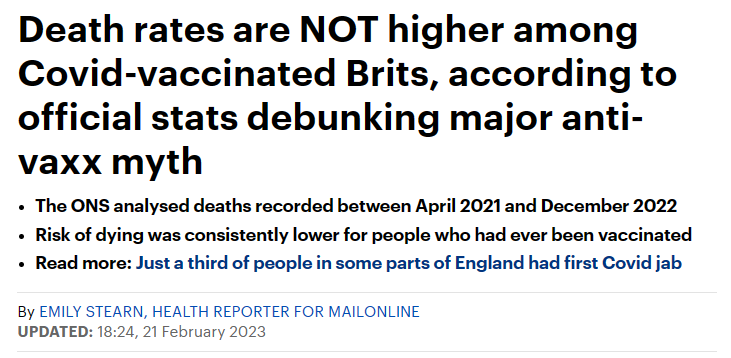
Our most recent article covers this whole issue of the ONS data:
In fact, if you make adjustments for the multiple flaws and biases in the ONS data, then it is increasingly clear that the vaccinated have a higher all-cause mortality in many age groups, especially the under 50’s. In other words, the evidence increasingly points to the need for the covid vaccine programme to be shut down completely. But that isn’t the message you want to portray is it, because your funders are the ones pushing the vaccines?
Only one of the links to examples of reports you were seeking to ‘debunk’ seems to be working, namely the article in The Expose. The claim there is that the ONS report reveals that “the Vaccinated account for 9 in every 10 COVID Deaths over the past TWO Years”. Based on the ONS dataset this is correct. Of course, without knowing the true proportion of vaccinated in each age group, we still cannot conclude that the vaccinated are at higher risk of death from covid. But the article is not claiming that, it is simply stating the FACT that a far higher number of vaccinated people have died of covid than unvaccinated since Jan 2022. That the number of vaccinated people who have died of covid is 25,768 is relevant, because we were told by people like you that this could not possibly happen; the vaccines were supposed to have ‘stopped hospitalisation and death from covid’.
Yours
Norman Fenton
How Scotland pays back for Malawi (non existent) climate damage
By Paul Homewood | Not A Lot Of People Know That | February 26, 2023
Today’s climate disinformation from the BBC:

Scotland is one of the first countries in the world to stump up cash for “loss and damage” caused by climate change in poorer countries.
When torrential rains came to the village of Mambundungu in Malawi, people’s homes were washed away but that was not the worst of it.
The flood waters were infested with crocodiles. Children were carried away by them. It was terrifying.
Eventually, in 2015, the villagers couldn’t take any more and moved their entire community to higher ground.
Then the new village began to flood too.
Malawi in southern Africa has been hard hit by the effects of climate change
But it is one of the poorest countries in the world and struggles to pay for the measures needed repair the damage.
That’s where the Scottish government has stepped in, promoting the notion that rich nations should help pay for the damage from climate change in less developed countries.
https://www.bbc.co.uk/news/uk-scotland-64501975
There is naturally no evidence provided of just how these floods are caused by climate change. (Well this is the BBC – what do you expect?)
And if you look at the three long running weather stations in Malawi, no evidence exists that daily rainfall extremes are increasing:


https://climexp.knmi.nl/getstations.cgi
So why do these floods appear to be getting worse? There is a very simple reason – deforestation.
According to the BBC themselves:

https://www.bbc.com/future/article/20210420-the-underappreciated-power-of-human-poo
As we know, deforestation leads to increased rainfall runoff, siltation and floods down valley.
The World Resources Institute studied the problem in 2017, writing:
Nearly a year ago, the New York Times ran a devastating story about the deforestation crisis in Malawi and its impact on residents of Lilongwe, Malawi’s capital city. Illegal cutting of nearby forests was causing water shortages and disrupting the city’s hydroelectric power supply, forcing the government to deploy soldiers to protect the forests. The root of this problem was Malawi’s dependence on wood for meeting energy needs―more specifically, charcoal. Nearly 97 percent of Malawian households depend on wood or charcoal for cooking or heating. Even in urban areas, 54 percent of households use charcoal (a product of wood) for cooking. But there are only so many trees.
Malawi is one of the poorest countries in Africa, where electricity is an uncommon luxury and subsistence farming is the norm. With seemingly few options and climate change adding uncertainty, the situation depicted in the New York Times article seemed hopeless.
https://www.wri.org/insights/malawi-turns-corner-solving-its-deforestation-crisis
Instead of blubbering on about climate change, maybe the Scottish government should be helping Malawi to build a reliable electricity grid, based on fossil fuels.
Broadcaster sacks host after external influence probe
RT | February 23, 2023
French broadcaster BFMTV has fired an anchor following a probe into alleged external meddling into his work, AFP reported Thursday, citing an internal company email it had seen.
The host in question, Rachid M’Barki, was found not to have followed due editorial process in multiple news segments aired between 2021 and 2022, BFMTV Marc-Olivier Fogiel reportedly said in the correspondence. The faulty news segments included false information on assorted topics, ranging from Russian “oligarchs” to the situation in the Middle East and Western Sahara.
The anchor was suspended early in January, after the company became aware of the potential misconduct on his part. The affair became public this month, when the Forbidden Stories collective released an investigation into a secretive Israeli contractor group, dubbed ‘Team Jorge,’ which had specialized in assorted malign cyber activities to manipulate the outcomes of elections worldwide. To expose the group, the journalists fancied themselves as prospective clients seeking electoral meddling, while covertly recording hours of footage during meetings with the members of the clandestine contractor unit.
The group, run by Tal Hanan, a 50-year-old former Israeli secret services operative, operated a vast social media bots network it used to affect public opinion in different countries. The team also reportedly used legitimate news outlets to plant the information it needed for its activities, with M’Barki identified among presenters which had been fed the misinformation.
The presenter had previously acknowledged receiving information from shady anonymous sources, but denied a deliberate spread of fake news on his part. Speaking with Politico after the investigation came out, M’Barki acknowledged that he “used information… received from sources” and that “they did not necessarily follow the usual editorial process.”
“They were all real and verified. I do my job… I’m not ruling anything out, maybe I was tricked, I didn’t feel like I was or that I was participating in an operation of I don’t know what or I wouldn’t have done it,” the journalist stated.
The climate scaremongers: Are hurricanes becoming more powerful?
By Paul Homewood | TCW Defending Freedom | February 17, 2023
If you believe what the media tell you, you would think so. But you would be wrong. As the chart below for 1980 to 2022 shows, there is no obvious trend in the frequency of major hurricanes worldwide during the satellite era.

http://tropical.atmos.colostate.edu/Realtime/index.php?arch&loc=global
The IPCC, the UN climate panel, can also find no evidence either, stating in their latest climate assessment: ‘There is low confidence in most reported long-term (multi-decadal to centennial) trends in Tropical Cyclone frequency- or intensity-based metrics due to changes in the technology used to collect the best-track data.’
The US National Oceanic & Atmospheric Administration says the same about Atlantic hurricanes: ‘There is no strong evidence of century-scale increasing trends in US landfalling hurricanes or major hurricanes. Similarly for Atlantic basin-wide hurricane frequency (after adjusting for observing capabilities), there is not strong evidence for an increase since the late 1800s in hurricanes, major hurricanes, or the proportion of hurricanes that reach major hurricane intensity.’
But facts don’t matter to the climate warriors at the BBC, who published a ‘Reality Check‘ following Hurricane Ian last summer, which claimed that there was evidence that hurricanes were getting more powerful.
I fired off a complaint to the BBC at the time, which their Executive Complaints Unit (ECU) have now rejected. They presented no real data to counter any of the evidence I have outlined above. Instead they relied almost entirely on computer modelled projections of what might happen in future.
Their dismissal of my complaint sums it up better than I can: ‘The evidence would therefore appear to indicate climate scientists who have studied hurricanes and the effect of human-induced climate change agree the proportion of tropical cyclones which develop into hurricanes or major hurricanes is expected to increase, and those hurricanes are expected to have higher peak wind speeds ‘
Of course, it was not what could happen in the future which I was complaining about. It was their claim that such changes are already happening. In short, they created a straw man and knocked it down, while ignoring the actual complaint!
The real problem, of course, is that the ECU is part of the BBC, and will always back them up even when the evidence against them is overwhelming. The BBC will never be properly held to account until a truly independent complaints unit is set up.
Rising Seas Threaten to Wipe Entire Nations Off the Map, UN Chief Warns
BY WILL JONES | THE DAILY SCEPTIC | FEBRUARY 15, 2023
An increase in the pace at which sea levels are rising threatens “a mass exodus of entire populations on a biblical scale” and whole nations could be drowned under the waves, the UN Secretary General has warned. The Guardian has more.
The climate crisis is causing sea levels to rise faster than for 3,000 years, bringing a “torrent of trouble” to almost a billion people, from London to Los Angeles and Bangkok to Buenos Aires, António Guterres said on Tuesday. Some nations could cease to exist, drowned under the waves, he said.
Addressing the UN Security Council, Guterres said slashing carbon emissions, addressing problems such as poverty that worsen the impact of the rising seas on communities and developing new international laws to protect those made homeless – and even stateless – were all needed. He said sea level rise was a threat-multiplier which, by damaging lives, economies and infrastructure, had “dramatic implications” for global peace and security.
Significant sea level rise is already inevitable with current levels of global heating, but the consequences of failing to tackle the problem are “unthinkable”. Guterres said: “Low-lying communities and entire countries could disappear for ever. We would witness a mass exodus of entire populations on a biblical scale. And we would see ever fiercer competition for fresh water, land and other resources. People’s human rights do not disappear because their homes do,” he said. “Yes, this means international refugee law.”
The International Law Commission is assessing the legal situation. In 2020, the UN Human Rights Committee ruled that it was unlawful for governments to return people to countries where their lives might be threatened by the climate crisis.
A new compilation of data from the World Meteorological Organisation (WMO) shows that sea levels are rising fast and the global ocean has warmed faster over the past century than at any time in the past 11,000 years. Sea levels rise as warmer water expands and ice caps and glaciers melt. …
In fact, sea levels are not accelerating and have continued rising at a modest 10-12 cm a century – not something that is going to give any nation an existential crisis any time soon. I somehow think that countries might be able to adapt to a one metre rise per millennium.

But why let facts get in the way of a good disaster narrative that justifies lots of Government intervention and control?
‘Finally’ The Lancet Acknowledges Natural Immunity Superior to mRNA COVID Vaccines
By Brenda Baletti, Ph.D. | The Defender | February 17, 2023
Immunity acquired from past COVID-19 infection provides strong, lasting protection against severe outcomes from the illness at a level “as high if not higher” than that provided by mRNA vaccines, according to a study published Thursday in The Lancet.
Researchers conducted a systematic review and meta-analysis of 65 studies worldwide, providing overwhelming evidence to support what many scientists, doctors and studies have said since early in the COVID-19 pandemic.
“The Lancet is finally acknowledging what doctors and scientists have been gaslit for saying for years — that natural immunity provides superior protection to experimental vaccines,” said Robert F. Kennedy, Jr., chairman and chief litigation counsel for Children’s Health Defense.
“Only the tsunami of propaganda and censorship from the pharma/government biosecurity cartel and the controlled media persuaded the public that Pfizer and Moderna were better at protecting the human immune system than God and evolution,” he added.
The study found that immunity acquired from infection was often far more robust and consistently waned more slowly than the immunity from two doses of an mRNA vaccine.
The researchers found that natural immunity was at least 88.9% effective against severe disease, hospitalization and death for all COVID-19 variants 10 months after infection.
It also provided 78.6% protection against reinfection for all variants except omicron BA.1, for which protection was 45.3%.
At an October 2022 Centers for Disease Control and Prevention (CDC) Advisory Committee on Immunization Practices meeting, the CDC presented data showing that vaccine-acquired immunity after two or three injections dropped to zero six months after injection, and then became negative.
The Lancet study stated that “although protection from reinfection from all variants wanes over time, our analysis of the available data suggests that the level of protection afforded by previous infection is at least as high, if not higher than that provided by two-dose vaccination using high-quality mRNA vaccines (Moderna and Pfizer-BioNTech).”
The study was funded in part by the Bill and Melinda Gates Foundation. Authors included Dr. Christopher Murray, director of The Institute for Health Metrics and Evaluation, the Gates-funded institute that was “largely responsible for the notoriously exaggerated mortality calculations that overestimated COVID deaths by 20-fold at the COVID pandemic’s outset,” according to Kennedy.
The authors argued, based on their findings, that natural immunity should be recognized along with vaccines when authorities are considering restricting travel, access to venues and work based on immunization status.
Commenting on these conclusions, Dr. Meryl Nass, internist and epidemiologist, said:
“While framing this as an acknowledgment that natural immunity confers protection, what it is also doing is providing tacit agreement that government-imposed policies restricting travel are acceptable. It furthermore provides tacit approval of vaccine passports.”
The ‘cartel’s’ war on natural immunity
In October 2020, The Lancet published an article — “Scientific consensus on the COVID-19 pandemic: we need to act now” — by authors including CDC Director Rochelle Walensky, which was widely covered in the mainstream press. They stated that “there is no evidence for lasting protective immunity to SARS-CoV-2 following natural infection” and that “the consequence of waning immunity would present a risk to vulnerable populations for the indefinite future.”
But in November 2021, a Freedom of Information Act (FOIA) request forced the CDC to admit that it didn’t even collect data on natural immunity.
Then, in January 2022, the CDC was compelled to revise its position on natural immunity, acknowledging in a report that natural immunity against COVID-19 was at least three times as effective as vaccination at preventing people from becoming infected with the Delta variant.
The pharmaceutical companies were also aware of the benefits of naturally acquired immunity, although they suppressed that information, documents revealed.
In October 2021, Project Veritas exposed three Pfizer officials saying that antibodies lead to equal if not better protection against the virus compared to the vaccine, The Defender reported.
Later, in April 2022, Pfizer documents held by the U.S. Food and Drug Administration (FDA) and released under court order confirmed Pfizer knew natural immunity was as effective as the company’s COVID-19 vaccine at preventing severe illness, journalist Kim Iversen reported.
Most recently, the Twitter files revealed that a Pfizer board member who used to head the FDA lobbied Twitter to take action against a post accurately pointing out that natural immunity is superior to COVID-19 vaccination, The Epoch Times reported.
FOIA requests also revealed that Dr. Anthony Fauci and his boss, National Institutes of Health Director Francis Collins, colluded to suppress the Great Barrington Declaration, which argues that natural immunity plays an important role in mitigating public harm from COVID-19, The Defender reported.
The vaccines are failing, which means we need more vaccines
Media that reported on the study, including NBC, ABC and U.S. News & World Report, continue to advocate for vaccination as the more important way to protect against severe disease and death from COVID-19.
This is despite the fact that even vaccine advocates Bill Gates and Fauci admitted that COVID-19 vaccines perform poorly.
In a paper published last month in Cell Host and Microbe, Fauci and his co-authors confirmed that the predominantly mucosal respiratory viruses, including influenza, coronaviruses, respiratory syncytial virus, or RSV, and common colds “have not to date been effectively controlled by licensed or experimental vaccines.”
They concluded, “Durably protective vaccines against non-systemic mucosal respiratory viruses with high mortality rates have thus far eluded vaccine development efforts.”
Nass said that while it is quite significant for The Lancet to publish these findings about natural immunity, the authors’ framing, like the admissions by Gates and Fauci, “is intended to quietly, without apology, veer away from current COVID vaccines, while implying that more money is needed to develop new types of vaccines. No one made any mistakes. No one accepts any blame. Chris Murray never erred with his outlandish estimates. No, just send money and let us do the science.”
Brenda Baletti Ph.D. is a reporter for The Defender. She wrote and taught about capitalism and politics for 10 years in the writing program at Duke University. She holds a Ph.D. in human geography from the University of North Carolina at Chapel Hill and a master’s from the University of Texas at Austin.
This article was originally published by The Defender — Children’s Health Defense’s News & Views Website under Creative Commons license CC BY-NC-ND 4.0. Please consider subscribing to The Defender or donating to Children’s Health Defense.
Featured Video

Trita Parsi: Israel Set a Trap for Total War in the Region
or go to
Aletho News Archives – Video-Images
From the Archive
Zionism’s Violent Legacy
By Donald Neff | Washington Report On Middle East Affairs | January 1996
On January 4, 1948, Jewish terrorists drove a truck loaded with explosives into the center of the all Arab city of Jaffa and detonated it, killing 26 and wounding around 100 Palestinian men, women and children.[1] The attack was the work of the Irgun Zvai Leumi – the “National Military Organization,” also known by the Hebrew letters Etzel – the largest Jewish terrorist group in Palestine. The Irgun was headed by Revisionist Zionist Menachem Begin and had been killing and maiming Arabs, Britons and even Jews for the previous ten years in its efforts to establish a Jewish state.
This terror campaign meant that at the core of Revisionist Zionism there existed a philosophical embrace of violence. … continue
Blog Roll
 Aletho News
- Trita Parsi: Israel Set a Trap for Total War in the Region
- Trump’s Iran war is on an Israeli leash
- Saudi oil boss issues global supply warning
- Riyadh Says Its Oil System Is Intact. The Numbers Say Otherwise.
- Trump and Netanyahu Want to “Finish the Job” on Iran
- US ‘one-sided dictation’ not Iran’s beliefs makes rational talks impossible: Baghaei
- Iran’s Next Strike May Not Explode. It Could Shut You Down /Col Doug Macgregor
- Iran: US political targets legitimate if assassinations return
- Iraq shuts key border crossing with Iran under US pressure: Report
- Undersea Internet cables could be targeted in retaliation for attacks on Iran: IRGC deputy chief
- If Americans Knew
- The Israel Lobby’s Changing Fortunes
- AIPAC has become such a political liability that it’s shifting to a more “nimble” approach to buying politicians
- At least 160 Israeli settler attacks in 2 weeks
- Will Gaza’s Ancient Christian Community Disappear Forever?
- Israel’s vision of regional security rests on keeping Arab states weak
- Heidi Levine recounts how Palestinian youths helped save her in settler attack
- DAILY UPDATE: Latest essential news on Palestine, Israel, & region
- Trump’s Intensifying Sabotage of the ICC, for Israel’s Sake
- Israeli military detain US and UK volunteers in West Bank including Democratic NY politician Brad Lander
- Americans at National Conservatism Conference held in Israel this year criticize Israel
- No Tricks Zone
- E-Cars Reduce CO2 Emissions By Only 41% Compared To Internal Combustion Engine Vehicles
- Predictions Made By Renowned Climate Professor Over Past Decades Have Been Proven To Be Poor
- New Study Suggests Large Regions Of The Pacific Ocean Have Been Cooling For The Last 80 Years
- Germany’s Green Energy Debacle: High Energy Costs Force Kahla Porzellan to Close After 182 Years!
- New Study: 50 Years Of The Most Aggressive ‘Net Zero’ Policies Can Only Affect The Global Climate By 0.03°C
- US September “Heat” Was No Record…Many Records Set Decades Ago
- Latest European Green Energy Debacle; Portugal’s Largest Flagship Solar Park Insolvent!
- Green Energy Debacle: German Expert Professor Fritz Vahrenholt Warns Of Severe Economic And Social Consequences
- Two More Paleo Reconstructions Affirm Meters-Higher Sea Levels Across Ireland, Brazil 7000-6000 Years Ago
- New Study: Earth And Venus Surface Warmth Largely Explained By Convection And Lapse Rate, Not CO2 Or Radiation

