The War on Truth, Dissent and Free Speech
Syria, the OPCW Douma Investigation and the Working Group on Syria, Propaganda and Media
Dr Piers Robinson | OffGuardian | October 6, 2020
On Saturday 13 June 2020 the Times newspaper published its third attack on academics associated with researching British government propaganda and the war in Syria. This time the attack focused on smearing myself and Professor David Miller with the objective of discrediting an academic organization we established, the Organisation for Propaganda Studies (OPS), designed to foster research and writing on propaganda.
The article contained multiple falsehoods and distortions and was similar in style to previous attacks aimed at character assassination mainly through employment of the ‘conspiracy theorist’ smear. Most prominently the hatchet pieces misleadingly conflated work by members of the Working Group on Syria, Propaganda and Media (WGSPM), of which myself and Miller are also members, with the OPS. Formal complaints from the OPS are in process and the Times has already been forced to issue a number of corrections.
Of course, character assassination as a propaganda tactic is widespread and there is even a Routledge academic handbook on the subject, the ‘Routledge Handbook of Character Assassination and Reputation Management’, which was published in 2019 and contains 30 odd chapters. The attacks by the Times have been amplified by similar pieces written by Chris York for the Huffington Post.
In total, approximately 20 articles have been produced attacking those of us who are working on the war in Syria and questioning important aspects of UK propaganda operations. The bulk of these articles have been written by just two journalists, Dominic Kennedy for the Times newspaper and Chris York for the Huffington Post. This represents an extraordinarily intensive and sustained campaign against us.
Why on earth have we gotten into so much trouble?
A history of the attacks is instructive. Attention first started to be paid by former Guardian journalist Brian Whitaker in February 2018 when he penned a series of crude hatchet pieces on his blog smearing academics associated with the then newly established WGSPM. At that point Huffington Post journalist Chris York had already been attempting for several months to make contact with me, Professor Tim Hayward and journalist Vanessa Beeley.
But it was several weeks after Whitaker’s smears that the attacks started in earnest. Following the now controversial alleged chemical weapon attack in Douma, Syria, on 7th April 2018, the US UK and France bombed Syrian government targets claiming Syria was responsible for the attack. At the same moment these air attacks were underway, the Times of London published four articles which included one on the Front page, photographs of some of us from WGSPM and an editorial.
These articles smeared the academics as ‘conspiracy theorists’ for questioning official narratives regarding chemical weapon attacks in Syria, as ‘Assadists’ and also implied the existence of nefarious links with Russia. Chris York of the Huffington Post then followed the Times attack with multiple articles attacking us. The articles followed a similar pattern to the Times’ hatchet pieces involving allegations of ‘conspiracism’, ‘war crimes denial’, being pro Assad and pro Putin etc. More than two years later, attack pieces are still being published.
The vast bulk of the output of WGSPM has concerned the issues of alleged chemical weapon attacks in Syria and, in particular, the Douma event. The working group’s briefing notes documented serious anomalies and issues regarding these attacks and, in particular, critically analysed both the OPCW investigations of these alleged attacks and also identified the involvement of UK-linked actors, including the late James Le Mesurier (founder of the White Helmets) and Hamish de Bretton-Gordon.
The evidence, as the working group briefing notes set out, is that the OPCW Douma investigation was manipulated in order to ensure the finger was pointed at Syrian government responsibility for the alleged chemical weapon attack. In reality, the evidence did not demonstrate an attack had occurred and, in fact, pointed toward the attack having been staged.
Our findings have been presented at an event at the UK House of Commons and at the Harvard-Sussex Program on Chemical and Biological Weapons.
The WGSPM has not been alone in raising questions and a wide body of material now corroborates its work. For example, even at the time of the Douma attack credible individuals voiced doubt about the likelihood of the Syrian government launching a chemical weapon attack in Douma just as its forces were on the brink of retaking the enclave.
For example, both retired Major General Jonathan Shaw and Admiral Lord West questioned the tactical logic of any such an attack and the latter raised the possibility the event was carried out by opposition groups.
Following the publication of the final OPCW report on Douma in March 2019, an engineering report was leaked to WGSPM and which concluded that the chlorine gas cylinders had likely been manually placed at the alleged attack scenes rather than having been dropped from a Syrian air force helicopter. This engineering report, it subsequently transpired, had been rejected by OPCW management on spurious grounds.
During the Autumn of 2019 the Courage Foundation hosted a panel at which a former OPCW official briefed a panel of trusted and authoritative individuals, including José Bustani the first Director General of the OPCW, about significant procedural and scientific flaws regarding chemistry, ballistics, toxicology and witness statements.
An open letter addressed to OPCW states parties from the Courage Foundation followed and was signed by eminent voices such as Professor Noam Chomsky, Hans von Sponeck (former UN Assistant Secretary-General), GCHQ whistleblower Katharine Gun, former UNSCOM weapons inspector Scott Ritter, film director and producer Oliver Stone and John Pilger.
Since then, multiple documents have been published by Wikileaks evidencing irregularities with respect to the Douma FFM investigation whilst journalists such as Peter Hitchens (Mail on Sunday ), Stefania Maurizi (formerly of La Repubblica ) and Robert Fisk (The Independent ) have reported on the issue.
Peter Hitchens has been a particularly vociferous voice defending the reputations of two OPCW staff who have been subjected to a malicious internal investigation aimed at smearing their reputations. In 2020, further leaks have been published by The Grayzone in the United States including statements from further OPCW persons and, most recently, Aaron Maté published an article in the leading US current affairs magazine The Nation.
Finally, and by no means least, former OPCW inspector Ian Henderson addressed an Arria Formula meeting of the UN Security Council at which he detailed the irregularities and misconduct he had experienced with respect to the FFM Douma investigation. In September 2020, a second Arria Formula meeting was held at which OPCW Syia FFMs and the Douma investigation were again debated and which included, again, the former OPCW Inspector Ian Henderson. And, this week at a UN Security Council meeting, a statement from OPCW First Director-General José Bustani was read out in which yet again raised concerns about the conduct of the OPCW Douma investigation.
To any casual observer it should be abundantly clear that the activities and output of the WGSPM is entirely legitimate. Our work has been at the forefront of an issue that has been discussed by mainstream media journalists and has been corroborated by information from people within the OPCW itself.
Why then have the Times of London and the Huffington Post published approximately 20 articles (including three Times leaders) in 2 years targeting us?
In general, the behaviour of both the Times and the Huffington Post is disturbing and suggestive of a deliberate campaign aimed at suppressing public debate regarding both the war in Syria and the involvement of the UK government in supporting activities aimed at the overthrow of the Syrian government.
UK involvement in the Syrian war has included direct support for opposition groups as well as potentially criminal activity relating to the OPCW and connection with the staging of alleged chemical weapon attacks.
In the last few weeks, a large volume of FCO documents have been leaked which document a vast ‘strategic communication’ operation aimed at supporting the war against Syria. According to Ben Norton from the Grayzone:
[V]irtually every major Western corporate media outlet was influenced by the UK government-funded disinformation campaign exposed in the trove of leaked documents, from the New York Times to the Washington Post, CNN to The Guardian, the BBC to Buzzfeed.
In fact, there are some indications that the media attacks might be the direct result of deliberate media alignment with the UK government position on Syria and its well-established policy seeking to overthrow the existing Syrian government. Specifically, two of the authors of the original Times attack on the academics, Dominic Kennedy and Deborah Haynes, are identified in leaked documents as being associated with the UK government-funded propaganda operation known as the Integrity Initiative.
The Integrity Initiative leaks provided powerful insights on how propaganda operations were being built around “clusters” of journalists. Haynes has subsequently denied involvement with the article whilst Kennedy has repeatedly refused to answer questions regarding the relationship between his articles and the Integrity Initiative.
Most notably, Times columnist Oliver Kamm has stated in public that the late James Le Mesurier ‘had reached out to this newspaper to urge us to keep on their [the academics] case’.
Regarding Huffington Post, Chris York’s line manager, Jess Brammar, is a member of the Defence and Security Media Advisory Committee which works with the UK government on influencing and controlling media reporting of defence and security related issues. Further information regarding the organizational details and scale of media-related activities aimed at suppressing criticism of UK Syria policy is still being investigated and information will be published in due course by WGSPM.
However, even if it is, as of yet, unclear whether the attacks are at the behest of those involved in UK government/FCO strategic communication operations related to Syria, it is certainly the case that they have a deleterious impact on open public debate and academic research. People might reasonably expect mainstream media to uphold, defend and encourage research and debate, as opposed to smear honest academics who are simply doing their jobs.
Even more seriously, the available evidence indicates that the alleged attack in Douma involved the murder of captive civilians. That means the event surrounding Douma likely involve an extremely serious, and indeed horrific, war crime. Those seeking to hinder those in pursuit of the truth run the risk of complicity, whether knowing or unknowingly, in a war crime and run legal jeopardy as a result.
A final note. The late Julian Perry Robinson, one of the world’s leading experts on chemical and biological weapons, was in communication with the Working Group. In an earlier era, Robinson played a key role challenging the false claim made by the US government that Soviet-backed forces in Laos and Cambodia were deploying toxins.
At the time of his death, he was completing a chronology regarding chemical weapons and the war in Syria. Writing about the events surrounding alleged chemical weapon attacks in Syria and the vicious attacks against WGSPM, he noted that:
It is not immediately clear from their pronouncements that the critics of the WGSPM just quoted have in fact adequately studied the Group’s publications. They certainly seem not to have done their reading with the care that might have been expected ahead of such vicious denigrations.
So is the Group simply becoming a victim of the fake news and other acts of information warfare it has itself been seeking to counter? Is the WGSPM being maliciously targeted by enemies that its principled research and outreach seem to have created?
— Part 8: The Chemical Warfare Reported From Syria: a documented chronology detailing reports of events in Syria since 1982 said to have involved use of chemical weapons, by Julian Perry Robinson
It was Julian Perry Robinson who subsequently invited WGSPM member Professor Paul McKeigue to present at the Harvard-Sussex Program on Chemical and Biological Weapons roundtable meeting in March 2020.
If a figure of such standing and brilliance wished for his colleagues to hear our analysis, where does this leave the Times and the Huffington Post who have so relentlessly sought to silence us through character assassination and smears?
Not, I would suggest, in a very good place.
Russia slams ‘disgraceful’ ban on founding OPCW chief speaking at UN Security Council on Syria
RT | October 6, 2020
An ex-OPCW chief, sacked under US pressure, has been barred from briefing the UN Security Council about a controversial probe into an alleged 2018 chemical attack in Syria. Russia called it a “shame” and published his speech.
Jose Bustani, a Brazilian diplomat who led the Organization for the Prohibition of Chemical Weapons (OPCW) from 1997 until 2002, was invited by Moscow to speak at a UN Security Council meeting about the so-called “Syrian chemical dossier,” but his appearance was blocked at the last minute by Belgium, Germany, Estonia, France, the US and the UK.
“What has happened now is yet more sad proof that Western delegations fear the uncomfortable truth,” Russia’s ambassador to the UN, Vassily Nebenzia, stressed while addressing the UN global body on Monday.
He said the six countries had “made history” because the Security Council has never voted “on the presence or absence of a briefer proposed by the [UNSC] president.” Prohibiting the former OPCW director general from speaking was a “shame and disgrace,” Nebenzia concluded, promising to publish Bustani’s statement after the meeting.
UK envoy Jonathan Allen said that Bustani is not in a position to “provide relevant knowledge or information.”
Shortly afterwards, the undelivered speech appeared on the website of the Russian mission to the UN. In it, the sacked OPCW chief raised “serious questions” over “whether the independence, impartiality, and professionalism of some of the organization’s work is being severely compromised, possibly under pressure from some member states.”
As a major example, Bustani cited an OPCW investigation into the alleged use of chemical weapons in the Syrian city of Douma on April 7, 2018. Western governments, and media outlets, maintain that forces loyal to Damascus dropped two gas cylinders as part of an offensive against jihadist forces, killing scores of civilians.
The allegations were used as a pretext for a major US-led airstrike against Syrian government forces later that year. The OPCW launched a probe into the “chemical attack,” and in early March of 2019, the final report by the Fact-Finding Mission (FFM) of the OPCW stated that there were “reasonable grounds” to believe that canisters filled with “molecular chlorine” were dropped from Syrian aircraft in Douma.
The final report gave credence to the Western show of force by implicating the Syrian government of Bashar Assad in conducting the attack, which the Syrian authorities vehemently deny.
Shortly after the release of the OPCW report, an internal memo by OPCW engineers was leaked, suggesting the canisters were likely just placed at the site of the “attack,” and did not come from the skies. Still, the final report did not include such information, and a senior OPCW official reportedly ordered the removal of “all traces” of the dissenting opinion, according to WikiLeaks.
Months later, Bustani noted that he was invited to an expert panel which heard the testimony of an unnamed OPCW investigator, who came forward with damning evidence that his own organization had engineered a report based on a flawed conclusion and likely deliberately steered toward the outcome favored by the West.
That expert provided “compelling and documentary evidence of highly questionable, and potentially fraudulent conduct in the investigative process,” Bustani’s statement recalled. The Brazilian diplomat had been so stunned by the testimony that he personally called on the OPCW to be “resurrected to become the independent and non-discriminatory body it used to be.”
However, he continued, the chemical weapons watchdog did not respond to any calls for greater transparency about the controversial Douma investigation. The probe was “hidden behind an impenetrable wall of silence and opacity, making any meaningful dialogue impossible.”
In conclusion, Bustani called on Fernando Arias, the current OPCW chief, to hear the grievances of OPCW inspectors who voiced dissenting opinions on the Douma incident. They “have dared to speak out against possible irregular behavior in your organization,” Bustani argued, adding that it is “in the world’s interest that you hear them out.”
Bustani noted that he had been removed from his OPCW position “following a US-orchestrated campaign in 2002.” Back then, he was trying to send chemical weapons inspectors to Iraq prior to the 2003 US invasion there. A UN tribunal ruled that his sacking was unlawful.
History as Warfare: The ‘1619 Project’ and the Plot to Destroy the Republic
By Matthew Ehret | Strategic Culture Foundation | October 4, 2020
“Repression is the only lasting philosophy. The dark deference of fear and slavery, my friend, will keep the dogs obedient to the whip, as long as this roof shuts out the sky.”
– Marquis St. Evrémonde (from Dickens’ Tale of Two Cities)
A major cultural fight has broken out between Donald Trump’s recently announced 1776 Commission and the NY Times’ 1619 Project.
While Trump’s commission designed to “promote patriotic history” naively paints over some glaring hypocrisies of American history by placing figures like Hamilton, Jackson, Jefferson and Lincoln in the same boat (thus keeping a bit too much bathwater along with the baby), it does represent an important major cultural battle over the soul of America which is now sitting precariously upon a new civil war, military coup threat and total disintegration.
In his recent Sept. 17 speech attacking the 1619 Project and announcing his 1776 Commission, Trump said quite rightfully:
“Whether it is the mob on the street, or the “cancel culture” in the boardroom, the goal is the same: to silence dissent, to scare you out of speaking the truth, and to bully Americans into abandoning their values, their heritage, and their way of life.
“We are here today to declare that we will never submit to tyranny. We will reclaim our history and our country for citizens of every race, color, religion, and creed.
“The radicals burning American flags want to burn down the principles in our founding documents, including the bedrock principle of equal justice under law. In order to radically transform America, they must first cause Americans to lose confidence in who we are, where we come from, and what we believe…. The left-wing cultural revolution is designed to overthrow the American Revolution.”
Attacking the underpinnings of Critical Race theory which attempts to assert that belief in rational thought, hard work and the nuclear family were the result of “whiteness”, Trump invoked Martin Luther King saying:
“where children are not judged by the color of their skin but by the content of their character. Critical Race Theory, the 1619 project, and the crusade against American history, are toxic propaganda, ideological poison that, if not removed, will dissolve the civic bonds that tie us together. It will destroy our country.”
What is the 1619 Project?
The New York Times’ 1619 Project, which was unveiled in June 2019 by Nikole Hannah-Jones, attempts to smear the entirety of American history as simply a slave-promoting fraud from the moment the first slave arrived in Jonestown in 1619.
During its short existence, this “project” has quickly won over thousands of academics, and in spite of its proven fallacies (which it had to secretly cover up in Orwellian fashion), Jones was still awarded the Pulitzer Prize legitimizing the fraud in the minds of countless school administrators, policy-makers and academics.
If one truly accepts the claims of the 1619 Project which have become turned into a Pulitzer curriculum and already embedded in 4500 U.S. schools, then America’s dissolution would be no great loss to the world. In fact, one would have to conclude that since the republic was always built upon the defense of slavery (going so far as to paint the British Empire as an anti-slavery bastion which the founding fathers broke away from only due to their fear of having their slaves removed), then America was always… evil.
The First Paradox
If it were true that the creation of the American republic was just driven by a desire to protect the institution of slavery from the abolition-loving British then it should be asked: why did every American state shut down the African slave trade by 1793??”
Don’t believe me? Let the facts speak for themselves.
By 1784, six states in the new nation had voted to totally abolish slavery (Rhode Island in 1774, Vermont in 1777, Pennsylvania in 1780, Massachusetts in 1781, New Hampshire in 1783 and Connecticut in 1784), while the importation of all new slaves was banned by every other state by 1793. The important Northwest Ordinances passed in the 1787 Continental Congress ensured that no slavery would be permitted in the immense North West Territories (giving rise to the later addition of Ohio, Indiana, Illinois, Michigan and Wisconsin as free states). This agreement was established during the 1774 Continental Congress where a non-importation act was signed by all colonies stating: “That we will neither import, nor purchase any slave imported, after the first day of December next; after which time, we will wholly discontinue the slave trade, and will neither be concerned in it ourselves, nor will we hire our vessels, nor sell our commodities or manufactures to those who are concerned in it.”
Another Paradox
If Britain was threatening to end the slave trade as the 1619 Project authors teach, then why did the Empire override dozens of petitions from the colonies between 1650-1765 demanding an end to slavery? Rather than oppose slavery, the British Royal Africa Company, under the direction of the Privy Council, and Board of Trade enforced the mass important of 8 million African slaves into the Americas during the 18th century alone! These same organizations constantly strove to destroy all efforts to establish manufacturing within the colonies from 1630-1765 which everyone knew was the only effective pathway to liberating a society from reliance on slave labor.
Additionally, IF it were true that the 1776 revolution were driven by the intent to protect the slave economy from the freedom-loving British Empire, then why did England only ban slavery in 1807 and why did they wait until 1833 to begin extending this ban across their colonies?? Did the founding fathers have a crystal ball and act on events that would occur only 65 years in the future? If the British truly hated slavery so much, then why did the empire maintain a global system of subjugation, famine and exploitation across Asia, Ireland and beyond for so many generations?
So what happened? Was the British Empire seriously pushing an anti-slavery agenda? Why did America’s anti-slave trajectory fall apart so soon after the revolution and why did the rot spread to the point of necessitating a Civil War by 1861?
How to proceed with a serious investigation?
The Matter of Money
Since one of the most effective keys to understanding history starts with the question of “who controls the money”, economics is a good place to start.
Approaching the matter this way will cause the inquiring mind to confront the battle between two opposing paradigms of statecraft which defined the world in which the American revolution arose as part of an international phenomenon involving leaders from Russia, France, Germany, Ireland, Spain, India and Morocco.
The battle over what sort of system of economics would govern America after political independence was achieved in 1783 will here become a very valuable question.
Where certain players of that age believed that “value” should be locked into rules of money-worship and profit (which all people desired since money bought pleasure and helped us avoid pain), others disagreed and believed value should be looked for elsewhere. These others believed that value transcended matters of pleasure/pain and touched upon something less transient and more universal… but what?
Introducing Ben Franklin
During the 18th century, these latter forces centered themselves around the figure of America’s “father of founding fathers” Benjamin Franklin who drafted some of the most important policies that led to the sovereign control over currency from his 1729 On the Necessity for a Paper Currency, onwards. Franklin used his powerful printing presses to spread both sovereign banking and anti-slavery pamphlets, books and treatises for decades before the revolution itself was declared in 1775. One of the most powerful anti-slavery books printed by Franklin was the influential 1737 ‘All Slave Keepers Who Keep the Innocent in Bondage’ by Benjamin Lay which argued that any Christian keeping slaves was an offense against God.
Lay wrote: “No greater sin Hell can invent than to prophane and blaspheme the pure and Holy Truth, which is God all in all, and remove God’s creatures made after his own image, from all the comforts of life and their country… and bring them into all the miseries that dragons, serpents, devils and hypocrites can procure and think of”.
In the mind of Franklin and his co-thinkers these issues (economics and slavery) represented two sides of the same fight.
Franklin argued in his many writings that “value” originated in what you create that satisfies the needs of humanity, and not what “things” you possess or wish to consume. Since a society of creators/producers requires sovereign manufacturing to generate real wealth and constant internal improvements of infrastructure to coordinate the development of all parts of a nation under a unified intention, Franklin recognized clearly that the production generated by “slave labor” is a chimera and actually represented a form of “anti-value”. Like heroine consumption today, anti-value simply means any form of “momentary profits” that might even be measurable as GDP and generate money flows, but actually represents a destruction of that society’s ability to sustain its own existence over time. (1)
The reason for this is simple.
Slavery destroys the creative powers of mentation in both the laboring slave who is valued only for their animal labor, and also the decadent slave master who’s potential for creativity becomes narrowly defined by ways to keep the slave under control.
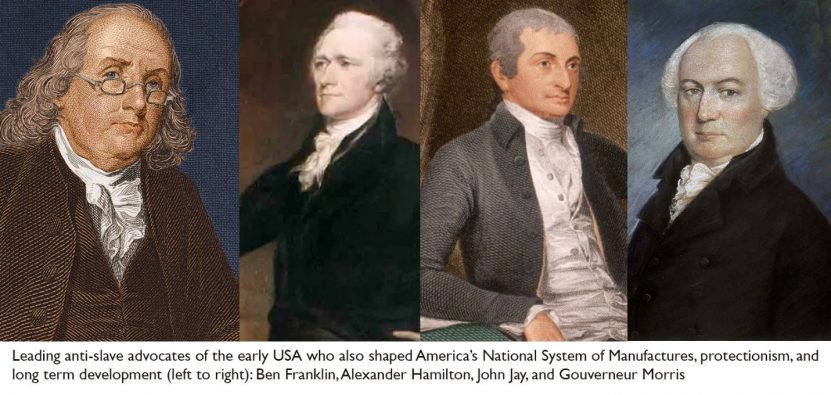
It is thus no coincidence that Franklin also created the anti-slavery alliance in the 1760s and later founded the 1785 Society for Promoting the Manumission of Slaves” alongside several of his devoted proteges. These proteges included the figures of Alexander Hamilton, John Jay, and Gouvernor Morris who all happened to become the creators and leaders of the “American System of political economy” premised on the use of a national bank, productive credit, protective tariffs, and large scale manufacturing to promote the economic sovereignty of the new nation. I introduced some of this in my recent essay How to Save a Dying Republic: Hamilton’s Genius.
When Jefferson took control of the Presidency from 1801-1809, a major victory was won for the pro-slavery oligarchs of America who saw immense profits to be gained by spreading their peculiar form of society under a perverse form of Manifest Destiny.
Admittedly, these oligarchs would have been much happier with the victory of Aaron Burr to the presidency in 1801 since an immediate dissolution of the union would have occurred between slave and free states as early as 1804 (to be discussed in a future essay). Unlike Burr, Jefferson was at least against breaking up the Union into northern and southern confederacies (with the free states merging with Canada and the slave states becoming their own nation), and that is why Hamilton (Jefferson’s political nemesis) ironically organized aggressively for his victory winning the fatal ire of Burr.
Sadly, Jefferson’s devout belief in agrarianism, hate for manufacturing, love of slavery, and British enlightenment thinking still made him an instrument for the slave power’s cancerous growth during his terms in office.
The British Empire’s Global Game
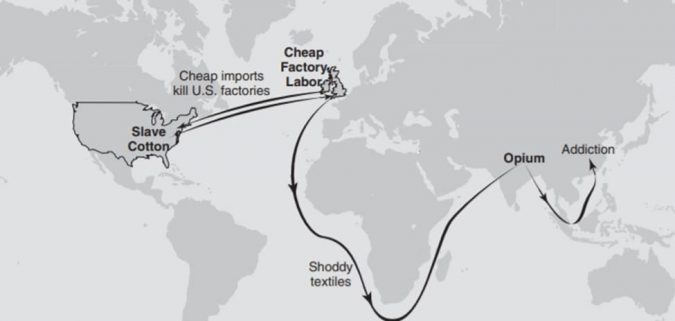
By destroying Indian textiles and subduing the “Chinese dragon” with a program of mass opium consumption that would stain the 19th century, the City of London quickly took control of world textile manufactures which created a primary export market for southern slave plantation cotton and a new set of addictions began: the addiction to the easy money derived from cheap slave labor. This proto globalization established a global closed system of controls onto all nations through cash cropping, free trade, speculation and drugs.
By 1840 over 20% of the British population was employed in textiles under such anti-human conditions that Charles Dickens described in his Tale of Two Cities and other writings.
The Best of Times and Worst of Times
With the 1804 murder of Hamilton, and undermining of America’s national credit system between 1804-1836, British free trade grew as protective tariffs were taken down, and credit towards infrastructure projects like the Erie Canal, roads, rail, etc shriveled up. Speculation ran rampant whenever this monetarist system was unleashed driven by booms and busts and the rise of “state-rights” programs that superseded all national initiatives. This process was taken directly from classic divide to conquer tactics which I outlined in my last essay Lincoln and the Greenbacks.
An astute Whig economist looking upon this bipolar process in America (while comparing it to the depressingly stagnant Canadian economic situation of 1791-1850) stated in 1853:
“Though the ratio of the increase of the population has been greater in Canada than in the United States, yet their increase of wealth has barely kept pace with the population, and they are as poor as they were half a century since. They have enjoyed the blessings of Free Trade with England all the time, we have only a part of the time. Whenever we have attempted to supply ourselves by our own industry, with the comforts and necessaries of life, we have improved our condition as a people; and during the intervals of Free Trade and large importations of foreign goods, we have relapsed again into a condition bordering on bankruptcy; while the Canadians have been constantly exhausted, and kept so poor by Free Trade, as to be unable to get sufficient credit to have even the ups and downs of prosperity and bankruptcy in succession.” (2)
The Slave Power Spreads
By 1836, the 2nd National Bank was officially killed after a mass propaganda campaign convinced a duped mob that it was an instrument of tyranny in America, and over the coming 6 decades, the only five presidents who would make any serious effort towards reviving America’s nationalist system would end up dead while in office (Harrison in 1841, Taylor in 1850, Lincoln in 1865, Garfield in 1880, and McKinley in 1901). The man who is today celebrated for having “killed the bank” and “paying Americas debts” was in reality a force of pure destruction. Jackson “paid the debt” by cutting all infrastructure projects and unleashing mass speculation which resulted in a devastating 1837 bank panic that drove the nation into discord and depression. An unrepentant racist, Jackson also gave enormous assistance to the slavocracy by emptying the southern lands of Cherokee in the genocidal “Trail of Tears” and giving the land over to cotton planting oligarchs loyal only to their profits, “way of life” and the British Empire.
This story is told in all of its ugly detail in historian Michael Kirsch’s groundbreaking 2012 study “How Andrew Jackson Destroyed the United States”.

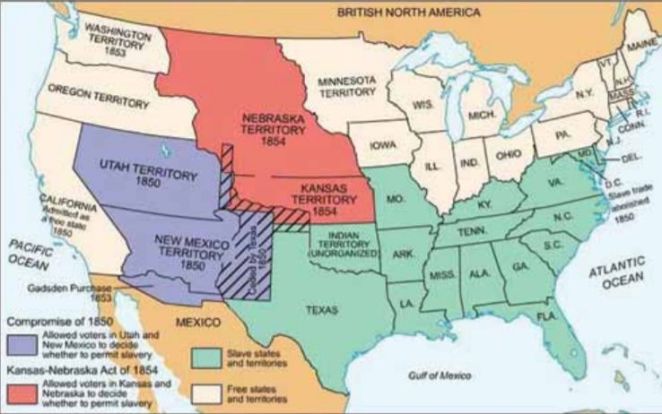
Between 1801 to 1840, southern cotton exports exploded from 100,000 bales/year to 1 million bales/year with 80% of the exports going to Britain. The City of London-Wall Street-New Orleans triangle dominated the world system with New Orleans representing over 12% of all U.S. banking capital. The southern slave states grew to represent the world’s fourth biggest economy through the support of the British Empire both financially and also in the logistical support needed to import mass slavery into the Americas. This degeneration proceeded slowly until the presidencies of Jackson and his handler Martin van Buren, but after this, cotton exports increased to 4 million bales/year by 1860 and the slave power grew immensely under the Kansas-Nebraska Act of 1854 that ensured the spread of slavery west of Mississippi.
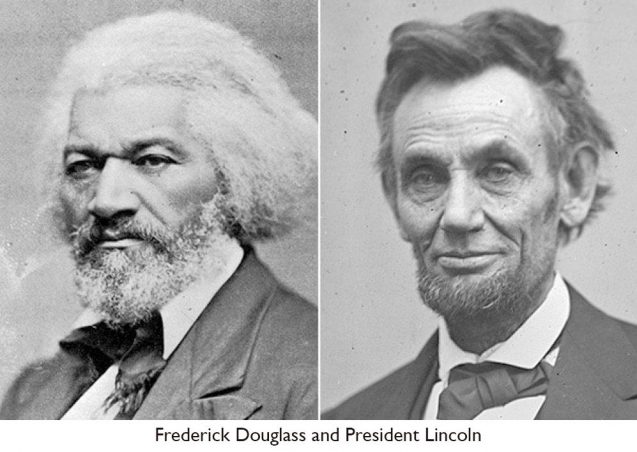
While many radical abolitionists in the USA and British Canada then advocated the dissolution of the union as an alternative to civil war, stronger souls like Frederick Douglass recognized the higher historic fight at hand. As a lesson to modern anarchists who believe in the 1619 Project and feel no sorrow at the burning of America under a new civil war today, Douglass took the time to research history, and broke with William Lloyd Garrison (the leader of the abolitionist movement) defending the Constitution in 1852:
“I differ from those who charge this baseness on the framers of the Constitution of the United States. It is a slander upon their memory… In that instrument [the U.S. Constitution] I hold there is neither warrant, license, nor sanction of the hateful thing; but interpreted, as it ought to be interpreted, the Constitution is a Glorious Liberty Document. Read its preamble, consider its purposes. Is slavery among them? Is it at the gateway? or is it in the temple? It is neither. While I do not intend to argue this question on the present occasion, let me ask, if it be not somewhat singular that, if the Constitution were intended to be, by its framers and adopters, a slaveholding instrument, why neither slavery, slaveholding, nor slave can anywhere be found in it”.
This higher understanding of history and the principles of the Constitution caused Douglass to ally himself with Lincoln where he worked with all his might to recruit 200,000 black soldiers to the cause. Later in life, Douglass attacked British free trade and “cheap labor” in defense of the Nationalist system writing in 1871:
“Cheap Labor, is a phrase that has no cheering music for the masses. Those who demand it, and seek to acquire it, have but little sympathy with common humanity. It is the cry of the few against the many. When we inquire who are the men that are continually vociferating for cheap labor, we find not the poor, the simple, and the lowly; not the class who dig and toil for their daily bread; not the landless, feeble, and defenseless portion of society, but the rich and powerful, the crafty and scheming, those who live by the sweat of other men’s faces.”
The British Hand Behind the Civil War
During the entirety of the Civil War, the British Empire’s guiding hand could always be felt, from supplying the south with battle ships, weapons and finances to providing logistic and diplomatic support internationally. Even British Canada was given over to the Confederacy’s intelligence headquarters which deployed spying, money laundering, and terrorist operations against the Union during the entire war.
Speaking to the British Parliament, Lord Robert Cecil (Marquis of Salisbury) expressed Britain’s logic succinctly when he said in 1861:
“The Northern States of America never can be our sure friends because we are rivals, rivals politically, rivals commercially…. With the Southern States, the case is entirely reversed. The population are an agricultural people. They furnish the raw material of our industry, and they consume the products which we manufacture from it. With them, every interest must lead us to cultivate friendly relations, and when the war began they at once recurred to England as their natural ally.”
A future installment will tackle the role of British operations in Canada that organized the murder of Lincoln, sabotaged the industrial reconstruction of the South, and undid the internationalization of Lincoln’s system around the world during the 19-20th centuries. This sabotage of potential created the foundations for the creature embedded within America now organizing a new Civil War and dissolution of the republic once and for all.
The author can be reached at matt.ehret@tutamail.com
(1) In the minds of those dirigistes like Franklin (including the Colbertist school of France, and its international leaders like Jonathon Swift, Daniel Dafoe, and Cotton Mathers in America who all wrote pamphlets supporting manufacturing over slave labor), a machine produced by the creative mind of man can accomplish the work of 100 laborers- thus liberating those laborers from the demands of the material forces of nature and freeing them to develop their powers of mind.
(2) Ezra Champion Seaman, Essays on the Progress of Nations (1853), p. 599
Hezbollah Media Refutes Netanyahu’s Claims about Missile Depot, Opens Site Shortly after His Remarks
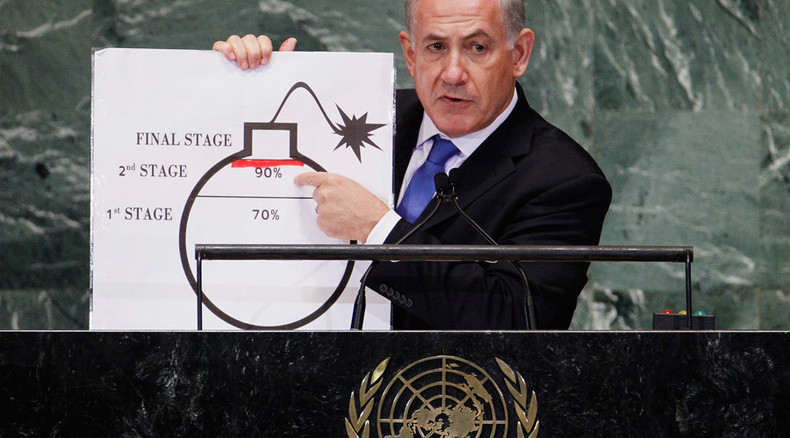
Al-Manar | September 29, 2020
Hezbollah Media Relations Department has issued a statement in which it invited media outlets to inspect the Beirut site falsely claimed by Zionist PM Benjamin Netanyahu as a missile Depot.
A large number of cameramen and reporters gathered near the alleged site around two hours after Netanyahu’s remarks in the context of the step organized by Hezbollah to refute the Zionist claims in light of the critical political conditions in Lebanon.
Head of Hezbollah Media Relations Department, Hajj Mohammad Afif, stressed that today’s tour aims at proving that Netanyahu’s story is wrong, adding that the Resistance is not concerned with exposing every site claimed by the Zionist enemy as a missile depot.
Netanyahu had alleged that Hezbollah stores missiles at a depot in a residential area in Jinah, adding that it lies near a gas facility and that its explosion will be similar to that of Beirut port.
The Israeli intelligence command has prepared a plan to provoke the Lebanese against Hezbollah by weaponry by unveiling maps of its locations in Lebanon and launching a propaganda that promotes its threat in light of the Beirut Port explosion, Al-Manar English Website reported on August 25, 2020.
Hezbollah Secretary General Sayyed Hasan Nasrallah announced the invitation during his televised speech, highlighting that it would be shortly after Netanyahu’s remarks so that the inspection will be very credible.
The following video shows the iron factory full of the media reporters shortly after Netanyahu’s remarks… continue to Al-Manar for video tour
Ex-OPCW Member Says Syria 2018 Chemical Attacks Report May Not Reflect Actual Events
Sputnik – 29.09.2020
A former lead investigator from the Organisation for the Prohibition of Chemical Weapons (OPCW), Ian Henderson, said the final report of the Fact-Finding Mission (FFM) into the alleged use of toxic chemicals in an attack in Douma, Syria, in 2018, may not reflect what happened on the ground.
Henderson was speaking at an informal meeting of the UN Security Council, organised by the Russian Mission, to openly discuss the treatment of the Syrian chemical dossier, in contrast to traditionally closed gatherings of the council on the issue.
“I speak for myself, but I know there are other Douma FFM inspectors who hold the similar concerns that I do about the manner in which the investigation was controlled, locked-down… [as well as] the findings reflected in the final FMM report”, Henderson said. “We believe that there is more than sufficient information out there today that has demonstrated our points that the findings of the FFM report on Duma may not reflect the actual situation”.
Henderson said the launching of a transparent technical inquiry aimed at clarifying the actual course of events in Douma in 2018 is justified, given the scope of the available information and facts on the alleged incident.
“And this needs to be done in a way that demonstrates scientific rigour and integrity because that currently has not been done”, he said. “perhaps, more importantly, we continue to hope that there’s someone who’s willing and able, someone who has the courage to do something about this”.
The OPCW concluded that chlorine was most likely used in the suspected April 2018 attack on the city, which lies on the northeastern outskirts of the Syrian capital. This led the United States, France and the United Kingdom to launch missile strikes on Syrian targets.
The OPCW relied in its probe on data provided by the White Helmets, a rebel-linked group that bills itself as a volunteer rescue force.
However, the group has faced severe criticism from the Syrian and Russian governments who accuse the organisation of supporting terrorists and staging provocations involving chemical weapons aimed at justifying potential foreign interventions.
In December 2019, whistleblowing website WikiLeaks made public documents from the OPCW on the accuracy of the investigation in Douma.
One is an internal email exchange between a senior OPCW official, Chief of Cabinet Sebastian Braha, and his colleagues regarding a technical assessment by Henderson into allegations that the Syrian government had dropped two gas cylinders in a civilian area of Duma from an aircraft.
Henderson, who was assisting the FFM with information collection in Douma, in particular, found that all evidence from the ground suggest that cylinders were placed there manually and, given that the area was not controlled by Damascus at the time, most likely by no one else but the anti-government rebels.
The final report of the OPCW has no mention of these findings. Henderson faced pressure from the OPCW leadership and was eventually fired.
MSM Promotes Yet Another CIA Press Release As News

By Caitlin Johnstone | September 23, 2020
The Washington Post, whose sole owner is a CIA contractor, has published yet another anonymously sourced CIA press release disguised as a news report which just so happens to facilitate longstanding CIA foreign policy.
In an article titled “Secret CIA assessment: Putin ‘probably directing’ influence operation to denigrate Biden“, WaPo’s virulent neoconservative war pig Josh Rogin describes what was told to him by unnamed sources about the contents of a “secret” CIA document which alleges that Vladimir Putin is “probably” overseeing an interference operation in America’s presidential election.
True to form, at no point does WaPo follow standard journalistic protocol and disclose its blatant financial conflict of interest with the CIA when promoting an unproven CIA narrative which happens to serve the consent-manufacturing agendas of the CIA for its new cold war with Russia.
And somehow in our crazy, propaganda-addled society, this is accepted as “news”.
The CIA has had a hard-on for the collapse of the Russian Federation for many years, and preventing the rise of another multi-polar world at all cost has been an open agenda of US imperialism since the fall of the Soviet Union. Indeed it is clear that the escalations we’ve been watching unfold against Russia were in fact planned well in advance of 2016, and it is only by propaganda narratives like this one that consent has been manufactured for a new cold war which imperils the life of every organism on this planet.
There is no excuse for a prominent news outlet publishing a CIA press release disguised as news in facilitation of these CIA agendas. It is still more inexcusable to merely publish anonymous assertions about the contents of that CIA press release. It is especially inexcusable to publish anonymous assertions about a CIA press release which merely says that something is “probably” happening, meaning those making the claim don’t even know.
None of this stopped The Washington Post from publishing this propaganda piece on behalf of the CIA. None of it stopped this story from being widely shared by prominent voices on social media and repeated by major news outlets like CNN, The New York Times, and NBC. And none of it stopped all the usual liberal influencers from taking the claims and exaggerating the certainty.
The CIA-to-pundit pipeline, wherein intelligence agencies “leak” information that is picked up by news agencies and then wildly exaggerated by popular influencers, has always been an important part of manufacturing establishment Russia hysteria. We saw it recently when the now completely debunked claim that Russia paid bounties on US troops to Taliban-linked fighters in Afghanistan first surfaced; unverified anonymous intelligence claims were published by mass media news outlets, then by the time it got to spinmeisters like Rachel Maddow it was being treated not as an unconfirmed analysis but as an established fact.
If you’ve ever wondered how rank-and-file members of the public can be so certain of completely unproven intelligence claims, the CIA-to-pundit pipeline is a big part of it. The most influential voices who political partisans actually hear things from are often a few clicks removed from the news report they’re talking about, and by the time it gets to them it’s being waved around like a rock-solid truth when at the beginning it was just presented as a tenuous speculation (the original aforementioned WaPo report appeared on the opinion page).
The CIA has a well-documented history of infiltrating and manipulating the mass media for propaganda purposes, and to this day the largest supplier of leaked information from the Central Intelligence Agency to the news media is the CIA itself. They have a whole process for leaking information to reporters they like (with an internal form that asks whether the information leaked is Accurate, Partially Accurate, or Inaccurate), as was highlighted in a recent court case which found that the CIA can even leak documents to select journalists while refusing to release them to others via Freedom of Information Act requests.
A lying, torturing, propagandizing, drug trafficking, assassinating, coup-staging, warmongering, psychopathic spook agency with an extensive history of deceit and depravity that selectively gives information to news reporters with whom it has a good relationship is never doing so for noble reasons. It is doing so for the same rapacious power-grabbing reasons it does all the other evil things it does.
The way mainstream media has become split along increasingly hostile ideological lines means that all the manipulators need to do to advance a given narrative is set it up to make one side look bad and then share it with a news outlet from the other side. The way media is set up to masturbate people’s confirmation bias instead of report objective facts will then cause the narrative to go viral throughout that partisan faction, regardless of how true or false it might be.
The coming US election and its aftermath is looking like it will be even more insane and hysterical than the last one, and the enmity and outrage it creates will give manipulators every opportunity to slide favorable narratives into the slipstream of people’s hot-headed abandonment of their own critical faculties.
And indeed they are clearly prepared to do exactly that. An ODNI press release last month which was uncritically passed along by the most prominent US media outlets reported that China and Iran are trying to help Biden win the November election while Russia is trying to help Trump. So no matter which way these things go the US intelligence cartel will be able to surf its own consent-manufacturing foreign policy agendas upon the tide of outrage which ensues.
The propaganda machine is only getting louder and more aggressive. We’re being prepped for something.
Hack reveals UK’s propaganda campaign to drive Syrian regime change
By Johanna Ross | September 25, 2020
When I reported on the leak of Integrity Initiative documents back in 2018/19 which exposed the extent of the UK’s propaganda war against Russia, I didn’t think it could get much more organised and coordinated than it was. Involving hundreds of journalists and academics across the globe to spin disinformation about Russia and paint the country in as negative a light as possible in the mainstream media, the UK government-funded campaign was as sophisticated as the information war gets. But here we are in 2020, still uncovering the true scope of western government influence on the narrative plugged by the mainstream media. And it doesn’t speak well for our ‘democracy’.
On 8th September the hacker group Anonymous published shocking revelations of how a concerted and organised campaign has been waged to support the anti-government rebels in Syria. One set of documents relates to the NGO ARK, which although brands itself as a humanitarian organisation, effectively functions as a vehicle for western-led regime change. In one of the papers it states:
‘ARK’s focus since 2012 has been delivering highly effective, politically- and conflict-sensitive Syria programming for the governments of the United Kingdom, United States, Denmark, Canada, Japan and the European Union.’
This is a somewhat different picture from the mission statement on their website:
‘ARK was created in order to assist the most vulnerable, particularly refugees, the displaced and those impacted by conflict and instability.’
Sounds lovely doesn’t it? But this organisation is far from charitable. In the last few years it has received $66 million from western governments to drive regime change in Syria. It boasts of relationships with Syrian opposition members that have been built up ‘over the years’, and we know that they date as far back as 2011, if not before, as its documents read ‘ARK staff are in regular contact with activists and civil society actors whom they initially met during the outbreak of protests in spring 2011’.
ARK also had a targeted propaganda campaign package for Syrian media. In the documents it is discussed how best to reach Syrian audiences to promote the regime change narrative, with success being achieved it is said, on digital media such as Facebook, but also through broadcast media. If there was ever any evidence that the mainstream media was bought, this is it:
‘To achieve a strong digital presence, ARK/Accadian will draw on its existing relationships with media organisations… Using its existing networks and connections, ARK/Accadian would target key Syrian satellite TV networks (Orient TV, Souria al-Shaab, Souria al-Ghad, Barada) and regional Arabic networks and primary international channels.’
What is extraordinary is the repeated use of the word ‘independent’ to describe the media outlets being promoted by ARK. The authors are clearly blissfully unaware that by interfering in the media of this sovereign state to promote the overthrow of the government, the media can hardly be termed ‘independent’ but instead an arm of the British state and its own particular political aims and objectives. The document reads:
‘Since ARK first began training citizen journalists in 2012, as part of HMG’s efforts to develop professional, 2 independent and self-sufficient local Syrian media organisations, it has trained more than 200 journalists and has been a key implementer of a multi-donor effort to develop media platforms inside Syria, maintaining close links with these organisations’.
It boasts having produced over 2000 news reports for various mainstream Arabic channels, including Orient, Al Arabiya, Al Jazeera and Sky Arabic which it says are ‘broadcast almost every day’. Some of the statements are pure, straightforward admissions of propaganda:
‘ARK has also facilitated contact between the Syrian opposition and international media, seeking to address the perception of an uncoordinated opposition by fostering the image of a united front.’
It is extraordinary the sheer brassneck with which this author writes about manipulating the Syrian public through propaganda. It has the stated goal of creating the impression of a united Syrian opposition, which of course there never was.
These documents contrast with the UK government’s website on ‘what it is doing in Syria’. There we are told that British involvement is limited to humanitarian aid as it ‘suspended all services of the British Embassy in Damascus and withdrew all diplomatic personnel from Syria in 2012’. The Anonymous hack shows that this is far from the truth. There has clearly been considerable British involvement in fostering regime change in Syria. If it weren’t for these leaked documents, the UK taxpayer would remain completely ignorant as to what foreign meddling is being carried out in his or her name.
For more detailed analysis and context of the hacked documents, please see Ben Norton’s report on The GrayZone.
Johanna Ross is a journalist based in Edinburgh, Scotland.
The American deep state revives its tired allegations of Russian interference in November’s presidential elections
By Scott Ritter | RT | September 23, 2020
CIA and FBI officials, helped by MSM chums, allege the Kremlin’s running a campaign to denigrate Joe Biden. But where’s the evidence? The real threat to US democracy isn’t Russia, but the anonymous sources behind the claims.
There have been a spate of reports recently, alleging Russian interference in the 2020 US presidential election, specifically the charge that Russian President Vladimir Putin is seeking to “sow divisiveness and discord” to “denigrate” the Democratic nominee, Joe Biden, and undermine public confidence in the legitimacy of the electoral process.
While allegations of Russian interference in the 2016 US presidential election continue to be bandied about by those who believe that President Donald Trump’s victory over Democratic challenger Hillary Clinton was solely due to Russian malfeasance, the new allegations arise from a separate set of facts unique to this year’s race.
These are the efforts of Donald Trump’s personal lawyer, Rudy Giuliani, and the Republican chairmen of the Senate Homeland Security and Finance Committees (Ron Johnson and Chuck Grassley, respectively) to uncover evidence of corruption on the part of Joe Biden and his son Hunter regarding the latter’s relationship with Burisma, a Ukrainian energy company. These efforts have led to the release of an 87-page joint report, titled ‘Hunter Biden, Burisma, and Corruption: The Impact on U.S. Government Policy and Related Concerns’, published by Senator’s Johnson and Grassley on September 22.
There is nothing substantively new in the report that has not already been publicly disclosed previously. The difference is that Giuliani, Johnson, and Grassley have made extensive use of information provided to them by a pro-Russian member of the Ukrainian Parliament, Andriy Derkach, in fleshing out the allegations of corruption leveled against Joe and Hunter Biden. The information contained in the report does not significantly further the case against either Joe or Hunter Biden and, if left to its own devices, the report would most likely have been ignored by the voting public.
But the Derkach angle has caught the eye of elements within the US intelligence community and the FBI, who have used the connection between Giuliani, Johnson, and Grassley on the one hand, and Derkach on the other, to promote their own conspiracy theories linking the Russian government to the revelations. This linkage was furthered by the fact that Derkach was singled out by the US Department of Treasury in August for being “an active Russian agent for over a decade,” who employed “manipulation and deceit to attempt to influence elections in the United States.”
Derkach’s activities were also the subject of a classified CIA assessment published on August 31 in the CIA World Intelligence Review. But the CIA took it a step further, stating: “We assess that President Vladimir Putin and the senior-most Russian officials are aware of and probably directing Russia’s influence operations aimed at denigrating the former U.S. Vice President, supporting the U.S. President and fueling public discord ahead of the U.S. election in November.”
Details of this classified CIA assessment were shared with Josh Rogin, an opinion columnist with the Washington Post (and vehement opponent of Trump), who published them in a column that appeared in his newspaper on September 22. According to Rogin, the information about the CIA assessment came from two unnamed sources “familiar with” the report. Rogin claims he withheld details about the intelligence used to form the assessment at the request of his sources to protect them and their methods.
Rogin’s ‘scoop’ comes on the heels of similar claims put forward in written testimony to Congress by the director of the National Counterintelligence and Security Center, William Evanina, in early August. “We assess that Russia is using a range of measures to primarily denigrate former Vice President Biden and what it sees as an anti-Russia ‘establishment,’” Evanina wrote. “This is consistent with Moscow’s public criticism of him when he was Vice President for his role in the Obama administration’s policies on Ukraine and its support for the anti-Putin opposition inside Russia.”
Evanina’s concerns were echoed by FBI Director Christopher Wray, who testified before the House Homeland Security Committee on September 17. “We certainly have seen very active, very active efforts by the Russians to influence our election in 2020 … to both sow divisiveness and discord and … to denigrate Vice President Biden,” Wray said.
Both Evanina and Wray drew heavily on the efforts by Derkach to assist Giuliani, Johnson, and Grassley in their aim of digging up dirt on Joe and Hunter Biden. Wray’s testimony, when viewed in conjunction with the Rogin revelations about the CIA’s assessment, appears to be timed to pre-empt the impact of the Johnson-Grassley report.
If that’s true, then the FBI director, together with whomever in the intelligence community leaked the details of the CIA’s assessment to Rogin, are guilty of the kind of politicization of intelligence that undermines public confidence in the US system of government far more than any thinly sourced allegations about Russian interference.
One can scour the government’s organizational charts, looking in vain for an entity that describes itself as the ‘deep state’, and the efforts will be in vain. But the deep state exists. It exists in the form of so-called intelligence professionals who craft analysis about alleged foreign interference in domestic American politics, derived from secret ‘sources and methods’, which is then leaked to a willing recipient in the press who publishes it for the sole purpose of undermining a sitting president on the eve of a national election, without disclosing what these ‘sources and methods’ are.
It exists in the form of an organization, the FBI, that is already stinging from the public disclosure of its massive failings on issues related to allegations of Russian collusion on the part of a sitting president (the Mueller Report fiasco, the disaster that was the Steele Dossier, and the incompetence manifested in the Carter Page FISA warrant process, to name but a few) suddenly seeking relevance – and, one might say, revenge – by speculating on the domestic impact of the same allegations put forward by the intelligence community.
The only purpose one can ascribe to these actions is the denigration of President Trump for the purpose of sowing divisiveness and discord regarding the legitimacy of the 2020 presidential election – the very charge that those who embrace the CIA and FBI allegations about Russian interference have levelled against Moscow.
A reasonable person can conclude that President Trump, by questioning the legitimacy of mail-in ballots and openly speculating about voter fraud, is actively engaging in a politically motivated ploy to undermine public confidence in the election for the purpose of preparing the public for an inevitable challenge if the results point to a Biden victory.
While this is not conduct that any politician seeking elected office should engage in, it isn’t being done in the shadows, as part of a vast secret conspiracy, but rather out in the open, for all the public to see and, by extension, to opine on come election day.
That’s the difference between what Trump and his supporters are doing, and the actions of the deep state. Both are destroying public confidence in whatever the outcome may be on election night, to make the case that their candidate has the more legitimate claim to electoral victory.
Two wrongs don’t make a right, but the fact that one side – the supporters of Donald Trump – are conducting their work with complete transparency, while the other side hides behind the impenetrable walls the deep state affords them, does serve as a discriminator.
America does not need any help in undermining the foundations of democratic rule, nor does it need help in destroying public confidence in the notion of a free and fair election. The actions of both political parties have shown they are collectively and individually more than capable of accomplishing this in their own right; all an outside power need do is sit back and watch the show.
There is nothing to gain for Putin, were he to orchestrate a campaign designed to attack Joe Biden, and everything to lose. If there wasn’t an Andriy Derkach, Rudy Giuliani and Senator Johnson would have found someone just like him. The Hunter Biden/Burisma story is to Republican operatives like chum is to sharks – irresistible.
It wasn’t manufactured by Putin and co behind the Kremlin walls, but was rather the by-product of Hunter and Joe Biden’s own words and deeds. The American electorate is sophisticated enough to sort through the chaff to get to the wheat. Nothing Giuliani or Johnson did was in secret – and they most certainly don’t hide behind secret ‘sources and methods’ when making their allegations.
One cannot say the same thing for the intelligence community, the FBI, or the partisan mainstream media. At the end of the day, the information they describe as being at the heart of the alleged Russian interference – the Derkach papers – contains the same fact set as does the report published by Senators Johnson and Grassley.
The big difference, however, is how this information is packaged and marketed. The Republicans have taken the path of full transparency, where every voter is capable of discerning whether this is a matter of legitimate national concern, or a political witch hunt. Most important of all is the fact that both Johnson and Grassley are elected officials who, at the end of the day, are accountable to their respective constituencies for their conduct while in office.
The deep state, however, has taken a different path – one of secret allegations about foreign manipulation of American democratic processes. The deep state seeks to distract from the political reality of what the Republicans have done – namely, to put it all on the line for the American people to see whether the Hunter Biden/Burisma story holds water, or to conclude that the Republicans have behaved poorly.
The Republicans have given the American voter a choice – one the deep state seeks to obviate by tainting it with unfounded allegations of Russian interference. Moreover, the deep state has put forward its case in an opaque way and in a manner where those making the case cannot be held accountable to the American public because they were never elected in the first place, and have opted to keep their identities a secret.
And it is destroying American democracy as we speak.
Scott Ritter is a former US Marine Corps intelligence officer and author of ‘SCORPION KING: America’s Suicidal Embrace of Nuclear Weapons from FDR to Trump.’ He served in the Soviet Union as an inspector implementing the INF Treaty, in General Schwarzkopf’s staff during the Gulf War, and from 1991-1998 as a UN weapons inspector. Follow him on Twitter @RealScottRitter
Betrayal. Infuriating, Betrayal
By Mike Whitney • Unz Review • September 23, 2020
“The belief in a supernatural source of evil is not necessary; men alone are quite capable of every wickedness.” Joseph Conrad
Here’s your political puzzler for the day: Which of these two things poses a greater threat to the country:
- An incompetent and boastful president who has no previous government experience and who is rash and impulsive in his dealings with the media, foreign leaders and his critics?
- Or a political party that collaborates with senior-level officials in the Intel agencies, the FBI, the DOJ, the media, and former members of the White House to spy on the new administration with the intention of gathering damaging information that can be used to overthrow the elected government?
The answer is “2”, the greater threat to the country is a political party that engages in subversive activity aimed at toppling the government and seizing power. In fact, that’s the greatest danger that any country can face, an enemy from within. Foreign adversaries can be countered by diplomatic engagement and shoring up the nation’s military defenses, but traitors–who conduct their activities below the radar using a secret network of contacts and connections to inflict maximum damage on the government– are nearly unstoppable.
What the Russiagate investigation shows, is that high-ranking members of the Democrat party participated in the type of activities that are described above, they were part of an illicit coup d’etat aimed at removing Donald Trump from office and rolling back the results of the 2016 elections. It is a vast understatement to say that the operation was merely an attack on Donald Trump when, in fact, it was an attack on the system itself, a full-blown assault on the right of ordinary people to choose their own leaders. That’s what Russiagate is really all about; it was an attempt to torpedo democracy by invoking the flimsy and unverifiable claim that Trump was an agent of the Kremlin.
None of this, of course, has been discussed in a public forum because those platforms are all privately-owned media that are linked to the people who executed the junta. But for those who followed events closely, and who know what actually happened, there has never been a more serious crime in American history. What we discovered was that the permanent bureaucracy, the media and the Democrat party are riddled with strategically-placed quislings and collaborators that are willing to sabotage their own government if they are so directed. The question that immediately comes to mind is this: Who concocted this plot, who authorized the electronic eavesdropping, the confidential informants, the widespread spying, the improperly obtained warrants, the fake news, and the endless leaks to the media? Who?
What we witnessed was not just an attempted coup, it was a window into the inner-workings of a secret government operating independently from within the state. And the sedition was not confined to a few posts at the senior levels of the FBI, CIA, NSA, or DOJ. No. The corruption has saturated the entire structure, seeping down to the lower levels where career bureaucrats eagerly perform tasks that are designed to damage or incriminate elected officials. How did it ever get this bad?
And who is calling the shots? We still don’t know.
Let me pose a theory: The operation might have been concocted by former CIA-Director John Brennan, but Brennan surely is not the prime instigator, nor is Clapper, Comey or even Obama. The real person or persons who initiated the coup will likely never be known. These are the Big Money guys who operate in the shadows and who have a stranglehold on the Intelligence agencies. These are the gilded Mandarins who have their tentacles wrapped firmly around the entire state-power apparatus and who dictate policy from their leather-bound chairs at their high-end men’s clubs. These are the people who decided that Donald Trump “had to go” whatever the cost. They pulled out all the stops, engaged their assets across the bureaucracy, and launched a desperate 3 and half year-long regime change operation that blew up in their faces leaving behind a trail carnage from Washington, DC to Sydney, Australia. In contrast, Trump somehow slipped the noose and escaped largely unscathed. He was pummeled mercilessly in the media, disparaged by his political rivals, and raked over the coals by the chattering classes, but — at the end of the day– it was Trump who was left standing. Trump– who took on the entire political establishment, the Intel agencies, the FBI, the mainstream media, and the Democratic party– had beaten them all at their own game. Go figure??
Keep in mind, the Democrats have known that the Mueller probe was a fraud from as early as 2017 when the President of Crowdstrike, Shawn Henry, (who provided cyber security for the DNC) admitted to Congress that there was no forensic evidence that the DNC emails had been hacked by Russia or anyone else.
Think about that for a minute: The entire Mueller investigation was based on the assumption that Russia hacked into the DNC servers and stole the emails. We now know that never happened. The cyber-security team that conducted the investigation of the DNC computers admitted in sworn testimony before Congress that there was no evidence of “exfiltration” or pilfering of any kind. Repeat: There was no proof of hacking, no proof of Russian involvement, and no proof of foul play. The entire foundation upon which the Russia investigation was built, turned out to be false. More importantly, Democrat members of the Intelligence Committee knew it was false from the get-go, but opted to let the charade continue anyway. Why?
Because the truth didn’t matter, what mattered was getting rid of Trump by any means necessary. That’s why they used “opposition research” (Note– “Oppo” research is the hyperbolic nonsense political parties use to smear a political opponent.) to illegally obtain warrants to spy on members of the Trump team. It’s because the Democrat leadership will do anything to regain power.
By the way, we also have evidence that the warrants that were used to spy on Trump were obtained illegally. The FISA court was deliberately misled so the FBI could carry out its vendetta on Trump. Former FBI lawyer Kevin Clinesmith “did willfully and knowingly make and use a false writing and document, knowing the same to contain a materially false, fictitious, and fraudulent statement and entry in a matter before the jurisdiction of the executive branch and judicial branch of the Government of the United States.” Bottom line: Clinesmith deliberately altered emails so that FISA applications could be renewed and the spying on the Trump campaign could continue.
So, let’s summarize:
- The Democrats knew there was no proof the emails were stolen; thus, they knew the Russia probe was a hoax.
- The Democrats knew that their fraudulent “opposition research” was being used to illegally obtain warrants to spy on the Trump camp. This makes them accessory to a crime.
- Finally, the Democrats continue to spread (virtually) the same Russia-Trump collusion allegations today that they did before the Mueller investigation released its report. The lies and disinformation have persisted as if the “nation’s most expensive and exhaustive investigation” had never taken place. What does this tell us about the Democrats?
On a superficial level, it tells us that they can’t be trusted because they don’t tell the truth. But on a deeper level, it expresses the party’s Ruling Doctrine, which is to control the public by means of deceit, disinformation, propaganda and lies. Only the powerful and well-connected are entitled to know the truth, everyone else must be subjected to fabrications that are crafted in a way that best coincides with the overall objectives of ruling elites. That’s why the Democrats stick with the shopworn mantra that Trump is in bed with Russia. It doesn’t matter that the theory has been thoroughly discredited and disproved. It doesn’t even matter that the theory was never the slightest bit believable to begin with. What matters is that party leaders are preventing ordinary people from knowing the truth, which is an essential part of their governing doctrine. It’s surprising that this doesn’t piss-off more Democrats, after all, it’s the ultimate expression of contempt and condescension. When someone lies to your face relentlessly, repeatedly and shamelessly, they are expressing their loathing for you. Can’t they see that?
But maybe you think this is overstating the case? Maybe you think the Dems are just trying to “cover their backside” on a matter that is purely political?
Okay, but answer this: Were the Democrats involved in a plot to overthrow the President of the United States?
Yes, they were.
Is that treason?
Yes, it is.
Then, are we really prepared to say that treason is “purely political”?
No, especially since Russiagate was not a one-off, but just the first shocking example of how the Democrats operate. If we examine the Dems approach to the Covid-19 crisis, we see that their policy is actually more destructive than the 4-year Russia fiasco.
For example, which party has imposed the most brutal, economy-eviscerating lockdowns and the most punitive mask mandates, while steadily ratcheting up the fearmongering at every opportunity? Which states suffered the most catastrophic economic damage due in large part to the edicts issued by their Democrat governors? Which party is using a public health emergency to advance the global “Reset” agenda announced at the World Economic Forum (WEF)? Which party is using the Covid-19 fraud to crash the economy, eliminate 40 million jobs, roll-back basic civil liberties and turn the United States into a NWO slave-state ruled by Wall Street bankers, Silicon Valley technocrats and Davos elites? Which party?
And which party has aligned itself with Black Lives Matter, the faux-social justice organization that is funded by foreign oligarchs that are working tirelessly to crush the emerging populist movement that supports “America First” ideals? Which party applauded while American cities burned and small businesses across the country were looted and razed by masses of hooligans engaged in an orgy of destruction? Which party’s mayors and governors rejected federal assistance to put down the riots and reestablish order so ordinary people could get back to work to provide for themselves and their families? And which party now is threatening widespread social unrest and anarchy if the upcoming presidential election does not produce the result that they or their globalist puppet-masters seek?
The Democrat party has undergone a sea-change in the last four years. There’s no trace of the party that was once headed by progressive-thinking idealists like John F Kennedy. What’s left now is a shell of its former self; a cynical, self-aggrandizing, cutthroat organization that has betrayed its base, the American people, and the country. Indeed, for all its many failings, it is the ‘betrayal’ that is the most infuriating.
Lies, Damned Lies and Health Statistics – the Deadly Danger of False Positives
By Dr Michael Yeadon | Lockdown Sceptics | September 20, 2020
I never expected to be writing something like this. I am an ordinary person, recently semi-retired from a career in the pharmaceutical industry and biotech, where I spent over 30 years trying to solve problems of disease understanding and seek new treatments for allergic and inflammatory disorders of lung and skin. I’ve always been interested in problem solving, so when anything biological comes along, my attention is drawn to it. Come 2020, came SARS-CoV-2. I’ve written about the pandemic as objectively as I could. The scientific method never leaves a person who trained and worked as a professional scientist. Please do read that piece. My co-authors & I will submit it to the normal rigours of peer review, but that process is slow and many pieces of new science this year have come to attention through pre-print servers and other less conventional outlets.
While paying close attention to data, we all initially focused on the sad matter of deaths. I found it remarkable that, in discussing the COVID-19 related deaths, most people I spoke to had no idea of large numbers. Asked approximately how many people a year die in the UK in the ordinary course of events, each a personal tragedy, they usually didn’t know. I had to inform them it is around 620,000, sometimes less if we had a mild winter, sometimes quite a bit higher if we had a severe ’flu season. I mention this number because we know that around 42,000 people have died with or of COVID-19. While it’s a huge number of people, its ‘only’ 0.06% of the UK population. Its not a coincidence that this is almost the same proportion who have died with or of COVID-19 in each of the heavily infected European countries – for example, Sweden. The annual all-causes mortality of 620,000 amounts to 1,700 per day, lower in summer and higher in winter. That has always been the lot of humans in the temperate zones. So for context, 42,000 is about ~24 days worth of normal mortality. Please know I am not minimising it, just trying to get some perspective on it. Deaths of this magnitude are not uncommon, and can occur in the more severe flu seasons. Flu vaccines help a little, but on only three occasions in the last decade did vaccination reach 50% effectiveness. They’re good, but they’ve never been magic bullets for respiratory viruses. Instead, we have learned to live with such viruses, ranging from numerous common colds all the way to pneumonias which can kill. Medicines and human caring do their best.
So, to this article. Its about the testing we do with something called PCR, an amplification technique, better known to biologists as a research tool used in our labs, when trying to unpick mechanisms of disease. I was frankly astonished to realise they’re sometimes used in population screening for diseases – astonished because it is a very exacting technique, prone to invisible errors and it’s quite a tall order to get reliable information out of it, especially because of the prodigious amounts of amplification involved in attempting to pick up a strand of viral genetic code. The test cannot distinguish between a living virus and a short strand of RNA from a virus which broke into pieces weeks or months ago.
I believe I have identified a serious, really a fatal flaw in the PCR test used in what is called by the UK Government the Pillar 2 screening – that is, testing many people out in their communities. I’m going to go through this with care and in detail because I’m a scientist and dislike where this investigation takes me. I’m not particularly political and my preference is for competent, honest administration over the actual policies chosen. We’re a reasonable lot in UK and not much given to extremes. What I’m particularly reluctant about is that, by following the evidence, I have no choice but to show that the Health Secretary, Matt Hancock, misled the House of Commons and also made misleading statements in a radio interview. Those are serious accusations. I know that. I’m not a ruthless person. But I’m writing this anyway, because what I have uncovered is of monumental importance to the health and wellbeing of all the people living in the nation I have always called home.
Back to the story, and then to the evidence. When the first (and I think, only) wave of COVID-19 hit the UK, I was with almost everyone else in being very afraid. I’m 60 and in reasonable health, but on learning that I had about a 1% additional risk of perishing if I caught the virus, I discovered I was far from ready to go. So, I wasn’t surprised or angry when the first lockdown arrived. It must have been a very difficult thing to decide. However, before the first three-week period was over, I’d begun to develop an understanding of what was happening. The rate of infection, which has been calculated to have infected well over 100,000 new people every day around the peak, began to fall, and was declining before lockdown. Infection continued to spread out, at an ever-reducing rate and we saw this in the turning point of daily deaths, at a grim press conference each afternoon. We now know that lockdown made no difference at all to the spread of the virus. We can tell this because the interval between catching the virus and, in those who don’t make it, their death is longer than the interval between lockdown and peak daily deaths. There isn’t any controversy about this fact, which is easily demonstrated, but I’m aware some people like to pretend it was lockdown that turned the pandemic, perhaps to justify the extraordinary price we have all paid to do it. That price wasn’t just economic. It involved avoidable deaths from diseases other than COVID-19, as medical services were restricted, in order to focus on the virus. Some say that lockdown, directly and indirectly, killed as many as the virus. I don’t know. Its not something I’ve sought to learn. But I mention because interventions in all our lives should not be made lightly. Its not only inconvenience, but real suffering, loss of livelihoods, friendships, anchors of huge importance to us all, that are severed by such acts. We need to be certain that the prize is worth the price. While it is uncertain it was, even for the first lockdown, I too supported it, because we did not know what we faced, and frankly, almost everyone else did it, except Sweden. I am now resolutely against further interventions in what I have become convinced is a fruitless attempt to ‘control the virus’. We are, in my opinion – shared by others, some of whom are well placed to assess the situation – closer to the end of the pandemic in terms of deaths, than we are to its middle. I believe we should provide the best protection we can for any vulnerable people, and otherwise cautiously get on with our lives. I think we are all going to get a little more Swedish over time.
In recent weeks, though, it cannot have escaped anyone’s attention that there has been a drum beat which feels for all the world like a prelude to yet more fruitless and damaging restrictions. Think back to mid-summer. We were newly out of lockdown and despite concerns for crowded beaches, large demonstrations, opening of shops and pubs, the main item on the news in relation to COVID-19 was the reassuring and relentless fall in daily deaths. I noticed that, as compared to the slopes of the declining death tolls in many nearby countries, that our slope was too flat. I even mentioned to scientist friends that inferred the presence of some fixed signal that was being mixed up with genuine COVID-19 deaths. Imagine how gratifying it was when the definition of a COVID-19 death was changed to line up with that in other countries and in a heartbeat our declining death toll line became matched with that elsewhere. I was sure it would: what we have experienced and witnessed is a terrible kind of equilibrium. A virus that kills few, then leaves survivors who are almost certainly immune – a virus to which perhaps 30-50% were already immune because it has relatives and some of us have already encountered them – accounts for the whole terrible but also fascinating biological process. There was a very interesting piece in the BMJ in recent days that offers potential support for this contention.
Now we have learned some of the unusual characteristics of the new virus, better treatments (anti-inflammatory steroids, anti-coagulants and in particular, oxygen masks and not ventilators in the main) the ‘case fatality rate’ even for the most hard-hit individuals is far lower now than it was six months ago.
As there is no foundational, medical or scientific literature which tells us to expect a ‘second wave’, I began to pay more attention to the phrase as it appeared on TV, radio and print media – all on the same day – and has been relentlessly repeated ever since. I was interviewed recently by Julia Hartley-Brewer on her talkRADIO show and on that occasion I called on the Government to disclose to us the evidence upon which they were relying to predict this second wave. Surely they have some evidence? I don’t think they do. I searched and am very qualified to do so, drawing on academic friends, and we were all surprised to find that there is nothing at all. The last two novel coronaviruses, Sar (2003) and MERS (2012), were of one wave each. Even the WW1 flu ‘waves’ were almost certainly a series of single waves involving more than one virus. I believe any second wave talk is pure speculation. Or perhaps it is in a model somewhere, disconnected from the world of evidence to me? It would be reasonable to expect some limited ‘resurgence’ of a virus given we don’t mix like cordial in a glass of water, but in a more lumpy, human fashion. You’re most in contact with family, friends and workmates and they are the people with whom you generally exchange colds.
A long period of imposed restrictions, in addition to those of our ordinary lives did prevent the final few percent of virus mixing with the population. With the movements of holidays, new jobs, visiting distant relatives, starting new terms at universities and schools, that final mixing is under way. It should not be a terrifying process. It happens with every new virus, flu included. It’s just that we’ve never before in our history chased it around the countryside with a technique more suited to the biology lab than to a supermarket car park.
A very long prelude, but necessary. Part of the ‘project fear’ that is rather too obvious, involving second waves, has been the daily count of ‘cases’. Its important to understand that, according to the infectious disease specialists I’ve spoken to, the word ‘case’ has to mean more than merely the presence of some foreign organism. It must present signs (things medics notice) and symptoms (things you notice). And in most so-called cases, those testing positive had no signs or symptoms of illness at all. There was much talk of asymptomatic spreading, and as a biologist this surprised me. In almost every case, a person is symptomatic because they have a high viral load and either it is attacking their body or their immune system is fighting it, generally a mix. I don’t doubt there have been some cases of asymptomatic transmission, but I’m confident it is not important.
That all said, Government decided to call a person a ‘case’ if their swab sample was positive for viral RNA, which is what is measured in PCR. A person’s sample can be positive if they have the virus, and so it should. They can also be positive if they’ve had the virus some weeks or months ago and recovered. It’s faintly possible that high loads of related, but different coronaviruses, which can cause some of the common colds we get, might also react in the PCR test, though it’s unclear to me if it does.
But there’s a final setting in which a person can be positive and that’s a random process. This may have multiple causes, such as the amplification technique not being perfect and so amplifying the ‘bait’ sequences placed in with the sample, with the aim of marrying up with related SARS-CoV-2 viral RNA. There will be many other contributions to such positives. These are what are called false positives.
Think of any diagnostic test a doctor might use on you. The ideal diagnostic test correctly confirms all who have the disease and never wrongly indicates that healthy people have the disease. There is no such test. All tests have some degree of weakness in generating false positives. The important thing is to know how often this happens, and this is called the false positive rate. If 1 in 100 disease-free samples are wrongly coming up positive, the disease is not present, we call that a 1% false positive rate. The actual or operational false positive rate differs, sometimes substantially, under different settings, technical operators, detection methods and equipment. I’m focusing solely on the false positive rate in Pillar 2, because most people do not have the virus (recently around 1 in 1000 people and earlier in summer it was around 1 in 2000 people). It is when the amount of disease, its so-called prevalence, is low that any amount of a false positive rate can be a major problem. This problem can be so severe that unless changes are made, the test is hopelessly unsuitable to the job asked of it. In this case, the test in Pillar 2 was and remains charged with the job of identifying people with the virus, yet as I will show, it is unable to do so.
Because of the high false positive rate and the low prevalence, almost every positive test, a so-called case, identified by Pillar 2 since May of this year has been a FALSE POSITIVE. Not just a few percent. Not a quarter or even a half of the positives are FALSE, but around 90% of them. Put simply, the number of people Mr Hancock sombrely tells us about is an overestimate by a factor of about ten-fold. Earlier in the summer, it was an overestimate by about 20-fold.
Let me take you through this, though if you’re able to read Prof Carl Heneghan’s clearly written piece first, I’m more confident that I’ll be successful in explaining this dramatic conclusion to you. (Here is a link to the record of numbers of tests, combining Pillar 1 (hospital) and Pillar 2 (community).)
Imagine 10,000 people getting tested using those swabs you see on TV. We have a good estimate of the general prevalence of the virus from the ONS, who are wholly independent (from Pillar 2 testing) and are testing only a few people a day, around one per cent of the numbers recently tested in Pillar 2. It is reasonable to assume that most of the time, those being tested do not have symptoms. People were asked to only seek a test if they have symptoms. However, we know from TV news and stories on social media from sampling staff, from stern guidance from the Health Minister and the surprising fact that in numerous locations around the country, the local council is leafleting people’s houses, street by street to come and get tested.
The bottom line is that it is reasonable to expect the prevalence of the virus to be close to the number found by ONS, because they sample randomly, and would pick up symptomatic and asymptomatic people in proportion to their presence in the community. As of the most recent ONS survey, to a first approximation, the virus was found in 1 in every 1000 people. This can also be written as 0.1%. So when all these 10,000 people are tested in Pillar 2, you’d expect 10 true positives to be found (false negatives can be an issue when the virus is very common, but in this community setting, it is statistically unimportant and so I have chosen to ignore it, better to focus only on false positives).
So, what is the false positive rate of testing in Pillar 2? For months, this has been a concern. It appears that it isn’t known, even though as I’ve mentioned, you absolutely need to know it in order to work out whether the diagnostic test has any value! What do we know about the false positive rate? Well, we do know that the Government’s own scientists were very concerned about it, and a report on this problem was sent to SAGE dated June 3rd 2020. I quote: “Unless we understand the operational false positive rate of the UK’s RT-PCR testing system, we risk over-estimating the COVID-19 incidence, the demand on track and trace and the extent of asymptomatic infection”. In that same report, the authors helpfully listed the lowest to highest false positive rate of dozens of tests using the same technology. The lowest value for false positive rate was 0.8%.
Allow me to explain the impact of a false positive rate of 0.8% on Pillar 2. We return to our 10,000 people who’ve volunteered to get tested, and the expected ten with virus (0.1% prevalence or 1:1000) have been identified by the PCR test. But now we’ve to calculate how many false positives are accompanying them. The shocking answer is 80. 80 is 0.8% of 10,000. That’s how many false positives you’d get every time you were to use a Pillar 2 test on a group of that size.
The effect of this is, in this example, where 10,000 people have been tested in Pillar 2, could be summarised in a headline like this: “90 new cases were identified today” (10 real positive cases and 80 false positives). But we know this is wildly incorrect. Unknown to the poor technician, there were in this example, only 10 real cases. 80 did not even have a piece of viral RNA in their sample. They are really false positives.
I’m going to explain how bad this is another way, back to diagnostics. If you’d submitted to a test and it was positive, you’d expect the doctor to tell you that you had a disease, whatever it was testing for. Usually, though, they’ll answer a slightly different question: “If the patient is positive in this test, what is the probability they have the disease?” Typically, for a good diagnostic test, the doctor will be able to say something like 95% and you and they can live with that. You might take a different, confirmatory test, if the result was very serious, like cancer. But in our Pillar 2 example, what is the probability a person testing positive in Pillar 2 actually has COVID-19? The awful answer is 11% (10 divided by 80 + 10). The test exaggerates the number of covid-19 cases by almost ten-fold (90 divided by 10). Scared yet? That daily picture they show you, with the ‘cases’ climbing up on the right-hand side? Its horribly exaggerated. Its not a mistake, as I shall show.
Earlier in the summer, the ONS showed the virus prevalence was a little lower, 1 in 2000 or 0.05%. That doesn’t sound much of a difference, but it is. Now the Pillar 2 test will find half as many real cases from our notional 10,000 volunteers, so 5 real cases. But the flaw in the test means it will still find 80 false positives (0.8% of 10,000). So its even worse. The headline would be “85 new cases identified today”. But now the probability a person testing positive has the virus is an absurdly low 6% (5 divided by 80 + 5). Earlier in the summer, this same test exaggerated the number of COVID-19 cases by 17-fold (85 divided by 5). Its so easy to generate an apparently large epidemic this way. Just ignore the problem of false positives. Pretend its zero. But it is never zero.
This test is fatally flawed and MUST immediately be withdrawn and never used again in this setting unless shown to be fixed. The examples I gave are very close to what is actually happening every day as you read this.
I’m bound to ask, did Mr Hancock know of this fatal flaw? Did he know of the effect it would inevitably have, and is still having, not only on the reported case load, but the nation’s state of anxiety. I’d love to believe it is all an innocent mistake. If it was, though, he’d have to resign over sheer incompetence. But is it? We know that internal scientists wrote to SAGE, in terms, and, surely, this short but shocking warning document would have been drawn to the Health Secretary’s attention? If that was the only bit of evidence, you might be inclined to give him the benefit of the doubt. But the evidence grows more damning.
Recently, I published with my co-authors a short Position Paper. I don’t think by then, a month ago or so, the penny had quite dropped with me. And I’m an experienced biomedical research scientist, used to dealing with complex datasets and probabilities.
On September 11th 2020, I was a guest on Julia Hartley-Brewer’s talkRADIO show. Among other things, I called upon Mr Hancock to release the evidence underscoring his confidence in and planning for ‘the second wave’. This evidence has not yet been shown to the public by anyone. I also demanded he disclose the operational false positive rate in Pillar 2 testing.
On September 16th, I was back on Julia’s show and this time focused on the false positive rate issue (1m 45s – 2min 30s). I had read Carl Heneghan’s analysis showing that even if the false positive rate was as low as 0.1%, 8 times lower than any similar test, it still yields a majority of false positives. So, my critique doesn’t fall if the actual false positive rate is lower than my assumed 0.8%.
On September 18th, Mr Hancock again appeared, as often he does, on Julia Hartley-Brewer’s show. Julia asked him directly (1min 50s – on) what the false positive rate in Pillar 2 is. Mr Hancock said “It’s under 1%”. Julia again asked him exactly what it was, and did he even know it? He didn’t answer that, but then said “it means that, for all the positive cases, the likelihood of one being a false positive is very small”.
That is a seriously misleading statement as it is incorrect. The likelihood of an apparently positive case being a false positive is between 89-94%, or near-certainty. Of note, even when ONS was recording its lowest-ever prevalence, the positive rate in Pillar 2 testing never fell below 0.8%.
It gets worse for the Health Secretary. On September the 17th, I believe, Mr Hancock took a question from Sir Desmond Swayne about false positives. It is clear that Sir Desmond is asking about Pillar 2.
Mr Hancock replied: “I like my right honourable friend very much and I wish it were true. The reason we have surveillance testing, done by ONS, is to ensure that we’re constantly looking at a nationally representative sample at what the case rate is. The latest ONS survey, published on Friday, does show a rise consummate (sic) with the increased number of tests that have come back positive.”
He did not answer Sir Desmond’s question, but instead answered a question of his choosing. Did the Health Secretary knowingly mislead the House? By referring only to ONS and not even mentioning the false positive rate of the test in Pillar 2 he was, as it were, stealing the garb of ONS’s more careful work which has a lower false positive rate, in order to smuggle through the hidden and very much higher, false positive rate in Pillar 2. The reader will have to decide for themselves.
Pillar 2 testing has been ongoing since May but it’s only in recent weeks that it has reached several hundreds of thousands of tests per day. The effect of the day by day climb in the number of people that are being described as ‘cases’ cannot be overstated. I know it is inducing fear, anxiety and concern for the possibility of new and unjustified restrictions, including lockdowns. I have no idea what Mr Hancock’s motivations are. But he has and continues to use the hugely inflated output from a fatally flawed Pillar 2 test and appears often on media, gravely intoning the need for additional interventions (none of which, I repeat, are proven to be effective).
You will be very familiar with the cases plot which is shown on most TV broadcasts at the moment. It purports to show the numbers of cases which rose then fell in the spring, and the recent rise in cases. This graph is always accompanied by the headline that “so many thousands of new cases were detected in the last 24 hours”.
You should know that there are two major deceptions, in that picture, which combined are very likely both to mislead and to induce anxiety. Its ubiquity indicates that it is a deliberate choice.
Firstly, it is very misleading in relation to the spring peak of cases. This is because we had no community screening capacity at that time. A colleague has adjusted the plot to show the number of cases we would have detected, had there been a well-behaved community test capability available. The effect is to greatly increase the size of the spring cases peak, because there are very many cases for each hospitalisation and many hospitalisations for every death.
Secondly, as I hope I have shown and persuaded you, the cases in summer and at present, generated by seriously flawed Pillar 2 tests, should be corrected downwards by around ten-fold.
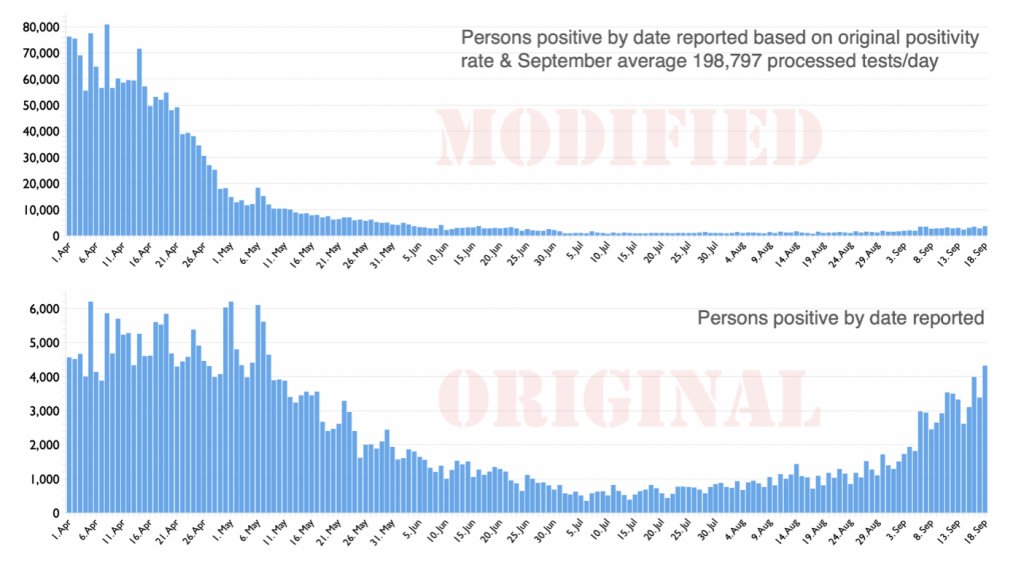
I do believe genuine cases are rising somewhat. This is, however, also true for flu, which we neither measure daily nor report on every news bulletin. If we did, you would appreciate that, going forward, it is quite likely that flu is a greater risk to public health than COVID-19. The corrected cases plot (above) does, I believe, put the recent rises in incidence of COVID-19 in a much more reasonable context. I thought you should see that difference before arriving at your own verdict on this sorry tale.
There are very serious consequences arising from grotesque over-estimation of so-called cases in Pillar 2 community testing, which I believe was put in place knowingly. Perhaps Mr Hancock believes his own copy about the level of risk now faced by the general public? Its not for me to deduce. What this huge over-estimation has done is to have slowed the normalisation of the NHS. We are all aware that access to medical services is, to varying degrees, restricted. Many specialities were greatly curtailed in spring and after some recovery, some are still between a third and a half below their normal capacities. This has led both to continuing delays and growth of waiting lists for numerous operations and treatments. I am not qualified to assess the damage to the nation’s and individuals’ health as a direct consequence of this extended wait for a second wave. Going into winter with this configuration will, on top of the already restricted access for six months, lead inevitably to a large number of avoidable, non-Covid deaths. That is already a serious enough charge. Less obvious but, in aggregate, additional impacts arise from fear of the virus, inappropriately heightened in my view, which include: damage to or even destruction of large numbers of businesses, especially small businesses, with attendant loss of livelihoods, loss of educational opportunities, strains on family relationships, eating disorders, increasing alcoholism and domestic abuse and even suicides, to name but a few.
In closing, I wish to note that in the last 40 years alone the UK has had seven official epidemics/pandemics; AIDS, Swine flu, CJD, SARS, MERS, Bird flu as well as annual, seasonal flu. All were very worrying but schools remained open and the NHS treated everybody and most of the population were unaffected. The country would rarely have been open if it had been shut down every time.
I have explained how a hopelessly-performing diagnostic test has been, and continues to be used, not for diagnosis of disease but, it seems, solely to create fear.
This misuse of power must cease. All the above costs are on the ledger, too, when weighing up the residual risks to society from COVID-19 and the appropriate actions to take, if any. Whatever else happens, the test used in Pillar 2 must be immediately withdrawn as it provides no useful information. In the absence of vastly inflated case numbers arising from this test, the pandemic would be seen and felt to be almost over.
Dr Mike Yeadon is the former CSO and VP, Allergy and Respiratory Research Head with Pfizer Global R&D and co-Founder of Ziarco Pharma Ltd.
Featured Video

Trita Parsi: Israel Set a Trap for Total War in the Region
or go to
Aletho News Archives – Video-Images
From the Archive
Zionism’s Violent Legacy
By Donald Neff | Washington Report On Middle East Affairs | January 1996
On January 4, 1948, Jewish terrorists drove a truck loaded with explosives into the center of the all Arab city of Jaffa and detonated it, killing 26 and wounding around 100 Palestinian men, women and children.[1] The attack was the work of the Irgun Zvai Leumi – the “National Military Organization,” also known by the Hebrew letters Etzel – the largest Jewish terrorist group in Palestine. The Irgun was headed by Revisionist Zionist Menachem Begin and had been killing and maiming Arabs, Britons and even Jews for the previous ten years in its efforts to establish a Jewish state.
This terror campaign meant that at the core of Revisionist Zionism there existed a philosophical embrace of violence. … continue
Blog Roll
 Aletho News
- Trita Parsi: Israel Set a Trap for Total War in the Region
- Trump’s Iran war is on an Israeli leash
- Saudi oil boss issues global supply warning
- Riyadh Says Its Oil System Is Intact. The Numbers Say Otherwise.
- Trump and Netanyahu Want to “Finish the Job” on Iran
- US ‘one-sided dictation’ not Iran’s beliefs makes rational talks impossible: Baghaei
- Iran’s Next Strike May Not Explode. It Could Shut You Down /Col Doug Macgregor
- Iran: US political targets legitimate if assassinations return
- Iraq shuts key border crossing with Iran under US pressure: Report
- Undersea Internet cables could be targeted in retaliation for attacks on Iran: IRGC deputy chief
- If Americans Knew
- The Israel Lobby’s Changing Fortunes
- AIPAC has become such a political liability that it’s shifting to a more “nimble” approach to buying politicians
- At least 160 Israeli settler attacks in 2 weeks
- Will Gaza’s Ancient Christian Community Disappear Forever?
- Israel’s vision of regional security rests on keeping Arab states weak
- Heidi Levine recounts how Palestinian youths helped save her in settler attack
- DAILY UPDATE: Latest essential news on Palestine, Israel, & region
- Trump’s Intensifying Sabotage of the ICC, for Israel’s Sake
- Israeli military detain US and UK volunteers in West Bank including Democratic NY politician Brad Lander
- Americans at National Conservatism Conference held in Israel this year criticize Israel
- No Tricks Zone
- E-Cars Reduce CO2 Emissions By Only 41% Compared To Internal Combustion Engine Vehicles
- Predictions Made By Renowned Climate Professor Over Past Decades Have Been Proven To Be Poor
- New Study Suggests Large Regions Of The Pacific Ocean Have Been Cooling For The Last 80 Years
- Germany’s Green Energy Debacle: High Energy Costs Force Kahla Porzellan to Close After 182 Years!
- New Study: 50 Years Of The Most Aggressive ‘Net Zero’ Policies Can Only Affect The Global Climate By 0.03°C
- US September “Heat” Was No Record…Many Records Set Decades Ago
- Latest European Green Energy Debacle; Portugal’s Largest Flagship Solar Park Insolvent!
- Green Energy Debacle: German Expert Professor Fritz Vahrenholt Warns Of Severe Economic And Social Consequences
- Two More Paleo Reconstructions Affirm Meters-Higher Sea Levels Across Ireland, Brazil 7000-6000 Years Ago
- New Study: Earth And Venus Surface Warmth Largely Explained By Convection And Lapse Rate, Not CO2 Or Radiation

