Lies, Newsweek and Control of the Media Narrative: First-Hand Account
A mafia runs editors. Freedom of the press is dead. Journalists and ordinary people must stand up.
By Tareq Haddad | December 14, 2019
Introduction
Until several days ago, I was a journalist at Newsweek. I decided to hand my resignation in because, in essence, I was given a simple choice. On one hand, I could continue to be employed by the company, stay in their chic London offices and earn a steady salary—only if I adhered to what could or could not be reported and suppressed vital facts. Alternatively, I could leave the company and tell the truth.
In the end, that decision was rather simple, all be it I understand the cost to me will be undesirable. I will be unemployed, struggle to finance myself and will likely not find another position in the industry I care about so passionately. If I am a little lucky, I will be smeared as a conspiracy theorist, maybe an Assad apologist or even a Russian asset—the latest farcical slur of the day.
Although I am a British citizen, the irony is that I’m half Arab and half Russian. (Bellingcat : I’m happy to answer any requests.)
It is a terribly sad state of affairs when perfectly loyal people who want nothing but the best for their countries are labelled with such preposterous accusations. Take Iraq war veteran and Hawaii congresswoman Tulsi Gabbard for example, who was the target of such mud slinging for opposing U.S. involvement in Syria and for simply standing up to the Democratic Party’s most corrupt politician, Hillary Clinton. These smears are immature for a democracy—but I, in fact, welcome such attacks.
When the facts presented are utterly ignored and the messengers themselves are crucified in this way, it signals to right-minded people who the true perpetrators of lies are and where the truth in fact lies.
That truth is what matters most to me. It is what first drove me to journalism while I was working in Jersey’s offshore finance industry after completing my degree from Binghamton University’s School of Management in upstate New York. I was so outraged when I grew to realize that this small idyllic island I love and had grown up on since the age of nine, a British Crown dependency fifteen miles off the coast of France, was in fact a hub for global tax evasion. This realization came to me while the British people were being told that austerity had to continue—public funding for schools, hospitals, policing and all matter of things were to be slashed—all while the government “recovered” after bailing out the banks following the 2008 crash. That austerity lie was one I could no longer stomach as soon as I came to understand that my fairly uninspiring administrative role was in fact a part of this global network of firms to help multinational companies, businessmen, politicians and members of various royal families in avoiding paying trillions in tax—all under a perfectly legal infrastructure that the government was fully aware of, but kept quiet about.
In my naivety, as I left that industry and began my journalism training, I wrote a piece that detailed some of this corruption in hopes of changing the public awareness around these issues and in hopes that they no longer continued—albeit I did so in a manner of writing and sophistication I would be embarrassed of presently—but to my disappointment at the time, the piece was hardly noticed and the system remains little changed to now. Nonetheless, since that moment, I have not once regretted speaking truthfully, most especially for my own mental well being: I would not have been able to regard myself with a grain of self-respect had I continued to engage in something I knew was a lie. It is the very same force that compels me to write now.
There is also another, deeper force that compels me to write. In my years since that moment when I decided to become a journalist and a writer, although I suspect I have known it intrinsically long before, I have come to learn that truth is also the most fundamental pillar of this modern society we so often take for granted—a realization that did not come to us easily and one that we should be extremely careful to neglect. That is why when journalistic institutions fail to remember this central pillar, we should all be outraged because our mutual destruction follows. It may sound like hyperbole, but I assure you it’s not. When our record of where we come from is flawed, or our truth to put it more simply, the new lies stack on top of the old until our connection to reality becomes so disjointed that our understanding of the world ultimately implodes. The failure of current journalism, among other factors, is undoubtedly linked to the current regression of the Western world. In consequence, we have become the biggest perpetrators of the crimes our democracies were created to prevent.
Of course, for those who pay attention, this failure of mainstream journalism I speak of is nothing new. It has been ongoing for decades and was all too obvious following the Iraq war fiasco. The U.S. and U.K. governments, headed by people who cared for little other than their own personal gain, told the people of their respective countries a slew of fabrications and the media establishment, other than a handful of exceptions, simply went along for the ride.
This was something that consumed my interest when I was training to be a journalist. How could hundreds of reputable, well-meaning journalists get it so wrong? I read numerous books on the issue—from Noam Chomsky’s Manufacturing Consent and Philip Knightley’s The First Casualty to work by Chris Hedges, the Pulitzer-prize-winning former foreign correspondent for the New York Times who was booted out for opposing that war (who I disagree with on some things, for the record)—but still, I believed that honest journalism could be done. Nothing I read however, came close to the dishonesty and deception I experienced while at Newsweek. Previously, I believed that not enough journalists questioned the government narrative sufficiently. I believed they failed to examine the facts with close enough attention and had not connected the dots as a handful of others had done.
No. The problem is far worse than that.
Syria
In the aftermath of the Iraq war and during my time studying this failure of the media since, I was of course extremely aware of the high likelihood that the U.S. government narrative on Syria was a deception. For starters, there were the statements made by the retired four-star general, General Wesley Clark, to Democracy Now!’s Amy Goodman in 2007, four years prior to the beginning of the Syria conflict. The following is worth watching to in full.
Nonetheless, once I joined IBTimes UK in 2016, after training with the Press Association and working at the Hull Daily Mail (both of whom I am eternally indebted to for giving me an excellent foundation for starting my career) I solidly understood that journalism was not the profession of making unverifiable claims. I, or any journalist for that matter, could not out-right say that the nature of the Syrian conflict was based on a lie, no matter how strongly we suspected it. To do so, we would need unshakeable evidence that pointed to this.
Through the years, good journalists did document evidence. Roula Khalaf, who will soon take over from Lionel Barber as the editor of the Financial Times, wrote one such piece alongside Abigail Fielding-Smith in 2013. It documented how Qatar provided arms and funded the opposition of Bashar al-Assad’s legitimate government to the tune of somewhere between $1 and $3 billion from the outset of the conflict, rubbishing claims that it was a “people’s revolution” that turned violent. Footage captured by Syrian photographer Issa Touma—made into a short film titled 9 Days From My Window in Aleppo—similarly showed how Qatar-funded jihadists from the Al-Tawhid Brigade were present in the streets of Syria’s capital from the very outset of the war.
“Fighters re-enter my street,” Touma says as he films covertly out of his window. “They look different. They are heavily armed men with beards. I had only heard about them before. This is Liwa al-Tawhid. National television calls them terrorists. The international press calls them freedom fighters. I don’t care what they call it—I refuse to chose a side. But it’s a lie that the revolution started peacefully everywhere. At least in my street, Al Said Ali Street, it started with guns. It didn’t start peacefully at all.”
Veterans of the trade Seymour Hersh and Robert Fisk also poked holes in the U.S. government narrative, but their treatment by other journalists has been one of the most shameful episodes in the history of the press.
Hersh—who exposed the My Lai Massacre during the Vietnam War, the clandestine bombing of Cambodia, the torture at Abu Ghraib prison, in addition to telling the world the real story of how Osama Bin Laden died—was shunned from the industry for reporting a simple fact: Bashar al-Assad’s government is not the only actor with access to chemical weapons in Syria. After a sarin attack in the Damascus suburb of Ghouta in 2013, he was further smeared for reporting that Barack Obama withheld important military intelligence: samples examined in Britain’s Porton Down did not match the chemical signatures of sarin held in the Syrian government’s arsenals.
Fisk, writing days before the Syrian conflict escalated, in a piece that asked Americans to consider what they were really doing in the Middle East as the ten-year anniversary of 9/11 approached, also raised important questions, but he too was largely ignored.
I also did my best to document evidence that poked holes in the narrative as best I could. In 2016, I wrote how Egyptian authorities arrested five people for allegedly filming staged propaganda that purported to be from Syria. Though I’m not aware of any evidence to suggest that the two are connected and I make no such claims, these arrests came to light after The Bureau of Investigative Journalism and The Sunday Times revealed that a British PR firm, Bell Pottinger, was working with the CIA, the Pentagon and the National Security Council and received $540 million to create false propaganda in Iraq a month prior.
The following year, after the alleged chemical weapons attack in Khan Sheikhoun, I documented the intriguing story of Shajul Islam, the British doctor who purported to have treated the alleged victims and appeared on several television networks including NBC to sell the case for retaliation. He gushed with heroism, but it was not reported he was previously charged with terror offences in the U.K. and was in fact considered a “committed jihadist” by MI6. He was imprisoned in 2013 in connection with the kidnapping of two Western photo-journalists in northern Syria and was struck off Britain’s General Medical Council in 2016. Why he was released without sentencing and was allowed to travel back to Syria remains a mystery to me.

I also refused to recycle the same sloppy language used, inadvertently or not, by a number of other publications. Al Qaeda and their affiliates had always been referred to as terrorists as far as I was aware—why the sudden change to “rebels” or “moderate rebels” for the purposes of Syria? Thankfully, the news editor I worked with most frequently at the time, Fiona Keating, trusted my reporting and had no problems with me using the more appropriate terms “anti-Assad fighters” or “insurgents”—though one could arguably say even that was not accurate enough.
When buses carrying civilian refugees hoping to escape the fighting in Idlib province were attacked with car bombs in April of 2017, killing over 100, most of them women and children, I was disappointed with the Guardian and the BBC for continuing with their use of this infantile word, but this was not the language I felt to be appropriate in my report.

At roughly the same time, in light of the Khan Sheikhoun attack, confronted with an ever-growing list of irregularities and obvious falsifications—such as increasing evidence that the White Helmets were not what they purported of being, or the ridiculousness that the Western world’s de facto authority on Syria had become 7-year-old Bana al-Abed—I wrote an opinion piece that came short of calling the narrative around the Syrian conflict a lie, but simply pleaded that independent investigations of the alleged chemical weapons attack were allowed to take place before we rushed head first into war. I still believed honesty would prevail.
That piece was ultimately declined by IBTimes—though I covertly published it in CounterPunch later—but the rejection email I received from the editor-in-chief at the time makes for interesting reading.

I was sad to hear that asking for an independent investigation into a chemical weapons attack was an “incendiary theory,” but I was forced to move on.
By that summer, I was let go alongside a number of other journalists from the publication after the Buzzfeed-style model of click-bait-aggregation journalism was heavily punished by a new Google algorithm and had largely failed: page views plummeted and editors couldn’t seem to understand it was because we weren’t doing any real journalism. Having felt frustrated with the industry, I decided not to pursue another position in reporting and decided to move to mainland Europe in hopes of pursuing my other passion—literature—with aspirations of being able to write more freely.
Fast forward to 2019, I decided to return to journalism as I was feeling the pressure to have “a grown-up job” and could not count on my ability to be a novelist as a means of long-term career stability. So when I joined Newsweek in September, I was extremely thankful for the opportunity and had no intention of being controversial—the number of jobs in the industry appeared to be shrinking and, besides, the Syrian conflict appeared to be dying down. As soon as I arrived, Newsweek editor-in-chief Nancy Cooper emphasized original reporting and I was even even more pleased. I wanted to come in, get my head down and start building my reputation as a journalist again.
Then on October 6, President Donald Trump and the military machine behind him threw my quiet hopes of staying well clear of Syria into disarray. He announced the decision to withdraw U.S. troops from the country and green-lit the Turkish invasion that followed in a matter of days. Given my understanding of the situation, I was asked by Newsweek editors to report on this.

Within days of the Turkish invasion into Syria beginning, Turkey was accused of using the incendiary chemical white phosphorus in an attack on Ras al-Ayn and, again, having pitched the story, I was asked to report on the allegations. This spurred a follow-up investigation on why the use of the substance—a self-igniting chemical that burns at upwards of 4,800 degrees Fahrenheit, causing devastating damage to its victims—was rarely considered a war crime under the relevant weapons conventions and I was commended by Nancy for doing excellent journalism.
It was while investigating this story that I started to come across growing evidence that the U.N.-backed body for investigating chemical weapons use, the Organisation for the Prohibition of Chemical Weapons (OPCW), issued a doctored report about an alleged chemical attack in Douma in April of 2018, much to the anger of OPCW investigators who visited the scene. Once Peter Hitchens of the Mail on Sunday published his story containing a leaked letter that was circulated internally from one of the disgruntled OPCW scientists, I believed there was more than enough evidence to publish the story in Newsweek. That case was made even stronger when the letter was confirmed by Reuters and had been corroborated by former OPCW director-general Dr. Jose Bustani.
Although I am no stranger to having story ideas rejected, or having to censor my language to not rock the ship, this was a truth that had to be told. I was not prepared to back down on this.
Let me be clear: there is evidence that a United Nations body—whose jurisdiction was established after the world agreed to never repeat the horrors of World War I and World War II, such as German forces firing more than 150 tons of chlorine gas at French colonial troops in Ypres—is being weaponized to sell the case for war.
After OPCW experts found trace levels of chlorine when they visited Douma—i.e. no different than the levels of chlorine normally present in the atmosphere—or raised concerns that the canisters may have been tampered with or placed, both of which were reflected in their original reports, they made protestations because this information was withheld from the final report that was released to the world’s media. Instead, the final wording said chlorine was “likely” used and the war machine continued.
This is not a “conspiracy theory” as Newsweek sadly said in a statement to Fox News—interestingly the only mainstream publication to cover my resignation. Real OPCW scientists have met with real journalists and explained the timeline of events. They provided internal documents that proved these allegations—documents that were then confirmed by Reuters. This is all I wanted to report.
Meanwhile, OPCW scientists were prevented from investigating Turkey’s alleged use of white phosphorus. This flagrant politicization of a neutral body is opening the world up to repeating the same horrors we experienced in those two devastating wars.
This is unacceptable and I resigned when I was forbidden from reporting on this. … Continue reading
Promoters of Climate Anxiety
Cliff Mass Weather and Climate Blog | December 9, 2019
There is a special place in the underworld for those who promote anxiety, desperation, and terror in the most vulnerable. A place where the infernal warmth is particularly torrid.
And one does not have to spend much time looking for candidates for this netherworld–the front page of the Seattle Times will do fine.
On Sunday, our local tabloid featured a story about fearful/desperate folks dealing with their apocalyptic fears about climate change.

Courtesy of the Seattle Times
A forest burning behind them. And if that didn’t get the message across, a burning world/head within the article made it clear.
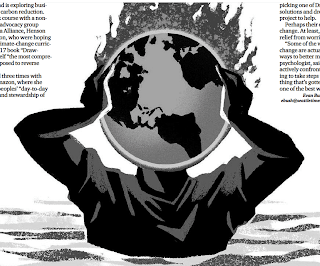
Courtesy of the Seattle Times
Among certain vulnerable people in our region, talk of eco-grief and anxiety has become signs of psychological crises. The UW Bothell has entire class given over to eco-grief, and non-profits like Climate Action Families have sessions for folks that are paralyzed with fear and grief over climate change. Some local Seattle therapists are specializing in climate grief therapy, and even the UW has sessions for students:

Unbelievably, even the Pacific Science Center is doing a session on dealing with eco-anxiety (see below).
But why stop at the borders of Seattle? Major media from the Guardian to the NY Times are covering climate anxiety, with anxiety-racked climate stars like Greta Thunberg are tearfully describing how their dreams and their childhood have been stolen by climate change.

I have gotten so many calls and emails from desperate folks I can’t list them here. One woman tearfully told me her mother was desperately ill in California, but she couldn’t move to be with her because she was afraid of the effects of climate change in that state. Another woman called, terribly worried about fires in western Washington from global warming. A few others asked about where they should move to escape our local apocalyptic conditions.
Global warming is a very serious issue, but most of the impacts are in the future. There is much we can do to address global warming, both in terms of adaptation and mitigation. There is, in fact, much reason for optimism.
So why are all these people so anxiety-ridden and desperate? I believe it is the unconscionable exaggeration, hype, and fear-mongering of our media, special interest groups, some activist scientists, and a number of politicians. And it is unethical, ungrounded in science, and hurting the most vulnerable among us.
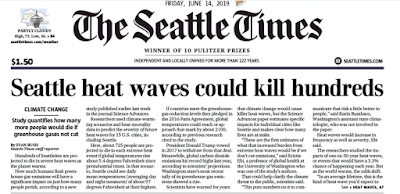
The Seattle Times is one of the worst offenders. I can provide a few dozen example of fear-mongering headlines, completely adrift from the truth. Like the June story claiming heat waves will claim hundreds of lives (actually 725) for each heat wave later in century (see below). It was complete nonsense, with extreme assumptions about warming rates and assuming no one would buy an air conditioner.
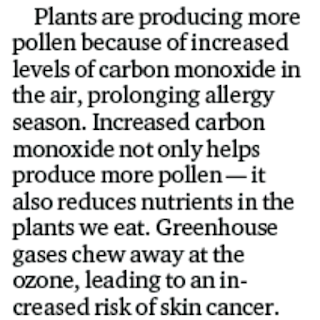
By the way, the stories in the Seattle Times are so confused, they can’t event get the key facts right, with one claiming carbon monoxide, not carbon dioxide is the problem (I kid you not, proof below).
So the Seattle Times is both producing exaggerated, fear-inducing stories and covering the psychological damage those stories are creating. Is there something wrong here?
Stories in a number of media outlets, amplified by special interest groups, talk about “tipping points”, and that it will be too late in 1, 10 or 12 years. No hope after that. Unfounded in the science. And enough to push some emotionally sensitive people over the edge.

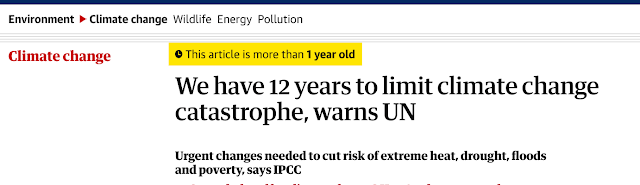
Here in the Washington State there are claims that recent fires are the result of climate change, and that it is about to get even worse. The truth is very different– there used to be MANY more wildfires in our region and the relationship of our fires with climate variations is very weak. But that hasn’t stopped irresponsible politicians from claiming just the opposite.
And, of course, there is all this talk about existential threats (yes, the means threats to your EXISTENCE), which have no support in the reports of the international scientific community (the IPCC) or the U.S. Climate Assessment. They predict a minor reduction in the future GDP, no more.
I could do ten blogs on this topic, but I won’t. The truth is that some very irresponsible folks are hyping and exaggerating the impacts of the minor global warming we have had so far, sending vulnerable folks into a panic. And these irresponsible folks and individuals are painting an apocalyptic view of the future that is completely at odds with the best science. Some do it for more money (advertising clicks), some do it for political reasons, and others like the attention.
But it is just wrong, and the harm they are doing to members of our community is substantial and unconscionable.
Newsweek reporter resigns after accusing outlet of SUPPRESSING story about OPCW leak
RT | December 8, 2019
A reporter for Newsweek says he has quit his job after his editor allegedly refused to publish an article about an internal email that raises serious questions about the OPCW’s findings on an alleged gas attack in Douma, Syria.
“Yesterday I resigned from Newsweek after my attempts to publish newsworthy revelations about the leaked OPCW letter were refused for no valid reason,” Tareq Haddad tweeted out on Saturday.
The recently-leaked document contradicts key conclusions in a report by the Organization for the Prohibition of Chemical Weapons (OPCW), about the April 2018 chemical weapons attack in Douma. The incident was blamed on Damascus and was used by the US and its allies to justify airstrikes against Syrian military installations.
The email, sent by an OPCW inspector who participated in the Douma probe, outlines several instances in which facts discovered by his team had been distorted or suppressed in the OPCW’s draft report, resulting in “an unintended bias” in the resulting text.
In a series of follow-up tweets, the former Newsweek journalist said that he had “collected evidence of how they suppressed the story,” adding that he also had evidence that the outlet had cut material, in a separate incident, because the information was “inconvenient to the US government” – even though it was factually correct.
Tareq claims that he was threatened with legal action after he’d asked his editor why his story about the damning leak had been refused.
Since making the announcement, the now-unemployed reporter has received accolades for his journalistic integrity. His story has also caught the attention of several prominent journalists, including Mail on Sunday columnist Peter Hitchens, who has been a fierce critic of western media’s coverage of the Douma attack.
While media outlets rushed last year to blame Damascus for the attack, the leaked email – as well as some troubling revelations from an OPCW whistleblower – have been almost completely ignored by the western press.
The Douma Hoax: Anatomy of a False Flag
Corbett • 12/07/2019
As whistleblowers and documents continue to destroy the narrative surrounding the alleged chemical weapons attack in Douma, Syria last year, it is becoming increasingly apparent that this false flag event has been exposed. This week on The Corbett Report podcast, James goes through the remarkable timeline of the Douma hoax and breaks the spell that the propagandists have sought to cast on the public.
For those with limited bandwidth, CLICK HERE to download a smaller, lower file size version of this episode.
For those interested in audio quality, CLICK HERE for the highest-quality version of this episode (WARNING: very large download).
Watch this video on BitChute / Minds.com / YouTube or Download the mp4
SHOW NOTES
Colin Powell’s Presentation to the UN Security Council On Iraq’s WMD Program
Cutting through media propaganda on the battle for Syria’s Eastern Ghouta
Syria crisis: Saudi Arabia to spend millions to train Jaysh al-Islam terrorists
Young children treated in suspected chemical attack in Douma, Syria
Trump blames “animal Assad” for atrocity
United States Assessment of the Assad Regime’s Chemical Weapons Use
U.S. and allies warn Syria of more missile strikes if chemical attacks used again
Statement by President Trump on Syria
The search for truth in the rubble of Douma – and one doctor’s doubts over the chemical attack
OPCW interim report (July 2018)
BBC producer: Footage of 2018 Douma chemical attack fabricated
OPCW final report (March 2019)
Leaked OPCW Report Raises New Questions About 2018 Chemical Attack in Douma, Syria
OPCW internal communique on leak
The OPCW and Douma: Chemical Weapons Watchdog Accused of Evidence-Tampering by Its Own Inspectors
PETER HITCHENS: My secret meeting with mole at the heart of The Great Poison Gas Scandal
Chemical weapons watchdog OPCW defends Syria report as whistleblower claims bias
7 (Bellingcat) Emails And Reading Comprehension: OPCW Douma Coverage Misses Crucial Facts
Narrative Managers Faceplant In Hilarious OPCW Scandal Spin Job
Fox News interview with Tucker Carlson
Bellingcat or Guard Dog for the Establishment?
Douma Videos and Photos analysis by Steven McItnyre
How the OPCW’s investigation of the Douma incident was nobbled
Iranian Unrest: Cover-Up Of Mass Killings Or Infowar Conspiracy?
By Andrew Korybko | December 5, 2019
The Mainstream Media is pushing forth the weaponized narrative that the Iranian government is carrying out a cover-up of mass killings that supposedly occurred during its recent unrest, though this is nothing more than an infowar conspiracy.
Amnesty International scandalously cited unpublished and vaguely described “credible reports” to claim that over 200 people were killed during Iran’s recent unrest, adding that “the real figure is likely to be higher”. This accusation is part and parcel of the renewed Hybrid War on Iran that’s seeking to capitalize on the failed Color Revolution attempt from last month when tens of thousands of people took to the streets to protest the government’s decision to decrease fuel subsidies in order to fund a cash payment plan to the country’s most needy families. It should be said that the majority of the people who participated in these large-scale protests didn’t engage in acts of violence, but their presence at these events inadvertently served as cover for a select cadre of professional provocateurs and foreign intelligence agents to carry out attacks against law enforcement officers and public property by exploiting those people as human shields behind which to hide.
As the author wrote at the time, “Iran’s Protests Are Grassroots, Not Foreign-Driven, And That’s The Real Problem”, while also later warning in an exclusive interview with Iran’s “Young Journalists Club” that Iran is being victimized by a US Hybrid War. These two analyses might initially seem mutually exclusive but they aren’t. Legitimate grievances served to spontaneously bring a critical mass of protesters into the streets, during which time the vast majority of the participants were unwittingly turned into human shields by Hybrid War “sleeper cells” that were waiting for an opportunistic moment to carry out anti-state terrorist activities such as the ones that were previously described. The Iranian authorities ultimately prevailed in restoring law and order, though it’s presumed that some of the most radical provocateurs might have been injured or even killed throughout the course of these security operations, which could naturally occur in any country facing similar unrest.
The US and its regional allies who support the forces responsible for the recent violence desperately wanted to film, selectively edit, and then propagate decontextualized footage of those individuals clashing with the state so that they could then present this as so-called “evidence” that Iran is “killing unarmed protesters”, hoping that this infowar conspiracy would make the majority of the non-violent citizens that participated in the protests suspicious of the state as well as further discredit the country’s international reputation. That plan failed, so now the back-up one is to still make this claim regardless of any fabricated “evidence” and strongly hint that the reason that there isn’t any is because Iran cut off the internet during its “crackdown”. While criticized by some at the time, it was actually a very wise move for the state to do so in order to offset the exact same scenario that was just described, though it unwittingly fed into the US’ back-up infowar narrative.
Even so, that doesn’t mean that it was the wrong thing to do since the benefits of preventing further provocations during that very sensitive time far outweigh the “costs” of having Iran’s adversaries conspiratorially claim without any fabricated “evidence” that the security forces “killed hundreds of innocent protesters”. In terms of the bigger picture, it’s much better to decisively nip the Color Revolution unrest in the bud and deal with unsubstantiated claims from self-interested international forces than to be too afraid of being criticized for cutting off the internet and then having to face the consequences of those same actors fabricating “evidence” to back up their preplanned provocative claims that “hundreds of innocent protesters were killed”. Considering all of this, there isn’t any credence to the West’s accusations that Iran is carrying out a cover-up of mass killings during its recent unrest as these claims are nothing more than an infowar conspiracy.
US not sending 14,000 troops to Mideast: Pentagon
Press TV – December 5, 2019
The Pentagon has denied a report concerning the expansion of US military presence in the Middle East.
The denial came in reaction to an article published in the Wall Street Journal on Wednesday.
The paper claimed that Washington was weighing the deployment of fourteen-thousand additional troops and a dozen of naval vessels in the region, to counter alleged threats from Iran.
A Pentagon spokesman, however, said that they were not considering sending additional troops to the Middle East.
“To be clear, the reporting is wrong. The U.S. is not considering sending 14,000 additional troops to the Middle East,” Alyssa Farah tweeted.
A Second Whistle Blown on the OPCW’s Doctored Report
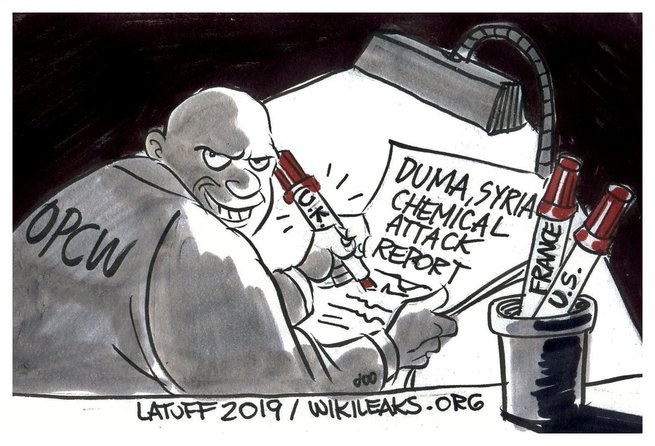
By Jeremy Salt | American Herald Tribune | December 3, 2019
Another whistleblower leak has exposed the fraudulent nature of the Organization for the Prevention of Chemical Weapons (OPCW) report on the alleged chemical weapons attack in the Syrian city of Douma, close to Damascus, on April 7 last year.
The first leak came from the Fact-Finding Mission’s engineering sub-group. After investigating the two sites where industrial gas cylinders were found in Douma and taking into account the possibility that the cylinders had been dropped from the air it concluded that there was a “higher probability” that both cylinders were placed at both sites by hand. This finding was entirely suppressed in the final report.
The engineering sub-group prepared its draft report “for internal review” between February 1-27, 2018. By March 1 the OPCW final report had been approved, published and released, indicating that the engineers’ findings had not been properly evaluated, if evaluated at all. In its final report the OPCW, referring to the findings of independent experts in mechanical engineering, ballistics and metallurgy, claimed that the structural damage had been caused at one location by an “impacting object” (i.e. the cylinder) and that at the second location the cylinder had passed through the ceiling, fallen to the floor and somehow bounced back up on to the bed where it was found.
None of this was even suggested by the engineers. Instead, the OPCW issued a falsified report intended to keep alive the accusation that the cylinders had been dropped by the Syrian Air Force.
Now there is a second leak, this time an internal email sent by a member of the Fact-Finding Mission (FFM) on June 22, 2018, to Robert Fairweather, the British career diplomat who was at the time Chief of Cabinet at the OPCW, and copied to his deputy, Aamir Shouket. The writer claims to have been the only FFM member to have read the redacted report before its release. He says it misrepresents the facts: “Some crucial facts that have remained in the redacted version have morphed into something quite different from what was originally drafted.”
The email says the final version statement that the team “has sufficent evidence to determine that chlorine or another reactive chlorine-containing chemical was likely released from the cylinders is highly misleading and not supported by the facts.” The writer states that the only evidence is that some samples collected at locations 2 and 4 (where the gas cylinders were found) had been in contact with one or more chemicals that contain a reactive chlorine atom.
“Such chemicals,” he continues, “could include molecular chlorine, phosgene, cyanogen chloride, hydrochloric acid, hydrogen chloride or sodium hypochlorite (the major element in household chlorine-based bleach.” Purposely singling out chlorine as one of the possibilities was disingenuous and demonstrated “partiality” that negatively affected the final report’s credibility.
The writer says the final report’s reference to “high levels of various chlorinated organic derivatives detected in environmental samples” overstates the draft report’s findings. “In most cases” these derivatives were present only in part per billion range, as low as 1-2 ppb, which is essentially trace qualitiea.” In such microscopic quantities, detected inside apartment buildings, it would seem, although the writer only hints at the likelihood, that the chlorine trace elements could have come from household bleach stored in the kitchen or bathroom.
The writer notes that the original draft discussed in detail the inconsistency between the victims’ symptoms after the alleged attack as reported by witnesses and seen on video recordings. This section of the draft, including the epidemiology, was removed from the final version in its entirety. As it was inextricably linked to the chemical agent as identified, the impact on the final report was “seriously negative.” The writer says the draft report was “modified” at the behest of the office of Director-General, a post held at the time by a Turkish diplomat, Ahmet Uzumcu.
The OPCW has made no attempt to deny the substance of these claims. After the engineers’ report made its way to Wikileaks its priority was to hunt down the leaker. Following the leaking of the recent email, the Director-General, Fernando Arias, simply defended the final report as it stood.
These two exposures are triply devastating for the OPCW. Its Douma report is completely discredited but all its findings on the use of chemical weapons in Syria must now be regarded as suspect even by those who did not regard them as suspect in the first place. The same shadow hangs over all UN agencies that have relied on the OPCW for evidence, especially the UN’s Independent International Commission of Inquiry on the Syrian Arab Republic, an arm of the OHCHR (Office of the High Commissioner for Human Rights).
This body is closely linked to the OPCW and while both mostly hide the sources of their information it is evident that where chemical weapons allegations have been made, the commission of inquiry has drawn on the OPCW.
As of January 2018, the commission reported on 34 “documented incidents” of chemical weapons use by various parties in Syria. It held the Syrian government responsible for 23 of them and, remarkably, did not hold the armed groups responsible even for one, despite the weight of evidence showing their preparation and use of such weapons over a long period of time.
The commission has made repeated accusations of chlorine barrel bombs being dropped by government forces. On the worst of the alleged chemical weapons attacks, on August 21, 2013, in the eastern Ghouta district just outside Damascus, it refers to sarin being used in a “well-planned indiscriminate attack targetting residential areas [and] causing mass casualties. The perpetrators likely had access to the Syrian military chemical weapons stockpile and expertise and equipment to manipulate large amounts of chemical weapons.”
This is such a travesty of the best evidence that no report by this body can be regarded as impartial, objective and neutral. No chemical weapons or nerve agents were moved from Syrian stocks, according to the findings of renowned journalist Seymour Hersh. The best evidence, including a report by Hersh (‘The Red Line and the Rat Line,’ London Review of Books, April 17, 2014), suggests a staged attack by terrorist groups, including Jaysh al Islam and Ahrar al Sham, who at the time were being routed in a government offensive. The military would have had no reason to use chemical weapons: furthermore, the ‘attack’ was launched just as UN chemical weapons inspectors were arriving in the Syrian capital and it is not even remotely credible that the Syrian government would have authorized a chemical weapons attack at such a time.
Even the CIA warned Barack Obama that the Syrian government may not have been/probably was not responsible for the attack and that he was being lured into launching an air attack in Syria now that his self-declared ‘red line’ had been crossed. At the last moment, Obama backed off.
It remains possible that the victims of this ‘attack’ were killed for propaganda purposes. Certainly, no cruelty involving the takfiri groups, the most brutal people on the face of the planet, can be ruled out. Having used the occasion to blame the Syrian government, the media quickly moved on. The identities of the dead, many of them children, who they were, where they might have been buried – if in fact they had been killed and not just used as props – were immediately tossed into the memory hole. Eastern Ghouta remains one of the darkest unexplained episodes in the war on Syria.
The UN’s Syria commission of inquiry’s modus operandi is much the same as the OPCW’s. Witnesses are not identified; there is no indication of how their claims were substantiated; the countries outside Syria where many have been interviewed are not identified, although Turkey is clearly one; and where samples have had to be tested, the chain of custody is not transparent.
It is worth stepping back a little bit to consider early responses to the OPCW report on Douma. The Syrian government raised a number of questions, all of them fobbed off by the OPCW. Russia entered the picture by arranging a press conference for alleged victims of the ‘attack’ at the OPCW headquarters in the Hague. They included an 11-year-old boy, Hassan Diab, who said he did not know why he was suddenly hosed down in the hospital clinic, as shown in the White Helmets propaganda video.
All the witnesses dismissed claims of a chemical weapons attack. Seventeen countries (Australia, Bulgaria, Canada, the Czech Republic, Denmark, Estonia, France, Germany, Iceland, Italy, Latvia, Lithuania, the Netherlands, Poland, Slovakia, the United Kingdom and the US) then put out a joint statement (April 26, 2018) expressing their full support for the OPCW report and dismissing the “so-called” information session at the Hague as a Russian propaganda exercise. Their statement claimed the authenticity of the information in the OPCW report was “unassailable.”
Russia followed up with a series of questions directed at the OPCW’s technical secretariat. It noted that the OPCW report did not mention that samples taken from Douma were “split” in the OPCW’s central laboratory in the Netherlands and not in the Syrian Arab republic. Fractions of samples were handed to Syria only after six months of insistent pressure (OPCW response: its terms of reference provided for Syria to be provided with samples “to the extent possible” but do not specify when or where samples should be ‘split’).
Russia also referred to the collection of 129 samples and their transfer to OPCW-designated laboratories. 31 were selected for the first round of analysis and an additional batch of 13 sent later. Of the 129 samples 39 were obtained from individuals living outside territory controlled by the Syrian army. Of 44 samples analyzed 33 were environmental and 11 biomedical: of the 44, 11 (four environmental and seven biomedical) were obtained from alleged witnesses.
As remarked by the Russian Federation, the OPCW report does not explain the circumstances in which these samples were obtained. Neither is there any information on the individuals from whom they were taken; neither is there any evidence demonstrating compliance with the chain of custody (OPCW response: there was respect for the chain of custody, without this being explained; the “standard methodology” in collecting samples was applied, without details being given. It stressed the need for privacy and the protection of witness identities).
Russia observed that the samples were analyzed in two unnamed OPCW laboratories and on the evidence of techniques and results, it raised the question of whether the same laboratories had been used to investigate earlier ‘incidents’ involving the alleged use of chlorine. Of the 13 laboratories that had technical agreements with the OPCW, why were samples analyzed at only two, apparently the same two as used before? Russia also observed that of the 33 environmental samples tested for chlorinated products, there was a match (bornyl chloride) in only one case.
Samples taken from location 4, where a gas cylinder was allegedly dropped from the air, showed the presence of the explosive trinitrotoluene, leading to the conclusion that the hole in the roof was made by an explosion and not by a cylinder falling through it (OPCW response: the Fact-Finding Mission did not select the labs and information about them is confidential. As there had been intense warfare for weeks around location four, the presence of explosive material in a broad range of samples was to be expected but this did not – in the OPCW view – lead to the conclusion that an explosion caused the hole in the roof).
Russia pointed out that the FFM interviewed 39 people but did not interview the actual witnesses of the ‘incident’ inside the Douma hospital who appeared and were easily identifiable in the staged videos (OPCW response: the secretariat neither confirms nor denies whether it interviewed any of the witnesses presented by Russia at the OPCW headquarters “as any statement to that effect would be contrary to the witness protection principles applied by the secretariat”).
Russia also pointed out the contradictions in the report on the number of alleged dead. In one paragraph the FFM says it could not establish a precise figure for casualties which “some sources” said ranged between 70 and 500. Yet elsewhere “witnesses” give the number of dead as 43 (OPCW response: the specific figure of 43 was based on the evidence of “witnesses” who claimed to have seen bodies at different locations).
Russia also pointed out that no victims were found at locations 2 and 4, where the ventilation was good because of the holes in the roof/ceiling. Referring to location 2, it asked how could chlorine released in a small hole from a cylinder in a well-ventilated room on the fourth floor have had such a strong effect on people living on the first or second floors? (OPCW response: the FFM did not establish a correlation between the number of dead and the quantity of the toxic chemical. In order to establish such a correlation, factors unknown to the FFM – condition of the building, air circulation and so on – would have had to be taken into account. It does not explain why this was not attempted and how it could reach its conclusions without taking these “unknown factors” into account).
Finally, Russia raised the question of the height from which the cylinders could have been dropped. It referred to the lack of specific calculations in the OPCW report. The ‘experts’ who did the simulation did not indicate the drop height. The charts and diagrams indicated a drop height of 45-180 meters. However, Syrian Air Force helicopters do not fly at altitudes of less than 2000 meters when cruising over towns because they would come under small arms fire “at least” and would inevitably be shot down.
Furthermore, if the cylinders had been dropped from 2000 meters, both the roof and the cylinders would have been more seriously damaged (OPCW response: there were no statements or assumptions in the FFM report on the use of helicopters or the use of other aircraft “or the height of the flight. The FFM did not base its modeling on the height from which the cylinders could have been dropped. “In accordance with its mandate,” the FFM did not comment on the possible altitude of aircraft. The OPCW did not explain why these crucial factors were not taken into account).
In its conclusion, Russia said there was a “high probability” that the cylinders were placed manually at locations 2 and 4 and that the factual material in the OPCW report did not allow it to draw the conclusion that a toxic chemical had been used as a weapon. These conclusions have now been confirmed in the release of information deliberately suppressed by the OPCW secretariat.
As the leaked material proves, its report was doctored: by suppressing, ignoring or distorting the findings of its own investigators to make it appear that the Syrian government was responsible for the Douma ‘attack’ the OPCW can be justly accused of giving aid and comfort to terrorists and their White Helmet auxiliaries whom – the evidence overwhelmingly shows – set this staged ‘attack ’up.
Critical evidence ignored by the OPCW included the videoed discovery of an underground facility set up by Jaysh al Islam for the production of chemical weapons. All the OPCW said was that the FFM inspectors paid on-site visits to the warehouse and “facility” suspected of producing chemical weapons and found no evidence of their manufacture. There is no reference to the makeshift facility found underground and shown in several minutes of video evidence.
Since the release of the report, the three senior figures in the OPCW secretariat have moved/been moved on. The Director-General at the time, Hasan Uzumlu, a Turkish career diplomat, stepped out of the office in July 2018: Sir Robert Fairweather, a British career diplomat and Chief of Cabinet at the OPCW, was appointed the UK’s special representative to Sudan and South Sudan on March 11, 2019: his deputy, Aamir Shouket, left the OPCW in August 2018, to return to Pakistan as Director-General of the Foreign Ministry’s Europe division. The governments which signed the statement that the evidence in the OPCW report was “unassailable” remain in place.
Jeremy Salt has taught at the University of Melbourne, Bosporus University (Istanbul) and Bilkent University (Ankara), specialising in the modern history of the Middle East. His most recent book is “The Unmaking of the Middle East. A History of Western Disorder in Arab Lands” (Berkeley: University of California Press, 2008.)
Linguist Refutes MSNBC Host Maddow’s Defense in ‘Russian Propaganda’ Defamation Suit
Sputnik – December 4, 2019
A Santa Barbara linguist may have just dealt the coup de grace to MSNBC anchor Rachel Maddow’s legal defense in a suit brought against her by One America News (OAN) alleging defamation when she claimed the network “really literally is paid Russian propaganda.”
“Maddow did not use any typical opinion-markers when she stated that OAN ‘really literally is paid Russian propaganda,’” Amnon Siegel, a lawyer for OAN owner Herring Networks, wrote in response to a motion to throw out the suit made by Maddow’s lawyers in late October.
Siegel retained UC Santa Barbara linguistics professor Stefan Thomas Gries, one of the most widely cited cognitive linguists in the world, as an expert witness for the legal filing, reported the Times of San Diego, which broke the story Monday.Noting that Maddow consistently uses markers such as “I mean” and “I guess,” as well as changes in intonation to distinguish her opinions from facts, Gries said in the filing that “there are virtually no lexical, grammatical, or intonational characteristics” that would lead viewers to conclude her statement was an opinion.
“In a highly-structured and transparent way, Maddow separates informational/factual reporting and opinion in a way that marks it as factual,” he noted. “It is very unlikely that an average or reasonable/ordinary viewer would consider the sentence in question to be a statement of opinion.”
“She is a graduate of Stanford and Oxford Universities and a Rhodes Scholar,” Siegel said of Maddow. Noting that misusing the word “literally” isn’t in the reporter’s repertoire, Siegel pointed out that ”on the show, Maddow regularly uses ‘literally’ in its primary meaning,” providing several supporting examples.According to the Times, Siegel supplied Merriam-Webster Online Dictionary definitions of “really” and “literally” as supporting evidence in his filing, alongside nearly three dozen references to state and federal courts citations and statutes.
In the segment in question, which aired on July 22, 2019, the MSNBC host blasted OAN for employing Kristian Brunovich Rouz, a former contributor to Sputnik News and a perennial favorite target for Maddow’s Russiagate crusade. Herring lawyers brought the $10 million suit in September.
Maddow lawyer Theodore J. “Ted” Boutrous Jr. has tried to parry the accusations by claiming his client’s use of the word “literally” was “a quintessential statement ‘of rhetorical hyperbole, incapable of being proved true or false.’”
Herring President Charles Herring also said in a declaration attached to Siegel’s response that the network was unaware of Rouz’s prior employment at Sputnik and that “neither Maddow nor anyone from Comcast Corporation, NBCUniversal Media, LLC, or MNSBC Cable LLC [sic]” had sought out answers from his company or OAN before airing the segment in question.
“Neither OAN nor Herring Networks has ever received money from Russia or the Russian government, and none of OAN’s content is influenced by Russians or the Russian government,” Herring said. “In fact, Herring Networks is exclusively financed by the Herring Family and has never received outside investment.”
Defence Ministry Dismisses NYT Report on Russia ‘Bombing’ Syrian Refugee Camp in August
Sputnik – December 2, 2019
The NYT wrote 1 December that “eyewitness photos and videos, flight logs and cockpit tapes obtained by The Times enabled reporters to trace an airstrike on a Syrian camp for displaced families to a Russian pilot.”
The Russian Defence Ministry dismissed a report by The New York Times (NYT) about Russia’s Aerospace Forces’ alleged bombing of a Syrian refugee camp in August.
“Like a month and a half ago, the ridiculous accusations by the authors of the fake are based on a video of unknown origin with swindlers from the White Helmets against the backdrop of buildings of the ‘refugee camp’; pictures of the blue sky in which a Russian plane was supposed to be and fragments of Russian phrases, allegedly belonging to the Russian Aerospace Forces pilots”, ministry spokesman Maj. Gen. Igor Konashenkov said.
Konashenkov added that to the disappointment of those who ordered the fake, the ministry is forced to recall again that the transfer of the coordinates of targets to the pilots of Russian bombers or reports on the fulfilment of their tasks are not carried out by voice on the air openly.
The comment comes as the NYT ran an article claiming that a Russian pilot conducted an airstrike on a refugee Syrian camp.
Russia’s Role in Syria
Since 2017, Russia has been one of the three guarantors of the ceasefire in Syria, which has been engulfed in a civil war for years. The Russian armed forces have been providing military assistance to Damascus throughout the conflict, while also carrying out regular humanitarian operations across the country.
Russia is now assisting Syria in the post-war reconstruction and the return of refugees.
The Russian military police are currently engaged in patrolling Syria’s provinces of Aleppo and Raqqa along the border with Turkey as part of the Russia-Turkey deal over the buffer zone in northern Syria.
Following talks between Russian President Vladimir Putin and Turkish President Recep Tayyip Erdogan, a Russian-Turkish memorandum was signed on 22 October in Russia’s Sochi, which stipulates conditions for the peaceful withdrawal of Kurdish militants in Syria to a distance of 30 kilometres (18.6 miles) from the border with Turkey.
The 10-point document envisions a variety of patrol missions carried out by the Russian military contingent in Syria, Syrian border guards, and Turkish troops in order to ensure the implementation of the deal.
Featured Video

The Most Important Bet You’ve Never Heard Of
or go to
Aletho News Archives – Video-Images
From the Archives
Wars for Israel: A reminder of who’s giving the marching orders
By Damian Lataan | February 7, 2012
As the West prepares to march off to yet another war in the Middle East, we should perhaps remind ourselves of who is giving the West their marching orders.
In February 2003, just weeks before the US and their allies launched their attack on Iraq and her peoples, a delegation of US congressmen, together with the US Ambassador to the United Nations, John Bolton, a well known pro-Zionist and neoconservative war-hawk, were in Israel at the invitation of the Israeli government then led by Israeli Prime Minister Ariel Sharon.
Addressing the congressmen, Sharon told them ‘that Iran, Libya and Syria should be stripped of weapons of mass destruction after Iraq’. Later, Sharon told John Bolton ‘that Israel was concerned about the security threat posed by Iran, and stressed that it was important to deal with Iran even while American attention was focused on Iraq’. … continue
Blog Roll
 Aletho News
- UAE rejects report claiming it is ready to join war on Iran to reopen Hormuz
- A New Resistance Front: How Does Syria Factor into the Regional War?
- Gulf states weigh pipeline expansion plans, hoping to bypass Hormuz
- Iran sets up ‘tollbooth’ system in Strait of Hormuz
- Wave 90: IRGC strikes US-linked industrial sites in Gulf
- Iran Says US-Israeli Claims of Its Military Strength Are Wrong
- Trump’s April Fools’ Address to the nation
- The Most Important Bet You’ve Never Heard Of
- The killing of three Indonesian soldiers in Lebanon should remind Jakarta that Israel does not want peace
- Defeated and delusional: Netanyahu’s remarks reveal $80bn war failure, says analyst
- If Americans Knew
- ‘War crime’: Global condemnation as Israeli ministers celebrate death penalty law targeting Palestinian prisoners
- 7 Ways Israel Is Turning Lebanon Into Gaza
- World’s Leading Football Bodies Under Fire Over Israel Policies
- Experts warn of possible use of nukes against Iran
- Israeli invasion of Lebanon could be worse than 1982, warn European officials
- Passover: Liberation and collective punishment
- Trump says the quiet part out loud: (Israel’s) war on Iran > Americans’ health – Daily Update
- Gaza families reunite years after babies evacuated amid Israel’s war
- International Rescue Committee warns Gaza’s children face grave protection risks
- Iran’s Alleged 47-Year War on America: Debunking the 1,050 American Deaths Canard
- No Tricks Zone
- Low Intensity Tornado Wrecks Major Solar Farm, Creating A Potential Toxic Dump
- New Study Finds Warming Saves Lives…Cold Temperatures 12 Times More Deadly Than Excess Heat
- German Science Blog Accuses PIK Climate Institute Of Hallucinating Climate Tipping Points
- Devastating Assessment Of Comirnaty Vaccine By Former Senior Pfizer Europe Toxicologist
- New Study: CO2 Is ‘Effectively Negligible’ As An Explanatory Climate Change Factor Since 2000
- Former Pfizer Toxicologist Dr. Helmut Sterz Tells Bundestag Hearing Pfizer Vaccine Should Have Never Been Approved
- Energy Expert: Germany’s Nuclear Phaseout Was A “500 Billion Euro Mistake”
- New Research: South Australia’s Mid-Holocene Sea Surface Temperatures Were 4°C Warmer Than Today
- Storing Green Energy To Last Germany 10 Days Would Require A 60-Million Tonne Battery
- New Studies: UK Sea Levels Were 4 Meters Higher Than Today During The Mid-Holocene
 Aletho News