To Ramp Up Fear of Russia in Africa, NYT Downplays Massive US Military Presence
By Adam Johnson – FAIR – April 4, 2019
The New York Times (3/31/19) added to its series of reports depicting Official Enemies surpassing the US in the race for global dominance. It seems that having taken control of the Arctic (FAIR.org, 9/15/15), the nuclear domain (FAIR.org, 3/7/18) and a whole host of other spaces the US is “behind” in, Russia is now gobbling up Africa—a threat the US, presumably, must counter with an even greater military build-up.
The report, “Russia’s Military Mission Creep Advances to a New Front: Africa,” by Eric Schmitt, asserting an uptick in Russian weapons contracts and military training exercises in Africa, is thin on context and hard numbers, but is artificially fortified with a series of anecdotes and frightening quotes. Since the obvious rejoinder to any discussion of increased Russian presence in Africa is, “OK, but what is the US’s current reach?” the Times hangs a lampshade on the inconvenience with this throwaway line:
The United States military has a relatively light footprint across Africa.
About 6,000 United States troops and 1,000 Defense Department civilians or contractors work on a variety of missions throughout Africa, mainly training and conducting exercises with local armies.
According to documents obtained by the Intercept’s Nick Turse (12/1/18), the US currently has 34 military bases in Africa; Russia has zero. The Times doesn’t tell us how many “contractors’ and “troops” Russia has in Africa, so it’s not clear what the so-called “light footprint” is “relative” to. Is it 10? 100? 10,000? If it’s a lot less than 6,000, then the story is a bit of a dud. Alas, we’re simply left guessing at the “relative” size of Russia’s Africa presence.
Also worth noting: “Light footprint” is the same Orwellian phrase the Pentagon has been using for years to obscure the growth of AFRICOM, as in this AFRICOM press release (6/13/12) :
AFRICOM Will Maintain Light Footprint in Africa — The United States has no plans to seek permanent bases in Africa, and, in the spirit of the new defense strategic guidance, will continue to maintain a “light footprint” on the continent, the top US Africa Command officer said.
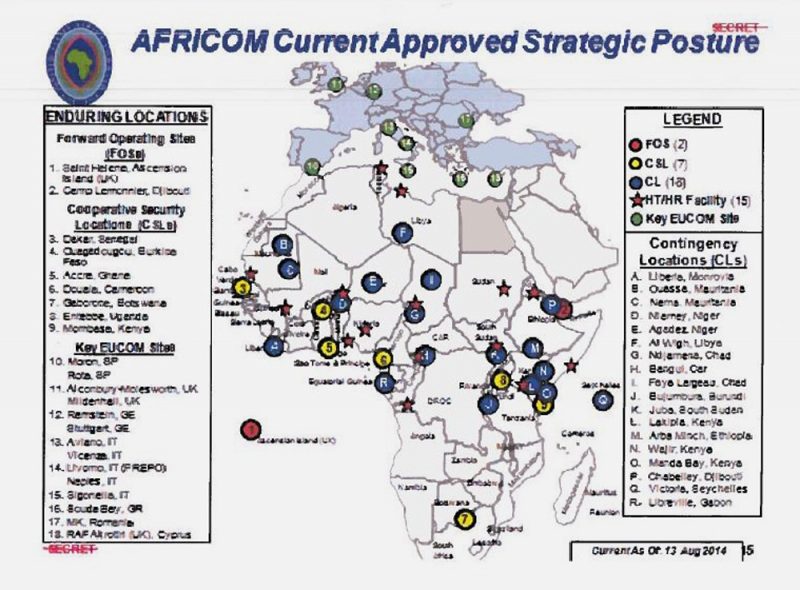
AFRICOM map of Africa, published by The Intercept (12/1/18). Note that in the Pentagon’s doubletalk, the US does not have “permanent bases” in Africa—it has “enduring locations.”
It’s always reassuring when the paper of record adopts the US government’s preferred press release language. (See also New York Times, 1/25/12 , 3/1/19.)
Aside from quotes from US military brass, Schmitt’s report was primarily propped up with testimony from weapons contractor-funded think tanks, namely the Institute for the Study of War and the Center for International and Strategic Studies, which both provided urgent, stakes-raising narratives:
Russia is seeking more strategic bases for its troops, including at Libyan ports on the Mediterranean Sea and at naval logistics centers in Eritrea and Sudan on the Red Sea, according to an analysis by the Institute for the Study of War, a research organization in Washington….
“Moscow and its private military contractors are arming some of the region’s weakest governments and backing the continent’s autocratic rulers,” said Judd Devermont, director of the Africa Program at the Center for Strategic and International Studies in Washington. “This engagement threatens to exacerbate current conflict zones.”
Panic over a creeping Russia menace in Africa is timed, not coincidentally, with congressional debate over the Defense budget, submitted by Trump two weeks ago. In addition, some congressional Democrats and Republicans are working to erode what little caps exist for the military budget, with a planned vote next week in the House for lifting limits on discretionary Defense spending.
Needless to say, the primary funders of the Center for Strategic and International Studies and Institute for Study of War—the think tanks whose juicy quotes and studies bolster the primary arguments of the articles’ premise—stand to make tens of billions in profit from both of these legislative efforts. Having the New York Times provide marketing collateral for these efforts is no doubt useful in convincing an increasingly war-weary public, and accordingly, war-wary Congress, to rubberstamp yet another record-setting Pentagon budget.
For hawkish arms industry-funded groups like CSIS, the answer is always to build more weapons systems and to paint enemy states in the most sinister light possible. One 2017 study by FAIR (5/8/17) found that while commenting on Korea, CSIS’s experts either explicitly backed its funder Lockheed Martin’s THAAD weapons system, or its central value proposition that it would ward off a hostile North Korea, 30 out of 30 times. There were zero examples of a CSIS rep downplaying a threat or arguing against more military spending. When asked in email to provide an example of CSIS saying any threat was exaggerated or advising against any kind of military spending increase, the CSIS spokesperson declined to comment.
The primary purpose of organizations like CSIS and ISW is to push the weapons systems of the corporations that fund them. Any analysis of their reports, studies or media appearances will show that at least 99 percent of the time, they come down on the side of hyping threats and pushing for the shiny new publicly funded instruments that would counter those threats.
This glaring conflict of interest, as usual, isn’t disclosed by the New York Times. A particularly strange omission, since it was the Times itself in 2016 that, citing leaked emails, argued (8/7/16) that CSIS was acting as a thinly veiled lobbyist for its weapons-maker funder General Atomics, and was, according to its own report, “blurring the line between researchers and lobbyists.”
“As a think tank, the Center for Strategic and International Studies did not file a lobbying report,” Eric Lipton and Brooke Williams reported, “but the goals of the effort were clear.”
They are clear indeed. Yet since that time, CSIS has continued to be the go-to source for analyzing global threats for the Times, without even a token disclosure.
Also as usual, the article went to no skeptical voices for any comment; the only sources sought were war makers and those funded by war makers. They all worked to paint a one-sided, cartoon picture of a Russian takeover of Africa, complete with the patented New York Times double standard of motives: Russia is said by Schmitt to be seeking “new economic markets and energy resources.” The United States? Simply there to provide “foreign aid” and “train and conduct exercises with local armies.” In the Times, the idea that the US would also be motivated by securing markets and resources would be tantamount to lizard people conspiracy theory talk. But for Russia, it’s simply taken for granted.
In the Times, Official Enemy threats are unquestionably bad and unquestionably sinister in nature. The only answer? Let the Pentagon gravy train run its course, year in and year out because invariably there will always be, with the help of the New York Times, the specter of an enemy threat “advancing on a new front.”
Reality check: CNN’s claim that Trump has been unwilling to confront Putin is total bulls**t
By Bryan MacDonald | RT | April 2, 2019
Fareed Zakaria is a veteran Putin conspiracy theorist. And you can assume he feels this obsession has helped further his career, especially at CNN.
Back in 2017, he made a pseudo-documentary on Russia’s president, titled “The most powerful man in the world,” which was widely pilloried. Indeed, the Kremlin labeled it “hysterical” and “odious,” and dismissed it as “often complete fiction.”
Russia expert Dominic Basulto summed it up as “what slick propaganda for the masses looks like in the digital era.” Further pointing out how Zakaria failed to disclose his own “Russian collusion” as a host at the 2016 St Petersburg Economic Forum. An appearance which didn’t go very well for the CNN anchor.
Over the past couple of years, Zakaria has been one of the loudest voices pushing the “Trump/Russia” hoax. But, instead of accepting reality after Robert Mueller’s report kiboshed the yarn, he doubled down. And his latest video is unhinged.
Dubbed ‘Fareed’s take,’ the segment’s blurb states “the real puzzle remains: Why has Trump been unwilling to confront Putin in any way on any issue? And will Venezuela be the moment when Trump finally ends his appeasement?” And note the use of the word “appeasement,” intended to ‘Chamberlain’ Trump.
Anyway, let’s not beat around the bush, the clip is complete bulls**t. President Trump has confronted Putin on many issues and their relationship has been hyper-adversarial. In the real world, of course, not the fantasy-land of American network TV.
The ways in which Trump has frustrated his Russian counterpart are myriad:
- He has withdrawn from the 1987 Intermediate-Range Nuclear Forces Treaty, citing Russian non-compliance – a charge the Kremlin rejects.
- Trump has accepted Montenegro into NATO and will probably add North Macedonia before his term is up. Both countries are in the Balkans, a traditional Russian sphere of influence.
- Under Trump, the US armed Ukraine with lethal weapons in 2017, a step his predecessor Barack Obama was reluctant to take.
- The US president expelled dozens of Russian diplomats last year in response to the alleged poisoning of a Russian spy, who defected to Britain. He also closed Russia’s consulate in Seattle (he’d already shuttered the San Francisco equivalent a year earlier).
- In the spring of 2018, Trump ordered airstrikes against Syria, Russia’s Middle Eastern ally, which Putin condemned “in the most serious way.”
- The Nord Stream 2 gas pipeline is a major piece of infrastructure for both Germany and Russia, and both countries have invested considerable energy in its completion. But Trump accuses Berlin of “paying billions of dollars into the coffers of Russia” adding how Germany is “totally controlled by Russia.” US media reported last month that Trump told German Chancellor Merkel: “Angela, you got to stop buying gas from Putin.”
- Russia has backed the government of Nicolas Maduro in Venezuela, which the Americans hope to remove. Just last week, Trump ‘ordered’ Russia to “get out” of Venezuela, despite the fact that they have been there under a treaty with Caracas.
So, there we go again, yet another CNN Russia-related falsehood debunked. If this carries on much longer, the once-respected channel might as well rebrand as “Conspiracy Network News.”
When Government Lies to You
By Donna Laframboise | Big Picture News | April 3, 2019
Fake news is everywhere, and governments can be a rich source. For example, a flyer distributed in the mail last week by Canada’s Revenue Agency – aka the taxman – tells us a pack of lies.
Against the will of elected leaders in four provinces, our federal government has just imposed a carbon tax. The price of gasoline has jumped at the pumps. Home heating costs have risen. This is just stage one, since the tax bite will increase every year.
The flyer begins by declaring:
Pollution has a cost. It impacts the air we breathe, our children’s health, and our economy. That’s why the Government of Canada has put a price on carbon pollution.
What nonsense. Carbon taxes are supposed to discourage people from burning fossil fuels not because of dirty black soot (sophisticated, anti-pollution technologies already exist), but because an invisible, odourless gas gets emitted whenever fossil fuels are used.
The entire climate scare rests on the idea that humanity is adding too much carbon dioxide – CO2 – to the atmosphere, and that this will hypothetically destabilize the climate.
Now is a good time to point out that the Canadian government admits this country is responsible for a mere 1.6 percent of global CO2 emissions. Between them, China (26 percent), America (14 percent), and India (6.4) are responsible for nearly half of all human-produced CO2 (46 percent).
It’s also a good time to remember that, over the past 50 years, experts have predicted one environmental catastrophe after another, none of which materialized. Even smart scientists with powerful computers are terrible at forecasting the future.
The flyer says this measure is all about fighting pollution. But CO2 wasn’t pollution when Al Gore called it that. It wasn’t pollution when Barack Obama called it that. And it isn’t pollution now.
As we all learned in Biology 101, bears, bunnies, and humans all exhale CO2 – which is then absorbed by grass, flowers, and trees. Without CO2, there would be no plants. Without plants, there would be no oxygen for wildlife or humanity to breathe.
CO2 is therefore an integral part of the natural, virtuous circle of life. It does no harm to our air quality. It does no harm to our children’s health.
And whatever harm a climate crisis might one day inflict on Canada’s economy must surely be balanced against the genuine hardship being experienced right now.
Every time people near the bottom of the economic ladder fill up their car in order to get to work, they’re being punished. Every time they pay their heating bill they’re being penalized by their own government. That’s what carbon taxes do.
We can argue endlessly about whether more CO2 in the atmosphere will be perilous over the long term. But the ‘pollution’ angle is total hogwash, dreamed up by political sleazeballs.
A planet without CO2 would be a wasteland, bereft of both plants and animals. Calling CO2 pollution is therefore abjectly dishonest.
Let me say this one more time: If CO2 is pollution, every human being is a non-stop pollution factory. Your neighbour’s newborn. Your grandmother. That blind child.
What a sick, dangerous perspective on the world.
Deadly Dust: US Spreading Radiation and No One Wants to Raise the Issue – Author
Sputnik – April 3, 2019
In a new book named “Deadly Dust – Made in the USA: Uranium Weapons Contaminating the World” German author Frieder Wagner gives a detailed account of how the US has contaminated vast territories using depleted uranium (DU) ammunition and the cover-up strategy of the military, industry and governments, as well as those in the media and politics.
Sputnik: Mr Wagner, in your book “Deadly Dust — Made in the USA: Uranium Weapons Contaminating the World” you talk about the use of uranium ammunition. What is especially dangerous about these weapons?
Frieder Wagner: Weapons containing uranium are produced from nuclear industry’s waste (byproducts of uranium enrichment). If, for example, you want to produce a ton of natural uranium fuel rods for nuclear power plants, you get about eight tons of depleted uranium. It is a source of alpha radiation — radioactive and, moreover, very poisonous. It needs to be stored somewhere, and it is not very cheap.
Sputnik: How can it be used in weapons?
Frieder Wagner: About 30-40 years ago, military scientists made a discovery: uranium is almost twice as dense as lead. If you turn depleted uranium into a projectile and give it proper acceleration, then within a fraction of a second it will pierce through tank armor, concrete or cement.This, of course, was an important discovery. Furthermore, when a shell hits an armored tank the impact produces dust caused by the detonation and the subsequent release of heat energy causes it to ignite and it explodes at a temperature of 3000 to 5000 degrees — incinerating the tank’s interior and destroying it.
Sputnik: But what happens afterwards is also a problem — after the use of DU ammunition, isn’t it?
Frieder Wagner: Yes! After its use depleted uranium, which, as I have already said, is a source of alpha radiation (that is, a radioactive and very toxic substance), burns down to nano-particles that are a hundred times smaller than a red blood cell.
This way, I would say, a sort of metallic gas forms that people can inhale, and which is released in the atmosphere and can be carried anywhere by wind. People who inhale it are at risk for developing cancer.These nano-particles can also penetrate the body of a pregnant woman, overcoming the barrier between a child and a mother, and affect the health of an unborn baby, can infiltrate the brain and by travelling through the bloodstream end up in any human or animal organ. Everything that goes around the planet, sooner or later settles and, of course, contaminates, in particular, drinking water and everything else.
Sputnik: In what wars have DU weapons been used so far?
Frieder Wagner: It was actively used during the first Gulf war in 1991 against Iraq. The military has admitted that about 320 tons were used. Then in the second war in Iraq in 2003 over 2,000 tons were used. In between, it was used during the war in Kosovo, in Yugoslavia (1999), and in Bosnia in 1995, and after 2001 in Afghanistan, where it still used today.
Sputnik: Your book title says Made in the USA, were these weapons only used by the United States?
Frieder Wagner: They were being developed in several countries at the same time. In Germany, they were also working on these weapons, as, of course, in Russia. However, it was used and on such a large scale, only by the US. They were reckless and they did not pay attention to any possible side effects — just as it was back when the first atomic bombs were used. That’s why I called the book: “Deadly Dust — Made in the USA”.
Sputnik: How did you manage to prove the use of this ammunition in the course of your research?
Frieder Wagner: For example, the Serbs gave us maps where they showed the locations where depleted uranium was used. When we were in Iraq, we talked to the locals. We traveled to places where large tank battles took place and took soil samples there, as well as dust samples from tanks. Looking at the tank, you can see whether it was hit by an ordinary projectile or a uranium munition.
Uranium munition leaves dust that burns everything around the hole made by the projectile. So you can determine the use of uranium ammunition. In all soil samples, we found depleted uranium. Unfortunately, uranium-236 was also found in most of the soil and dust samples — it is even more intense and poisonous. Its radiation is even stronger and does not occur in nature. It can only be produced artificially during reprocessing of fuel rods. This means that we were able to prove that the military, the United States and its coalition allies used uranium munitions made from spent uranium fuel rods.
Sputnik: Your book is based on the films The Doctor, the Depleted Uranium, and the Dying Children of Basra (Der Arzt und die verstrahlten Kinder von Basra, 2004) and Deadly Dust (Todesstaub, 2007). What did you see in Basra during your work on the documentary?
Frieder Wagner: It was horrific and still sometimes haunts me in my dreams. These were children with deformities, which we saw in orphanages in Basra and Baghdad. Some of them had such deformities that they had almost nothing human anymore.
There were children without a head or a nose, either with one eye or without eyes at all, with internal organs in a kind of “sack” outside their body. These ‘creatures’ can live only for a few hours, experiencing terrible pain, and then die.
Sputnik: The film “Deadly Dust” is linked to the book, but it is no longer distributed. WDR channel after this film did not make any more orders? Why is that?
Frieder Wagner: My exposes which I sent to WDR, as well as to the ZDF channels were rejected. Then I contacted an editor at WDR, for which I always made good films and with which I always had good relations with, because these films had doubled or trippled their ratings, and asked him: “What’s going on here?”” And after some hesitation he said: “Yes, Frieder Wagner, someone must tell you this. WDR considers you a ‘difficult’ person. And most importantly, the topics you suggest are especially hard. Right now I’ve got nothing more to tell you.” And that’s when I understood everything. It was in 2005.
I can also tell you the story of how, for example, a female editor at ZDF offered the TV channel a story on the use of these weapons during the war in Yugoslavia and also in Croatia. She wanted to talk about it with me prior so I could share my experiences. But when her boss found out that she wanted to talk to Frieder Wagner, he refused to pay for her trip — without any further explanation.
Sputnik: The so-called “deadly dust” is, as you have already described it, is spread by the wind. So should the use of uranium ammunition, in fact, be considered a war crime and banned?
Frieder Wagner: This is definitely a war crime. The dust from southern Iraq is carried to the north by the constant storms, the so-called desert storms — for example, to Erbil, where it meets the mountains and can’t travel further as the mountains make it difficult for it to go past towards Turkey. So this huge mass of dust settles in Erbil.We, for example, took samples of beef from around Erbil, and this is what we found out: depleted uranium used in ammunition has a characteristic atomic “fingerprint”. In northern Iraq we found the same “uranium fingerprint” as in the south. This means that the uranium dust that had originally settled in the south of Iraq is now also in the north, and children are now getting sick there and are born with deformities. It is now spreading all over the world.
Sputnik: Have the victims of uranium munition use in Kosovo or, for example, in Iraq, tried to go to court?
Frieder Wagner: So far no such attempts have been made in Kosovo or Iraq. Now in Kosovo, a whole group of lawyers are working on a lawsuit against NATO, because after the war they unleashed, people were injured, fell ill and died. The morbidity rate has increased by 20 to 30 percent, and there are more effected each year. So there will be an attempt to file a lawsuit.
Out of the approximately two thousand Italian soldiers stationed in Iraq and Kosovo, 109 have later developed cancer and died — this is proven information. 16 families, out of the 109 dead, filed lawsuits and won their cases. The courts ordered the Italian state or the country’s Ministry of Defence to pay them compensation. Since each cancer was of a different type, the payout amounts differed. But they ranged between 200,000 and 1,4 million euros.
Sputnik: How are things in Germany? Have there been lawsuits filed by the soldiers of the Bundeswehr?
Frieder Wagner: The German Ministry of Defense constantly denies any connection to this. Our soldiers are stationed in Afghanistan and Kosovo. About 100,000 soldiers served in Afghanistan, and we found out that about 30% of those who returned got sick, although at first, of course, they do not notice this. If they subsequently marry and have children, then there’s a great risk that their children will have disabilities.These children will have the same toxic substances in their DNA as their parents. And this will be passed on for several generations — from children to grandchildren and to great-grandchildren.
Sputnik: But none of these people ever filed a lawsuit?
Frieder Wagner: In Germany there were no such precedents. About 600 servicemen went to court in the United States who could not appeal on their own behalf, but they filed lawsuits on behalf of their children who were born with developmental disabilities. And we’re not talking about a mere 90 or even 900 million pay out, but about billions of dollars now. The United States, of course, will try to delay the adoption of a ruling as much as it is possible and hope for a “biological” resolution of the situation — that is, that the plaintiffs will simply die.
From Bana to Neda to Genevieve: The Iconography of Turmoil
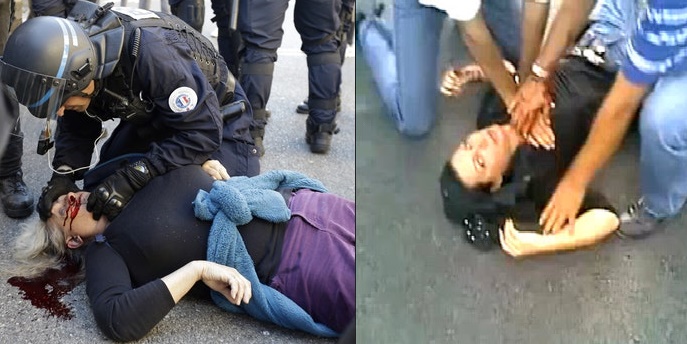
Genevieve Legay (L) and Neda Agha-Soltan (R)
By Hafsa Kara-Mustapha | American Herald Tribune | April 2, 2019
In the digital age, conflicts are sold to public opinion via powerful imagery, one that would be ingrained in the national consciousness and make for a solid casus belli.
More often than not they are of women or young girls who are presented as the victims of a brutal regime that only Western benevolence can save.
In Syria, a young girl called Bana Al Abed rapidly turned into the iconic figure of the Syrian crisis when she tweeted about the horrors of the conflict and the perils of life in a war zone.
She soon became the favorite of the celebrity Twitterati and was eventually hosted by Turkish leader Recip Tayep Erdogan, touring Western capitals and doing the talk show rounds before signing, with the help of her more eloquent mother, a lucrative book deal.
Her story precipitated Western intervention in Syria.
Before her, we’d been treated to Malaala Youzoufai, a young girl desperate to educate herself and fearlessly challenging Taliban brutality until they eventually shot her in the head but was saved by British doctors. Her face, now familiar to millions around the world thanks to her consequent fame, made Western presence in Afghanistan appear worthwhile despite its absolute failure in defeating the far less equipped Taliban.
After the talk show rounds, the book deals and the presentations at the UN she was eventually awarded half a Nobel peace prize for what appeared to be good services.
She has now entered adulthood and since she spoke out in defense of the children of Gaza has disappeared from public view.
In 2009, when the drum rolls were once again beating for war against Iran, it was the face of Neda Agha-Soltan that became the ‘poster victim’ of what was then dubbed the Green revolution.
Claims that this young woman had been shot by government forces turned her picture into the face of the rebellion.
Since it was claimed she’d been killed, it was no longer possible to invite her on the talk show circuit, instead, her face became the iconic imagery of the Middle Eastern turmoil of summer 2009.
Which brings us to Genevieve Legay.
Who? I hear you ask.
Legay is a 74-year-old French woman who was brutally pushed to the ground by French police forces during the weekly ‘Gilets Jaunes’ protests in France.
She fractured her skull and was left bleeding on the ground.
Though the disturbing images were broadcast in France, unlike those of brutalized people in other geographies, Legay’s was not transformed into the ‘iconic’ image of France’s protests.
She wasn’t invited on talk shows and the picture of her ashen face lying in a puddle of blood was not broadcast across the front pages of international media.
It’s been almost two weeks and her name is all but forgotten. No foreign head of state has invited her to discuss the brutality of the French regime.
No memes have been circulating on various social media with her face and an emotionally charged caption inviting viewers to sympathize with victims of French brutality.
There have been no twitter storms and George Clooney hasn’t waded into the controversy by condemning such violence.
It’s fair to say there will be no book deals or international prizes for Mizz Legay who is a victim but in the wrong context.
For victims of brutality to be accepted as such, they would have to be brutalized by a regime Western nations have decided was evil or at the very least evil enough.
Icons of ‘foreign’ brutality have to convey a message that aligns with the political agendas of Western powers.
It has to re-affirm in their public opinion’s mindset that state brutality is an alien, backward concept and that it only occurs far away.
For it to be considered relevant and newsworthy it has to serve a purpose, one of regime change or war or usually both.
When, however, such powerful imagery occurs in a Western setting, opinion shapers are destabilized.
What should they do? Can they avoid broadcasting the information when camera phones capture everything and everywhere?
The key is to report it but just not dwell on it.
The victim of whichever ‘tyrannical’ country is in the West’s bad books will become a household name, the one of Western tyranny will become a footnote in the news agenda.
For every war, unrest, protest in the third world we’ve had the accompanying ‘iconic image.’
For every protest, police brutality, unlawful arrest we’ve seen in the west we’ve witnessed organized mass amnesia.
Move along, there is nothing to see when Western crimes are committed.
Jewish Power Rolls Over Washington
AIPAC gathering is full of lies and liars
By Philip Giraldi • Unz Review • April 2, 2019
The American Israel Public Affairs Committee (AIPAC) has just completed its annual summit in Washington. It claims that 18,000 supporters attended the event, which concluded with a day of lobbying Congress by the attendees. Numerous American politicians addressed the gathering and it is completely reasonable to observe that the meeting constituted the most powerful gathering of people dedicated to promoting the interests of a foreign nation ever witnessed in any country in the history of the world.
There are a number of things that one should understand about the Jewish state of Israel and its powerful American domestic lobby. First of all, the charge that the actions of The Lobby (referred to with capital letters because of its uniqueness and power) inevitably involves dual or even singular allegiance based on religion or tribe to a country where the lobbyist does not actually reside is completely correct by definition of what AIPAC is and why it exists. It claims to work to “ensure that the Jewish state is safe, strong and secure” through “foreign aid, government partnerships, [and] joint anti-terrorism efforts…,” all of which involve the U.S. as the donor and Israel as the recipient.
Being a citizen of a country is not just an accident of birth. It requires loyalty to the interests of that country and to one’s fellow citizens. No two countries have identical interests, something that is particularly true when one is considering Israel, an ethno-religious autocracy, and the United States, where The Lobby works assiduously to compel the American government at all levels to adopt positions that are beneficial to Israel and almost invariably harmful to U.S. interests. Asserting that the two nations have nearly identical interests is little more than a fraud.
Second, there is the claim that Israel benefits American security. That is also a lie. Washington’s relationship with Israel, which is now more subservient than it ever has been, is a major liability that is and always has been damaging to both American regional and global interests. The recent decisions to move the U.S. Embassy to Jerusalem and to recognize Israeli sovereignty over the Golan Heights were ill-conceived and have been condemned by the world community, including by nearly all of America’s genuine close allies.
The harm done by the Israeli connection to policy formulation in Washington and to U.S. troops based in the Middle East has been noted both by Admiral Thomas Moorer and General David Petraeus, with Moorer decrying how “If the American people understood what a grip those people have got on our government, they would rise up in arms. Our citizens certainly don’t have any idea what goes on.” Petraeus complained to a Senate Committee that U.S. favoritism towards Israel puts American soldiers based in the Middle East at risk. He was quickly forced to recant, however.
Former CIA Deputy Director Admiral Bobby Inman has also rejected the claim that Israel is a security asset by observing that “Israeli spies have done more harm and have damaged the United States more than the intelligence agents of all other countries on earth combined… They are the gravest threat to our national security.” Inman was referring to American Jewish spy Jonathan Pollard, who stole for Israel an entire roomful of the most highly classified defense information. Israeli spies, including current Prime Minister Benjamin Netanyahu and Hollywood movie producer Arnon Milchan, also participated in the systematic theft of weapons grade uranium and nuclear triggers in the 1960s so Israel could secretly create a nuclear weapons arsenal. The FBI, for its part, in its annual counterintelligence report, consistently identifies Israel as the “friendly” country that spies most persistently against the U.S. FBI Agents have testified that there are very few prosecutions of the swarms of Israeli spies due to “political pressure.”
Third, there is the myth that the United States and Israel have “shared values,” which is meant to imply that both are liberal democracies where freedom and human rights prevail, beacons of light offering enlightened leadership in a world where tyranny threatens at every turn. This was stressed in the opening remarks last weekend by AIPAC Executive Director Howard Kohr, who described Israel as “A nation always striving to be better, more just and true to the message of its founders, a nation dedicated to freedom of religion for people of all faiths. We do our work for all to see. What unites our pro-Israel movement is the passion for bringing American and Israel closer for the benefit of both and the benefit of all. We look like America because we are America.”
Kohr is, of course, preaching to an audience that wants desperately to believe what he says in spite of what they have been able to see with their own eyes in the media when it dares to publish a story criticizing Israel. Jewish hypocrisy about one standard for Israel and Jews plus another standard for everyone else operates pretty much out in the open if one knows where to look. Zionist Organization of America’s Morton Klein, who once tweeted regarding a “filthy Arab,” was interviewed by journalist Nathan Thrall and asked why he believed it was “utterly racist and despicable” to support a “white nationalist” ethnic group but not racist for Israel to do the same. He responded “Israel is a unique situation. This is really a Jewish state given to us by God. God did not create a state for white people or for black people.” Senator Charles Schumer, the Democratic minority leader, who calls himself the Senate’s “shomer” or guardian for American Jews, had a slightly different take on it: “Of course, we say it’s our land, the Torah says it, but they don’t believe in the Torah. So that’s the reason there is not peace.”
But Kohr, Klein and Schumer all know as well as anyone that Israeli Jews, fortified by their conceit of being a “Chosen people,” are not interchangeable with contemporary Americans, or at least not “like” the Americans who still care about their country. There are hundreds of mostly Jewish pro-Israel organizations in America, having a combined endowment of $16 billion, that are actively propagandizing and promoting Israeli interests by ignoring or lying about the downside of the relationship. The University of Michigan affiliate of the Hillel International campus organization alone has a multistory headquarters supported by a budget of $2 million and a staff of 15. It hosts an emissary of the Jewish Agency for Israel, an Israeli government supported promotional enterprise.
So, what is the meaning of the “American” in AIPAC? Requiring a religious-ethnic litmus test for full citizenship and rights is Israeli, not American. Having local government admissions committees that can bar Israeli-Palestinian citizens based on “social suitability” would not be acceptable to most Americans. Demanding a unique Israeli right to exist while denying it to Israel’s neighbors; demolishing homes while poisoning Palestinian livestock and destroying orchards; shooting children for throwing stones; and inflicting death, terror and deprivation upon the imprisoned people of Gaza are all everyday common practice for the Israeli government.
Israel and AIPAC have relentlessly pursued their agenda while also corrupting the Congress of the United States to support the Israeli government with money and political cover. Israel and friends like Kohr routinely make baseless charges of anti-Semitism against critics while also legislating against free-speech to eliminate any and all criticism. This drive to make Israel uniquely free from any critique has become the norm in the United States, but it is a norm driven by Israeli interests and Israel’s friends, most of whom are Jewish billionaires or Jewish organizations that meet regularly and discuss what they might do to benefit the Jewish state.
And the fourth big lie is that the American people support Israel on religious as well as cultural grounds, not because mostly Jewish money has corrupted our political system and media. Indeed, many Christian fundamentalists have various takes on what Israel means, but their influence is limited. The Israel-thing is Jewish in all ways that matter and its sanitized Exodus-version that has been sold to the public is essentially a complete fraud nurtured by the media, also Jewish controlled, by Hollywood, and by the Establishment.
Mondoweiss reported recently that
“This weekend the New York Times breaks one of the biggest taboos, describing the responsibility of Jewish donors for the Democratic Party’s slavish support for Israel. Nathan Thrall’s groundbreaking piece repeats a lot of data we’ve reported here and says in essence that it really is about the Benjamins, as Rep. Ilhan Omar said so famously. The donor class of the party is overwhelmingly Jewish, and Jews are still largely wed to Zionism– that’s the nut.” Ben Rhodes, a former deputy national-security adviser to ex-President Barack Obama recounted in the article how “a more assertive policy toward Israel” never evolved “The Washington view of Israel-Palestine is still shaped by the [Jewish] donor class.”
And the support for Israel goes beyond money. The Times article included an October 2018
“Survey of 800 American voters who identify as Jewish, conducted by the Mellman Group on behalf of the Jewish Electoral Institute, 92 percent said that they are ‘generally pro-Israel.’ In the same poll — conducted after the United States closed the Palestinian diplomatic mission in Washington, moved the U.S. Embassy in Israel from Tel Aviv to Jerusalem, appointed a fund-raiser for the settlements as U.S. ambassador and cut humanitarian aid to Palestinians — roughly half of American Jews said they approved of President Trump’s handling of relations with Israel. On what is considered the most divisive issue in U.S.-Israel relations, the establishment of Israeli settlements in the West Bank, a November 2018 post-midterm election poll of more than 1,000 American Jews that was commissioned by J Street, the pro-Israel lobby aligned with Democrats, found that roughly half said the expansion of settlements had no impact on how they felt about Israel. According to a 2013 Pew survey, 44 percent of Americans and 40 percent of American Jews believe that Israel was given to the Jewish people by God, [a] fact that Jews believe they have rights in historic Palestine that non-Jews do not.”
And one only has to listen to the AIPAC speeches made by leading members of the U.S. government establishment to appreciate the essential hypocrisy over the U.S. wag-the-dog relationship with the Jewish state of Israel. House Majority Leader Steny Hoyer led the parade of Democrats on the first evening of AIPAC, thundering “When someone accuses American supporters of Israel of dual loyalty, I say: Accuse me, I am part of a large, bipartisan coalition in Congress supporting Israel—an overwhelming majority of the United States Congress. I tell Israel’s accusers and detractors: Accuse me.”
Well, Steny there is a certain irony in your request and to be sure you should be accused over betrayal of your oath to uphold the constitution against all enemies “domestic and foreign.” Hoyer is a product of the heavily Jewish Maryland Democratic Party machine that has also produced Pelosi and Senator Ben Cardin. Pelosi told the AIPAC audience about her father in Baltimore, a so-called Shabbos goy who would perform services for Jews on the sabbath and who would also speak Yiddish while at home with his Italian family. Cardin meanwhile has been the sponsor of legislation to make criticism or boycotting of Israel illegal, up to and including heavy fines and prison time.
Hoyer, widely regarded as one of the most pro-Israel non-Jewish congressman, also boasted to AIPAC about the 15 official trips to Israel he’s made in forty years in Congress, accompanied by more than 150 fellow Democrats. “This August, I will travel with what I expect will be our largest delegation ever—probably more than 30 Democratic members of Congress, including many freshmen.”
Steny Hoyer will be on an AIPAC affiliate sponsored trip in which any contact with Palestinians will be both incidental and carefully managed. He also clearly has no problem in spending the taxpayer’s dime to go to Israel on additional “codels” to get further propagandized. He is flat out wrong about Israel in general, but don’t expect him to be convinced otherwise, which may be somehow related to the $317,525 in pro-Israel PAC contributions he has received.
There was much more at the AIPAC Summit. House Speaker Nancy Pelosi denounced “the pernicious myth of dual loyalty and foreign allegiance” while Secretary of State Mike Pompeo, fresh from selling out U.S. interests on a visit to Israel, declared that “We live in dangerous times. We have to speak the truth. Anti-Semitism should and must be rejected by all decent people. Anti-Semitism – anti-Zionism is anti-Semitism, and any nation that espouses anti-Zionism, like Iran, must be confronted. We must defend the rightful homeland of the Jewish people.”
Vice President Mike Pence, like Pompeo an evangelical Christian, piled on in his Monday prime time speech, declaring that “Anyone who aspires to the highest office of the land should not be afraid to stand with the strongest supporters of Israel in America. It is wrong to boycott Israel. It is wrong to boycott AIPAC. Anti-Semitism has no place in the Congress of the United States of America. Anyone who slanders this historic alliance between the United States and Israel should never have a seat on the Foreign Affairs Committee.”
Clearly, there is considerable evidence to support the theory that one has to be completely ignorant to hold high office in the United States. Rejecting Zionism and/or questioning Israeli policies is not anti-Semitism and the Jewish state is in fact no actual ally of the United States. Nor is there any mandate to defend it in its questionable “rightful homeland.” Furthermore, dual-loyalty is what the relationship with Israel is all about and it is Jewish money and political power that makes the whole thing work to Israel’s benefit.
But the good news is that all the lying blather from the likes of Steny Hoyer and Howard Kohr reveals their desperation. They are running scared because “the times they are a changing.” Sure, Congressmen will continue to be bought and sold and Jewish money and the access to power that it buys will be able to prevail in the short term in a conspiratorial fashion. But, in the long run, everyone knows deep down that loyalty to Israel is not loyalty to the United States. And what Israel is doing is evil, as is becoming increasingly clear. It is trying to convince Washington to make war on Iran, a country that does not threaten the U.S., while the willingness of the American people to continue to look the other way as Benjamin Netanyahu uses army snipers to shoot down unarmed demonstrators who are starving will not continue indefinitely. It must not continue and we Americans should do whatever it takes to stop it.
Philip M. Giraldi, Ph.D., is Executive Director of the Council for the National Interest, a 501(c)3 tax deductible educational foundation that seeks a more interests-based U.S. foreign policy in the Middle East. Website is councilforthenationalinterest.org, address is P.O. Box 2157, Purcellville VA 20134 and its email is inform@cnionline.org.
NATO propaganda promotes war, military spending
Third in a four-part series on the 70th anniversary of the North Atlantic Treaty Organization.
By Yves Engler · April 1, 2019
 The first two installments of the series showed how NATO was set up to blunt the European left and to justify European/North American dominance across the globe. Recently, the alliance has intensified pressure on Canada to increase spending on the military and participate in more wars.
As its Cold War pretext fades further from view, NATO has become more belligerent. In 1999 Canadian fighter jets dropped 530 bombs in NATO’s illegal 78-day bombing of Serbia. During the 2000s tens of thousands of Canadian troops fought in a NATO war in Afghanistan. In 2011 a Canadian general led NATO’s attack on Libya in which seven CF-18 fighter jets and two Canadian naval vessels participated.
In a dangerous game of brinksmanship, NATO has massed troops and fighter jets on Russia’s border. Five hundred Canadian troops lead an alliance mission in Latvia while the US, Britain and Germany head missions in Poland, Lithuania and Estonia. Over the past decade Canadian naval vessels have almost constantly engaged in NATO patrols in the Mediterranean and Indian Ocean.
In addition to spurring deployments and war, militarists use the alliance to boost socially and ecologically damaging military spending. “Canada’s defence spending questioned at NATO parliamentary meeting”, noted a November CBC headline while a National Post editorial bemoaned “Canada’s continuing failure to honour our pledge to NATO allies to spend 2 per cent of GDP on defence.” In 2006 NATO countries adopted a pledge to put 2% of economic output into their military.
NATO has also been used to push weapons procurement. Calling for expanding the jet fleet, senior military officials told the Globe and Mail in 2017 that “Canada’s fighter fleet is not big enough to meet its NORAD and NATO obligations at the same time.” In a history of the first century of the navy Marc Milner describes a series of reports in the mid-1960s concluding that the Royal Canadian Navy was “too small to meet Canada’s NATO obligations” and should be expanded “to meet NATO and North American commitments.”
NATO has also been invoked to justify arming the US war machine. In 1967 the Prime Minister responded to calls by opponents of the war in Vietnam to end the Defence Production Sharing Agreement, the arrangement under which Canada sold the US weapons, with the claim that to do so would imperil NATO. Lester Pearson claimed this “would be interpreted as a notice of withdrawal on our part from continental defense and even from the collective defence arrangements of the Atlantic alliance.”
In 2017 the Justin Trudeau government “hid behind Canada’s NATO membership”, according to NDP foreign critic Hélène Laverdière, when it opposed international efforts to ban nuclear weapons. At a time when he made a big display about “suffocating” the (nuclear) arms race Pierre Trudeau justified nuclear tipped cruise missiles testing in Canada. In 1983 the Prime Minister said, “having declared our support for the two track strategy, Canada should bear its fair share of the burden which that policy imposes on the NATO alliance.”
NATO is a nuclear weapons club. These monstrous bombs have been “a fundamental component” of the alliance’s military planning. Through NATO Canada has effectively committed to fighting a nuclear war if any country breached its boundaries. Additionally, the alliance does not restrict its members from using nuclear weapons first.
NATO supports various militarist organizations in this country and operates a public diplomacy division. Founded in 1966 the NATO Association of Canada, formerly Atlantic Council of Canada, promotes the alliance. With an office in Toronto its staff and interns organize public events and publish different materials. A decade older than the NATO Association of Canada, the Canadian NATO Parliamentary Association seeks “to increase knowledge of the concerns of the NATO Parliamentary Assembly among parliamentarians.”
A number of Canadian organizations receive NATO’s largess. Conference of Defense Associations conferences in Ottawa have received support from NATO while the Canadian Global Affairs Institute has held numerous joint symposiums with NATO. The annual Halifax International Security Forum, which brings together hundreds of academics and policymakers, is sponsored by NATO. In the late 1980s the Canadian Institute for Strategic Studies had “agreements with NATO’s Information Service to conduct a national/regional speakers tour.”
In other words NATO spends money (which ultimately come from our taxes) to convince Canadians that wars and military spending are good for us.
Russian collusion was no more than “conspiracy porn” created by Clinton and Obama
By Mitchell Feierstein | The Duran | April 1, 2019
After 675 days, 25 million dollars, 2,800 subpoenas, over 500 witnesses, and more than 500 search warrants, all of which took up the time of 20 prosecutors and nearly 50 FBI agents, Special Counsel Robert Mueller submitted the results of his “witch hunt” to the Attorney General of the United States of America, Robert Barr.
Barr, in turn, submitted a four-page overview highlighting the following conclusions: There are no further indictments of anyone and there was no collusion with Russia by any American. Barr and Assistant Attorney General Rod Rosenstein, whom Mueller reported to, determined that there was no obstruction by President Trump.
But, for the past three years, elite Democratic Party partisans, along with their media partners, force-fed thousands of “Bombshell” headlines to millions of Americans, without ever providing a lick of evidence. The absence of evidence supporting their outrageous lies coupled with the results of Mueller’s investigation and Barr’s conclusions establishes collusion – not between Russia and the Trump family to influence the 2016 presidential election, but amongst the Democrats and mass media to delegitimize the Trump presidency.
The Speaker of the House Nancy Pelosi said, “We saw cold, hard evidence of the Trump campaign, and indeed the Trump family, eagerly intending to collude with Russia.” Pelosi has never presented any evidence to support this claim or any of the many other suspect claims the speaker has made.
The Chairman of House Intelligence Committee Adam Schiff said, “I have evidence of collusion with Russia and kompromat. It’s all in plain sight.” Schiff regularly repeated this claim to the public yet never provided any evidence. He appeared on CNN, MSNBC, NBC, and ABC over 150 times and was never called out for repeating these lies over and over again.
Congressman Eric Swalwell on MSNBC said, “Donald Trump is a Russian agent; we have evidence Trump and his family colluded with Russia.” Swalwell has parroted this and many other claims since 2016. Evidence provided: none.
Congresswoman Maxine Waters stated, “Trump and his buddies are scumbags who are all Putin’s puppets; we will Impeach 45.” Waters has been shrieking “Impeach 45” since election day in 2016. Water’s reason: she hates Trump and the entire Grand Old Party “GOP.”
Many other Democratic members of Washington DC’s swamp echoed similar propaganda that mobilized the Trump “resistance.” Their hit list of frequent salacious claims included “Trump in handcuffs;” “The entire Trump family, frog-marched, and jailed forever;” “Treason, much worse than Watergate, we have evidence;” “Trump has been a Russian asset since 1987;” “Trump is a racist, sexist, misogynist, Islamophobic, homophobic, transphobic, anti-Semitic, xenophobic, white-national, white-supremacist;” and let’s not forget “He’s the next Hitler.” This “hit list” has become the Democratic party mantra since Donald trump announced his candidacy in 2015.
Ex-Central Intelligence Agency “CIA” director John Brennan, who just so happens to be on MSNBC’s payroll, also weighed in on Trump. “Trump’s behavior is treasonous. He committed high crimes and misdemeanors. There is evidence that proves many people in Trump’s orbit are guilty of serious crimes and indictments are coming, and soon. Trump committed Treason” The penalty for committing “treason” in America, death. Brennan never provided any evidence. Brennan’s lies have destroyed the CIA’s reputation and credibility.
Viewers of CNN, MSNBC, NBC, and ABC were inundated with purposeful misrepresentations that continuously promised faithful audiences that Mueller and his team had “mountains” of evidence of Trump’s collusion with Russia and obstruction of justice. Day after day, these media outlets repeated how Mueller would deliver an indictment of President Trump, who had committed “treason and high crimes and misdemeanors” that would lead to his impeachment and jail time. The corrupt media represented that Trump’s family members, who were also guilty of similar crimes, would be sent to prison. All the above were outrageous lies.
In fact, the only convictions that arose through the Mueller investigation were low-level process crimes which had NOTHING to do with Trump. $25 million wasted, bravo! These salacious accusations proved to be part of an elaborate scheme to delegitimize the sitting president and his administration in order to remove him from office. However, the Democrats and mass media could not have done it without FBI Director James Comey’s exploitation of the United States Foreign Intelligence Surveillance Act (FISA).
We know the whole coup d’état was facilitated by FBI Director James Comey’s October 20, 2016 submission of a 66-page application to the FISA court.
Comey and Sally Quillian Yates, the Deputy Attorney General of the United States, signed this application. Judge Rosemary M. Collyer, the presiding judge of the secret FISA court, granted an order that led to our intelligence agencies spying on the presidential campaign of Donald J. Trump. The FBI ran a counter-intelligence investigation named “Crossfire Hurricane” on Trump’s campaign.
Comey’s FISA application was largely based on information contained in the Steele dossier, a dossier written by a disgraced MI6 agent named Christopher Steele. The dossier made wild, unsubstantiated claims and was financed by the campaign of Hillary Clinton and the Democratic National Committee via Clinton’s law firm Perkins Coie through a company named Fusion GPS.
In a meeting with President Trump in early January 2017, James Comey told President Trump about the existence of the Steele dossier and told him not to worry about it. Comey stated that the dossier’s contents were salacious, unverified, and untrue. Apparently, James Comey knew, yet never disclosed to Judge Collyer, that the Steele dossier was garbage prepared by political partisans that did not want Trump to be
elected and financed by Hillary Clinton’s campaign. Three days after Comey’s meeting with Trump the entire Steele dossier was “leaked” to numerous media sources and published in it’s entirety on Buzzfeed with no mention that none of the claims in the Steele dossier had been verified.
Comey signed and submitted two more FISA applications, one in Jan 2017, and another in April 2017 which relied upon the Steele dossier. FISA Judge Michael W. Mosman signed the January renewal, and Judge Anne C. Conway signed the April renewal.
Apparently, Comey never disclosed, to any of the FISA judges, that the Steele dossier was: paid for by the Hillary Clinton campaign, and the DNC, or that the Department of Justice’s Bruce Ohr had warned on the credibility of the unverified Steele Dossier, or that Bruce Ohr’s wife worked for Fusion GPS and helped back door the Steele dossier into the FBI, or that the dossier was filled with baseless allegations, lies, and
propaganda. It appears that four secret court, FISA, judges were lied to in order to kick- off the biggest scandal in history.
FBI’s Deputy Director Andrew McCabe recently stated during Congressional testimony that “without the Steele dossier, the FISA warrants would have never been granted.” Recent reports suggest that it was ex-CIA director John Brennan who insisted that the Steele dossier be included in the intelligence report used to request the FISA warrants. Senator Rand Paul has issued a call that Brennan be called to testify under oath in Congress.
The entire Mueller investigation would have never been possible without this fake dossier being used to illegally obtain FISA warrants by the omission of material facts within the original FISA application and the three subsequent renewal applications.
Why is Judge Collyer not looking into these and other material misrepresentations used in the FISA application to obtain search warrants to spy on Americans and on a presidential campaign by its opposition and enabled by a weaponized Obama Department of Justice? The silence of secret FISA court Judges Mosman, Conway, and Dearie is frightening. America’s secret courts should be abolished.
Courthouse News yanks article for its woefully fair and accurate coverage of 9/11 lawsuit
By Ted Walter | Architects & Engineers for 9/11 Truth | March 28, 2019
If you had to pick one example to best encapsulate the mainstream media bias and censorship that have contributed significantly to suppressing the truth about 9/11 for nearly two decades, it would have to be the extraordinary actions of Courthouse News Service earlier this week.
The first extraordinary action came on March 26, 2019, when Courthouse News published the article “FBI Accused of Omitting Evidence From 9/11 Report,” which — to the astonishment of many — offered fair coverage of the lawsuit filed one day earlier by the Lawyers’ Committee for 9/11 Inquiry, Architects & Engineers for 9/11 Truth, and 9/11 family member Bob McIlvaine.
In this rare deviation from the media’s dogmatic denigration of any person who questions the government account of 9/11 (and who refuses to believe that miracles took place that day), Courthouse News reporter Jennifer Hijazi committed the cardinal sin of failing to refer to the plaintiffs as “truthers” or “conspiracy theorists.” She also neglected to question their mental state or to dismiss out-of-hand the validity of their case against the FBI. Practicing objective journalism, she accurately quoted from the complaint and from her interview with attorney Mick Harrison.
“The plaintiffs’ attorney, Harrison, told Courthouse News that he is ‘cautiously optimistic’ they’ll see the injunction they’re looking for. He said the complaint isn’t about any one particular theory regarding the attacks, but simply ‘to force the FBI to do its job’ and present all the available evidence to Congress as required by its original mandate.”
The second extraordinary action came the following day, at around 6:00 PM Eastern, when Courthouse News apparently pulled the article from its website. This happened to coincide with the time that Architects & Engineers for 9/11 Truth sent a bulletin to its email list, sharing the refreshingly unbiased coverage with thousands of supporters — except that thousands of supporters were directed to a dead link.
As of now, approximately 24 hours after the article was first removed, Courthouse News has not provided an explanation for why its article is no longer available on its website. It could just be an innocent technical issue that will hopefully be fixed soon. On the other hand, it is more likely that the article was un-published for editorial reasons.
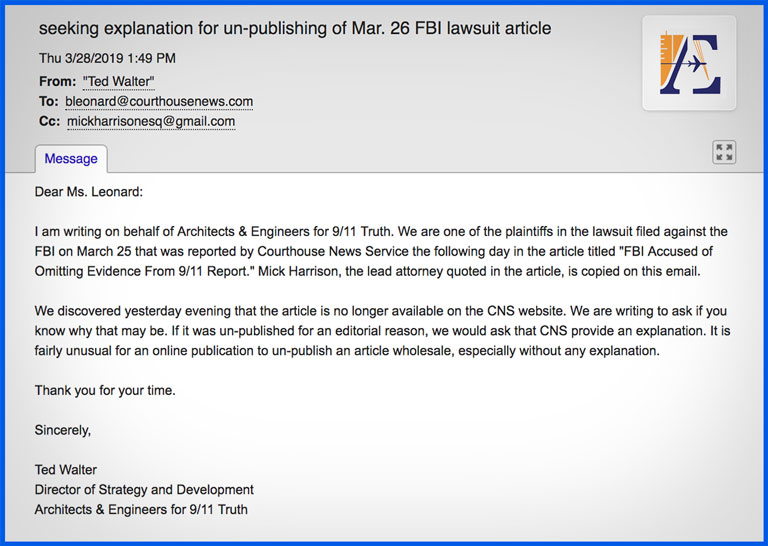
An email from Ted Walter to Courthouse News Webpage Editor Barbara Leonard.
I am not a journalist. But, from the information I’ve gathered, it is exceedingly unusual for an online publication to completely yank an article it has already published. News outlets seem to agree that it should be done only as a last resort — when extreme journalistic malpractice has been committed — and that such deletions should always be accompanied by an explanation.
If Courthouse News did remove the article for editorial reasons, its editors should explain those reasons to the public (assuming they want to be taken seriously as a news source). Until that happens, we can reasonably surmise that Courthouse News censored its own article not because of any journalistic malpractice, but because of the woefully fair and accurate coverage that its young reporter afforded to groups and survivors still seeking truth and justice regarding the tragic events of 9/11.
The Courthouse News article can still be accessed on Wayback Machine and as a PDF on AE911Truth.org.
African Country Bans BBC, Voice of America for Spreading ‘Fake News’
Sputnik – 31.03.2019
The country’s media regulator accused the BBC of broadcasting content which “put national cohesion and reconciliation at stake,” while charging VOA with employing an opposition figure wanted in connection with violence that preceded a May 2015 coup attempt.
The landlocked Central African country of Burundi has banned the BBC and indefinitely suspended the Voice of America*, accusing the international UK and US outlets of spreading “lies” and disinformation.
In a statement put out on Friday, Burundi’s media regulator said it revoked the British Broadcasting Corporation’s license over the lack of “proper measures” following the airing of a documentary which authorities said contained falsehoods, including allegations that members of the intelligence services engaged in the detention and torture of dissidents.
Meanwhile, Voice of America saw its license pulled over its employment of Patrick Nduwimana, a radio journalist suspected of involvement in a failed coup attempt against President Pierre Nkurunziza in May 2015.
Both BBC and VOA had already received six month suspensions last May ahead of a constitutional referendum seeking to allow for the extension of Nkurunziza’s term in office by two terms.
The BBC blasted the Burundian government’s “unwarranted decision” against itself and the VOA, saying that the move “strikes a serious blow against media freedom.”
VOA director Amanda Bennett said the US government-funded broadcaster was “alarmed that reporters in Burundi are now forbidden to communicate with VOA,” and echoed the BBC’s sentiment that “these continuing threats to our journalists undermine press freedom in the country.”
Both the BBC and VOA continue to broadcast into Burundi using shortwave frequencies which can be picked up by ordinary radios.
Speaking to VOA by phone, Willy Nyamitwe, a senior advisor to President Nkurunziza, said the media outlets were banned for spreading ‘fake news’.
“Some international media are biased. Everybody knows some reports were fake reports, fake news,” he said. “So if people cannot even try to speak the truth…if some people are using some media outlets only to spread lies, what other comments do I have to do?” he asked.
Nyamitwe stressed that the country has “thousands of journalists” and dozens of “media houses, radio stations, TV stations, newspapers, media online” which continue to operate freely.
Hundreds of thousands of Burundians have been displaced and up to 1,200 killed in clashes with security forces between 2015 and 2017. In May 2015, rebel officer Godefroid Niyombare announced in a radio broadcast that President Nkurunziza and his government had been “dismissed” while the president was on a visit to Tanzania. The announcement led to heavy street fighting for control of state and private broadcasters, with five independent news agencies said to have been completely or partially shuttered in the aftermath of the violence.
Last May, Burundians overwhelmingly approved changes to the country’s constitution to approve Nkurunziza running for up to two more additional terms as president. The US and the EU dismissed the vote, alleging that it was marred by ‘intimidation, repression and violence’ against the opposition.
*Listed as a foreign agent in Russia.
Featured Video

Seyed M. Marandi: US-Iran War Inevitable: Kuwait and Bahrain May Fall
or go to
Aletho News Archives – Video-Images
From the Archives
USS Liberty Massacre: A Pivotal Moment in the Hostile Takeover of America
By Kevin Barrett | Crescent | Dhu al-Qa’dah 24, 1445
In corporate America, hostile takeovers are commonplace. They occur when an aggressor—a larger corporation or rich individuals—seizes control of a smaller corporation without asking permission.
What few recognize is that the United States itself has been subjected to a hostile takeover. Since the aggressor, the illegitimate settler colony known as “Israel,” is much smaller than the US, the takeover has necessarily been surreptitious.
As of June, 2024, Israel’s gradual takeover of the US has become obvious and undeniable—a proverbial “elephant in the living room.” … continue
Blog Roll
 Aletho News
- Seyed M. Marandi: US-Iran War Inevitable: Kuwait and Bahrain May Fall
- Leaders Condemn Ansarallah Attack on Saudi Arabia While Ignoring Illegal War Against Yemen
- Leaked: Britain’s Covert Iraqi Psyops Network
- Yemeni Armed Forces Warn Airlines Against Using Saudi Airports, Exempt Mecca and Medina
- Iran security chief says powers greater than US tried to conquer Iran but ended in ‘dustbin of history’
- Europe’s mounting social chaos… chickens coming home to roost for proxy war against Russia
- US-Russia Diesel Deal Becomes Massive Defeat for Ukraine
- Hormuz and the Looming Economic Catastrophe
- Dhubab offensive, media blitz and the rapid unraveling of Saudi-backed coalition’s new gambit
- Putin Conveys to Trump Iran’s Vision on Possible Conflict Resolution – Kremlin
- If Americans Knew
- Gaza: Ceasefire Anniversary Marks Year of Failed Promises
- The American Conservative: Mike Huckabee Should Resign
- A C-Section in Shackles: A Palestinian Woman’s Harrowing Birth in Israeli Detention
- ‘He’s Desperate’: AIPAC Begins Spending Against Abdul El-Sayed to Boost Mike Rogers:
- Trump, Hormuz, and the Looming Economic Catastrophe
- For three years, Israel has killed a child in Gaza every 71 minutes – Daily Update
- Israeli forces kill another child in Gaza – Daily Update
- Gaza ceasefire exists in name only, say more than 100 organizations
- Nearly 2 Million in Gaza Need Urgent Shelter Assistance as Winter Looms: IOM Chief Warns
- Suppressing Palestinian resistance: US charity under fire for AI monitoring of Gaza classrooms
- No Tricks Zone
- Germany’s Green Energy Debacle: High Energy Costs Force Kahla Porzellan to Close After 182 Years!
- New Study: 50 Years Of The Most Aggressive ‘Net Zero’ Policies Can Only Affect The Global Climate By 0.03°C
- US September “Heat” Was No Record…Many Records Set Decades Ago
- Latest European Green Energy Debacle; Portugal’s Largest Flagship Solar Park Insolvent!
- Green Energy Debacle: German Expert Professor Fritz Vahrenholt Warns Of Severe Economic And Social Consequences
- Two More Paleo Reconstructions Affirm Meters-Higher Sea Levels Across Ireland, Brazil 7000-6000 Years Ago
- New Study: Earth And Venus Surface Warmth Largely Explained By Convection And Lapse Rate, Not CO2 Or Radiation
- 2025 Nature Paper Claiming Worsening Global Drought Gets RETRACTED …Heavily Flawed
- New Study: ‘Global Drought Shows No Detectable Recent Acceleration Under Climate Warming’
- Economic Masterminds: German Socialists Suggest Taxing Productivity Gains Stemming From Using AI

