Silencing the Whistle: The Intercept Shutters Snowden Archive, Citing Cost
By Whitney Webb | MintPress News | March 30, 2019
NEW YORK — On March 13, a report in the Daily Beast revealed that the New York-based outlet The Intercept would be shutting down its archive of the trove of government documents entrusted to a handful of journalists, including Intercept co-founders Glenn Greenwald and Laura Poitras, by whistleblower Edward Snowden. However, that account did not include the role of Greenwald, as well as Jeremy Scahill — another Intercept co-founder, in the controversial decision to shutter the archive.
According to a timeline of events written by Poitras that was shared and published by journalist and former Intercept columnist Barrett Brown, both Scahill and Greenwald were intimately involved in the decision to close the Snowden archive.
While other outlets — such as the Jeff Bezos-owned Washington Post and the New York Times — also possess much (though not all) of the archive, the Intercept was the only outlet with the (full) archive that had continued to publish documents, albeit at a remarkably slow pace, in recent years. In total, fewer than 10 percent of the Snowden documents have been published since 2013. Thus, the closing of the publication’s Snowden archive will likely mean the end of any future publications, unless Greenwald’s promise of finding “the right partner … that has the funds to robustly publish” is fulfilled.
Poitras told Brown that she first caught wind of the coming end of the Snowden archive on March 6, when Scahill and Intercept editor-in-chief Betsy Reed asked to meet with her “to explain how we’ve assessed our priorities in the course of the budget process, and made some restructuring decisions.” During the resulting two-hour meeting, which Poitras described as “tense,” she realized that they had “decided to eliminate the research department. I object to this on the grounds Field of Vision [Intercept sister company where Poitras works] is dependent [on the] research department, and the Snowden archive security protocols are overseen by them.”
Poitras later sent two emails opposing the research department’s elimination and, in one of those emails, argued that the research department should stay, as it represented “only 1.5% of the total budget” of First Look Media, The Intercept’s parent company, which is wholly owned by billionaire Pierre Omidyar. The last of those emails was sent on March 10 and Poitras told Brown:
Throughout these conversations and email exchanges, there was no mention of shutting down the archive. That was not on the table. That decision was made on either Monday March 11 or Tuesday March 12, again without my involvement or consent.”
She then noted that “On Tuesday March 12, on a phone call with Glenn and the CFO [Drew Wilson], I am told that Glenn and Betsy [Reed] had decided to shut down the archive because it was no longer of value [emphasis added] to the Intercept.” Poitras stated that this was:
the first time I … heard about the decision. On the call, Glenn says we should not make this decision public because it would look bad for him and the Intercept. I objected to the decision. I am confident the decision to shut the archive was made to pave [the way] to fire/eliminate the research team.”
Notably, Edward Snowden — who was granted asylum in Russia after going public as a whistleblower — had not been consulted by Greenwald or Reed over what, according to Poitras, was their decision to shut down the Snowden documents. Snowden was subsequently informed of the decision by Poitras on March 14 and has yet to publicly comment on the closure.
Omidyar’s suddenly shallow pockets
The publicly stated reason offered by Greenwald and other Intercept employees for the closure of the Snowden archive has been budget constraints. For instance, Greenwald — in explaining the closure on Twitter — asserted that it was very expensive to publish the documents and that the Intercept only had a fraction of the budget enjoyed by other, larger news organizations like the Washington Post, which had stopped published Snowden documents years ago, allegedly “for cost reasons.”
Yet, as Poitras pointed out, the research department accounted for a minuscule 1.5 percent of First Look Media’s budget. Greenwald’s claim that the archive was shuttered owing to its high cost to the company is also greatly undermined by the fact that he, along with several other Intercept employees — Reed and Scahill among them — receive massive salaries that dwarf those of journalists working for similar nonprofit publications.
Greenwald, for instance, received $1.6 million from First Look Media, of which Omidyar is the sole shareholder, from 2014 to 2017. His yearly salary peaked in 2015, when he made over $518,000. Reed and Scahill both earn well over $300,000 annually from First Look. According to journalist Mark Ames, Scahill made over $43,000 per article at the Intercept in 2014. Other writers at the site, by comparison, have a base salary of $50,000, which itself is higher than the national average for journalists.
The Columbia Journalism Review recently noted that these salaries are massive when compared to those doled out by comparable progressive and “independent” news outlets. For instance, editor-in-chief of Mother Jones, Clara Jeffrey, earns just under $200,000 annually while the sites’s D.C. correspondent David Corn made just over $171,000 in 2017.
Given that the research department was allegedly axed owing to “financial constraints” despite representing only 1.5 percent of First Look Media’s budget, it seems strange that Greenwald, Scahill and Reed — who were, according to Poitras, the brains behind the lay-off and archive-shuttering decision — were unwilling to apply those same financial constraints to their own massive salaries.
Furthermore, this also undercuts Greenwald’s claim that he is just waiting for the “right partner… that has the funds to robustly publish” the archive. Omidyar has a net worth of over $12 billion dollars and Greenwald’s annual salary from Omidyar has topped half a million dollars. It is hard to imagine what type of “partner” with “the funds to robustly publish” Greenwald has envisioned, since First Look’s massive funding and a multi-billionaire owner was insufficient to keep the Snowden archive open.
The real reason almost certainly not cost
This all suggests that the real reason behind the archive’s closure lies closer to the fact that Greenwald and Reed both allegedly felt that the archive was “no longer of value” to the Intercept. Given that many of the publication’s most high-profile and lauded reports have been based on that archive, it seems strange that the troves of documents — 90 percent of which have never been made public and ostensibly contain material for a litany of new and explosive investigations — would no longer hold value to the outlet that was ostensibly founded to publish said documents.
A more compelling reason for why the Snowden archive failed to retain its value to the Intercept in the eyes of Greenwald, Scahill and Reed lies in the troubling government and corporate connections of their benefactor Pierre Omidyar, who — as the sole shareholder of First Look Media — pays their enormous salaries.
As journalist Tim Shorrock recently wrote at Washington Babylon, a likely motive behind the decision to shut down the Snowden archive was related to “the extensive relationships the Omidyar Group, the billionaire’s holding company, and the Omidyar Network, his investment vehicle, have forged over the past decade with the U.S. Agency for International Development (USAID) and other elements of the national security state,” as well as “the massive funds Omidyar and his allies in the world of billionaire philanthropy control through their foundations and investment funds.” MintPress has recently published several reports on both aspects of Omidyar’s many connections to the national security state and the non-profit industrial complex.
Shorrock goes on to further detail his theory, stating:
The Snowden collection had become problematic to Omidyar as he positioned himself as a key player in USAID’s ‘soft power’ strategy to wean the world from ‘extremism’ with massive doses of private and public monies. The classified NSA documents may not have been a problem under the Obama White House, where Omidyar enjoyed privileged status. But under Trump, whose Justice Department has gone beyond Obama’s attacks on whistleblowers by pursuing Julian Assange and WikiLeaks, holding on to the Snowden cache may had become a liability.”
Indeed, were the Snowden archive to become a liability for The Intercept’s owner, Omidyar, it certainly would cease to be of value to the publication. However, there have also long been claims that Omidyar’s involvement with the publication from the very beginning was a means of “privatizing” the Snowden documents, which allegedly contain compromising information about PayPal (owned by Omidyar) and its dealings with the U.S. government and intelligence community.
While both theories deserve careful consideration, the recent revelations regarding the back-story behind the outlet’s decision suggest that issues of “cost” were highly unlikely to have been the true motivation behind the recent closure of the Snowden archive.
Whitney Webb is a MintPress News journalist based in Chile. She has contributed to several independent media outlets including Global Research, EcoWatch, the Ron Paul Institute and 21st Century Wire, among others. She has made several radio and television appearances and is the 2019 winner of the Serena Shim Award for Uncompromised Integrity in Journalism.
Journalist says MSNBC politics editor bullied him on DNC’s behalf
RT | March 29, 2019
A freelance journalist has gone public about a bizarre intimidation attempt by a senior MSNBC editor who tried to “bully” him into keeping a story under wraps – on behalf of the Democratic National Committee, not the network.
MSNBC politics managing editor Dafna Linzer tried to pressure Yashar Ali, a journalist who has written for the Huffington Post and New York Magazine, into holding back the release of the Democratic primary debate dates, Ali has claimed in a series of tweets. Linzer wasn’t trying to beat him to the story, or calling on behalf of her own network at all – she was acting wholly on behalf of the DNC, according to Ali.
Ali got wind of the Democratic primary dates, information even the candidates didn’t have, on Thursday morning and called the party to verify them before publishing. They asked him to hold back the information while they made a few calls – which he refused, not wanting to lose the scoop – and then things got weird.
Linzer then called Ali and asked him to hold the story in order to give the DNC time to “make a few phone calls” to state party leaders, informing them of the debate dates. While her own network was planning to break the news later on that day, she spent the call “menacing” Ali, threatening to call his editor and trying several lines of reasoning to convince him to sit on the story – even bringing up her own history as a national security reporter at the Washington Post, when they “would hold stuff all the time.”
While MSNBC generally favors the Democratic Party in its news coverage, the network isn’t a party organ – not officially, at least – and Linzer’s “unethical” behavior, conspiring with party leadership to quash another journalist’s story, set off alarm bells in the journalist. Several other reporters he spoke to urged him to go public.
Neither MSNBC nor Linzer have made any public comment in response to Ali’s tweets so far. In the week since Special Counsel Robert Mueller concluded his investigation, Rachel Maddow and other top-rated MSNBC shows have lost 20 percent of their viewers as Americans realize they spent the last two years being led down the garden path. It’s understandable that Linzer might be a little stressed, now that so much is riding on the network’s “pivot to 2020.”
The Illusory Truth Effect: How Millions Were Duped by Russiagate
By Caitlin JOHNSTONE | Medium | March 26, 2019
“Mueller Finds No Trump-Russia Conspiracy”, read the front page headline of Sunday’s New York Times. Bit by bit, mainstream American consciousness is slowly coming to terms with the death of the thrilling conspiracy theory that the highest levels of the US government had been infiltrated by the Kremlin, and with the stark reality that the mass media and the Democratic Party spent the last two and-a-half years monopolizing public attention with a narrative which never had any underlying truth to it.
There are still holdouts, of course. Many people invested a tremendous amount of hope, credibility, and egoic currency in the belief that Robert Mueller was going to arrest high-ranking Trump administration officials and members of Trump’s own family, leading seedy characters to “flip” on the president in their own self-interest and thereby providing evidence that will lead to impeachment. Some insist that Attorney General William Barr is holding back key elements of the Mueller report, a claim which is premised on the absurd belief that Mueller would allow Barr to lie about the results of the investigation without speaking up publicly. Others are still holding out hope that other investigations by other legal authorities will turn up some Russian shenanigans that Mueller could not, ignoring Mueller’s sweeping subpoena powers and unrivaled investigative authority. But they’re coming around.
The question still remains, though: what the hell happened? How did a fact-free conspiracy theory come to gain so much traction among mainstream Americans? How were millions of people persuaded to invest hope in a narrative that anyone objectively analyzing the facts knew to be completely false?
The answer is that they were told that the Russiagate narrative was legitimate over and over again by politicians and mass media pundits, and, because of a peculiar phenomenon in the nature of human cognition, this repetition made it seem true.
The rather uncreatively-named illusory truth effect describes the way people are more likely to believe something is true after hearing it said many times. This is due to the fact that the familiar feeling we experience when hearing something we’ve heard before feels very similar to our experience of knowing that something is true. When we hear a familiar idea, its familiarity provides us with something called cognitive ease, which is the relaxed, unlabored state we experience when our minds aren’t working hard at something. We also experience cognitive ease when we are presented with a statement that we know to be true.
We have a tendency to select for cognitive ease, which is why confirmation bias is a thing; believing ideas which don’t cause cognitive strain or dissonance gives us more cognitive ease than doing otherwise. Our evolutionary ancestors adapted to seek out cognitive ease so that they could put their attention into making quick decisions essential for survival, rather than painstakingly mulling over whether everything we believe is as true as we think it is. This was great for not getting eaten by saber-toothed tigers in prehistoric times, but it’s not very helpful when navigating the twists and turns of a cognitively complex modern world. It’s also not helpful when you’re trying to cultivate truthful beliefs while surrounded by screens that are repeating the same bogus talking points over and over again.
I’m dealing with a perfect example of the perils of cognitive ease right now. Writing this essay has required me to move outside my familiar comfort zone of political commentary and read a bunch of studies and essays, think hard about new ideas, and then figure out how to convey them as clearly and concisely as possible without boring my audience. This movement away from cognitive ease has resulted in my checking Twitter a lot more often than I usually do, and seeking so much distraction that this essay will probably end up getting published about twelve hours later than I had intended. Having to read a bunch of scholars explaining the precise reasons why I’m acting like such an airhead hasn’t exactly helped my sense of cognitive ease any, either.

Science has been aware of the illusory truth effect since 1977, when a study found that subjects were more likely to evaluate a statement as true when it’s been repeatedly presented to them over the course of a couple of weeks, even if they didn’t consciously remember having encountered that statement before. These findings have been replicated in numerous studies since, and new research in recent years has shown that the phenomenon is even more drastic than initially believed. A 2015 paper titled “Knowledge Does Not Protect Against Illusory Truth” found that the illusory truth effect is so strong that sheer repetition can change the answers that test subjects give, even when they had been in possession of knowledge contradicting that answer beforehand. This study was done to test the assumption which had gone unchallenged up until then that the illusory truth effect only comes into play when there is no stored knowledge of the subject at hand.
“Surprisingly, repetition increased statements’ perceived truth, regardless of whether stored knowledge could have been used to detect a contradiction,” the paper reads. “Reading a statement like ‘A sari is the name of the short pleated skirt worn by Scots’ increased participants’ later belief that it was true, even if they could correctly answer the question ‘What is the name of the short pleated skirt worn by Scots?’”
Stored knowledge tells pretty much everybody that the “short, pleated skirt worn by Scots” is a kilt, not a sari, but simply repeating the contrary statement can convince them otherwise.
This explains why we all know people who are extraordinarily intelligent, but still bought into the Russiagate narrative just as much as our less mentally apt friends and acquaintances. Their intelligence didn’t save them from this debunked conspiracy theory, it just made them more clever in finding ways of defending it. This is because the illusory truth effect largely bypasses the intellect, and even one’s own stored knowledge, because of the way we all reflexively select for cognitive ease.
Another study titled “Incrimination through innuendo: Can media questions become public answers?” found that subjects can be manipulated into believing an allegation simply by exposure to innuendo or incriminating questions in news media headlines. Questions like, for example, “What If Trump Has Been a Russian Asset Since 1987?”, printed by New York Magazine in July of last year.

You can understand, then, how a populace who is consuming repetitive assertions, innuendo, and incriminating questions on a daily basis through the screens that they look at many times a day could be manipulated into believing that Robert Mueller would one day reveal evidence which will lead to the destruction of the Trump administration. The repetition leads to belief, the belief leads to trust, and before you know it people who are scared of the president are reading the Palmer Report every day and parking themselves in front of Rachel Maddow every night and letting everything they say slide right past their skepticism filters, marinating comfortably in a sedative of cognitive ease.
And that repetition has been no accident. CNN producer John Bonifield was caught on video nearly two years ago admitting that CNN’s CEO Jeff Zucker was personally instructing his staff to stay focused on Russia even in the midst of far more important breaking news stories.
“My boss, I shouldn’t say this, my boss yesterday we were having a discussion about this dental shoot and he goes and he was just like I want you to know what we are up against here,” Bonifield told an undercover associate of James O’Keefe’s Project Veritas. “And he goes, just to give you some context, President Trump pulled out of the climate accords and for a day and a half we covered the climate accords. And the CEO of CNN said in our internal meeting, he said good job everybody covering the climate accords, but we’re done with it, let’s get back to Russia.”
(And before you get on me about O’Keefe’s shady record, CNN said in a statement that the video was legitimate and disputed none of its content, saying only that it stands by Bonifield and that “Diversity of personal opinion is what makes CNN strong, we welcome it and embrace it.”)
Zucker, for his part, told the New York Times in an article published yesterday that he was “entirely comfortable” with CNN’s role in promoting the Russiagate conspiracy theory the way that it did.
“We are not investigators. We are journalists, and our role is to report the facts as we know them, which is exactly what we did,” Zucker said. “A sitting president’s own Justice Department investigated his campaign for collusion with a hostile nation. That’s not enormous because the media says so. That’s enormous because it’s unprecedented.”

“We are not investigators”? What the fuck kind of dumbass shit is that? So it’s not your job to investigate whether what you’re reporting is true or false? It’s not your job to investigate whether the anonymous sources you’re basing your reports on might be lying or not? It’s not your job to investigate whether or not you’d be committing journalistic malpractice with the multiple completely bullshit stories your outlet has been humiliated by in the last two years? It’s not your job to weigh the consequences of deliberately monopolizing public attention on a narrative which consists of nothing but confident-sounding assertions and innuendo?
“We are not investigators.” So? You’re not dentists or firefighters either, what’s your point? That has nothing to do with the mountains of journalistic malpractice you’ve been perpetrating by advancing this conspiracy theory, nor with the inexcusable brutalization you’ve been inflicting upon the American psyche with your deliberate nonstop repetition of bogus assertions, innuendo, and incriminating questions.
The science of modern propaganda has been in research and development for over a century. If you think about how many advances have been made in other military fields over the last hundred years, that gives you a clear example of how sophisticated an understanding the social engineers must now have of the methods of mass manipulation of human psychology. We may be absolutely certain that there are people who’ve been working to drive the public narratives about western rivals like Russia, and that they are doing so with a far greater understanding of the concepts we’ve touched on in this essay than we have at our disposal.
The manipulators understand our psyches better than we understand them ourselves, and they’re getting more clever, not less. The only thing we can do to keep our heads while immersed in a society that is saturated with propaganda is be as relentlessly honest as possible, with ourselves and with the world. We’ll never be able to out-manipulate the master manipulators, but we can be real with ourselves about whether or not we’re selecting for cognitive ease rather than thinking rigorously and clearly. We can be truthful with our friends, family, coworkers and social media followers wherever untruth seems to be taking hold. We can do our very best to shine the light of truth on the puppeteers wherever we spot them and ruin the whole goddamn show for everyone.
It may not seem like a lot, but truth is the one thing they can’t manipulate, whether it’s truth about them, truth about the world, or truthfulness with yourself. The lying manipulators got us into this mess, so only truth can get us out.
‘Russiagate’ hoax helped turn ordinary Russians against the US
By Bryan MacDonald | RT | March 28, 2019
‘Russiagate’ is over. But its toxic legacy will endure. And in Russia it has led to disenchantment with the United States.
Red Army Street is a 3km-long thoroughfare in Krasnodar, southern Russian, notable for its many bars and nightclubs, which number in the dozens. Indeed, it’s so raucous it makes snooty Moscow look rather pedestrian.
Last summer, I was in one hostelry, with a South African farmer who was visiting the region. Naturally, we spoke in English. This seemed to upset three drunken locals who (in Russian) were loudly exchanging anti-American slurs.
Eventually, the largest, and scariest, of the trio broke into English to shout “Yankee, go home.” To which I swiftly replied that I was Irish. Suddenly, he ran over, bear-hugged me, and shouted at the top of his voice: “Conor McGregor!”
It wasn’t always like this. When I moved to Russia, nine years ago, Americans were very popular here. And Russians knew little of my homeland, most wrongly seeing it as an extension of the United Kingdom.
If I’d had a dollar, in the early part of the decade, for every Russian who’d expressed a desire to visit the US, I’d easily have had enough to fund return tickets there myself, plus a few weeks in a decent hotel.
However, times have changed. And admiration and curiosity towards the US has been replaced with disappointment, hostility and often anger. We’re a long way from Mikhail Gorbachev advertising “Pizza Hut” now.
Wide Awake
And, it’s largely down to the Russiagate hoax which consumed American politics and its mainstream media for almost three years, before Robert Mueller kicked it into touch last weekend. Of course, there are other factors, among them US interference in Ukraine, anti-Russia sanctions and continued NATO expansion, but it’s the xenophobia Russiagate unleashed which has done the most damage.
Russians are not stupid. And their media is not behind a Chinese-style firewall. Instead, Russian news outlets are firmly positioned in the Western information ecosystem and carry unfiltered stories from various international sources, many of them American.
As a result, when a famous publication like the Washington Post reports how Netflix is Russian propaganda and alleges Russia hacked the Vermont power grid, people read all about it in the local press.
Furthermore, even if most can’t speak English well, a great many of them understand it. Thus, they know what’s been going on and can see online how prominent Americans have smeared them, and their country, during the mass hysteria of the past few years.
And, viewed from here, the delirium, panic and frenzy is greeted with dismay and incredulity. Because, for Russians, the notion of Putin somehow swaying the US election isn’t credible. But the fact so many prominent Americans deluded themselves into believing the trope serves to make the US, once seen as mighty, look very, very weak. Which confuses people who spent close on two decades lamenting how feeble Russia itself had become after the Soviet collapse ended Moscow’s superpower days.
Not Easy
 Especially given the Kremlin can’t even control domestic Russian elections. For evidence, witness the failures of Putin’s preferred candidates in various Gubernatorial contests last year, including Khabarovsk, Khakassia and Vladimir. Now, given the latter region’s administrative centre is only 180km from Moscow, United Russia’s defeat there doesn’t say much for the efficiency of Kremlin election manipulation.
Despite this, high-profile fantasists in the US, such as Rachel Maddow, Michael McFaul and Joy-Ann Reid, have spent years whipping up delirium about a “Trump/Putin” conspiracy. And Russians are fully aware. They know James Clapper, the former Intelligence chief, said “the Russians are not our friends”, before he added how Russians are “almost genetically driven to co-opt, penetrate, gain favor.” Comments which were xenophobic and bigoted towards an entire ethnicity and far beyond criticism of Putin and his government.
They’ve also seen Morgan Freeman’s nutty video, where the veteran American actor tells viewers “we are at war with Russia”. As a result, the biggest legacy of “Russiagate” here is the transformation of attitudes to the US. And it’s hard to see how goodwill can be restored, in the immediate term.
In simpler times, at the tail end of the Cold War, a series of TV shows named “Space Bridge” tried to help Russians and Americans understand each other, as the hosts, Vladimir Pozner and Phil Donahue, encouraged dialogue between their audiences.
Both are still around. For his part, Pozner hosts a weekly show on Russia’s First Channel. However, Donahue was fired by MSNBC in 2002, due to his opposition to the illegal US-led invasion of Iraq. Perhaps this, in itself, explains a lot about how the two countries have diverged.
‘Hard to find a black cat in a dark room, if it isn’t there’ – Kremlin on Mueller report
RT | March 25, 2019
Russia doesn’t interfere in the affairs of other countries and has no intention of doing so, the Kremlin said, dismissing accusations of meddling in US elections, contained in the Mueller report, as groundless.
“It’s hard to find a black cat in a dark room, especially if it isn’t there,” the President’s spokesman Dmitry Peskov commented on the release of a summary of Special Counsel Robert Mueller’s report.
He added that the Kremlin has seen only the released summary of the report “which, incidentally, does not say anything new, except for the recognition of the absence of collusion.”
The Russian Foreign Ministry said that the “political motivation” of Mueller’s investigation was obvious and called the report “a disgrace of American justice.”
In a statement, the ministry expressed hope that Washington would have the “courage” to officially acknowledge that “any slurs about the ‘Russian meddling’ were groundless defamation.”
Wrapping up 22 months of the investigation, Mueller’s report found no proof that “the Trump campaign conspired or coordinated with the Russian government in its election interference activities.”
However, Mueller’s report does claim that the Russian government sought to influence the 2016 election, via the organization called the Internet Research Agency.
The report accuses the agency of conducting “disinformation and social media operations” to sow discord in US society and alleges that Russian hackers obtained the emails of Hillary Clinton’s associates and passed them to WikiLeaks.
Beware foreign policy ‘experts’ who are shills for imperialism
By Yves Engler · March 20, 2019
 Aside from government officials the dominant media is fond of quoting “experts” from foreign policy think tanks when discussing Canada’s role in the world. While presented as neutral specialists, these opinion shapers are generally entangled with powerful, wealthy, elites.
Take the case of Venezuela and Canada’s leading foreign policy ‘ideas organization’. Recently Canadian International Council President Ben Rowswell has been widely quoted promoting Ottawa’s regime change efforts in Venezuela. After 25 years in Canada’s diplomatic service, including stints as chargé d’affaires in Iraq and ambassador in Caracas, Rowswell joined the CIC in November. Rowswell’s move highlights the close relationship between Global Affairs Canada and this corporate funded think tank, which has deep imperial roots.
Formerly the Canadian Institute of International Affairs, CIC has 15 (mostly university based) regional branches that hold dozens of conferences and seminars annually. The head office publishes International Journal, Behind the Headlines as well as reports and books. It also does media outreach.
Officially formed in 1928, CIIA’s stated aim was to promote “an understanding of international questions and problems, particularly in so far as these may relate to Canada and the British Empire.” Its first meeting was held at the Ottawa home of staunch imperialist Sir Robert Borden, prime minister between 1911 and 1920.(Borden publicly encouraged Canadian businessmen to buy up southern Mexico and sought to annex the British Caribbean colonies after World War I.) Borden was made first president of CIIA and another former prime minister, Arthur Meighen, became vice-president in 1936. On hand to launch CIIA was the owner of six Canadian newspapers, Frederick Southam, as well as Winnipeg Free Press editor John W. Dafoe and Ottawa Citizen editor Charles Bowman.“The CIIA’s early leadership constituted a roster of Canada’s business, political, and intellectual elite”, explains Priscilla Roberts in Tweaking the Lion’s Tail: Edgar J. Tarr, the Canadian Institute of International Affairs, and the British Empire, 1931–1950.
CIIA’s genesis was in the post-World War I Paris Peace Conference. At the 1919 conference British and US delegates discussed establishing internationally focused institutes. The next year the Royal Institute of International Affairs (RIIA), or Chatham House Study Group, was founded in London and in 1921 the Council on Foreign Relations was set up, notes Imperial Brain Trust: The Council on Foreign Relations and United States Foreign Policy, “to equip the United States of America for an imperial rule on the world scene.”
The driving force behind these international affairs institutes was British historian Lionel Curtis. An “indefatigable proponent of Imperial Federation” and former Colonial Office official in South Africa, Curtis set up a network of semi-secret Round Table Groups in the British Dominions and US. The aim was “to federate the English-speaking world along lines laid down by Cecil Rhodes”, the famous British imperialist. The Rhodes Trust and South African mining magnet Sir Abe Bailey financed the Round Table Groups and former British Secretary of State for War Lord Milner promoted the initiative.
Before its official formation CIIA sought to affiliate with RIIA. A number of prominent Canadians were part of Chatham House and the Canadian elite was largely pro-British at the time. “Much of the impetus and funding to” launch CIIA, Roberts writes, “came from Sir Joseph Flavelle, a meatpacking and banking magnate who strongly supported British Imperial unity. Other key Anglophile supporters included Newton W. Rowell, a leading Liberal politician, the wealthy Liberal politician and diplomat, Vincent Massey, and Sir Arthur Currie, commander of Canadian forces on the Western front during the war, who became principal of McGill University in 1920.”
The CIIA’s early powerbrokers generally identified with British imperialism. But its younger members and staff tended to back Washington’s foreign policy. In subsequent decades US foundation funding strengthened their hand. The Rockefeller Foundation accounted for as much as half of CIIA’s budget by the early 1940s. Alongside Rockefeller money, the Carnegie Corporation and Ford Foundation supported the institute. Set up by US capitalists responsible for significant labour and human rights abuses, the Big 3 foundations were not disinterested organizations. In The Influence of the Carnegie, Ford and Rockefeller Foundations on American Foreign Policy Edward Berman writes: “The Carnegie, Ford, and Rockefeller foundations have consistently supported the major aims of United States foreign policy, while simultaneously helping to construct an intellectual framework supportive of that policies major tenants.”
In subsequent decades CIIA would receive significant funding from Canada’s External Affairs and the Department of National Defence. But the institute’s nonfinancial ties to the government have always been more significant. After nearly two decades at External Affairs, John Holmes returned to lead the institute in 1960. In Canada’s Voice: The Public Life of John Wendell Holmes Adam Chapnick notes, “during [Prime Minister Lester] Pearson’s time in office [1963-68] Holmes had unprecedented access to the highest levels of government. He could reach Pearson personally when he was in Ottawa, and the Prime Minister promoted the CIIA while entertaining. Holmes also drafted speeches for Minister of Trade and Commerce Robin Winters.”
Upon leaving office external ministers Lester Pearson, Paul Martin Senior and Mitchell Sharp all took up honorary positions with CIIA. In 1999 former foreign minister Barbara McDougall took charge of the institute and many chapters continue to be dominated by retired diplomats. Active Canadian diplomats regularly speak to CIIA meetings, as did Prime Ministers Pierre Trudeau and Jean Chretien.
Alongside Ottawa and US foundations, Canadian capitalists with foreign policy interests also funded CIIA. Annual reports I analyzed from the late 1960s to mid-1990s list numerous globally focused corporate sponsors and corporate council members, including Bata Shoes, Toronto Dominion, Bank of Montréal, Bank of Nova Scotia, Brascan, Barrick Gold and Power Corporation.
In 2006 CIIA’s operations were subsumed into CIC. With financing from Research In Motion (RIM) co-founder Jim Balsillie, CIIA partnered with the Balsillie-created Centre for International Governance Innovation (CIGI) to establish CIC. The CIIA library and its publications were maintained while an infusion of cash bolstered local chapters. The new organization also added a major national fellowship program, which is headquartered at the University of Toronto’s Munk Centre for Global Affairs.
Balsillie was made founding chair of CIC and the initial vice chairs were former foreign ministers Bill Graham and Perrin Beattie. “The CIC promises to transform the debate about and understanding of Canadian foreign policy,” said Balsillie in 2007.
Balsillie put up $1-million in seed funding and launched a fundraising drive in the corporate community. Trying to drum up support for CIC, Balsillie wrote a commentary for the Globe and Mail Report on Business, explaining that “in return for their support, contributing business leaders would be offered seats in a CIC corporate senate that would give them influence over the research agenda and priorities of the new council.” In another piece for the National Post Balsillie wrote: “To create a research base on Canadian foreign policy, I have spearheaded the creation of the Canada-wide Canadian International Council (CIC). The Americans have their powerful Council on Foreign Relations, which offers non-partisan analysis of international issues and integrates business leaders with the best researchers and public policy leaders.”
The CIC Senate has included the CEOs of Barrick Gold, Power Corporation, Sun Life Financial and RBC. According to the most recent financial statement on its website, half of CIC’s funding comes from corporate donations (a quarter is from its International Journal and another quarter from dues).
Ben Rowswell’s transition from Global Affairs Canada to President of the Canadian International Council reflects the institute’s long-standing ties to government. His aggressive promotion of regime change in Venezuela also fit with the politics of an ‘ideas organization’ tied to the corporate world.
Trump Reportedly Takes Helm in US-DPRK Negotiations as MSM Cries Foul
Sputnik – 21.03.2019
In the aftermath of the failed Hanoi summit between the US and North Korea, US President Donald Trump has reportedly taken the helm in denuclearization negotiations with Pyongyang. Meanwhile, Seoul now sees the ball as having landed in its court to convince its neighbor to give up its weapons and rocket programs.
According to Trump administration officials who spoke with Time for a Monday article, the US president is “sidelining” his special envoy to North Korea, Stephen Biegun, and “dismissing the warnings of top intelligence and foreign policy advisers” who dissent from his continued policy of negotiation with North Korean leader Kim Jong Un.
Time reports that Trump has shut down attempts by Biegun to establish a back channel to Pyongyang via the socialist country’s United Nations mission in New York, citing US and South Korean officials, and is focusing on attempts to negotiate a deal with Kim instead of bowing to the advice of his advisers to press North Korea harder with sanctions — or to abandon negotiations altogether.
Trump and Kim met late last month in Hanoi, Vietnam, for a second round of denuclearization talks to follow up on a June 2018 summit that laid the groundwork for peace on the Korean Peninsula. While Pyongyang has made considerable progress with the South toward that end, negotiations with Washington have stalled, as the two sides reached a point where neither was willing to budge any further until the other side gave something first.
The Democratic People’s Republic of Korea (DPRK) has made several good faith moves toward reducing tensions, including the halting of weapons tests and the destruction of key missile and nuclear program sites. However, Kim was unwilling to make further concessions before Washington lowered at least some of its economic sanctions blocking international trade in many items with his country. The US has refused to lower any of those sanctions until Kim produces “verified denuclearization.” The Hanoi summit failed to surmount this impasse.
Trump administration officials such as Secretary of State Mike Pompeo and National Security Adviser John Bolton have used Pyongyang’s red line to argue that Kim is intransigent and not cooperative. The mainstream media has also largely adopted this position, as the articles by Time, CNN and The Hill on these developments show.
Indeed, ever since Trump agreed to meet with Kim last spring, the mainstream media has been devoted to producing stories that undermined Trump’s attempts at peace, and hawkish foreign policy think tanks have produced report after report claiming Kim has violated the terms of the negotiations. Their reports are often based on outdated or undated evidence, supposition or otherwise unverifiable claims, Sputnik has reported.
One example, from Time’s Tuesday article, tries to juxtapose Trump’s supposedly delusional belief that “Kim is his ‘friend,'” according to an administration official, with the “unanimous assessment by multiple agencies that Kim remains wedded to his nuclear program,” and thus is incapable of responding to a carrot, understanding only the stick.
Indeed, such has been the common refrain by US state officials for decades, going back to George F. Kennan’s eponymous telegram about how the US should handle the Soviet Union during the Cold War, and even further to the suppression of the Boxer Rebellion in imperial China at the turn of the last century.
Meanwhile, South Korean President Moon Jae In has continued his rapprochement with Kim, despite US-DPRK failures.
“We’re in a deep agony over how to take advantage of this baton that has been handed over to us,” said a Moon administration figure earlier this week, according to South China Morning Post.
“We agree with the view that no deal is better than a bad deal… However, in reality, it is difficult to achieve complete denuclearization at one stroke. I think we need to reconsider the so-called all or nothing strategy,” the official said.
Seoul aims to get Pyongyang to “agree with a broad road map aimed to achieve the overarching goal of denuclearization,” the official said, noting that “we should make further efforts to turn a small deal into a deal that is good enough. In order to achieve meaningful progress, we need one or two early harvests for mutual trust-building to move on toward the final goal.”
Still, in the aftermath of Hanoi, Moon’s popularity fell in his country from a high of 70 percent last summer to a measly 45 percent earlier this month, Sputnik reported.
The metaphor of the “harvest” presents a timely parallel as North Korean officials have pressed the UN to step up its food and medical aid to DPRK in the coming year due to bad harvests last year and projected shortages in 2019, Sputnik has reported.
“Although Security Council sanctions clearly exempt humanitarian activities, life-saving programs continue to face serious challenges and delays,” Tapan Mishra, the UN’s resident coordinator in the DPRK lamented earlier this month. “While unintended consequences of sanctions persist, these delays have a real and tangible impact on the aid that we are able to provide to people who desperately need it.
US and other international sanctions bar many useful medical items from being imported by DPRK, too. For example, a paper published last December by the Middlebury Institute of International Studies at Monterey looked at scientific projects in which North Korean scientists had partnered with scholars from other countries, noting that roughly 100 of the 1,300 they examined had “identifiable significance for dual-use technology, weapons of mass destruction (WMD) or other military purposes.”
That means that even though DPRK doctors might be studying epidemiology, their work could be subject to weapons sanctions. “When you study infectious diseases, which are a big burden in North Korea, you have to grow bacteria,” Harvard Medical School neurosurgeon Kee Park, director of DPRK Programs for the Korean American Medical Association, told NPR at the time. “That’s the kind of technology that goes into creating biological weapons.”
The problem is that “virtually all technology you can possibly think of is dual use,” professor and author Tim Beal told Sputnik.
Time reports that Trump administration officials fear the US president might try and strike a deal with Pyongyang and lift some sanctions in exchange for a pledge to continue their freeze on weapons development and testing, which Trump has said he considers to be more important to maintain than the total removal of nuclear weapons and delivery systems from North Korean possession. However at the same time, it seems to be the consensus among administration officials that any such deal wouldn’t actually make progress at all, only “remove much of the leverage” on the DPRK that they believe compels the country to negotiate in the first place.
New Republic: Climate Change = Vietnam War
By David Middleton | Watts Up With That? | March 18, 2019
Climate Change Is This Generation’s Vietnam War
It’s an existential threat to millennials—and older Americans are standing in the way of action.
By MATT FORD – The New Republic – March 14, 2019
Every year, the world’s elite gather like the Illuminati in the Swiss chalet town of Davos for the World Economic Forum, where they discuss how to solve humanity’s most pressing problems. Often that results in comically out-of-touch conversations, such as the idea, put forth at this year’s summit, that digital “upskilling” can solve economic inequality. But sometimes it provides a platform for someone like the 16-year-old Swedish climate activist Greta Thunberg, who appeared before these elites like the prophet Cassandra.
“Either we prevent 1.5 degrees Celsius of warming or we don’t,” she said at the summit in January. […]
Like the Vietnam protesters of the ’60s and ’70s, millennials have shown a knack for mass organizing. […]
The ruling gerontocracy won’t make it easy for younger Americans to translate their political energy into policy. […]
The Vietnam War was a clear mortal threat to young people, tens of millions of whom were eligible to be drafted; nearly 60,000 Americans were killed in the conflict. Climate change presents a different sort of threat to millennials. It’s less immediate than an ongoing war, less visceral than being shot at. But ultimately it will prove more catastrophic. Even if drastic action is taken over the next decade, the impact of rising global temperatures on civilization will dwarf the Vietnam War’s bloodshed. The World Health Organization has projected that come 2030, climate change will cause an additional 250,000 deaths per year.
Combatting climate change will take much more effort than ending the Vietnam War, and much longer. […]
I’m still laughing. When I saw the title, I said to myself, “Self, they’re right. The Global War on the Weather is like the Vietnam War. No matter how much blood & treasure our government spends, it can’t win.” But, the author went in a whole different direction; he’s comparing the Global War Against the Weather to protests against the Vietnam War.
I think my analogy is better. In the early 1960’s, the choices were: Either we defeat communism in Southeast Asia or we don’t. From 1953 to 1975 spent $168 billion (almost $1 trillion in 2011 USD) and 58,000 American lives on a war that was unwinnable under the conditions imposed by our government. In the Global War Against the Weather, we face a choice of preventing or not preventing 1.5 °C of warming.
“Either we prevent 1.5 degrees Celsius of warming or we don’t,” [Greta Thunberg] said at the summit in January.
Greta, I’m afraid I have bad news for you. With or without the New Green Deal Cultural Revolution… we don’t prevent 1.5 °C of warming. Let’s use the Paris Accord as a proxy for the Green New Deal Cultural Revolution.
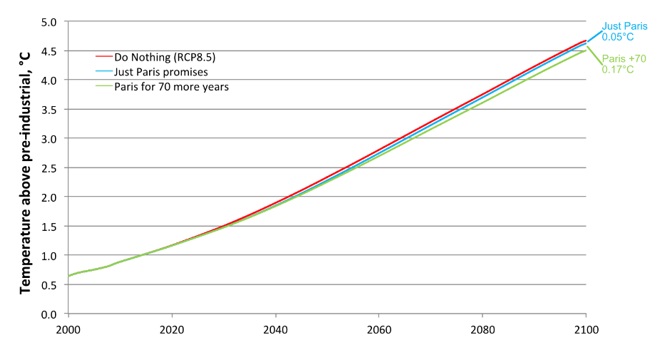
Bjorn Lomborg
We already have 1.0 °C relative to the mid 1800’s and about 1.5 °C relative to the coldest phase of the Little Ice Age, the coldest part of the Holocene Epoch. If 1.5 to 2.0 °C of warming relative to the glacial interstadial temperatures of the Little Ice Age is an “existential threat to millennials,” their threshold for existence is set too low (or would that be too high?).

Central Greenland temperature reconstruction (data from Alley, 2000)
The Vietnam War was a clear mortal threat to young people, tens of millions of whom were eligible to be drafted; nearly 60,000 Americans were killed in the conflict. […]
The World Health Organization has projected that come 2030, climate change will cause an additional 250,000 deaths per year.
Is this a non sequitur or a red herring?
Vietnam War…
STATISTICS FOR INDIVIDUALS IN UNIFORM AND IN COUNTRY
VIETNAM VETERANS3. 2,709,918 Americans served in Vietnam , this number represents 9.7% of their generation.
CASUALTIES
2. Non-hostile deaths: 10,800
3. Total: 58,202 (Includes men formerly classified as MIA and Mayaguez casualties). Men who have subsequently died of wounds account for the changing total.
(a) 2,709,918 divided by 9.7% equals 27,937,299.
(b) 58,202 divided by 27,937,299 equals 0.002… 0.2%.
(c) 99.8% of the Vietnam War generation did not die in the Vietnam War.
Those were real deaths. The brave men and women who sacrificed their lives in the Vietnam War were real people… They have names.
Global War Against the Weather…
The World Health Organization has projected that come 2030, climate change will cause an additional 250,000 deaths per year.
Is this comparable to to Vietnam War in any way, shape or form?
Estimated 2011
Death Rate
• 8 deaths/1,000 population
• 55.3 million people die each year
• 151,600 people die each day
• 6,316 people die each hour
• 105 people die each minute
• Nearly two people die each second
In 2011, 55.3 million real people died. That’s 0.8% of 7 billion people. If I add 250,000 to 55.3 million, it’s still 0.8% of 7 billion people. Furthermore, these hypothetical deaths are the results of models. There will be no way to actually attribute any of these deaths, if they occur, to whatever climate changes actually occur between now and 2030.
Now, we do have a pretty good idea how many real people, with names, are currently dying due to energy poverty.

Energy Poverty Kills More People Than Coal and Cecil B. DeMille… Combined!
4 million is 7% of 55.3 million. Will a $240/gal tax on gasoline to fund a $122 trillion Global War on Weather make energy poverty better or worse? My bet is on worse.
Combatting climate change will take much more effort than ending the Vietnam War, and much longer.
Note to The New Republic: There’s only 1 “t” in combating.
The Global War Against the Weather will cost at least $122 trillion, claim tens of millions of lives and have no discernible affect on the weather.
Featured Video

Seyed M. Marandi: US-Iran War Inevitable: Kuwait and Bahrain May Fall
or go to
Aletho News Archives – Video-Images
From the Archives
USS Liberty Massacre: A Pivotal Moment in the Hostile Takeover of America
By Kevin Barrett | Crescent | Dhu al-Qa’dah 24, 1445
In corporate America, hostile takeovers are commonplace. They occur when an aggressor—a larger corporation or rich individuals—seizes control of a smaller corporation without asking permission.
What few recognize is that the United States itself has been subjected to a hostile takeover. Since the aggressor, the illegitimate settler colony known as “Israel,” is much smaller than the US, the takeover has necessarily been surreptitious.
As of June, 2024, Israel’s gradual takeover of the US has become obvious and undeniable—a proverbial “elephant in the living room.” … continue
Blog Roll
 Aletho News
- Seyed M. Marandi: US-Iran War Inevitable: Kuwait and Bahrain May Fall
- Leaders Condemn Ansarallah Attack on Saudi Arabia While Ignoring Illegal War Against Yemen
- Leaked: Britain’s Covert Iraqi Psyops Network
- Yemeni Armed Forces Warn Airlines Against Using Saudi Airports, Exempt Mecca and Medina
- Iran security chief says powers greater than US tried to conquer Iran but ended in ‘dustbin of history’
- Europe’s mounting social chaos… chickens coming home to roost for proxy war against Russia
- US-Russia Diesel Deal Becomes Massive Defeat for Ukraine
- Hormuz and the Looming Economic Catastrophe
- Dhubab offensive, media blitz and the rapid unraveling of Saudi-backed coalition’s new gambit
- Putin Conveys to Trump Iran’s Vision on Possible Conflict Resolution – Kremlin
- If Americans Knew
- Gaza: Ceasefire Anniversary Marks Year of Failed Promises
- The American Conservative: Mike Huckabee Should Resign
- A C-Section in Shackles: A Palestinian Woman’s Harrowing Birth in Israeli Detention
- ‘He’s Desperate’: AIPAC Begins Spending Against Abdul El-Sayed to Boost Mike Rogers:
- Trump, Hormuz, and the Looming Economic Catastrophe
- For three years, Israel has killed a child in Gaza every 71 minutes – Daily Update
- Israeli forces kill another child in Gaza – Daily Update
- Gaza ceasefire exists in name only, say more than 100 organizations
- Nearly 2 Million in Gaza Need Urgent Shelter Assistance as Winter Looms: IOM Chief Warns
- Suppressing Palestinian resistance: US charity under fire for AI monitoring of Gaza classrooms
- No Tricks Zone
- Germany’s Green Energy Debacle: High Energy Costs Force Kahla Porzellan to Close After 182 Years!
- New Study: 50 Years Of The Most Aggressive ‘Net Zero’ Policies Can Only Affect The Global Climate By 0.03°C
- US September “Heat” Was No Record…Many Records Set Decades Ago
- Latest European Green Energy Debacle; Portugal’s Largest Flagship Solar Park Insolvent!
- Green Energy Debacle: German Expert Professor Fritz Vahrenholt Warns Of Severe Economic And Social Consequences
- Two More Paleo Reconstructions Affirm Meters-Higher Sea Levels Across Ireland, Brazil 7000-6000 Years Ago
- New Study: Earth And Venus Surface Warmth Largely Explained By Convection And Lapse Rate, Not CO2 Or Radiation
- 2025 Nature Paper Claiming Worsening Global Drought Gets RETRACTED …Heavily Flawed
- New Study: ‘Global Drought Shows No Detectable Recent Acceleration Under Climate Warming’
- Economic Masterminds: German Socialists Suggest Taxing Productivity Gains Stemming From Using AI

