What If Mainstream Media’s Message About Putin Was Delivered in Orwell’s Language?
By Patrick ARMSTRONG | Strategic Culture Foundation |16.04.2019
The West is under attack by Putin; he is at war with us and wars demand extreme measures. Putin’s influence is spreading: everywhere he is nibbling away at the foundations of democratic society. He is the dictator of Russia; still evil, still an empire; Russians are genetically driven to co-opt and penetrate and gain favour: it’s who they are and what they do. Russian scum! Putin interferes in referendums and elections all over the democratic world. A world that, for no good reason except his own needs, he calls his enemy. When his bots swung the US election and made his puppet POTUS, the world community began to wake up to the threat. Putin is bent on restoring the USSR and, until he can, he assembles an empire of losers, basket-cases and rogue states. When the weather is cold, we should fear him more. Putin’s whole existence depends on having an enemy and we are that enemy. We must defend against Putin’s threat to democracy; he threatens our democracy because he hates democracy and he fears democracy. We must defend against these multi-faceted, aggressive, unacceptable, bullying, continual and sinister attacks on the Rules-Based International Order which our democracies uphold. (Added to which, he’s short and can’t hide the fact and that makes him a megalomaniac.)
I humbly offer a few proposals so that we can better defend our precious heritage of democracy against his attacks.
• Putin hates democratic elections and seeks to twist them to his ends. He will interfere in Your Democracy’s elections. If your Ruling Party loses, it’s because Putin wanted it to lose and interfered with the voting: if your Ruling Party loses, Putin wins. Therefore, the “election” must be annulled and the Ruling Party must stay in power. That way Putin loses and we all win.
• Putin seeks to sow division in Your Democracy. Disagreement with the Ruling Party’s policy helps Putin divide us. Russian bots are ceaselessly trying to sow division; therefore you, as a True Democrat, must resist all attempts to disagree with your Ruling Party. Remember, disagreeing with the Ruling Party is what Putin wants you to do and that means he wins; agreeing with the Ruling Party means we all win and Putin loses.
• As a corollary, objectively speaking, if you disagree with the Ruling Party, you are agreeing with Putin and he wins. Putin hates what the Ruling Party stands for and you, as a True Democrat, shouldn’t hate what Putin hates. So love the Ruling Party: we all win and Putin loses.
• Putin and his legions of trolls engage in hybrid warfare an important part of which is the spreading of fake news. Putin and his trolls know that, while full mind control may not be possible or practical, sowing doubt is much easier. The True Democrat will never risk the chance of having his opinions infiltrated and therefore will be careful to read only news that has been first authenticated by responsible news outlets. Reading unauthenticated stories can let Putin into your brain. Keep him out and we all win.
• Putin uses social media to spread fake news and sow division in Your Democracy. It was one of the most important of his tools in winning the election for his stooge Trump. Putin is subtle – he even uses children’s cartoons and he has weaponised humour – and we must be protected if we don’t want him to win. The True Democrat will encourage efforts to regulate social media by trusted and reliable authorities such as the aptly-named Minister of Democratic Institutions in Canada. If Putin wins, we all lose!
• Putin needs useful idiots in Your Democracy to further his aims. Therefore the True Democrat will continually examine his thoughts to see whether any doubt or divisions are taking root: Putin wants us all to live in his “paranoid and polarized world“. If you find any division in your mind, Putin has put it there and you should make full confession to the authorities so that the rot may be stopped early and the damage repaired. The True Democrat will monitor his neighbours for signs of infection. Always remember that doubting the Ruling Party is what Putin wants you to do: stop doubting and we all win and Putin loses.
• Your Democracy’s security services work hard to protect our freedoms against Putin’s attacks. Putin wants us to criticise and impede the work of these brave men and women who put their lives on the line for us. Only Putin is served when these institutions are attacked. Support our brave men and women in all that they do to protect us. In that way we all win and Putin loses.
• From time to time, although they never start wars, democracies must use military force to end evil in the world. Putin is on the side of evil – he opposes the Rules-Based International Order – and he supports, when he is not actually causing, most of the evil and suffering in the world. As a dictator himself, he invariably sides with dictators who are torturing their populations. Dictators are repugnant to True Democracies and, therefore, they must occasionally take up arms in order to secure peace and order and punish the dictator’s “cruel indifference to the suffering of his people“. True Democrats understand this and support the Ruling Party in its occasional but justified uses of limited force. Objectively speaking, opposing these wars is the same as supporting Putin. True Democrats understand that wars must be fought for the sake of peace so we can all win and Putin can lose.
War against Putin is Peace
Freedom to Question is Slavery to Putin
Ignorance of Putin is Strength
Why Attenborough’s Walrus Claims Are Fake
By Paul Homewood | Not A Lot Of People Know That | April 14, 2019

Our Planet has showcased hundreds of walruses falling off a 260ft cliff to a slow, agonising death in heartbreaking scenes
https://www.thesun.co.uk/tvandshowbiz/8800576/netflix-david-attenborough-our-planet-walrus-heartbreaking/
Last week, the new Netflix series, Our Planet, was launched with great fanfare. Narrated by David Attenborough, however, one segment made headlines around the world, showcasing hundreds of walruses falling off a 260ft cliff to a slow, agonising death in heartbreaking scenes.
Narrating the disturbing scene in the second episode, Attenborough began:
“They do so out of desperation not choice.
“Their natural home is out on the sea ice, but the ice has retreated away to the north and this is the closest place to their feeding grounds.
“Every square inch is occupied, climbing over the tightly packed bodies is the only way across the crowd – those beneath can get crushed to death.
“In a desperate bid to avoid the crush they try to head towards the cliffs.
“But walruses’ eyesight out of the water is poor, but they can sense the others down below, as they get hungry they need to return to the sea.
“In their desperation to do so, hundreds fall from heights they should never have scaled.”
But the story quickly began to unravel.
Zoologist, Dr Susan Crockford, suspected that the event was actually a well publicised incident in October 2017, at Ryrkaypiy in NE Russia, when a group of polar bears drove several hundred walruses over the cliffs to their deaths, before feasting on the corpses.
Then a couple of days later, Andrew Montford was able to positively identify Ryrkaypiy as the location in the Our Planet film. The Netflix producers denied seeing any polar bears, but this does not alter the fact that many bears were in the area at that time.
There is however another rather more sinister possible explanation for the stampede. According to the US Fish and Wildlife Service (FWS):
Walruses often flee haulouts en masse in response to the sight, sound, and especially odours from humans and machines.
So it is perfectly possible that it was the filmmakers themselves who caused the stampede up the cliffs.
Indeed, as this aerial shot showed, there must have been some sort of helicopter or drone flying immediately above the walrus, which seems to me to be an utterly irresponsible thing to do.
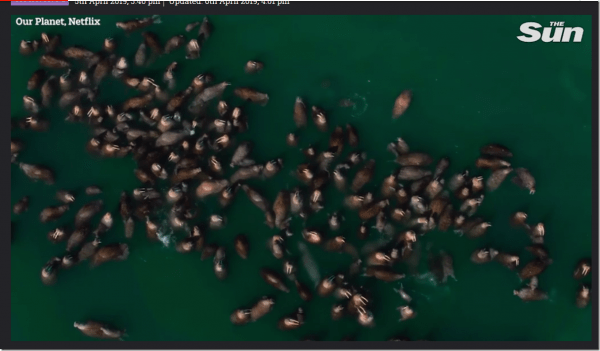
As the US Fish and Wildlife Service also note, events like this one are not uncommon:
Some haulout sites include shorelines that grade from little topographical relief to steep slopes and cliffs. As large numbers of walruses gather at these sites, the first to arrive move further inland and may eventually settle at the tops of the steeper slopes and cliffs. As most animals head back to sea to feed, those on the steeper slopes and cliffs are also rested and ready to feed and sometimes take the most direct route down the slope or off the cliff. This behavior has resulted in serious injuries and deaths. As with most animals whose eyes are oriented to the side of their head, rather than forward, walrus’s depth perception is likely poor and they are nearsighted.
Sea Ice and Haulouts
Regardless of the exact cause of the stampede, why were the walrus at Ryrkaypiy in the first place? Is it the case that they were forced to go ashore, because their sea ice had melted?
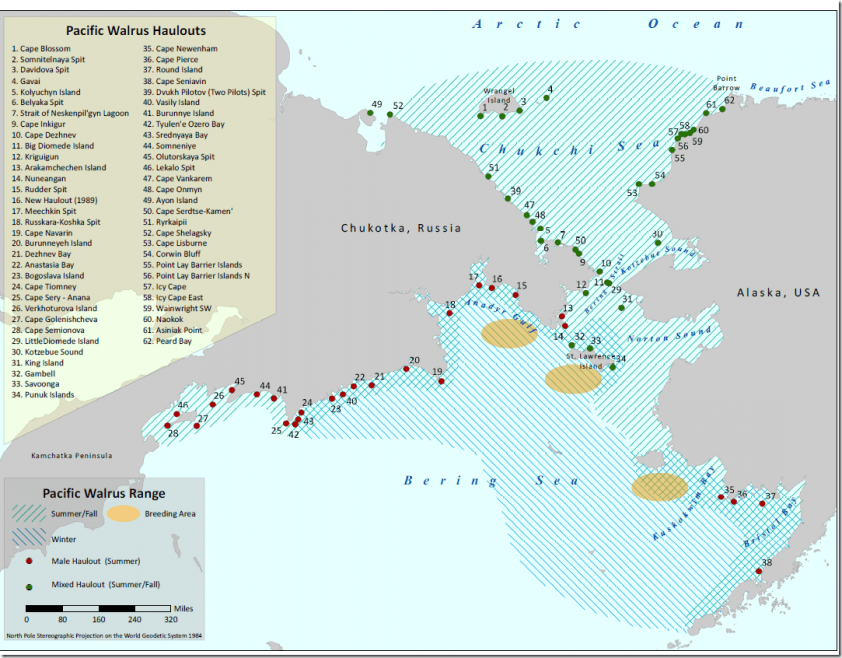
The US Fish and Wildlife Service explain the Pacific walrus’ migratory habits:
The distribution of Pacific walruses varies markedly with the seasons. Almost the entire population occupies the pack ice in the Bering Sea in the winter months. Through the winter they generally congregate in three areas, immediately southwest of St. Lawrence Island, south of Nunivak Island, and in the Gulf of Anadyr in Russia. As the Bering Sea pack ice begins to break up and melt in spring walruses begin to move northward and their distribution becomes less clumped. By late April walruses can be found from Bristol Bay northward to the Bering Strait. During the summer months, as the pack ice continues to recede northward, most of the population migrates into the Chukchi Sea. The largest concentrations are found near the coasts between 70 N latitude and Pt. Barrow in the east, and between the Bering Strait and Wrangel Island in the west. Concentrations, mainly of males, are also found on and near terrestrial haulouts in the Bering Sea in Bristol Bay and the northern Gulf of Anadyr throughout the summer. In October the pack ice begins to develop in the Chukchi Sea, and large herds begin to move southward. Many come ashore on haulouts on the Russian side of the Bering Strait region. Depending on ice conditions, those haulout sites continue to be occupied through November and into December, but with the continuing development of ice, most walruses move south of St. Lawrence Island and the Chukchi Peninsula by early to mid-December.
https://www.fws.gov/alaska/fisheries/mmm/walrus/wmain.htm
In short, adult males migrate south in summer, and haulout in Bristol Bay and the Gulf of Anadyr. (Per the red dots).
There is a very good reason for these haulouts, as the FWS go on to explain:
Walruses depend on hauling out to complete their moult and grow new hair, to whelp, to nurse young, and just to rest.
Hauling out is what they do naturally, not what they are forced to do because there is no sea ice around.
Whereas the males head south, the females and juveniles follow the sea ice north, as it recedes in Spring, eventually going as far as Wrangel Island and Point Barrow. Crucially, as the ice begins to grow back in October, these large herds follow it back south, often coming ashore at places like Ryrkaypiy on the Russian coast (No 51 on the map above). As the map indicates, such hauling out is commonplace and widespread along that stretch of coastline. (Green dots).
Remember that the Ryrkaypiy incident occurred in October 2017.
The earlier the sea ice reforms, the earlier the walrus arrive on Ryrkaypiy. This is the total opposite of Attenborough’s version, that they are there because of a lack of sea ice.
How he can get such a basic fact as this wrong is beyond my comprehension.
Walrus are thriving
Given all of this mayhem and loss of sea ice, you might think that walrus were an endangered species. But you would be wrong.
According to the FWS:
The size of the Pacific walrus population is uncertain. The size of the pre-exploitation population (1700’s) may have been between 200,000-250,000 animals. Cooperative aerial surveys by the U.S. and the former Soviet Union (now Russia) occurred in 1975, then at five-year intervals until 1990. The 1975 survey estimated the population size at 221,360. The joint census conducted in 1980 estimated population size at 246,360. Surveys conducted in 1985 and 1990 produced estimates of 234,020 and 201,039, respectively. Cooperative aerial surveys ceased in 1995 due to budget limitations and unresolved methodological problems. After much deliberation and testing, another aerial survey occurred in 2006 incorporating advanced thermal imaging and telemetry technologies, resulting in an estimate of 129,000 animals with a confidence interval of 55,000-550,000. The estimates generated from these aerial surveys are conservative minimum population estimates that are not useful for detecting population trends.
In 2012, a new approach to population estimation using the genetic fingerprint of individual walruses within a mark-recapture framework began testing. Two aspects of the approach were successfully assessed in 2013, the genetic identification of individuals and the ability to collect an adequate sample. The surveys then continued through 2017. A preliminary estimate for the year 2014 was about 283,000 individuals and a confidence interval of 93,000-479,000. The data for subsequent years is currently under analysis.
The decline in population in the 1980s and 90s was largely due to an increase in hunting, which followed a relaxation of harvest restrictions.
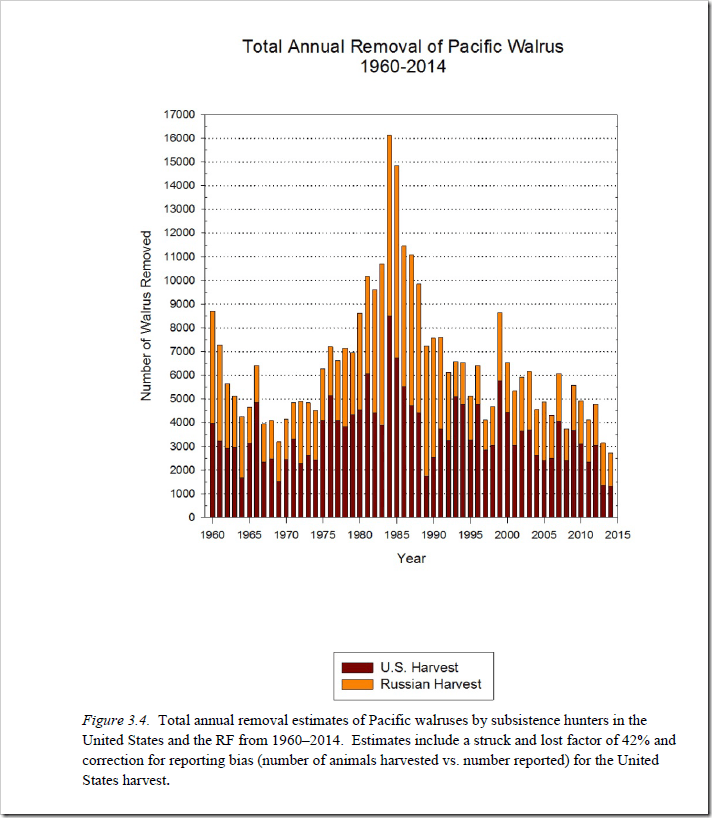
https://www.fws.gov/alaska/fisheries/mmm/walrus/pdf/final-pacific-walrus-species-status-assessment.pdf
The FWS also state that:
Pacific walrus population size has varied substantially in the last 150 years, it increased between 1960 and 1980 and may have reached the carrying capacity of the marine environment
In other words, the current population, which is believed to be similar to those earlier ones, may also be at maximum levels of sustainability.
Certainly, if Our Planet is correct about there being 100,000 walrus at Ryrkaypiy, the global population must be much greater than estimated, and would explain why the beach there was so crowded.
What we do know is that the U.S. Fish and Wildlife Service found after a comprehensive review in 2017 that the Pacific walrus does not require protection as threatened or endangered under the Endangered Species Act.
Breathtaking dishonesty
The migratory habits of walrus are pretty basic knowledge, which a natural historian such as David Attenborough should be familiar with.
Why then has he chosen to ignore the truth, and instead present a fictionalised account?
Is it to further his own political agenda? Is it simply incompetence? Or has he merely followed the script given to him by the WWF?
We don’t expect to hear the truth from the WWF. But if Netflix doesn’t quickly correct and retract this particular segment of the series, it will be highly damaging for their own credibility at a time when they are just embarking on producing serious documentaries.
As for Attenborough’s upcoming programme for the BBC on climate change, this little episode offers a clue about how inaccurate and biased it will be.
How the U.S. Navy Sold the Vietnam War
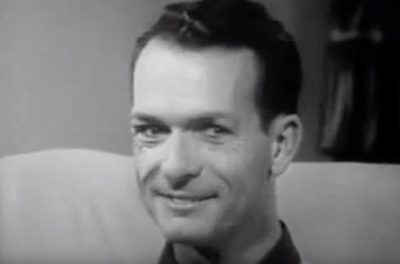
Dr. Tom Dooley. (YouTube screen shot)
By Gareth Porter | TruthDig | March 27, 2019
Dr. Tom Dooley, whose best-selling book “Deliver Us From Evil” helped create a favorable climate of opinion for U.S. intervention in South Vietnam, has long been linked to legendary CIA officer Edward G. Lansdale and his black operations in Vietnam between 1954 and 1955. But the real story about Dooley’s influential book, which has finally emerged from more recent scholarly research, is that it was engineered by an official of the U.S. Navy’s Pacific Command, Capt. William Lederer.
Lederer is best known as the co-author, with Eugene Burdick, of the 1958 novel “The Ugly American,” which was turned into a 1963 movie starring Marlon Brando. Far more important, however, is the fact that from 1951 through 1957 Capt. Lederer was on the staff of the commander in chief of the U.S. Pacific Fleet (CINCPAC), Adm. Felix Stump.
The Pacific Command was intensely interested in Dooley, because the U.S. Navy had the greatest stake of all the military services in the outcome of the conflict between the communists and U.S.-backed anti-communist regimes in Vietnam and China during the mid-1950s. And the Pacific Command was directly involved in the military planning for war in both cases.
Adm. Arthur Radford, the former CINCPAC and then chairman of the Joint Chiefs of Staff, led the senior officials pressing President Dwight D. Eisenhower to approve a massive U.S. airstrike against the Viet Minh at Dien Bien Phu in April 1954. And between 1954 and 1955, Adm. Stump called for increasing the size of the Nationalist Chinese raids on the Chinese mainland from offshore islands. He also pushed for a U.S. attack on the mainland, including the use of nuclear weapons, if necessary, to defend those same offshore islands.
Capt. Lederer met Dooley in Haiphong, Vietnam, in 1954 after the Navy launched “Operation Passage to Freedom” to help transport more than 300,000 Vietnamese civilians, soldiers and members of the French Army from the French-controlled North to Saigon. A CIA psychological warfare team led by Lansdale had slipped into Hanoi and Haiphong to sabotage the Ho Chi Minh government takeover and to spread propaganda to provoke fear among Catholics and other residents.
The key tactic of the Lansdale team was to print a series of “black propaganda” leaflets—designed to appear as though they came from the Viet Minh—to frighten residents of the North into leaving for South Vietnam. The most dramatic such deception involved spreading the rumor that the U.S. military was going to bomb Hanoi, a story that was further promoted by leaflets showing concentric circles of destruction of the city by an atomic bomb.
Lt. Tom Dooley, a young Irish Catholic Navy doctor, was “loaned” by the U.S. Navy to Lansdale for the operation, although Dooley apparently thought the team’s function was to gather intelligence. Dooley’s job was ostensibly to manage medical supplies needed for the movement of North Vietnamese to the South, but in fact Dooley functioned as the team’s propagandist, briefing visiting news media and sending out out reports through Catholic media in the United States that supported the CIA’s anti-Viet Minh mission.
Lederer quickly recognized Dooley as a potentially valuable propaganda asset because of his connection with Vietnamese Catholics and his penchant for telling tales of Viet Minh atrocities. It was Lederer who suggested that Dooley write a book about his experiences with North Vietnamese refugees who wanted to move to the South. The Navy gave him a leave of absence to write it, and Lederer became Dooley’s handler for the project. Dooley was a charismatic public speaker but needed Lederer’s help with writing. Lederer also introduced Dooley to Reader’s Digest—by far the most popular magazine in America, with 20 million readers. Chief of Naval Operations Arleigh Burke officially embraced the book and even wrote the introduction to it.
Reader’s Digest published a highly condensed 27-page version of the book in its April 1956 edition, and Farrar, Straus and Cudahy immediately published the full-length version. It became a runaway bestseller, going through twelve printings.
The constantly reiterated theme of Dooley’s book “Deliver Us From Evil” was that the Ho Chi Minh government was determined to suppress the Catholic faith in Vietnam and used torture and other atrocities to terrorize Catholics into submission. That was a grotesque distortion of actual Viet Minh policy. The Ho Chi Minh government had worked hard from the beginning of the war to ensure that there was no interference with Catholics’ exercise of their faith, even establishing severe legal penalties on any infringement of that freedom.
But Dooley’s book was full of lurid descriptions of North Vietnamese Communist atrocities against Catholics that Dooley claimed to have known about from treating the victims. It told of the Viet Minh having partially torn off the ears of several teenagers with pliers and left them dangling—supposedly as punishment for their having listened to the Lord’s Prayer.
And he described the Viet Minh taking seven youths out of their classroom and forcing wooden chopsticks through their eardrums. The children, he wrote, had been accused of “treason” for having attended a religious class at night. As for the teacher, Dooley claimed the Viet Minh had used pliers to pull out his tongue, as punishment for having taught the religious class.
But it was widely recognized within the U.S. government that these stories were false. Six U.S. Information Agency officials who had been in North Vietnam during that period, as well as former Navy corpsmen who had worked in the Haiphong camp with Dooley, all said they had never heard of any such events. And in 1992 Lederer himself, who had made 25 fact-finding trips to Vietnam since 1951, told an interviewer, “[T]hose things never happened. … I traveled all over the country and never saw anything like them.”
Many years later, in an interview with scholar Edward Palm, Lederer disclaimed any significant influence on the content or tone of Dooley’s book, even though Dooley had credited Lederer with helping put the book in final form. Lederer also told Palm he didn’t remember any such stories appearing in the first draft of the book he read.
But Palm, who obtained the first draft of the manuscript from Dooley’s papers, confirmed to this writer that the first draft did contain those stories of atrocities. And Palm’s monograph documented the fact that the last draft chapter was dated the end of July 1955 and that communications from both men at the time indicated that Lederer had met repeatedly with Dooley during June and July to help him finish the draft.
Palm also quoted from Dooley’s first draft to show that it concluded with a call for Americans to be ready for a U.S. war against communism. If negotiations with the Soviet Union failed to bring “lasting peace,” Dooley’s draft warned, “Communism will have to be fought with arms … it must be annihilated….” Dooley concluded, “[T]here can be no concessions, no compromise and no coexistence.”
Palm pointed out that the published version of the book dropped that rabidly warlike rhetoric and instead introduced a new character named “Ensign Potts” to represent the view that America must be ready to fight a war to destroy communism. The role of the “Potts” character was to be converted to Dooley’s argument that service to the ordinary Vietnamese would be the most effective way to prevail in the Cold War—after Dooley’s tearful recounting of the story of the Viet Minh puncturing the Catholic youths’ ears with chopsticks, reduced “Potts” to tears as well.
Lederer and Burdick popularized the idea that personal kindness to the people of Southeast Asia from American could help defeat Communism in “The Ugly American” and that same idea infused Lederer’s own March 1955 Reader’s Digest article on the interactions between U.S. sailors and Vietnamese aboard a U.S. Navy ship. Lederer told Palm in a 1996 interview that he had suggested that Dooley model his book on that article.
Palm wrote that he didn’t believes Lederer’s personal preference was to promote a U.S. war in Vietnam. But Lederer had obviously approved Dooley’s portrayal of the Vietnamese Communists as an alien horde terrorizing the Catholics. Catholics were the fastest-growing religious denomination in America from 1940 to 1960, during which time their numbers doubled, and Dooley’s message was an obvious way of mobilizing American Catholics to support Adm. Stump and the Navy’s agenda for Vietnam.
Marine Lt. Col. William Corson, who was detailed to the CIA during much of his career and knew Dooley during the writing of his book, told fellow former Marine Edward Palm in a 1997 telephone interview, “Dooley was programmed toward a particular end.” He did not say specifically what that end was, but he appeared to mean building popular support for U.S. intervention in Vietnam.
While on a nationwide book tour, Dooley was one of the featured speakers at the first conference of The American Friends of Vietnam—later known as the “Vietnam Lobby”—in Washington, D.C., on June 1, 1956. The meeting was held at a crucial moment in U.S. Vietnam policy. Eisenhower was still supporting the election for a government throughout Vietnam as called for by the 1954 Geneva Agreement, with strict conditions for a free vote. Meanwhile, hardliners in the administration were pushing for opposing that election outright on the ground that Ho Chi Minh would certainly win it, regardless of conditions.
Dooley’s contribution was to describe “Communism” as an “evil, driving, malicious ogre” and recount the “hideous atrocities that we witnessed in our camps every single day.” And he retold the story of the Viet Minh punishing the schoolchildren by puncturing their eardrums.
A few weeks after the meeting, Eisenhower reversed his previous position of supporting the all-Vietnamese Vietnamese, opening the path to deeper U.S. political and military intervention in Vietnam.
Dooley had just learned that his secret life as a gay man in the Navy had been discovered by Naval intelligence, and he was forced to quietly resign. At Lansdale’s suggestion, Leo Cherne of the International Rescue Committee helped Dooley establish a primitive medical clinic near the Chinese border in northern Laos. But Dooley had to agree to cooperate with CIA in Laos by allowing it to smuggle arms into the site of the clinic to eventually be distributed to local anti-Communist militiamen.
The Dooley Clinic in Laos helped make him a hugely popular celebrity, with two more best-selling books, feature stories in popular magazines and network television appearances. By the time Dooley died of cancer in 1961, a Gallup Poll found that Americans viewed him as the third most admired person in the world, after Eisenhower and the pope. But his role in the larger tragedy of U.S. war in Indochina was to serve as the instrument of a highly successful campaign by the U.S. Navy to create the first false propaganda narrative of the conflict—one that has endured for most of Dooley’s fans for decades.
But Dooley’s popularity and saintly image increased the power of his tales of Viet Minh atrocities against Catholics that represented the first major false U.S. propaganda narrative of the Vietnam conflict—one that helped build public support for the U.S. military intervention in Vietnam that began under President John F Kennedy in 1962.
Roméo Dallaire and the Toronto Star’s distortion of Rwanda’s tragedy
By Yves Engler · April 11, 2019
 The Toronto Star should get its facts straight and stop distorting Rwanda’s tragedy.
A day after the 25th anniversary of when two Hutu presidents were blown out of the sky, the Star’s editorial board published “There’s no excuse for ignoring lessons of Rwanda’s genocide”. It claims, “on Jan. 11, 1994, Canadian Maj.-Gen. Roméo Dallaire, at the time force commander with the United Nations Assistance Mission for Rwanda, sent a chilling and urgent cable to UN Headquarters in New York. He had been informed of the details of a plan for the ‘extermination’ of ethnic Tutsis by Hutus.” After stringing together a few hundred more humane-sounding, though meaningless, words Star editorialists returned to their core liberal interventionist Canadian hero theme: “In his cable of January 1994 he urged UN leaders to act by telling them the obvious: Where there’s a will to prevent mass killing, there is a way.”
The Star should check Dallaire’s fax more closely. Revealingly, the much-celebrated “genocide fax” the editorialists reference is not titled “‘genocide’ or ‘killing’ but an innocuous ‘Request for Protection of Informant’”, reports International Criminal Tribunal for Rwanda (ICTR) lawyer Christopher Black in a 2005 story titled “View from Rwanda: The Dallaire Genocide Fax: A Fabrication”. The two-page “genocide fax”, as New Yorker reporter Philip Gourevitch dubbed it in 1998, was probably doctored a year after the mass killings in Rwanda ended. In a chapter devoted to the fax in Enduring Lies: The Rwandan Genocide in the Propaganda System, 20 Years Later Edward S. Herman and David Peterson argue two paragraphs were added to a cable Dallaire sent to Canadian General Maurice Baril at the UN Department of Peacekeeping Operations in New York about a weapons cache and protecting an informant (Dallaire never personally met the informant). The added paragraphs said the informant was asked to compile a list of Tutsi for possible extermination in Kigali and mentioned a plan to assassinate select political leaders and Belgian peacekeepers.
At the ICTR former Cameroon foreign minister and overall head of the UN mission in Rwanda, Jacques-Roger Booh-Booh, denied seeing this information and there’s no evidence Dallaire warned the Belgians of a plan to attack them, which later transpired. Finally, a response to the cable from UN headquarters the next day ignores the (probably) added paragraphs. Herman and Peterson make a compelling case that a doctored version of the initial cable was placed in the UN file on November 27, 1995, by British Colonel Richard M. Connaughton as part of a Kigali-London-Washington effort to prove the existence of a plan by the Hutu government to exterminate Tutsi.
Even if the final two paragraphs were in the original version, the credibility of the information would be suspect. Informant “Jean-Pierre” was not a highly placed official in the defeated Hutu government, reports Robin Philpott in Rwanda and the New Scramble for Africa: From Tragedy to Useful Imperial Fiction. Instead, “Jean-Pierre” was a driver for the MRDN political party who later died fighting with the Rwandan Patriotic Front.
Incredibly, the “genocide fax” is the primary source of any documentary record demonstrating UN foreknowledge of a Hutu “conspiracy” to exterminate Tutsi, a charge even the victor’s justice at the ICTR failed to convict anyone of. According to Herman and Peterson, “when finding all four defendants not guilty of the ‘conspiracy to commit genocide’ charge, the [ICTR] trial chamber also dismissed the evidence provided by ‘informant Jean-Pierre’ due to ‘lingering questions concerning [his] reliability.’”
Tellingly, Dallaire didn’t even initially adhere to the “conspiracy to commit genocide” version of the Rwandan tragedy. Just after leaving his post as UNAMIR force commander Dallaire replied to a September 14, 1994, Radio Canada Le Point question by saying, “the plan was more political. The aim was to eliminate the coalition of moderates. … I think that the excesses that we saw were beyond people’s ability to plan and organize. There was a process to destroy the political elements in the moderate camp. There was a breakdown and hysteria absolutely. … But nobody could have foreseen or planned the magnitude of the destruction we saw.”
Doctoring a fax to make it appear the UN had foreknowledge of a plot to exterminate Tutsi may sound outlandish, but it’s more believable than many other elements of the dominant narrative of the Rwandan genocide. The day after their editorial, for instance, the Star published a story titled “25 years after genocide, Rwanda rebuilds” which included a photo of President Paul Kagame leading a walk to commemorate the mass killings. But, Kagame is the individual most responsible for unleashing the hundred days of genocidal violence by downing a plane carrying two Hutu presidents and much of the Rwandan military high command.
Even the Star has reported as much. A year ago they published a story titled “Did Rwanda’s Paul Kagame trigger the genocide of his own people?” For its part, the Globe and Mail has published a series of front-page reports in recent years confirming Kagame’s responsibility for blowing up the plane carrying Rwandan President Juvénal Habyarimana, which triggered mass killings in April 1994. In an October story titled “New information supports claims Kagame forces were involved in assassination that sparked Rwandan genocide” the Globe all but confirmed that the surface-to-air missiles used to assassinate the Rwandan and Burundian Hutu presidents on April 6, 1994, came from Uganda, which backed the RPF’s bid to conquer its smaller neighbour. (A few thousand exiled Tutsi Ugandan troops, including the deputy minister of defence, “deserted” to invade Rwanda in 1990.) These revelations strengthen the case of those who argue that responsibility for the mass killings in spring 1994 largely rests with the Ugandan/RPF aggressors and their US/British/Canadian backers.
By presenting the individual most culpable for the mass killings at the head of a commemoration for said violence the Star is flipping the facts on their head. The same might be said for their depiction of the Canadian general. At the end of their chapter tracing the history of the “genocide fax” Herman and Peterson write, “if all of this is true,” then “we would suggest that Dallaire should be regarded as a war criminal for positively facilitating the actual mass killings of April-July, rather than taken as a hero for giving allegedly disregarded warnings that might have stopped them.”
Who Is Killing Whom in the Middle East? Blaming Iran Might be an Excuse for War
By Philip M. GIRALDI | Strategic Culture Foundation | 11.04.2019
Newsweek is reporting a story regarding how Iran “was responsible for the deaths of at least 608 American troops in Iraq between 2003 and 2011.” The account is sourced to a newly revised estimate prepared by analysts at the Pentagon that was discussed by Special Representative for Iran Brian Hook at a State Department press briefing on April 2nd. According to Hook, Tehran is now being blamed for 17 per cent of all US military deaths because it supplied weapons to the several Shiite militias that were opposing the US invasion, occupation and subsequent presence in the country.
Hook also stated that the American casualties are in addition to the “thousands” of Iraqi troops and civilians that were killed in attacks initiated by what he referred to as the Iranian proxy forces. Hook noted that the new number is higher than the 2015 confirmed death total of 500 that was reported by then Chairman of the Joint Chiefs of Staff General Joseph Dunford, who qualified his estimate by saying “We were not always able to attribute the casualties that we had to Iranian activity, although many times we suspected it was Iranian activity, even though we did not necessarily have the forensics to support that.”
There is little doubt that Tehran provided weapons to Shiite militias in Iraq after the invasion of the country by American forces in April 2003 and the defeat and replacement of the Saddam Hussein regime. The US was occupying the country at the time and Shiites were a repressed majority of the population given the fact that Saddam ruled through his Sunni minority.
The most controversial and lethal weapons used by the Shiite and Sunni resistance to the United States were the Improvised Explosive Devices or IEDs, subsequently also referred to as Explosively Formed Penetrators or EFPs which were capable of penetrating the armor on US military vehicles. They first appeared in Iraq in the summer of 2004, but they were initially mostly used by Sunni insurgents, not by the Shiites.
Now that the US occupation has ended, Iran and Iraq enjoy a close relationship that is based on their common Shiite religion. The former militiamen are now referred to as Popular Mobilization Forces, which were key to the eventual defeat of ISIS. The United States, which retains a major military base inside Iraq, continues to rail against Iran. During the briefing, Hook said “We are imposing costs on the [Iranian] regime for behaving as an outlaw expansionist regime. The regime is weaker today than when we took office two years ago. Its proxies are also weaker. Unless the regime demonstrates a change in policy and behavior, the financial challenges facing Tehran will mount.”
There are several problems with the Hook analysis, if that is actually what it was. The United States government has been arguing since 2005 that Iran is “interfering” in neighboring Iraq, combined with allegations about “they are killing our soldiers” to make sure that Tehran continues to be everyone’s recognizable regional enemy. Specific claims by generals and US politicians were made between 2005 and 2007 regarding Iranian involvement in the production of the shaped charges, which were increasingly exacting a bloody toll of US and allied military personnel.
But the claims being made by the Bush Administration, by Congress, and by the media regarding Iranian support of militants in Iraq had a number of things in common: they were generic and lacking in specificity, they were based on possibly unwarranted assumptions about Iranian interactions with other players in the region, they played fast and loose with statistics, and they seldom provided actual verifiable evidence to back up the assertions being made. One might also point out that nearly all the reports were derivative in that they build on each other to develop credibility, much like the reports about Iraq in 2002.
It has also been noted that the arguments about Iranian involvement are logically inconsistent. The Iraqi insurgency in the period 2004-2006 was largely Sunni. That the Iranians would be supplying the Sunnis or that the Sunnis would even seek such assistance does not appear probable. In an April 2007 briefing Major General William Caldwell explained, “We have, in fact, found some cases recently where Iranian intelligence services have provided to some Sunni insurgent groups some support.” Three uses of “some” in one sentence suggest a degree of uncertainty. Even the relatively tame media at the briefing were skeptical, asking “Do the Iranians support all the militias in Iraq?”
The fact that the EFP is very simple to make also argues against a largely Iranian provenance. The EFP or variations thereof has been around for a long time. It was reportedly used under its old name “shaped charge” by the French resistance against the Germans and by the Irish Republican Army against British armored vehicles and it has been used extensively by both Hezbollah and Hamas against the Israelis.
The case against Iran basically relies on a basic argument that the EFP is actually a sophisticated weapon that has to have its copper disk machined in a weapons shop that is accustomed to milling metal to the finest tolerances. According to those who believe in an Iranian hand in EFP attacks, it is not possible that the weapons are being produced by Iraqis without Iranian assistance but the fact is that the Iraqis are more than capable of making the weapon. Iraq had a large and relatively sophisticated military prior to 2003. It had its own weapons shops and ordnance experts, many of whom were Sunnis and many of whom became unemployed in the spring of 2003 when the army was disbanded.
So Iran’s EFP weapon of choice that, according to the Pentagon, has killed 608 Americans turns out to be not that hard to make and not uniquely Iranian. But the real argument against Brian Hook’s numbers is the assumption made by the government analysts that supplying weapons, even if and when the end user can be demonstrated, makes one responsible for who gets killed as a result. Since the US is the world’s leading arms manufacturer, that argument leads down a slippery slope as “Made in USA.” weapons are likely featured in every conflict.
Also bear in mind that the United States in Iraq was an invading army in what became a guerrilla war in which that country’s civilians ultimately constituted most of the victims. By one estimate, 460,000 Iraqis died, many by US-made ordnance. To cite one other more recent example of what that measure of accountability might mean, the United States could be considered responsible for the deaths of tens of thousands civilians in Yemen, 5,000 in 2018 alone, as the Saudis are using US supplied weapons. And there are a lot of other instances of American made weapons winding up in all kinds of places, including the arsenals of ISIS and al-Qaeda. Al-Qaeda in its war against the Russians in Afghanistan relied largely on American weaponry. Some of those weapons are still being used to kill American rather than Russian soldiers.
Since the United States government is selectively charging Iran with offenses that might well be exploited by neoconservatives named Bolton and Pompeo to initiate a war it should be more careful in how it attempts to frame its arguments. Iran did not kill those 4,424 American soldiers who died in Iraq. President George W. Bush, Vice President Dick Cheney and the band of psychopaths at the Pentagon and National Security Council did that when they initiated a chain of events that began with attacking a country that they knew posed no threat against the United States. The bloody consequences of that action continue to this day.
Unaccountable Media Faced with Dilemma in Next Phase of Deep State-gate
By Ray McGovern | Consortium News | April 10, 2019
Readers of The Washington Post on Monday were treated to more of the same from editorial page chief Fred Hiatt. Hiatt, who won his spurs by promoting misleading “intelligence” about weapons of mass destruction in Iraq and suffered no consequences, is at it again.
This time he is trying to adjust to the fading prospect of a Deus ex Mueller to lessen Hiatt’s disgrace for being among the most shameless in promoting the Trump-Russia collusion narrative.
He is not giving up. When you are confident you will not lose your job so long as you adhere to the agenda of the growing Military-Industrial-Congressional-Intelligence-Media-Academia-Think-Tank complex (MICIMATT if you will), you need not worry about being a vanguard for the corporate media. It is almost as though Hiatt is a tenured professor in an endowed chair honoring Judith Miller, the New York Times reporter who perhaps did most to bring us Iraqi WMD.
In his Monday column Hiatt warned: “Trump was elected with the assistance of Russian spies and trolls, which he openly sought and celebrated. But he did not (or so we are told) secretly conspire with them.” In effect, Hiatt is saying, soto voce: “Fie on former (now-de-canonized) Saint Robert of Mueller; we at the Post and our colleagues at The New York Times, CNN et al. know better, just because we’ve been saying so for more than two years.”
Times executive editor Dean Baquet said, about the backlash to the Times‘ “collusion” coverage: “I have no regrets. It’s not our job to determine whether or not there was illegality.” CNN President Jeff Zucker said: “We are not investigators. We are journalists.” (One wonders what investigative journalist Bob Parry, who uncovered much of Iran-Contra and founded this site, would have thought of that last one.)
Going in Circles
Hiatt’s circular reasoning is all too familiar. It is the kind a former director of national intelligence excels at when he’s not lying, sometimes under oath. For instance, James Clapper was hawking his memoir at the Carnegie Endowment last year when he was confronted by unexpectedly direct questions from the audience.
Asked about the misleadingly labeled, rump “Intelligence Community Assessment” (ICA) of Jan. 6, 2017, which he orchestrated, and which blamed Russia for interfering in the 2016 election, Clapper gave an ipse dixit response: The ICA simply had to be correct because that’s what he had told President Barack Obama and President-elect Donald Trump.
In fact, that “Intelligence Community Assessment” stands out as the most irresponsible, evidence-free and at the same time consequential crock of intelligence analysis since the National Intelligence Estimate of Oct. 2001 claimed there was WMD in Iraq. Recall that that one was shaped by out-and-out fraudulent intelligence to “justify” an attack on Iraq six months later.
Sen. Jay Rockefeller (D-WV), as chair of the Senate Intelligence Committee, described the main thrust of the committee’s five-year bipartisan report, stating, “In making the case for war, the [Bush] Administration repeatedly presented intelligence as fact when in reality it was unsubstantiated, contradicted, or even non-existent.”
Hiatt was one of the media’s major offenders, feeding on what the Cheney/Bush folks told him. When no “weapons of mass destruction” were found in Iraq, Hiatt conceded during an interview with The Columbia Journalism Review that, “If you look at the editorials we write running up [to the war], we state as flat fact that he [Saddam Hussein] has weapons of mass destruction … If that’s not true, it would have been better not to say it.” [CJR, March/April 2004] As Parry wryly observed at the time in a piece calling for Hiatt’s dismissal, “Yes, that is a common principle of journalism, that if something isn’t real, we’re not supposed to confidently declare that it is.”
The Morning After
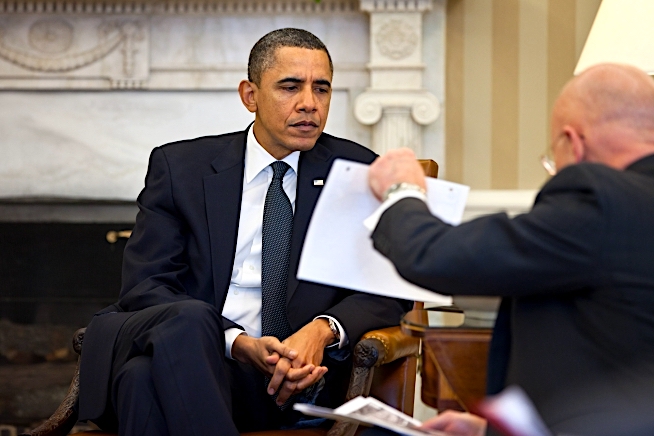
Clapper: After WMD failure, promoted by Obama. (White House Photo/ Pete Souza)
The media set the prevailing tone the day after the ICA was published. The banner headline atop page one of the Times read: “Putin Led Scheme to Aid Trump, Report Says.” That put in motion more than two years of Dick Cheney-like chicanery in the media.
Buried inside the Times that same day was a cautionary paragraph written by staff reporter Scott Shane who noted, “What is missing from the public report is what many Americans most eagerly anticipated: hard evidence to back up the [three] agencies’ claims that the Russian government engineered the election attack. That is a significant omission.” Indeed it was; and remains so.
(Sadly, Shane was then given his marching orders and fell in line with many other formerly reputable journalists in what has been the most miserable performance by the mainstream media since they helped pave the way for war on Iraq.)
Clapper and Hiatt are kindred souls when it comes to the “profound effect” of Russian election interference. In his column, Hiatt asserted as flat fact that: “Trump was elected with the assistance of Russian spies and trolls …” At the Carnegie event in November, Clapper opined:
“As a private citizen, understanding the magnitude of what the Russians did and the number of citizens in our country they reached and the different mechanisms that, by which they reached them, to me it stretches credulity to think they didn’t have a profound impact on election on the outcome of the election.”
Hiatt: Captain of Cheerleaders
Hiatt emulated peppy, preppy cheerleader George W. Bush in leading Americans to believe that war on Iraq was necessary. Appointed Washington Post editorial page editor in 2000, he still runs the page — having not been held accountable for gross misfeasance, if not malfeasance, on Iraq. Shades of Clapper, whom President Obama allowed to stay on as director of national intelligence for three and a half years after Clapper lied under oath to the Senate Intelligence Committee about NSA surveillance of U.S. persons.
That Obama appointed Clapper to lead the investigation into Russian interference in the 2016 election speaks volumes. Clapper claims to have expertise on Russia and has made no effort to disguise his views on “the Russians.” Two years ago, he told Chuck Todd on Meet the Press:
“… in context with everything else we knew the Russians were doing to interfere with the election, and just the historical practices of the Russians, who are typically, almost genetically driven to co-opt, penetrate, gain favor, whatever, which is a typical Russian technique … we were concerned.”
It beggars belief that Obama could have been unaware of Clapper’s bizarre views on “the Russians.” Clearly, Obama was bowing yet again to pressure from powerful Deep State actors arguing that Clapper was the ideal man for the job.
And there is now documentary evidence that, from the Deep State point of view, indeed he was. In the text exchanges between discredited FBI sleuth Peter Strzok and his girlfriend, Lisa Page, a lawyer working for the FBI Deputy Director Andrew McCabe, it seems clear that Obama wanted to be kept apprised of the FBI’s behind-the-scenes machinations. In a Sept. 2, 2016 text to Strzok, Page writes that she was preparing talking points because the president “wants to know everything we’re doing.”
A Sweaty Pate?
Clapper is aware now that he is going to have to sweat it out. He may believe he can ignore White House press secretary Sarah Sanders, who has said that he and other former intelligence officials should be investigated after special counsel Mueller did not establish collusion between the Trump campaign and Russia.
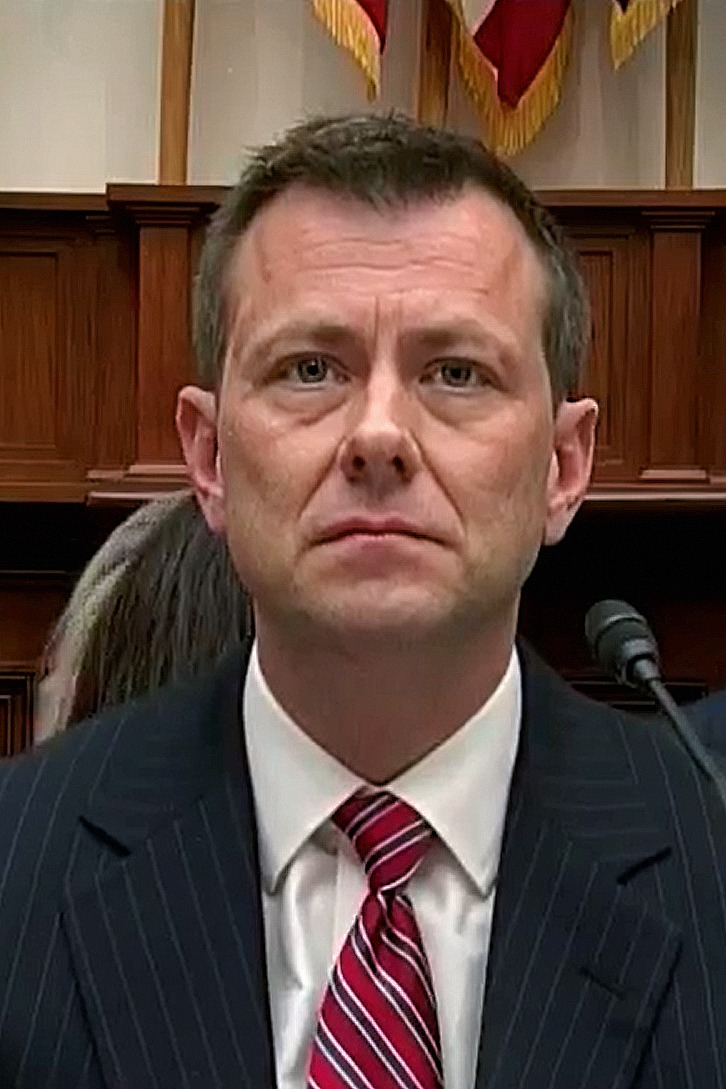
Strzok: Will he be on Nunes’s list? (Wikipedia)
But recent statements by members of the House and Senate intelligence committees cannot be dismissed so easily. In his media appearances, the supremely confident, hero-of-many-liberals Clapper has been replaced by a squirming (but-Obama-made-me-do-it) massager of facts. He may find it harder this time to avoid being held accountable.
Devin Nunes (R-CA), the House Intelligence Committee ranking member, has gone on the offensive, writing Friday that committee Republicans “will soon be submitting criminal referrals on numerous individuals involved … in the abuse of intelligence for political purposes. These people must be held to account to prevent similar abuses from occurring in the future.”
On Sunday, Nunes told Fox News he’s preparing to send eight criminal referrals to the Department of Justice this week concerning alleged misconduct during the Trump-Russia investigation. This will include leaks of “highly classified material” and conspiracies to lie to Congress and the Foreign Intelligence Surveillance Act (FISA) court. It’s no-holds-barred for Nunes, who has begun to talk publicly about prison for those whom DOJ might indict and bring to trial.
Nunes’s full-speed-ahead offensive is being widely ignored in “mainstream” media (with the exception of Fox), giving the media the quality of “The Dog That Did Not Bark in the Night.” The media has put its ducks in a row, such as they are, to try to rip Attorney General William Barr apart this coming week when he releases the redacted text of the Mueller report that so disappointed the Democratic Party/media coalition.
But how will they cover criminal referrals of the “heroes” who have leaked so much to them, providing grist for their Russia-gate mill? They will likely find a way, eventually, but the media silence about Nunes is depriving oxygen to the story.
On Sunday, Nunes said,
“They [the Democrats] have lied multiple times to the American people. All you have to do is look at their phony memos. They have had the full support of the media, 90 percent of the media in this country. They all have egg on their face. And so the fact of the matter remains, is there going to be — is justice going to be served or is justice going to be denied? And that’s why we’re sending over these criminal referrals.”
Nunes is, of course, trying to project an image of confidence, but he knows he is fighting uphill. There is no more formidable foe than the MICIMATT, with the media playing the crucial role in these circumstances. How will the American people be able to see egg on anyone’s face if the “mainstream media” find ways to wipe it off and turn the tables on Nunes, as they have successfully done in the past?
Though the Democrats now control the House, they have lost some key inside-the-Deep-State allies.
By all appearances, House Democrats still seem to be banking on help from the usual suspects still on duty in the FBI, CIA, and the Justice Department. Lacking that they seem ready to go down with the Schiff—Rep. Adam Schiff of California, perhaps the most virulent Russia-gater that there’s been.
Clapper is no longer in a position to help from the inside, and there’s no knowing how his sleepy replacement, Dan Coates, will react, if and when he wakes up long enough to learn chapter and verse about the machinations and dramatic personae of 2016.
Of course, there is a new sheriff in town running the Department of Justice. Attorney General William Barr, for better or ill, is a far cry from Jeff Sessions, who let himself be diddled into recusing himself. He’s not Rod Rosenstein either, whose involvement in this affair may have already earned him a prominent place on Nunes’s list of referrals.
What Did Obama Know, and When Did He Know It?
On top of this, Sen. Rand Paul (R, KY) has called for an investigation into the origins of Mueller’s probe, including on the dicey question of how witting President Obama was of the Deep State chicanery during the last months of his administration. Page did tell Strzok in that Sept. 2, 2016 text that the president “wants to know everything we’re doing.”
Sen. Paul has also tweeted information from “a high-level source” that it was former CIA Director John Brennan who “insisted that the unverified and fake Steele dossier be included in the Intelligence Report… Brennan should be asked to testify under oath in Congress ASAP.”
Vying for Media Attention
If, as expected, Nunes discloses the names of those being criminally referred to DOJ, and Barr releases a redacted text of the Mueller report, the “mainstream” media will have a fresh challenge on their hands. The odds would seem to favor the media covering the Democrats’ predictable criticism of Barr — and perhaps even of Mueller, now that he has been defrocked.
The Post’s Hiatt should be counted on, as always, to play a leading role.
At the same time, there are signs the America people are tired of this. It would be difficult though for the media to avoid reporting on criminal referrals of very senior law enforcement and intelligence officials. Given the media’s obvious preference for siding with the intelligence agencies and reporting on Russia-gate rather than Deep-State-gate, it would be even harder for the media to explain why these officials would be in trouble.
Things appear to be unraveling but, as always, much will depend on whether the media opts to remain the “dog that didn’t bark,” and succeeds again in hoodwinking too many people.
Ray McGovern works with Tell the Word, a publishing arm of the ecumenical Church of the Saviour in inner-city Washington. He was a CIA analyst for 27 years and prepared the President’s Daily Brief for Presidents Nixon, Ford, and Reagan. He is on the Steering Group of Veteran Intelligence Professionals for Sanity (VIPS).
Putin Derangement Syndrome After Mueller
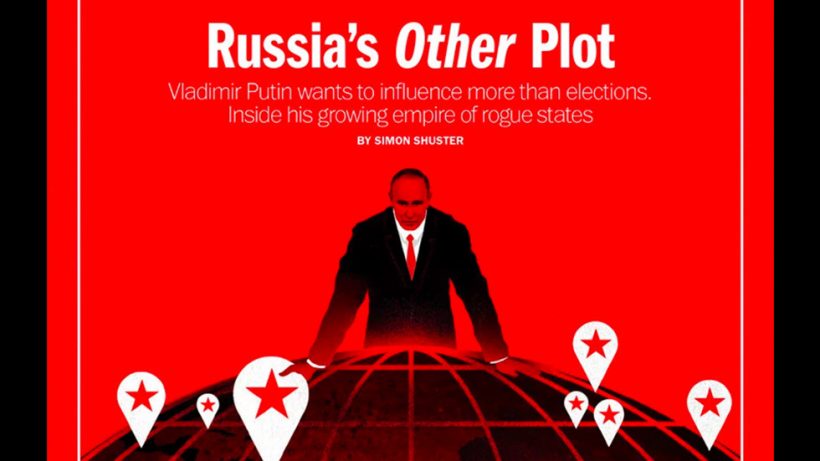
© Time Magazine
By Patrick ARMSTRONG | Strategic Culture Foundation | 09.04.2019
The West – its governments and its governments’ scribes – are obsessed with Russian President Vladimir Putin. “Obsessed” is probably too weak a word to describe the years of impassioned coverage, airy speculation and downright nonsense. He is the world’s leading cover boy: military hats, Lenin poses, imperial crowns, scary red eyes, strait-jackets, clown hats; anything and everything. He’s the avatar of Stalin, he’s the avatar of the Tsars, he’s the Joker, he’s Cthulhu, he’s Voldemort, he’s Satan. He’s the palimpsest for the New World Order’s nightmares. Putin is always messing with our minds. He weaponises information, misinformation and sexual assault accusations. Childrens’ cartoons, fishsticks, Pokemon and Yellow Vests, “Putin’s warships” are lurking when they aren’t stalking; “Putin’s warplanes” penetrate European airspace; “Putin’s tanks”, massing in 2016, massing in 2018, still massing. His empire of rogue states grows. All Putin, all the time.
In an especially imbecilic display in 2015, Western reporters (unable to find his website) thinking he hadn’t been seen for several days started a contest of speculation about coups, death, wars, plastic surgery, secret births and other nonsense; when he “re-appeared”, the story went down the Memory Hole.
For some reason, Americans personalise everything. In meetings with US intelligence agencies I was always fascinated how they would reduce every complicated reality to a single individual. But it isn’t Saddam, or Assad, or Qaddafi, or Osama, or Aidid, or Milosevic, or Maduro, or Castro or any of the other villains-of-the-day, it’s a whole country: these people got to the top for good reasons. Removing the boss makes some difference but never all the difference. They go but they never leave a Washington-friendly country behind and Washington does it all over again somewhere else. This peculiar blindness drives Putin Derangement Syndrome and has infected everybody else.
But Putin is much worse than the others. The other enemies had relatively weak countries but Russia could obliterate the USA. But worse, Putin’s team has steadily become more powerful and more influential. And worst of all, he’s still there: huffing and puffing has not blown him down, sanctions strengthen the economy and there is nothing to suggest he won’t be succeeded by someone who carries on the same policies. It’s a whole country, not just one man.
Vladimir Putin is the biggest man on earth.
Except that he’s short and can’t hide it. He’s a megalomaniac because he’s short; he’s trying to prove his bigness; napoleon complex says some shrink. Just another in a long list of crackpot “expert” opinions. From a list I complied in 2015: Asperger’s Syndrome, cancer of the spinal cord, personality disorders, gayness, Parkinson’s Disease, psychopath, people don’t like him so animals have to, sinister, lonely life, fears his own people, envious of Obama. Remember the “gunslinger walk”? Oh, in case you hadn’t heard, he was in the KGB and that explains everything: “Once a KGB man, always a KGB man”. Nothing is too absurd.
But laughing has passed – Putin Derangement Syndrome has become dangerous.
In 2016 Hillary Clinton lost a sure-fire election to Donald Trump and, looking for an excuse, jumped on the Russia claim. Putin Derangement Syndrome was ramped up to a much more dangerous level. War-level dangerous.
A popular actor made a video to tell us we were at war. “Warfare” says Haley, “act of war” said John McCain, could be says Cheney, 911 says Clinton, disappointed CIA guy agrees, Pearl Harbor says Nadler. Diplomatic expulsions and sanctions and more sanctions. These are much more serious than gassy op-eds about Putin’s gait or fish weights, these are actions: actions have consequences. Moscow doesn’t find war talk very funny.
Clinton’s victory was 99% certain until it wasn’t and excuses were needed. Clinton went through a lot of them but “Russian interference” was always the big one.
That strategy had been set within twenty-four hours of her concession speech. [9 November 2016] Mook and Podesta assembled her communications team at the Brooklyn headquarters to engineer the case that the election wasn’t entirely on the up-and-up. For a couple of hours, with Shake Shack containers littering the room, they went over the script they would pitch to the press and the public. Already, Russian hacking was the centerpiece of the argument. (From Shattered, quoted here.)
In What Happened, Clinton also says Russian President Vladimir Putin’s support for Trump was driven by his own anti-women sentiment, stacking the deck against her: “What Putin wanted to do was… influence our election, and he’s not exactly fond of strong women, so you add that together and that’s pretty much what it means.” At press events for her memoir, Clinton continues to warn Americans against Russia’s power over Trump and the country. “The Russians aren’t done. This is an ongoing threat, and that is one of the reasons why I wrote the book and one of the reasons I’m talking about it,” she said on Sunday at Southbank Centre’s London Literature Festival. (Newsweek)
Her claim is, to put it mildly, unproven; the so-called “all 17 agencies” report notwithstanding. (The first premise that it was hacked is here disproved: downloaded by someone in the building). Her accusation moved Putin Derangement Syndrome away from the realm of mere craziness into war talk. Taking the hint, Western politicians, under attack for their lacklustre performances, were happy to push the blame onto Putin. He’s attacking democracy! Western media weighed in until it became completely accepted by some people that anything that spoiled the happy complacency of the Western world must be a result of Putin’s interference: gilets jaunes, “assistance provided to far-right and anti-establishment parties”, he’s the poster boy of the dreaded populism, his populist tentacles reach Hungary and Italy. And the next thing we knew, Putin was mucking around in everybody’s votes: Brexit; Catalonia; Netherlands; Germany; Sweden; Italy; EU in particular and Europe in general; Mexico; Canada. Newsweek gives a helpful list. Sometimes he loses elections: Germany, Ukraine but he goes on, unstopping. But his greatest triumph was said to have been in the US election: he “won” because Donald Trump was his willing puppet.
(None of these “experts” ever seem to wonder why Putin’s influence, so decisive far away, is so ineffective in Ukraine or Georgia. But then, it’s not actually a rational, fact-based belief, is it?)
The entire ramshackle construction is collapsing: if Mueller says there was no collusion then even the last ditch believers will have to accept it: Robert Mueller Prayer Candles are out of stock, time to toss the other tchotchkes, it wasn’t a Mueller Christmas after all. Clinton’s fabrication had two parts to it: 1) Putin interfered/determined the election 2) in collusion with Trump. When the second part is blown up, so must the first be. And then what will happen to all the loyal little allies crying “ours were interfered with too”!? The two halves of the story had the same authors and the same purpose: if one dies, so must the other. Now that Trump is secured from the obstruction charges that hung there as long as Mueller was in session, he is free to declassify the background documents that will show the origin, mechanics, authors and extent of the conspiracy. And he has said he will. In the process, both halves of the story will be destroyed: they’re both lies.
(For those who now realise there is something they have to catch up on: Conrad Black has a good exposition of the overall conspiracy and here is a quick round-up of the mechanics of the conspiracy. This may show its very beginning, three years ago).
Will the exposure of the plot and the plotters end the war-talk stage of Putin Derangement Syndrome? In a rational world, it would (but can its believers be embarrassed by the exposure of their credulity? Can they be made to think it all over again from the beginning?). It is true that Russia stands in the way of the neocons and liberal interventionists who have been guiding Washington this century, but that hardly means that Putin is the enemy of the American people. Because, properly considered, it’s the neocons/liberal interventionists and their endless wars burning up lives, money and good will that are the enemies of Americans; in that respect Putin (unintentionally) stands with the true best interests of the American people. But the propaganda is so strong and the hysteria so unrestrained, that anyone who suggests that blocking the war party is in the best interests of Americans would be run out of town on a rail. (As the attacks on Tulsi Gabbard show.) The USA is far down the rabbit hole. (Although I should say US elites: a Rasmussen poll shows that slightly more Americans think Clinton colluded with a foreign power than think Trump did. Considering the news coverage of the last two and a half years, that’s a very interesting finding.)
So, the sad conclusion is that Putin Derangement Syndrome will probably endure and the best we can hope for is that it is dialed down a bit and the “act of war” nonsense is quietly forgotten. Derangement was strong before the interference/collusion lie and it will exist as long as Putin does: the war party is too invested in personalities ever to realise that it’s Russia, not its president, that’s the obstacle. Let alone ever understand that much of what Moscow does is a pushback against Washington’s aggression.
Let The Onion have the last laugh at this dismal matter:
“What the hell? I worked so hard on this—if I wasn’t colluding with the Trump campaign, who the hell was I colluding with?” said the dumbfounded Russian president, growing increasingly angry as he scrolled through his email inbox and recounted his numerous efforts at covert communication with individuals who he had thought were high-ranking Trump officials, but now he suspected were bots or anonymous internet trolls.”
Venezuela sabotage, evil Russians: 5 times video games were just blatant US war propaganda
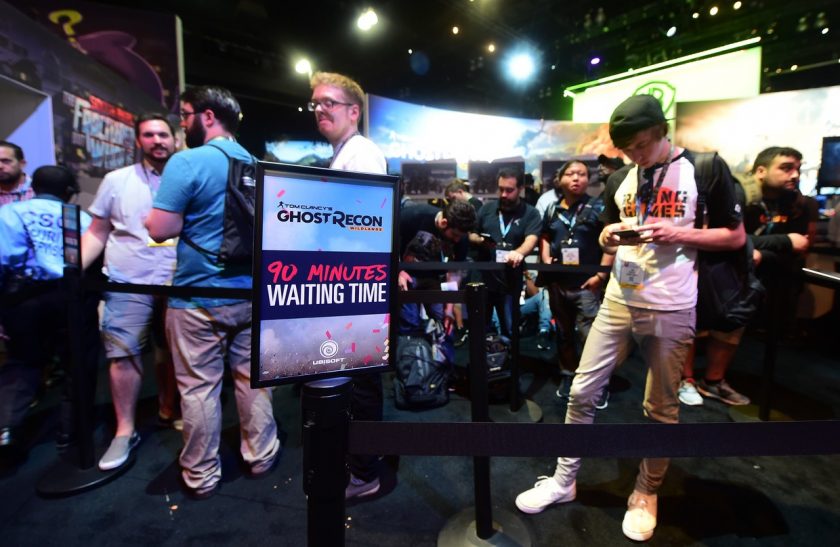
© AFP / Frederic J. Brown
RT | April 9, 2019
It’s long been known that Hollywood works hand-in-glove with the CIA to produce entertainment imbued with unsubtle pro-US messaging — but the use of video games as propaganda, while as common, is less talked about.
A producer for Venezuela-based news outlet Telesur tweeted a video on Monday showing clips from the 2013 game ‘Call of Duty: Ghosts’ which appear to foreshadow massive electricity blackouts which left Venezuela’s capital city Caracas in almost total darkness in March.
In the game, US special forces are seen on a “mission” to cause a blackout by installing a virus onto a computer at the Guri Hydroelectric Dam — the very same location where a major failure caused the recent blackouts, which the Venezuelan government blamed on the US. The game’s creator said in 2014 that the Activision publishing company brought in “outside help” to produce the game, including “military advisers” and planners from the Department of Defense.
Here’s a look at some other games that don’t exactly do ‘subtle’ when it comes to pro-US propaganda.
Regime change in Bolivia!
US special forces are back in ‘Ghost Recon: Wildlands (2017)’, but this time the setting is Bolivia, where a brutal Mexican drug cartel called Santa Blanca are propping up another bad government. The good Americans, working for the CIA, must infiltrate Bolivia on the side of the harmless rebels to protect and liberate the innocent villagers we see dotted around the Bolivian landscape.
Depose the Venezuelan dictator…
Off to Venezuela again for the 2006 game ‘Mercenaries 2: World in Flames,’ where the goal is to oust “a power-hungry tyrant [who] messes with Venezuela’s oil supply, sparking an invasion that turns the country into a war zone.”
The game, developed by Pandemic Studios (which has also developed training aids for the US military), is set in what the makers called a “fully destructible Venezuela” and was criticized upon its release by the government of Hugo Chavez which said it was an attempt to drum up support for a real invasion.
US Army-funded recruitment tool
America’s Army is the “official” US Army game which “provides young Americans with a virtual web-based environment in which they can explore an army career.” AA was developed and offered for free as part of a post-9/11 campaign to help recruit new members to the military. It was revealed in 2009 through Freedom of Information Act requests that the game cost American taxpayers $33 million over eight years.
Evil Russians on the eastern front
Turning to World War 2, the 2013 game ‘Company of Heroes 2’ caused controversy in Russia over the presence of unnecessarily brutal Russian characters who killed for the fun of it. In one instance, the evil Russians even burn down civilian homes. Popular Ukrainian games blogger and developer told gaming website Polygon that the game “manages to use almost every single Russia-related trope” and that the missions even inexplicably show Soviet soldiers “killing more of their own people than the enemy.” The American characters, unsurprisingly, were depicted in a far more positive light.
‘Culture of consent’
Former associate professor of communication and journalism at Suffolk University in Boston, Nina Huntemann, wrote in a 2010 paper that video games are a vital part of US government efforts to create a “culture of consent” for war.
“The people need to consent to our government participating in war. To do that, we need a whole process of teaching us from childhood that killing is a legitimate mode of conflict resolution.”
This “soft propaganda,” she added, helps persuade the public by telling stories with universal appeal “where the sides of “good” and “evil” are unquestionable.”
It’s no secret that the earliest forms of digital gaming were heavily funded by military spending — not only for the purposes of propaganda but also to develop tools to train recruits. Historian Nick Turse told the Guardian in 2012 that by the late 1990s, the US Army was pouring tens of millions of dollars into the Institute of Creative Technologies at the University of Southern California, “specifically to build partnerships with the gaming industry and Hollywood.”
Video games and reality have become so intertwined that in 2010, when a United Nations investigator called for a halt to CIA-directed drone strikes in Afghanistan and Pakistan, he warned that killings ordered from afar could lead to a “Playstation mentality.”
But if any more proof was needed that the US government sees video games as the perfect tool for soft propaganda, look no further than former CIA director William Colby, who upon retiring from that job, went to work for video game company Activision to develop “spy thriller video games.”
Brunei Has Never Executed Anyone And This is Unlikely to Change
By Adam Garrie | Eurasia Future | 2019-04-07
Since 2014, the small south east Asian Sultanate of Brunei has been amending its penal code to reflect letter and spirit of Islamic law. Crucially, the Islamic law that forms the basis of the revised penal code will only apply to instances involving Muslims. This means that non-Muslim tourists in Brunei will still be subject to the same British penal law that Brunei had erstwhile enforced throughout its territory since becoming an independent state in 1984.
Most notably, because the British penal laws of many post-colonial states were never amended to reflect contemporary developments in the UK itself, countries like Brunei prohibited homosexual relations not due to Islamic law but due to post-colonial British laws. It was only in 1967 that homosexual relations were made legal in England and Wales. In 1980, homosexual relationships were made legal in Scotland whilst in 1982 the same became law in Northern Ireland. Even today, the UK’s legal system is not monolithic when it comes to the issue of same-sex rights under the law. Most notably, whilst same-sex marriage is legal in Great Britain, it remains illegal in Northern Ireland.
It is against this context that one must view contemporary legislative developments in Brunei. It is likewise true that just as Brunei inherited Britain’s laws regarding homosexuality, the country also inherited British laws regarding capital punishment. In fact, the last time that someone was executed on the soil of Brunei it was whilst the Sultanate was under British rule. This hanging took place in 1957 and there has not been a single execution in Brunei since. This means that in the history of Brunei as a post-colonial independent state, the death penalty has never been used and there is no reason to believe this will change.
It is a further misnomer that Brunei revised its penal code to specifically target homosexuals. The year-by-year shift from a British corpus of criminal law to an Islamic one has been one that covers all areas of the law. It just so happens that the Islamic legal view on homosexual relations has caught the eye of the international media whilst other elements of Brunei’s revised penal code have not. That being said, the illegality of same-sex relations is not new in Brunei, the issue has simply gone from one that was governed by a largely Victorian British conception of justice to one governed by a strict Islamic conception of justice.
For all intents and purposes however, the situation on the ground in Brunei will not change. Just as technically homosexuality remains illegal in Singapore although the law is openly not enforced, in Brunei there will not be any acts of violence against homosexuals in the small Sultanate whose indigenous population is a mere 428,697 people.
These are the facts – facts which have been woefully misinterpreted by so-called responsible media outlets.
The ‘Caesar Report’ conundrum and the increasing weaponisation of “international justice”

Moaz Moustafa (on right) facilitates John McCain’s illegal entry into Syria to meet with extremist group leaders and known kidnappers. (Photo: Antiwar)
By Tim Hayward | 21st Century Wire | April 6, 2019
The photos brought to public attention in January 2014 by the anonymous witness codenamed ‘Caesar’ show corpses, thousands in number, deceased from violent causes, some bearing signs of torture and many having suffered starvation and neglect.[1] The dead are said to be victims of Syrian state detention facilities, but it is now known that many were not, and it is still not known for sure how many of them were.[2]
If the atrocity of the crimes to which the photos attest is in no doubt, the question of who perpetrated them is less clear-cut. Yet Western reports have unequivocally blamed the ‘Assad regime’. A counter-hypothesis, hardly considered in public discussions, is that many of the bodies were of civilians captured by Jaish al-Islam (JAI) after taking control of Douma in December 2012. JAI are known to have starved their captives while using them as slave labourers, which they did on a scale monumental enough to create the extraordinary network of deep and impressively engineered tunnels that we now see had been built across the area under their control.[3]
Nevertheless, a Qatari-sponsored prosecution team vouched for the Caesar evidence as being ‘capable of being believed’ – in a court of law – to show ‘systematic torture and killing of detained persons by the agents of the Syrian government.’[4] The Western media’s subsequent dissemination of the prosecutors’ interpretation of the images – unchallenged – caused it to be widely believed in the ‘court of public opinion’. Despite significant unsettled and unsettling questions, then, a particular account of what the images show has exercised considerable influence over people’s default assumptions about accountability for atrocities in Syria.
It is the influence of this specific interpretation of evidence that will be reflected on here, and without prejudice as to what may be established about occurrences in Syrian detention on other bases.[5] Questions about the Caesar evidence point up concerns about the extent to which the dissemination of inaccurate information might have distorted the written historical record of our times and how it may have practically influenced real decisions and events.
It matters to get at the truth about the photos for those reasons, as well as for the sake of families whose loved ones have disappeared, but there is also a further reason. This concerns a use made of Caesar’s testimony that may affect the future course of history too. It is the promotion by Western prosecutors of judicial innovation in the pursuit of accountability for atrocity crimes. The purpose of this article is to set out how and why that is a concern, and fundamentally one about justice.
To situate the discussion it will be worth briefly outlining the contrasting kinds of reception the Caesar testimony has received – affirmative versus sceptical – and then also pointing to a much less noticed reception, one of significant silence. For there is an identifiable group of usually vocal critics of the Syrian president and government that has refrained from mentioning the name Caesar. This in itself could be somewhat revealing about what intelligence that group accepts as authoritative. But it also throws into relief the distinctive commitments of another group who, by contrast, have made considerable use of the Caesar name.
It is they who have, for instance, provided the impetus behind successful lobbying for the Caesar Syria Civilian Protection Act in the United States. Less spectacular, but of potentially more enduring international significance, is dissemination of Caesar’s narrative in a wider campaign aimed at creating increasingly flexible mechanisms for international criminal prosecutions.[6]
Billed by some as a progressive and cosmopolitan approach to ‘global justice’ that sets human rights above the prerogative of despots, this movement might more cautiously be assessed as legitimising ‘regime change’ by means of judicial innovation. Such use of the Caesar testimony could serve not only to delegitimise the current president of Syria but also to enhance the possibility of delegitimising any head of state.
This would be at the initiative of prosecution teams who themselves are accountable to their clients and sponsors rather than to the victims of conflict or to principles of humanitarian justice. The argument thus to be developed in this article commends caution about both the evidentiary value of the Caesar testimony and the intentions of those who have most vocally asserted it.
Caesar, his story and the questions raised.
The basic outline of Caesar’s story can be sketched quite succinctly. According to the testimony attributed to Caesar, he had been working as a military photographer in Damascus, where his job was to photograph the dead for purposes of state record keeping. In 2011, concerned at the number of deceased, and the visible indications of torture and starvation, he started smuggling digital files of the images to a contact, now referred to as Sami, who passed them to the Syrian National Movement (SNM). In August 2013, the SNM facilitated Caesar’s extrication from Syria, to be followed shortly after by his immediate family members.
The SNM, although based in Turkey, was backed by Qatar, and the Qatari government hired a team of lawyers and forensic specialists to assess the credibility of the witness and his evidence as a basis for potential prosecutions. In a matter of days the team pronounced Caesar’s evidence ‘capable of being believed’ in a court.[7]
Caesar was then taken to Washington on a visit facilitated by Mouaz Moustafa, director of the Syrian Emergency Task Force, a US State Department sponsored organisation representing some of the anti-government forces in Syria. When giving testimony there, Caesar’s face was concealed and his words were whispered to Moustafa, who acted as translator. After appearing in several other high profile venues with similar arrangements for anonymity, Caesar withdrew from the limelight.

Caesar testimony fed through Moaz Moustafa, facilitator of McCain’s trip to meet “rebels” in Syria. (Photo: Tim Hayward blog)
Meanwhile, an influential section of United States political opinion has pronounced itself confident enough in the witness Caesar to enact legislation in his name – the Caesar Syria Civilian Protection Act – aimed at enforcing ‘accountability’ measures on Syria. The lead author of the Caesar Report, David Crane, has spoken of the photographic evidence as a ‘smoking gun’, words echoed by Keith Harper, US Ambassador to the UN Human Rights Commission (UNHRC). Stephen Rapp, the former US Ambassador At Large for War Crimes, has stated that the photos help to provide ‘much better evidence than has been available to prosecutors anywhere since Nuremberg’.[8]
Prosecution teams in Europe have also attributed great value to the photos as evidence of atrocity crimes.[9] Among the lawyers prominent in promoting the prosecutorial value of the Caesar evidence are Toby Cadman,[10] Wolfgang Kaleck[11] and Patrick Kroker.[12] Meanwhile, the NGO Human Rights Watch produced its own report claiming to validate some of the Caesar evidence.[13] A number of journalists have also expressed themselves convinced, including Richard Engel, who has met ‘Caesar’, and Josh Rogin, Ben Taub, Susie Linfield,[14] Nick Robins-Early,[15] Adam Ciralsky,[16] Jim Muir for the BBC,[17] as well as many more contributors to news outlets including Spiegel,[18] Daily Mail,[19] CNN.[20]
Garance le Caisne wrote a book on Operation Caesar, and documentary films featuring it include Sara Afshar’s Syria’s Disappeared. Affirmation of the evidence has made its way into academic publications too. Some of this has come from people involved in organisations campaigning for an approach to justice and accountability for atrocity crimes that allows implementation of a ‘responsibility to prosecute’.
Those with this interest include prosecution lawyers and advisors like Stephen Rapp, David Crane, Wolfgang Kaleck, Patrick Kroker, and Beth Van Schaack. Other academics who have cited the Caesar evidence uncritically, treating it as part of an established factual record, include: Noha Aboueldahab;[21] Jamie Allinson;[22] Adam Bazco, Gilles Dorronsoro and Arthur Quesnay;[23] Nader Hashemi;[24] Bessma Momani and Tanzeel Hazak;[25] Chris Tenove;[26] and Thomas Weiss.[27]
Some academics have cited the HRW report rather than the original Caesar Report, even if, like Van Schaack,[28] they apparently did not notice how HRW had significantly modified some of the original report’s claims, such as the 11,000 victims figure that HRW corrected down. In all, it can certainly be said that Operation Caesar has made its way into publications that will be regarded as laying down the historical record.
Not everyone is convinced, however. Even the initial reception was cautious in some quarters. One reason was the revelation that Operation Caesar had been initiated by Qatar, a country that had been providing funds – now known to be in the billions of dollars – to opposition fighters aiming to bring down the government of Bashar al-Assad.
There were also the questions, flagged at the start of this article, that are simply begged by appeals – of Rapp and others – to the confirmation by the FBI that the photos showed real dead people.[29] Other serious concerns have been set out in detail by Rick Sterling[30] and Adam Larson[31], but an elementary and conspicuous one is the unconvincing justification for Caesar’s anonymity, which serves to prevent any rigorous independent questioning of his story.
The rationale given for secrecy appears to depend on the implausible proposition that a photographer in the state’s employ could go missing and yet not be missed. A result of the anonymity is that the public ultimately has to place a lot of trust in the competence, integrity and good faith of the people translating and relaying the story. Given that these are people pressing a case for the prosecution, it would be only proper to allow a full examination of the methods they have deployed in presenting their case.
From a defence perspective, it would be hard to ignore facts like prime mover Rapp and the fixer and translator Moustafa having been among the most persistent lobbyists on Capitol Hill for regime change – previously in Libya and then in Syria. Rapp, furthermore, has been campaigning for changes in international criminal law that would lower the barriers to prosecution for atrocity crimes. Even their allies in the quest to prosecute Assad have expressed reservations.
Notably, the directors of the organisations gathering the documentary evidence that Rapp finds the necessary complement of Caesar’s evidence have been quite clear on the point. Thus Bill Wiley, director of the Europe-based Commission for International Justice and Accountability (CIJA) has said ‘would it make a case against Assad? No, not at all, not at all.’[32] Wiley’s counterpart in America, Mohammad al-Abdallah – director of the Syria Justice and Accountability Centre – is also deeply sceptical of the photos’ evidentiary value.[33]
Who dares to cite Caesar?
The central concern of this study can now be further delineated by reference to a group of social media commentators who, to my initial surprise, have appeared to accept that point. This is a group of people who are generally vocal in matters relating to the war in Syria and would not typically pass up an opportunity to highlight crimes alleged of the Syrian president and government.
This group would include Idrees Ahmad, Eliot Higgins, Oz Katerji, Scott Lucas, George Monbiot,[34] Thomas Pierret and Robin Yassin-Kassab. None of them – as far as I can discern – has ever referred to Caesar.[35] The most natural explanation would be that each has individually examined the Caesar Report and decided it did indeed give rise to the critical concerns that sceptics have identified.
However, the same people have been prepared to refer to the HRW report that validates the Caesar evidence, even though it does not address the critical questions. It is as if they are aware that particulars of the Caesar story may be vulnerable to being discredited but they are satisfied that the reputation of the NGO makes it safe to cite as an authority.
What makes this anomalous is that similar caution does not come into play for members of the group with regard to other operations that are no less controversial. A notable example would be the White Helmets. The idea that the White Helmets organisation consists of unarmed humanitarian volunteers devoted to altruistic and impartial service of their home communities is demonstrably misleading in that the funding, coordination and training comes from abroad, its recruits are paid, and they do not represent or serve all sections of Syrian society.
If some of the men may simply be carrying out the tasks they are ostensibly paid to, others have appeared to bear arms and to collaborate with militant extremists. Some have been accused of crimes, including serious ones, and there are even questions about whether some may have been involved in committing atrocities. In short, if one sees reason to be cautious about the credibility of Caesar it would be consistent and reasonable to be cautious about the White Helmets too.
In order to try and resolve the anomaly, it is worth considering another feature of the White Helmets operation that invites comparison with the Caesar narrative:
‘Like Caesar, the White Helmets—also known as the Syrian Civil Defense forces—have become inadvertent documentarians. … White Helmet volunteers have testified before the Security Council, in capitals, and elsewhere and provided photographs and videos of the aftermath of attacks that have helped to shed light on chemical weapon use.’[36]
This documentary role – ‘inadvertent’ or otherwise – has not been lost on promoters of the two operations. Of the Caesar exhibition, Van Schaack observes ‘Such displays respond to the behavioral psychology research on the “picture superiority effect,” which teaches that humans respond to photos more viscerally than to text.’
Of the White Helmets, James Le Mesurier has explained how, in 2012, the security firm he then co-directed, ARK FZC, consulted global market research showing that military and security actors were least likely to win public trust whereas first responders are the most trusted.[37] Thereupon ARK created the White Helmets, and Le Mesurier subsequently formed the Netherlands-registered non-profit Mayday Rescue to manage them (although he was funded from sources like the UK FCO through his company Mayday Rescue FZ-LLC based in a UAE tax haven). As documentarians, the White Helmets have had a much more widespread and sustained impact than Operation Caesar.
So there are some differences worth reflecting on. First, the publicity value of the Caesar images needs no narrative or naming, no due process or due diligence to underwrite, since it is immediate and visceral.
The name that needs to be tagged to those images, moreover, is not Caesar but Assad.[38] People don’t need to be kept in mind of the codename for an operation but they do need to have in mind a constant association of those terrible images with the name of Assad. Seen in this light, therefore, silence about Caesar is an entirely consistent element of an anti-Assadist strategy to influence public opinion.
By contrast, although the White Helmets also make considerable use of imagery,[39] their narrative and their projected identity are necessary for situating and making sense of the images. Moreover, they are protagonists of their own narrative and have remained in situ to cover continuing developments on the ground (even if they have had to move towns as battle lines have shifted).
Their trustworthiness being necessary for the effect of their message, it has been vigorously defended even in the face of serious criticisms. So it is not so surprising, after all, that activists and publicists who have avoided getting drawn into discussion of the Caesar narrative stand firm in defence of the White Helmets narrative.
But if the preference for the White Helmets over Caesar is explicable in those terms, what then needs to be understood is why some other people have nevertheless so actively promoted the Caesar narrative. If the initial purpose of promoting it was to press President Obama’s administration to take a more active interventionist approach to Syria, then it had already failed, and Caesar was not in a position to produce any new evidence. In seeking an explanation it is worth reflecting on who has been most active and consistent in promoting Operation Caesar – from its inception to this day.
The Caesar promoters
The lead author of the Qatari-commissioned Caesar report is David Crane, and he also leads the Syrian Accountability Project (SAP), which he founded some time prior to Caesar’s defection.[40] SAP is said to be student-run and its clients include the Syrian National Council and US State Department.[41] It also ‘works very closely with’ the Syria Justice and Accountability Centre, which in turn is a conduit of US funding to CIJA.
Incidentally, Rapp, Crane, and fellow Caesar Report author Desmond De Silva, were all previously successive holders of the same job, namely, chief prosecutor at the Special Court for Sierra Leone.[42] The man who brought Caesar from his Qatari handlers to the West, and accompanied him on tour, even providing his voice, is Mouaz Moustafa.
Moustafa’s constant companion on the tour – which has included visits to the UK Foreign Office – is Rapp. Rapp was also involved in founding the organisation supplying the documentary evidence that is a sine qua non for the legal effect of Caesar materials. Now known as CIJA, that organisation grew out of Wiley’s collaboration at ARK FZC with the UK FCO’s go-to contractor, the former diplomat Alistair Harris, who through his ARK business also founded the White Helmets and other Syria security and ‘stabilisation’ projects.
Harris, a man of ideas and advocacy as well as action, was co-author with Cadman and Moustafa of a 2013 paper for RUSI urging that it was not too soon to start implementing transitional justice in Syria; and Harris’s ARK has been a conduit of funding – received from US as well as UK – for Moustafa’s organization SETF. As for the European prosecutions, and related initiatives pressing for ‘universal jurisdiction,’ Rapp is there too a constant and inspirational presence.
Stephen Rapp with Moaz Moustafa in New Hampshire. (Photo: New Hampshire Gazette)
Rapp’s core ambition is not focused exclusively on President Assad. He advocates in more general terms a principle of ‘no peace without justice’, which he interprets as implying a ‘responsibility to prosecute’ whose ultimate implications would be to enhance the legitimacy of externally imposed regime change operations on any nation – not just Syria – whose leadership is deemed to be oppressing its people and standing in the way of democracy and freedom.
It may be noted that Rapp has been part of on-going high level US deliberations about how to finesse that nation’s awkward situation of wanting to see other countries’ leaders prosecuted while not itself even signing up to the existing procedures that are provided by the International Criminal Court (ICC).
This conundrum has exercised the American elite for some years, and Rapp appears committed to a solution that lies in promoting innovative jurisprudence and hybrid courts. It would be facilitated by the emergence of a principle of ‘universal jurisdiction’, a principle that has gained particular traction in Germany, and some in other European countries too, like Spain, France and Sweden,[43] where the Caesar materials have apparently been deployed in courts.
In short, there is a discernible aim here of redefining the rules of the ‘rules-based international order’, with particular relevance to who shall be permitted to govern a country.[44] This is to press for global rules that override the powers of nation-states – a development whose effects are akin to what is already being accomplished through trade and investment agreements like TTP and TTIP by imposing rules of corporate globalism on nations with compliant governments.
Thus, from the standpoint of concern to serve US-based corporate interests, there is more at stake than the matter of who should be president of Syria.
The purpose of Caesar
Viewed from that perspective, Operation Caesar appears as a particular expedient in relation to a particular recalcitrant nation-state. The Caesar materials are likely to have little or no direct legal effect to that end, however, according to Wiley, and will not make a case against Assad in courts.
What the images do is harness powerful human emotion to the case. And it is entirely fitting that great human emotion should be stirred by images of human atrocities, as it may also be fitting that justice and accountability should be sought. If war crimes are committed, justice arguably requires accountability for them,[45] and so the value of evidence has to be assessed on its merits, and that means creating opportunities for such an assessment – even, conceivably, by deploying innovative judicial means.
I would just add that there are also other important considerations to keep in mind.
First, justice has to be assiduously sought by means that are rigorously directed to the pursuit of truth. This would be a sine qua non for just retribution. The pursuit of justice requires great scrupulousness of method and honesty of intent; it entails respecting the presumption of innocence, ensuring procedures are impartial and consistent, with due transparency and openness. These are qualities that need ensuring and cannot be assumed to follow from initiatives of ‘innovation’ that are pursued by special interest groups as is a concern about Operation Caesar.
Second is the need in due process to reserve judgement as to the honesty and intentions of witnesses to any alleged crime, pending their evidence being put to the test in a properly constituted hearing.
For the purposes of justice it is never to be assumed that all people at all times act honestly and in good faith, for it is precisely because they do not that institutions of justice are required to provide a remedy.
Thus a requisite degree of realism in retributive justice has always to attend to motivations, including thoughts about deterrents and incentives. As well as this general concern there is in the present context also a more specific kind of concern. It is a fact that deceptive events are sometimes staged, including by way of what are referred to as false flag operations.
Regarding many of the various accusations of atrocity crimes levelled against the Syrian government there are reasonable grounds for doubt, and justice certainly requires that no blanket presumption be made about the dependability of testimony from witnesses like the White Helmets or Caesar.
Third, although the Caesar evidence, like that of the White Helmets, has never been tested in a properly constituted court of law, it has sounded very loudly in the media and has thus exercised a determinate influence on the ‘court of public opinion’.
The media reports that shape public opinion, however, often appear to have scant regard for truth or accuracy, let alone justice. Insofar as promoters of prosecutions against state leaders are also seeking to use ‘innovative’ forms of justice effectively to lower the barrier to effective prosecutions, it could be perceived as extremely prejudicial that they are able to make their case so unrestrainedly to the wider public ahead of any properly constituted hearing.
Fourth, there is the distinct possibility that under circumstances where not only is public opinion manipulated but also political agendas are promoted, the communications can even provide incentives to stage harmful acts as false flag operations.
Specifically, the pronouncement of red lines can favour this effect. There are strong grounds for suspicion that in practice this effect has operated from time to time in Syria, as elsewhere, and a simple logic of incentives does nothing to assuage such suspicions.
It is therefore a matter of serious concern that the informal penumbra of ‘justice and accountability’ talk that goes to support the imposition of ‘red lines’ could be not only prejudicial to the trying of crimes that have occurred but potentially be used to support incentives for crimes to be committed.
The fifth point is the most important of all. Concerns about justice and accountability for war crimes are ultimately about acting on behalf of the moral conscience of humanity.
If any given war crime shocks the human conscience, then so much more ought the very occurrence of war itself do so, especially when it is not clearly just or necessary.
If war crimes have been committed in Syria it is because there has been a war in Syria – a war that need never have been but for the provocations and facilitations of external actors.
If we truly want to hold people responsible for war crimes, then should we not attribute great responsibility to those whose actions are among the root causes of them?
Let us bear in mind, for instance, that Qatar was the biggest supplier of funds and arms to the enemies of Syria’s government, and that the United States has been a major orchestrator of international collaboration to delegitimise that government. With such facts in mind, it can be argued that for agents of those states to be producing evidence to accuse Syria of war crimes is to add moral insult to injury.
Had these states not promoted an armed insurgency in the first place, there would have been no war and thus no war crimes in Syria. They certainly have earned no benefit of the doubt regarding the anonymous, secretive and unverifiable testimony their agents jointly presented in Operation Caesar.
On this last point, it is further interesting to note that we in the West do not receive much unfiltered communication from the side of the defence to these attempted prosecutions. We hear that Syria, Russia, China and various non-aligned countries have forceful reservations but this is always attributed to pure political calculation on their part. ‘They’, it seems, are always subject to conflicts of interest whereas ‘we’, in the West, are concerned only with the pure pursuit of humanitarian justice.
Just how far this might be from the truth is glimpsed in the reflections of former international criminal defence lawyer Christopher Black. His considerations of the modus operandi of prominent prosecutors like those pressing the ‘responsibility to prosecute’ as part of an ‘innovative justice’ agenda are sobering, to put it mildly.[46] For present purposes, however, it suffices to have indicated the much bigger game that the Caesar testimony has played a small part in.[47]
In conclusion, I would emphasise that it behoves us to try and be clear about the effects of Operation Caesar and learn lessons from the study of it. Having noted that even vocal critics of Assad and his government avoid appeals to Caesar, and given the serious criticisms made by others, we have good reason to reserve judgement as to its credibility.
This means that those who have committed to accrediting it as wholly true have quite possibly disseminated a falsehood. With NGOs, journalists and even academics embedding in it lessons of that possible falsehood, the historical record may already have been distorted in ways that may not be undone. But a still greater concern is that further harms may be generated in the future not only as a result of misinformation but also as a result specifically of what the West’s legal innovators are seeking, which is nothing less than a change in the rules of the ‘rules-based international order’.
We already find some scholars of international law viewing such changes as positive steps towards ‘global justice’. This is a matter about which more critical concern should be in evidence than has been to date.
To put bluntly this contextualised concern about Operation Caesar: not only may it already have altered the historical record, and not only may its effects have served to alter somewhat the course of history to date, but in serving to influence decision makers, it may contribute more indelibly to shifting the baseline of normative consensus in a direction favourable to ousting non-compliant leaders of sovereign states.
That is effectively to bestow legitimacy on imperialist regime change projects.
What justice meanwhile requires with regard to the ‘Caesar’ evidence is genuine and impartial investigation into the truth about who died and at whose hands. The instrumentalisation of those terrible deaths for the purposes of further destabilizing a country ripped apart by violent forces that are aided and abetted by foreign states – including so-called liberal democracies – is itself an affront to the conscience of humankind.
***
[1] For an overview of the story at the time see Ian Black in The Guardian https://www.theguardian.com/world/2014/jan/20/evidence-industrial-scale-killing-syria-war-crimes. For a later and fuller reconstruction see Adam Ciralsky in Vanity Fair: https://www.vanityfair.com/news/2015/06/assad-war-crimes-syria-torture-caesar-hospital.
[2] See the Human Rights Watch study of the Caesar evidence: https://www.hrw.org/report/2015/12/16/if-dead-could-speak/mass-deaths-and-torture-syrias-detention-facilities. For a more detailed and critical study of the evidence see the website of Adam Larson: http://libyancivilwar.blogspot.com/search?q=caesar.
Drawing on Larson’s study, Paul McKeigue has summarised what is not in dispute and what other factors should be borne in mind (personal communication) and I follow his advice in the summary that follows.
Not disputed:- The photos show the bodies of at least 5000 adult men at the Damascus military hospital, many of whom have been starved, over a period of about 8 months up to August 2013. Their identities are unknown, and the bodies have been labelled with numbers.
Other factors:- Some of them may be battlefield casualties, although most have no obvious external injuries. Some of them appear to have been gassed while hung upside down. From this, and the signs of prolonged starvation it is clear that most of them were captives. What is not known for certain regarding most of them is whether they were captured and/or killed by the government or by rebel forces (since the fact of being gathered for delivery to the mortuary could apply in either event. Some victims have tattoos indicating they are Christian, Shia or Assad supporters. The picture is further complicated by the fact that there were prisoner swaps between the Syrian Arab Army (SAA) and JAI in 2013.
Adam Larson (personal communication) adds that there is no semblance of a prison uniform evident in the photos, the men being mainly naked or in underwear, in street clothes or, in a few cases, still in their camouflage military uniforms.
For my part, I do not have the knowledge or expertise to offer an opinion as to the relative likelihoods of the two hypotheses. Nor does my argument depend on the likelihood of the JAI hypothesis being much greater than the official Western hypothesis, as Larson and McKeigue suggest it is. (Nor can some combination of those or other possibilities be definitively ruled out.) My argument relies only on the consideration that a self-consistent and materially possible explanation has not been ruled out while the accepted Western narrative has not been sufficiently established.
[3] https://www.youtube.com/watch?v=PgGqwAwJL5M&feature=youtu.be
[4] https://www.carter-ruck.com/images/uploads/documents/Syria_Report-January_2014.pdf
[5] This is a point made particularly effectively by Dan Murphy in an early response to the Caesar evidence: for he declares himself convinced on the basis of reports from other sources that the Syrian security apparatus is in fact responsible for large scale and egregious violation of human rights, and yet he vigorously challenges the credibility of the Caesar Report. https://www.csmonitor.com/World/Security-Watch/Backchannels/2014/0121/Syria-smoking-gun-report-warrants-a-careful-read
[6] These include, most recently, creation of the International Impartial and Independent Mechanism (IIIM).
[7] https://www.carter-ruck.com/images/uploads/documents/Syria_Report-January_2014.pdf
[8] Rapp in a 2016 interview with Ben Taub in the The New Yorker: https://www.newyorker.com/magazine/2016/04/18/bashar-al-assads-war-crimes-exposed
[9] These include ECCHR https://www.ecchr.eu/en/case/caesar-photos-document-systematic-torture/ and the Guernica teams https://www.guernicagroup.org/syria, and German Public Prosecutors in Karlsruhe https://en.qantara.de/content/assads-crimes-tried-in-german-courts-hoping-for-justice.
[10] Before setting up the Guernica teams, Cadman had been an associate at Cherie Blair’s law firm Omnia and was at the centre of a scandal: https://www.independent.co.uk/news/uk/politics/cherie-blairs-right-hand-man-previously-pitched-to-represent-the-other-side-in-maldives-case-a6779321.html. This is relevant to mention insofar as much of the drive for judicial innovation is based on arguments about humanitarianism and morality that sit uneasily alongside motivations of making business profits.
[11] Wolfgang Kaleck founded the European Center for Constitutional and Human Rights (ECCHR) together with other internationally renowned lawyers in Berlin in 2007. He has promoted prosecuting on the basis of Caesar evidence https://www.ecchr.eu/nc/en/press-release/torture-in-syria-investigations-in-austria-are-a-first-step-now-arrest-warrants-must-follow/
[12] Patrick Kroker is responsible for ECCHR’s work on Syria. He sets out his perspective in this interview: https://www.youtube.com/watch?v=qyi3jkDCRlE&feature=youtu.be
[13] https://www.hrw.org/report/2015/12/16/if-dead-could-speak/mass-deaths-and-torture-syrias-detention-facilities.
[14] Susie Linfield in The New York Review of Books: https://www.nybooks.com/daily/2019/02/09/syrias-torture-photos-witness-to-atrocity/)
[15] https://www.huffingtonpost.co.uk/2015/03/28/syria-war-crimes_n_6950660.html
[16] Adam Ciralsky in Vanity Fair: https://www.vanityfair.com/news/2015/06/assad-war-crimes-syria-torture-caesar-hospital.
[17] Jim Muir for the BBC: https://www.bbc.co.uk/news/world-middle-east-25822571
[18] http://www.spiegel.de/international/world/spiegel-reporting-supports-accounts-of-torture-and-execution-in-syria-a-945760.html
[19] https://www.dailymail.co.uk/news/article-2544711/Starved-tortured-throttled-The-true-horror-Assads-soldiers-execute-rebel-prisoners-revealed-new-images-released-today.html
[20] https://edition.cnn.com/2014/01/20/world/syria-torture-photos-amanpour/index.html t.
[21] Noha Aboueldahab, Writing Atrocities (2018)
[22] Jamie Allinson, ‘Disaster Islamism’ (http://salvage.zone/in-print/disaster-islamism/
[23] Adam Bazco, Gilles Dorronsoro and Arthur Quesnay Civil War in Syria, Cambridge UP 2017.
[24] Nader Hashemi, ‘The ISIS Crisis and the Broken Politics of the Middle East’ http://www.bu.edu/cura/files/2016/12/hashemi-paper1.pdf
[25] Bessma Momani and Tanzeel Hazak, ‘Syria’, in The Oxford Handbook of the Responsibility to Protect Edited by: Alex Bellamy, Tim Dunne 2016 Oxford University Press.
[26] Chris Tenove (2019), ‘Networking justice: digitally-enabled engagement in transitional justice by the Syrian diaspora, Ethnic and Racial Studies’, DOI: 10.1080/01419870.2019.1569702
[27] Thomas G. Weiss (2014) ‘Military Humanitarianism: Syria Hasn’t Killed It’, The Washington Quarterly, 37:1.
[28] Beth Van Schaack (2019) ‘Innovations in International Criminal Law Documentation Methodologies and Institutions’ https://papers.ssrn.com/sol3/papers.cfm?abstract_id=3329102
[29] Tim Anderson has commented that ‘we have no way of verifying in which year, circumstance or even which country the photos were taken. Those who finance and arm the sectarian groups have slaughtered hundreds of thousands in recent years, in the wars in Afghanistan, Iraq and Syria. There is no shortage of photos of dead bodies…’ (Tim Anderson ‘The Dirty War on Syria: Barrel Bombs, Partisan Sources and War Propaganda’ Global Research 7 October 2015). However, after a very close study of the photographs, Adam Larson believes that the photos were taken in the Damascus area and that the deaths occurred within that area, mostly in the period from mid-late 2012 to August 2013. This fact, nonetheless, does not make the Syrian government a more likely suspect for their murder than Jaish al-Islam. (Adam Larson, personal communication)
[30] Rick Sterling, ‘The Caesar Photo Fraud that Undermined Syrian Negotiations’ https://dissidentvoice.org/2016/03/the-caesar-photo-fraud-that-undermined-syrian-negotiations/
[31] Adam Larson, ‘Fail Caesar’, in 10 parts: http://libyancivilwar.blogspot.com/search?q=caesar
[32] Wiley interviewed in the Al Jazeera documentary Syria: Witnesses for the Prosecution https://www.youtube.com/watch?v=9GGK4zrl7P0 ). Speaking at a conference organised by his friend David Crane at Syracuse University, Wiley is clear that for advocacy groups like Amnesty and HRW ‘the burden of proof for the sort of evidence they need for their reports, it is very, very low. … Oftentimes they do allege crimes, in my opinion, incorrectly, but they are just drawing attention to the suffering.’ (19.55) (https://www.youtube.com/watch?v=enJvVvN8thU (Running for Cover conference, Syracuse, 2016)
[33] Mohammad al-Abdallah quoted in Enab Baladi’s Investigation Team (2018) ‘Al-Assad’s crimes in millions of documents: When will accountability start?’ https://english.enabbaladi.net/archives/2018/10/al-assads-crimes-in-millions-of-documents-when-will-accountability-start/
[34] For readers not familiar with these debates, but who know Monbiot for his interesting work on environmental issues, his inclusion in this list may be surprising. I for one was very surprised to discover the company he keeps in this matter, and after some rather disagreeable interactions with him on the subject, I did an extended study attempting to understand it: https://timhayward.wordpress.com/2018/04/11/how-we-were-misled-about-syria-george-monbiot-of-the-guardian/
[35] I stand to be corrected on this, of course, and I do note that Caesar has been referred to by Higgins, for instance, in the context of geolocating one of the photos, but without direct comment as to its significance.
[36] Beth Van Schaack (2019) ‘Innovations in International Criminal Law Documentation Methodologies and Institutions’, p.40.
[37] This information comes from an address delivered by Le Mesurier at The Performance Theatre in 2015 [links to the video recording of which appear to have been taken down].
[38] See the discussion in Lissa Johnson, ‘The Psychology of Getting Julian Assange’ Pt 5 https://newmatilda.com/2019/03/25/the-psychology-of-getting-julian-assange-part-5-war-propaganda-101/.
[39] As shown by Simone Rudolphi (2018), ‘Analysis of White Helmets’ Visual Strategy’, Masters Thesis, University of Sunderland.
[40] Already in 2013, before Caesar’s defection, Crane was ‘working with a team of lawyers and civil-society advocates to set up an archive of war crimes and atrocities committed in Syria that could be used as a basis for prosecution.’ As Crane put it, “We former chief prosecutors are like racehorses – you can put us out to pasture but we still want to run.” (https://www.newsweek.com/2013/09/27/david-cranes-prosecution-former-liberian-president-charles-taylor-238008.html)
[41] http://www.iamsyria.org/uploads/1/3/0/2/13025755/syria-sap_general_overview.pdf
[42] http://www.rscsl.org/prosecution.html
[43] Thierry Cruvellier (2019) ‘European Justice Strikes on Crimes in Syria’ https://www.justiceinfo.net/en/tribunals/national-tribunals/40383-european-justice-strikes-on-crimes-in-syria.html
[44] Ultimately, however, what is at stake affects the United States as a nation of people too, since what is driving it is a form of association that knows no national loyalties to any body politic but only to the interests of those with control of the world’s mega-corporations.
[45] I say ‘arguably’, since another view would take justice to have a more complex relationship with peace such as may find some place for the principle of amnesty – forgetting – but the present paper does not call into question the principle of punishing war crimes through due process.
[46] See Christopher Black (2014), ‘Rwanda and the Criminalisation of International Justice: Anatomy of War Crimes Trials’, Global Researchhttps://www.globalresearch.ca/rwanda-and-the-criminalisation-of-international-justice-anatomy-of-war-crimes-trials/5408604 and ‘Rwanda Confronting the 1994 Apocalypse’ https://christopher-black.com/rwanda-confronting-the-1994-apocalypse/
[47] See also the perspective offered by the historian John Laughland on the notion of International Justice, as in this video interview: https://www.youtube.com/watch?v=q4_J-ZxYnMw
Featured Video

Seyed M. Marandi: US-Iran War Inevitable: Kuwait and Bahrain May Fall
or go to
Aletho News Archives – Video-Images
From the Archives
USS Liberty Massacre: A Pivotal Moment in the Hostile Takeover of America
By Kevin Barrett | Crescent | Dhu al-Qa’dah 24, 1445
In corporate America, hostile takeovers are commonplace. They occur when an aggressor—a larger corporation or rich individuals—seizes control of a smaller corporation without asking permission.
What few recognize is that the United States itself has been subjected to a hostile takeover. Since the aggressor, the illegitimate settler colony known as “Israel,” is much smaller than the US, the takeover has necessarily been surreptitious.
As of June, 2024, Israel’s gradual takeover of the US has become obvious and undeniable—a proverbial “elephant in the living room.” … continue
Blog Roll
 Aletho News
- Seyed M. Marandi: US-Iran War Inevitable: Kuwait and Bahrain May Fall
- Leaders Condemn Ansarallah Attack on Saudi Arabia While Ignoring Illegal War Against Yemen
- Leaked: Britain’s Covert Iraqi Psyops Network
- Yemeni Armed Forces Warn Airlines Against Using Saudi Airports, Exempt Mecca and Medina
- Iran security chief says powers greater than US tried to conquer Iran but ended in ‘dustbin of history’
- Europe’s mounting social chaos… chickens coming home to roost for proxy war against Russia
- US-Russia Diesel Deal Becomes Massive Defeat for Ukraine
- Hormuz and the Looming Economic Catastrophe
- Dhubab offensive, media blitz and the rapid unraveling of Saudi-backed coalition’s new gambit
- Putin Conveys to Trump Iran’s Vision on Possible Conflict Resolution – Kremlin
- If Americans Knew
- Gaza: Ceasefire Anniversary Marks Year of Failed Promises
- The American Conservative: Mike Huckabee Should Resign
- A C-Section in Shackles: A Palestinian Woman’s Harrowing Birth in Israeli Detention
- ‘He’s Desperate’: AIPAC Begins Spending Against Abdul El-Sayed to Boost Mike Rogers:
- Trump, Hormuz, and the Looming Economic Catastrophe
- For three years, Israel has killed a child in Gaza every 71 minutes – Daily Update
- Israeli forces kill another child in Gaza – Daily Update
- Gaza ceasefire exists in name only, say more than 100 organizations
- Nearly 2 Million in Gaza Need Urgent Shelter Assistance as Winter Looms: IOM Chief Warns
- Suppressing Palestinian resistance: US charity under fire for AI monitoring of Gaza classrooms
- No Tricks Zone
- Germany’s Green Energy Debacle: High Energy Costs Force Kahla Porzellan to Close After 182 Years!
- New Study: 50 Years Of The Most Aggressive ‘Net Zero’ Policies Can Only Affect The Global Climate By 0.03°C
- US September “Heat” Was No Record…Many Records Set Decades Ago
- Latest European Green Energy Debacle; Portugal’s Largest Flagship Solar Park Insolvent!
- Green Energy Debacle: German Expert Professor Fritz Vahrenholt Warns Of Severe Economic And Social Consequences
- Two More Paleo Reconstructions Affirm Meters-Higher Sea Levels Across Ireland, Brazil 7000-6000 Years Ago
- New Study: Earth And Venus Surface Warmth Largely Explained By Convection And Lapse Rate, Not CO2 Or Radiation
- 2025 Nature Paper Claiming Worsening Global Drought Gets RETRACTED …Heavily Flawed
- New Study: ‘Global Drought Shows No Detectable Recent Acceleration Under Climate Warming’
- Economic Masterminds: German Socialists Suggest Taxing Productivity Gains Stemming From Using AI

