US media intensify pretext for ousting Trump
By Finian Cunningham | RT | January 16, 2019
It’s no secret that since his election in 2016, powerful elements in the US political and media establishment have been running a non-stop campaign to remove Trump from the White House. Lately, the stakes have been raised.
Spearheading the media effort to defenestrate Trump are the New York Times and Washington Post. Both have been prominent purveyors of the “Russiagate” narrative over the past two years, claiming that Republican candidate colluded with Russian state intelligence, or at least was a beneficiary of alleged Russian interference, to win the presidency against Democratic rival Hillary Clinton.
Congressional investigations and a probe by a Special Counsel Robert Mueller, along with relentless media innuendo, have failed to produce any evidence to support the Russiagate narrative.
Now, the anti-Trump media in alliance with the Democratic leadership, the foreign policy establishment and senior ranks of the state intelligence agencies appear to have come up with a new angle on President Trump – he is a national security risk.
Ingeniously, the latest media effort lessens the burden of proof required against Trump. No longer has it to be proven that he deliberately collaborated with Russian President Vladimir Putin. Trump could have done it “unwittingly,” the media are now claiming, because he is a buffoon and reckless. But the upshot, for them, is he’s still a national security risk. The only conclusion, therefore, is that he should be removed from office. In short, a coup.
Over the past couple of weeks, the supposed media bastions have been full of it against Trump. An op-ed in the New York Times on January 5 by David Leonhardt could not have made more plain the absolute disdain. “He is demonstrably unfit for office. What are we waiting for?”
Follow-up editorials and reports have piled on the pressure. The Times reported how the Federal Bureau of Investigation – the state’s internal security agency – opened a counterintelligence file on Trump back in 2017 out of concern that he was “working for Russia against US interests.”
That unprecedented move was prompted partly because of Trump’s comments during the election campaign in 2016 when he jokingly called on Russia to release Hillary Clinton’s incriminating emails. Never mind the fact that Russian hackers were not the culprits for Clinton’s email breach.
Then the Washington Post reported former US officials were concerned about what they said was Trump’s “extraordinary lengths” to keep secret his private conversations with Russia’s Putin when the pair met on the sidelines of conferences or during their one-on-one summit in Helsinki last July.
The Post claimed that Trump confiscated the notes of his interpreter after one meeting with Putin, allegedly admonishing the aide to not tell other officials in the administration about the notes being sequestered. The inference is Trump was allegedly in cahoots with the Kremlin.
This week, in response to the media speculation, Trump was obliged to strenuously deny such claims, saying: “I have never worked for Russia… it’s a big fat hoax.”
What’s going on here is a staggering abuse of power by the US’ top internal state intelligence agency to fatally undermine a sitting president based on the flimsiest of pretexts. Moreover, the nation’s most prominent news media outlets – supposedly the Fourth Estate defenders of democracy – are complacently giving their assent, indeed encouragement, to this abuse of power.
The Times in the above report admitted, in a buried one-line disclaimer, that there was no evidence linking Trump to Russia.
Nevertheless, the media campaign doubled down to paint Trump as a national security risk.
The Times reported on January 14 about deep “concerns” among Pentagon officials over Trump’s repeated threats to withdraw the US from the North Atlantic Treaty Organization (NATO). The reporting portrays Trump as incompetent, ignorant of policy details and habitually rude to American allies. His capricious temper tantrums could result in the US walking away from NATO at any time, the newspaper contends.
Such a move would collapse the transatlantic partnership between the US and Europe which has “deterred Soviet and Russian aggression for 70 years,” claimed the Times.
The paper quotes US Admiral James Stavridis, the former supreme allied commander of NATO, calling Trump’s withdrawal whims “a geopolitical mistake of epic proportion.”
“Even discussing the idea of leaving NATO — let alone actually doing so — would be the gift of the century for Putin,” added Stavridis.
The Times goes on to divulge the media campaign coordination when it editorialized: “Now, the president’s repeatedly stated desire to withdraw from NATO is raising new worries among national security officials amid growing concern about Mr Trump’s efforts to keep his meetings with Mr Putin secret from even his own aides, and an FBI investigation into the administration’s Russia ties.”
Still another Times report this week reinforced the theme of Trump being a national security risk when it claimed that the president’s Middle East policy of pulling troops out of Syria was “losing leverage” in the region. It again quoted Pentagon officials “voicing deepening fears” that Trump and his hawkish National Security Advisor John Bolton “could precipitate a conflict with Iran”.
That’s a bit hard to stomach: the Pentagon being presented as a voice of sanity and peace, keeping vigilance over a wrecking-ball president and his administration.
But the New York Times, Washington Post and other anti-Trump corporate media have long been extolling the military generals who were formerly in the administration as “the adults in the room.”
Generals H.R. McMaster, the former national security adviser, John Kelly, Trump’s ex-chief of staff, and James Mattis, the former defense secretary until he was elbowed out last month by the president, were continually valorized in the US media as being a constraining force on Trump’s infantile and impetuous behavior.
The absence of “the adults” seems to have prompted the US media to intensify their efforts to delegitimize Trump’s presidency.
A new House of Representatives controlled by the Democratic Party has also invigorated calls for impeachment of Trump over a range of unsubstantiated accusations, Russian collusion being prime among them. But any impeachment process promises to be long and uncertain of success, according to several US legal and political authorities.
Such a tactic is fraught with risk of failing, no doubt due to the lack of evidence against Trump’s alleged wrongdoing. A failed impeachment effort could backfire politically, increase his popularity, and return him to the White House in 2020.
Given the uncertainty of impeaching Trump, his political enemies, including large sections of the media establishment, seem to be opting for the tactic of characterizing him as a danger to national security, primarily regarding Russia. Trump doesn’t have to be a proven agent of the Kremlin – a preposterous idea. Repeated portrayal of him as an incompetent unwitting president is calculated to be sufficient grounds for his ouster.
When the Washington Post editorial board urges a state of emergency to be invoked because of “Russian meddling in US elections”, then the national mood is being fomented to accept a coup against Trump. The media’s fawning over the Pentagon and state intelligence agencies as some kind of virtuous bastion of democracy is a sinister signal for a military-police state.
There’s More to Russia than Meets the Eye
By James V. DeLong | American Thinker | January 15, 2019
While I have only a concerned citizen’s knowledge of foreign affairs, I am baffled by the hysterical Russophobia of the MSM and the Democratic Party since the 2016 election.
As far as I can tell, there should be no real issues between Russia and the U.S. Ukraine or Crimea is freighted with questions of local ethnicity and brutal history and should be sorted out by the parties, or at most by Europe. We have no stake. As for the defense of Europe, it is not credible that Russia has designs on an entity that so outweighs it in population and wealth. Trump was right to point out that the Europeans themselves do not believe in the threat, since they are happy to shortchange defense while relying on Russia for natural gas. Why would the Russians send tanks when shutting a valve would cripple Germany?
I do not really understand why either nation is in Syria, and any Russian intervention in the 2016 election was trivial. In any case, of course the Russians want to influence our elections. We are the world’s 800-pound gorilla (or bull in the china shop), so everyone wants to influence our elections, and who can blame these people? People all over the world live and die depending on the self-centered whims of whoever holds power in the U.S. – just ask Moammar Gaddafi (“we came, we saw, he died“). Saudis, Israelis, Europeans, Brits, and many others have been meddling for decades and will continue to do so. So grow up, MSM.
Irritated by the repetitive triviality of the press, I began searching for sources that would broaden and deepen my perspective. Indeed, I found an avalanche of web material that rarely makes it through the gatekeepers in the U.S. The quality and honesty of these varies greatly, but, to help out readers who share my unease about the information they are getting from the MSM, or even from many U.S. conservative sites, I will list a few that are worth your attention because, in my estimation, they are intelligent observers who know what they are talking about and who are trying to tell their readers the truth as they see it.
Russia Observer is the site of Patrick Armstrong, a former analyst in the Canadian Department of National Defense. He writes a column on some current issue every week or so, plus a useful biweekly “SitRep” covering many issues in terse style. His orientation as follows:
[T]he predominant theme of my career was that we had a great opportunity when the USSR disappeared to make a more cooperative world. Instead, we have steadily turned Russia into an enemy – and a much more capable one than we casually assumed in the 1990s.
So here we are today. Paying for our arrogance, incompetence and maybe worse.
But I haven’t given up hope.
Everything Armstrong does is first-rate. His work also appears at Strategic Culture, a Russophile site that publishes dozens of authors of multifarious perspectives, but with a commonality that none is a fan of the U.S.
Irrussianality is the work of Paul Robinson, another Canadian, who teaches at the University of Ottawa. He writes every few days on “the relationship between Russia and the West; and the apparently irrational decision making processes which dominate much of international relations.” Again, everything he does is worthwhile. He also has an interesting blog roll, which I have only begun to explore.
Stephen F. Cohen is professor emeritus of Russian Studies at NYU and Princeton. He has been working the Russian beat at The Nation for several years, warning that something has gone seriously askew, and his new book of columns, War with Russia: From Putin & Ukraine to Trump & Russiagate, demands attention. To recommend the lefty Nation seems a bit droll, but virtue is where you find it.
What will you learn from these? Not long ago, Patrick Armstrong said, in Back to the USSR: How to Read Western News:
[H]as any Western news outlet reported, say, these ten true statements?
- People in Crimea are pretty happy to be in Russia.
- The US and its minions have given an enormous amount of weapons to jihadists.
- Elections in Russia reflect popular opinion polling.
- There really are a frightening number of well-armed nazis in Ukraine.
- Assad is pretty popular in Syria.
- The US and its minions smashed Raqqa to bits.
- The official Skripal story makes very little sense.
- Ukraine is much worse off, by any measurement, now than before Maidan.
- Russia actually had several thousand troops in Crimea before Maidan.
- There’s a documentary that exposes Browder that he keeps people from seeing.
I typed these out as they occurred to me. I could come up with another ten pretty easily. There’s some tiny coverage, far in the back pages, so that objectivity can be pretended, but most Western media consumers would answer they aren’t; didn’t; don’t; aren’t; isn’t; where?; does; not; what?; never heard of it.
Recently, at “The Blob Strikes Back,” Paul Robinson discussed Trump’s plan to withdraw from Syria:
The most recent [defense policy story] … could be well titled ‘The Blob Strikes Back’ – the ‘Blob’ being a derogatory term for the American security establishment, an amorphous being which defies easy definition and is decidedly hard to pin down, but which exerts enormous power and which seems to be impervious to outside realities, continuing along its chosen path regardless of all the disasters it confronts, and causes, along the way. … Starting wars is something the American security establishment can cope with; ending them is something which causes it real difficulties.
Stephen Cohen’s most recent column asks, “Do Russiagate Promotors Prefer Impeaching Trump to Avoiding War with Russia?“:
In large part due to … media malpractice, and despite the escalating dangers in US-Russian relations, in 2018 there continued to be no significant anti-Cold War opposition anywhere in mainstream American political life – not in Congress, the major political parties, think tanks, or on college campuses, only a very few individual dissenters. Accordingly, the policy of détente with Russia, or what Trump has repeatedly called “cooperation with Russia,” still found no significant supporters in mainstream politics, even though it was the policy of other Republican presidents, notably Eisenhower, Nixon, and Reagan. Trump has tried, but he has been thwarted, repeatedly again in 2018.
Agree or disagree, the points made by these authors are serious, and they deserve attention and discussion, not oblivion. They are not made in the MSM.
For those who wish to delve, here is one more recommendation.
Vladimir Putin has a website that prints English transcripts of his torrent of speeches, communiqués, and meetings. Putin is quite available; he meets frequently with groups of all stripes and holds news conferences that last for three or four hours. As with all politicians, total candor is improbable, but, on the other hand, he must use these events to communicate with Russia’s many constituencies, so one learns at least what he wants people to think he thinks, whether or not it is what he really thinks.
The Putin of these materials is not at all the thug of the MSM. One can read his remarks at the 2017 dedication of the Wall of Sorrow, a memorial to the victims of political repression, which, with other statements, expresses a clear understanding of need to keep green the memory of the Bolshevik tragedy.
Here one can read his 2018 Presidential Address to the Federal Assembly. Like a U.S. State of the Union address, it genuflects to multifarious interest groups, but it also places great emphasis on the importance of civil society. Putin is on the same page as the American conservatives who keep saying politics is downstream from culture. The speech also contains Putin’s view of the military balance, explaining why he thinks Russia can forestall any aggression by the U.S. while spending a tenth as much.
As stated above, agree or disagree, but it is better to read Putin’s own words than to have his thoughts filtered through the MSM. His speeches are far more substantive than what one gets from our own politicians. (In any case, whom are you going to believe – Chuck Schumer and Nancy Pelosi or Vladimir Putin? It’s not even close.)
Like Patrick Armstrong, I am appalled at the direction taken by Russian-American relations, but neither have I given up hope. Reading Armstrong and his confreres may help lead to a path out of this potentially deadly slough of misinformation.
James V DeLong is a retired lawyer, government official, and think-tank analyst.
Russia-gate Evidence, Please
By Ray McGovern | Consortium News | January 15, 2019
For those interested in evidence — or the lack of it— regarding collusion between Russia and the presidential campaign of Donald Trump, we can thank the usual Russia-gate promoters at The New York Times and CNN for inadvertently filling in some gaps in recent days.
Stooping to a new low, Friday’s Times headline screamed: “F.B.I. Opened Inquiry Into Whether Trump Was Secretly Working on Behalf of Russia.” The second paragraph noted that FBI agents “sought to determine whether Mr. Trump was knowingly working for Russia or had unwittingly fallen under Moscow’s influence.”
Trump had been calling for better relations with Russia during his presidential campaign. As journalist Michael Tracy tweeted on Sunday, the Times report made it “not a stretch to say: the FBI criminally investigating Trump on the basis of the ‘national security threat’ he allegedly poses, with the ‘threat’ being his perceived policy preferences re: Russia, could constitute literal criminalization of deviation from foreign policy consensus.”
On Monday night CNN talking heads, like former House Intelligence Committee chair Mike Rogers, were expressing wistful hope that the FBI had more tangible evidence than Trump’s public statements to justify such an investigation. Meanwhile, they would withhold judgment regarding the Bureau’s highly unusual step.
Evidence?
NYT readers had to get down to paragraph 9 to read: “No evidence has emerged publicly that Mr. Trump was secretly in contact with or took direction from Russian government officials.” Four paragraphs later, the Times’ writers noted that, “A vigorous debate has taken shape among former law enforcement officials … over whether FBI investigators overreacted.”
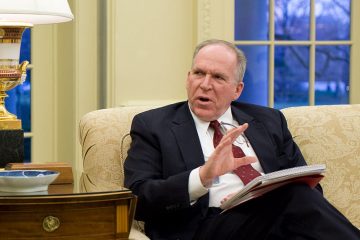
Brennan: “I don’t do evidence.” (White House photo)
That was what Republican Rep. Trey Gowdy was wondering when he grilled former CIA director John Brennan on May 23, 2017 on what evidence he had provided to the FBI to catalyze its investigation of Trump-Russia collusion.
Brennan replied: “I don’t do evidence.”
The best Brennan could do was repeat the substance of a clearly well-rehearsed statement: “I encountered and am aware of information and intelligence that revealed contacts and interactions between Russian officials and U.S. persons involved in the Trump campaign … that required further investigation by the Bureau to determine whether or not U.S. persons were actively conspiring, colluding with Russian officials.”
That was it.
CNN joined the piling on Monday, quoting former FBI General Counsel James Baker in closed-door Congressional testimony to the effect that FBI officials were weighing “whether Trump was acting at the behest of [the Russians] and somehow following directions, somehow executing their will.” The problem is CNN also noted that Lisa Page, counsel to then FBI Acting Director Andrew McCabe, testified that there had been “indecision in the Bureau as to whether there was sufficient predication to open [the investigation].’ “Predication” is another word for evidence.
Within hours of Comey’s firing on May 9, 2017, Page’s boyfriend and a top FBI counterintelligence official, Peter Strzok texted her: “We need to open the case we’ve been waiting on now while Andy [McCabe] is acting [director].” After all, if Trump were bold enough, he could have appointed a new FBI director and who knew what might happen then. When Page appeared before Congress, she was reportedly asked what McCabe meant. She confirmed that his text was related to the Russia investigation into potential collusion.
Comey v. Trump Goes Back to Jan. 6, 2017
The Times and CNN, however unintentionally, have shed light on what ensued after Trump finally fired Comey. Apparently, it finally dawned on Trump that, on Jan. 6, 2017, Comey had treated him to the time-honored initiation-rite-for-presidents-elect — with rubrics designed by former FBI Director J. Edgar Hoover.
It seems then-FBI Director James Comey rendered a good impersonation of Hoover that day when he briefed President-elect Trump on the scurrilous “Steele dossier” that the FBI had assembled on Trump. Excerpts from an interview Trump gave to the Times (below) after the firing throw light on what Trump says was at least part of his motivation to dump Comey.
To dramatize the sensitivity of the dossier, Comey asked then-National Intelligence Director James Clapper and the heads of the CIA and NSA to depart the room at the Trump Tower, leaving Comey alone with the President-elect. The Gang of Four had already briefed Trump on the evidence-impoverished “Intelligence Community Assessment.” That “assessment” alleged that Putin himself ordered his minions to help Trump win. The dossier had been leaked to the media, which withheld it but Buzzfeed published it on Jan. 10.?
‘This Russia Thing’
Evidently, it took Trump four months to fully realize he was being played, and that he couldn’t expect the “loyalty” he is said to have asked of Comey. So Trump fired Comey on May 9. Two days later he told NBC’s Lester Holt:
“When I decided to just do it, I said to myself, I said, ‘You know, this Russia thing with Trump and Russia is a made-up story, it’s an excuse by the Democrats for having lost an election that they should’ve won.’”
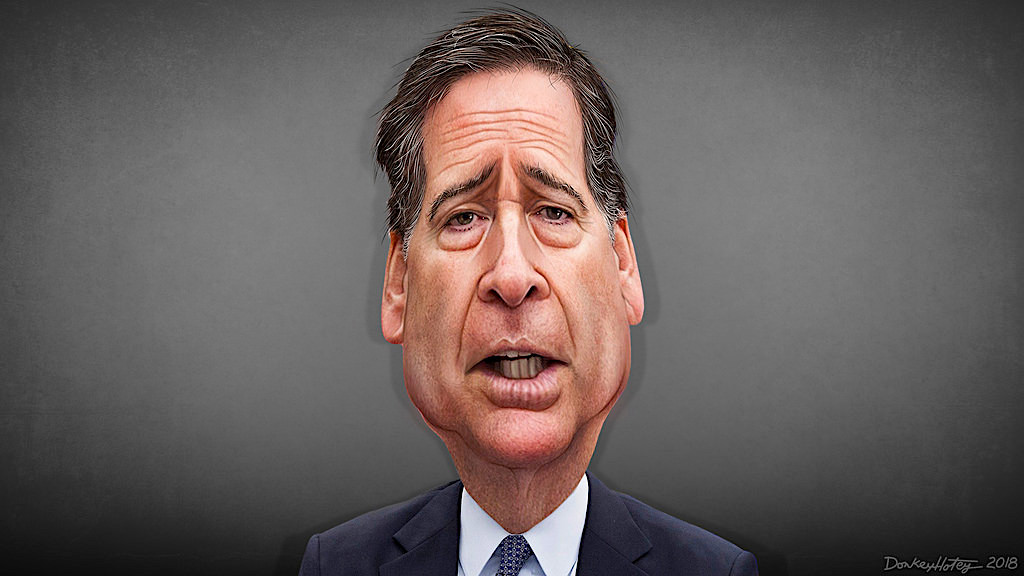
Comey: Pulled a Hoover on Trump? (Carciature by DonkeyHotey)
The mainstream media and other Russia-gater aficionados immediately seized on “this Russian thing” as proof that Trump was trying to obstruct the investigation of alleged Russian collusion with the Trump campaign. However, in the Holt interview Trump appeared to be reflecting on Comey’s J. Edgar Hoover-style, one-on-one gambit alone in the room with Trump.
Would Comey really do a thing like that? Was the former FBI director protesting too much in his June 2017 testimony to the Senate Intelligence Committee when he insisted he’d tried to make it clear to Trump that briefing him on the unverified but scurrilous information in the dossier wasn’t intended to be threatening. It took a few months but it seems Trump figured out what he thought Comey was up to.
Trump to NYT: ‘Leverage’ (aka Blackmail)
In a long Oval Office interview with the Times on July 19, 2017, Trump said he thought Comey was trying to hold the dossier over his head.
“… Look what they did to me with Russia, and it was totally phony stuff. … the dossier … Now, that was totally made-up stuff,” Trump said. “I went there [to Moscow] for one day for the Miss Universe contest, I turned around, I went back. It was so disgraceful. It was so disgraceful.
“When he [James B. Comey] brought it [the dossier] to me, I said this is really made-up junk. I didn’t think about anything. I just thought about, man, this is such a phony deal. … I said, this is — honestly, it was so wrong, and they didn’t know I was just there for a very short period of time. It was so wrong, and I was with groups of people. It was so wrong that I really didn’t, I didn’t think about motive. I didn’t know what to think other than, this is really phony stuff.”
The dossier, paid for by the Democratic National Committee and the Clinton campaign and compiled by former British spy Christopher Steele, relates a tale of Trump allegedly cavorting with prostitutes, who supposedly urinated on each other before the same bed the Obamas had slept in at the Moscow Ritz-Carlton hotel. [On February 6, 2018, The Washington Post reported that that part of the dossier was written Cody Shearer, a long-time Clinton operative and passed it along to Steele. Shearer ignored a request for comment from Consortium News. [Shearer had been a Consortium advisory board member who was asked to resign and left the board.]
Trump told the Times: “I think [Comey] shared it so that I would — because the other three people [Clapper, Brennan, and Rogers] left, and he showed it to me. … So anyway, in my opinion, he shared it so that I would think he had it out there. … As leverage.
“Yeah, I think so. In retrospect. In retrospect. You know, when he wrote me the letter, he said, ‘You have every right to fire me,’ blah blah blah. Right? He said, ‘You have every right to fire me.’ I said, that’s a very strange — you know, over the years, I’ve hired a lot of people, I’ve fired a lot of people. Nobody has ever written me a letter back that you have every right to fire me.”
McGovern lays out more details during a 12-minute interview on Jan. 10 with Tyrel Ventura of “Watching the Hawks.”
Ray McGovern works with Tell the Word, a publishing arm of the ecumenical Church of the Saviour in inner-city Washington. A CIA analyst for 27 years and Washington area resident for 56 years, he has been attuned to these machinations. He is co-founder of Veteran Intelligence Professionals for Sanity (VIPS).
The US Mainstream Media Prefer Confrontation to Cooperation
By Brian CLOUGHLEY | Strategic Culture Foundation | 15.01.2019
The Washington Post is a noisily anti-Russian newspaper which every weekday by email produces for subscribers (of whom I am one) the Daily 202 (“Power Post — Intelligence for Leaders”) which covers US politics, a little international stuff, and a section called “There’s a Bear in the Woods” aimed at denigrating, belittling and generally insulting Russia.
The Post is intent on convincing citizens of the United States and the world in general that nothing good is ever done by, in or with the government of Russia, and a favourite target is President Putin. A typical Editorial was headed “Trump just colluded with Russia. Openly” and dealt savagely with the Trump-Putin meeting in Helsinki last year. Much of the world believes that such discussions between nations’ leaders are better than hostile rhetoric, and most reasonable people are pleased and even relieved when meetings take place. They prefer amicable dialogue to venomous confrontation.
But the Post ended its comment on the meeting by asserting that “Mr Trump in fact was openly colluding with the criminal leader of a hostile power.”
That’s the ‘hostile power’ that has cooperated for twenty years with the United States in operating the International Space Station.
The Post doesn’t like such news as “[Russian space agency] Roscosmos director Dmitry Rogozin and Bill Gerstenmaier, head of NASA’s human explorations and operations, said after a conference marking the 20th anniversary of the International Space Station that their agencies plan to collaborate on developing a moon orbiting outpost. Russia is working on a heavy booster rocket and a new spacecraft to complement American projects intended for a future moon mission, Rogozin said. ‘We absolutely trust each other, and political winds haven’t touched us.’ Gerstenmaier spoke in kind, noting that partnership in space exploration could be ‘an example to the outside world. It has been a blessing that our governments have both seen the wisdom of what we are doing and both our governments have avoided placing sanctions on us or getting us caught up in the political things’.”
It is most gratifying that the United States and Russia can cooperate so closely on such an important endeavour. As noted by CNN, “since the retirement of the space shuttle in 2011 the US has depended on Roscosmos to transport astronauts to the space station.” In other words, the space station could not exist without Russia’s no-strings collaboration.
But most western media play down, ignore or deplore such instances of harmony and amity. The UK’s Daily Telegraph, for example, is entirely negative, and grudgingly reported last December that the most recent “launch of the MS-11 ship was a closely watched test for Russia’s space industry, which has suffered several high-profile failures in recent years but remains the only reliable way to deliver crew to the orbiting station.” There had been an accident in the course of a previous launch but, to the regret of many in the West, Russia’s emergency procedures were flawless and there was no loss of life.
In spite of this example of outstandingly successful bilateral cooperation, a meeting scheduled for February between the space professionals of Russia and the United States was cancelled “after mounting pressure from Capitol Hill.” Roscosmos Director General Dmitry Rogozin had hosted his NASA counterpart, Jim Bridenstine, in October last year, so his February visit was to be a combination of practicality and courtesy — but this isn’t the way the US Senate sees or does things.
Senator Bob Menendez of the Foreign Relations Committee declared that “to welcome Mr Rogozin to the United States and provide him a platform to speak is an affront to our sanctions regime and will further undermine the Trump Administration’s limited credibility on Russia policy,” and Senator Jeanne Shaheen of the Senate panel that funds NASA said the planned meeting “undermines the United States’ core national security objectives” and “weakens the US’s global standing by demonstrating the ease by which Russian officials can get around transatlantic sanctions.”
The Senate’s pressure on NASA is part of the campaign of petulant and spiteful attacks on Russia which show that Washington is intent on destruction of even the slightest efforts to bring the US and Russia closer.
Which brings us back to the Washington Post which distinguished itself by getting just a little mixed up during one of its anti-Russia forays when it enthusiastically seized on a faulty piece in the New York Times.
It all started when the Times breathlessly revealed that during the 2016 election campaign, Trump’s campaign manager, Paul Manafort “and his Russian associate, Konstantin V. Kilimnik, discussed a plan for peace in Ukraine.” This dastardly anti-America, pro-Russia activity could not be tolerated by the US mainstream media which reported that one of Mr Manafort’s menacing machinations involved sharing “political polling data with a business associate tied to Russian intelligence.”
(As an aside, it is difficult to believe that notification of political polling data is in some fashion a national security risk. Most of us know that poll results can be made public without release conditions. Every foreign mission in Washington analysed them.)
The Times continued, in a version of the report that has been deleted, that Manafort wanted the data passed on to “Oleg V Deripaska, a Russian oligarch close to the Kremlin,” and in its ‘202’ the Washington Post went to town about this supposedly sinister character. It began by stating that “several experts said the Deripaska connection makes this news a huge deal” and quoted Steven Hall, a former head of Russia operations at the CIA, as tweeting “Remember, the polling info Manafort passed to Kilimnik was headed to Deripaska, who is close to Putin… The margins the Russians needed to change in key states during the 2016 elections [were] pretty small. Now we know how they were able to be so precise: Paul Manafort was providing polling data to Russia.” Shock! Horror!
Another expert shaken by such disclosures was Post columnist Max Boot, a senior fellow at the Council on Foreign Relations, who declared “This is potentially very significant evidence of collusion… Why would Manafort share polling data with the Russians unless it was to help them target their pro-Trump social media campaign?”
On it went for over 400 words recounting how the dastardly Deripaska was up to his ears in conspiracy, although a cautionary note was sounded by former ambassador to Russia Mike McFaul who like a good diplomat injected the phrase “if proven” in his tweet before agreeing “this is serious.”
Yes, it was serious. But not as serious as the downplayed low-profile admission by the Washington Post that its chatter allegations were not “proven”. The Post noted that “the New York Times corrected a story we included in yesterday’s 202: ‘A previous version of this article misidentified the people to whom Paul Manafort wanted a Russian associate to send polling data. Mr. Manafort wanted the data sent to two Ukrainian oligarchs, Serhiy Lyovochkin and Rinat Akhmetov, not to Oleg V Deripaska, a Russian oligarch close to the Kremlin’.”
So much for the Washington Post’s Bear in the Woods, but a sad indicator of how determined are some of the US media to help destroy any movement towards rapprochement with Russia. Fortunately, in spite of their malevolent efforts and the spiteful Senate shenanigans, the International Space Station cooperation will continue, which shows, thank goodness, that there are still some grown-ups in the woods.
Integrity Initiative: By all means smear & attack, but at least be honest about it
By Simon Rite | RT | January 13, 2019
We’ve all met those people who describe themselves as laid back, when in reality they’re just one loud noise from a mouth frothing breakdown. So when something describes itself as having integrity, be wary.
Enter the Integrity Initiative (II), Britain’s very own government funded influence network which is currently in the process of having its underpants revealed to the world. There’s no doubting it’s an initiative, the jury’s out on the other bit. Some of the people behind it are alleged former spies (can you be a former spy?), a calling not often linked to integrity.
There’s a good chance you may not know much about the Integrity Initiative, the mainstream media is not exactly straining to tell you about it. Labour MP Chris Williamson suggests that’s because a number of mainstream journalists have signed up to work with it.
The only time II briefly attracted the attention of the mainstream world was when it became clear it had been pushing conspiracies about Labour leader Jeremy Corbyn’s links to the Kremlin. That’s not a good look for an organization which receives cash from the Foreign Office.
It describes itself as non-partisan, but then as we’ve discussed, it also has “Integrity” in the title. Maybe it can get away with it, always worth a try I suppose. It also claims to be “combating propaganda and disinformation,” but as you’ll see for yourself on its Twitter account, it’s simply a stream of invective and criticism about Russia. If you want to spend cash smearing an entire nation, fine, fill your boots, but don’t then act all moral about it.
Integrity Initiative deals in propaganda, mainly against Russia, and if anyone involved tries to deny that, then they’ve clearly been drinking their own Kool Aid. Of course, it defends itself by saying it’s on the front line of the fight against so-called Russian disinformation, which is a pretty wide category these days. But it doesn’t matter if it’s propaganda you agree with or disagree with, it’s still propaganda.
One of its main aims is to put together what it calls ‘clusters’ of journalists, writers and the like who are sympathetic to the cause. If you’ve been paying attention, you won’t be surprised to find out who are making up those clusters.
Some of those journalists who have had their links revealed are carefully backtracking. One interesting form of mea culpa from some of them is to admit that while they did do some work for II, they didn’t get paid much to do it, which is a curious defense if you think about it. If you’re involved in something you might feel the need to defend in the future, at least make sure you getting paid! About £200 for a talk or an article seems to be the going rate if you’re interested.
Good luck to anyone signing up to work with II, we’ve all got mortgages to pay, there’s no judgement from me, but at least take responsibility for it. And if you really didn’t know you were engaging in propaganda, then perhaps a period of self-reflection is in order.
Guardian journalist James Ball, for example, wrote a column in which he came clean on his links to II (he gave a training talk for about 225 quid) but there was no real self-reflection. The headline “When free societies copy Russian media tactics, there’s only one winner” is indicative of the myopia which drives the movement against so-called Russian disinformation. Even when he is literally caught up in a Western government funded propaganda effort, he somehow still manages to reflect it back on Russia. Moscow made me do it!
Ball goes on to lament the hacking of Integrity Initiative in a newspaper which revelled in publishing juicy stories from WikiLeaks.
He even analyses the events around the Salisbury poisoning by saying: “Russian-backed outlets and supporters threw question after question to cast doubt on the official narrative.”
There we have it, the biggest crime of all – casting doubt on the official narrative.
Real Crickets, Fake News
By Patrick ARMSTRONG | Strategic Culture Foundation | 14.01.2019
You’re an American diplomat. Posted to Cuba. You compose yourself for peaceful slumber, as an innocent American dip should… What’s that noise? Whine, buzz. Get up. Lights on. Look. Nothing. Head on pillow. Whine, buzz. We’ve all been kept up nights by some unidentifiable sound. You promise yourself you won’t listen to it. Aha, it’s stopped… no, there it is again. Another night of tossing and turning. Very understandable. The next morning you tell a colleague, heard it too, another hadn’t but can’t help listening. Soon everybody is awake listening to this irritating noise. Doctors come, check people out and find this and that (as ageing apes we all have something. Is there any before and after take on these injuries?) This is happening in Cuba, a country richly furnished with noisy insects. At some point, this irritating sound, that could be insects, morphs into something more sinister: “‘microwave hearing,’ also known as the Frey effect” for example.
The US Embassy in Havana re-opened in July 2015. About a year later, it was reported that some American diplomats complained about strange noises. The Guardian reported the story using numerous variations on the word “attack”. Crickets are mentioned, but only to be dismissed; “But this is Cuba”, wink, wink, nudge, nudge; Russia peeps above the horizon:
In fact, almost nothing about what went down in Havana is clear. Investigators have tested several theories about an intentional attack: by Cuba’s government, a rogue faction of its security forces, a third country like Russia or some combination thereof. Yet they’ve left open the possibility an advanced espionage operation went horribly awry, or that some other, less nefarious explanation is to blame.
Attacks – the story builds. A recording is produced (verrry irritating; keep anybody awake). “High pitched cricket sound”. That’s because they are insects say the Cubans. The phrasing of the AP report that covered the Cuban findings has to be read to be believed: it’s written in the sneering tone that tells you to ignore them:
Cuba on Thursday presented its most detailed defense to date against U.S. Accusations… Cuban officials attempted to undermine the Trump administration’s assertion… alleged was a lack of evidence for the U.S. Accusations… an exhaustive investigation ordered by “the highest government authorities,” a clear reference to President Raul Castro… Thursday night’s special did not present an alternate explanation for the facts presented by U.S. officials, with one significant exception…
What a dishonest way to cover a report by Cuban specialists saying we compared the recordings with cicada sounds and there was a good fit. Fortunately, as we shall see, honest people did follow that lead.
American tourists are solemnly warned “Exercise increased caution in Cuba due to attacks targeting U.S. Embassy”. Washington expels Cuban diplomats and the Guardian helpfully tells us:
Cuba employs a massive state security apparatus that keeps hundreds and possibly thousands of people under constant surveillance. US diplomats are among the most closely monitored people on the island. It’s virtually impossible for anyone to take action against an American diplomat without an element of the Cuban state being aware.
So the state of play as of the end of 2017 is this. Facts: noises, medical findings, investigations, expulsions. Speculation, they’re “attacks”, the Cuban authorities control everything and the insect explanation should be laughed at. Next year it’s China’s turn.
But at last, in September 2018, the Russian sun rises over the horizon.
The suspicion that Russia is likely behind the alleged attacks is backed up by evidence from communications intercepts, known in the spy world as signals intelligence, amassed during a lengthy and ongoing investigation involving the FBI, the CIA and other U.S. agencies. The officials declined to elaborate on the nature of the intelligence… If Russia did use a futuristic weapon to damage the brains of U.S. personnel, it would mark a stunning escalation in Russian aggression toward Western nations, compounded recently by the use of a military-grade nerve agent to poison an ex-spy and his daughter in Britain.
Love the juxtaposition of “suspicion”, “likely” and “alleged”: how many degrees of uncertainty is that? You have to wonder whether an Integrity-challenged Initiative clusteroid gave that little gem to NBC – the “signals intelligence” will probably turn out to be a five-year-old RT report about insomnia. Also note that the US military “has been working to reverse-engineer the weapon or weapons used to harm the diplomats”.
Ensorcelled by this “un-elaborated” “intelligence”, the Gadarene media swine rush straight for the cliff:
- Did Russia Attack U.S. Officials in Cuba? U.S.S.R. Used Microwaves Against American Diplomats During Cold War (Newsweek)
- Russia Is No. 1 Suspect in Mystery Brain Attacks in Cuba and China: Report (Daily Beast)
- Russia Might Be Behind Those Sonic Attacks on U.S. Government Workers in Cuba and China (Fortune)
- The U.S. Now Believes RUSSIA May Be Behind Sonic Attacks On Americans In Cuba And China (Daily Wire)
- So the Russians were ‘sonic-ing’ down in Cuba? (American Thinker)
- Russia main suspect behind illnesses of US staff in Cuba and China – report (Guardian)
- Russia suspected in Cuba mystery ‘attacks’ against US diplomats (NBC)
- Report: Experts Suspect Cuba May Have Had Russian Help in ‘Sonic’ Diplomat Attacks (Breitbart)
Altogether a perfect illustration of how fake news is built.
► Step One. Something that could be lots of things but we’ll call it an attack.
► Step Two. Attacks have attackers, so who is it? (I find it interesting that they weren’t quite ready to blame Havana, although they expelled a few Cuban diplomats: “‘I still believe that the Cuban government, someone within the Cuban government can bring this to an end,’ Tillerson added.”)
► Step Three. Drum roll… Putindunnit!
It’s surprising, actually, that it took so long; after all, Putin has weaponised Soviet history, Syrian refugees, Photoshop, humour, Pokemon, and Russophobia, why would you think he’d have forgotten crickets? Nothing is beyond or beneath him: “14-legged killer squid found TWO MILES beneath Antarctica being weaponised by Putin?“.
This happy complacency was interrupted…
by…
a loud…
POP!
The Sounds That Haunted U.S. Diplomats in Cuba? Lovelorn Crickets, Scientists Say.
And, because they’re Western scientists, not Castro’s Cuban Collaborators, we have to believe them. Two honest scientists – remember their names: Alexander Stubbs of the University of California, Berkeley, and Fernando Montealegre-Zapata of the University of Lincoln in England – on their own it seems, applied human reason to the problem and solved it. Here’s a summary of their paper.
+++++++++++++++++++++++++++++
So that’s it; the story’s dead (although the NYT does its best to keep it alive: “That’s not to say that the diplomats weren’t attacked, the scientists added”). Would be nice, though, if State took its warning down. In time the details will fade away leaving a vague sense that Cuba’s a bad and dangerous place and nasty Russians do nasty things for the fun of it. But that’s the purpose of propaganda: to leave an impression when the details are forgotten.
So what really happened? Irritating cricket sounds produced a kind of dancing mania among US diplomats and the presstitutes sank to the occasion – even though the Cuban evidence was out there – and blamed Russia.
PS. My neighbours often ask me from where I get my news when I tell them something they’ve never heard of. Well not from the Guardian or the NYT or NBC or the others that boomed this fake story: I learned from Moon of Alabama that it was crickets waaaay back in October 2017 when he (a one-man operation who does more reporting than the entire NYT building) beat the NYT by 14 months. You should read him too so you too can get next year’s NYT headlines today.
WaPo recycles old Russiagate memes in latest gossip piece about Trump-Putin secret collusion
RT | January 13, 2019
Donald Trump’s reluctance to provide unfettered access to his conversations with Vladimir Putin has upset nameless American officials, the Washington Post has revealed. The US president dismissed the story as absurd and offensive.
According to the revered paper, Trump has “gone to extraordinary lengths to conceal details” of his face-to-face conversations with Putin. During a meeting with the Russian leader in Hamburg in 2017, Trump even purportedly confiscated the notes of his own interpreter, who was then instructed not to discuss what had transpired with other administration officials.
Various (and of course nameless) US officials have now apparently complained to the Washington Post about how they’ve been left in the dark about five conversations that Trump had with the Russian leader, colorfully described by the newspaper as “one of the United States’ main adversaries.”
The story’s thinly veiled assumption is of course that Donald Trump has used his handful of private meetings with Putin to receive secret instructions from Moscow – impose new sanctions on Russia, bomb Syria, send lethal weapons to Ukraine, shred the Iran deal and missile treaties, and so forth.
The creatively framed story suffers from a few other inconvenient plot holes. The super-secret meeting with Putin in Hamburg was also attended by then-secretary of state Rex Tillerson. Does this mean that Tillerson is also a deep-cover KGB agent? Tillerson even released a readout after the meeting – following completely standard, but apparently unsatisfactory protocol.
The self-contradictory report goes on to explain how, as part of Trump’s obsession with ultra-secret Putin pow-wows, the president “generally has allowed aides to listen to his phone conversations” with the Russian leader.
Trump “allies” interviewed by the Post said that the president’s caution when it comes to meeting with Putin may be “driven by embarrassing leaks that occurred early in his presidency.” This theory is of course way less fun than the airtight idea that Trump is actually a Russian agent – that’s why WaPo only gave it one sentence.
Responding to the report, Trump told Fox News that there was nothing scandalous about his talks with the Russian leader. When Fox News host Jeanine Pirro asked if he is or has ever been working on behalf of the Kremlin, Trump responded: “I think it’s the most insulting thing I’ve ever been asked.” Among hardcore Russiagaters, his answer was naturally interpreted as an explosive non-denial.
“Credit to Jeannine Pirro for asking Trump if he’s a Russian Agent. The President, notably, never actually answered that question,” Colby Hall, founding editor of Mediaite, tweeted.
Rehashing months-old Russiagate news, the Washington Post also disclosed that Democratic lawmakers are still demanding details about Trump’s meeting with Putin in Helsinki last summer. House Democrats reportedly plan to form a subcommittee which aims to obtain State Department records of Trump’s various encounters with the Russian president.
Making Sense of Trump’s Foreign Policy
By Federico PIERACCINI | Strategic Culture Foundation | 11.01.2019
As was to be expected, the announcement that the US was withdrawing troops from Syria has served to provoke numerous reactions in the Middle East and beyond. Following the removal of Mattis, Pompeo and Bolton embarked on a whirlwind Middle Eastern tour of Israel, Jordan, Egypt, Bahrain, the United Arab Emirates, Qatar, Saudi Arabia, Oman, and Kuwait to reassure regional allies.
The idea of withdrawing US troops from Syria was based on Trump wishing to fulfil one of his most important electoral promises. Trump knows that he needs to demonstrate to his electoral base that he has kept the most significant promises he made during his 2016 election campaign in order to have any chance of being reelected in 2020. People voted for change, and that includes preventing new wars and getting out of the ones the US is already embroiled in, especially in the Middle East.
If Trump betrays his constituents by not delivering on his campaign promises, then he would simply be like any other politician who, upon being elected, soon forgets about those who put him in office. Trump is aware that such a perception would cost him the possibility of a second term.
We live in a time where Western elites completely ignore the consequences of their actions, manipulate information, lie to their citizens and spread fake news. While we may not always believe what Trumps says in his bombastic remarks, we can rest assured that MSNBC/CNN are even less reliable in terms of facts and unbiased news. Keeping oneself correctly informed is a difficult and demanding task, involving the constant comparison and weighing up of a lot of different sources and constantly researching and learning through the process. Most people do not have the time for this and usually do not care, preferring to rely instead on the mainstream media. This obviously exposes such people to manipulation, lies and distorted facts, clouding the truth and making it difficult to distinguish between what is real and what is fake. Alternative media — the real media — are riding to the rescue, but the overhauling process will require a full generation or even two.
This is why it little matters whether the wall will really built or whether it will only start to be built as a PR stunt or whether it even makes sense in the first place to build it or not. Democrats watching MSNBC/CNN will agree that it is a dumb idea and should not be funded. Republicans watching Fox News will call it a brilliant idea and demand a government shutdown (as Trumps is doing) to force the Democrats to concede. The point is that Democrats or Trump supporters, feeding on news sources based on propaganda and lies, will only have their respective biases confirmed without the need for any real debate.
What is important for us to understand is how Trump operates in order to gain the support of his base. That is what guides him in domestic, foreign and economic affairs. In the case of the wall, Trump’s battle is against the Democrats, and the actions he has taken to fight his opponents is by using the government shutdown to provide himself with a win-win outcome. If the Democrats fund the wall, they lose in the eyes of their voters, as Trump ends up getting his wall. If the Democrats do not fund the wall, Trump will blame them and point to the government shutdown to demonstrate how he valiantly struggled against the Democrats in an effort to keep his promises.
The same is the case with the economic warfare employing the US dollar and imposing tariffs and duties on allies and enemies alike. MSNBC/CNN will tell you that this is damaging the American economy. The Democrats will say that it is a failed strategy, without admitting that they hate Trump’s “economic war” because it undermines US dollar hegemony and thereby their ability to prosecute the neoliberal imperialism to which they are so addicted.
Fox News, on the other hand, will spin the news to show how Trump is battling against Xi Jinping and China in the interests of American farmers. Self-proclaimed experts will go on about the success of the White House’s economic strategy, declaring it a brilliant idea. Trump voters will enjoy the coverage of Fox News and accordingly praise the “commercial war”. Democrats will love the coverage of MSNBC/CNN and will worry about how various policies will either restore or further diminish US global leadership.
The announcement of the withdrawal from Syria follows the same logic as the examples given above. Trump announced the withdrawal only in order to keep an electoral promise. The entire Washington foreign-policy establishment is opposed to Trump’s decision. The purpose of the announcement was to convey to his voters a simple but clear message: I am trying to do what I promised you, but I have everyone against me in Washington as well as in the media.
The same logic is employed with the government shutdown in order to fund the wall. Whenever Democrats, Republicans or talking heads condemn Trump’s withdrawal from Syria/Afghanistan, his effort to build the wall, his imposition of tariffs and duties, his sanctions on Iran, they reinforce the beliefs of Trump’s supporters, showing that Trump is really trying to keep his promises in the face of tremendous opposition.
Every time they bash him they provide free advertisement for Trump and his political line, and this has been going on from the first time he announced he would run in the primaries in 2015. It is a win-win situation for him, even if he does not really build the wall, pull out of Syria, or effectively reduce the trade imbalance between China and the US. If he succeeds, he can declare that he has kept his promises. If he fails, then he can lay be blame squarely at the feet of his political opponents. People elected him on the basis of his words and promises. If he can demonstrate that he at least tried to keep his promises (even if he never actually does), then that should be enough to give him a second term.
Trump understands very well how the media works and how much Washington detests him. He does not want to change the status quo and revolutionize Washington. He does not want to openly challenge the foreign-policy establishment by following a realist-isolationist policy. That was what he said in 2015/16 during the campaign trail, but his presidency has been much different from what he promised, especially in foreign policy. Nevertheless, Trump seeks re-election, and he cannot entirely break with the Washington establishment if he hopes to succeed. Indeed in 2016 he demonstrated this by appointing a staff of generals whose credo over the span of several decades has been that of American exceptionalism, the governing religion of Washington. He used the military to protect himself from the media-intelligence community, shielding himself with four generals (Kelly, McMaster, Mattis and Flynn), in the full knowledge that none of them would support a realist-isolationist policy.
For this reason, the ructions that have followed the announcement of the withdrawal from Syria are part of normal US political theater, such as was the case with the resignation/dismissal of Mattis. It is no surprise that the deep state immediately dispatched Bolton and Pompeo to sooth the concerns of dozens of US allies, in particular Israel and the Arab states. It was a PR exercise to reassure them of the real intentions of the US in the area (i.e., enduring imperialism).
In practice, it makes little difference whether the US has 2,000 or 200 men in Syria. They will not be able to change the course of the war of aggression against Damascus in their favor. It is therefore not surprising that Bolton was not fired for publicly contradicting Trump on the question of withdrawing troops from Syria. Such contradictions play in Trump’s favor. His supporters will say that Trump is so anti-establishment that even his closest collaborators are against him.
If Trump were to fire Bolton as he did Mattis, none of his faithful voters will remember the ill-considered choice to appoint him in the first place, and will be struck instead by Trump’s determination to stick to his guns and rid himself of internal saboteurs who stand in the way of his electoral mandate. As long as Trump, in our scenario, were not to name someone worse than Bolton, the imperialist wheel will continue to turn.
Just look at North Korea as an example. Trump threatened to destroy Pyongyang, even knowing the US could not really do so. Then he meet with Kim, did an epic PR exercise that presented Trump as solving a major international problem that had eluded all his predecessors. After conveying this triumph to his base, he simply forgot all about Kim, Pyongyang and Seoul. In the meantime, the two Koreas are nonetheless speaking, advancing reconciliation and preparing for historical changes. As for Trump, he has already moved on, North Korea no longer holding his interest, the drama having served its purpose for a certain time but no longer being of relevance. (This, thankfully, is to the benefit of the Korean people.)
It seems the same playbook is being employed in Syria. Trump announced the withdrawal, while leaving a few hundred soldiers behind who continue to be unable to change the situation on the ground; Bolton and Pompeo are dispatched to reassure allies/financiers, though Trump cannot wait to forget about Syria, proclaiming the falsehood that US, under his leadership, defeated ISIS (thereby fulfilling one of his electoral promises).
As I wrote following Trump’s election, The Donald’s victory only served to accelerate the transition to a multipolar world, as we saw in the first two years of his presidency, with Trump’s focus on his base translating into a perennial electoral campaign that uses all the tools at his disposal (domestic, foreign, economic, financial, and currency policy). This creates distrust and concern amongst historical allies and pushes Washington’s enemies closer together, serving in the process to smooth out any tensions that may have hitherto existed between these countries.
Just think of the Astana format of Turkey, Iran and Russia concerning Syria, Inter-Korean talks in Asia, a peace treaty to be signed between Russia and Japan, Indian-Iranian cooperation on trade in oil, a European stance against Iranian and Russian sanctions, and, to top it off, coordination between the Russians and the Chinese on almost everything. All this is in the name of opposing US imperialist policies or trying to directly score a political win against Donald Trump and his policies.
Trump’s enemies have learned to ignore US decisions, which have now become irrelevant in certain parts of the globe. America’s historical allies cling hopefully to the words of Bolton and Pompeo, well aware that the US will not soon change their basic neoliberal and imperialist approach towards the world. Nevertheless, Washington is losing military and economic influence due to the transition into a multipolar world order, where power is shared among multiple countries (China, Russia, Iran, India). The unipolar moment is over and is not coming back, especially not with Donald Trump as president. And that is a good thing for the rest of the world.
Another Climate Propaganda Story Promoting the Normal as Abnormal
By Dr. Tim Ball | Watts Up With That? | January 8, 2019
Almost every day there are stories in the media about weather or climate events that create the impression that they are new and outside of the normal pattern. None of them are. The objective is to sensationalize the story, even if it means using a meaningless period. A simple trick is to pick a period in which your claim is valid. This practice of cherry-picking the period of study is not exclusive to the media. It was a clear sign of corruption of climatology brought to a head with Roseanne D’Arrigo’s infamous comment to the 2006 National Academy of Science (NAS) panel that “if you are going to make a cherry pie, you have to pick cherries.”
That doesn’t condone the media use of the technique. All it does is illustrate why it was a convenient technique for creating a deception about what is normal. For example, a 2017 BBC headline said “Hottest June day since summer of 1976 in heatwave.” That is 41 years, which is statistically significant but not climatologically significant. A Youtube story reports “Sydney has wettest November day since 1984.” CBS Pittsburgh reported “NWS: 2018 is the 2nd Wettest Year on Record in Pittsburgh.” The record began in 1871 or 147 years ago, but even that is not climatologically significant. The ones I like are this one from North Carolina, that says, “A Look Back at the Coldest day Ever in North Carolina.” “Ever” is approximately 4.5 billion years.
Other stories focus on a pattern or change in a pattern again with the idea that it is new or abnormal. Headlines like this one from 2012, “Why have there been more tornadoes than usual this year?” Often, they are suggestive such as this 2017 New York Times story. “The 2017 Hurricane Season Really Is More Intense Than Normal.” When you read the story, you find, as is usually the case, that the caveats at the end indicate it is not unusual. The problem is the headline already set the pattern in the public mind.
The headline says, “Forget El Nino, StormFest Is about To Hit The West Coast.” The author is talking about a series of storms tracking on to the west coast of North America. The story told us
Things often calm down after January 1 during El Nino years… but not this year… with the U.S. West Coast from central California to Washington State about to be pummeled by a series of storms. Rain, snow, wind? Plenty for everyone. A view of the latest infrared satellite imagery shows an amazing line-up of one storm after another stretching way into the Pacific. A traffic jam of storms.
The terms, “pummeled” and “traffic jam” are evocative and imply the pattern is unusual. In fact, it is perfectly normal to the point that there is a descriptive term for it, the Pineapple Express. This refers to the establishment of the Polar Front along the northwest coast of North America after it migrates south from its summer position off the coast of Alaska and northern British Columbia. Low pressure systems known as anti-cyclones develop along the Front all year round. The areas affected by these systems changes as the Front migrates between its more northerly summer position and more southerly winter position. The term Pineapple Express refers to the situation in the winter when these anti-cyclones generate in the region of Hawaii and track along the Front hitting the northwest coast in a series of storms. The pattern does not stop in an El Nino year but takes a different path.
These anti-cyclone systems are also the focus of exploitation of normal weather events as abnormal, in Europe. The southerly shift of the Polar Front in the Northern Hemisphere occurs around the globe. Two major factors influence the weather pattern, sea surface temperatures that fluctuate with ocean circulation, and the Rossby Wave pattern in the Circumpolar Vortex. This pattern of anti-cyclones hitting western Europe in the winter was added to the propaganda list when they started naming the storms. It linked them to hurricanes in the public mind, and it implied they were a recent phenomenon.
They are not recent, new, or of greater intensity.

A significant part of professor Hubert Lamb’s ground-breaking and monumental work on historical climatology was a long-term reconstruction of the pattern of these anti-cyclones. It fit with his claim about why he established the Climatic Research Unit (CRU) at the University of East Anglia.
“… it was clear that the first and greatest need was to establish the facts of the past record of the natural climate in times before any side effects of human activities could well be important.”
Once he created a long-term record of these anti-cyclonic systems, there was a better chance of determining the underlying mechanisms. From this, he could achieve his final objective of better forecasting. The ability to forecast defines science. If that is not the final objective the work is mostly irrelevant.
Consider the destructive and history-altering impact of storms like the one that hit the Spanish Armada that attempted to invade England in 1588. Ironically, Phil Jones, who ran the CRU reputation into the ground while under his direction, wrote a good synopsis of Lamb’s work. There is also the storm of 1703 reported in great detail in the book “The Storm” by the famous author Daniel Defoe.
Marcel Leroux was an early major skeptic of the claim of anthropogenic global warming (AGW). His 2005 book “Global Warming: Myth or Reality” was impactful because Leroux was well qualified. As one review of his book notes,
In the global-warming debate, definitive answers to questions about ultimate causes and effects remain elusive. In Global Warming: Myth or Reality? Marcel Leroux seeks to separate fact from fiction in this critical debate from a climatological perspective. Beginning with a review of the dire hypotheses for climate trends, the author describes the history of the 1998 Intergovernmental Panel on Climate Change (IPCC) and many subsequent conferences. He discusses the main conclusions of the three IPCC reports and the predicted impact on global temperatures, rainfall, weather and climate, while highlighting the mounting confusion and sensationalism of reports in the media.
The comment about sensationalism in the media is relevant to this article because Leroux, like Lamb, also worked on a reconstruction of the anti-cyclonic systems in the North Atlantic. Leroux also worked on another later exploitation of the normal by John Holdren, Obama’s Science Advisor, the so-called “Polar Vortex.” Leroux’s 1993 work on the impact of the “The Mobile Polar High: a new concept explaining present mechanisms of meridional air-mass and energy exchanges and global propagation of palaeoclimatic changes” showed how these outbreaks of cold Polar air are a normal weather event that enter the climate record because of their regular but variable appearance and impact.
We are confronted by the unholy alliance between the political use of science by the Intergovernmental Panel on Climate Change, the spin doctors or, as I prefer, the professional liars, and the mainstream media, that create fake news by making the normal appear abnormal. As the Yiddish proverb observes, “Truth never dies but lives a wretched existence,” especially under such a deliberate onslaught.
Featured Video

Seyed M. Marandi: US-Iran War Inevitable: Kuwait and Bahrain May Fall
or go to
Aletho News Archives – Video-Images
From the Archives
Oil and the Israel Lobby
Reknowned economist M. Shahid Alam offers this excellent critique of Noam Chomsky’s defective analysis of the relative influence of Oil versus the Israel lobby over US foreign policy: … continue
Blog Roll
 Aletho News
- Seyed M. Marandi: US-Iran War Inevitable: Kuwait and Bahrain May Fall
- Leaders Condemn Ansarallah Attack on Saudi Arabia While Ignoring Illegal War Against Yemen
- Leaked: Britain’s Covert Iraqi Psyops Network
- Yemeni Armed Forces Warn Airlines Against Using Saudi Airports, Exempt Mecca and Medina
- Iran security chief says powers greater than US tried to conquer Iran but ended in ‘dustbin of history’
- Europe’s mounting social chaos… chickens coming home to roost for proxy war against Russia
- US-Russia Diesel Deal Becomes Massive Defeat for Ukraine
- Hormuz and the Looming Economic Catastrophe
- Dhubab offensive, media blitz and the rapid unraveling of Saudi-backed coalition’s new gambit
- Putin Conveys to Trump Iran’s Vision on Possible Conflict Resolution – Kremlin
- If Americans Knew
- Gaza: Ceasefire Anniversary Marks Year of Failed Promises
- The American Conservative: Mike Huckabee Should Resign
- A C-Section in Shackles: A Palestinian Woman’s Harrowing Birth in Israeli Detention
- ‘He’s Desperate’: AIPAC Begins Spending Against Abdul El-Sayed to Boost Mike Rogers:
- Trump, Hormuz, and the Looming Economic Catastrophe
- For three years, Israel has killed a child in Gaza every 71 minutes – Daily Update
- Israeli forces kill another child in Gaza – Daily Update
- Gaza ceasefire exists in name only, say more than 100 organizations
- Nearly 2 Million in Gaza Need Urgent Shelter Assistance as Winter Looms: IOM Chief Warns
- Suppressing Palestinian resistance: US charity under fire for AI monitoring of Gaza classrooms
- No Tricks Zone
- Germany’s Green Energy Debacle: High Energy Costs Force Kahla Porzellan to Close After 182 Years!
- New Study: 50 Years Of The Most Aggressive ‘Net Zero’ Policies Can Only Affect The Global Climate By 0.03°C
- US September “Heat” Was No Record…Many Records Set Decades Ago
- Latest European Green Energy Debacle; Portugal’s Largest Flagship Solar Park Insolvent!
- Green Energy Debacle: German Expert Professor Fritz Vahrenholt Warns Of Severe Economic And Social Consequences
- Two More Paleo Reconstructions Affirm Meters-Higher Sea Levels Across Ireland, Brazil 7000-6000 Years Ago
- New Study: Earth And Venus Surface Warmth Largely Explained By Convection And Lapse Rate, Not CO2 Or Radiation
- 2025 Nature Paper Claiming Worsening Global Drought Gets RETRACTED …Heavily Flawed
- New Study: ‘Global Drought Shows No Detectable Recent Acceleration Under Climate Warming’
- Economic Masterminds: German Socialists Suggest Taxing Productivity Gains Stemming From Using AI

