A Reuters Report on Iran That Fueled US Diatribes
By Ivan Kesic | Consortium News | December 27, 2018
When U.S. Secretary of State Mike Pompeo gave speeches about mega corruption in Iran this year, he did not cite a Reuters’ 2013 article or give credit to its three reporters; Steve Stecklow, Babak Dehghanpisheh and Yeganeh Torbati.
Instead he presented it as the kind of specialized knowledge that only a high-ranking official such as himself might be in a position to reveal. “Not many people know this,” Pompeo told an audience gathered last July at the Ronald Reagan Presidential Foundation and Library in Simi Valley, California, “but the Ayatollah Khamenei has his own personal, off-the-books hedge fund called the Setad, worth $95 billion, with a B.” Pompeo went on to tell his audience that Khamenei’s wealth via Setad was untaxed, ill-gotten, and used as a “slush fund” for the Islamic Revolutionary Guard Corps.
But a comparison between the 5-year-old Reuters article and Pompeo’s speech, which was lauded by The Wall Street Journal’s editorial board as “truth telling,” shows a type of symbiosis that could only help cast a backward glow over President Donald Trump’s move, last summer, to reimpose all sanctions lifted by the Obama’s administration’s historic nuclear deal with Iran.
The imprint of the Reuters article on Pompeo’s speech was obvious in an anecdote about the travails of an elderly woman living in Europe. “The ayatollah fills his coffers by devouring whatever he wants,” Pompeo said. “In 2013 the Setad’s agents banished an 82-year-old Baha’i woman from her apartment and confiscated the property after a long campaign of harassment. Seizing land from religious minorities and political rivals is just another day at the office for this juggernaut that has interests in everything from real estate to telecoms to ostrich farming.”
The 82-year-old Baha’i woman living in Europe clearly matches Pari Vahdat-e-Hagh, a woman the Reuters team put at the very start of their extensive, three-part investigation. Here’s how the Reuters article begins: “The 82-year-old Iranian woman keeps the documents that upended her life in an old suitcase near her bed. She removes them carefully and peers at the tiny Persian script.”
While tapping the human-interest aspects of the story, Pompeo’s speech steered clear of some of the qualifications that the Reuters reporters and editors injected into their general profile of corruption. Pompeo referred to Khamenei using Setad as a “personal hedge fund,” for instance, suggesting personal decadence on the part of the Iranian leader. But the Reuters team was careful to note that it had found no evidence of Khamenei putting the assets to personal use. “Instead, Setad’s holdings underpin his power over Iran.”
While stipulating that Khamenei’s greed was not for money but for power, the Reuters team neglected something of timely and possibly greater relevance. Earlier that same year the U.S. admitted its own longstanding greed for power over this foreign country.
Final CIA Admission
In August 2013—three months before the Reuter’s article was published—the CIA finally admitted its role in the 1953 Iranian coup. “Marking the sixtieth anniversary of the overthrow of Iranian Prime Minister Mohammad Mosaddeq, the National Security Archive is today posting recently declassified CIA documents on the United States’ role in the controversial operation. American and British involvement in Mosaddeq’s ouster has long been public knowledge, but today’s posting includes what is believed to be the CIA’s first formal acknowledgement that the agency helped to plan and execute the coup,” the archive said.
This U.S. aggression led directly to two phases of property confiscation in Iran: first under the Shah and then under the religious fundamentalists who overthrew him. Unaccountably, however, the Reuters team ignored the CIA admission so relevant to their story.
To its credit, the Reuters article does allude, early on, to the two inter-related periods of property confiscation in Iran. “How Setad came into those assets also mirrors how the deposed monarchy obtained much of its fortune – by confiscating real estate,” the article says. But that sentence only functions as a muffled disclaimer since the team makes no effort to integrate that history into the laments of people such as Pari Vahdat-e-Hagh, who emotionally drives the story.
Dubious Figure
For anyone familiar with the history of property confiscations in Iran, this ex-pat widow is a dubious figure. In the article, she claims that she lost three apartments in a multi-story building in Tehran, “built with the blood of herself and her husband.” She also says her late husband Hussein was imprisoned in 1981 because he began working for a gas company that had been set up to assist unemployed members of the Baha’i faith, and finally executed a year later.
The suggestion is that he was killed as part of a widespread persecution of Bahai’i followers.
What the Reuters reporters and editors omitted to mention, however, is that Hussein had been a lieutenant in the military regime of Mohammad Reza Shah Pahlavi; the last shah of Iran who was overthrown by the uprising of 1979.
The Shah’s name has become so intertwined with UK and U.S. meddling in Iran that his role in setting a pro-western foreign policy is mentioned in the opening sentence of the Encyclopedia Brittanica entry on him. But the Reuters article places this mention at the end of the story, as deep background. By the time the team discloses the Shah’s penchant for confiscating property and flagrant corruption, the reader is in the third section of a three-part article. By that time, the elderly Vahdat-e-Hagh has come and gone. By then, she has cemented herself in the reader’s imagination as an unequivocal victim, even though some obvious questions about her should occur to anyone familiar with the country’s history.
How, for instance, did she and her husband come to own such significant property at the center of Iran’s capital city? Under the Pahlavi regime, most military personnel were provided with one apartment, not three. In the article, Vahdat-e-Hagh says that she and her husband obtained the property themselves, so presumably they did not inherit it. Could her late husband, Hussein, have been of high importance to the Shah’s U.S.-backed regime, which was famous for its lavish handouts to special loyalists?
Such questions float over the article, not only about this particular subject, but many others who are presented to dramatize the ayatollah’s misdeeds. Several sources appear as human rights “experts” and lawyers. They are all Iranians living abroad and many have controversial biographical details that go unmentioned. There are similar well-known credibility issues with people who are introduced as respectable scholars and politicians.
The article offers the story of another aggrieved Baha’i family without ever mentioning how such people, in general, had lost property during the Shah’s White Revolution of 1963 which was intended to weaken those classes that supported the traditional system, primarily landed elites.
One obvious problem with the article is the distance of the three Reuters journalists from the scene of their story. They are based in New York, London and Dubai and do not reveal their information-gathering methods about Iran, a country that admits very few foreign reporters. So far, Yeganeh Torbati, the reporter who presumably wrote the first, human-interest part of the story, has not responded to a message to her Facebook account seeking comment. Nor has she responded to an email. Torbati, now based in Washington, was based in Dubai in 2013.
Story with Long Legs
In the years since its publication, the Reuters article has been bubbling up in book citations. Suzanne Maloney mentioned it in her 2015 book “Iran’s Political Economy since the Revolution” as did Misagh Parsa in “Democracy in Iran: Why It Failed and How It Might Succeed” published in 2016.
This year Pompeo relied on it in four speeches. Two books published in 2018 place some weight on the Reuters article: “Challenging Theocracy: Ancient Lessons for Global Politics” by David Tabachnick, Toivo Koivukoski and Herminio Meireles Teixeira; and “Losing Legitimacy: The End of Khomeini’s Charismatic Shadow and Regional Security” by Clifton W. Sherrill.
The name Setad, which means “headquarters” in Farsi, has been kicking around Washington for five years, ever since the U.S. imposed sanctions on the group. In June of 2013, the U.S. Treasury Department issued a press release about Setad and its subsidiaries, with a long list of Persian-named properties that were managing to avoid UN sanctions imposed on the country’s business dealings as a means of discouraging Iran’s enrichment of nuclear-weapon grade uranium.
Six months later, in November, Reuters published its extensive, three-part investigative package, which now tops Google searches for “Setad.”
The report was the first piece of important follow-up journalism on the U.S. Treasury press release. But in one key piece of wording, editors and reporters almost seem to be straining to move their story ahead of the government’s rendition, to the primary position it now holds in Google search-terms.
“Washington,” according to the article, “had acknowledged Setad’s importance.” Acknowledged? By journalistic conventions that Reuters editors would certainly know, an acknowledgement indicates a reluctant admission, something a source would rather not reveal. Five months earlier, however, the Treasury Department sounded eager to call attention to Setad as “a massive network of front companies hiding assets on behalf of … Iran’s leadership.”
For hardliners on Iran, the U.S. Treasury press release was important fodder. But it lacked the human drama necessary to stir an audience against the current regime. When the Reuters article came along, with all its historical omissions, it filled that gap.
Wag the Dog… British Media Watchdog Accuses Russia of Bias
By Finian CUNNINGHAM | Strategic Culture Foundation | 27.12.2018
Irony is dead when British state media controllers accuse Russian news outlets RT and Sputnik of “imbalance” over their reporting on the Skripal alleged poisoning affair.
In the past week, Ofcom, the British media watchdog, condemned seven programs aired during March and April this year following the apparent poisoning of former Russian spy Sergei Skripal in Salisbury. The Russian outlets may be fined or denied future broadcasting rights in Britain. The latter suggests what the real, ulterior agenda is all about.
It remains a mystery as to what happened exactly to Skripal and his daughter when they reportedly fell ill on March 4 in the famous south of England cathedral town. Neither Sergei nor Julia have been seen in public since, apart from a brief and carefully controlled interview given by Julia to Reuters a few months ago, apparently having recovered from her stricken condition. Russian consular services have been denied access to Julia by the British authorities, despite her being a Russian citizen.
The murkiness of the affair, the flagrant obfuscation by the British authorities and their violation of diplomatic norms speaks of a British state intrigue aimed at provoking international recriminations against Russia. Such is the outrageous apparent skullduggery by the British state, it is arguably very appropriate therefore for critical media coverage of the incident and the subsequent prevarication by London.
However, in a staggering inversion of reality, British media regulators complain that Russian news outlets have broken “impartiality rules” in their reporting on what is a bizarre de facto disappearance of a Russian citizen and her father while in the custody of British authorities. The protagonists are off-limits from criticism; their ropey claims must be treated as the sane version of events.
Within days of the Salisbury incident, senior British officials, including Prime Minister Theresa May, were accusing Russia of an assassination attempt against the Skripals, allegedly with a Soviet-era nerve poison.
London’s narrative inculpating the Kremlin and Russian President Vladimir Putin continues, despite Russia’s vehement denial of involvement and despite the lack of independently verifiable evidence.
This week, in her Christmas speech to the nation, premier May again repeated her condemnation of the “nerve agent attack in Salisbury” and she praised British armed forces for “protecting the country’s waters and skies from Russian intrusion”.
So, Russian media are castigated for “bias”, but British media are evidently permitted to report and broadcast official British assertions that are unproven and wildly sensational, if not tantamount to inciting international conflict. Just who is breaking journalistic standards?
Among the news outlets reporting May’s words were the BBC. The government-owned British broadcaster routinely and snidely refers to Russian news outlets RT and Sputnik as “Kremlin-backed”. As if the state-backed BBC is somehow immune from disseminating British government propaganda.
May’s assertions in her Christmas speech about Russia carrying out an alleged assassination and threatening Britain with invasion went unchallenged by the BBC. Nor were her other claims about chemical weapons being used by Syrian government forces against civilians.
On Syria, May was referring to an incident near Damascus in April this year when toxic chlorine was purportedly used in an assault on civilians. Back then, the British prime minister joined with US President Trump and France’s President Macron to order air strikes on Syria, supposedly in retaliation for the Syrian army’s use of chemical weapons. But it soon transpired that the incident was a provocation staged by jihadist militants and their media operatives, the so-called White Helmets. In other words, the British, American and French carried out a criminal act of aggression against Syria under false pretenses.
Yet May in her solemn set-piece nationwide Christmas speech this week was allowed by British media to repeat blatant lies against Syria, and brazenly avoid the issue of justice facing her government over illegal air strikes on Syria, as well as to continue smearing Russia over the murky Skripal affair.
The arrogant hypocrisy of British media and the state regulator is astounding. British citizens are compelled by law to pay an annual license fee of £150 ($190) per household for possessing a television set. Failure to pay can result in a jail sentence. The TV license fee collected by the British state is handed over to the BBC. So, here we have a state-owned media channel that is funded through a compulsory tax on citizens, and yet this same channel willingly broadcasts British government propaganda claims denigrating Russia and covering up for British war crimes in Syria. If that sounds Orwellian, that’s because it is.
The BBC’s corporate advertising claims to be the “world’s leader in breaking global news”. It also assures its listeners and readers that it produces “news you can trust”.
There are countless cases where the BBC’s pompous self-importance can be exposed, revealing an altogether more malevolent purpose. One of the most notorious cases was its complicity in orchestrating the 1953 coup in Iran carried out by the American CIA and Britain’s MI6. In his book, Web of Deceit, British historian Mark Curtis details the crucial role played by the BBC and its Persian service in helping to foment the coup against the elected premier Mohammad Mosaddegh.
More recently, BBC coverage of the war in Syria over the past eight years has been a relentless propaganda assault on the government of President Bashar al Assad. It is not merely about omission or biased distortion. The BBC has been caught out actually fabricating fake news in Syria, such as the case when it accused the Syrian army of using napalm on civilians near Aleppo in 2013. Those reports were later exposed as deliberate fabrications.
More generally on Syria, the BBC, as with other Western news media, are serving as facilitators of the criminal regime-change objective of their governments. May’s grotesque falsehoods reiterated this week – in a Christmas speech of all things! – about chemical weapons are afforded respectability and apparent credibility by the way the BBC and other British outlets dutifully report her words without any qualification, let alone criticism.
It is a measure of how distorted the British media landscape is when alternative news channels which do raise critical viewpoints and insights on propaganda narratives are then accused of being “imbalanced” and “in breach of broadcasting rules”.
In response to Britain’s Ofcom regulator condemning Russia’s RT and Sputnik, Moscow is now saying that its own state regulator is considering filing a case against the BBC and how it operates in Russia. Given how the BBC tried to tie Russia to instigating the Yellow Vest protests in France and how it recently ran an article accusing the Kremlin of “weaponizing satire”, there seems much more credibility to Russian claims that the “British state-backed outlet” is in breach of journalistic standards.
The broader background of how the BBC serves British state propaganda is panoramic in its scope. But such is official British hypocrisy, the authorities attack critical news outlets that happen to expose their propaganda service posing as “news you can trust”.
Free speech in Britain? Yes, as long as you freely speak in the service of British state propaganda.
Organ theft, staged attacks: UN panel details White Helmets’ criminal activities, media yawns
By Eva Bartlett | RT | December 25, 2018
Utter silence. That is the sound of Western corporate media days after a more than one-hour-long panel on the White Helmets at the United Nations on December 20.
Journalists were present, so the silence isn’t due to lack of access. And in any case it was live streamed on the UNTV channel, and remains available on Youtube for keen observers to watch.
More likely, the silence is due to the irrefutable documentation presented on the faux-rescue group’s involvement in criminal activities, which include organ theft, working with terrorists — including as snipers — staging fake rescues, thieving from civilians, and other non-rescuer behaviour.
On the panel was one of corporate media’s favourite targets to smear, British journalist Vanessa Beeley, who gave a fact-based lecture on her years of research into the founding, funding and nefarious activities of the White Helmets, research which includes numerous visits to White Helmets centers, countless testimonies from Syrian civilians, and even an interview with a White Helmets leader in Dara’a al-Balad, Syria.
Maxim Grigoriev, the director of the Foundation for the Study of Democracy (a member of the UN’s Global Counter-Terrorism Research Network) spoke at length, detailing some of the over 100 eyewitnesses his foundation has conducted interviews with.
These include over 40 White Helmets members, 15 former terrorists, 50 people from areas where terrorists and WH operated, with another over 500 interviewed by survey in Aleppo and Daraa.
Among testimonies presented by Grigoriev were numerous accounts of the White Helmets’ involvement in organ theft.
A head of nursing in Aleppo is cited as seeing the body of his neighbour who had been taken by the White Helmets to Turkey for “treatment”. “I lifted the sheet and saw a large wound cut from the throat to the stomach… I touched him with my hand and understood there were clearly no organs left.”
Another interviewee said: “A person receives a minor injury, is rescued… and then brought back with their stomach cut open and with their internal organs missing.”
The interviews with civilians, White Helmets and terrorist members themselves put to rest NATO’s and their lapdog media’s explanations that in the White Helmets there are a few bad apples but in general these are humanitarian rescuers.
For example, a Syrian civilian, Omar al-Mustafa, is cited as stating:
“Almost all people who worked in nearby White Helmets centers were al-Nusra fighter or were linked to them. I tried to join the White Helmets myself, but I was told that if I was not from al-Nusra, they could not employ me.”
Still more testimonies detail staged fake rescues and staged chemical attacks. Omar al-Mustafa was cited as stating:
“I saw them (White Helmets) bring children who were alive, put them on the floor as if they had died in a chemical attack.”
The testimonies incriminate not only the White Helmets organization, but also the doctors who, in 2016, Western corporate media fawned over.
According to one interviewee, Mohamed Bashir Biram, his attempt to take his father to a White Helmets affiliated al-Bayan hospital, failed. He said: “Since my father was not a fighter, the doctors in the hospital refused to help him and he died.”
But in 2016, the Western media was praising the same valiant doctors, in their crescendo of war propaganda around Aleppo.
Many other independent journalists have corroborated aspects of what the panelists — also comprising Syrian journalist Rafiq Lotef, and Russian and Syrian Representatives to the UN, Ambassadors Vassily Nebenzia and Bashar al-Ja’afari — described in detail.
In my own visits to eastern Ghouta towns last April and May, residents likewise spoke of organ theft, staged rescues, the White Helmets working with Jaysh al-Islam, while an Aleppo man likewise described them as thieves who steal from civilians, not rescuers.
Copy-paste corporate media silence
Journalists present at the panel were not interested in asking follow-up questions on organ theft, staged rescues, or any of the content presented, unsurprisingly, instead asking questions about other Syrian issues.
A CBS journalist didn’t have a single question about what had just been presented, although CBS has previously repeatedly reported on the White Helmets. But their reporting, like most in corporate media, spun the transparent propaganda that is corporate media coverage of the group.
Four days after the UN panel, to my knowledge, not a single corporate media outlet has covered the event and its critical contents.
This is in spite of the fact that the Western corporate media has been happy to propagandize about the White Helmets for years, and to attack those of us who dare to present testimonies and evidence from on the ground in Syria which contradicts the official narrative.
Russian, Syrian, and Lebanese media did report on the panel, and of course if Western corporate journalists ever do bother to mention it, they will ignore the incriminating evidence presented by panellists and instead accuse Russia of bullying the White Helmets.
Prior to the panel, a number of publications came out with articles echoing one another, and in fact echoing claims already repeatedly uttered about a “Russian disinformation campaign” against the White Helmets.
That’s right, that’s the best they’ve got.
‘Big bad Russia’ tarnishing the pristine image of the White Helmets, a theme rerun ad nauseum over the last year or two, and one which I addressed in early January 2018 when I was under attack for questioning the White Helmets.
In my rebuttal to a mid-December 2017 Guardian smear, I pointed out that it was not Russia which began looking into the White Helmets’ affiliations, funding, and role in the propaganda war, but two independent North American researchers.
Canadian journalist Cory Morningstar in September 2014 exposed the role of the New York based PR firm, Purpose Inc, in marketing campaigns for the White Helmets.
And as I wrote, “In April 2015, American independent journalist revealed that the White Helmets had been founded by Western powers and managed by a British ex-soldier, and noted the “rescuers” role in calling for Western intervention—a No Fly Zone on Syria.”
These, and the subsequent numerous investigations by Vanessa Beeley, including on the ground in Syria, taking countless testimonies of Syrian civilians on the matter of the White Helmets, far precede any Russian media reporting on the group.
That Russian media and bodies have since done their own investigations does not equate to a “disinformation campaign”, but rather doing the job corporate media are clearly incapable of, and unwilling to do.
Why haven’t the media written about the panel, or as per the corporate media norm, issued yet more smears against panelists?
They haven’t because they are cornered, and while they can always try their standard juvenile character smears and libel, they cannot refute the facts, the countless testimonies which corroborate yet still more testimonies taken by independent journalists over the years.
Or as Ambassador Nebenzia said:
“We understand why #WhiteHelmets are being defended by #Western capitals. They do not hide that they provided substantial financial support to this organization and instrumentalized it to pursue political goals under humanitarian cover. It’s logical to protect your asset.”
Last week, it came out that German reporter for Der Spiegel, Claas Relotius, winner of the German Reporter Award 2018, had falsified a number of his articles. One article on the fakery noted Relotius had, “confessed to have fabricated at least 14 of 55 articles,” including a “story about a Syrian boy who believed he triggered the civil war in the country with his graffiti, an article that won the German Reporter Prize just three weeks ago but which was made up.”
Former German journalist, Udo Ulfkotte, in 2014 reached his tipping point and admitted to having for years lied for Western, anti-Russia interests, admitting to making propaganda against Russia after having been bribed by billionaires, and by the Americans, to “not to report exactly the truth.”
As 2018, a year of staggering corporate media fake news, draws to a close, so do the last vestiges of credibility of media lauding the White Helmets.
Given the scandalous depth of their lies, it is unlikely corporate journalists will have an Ulfkotte moment and admit to their manifold deceptions.
But it doesn’t really matter, because more and more, Western corporate media, and the propaganda construct known as the White Helmets they support, are becoming irrelevant.
Eva Bartlett is a freelance journalist and rights activist with extensive experience in the Gaza Strip and Syria. Her writings can be found on her blog, In Gaza.
READ MORE:
‘Organ traders, terrorists & looters’: Evidence against Syrian White Helmets presented at UN
Syria Withdrawal Enrages the Chickenhawks
A Christmas present for the American and Syrian people
By Philip Giraldi • Unz Review • December 25, 2018
President Donald Trump’s order to withdraw from Syria has been greeted, predictably, with an avalanche of condemnation culminating in last Thursday’s resignation by Defense Secretary James Mattis. The Mattis resignation letter focused on the betrayal of allies, though it was inevitably light on details, suggesting that the Marine Corps General was having some difficulty in discerning that American interests might be somewhat different than those of feckless and faux allies like Israel and Saudi Arabia that are adept at manipulating the levers of power in Washington and in the media. Mattis clearly appreciates that having allies is a force multiplier in wartime but fails to understand that it is a liability otherwise as the allies create an obligation to go to war on their behalf rather than in response to any actual national interest.
The media was quick to line up behind Mattis. On Friday, The New York Times featured a lead editorial entitled “Jim Mattis was right” while neocon twitter accounts blazed with indignation. Prominent chickenhawk mouthpieces David Frum and Bill Kristol, among many others, tweeted that the end is nigh.
During the day preceding Mattis’s dramatic announcement, the press went to war against the Administration over Syria and also regarding other reports that there would be troop reductions in Afghanistan. The following headline actually appeared on a Reuters online article the day after the announcement by the president: “In Syria retreat, Trump rebuffs top advisers and blindsides U.S. commanders.” It would be difficult to imagine stuffing more bullshit into one relatively short sentence. “Retreat,” “rebuffs” and “blindsides” are not words that are intended to convey any sort of even-handed assessment of what is occurring in U.S. policy towards the Middle East. They are instead meant to imply that “Hey, that moron in the White House has screwed up again!”
Consider for a moment the agenda that Reuters is apparently pushing. It is supporting an illegal and unconstitutional invasion of Syria by the United States that has a stated primary objective of removing a terrorist organization which is already mostly gone and a less frequently acknowledged goal of regime change for the legitimate government in Damascus and the expulsion of that government’s principal allies. Reuters is asserting that staying in Syria would be a good thing for the United States and also for its “allies” in the region even though there is no way to “win” and no exit strategy.
Reuters is presumably basing its assessment on the collective judgments of a group of “top advisers” who are warmongers that the rest of the world as well as many Americans consider to be psychopaths or possibly even insane. And then there are the preferences of the “blindsided” generals, like Mattis, who have a personal interest in career terms for maintaining a constant state of warfare. If you want to really know how what the military thinks about an ongoing war ask a sergeant or a private, never a general. They will tell you that they are sick of endless deployments that accomplish nothing.
The New York Times lead story headline on Thursday also let you know that its Editors were not pleased by Trump’s move. It read “U.S. Exit Seen as a Betrayal of the Kurds, and a Boon for ISIS.” They also editorialized “Trump’s Decision to Withdraw From Syria Is Alarming. Just Ask His Advisers.”
The Washington Post was not far behind. It immediately ran an op-ed by the redoubtable neocon chickenhawk Max Boot, whom Caitlin Johnstone has dubbed “The Man Who Has Been Wrong About Everything.” The piece was entitled Trump’s surprise Syria pullout is a giant Christmas gift to our enemies making a twofer with an incredible “Fuck the EU” Victoria Nuland’s piece entitled “In a single tweet Trump destroys U.S. policy in the Middle East,” which appeared simultaneously. That anyone would regard Boot and Nuland as objective authorities on the Middle East given their ultimate and prevailing loyalty to Israel has to be wondered at, but then again Fred Hiatt is the editorial/opinion page editor and he is of the same persuasion, both ethnically and philosophically. They are all, of course, devoted Zionists and the big lie about what is going on in the region is apparently always worth repeating. As Joseph Goebbels put it in 1941 “… when one lies, one should lie big, and stick to it… even at the risk of looking ridiculous.”
Comments relating to the articles, op-eds and editorials in the Post and Times bordered on the hysterical, sometimes suggesting that readers actually believe that Trump was following orders from Russian President Vladimir Putin. And what was stirring at Reuters, The Times, and the Post was only the tip of the iceberg. The mainstream television news providers united in condemning the audacity of a president who might actually try to end a war while the only favorable commentary on Trump’s having taken a step that is long overdue came from the alternative media.
One might profitably recall how Trump has only been praised as “presidential” by the Establishment twice – when he staged cruise missile attacks on Syria based on faulty intelligence. The Deep State wants blood, make no mistake about it and it is not interested in “retreat.” And Trump will also get almost no support from Congress, with only longtime critics of Syrian policy Senators Rand Paul and Mike Lee as well as Congresswoman Tulsi Gabbard praising the move initially.
The arguments being made to criticize the Trump initiative were essentially cookie cutter neocon soundbites. The Reuters piece in its first few lines of text asserts that the reversal of policy “stunned lawmakers and allies with his order for U.S. troops to leave Syria, a decision that upends American policy in the Middle East. The result, said current and former officials and people briefed on the decision, will empower Russia and Iran and leave unfinished the goal of erasing the risk that Islamic State, or ISIS, which has lost all but a sliver of territory, could rebuild.” The article goes on to quote an anonymous Pentagon source who opined that “… Trump’s decision was widely seen in the Pentagon as benefiting Russia as well as Iran, both of which have used their support for the Syrian government to bolster their regional influence. Iran also has improved its ability to ship arms to Lebanese Hezbollah for use against Israel. Asked who gained from the withdrawal, the defense official, who spoke on condition of anonymity, replied: ‘Geopolitically Russia, regionally Iran.’”
Another so-called expert Charles Lister of the Middle East Institute was also cited in the article, saying “It completely takes apart America’s broader strategy in Syria, but perhaps more importantly, the centerpiece of the Trump administration policy, which is containing Iran.”
Israel is also turning up the heat on Trump, claiming that the move will make it more insecure. Prime Minister Benjamin Netanyahu pledged to increase air attacks on Iranian targets in Syria as an added security measure to make up for the American betrayal. Normally liberal American Jews have joined the hue and cry against Trump on behalf of Israel. Filmmaker Rob Reiner tweeted on Thursday that the president is a “childish moronic mentally unstable malignant narcissist” who is “committing Treason” against the United States.
The real story, lost in the wailing and gnashing to teeth, is that even after conceding that Donald Trump’s hyperbolic claim that the United States had defeated ISIS as the motive for the withdrawal is nonsense, there is still no good reason for Washington to continue to keep troops in Syria. The U.S. in reality did far less in the war against the terrorist groups infesting the region than did the Russians, Iranians or the Syrians themselves and, as a result, it will have less say in what kind of Syria emerges from the carnage. That is almost certainly a good thing for the Syrian people.
But let’s assume for sake of argument that the U.S. invasion really was about ISIS. Well, ISIS continues to hold on to a small bit of territory near the Euphrates River and is reported to have between one and two thousand remaining fighters. There are other estimates suggesting that between 10,000 and 20,000 followers have dispersed and gone underground awaiting a possible resurgence by the group. The argument that ISIS will reorganize and re-emerge as a result of the American withdrawal assumes that it is the 2,000 strong U.S. armed forces that are keeping it down, which is ridiculous. The best remedy against an ISIS recovery is to support a restored and re-unified Syria, which will have more than enough resources available to eliminate the last bits of the terrorist groups remaining in its territory.
So we go to fallback argument B, which is “containing Iran.” “Containment” was a U.S. policy devised by George Kennan in 1947 to inhibit the expansion of a powerful and sometimes aggressive soon-to-be nuclear armed Soviet Union, which was rightly seen as a serious threat. Iran is a second world country with a small military and economy with no nuclear arsenal and it neither threatens the United States nor any of its neighbors. But Israel supported by Saudi Arabia does not like Iran and has induced Washington to follow its lead. Withdrawing from Syria recognizes that Iran is no threat in reality. Positioning American military forces to “counter” Iran does not reduce the threat against the United States because there was no threat there to begin with.
And then there is the argument that the U.S. departure empowers Iran and Russia. Staying in Syria is, on the contrary, a drain on both those countries’ limited resources. The more money and manpower they have to commit to Syria the less they have to become engaged elsewhere and it is hard to imagine how either country would exploit the “victory” in Syria to leverage their involvement in other parts of the world. Both would be delighted if a final settlement of the Syrian problem could be arrived at so they can get out.
And as for the United States, the military should only be deployed anywhere to defend the U.S. itself or vital interests. There is nothing like that at stake in Syria. So, is American national security better or worse if the U.S. leaves? As Russian and American soldiers only confront each other directly in Syria, U.S. national security would in fact be greatly improved because the danger of igniting an accidental war with Russia would be dramatically reduced. There have reportedly already been a dozen incidents between U.S. and Russian troops, including some involving shooting. That has been a dozen too many. Even the possibility of starting an unintended war with Iran would potentially be disastrous for the United States as well as for everyone else in the region, so it is far better to put some distance between the two sides.
And finally, it is necessary to go to the argument for disengagement from Syria that is too little heard in the western media or from the usual bonehead politicians named Graham and Rubio who pronounce on foreign policy. How has American intervention in the Middle East and south and central Asia benefited the people in the countries that have been invaded or bombed? Not at all. By some estimates four million Muslims have been killed as a consequence of the wars since 2001 and millions more displaced. More than eight thousand U.S. military have died in the process in wars that had no purpose and no exit strategy. And the wars have been expensive – $6 trillion and counting, much of it borrowed. War without end means killing without end and it has to stop.
Withdrawing from Syria is the right thing to do, though one has to be concerned that there might be some secret side deals with Israel or Turkey that could actually result in more attacks on Syria and on the Kurds. Donald Trump is already under extreme pressure coming from all directions to reverse his decision to leave Syria and it is quite possible that he will either fold completely or bend at least a bit. It is to be hoped that he will not do so as a Christmas present to the American people. And he might want to think of a Christmas present for 2019. One might suggest a complete withdrawal from Afghanistan.
Philip M. Giraldi, Ph.D., is Executive Director of the Council for the National Interest, a 501(c)3 tax deductible educational foundation that seeks a more interests-based U.S. foreign policy in the Middle East. Website is www.councilforthenationalinterest.org, address is P.O. Box 2157, Purcellville VA 20134 and its email is inform@cnionline.org.
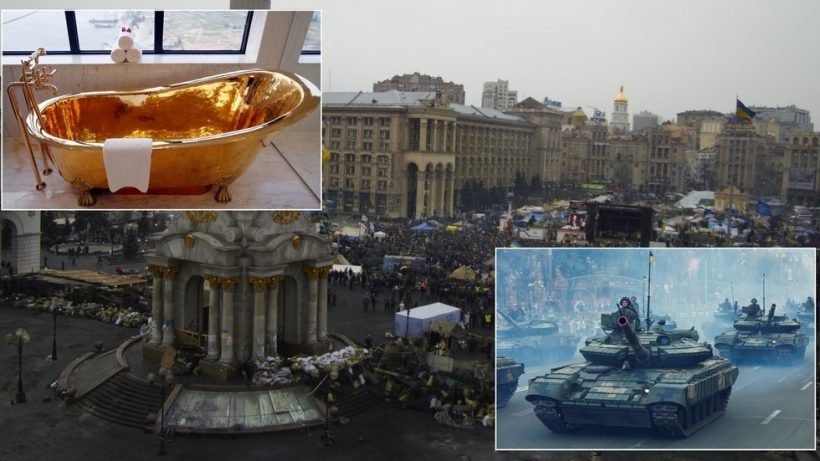
Tanks on Maidan, president’s gold bath & more outrageous Ukraine fakes by disgraced Spiegel reporter
RT | December 22, 2018
One wonders just how outrageous ‘fake news’ must be in order to get busted, but Der Spiegel’s ex-star reporter Claas Relotius got away with it all while writing for several outlets – maybe because it was about places like Ukraine.
Titled ‘Bribing prohibited’ Relotius’ piece on the new Ukrainian police has all the elements of his trademark style: dramatic narrative, likeable heroes – and entirely made-up ‘facts’.
The ‘report’, published by the Swiss magazine Reportagen in June 2016, tells a tale of two young people – Dimitri and Valeria – who became members of the rebranded police force of post-Maidan Ukraine. Given the recent revelations over his fictional reporting, it’s now unclear whether Relotius met the duo in reality, but the story makes for a very compelling read indeed.
It states that each day before going on patrol, Dimitri and Valeria have been coming to the center of Kiev to pray near the “altar” erected in memory of those who died during the 2014 Euromaidan unrest. The two were among the protesters back then, it reveals, describing how they recall burning buildings, the “smell of corpses,” a man “with a child in his arms” shot dead beside an old well – and a ruined wall, where dozens were “slayed by snipers” and “rolled over by tanks.”
Wait, what? Given that the majority of victims in Kiev – both protesters and law enforcement officers – were killed over two days of murky clashes in February 2014, the “smell” of dead bodies appears to be a little of an exaggeration. No “old wells” could immediately be found in central Kiev, and there’s nothing to back up the story about a “man with a child” either.
But most glaring of all, no “tanks” were ever deployed to curb the city unrest, so the “ruined wall” part was made up in its entirety. In reality, the police unsuccessfully tried to use light APCs to storm some barricades, but the vehicles were pelted with Molotovs and burnt down. At least the “burning buildings” part holds some water, as some central Kiev sites, including the Trade Unions Building, were indeed put to the torch.
It’s not much of a surprise that the rest of the article is riddled with inconsistencies and false statements. Notably, it claims that the ousted President of Ukraine, Viktor Yanukovych, had a mansion where he “lived like a pharaoh, with banisters and baths made of pure gold.” The claim appears to be based on the long-debunked rumor that the protesters who stormed the president’s lavish residence discovered a golden toilet.
Incumbent president of the country – Petro Poroshenko – is also described, for some reason, as a “billionaire praline manufacturer from Odessa.” Poroshenko has held several top government posts since the early 2000s, but this fact is not even mentioned in the article. He was indeed born in the Odessa region in the Soviet Union, yet the image of a “successful businessman from Odessa” seems to be quite a stretch.
Describing the old bribery mindset the new police officers have been supposedly battling, Relotius managed to make another, quite outlandish, mistake. The article says that the new police force was in use not only in the capital city of Kiev, but in other major cities, namely “in Kharkiv and Donetsk, in Lviv and in Odessa.”
The problem is, at the time of publication, the eastern city of Donetsk had for two years been under the control of anti-Kiev rebels, who rejected the Euromaidan coup, proclaimed their own republic, and had actual tanks and warplanes sent to crash them into submission – with only limited success.
It doesn’t seem probable that the new Ukrainian police force would have been welcome there – a fact that may have eluded the disgraced Der Spiegel reporter. Just as it, sadly, would go over the head of many of his readers, submerged in the MSM reporting on Ukraine – a narrative often fed from the Kiev government’s POV – and with little fact-checking.
Read more:
Game of deception: How a fraudster who faked his stories for years got to be Germany’s top reporter
How NBC News Lied about RT to Whip Up Anti-Russian Hysteria
Dr. Paul Kindlon | Russia Insider | December 19, 2018
“Alleged Terrorist says Russian TV Channel influenced attack on Buckingham Palace.”
This was an actual headline -in big bold type- run by NBC recently.
The subtext of this headline – what the headline is really saying – is this:
“Man watches news report on government-controlled channel of our enemy, Russia, which convinces him to commit an act of terror!”
In other words, “Russia is guilty of instigating terror in London!” The article begins this way…
“An Uber driver who allegedly tried to attack police with a Samurai sword outside Buckingham Palace has told a court he became angry after seeing news put out by the Russian television network RT.
Mohiussunnath Chowdhury, 27, from Luton, said he was looking at news produced by the controversial English-language channel on his phone on the day he decided to “confront” police outside Windsor Castle, 40 miles south of Luton.”
Actually – no – he did not say he was definitely watching RT. He said and I quote “I think it was RT”. But in many respects this fact is irrelevant. Many news outlets have been covering the tragic war in Yemen. NBC clearly implies that there was some nefarious propagandistic angle to RT’s coverage. But reporting on war is what news networks do. That is their job. Insinuating that a news network of a country is culpable for an act of terror by covering a news story IS propaganda however. Linking the terror act to Russia by implying a terrorist was provoked by RT News is misleading, deceptive and manipulative. It was the bombing of Yemen by the Saudis that triggered Chowdhury’s angry response. NBC wants you to “shoot the messenger” for delivering the bad news. So who’s being nefarious?
The globalists’ mainstream media are incorrigibly dishonest.
Chowdhury makes it clear that he was disturbed by the crimes he witnessed. Of civilians – many of whom are women and children – being killed by Saudi bombs with support from the UK and America. Does RT support the pro-Saudi foreign policy of America and UK ? Far from it. RT has been consistently critical of the Saudi campaign of bombing.
Study the language being used in that article – “controversial English-language channel”. What does that even mean? As more and more people come to distrust mainstream corporate media, aren’t CNN, the NY Times, the Washington Post, and even NBC considered “controversial”? Why single out RT in this manner? Well, there’s a reason…
“Controversial” is a word with a negative connotation. I am reminded of the time, while working as a journalist in Moscow, reading an AP wire report on the confrontation between President Yeltsin and his opponents in Parliament. The lead paragraph spoke of Yeltsin having to deal with “former Communists Alexander Rutskoi and Ruslan Khasbulatov” (the leaders of the revolt in 1993). To an uninformed reader, this portrays Yeltsin as a democratic reformer up against the bad guys. What the wire report failed to mention is that Yeltsin was also a Communist. In fact, Yeltsin was the head of the Communist Party in Sverdlovsk where he protected the powerful local mafia from prosecution.
A news organization should try to inform its audience, not willfully deceive. So why is NBC engaging in such poor journalistic activity?
What most people do not know is that corporate news networks are journalistic entities in name only. In reality they function as PR departments for what Ray McGovern calls“ the “Military- Industrial – Congressional -Intelligence-Media-Academia-Think-Tank Complex… profiteering on high tension with Russia.” This explains why NBC, CNN and others spin stories and twist facts about RT and Russia in order to misinform its unsuspecting audience.
Want to know the real truth? NBC and other corporate media entities think you are dumb. And they want to make you even dumber if they can. By lying.
Endless War Has Been Normalized and Everyone Is Crazy
By Caitlin JOHNSTONE | Medium | December 22, 2018
Since I last wrote about the bipartisan shrieking, hysterical reaction to Trump’s planned military withdrawal from Syria the other day, it hasn’t gotten better, it’s gotten worse. I’m having a hard time even picking out individual bits of the collective freakout from the political/media class to point at, because doing so would diminish the frenetic white noise of the paranoid, conspiratorial, fearmongering establishment reaction to the possibility of a few thousands troops being pulled back from a territory they were illegally occupying.
Endless war and military expansionism has become so normalized in establishment thought that even a slight scale-down is treated as something abnormal and shocking. The talking heads of the corporate state media had been almost entirely ignoring the buildup of US troops in Syria and the operations they’ve been carrying out there, but as soon as the possibility of those troops leaving emerged, all the alarm bells started ringing. Endless war was considered so normal that nobody ever talked about it, then Trump tweeted he’s bringing the troops home, and now every armchair liberal in America who had no idea what a Kurd was until five minutes ago is suddenly an expert on Erdoğan and the YPG. Lindsey Graham, who has never met an unaccountable US military occupation he didn’t like, is now suddenly cheerleading for congressional oversight: not for sending troops into wars, but for pulling them out.
“I would urge my colleagues in the Senate and the House, call people from the administration and explain this policy,” Graham recently told reporters on Capitol Hill. “This is the role of the Congress, to make administrations explain their policy, not in a tweet, but before Congress answering questions.”
“It is imperative Congress hold hearings on withdrawal decision in Syria — and potentially Afghanistan — to understand implications to our national security,” Graham tweeted today.
In an even marginally sane world, the fact that a nation’s armed forces are engaged in daily military violence would be cause for shock and alarm, and pulling those forces out of that situation would be viewed as a return to normalcy. Instead we are seeing the exact opposite. In an even marginally sane world, congressional oversight would be required to send the US military to invade countries and commit acts of war, because that act, not withdrawing them, is what’s abnormal. Instead we are seeing the exact opposite.
A hypothetical space alien observing our civilization for the first time would conclude that we are insane, and that hypothetical space alien would be absolutely correct. Have some Reese’s Pieces, hypothetical space alien.
It is absolutely bat shit crazy that we feel normal about the most powerful military force in the history of civilization running around the world invading and occupying and bombing and killing, yet are made to feel weird about the possibility of any part of that ending. It is absolutely bat shit crazy that endless war is normalized while the possibility of peace and respecting national sovereignty to any extent is aggressively abnormalized. In a sane world the exact opposite would be true, but in our world this self-evident fact has been obscured. In a sane world anyone who tried to convince you that war is normal would be rejected and shunned, but in our world those people make six million dollars a year reading from a teleprompter on MSNBC.
How did this happen to us? How did we get so crazy and confused?
I sometimes hear the analogy of sleepwalking used; people are sleepwalking through life, so they believe the things the TV tells them to believe, and this turns them into a bunch of mindless zombies marching to the beat of CIA/CNN narratives and consenting to unlimited military bloodbaths around the world. I don’t think this is necessarily a useful way of thinking about our situation and our fellow citizens. I think a much more useful way of looking at our plight is to retrace our steps and think about how everyone got to where they’re at as individuals.
We come into this world screaming and clueless, and it doesn’t generally get much better from there. We look around and we see a bunch of grownups moving confidently around us, and they sure look like they know what’s going on. So we listen real attentively to what they’re telling us about our world and how it works, not realizing that they’re just repeating the same things grownups told them when they were little, and not realizing that if any of those grownups were really honest with themselves they’re just moving learned concepts around inside a headspace that’s just as clueless about life’s big questions as the day it was born.
And that’s just early childhood. Once you move out of that and start learning about politics, philosophy, religion etc as you get bigger, you run into a whole bunch of clever faces who’ve figured out how to use your cluelessness about life to their advantage. You stumble toward adulthood without knowing what’s going on, and then confident-sounding people show up and say “Oh hey I know what’s going on. Follow me.” And before you know it you’re donating ten percent of your income to some church, addicted to drugs, in an abusive relationship, building your life around ideas from old books which were promoted by dead kings to the advantage of the powerful, or getting your information about the world from Fox News.
For most people life is like stumbling around in a dark room you have no idea how you got into, without even knowing what you’re looking for. Then as you’re reaching around in the darkness your hand is grasped by someone else’s hand, and it says in a confident-sounding voice, “I know where to go. Come with me.” The owner of the other hand doesn’t know any more about the room than you do really, they just know how to feign confidence. And it just so happens that most of those hands in the darkness are actually leading you in the service of the powerful.
That’s all mainstream narratives are: hands reaching out in the darkness of a confusing world, speaking in confident-sounding voices and guiding you in a direction which benefits the powerful. The largest voices belong to the rich and the powerful, which means those are the hands you’re most likely to encounter when stumbling around in the darkness. You go to school which is designed to indoctrinate you into mainstream narratives, you consume media which is designed to do the same, and most people find themselves led from hand to hand in this way all the way to the grave.
That’s really all everyone’s doing here, reaching out in the darkness of a confusing world and trying to find our way to the truth. It’s messy as hell and there are so many confident-sounding voices calling out to us giving us false directions about where to go, and lots of people get lost to the grabbing hands of power-serving narratives. But the more of us who learn to see through the dominant narratives and discover the underlying truths, the more hands there are to guide others away from the interests of the powerful and toward a sane society. A society in which people abhor war and embrace peace, in which people collaborate with each other and their environment, in which people overcome the challenges facing our species and create a beautiful world together.
People aren’t sleepwalking, they are being duped. Duped into insanity in a confusing, abrasive world where it’s hard enough just to get your legs underneath you and figure out which way’s up, let alone come to a conscious truth-based understanding of what’s really going on in the world. But the people doing the duping are having a hard time holding onto everyone’s hand, and their grip is slipping. We’ll find our way out of this dark room yet.
British Government Covert Anti-Russian Propaganda and the Skripal Case
By Craig Murray | December 21, 2018
It is worth starting by noting that a high percentage of the Integrity Initiative archive has been authenticated. The scheme has been admitted by the FCO and defended as legitimate government activity. Individual items like the minutes of the meeting with David Leask are authenticated. Not one of the documents has so far been disproven, or even denied.
Which tends to obscure some of the difficulties with the material. There is no metadata showing when each document was created, as opposed to when Anonymous made it into a PDF. Anonymous have released it in tranches and made plain there is more to come. The reason for this methodology is left obscure.
Most frustratingly, Anonymous’ comments on the releases indicate that they have vital information which is not, so far, revealed. The most important document of all appears to be a simple contact list, of a particular group within the hundreds of contacts revealed in the papers overall. This is it in full:
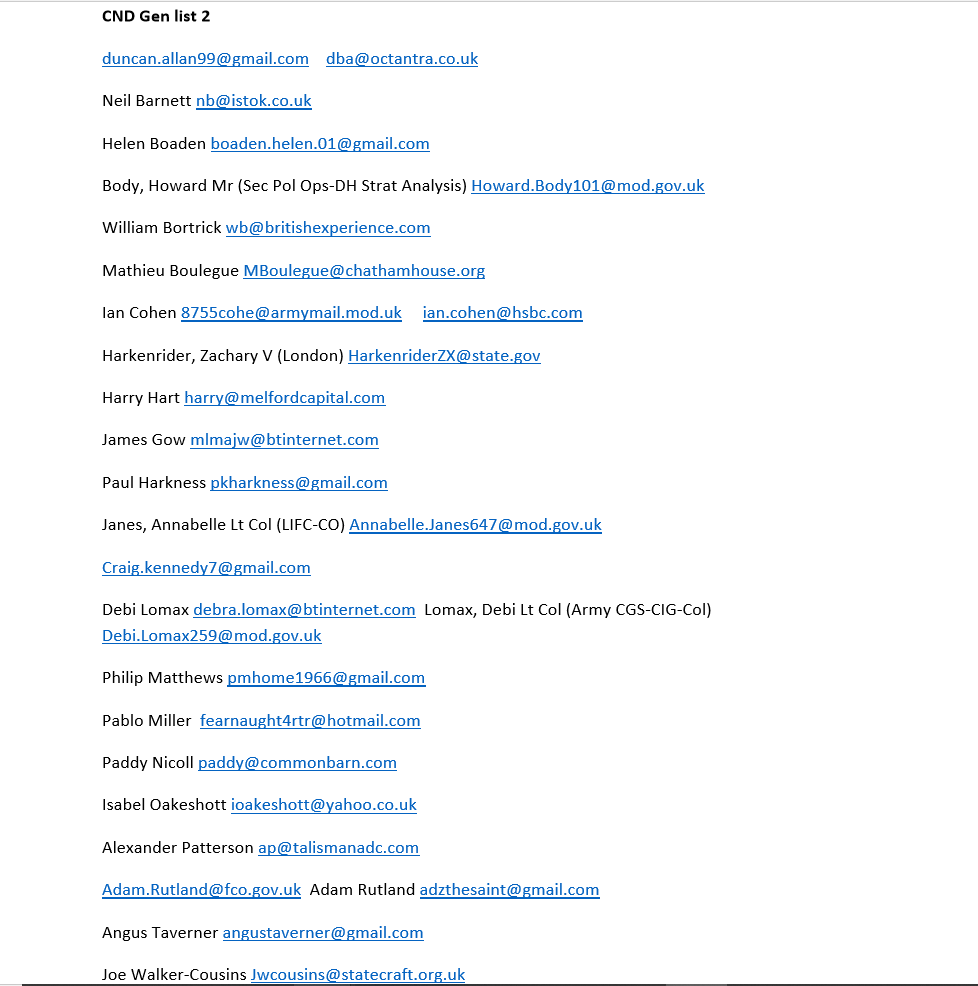
Tantalisingly, Anonymous describe this as a list of people who attended a meeting with the White Helmets. But there is no evidence of that in the document itself, nor does any other document released so far refer to this meeting. There is very little in the documents released so far about the White Helmets at all. But there is a huge amount about the Skripal case. With the greatest of respect to Anonymous and pending any release of further evidence, I want you to consider whether this might be a document related to the Skripal incident.
The list is headed CND gen list 2. CND is Christopher Nigel Donnelly, Director of the Institute for Statecraft and the Integrity Initiative and a very senior career Military Intelligence Officer.
The first name on the list caught my eye. Duncan Allan was the young FCO Research Analyst who, as detailed in Murder in Samarkand, appears in my Ambassadorial office in Tashkent, telling me of the FCO staff who had been left in tears by the pressure put on them to sign up to Blair’s dodgy dossier on Iraqi WMD. During the process of clearing the manuscript with the FCO, I was told (though not by him) that he denied having ever said it. It was one of a very few instances where I refused to make the changes requested to the text, because I had no doubt whatsoever of what had been said.
If Duncan did lie about having told me, it did his career no harm as he is now Deputy Head of FCO Research Analysts and, most importantly, the FCO’s lead analyst on Russia and the Former Soviet Union.
Now let us tie that in with the notorious name further down the list; Pablo Miller, the long-term MI6 handler of Sergei Skripal, who lived in Salisbury with Skripal. Miller is the man who was, within 24 hours of the Skripal attack, protected by a D(SMA) notice banning the media from mentioning him. Here Pablo Miller is actively involved, alongside serving FCO and MOD staff, in a government funded organisation whose avowed intention is to spread disinformation about Russia. The story that Miller is in an inactive retirement is immediately and spectacularly exploded.
Now look at another name on this list. Howard Body. Assistant Head of Science Support at Porton Down chemical weapon research laboratory, just six miles away from Salisbury and the Skripal attack, a role he took up in December 2017. He combines this role with Assistant Head of Strategic Analysis at MOD London. “Science Support” at Porton Down is a euphemism for political direction to the scientists – Body has no scientific qualifications.
Another element brought into this group is the state broadcaster, through Helen Boaden, the former Head of BBC News and Current Affairs.
In all there are six serving MOD staff on the list, all either in Intelligence or in PR. Intriguingly one of them, Ian Cohen, has email addresses both at the MOD and at the notoriously corrupt HSBC bank. The other FCO name besides Duncan Allan, Adam Rutland, is also on the PR side.
Zachary Harkenrider is the Political Counsellor at the US Embassy in London. There are normally at least two Political Counsellors at an Embassy this size, one of whom will normally be the CIA Head of Station. I do not know if Harkenrider is CIA but it seems highly likely.
So what do we have here? We have a programme, the Integrity Initiative, whose entire purpose is to pump out covert disinformation against Russia, through social media and news stories secretly paid for by the British government. And we have the Skripals’ MI6 handler, the BBC, Porton Down, the FCO, the MOD and the US Embassy, working together in a group under the auspices of the Integrity Initiative. The Skripal Case happened to occur shortly after a massive increase in the Integrity Initiative’s budget and activity, which itself was a small part of a British Government decision to ramp up a major information war against Russia.
I find that very interesting indeed.
With a hat-tip to members of the Working Group on Syria, Media, and the Propaganda, who are preparing a major and important publication which is imminent. UPDATE Their extremely important briefing note on the Integrity Initiative is now online, prepared to the highest standards of academic discipline. I shall be drawing on and extrapolating from it further next week.
Trump Syria Withdrawal Decision Requires Congressional Hearings – Senator Graham
Sputnik – December 21, 2018
WASHINGTON – President Donald Trump’s plan to pull all American forces out of Syria needs to be examined by Congress to determine the impact on US national security, Senator Lindsey Graham said on Friday.
“It is imperative Congress hold hearings on withdrawal decision in Syria — and potentially Afghanistan — to understand implications to our national security,” Graham said on Twitter.
Any hearings, as suggested by Graham, would likely be held when the new Congress convenes in January.
Trump announced plans this week to pull 2,000 US troops out of northern Syria, where they have been backing Kurdish rebels in the US-allied Syrian Democratic Forces (SDF). The president has also ordered the withdrawal of about half of the 14,000 US forces in Afghanistan, according to media reports.
The planned withdrawals – which are opposed by many Republicans and Democrats in Congress — prompted the resignation of Defense Secretary James Mattis on Thursday.
More: ‘Trump Plunging Country Into Chaos’: GOP, Dems Slam Trump for Mattis Resignation
Influencing Foreigners Is What Intelligence Agencies Do
By Philip M. GIRALDI | Strategic Culture Foundation | 20.12.2018
The Rand Corporation defines America’s influence operations as… “the coordinated, integrated, and synchronized application of national diplomatic, informational, military, economic, and other capabilities in peacetime, crisis, conflict, and post-conflict to foster attitudes, behaviors, or decisions by foreign target audiences that further US interests and objectives. In this view, influence operations accent communications to affect attitudes and behaviors but also can include the employment of military capabilities, economic development, and other real-world capabilities that also can play a role in reinforcing these communications.”
In a world where communications and social networks are global and accessible to many ordinary people, influence operations are the bread-and-butter of many intelligence agencies as a means of waging low intensity warfare against adversaries. During the past week there have been two accounts of how influencing foreign audiences has worked in practice, one relating to Russia and one to Great Britain.
The Russian story is part of the continuing saga of Russiagate. On Monday, the Senate Intelligence Committee released two reports on Russian operations before during and after the 2016 election to influence targeted groups, to include African-Americans, evangelical Christians and Second Amendment supporters to confuse voters about what the candidates stood for. Russia Internet Research Agency, headed by Yevgeny V. Prigozhin, alleged to be a friend of President Vladimir Putin, reportedly coordinated the effort.
The New York Times, slanted its coverage of the story, claiming that Moscow was “weaponizing” social media and that it was intended to support the candidacy of Donald Trump who “had a Russian blind spot and an army of supporters willing to believe convenient lies and half-truths.” They also dubbed it “a singular act of aggression that ushered in an era of extended conflict.” Of course, one might note that in 2016 the Times itself had a blind spot regarding Hillary Clinton compounded by a bias against Trump and his “deplorable” supporters, while one must also point out that Russian intentions are unknowable unless one were a fly on the wall inside the Kremlin when the US election was under discussion, so one might conclude that the newspaper is itself spreading something like disinformation.
It is undoubtedly true that Russia had a vital national interest in opposing Clinton, whose malevolent intentions towards Moscow were well known. It is also undoubtedly true that there was a campaign of manipulation of social networks by the Kremlin and its proxies to influence readers and also to assess the development of the two major party campaigns. But it also should be observed that the claim that it was seeking to suppress Democratic voters is not really borne out given the other much more conservative demographics that were also targeted. Indeed, involvement by Russia did not alter the outcome of the election and may have had virtually no impact whatsoever, so the claims by the Times that the world is seeing a new form of warfare is clearly exaggerated to reflect that paper’s editorial stance.
The fact that the Times is trying to make the news rather than reporting it is clearly indicted by its sheer speculation that “The Internet Research Agency appears to have largely sat out the 2018 midterm elections, but it is likely already trying to influence the 2020 presidential election, in ways social media companies may not yet understand or be prepared for. And Russia is just the beginning. Other countries, including Iran and China, have already demonstrated advanced capabilities for cyberwarfare, including influence operations waged over social media platforms.” It is certainly convenient to have all one’s enemies collectivized in two sentences, but the Times manages that quite neatly.
The second story, much less reported in the US media, relates to how the British intelligence services have been running their own disinformation operations against Russia, also using social networks and the internet. The British government has been financing a program that was given the name Integrity Initiative. It has been tasked with creating and disseminating disinformation relating to Russia in order to influence the people, armed forces and governments of a number of countries that Moscow constitutes a major threat to the west and its institutions.
Former British intelligence officer and established Russo-phobe Christopher Nigel Donnelly (CND) is the co-director of The Institute for Statecraft and founder of its offshoot Integrity Initiative. The Initiative ironically claims to “Defend Democracy Against Disinformation.” According to leaked documents, the Initiative plants disinformation that includes allegations about the “Russian threat” to world peace using what are referred to as journalists ‘clusters’ in place both in Europe and the United States.
Even though the Institute and Initiative pretend to be independent Non-Government Organizations (NGOs), they are both actually supported financially by the British government, NATO and what are reported to be other state donors, possibly including the United States.
The Integrity Initiative aside, the United States has also long been involved in influence operations, sometimes also referred to as perception management. Even before 9/11 and after the breakup of the Soviet Union the State Department, Pentagon and National Security Agency were all active on the internet in opposing various adversaries, to include terrorist groups. The CIA has been spreading disinformation using paid journalists and arranging foreign elections since 1947. Sometimes US federal government agencies are operating openly, but more often they are using covert mechanisms and cover stories to conceal their identities. America’s internet warriors are adept at spreading misinformation aimed at target audiences worldwide.
The fact is that spreading disinformation and confusion are what governments and intelligence services do to protect what they consider to be vital interests. It is naïve for the US Senate and America’s leading newspapers to maintain that intelligence probing and other forms of interference from Russia or China or Iran or even “friend” Israel occur in a vacuum. Everyone intrudes and spreads lies and everyone will continue to do it because it is easy to understand and cheap to run. In the end, however, its effectiveness is limited. In 2016 the election result was determined by a lack of trust on the part of the American people for what the establishment politicians have been offering, not because of interference from Moscow.
This Isn’t News. This Is War Crimes Apologia.
By Caitlyn Johnstone | Medium | December 18, 2018
The fact that George W Bush has given Michelle Obama two pieces of candy is once again making headlines in mainstream outlets like Time, The Hill, and Newsweek. He has not given her any new pieces of candy since the last time he did so at his father’s funeral. He also has not ceased to be the man who facilitated the murder of a million Iraqis and inflicted a whole new level of military expansionism and Orwellian surveillance upon our world. As near as I can tell, the only reason this story is once again making headlines is because Michelle Obama and the mainstream media have decided to bring it up again.
“He has the presence of mind and the sense of humor to bring me a mint, and he made it a point to give me that mint right then and there and that’s the beauty of George Bush,” Obama said of the war criminal in conversation at the SAP Center over the weekend, which we apparently need to know about because the news is telling us about it.
“We’re all Americans. We all care about our family and our kids, and we’re trying to get ahead,” Obama continued. “And that’s how I feel about [Bush]. You know? He’s a beautiful, funny, kind, sweet man.”

If you’re starting to feel like attempts to rehabilitate George W Bush’s image are being aggressively shoved down your throat by the mass media at every opportunity, it’s because that is exactly what is happening. Every few weeks there’s a new deluge of headlines explaining to consumers of mainstream media why they should love the 43rd president because he’s such a cutesy wootsey cuddle pie, and completely forget about the piles upon piles of human corpses he is responsible for creating for no legitimate reason at all. The last Bush appreciation blitz was less than two weeks ago.
And there is a reason for this. Make no mistake, this relentless, aggressive campaign to rehabilitate George W Bush whether you like it or not is actually a campaign to rehabilitate what he did and the mass media’s unforgivable complicity in it.
The mass media failed spectacularly to practice due diligence and hold power to account in the lead-up to the illegal and unconscionable Iraq invasion, not just the ghouls at Fox News but respected centrist outlets like CNN, the New York Times and the Washington Post as well. Bogus government reports were passed on uncritically and unquestioned, antiwar demonstrations with hundreds of thousands of protesters were ignored and downplayed, and the words “Saddam Hussein” and “9/11” were deliberately mentioned in the same breath so frequently that seven out of ten Americans still believed Saddam was responsible for the September 11 attacks months after the Iraq invasion had occurred.
In an environment where the New York Times is instructing its readers how to “help fight the information wars” against Russia, the BBC is coaching its audience to scream the word “whataboutism” whenever a skeptic of establishment Russia narratives brings up Iraq, and the US Secretary of Defense is claiming that Putin is trying to “undermine America’s moral authority,” the massive credibility hit that imperial media and institutions took by deceiving the world into the destruction of Iraq matters. Propaganda is a lot more important in cold war than in hot war since avoiding direct military confrontation limits the options of the participants, and Iraq is a giant bullet hole in the narrative of US moral authority which Moscow is rightly all too happy to point out.
Without the claim of moral authority, none of America’s manipulations against Russia make any sense. It’s absurd for America to spend years shrieking about Russian election meddling after it openly rigged Russia’s elections in the nineties, unless America claims that it rigged Russia’s elections for moral reasons while Russia rigged America’s elections for immoral reasons. It makes no sense to have mainstream western media outlets uncritically manufacturing support for wars and coaching their audiences on how to help government agencies fight “information wars” against Russia while also criticizing RT as “state media”, unless you can say that western media functions as an arm of the US government for moral reasons while RT does so for immoral reasons. It makes no sense for the US to criticize Russian military interventionism when the US is vastly more guilty of vastly more egregious forms of military interventionism, unless the US can claim its interventionism is moral while Russia’s is immoral.
For this reason it’s been necessary to rehabilitate the image of the Iraq invasion, and since there is no aspect of the Iraq invasion itself that isn’t soaked in blood and gore, they are rehabilitating its most recognizable face instead. Mainstream media outlets are doing this both to restore their own credibility and the credibility of the US world order they serve, in order to help secure crucial narrative control as we slide ever closer to a direct military confrontation with Russia and/or China.
Whoever controls the narrative controls the world, and Iraq is a major weak point in the US-centralized empire’s narrative control. When you see a political insider like Michelle Obama constantly facilitating the mass media’s fixation on how cuddly wuddly George W Bush has become, you are not witnessing a heartwarming moment, you are not witnessing redemption, and you are most certainly not witnessing the news. You are witnessing war propaganda, plain and simple.
Featured Video
Seyed M. Marandi: US-Iran War Inevitable: Kuwait and Bahrain May Fall
or go to
Aletho News Archives – Video-Images
From the Archives
Oil and the Israel Lobby
Reknowned economist M. Shahid Alam offers this excellent critique of Noam Chomsky’s defective analysis of the relative influence of Oil versus the Israel lobby over US foreign policy: … continue
Blog Roll
 Aletho News
- SNSC secretary dismisses US response to Iran’s conditions as ‘inadequate’
- Sanaa says Taiz roads open, secure for residents, warns Saudi forces
- Iraqi resistance group urges Saudi leadership to admit defeat, lift Yemen siege
- Trump’s Retreat: How Al-Aqsa Flood Took Down the US Empire
- Israel’s Military Actions in Lebanon Grossly Violate International Law — Lavrov
- Seyed M. Marandi: US-Iran War Inevitable: Kuwait and Bahrain May Fall
- Leaders Condemn Ansarallah Attack on Saudi Arabia While Ignoring Illegal War Against Yemen
- Leaked: Britain’s Covert Iraqi Psyops Network
- Yemeni Armed Forces Warn Airlines Against Using Saudi Airports, Exempt Mecca and Medina
- Iran security chief says powers greater than US tried to conquer Iran but ended in ‘dustbin of history’
- If Americans Knew
- Gaza: Ceasefire Anniversary Marks Year of Failed Promises
- The American Conservative: Mike Huckabee Should Resign
- A C-Section in Shackles: A Palestinian Woman’s Harrowing Birth in Israeli Detention
- ‘He’s Desperate’: AIPAC Begins Spending Against Abdul El-Sayed to Boost Mike Rogers:
- Trump, Hormuz, and the Looming Economic Catastrophe
- For three years, Israel has killed a child in Gaza every 71 minutes – Daily Update
- Israeli forces kill another child in Gaza – Daily Update
- Gaza ceasefire exists in name only, say more than 100 organizations
- Nearly 2 Million in Gaza Need Urgent Shelter Assistance as Winter Looms: IOM Chief Warns
- Suppressing Palestinian resistance: US charity under fire for AI monitoring of Gaza classrooms
- No Tricks Zone
- Germany’s Green Energy Debacle: High Energy Costs Force Kahla Porzellan to Close After 182 Years!
- New Study: 50 Years Of The Most Aggressive ‘Net Zero’ Policies Can Only Affect The Global Climate By 0.03°C
- US September “Heat” Was No Record…Many Records Set Decades Ago
- Latest European Green Energy Debacle; Portugal’s Largest Flagship Solar Park Insolvent!
- Green Energy Debacle: German Expert Professor Fritz Vahrenholt Warns Of Severe Economic And Social Consequences
- Two More Paleo Reconstructions Affirm Meters-Higher Sea Levels Across Ireland, Brazil 7000-6000 Years Ago
- New Study: Earth And Venus Surface Warmth Largely Explained By Convection And Lapse Rate, Not CO2 Or Radiation
- 2025 Nature Paper Claiming Worsening Global Drought Gets RETRACTED …Heavily Flawed
- New Study: ‘Global Drought Shows No Detectable Recent Acceleration Under Climate Warming’
- Economic Masterminds: German Socialists Suggest Taxing Productivity Gains Stemming From Using AI


