BBC Caught Cherry-Picking Anti-Privacy Computer Scientists for Segment
Sputnik – 15.08.2018
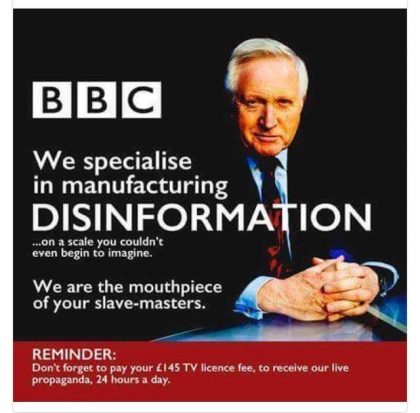 The BBC was caught red-handed engaging in manipulation after it declined to invite a potential guest for a segment on computer security, turning the expert down because he refused to state why it would be a good idea to put “back-doors” into cryptographic systems.
When “the UK Home Secretary outlined her plans around restrictions on end-to-end encryption, I was called by the BBC about back-doors in cryptography. As it is a subject I know well, and had even presented to a select committee in the House of Commons, I said I would be interested in debating the issue. They then they asked if I could put forward the concept of backdoors in encryption, and I said: ‘I can’t do that!'” professor Bill Buchanan of Edinburgh Napier University said in a Monday Medium post.
BBC’s producers then pressed the professor on the grounds that they were “really struggling” to find someone to make the case in favor of back-doors.
Buchanan was willing to offer his expertise here, explaining to BBC: “Well, most people with any technical knowledge know that it is a bad thing, and to provide an academic point of view I would have to be critical of it. In fact if I put forward the concept of back-doors in cryptography, I would have no credibility in my field.”
He said that BBC declined to invite him onto its show after his response ended the conversation.
What was BBC’s real motivation for pre-interviewing the computer scientist? “Basically I was there to back-up a politician who was on the show,” he demurred.
‘Too Big to Fail’: Russia-gate One Year After VIPS Showed a Leak, Not a Hack
By Patrick Lawrence | Consortium News | August 13, 2018
A year has passed since highly credentialed intelligence professionals produced the first hard evidence that allegations of mail theft and other crimes attributed to Russia rested on purposeful falsification and subterfuge. The initial reaction to these revelations—a firestorm of frantic denial—augured ill, and the time since has fulfilled one’s worst expectations. One year later we live within an institutionalized proscription of proven reality. Our discourse consists of a series of fence posts and taboos. By any detached measure, this lands us in deep, serious trouble. The sprawl of what we call “Russia-gate” now brings our republic and its institutions to a moment of great peril—the gravest since the McCarthy years and possibly since the Civil War. No, I do not consider this hyperbole.
Much has happened since Veteran Intelligence Professionals for Sanity published its report on intrusions into the Democratic Party’s mail servers on Consortium News on July 24 last year. Parts of the intelligence apparatus—by no means all or even most of it—have issued official “assessments” of Russian culpability. Media have produced countless multi-part “investigations,” “special reports,” and what-have-yous that amount to an orgy of faulty syllogisms. Robert Mueller’s special investigation has issued two sets of indictments that, on scrutiny, prove as wanting in evidence as the notoriously flimsy intelligence “assessment” of January 6, 2017.
Indictments are not evidence and do not need to contain evidence. That is supposed to come out at trail, which is very unlikely to ever happen. Nevertheless, the corporate media has treated the indictments as convictions.
Numerous sets of sanctions against Russia, individual Russians, and Russian entities have been imposed on the basis of this great conjuring of assumption and presumption. The latest came last week, when the Trump administration announced measures in response to the alleged attempt to murder Sergei and Yulia Skripal, a former double agent and his daughter, in England last March. No evidence proving responsibility in the Skripal case has yet been produced. This amounts to our new standard. It prompted a reader with whom I am in regular contact to ask, “How far will we allow our government to escalate against others without proof of anything?”
This is a very good question.

Cover of 2001 book that looks at an earlier era of anti-Russia hysteria
There have been many attempts to discredit VIPS50 as the group’s document is called. There has been much amateurish journalism, false reporting, misrepresentation, distortion, misquotation, and omission. We have been treated to much shoddy science, attempts at character assassination, a great deal of base name-calling, and much else. Russia is routinely advanced as the greatest threat to democracy Americans now face. Is there any denying that we live amid an induced hysteria now comparable to the “Red under every bed” period of the 1950s?
None of this has altered the basic case. VIPS and forensic scientists working with it have continued their investigations. New facts, some of which alter conclusions drawn last year, have come to light, and these are to be addressed. But the basic evidence that Russia-gate is a false narrative concocted by various constituents of national power stands, difficult as this is to discern. Scrape back all that is ethically unacceptable and unscrupulously conveyed into the public sphere and you find that nothing has changed: No one “hacked” the Democratic party’s mail in the summer of 2016. It was leaked locally, from what one can make out, to expose the party leadership’s corrupt efforts to sink Bernie Sanders’ insurgent campaign to win the Democratic nomination.
But in another, very profound way, more has changed since VIPS50 was published than one could have imagined a year ago. American discourse has descended to a dangerous level of irrationality. The most ordinary standards of evidentiary procedure are forgone. Many of our key institutions—the foreign policy apparatus, the media, key intelligence and law-enforcement agencies, the political leadership—are now extravagantly committed to a narrative none appears able to control. The risk of self-inflicted damage these institutions assume, should the truth of the Russia-gate events emerge—as one day it surely will—is nearly incalculable. This is what inspires my McCarthy and Civil War references. Russia-gate, in a phrase, has become too big to fail.
This column is an attack on no one. However it may be read, it is not intended as another round of vituperative argument adding to the din and fog we already suffer daily. No shred of ideology informs it. I write a lament—this for all we have done to ourselves and our institutions this past year, and to the prospect of an orderly world, and for all that must somehow be done to repair the damage once enough of us indeed recognize what has been done.
New VIPS Findings
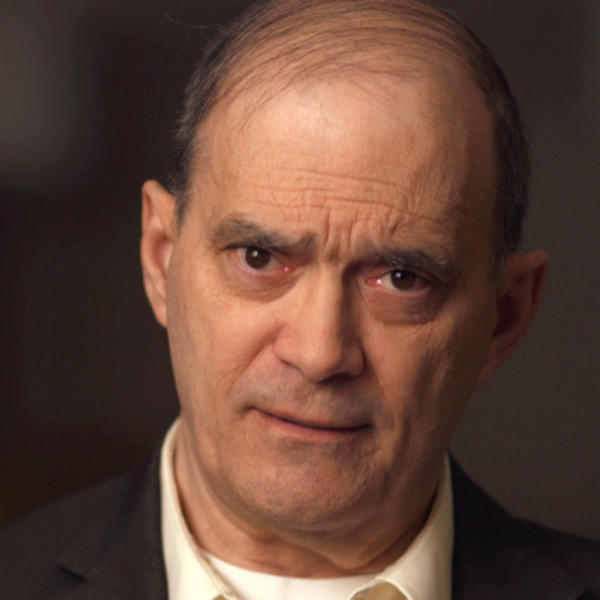
Binney: Dares anyone to prove remote speeds
The forensic scientists working with VIPS continued their research and experiments after VIPS50 was published. So have key members of the VIPS group, notably William Binney, the National Security Agency’s former technical director for global analysis and designer of programs the agency still uses to monitor internet traffic. Such work continues as we speak, indeed. This was always the intent: “Evidence to date” was the premise of VIPS50. Over the past year there have been confirmations of the original thesis and some surprises that alter secondary aspects of it. Let us look at the most significant of these findings.
At the time I reported on the findings of VIPS and associated forensic scientists, that the most fundamental evidence that the events of summer 2016 constituted a leak, not a hack, was the transfer rate—the speed at which data was copied. The speed proven then was an average of 22.7 megabytes per second. That speed matches what is standard when someone with physical access uses an external storage device to copy data from a computer or server and is much faster than a remote hack reliant on an internet service provider could achieve—either at the time or since, Binney has found.
Binney experimented into the autumn. By mid-autumn he had tested several routes—from East Coast locations to cities in eastern Europe, from New Jersey to London. The fastest internet transfer speed achieved, during the New Jersey–to–Britain test, was 12.0 megabytes of data per second. Since this time it has emerged from G-2.0’s metadata that the detected average speed—the 22.7 megabytes per second—included peak speeds that ran as high as 49.1 megabytes per second, impossible over the internet. “You’d need a dedicated, leased, 400–megabit line all the way to Russia to achieve that result,” Binney said in a recent interview.
To my knowledge, no one with an understanding of the science involved, including various former skeptics, any longer questions the validity of the specific finding based on the observed transfer rate. That remains the bedrock evidence of the case VIPS and others advance without qualification. “No one—including the FBI, the CIA, and the NSA—has come out against this finding,” Binney said Monday. “Anyone who says the speed we demonstrated can be achieved remotely, our position is ‘Let’s see it. We’ll help any way we can.’ There hasn’t been anyone yet.”
There is also the question of where and when leaks were executed. Research into this has turned out differently.
Evidence last year, based on analysis of the available metadata, showed that the copy operation date-stamped July 5, 2016, took place in the Eastern U.S. time zone. But Forensicator, one of the chief forensic investigators working on the mail-theft case anonymously, published evidence in May that, while there was activity in the Eastern zone at the time of that copy, here was also a copy operation in the Pacific time zone, where clocks run three hours earlier that EST. In an earlier publication he had also reported activity in the Central time zone.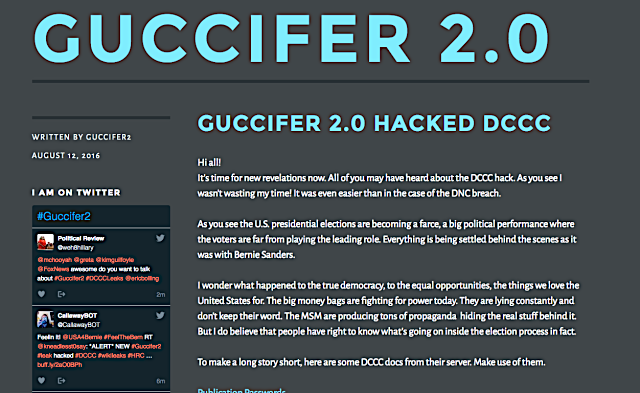
Plainly, more was awaiting discovery as to the when and where of the copy operations. The identity of Guccifer 2.0, who claimed to be a Romanian hacker but which the latest Mueller indictment claims is a construct of the GRU, Russian military intelligence, has never been proven. The question is what G–2.0 did with or to the data in question. It turns out that both more, and less, is known about G–2.0 than was thought to have been previously demonstrated. This work has been completed only recently. It was done by Binney in collaboration with Duncan Campbell, a British journalist who has followed the Russia-gate question closely.
Peak Speed Established
Binney visited Campbell in Brighton, England, early this past spring. They examined all the metadata associated with the files G–2.0 has made public. They looked at the number of files, the size of each, and the time stamps at the end of each. It was at this time that Binney and Campbell established the peak transfer rate at 49.1 megabytes per second.
But they discovered something else of significance, too. At some point G–2.0 had merged two sets of data, one dated July 5, 2016, which had been known, and another dated the following September 1, which had not been known. In essence, Campbell reverse-engineered G–2.0’s work: He took the sets of data G–2.0 presented as two and combined them back into one. “G–2.0 used an algorithm to make a downloaded file look like two files,” Binney explained. “Those two shuffled back together like a deck of cards.”
G–2.0 then took another step. Running another algorithm, he changed all the dates on all the files. With yet another algorithm, he changed the hours stamped on each file. These are called “range changes” among the professionals. The conclusion was then obvious: G–2.0 is a fabrication and a fabricator. Forensicator had already proven that the G–2.0 entity had inserted Russian “fingerprints” into the document known as the “Trump Opposition Report,” which he had published on June 15, 2016. It is clear that no firm conclusions can be drawn at this point as to when or where G–2.0 did what he did.
“Now you need to prove everything you might think about him,” Binney told me. “We have no way of knowing anything about him or what he has done, apart from manipulating the files. We detected activity in the Eastern time zone. Now we have to ask again, ‘Which time zone?’ The West Coast copy operation [discovered by Forensicator] has to be proven. All the data has been manipulated. It’s a fabrication.”
This throws various things into question. The conclusions initially drawn on time and location in VIPS50 are now subject to these recent discoveries. “In retrospect, giving ‘equal importance’ status to data pertaining to the locale was mistaken,” Ray McGovern, a prominent VIPS member, wrote in a recent note. “The key finding on transfer speed always dwarfed it in importance.”
The indictments against 12 Russian intelligence officers announced in mid–July by Rod Rosenstein, the deputy attorney-general, also come into question. They rest in considerable part on evidence derived from G–2.0 and DCLeaks, another online persona. How credible are those indictments in view of what is now known about G–2.0?
Binney told me: “Once we proved G–2.0 is a fabrication and a manipulator, the timing and location questions couldn’t be answered but really didn’t matter. I don’t right now see a way of absolutely proving either time or location. But this doesn’t change anything. We know what we know: The intrusion into the Democratic National Committee mail was a local download—wherever ‘local’ is.” That doesn’t change. As to Rosenstein, he’ll have a lot to prove.”
What Role does Evidence Play?
Rosenstein’s predicament—and there is no indication he understands it as one—brings us to an essential problem: What is the place of evidence in American public discourse? Of rational exchange?
The questions are germane far beyond the Russia-gate phenomenon, but it is there that answers are most urgent. What is implicit in the Rosenstein indictments has been evident everywhere in our public sphere for a year or more: Make a presumption supported by circumstantial evidence or none and build other presumptions upon it until a false narrative is constructed. The press has deployed this device for as long as I have been a practitioner: “Might” or “could” or “possibly” becomes “perhaps,” “probably” and “almost certainly,” and then moves on to unqualified fact in the course of, maybe, several weeks. Now this is how our most basic institutions—not least agencies of the Justice Department—routinely operate.

Rosenstein at the Department of Justice July 13, 2018 announcing indictments against 12 Russian GRU. (Photo by Chip Somodevilla/Getty Images)
This is what I mean when I refer to ours as a republic in peril.
There is the argument that certain things have been uncovered over the past year, and these are enough to conclude that Russia plots to undermine our democracy. I refer to the small number of Facebook advertisements attributed to Russians, to strings of Twitter messages, to various phishing exercises that occur thousands of times a day the world over. To be clear, I am no more satisfied with the evidence of Russian involvement in these cases than I am with the evidence in any other aspect of the Russia-gate case. But for the sake of argument, let us say it is all true.
Does this line up with the Russophobic hysteria—not too strong a term—that envelops us? Does this explain the astonishing investments our public institutions, the press, and leading political parties have made in advancing this hysteria as they did a variant of in the 1950s?
As global politics go, some serious thought should be given to a reality we have created all by ourselves: It is now likely that America has built a new Cold War division with Russia that will prove permanent for the next 20 to 30 years. All this because of some Facebook ads and Twitter threads of unproven origin? Am I the only one who sees a weird and worrisome gap between what we are intent on believing—as against thinking or knowing—and the consequences of these beliefs?
There was an orthodoxy abroad many centuries ago called Fideism. In the simplest terms, it means the privileging of faith and belief over reason. It was the enemy of individual conscience, among much else. Fideism has deep roots, but it was well around in the 16th century, when Montaigne and others had to navigate its many dangers. Closer to our time, William James landed a variant on American shores with an 1896 address called “The Will to Believe.” Bertrand Russell countered this line of thinking a couple of decades later with “Free Thought and Official Propaganda,” a lecture whose title I will let speak for itself. Twenty years ago, none other than Pope John Paul II warned of a resurgence of Fideism. It is still around, in short.
Do we suffer from it? A variant of it, I would say, if not precisely in name. There seems to be a givenness to it in the American character. I think we are staring into a 21st century rendition of it.
To doubt the hollowed-out myth of American innocence is a grave sin against the faith. It is now unpatriotic to question the Russia-gate narrative despite the absence of evidence to support it. Informal censorship of differing perspectives is perfectly routine. It is now considered treasonous to question the word of intelligence agencies and the officials who lead them despite long records of deceit. Do we forget that it was only 15 years ago that these same institutions and people deceived us into an invasion of Iraq the consequences of which still persist?
This was the question Craig Murray, the former British diplomat (who has vital information on the DNC mail theft but who has never been interviewed by American investigators) posed a few weeks ago. Eugene Robinson gave a good-enough reply in a Washington Post opinion piece shortly afterward: “God Bless the Deep State,” the headline read.
How we got here deserves a work of social psychology, and I hope someone takes up the task. Understanding our path into our self-created crisis seems to me the first step to finding our way out of it.
Patrick Lawrence, a correspondent abroad for many years, chiefly for the International Herald Tribune, is a columnist, essayist, author, and lecturer. His most recent book is Time No Longer: Americans After the American Century (Yale). Follow him @thefloutist. His web site is www.patricklawrence.us. Support his work via www.patreon.com/thefloutist.
The goal of propaganda is a population that polices itself
Why the attacks on Jeremy Corbyn are not what they seem
By MarkGB | The Renegade | August 10, 2018
Propaganda has reached its zenith when each member of the target population thinks the same; when they are afraid to think differently. At this point ‘leadership’ may commit whatever atrocities it sees fit… in the certainty that the population will either not ‘see’ it, or will view the expression of criticism as a more heinous crime than the act being observed. This is achieved through cementing a ‘false equivalence’ in the mind of the group. Such a false equivalence is being cemented in the UK right now – the idea that criticism of Israel’s persecution of Palestinians is an act of anti-Semitism.
The propagandist seeks to bend the ‘group mind’. Thoughts and actions consistent with the ‘narrative’ are deemed to be socially acceptable & politically correct… ones that challenge it are regarded as socially UN-acceptable & politically IN-correct. Overtime this is reinforced through a dynamic that exists within every human grouping, and many species of mammal – fear of disapproval. Ergo, the propagandist is employing a form of ‘crowd control’.
When the fear of disapproval becomes so strong that one’s sense of belonging, or even physical survival, depend on adherence to the narrative… when failure to comply with it attracts immediate rebuke from other members of the group… then the population can be said to be policing itself. That is how ‘cults’ function, and more frequently than you might imagine… it’s how intelligence agencies and other governmental figures attempt to work through the media.
This is what Orwell warned of in the dystopia of ‘1984’. The Party had achieved what we might call a ‘maintenance state’ for the narrative – society was policing itself. For example, in Oceania, children were taught to report their parents to the ‘Thought Police’ if they demonstrated any sign of disloyalty to The Party. Disloyalty was considered a ‘thought crime’:
“Actions are held to be good or bad, not on their own merits, but according to who does them. There is almost no kind of outrage – torture, imprisonment without trial, assassination, the bombing of civilians – which does not change its moral colour when it is committed by ‘our’ side. The nationalist not only does not disapprove of atrocities committed by his own side, he has a remarkable capacity for not even hearing about them” – George Orwell, ‘1984’
This process is happening now. The false equivalence of ‘criticism of Israel’ with ‘anti-Semitism’ is being inculcated into society in general, into the Labour Party in particular, and in its sharpest manifestation, into the smear campaign against Jeremy Corbyn.
As you will already be aware (unless you’ve been trapped behind the fridge for several weeks) Corbyn is the target of a virulent campaign from a number of different directions, which have made ‘common cause’ on the accusation of anti-Semitism. Here, for example, are three major Jewish Newspapers, competitors of each other, who made the extraordinary decision to agree a common headline and verdict on ‘Corbyn’s Labour Party’:

And here is the Jewish Chronicle after Margaret Hodges attacked Corbyn in public with ‘you’re a fucking racist and anti-Semite’:
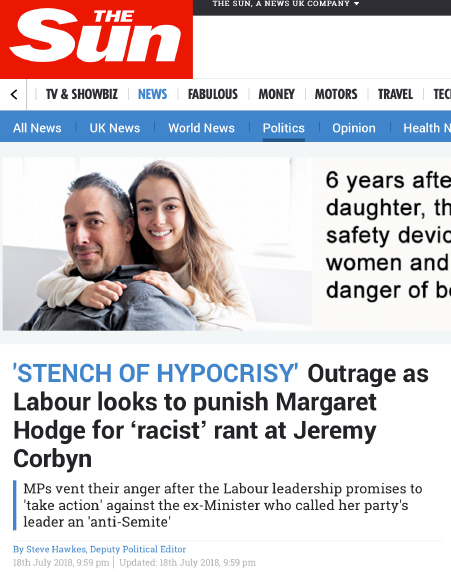
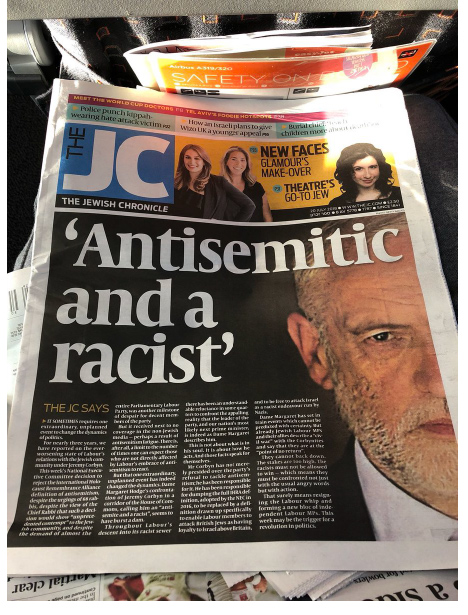 The mainstream media has not missed any opportunity to bash Corbyn either. Here’s a relatively mild headline from the Sun, who selected a comment from one of Corbyn’s backbenchers, Wes Streeting:
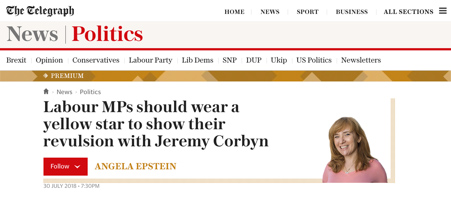
And to demonstrate that upmarket & downmarket means little when it comes to this stuff, here’s a hysterical comment from the usually ‘sober’ Telegraph :
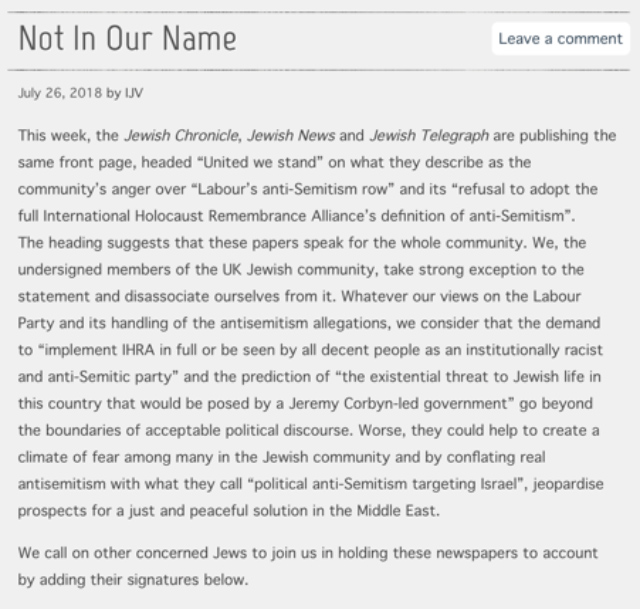
What you will probably NOT have seen, however, is coverage of a statement published by 650 members of the Jewish Community, who are passionately opposed to the narrative. Here is the statement from ‘Independent Jewish Voices’ whose aim is ‘human rights and a just and peaceful solution’:
Neither is it likely that you will have heard the following statement from a Jewish academic, a person I’ve never met, but one who strikes me as a thoroughly intelligent and compassionate human being, Professor Annabelle Sreberney:
Professor Annabelle Sreberny pic.twitter.com/O3HXEG8Gwy
— LabourFanTV (@TheBirmingham6) July 26, 2018
At this point, let me spell out my personal opinion regarding Jeremy Corbyn’s alleged anti-Semitism:
You have to be a propagandist, an opportunist, or a complete idiot to discount decades of evidence demonstrating that Jeremy Corbyn is an enemy of racism. Wake up and smell the coffee – the guy stands up for the underdog… racists, by stark contrast, are always bullies
The reality I perceive, is not that Corbyn hates Jews, or loves Arabs… it’s that he challenges injustice where he sees it – and he sees it in the treatment that Palestinians receive from the State of Israel.
The Propagandists in this situation must ‘redirect’ the attention of the population to the ‘false equivalence’: Criticism of Israel = Anti-Semitism.
The Opportunists in the equation are many:
- This is a wonderful distraction for a Tory government that couldn’t run a kid’s party at Willy Wonka’s
- The Blairites in the Labour Party who’ve been trying to get rid of Corbyn since Day 1, have been handed a much more powerful weapon than anything they’ve tried up-to-now, and boy do they love it
- There are a number of other groups who would rather invite Dracula over the threshold than see Corbyn enter Number Ten. The banks and the Murdoch empire are two examples
As for the Complete Idiots… sadly ‘careful thought’ is about as popular as ‘listening’, and to be fair to younger folk & millennials, this has been the case for the six decades I’ve been observing my fellow ‘talking monkeys’. In short, propaganda relies on people ‘not thinking’ – there’s a lot of it about.
Now, let’s look at some ‘nitty gritty’ – the everyday stuff. This isn’t something that only happens in the newspapers – it’s a real part of everyday thinking and discourse. Here is an example I encountered a few days ago, which will serve to illustrate the process:
Context
A Labour supporter on Twitter made an accurate observation that the BBC’s coverage of Jeremy Corbyn is so biased that it’s painful to listen to. I will keep his identity confidential since I have no desire to embarrass him – my purpose is to demonstrate ‘false equivalence’ in action.
Secondly, I should add that the Israeli Embassy has a fearsome reputation amongst journalists for making its feelings known if Israel doesn’t get the coverage it feels it deserves. This is no secret… and it’s not new. Here is Tim Llewellyn, former Middle East correspondent for the BBC, writing in The Observer in June 2004:
“The reasons for this tentative, unbalanced attitude to the central Middle East story are powerful. BBC news management is by turns schmoozed and pestered by the Israeli embassy. The pressure by this hyperactive, skilful mission and by Israel’s many influential and well organised friends is unremitting and productive, especially now that accusations of anti-Semitism can be so wildly deployed
And here is a clip from a suppressed Al-Jazeera film, showing Israeli Embassy staff advising Labour activists about how to discredit MPs who support an end to the abuse of Palestinians:
Evidence, filmed on camera, of Israeli diplomats, operating out of a London embassy, plotting to use #antisemitism as a weapon to damage and bring down @jeremycorbyn & create a schism with his key supporters in @UKLabour https://t.co/miayB7FXQB pic.twitter.com/PQ3PSEfYp7
— Joel Benjamin (@Gian_TCatt) August 5, 2018
The conversation
Labour Supporter:
Will the Media ever accept Corbyn as the leader of Lab Party, No! Listen to Justin Webb’s Masterclass in unconscious bias, in a short interview with John McDonnell he trundled out every Anti-Corbyn narrative and the newest or oldest That Corbyn is like Trump
MarkGB:
When ‘journalists’ at BBC interview Jeremy Corbyn, they repeat what they hear in the echo chamber of Whitehall, itself an echo of the fears of corps, banks & other ‘lobbyists’… but the thing that scares the veritable ‘crap’ out of the BBC is a call from the Israeli Embassy
Labour Supporter:
You know that sounds like Paranoia and to my ears Anti-Semitic. If we are going to convince the media to give us a fair crack of the whip and balance reporting we need to be careful in our use of language
MarkGB:
‘To your ears’. There is no anti-Semitism in my tweet whatsoever. Don’t buy the conflation between criticism of Israeli government policy and anti-Semitism, or if you do, don’t try to pin it onto me. There’s none here.
As expected, he did not reply.
My comments
So here is a guy who is so scared of being seen as anti-Semitic he does the following, albeit probably unconsciously
- Sacrifices truth on the altar of the need to be careful. I.E. don’t tell the truth – it gets us into trouble. It may bring me disapproval
- Projects his fear onto another, in this case myself, who is thus cast as the ‘anti-Semitic’ one… so that people know that he isn’t
- Imagines that there is the remotest possibility that the media will give Labour or Corbyn, a ‘fair crack of the whip’
There is no way that Jeremy Corbyn or the Labour Party will ever get a ‘fair crack of the whip’ on this issue. The narrative requires that Corbyn’s support for Palestinians goes away… if you are entertaining the possibility that there is any place for ‘rational argument’ or ‘objective reporting’ from or with the people driving this narrative… you are deluding yourself. This is Propaganda… this is how it’s supposed to work
And it is working… have you noticed how the media is utterly obsessed with talking about Corbyn’s ‘anti-Semitism’… at the expense of the underlying issue he calls attention to – Israel’s abuse of the Palestinian people?
What then, is a person to do?
The solution to this is not quick, and it’s not easy. However, one action that any human being can take, is to stay alert to the meaning of words and how they are structured. If the communication is verbal, also to the body language and vocal tonalities. Pay attention to what is really being said… and also notice what is not being said or skirted around… and refuse to sacrifice your truth for an easier life. Do not let the false equivalence stand. As Gandalf said to the Balrog on the bridge at Khazad Dum…“You shall not pass”.
Propaganda is a thought virus. Speaking your truth is the antidote. Here is the antidote in action – the splendid Dr Norman Finkelstein, giving an impassioned reply to an audience intent on using ’emotional blackmail’ to shut him up:
Norman Finkelstein’s Famous Speech: Do NOT use the Holocaust to try and justify the Israelis brutalizing the Palestinians.
This is #Israel#Israeli War Crimes
Ahed Tamimi pic.twitter.com/cQ6nVOpwIC— Ian56 (@Ian56789) July 29, 2018
Here is my personal response to this thought virus, and to anyone who tries to infect me with it:
I don’t care if you worship in a synagogue, a church, a temple, or a mosque. I don’t care if you’re black, white, yellow, brown or green. I don’t give a monkey’s what you eat for dinner & I don’t care who you sleep with… provided it’s a consenting adult. I cannot abide bullies, liars and sociopaths. Benjamin Netanyahu and the current government of Israel are war criminals… & your guilt-trip won’t work on me.
Finally, to those who are having thoughts like ‘this is all a misunderstanding’ or ‘common sense will prevail’, or ’a few concessions is enough to fix this’… it isn’t, it won’t, & it never will be… that isn’t how this works.
You cannot appease a smear campaign.
Resignation matter or fake news? Attack on Corbyn over ‘terrorist wreath laying’
RT | August 13, 2018
The latest anti-Semitism story to hit Labour’s Jeremy Corbyn has polarised debate. His critics want him to resign immediately, while supporters are rushing to his defence, denying the accusations and crying ‘fake news.’
Photographs, taken in 2014 and published by the Daily Mail on August 11, show Corbyn holding a wreath at a service in Tunisia close to the graves of the Black September terrorists, who were implicated in the Munich attacks, in which 11 Israeli athletes were killed in 1972.
The original story is headlined “Corbyn’s wreath at Munich terrorists’ graves,” goes on to accuse the Labour leader of attending a “tribute event for Palestine ‘martyrs’ including plotters behind 1972 slaughter of Israeli Olympic athletes.”
The Labour Party has rejected calls for an apology, reiterating that Corbyn’s statement that he was laying a wreath honoring the 47 victims of an Israeli attack on a Palestinian Liberation Organisation (PLO) base outside of Tunis in 1985.
Responding to a follow up story, in which relatives of the Munich victims state that Corbyn should be “ashamed and apologize,” the party’s press team posted that the relatives were being “misled” by the story.
Writing in the left-wing Morning Star after the visit to the Tunisian cemetery, Corbyn stated that wreaths were laid to mark the 1985 Israeli bombing, adding: “After wreaths were laid at the graves of those who died on that day and on the graves of others killed by Mossad agents in Paris in 1991.”
It is unclear who Corbyn was referring to as there are no known Israeli killings in Paris in that year. However, Mossad agents did reportedly kill the PLO’s liaison officer with foreign intelligence agencies, Atef Bseiso, a suspected Black September member in 1992 in the French capital.
The article’s perceived inaccuracies prompted certain Corbyn supporters to call on him to sue the Daily Mail and over what they insist is ‘inaccurate reporting.’
In turn, right-wing Twitter condemnations of Corbyn were rife. Broadcaster Julia Hartley-Brewer mocked the Labour leader, and staunch Corbyn critic and Daily Mail journalist, Dan Hodges posted: “Dear Corbynites. It’s clear your hero honoured one, or a number of, the terrorists responsible for the Munich attack.”
The accusations led to Home Secretary Sajid Javid to demand Corbyn resign. “If this was the leader of any other major political party, he or she would be gone by now.” stated the Conservative.
While Jewish Leadership Council, Jonathan Goldstein, told the Jewish News : “This man is not fit to be a Member of Parliament, let alone a national leader.”
Another piece published by the Daily Mail on the same day attacked Corbyn for attending the wedding of a Palestinian ambassador who was accused of Holocaust denial in 2014, a claim he denies. Corbyn attended the wedding in 2010.
Question more? You’re a pesky ‘Russophile’, says Soros-backed Belgian NGO
By Nebojsa Malic | RT | August 11, 2018
Once a leader in philosophy and fashion, France has now been reduced to falling for tricks recycled from US con artists by Brussels-based grifters, with a little help from Twitter’s ‘mea culpa’ cash and even Uncle George Soros.
It all began when EU DisinfoLab, a non-governmental organization based in Belgium, published a report on Wednesday about how some 55,000 “hyperactive” twitter accounts spread the news of the Benalla affair, and accused a portion of those accounts of being “Russophiles.”
Within a day, French media were printing headlines screaming about “Russian bots,” prompting the NGO to issue a “clarification” of their findings. Not all of the accounts were “Russophiles,” the outfit said, and the report said nothing about “bots” – but the French public was already outraged.
Politicians Jean-Luc Melenchon of La France Insoumise and Marine Le Pen from the National Rally (NR) –previously known as Le Front National– who both ended up on the NGO’s list, tweeted derisively about the report, with Melenchon calling the outfit “stupid spooks.”
EU DisinfoLab basically used tools –as well as funding– provided by Twitter to compile a list of accounts tweeting about the scandal involving Alexandre Benalla, deputy chief of staff and bodyguard to President Emmanuel Macron. Benalla was fired in July after it emerged he had assaulted a protester at May Day demonstrations while impersonating a police officer, then tried to suppress the video footage of the incident.
Of the accounts thus rounded up, the group identified 27 percent as being part of the “Russian disinformation ecosystem,” described as people retweeting content from RT and Sputnik, or promoting the “Russian narrative.” Examples of the latter were listed as people spreading “false information” like that the Syrian government did not use chemical weapons in Douma (#SyriaHoax) or doubting the official [UK] narrative about the poisoning of Sergei and Yulia Skripal in Salisbury.
Having thus characterized the doubters of the official Western media narratives as Russian agents, the group had the cheek to declare this is “not a value judgment, but a quantifiable fact according to methodology.”
What methodology? Well, in part that used by FirstDraft’s CrossCheck project, sponsored by Google partnering with US and French mainstream media outlets, the London School of Economics, and the notorious bloggers at Bellingcat, affiliated with the Atlantic Council, a pro-NATO think tank.
However, the approach of EU DisinfoLab is actually closer to that of Hamilton68 Dashboard, a project of the Alliance for Securing Democracy (ASD), which, in turn, is backed by the German Marshall Fund. This alliance of Democrats and neocons was set up last year to “defend democracy” on Twitter from those evil Russkies. Having started from the assumption that agents of the Kremlin were everywhere, the dashboard proceeded to blame them for every trending hashtag – and the US media swallowed it whole, breathlessly reporting their “discoveries” for months.
Journalist Glenn Greenwald, who has followed ASD since its inception, described it as “the single most successful media fraud & US propaganda campaign” he had seen in years of covering US politics.
This hysteria wave eventually crested in March this year, when even such ardent Russiagate-obsessed publications as BuzzFeed (the outfit that published Christopher Steele’s “salacious and unverified” dossier accusing Trump of being a Russian puppet) declared the reports of Russian bots to be “total bullshit.”
Here is the best part: The funding for EU DisinfoLab’s report was provided by Twitter itself! Back in October 2017, under tremendous pressure from Democrats angry about their defeat in the presidential election, the company “off-ramped” all advertising from RT and Sputnik, then pledged to donate the $1.9 million in (generously) estimated profits to “civil society” projects. Enter EU DisinfoLab, which admitted receiving $125,000 from Twitter in January.
The group also received $25,000 from George Soros’s Open Society Foundation, though that was earmarked for monitoring the March 2018 elections in Italy. True to form, Soros claimed Russia was behind the victory of populist parties over the Eurocrat establishment he favored.
So long as Uncle George and social media giants pay good money, and the media is eager to quote those offering to cater to their confirmation bias, there will be outfits such as Hamilton68 and EU DisinfoLab, all too willing to oblige.
Read more:
Atlantic Council: Pro-NATO pressure group uses distortions to fight ‘disinformation’
Neocons Concoct Threat of “Iranian Hackers” to Justify Preemptive “Counterattack” Against Iran
By Whitney Webb | Mint Press News | August 10, 2018
WASHINGTON — Several reports in both American and Israeli media have recently been circulating the claim that Iran is increasingly likely to respond to draconian U.S.-imposed sanctions by conducting “cyberattacks” against the United States. According to this narrative, “Iranian hackers have laid the groundwork to carry out extensive cyberattacks on U.S. and European infrastructure and on private companies,” prompting the U.S. to consider launching a preemptive “counterattack” in response.
Quoting anonymous U.S. government officials, think tanks and “experts,” these articles assert that the sanctions the U.S. re-imposed on Iran this Tuesday are “likely to push that country to intensify state-sponsored cyber-threat activities,” activities that one expert called “the most consequential, costly and aggressive in the history of the internet, more so than Russia.”
However, upon closer examination, it is clear that these warnings of an imminent Iranian cyberattack are dubious at best — aimed at ending the U.S.’ isolation on the issue through dishonest intelligence, while also justifying a U.S. “preemptive counterattack” on Iran’s infrastructure in a bid to further destabilize the nation, in service to the Trump administration’s overall goal of regime change in Iran.
Chatter by whom?
Most of these articles, in introducing the “threat” posed by Iranian state-sponsored hackers, state that they originated with “cybersecurity and intelligence experts.” However, just sentences later, when these experts are quoted they specifically state that no evidence of such a threat even exists.
For instance, an Associated Press story, which begins with the statement that “the United States is bracing for cyberattacks Iran could launch in retaliation for the re-imposition of sanctions,” quotes Priscilla Moriuchi — director of strategic threat development at Recorded Future, a cyber-threat intelligence company — as saying the following just two sentences later:
While we have no specific threats, we have seen an increase in chatter related to Iranian threat activity over the past several weeks.”
In saying so, Moriuchi essentially admits that there is no threat from Iranian hackers, merely stating that there has been a jump in “chatter” related to Iranian threat activity. Notably, the “chatter” is not attributed, meaning that this increase could be a result of U.S. or Israeli intelligence hyping the possibility of a threat, not necessarily Iranians or their allies threatening a cyberattack.
Considering the source
Furthermore, Moriuchi is hardly unbiased, as her company, Recorded Future, counts among its clients several U.S. weapons manufacturers like Raytheon, and also regularly collaborates with the U.S. Department of Homeland Security as well as technology companies that double as U.S. military contractors, such as Google and Palantir. Notably, Recorded Future was initially funded by both Google and In-Q-Tel, the venture-capitalist arm of the Central Intelligence Agency (CIA).
In addition, this report and others rely on the analysis of equally flawed “experts” to make their case. For instance, NBC cites “Iran expert” Behnam Ben Taleblu, who states that “Iran has a penchant for using such tools against the West.” However, Taleblu is a fellow at the Foundation for Defense of Democracies (FDD), the hawkish neo-conservative think tank that has long championed preemptive bombings against Iran.
The FDD is so stacked with notorious neo-conservatives that it has long been called the successor to the now-defunct think tank Project for a New American Century (PNAC), which was instrumental in promoting the invasion of Iraq under false pretenses. The FDD is also closely associated with National Security Adviser John Bolton, who promised just last year that the Iranian government would be toppled before 2019. However, NBC left out this important context, merely calling the FDD “a conservative think tank in Washington.”
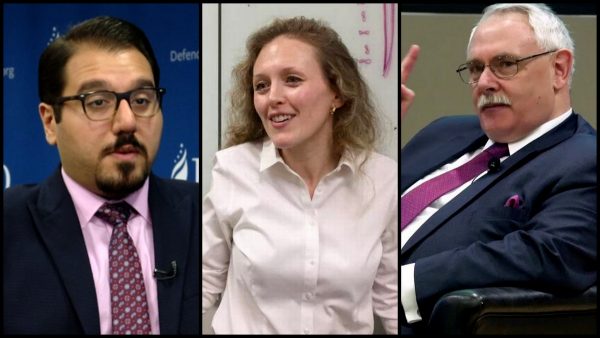
From left to right: Behnam Ben Taleblu, Priscilla Moriuchi, Nomran Roule
Another “expert” quoted in these articles was Norm Roule, who was introduced as “the former Iran manager for the office of the Director of National Intelligence.” Roule, who recently told the press that he believes that Iran “will muster its cyberforces in response” to U.S. sanctions, is a 34-year veteran of the CIA and, more importantly, a senior adviser to the group United Against Nuclear Iran (UANI).
UANI is a think tank stuffed to the brim with Iran hawks, counting among its current members former Senator Joseph Lieberman; Richard Dearlove, former head of the UK’s MI6; Tamir Pardo, former general director of Israel’s Mossad; and Jeb Bush. UANI was originally co-founded by Richard Holbrooke, John Bolton and Meir Dagan — another former general director of the Mossad. Thus, given their associations to organizations that have long promoted the destruction of the Iranian state, Roule’s analysis, much like Taleblu’s, can hardly be considered impartial or objective.
Self-isolated U.S. seeks a way out of the trap
The U.S.’ warning of an imminent Iranian cyber-threat in response to the U.S.’ decision to withdraw from the Joint Comprehensive Plan of Action (JCPOA), better known as the Iran nuclear deal, and its subsequent decision to reimpose harsh sanctions against the Islamic Republic, comes at a crucial time, as many key countries, including many important U.S. allies, have declined to follow the U.S.’ lead on isolating Iran and have even rejected it outright.
Indeed, as opposed to isolating Iran, the U.S. has become isolated itself, as E.U. countries have banned companies from complying with U.S. sanctions efforts and other key nations like China have refused to halt Iranian oil imports despite U.S. threats. However, were U.S. warnings of an “Iranian cyber-threat” to convince these countries, particularly Europe, that Iran was indeed on the offensive despite its desperate efforts to keep JCPOA alive, the U.S.’ isolation in terms of its Iran policy could well end.
The Iranian government seems to have caught on to the U.S.’ game but seemed to think that rather than simply being intended to intensify Washington’s isolation campaign, the fear mongering over “Iranian hackers” was aimed at justifying imminent U.S. aggression against Iran.
In a statement given to NBC by Alireza Miryousefi, spokeswoman for Iran’s UN delegation, she stated that “Iran has no intention of engaging in any kind of cyber war with the U.S.,” adding, “from our perspective, it’s more likely the U.S. wants the supposed suspicion of an attack as rationalization for a cyberattack against Iran.” Miryousefi went on to call the U.S. “the most belligerent cyber-attacker of any nation in the world, repeatedly attacking military and civilian targets across the world, including in Iran.”
Indeed, the U.S. famously targeted Iran’s civilian nuclear program with the Stuxnet virus it had jointly developed with Israel. It infected over 200,000 machines and destroyed around 20 percent of Iran’s nuclear centrifuges.
Perhaps unsurprisingly, even the media reports themselves hint that this is the case, stating that while “the U.S. has not yet decided whether it will retaliate in the event of an attack,” it is already preparing new sanctions to impose on the country whether or not an attack occurs and is also building “a case for its more confrontational stance” in a bid to convince its wary allies to join its aggressive Iran policy.
The reports also openly state that a “preemptive attack” against Iran is currently being debated by the Trump administration, but notes that officials are “divided” over the measure. However, given the increasing likelihood that Secretary of Defense James Mattis, who had supported JCPOA, is on the way out of the administration, the growing chorus of Iran war-hawks in the White House could soon make such “divisions” a thing of the past.
Whitney Webb is a staff writer for MintPress News and a contributor to Ben Swann’s Truth in Media. Her work has appeared on Global Research, the Ron Paul Institute and 21st Century Wire, among others. She has also made radio and TV appearances on RT and Sputnik. She currently lives with her family in southern Chile.
BBC bows to pressure from Israel and changes Gaza headline

Israel carried out air strikes in Gaza City on 9 August 2018 [Mahmoud Khattab/Apaimages]
MEMO | August 10, 2018
The BBC has once again come under sharp criticism over its coverage of violence perpetrated by Israel against the Palestinians. Critics called the BBC out over its bias after the broadcaster bowed to pressure from the Israeli Foreign Ministry and changed the headline of a news piece concerning Israeli air strikes on Gaza.
The BBC headline read: “Israeli air strikes ‘kill woman and baby’” for a news piece related to the killing of three Palestinians including a pregnant mother and toddler in Gaza on Wednesday night.
The headline attracted the attention of Israel’s Foreign Ministry and the Board of Deputies of British Jews, who is currently leading a bitter campaign against Labour leader Jeremy Corbyn over a definition of anti-Semitism that conflates criticism of Israel with racism against Jews.
Israel’s foreign ministry spokesman Emmanuel Nahshon shot the BBC down and demanded for the headline to be changed “IMMEDIATELY”:
.@BBCWorld this is a formal complaint by @IsraelMFA .This title is a deliberate misrepresentation of reality ( that’s the polite equivalent of “ this is a LIE”, if you don’t get it). Israelis were targeted by Hamas and IDF acts to protect them.Change it IMMEDIATELY!!! @IsraelMFA pic.twitter.com/pqjXuopXgO
— Emmanuel Nahshon (@EmmanuelNahshon) August 9, 2018
The Board of Deputies joined the act, denouncing the BBC headline as “appalling”. They said that they had lodged a complaint and encouraged others to do the same.
A short while after the complaints the BBC completely changed the headline: “Gaza air strikes ‘kill woman and child’ after rockets hit Israel.”
The dramatic change in headline caught the attention of social media users who were astonished by BBC’s capitulation to the dictates of a foreign state.
British commentator Owen Jones tweeted:
Wow. The Israeli Foreign Ministry demanded the BBC change their headline – which said Israeli air strikes “kill pregnant women and baby” – and the BBC did as they were told. Astonishing. https://t.co/CPc7SWE2Cn
— Owen Jones🌹 (@OwenJones84) August 9, 2018
Others pointed to the influence of the Israeli lobby in the UK citing the Al Jazeera documentary “The Lobby,” which exposed how the Israeli embassy was providing covert assistance to supposedly independent groups within the Labour Party, and led a campaign to remove not just Foreign Office Minister Sir Alan Duncan, but also Crispin Blunt MP, the chair of the Foreign Affairs Select Committee for their strong views on Israel. Many of these groups are now at the centre of the anti-Semitism row within the Labour Party.
“Looks like the influence of a foreign power on our political landscape and media never went away,” tweeted a social media user who also shared a video of Israeli embassy staff Shai Masot attempting to organise a takedown of British MPs sympathetic to the Palestinians and possibly hostile to the Israeli state.
Many responded with personal accounts to highlight the extent to which the BBC is bullied into taking a pro-Israel stance. A video clip of a famous study “Bad News from Israel” by the renowned Glasgow University Media Group resurfaced. Its author Greg Philo can be heard saying:
“I spent time with BBC journalists and a senior producer said to me, ‘We wait in fear for the phone call from the Israelis,’” referring to the trepidation felt by BBC editors when publishing negative stories about Israel.
It is unusual for the BBC to publish a story about Israeli aggression using headlines that doesn’t make excuses. On this occasion the fact that the story appeared in BBC World perhaps explains why the headline may not have gone through the rigorous vetting that many suspect stories about Israel are subjected to.
A BBC spokesperson admitted that “although the original headline was not factually incorrect, we updated it to add more context to the story”.
Meet Wikipedia Founder Jimmy Wales: Ex Porn Peddler Paid by ‘Israel’ to Spread Zionist Propaganda
Empire Strikes Black | August 10, 2018
In the midst of the ongoing ‘Israeli’ government campaign against Jeremy Corbyn,(1) Wikipedia founder Jimmy Wales has entered the fray launching an inexplicable attack on the Labour leader. His tweet posted on the 9th of August 2018 lambastes Jeremy Corbyn for apparently failing to condemn Hamas rockets.
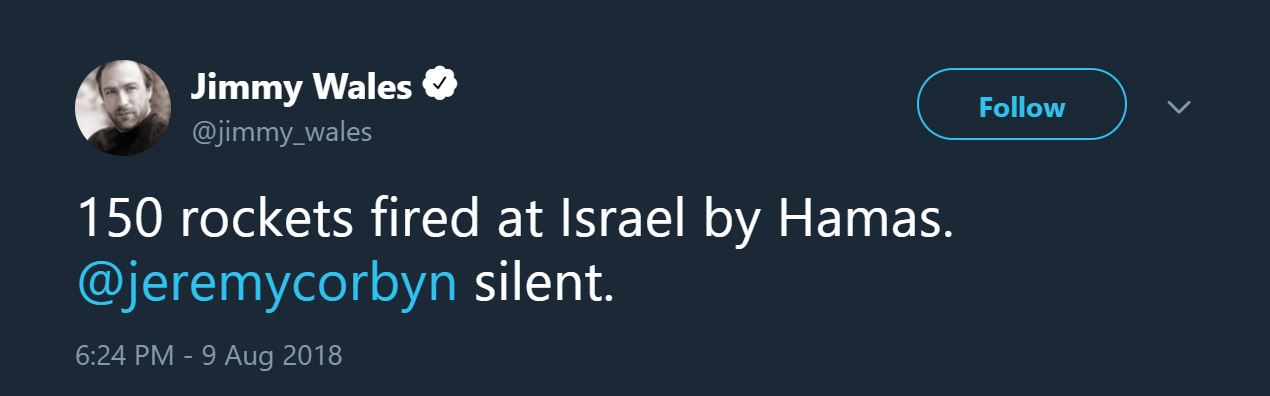
Wales tweets: 150 rockets fired at Israel by Hamas. @jeremycorbyn silent
To those well-versed on the history of Palestine this statement rightfully seems absurd and somewhat topsy-turvy. How can an occupied, brutalised and imprisoned people be castigated for merely defending themselves? While ‘Israel’ occupies land that does not belong to it – including Gaza which has no semblance of freedom with its borders and airspace locked down by the occupying regime which routinely commits bloody massacres with huge civilian death tolls – it absolutely must distort the facts in order to shape public opinion in its favour. ‘Israel’ committed and commits every day the causal acts of violence of ethnically cleansing Palestine and keeping the natives imprisoned, occupied and disenfranchised. The ‘Israel is acting in self-defence’ trope is then in fact the only form of rhetorical recourse that the Zionists can resort to in order to justify the historical and ongoing crimes against humanity committed every day in Palestine.
Jimmy Wales: Porn-Peddler-cum-Paid-Hasbara-Agent
In a revelation that will no-doubt raise eyebrows amongst Wikipedia users, in 1996 Jimmy Wales co-founded an online Internet portal called Bomis which sold porn and explicit material to users. The following, actually taken from the Wikipedia article for Bomis(2) adds context:
Bomis became successful after focusing on X-rated media. “Bomis Babes” was devoted to erotic images; the “Bomis Babe Report” featured adult pictures. Bomis Premium, available for an additional fee, provided explicit material. “The Babe Engine” helped users find erotic content through a web search engine. The advertising director for Bomis noted that 99 percent of queries on the site were for nude women.
Even the New York Times reports that the creation of Wikipedia was financed by Wales’ earlier porn venture,(3) whereby he would literally hand deliver cheques from Bomis porn revenues in order to keep Wikipedia’s servers running. On a perhaps related but definitely unsurprising note, the same New York Times article also reveals that via his wife, Jimmy Wales is very closely connected to Tony Blair(3) who even attended their wedding.
Though peddling porn may not be illegal, at the very least it sheds light on the true character of this man. What heroic agent of free information exchange makes money from selling pornography?
Wales has close links to ‘Israel’ and was awarded $1 million ‘Israeli’ prize for his services
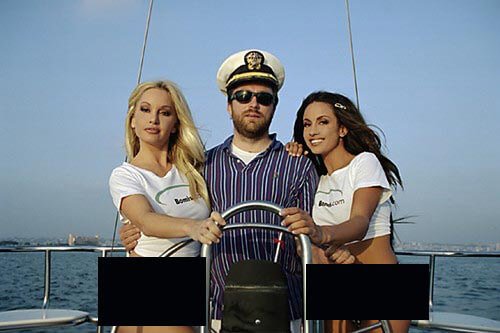
Wikipedia founder Jimmy Wales poses in a sleazy Bomis advertisement
In 2015 Jimmy Wales told The Times of Israel (4) that he had visited ‘more than ten times’, suggesting links to the Zionist enclave. He even told the Jewish Telegraphic Agency,(4) “I’m a strong supporter of Israel, so I don’t listen to those critics.” Laughably Wales cites ‘women’s rights’ as one of his reasons(4) for his support of the illegitimate Zionist entity. This is a statement that rings as hollow as a drum considering this man made his money in an industry that degrades women and enslaves vulnerable girls.
Wales’ numerous visits to ‘Israel’ during this time period must be understood in the wider context of Zionist information warfare. In 2010 the UK Guardian reported that Zionist groups were establishing Wikipedia editing courses(5) in order to sway Wikipedia entries in the Zionist regime’s favour. Additionally in 2012 The National Union of Israeli Students (NUIS) launched a program(6) to pay Israeli university students $2,000 to spread pro-‘Israel’ propaganda online for 5 hours per week.
Moreover, in the same year (2015) Mr. Wales was awarded $1 million by the ‘Israeli’ Dan David Foundation(7) after being selected by the prize committee for spearheading what they referred to as ‘the information revolution’.
The Electronic Intifada reports that the ‘Israeli’ government itself has been implicated in running the information war against Jeremy Corbyn. As part of this campaign, the ‘Israeli’ government has used its Act.IL software application to issue a mission for social media users to post negative comments against Jeremy Corbyn(1) suggesting he is an ‘anti-Semite’.
Let’s bring things full circle. Not only is Jimmy Wales a man of highly questionable moral character. Wales has close links to the Zionist regime, having visited it numerous times during the very same time period that Zionist groups were running Wikipedia editing courses and the ‘Israeli’ government was literally paying people to spread Zionist propaganda online. Wales’ efforts have culminated in him being awarded $1m by an ‘Israeli’ charitable organisation for his efforts in the ‘information revolution’. And now, interestingly, Mr. Wales is taking part in the very same information warfare campaign against Jeremy Corbyn that the ‘Israeli’ government has itself launched.
What is most alarming here is not merely Wales’ questionable character – having peddled porn and sleaze to make money – but the alarming indications that he could in fact be a de facto paid agent of the Zionist regime.
Notes
(1) ‘Israel running campaign against Jeremy Corbyn’ – The Electronic Intifada, 7 August 2018.
(2) ‘Bomis’ Wikipedia.com entry as of 10 August 2018.
(3) ‘Jimmy Wales Is Not An Internet Billionaire’ – The New York Times, 27 June 2013.
(4) ‘Wikipedia founder Jimmy Wales likes Israel but stays neutral’ – The Times of Israel, 19 May 2015.
(5) ‘Wikipedia editing courses launched by Zionist groups’ – The Guardian, 18 August 2010.
(6) ‘Israeli students to get $2,000 to spread state propaganda on Facebook’ – The Electronic Intifada, 4 January 2012.
(7) ‘Wiki founder wins $1m Israeli prize’ – The Times of Israel, 10 February 2015.
Social Media Users in Scotland Planning on Boycotting BBC
Sputnik – August 9, 2018
Following the removal of the prominent Scottish independence blogger, Wings Over Scotland, social media users in Scotland are preparing for an outright boycott of the BBC. Earlier Sputnik spoke to the political analyst, Joe McGregor about this story.
Sputnik: So Joe can you explain a little bit about why people are planning on boycotting the BBC? Why are such a large proportion of Scots so disenfranchised with the BBC?
Joe McGregor: I’m deeply disenfranchised with that because it seems like Scotland don’t have a voice on the channel whatsoever – it’s very Westminster-centric, very England-centric. I don’t mean that as coming from the point of view that as a Scotsman I should be opposed… not at all. It seems to be that the BBC likes to show only the worst side of Scotland, or not give the SNP (Scottish National Party) a voice, when they are national broadcaster.
Sputnik: Does this have effect on Scottish political issues such as campaigns for Scottish independence and if so what kind of effect?
Joe McGregor: Eventually you become used to it. Say for the youth of Scotland that are coming through and they’re only having that information they would be guided to believing that information thinking that having nuclear weapons and having the nuclear base is a great thing. Scotland should be proud of having that there but they don’t show other side things, with nuclear apparatus being driven through city centers like Glasgow. If there was to be a problem there, it would wipe out most of central Scotland. Why does Scotland have to house that when Scotland doesn’t want to house that and why does the BBC not show that, that Scotland isn’t with that? They only tend to say ‘If it wasn’t there, then so many people would be out of work’ and that the local businesses wouldn’t have the customs of the people who work there – which I find ridiculous.
Sputnik: Is this boycott anti-English and what would you say to critics who suggest that it is?
Joe McGregor: It’s not anti-English, its anti-BBC. If the BBC was to give Scotland a fair crack of the whip and report the SNP are doing great things in Scotland and report on the fact that people aren’t happy having nuclear weapons on their doorstep, I think you would find that people don’t think its anti-English, its simply anti-BBC.
Sputnik: What would you like to see from the BBC that would improve the image of the broadcaster in your eyes?
Joe McGregor: I would just like to see every nation in the UK getting a fair crack of the whip. It’s not just Scottish issues; there’s Welsh issues, Northern Ireland issues… it’s not just Westminster-centric issues, it’s not like Westminster is big brother and its do what you say and everything will be ok and you know what, keep drinking beer because that will nullify any of the effects that may occur.
See also:
BBC Was in Bed With the Government to Flush Out ‘Subversives’ – Archives
Bjorn Lomborg: ‘Stop these silly, undocumented claims of ever-increasing fire’ Claims ‘based on anecdotes, not data’ – Reality is Global & U.S. fires declining
By Bjørn Lomborg · August 6 2018
Could we please stop with the misleading fire stories?
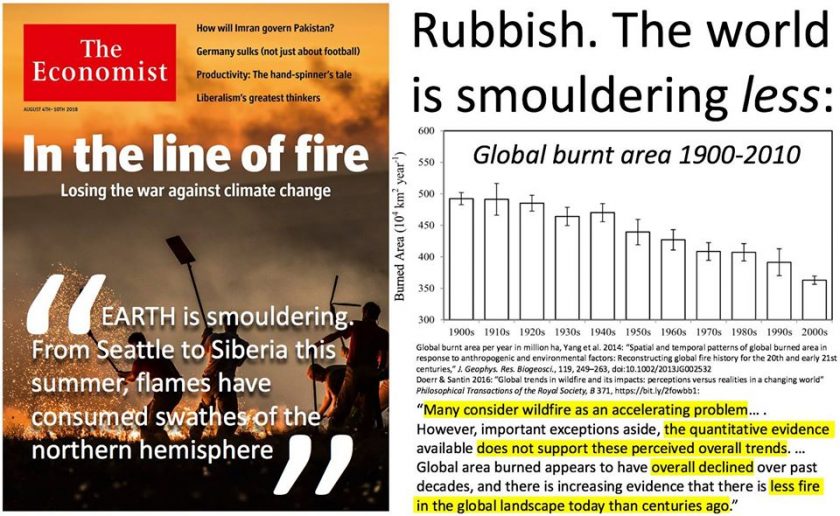
The Economist cover story, like so many other stories these last weeks, claim that forest fires are exceptional and record-breaking: “EARTH is smoldering. From Seattle to Siberia this summer, flames have consumed swathes of the northern hemisphere”
This is based on anecdotes, not data.
As I’ve shown in previous days, the US burnt area was much higher in the early part of last century, and the EU burnt area has declined by half over the past 36 years.
So: No, the US is not smoldering more – it is smoldering much less than it used to in the first part of the 20th century.
And no, the EU is not smoldering more – it is smoldering much less over the past 36 years.
Let’s finally look at the global perspective. While many of these fire scare stories are based on news from the US and the EU, the Economist claim was explicitly global.
Yet, the data does not support the argument that things are burning more and more.
The graph shows the estimated area burnt globally per year from 1900-2010. And it shows a steady decline.
It is from the article “Spatial and temporal patterns of global burned area in response to anthropogenic and environmental factors: Reconstructing global fire history for the 20th and early 21st centuries” One important point is to recognize that there is absolutely not enough data to do this only based on reported burning.
This is one of the reasons I started off with the US (where we have solid (if likely under-reported) data from 1926) and the EU. But clearly, the evidence for the global trend is unmistakable.
We see a similar pattern from the 2018 Nature article “Reduction in global area burned and wildfire emissions since 1930s enhances carbon uptake by land” which (as the title suggests, finds a strong decline in area burnt since 1930 (figure 2).
We also see declining area burnt from 1900-2000 from the article “Human impacts on 20th century fire dynamics and implications for global carbon and water trajectories”, figure 4b.
In a very recommendable (and freely available) overview article “Global trends in wildfire and its impacts: perceptions versus realities in a changing world” they clearly write that people (like the journalist at the Economist ) who believe there is more fire now, that is worse and have higher impact, are likely wrong:
“Many consider wildfire as an accelerating problem, with widely held perceptions both in the media and scientific papers of increasing fire occurrence, severity and resulting losses. However, important exceptions aside, the quantitative evidence available does not support these perceived overall trends. Instead, global area burned appears to have overall declined over past decades, and there is increasing evidence that there is less fire in the global landscape today than centuries ago.”
Beyond better fire prevention an important reason might be that more people and higher population densities perhaps surprisingly means *less* fire. The paper “Impact of human population density on fire frequency at the global scale” shows that “at the global scale, the impact of increasing population density is mainly to reduce fire frequency.”
So: Stop these silly, undocumented claims of ever-increasing fire, please.
Sources:
Graph from “Spatial and temporal patterns of global burned area in response to anthropogenic and environmental factors: Reconstructing global fire history for the 20th and early 21st centuries” https://agupubs.onlinelibrary.wiley.com/…/10.1…/2013JG002532.
“Reduction in global area burned and wildfire emissions since 1930s enhances carbon uptake by land” https://www.nature.com/articles/s41467-018-03838-0
“Human impacts on 20th century fire dynamics and implications for global carbon and water trajectories” https://www.sciencedirect.com/…/artic…/pii/S0921818117303910
“Global trends in wildfire and its impacts: perceptions versus realities in a changing world” http://rstb.royalsocietypublishing.org/cont…/…/1696/20150345 (not embargoed)
“Impact of human population density on fire frequency at the global scale.” https://www.biogeosciences.net/11/1085/2014/
US fire data: https://www.facebook.com/…/a.2217582089…/10157044699208968/… and additional data set here: https://www.facebook.com/bjornlomb…/posts/10157044718363968…
EU fire data: https://www.facebook.com/…/a.2217582089…/10157047962983968/…
A Four Person NATO-Funded Team Advises Facebook On Flagging “Propaganda”
By Tyler Durden | Zero Hedge | August 7, 2018
This is not at all comforting: during a week that’s witnessed Alex Jones’ social media accounts taken down by Facebook, Apple, Spotify and Google, and what appears to be a growing crackdown against alternative media figures including several prominent Libertarians, notably the Ron Paul Institute director, and the Scott Horton Show, who found their Twitter accounts suspended — we learn that the Atlantic Council is directly advising Facebook on identifying and removing “foreign interference” on the popular platform.
While the initiative was initially revealed last May through an official Facebook media release, more details of the controversial think tank’s role have been revealed.
Supposedly the whole partnership is aimed at bringing more objectivity and neutrality to the process of rooting out fake accounts that pose the threat of being operated by nefarious foreign states.
And yet as a new Reuters report confirms, Facebook is now itself a top donor to the Atlantic Council, alongside Western governments, Gulf autocratic regimes, NATO, various branches of the US military, and a number of major defense contractors and corporations.

What’s more is that the team of four total individuals running the Atlantic Council’s Digital Forensic Research Lab (DFR Lab) is headed by a former National Security Council advisor for the last four years of the Obama administration, Graham Brookie, who is also its founder.
Apparently the group’s work has already been instrumental in Facebook taking action against over two dozen “suspicious pages” flagged potential foreign actors such as Russia. According to Reuters:
Facebook is using the group to enhance its investigations of foreign interference. Last week, the company said it took down 32 suspicious pages and accounts that purported to be run by leftists and minority activists. While some U.S. officials said they were likely the work of Russian agents, Facebook said it did not know for sure.
This is indeed the shocking key phrase included in the report:“Facebook said it did not know for sure.” And yet the accounts were removed anyway.
The Facebook-Atlantic Council alliance reportedly springs from the social media giant’s finding itself desperate for outside “neutral” help after a swell of public criticism, mostly issuing from congressional leaders and prominent media pundits, for supposedly allowing Russian propaganda accounts to operate ahead of the 2016 elections.
The suspiciously simultaneous censorship of Infowars by Google, Apple, Facebook came just one week after U.S. Senate intelligence committee hawk Mark Warner (D) circulated this policy paper threatening new regulation against those same media companies: https://t.co/8kLI1GAedM pic.twitter.com/Qdo0frJbPJ
— WikiLeaks (@wikileaks) August 7, 2018
And in perhaps the most chilling line of the entire report, Reuters says, “But the lab and Atlantic Council bring geopolitical expertise and allow Facebook to distance itself from sensitive pronouncements.” This is ostensibly to defuse any potential conflict of interest arising as Facebook seems a bigger presence in emerging foreign markets.
Facebook’s chief security officer Alex Stamos recently told reporters, “Companies like ours don’t have the necessary information to evaluate the relationship between political motivations that we infer about an adversary and the political goals of a nation-state.” He explained further that Facebook would collect suspicious digital evidence and submit it to “researchers and authorities”.
Since at least May when the relationship was first announced, the DFR Lab has been key to this process of verifying what constitutes foreign interference or nefarious state propaganda.
But here’s the kicker. Reuters writes of the DFR Lab’s funding in the following:
Facebook donated an undisclosed amount to the lab in May that was enough, said Graham Brookie, who runs the lab, to vault the company to the top of the Atlantic Council’s donor list, alongside the British government.
Facebook employees said privately over the past several months that Chief Executive Mark Zuckerberg wants to outsource many of the most sensitive political decisions, leaving fact-checking to media groups and geopolitics to think tanks.
Facebook has defended the process as part of ensuring that it remains politically neutral, yet clearly the Atlantic Council itself is hardly neutral, as a quick perusal of its top donors indicates.

Among the DFR Labs partners include UK-based Bellingcat, which has in the past claimed “proof” that Assad gassed civilians based on analyzing YouTube videos and Google Earth. And top donors include various branches of the US military, Gulf sates like the UAE, and notably, NATO.
The Atlantic Council has frequently called for things like increased military engagement in Syria, militarily confronting the “Russian threat” in Eastern Europe, and now is advocating for Ukraine and Georgia to be allowed entry into NATO while calling for general territorial expansion of the Western military alliance.
Further it has advocated on behalf of one of its previous funders, Turkish dictator Recep Tayyip Erdoğan and gave a “Distinguished International Leadership” award to George W. Bush, to name but a few actions of the think tank that has been given authorization to flag citizens’ Facebook pages for possible foreign influence and propaganda.
Quite disturbingly, this is Mark Zuckerberg’s outside “geopolitical expertise” he’s been seeking.
Featured Video
Seyed M. Marandi: US-Iran War Inevitable: Kuwait and Bahrain May Fall
or go to
Aletho News Archives – Video-Images
From the Archives
Oil and the Israel Lobby
Reknowned economist M. Shahid Alam offers this excellent critique of Noam Chomsky’s defective analysis of the relative influence of Oil versus the Israel lobby over US foreign policy: … continue
Blog Roll
 Aletho News
- ICC ignored ‘very well-documented’ NATO crimes – ex-Libyan minister
- SNSC secretary dismisses US response to Iran’s conditions as ‘inadequate’
- Sanaa says Taiz roads open, secure for residents, warns Saudi forces
- Iraqi resistance group urges Saudi leadership to admit defeat, lift Yemen siege
- Trump’s Retreat: How Al-Aqsa Flood Took Down the US Empire
- Israel’s Military Actions in Lebanon Grossly Violate International Law — Lavrov
- Seyed M. Marandi: US-Iran War Inevitable: Kuwait and Bahrain May Fall
- Leaders Condemn Ansarallah Attack on Saudi Arabia While Ignoring Illegal War Against Yemen
- Leaked: Britain’s Covert Iraqi Psyops Network
- Yemeni Armed Forces Warn Airlines Against Using Saudi Airports, Exempt Mecca and Medina
- If Americans Knew
- After Oct 7, IDF policy allowed civilian casualties for even the lowest-ranking targets
- Israel’s Destruction of Southern Lebanon Intensified After the Cease-Fire
- The Last-Minute Decision That Gave Israel Its Name
- The American Conservative: How Trump Made the World Go Nuclear
- Meet the US generals and admirals advancing Israeli policy
- Opinion: Why news organizations should boycott Israel
- The Israeli witch hunt of Sami Abu Shehadeh exposes the lie of the ‘Jewish and democratic’ state
- No state has a ‘right’ to exist – least of all Israel
- Testimonies about Gaza’s civilian death toll expose Israel’s atrocities – Daily Update
- How Israel Conquered the Latin American Right
- No Tricks Zone
- New Study Suggests Large Regions Of The Pacific Ocean Have Been Cooling For The Last 80 Years
- Germany’s Green Energy Debacle: High Energy Costs Force Kahla Porzellan to Close After 182 Years!
- New Study: 50 Years Of The Most Aggressive ‘Net Zero’ Policies Can Only Affect The Global Climate By 0.03°C
- US September “Heat” Was No Record…Many Records Set Decades Ago
- Latest European Green Energy Debacle; Portugal’s Largest Flagship Solar Park Insolvent!
- Green Energy Debacle: German Expert Professor Fritz Vahrenholt Warns Of Severe Economic And Social Consequences
- Two More Paleo Reconstructions Affirm Meters-Higher Sea Levels Across Ireland, Brazil 7000-6000 Years Ago
- New Study: Earth And Venus Surface Warmth Largely Explained By Convection And Lapse Rate, Not CO2 Or Radiation
- 2025 Nature Paper Claiming Worsening Global Drought Gets RETRACTED …Heavily Flawed
- New Study: ‘Global Drought Shows No Detectable Recent Acceleration Under Climate Warming’

