Will the Real John Brennan Please Stand Up?
When will he answer for his war crimes?

By Philip Giraldi • Unz Review • August 21, 2018
The battle between many former intelligence chiefs and the White House is becoming a gift that keeps on giving to the mass media, which is characteristically deeply immersed in Trump derangement syndrome in attacking the president for his having stripped former CIA Director John Brennan of his security clearance. One of the most ludicrous claims, cited in the Washington Post on Sunday, was that the Trump move was intended to “stifle free speech.” While I am quite prepared to believe a lot of things about the serial maladroit moves and explanations coming out of the White House, how one equates removing Brennan’s security clearance to compromising his ability to speak freely escapes me. Indeed, Brennan has been speaking out with his usual vitriol nearly everywhere in the media ever since he lost the clearance, rather suggesting that his loss has given him a platform which has actually served to enhance his ability to speak his mind. He should thank Donald Trump for that.
Indeed, Brennan’s retaining a Top Secret code word clearance had nothing to do with free speech and everything to do with enhancing his market value for those poor sods who actually pay him to mouth off as an “expert” on television and in the newspapers. Are you listening New York Times and NBC? Brennan’s clearance did not mean that he had any real insight into current intelligence on anything, having lost that access when he left his job with the government. It only meant that he could sound authoritative and well informed by relying on his former status, enabling him to con you media folks out of your money on a recurrent basis.
It has sometimes been suggested that free speech is best exercised when it is somehow connected to the brain’s prefrontal lobes, enabling some thought process before the words come out of the mouth. It might be argued that Brennan has been remarkably deficient in that area, which is possibly why he looks so angry in all his photographs. Even John Brennan’s supporters are shy about defending the former CIA Director’s more extravagant claims. James Clapper, the ex-Director of National Intelligence, has described Brennan’s comments as “overheated.”
The John Brennan backstory is important. In 2016 he was Barack Obama’s CIA Director and also simultaneously working quite hard to help Hillary Clinton become president, which some might regard at a minimum as a conflict of interest. After Clinton lost, he continued his attacks on Trump. He apparently played a part in the notoriously salacious Steele dossier, which was surfaced in January just before the inauguration. The dossier included unverifiable information and was maliciously promoted by Brennan and others in the intelligence and law enforcement community. And even after Trump assumed office, Brennan continued to prove to be unrelenting.
In May 2017, Brennan testified before Congress that during the 2016 campaign he had “… encountered and [was] aware of information and intelligence that revealed contacts and interactions between Russian officials and U.S. persons involved in the Trump campaign that I was concerned about because of known Russian efforts to suborn such individuals. It raised questions in my mind whether or not Russia was able to gain the co-operation of those individuals.” Politico was also in on the chase and picked up on Brennan’s bombshell in an article entitled Brennan: Russia may have successfully recruited Trump campaign aides.
What Brennan did not describe, because it was “classified,” was how he developed the information regarding the Trump campaign in the first place. We know from Politico and other sources that it derived from foreign intelligence services, including the British, Dutch and Estonians, and there has to be a strong suspicion that the forwarding of at least some of that information might have been sought or possibly inspired by Brennan unofficially in the first place. But whatever the provenance of the intelligence, it is clear that Brennan then used that information to request an FBI investigation into a possible Russian operation directed against potential key advisers if Trump were to somehow get nominated and elected, which admittedly was a long shot at the time. That is how Russiagate began.
Since that time, Brennan has tweeted President Donald Trump, asserting that “When the full extent of your venality, moral turpitude, and political corruption becomes known, you will take your rightful place as a disgraced demagogue in the dustbin of history.” He has attacked the president for congratulating President Vladimir Putin over his victory in Russian national elections. He said that the U.S. President is “wholly in the pocket of Putin,” definitely “afraid of the president of Russia” and that the Kremlin “may have something on him personally. The fact that he has had this fawning attitude toward Mr. Putin … continues to say to me that he does have something to fear and something very serious to fear.” And he then administered what might be considered the coup de main, saying that the president should be impeached for “treasonous” behavior after Trump stood next to President Vladimir V. Putin of Russia at a news conference in Finland and cast doubt on the conclusion of the intelligence agencies that Moscow interfered in the 2016 presidential election.
Trump’s decision to pull Brennan’s clearance attracted an immediate tweeted response from the ex-CIA Director: “This action is part of a broader effort by Mr. Trump to suppress freedom of speech & punish critics. It should gravely worry all Americans, including intelligence professionals, about the cost of speaking out.” He also added, in a New York Times op-ed, that “Mr. Trump’s claims of no collusion [with Russia] are, in a word, hogwash,” though he provided no evidence to support his claim and failed to explain how exactly one washes a hog. There has subsequently been an avalanche of suitably angry Brennan appearances all over the Sunday talk shows, a development that will undoubtedly continue for the immediate future.
The claim that Trump is a Russian agent is not a new one, having also been made repeatedly by Brennan CIA associate the grim and inscrutable Michael Morell, who flaunts his insider expertise both at The Times and on CBS. Regarding both gentlemen, one might note that it is an easy mark to allege something sensational that you don’t have to prove, but the claim nevertheless constitutes a very serious assertion of criminal behavior that might well meet the Constitutional standard for treason, which comes with a death penalty. It is notable that in spite of the gravity of the charge, Brennan and Morell have been either unable or unwilling to substantiate it in any detail. Even a usually tone-deaf Congress has noted that there is a problem with Brennan’s credibility on the issue, not to mention his integrity. Richard Burr, Chairman of the Senate Intelligence Committee, has observed that,
“Director Brennan’s recent statements purport to know as fact that the Trump campaign colluded with a foreign power. If Director Brennan’s statement is based on intelligence he received while still leading the CIA, why didn’t he include it in the Intelligence Community Assessment released in 2017? If his statement is based on intelligence he has seen since leaving office, it constitutes an intelligence breach. If he has some other personal knowledge of or evidence of collusion, it should be disclosed to the Special Counsel, not The New York Times.”
This behavior by Brennan is no surprise to those who know him and have worked with him. An ambitious crawler with a checkered history, he was strongly disliked by his peers at CIA, largely because of his lack of any sense of restraint and his reputation for over-the-top vindictiveness. He notoriously flunked out of spy training at the Agency, forcing him to instead become an analyst, so he went after the Clandestine Service in his reorganization of CIA after he became Director.
John Brennan has always been a failure as an intelligence officer even as he successfully climbed the promotion ladder. He was the CIA’s Chief of Station (COS) in Saudi Arabia when the Khobar Towers were bombed, killing 19 Americans, a disaster which he incorrectly blamed on the Iranians. He was deputy executive director on 9/11 and was complicit in that intelligence failure. He subsequently served as CIA chief of staff when his boss George Tenet concocted phony stories about Iraqi weapons of mass destruction. He also approved of the Agency torture and rendition programs and was complicit in the destruction of Libya as well as the attempt to do the same to Syria.
Barack Obama wanted Brennan to be his CIA Director but his record with the Agency torture and rendition programs made approval by the Senate problematical. Instead, he became the president’s homeland security advisor and deputy national security advisor for counterterrorism, where he did even more damage, expanding the parameters of the death by drone operations and sitting down with the POTUS for the Tuesday morning counterterrorism sessions spent refining the kill list of American citizens.
After Obama was re-elected in 2012, he was able to overcome objections and appoint Brennan CIA Director. Conniving as ever, Brennan then ordered the Agency to read the communications of the congressional committee then engaged in investigating CIA torture, the very program that he had been complicit in. Brennan then denied to Congress under oath that any such intramural spying had occurred, afterwards apologizing when the truth came out. Moon of Alabama characterizes him as “… always ruthless, incompetent and dishonest.”
So the real John Brennan emerges as an unlikely standard bearer for the First Amendment. He has an awful lot of baggage and is far from the innocent victim of a madman Trump that is being portrayed in much of the media. Indeed, he should be answerable for torture, renditions, extrajudicial killing of foreigners and targeted murder of American citizens. Those constitute war crimes and in the not too distant past Japanese and German officers were hung for such behavior. One has to hope that Brennan’s day of judgment will eventually come and he will have to pay for his multiple crimes against humanity.
Western media frames jihadist-controlled Idlib as peaceful enclave under assault by Assad
RT | August 21, 2018
Western media reports denouncing the Syrian Army’s offensive to retake Idlib conveniently fail to mention that the area is controlled by warring jihadist groups that were designated as terrorists by the US State Department.
Idlib province – located in northwest Syria – is the last major jihadist stronghold in the country, but you would never know it if you got your news exclusively from CNN.
As RT’s Ilya Petrenko explains, some Western media reports have attempted to portray Idlib as a peaceful enclave under assault by the Syrian Army – while omitting the fact that the region is ruled by extremist groups such as Tahrir al-Sham (better known as Al-Nusra, or Al-Qaeda in Syria), Ahrar al-Sham, Jaysh al-Islam, and Nour al-Din al-Zenki. These groups have been accused of, among other crimes, beheading children, abductions, torture, and attacks on journalists and aid workers. Jayash al-Islam even once paraded caged hostages through neighborhoods that it once controlled – in hopes of using the civilians as human shields.
Several of the groups currently holed up in Idlib were even placed on the US terrorist list by then-Secretary of State John Kerry.
The Western media tactic of painting a jihadist stronghold as a bastion of legitimate resistance under siege by Assad was similarly deployed during the campaign to liberate East Aleppo, with breathless reports about bombed civilians, carefully ignoring the fact that designated terrorist groups – not “moderate rebels” – controlled the city.
And as the Syrian Army advances on Idlib, the media is once again starting to howl. Sky News even boasted of having “exclusive access to Idlib province,” describing the region as “the final rebel-held area of the country.”
However, it appears that the narrative is already starting to crumble. The disclosure sparked considerable pushback on social media, with some commenters openly speculating about how Sky News was granted “exclusive access” to an area controlled by warring jihadist groups.
In another setback to the “besieged moderate rebel” narrative, the UK is cutting its funding for rebel groups in Syria, with The Times of London noting that the decision was made in light of the fact that the war was coming to an end and remaining rebel areas had “fallen into the grip of jihadists.”
In Monsters We Trust: US Mainstream Media No Friend of the American People
By Robert BRIDGE | Strategic Culture Foundation | 20.08.2018
Over the course of his turbulent presidency, Donald Trump has accused various media companies, with special attention reserved for CNN, as being purveyors of ‘fake news.’ In one early-morning Tweet last year, he slammed the “FAKE NEWS media” as the “enemy of the people.”
This week, over 300 US newspapers ran editorials on the same day – an event in itself that points to some high degree of collusion and groupthink – denouncing Trump’s insensitive portrayal of them, as if the notion that journalists were not in the same sleaze league as lawyers, politicians and professional con artists never crossed anyone’s mind before. Even the peace-loving Mahatma Gandhi recommended “equality for everyone except reporters and photographers.”
But is the MSM really an “enemy of the people?”
 First, it cannot be denied that the US media, taken in all its wholesomeness, has been overwhelmingly consistent in its ‘style’ of reporting on Donald Trump, the 45th POTUS. And by consistent I mean unprecedentedly critical, misleading and outright aggressive in its guerilla coverage of him. If one is not convinced by the gloom-and-doom Trump stories featured daily in the Yahoo News feed, then a study by the Media Research Center (MRC) should do the job. From January 1 through April 30, evening news coverage of the US leader – courtesy of ABC, CBS and NBC – were 90 percent negative, which is pretty much the same incredible average revealed by MRC one year earlier.
The study looked at every one of the 1,065 network evening news stories about Trump and his administration during the first four months of 2018. Total negative news time devoted to Trump: 1,774 minutes, or about one-third of all evening news airtime. That’s pretty much the definition of a circle jerk.
“Nearly two-fifths (39%) of the TV coverage we examined focused on Trump scandals and controversies, while 45 percent was devoted to various policy issues,” MRC wrote in its report.
Meanwhile, the farcical Russia ‘collusion’ story was consistently the main grabber — clocking in at 321 minutes, or nearly one-fifth of all Trump coverage. Of the 598 statements MRC calculated about Trump’s personal scandals, virtually all of them (579, or 97%) came out of the media wash cycle tarred and feathered.
If this represents an orchestrated attack on the Commander-in-Chief, and in light of those numbers it would be difficult to argue it isn’t, the strategy appears to be falling flat. Despite, or precisely because of, the avalanche of negative media coverage, Trump’s popularity rating smashed the 50 percent ceiling in early August and continues to remain high.
In Monsters We Trust
Although it can be safely stated that the MSM is an entrenched and relentless enemy of Donald Trump, that doesn’t necessarily mean it’s an “enemy of the American people,” as Trump argues it is. Let’s be a bit more diplomatic and say it isn’t our friend.
One yard stick for proving the claim is to consider the steadily mounting concentration of media holdings. In 1983, 90 percent of US media were controlled by 50 companies; today, 90 percent is controlled by the Big Six (AT&T, Comcast, The Walt Disney Company, 21st Century Fox, CBS and Viacom control the spoken and printed word from sea to shining sea).Although many people are aware of the monopolistic tendencies of the US mainstream media, it’s important to understand the level of concentration. It means the vast majority of everything you see and hear on any electronic device or printed publication is ‘democratically’ controlled by six average white guys and their shareholders.
However, keeping track of who owns what these days is practically impossible since the dozens of subsidiary companies that fall under each main company are themselves fiefdoms, each with their own separate holdings. In fact, the already short ‘Big Six’ list is already dated, since National Amusements, Inc. has gobbled up both Viacom and CBS, while 21st Century Fox merged with Disney this year. As for the 350 US newspapers that penned tortured editorials decrying Trump’s critical opinion of them, many of those ‘local’ publications get their marching orders from either the Hearst Communications or the Gannett Company on the East Coast.
Now, with this sort of massive power and influence lying around like dynamite, it stands to reason, or unreason, that the corporate and political worlds will succumb to the law of attraction and gravitation, forging powerful and impregnable relationships. It’s no secret that the politicians, our so-called ‘public servants,’ are mostly in the game to make a fast buck, while the corporations, desperate for ‘democratic representation’ to control regulation and market share, have an inexhaustible source of funds to secure it. Naturally, this oligarchical system precludes any sort of democratic participation from the average person on the street, who thinks just because he remembers to yank a lever once every several years he is somehow invested in the multibillion-dollar franchise.
As far as media corporations being ‘private enterprises’ and therefore free to demolish the freedom of speech (even censoring major media players, like Infowars, simply because they whistle to a different political tune), that is quickly becoming revealed as nothing more than corporate cover for state-sponsored machinations.
“In a corporatist system of government, wherein there is no meaningful separation between corporate power and state power, corporate censorship is state censorship,” writes Caitlin Johnstone. “Because legalized bribery in the form of corporate lobbying and campaign donations has given wealthy Americans the ability to control the US government’s policy and behavior while ordinary Americans have no effective influence whatsoever, the US unquestionably has a corporatist system of government.”
Meanwhile, it cannot be denied, from the perspective of an impartial observer, that the mainstream media is nearly always positioned to promote the government narrative on any number of significant issues. From the media’s unanimous and uncritical clamoring that Osama bin Laden was responsible for 9/11 (even the FBI has admitted it has no “hard evidence” that bin Laden carried out the attacks on the World Trade Center and the Pentagon), to its gung-ho enthusiasm for the 2003 Iraq War, to the sycophantic cheerleading for a war in Syria, the examples of media toeing the government line are legion. And if US intel is in bed with Hollywood you can be damn sure they’re spending time in the MSM whorehouse as well.
Is it any surprise, then, that public trust in the US media is reaching all-time lows, while news consumers are increasingly looking to alternative news sites – themselves under relentless attack – to get some semblance of the elusive truth, which is the God-given right of any man? Truth is our due, and we should demand nothing less.
As Thomas Paine reminded the world in the face of a different foe: “Tyranny, like hell, is not easily conquered; yet we have this consolation with us, that the harder the conflict, the more glorious the triumph. What we obtain too cheap, we esteem too lightly: it is dearness only that gives everything its value.”
SYRIA: The Emerging Reality of the U.S Coalition Regime Change War – On the Ground Reporting

Life and food return to Douma after liberation by SAA from Saudi-backed, UK-promoted Jaish Al Islam terrorists. (Photo: Vanessa Beeley)
By David Macilwain | 21st Century Wire | August 20, 2018
The withdrawal of US coalition support for “rebels” in Syria, portrayed as a failure to achieve noble and humanitarian goals by Western governments and media, should rather be seen as an admission of guilt. The rescuing of violent militants and “White Helmets” from Southern Syria by Israeli forces actually marked the failure of the covert project to forcibly replace Syria’s legitimate government with one of NATO’s choice, regardless of the democratic will and lives of the Syrian people.
Before we can ask “what if?” about the war on Syria, as Ramesh Thakur does in “The Strategist”, republished here on P&I, we need to understand what actually happened during the Western-sponsored seven-year long assault on the Syrian state, as seen from the perspective of those on the receiving end of this attack. Now that the Syrian Arab Army and its allies are finally prevailing in their defence of the country and its citizens, it is also time for Western commentators to stop repeating the same vapid accusations against the Syrian President, and instead start making accusations against their own “mis-leaders”.
Rather it appears that many in the West are entrenching their opposition to the Syrian government at the same time as millions of Syrians are confirming their support for it, and the armies that have fought off their enemies’ chosen alternative.
Ramesh Thakur’s partisan view on the “Syrian civil war” and the benign nature of the West’s intimate involvement in it is evidently shared by the Australian Strategic Policy Institute, and – one would imagine – by many of those in public office who act on its advice. The same innocence could not be assumed for ASPI sponsors, – defence contractors Lockheed Martin and Thales – who profit from that advice, nor presumably for Australian Intelligence agencies and their overseers in the government.
Back in May, and only weeks after the latest US/UK/French missile attack on Syria, I visited Damascus with my partner, and was able to verify the essential truth of reports from Syrian sources on the situation there, both in regard to the recent campaign to liberate Eastern Ghouta from armed militants, and more generally through personal contact with Syrians.
What we found however was both surprising and heartening; here was a country full of hope and passion, finally celebrating its imminent victory against one of the vilest and most devious enemies in history, led and supported by the most powerful and determined regimes in the world, including our own. Despite the harrowing cost to Syrian society, with over 80,000 regular Syrian soldiers killed, the people were strengthened and united behind their defence forces and their President.
In the seemingly endless fight against foreign-backed and foreign-armed insurgents, every Syrian now has a friend, relative or partner who has “died for his country”, killed, injured or tortured by these “barbarian invaders”. Even in Damascus an estimated 11,000 innocent people have been killed by “rebel” mortars and sniper fire from nearby suburbs.
Visiting a Government camp for the displaced residents of those same rebel-occupied Eastern suburbs of Damascus – Eastern Ghouta – brought home to us what this really means. The people sheltered and fed there – 15,000 in mid-May – had many stories to tell of the years they were held under siege in their communities by the violent militants of Jaish al Islam and Faylaq al Rahman, as well as of the behaviour of the so-called “White Helmets” who worked hand in hand with these terrorist groups. My colleague Vanessa Beeley, who visited the same camp a week earlier and conducted many interviews with Douma and Hamouriya residents has written comprehensively on their experiences; alone her report utterly condemns and exposes the lies and misinformation to which Australian and Western audiences have been subject on the “siege of Eastern Ghouta” and its denouement in the criminal Douma “gas attack” provocation.
Beeley had already exposed the incriminating truth of the previous US alliance campaign over East Aleppo, and the cooperation between the US/UK supported White Helmets and Al Qaeda that effectively prevented the city’s liberation for months in 2016.
It was likely at that point that Russia concluded that the US administration was “non-agreement-capable”, – a situation little altered by the subsequent change of US leadership. Progress towards a resolution of the conflict – in Astana – was then only made because the US was excluded, along with those Opposition groups that refused any compromise with the Assad government.
It is the nature of these Opposition groups, still supported by Western powers including Australia as some legitimate alternative to Syrians’ choice of government, which continues to elude most Western commentators. These groups were cultivated primarily by the Saudis, and reflect their extremist Wahhabi vision of ideal government as well as being associated with the worst terrorist groups operating in Syria. Had he not suffered a timely demise at the hands of Syrian security forces, the notorious terrorist and former leader of Jaish al Islam Zahran Alloush would have been in the running for Syria’s new leadership.
It is in this context that we ask “what if?” the Syrian government had been forcibly replaced by one of the West’s choosing; it belies both the intentions and the actions of the NATO – Saudi – Gulf state coalition, who ploughed billions in arms and support to these very immoderate groups to achieve their own objectives – which had nothing whatsoever to do with “humanitarian intervention” or “democratic reforms”.
By contrast, what actually happened in Syria, and in the main stronghold of Jaish al Islam in Douma, was all too easy to see on the ground. Our visit to Douma hospital, scene of the White Helmets’ most recent criminal fabrication, proved shocking even with what we already knew about the situation. Their claims of a chemical weapon attack, and staged “water-hosing” treatment for its alleged victims in the hospital’s emergency ward, continue to be endorsed by Western commentators like Thakur as well as governments, NGOs and the UN, despite being comprehensively exposed as false.
This remains the case even following the testimony of supposed gas victims seen in the staged video, brought to the Hague by Russia, and the findings of the OPCW showing no presence of chemical weapons residues at the site.
Many commentators have evidently now become impregnable bastions of the false Syrian chemical weapons narrative spread by their governments; in a previous article while discussing the Khan Shaikoun “gas attack” a year earlier, Ramesh Thakur quite wrongly concludes that the Syrian government was proven responsible.
While he cites the UNHRC and the UN-OPCW “evidence” as endorsement of this position, both bodies actually relied on second hand information from Opposition sources only, and refused Syria’s invitation to visit and inspect the Shayrat airbase from which they claimed the chemical weapons had come. Their duplicity was exposed when the US coalition sought to reinforce the mandate for the JIM at the Security Council over the Douma incident; Russia rightly vetoed this clearly disingenuous proposal.
In fact there was nothing for such a commission to investigate in Douma, as Russian and Syrian investigators had already found no toxic chemicals at the alleged site, and hospital staff denied knowledge of any such attack. But what proved really shocking to see at Douma hospital was the sophistication and extent of the tunnel system built beneath it. Canadian investigative journalist Eva Bartlett, who visited Douma just before we did, posted this article that includes video of her exploration of this extraordinary tunnel system, as well as corroborating interviews about the fabricated chemical weapons stories from many residents. The tunnel network not only allowed the armed militants of Jaish al Islam and Al Qaeda – along with their White Helmeted “partners” – to enter and take over the hospital whenever they wished, but protected them from Syrian and Russian bombs.
The belief amongst Syrians that these jihadist/terrorist groups were being assisted by foreign Special Forces, not just in constructing and equipping the tunnel system but in directing and coordinating the “underground resistance” was confirmed during the final evacuation of the Douma “jihadists” on buses to Northern Syria; special forces from Britain, Turkey and other countries were reportedly apprehended trying to escape with them. The MOD naturally denied this collusion, but events in Southern Syria last month, when hundreds of foreign fighters and White Helmets were “rescued” by their closest local ally Israel, seem to confirm and reinforce the Russian and Syrian claims.
While the Syrian people are remarkably forgiving, and focused on recovery and reconciliation within their own territory, few would not now lay blame for the death and devastation inflicted on the fabric of their society at the feet of the US-led coalition – of which Australia has been an integral part. Responsibility for the countless atrocities committed by the hundreds of violent sectarian militias, including Al Qaeda and Da’esh/Islamic State, lies squarely with those countries who conspired to assist them with rivers of weaponry and a tide of propaganda, like – in Trump’s words – “the world has never seen”; this was a conspiracy that began long before the “uprising” of March 2011.
Those who ignore the Syrian reality – that stares in the face of those who deign to look – and so allow this mountain of lies to remain even as another Western regime-change scheme gets under way, should also now prepare their defence; ignorance can no longer be an excuse.
***
David Macilwain is an independent observer and writer with a special focus on the war on Syria and its allies. He writes voluntarily for Russia Insider and the American Herald Tribune, from his home in the hills of NE Victoria. He visited Syria in May independently and at his own expense.
CNN Español uses photo of pro-government rally in report about protest against Nicaraguan president
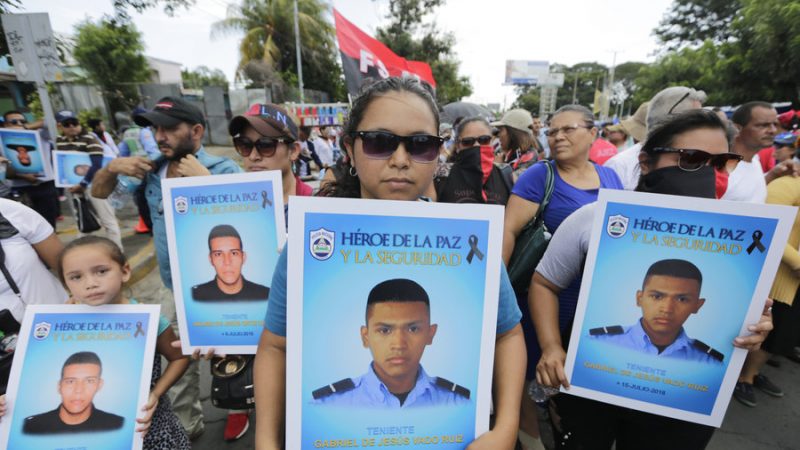
Supporters of Nicaraguan President Daniel Ortega “expressing their rejection of Daniel Ortega’s government,” according to CNN © Inti Ocon / AFP
RT | August 17, 2018
CNN’s Spanish-language site used an easily-identifiable photograph of a pro-government rally in a report detailing a protest against Nicaragua’s president, sparking accusations of propaganda peddling and sloppy journalism.
CNN Español tweeted out a video report on August 15 about Nicaraguans “returning to the streets to express their rejection of [President] Daniel Ortega’s government,” accompanied by a photograph of a large pro-government rally that took place several days prior.
The odd choice of photograph is particularly curious because it’s difficult to imagine how the marchers could be mistaken as anti-government. A red-and-black Sandinista flag is clearly visible in the background, and some demonstrators are even seen wearing red-and-black bandanas over their mouths. The Sandinista National Liberation Front – or FSLN – is the democratic socialist political party headed by Ortega.
“There is a flag of the FSLN in the picture. This is a PRO-government demonstration, absurd propaganda,” US journalist Ben Norton tweeted at the news site in Spanish.
Although the photograph appears to have been updated to more accurately reflect the story’s content, it’s still being used for an audio version of the video posted to the news channel’s Soundcloud account.
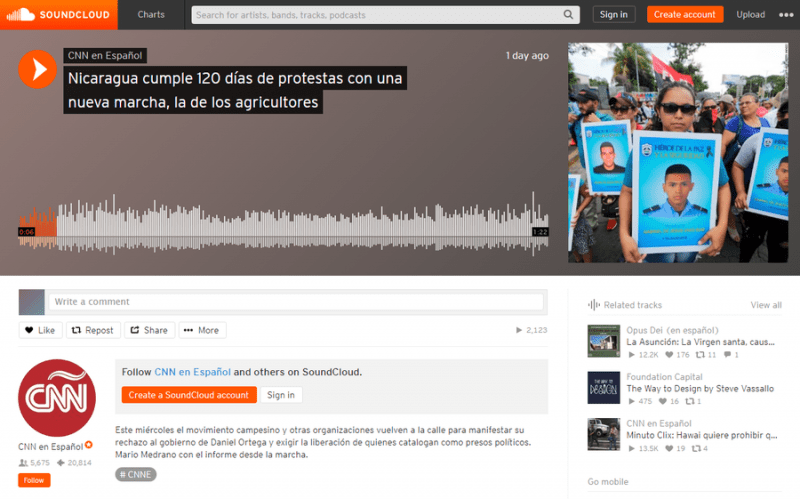
CNN Español’s audio report about an anti-government protest in Nicaragua continues to feature a photograph of a large pro-government rally
The erroneous tweet – which CNN has yet to delete – has been bombarded by hundreds of angry comments.
The CNN report comes amid months of civil unrest in Nicaragua, with more than 100 people having been killed in what has been characterized as a US-backed effort to overthrow the government.
“We have always wanted to have normal relations with the US but we see only aggression in return,” Ortega said in an exclusive interview with RT Spanish earlier this month.
US Senate Intel Chairman to Former CIA Chief: Put Up or Shut Up About Collusion

Sputnik – 17.08.2018
Senate Intelligence Committee Chairman Richard Burr (R-NC) had some choice words for security credential-deprived former CIA Director John Brennan. In a statement on Thursday, Burr essentially told Brennan to put up or shut up on the topic of Trump-Russia collusion.
“Russian denials are, in a word, hogwash,” Brennan wrote on Thursday in the New York Times’ opinion section. “Mr. Trump’s claims of no collusion are, in a word, hogwash.”
The former top brass at the CIA had his security clearance revoked by President Trump on Wednesday over what the White House called “risks posed by his erratic conduct and behavior.”
Burr fired back swiftly, saying, “Director Brennan’s recent statements purport to know as fact that the Trump campaign colluded with a foreign power.” If Brennan “has some other personal knowledge of or evidence of collusion, it should be disclosed to the Special Counsel, not The New York Times,” he said.
Burr wondered whether the former chief spy’s assertion was based on intelligence he received while still working at the CIA. If so, “Why didn’t he include it in the Intelligence Community Assessment released in 2017?” the senator wondered.
Moreover, would leaking intelligence assessments not constitute disclosure of classified information pertaining to an ongoing investigation, one must wonder?
On the other hand, if Brennan got the supposed information after leaving the CIA, “it constitutes an intelligence breach,” Burr wrote.
Lastly, Burr addressed the possibility that Brennan had no inside information at all. “If, however, Director Brennan’s statement is purely political and based on conjecture, the president has full authority to revoke his security clearance as head of the Executive Branch,” the chairman concluded.
The CIA once spied on the Senate Intelligence Committee “at the behest of” Brennan, according to the New York Times. Brennan had previously said that those claiming the CIA had hacked the committee “will be proved wrong” Brennan told the Council on Foreign Relations. Burr has sat on the committee since 2007 and has chaired it since 2015.
Almost all of the former director’s 51 tweets are about Trump — or in response to a Trump policy — or Special Counsel Robert Mueller’s investigation.
Why You Shouldn’t Read The Independent Even If You Want To – #PropagandaWatch
corbettreport | August 15, 2018
Just kidding. Of course you should read and gain information from a wide variety of sources, including those you disagree with. Just don’t dare tell The Independent that, because they’re here to pester you into only ever trusting the MSM and government sources. Join James for this week’s edition of #PropagandaWatch where he breaks down the latest attempt to stamp out anti-establishment WrongThink.
SHOW NOTES: https://www.corbettreport.com/?p=27696
Saudi-US Propaganda by PBS NewsHour in Houthi-held Yemen

By William Boardman | Reader Supported News | July 24, 2018
One of the poorest countries in the Middle East, Yemen’s war has pushed it to the brink of famine. A Saudi blockade has slowed the flow of food and helped push prices up. Markets and businesses are ruined from airstrikes. Millions are destitute. Special correspondent Jane Ferguson smuggled herself across front lines to report on what’s happening inside the world’s worst humanitarian disaster.
— PBS NewsHour summary, July 2, 2018
This is what American tax-supported propaganda looks like when an organization like the PBS NewsHour wants to maintain a semblance of credibility while lying through its intimidated teeth. Yes, Yemen is one of the poorest countries in the world, long dependent on imported food and other life support. But to say “Yemen’s war” is major league deceit, and PBS surely knows the truth: that the war on Yemen is American-backed, initiated – illegally – in March 2015 by a Saudi-led coalition that includes the UAE (United Arab Emirates). The US/Saudi war is genocidal, creating famine and a cholera epidemic for military purposes. These are American and Arab war crimes that almost no one wants to acknowledge, much less confront.
The “Saudi blockade” is also a US Navy blockade. The blockade is a war crime. Starving civilians is a war crime.
The most amazing sentence is: “Markets and businesses are ruined from airstrikes.” Seems rather bland. But this is a tacit admission of more war crimes – Saudi bombing of civilian businesses, as well as civilian hospitals, weddings, and funerals. But PBS makes it sound like the airstrikes sort of come out of nowhere, like the rain. PBS omits the American culpability that makes the airstrikes possible: mid-air refueling, targeting support, intelligence sharing, and the rest. Think of Guernica, the fascist bombing of civilians that inspired Picasso’s painting. Now think of Guernica lasting three years. That’s what the US has supported in Yemen and that’s what PBS helps cover up.
Yes, “Millions are destitute,” and yes, this is “the world’s worst humanitarian disaster.” But an honest news organization might go on to note that the destitution and the disaster are deliberate results of the world’s most relentless war crime.
From a journalistic perspective, getting the perky blonde reporter Jane Ferguson into northern Yemen, where the Houthis have been in control since 2014, is an accomplishment of note. There has been little firsthand reporting from Houthi Yemen, where the worst war crimes have been committed and the worst suffering continues. Ferguson’s presence was certainly an opportunity for serious independent reporting. PBS didn’t allow that. Based on no persuasive evidence, PBS NewsHour host Judy Woodruff framed the report as coming from “territory held by the Iranian-backed Houthi rebels.” There is no credible evidence of meaningful Iranian support for the Houthis. To believe there is, one has to believe the Iranians are consistently getting through the US-Saudi blockade. PBS ignores such realities, as do most Washington policy-makers. Woodruff does acknowledge in her weaselly way that it’s “a brutal war that the United States is supporting through a Saudi-led coalition,” which is still a long way from the truth that it’s a genocidal bombing campaign made possible by the US.
Reporter Ferguson adds to the distraction by focusing on the poverty and suffering as if they came from nowhere:
Life is slipping away from Maimona Shaghadar. She suffers the agony of starvation in silence. No longer able to walk or talk, at 11 years old, little Maimona’s emaciated body weighs just 24 pounds. Watching over her is older brother Najib, who brought her to this remote hospital in Yemen, desperate to get help. The nurses here fight for the lives of children who are starving….
You were never supposed to see these images of Maimona. A blockade of rebel-held Northern Yemen stops reporters from getting here. Journalists are not allowed on flights into the area. No cameras, no pictures.
That last bit of self-dramatization of the daring journalist glosses over a harsh reality: in addition to waging a genocidal war on a trapped population, the US-Saudi axis is also enforcing isolation and censorship on the victim population. It is a US-Saudi blockade that keeps reporters out, preventing firsthand reporting of endless war crimes. Who says? Jane Ferguson says:
The Houthis cautiously welcomed me in and, once I was there, watched me closely.
Ferguson’s coverage of the hunger and starvation is heart-wrenching, journalism at its most moving but least informative. She frames her narrative falsely:
In the midst of political chaos in Yemen after the Arab Spring, Houthi rebels from the north captured the capital, Sanaa, in 2014, before sweeping south and causing the country’s then president to flee. Neighboring Sunni, Saudi Arabia, views the Houthis, from a Yemeni sect close to Shia Islam and backed by rival Iran, as an unacceptable threat along their border.
Political chaos is Yemen is decades if not centuries old, often fomented by the Saudis and other outside powers. The Houthis have been there for thousands of years (as Ferguson later acknowledges) and their dispute with the Saudis is ancient and territorial. The Houthis’ religion is independent. The influence of Iran is largely a Saudi night-fright made increasingly real by the war the Saudis say is supposed to stop Iran. This is contrary to the official story. Ferguson does not acknowledge it.
Ferguson pitches the second part of her three-part series, deceitfully understating American responsibility for the carnage. She doesn’t mention that the war would not have started without a US green light, saying only:
But there is a role played by the U.S. military, one that is sort of more passively behind, not quite as visible. And so we’re going to be looking at that role.
This is the official position of the Pentagon, which has claimed the US is not involved in combat in Yemen. The US role that is “more passively behind, not quite so visible” is still crucial to killing Yemenis on a daily basis. The war on Yemen began with US blessing and continues only because of US political, logistical, and materiel support. Jane Ferguson begins this segment with a reasonably accurate albeit morally numb description:
Inside rebel territory in Yemen, the war rains down from the sky. On the ground, front lines have not moved much in the past three years of conflict. Instead, an aerial bombing campaign by the Saudi-led and American-backed coalition hammers much of the country’s north….
Treating war crimes against defenseless people as a kind of natural disaster is barren of journalistic integrity and gives the war criminals a pass when they need calling out. Ferguson goes on in her antiseptic, no-one’s-responsible manner to illustrate the killing of civilians and the destruction of civilian facilities, including a Doctors Without Borders cholera clinic. She also documents US-made weaponry, including an array of unexploded bombs and a collection of cluster bombs. She doesn’t mention that cluster bombs are banned by most of the world and constitute a war crime in themselves. She does note that cluster bombs often wound civilians, then follows this fact with the gratuitously propagandistic comment: “The Houthis have also targeted civilians, throwing anyone suspected of opposing them in jail.” She has no follow-up, leaving the audience with a false moral equivalence between blowing off a child’s arm and throwing someone in jail. But it gets worse. Ferguson later gets off this political judo move:
Most people here, whether they support the Houthis or not, know that many of the bombs being dropped are American. It provides a strong propaganda tool for the Houthi rebels, who go by the slogan “Death to America.”
What does that even mean, “go by the slogan ‘Death to America’?” Again Ferguson has no follow-up. Later she shows a crowd chanting “Death to America” as if that has relevance. Why wouldn’t the defenseless victims wish death on the country that murders them without surcease? The main purpose of introducing “Death to America” (with all its Iran-hostage resonance) seems propagandistic, to inflame American audiences that remain in denial about their own very real war guilt. American-supported bombing of Yemen is a fact. It is, quite literally, “Death to Yemen.” For Ferguson to call it a “strong propaganda tool” is a Big Lie in classic propaganda tradition. For PBS to broadcast this lie is to engage in propaganda. PBS and Ferguson not only blame the victim, they characterize their very real victimization as if it weren’t true but mere propaganda. At the end of the segment, Ferguson once again engages in false moral equivalence:
Both the Houthis and the Saudi-led coalition have disregarded innocent civilian life in this war. Every bomb that falls on a hospital, office building or home causes more unease about where they come from.
While it may well be true that “both sides” have killed or wounded civilians, there is absolutely no comparison in scale. The US-Saudi coalition comprises mass murderers; the Houthis don’t come close. “Every bomb that falls,” Ferguson should have said, is dropped by the US-Saudi side on the Houthi side. There is no doubt where the bombs come from.
In her third and last PBS segment, Ferguson foregoes any effort to explore the reality of hundreds of years of Houthi-Saudi territorial conflict. Instead, she goes to bed with US propaganda, opening with a crowd of Yemenis chanting “Death to America” and then stating:
These rebels, known as Houthis, seized control of Sanaa City and much of the north of the country in 2014. They are of Yemen’s Zaydi sect and closest to Shia Islam. Their growing power caused alarm across the border in Sunni Saudi Arabia, so the Saudis formed a coalition of Arab countries to defeat them, a coalition backed by the United States.
This is so twisted it amounts to intellectual fraud. Yemen has a long, tortured history of foreign interference. In the years before 2014, Yemen served (without much choice) as a base for US drone bases. At the same time, the international community imposed a Saudi puppet as Yemen’s president (presently in exile in Saudi Arabia). In 2014, the Houthi uprising, widely popular among Yemen’s 28 million people, drove out both the US drone bases and the Saudi puppet president. The Houthis represented something like Yemeni independence, which the US, Saudis, and others opposed with lethal force.
US support for the war in Yemen constitutes an impeachable offense for two American presidents. So do continuing drone strikes, also known as presidential assassinations. The war began because President Obama approved it and the Saudis were willing to bomb a defenseless population. But according to Ferguson:
The Saudis and the United States say the Houthis are puppets for Tehran, a proxy form of Iranian military power right on Saudi Arabia’s doorstep.
This is real propaganda. There is no evidence that the Houthis are anyone’s puppets (which is one reason they need to be oppressed). Historically, the Houthis are an oppressed people who keep rising up again and again to re-establish their own freedom and independence. There is no credible evidence of significant Iranian presence in Yemen. PBS and Ferguson certainly present none, and neither have the US or Saudi governments. American demonization of Iran has been a fixed idea since 1979, rooted in two psychopathologies: American unwillingness to accept responsibility for imposing a police state on Iran and American inability to see the hostage-taking of 1979 as a rational response to past American predation. American exceptionalism is a sickness that punishes others, currently millions of innocent Yemenis.
Ferguson concludes her series with a dishonest use of journalistic balance, first with a quote from Senator Bernie Sanders arguing that the US role in the Yemen war is unconstitutional. Rather than assess that straightforward argument, Ferguson turns to an Idaho Republican, Senator James Reich, who offers fairy dust and lies:
The Iranians are in there and they are causing the difficulty that’s there. If the Iranians would back off, I have no doubt that the Saudis will back off. But the Saudis have the absolute right to defend themselves.
Imaginary Iranians aren’t there now and they weren’t there when the Saudis attacked in 2015. No one attacked Saudi Arabia. The Saudis are not defending themselves, they are waging aggressive war.
By balancing these quotes, Ferguson creates yet another false moral equivalence. There is no meaningful equivalence between Bernie Sanders challenging the president’s right to take the country to war on his own and James Reich using a lie to defend war-making that disregards Congress. PBS should be ashamed. Jane Ferguson offers a fig leaf with another quote from Bernie Sanders:
I don’t know that I have ever participated in a vote which says that the United States must be an ally to Saudi’s militaristic ambitions. This is a despotic regime which treats women as third-class citizens. There are no elections there. They have their own goals and their own ambitions.*
All this is true, but Ferguson has no follow up. Instead she again offers spurious analysis: “American support for Saudi Arabia is a major propaganda tool for the Houthis.” No, it’s not. American support for the Saudis is not propaganda, it’s a lethal reality for the Houthis and a crime against humanity for the world. Ferguson completes her piece with a soppy lament for civilian victims, as if no one is responsible for their suffering. That’s one last lie. There are many people responsible for the horror in Yemen today and leading the list is the US-Saudi coalition. It doesn’t take much intelligence to see that, but apparently it takes more courage than PBS has to report the obvious.
*[Yet Sanders campaigned on using Saudi troops to depose Syria’s legitimate and secular government – Aletho News ]
Featured Video
Seyed M. Marandi: US-Iran War Inevitable: Kuwait and Bahrain May Fall
or go to
Aletho News Archives – Video-Images
From the Archives
Oil and the Israel Lobby
Reknowned economist M. Shahid Alam offers this excellent critique of Noam Chomsky’s defective analysis of the relative influence of Oil versus the Israel lobby over US foreign policy: … continue
Blog Roll
 Aletho News
- ICC ignored ‘very well-documented’ NATO crimes – ex-Libyan minister
- SNSC secretary dismisses US response to Iran’s conditions as ‘inadequate’
- Sanaa says Taiz roads open, secure for residents, warns Saudi forces
- Iraqi resistance group urges Saudi leadership to admit defeat, lift Yemen siege
- Trump’s Retreat: How Al-Aqsa Flood Took Down the US Empire
- Israel’s Military Actions in Lebanon Grossly Violate International Law — Lavrov
- Seyed M. Marandi: US-Iran War Inevitable: Kuwait and Bahrain May Fall
- Leaders Condemn Ansarallah Attack on Saudi Arabia While Ignoring Illegal War Against Yemen
- Leaked: Britain’s Covert Iraqi Psyops Network
- Yemeni Armed Forces Warn Airlines Against Using Saudi Airports, Exempt Mecca and Medina
- If Americans Knew
- After Oct 7, IDF policy allowed civilian casualties for even the lowest-ranking targets
- Israel’s Destruction of Southern Lebanon Intensified After the Cease-Fire
- The Last-Minute Decision That Gave Israel Its Name
- The American Conservative: How Trump Made the World Go Nuclear
- Meet the US generals and admirals advancing Israeli policy
- Opinion: Why news organizations should boycott Israel
- The Israeli witch hunt of Sami Abu Shehadeh exposes the lie of the ‘Jewish and democratic’ state
- No state has a ‘right’ to exist – least of all Israel
- Testimonies about Gaza’s civilian death toll expose Israel’s atrocities – Daily Update
- How Israel Conquered the Latin American Right
- No Tricks Zone
- New Study Suggests Large Regions Of The Pacific Ocean Have Been Cooling For The Last 80 Years
- Germany’s Green Energy Debacle: High Energy Costs Force Kahla Porzellan to Close After 182 Years!
- New Study: 50 Years Of The Most Aggressive ‘Net Zero’ Policies Can Only Affect The Global Climate By 0.03°C
- US September “Heat” Was No Record…Many Records Set Decades Ago
- Latest European Green Energy Debacle; Portugal’s Largest Flagship Solar Park Insolvent!
- Green Energy Debacle: German Expert Professor Fritz Vahrenholt Warns Of Severe Economic And Social Consequences
- Two More Paleo Reconstructions Affirm Meters-Higher Sea Levels Across Ireland, Brazil 7000-6000 Years Ago
- New Study: Earth And Venus Surface Warmth Largely Explained By Convection And Lapse Rate, Not CO2 Or Radiation
- 2025 Nature Paper Claiming Worsening Global Drought Gets RETRACTED …Heavily Flawed
- New Study: ‘Global Drought Shows No Detectable Recent Acceleration Under Climate Warming’

