Finally, on Monday, July 16, 2018, the Helsinki Summit bringing together Russian President Vladimir Putin and US President Donald Trump took place, despite shrill demands that it be stopped, canceled, or turned into a platform for more aggression. “President Trump should cancel his meeting with Vladimir Putin until Russia takes demonstrable and transparent steps to prove that they won’t interfere in future elections. Glad-handing with Vladimir Putin on the heels of these indictments would be an insult to our democracy,” Senate Minority Leader Chuck Schumer said. Yet there could never be any “proof” of someone not doing something in the future, and to implement the conditions for this specific case would require turning off all the electricity in Russia and seizing all computers everywhere on its territory. It is thus plainly an absurd, irrational, and unrealistic statement that is meant to satisfy partisan emotional needs. As a recipe for international relations, it would be a disaster of a policy. In a desperate effort to maintain the interests vested in the new Cold War, Democrats tried to elbow their way into the summit, to no avail. In the US today, “resistance” means continuing, even escalating, the fabricated Cold War against Russia—resistance has become the catchy buzzword for what Eisenhower called the military-industrial complex, updated to include billionaire tycoons funding “social movements” operating as part of “civil society”.
Thus days before the event, President Trump pointed critically at the shrill media and Democrats for firing up the new Cold War:
“Heading to Helsinki, Finland – looking forward to meeting with President Putin tomorrow. Unfortunately, no matter how well I do at the Summit, if I was given the great city of Moscow as retribution for all of the sins and evils committed by Russia… … over the years, I would return to criticism that it wasn’t good enough – that I should have gotten Saint Petersburg in addition! Much of our news media is indeed the enemy of the people and all the Dems… … know how to do is resist and obstruct! This is why there is such hatred and dissension in our country – but at some point, it will heal!” (Twitter 1, Twitter 2, Twitter 3).
What united all of the US media, from Fox News to CNN and right across to MSNBC, was the dominance of the America-the-innocent-victim narrative. Joining them was an established band of encrusted “neocons” such as Senator John McCain who asserted, in the usual evidence-free fashion of the kind that brought the US to Iraq, that Putin was guilty of “ongoing aggression towards the United States”. The “no blame” narrative (that permanently shields Americans from the consequences of their actions) was joined by the insistence that the secret police and espionage agencies should just be believed, without doubt, and that such agencies should have primacy over democratically elected representatives. Funny that this is what should issue from the same mouths that claim to warn us against “fascism”.
However, in an amazing press conference featuring Putin and Trump at the close of the summit, virtually everything the Democrats, their neocon associates, the media, and the military-intelligence establishment did not want to hear, is what they were instead forced to hear. Allegations of “collusion” between Trump and Russia faced thorough embarrassment as utter idiocy. Putin tossed back allegations of Russian interference in US elections, and essentially laughed at the bogus “assessment” that has been treated as if it were sacrosanct truth in the US media, such that Trump was expected to perform an auto da fé in front of the new Cold War media’s Grand Inquisition. There was no hint of Russia withdrawing from Syria (there at the Syrian government’s request)—though Trump reiterated the near total defeat of ISIS that had been achieved, which also eliminates the US’ rationale for its illegal intervention in Syria. Russia refused to accept that Crimea did not legally, peacefully, and democratically choose to join Russia, to which it belonged for the majority of its history. On these and other issues, it was as if a stake had been driven through the heart of the new Cold War. Of course, it was also just a beginning, and not an end. In an interview with Fox News’ Chris Wallace, Putin said that the Helsinki Summit was simply “a good start” to ending a revived Cold War that significantly endangered the world. Trump also said that US-Russia relations had reached a disastrously low point, without precedent, and that had ended with the Helsinki Summit. This was an important diplomatic breakthrough, and a legitimate success. Then how was it turned into a moment of infamy in the US? Just how deep is the addiction to empire?
Misunderstanding the Previews
Any student of international relations will know that such summits leave as little room as possible to spontaneity and chance. Instead, they are preceded by officials meeting and corresponding behind the scenes, in planning the event weeks and months in advance. They collaborate in drafting an agenda, and preparing the process of formulating and articulating what could become points of agreement, to be ironed out when the leaders meet in person. That was true of the Helsinki Summit as it was true of the Singapore Summit, as it has been true of all other major summits in the last three centuries of international diplomacy. The notion that Donald Trump would somehow be “winging” this and that the meeting could produce a “surprise” is something entertained by either those who do not know better, or those who pretend to be ignorant. The fact of months of preparation was confirmed by Vladimir Putin himself, at the opening of his interview with Chris Wallace of Fox News on the evening of the summit, July 16. Unfortunately the media completely missed the significance of these statements.
As such, what Trump did in the lead up to the summit was to begin to widen the path for his point of departure. Speaking of trade relationships with “allies,” days before the Helsinki Summit Trump stated: “Sometimes our friends, when it comes to trade, are treating us worse than the enemies”. A day before the Helsinki Summit, Trump told a journalist that, “I think we have a lot of foes. I think the European Union is a foe, what they do to us in trade. Now, you wouldn’t think of the European Union, but they’re a foe”.
Trump’s European counterparts seemed to understand what was coming too: some officials confessed that, as the NATO gathering approached, they were “scared shitless” by Trump. Leon Panetta claimed that the Europeans were “scared to death” that Trump would seriously act on his “America First” strategy. Being “absolutely worried” seemed justified, as NATO members had no good arguments for maintaining NATO and for perpetuating what some astute analyses saw as an obsolete and abusive relationship. On his way to the NATO gathering in Belgium, President Trump said this about the alliance and how it benefited allies: “Frankly it helps them a lot more than it helps us”. The divisions dominating NATO, since Trump took office, were now apparent to anyone willing to pay some attention.
Predictably, The Economist voiced the outcry of liberal imperialist elites for the waning NATO alliance, astonishingly touting it as an anchor for democracy—this, despite all evidence to the contrary, particularly NATO’s disastrous intervention in Libya, and the corrupt and rigged elections which it supervised in Afghanistan. The argument one could not credibly make, is the one about NATO as a support system for democracy. Moreover, the manner in which NATO is upheld, against the wishes of citizens in its member states, who are tired of NATO’s incessant war agenda, and the way NATO leaders try to delegitimize democratically-elected leaders, blasts more holes into the democracy illusion advanced by NATO’s elitist apologists. Indeed, democracy is in decline even among NATO members themselves, albeit according to some questionable analyses. Either way, democracy is the last argument one should ever make in defense of NATO, and is easily one of the worst arguments. As for the notion that the military is the supreme guardian and supervisor of democracy, that is better left with the likes of General Augusto Pinochet and other legitimate “fascists”.
The really significant moment, misinterpreted and misunderstood in every article I have read, concerned Trump’s comments on Germany. Trump expressed acute condemnation of Germany, going as far as calling it a “captive” of Russia, in language evocative of Russiagate conspiracy theories. For those who would use Russiagate conspiracy theories against Trump, provoking a new Cold War, Trump seized on their contrived fears and turned them against the fear-mongers. Some argued, with considerable merit, that NATO itself has helped to cause a new Cold War. Trump’s harangue against Germany’s agreement to be connected via a gas pipeline to Russia, pointed to the German government’s hypocrisy—in demanding the US remain committed to the defense of Germany, presumably against Russia, while doing business with Russia. Implausibly, the German response was that the two matters were separate. Seizing on this contradiction, and using it for his own purposes, Trump himself said this: “I am meeting with President Putin next week and getting along—let me tell you, getting along with Russia and getting along with China and getting along with other countries is a good thing. It’s not a bad thing. It’s a good thing”. Indeed, Trump later altered his message, saying the pipeline deal would not be so bad, if NATO states improved their relations with Russia—which seems to have been his larger point, one that both undermined the new Cold War and NATO’s very own reason for being. As for why Trump is doing all of this, right now, so far the lone genius in the story who has correctly discerned the forces producing the pattern, is the eccentric and entertaining Max Keiser.
How Trump used the new Cold War and its Russiagate conspiracy theory rhetoric against its own purveyors, calling out their hypocrisy and then attaching a price to it, seems to have been missed in most analyses. It was a particularly deft move, similar to his holding neoliberals hostage to their own free trade rhetoric (while they practiced less-than-free trade). In this as in other instances, Trump proved to be more clever than many of his professional critics.
What cannot be said, with any justification, is that “nobody saw this coming”. Trump’s messaging has been consistent in recent weeks and months, taking aim at the European Union, at NATO, at Canada (now a “national security threat”), and even at the UK over Brexit as in his “explosive” interview with The Sun. Finally, Trump also denounced the “foolishness” that prevailed in the US around Russia (as displayed in the reactions in the next section):
“Our relationship with Russia has NEVER been worse thanks to many years of U.S. foolishness and stupidity and now, the Rigged Witch Hunt!”—Donald J. Trump: @realDonaldTrump
Taken together, all of these positions are united by their divergence from the status quo ante, the neoliberals’ dream of a New World Order, of a “transatlanticism” that married Europe and the US in an imperial alliance that sought to command, and thus exploit, the rest of the planet. In the US, it repaired the apparent belief among neoliberals of the right and left that the political system is one where the FBI/CIA rule at the top, and the President is second.
The Alarmists: Addicted to Imperialism
The US’ foreign policy establishment, and specifically the military-industrial-complex, had been alarmed at least since 2016 that Trump, in seeking to improve relations with Russia, would yank the rug out from underneath their lucrative anti-Russia scare-mongering. True to form, just three days before Trump would meet with Putin and in an obvious attempt to “pressure” Trump, Deputy Attorney General Rod Rosenstein issued an indictment alleging 12 Russian operatives had attempted to interfere with the US election of 2016. Not facing a realistic prospect that these 12 individuals would ever appear in a US court, the alleged evidence against them would never be tested—the easiest indictment to make, as Glenn Greenwald put it. Under the rules of due process, it also means such operatives were innocent, simply because they had yet to be proven guilty. One can also wonder, if one wants to pretend being naïve, whether the US would ever fork over its intelligence agents if they were indicted by a foreign state.
Of course an onslaught of alarmist, anti-Russia and anti-Trump hyperbole vented from the US media once more, as if oblivious not only to popular distrust of the same media, but the incredible fatigue over everything constantly being likened to Pearl Harbor. Absurdly irrational contradictions continued—the Russians apparently stole DNC emails, and then spread “fake news”…except both of those statements cannot be true at the same time. Either the news was fake, or the emails were real and thus dissemination of their contents was real. Clearly Rosenstein, with the aid of the FBI’s Bob Mueller, was intent on destabilizing Trump’s government and specifically its authority to conduct foreign policy, employing a transparently cheap political stunt that casts Mueller in the worst possible light. (The move backfired somewhat: almost immediately it was announced that Rosenstein would face impeachment, while Trump pointed out that the alleged Russian interference occurred under Obama, which did nothing to stop it.) The indictment also came just one day after a scandalous performance by the FBI’s Peter Strzok in front of cameras in an open Congressional hearing, revealing the level of corruption, bigotry and bias permeating the highest levels of the FBI. Strzok successfully caricatured himself as the classic fascist secret policeman. Meanwhile, Rosenstein’s opportunistic and futile indictment not only failed to present any new information, it left out a great deal about how Republicans were also allegedly targeted.
If the Democrats and the media only suggested opposition to Donald Trump’s summit with Kim Jong-un a month before, they both came out openly against any meeting with Vladimir Putin. In the two days leading up to the event, there were shrill demands that the meeting be canceled outright. As such, the Democrats and their media were sealing their fate as the party of imperialism, the party of the Cold War, and the party of the past. Their denunciations of diplomacy served as a reminder of why they deserved to lose the 2016 elections.
Witness the reactions that came from Democrats:
“Every single day, I find myself asking: what do the Russians have on @realDonaldTrump personally, financially, & politically? The answer to that question is that only thing that explains his behavior & his refusal to stand up to Putin.”—Nancy Pelosi: @NancyPelosi
“In the entire history of our country, Americans have never seen a president of the United States support an American adversary the way @realDonaldTrump has supported President Putin.”—Senator Chuck Schumer: @SenSchumer
“Donald Trump’s press conference performance in Helsinki rises to & exceeds the threshold of ‘high crimes & misdemeanors.’ It was nothing short of treasonous. Not only were Trump’s comments imbecilic, he is wholly in the pocket of Putin. Republican Patriots: Where are you???”—John Brennan, CIA Director under Obama: @JohnBrennan
“For the President to side with Putin over his own intelligence officials and blame the United States for Russia’s attack on our democracy is a complete disgrace.”—Senator Mark Warner, in just one message among a torrent of similar denunciations: @MarkWarner
“Once again, @realDonaldTrump takes to the international stage to embarrass America, undermine our institutions, weaken our alliances, & embrace a dictator. Russia interfered in our elections & attacked our democracy. Putin must be held accountable – not rewarded. Disgraceful.”—Elizabeth Warren: @SenWarren
“Today is a good day for Putin and the oligarchs in Russia. It is a bad day for people in the United States and all over the world who believe in democracy and who are trying to understand what world our idiot president lives in.”—Bernie Sanders: @SenSanders
Also, here are some reactions from liberal imperialist Republicans:
“Today’s press conference in #Helsinki was one of the most disgraceful performances by an American president in memory.”—Senator John McCain: @SenJohnMcCain
“I never thought I would see the day when our American President would stand on the stage with the Russian President and place blame on the United States for Russian aggression. This is shameful.”—Senator Jeff Flake: @JeffFlake
“Missed opportunity by President Trump to firmly hold Russia accountable for 2016 meddling and deliver a strong warning regarding future elections. This answer by President Trump will be seen by Russia as a sign of weakness and create far more problems than it solves.”—Senator Lindsey Graham: @LindseyGrahamSC
“President Trump must clarify his statements in Helsinki on our intelligence system and Putin. It is the most serious mistake of his presidency and must be corrected—-immediately.”—Former House Speaker Newt Gingrich: @newtgingrich
The Reactionary Resistance and its Struggle with Reality
Most of the Republicans quoted above are “never Trump” has beens, on their way out of electoral politics because they became so unpopular with constituents, or are no longer involved in elections. The never Trumpers are boiling at their collective failure, having been driven from the Republican Party and thus no longer in a position to dictate its agenda. Like other exiles the US has hosted, they are determined to carry out regime change from another shore.
As for the Democrats, and specifically Bernie Sanders, we have known for years that Sanders is the perfect example of a “progressive” who is an imperialist half-head. Bernie Sanders, whose greatest political acts of courage these days involve pushing for a higher wage for Walmart workers, was already on the record as a supporter of NATO and taking an aggressive stance toward Russia. Had the imperial left seen its dream of a Sanders presidency come true, we already know that it would have just been more of the same. On NATO Sanders himself stated in the Democratic debate in Wisconsin on February 11, 2016:
“Russia’s aggressive actions in the Crimea and Ukraine have brought about a situation where President Obama and NATO—correctly, I believe—are saying we’re going to beef up our troop level in that part of the world to tell Putin that his aggressiveness is not going to go unmatched. We have to work with NATO to protect Eastern Europe against any kind of Russian aggression”.
But what did these people seriously expect of Donald Trump? Did they imagine that President Trump would essentially invalidate his own electoral victory, stripping it of all legitimacy, by affirming that the “Russian collusion” stories were what they are patently not, i.e., serious, credible, evidence-based, truthful representations of reality? Apparently the “logic” at work among his critics is that if Trump fails to agree that his election was the result of a Russian conspiracy, then that means he is the agent of a Russian conspiracy.
Otherwise Trump’s “failures” at Helsinki appear to have been that, (a) he was critical of American spies and secret police, and, (b) that he was diplomatic toward Putin. By criticizing American agencies, Trump diminished the American claim to perpetual victimhood. The US is in the grips of a generalized fever, ruled by a panic that privileges “victims” and which constructs victims everywhere one looks. Trump thus challenged the prevailing fiction that America was without any blame—and here Trump was making a major break with his own narratives. His critics denounced the “moral equivalency” implicit in his remarks at the Helsinki press conference, which is a familiar complaint of American exceptionalists who have long been trained in the arts of hypocrisy and decontextualized self-representation.
Speaking of hypocrisy, Trump’s Democratic critics persisted in their failure to explain what their “reset” with Russia would have looked like, if the little that Trump did so offended them. What exactly did Obama mean in 2012 by his otherwise clever retort to the hawkish Mitt Romney, “the 1980s called and they want their foreign policy back”? Worse yet is the glaring contradiction between opposing an economic Cold War with China, played out on the field of trade, while proposing to escalate a Cold War with Russia. What sort of globalism is that? “Globalization has transformed American universities into a front line for espionage,” argues Daniel Golden, author of the recently published book, Spy Schools. However, The New York Times, having energetically fanned the flames of anti-Russian hysteria and xenophobic paranoia, it now accuses the Trump administration of doing just that, only with reference to China and Chinese researchers on US campuses who may soon face tighter restrictions in gaining access. What media elites obfuscate, of course, is that deglobalization is increasingly a fact. Whether the favourite target is Russia (for Democrats) or China (for Trump’s Republicans), either way the logic, means, and outcomes are the same: diminished international cooperation at the heart of the globalist ethos.
On the other hand, whether they admit it or not, the Democrats (and the EU) are fully on Russia’s side in defending the Iran nuclear agreement, which Russia upholds and which Trump abrogated. How do the Democrats explain this rather strange overlap in interests? Are they secretly colluding with the Kremlin to support Tehran? Would not the Uranium One deal exposed by the New York Times be further evidence of such collusion? When one lowers the threshold for rational thought, the way critics of Trump have done, then any old crazy talk should suddenly sound plausible.
Trump’s critics also expected him to shame and berate Putin, escalating tensions to the breaking point, in what would have been an unprecedented scene of personal aggression on the diplomatic stage. Yet recall how utterly charming and amiable Vice President Richard M. Nixon, an arch anti-communist, was when he publicly met with Soviet Premier Nikita Khrushchev during the famous “kitchen debate”. Trump was hectored for merely shaking hands with Kim Jong-un, taken as a sure sign that he “loves dictators”. The question then becomes: with a domestic opposition so ostensibly debased and pathological, who wouldn’t love foreign dictators instead?
Demonizing Russia: Inventing Fictions to Boost Faith in a Defunct World Order
In an interview with Larry King, Russia’s Foreign Minister, Sergei Lavrov, outlined the issues of importance to Russia—these ranged from a strong critique of the West’s humanitarian imperialism, to its double-standards on the popular referendum in Crimea that saw its Russian majority choose to join Russia (there was no “invasion”), to the continued threat of NATO expansion. Lavrov specifically cited NATO as an “atavism of Cold War times” and criticized the “inertia of Cold War thinking” that dominates the West. As for the much touted “rules based international order,” Lavrov correctly pointed out that it was built on Western double-standards that allowed the US to flout international law with impunity and live by a separate set of norms. Separately, the Kremlin spokesperson, Dmitri Peskov, pointed out that it was not Russia that was responsible for initiating the deterioration in relations, and that the US seemed to particularly resent that Russia would not simply bend to its will like a dependent puppet state. In advance of the summit, Peskov made some very reasonable and basic observations on the need for peaceful cooperation, while each state should safeguard the interests of its own citizens. There was nothing here indicative of the fabled Russian “aggression” that seems to preoccupy the shrill, imperialist “resistance” in the US.
But then rational, critical, independent-minded thought is not allowed. We are instead plunged into a free fall to new depths of distortion, exaggeration, and outright invention.
Thus in the US media and political circles (the two being virtually indistinguishable), it has become a matter of fact that “Russia invaded Crimea”. Do they mean like the US invaded Iraq? Fine. Then it should be a very simple matter for the reader to find us photographs and videos of Russian columns pouring into Crimea, seizing buildings, and engaged in gunfire. Also, remind us of the body count resulting from Russia’s “invasion”. The actual reality is that Russia neither invaded nor annexed Crimea, not if words are to have any meaning at all. Acceptance of the notion that Russia invaded Crimea indicates that one is already prepared to accept any sort of fabrication as if it were fact. Nothing has apparently been learned from the great WMDs myth of 2003, except how to repeat it and amplify it. This involves a deeply perverse commitment, and there is no point railing against “alternative facts” when all you do is recite alternatives to facts.
And what exactly is “the solution” to Crimea? Is it about forcing the majority of Crimeans to subjugate themselves to rule by a government that has resolutely persecuted Russian communities within its borders? What sort of idea of justice is this exactly? Let us not forget how that government came into being in Ukraine, which was through a Western-backed coup and violence in the streets, and which has also witnessed the rise to power of actual neo-Nazis.
Then there is the assertion and easy acceptance of the fabrication that Russia aided “the Syrian regime” in its “chemical weapons” attacks on civilians. What chemical attacks? Has the reader noticed the almost total silence in the media about the facts actually found on the ground? After the US, France, and the UK used a “chemical attack” as a justification for attacking Syria, Western media largely ignored the facts that were revealed by the Organization for the Prohibition of Chemical Weapons, tasked by the UN to conduct an investigation. In a July report, the OPCW stated that it had found “no organophosphorous nerve agents or their degradation products were detected in the environmental samples or in the plasma samples taken from alleged casualties”. That it called the casualties “alleged,” meant it also found none. No nerve agents, no casualties. Again, let me ask: what chemical attacks? Like the Iraq WMD myth, once again Western governments and media perpetrated egregious lies against their own citizens, to justify acts of unlawful military aggression. How many more times do we need to repeat this before you finally learn the lesson? This is a very serious question, because what is being challenged here is your human capacity to learn, and to remember what you learned.
We are also told that Russians subverted US elections. If it had been true, how would you have been able to spot their subversion among all the other subversion? Here I am referring to the persistent subversion of American politics by giant corporations and oligarchic financiers, and of the pervasive influence of the military-industrial complex, to the point that US elections risked degenerating into mere demonstration elections staged by the corporate imperial state, not to mention an impressive array of foreign donors (recall the Clinton Foundation). Logically, the only way one can “subvert” something that is already corrupted, is by fixing it.
Repeatedly we have been instructed that all of the US’ intelligence agencies concluded that there was significant Russian interference in the US elections of 2016. First, it would be useful to consult the resources on Russiagate compiled on Fabius Maximus. Second, it is important to remember that: “The intelligence community as a whole has not been tasked to make a judgment and some key members of that community did not participate in the report that is routinely cited as ‘proof’ of ‘Russian interference’,” as explained in careful detail by Jack Matlock, a veteran of government service with experience on national security matters at the highest levels. Next, remember that US media such as the New York Times have been forced to withdraw statements that all of the US intelligence agencies reached these so-called conclusions about Russian interference, not to mention all of the other “fake news” actually produced by CNN, The Washington Post and others on Russiagate. Third, recall that veterans of US intelligence agencies openly challenged claims that Russians hacked the emails of the DNC. Even this short list should, in the mind of any reasonable adult, provoke at least some misgivings.
Finally, in what became an all too obvious and predictable pattern, shortly before Donald Trump was to finally meet with Vladimir Putin—worrying the globalists and interventionist establishment—another chemical hoax emerged, this time involving a random couple being poisoned not far from the site of the Skirpal attack in the UK. The only thing that was apparent about this attack, according even to The Guardian which usually lusts after anti-Russia conspiracy theories, is that “someone is out to embarrass Vladmir Putin”:
“all we can see are the devious tools of the new international politics. We see the rush to judgment at the bidding of the news agenda. We see murders and terrorist incidents hijacked for political gain or military advantage. Ministers plunge into Cobra bunkers. Social media and false news are weaponised. So too are sporting events”.
That Vladimir Putin should publicly assert, as he did on July 16, that the Russian state has no compromising information about Donald Trump, should have put an end to that story. Why? Simply because if in the future the Russian government should purport to have any such information, it will have been contradicted and thus invalidated by Putin’s prior statement. There is no point in having compromising information, if you challenge its very existence at the outset. Case closed.
Yet, we are instructed that Russia is “untrustworthy”. What makes it so unworthy of trust? The real problem about Russia is twofold. One is that Russia has been cynically exploited by Americans which have used Russia as a cheap political football in their domestic conflicts. The second problem is that Russia is the kind of state that does not immediately bend its knee to Western demands. What Americans describe as “trustworthy” is exactly what describes a puppet, an instrument that bends to the American will. It is thus not terribly flattering to have an American call you a “trusted partner”.
What especially irks Americans in the foreign policy establishment is that Vladimir Putin is an obviously brilliant statesman, and that Russian diplomats have bested their Western counterparts for decades, both in their expertise and professionalism, and in their deep appreciation of international law, sovereignty, and self-determination. These are all qualities to be detested.
In the interview with Wallace, Putin provided a short list of Russian complaints, that rarely get aired by the US media: NATO’s relentless expansion eastward, even after the Cold War had ended, and in violation of promises to Russia in return for its agreement to allow the reunification of Germany. Added to this is the US’ unilateral withdrawal from the ABM Treaty. Then added to that was the US and European intervention in Yugoslavia, participating in its illegal breakup, and then backing a coup in Ukraine. While freaking out about some emails and Facebook ads, compare it to that list and see which side weighs more.
That Putin should end his interview with Wallace by pointing how US sanctions on Russia have backfired, producing only opportunity for the US’ competitors, is not a simple demonstration of his concern for Americans. It is a reminder to the viewer of just how stupid we have become.
A Bad Day? For Whom?
Probably the single most important achievement for Donald Trump arising from the Helsinki Summit, is that he forced fellow Americans to begin to debate what was previously treated as unquestionable, to debate that faith which has been masked as “facts” and which are used to create a sacred aura around the upholders of empire. Trump’s supporters will be divided between those who supported Trump while they thought they could use him, and his genuine supporters who elected him because of the principles he advanced in the 2016 campaign.
We can look forward to some interesting and embarrassing contradictions. Fox News has a privileged relationship with Donald Trump, but also an ambiguous and contradictory one that contains a lot of latent conflict (hopefully an intelligent study by a calm media analysis scholar will eventually bring this out better). Emblematic of this privilege, Fox News monopolized all of the key interviews arising from the summit: Chris Wallace was granted an exclusive interview with Vladimir Putin; at the same time that was happening, Sean Hannity was interviewing Donald Trump; thirdly, this was to to be followed up by Tucker Carlson’s interview with Trump, to be aired on July 17. Sean Hannity, who until now has been an unquestioning supporter of President Trump, never expressing even the mildest of reservations, is also a close friend of Newt Gingrich who appears frequently on Hannity’s show. Gingrich condemned Trump’s statements in Helsinki. Hannity was apparently unaware of this when he scorched all of Trump’s Republican critics. Hannity’s “Opening Monologue” for July 16, just hours after the summit ended, seemed to show someone who was unable or unwilling to digest what had just happened. Hannity was full of contradictions; he continued, like a broken record, to repeat content that is now many months old; and he praised Trump, but in the way that a neoconservative would, touting Trump’s “toughness” on Russia and belligerence toward Iran, North Korea, etc. Meanwhile, people commenting under Fox News’ reports on the summit are for the most part firmly in support of Trump’s stance at the summit, condemning the neocon elites ousted from the Republican Party. Fox, for its part, has largely tilted against Trump—they risk bringing the relationship with Trump back to what it was in late 2015, when Trump’s arch enemy in the media was not CNN, but Fox News. How some have forgotten already. Trump went as far as boycotting and then upstaging a Fox News Republican primary debate. Since Fox decided to repair relations with Trump, it has tried to use him as an instrument: knowing they have his ear, their commentary has consistently pushed the old neoliberal imperialist orthodoxy, trying to preserve the interests of the status quo ante, while reducing Trump’s ascendancy from a structural shift to a mere partisan switch. All of Fox’s contributors, virtually without a single exception, all presumed to advise Trump from a distance, to treat the meeting with Putin as something like a boxing match and to make sure to bloody Putin’s face. Fox failed. It is actually worth relishing how solidly and totally they have been ignored.
Trump is definitely not a politician, or he would not show this much courage. Seemingly aware of this himself, Trump’s opening comments at the joint press conference with Putin at the summit indicated as much, saying: “I would rather take a political risk in pursuit of peace, than to risk peace in pursuit of politics”. By politics he clearly meant partisan status and security.
What was especially significant about the Helsinki Summit was not so much anything either Vladimir Putin or Donald Trump said, as much as the hyperbole of knee-jerk reactions—excessive even by American standards—involving a growing, collective, high-pitched scream coming especially from displaced liberal imperialist elites who have still not come to grips with their loss of the US presidency. Witnessing the reactions to the press conference that closed the summit afforded a special, rich, and just pleasure to those of us who just a few years ago saw today’s screamers pompously preside over the razing of Iraq, the military colonization of Afghanistan, the destruction of Libya, and the dismantling of Syria, all while cheerfully preaching the virtues of a neoliberal world “order” that saw the biggest wealth transfer ever recorded in human history. What they did not steal abroad they robbed at home. It was about time that they had (another) bad day.
And it was indeed a very bad day—a bad day for the conspiracy theories pushed by the Democrats, their neoconservative bed partners, and the corporate media who are the instruments of power. It was also a bad day for the interests vested in the way things were before, who had poured hundreds of millions of dollars into the failed campaign of their would-be stewardess, Hillary Clinton. And, it was an especially bad day for orthodox, imperialist reactionaries who in the US gesture as progressives and garb themselves as “the resistance”. These are the same forces that would claim monopoly ownership over “respectability,” “reason,” and “decency,” assuming in turn that the rest of us suffer from a collective amnesia as deep as our generous credulity. If one could rewind and replay a day, then July 16, 2018, was the day worth recording.
To better understand what happened at Helsinki, it is useful to follow the trail of tears to its sources. What took a big blow were the interests of self-styled “transatlanticists,” the elites of a transnational capitalist class that has ardently preached the virtuous necessity of neoliberal empire. This is the class, with all its “responsibility to protect,” its “humanitarian intervention,” and its projects of regime change. We are speaking here of the stalwarts of failure, the abiding defenders of the New World Order which has collapsed in front of their eyes. Keeping this in mind, one sees the pattern that joins the seemingly disparate dots that have dared, in the face of their popular repudiation at the polls, to condemn Trump for moving toward what he promised.
How the imperial national security state will let this stand, is to be seen.
July 17, 2018
Posted by aletho |
Fake News, Mainstream Media, Warmongering, Progressive Hypocrite, Russophobia | Donald Trump, NATO, New York Times, Russia, United States |
Leave a comment
Russian national Mariia Butina has been arrested and charged with conspiring to act as an agent of a foreign government, the US Department of Justice announced on Monday.
According to the US Department of Justice, Butina, who was arrested on Sunday, was developing ties with US citizens and infiltrating political groups without informing the US attorney general of her alleged intentions — to further Russian interests, it alleges. ‘Overt acts’ she stands accused include sending two emails to a “US person in an effort to develop, maintain, and exploit a relationship to furtherance of the conspiracy” to promote Russian interests in the US.
Butina’s first name is also sometimes transliterated as “Maria” in documents.
”Butina worked at the direction of a high-level official in the Russian government who was previously a member of the legislature of the Russian Federation and later became a top official at the Russian Central Bank,” the Monday statement from the DOJ reads. “This Russian official was sanctioned by the US Department of the Treasury, Office of Foreign Assets Control in April 2018.”
It adds that the 29-year-old “undertook her activities without officially disclosing the fact that she was acting as an agent of Russian government” and that the international relations student tried to build relationships with people in the Washington, DC, area while working at the behest of a former Russian lawmaker who went on to become a central bank official.
Butina’s next hearing is scheduled for July 18.
In a supporting document, FBI Special Agent Kevin Helson said in a sworn statement that one of the goals Butina was attempting to accomplish was to “exploit personal connections with US person having influence in American politics in an effort to advance the interests of the Russian Federation.” It notes that one of her contacts was with an “organization promoting gun rights.”
Robert Driscoll, Butina’s lawyer, denies that she was acting as a Russian agent.
“Mariia Butina is not an agent of the Russian Federation. She is a Russian national in the United States on a student visa who recently graduated from American University in Washington, DC, with a Masters Degree in International Relations and 4.0 grade point average,” Driscoll said in a statement to Sputnik. “She has received her work permit and is seeking to use her degree to pursue a career in business.”
“The substance of the charge in the complaint is overblown. While styled as some sort of conspiracy to violate the Foreign Agent Registration Act, in actuality it describes a conspiracy to have a ‘friendship dinner’ at Bistro Bis with a group of Americans and Russians to discuss foreign relations between the two countries,” he continued.
“There is simply no indication of Butina seeking to influence or undermine any specific policy or law in the United States… the complaint is simply a misuse of the Foreign Agent statute, which is designed to punish covert propaganda, not open and public networking by foreign students.”
July 16, 2018
Posted by aletho |
Deception, Fake News, Mainstream Media, Warmongering, Russophobia | DOJ, FBI, United States |
Leave a comment
Vladimir Putin laughed after being asked if Russia had compromising information about Donald Trump or his family, replying that it’s absurd to suggest that Moscow collects dirt on every American businessman who visits the country.
Jonathan Lemire, a White House reporter for the Associated Press, asked Putin during the post-summit press conference whether Russia had any “compromising material on president Trump or his family.”
Laughing once the question was fully translated, Putin responded: “When Trump came over to Moscow, I was not aware of it. When he came over as a businessman, I was not even aware that he was in Moscow. Take the St. Petersburg Economic Forum. More than 500 senior executives from the US came over to Russia. Do you think that we are compiling compromising material on all of them? Well, definitely it’s absurd. I cannot really imagine anything more absurd than this. So please, throw out this nonsense.”
Trump added that if there was compromising information about him, it would have been published long ago.
While the Russian leader’s answer was hardly ambiguous, journalists flocked to Twitter to claim that Putin had not denied that Moscow had dirt on Trump.
The theory that Moscow has dirt on the US president stemmed from the so-called ‘Steele Dossier,’ which – among other sensational but ultimately unproven allegations – claims that Trump paid prostitutes to urinate on a bed in which Barack Obama once slept. The dossier, written by retired UK intelligence officer Christopher Steele and allegedly compiled using sources from “inside the Kremlin,” has been repeatedly cited by Russiagate enthusiasts who claim that Donald Trump is a Kremlin puppet.
July 16, 2018
Posted by aletho |
Fake News, Mainstream Media, Warmongering, Russophobia, Timeless or most popular | Russia, United States |
Leave a comment
The sight of US President Donald Trump and Russian President Vladimir Putin not attacking each other at the press conference following their summit in Helsinki sent mainstream US media into a spiral of rage.
“You have been watching one of the most disgraceful performances by an American president at a summit in front of a Russian leader that I have ever seen,” CNN anchor Anderson Cooper declared at the end of the joint press conference.
“Trump declines to side with US intelligence over Putin” blared a CNN chyron a little while later, as anchor Wolf Blitzer somberly declared the “Russians must be high-fiving each other” following the summit.
CNN has been openly confrontational with Trump since before his inauguration and the president has called them “fake news” on more than one occasion – most recently during his visit to the UK.
The network’s White House correspondent Jeff Zeleny was appalled that, instead of confronting Putin publicly, Trump brought up the Democratic National Committee servers – which the FBI never inspected – as well as servers of House Democrats managed by Imran Awan, a Pakistani national who was recently convicted of wire fraud.
The mere fact that the summit happened in the first place was a “political victory for the Kremlin,” added senior international correspondent Matthew Chance. “Russians must be toasting Trump with champagne right now, I imagine.”
Russia’s “invasion” of Crimea, the shooting down of the MH17 passenger jet, the “novichok” poisoning in Salisbury – all the favorite talking points the US politicians and media have used to attack Russia since 2014, without offering any proof – “none of it matters now,” Chance lamented.
MSNBC let the former CIA director, now contributor, John Brennan set the tone of the debate, with a tweet declaring Trump’s behavior at the press conference “nothing short of treasonous.”
AP correspondent Jonathan Lemire, who had asked Trump to denounce Putin at the press conference, told MSNBC’s Stephanie Ruhle that the president bringing up the DNC servers instead was “an attack on [Special Counsel] Robert Mueller.”
Putin admitted he’d wanted Trump to win the presidency and Trump castigated the FBI instead of Russia, New York Times correspondent Peter Baker chimed in.
Republicans have traditionally been more suspicious and skeptical of Russia than Democrats but, in light of the summit, they now either have to oppose the president of their party or accept that “President Putin is really running the show,” Baker argued.
Trump and Putin “essentially parroted each other’s talking points,” said former CIA officer Ned Price, who dubbed as “delusional” those Republicans who thought Trump would raise the issue of elections-meddling, even though “we know in minute detail” the names and methods of the conspirators that “attacked our democracy in 2016.”
Evelyn Farkas, the former State Department official in charge of Russia during the Obama administration, declared it “despicable” that Trump was siding “against democracy,” reminding viewers she’s descended from Hungarian immigrants who fled a Soviet crackdown in 1956.
“We have to defend Langley, we have to defend the US,” Farkas added.
Earlier, MSNBC had interviewed Michael McFaul, the former US ambassador to Russia.
Even Fox News, accused by Democrats of being a propaganda network for Trump, had several anchors blasting the president.
Neil Cavuto of Fox Business thought it was “disgusting” that Trump did not use the press conference to publicly accuse Putin of interfering in the 2016 election.
“I’m sorry, it’s the only way I feel. It’s not a right or left thing to me, it’s just wrong,” Cavuto said. “A US president on foreign soil talking to our biggest enemy, or adversary, or competitor … is essentially letting the guy get away with this. That sets us back a lot.”
Brett Baier, who hosts Special Report, wondered how exactly the summit might improve US interests and brought up the Republican lawmakers who were putting out statements against the summit, such as Senators Lindsey Graham (R-South Carolina), Ben Sasse (R-Nebraska) and Jeff Flake (R-Arizona).
Fox anchors were also puzzled by Putin’s offer to interrogate suspects in the presence of Mueller’s investigators, as long as the US would allow Russian prosecutors to question Americans suspected by Russia of crimes, as outlined in a treaty going back to 1999.
“What we did hear was this kind of moral equivalence when it comes to meddling,” Baier said, adding Trump standing in a foreign country next to a leader who “clearly attacked the US” and saying such things is going to “ruffle a lot of feathers.”
As to what the summit may have produced in terms of nuclear disarmament, peace in the Korean Peninsula, resolving the conflicts in Ukraine and Syria, or ratcheting down tensions in Europe… no one in the US media seemed interested in asking.
July 16, 2018
Posted by aletho |
Fake News, Mainstream Media, Warmongering, Russophobia, Timeless or most popular | Ben Sasse, CNN, Jeff Flake, Lindsey Graham, United States |
Leave a comment
The meeting between Donald Trump and Vladimir Putin is a “step in the right direction,” former US Senator Ron Paul told RT, while also addressing the “propaganda” notion that the US must have an enemy in Russia.
“I was very pleased with what went on today,” Paul said. He added that if the two leaders ever had a serious discussion, “I guess it would come out on how much we’ve been involved when we shouldn’t be involved, for instance in Ukraine, and how that occurred.”
“But if they don’t want to concentrate on those problems and they want to look forward I think that is great… I think the next best step ever would be for us to reassess this and say that Trump’s going in the right direction and talk him into getting rid of the sanctions on Russia.”
Paul also addressed the US media, calling it a “big problem” because “they’re almost unanimously endorsing the idea that we have to have an enemy, and at this point – especially for the last 20 years – they’ve been working very hard to make Russia the enemy, and I think this is wrong.”
When asked by RT why the US media already seems angry about the meeting between the two presidents, he said: “It’s hard to say, but we usually describe that there is a secret government that likes to control things and most people know what we talk about when we talk about the ‘deep state.’ And they do have a lot of clout, they are very much involved in the media and the leadership of both parties, so both parties and the media are very, very, annoyed with Trump [being so] independent.”
Paul also addressed the recent indictment of 12 Russian individuals by Special Counsel Robert Mueller, saying there is “an argument why Russia is an enemy and we have to quit talking to them and I think it’s just a propaganda stunt and I think those indictments were more about propaganda than seeking justice.”
The retired Libertarian senator’s comments came just after Trump and Putin met in Helsinki, holding a joint press conference in which they once again reiterated that no meddling or collusion had taken place during the 2016 presidential election.
July 16, 2018
Posted by aletho |
Mainstream Media, Warmongering, Russophobia | United States |
Leave a comment
Carlos Lozada, the nonfiction book critic for the Washington Post, promised “an honest investigation” of whether truth can survive the Trump administration in the lead article in the paper’s Sunday Outlook section. He delivered considerably less.

The Washington Post fails. But, hey, it’s the Washington Post.
Most importantly and incredibly, Lozada never considers the possibility that respect for traditional purveyors of “truth” has been badly weakened by the fact that they have failed to do so in many important ways in recent years. Furthermore, they have used their elite status (prized university positions and access to major media outlets) to deride those who challenged them as being unthinking illiterates.
This dynamic is most clear in the trade policy pursued by the United States over the last four decades. This policy had the predicted and actual effect of eliminating the jobs of millions of manufacturing workers and reducing the pay of tens of millions of workers with less than a college education. The people who suffered the negative effects of these policies were treated as stupid know-nothings, and wrongly told that their suffering was due to automation or was an inevitable product of globalization.
These claims are what those of us still living in the world of truth know as “lies,” but you will never see anyone allowed to make these points in the Washington Post. After all, its readers can’t be allowed to see such thoughts.
This was far from the only major failure of the purveyors of truth. The economic crisis caused by the collapse of the housing bubble cost millions of workers their jobs and/or houses. While this collapse was 100 percent predictable for anyone with a basic knowledge of economics, with almost no exceptions, our elite economists failed to see it coming, and ridiculed those who warned of the catastrophe.
Incredibly, there were no career consequences for this momentous failure. No one lost their job and probably few even missed a scheduled promotion. Everyone was given a collective “who could have known?” amnesty. This leaves us with the absurd situation where a dishwasher who breaks the dishes get fired, a custodian that doesn’t clean the toilet gets fired, but an elite economist who completely misses the worst economic disaster in 70 years gets promoted to yet another six-figure salary position.
And, departing briefly from my area of expertise, none of the geniuses who thought invading Iraq was a good idea back in 2003 seems to be on the unemployment lines today. Again, there was another collective “who could have known?” amnesty, with those responsible for what was quite possibly the greatest foreign policy disaster in US history still considered experts in the area and drawing high salaries.
When we have a world in which the so-called experts are not held accountable for their failures, even when they are massive, and they consistently look down on the people who question their expertise, it undermines belief in truth. It would have been nice if Lozada had explored this aspect of the issue, but, hey, it’s the Washington Post.
Dean Baker is the author of Rigged: How Globalization and the Rules of the Modern Economy Were Structured to Make the Rich Richer.
July 16, 2018
Posted by aletho |
Economics, Fake News, Mainstream Media, Warmongering, Militarism, Timeless or most popular | Carlos Lozada, United States, Washington Post |
Leave a comment
On 4th of March 2018 former Russian double agent Sergei Skripal and his daughter Yulia were discovered on a park bench in Salisbury England in a distressed state. They were treated by passers-by, including a doctor, before being taken to Salisbury General Hospital.
The hospital initially treated the Skripals for a suspected drug overdose as the symptoms they exhibited were consistent with poisoning by fentanyl, a substance 10 times stronger than heroin, and with which the hospital had prior experience. The hospital’s initial diagnosis was confirmed in an article that appeared in the Clinical Services Journal on 27 April 2018. After the journal’s online article was publicized on social media, references to “fentanyl” were changed to “a substance.”
It was not the first or last time that the official story about what happened to the Skripals was changed.
Three days after the Skripals were found, the British government issued a “D” Notice. The ‘Notice”, officially a “request” but in effect a demand, forbade mention of Mr Skripal’s friend Pablo Miller. Why publicity about Mr Miller was to be suppressed is one of the features of this case, and apart from the initial report in the UK newspaper the Daily Telegraph, which led to the ‘D’ Notice, he has not been referred to again in the mainstream media.
On 12 March 2018 the British Prime Minister Theresa May made her first statement to the House of Commons in which she alleged that the Skripals had been poisoned with a nerve agent “of a type developed by Russia,” and that it was “highly likely” Russia was responsible.
The British government subsequently circulated a memorandum and power point presentation to 80 embassies setting out the argument that Russia was responsible for what happened to the Skripals, and seeking support for their intention to expel Russian diplomats as a punishment. The various allegations made in the PowerPoint presentation were at best contentious and some were demonstrably untrue. It is suffice for present purposes however to focus only on the claims of alleged Russian responsibility for the Skripal attacks.
A number of countries, including Australia, acceded to the British demand and expelled diplomats. The statement made by Prime Minister Malcolm Turnbull announcing that two Russian diplomats would be expelled made no attempt to establish the truth of the matter or indicate any desire to do so. His statement simply echoed the allegations made in the British document.
Turnbull said that the use of a chemical weapon to try to murder Sergei and Yulia Skripal reflected a “pattern of recklessness and aggression” by the Russian government that had to be stopped. Russia, he said was threatening no less than “the democratic world” in deliberately undermining the international rules based order. He went on to list a series of other alleged transgressions that echoed the claims made by the United Kingdom government.
One of the interesting features of this case is that not only was it a rush to judgement before the evidence could possibly have been gathered and analysed, but that the mainstream media and the politicians have not deviated from their initial claims, despite the wealth of evidence that has subsequently emerged.
Like the Red Queen in Alice in Wonderland, they demanded the sentence before the evidence had been presented, and also like Alice in the eponymous story, asked us to believe six impossible things before breakfast.
The diligent reader is able to readily ascertain just how lengthy that list of impossible things is. It is suffice for present purposes to mention only a few to demonstrate that the United Kingdom’s entire story is a fabrication that would be funny were its potential consequences not so serious.
The United Kingdom government claimed that the Skripals had been poisoned by “a military grade nerve agent” that they see it was a Novichok “of a type of developed by Russia.” From that combination of alleged facts, we were expected to infer that only the Russians could have been responsible.
”Novichok” is a sufficiently Russian sounding nomenclature to give superficial credence to at least part of the claim. The first difficulty however is that there is no “Novichok” nerve agent. The term simply refers to a class of organophosphate chemical weapons. It is true that this class of chemical weapon was developed in the former Soviet Union, as described in a book published by a former employee of the chemical centre, readily available on Amazon.
That manufacturing and research development centre was demolished pursuant to the Chemical Weapons Convention in 1999, as was described as the time in an article in the New York Times. Material from the demolition process was taken back to the United States. All of this information is readily available and politicians and journalists prior to their making claims about nerve agents “of a type developed by Russia” should have known it
The Novichok class of nerve agents may or may not have been initially developed by the Soviet Union, but that is a far cry from linking the substance allegedly used in Salisbury with that original program. A number of European governments have acknowledged that they possess the Novichok class of nerve agents.
A search of the United States Patent Office records however, reveals that between 2002 and November 2017 81 patents were applied for using the name “Novichok”. A patent filed in April 2013 includes a description of a delivery method, including bullet like projectiles that can target a single person.
Secondly, the former United Kingdom Foreign Secretary Boris Johnson told the Russian ambassador to the United Kingdom on 12 March 2018 that the nerve agent used on the Skripals was an A234. You are a number of problems with this claim quite apart from Mr Johnson’s general difficulty with the truth. The consulting surgeon at Salisbury Hospital, Dr Steven Davies had a letter to The Times newspaper published on 14 March 2018 in which he stated that “no patients have experienced symptoms of nerve agent poisoning in Salisbury.” In contradistinction to unsubstantiated claims that as many as 40 people had been affected, Dr Davies referred to only three patients receiving treatment in this context. This was presumably a reference to the two Skripals and a police officer.
A234 is a highly toxic substance, 8 to 10 times more powerful then VX (of a type developed by the UK) that had been used to kill a relative of North Korean leader Kim at the Kuala Lumpur airport. VX will kill within a few minutes, yet the A234 allegedly used on the Skripals failed to kill or even severely disable them or the third alleged victim, detective Sergeant Bailey.
A further and likely conclusive reason to reject A234 as the substance used, was that the report by the OPCW based on samples collected from Salisbury 17 to 18 days after the incident said that the substance in the samples was of “high purity”.
The scientific evidence, again readily ascertainable by a reasonably diligent journalist is that A234 and similar substances degrade rapidly. It is literally impossible for samples collected 17 to 18 days after the event to be of “high purity.” The purity also makes it impossible to identify the specific source of the manufacture, and furthermore guarantees that it originated in a properly equipped laboratory. That OPCW report effectively destroyed the last shreds of the UK government’s claims.
Given that Bailey and the Skripals have both made complete recoveries, it could not have been a “military grade” nerve agent that caused their plight. There is also the indisputable fact that whatever was used on the Skripals could not have come from Yulia’s suitcase, the air vents of their motor vehicle, or the front door knob of Mr Skripal’s house, or any of the other fantastical claims made at various times by the UK government for the simple reason that they were alive and well approximately six hours after leaving the house.
During that time the Skripals visited the cemetery, had a meal at Zizzi’s restaurant, and had an untroubled walk through the centre of Salisbury, captured by the CCTV camera. The fact that they both took ill, at the same time and in the same specific location, leads to the almost irresistible inference that they were attacked at or near the park bench where they were found in a distressed state.
For these various reasons, and a great deal of the others in the now considerable body of literature on this topic, we do not know with what they were attacked, nor by whom. At best we know approximately where and at approximately what time. A proper inquiry, as opposed to the wild and unjustified accusations and premature conclusions constantly reiterated in the mainstream media, would approach this question with an open mind. It has been abundantly clear that a proper enquiry is the furthest thing from the minds of the British government or their acolytes such as Australia.
A proper inquiry would also consider the relevance of motive. There has been no plausible suggestion, much less evidence, as to why the Russian government would wish to do the Skripals harm, and some solid reasons why the Russian government would be the least likely candidate to wish ill upon the Skripals.
This brings us back to Sergei Skripal, his history and the aforementioned D notices. One of those D notices inhibited publication of the details relating to Pablo Miller. That raises the obvious question, not pursued by the mainstream media unfettered by the D notice, as to why the British government would wish to protect Mr Miller’s identity and his links to Mr Skripal.
Miller and Skripal are friends, both living in Salisbury and known to socialize together. Their history goes rather deeper. Miller is a former MI6 officer and during the time that Skripal was a double agent in the employ of the Russian GRU Agency and selling Russian secrets to the British, Miller was his ‘handler.’
Miller worked in Moscow in conjunction with Christopher Steele, the assumed author of the infamous Trump dossier that collected together various allegations about Trump’s Russian activities, both business and personal.
That dossier was commissioned by the Democratic National Committee on behalf of Trump’s opponent in the 2016 presidential election, Hilary Clinton. The DNC commissioned Fusion GPS who in turn contracted with Orbis Business Intelligence. Christopher Steele was the principal of Orbis and Miller was one of his associates.
The American outlet Buzzfeed released the complete dossier on 10 January 2017 and on the same day the May government issued a D notice prohibiting the British press from revealing Steele to be the author. The Wall Street Journal however, published his name the following day.
According to the Czech magazine Respekt, Skripal had recent links to Czech intelligence and he travelled to both the Czech Republic and Estonia in 2016 and had met with intelligence officers from both countries.
This evidence strongly supports the inference that Skripal was still an active agent on behalf of the British who were known to be strongly opposed to the election of Donald Trump. Given Skripal’s knowledge of Russian intelligence, his links with the intelligence community in at least four countries, his close ties to both Miller and Steele going back to his GRU days, and at least according to one textual analysis of the dossier, it is entirely possible that Skripal was in fact one of the authors of the dossier.
These facts are now well established. At the very least it raises serious questions about who else might have a motive to give Mr Skripal a “message.” Whoever was responsible, the incident was certainly used by the UK government as part of a wider campaign to discredit the Russian government in general and President Putin in particular. In this endeavour, they have been willingly aided and abetted by the Australian government and mainstream media.
The failure of either to acknowledge the manifold flaws in the original allegations and to accept that the UK government’s version has been comprehensively discredited is an enduring disgrace.
At the very least the Russian government is owed an apology. That would go at least some way to acknowledging that the premature judgement and intemperate response has damaged Australia’s international image and its foreign relations.
July 16, 2018
Posted by aletho |
Fake News, False Flag Terrorism, Mainstream Media, Warmongering, Russophobia | Australia, UK |
Leave a comment

On July 8th, The New Yorker published a short piece by Adam Entous, under the graphic above, titled “The Maps of Israeli Settlements That Shocked Barack Obama.” In the article, Entous purports to tell us the heretofore unknown inside story of how the Obama administration came to the surprising realization that Israeli settlements were taking over the West Bank. In the kind of irony The New Yorker might best appreciate, the magazine’s latest promotional tag line is: “Fighting Fake Stories With Real Ones,” and this Adam Entous article is the epitome of fake.
As Entous narrates it, in 2015, the third year of Obama’s second term, as his “Presidency was winding down,” a gentleman called Frank Lowenstein—who was, and still is, the Special Envoy for Israeli-Palestinian Negotiations and Senior Advisor to the Secretary of State—stumbled upon a map of West Bank settlements “that he had never seen before.” Though Lowenstein—as, you know, Special Envoy for Palestinian Negotiations and all—had seen “hundreds of maps of the West Bank” and had one “adorning” his office, this “new map in the briefing book” was a revelation to him. It showed clearly that “not only were Palestinian population centers cut off from one another but there was virtually no way to squeeze a viable Palestinian state into the areas that remained.”
Shocked, shocked, Lowenstein scurried off to show the map to Secretary of State John Kerry, telling him: “Look what’s really going on here.” After studiously having the map’s information “verified by U.S. intelligence agencies,” Kerry then unfurled the map on a coffee table in the White House for President Obama to see. As Ben Rhodes, “one of Obama’s longest-serving advisers,” recounted, Obama, too, was “shocked” at Israel’s “systematic” use of settlements to “cut off Palestinian population centers from one another.”
All of this shock was then translated into action. Of the rhetorical sort. Kerry “incorporated [the key findings] into … speeches and other documents, and Lowenstein “walk[ed] [the Israelis] through” those findings—though he “didn’t show the maps to the Israelis.” (Because what? He didn’t want to “shock” them? Didn’t want to make the case to them too strongly, lest it upset them? Didn’t want to have to apologize? [see below] Pause for a moment, or more, to consider that demurral, which remains unexplained by Entous or Lowenstein. It’s the kind of withholding of information one would do in the face of an innocent child one wants to protect, or in the face of a more powerful superior one does not want to annoy. What is the place for such reticence in the relation between the United States and Israel?)
Capping off this new wave of decisive rhetorical action, driven by the “alarm” over what he saw in the “maps” (now plural), President Obama “decided to abstain on a U.N. Security Council resolution condemning the settlements.” In the true punchline of the article, Entous presents this abstention as “Obama’s final act of defiance against Benjamin Netanyahu… before Donald Trump took office and put in place policies that were far more accepting of the settlers.”
All in all, this article presents a perfect exemplar of ideological production: it produces without recognizing the bizarre, nearly delusional aspects of liberal ideology in its current state; for the author and his likely readers, it shows the faults of that mindset but does not see them, and in fact turns them into a story re-confirming the virtue of those—whether author, reader, or subject of the story—who hold that mindset. It’s not only fake; it’s a fake-out.
Let’s walk through all the possible meanings of this article.
Either:
1) The story is true. Entous, using his reliable, inside-the-room sources and direct quotes, has accurately reported something that actually happened. Harvard-educated Barack Obama and his team of oh-so-smart and-well-educated foreign-policy wonks—Yale-educated Secretary of State Kerry and Special Envoy for Palestinian Negotiations Frank Lowenstein, and Rice- and NYU-educated Ben Rhodes (whose brother, David, is President of CBS News)—were completely unaware of what the Israelis had been doing for the 48 years before they just happened to see that map. Neither Barack Obama nor John Kerry during their careers as senators and presidential candidates, nor Obama, during over six years as President, had ever imagined any such thing.
They must have missed this UN map, showing in red all the West Bank areas inaccessible to Palestinians, which has been around since 2009:

And they must have missed this one, also widely available since 2009, showing Israel’s relentless theft and pulverization of Palestinian land. This is the map that MSNBC apologized for showing to its viewers:
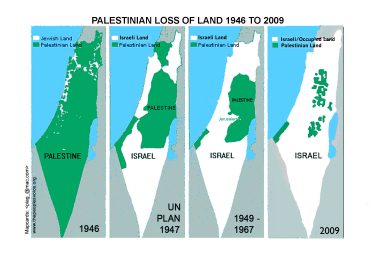
So, in this case, if this story is true, Obama and his team are as politically stupid as Trump and his, regarding Palestine at least. If this story is true, it means that years of studying in the highest academies of the empire and working in the highest levels of political power may only yield abysmal ignorance regarding one of the most important issues in the world.
Which is, in fact, quite possible.
In a meeting at the Left Forum last year, Andy Trimlett, who produced and directed the fine new documentary, 1948: Creation and Catastrophe (which I supported on Kickstarter), told of how he was able to get a Master’s degree in Middle East Studies from the University of Washington while learning virtually nothing about what the creation of Israel entailed. He’s not the only person I’ve heard that from.
So, in his acerbic tweet, the excellent British journalist Jonathan Cook may be (probably is) right in his skepticism regarding this New Yorker story, but he may also be underestimating the political vacuity of the “educated” American, especially regarding Palestine and Israel:
The New Yorker insults its readers’ intelligence with this article claiming that Obama officials only worked out – accidentally – in 2015 that Israeli settlements had taken over 60% of the West Bank. Who could have guessed what Israel was up to?! — Jonathan Cook (@Jonathan_K_Cook) July 10, 2018
Or:
2) The story is not true. Obama and Co. knew very well, all along, what Israel was doing, and they are now putting out this story—a flat-out lie–because… Well, maybe because after the Gaza massacre, with the tide turning among the Democratic constituency, to exacerbate the image of Trump as the absolute villain, etc., the Obama team, as an exemplar of establishment Democratic liberalism, wants to pose as naive innocents rather than the conscious collaborators with ethnic cleansing they were and still are. They really want The New Yorker’s readership to have that image of Obama as the one who continually “defied” Netanyahu, versus Trump who is now capitulating to him.
That, too, is a flat-out lie, as anyone who isn’t mis-educated into political stupidity by the media, the politicians, and the highest academies of the empire knows. The whole “Obama’s final act of defiance” punchline, which is in Entous’s voice, makes the story fake, even if it’s true. There was no series of “acts of defiance” by Obama, of which the lame-duck abstention on the Security Council resolution was the “final” one.
It’s fair to say, and to his credit, that Obama acted against Netanyahu’s wishes in accepting the Iran deal, which Trump has abrogated. And Obama made good noises, from early in his administration, about the dangers of Israeli settlement construction—which, of course, indicates that he knew about all those “systematic” problems before he discovered The Map. But he, like his predecessors, did nothing about it. He, like they, enabled and supported the systematic, two-state-destroying settlement of the West Bank, and continually supported Israel in whatever violence it wanted to do to the Palestinians—including bombing the crap out of them in Gaza, twice.
No slouch in that regard, Obama was the first American President to give bunker-buster bombs to Israel—secretly, precisely because he had publicly said Israel had to curtail settlement construction in exchange for such gifts and didn’t want it to be known that he was capitulating. He was also the first American President to demand that “Palestinians must recognize that Israel will be a Jewish state”—a new, gratuitous, and excessive demand, insisted upon by Netanyahu. The lame-duck abstention on the Security Council resolution cost Israel nothing. Overall, Obama’s Palestine-Israel policy, consistent with American policy over decades, was one of continual capitulation to the will of Israel–including specifically on settlements. That is not some new policy “put in place” by Donald Trump.
And, if the story is not true, then
Either:
2A) Adam Entous and The New Yorker—that oh-so-intelligent, sophisticated, and “reliable” journal—fully and sincerely believe the fake story the Obama people are putting out, and are communicating that bullshit to you in good faith, as what they think is true, in-depth knowledge of an important aspect of American foreign policy that you should have. In which case, Entous and The New Yorker are as stupid and gullible as any Trump supporter.
Or,
2B) Entous and The New Yorker know very well this is a fake story that Obama and his people are putting out, and they are consciously collaborating with them to get you to believe something they know to be untrue. (And the lite, bad faith version of this—that they can deny that they “know,” even if they suspect, the story is not true, because they take these— i.e., their—people at their word, share their objectives, and don’t ask too many questions—is no less deceptive and pernicious.)
Why would they do this? Because it’s the tortured-humanitarian version of Obama’s and the liberal Democrats’ implication in the colonization of Palestine that they want you to have. And because it helps enforce the fairy tale of how the good, progressively-intentioned American presidency under Obama has been completely overturned by the bad, anti-American-values presidency of Trump.
So, in any possible reading of this article, it’s a damning indictment of the liberal ideology embodied by Obama Democrats and/or by an iconic media outlet of highbrow culture. In any possible reading, someone’s a political fool. In option 1, it’s a true story, and Obama and his team were terribly ignorant fools who should not have been allowed near the responsibilities of the Presidency; in option 2, it’s a fake story, and Entous and The New Yorker have themselves either been fooled by, or are complicit in trying to fool you with, the Obama team’s mendacious attempt to create a false image of themselves, and a phony nostalgia about American politics. There is no option 3.
In all options, of course, the target of the tomfoolery is the audience, the likely reader of The New Yorker. Indeed, in option 2B, which gets Jonathan Cook’s vote (and mine) and is at least as likely as any other, the reader is the only one being fooled. The article, and the ideology, counts on the reader not noticing that these are its only possible—and all quite damning—meanings. Any reader who doesn’t notice this is totally captured within, and faked-out by, the ideology the article reproduces.
There’s no bigger problem in the United States today than the citizenry’s widespread mis-education into political gullibility, not to say stupidity, and it’s the height of foolishness to think this is only a problem of Republicans and rightists, of those who read Breitbart and not those who read The New Yorker, or of those who finish their education at high school and not those who get it finished off at one of the higher academies of the empire.
As I’ve said before, America is now a ship of fools, with a thousand captains barking fake orders. Reader, beware.
July 15, 2018
Posted by aletho |
Deception, Mainstream Media, Warmongering | Adam Entous, Frank Lowenstein, Israel, Obama, Palestine, The New Yorker, United States, Zionism |
Leave a comment

As we just discussed, some major news stories have recently dropped about what a horrible horrifying menace the Russian Federation is to the world, and as always I have nothing to offer the breathless pundits on CNN and MSNBC but my completely unsatisfied skepticism. My skepticism of the official Russia narrative remains so completely unsatisfied that if mainstream media were my husband I would already be cheating on it with my yoga instructor.
I do not believe the establishment Russia narrative. I do not believe that Donald Trump colluded with the Russian government to rig the 2016 election. I do not believe the Russian government did any election rigging for Trump to collude with. This is not because I believe Vladimir Putin is some kind of blueberry-picking girl scout, and it certainly isn’t because I think the Russian government is unwilling or incapable of meddling in the affairs of other nations to some extent when it suits them. It is simply because I am aware that the US intelligence community lies constantly as a matter of policy, and because I understand how the burden of proof works.
At this time, I see no reason to espouse any belief system which embraces as true the assertion that Russia meddled in the 2016 elections in any meaningful way, or that it presents a unique and urgent threat to the world which must be aggressively dealt with. But all the establishment mouthpieces tell me that I must necessarily embrace these assertions as known, irrefutable fact. Here are five things that would have to change in order for that to happen:
1. Proof of a hacking conspiracy to elect Trump.
The first step to getting a heretic like myself aboard the Russia hysteria train would be the existence of publicly available evidence of the claims made about election meddling in 2016, which rises to the level required in a post-Iraq invasion world. So far, that burden of proof for Russian hacking allegations has not come anywhere remotely close to being met.
How much proof would I need to lend my voice to the escalation of tensions between two nuclear superpowers? Mountains. I personally would settle for nothing less than hard proof which can be independently verified by trusted experts like the Veteran Intelligence Professionals for Sanity.
Is that a big ask? Yes. Yes it is. That’s what happens when government institutions completely discredit themselves as they did with the false narratives advanced in the manufacturing of support for the Iraq invasion. You don’t get to butcher a million Iraqis in a war based on lies, turn around a few years later and say “We need new cold war escalations with a nuclear superpower but we can’t prove it because the evidence is secret.” That’s not a thing. Copious amounts of hard, verifiable proof or GTFO. So far we have no evidence besides the confident-sounding assertions of government insiders and their mass media mouthpieces, which is the same as no evidence.
2. Proof that election meddling actually influenced the election in a meaningful way.
Even if Russian hackers did exfiltrate Democratic party emails and give them to WikiLeaks, if it didn’t affect the election, who cares? That’s a single-day, second-page story at best, meriting nothing beyond a “Hmm, interesting, turns out Russia tried and failed to influence the US election,” followed by a shrug and moving on to something that actually matters.
After it has been thoroughly proven that Russia meddled in the elections in a meaningful way, it must then be established that that meddling had an actual impact on the election results.
3. Some reason to believe Russian election meddling was unwarranted and unacceptable.
The US government, by a very wide margin, interferes in the elections of other countries far, far more than any other government on earth does. The US government’s own data shows that it has deliberately meddled in the elections of 81 foreign governments between 1946 and 2000, including Russia in the nineties. This is public knowledge. A former CIA Director cracked jokes about it on Fox News earlier this year.
If I’m going to abandon my skepticism and accept the Gospel According to Maddow, after meaningful, concrete election interference has been clearly established I’m going to need a very convincing reason to believe that it is somehow wrong or improper for a government to attempt to respond in kind to the undisputed single worst offender of this exact offense. It makes no sense for the United States to actively create an environment in which election interference is something that governments do to one another, and then cry like a spanked child when its election is interfered with by one of the very governments whose elections the US recently meddled in.
This is nonsense. America being far and away the worst election meddler on the planet makes it a fair target for election meddling by not just Russia, but every country in the world. It is very obviously moral and acceptable for any government on earth to interfere in America’s elections as long as it remains the world’s worst offender in that area. In order for Russia to be in the wrong if it interfered in America’s elections, some very convincing argument I’ve not yet heard will have to be made to support that case.
4. Proof that the election meddling went beyond simply giving Americans access to information about their government.
If all the Russians did was simply show Americans emails of Democratic Party officials talking to one another and circulate some MSM articles as claimed in the ridiculous Russian troll farm allegations, that’s nothing to get upset about. If anything, Americans should be upset that they had to hear about Democratic Party corruption through the grapevine instead of having light shed on it by the American officials whose job it is to do so. Complaints about election meddling is only valid if that election meddling isn’t comprised of truth and facts.
5. A valid reason to believe escalated tensions between two nuclear superpowers are worthwhile.
After it has been proven beyond a reasonable doubt that Russia did indeed meddle in the US elections in a meaningful way, and after it has then been proven beyond a reasonable doubt that Russia actually influenced election results in a significant way, and after the case has been clearly made that it was bad and wrong for Russia to do this instead of fair and reasonable, and after it has been clearly proven that the election meddling went beyond simply telling Americans the truth about their government, the question then becomes what, if anything, should be done about it?
If you look at the actions that this administration has taken over the last year and a half, the answer to that question appears to be harsh sanctions, NATO expansionism, selling arms to Ukraine, throwing out diplomats, increasing military presence along Russia’s border, a Nuclear Posture Review which is much more aggressive toward Russia, repeatedly bombing Syria, and just generally creating more and more opportunities for something to go catastrophically wrong with one of the two nations’ aging, outdated nuclear arsenals, setting off a chain of events from which there is no turning back and no surviving.
And the pundits and politicians keep pushing for more and more escalations, at this very moment braying with one voice that Trump must aggressively confront Putin about Mueller’s indictments or withdraw from the peace talks. But is it worth it? Is it worth risking the life of every terrestrial organism to, what? What specifically would be gained that makes increasing the risk of nuclear catastrophe worthwhile? Making sure nobody interferes in America’s fake elections? I’d need to see a very clear and specific case made, with a ‘pros’ and ‘cons’ list and “THE POTENTIAL DEATH OF LITERALLY EVERYTHING” written in big red letters at the top of the ‘cons’ column.
Rallying the world to cut off Russia from the world stage and cripple its economy has been been a goal of the US power establishment since the collapse of the Soviet Union, so there’s no reason to believe that even the people who are making the claims against Russia actually believe them. The goal is crippling Russia to handicap China, and ultimately to shore up global hegemony for the US-centralized empire by preventing the rise of any rival superpowers. The sociopathic alliance of plutocrats and intelligence/defense agencies who control that empire are willing to threaten nuclear confrontation in order to ensure their continued dominance. All of their actions against Russia since 2016 have had everything to do with establishing long-term planetary dominance and nothing whatsoever to do with election meddling.
Those five things would need to happen before I’d be willing to jump aboard the “Russia! Russia!” train. Until then I’ll just keep pointing to the total lack of evidence and how very, very far the CIA/CNN Russia narrative is from credibility.
July 14, 2018
Posted by aletho |
Fake News, Mainstream Media, Warmongering, Russophobia | United States |
Leave a comment
Charges against 12 Russian intelligence agents for allegedly hacking emails from the Democratic Party during the 2016 presidential election were announced by the U.S. Justice Department on Friday at the very moment President Donald Trump was meeting Queen Elizabeth II at Windsor Castle and just days before a summit between Trump and Russian President Vladimir Putin in Helsinki.
A central claim of Russia-gate has been that the Russian government with help from the Trump campaign stole emails from the Democratic Party and the Hillary Clinton campaign and then gave those emails to WikiLeaks for publication to damage Clinton’s quest for the White House.
Until Friday however, the investigation into the allegations had produced no formal indictment of Russian government interference in the election. Like previous U.S. government accusations against Russia for alleged election meddling, the indictment makes assertions without providing evidence. Under U.S. law, indictments are not considered evidence. And it is highly unlikely that the government will ever have to produce any evidence in court.
Friday’s indictments do not include any charges against Trump campaign members for allegedly colluding with the Russian government to carry out the hacks. That has been at the core of allegations swirling in U.S. media for two years. If the alleged co-conspirators “known” to the DOJ were on the Trump team, the indictments do not say. There is only a hint that “unknown” persons might be.
In announcing the indictments at a press conference Friday, Deputy Attorney General Rod Rosenstein said: “The conspirators corresponded with several Americans during the course of the conspiracy through the internet. There’s no allegation in this indictment that the Americans knew they were corresponding with Russian intelligence officers.”
The indictment alleges that Russian agents, posing as Guccifer 2.0, communicated on Aug. 15, 2016 with “a person who was in regular contact with senior members” of the Trump campaign, mostly like advisor Roger Stone, who has spoken about communicating with Guccifer 2.0. The indictment says Guccifer offered to “help u anyhow,” apparently indicating that Stone did want Guccifer 2.0’s help.
Clinging to ‘Collusion’
The lack of evidence that the Trump campaign was colluding with Russia has never stopped Democrats and their media outlets from believing unnamed U.S. intelligence sources for two years about such collusion. “Collusion” is the title of a best-selling book about the supposed Trump-Russia conspiracy to steal the election, but such a charge is not to be found.
The indictment excluding collusion also undermines the so-called Steele dossier, a work of opposition research paid for by the DNC and Clinton campaign masquerading as an intelligence document because it was compiled by a former MI6 agent. The memos falsely claimed, it turns out, that Trump’s people started colluding with Russia years before he became a candidate.
But even after Friday’s indictments failed to charge anyone from Trump’s team, the Democratic media continued to insist there was collusion. A New York Times story, headlined, “Trump Invited the Russians to Hack Clinton. Were They Listening?,” said Russia may have absurdly responded to Trump’s call at 10:30 a.m. on July 27, 2016 to hack Clinton’s private email server because it was “on or about” that day that Russia allegedly first made an attempt to hack Clinton’s personal emails, according to the indictment, which makes no connection between the two events.
If Russia is indeed guilty of remotely hacking the emails it would have had no evident need of assistance from anyone on the Trump team, let alone a public call from Trump on national TV to commence the operation.
Instead of Trump operatives, the indictments name 12 Russians, allegedly agents from the GRU, the Russian military intelligence agency. The agents “knowingly and intentionally conspired with each other, and with persons known and unknown to the Grand Jury (collectively the ‘Conspirators’), to gain unauthorized access (to ‘hack’) into the computers of U.S. persons and entities involved in the 2016 U.S. presidential election, steal documents from those computers, and stage releases of the stolen documents to interfere with the 2016 U.S. presidential election,” the 29-page indictment says.
“Starting in at least March 2016, the Conspirators used a variety of means to hack the email accounts of volunteers and employees of the U.S. presidential campaign of Hillary Clinton (the ‘Clinton Campaign’), including the email account of the Clinton Campaign’s chairman,” the indictment says.
Obvious Timing
The timing of the announcement was clearly intended to embarrass Trump as he was meeting the Queen and to undermine his upcoming meeting with Putin on July 16. The indictments may also have been meant to embarrass Russia two days before the World Cup final to be held in Moscow.
Pressure was immediately brought on Trump to cancel the summit in light of the indictments, which may have been the main aim in the timing of their announcement. “Glad-handing with Vladimir Putin on the heels of these indictments would be an insult to our democracy,” Senator Chuck Schumer (D-NY) said in a statement less than an hour after the indictments were announced. “President Trump should cancel his meeting with Vladimir Putin until Russia takes demonstrable and transparent steps to prove that they won’t interfere in future elections,” Schumer said.
With no apparent irony, The New York Times reported, “The timing of the indictment … added a jolt of tension to the already freighted atmosphere surrounding Mr. Trump’s meeting with Mr. Putin. It is all but certain to feed into the conspiratorial views held by the president and some of his allies that Mr. Mueller’s prosecutors are determined to undermine Mr. Trump’s designs for a rapprochement with Russia.”
Russia Denies
The Russian government on Friday strongly denied the charges. In a statement, the Foreign Ministry called the indictments “a shameful farce” that was not backed up by any evidence. “Obviously, the goal of this ‘mud-slinging’ is to spoil the atmosphere before the Russian-American summit,” the statement said.
The Ministry added that the 12 named Russians were not agents of the GRU.
“When you dig into this indictment … there are huge problems, starting with how in the world did they identify 12 Russian intelligence officers with the GRU,” said former CIA analyst Larry Johnson in an interview with Consortium News. Johnson pointed out that the U.S. Defense Intelligence Agency was not allowed to take part in the January 2017 Intelligence Community Assessment on alleged interference by the GRU. Only hand-picked analysts from the FBI, the NSA and the CIA were involved.
“The experts in the intelligence community on the GRU … is the Defense Intelligence Agency and they were not allowed to clear on that document,” Johnson said.
“When you look at the level of detail about what [the indictment is] claiming, there is no other public source of information on this ,and it was not obtained through U.S. law enforcement submitting warrants and getting affidavits to conduct research in Russia, so it’s clearly intelligence information from the NSA, most likely,” Johnson said.
CrowdStrike’s Role
The indictment makes clear the evidence of an alleged hack of the DNC and DCCC computers did not come from the FBI, which was never given access to the computers by the DNC, but instead from the private firm CrowdStrike, which was hired by the DNC. It is referred to as Company 1 in the indictment.
“Despite the Conspirators’ efforts to hide their activity, beginning in or around May 2016, both the DCCC and DNC became aware that they had been hacked and hired a security company (“Company 1”) to identify the extent of the intrusions,” the indictment says.
The indictment doesn’t mention it, but within a day, CrowdStrike claimed to find Russian “fingerprints” in the metadata of a DNC opposition research document, which had been revealed by DCLeaks, showing Cyrillic letters and the name of the first Soviet intelligence chief. That supposedly implicated Russia in the hack.
CrowdStrike claimed the alleged Russian intelligence operation was extremely sophisticated and skilled in concealing its external penetration of the server. But CrowdStrike’s conclusion about Russian “fingerprints” resulted from clues that would have been left behind by extremely sloppy or amateur hackers–or inserted intentionally to implicate the Russians.
One of CrowdStrike’s founders has ties to the anti-Russian Atlantic Council raising questions of political bias. And the software it used to determine Russia’s alleged involvement in the DNC hack, was later proved to be faulty in a high-profile case in Ukraine, reported by the Voice of America.
The indictment then is based at least partially on evidence produced by an interested private company, rather than the FBI.
Evidence Likely Never to be Seen
Other apparent sources for information in the indictment are intelligence agencies, which normally create hurdles in a criminal prosecution.
“In this indictment there is detail after detail whose only source could be intelligence, yet you don’t use intelligence in documents like this because if these defendants decide to challenge this in court, it opens the U.S. to having to expose sources and methods,” Johnson said.
If the U.S. invoked the states secret privilege so that classified evidence could not be revealed in court a conviction before a civilian jury would be jeopardized.
Such a trial is extremely unlikely however. That makes the indictment essentially a political and not a legal document because it is almost inconceivable that the U.S. government will have to present any evidence in court to back up its charges. This is simply because of the extreme unlikelihood that arrests of Russians living in Russia will ever be made.
In this way it is similar to the indictment earlier this year of the Internet Research Agency of St. Petersburg, Russia, a private click bait company that was alleged to have interfered in the 2016 election by buying social media ads and staging political rallies for both Clinton and Trump. It seemed that no evidence would ever have to back up the indictment because there would never be arrests in the case.
But Special Counsel Robert Mueller was stunned when lawyers for the internet company showed up in Washington demanding discovery in the case. That caused Mueller to scramble and demand a delay in the first hearing, which was rejected by a federal judge. Mueller is now battling to keep so-called sensitive material out of court.
In both the IRA case and Friday’s indictments, the extremely remote possibility of convictions were not what Mueller was apparently after, but rather the public perception of Russia’s guilt resulting from fevered media coverage of what are after all only accusations, presented as though it is established fact. Once that impression is settled into the public consciousness, Mueller’s mission would appear to be accomplished.
For instance, the Times routinely dispenses with the adjective “alleged” and reports the matter as though it is already established fact. It called Friday’s indictments, which are only unproven charges, as “the most detailed accusation by the American government to date of the [not alleged] Russian government’s interference in the 2016 election, and it includes a litany of [not alleged] brazen Russian subterfuge operations meant to foment chaos in the months before Election Day.”
GRU Named as WikiLeak’s Source
The indictment claims that GRU agents, posing as Guccifer 2.0, (who says he is a Romanian hacker) stole the Democratic documents and later emailed them to WikiLeaks, named as “Organization 1.” No charges were brought against WikiLeaks on Friday.
“After failed attempts to transfer the stolen documents starting in late June 2016, on or about July 14, 2016, the Conspirators, posing as Guccifer 2.0, sent Organization 1 an email with an attachment titled ‘wk dnc linkl.txt.gpg,’” the indictment says. “The Conspirators explained to Organization 1 that the encrypted file contained instructions on how to access an online archive of stolen DNC documents. On or about July 18, 2016, Organization 1 confirmed it had ‘the 1Gb or so archive’ and would make a release of the stolen documents ‘this week.’”
WikiLeaks founder and editor Julian Assange, who is in exile in the Ecuador embassy in London, has long denied that he got the emails from any government. Instead Assange has suggested that his source was a disgruntled Democratic Party worker, Seth Rich, whose murder on the streets of Washington in July 2016 has never been solved.
On Friday, WikiLeaks did not repeat the denial that a government was its source. Instead it tweeted: “Interesting timing choice by DoJ today (right before Trump-Putin meet), announcing indictments against 12 alleged Russian intelligence officers for allegedly releasing info through DCLeaks and Guccifer 2.0.”
Assange has had all communication with the outside world shut off by the Ecuadorian government two months ago.
Since the indictments were announced, WikiLeaks has not addressed the charge that GRU agents, posing as Guccifer 2.0, were its source. WikiLeaks’ policy is to refuse to disclose any information about its sources. WikiLeaks’ denial that the Russian government gave them the emails could be based on its belief that Guccifer 2.0 was who he said he was, and not what the U.S. indictments allege.
Those indictments claim that the Russian military intelligence agents adopted the personas of both Guccifer 2.0 and DCLeaks to publish the Democratic Party documents online, before the Russian agents, posing as Guccifer 2.0, allegedly supplied WikiLeaks.
The emails, which the indictment does not say are untrue, damaged the Clinton campaign. They revealed, for instance, that the campaign and the Democratic Party worked to deny the nomination to Clinton’s Democratic Party primary challenger Bernie Sanders.
The indictments also say that the Russian agents purchased the use of a computer server in Arizona, using bitcoin to hide their financial transactions. The Arizona server was used to receive the hacked emails from the servers of the Democratic Party and the chairman of Clinton’s campaign, the indictment alleges. If true it would mean the transfer of the emails within the United States, rather than overseas, presumably to Russia.
Some members of the Veterans’ Intelligence Professionals for Sanity argue that metadata evidence points to a local download from the Democratic computers, in other words a leak, rather than a hack. They write the NSA would have evidence of a hack and, unlike this indictment, could make the evidence public: “Given NSA’s extensive trace capability, we conclude that DNC and HRC servers alleged to have been hacked were, in fact, not hacked. The evidence that should be there is absent; otherwise, it would surely be brought forward, since this could be done without any danger to sources and methods.”
That argument was either ignored or dismissed by Mueller’s team.
The Geopolitical Context
It is not only allies of Trump, as the Times thinks, who believe the timing of the indictments, indeed the entire Russia-gate scandal, is intended to prevent Trump from pursuing detente with nuclear-armed Russia. Trump said of the indictments that, “I think that really hurts our country and it really hurts our relationship with Russia. I think that we would have a chance to have a very good relationship with Russia and a very good chance — a very good relationship with President Putin.”
There certainly appear to be powerful forces in the U.S. that want to stop that.
After the collapse of the Soviet Union in 1991, Wall Street rushed in behind Boris Yeltsin and Russian oligarchs to asset strip virtually the entire country, impoverishing the population. Amid widespread accounts of this grotesque corruption, Washington intervened in Russian politics to help get Yeltsin re-elected in 1996. The political rise of Vladimir Putin after Yeltsin resigned on New Year’s Eve 1999 reversed this course, restoring Russian sovereignty over its economy and politics.
That inflamed American hawks whose desire is to install another Yeltsin-like figure and resume U.S. exploitation of Russia’s vast natural and financial resources. To advance that cause, U.S. presidents have supported the eastward expansion of NATO and have deployed 30,000 troops on Russia’s border.
In 2014, the Obama administration helped orchestrate a coup that toppled the elected government of Ukraine and installed a fiercely anti-Russian regime. The U.S. also undertook the risky policy of aiding jihadists to overthrow a secular Russian ally in Syria. The consequences have brought the world closer to nuclear annihilation than at any time since the Cuban missile crisis in 1962.
In this context, the Democratic Party-led Russia-gate appears to have been used not only to explain away Clinton’s defeat but to stop Trump — possibly via impeachment or by inflicting severe political damage — because he talks about cooperation with Russia.
Joe Lauria is editor-in-chief of Consortium News and a former correspondent for The Wall Street Journal, Boston Globe, Sunday Times of London and numerous other newspapers. He can be reached at joelauria@consortiumnews.com and followed on Twitter @unjoe .
July 14, 2018
Posted by aletho |
Deception, Fake News, Mainstream Media, Warmongering, Russophobia | Chuck Schumer, CIA, DNC, FBI, NATO, New York Times, NSA, United States |
Leave a comment

If FBI agent Peter Strzok were not so glib, it would have been easier to feel some sympathy for him during his tough grilling at the House oversight hearing on Thursday, even though his wounds are self-inflicted. The wounds, of course, ooze from the content of his own text message exchange with his lover and alleged co-conspirator, Lisa Page.
Strzok was a top FBI counterintelligence official and Page an attorney working for then-FBI Deputy Director Andrew McCabe. The Attorney General fired McCabe in March and DOJ has criminally referred McCabe to federal prosecutors for lying to Justice Department investigators.
On Thursday members of the House Judiciary and Oversight/Government Reform Committees questioned Strzok for eight hours on how he led the investigations of Hillary Clinton’s unauthorized emails and Donald Trump’s campaign’s ties with Russia, if any.
Strzok did his best to be sincerely slick. Even so, he seemed to feel beleaguered — even ambushed — by the questions of Republicans using his own words against him. “Disingenuous” is the word a Republican Congresswoman used to describe his performance. Nonetheless, he won consistent plaudits from the Democrats. He showed zero regret for the predicament he put himself into, except for regret at his royal screw-up in thinking he and Lisa could “talk about Hillary” (see below) on their FBI cellphones and no one would ever know. One wag has suggested that Strzok may have been surreptitiously texting, when he should have been listening to the briefing on “Cellphone Security 101.”
In any case, the chickens have now come home to roost. Most of those chickens, and Strzok’s predicament in general, are demonstrably the result of his own incompetence. Indeed, Strzok seems the very embodiment of the “Peter Principle.” FBI agents down the line — that is, the non-peter-principle people — are painfully aware of this, and resent the discredit that Strzok and his bosses have brought on the Bureau. Many are reportedly lining up to testify against what has been going on at the top.
It is always necessary at this point to note that the heads of the FBI, CIA, NSA and even the Department of Justice were operating, as former FBI Director James Comey later put it, in an environment “where Hillary Clinton was going to beat Donald Trump.” Most of them expected to be able to stay in their key positions and were confident they would receive plaudits — not indictments — for the liberties that they, the most senior U.S. law enforcement officials, took with the law. In other words, once the reality that Mrs. Clinton was seen by virtually everyone to be a shoo-in is taken into account, the mind boggles a lot less.
Peter Principle
In a text sent to Page on April 2, 2016, Strzok assured her that it was safe to use official cellphones. Page: “So look, you say we text on that phone when we talk about Hillary because it can’t be traced.” It goes downhill from there for the star-crossed lovers.
Pity Page, who asked for more time to answer a subpoena to testify to the same joint-committee. It is understandable that she would have trusted Strzok on this. After all, he was not only her lover, but also one of the FBI’s top counterintelligence officials.
How could she ever have expected to taste the bitter irony that the above text exchange could be retrieved, find its way to the Department of Justice Inspector General, to Congress, and then to the rest of us, not to mention far more incriminating exchanges.
The ‘Hillary Dispensation’
There were moments of high irony at Thursday’s hearing. For example, under questioning by Darrell Issa (R-CA), Strzok appealed, in essence, for the same kid-gloves treatment that his FBI and DOJ associates afforded Mrs. Clinton during the Strzok-led investigation of her emails.
Issa: Mr. Strozk, you were part of the Hillary Clinton email investigation, that’s correct?
Strzok: Yes.
Issa: And in that investigation, uh, you were part of the decision for her to, uh, and her lawyers, to go through emails that were produced during, uh, you, if you will, during her time as Secretary, go through and determine which ones were Government, and which ones were not, both the classified and unclassified, is that correct?
Strzok: I was not.
Issa: You were not involved at all.
Strzok: That’s correct.
Issa: But you’re aware of it.
Strzok: I.. I’m aware of their statements to us about how they did it.
Issa: And do you think it was ok, uh, for Secretary Clinton to determine what could or couldn’t, uh, uh, qualify for her to turn in under the Federal Records Act?
Strzok: I, I can’t speak to that. That was a decision, my understanding between her and her attorneys, and…
Issa: Ok, but you were aware that in her production she failed to deliver some items that’ve now been ruled were classified, is that correct?
Strzok: I’m aware that we recovered information that was not in the material that she turned over. I don’t know if it was her failure, the failure of the attorneys conducting that sort, or simply because she didn’t have it. I, I don’t know the answer to that question.
Issa: So, I bring up something that came up in the previous round. So far, only you have determined what should be turned over from your private emails, that, or your non-government emails and texts, what should be delivered because it was government in nature. You’ve made that decision.
Strzok: That’s right.
Issa: And it’s your position that nobody else in the way of a government entity should be able to look over your shoulder, so to speak, and make that decision.
Strzok: That, that’s right.
Issa: So you think it’s ok for the target — and you are a target — of an investigation to determine what should be delivered rather than, if you will, the government, right?
Strzok: Sir, I am not aware of any investigation of which I am a target, not aware I’m a target of any investigation.
At this point Issa tells Strzok he is indeed a target of investigation by Congress. More importantly, Issa makes the point that the content of the texts exchanged on the FBI phones contained a mixture of official business and personal matters.
So why, asks Issa, should we not ask you to provide similar texts from your personal exchanges, since there is likely to be a similar mixture of official and personal matters in those texts? Issa suggests they likely “would be similar.”
Strzok asks if, by “similar,” Issa means “commenting on Mr. Trump or Hillary Clinton or anything else political in nature.” Strzok then adds, “I don’t specifically recall but it is probably a safe assumption.”
Uh oh.
Strzok: No Good Options
If Strzok was distracted by texting during the standard briefing on “NSA Capabilities:101,” he may have missed the part about NSA collecting and storing everything that goes over the Internet. That would include, of course, his private text messages with Page on private phones.
There is, admittedly, a very slim chance Strzok is unaware of this. But, given his naiveté about how well protected the texts on his FBI cellphone were, that possibility cannot be ruled out. In any case, given the high stakes involved, there seems a chance he might be tempted to follow Mrs. Clinton’s example with her emails and try to delete or destroy texts that provide additional incriminating evidence — or get someone else to do so.
More probably, after Thursday’s hearing, Strzok will see it as too late for him to try to cash in on the “Hillary Exemption.” Strzok, after all, is not Hillary Clinton. In addition, it has probably long since dawned on him that his FBI and DOJ co-conspirators may well decide to “throw him under the bus,” one of those delicate expressions we use in Washington. In this connection, Strzok will have noted that last month McCabe asked the Senate Judiciary Committee to give him immunity from prosecution in return for his testimony on how senior officials at the FBI and Justice Department handled the investigation of Mrs. Clinton’s private email server.
If McCabe knows FBI history, he is aware that one of his predecessors as acting director, L. Patrick Gray, famously was left to “twist slowly in the wind” per the instructions of President Richard Nixon’s aide John Ehrlichman, when the Senate Judiciary Committee could not get satisfactory answers from Gray.
Nixon had nominated Gray to lead the FBI after J. Edgar Hoover died in May 1972, but he could never get confirmed by the Senate. Worse still, Gray was forced to resign after less than a year as acting FBI director, after he admitted to having destroyed Watergate-related documents.
Predictable Media Spin
The “mainstream media” remain the main obstacle to understanding what is going on behind the scenes. It would be easier to forgive them, were not a full-blown Constitutional crisis brewing the Executive and Legislature branches, as the DOJ and FBI continue to resist Congress’s requests for original documents. Former CIA chief John Brennan is also being given space to indulge in pre-emptive rhetoric that he apparently thinks will help when they get to him.
The New York Times reported Friday that “Peter Strzok … was hauled before the House but came out swinging. … The embattled F.B.I. agent who oversaw the opening of the Russia investigation mounted an aggressive defense of himself and the F.B.I. on Thursday, rejecting accusations that he let his private political views bias his official actions and labeling Republicans’ preoccupation with him ‘another victory notch in Putin’s belt.’”
The Potomac Times (aka The Washington Post) ran similarly laudatory coverage of Strzok — “Strzok testifies amid partisan fury: heated hearing sheds little light as agent fumes at accusations of FBI bias” — and laced its coverage with a defamatory article about Rep. Jim Jordan (R-OH), who led the most aggressive Republican questioning of Strzok.
According to the Times, Jordan is “under withering scrutiny as he faces numerous accusations that he knew or should have known about the alleged sexual misconduct of a doctor who worked with the Ohio State wrestling team when Jordan was an assistant coach there between 1986 and 1995.” The Times goes on to quote House Minority Leader Nancy Pelosi (D-CA): “Well, many people say that he did know and by his own standard, he should have known.”
And, sadly, do not look to so-called progressive media for more balanced reporting. For example, Democracy Now! Friday morning chose to highlight Strzok’s tortured explanation of what he really meant when he told Page, “We will stop” Trump. Strzok says the “we” he referred to was “the American population [which] would not elect somebody” who behaves like Trump. The context of that text exchange, however, makes it clear who the “we” is — or was.
Finally, for those with the courage to dissect and explain Strzok’s testimony to neighbors still drinking Russia-gate Kool-Aid, please note that Strzok’s name is easier to say, than to spell. It is pronounced “struck” like “dumbstruck,” or — equally applicable in Strzok’s circumstances — “Moonstruck.” Those watching Thursday’s hearing will have noticed that not all members of the House Judiciary and Oversight/Government Reform Committees had gotten the word on how to pronounce what may now become a household word.
Ray McGovern works with Tell the Word, a publishing arm of the ecumenical Church of the Saviour in inner-city Washington. A former U.S. Army officer and CIA analyst, he has closely watched Washington goings-on like this for five decades. Ray co-created Veteran Intelligence Professionals for Sanity (VIPS).
July 13, 2018
Posted by aletho |
Deception, Mainstream Media, Warmongering | Democracy Now!, FBI, Hillary Clinton, United States |
Leave a comment
An article written by Jonathan Chait of New York Magazine has been making the rounds of the Twitterverse since its publication Monday. Described by former CIA officer and anti-Trump 2016 presidential candidate Evan McMullin as “the best summary and assessment of publicly known facts regarding the nature of President Trump’s relationship with Moscow so far,” the article seeks to lay out in systematic fashion the allegation that Donald Trump is a compromised Russian asset, since as early as 1987.
Blasted by many as kooky and unfit for a mainstream publication, Chait is clear in explaining that he does not accept the ‘Trump as Russian Asset’ story as conclusive. The opening of the article is written as an analogy comparing the whole collusion allegation as “like walking into a dark cavern.” Chait wishes to hold up a lantern and peer deeper into the cave for what might be there. On Twitter he concedes that the whole story could “go nowhere” and Trump’s professed innocence “might well be true.” He only wants to “explore the unlikely scenario on the other side.” In a separate tweet, Chait calls the accusations that Intercept journalist Glenn Greenwald is on the financial take from Russia “totally nuts.” Taking Chait at his word, his article can be taken as unsubstantiated hypothesizing from a viewpoint of honest commentary, separate from the peanut gallery of cranks like Louise Mensch and Seth Abramson. At the same time, he pegs the odds that “the president of the United States has been covertly influenced or personally compromised by a hostile foreign power for decades” at 10 to 20%—higher than the odds many publications gave Trump of even winning the presidency.
While others may combat specific factoids and details in Chait’s unverified theory, it is equally important to address the point of view it is written from. All commentary is inherently biased, but too often in the modern age journalists attempt to write as objective beings without presuppositions. Chait’s commentary is typical of liberal, mainstream elites. It has a deep deference for established institutions (no matter their track records), an acceptance that America has a duty (or even a right) to global hegemony, and that the foreign policy of military empire used to uphold this hegemony is fundamentally good. When you are writing from the top of the world, you are going to be hostile to any view that is more earthbound.
While still writing the introduction, Chait makes two points that are worth expanding before moving on to the body of the article. In the very first paragraph, Chait mentions that in the midst of the 2016 presidential campaign “Russia was already broadcasting its strong preference for Trump through the media.” He links to a Politico Europe article that cites RT programing hosts like the recently-deceased Ed Shultz and television staple Larry King, along with online articles published at RT that were sympathetic to Trump’s campaign. This proposition that Russian media was in the bag for Trump is contradicted by the media actually in Russia, which both adheres closer to the official Kremlin line and has a much more influential following than RT’s foreign broadcasts. The positions expressed here, on Russia’s No. 1 talk show for instance, were much more skeptical of both Donald Trump’s sincerity and governing ability.
Secondly, he makes an all-too-true observation that is ignored all-too-often. “Conspiracy theories tend to attract people far from the corridors of power, and they often hypothesize vast connections within or between governments and especially intelligence agencies. One of the oddities of the Russia scandal is that many of the most exotic and sinister theories have come from people within government and especially within the intelligence field.” Whether or not someone has legitimacy as an intrepid investigator of dominant narratives or is viewed as a baseless theorizer of nonexistent conspiracies does not depend on their honesty or how many facts they can document. If a conspiracy theory originates from within the political center as a defense of the status quo, none dare call it conspiracy. Perhaps this is a legacy of the term’s underhanded creation. Chait’s unintentional acknowledgement of this double standard is helpful in identifying “Russiagate” as uniquely separate from theories generating on the fringe. Not due to any factual basis, but because of narrative difference.
The former intelligence official Chait trots out as an example is John O. Brennan, who has gone on the record saying there is something fishy about the Trump-Russia relationship that might even breach on treasonous. “While the fact that the former CIA director has espoused this theory hardly proves it, perhaps we should give more credence to the possibility that Brennan is making these extraordinary charges of treason and blackmail at the highest levels of government because he knows something we don’t.” Contrary to that impression, Brennan’s statements should make one very skeptical. Or at least that’s the logical conclusion of anyone outside the establishment groupthink previously described. If the former CIA director knows something the public doesn’t, why has no action been taken? If there is solid, irrefutable evidence that Donald Trump has been compromised by a foreign power, why is John Brennan keeping it secret? Congress should be alerted, and Vice President Pence sworn in under the Twenty-fifth Amendment. But in two years since the original start of the investigation, Brennan has presented no such evidence. In fact, using Brennan as the example shows how blind one can be when only seeing life through the establishment paradigm. As CIA director, John Brennan not only provided a real-guard defense of torture, but oversaw U.S. military aid to Syrian jihadists allied with Al-Qaeda. If Donald Trump is a traitor to his country, what does that make Brennan and his aiding and abetting of America’s sworn enemy? The actions of the Obama administration are widely sourced and admitted by public officials, but Chait pays no mind. That’s because people like Chait don’t see crimes committed in defense of the empire as real crimes.
Chait opens his chronology in the year 1987, when Donald Trump both visited Moscow on a business trip and began voicing open political sentiments. Trump’s comments focused on the United States’ relationship with its allies, saying Americans were getting a raw deal. “The safest assumption is that it’s entirely coincidental that Trump launched a national campaign, with himself as spokesman, built around themes that dovetailed closely with Soviet foreign-policy goals shortly after his Moscow stay.” Chait is nothing short of duplicitous here, admitting that the whole premise reaches nothing above coincidental while simultaneously trying to poison the waters. As Trump said, why shouldn’t countries that can afford to defend themselves do so? Why does the burden fall on the American taxpayer to defend the economically rich people of Germany and Japan? The answer, Chait says, is to defend the “liberal international order” of the postwar era. An order that requires U.S. military domination of the planet. Having other countries defend themselves would take away from U.S. preeminence, and most importantly, U.S. power. The idea of Americans protecting America only would at first glance to be the logical, even pro-American answer. But it is certainly the anti-hegemony answer, and to Chait that puts it in the category of a pro-Soviet goal.
In a single sentence, Chait tries to both summarize and dismiss the downturn in Russian-American relations that accelerated during Barack Obama’s second term. “During the Obama administration, Russia grew more estranged from the United States as its aggressive behavior toward its neighbors triggered hostile responses from NATO.” Perhaps it would be unreasonable to expect Chait to detail Russian relations with the West over the past 25 years, such as NATO expansion eastward in contradiction to previous promises, the U.S. withdraw from the Anti-Ballistic Missile Treaty in 2002, or the 2008 Russo-Georgian War with violence initiated by the latter. But to not only ignore the February 2014 coup in Ukraine that initiated recent hostilities between the U.S. and Russia, but to also put the blame on the latter’s “aggressive behavior,” is at best laughable and at worst dishonest. In February of 2014 the democratically elected government of Ukraine was overthrown in a coup orchestrated by the United States government, an event Chait and his peers do their best to forget. Russia’s subsequent annexation of the Crimean Peninsula (containing the Russian naval base at Sevastopol) was a wholly reactive measure. To say the recent estrangement was triggered by anything else than western aggressive behavior is factually inaccurate.
A deep-dive into Paul Manafort’s past relationships fills the middle of the article, along with Chait’s biased perceptions. “This much was clear in March 2016: The person [Manafort] who managed the campaign of a pro-Russian candidate in Ukraine was now also managing the campaign of a pro-Russian candidate in the United States.” What makes Donald Trump pro-Russian? “Well I hope that we do have good relations with Russia. I say it loud and clear, I’ve been saying it for years. I think it’s a good thing if we have great relationships, or at least good relationships with Russia. That’s very important,” says the President. Donald Trump has not proposed any kind of military alliance with Russia, giving it financial aid of any kind, or granting it favored-nation status. Simply to want “good” relations with a country is enough to be pro-Russian, in Chait’s characterization. Does that make Trump pro-any country he doesn’t wish to bomb? Is Donald Trump equally pro-Peruvian, pro-Nepalese, and pro-Tanzanian as he is pro-Russian? Shouldn’t it be the proper view of the United States to try to have good working relations with all foreign powers, especially if that power has thousands of stockpiled nuclear weapons? A better description of that view would be pro-American.
It is important to emphasize and explain these seemingly small choices of language because of how much they reveal of Chait’s worldview. When one believes that patriotism and defense of empire must be synonymous, and that skepticism of international conflict implies sympathy with a foreign power, it is easy to see why someone would seek out the most nefarious answer. Chait is willing to overlook obvious, mundane explanations to imply Trump has committed wrong because to Chait, he already has by opposing the international order’s chosen script. “It is possible to construct an innocent explanation for all the lying and skulduggery [sic], but it is not the most obvious explanation. More likely, collusion between the Russians and the Trump administration has continued beyond the campaign.” Or, perhaps, politics is naturally a game for liars and the political world is specially made to house them. “Why would Manafort, who has a law degree from Georgetown and years of experience around white-collar crime, behave like this? Of all those in Trump’s camp, he is the furthest thing from a true believer, and he lacks any long-standing personal ties to the president or his family, so what incentive does he have to spend most or all of his remaining years in prison rather than betray Trump?” The most obvious answer would seem to be that there is nothing to betray; if there is no grand conspiracy of Russian collusion, Manafort has not spilled the beans for any reason more inexplicable than there is nothing to spill. Or if that’s too boring, there’s always the answer Chait is giddy to suggest. “One way to make sense of his behavior is the possibility that Manafort is keeping his mouth shut because he’s afraid of being killed.” Creativity knows no bounds.
Chait seeks comfort in those who might be even further down the establishment paradigm than he is. He describes an exchange between House Speaker Paul Ryan and House Majority Leader Kevin McCarthy in the summer of 2016 where they joke about Trump and California Congressman Dana Rohrabacher being on Russian President Vladimir Putin’s payroll. While criticizing the GOP leaders’ joke as in bad taste, he describes the foreign policy positions taken by Rohrabacher. He once again uses the phrase “pro-Russian” to describe them, falling into the same verbal trap as before. Of interest, Chait mentions Rohrabacher’s denouncement of U.S. opposition to the Crimean annexation as “hypocrisy” considering America’s foreign policy. The implication is that this is some sort of hokum, but it is nothing more than showing American self-awareness. Verbal reproaches to Russia by the U.S. government are drown out by the facts, including the overthrow of the Ukrainian government just days before Russian actions in Crimea, and the 2003 invasion of Iraq which stands to this day as the biggest crime of the 21st century. But when one is an empire, the indispensable nation, rules just don’t apply to it like they do to other, lesser countries. “He [Rohrabacher] is widely suspected of having an ulterior motive.” What Chait means is his cocktail party peers widely suspect it.
What follows is a description of Trump’s actions as President regarding Russia, which seem to belie Chait’s point of a special closeness. Trump was apparently “apoplectic” when political realities compelled him to sign new sanctions on Russia in the summer of 2017. Since those sanctions ran counter to the explicit platform Trump campaigned and won on, that would seem to be a normal reaction to any policy reversal. Trump says he thinks Russia should be allowed back into the G7. The idea that a geopolitical power player that approaches nuclear parity with the United States should be involved in such a global forum doesn’t require further explanation. During that G7 conference Trump expressed the belief that Crimea rightfully belongs to Russia because the people there speak Russian. He’s not wrong; the people of Crimea are ethnically Russian, speak the language, and culturally identify with Russia proper. The people of Crimea should have the right to vote in a fair, internationally monitored referendum on whether to be a part of Ukraine or Russia. That’s the right of self-determination, an American goal if there ever was one. Chait says Putin engineered the end of the U.S.-South Korea military exercises during the recent negotiations with North Korea. Such an insinuation, outright ignoring the months of talks that have been taking place between North and South Korea, the stated goals of the Moon Jae-in administration, and South Korean public opinion, is naïve to the highest degree. That sort of western-centric view, that the United States is always the decision maker, is further proof of the establishment imperialistic mindset Chait has written his entire article from. He concludes with the foreboding note that Trump is about to meet with Putin in a special summit next month. Somehow Trump meeting with Putin 19 months into his presidential term is scandalous, while George Bush meeting Putin 5 months into his term, and Barack Obama 6 months into his term (in Moscow no less!) garnered so such suspicious coverage.
Chait, to his credit, almost makes it through the entire article without pulling out one of the most overused, most debunked storylines of “Russiagate.” The storyline that anyone who says Russia was not behind the 2016 Democratic National Committee hack (or leak) is “… contradicting the conclusion of every U.S. intelligence agency.” That conclusion was reached not by the U.S. intelligence community but handpicked analysts from only four of seventeen agencies. “But who is bending the president’s ear to split the Western alliance and placate Russia?… His motive for these foreign-policy moves is obviously strong enough in his mind to be worth prolonging an investigation he is desperate to terminate.” It cannot be that good relations with Russia is self-evidently beneficial to the United States, or that Donald Trump is a genuine believer in that policy. Jonathan Chait is so enamored with established Washington foreign policy that no disagreement can be anything other than odious.
To reiterate, Jonathan Chait is not convinced that what he wrote is the truth. He admits that there is no conclusive evidence that Donald Trump was a Russian intelligence asset in 1987 or any other year. But what he is convinced about is the utility of the U.S. led liberal world order imposed at the point of a gun. The biases of his language towards permanent military hegemony run through his writing. This leads to the discoloring or even misrepresentation of the facts.
Hunter DeRensis is a senior at George Mason University majoring in History and minoring in Public Policy & Administration. You can follow him on Twitter [@HunterDeRensis]
July 13, 2018
Posted by aletho |
Mainstream Media, Warmongering, Russophobia | United States |
Leave a comment