The Rapidly Evolving Skripal Story: Evidence of the Destruction of an Anglo-American Plan
By James O’Neill | OffGuardian | April 7, 2018
On 4th of March 2018 former Russian intelligence officer Sergei Skripal and his 33-year-old daughter Yulia were found on a park bench in Salisbury England at 16. 15 hours in an unconscious state.
They were tended to by a number of passers by who included a doctor, an off duty nurse and some civilians. It was not known at that stage what had caused the Skripal’s illness. No one had any reason to believe that they were the victims of any nerve agent, and accordingly took no precautions against such a possibility. Despite the very well documented dangers of even casual contact with nerve agents, none of those helpful citizens suffered any ill-effects.
The Skripals were taken to hospital where they have remained ever since. The public were told that they were both in a coma and unable to communicate in any way. Yet on the morning of 7 March 2018 Yulia Skripal accessed the Russian equivalent of her Facebook page (VKontakte).
There are a number of possible explanations for this. She may have briefly returned to consciousness and her first thought was to access VKontakte before relapsing. Alternatively her VK could have been hacked, but that would not have been easy and there is no known evidence to support this possibility. A third possibility, implicit in the words of her treating physician, was that she “came to her senses.” Precisely what that meant is unclear because it was never elaborated upon.
The hospital authorities have disclosed that Yulia is now fully awake, eating, drinking and talking, these and other questions may be able to be asked and answered. Precisely what we are told about Yulia’s answers depends upon who is allowed to talk to her. Another of the disturbing aspects of this case is that none of her family, her fiancé, or the Russian consulate authorities has been permitted access.
This latter fact is directly contrary to the provisions of the 1963 Vienna Convention on Consular Relations. The British have pretended that this did not apply to Ms Skripal as she was a Russian national (unlike Sergei who had dual British citizenship) because article 37 of the Convention had not been incorporated into English law.
The judge who heard an application for the taking of blood samples came to this conclusion, apparently without reference to, or being advised by counsel acting for the Skripals on behalf of the British government, that there was in fact a consular treaty between the then Soviet Union and Britain. This treaty was ratified in 1968 and specifically provides for the right of consular access. Article 36 of the treaty provides:
(1) (a) A consular officer shall be entitled within the consular district to communicate with, interview and advise a national of the sending state and it may render him every assistance including, where necessary, arranging for aid and advice in legal matters.
(b) No restriction shall be placed by the receiving state upon the access of a national of the sending state to the consulate or upon communication by him with the consulate.
Notwithstanding this provision, which as the terminology makes clear, is not optional but mandatory, the British continue you to refuse the Russian consular staff their lawful access to the Skripals.
In that same court case (NoB228376 & 13228382 [2018] EWCOP 6 Judgement 22 March 2018) the judge was also apparently not told by counsel that while the Skripals “appeared to have some relatives in Russia” they had not been advised of the application before the court and neither were the Russian authorities. According to the judgement the Russians would find out about the court case after the event because the judge intended to publish his findings!
Ms Skripal does not just “appear” to have relatives in Russia. She has her grandmother and also a fiancé with whom she was living. She also has a cousin, Victoria, with whom she has recently had a conversation according to Russian TV that has released a transcript of the discussion.
The Russian authorities have also released copies of multiple requests made to the British government for consular access and other information. Not only were the requests ignored, contrary to the treaty quoted above, but the judge was not even informed that such requests had been made.
The judgement ordering the taking of blood samples from the Skripals was for the purposes of technical analysis to try and determine what caused their illness, from whence the presumed nerve agent had originated, and possibly identified who might be responsible. Then again it might not, for a host of technical reasons.
The point here however, is that the order was made on 22 March 2018 when the answers to those key questions were not known, unless of course the British themselves or one of their allies were the perpetrators. Both the Police who were inquiring into what was a possible attempted homicide, and the scientific investigation by both Porton Down and the technical team at the OCPW to whom the matter was eventually referred, said that the results would take some time and possibly weeks.
Yet on 14 March 2018, one week before the judgement, and weeks before the scientific results could possibly be known, British prime minister Therese May was telling the House of Commons that the culprit was a nerve agent “of a type developed by Russia” that had been used, and that it was “an unlawful use of force by the Russian State against the United Kingdom.”
Whether or not May appreciated it, such a statement amounted to her declaring that Russia had committed an act of war against the United Kingdom, contrary to international law. Her statements, together with those of her foreign minister Boris Johnson, carried hyperbole to extreme lengths. It immediately brings to mind the Mad Queen from Alice in Wonderland who demanded the sentence before the verdict.
That was not the end of the British rhetorical overkill. The Salisbury hospital authorities directly contradicted the British government’s claims of dozens of people having been affected by the alleged nerve agent. The Consultant at Salisbury Hospital, Dr Stephen Davies, wrote a letter to The Times saying
no patients have experienced symptoms of nerve agent poisoning in Salisbury.
Davies told the newspaper that only three persons were being treated, presumably the Skripals and Detective Sergeant Bailey. Note that the physician was careful not to specify precisely what the three were being treated for, other than that it was not nerve agent poisoning.
This rare example of sanity in the mainstream media was lost in the ongoing stampede to indict, convict and sentence Russia before all of the evidence had been gathered and analysed.
The campaign of vilification against Russia was extended further by the British government circulating a six-page document to 80 foreign embassies in Moscow setting out their “case” for blaming Russia. That “case” was simply risible. Its manifold falsehoods and absurdities have been pointed out elsewhere (O’Neill Australia confirms its colonial status with expulsion of Russian diplomats www.journal-neo.org 5 April 2018).
That did not prevent Australia and more then 20 other allies of the United Kingdom expelling diplomats on no further ground than giving their support to the British government and its absurd claims. Not even all of Britain’s NATO and EU allies and partners were prepared to jump on that particular bandwagon, not to mention the more than 160 nations in the world who dissociated themselves from the allegations.
The means by which the Skripals became infected has also been a subject of constantly changing scenarios. At various times the nerve agent was said to have been brought into Britain in Yulia’s suitcase; that it was placed their car’s air system; and that it was placed on the doorknob of the front door to Mr Skripal’s home.
Here again there were logical contradictions. The nerve agent was said to be up to 8 times more toxic than VX (a nerve agent of a type developed by the British and used in the Kuala Lumpur assassination of a relative of North Korea’s President Kim.) Yet that door was touched multiple times by police and others without them becoming infected.
Even more problematic was the four-hour time gap between when the Skripals left their house and suddenly taking ill before being found on the park bench in central Salisbury. The word “suddenly” is apt because CCTV footage of pair 15 minutes before being discovered on the park bench shows them alive, seemingly healthy and walking along a Salisbury Street without difficulty after having a meal at Zizzi’s restaurant.
If the claims of Novichok’s toxicity are true, then the front door handle could not possibly have infected them. If the nerve agent was so weak that it takes four hours to do its job of rendering targets dead or immobilized, then its utility as a weapon is less than useless.
The weight of logic therefore points to them being infected at some point during the 15 minute interval between leaving the restaurant and being found. Unless either eyewitnesses come forward; the CCTV cameras caught the crucial moment; or the now recovered Yulia is able to shed light on what happened, it may never be possible to ascertain the perpetrators.
On 3 April 2018 a further huge hole was blown in the British government’s case. The director of Porton Down’s defence science and technology laboratory told Britain’s SKY TV News that they had been unable to identify the source of the Novichok agent said to have been used against the Skripals.
The sophistication of the agent used was such, Mr Aitkenhead said, that it could “probably” be deployed only by a nation state. While Russia might be presumed to have such capability, the same is equally true of the United Kingdom, the United States, France, China and a significant number of other states with advanced technical capabilities (Hayward et al http://www.timhayward.wordpress.com 1 April 2018).
The Porton Down statement directly contradicts the assertions of Theresa May, Boris Johnson and their Australian counterparts Malcolm Turnbull and Julie Bishop. The latter pair, in the joint media release of 27 March 2018 said, “this attack is part of a pattern of reckless and deliberate conduct by the Russian state.” It would be unwise to hold one’s breath waiting for an apology from those politicians and a withdrawal of the reckless, unfounded and inflammatory statements.
Instead, the mainstream media has either ignored the Porton Down statement and its implications, or they have been complicit in obscuring the original unequivocal claims of Russian culpability espoused by May, Turnbull and others (http://www.moonofalabama.org 4 April 2018). This dishonesty has been evident throughout this whole saga.
The issue yet to be properly addressed by the investigation is who had the means, motive and opportunity to carry out what increasingly looks like a false flag attack, and a not very competent one at that.
A series of events occurred shortly before the attack on the Skripals that possibly provide some insight into the perpetrator’s motives. First, the so-called Russiagate witch-hunt, attempting to blame Russia for “interfering” (rich in irony) in the 2016 United States presidential election had spectacularly collapsed.
That particular campaign against Russia had relied heavily upon a dossier produced by a “former” British spy named Christopher Steele. In the weeks preceding the Skripal attack it was revealed by Britain’s conservative newspaper the Daily Telegraph among others, that Sergei Skripal had links with Steele and another major player, Pablo Miller, in the Steele dossier saga when they worked together during the time of Skripal’s betrayal of his country. Miller also lived in Salisbury and was known to have had contact with Skripal.
Secondly the Anglo American attempt at regime change in Syria through its terrorist proxies and others had failed miserably thanks largely to Russian and Iranian intervention.
Those terrorist groups have being responsible for a number of false flag chemical weapons attacks blamed upon the Assad Government. With the liberation of Eastern Ghouta, the Syrian and Russian forces found a significant cache of chemical weapons materials. The Russians announced that those materials were clearly destined to be used in another false flag attack that would provide the justification for United States and its “coalition” allies, including Australia, to mount air and missile attacks upon Syrian and Russian forces.
The chemical cache discovery, which received minimal coverage in the western media, was accompanied by a blunt warning from the Russian military command, that any such air and missile attack would be met with retaliation, including against the source of the attack. This was a clear warning to US ships and missile sites. The discovery of the chemical weapons and materials and the blunt warning were sufficient to deter any attack. Clearly however, the Anglo American forces were angered by their plans being thwarted.
Thirdly, on 1 March 2018 President Putin addressed a joint sitting of the Russian Parliament. Part of that speech announced a range of new weapons that were years ahead of any western systems. Russia not only had the capacity to defend itself with its sophisticated S400 anti-missile systems, it could retaliate against any western military attack with devastating force, against which the west had no defence.
Fourthly, despite a prolonged campaign of vilification against Mr Putin, he was overwhelmingly re-elected by the Russian people for a further six-year term. That result was entirely consistent with his level of popularity as revealed in opinion polls conducted by Western polling agencies.
Those results did not stop the western media from a alleging that the vote was rigged, or that Putin did not allow real opposition, and some other desperate claims. The American analyst Gilbert Doctorow has written a number of articles demolishing the western media’s claims, although one is unlikely to see them given wider coverage. (http://www.consortiumnews.com 15 March 2018) Western “analysts” for the most part prefer the comfort of your own prejudices.
In the light of these four factors, it is a reasonable hypothesis that the Skripal attack was a sign of the increasing desperation of some western governments, chief among them the United States and United Kingdom. The propaganda barrage and the pointless posturing over diplomatic expulsions gave those governments and others foolish enough to be taken in by their patently nonsensical allegations some brief self-satisfaction.
The latest revelations from Porton Down however, are exposing that anti-Russia campaign for the shoddy and deceptive conduct that it is. In time, the Skripal incident will be placed alongside the Gulf of Tonkin, Saddam Hussein’s weapons of mass destruction, the attacks upon Yugoslavia in 1996, Afghanistan in 2001, Libya in 2011, and Syria in 2015 as examples of provocations justifying the destruction of societies that threaten Western hegemony.
The Russia-China strategic alliance; the progressive de-dollarization of the world’s economy; and the success of defeats of Anglo American plans in Ukraine, North Korea and elsewhere indicate that the geopolitical balance of the world is changing rapidly. The challenge will be to discourage the increasingly desperate crazies who inhabit Western centres of power from embarking upon a war to try and reverse the inevitable destruction of their rapidly failing plans for “full spectrum dominance.”
James O’Neill is a Barrister at Law and geopolitical analyst. He may be contacted at joneill@qldbar.asn.au
Media Warn of ‘Russian Bots’—Despite Primary Source’s Disavowal
By Adam Johnson | FAIR | April 5, 2018

Washington Post (4/2/18)
One could forgive the average reader for thinking reporters covering bots had been replaced by bots. The formula is something we’ve seen a million times now: After a controversial story breaks, media outlets insist that “Russian bots” used the controversy to “sow discord” or “exploit tensions”; a “Russian bot dashboard” is offered as proof. (These “dashboards” let one see what Russian bots—automated online persona controlled by the Kremlin—are allegedly “pushing” on social media.)
The substance of the concern or discord is underreported or ignored altogether. Online conflict is neatly dismissed as a Kremlin psyop, the narrative of Russia interference in every aspect of our lives is reinforced, and one is reminded to be “aware” of Russian trolls online.
Note the latest iteration of this story:
- Russian Bots Are Rallying Behind Embattled Fox News Host Laura Ingraham as Advertisers Dump Her Show (Business Insider, 4/1/16)
- Russian Bots Defend Fox News Pundit Laura Ingraham as Advertisers Leave Following David Hogg Tweet (Newsweek, 4/2/18)
- Russian Bots Are Tweeting Their Support of Embattled Fox News Host Laura Ingraham (Washington Post, 4/2/18)
- Russian Bots Flock to Laura Ingraham Feud With Parkland Student: Report (The Hill, 4/2/18)
- Russian Bots Rush to Laura Ingraham’s Defense in David Hogg Feud (Washington Times, 4/2/18)
Not to be confused with the Russian bots that were heard from after the Austin bombings from last month:
- Russian Social Accounts Adding to Complaints That Austin Bombings Aren’t Being Covered (NPR, 3/19/18)
- Fallout of Austin Bombings Exposes Racial Tensions, Russian Bots and Media Distrust (France 24, 4/1/18)
- Russian Bots Were Sowing Discord During Hunt for Austin Bomber, Group Says (Houston Chronicle, 3/20/18)
Or the bots from Russia that were seen in the wake of the Parkland massacre:
- After Florida School Shooting, Russian ‘Bot’ Army Pounced (New York Times, 2/19/18)
- After the Parkland Shooting, Pro-Russian Bots Are Pushing False-Flag Allegations Again (Washington Post, 2/16/18)
- How Russian Trolls Exploited Parkland Mass Shooting on Social Media (Politifact, 2/22/18)
One problem, though: The “Russian bot dashboard” reporters generally cite as their primary source, Hamilton 68, effectively told reporters to stop writing these pieces six weeks ago. According to a report from Buzzfeed (2/28/18)—hardly a fan of the Kremlin—Russian bot stories are “bullshit”:

The New York Times (2/19/18)
By now you know the drill: massive news event happens, journalists scramble to figure out what’s going on, and within a couple hours the culprit is found — Russian bots.
Russian bots were blamed for driving attention to the Nunes memo, a Republican-authored document on the Trump-Russia probe. They were blamed for pushing for Roy Moore to win in Alabama’s special election. And here they are wading into the gun debate following the Parkland shooting. “[T]he messages from these automated accounts, or bots, were designed to widen the divide and make compromise even more difficult,” wrote the New York Times in a story following the shooting, citing little more than “Twitter accounts suspected of having links to Russia.”
This is, not to mince words, total bullshit.
The thing is, nearly every time you see a story blaming Russian bots for something, you can be pretty sure that the story can be traced back to a single source: the Hamilton 68 dashboard, founded by a group of respected researchers, including Clint Watts and JM Berger, and currently run under the auspices of the German Marshall Fund.
But even some of the people who popularized that metric now acknowledge it’s become totally overblown.
“I’m not convinced on this bot thing,” said Watts, the cofounder of a project that is widely cited as the main, if not only, source of information on Russian bots.
Watts, the media’s most cited expert on so-called “Russian bots” and co-founder of Hamilton 68, says the narrative is “overdone.” The three primary problems, as Buzzfeed, reported, are:
- The bots on the Hamilton 68 dashboard are not necessarily connected to Russia: “They are not all in Russia,” Watts told Buzzfeed. “We don’t even think they’re all commanded in Russia—at all. We think some of them are legitimately passionate people that are just really into promoting Russia.” (Hamilton 68 doesn’t specify which accounts are viewed as Russian bots; that’s a trade secret.)
- Twitter is clogged with bots, so telling which are Russian and which aren’t is impossible. Bots naturally follow trending or popular stories, like all the stories cited above; how does one distinguish “Russian bot” activity versus normal online trend-chasing?
- Tons of bots are run out of the United States, in totally routine partisan marketing efforts; the singular obsession with Russia lets these shady players off the hook. And, again, it’s almost impossible to distinguish between simply partisan GOP bots and “Russian” ones.

BuzzFeed (2/28/18)
Put another way: These stories are of virtually no news value, other than smearing whichever side the “Russian bots” happened to support, and reinforcing in the public mind that one cannot trust unsanctioned social media accounts. Also that the Russians are hiding in every shadow, waiting to pounce.
Another benefit of the “Russian bots agitate the American public” stories is they prevent us from asking hard questions about our society. After a flurry of African-American Twitter users alleged a racist double standard in the coverage of the Austin bombings in March (which killed two people, both of them black), how did NPR address these concerns? Did it investigate their underlying merit? Did it do media analysis to see if there was, in fact, a dearth of coverage due to the victims’ race? No, it ran a story on how Russia bots were fueling these concerns: “Russian Social Accounts Adding to Complaints That Austin Bombings Aren’t Being Covered” (All Things Considered, 3/19/18):
NPR’s Philip Ewing: Well, there’s two things taking place right now. Some of this is black users on Twitter saying that because some of the victims in this story were not white, this isn’t getting as much attention as another story about bombings, or a series of bombings in the United States, would or should, in this view.
This seems like a pretty serious charge, and would have a lot of historical precedent! Does NPR interrogate this thread further? Does it interview any of these “black users”? No, they move on to the dastardly Russians:
Ewing: But there’s also additional activity taking place on Twitter which appears initially to be connected with the Russian social media agitation that we’ve sort of gotten used to since the 2016 presidential race. There are dashboards and online tools that let us know which accounts are focusing on which hashtags from the Russian influence-mongers who’ve been targeting the United States since 2016, and they, too, have been tweeting about Austin bombings today.
NPR host Ailsa Chang: The theory being that these Russian bots are being used to drive a wedge between groups of people here in the United States about this issue, about the coverage being potentially racist.
Ewing: That’s right.
Nothing to see here! There’s a problem in our society—systemic racism in American media—and rather than an examination of whether it’s affecting coverage here, what the listener gets is yet another boilerplate story about “Russian bots,” the degree, scope and impact of which is wholly unknown, and likely inconsequential. Hesitant to cite Hamilton 68 by name (perhaps because its co-founder mocked this very kind of story a few weeks prior), NPR reporter Ewing simply cites “dashboards and online tools” as his source.

To All Things Considered (3/19/18)
Which ones? It doesn’t really matter, because “Russian bots support X” reports are a conditioning exercise more than a story. The fact that this paint-by-numbers formula is still being applied weeks after the primary source’s co-founder declared himself “not convinced on this bot thing” and called the story “overdone” demonstrates this. The goal is not to convey information or give the reader tools to better understand the world, it’s to give the impression all unrest is artificially contrived by a foreign entity, and that the status quo would otherwise be rainbows and sunshine. And to remind us that the Enemy lurks everywhere, and that no one online without a blue checkmark can be trusted.
The Skripal case and the misuse of ‘intelligence’
By Alexander Mercouris | The Duran | April 5, 2018
The events of the last few days in the Skripal case provide an object lesson of why in criminal investigations the rules of due process should always be adhered to. The reason the British now find themselves in difficulties is because they have not adhered to them.
This despite the fact that – as they all too often like to remind us – it was the British themselves who largely created them.
The single biggest unexplained mystery about the Skripal case is why it attracted so much attention so quickly.
Within hours of Sergey and Yulia Skripal being found passed out on a bench the British media were feverishly speculating that they had been poisoned by Russia.
This despite the fact that no information at that point existed which warranted such speculation, and despite pleas for the investigation to be allowed to take its course from the police and from the government minister responsible for the police, Home Secretary Amber Rudd (who has ever since been conspicuously silent about the whole affair).
Within three days of Sergey and Yulia Skripal being found passed out on a bench – and before any information linking the incident to Russia had become publicly available – the British government’s COBRA committee was meeting – a fact which caused me incredulity – during which a highly revealing article in The Times of London has now revealed it was already agreed that Russia was “almost certainly” responsible.
A Whitehall source added: “We knew pretty much by the time of the first Cobra [the emergency co-ordination briefing that took place the same week] that it was overwhelmingly likely to come from Russia.” (bold italics added)
“It” of course refers to the chemical agent which poisoned Sergey and Yulia Skripal, with the clear implication that by the date of the first COBRA meeting on 7th March 2018 – three days after Sergey and Yulia Skripal were found in the bench – “it” had already been identified as a Novichok “of a type developed by Russia”.
If what this article says is true – and despite the fact that the article is full of tendentious reporting (of which more below) on this one point I am inclined to believe what it says – then that must mean either (1) that Porton Down is highly familiar with the properties of Novichok agents if it can identify the agent used so quickly; or (2) the British authorities already had “other” information before Porton Down completed its analysis which caused them to think that Sergey and Yulia Skripal were poisoned with a chemical agent “of a type developed by Russia”.
If it was the first then note that Porton Down took no more than three days to identify the poison as a Novichok despite the fact (1) that Novichok agents are not in general use and are supposed to be very rare and there is no known instance of their having been used before (it seems that contrary to previous reports the Kivelidi murder in 1995 in Russia did not involve use of a Novichok); and (2) that confirming Porton Down’s analysis that the poison is a Novichok is taking the OPCW’s experts two weeks.
If it was the second, and the COBRA committee came to its view on 7th March 2018 that Russia was ‘almost certainly responsible’ before Porton Down had identified the poison, then the last few weeks have been an exercise in smoke-and-mirrors, with the British authorities pretending that the reason for their belief in Russian responsibility was that the poison used was a Novichok, whereas in reality they came to that belief for some entirely different reason.
If so then that might partially [explain] why Porton Down and the French scientists were able to identify the chemical agent so quickly.
They were able to identify the poison as a Novichok by the weekend prior to Theresa May’s statement to the House of Commons on Monday 12th March 2018 because they were told in advance what to look for.
I do not know which of these alternatives is true. However, for what it’s worth, I believe it is the second because it is the one which makes most sense in light of the known facts.
That this is the likeliest explanation of what happened finds support from The Times of London article which I cited earlier. It contains this highly revealing claim:
Security services believe that they have pinpointed the location of the covert Russian laboratory that manufactured the weapons-grade nerve agent used in Salisbury, The Times has learnt.
Ministers and security officials were able to identify the source using scientific analysis and intelligence in the days after the attempted murder of Sergei and Yulia Skripal a month ago, according to security sources.
Britain knew about the existence of the facility where the novichok poison was made before the attack on March 4, it is understood……
Security sources do not claim 100 per cent certainty but the source has insisted that they have a high degree of confidence in the location. They also believe that the Russians conducted tests to see whether novichok could be used for assassinations.
The disclosure is the latest part of Britain’s intelligence case against Russia, which has been undermined this week by a series of blunders. (bold italics added)
In other words the entire British case against Russia derives not from identification of the poison as a Novichok but from information about the supposed existence of a ‘secret laboratory’ making Novichok in Russia which British intelligence had obtained – or thinks it had obtained – before the attack took place.
That the British case against Russia is intelligence based and is not based on the fact that the poison used was (allegedly) a Novichok is further shown by one case of manipulation of language and one case of crude editing in some of the things which have been said.
The example of manipulation of language is the constant British harping on the fact that the Novichok allegedly used in the attack is “military grade”.
I am not a chemist or a chemical weapons expert but I cannot see how it is possibly to say such a thing given that no military – not even the Russian military – has apparently ever stockpiled Novichok agents for use as a military weapon. How can one say therefore that any particular sample of Novichok is “military grade” if no military has ever stockpiled or used it?
As for the example of editing, it is one which I admit I previously overlooked but which was noticed by the invaluable Craig Murray, whose commentary on the Skripal case has been nothing short of outstanding.
The editing is of what was said by Porton Down chief executive Gary Aitkenhead. Since it was Craig Murray who noticed it rather than discuss it myself I will link and quote to what Craig Murray has to say about it
It is in this final statement that, in a desperate last minute attempt to implicate Russia, Aitkenhead states that making this nerve agent required
“extremely sophisticated methods to create, something probably only within the capabilities of a state actor.”
Very strangely, Sky News only give the briefest clip of the interview on this article on their website reporting it. And the report is highly tendentious: for example it states
However, he confirmed the substance required “extremely sophisticated methods to create, something only in the capabilities of a state actor”.
Deleting the “probably” is a piece of utterly tendentious journalism by Sky’s Paul Kelso.
I did not notice that the key word “probably” had been deleted from what Aitkenhead had said, and as a result my previous article wrongly quoted his words, saying them not as he had said them but as they had been wrongly edited.
It turns out that even what Aitkenhead actually said – that the Novichok agent would have required “extremely sophisticated methods to create, something probably only within the capabilities of a state actor” is almost certainly wrong.
Here is what Craig Murray has to say about that
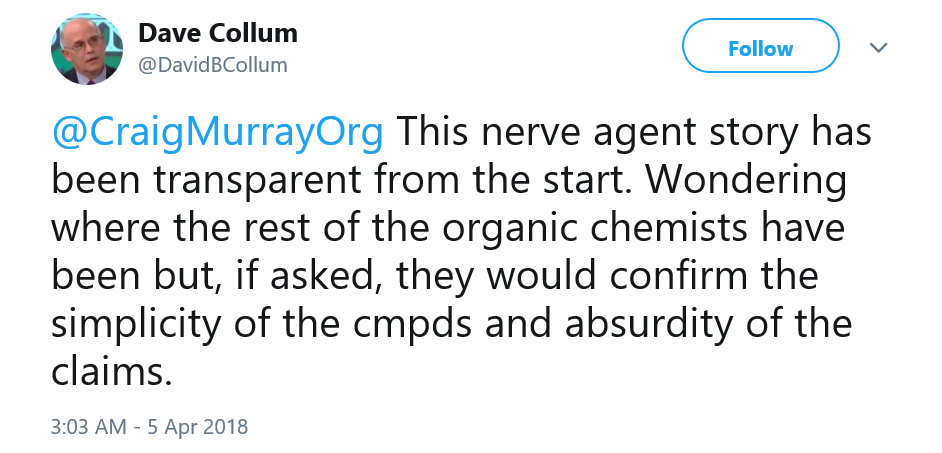
Motorola sales agent Gary Aitkenhead – inexplicably since January, Chief Executive of Porton Down chemical weapons establishment – said in his Sky interview that “probably” only a state actor could create the nerve agent. That is to admit the possibility that a non state actor could. David Collum, Professor of Organo-Chemistry at Cornell University, infinitely more qualified than a Motorola salesman, has stated that his senior students could do it. Professor Collum tweeted me this morning.
The key point in his tweet is, of course “if asked”. The state and corporate media has not asked Prof. Collum nor any of the Professors of Organic Chemistry in the UK. There simply is no basic investigative journalism happening around this case.
That the entire British case against Russia depends on intelligence is further shown by a further strange development in the case today.
This is that the British authorities are now apparently claiming that the fact that the poison which was used to poison Sergey and Yulia Skripal was supposedly found on Sergey Skripal’s door knob is the ‘smoking gun’ which points to Russia.
Whether that is so or not – and I share Craig Murray’s deep skepticism about this – the alleged presence of the poison on the door knob cannot be the reason why on 7th March 2018 the British government’s COBRA committee had already come to the conclusion that the attack on Sergey and Yulia Skripal “was almost certainly” the work of Russia.
That is because the theory that Sergey and Yulia Skripal were poisoned when they came into contact with the poison on the door knob only appeared several weeks after 7th March 2018.
All the evidence points to fact that the ‘intelligence’ the British government used to come to the conclusion – reached within hours of Sergey and Yulia Skripal being found passed out on a bench – that the attack on them had been carried out by Russia must have come from a human source.
If the British authorities really do possess what they believe to be a Russian assassin’s manual (see Craig Murray again) then that all but confirms it. How else would such a manual have come into their hands?
If that human source really was able to identify the particular poison used in the attack on Sergey and Yulia Skripal in advance, then that suggests a very well informed source indeed.
That might be because the source does have genuine access to secret information about a top secret Russian assassination programme, in which case the Russian authorities will by now almost certainly know who that source is.
However given the complete absence of any other evidence of a top secret Russian assassination programme I must say I doubt this (as I have discussed elsewhere, the Litvinenko case does not provide such evidence).
The alternative – which of course is what many people believe – is that this whole affair is a provocation, staged by someone who then tipped the British off that Novichok – a poison of “a type developed by Russia” but which can in fact easily be made elsewhere (see above) – had been used, whilst misleading the British by giving them a trail of false leads which appeared to point towards Russia.
The claim that the fact that traces of the poison were found on the door knob is the ‘smoking gun’ which points to Russia to my mind rather supports this second theory.
If this claim was made before the poison was found on the door knob it suggests that the source knew in advance that it was there, which would tend to implicate the source in the attack.
If the source provided the information about the alleged ‘assassin’s manual’ after reports appeared in the British media about the poison being found on the door knob – which by the way is what I suspect – then that strongly suggests that the source is adapting its information to the changing news, which suggests manipulation of the intelligence in order to implicate Russia.
Whatever the case the fact that Novichok was probably used to poison Sergey and Yulia Skripal (we will only know with any measure of certainty when the OPCW reports its tests) is not proof that Russia was involved.
The British have got themselves into a total mess by pretending that it is.
They would have avoided getting into this mess – and avoided being manipulated by whoever is giving them ‘secret’ information, if that is what is happening – if they had instead done what their law and traditions dictate they should have done, which is allowed the criminal investigation to take its course.
It bears repeating that at this stage no suspect has been identified in the case and even the theory that Sergey and Yulia Skripal were poisoned by touching Sergey Skripal’s door knob is pure conjecture.
Once again – as in the Litvinenko case and the Russiagate scandal – the course of a criminal investigation has been corrupted by the misuse of ‘intelligence’.
How the Ex-Spy Case is Transforming UK Media Into Orwellian ‘Ministry of Truth’
Sputnik – April 5, 2018
The admission by scientists from the Porton Down defense lab that that they could not actually verify the source of the nerve agent used to poison Sergei Skripal and his daughter has not stopped British media from blaming Russia for the affair, or calling on London to take an even tougher stance against the Russians.
Unnamed ‘security sources’ have told The Times that they may have pinpointed the location of the “covert Russian laboratory” which allegedly created the chemical agent used to poison the Skripals.
According to the newspaper, government ministers and security officials “were able to identify the source using scientific analysis and intelligence” soon after the attack. “We knew pretty much by the time of the first Cobra [the emergency coordination briefing] that it was overwhelmingly likely to come from Russia,” a Whitehall source said.
The Times’ source insisted that the security services have a “high degree of confidence” regarding the location where the chemical was produced, but admitted they were not 100% certain.

Screenshot of The Times’ story.
Not to be outdone, The Sun ran a similar story, claiming that a lab run by Russia’s SVR foreign intelligence service in the Moscow district of Yasenevo was the “likely” creator of the poison. The tabloid paraphrased unnamed ‘security sources’, who told the newspaper that the Russian lab is “one of a handful of labs in the world that produces the nerve agent.”

Screengrab of The Sun article.
No Proof Needed
The pair of stories comes 48 hours after Porton Down Defense Science & Technology Laboratory chief Gary Aitkenhead’s admission that the military could not definitively conclude that the nerve agent believed used in the Skripal case was of Russian origin.
The new media efforts to implicate Russia, using unnamed sources and terms such as “likely” and “high degree of confidence” is reminiscent of the kind of language used by the British government in the days and weeks following the poisoning. However, following Tuesday’s revelation by Mr. Aitkenhead, the government and Foreign Secretary Boris Johnson in particular have been reeling from their attempts to definitively claim Russian involvement in the Skripal case.
Some outlets, including The Independent, decided to meet Aitkenhead’s revelations with a stiff upper lip, insisting that Russia’s efforts in the Skripal case, including its “ever more reasonable-sounding but insincere offers” to help in the investigation, don’t change “the overwhelming probability that the novichok nerve agent originated in Russia…” It is simply “inconceivable that anyone other than the Russians” could organize such a plot, according to the newspaper.
As for Russia’s demand that London actually prove its allegations, The Independent suggests that “a legal standard of proof is not required,” adding that the kind of proof asked for by Moscow is “impossible to achieve.” The paper even accuses Labour leader Jeremy Corbyn and others of ‘buying into’ the arguments presented by the Russians.
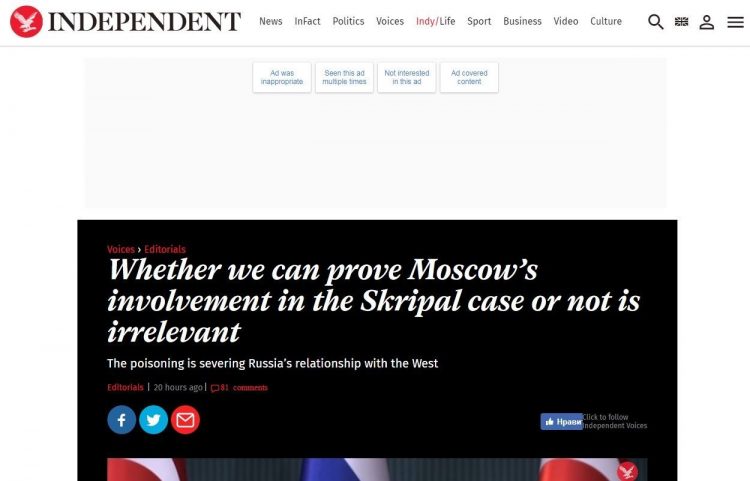
The Independent’s ‘bold’ editorial amid the revelation that Porton Down scientists couldn’t prove the poison’s origin.
Ministry of Truth
Also, even as the case against Russia over the Salisbury poisoning slowly falls apart, some UK and other Western media continue an effort to further poison Russia-Western relations, insisting that Russia is surely responsible for the attack, and criticizing their governments for not being tough enough on Moscow.
Bloomberg, for example, has run an editorial arguing that while the recent expulsion of dozens of Russian diplomats from dozens of Western countries is all well and good, “it’s too mild” to put real pressure on Vladimir Putin and the Russian government.Rather, the business news agency says, the West should band together to turn up the heat to “counter the domestic propaganda that Putin has used to increase his popularity and build anti-Western sentiment. Reaching out to Russians in big cities and neighboring countries, where dissent exists and could be encouraged, the US and its allies should make clear that the cause of their complaints is Putin and his helpers, not Russia at large.”

Screenshot of the Bloomberg piece.
Commenting on the Bloomberg piece, Rossiya Segodnya politics contributor Viktor Marakhovsky quipped that the logic of the story was just brilliant: “When Russia appeals to the citizens of Western countries with criticism toward their authorities, this is propaganda and an attempt to assert influence. But when it’s the other way around, this is a fight against internal propaganda and bringing the truth to Russia,” he wrote.
The Guardian issued its own editorial, recommending paying more attention to the ‘home front’ to arrange a nationwide informational manhunt of ‘Putin’s trolls’.
Complaining about The Guardian’s comments section being “infected” by “Russian trolls,” the editorial says that while not all offending accounts or hashtags may be Russian-made, “its sentiments chime sufficiently with the trolls’ aim for them to boost it.”
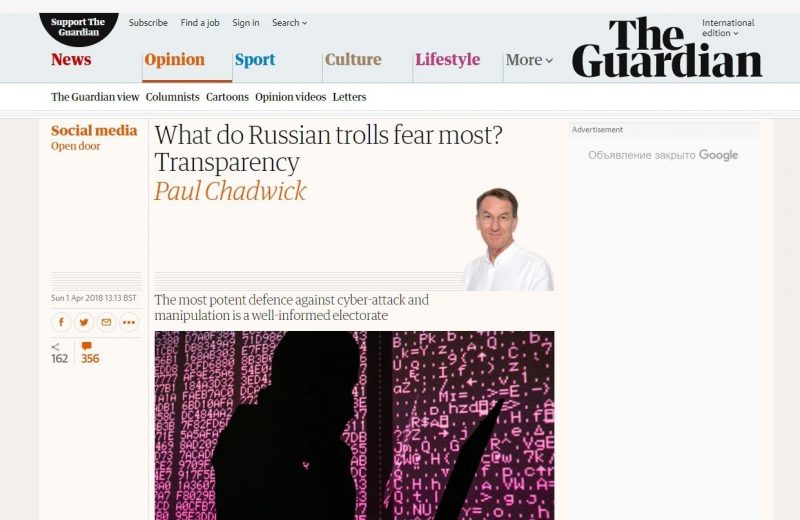
Screengrab of The Guardian editorial.
In other words, Marakhovsky commented, these non-Russian accounts are de facto “enemies because they think and write the wrong thing.” In this way, the journalist noted, the newspaper is effectively calling on Western media “to assume the functions of the Ministry of Truth – to identify both Russian trolls and those who have been infected by their propaganda… and explain to them why their views are wrong, because they happen to agree with the opinion of the Russian foe.”
Russian ex-spy Sergei Skripal and his daughter Yulia were hospitalized in Salisbury, southern England on March 4 following a chemical attack thought to involve the A-234 nerve agent. Sergei remains in critical condition; his daughter has regained consciousness and is making a recovery. London almost immediately accused Moscow for the attack, and initiated a series of measures directed against Russia, including the expulsion of 23 Russian diplomats. Many of the UK’s allies have followed suit. Moscow has rejected London’s accusations, saying claims of Russian involvement are entirely unsubstantiated.
Tycoon who pushed Magnitsky Act warns EU minister of ‘career ruining’ opposition to Russia-bashing
RT | April 4, 2018
Bill Browder, the financier convicted of tax fraud in Russia and the driving force behind the Magnitsky Act, has taken aim at the Dutch foreign minister, warning him that opposing sanctions against Russia is dangerous.
Foreign Minister Stef Blok should take note of what happened to his Canadian colleague, Stephane Dion, after he opposed the hard line on Russia, Browder tweeted on Tuesday. Blok had voiced opposition to an EU version of the Magnitsky Act, the 2012 US law blacklisting dealings with the Russian government and certain individuals, enacted over “human rights violations.”
Browder’s tweet was pointed out by the Russian embassy in Canada as an instance of foreign meddling.
After Dion expressed opposition to Canada’s adoption of the Magnitsky Act in 2016, Browder made it a “domestic political issue with [the] large Ukrainian diaspora in Canada.” In January 2017, Prime Minister Justin Trudeau replaced Dion with Chrystia Freeland, a Ukrainian-Canadian with a hardline position on Russia. Canada passed its own version of the anti-Russian law in October that year.
Browder followed up the threat to Blok by singling out two Dutch lawmakers, Pieter Omtzigt and Sjoerd Wiemer Sjoerdsma, for advancing the proposal in a 81-69 vote.
Browder, the CEO of Hermitage Capital, made billions from the 1990s chaos in Russia. He gave up his American citizenship in 1998 to avoid having to pay US taxes, and obtained British citizenship instead. The UK does not have an extradition treaty with Russia, which Browder found useful in 2005, when he was expelled by the Russian government.
Hermitage has been repeatedly investigated for tax fraud. When Sergey Magnitsky, a lawyer hired by Hermitage, was found dead in his Moscow prison cell in 2009, Browder embarked on a global crusade to demonize Russia as a murderous dictatorship.
This resulted in the 2012 passage of the Magnitsky Act, ostensibly enabling the US government to blacklist Russian officials “thought to be responsible” for Magnitsky’s death. In 2016, the law was expanded to have a global scope and blacklist any Russian officials for “corruption” or “human rights violations.” In practice, this has translated into things like stripping Chechen leader Ramzan Kadyrov of his Instagram account.
Both the original act and the 2016 expansion were championed by Senator Ben Cardin (D-Maryland), a well-known hardliner on Russia.
Browder is not content to stop there. He has called for using the EU-wide Magnitsky Act to bully the government of Hungary – or “government kleptocrats who are ruining democracy in that country,” as he described it – into submission to Brussels. He is also supporting the Democrats’ campaign to oust Congressman Dana Rohrabacher (R-California), accusing him of “selling out his integrity and US national security to the Russian FSB.”
Meanwhile, in Russia, a Moscow court convicted Browder of tax fraud in the amount of $79 million and sentenced him to nine years in a penal colony and a fine of 200,000 rubles ($3,470). The sentence was handed down in December 2017.
Blok became the Dutch foreign minister on March 5. His predecessor Halbe Zijlstra resigned in February, after admitting he lied about a 2006 meeting with Russian President Vladimir Putin. Zijlstra claimed that he had overheard Putin talk about plans for a “Greater Russia.” It later emerged he was never at the meeting.
West Uses Skripal Row to Boot Russia From Syrian Chemical Weapons Issue – Moscow
Sputnik – 04.04.2018
Blaming Skripal’s poisoning on Moscow, Western states are trying to push Russia aside from discussion of cases of chemical weapons usage in Syria, according to the Russian Foreign Ministry’s spokeswoman.
On Issue of Chemical Weapons
Ministry spokeswoman Maria Zakharova noted that chemical weapons remain a key issue in the decision-making process for all countries, as the legitimacy of Bashar Assad’s power in Syria is always being linked to it by Western countries and the US-led coalition.
“Before, we were told that Assad just had to leave, because he was bad but then this concept was abandoned. Now they say that he is bad and must leave because he violates international law using chemical weapons in Syria,” she said.
The representative went on saying that the West is trying to play the same card in the current row over Skripal’s poisoning.
“Thus, inventing the story about the alleged use of chemical weapons by Russia on British soil, Western countries are trying to push Russia aside from the legal field of discussion of issues pertaining to the chemical weapons in Syria. Under the pretext that there is nothing to talk about with Russia, as they claim Russia has used chemical weapons in Europe,” Zakharova added.
Earlier in the day, the British side presented its own version of why Russia proposed to convene an extraordinary session of the Organization for the Prohibition of Chemical Weapons (OPCW) Council. According to the UK permament representative to the OPCW John Foggo, Russia wants to use the organization’s meeting scheduled for April 4, the date on which a year ago a chemical attack in Syria’s Khan Sheikhoun took place, in order to make a political statement.
“For all of us gathered here, it is very sad to admit that chemical weapons attacks continue not only in Syria. Today marks exactly one month since the usage of the nerve agent here in Europe,” he said.
After the alleged use of chemical weapons in Syria’s Eastern Ghouta in January, US Secretary of State Rex Tillerson accused Damascus of using chemical weapons and also claimed that Russia was responsible for the victims because of its engagement in Syria.
The Russian Foreign Ministry back then said that Washington was spreading propaganda against Moscow in an attempt to demonize the Syrian government and subsequently topple it, underscoring that the information on the chemical attacks used by the United States was uncorroborated.
In October 2017, the OPCW report alleged that the Syrian government was responsible for the April 4 sarin attack on the Syrian city of Khan Sheikhoun, claiming that the nerve gas used during the attack had been taken from stockpiles belonging to the Syrian government. However, the latter was destroyed as part of a 2013 deal with the US and Russia — a process the OPCW itself signed off on as having been completed that November.
Damascus has constantly denied being in possession of chemical weapons, the destruction of which had been confirmed by the OPCW.
On Russian Media
Russia would like to receive clarifications from the US State Department after accounts of Russian media outlets were blocked on Facebook, Russian Foreign Ministry spokeswoman said.
“We expect an official reaction to this situation from US authorities … we would very much like to hear official comments from the US State Department,” she told a briefing.
She called on Facebook to specify its issues with Russian media accounts and explain reasons behind its decision to block them.
On Tuesday, Russia’s Federal News Agency (FAN) said that Facebook had blocked its official page without any warning. Also on Tuesday, Facebook CEO Mark Zuckerberg said that the company blocked more than 270 accounts and pages run by Russia’s Internet Research Agency.
On Russian Vessel Detained in Ukraine
Moscow summoned the Ukrainian temporary charge d’affaires in Russia on Wednesday to protest the detention of a Russian ship and to demand the release of its crew as well as the return of the vessel, the Russian Foreign Ministry said.
“On April 3, the charge d’affaires ad interim of Ukraine in the Russian Federation was summoned to the Russian Foreign Ministry where he was handed a protest note in connection with the illegal detention of Russian fishing vessel Nord by the Ukrainian Border Guard Service on March 25 in the Sea of Azov, the transfer of the vessel to the port of Berdyansk and illegal custody of its 10 Russian crew members,” spokeswoman Maria Zakharova noted.
According to Zakharova, Moscow demanded the immediate release of the illegally detained crew and the return of the vessel to its legitimate owner.
On March 26, Ukrainian border guards detained the Russian ship Nord, claiming that its crew had violated the sea border. The Russian Foreign Ministry demands the Ukrainian side to return the captured ship, which is in the Ukrainian port of Berdyansk, and to release the crew.
READ MORE:
Russia’s Offer for Joint Probe Into Skripal Case ‘Perverse’ – UK OPCW Delegation
Russia Concerned, Outraged Over US Claims on Attacking Syria — Moscow
Facebook, Instagram Delete Dozens of Russia-Linked Accounts
Russian Navy Disproves Dangerous Manoeuveres between Russian and UK Vessels
Down & out at Porton Down: Embarrassment for the UK’s ‘Rush to Blame Russia’ brigade

By Neil Clark | RT | April 4, 2018
The news that the UK’s own chemical weapons scientists can’t confirm that the nerve agent we’re told was used on the Skripals came from Russia is another blow to the credibility of the UK political and media establishment.
They were oh so sure, weren’t they? Or at least they wanted us to think that. For the past four weeks in Britain, we’ve been subjected to a quite hysterical wave of Russophobia, worse than anything we witnessed even at the height of the old Cold War. The poisoning of former MI6 agent Sergei Skripal and his daughter Yulia, who were found in a collapsed state on a bench in the cathedral city of Salisbury on Sunday, March 4, led not only to calls for a boycott of the football World Cup in Russia, but for RT to be taken off the air. The UK expelled 23 Russian diplomats, and then pressured other European countries to do the same. While on Good Friday, in another provocative move, British authorities boarded an Aeroflot plane at Heathrow Airport.
The important principle of ‘innocent until proven guilty,’ enshrined in Article 11 (1) of the UN’s Universal Declaration of Human Rights, was chucked out of the window. In its place we had ‘guilty until proven innocent.’
Instead of waiting until a full and proper investigation could even begin – let alone be concluded – we had a show trial and sentencing, by media, politicians, and members of neocon think tanks.
Anyone who dared to question the official narrative and didn’t support punishing Russia, faced attack from Imperial Truth Enforcers. Former UK Ambassador to Uzbekistan Craig Murray, who said that Foreign and Commonwealth Office sources had told him that Porton Down scientists were unable to confirm Russian culpability, was labelled a ‘conspiracy theorist’ for observing: “The same people who assured you Saddam Hussein had WMDs now assure you Russian ‘Novichok’ nerve agents are being wielded by Vladimir Putin to attack people on British soil.”
Labour leader Jeremy Corbyn, who condemned the attack but called for a thorough investigation, was savaged not just by the Tories, but also his own Parliamentary party, simply for taking a cautious line in Parliament on March 14.
Thirty-six Labour MPs signed an Early Day Motion – sponsored by arch Corbyn-critic John Woodcock – which declared “This House UNEQUIVOCALLY accepts the Russian state’s culpability for the poisoning of Yulia and Sergei Skripal.” The EDM supported the expulsion of Russian diplomats and the calling of a special meeting of the UN Security Council to “discuss Russia’s use of chemical weapons on UK soil.”
Will these MPs now be apologizing to Russia for accusing them of doing something which most definitely has not been proved? Or does supporting a neocon foreign policy mean never having to say you’re sorry?
It’s not just politicians who need to eat some humble pie.
In all my years in journalism, I have never felt so ashamed of my profession as in the last four weeks. The job of the journalist is to ask questions. To find out the truth. To be absolutely fearless in following leads, wherever they may take you. Today in Britain, political journalism means just parroting the official War Party line. It soon became apparent that the government narrative on Salisbury had more holes in it than a slab of Swiss cheese. But we were all expected, like the good little townsfolk in Hans Christian Andersen’s ‘Emperor’s New Clothes,’ not to notice. Newspapers and magazines which should have been holding Theresa May and Boris Johnson to account did nothing of the sort. Suppositions were reported, day after day, as proven fact.
The last four weeks have shown how nothing really changed even after the catastrophe of Iraq. The same pro-war commentators are still in place, robotically churning out their rabidly anti-Russian, anti-Putin diatribes for an ever-dwindling readership.
After the lies told about Iraqi WMDs, you might have thought there would be a bit of ‘mainstream’ skepticism about UK government chemical weapons claims against an ‘Official Enemy’ state, which seem designed to lead us into an even more calamitous war. But no, they all carried on as if the only important thing that had happened in 2003 was Arsenal beating Southampton 1-0 in the FA Cup Final.
Just before the Iraq invasion, I remember asking a Conservative MP at a party if he really believed the guff about Saddam having WMDs. He looked at me and paused, before saying, “Well you’ve got to admit, he’s not a frightfully nice chap.” Today that MP, who clearly didn’t believe the government’s assertions, is the British Foreign Secretary.
Boris Johnson has gone further than any minister down the ‘Russia did it’ line. In an interview with Deutsche Welle on March 20, he said: “they (the scientists at Porton Down) were absolutely categorical and I asked the guy myself, I said, ‘Are you sure?’ And he said there’s no doubt.”
That is flatly contradicted by the statement today of Gary Aitkenhead, the chief executive of the Defence Science and Technology Laboratory at Porton Down, who said, “We have not identified the precise source.”
Just as interesting was Aitkenhead’s response to being asked if Novichok could have emanated from Porton Down itself. “There’s no way that anything like that would ever have come from us… we’ve got the highest standards of control and security,” he said.
Yet in his Deutsche Welle interview, Boris Johnson, in answer to the question: “Does Britain possess samples of it?” (i.e. Novichok), replied, “They (Porton Down) do.” How could Porton Down know the substance used was Novichok if they possessed no samples to test it against?
If samples were stored literally just down the road from where the Skripals were poisoned, surely it’s reasonable to ask whether or not some of them did get out? To maintain, as the UK government does, that no other explanation other than Russian guilt is plausible is clearly nonsense. After going out on a limb on this one, (one suspects in order to curry favor with kingmaker Rupert Murdoch, Boris Johnson’s position as foreign secretary is surely now untenable. Jeremy Corbyn needs to be calling for his resignation – and also that of Prime Minister Theresa May – when he next goes to the House of Commons.
But it’s clear that the UK’s problems go a lot deeper than changing the faces at the top. The Salisbury ‘Rush to Blame Russia,’ before any evidence of Kremlin involvement was produced, proves that we need a clear out of the entire political and media establishment and a move to a more democratic, publicly accountable system. We didn’t get that after Iraq, but we really must get it now.
BDS Movement Calls on Netflix to Remove Series ‘Sanitizing’ Israeli Occupation
teleSUR | April 3, 2018
Pro-Palestinian groups including the Boycott, Disinvestment, and Sanctions (BDS) Movement along with the Palestinian Campaign for the Academic and Cultural Boycott of Israel (PACBI) have called on Netflix to discontinue the series ‘Fauda’ (Chaos in Arabic) for “sanitizing and normalizing war crimes” and “promoting and justifying these grave human rights violations.”
Originally produced by a network named, Yes, the series depicts the Israeli-Palestinian conflict and justifies the crimes against humanity by the Israeli intelligence.
Calling the series, “racist propaganda material for the Israeli occupation army,” the BDS movement wrote a letter to Netflix, the United States-based entertainment company to remove the series.
The series produced by the two former Israeli Defense Forces (IDF) officers is scheduled to be broadcast in May, which also marks the 70th anniversary of the 1948 Nakba (catastrophe) of the Palestinian people.
“The two authors [of the series], who are graduates of one of these teams, without any ambiguity have collaborated with the occupation, colonization and the Apartheid regime,” the letter noted, referring to the series’ creators, Lior Raz and Avi Issacharoff’s former service in elite IDF units.
The series has won over 11 awards at the Israeli Academy for Film and Television awards in March, after which it was picked up by Netflix.
Netflix needs to “stop broadcasting and not to produce the third season of the series and remove the previous seasons” as “the series promotes and legitimizes the war crimes committed by death squads disguised as people pretending to be Arabs,” the BDS movement said in a statement.
“Fauda promotes and legitimizes violent acts committed against Palestinians in the occupied Palestinian territory by Israeli army death squads — the so-called “Mistaravim.” The show’s writers, who were members in these units, have based the series on the war crimes committed by these squads against Palestinians,” PACBI said in a press release.
Adding that if Netflix fails to pay heed to the call of Palestinian social movements, it will face “nonviolent grassroots pressure and possible legal accountability.”
Featured Video

Saudi Led Destruction of Yemen’s heritage
or go to
Aletho News Archives – Video-Images
From the Archives
Israel: Strategic Ally or Liability?
By Stephen Sniegoski | My Catbird Seat | June 12, 2010
The claim that Israel serves as a valuable ally for the United States is made by both pro-Zionists and much of the anti-war and anti-Zionist Left that is influenced by Noam Chomsky. As a result of the Gaza flotilla massacre, which has caused a world-wide uproar against Israel, the value of Israel to the United States is being publicly questioned in more mainstream foreign policy forums. … continue
Blog Roll
 Aletho News
- Burnham’s ‘Russia did Brexit’ ruse crumbles
- Estonia making movies and games to encourage war against Russia
- Four in five new UK jobs taken by foreigners – report
- Here’s what Trump’s latest U-turn really means for Russia and Ukraine
- The Houthis Are Not an Iranian Proxy
- Europe’s Energy Hypocrisy, Russian LNG Profits and US Dependence
- ICC ignored ‘very well-documented’ NATO crimes – ex-Libyan minister
- SNSC secretary dismisses US response to Iran’s conditions as ‘inadequate’
- Sanaa says Taiz roads open, secure for residents, warns Saudi forces
- Iraqi resistance group urges Saudi leadership to admit defeat, lift Yemen siege
- If Americans Knew
- Nearly 50,000 women, girls killed or severely injured in Gaza since October 2023: UN Women
- ADL is working with AI companies to suppress alleged ‘antisemitism’
- Israeli occupation forces using social media surveillance unit to target hundreds of Palestinians in the West Bank
- Israel’s New – and Terrifying – Security Doctrine
- Israeli Attacks Kill Five in Gaza, Including a four-year-old and a woman
- Air Force Major Who Called for Trump’s Impeachment Held in Solitary Confinement
- It’s a Genocide, I’m Into It’: Seinfeld Mocks Protest over Palestinian Children Killed
- Universities fire dozens amid pressure from Zionist billionaires
- Gaza’s buildings are collapsing on top of us. But there’s nowhere else to shelter
- Israel kills four-year-old Gaza child – Daily Update
- No Tricks Zone
- New Study Suggests Large Regions Of The Pacific Ocean Have Been Cooling For The Last 80 Years
- Germany’s Green Energy Debacle: High Energy Costs Force Kahla Porzellan to Close After 182 Years!
- New Study: 50 Years Of The Most Aggressive ‘Net Zero’ Policies Can Only Affect The Global Climate By 0.03°C
- US September “Heat” Was No Record…Many Records Set Decades Ago
- Latest European Green Energy Debacle; Portugal’s Largest Flagship Solar Park Insolvent!
- Green Energy Debacle: German Expert Professor Fritz Vahrenholt Warns Of Severe Economic And Social Consequences
- Two More Paleo Reconstructions Affirm Meters-Higher Sea Levels Across Ireland, Brazil 7000-6000 Years Ago
- New Study: Earth And Venus Surface Warmth Largely Explained By Convection And Lapse Rate, Not CO2 Or Radiation
- 2025 Nature Paper Claiming Worsening Global Drought Gets RETRACTED …Heavily Flawed
- New Study: ‘Global Drought Shows No Detectable Recent Acceleration Under Climate Warming’

