Noor Zahi Salman: Everything You’re Hearing About Me Is a Lie
By Sam Husseini | June 15, 2016
Virtually everything in the media about Noor Zahi Salman, Omar Mateen’s wife, is from anonymous government sources. They lie in situations like this.
Such anonymous sourcing helped facilitate the lies used to invade Iraq and countless other horrific policies. They’re doubly dangerous during a panic, consider that after government anthrax killed people in 2001, Andrew Sullivan talked about using nuclear weapons.
And the government has a lot of incentives to lie about this case. They failed to keep people safe. So, what to do? Blame the wife. Blame the Muslims. They didn’t alert us. They are suspect. Potentially, all of them. That’s what Trump — and Clinton in more subtle ways — are saying.
I didn’t need to be in contact with people who know Noor Zahi Salman to know that, but it helps.
In fact, I am in touch with a friend of hers who is in regular contact with people around her now. This means I am probably in closer touch with the actual facts of the case than the zillion media outlets blaring whatever it is “sources” are telling them to blare at you. In so doing, they are smearing a woman who was questioned by the most powerful government in the world, smeared on the largest media outlets as a virtual accessory to mass murder — all without the benefit of a lawyer.
She is apparently telling people around her that virtually everything you’re hearing about her is a lie.
Some examples:
NBC claims: “The Orlando gunman’s wife feared he was going to attack a gay nightclub overnight Saturday and pleaded with him not to do anything violent — but failed to warn police after he left, NBC News has learned.”
Noor Zahi Salman is apparently saying she didn’t have any idea of an attack.
NBC claims: “In addition, she said she was with him when he bought ammunition and a holster, several officials familiar with the case said.”
Noor Zahi Salman is apparently saying she didn’t do that. She says it might be possible that they went shopping together — and she went to buy food or clothing and he might have gone to a gun store. In any case, why is this on her? Why are people focusing on her and not the “security” firm G4S that employed Mateen? How is it that the FBI is suddenly off the hook?
The Daily Beast claims: “Noor Zahi Salman also reportedly drove Mateen to the gay nightclub Pulse to case the place before he killed 49 people there on Sunday night.”
Noor Zahi Salman is apparently saying that she never drove him to the club and that in fact, she doesn’t like to drive at all.
ABC claims: “After Noor Mateen began to answer questions, agents administered a polygraph test to determine whether she was telling the truth.”
Noor Zahi Salman is apparently saying she offered to take a polygraph but the government declined.
Noor Zahi Salman is apparently “free”, but with an electronic bracelet.
What we apparently have is severe logrolling between media and government — where government sources hide behind anonymous quotes and media hide behind anonymous sources. So, basically, they can mutually absolve each other and publish most anything that will benefit the both of them.
Seriously, what’s the justification for using anonymous sources on this story? My justification for using my anonymous sources is that they are scared. The only thing the government sources driving this story are afraid of is that they will be held responsible for their words.
We’re not seeing a free-for-all in terms of everyone speculating as they please. There might be justification for that: Bring on the government stenographer, then bring on the false flag theorist. No, what we’re seeing are directed leaks laying out a pattern of smearing an individual, smearing a community and getting the government and media off the hook for the fact that 50 people are dead.
Some friends of Noor Zahi Salman are apparently speculating that what actually happened was that Omar Mateen was about to be outed as gay — and went nuts. This could have broader implications since “Israel surveils and blackmails gay Palestinians to make them informants.” That clearly is speculative. But far more responsible than speculation that is streaming forth from your TV.
I know more, including an allegation about how the government treated Noor Zahi Salman that would turn your stomach.
I’m not telling all I know now because I have reason to believe it might make the family and friends uncomfortable.
See what I did just there? I was forthright with you, my reader, while respectful of my sources.
Big media propagating anonymous government allegations about Noor Zahi Salman distracts from their own failure to protect the public from attacks.
Instead, it fingers the Arab and Muslim communities as responsible. And that’s a message that is being articulated in ways crude and subtle from our “leaders”:
Says Donald Trump: “But the Muslims have to work with us. They have to work with us. They know what’s going on. They know that he was bad. They knew the people in San Bernardino were bad. But you know what? They didn’t turn them in. And you know what? We had death, and destruction.”
More subtly, says Hillary Clinton: “Since 9/11, law enforcement agencies have worked hard to build relationships with Muslim-American communities. Millions of peace-loving Muslims live, work, and raise their families across America. They are the most likely to recognize the insidious effects of radicalization before it’s too late, and the best positioned to help us block it. We should be intensifying contacts in those communities, not scapegoating or isolating them.” Clinton pretends to be against “scapegoating” when that’s exactly what she just did. Most just let it slide because it’s not as crass as Trump’s formulation of much the same idea.
Most subtle still is President Obama: “Since before I was President, I’ve been clear about how extremist groups have perverted Islam to justify terrorism. As President, I have repeatedly called on our Muslim friends and allies at home and around the world to work with us to reject this twisted interpretation of one of the world’s great religions.”
I don’t know Noor Zahi Salman. I have not had the opportunity to speak to her directly. I don’t know for certain how forthright of a person she is, though even through media reports, several people who have known her have said she’s upstanding. My immediate source I believe is very reliable. Things are rushed, there may be misunderstandings here. Noor Zahi Salman is quite likely in shock, she may be honestly misspeaking, especially when in a coercive environment before threatening government agents.
Now, would I like more sources to confirm what I’m writing? Yes, I would, but I think it would be irresponsible to let what are likely falsehoods contaminate the public mind on virtually every major media outlet given the limited capacity to communicate directly with Noor Zahi Salman at this time.
NYT Praises Obama’s Phony War on Terror, Lauds Clinton, Blasts Trump
By Stephen Lendman | June 15, 2016
New York Times editors never let facts interfere with their worldview, consistently misinforming readers, willfully lying.
On Tuesday, they ignored Obama’s imperial madness, his high crimes against peace, his rage for wars, waging them in multiple theaters, using ISIS and other terrorist groups as US foot soldiers.
Instead they praised what demands universal condemnation and accountability, saying in a Tuesday speech, Obama “listed the ways in which his administration has worked to subdue the threat of terrorism abroad and home” – at the same time denouncing what he called Trump’s “dangerous” mindset.
Fact: America created ISIS and likeminded terrorist groups.
Fact: It uses them in Syria, Iraq, Libya and elsewhere, providing their fighters with arms and other material support, waging wars on sovereign independent states, wanting US-controlled puppet regimes replacing them.
What’s ongoing is longstanding imperial policy, wanting all nations transformed into US vassal states. Instead of denouncing America’s war on humanity, The Times supports it.
As part of its pro-Clinton, anti-Trump campaign, it quoted Obama’s Big Lie about nonexistent US “pluralism and… openness, our rule of law, our civil liberties, the very things that make this country great.”
“The very things that make us exceptional.” The very things neocon infested Washington rejects.
On Thursday, Obama heads for Orlando – not “to bring solace to grieving families and a stricken city” as The Times suggests – solely to exploit last Sunday’s shootings for political advantage, ignoring a likely state-sponsored false flag, his administration responsible for what happened.
He’s been at war with Islam throughout his tenure, Hillary Clinton its lead orchestrator as secretary of state, an unindicted war criminal/racketeer The Times endorses.
Ignoring her rage for escalated war on humanity and increased crackdowns on fundamental homeland freedoms in the wake of Orlando, it praised her for “echo(ing) many of (Obama’s) points and even some of his language” – quoting her saying “(h)istory will remember what we do in this moment.”
“History” documents millions of US imperial victims at home and abroad, its contempt for rule of law principles, its rage for unchallenged dominance, its threat to world peace.
Neocon infested Democrat and Republican parties represent pure evil. World peace hangs in the balance.
Stephen Lendman can be reached at lendmanstephen@sbcglobal.net.
His new book as editor and contributor is titled Flashpoint in Ukraine: US Drive for Hegemony Risks WW III.
Law Enforcement Misrepresentation of Orlando Killer’s 911 Call Ignores U.S. Foreign Policy Motivation
By Matt Peppe | Just the Facts | June 14, 2016
In the aftermath of the horrific mass murder at the Pulse nightclub in Orlando over the weekend in which 50 people were killed, media including CNN, USA Today, NPR, NBC News, and CBS News, all reported that the gunman called 911 during his murderous rampage and pledged allegiance to ISIS. None of the journalists writing for any of these news outlets heard the call themselves; they all cite the FBI as their source.
The U.S. government has been engaged in a war against the self-professed Islamic State for the last two years. Their military intervention consists of a bombing campaign against ISIS targets in Iraq and Syria. Hyping the threat members connected to the terror group – or spiritually loyal to it – pose to American citizens is supportive of U.S. foreign policy. If ISIS, or people claiming to act on behalf of ISIS, are a real danger to Americans, it bolsters the notion that the group is a threat to national security and helps justify the government’s military response.
The FBI seems eager to show itself as disrupting ISIS plots in the States. As Adam Johnson has written in FAIR, the FBI has put Americans in contact with informants who claim to represent ISIS and then led the targets to believe they would help the targets join the terrorist organization. The media have then conflated this with an “ISIS Plot” and “ISIS Support,” when no members of ISIS were ever involved in any way.
The FBI’s motivation to portray events in a way that supports U.S. foreign policy, and its history of portraying its actions in a way that has served to hype an ISIS threat should make journalists cautious about taking officials’ words at face value. Especially in the case of a 911 call, which is a public record in Florida, proper journalistic due diligence would be to consult the actual source of the claims being disseminated.
Instead, not a single journalist appears to have done this with Orlando killer Omar Mateen’s 911 call.
On Tuesday, CNN aired interviews of eyewitnesses to the shooting spree who described their harrowing encounters with the gunman inside the club. Patience Carter, who was inside a bathroom stall feet from the gunman when he called 911, said he told the dispatcher that “the reason why he was doing this is because he wants America to stop bombing his country.” (Mateen is a native of the United States, but he was presumably referring to Afghanistan, where both of his parents are from.) She said he then declared that “from now on he pledges his loyalty to ISIS.”
This demonstrates that his primary motive for his terror attack was retaliation for the U.S. aggression in Afghanistan, where nearly 100,000 people have been killed since the illegal U.S. invasion in 2001. His mention of ISIS seems merely adjunct to what he admits was his justification for the attack. His motivation precedes his ideological alignment with ISIS, not the other way around.
Anti-war activists have long argued that overseas military operations endanger not only the populations whose countries are invaded, occupied and bombed, but Americans in the United States who are at risk of terrorist retaliation from people outraged by the death and destruction war inevitably produces to the point of being willing to resort to violence themselves.
Carter’s version of the 911 call reveals a very different picture than the partial one revealed by the FBI and reprinted by each of the largest news organizations. The complete conversation depicts Mateen as indicating that he considered his actions a response to U.S. foreign policy. Of course, the murder of innocent civilians is always reprehensible and can never be justified by claiming they are a response to a state’s military aggression, regardless of how deadly and devastating such military operations are. But it should be predictable that some people will use this rationalization regardless and seek out soft targets in the country whose government they claim to be retaliating against.
The FBI chose to omit Mateen’s professed motive entirely when recounting the 911 call to the media, and merely state that he professed allegiance to ISIS. Perhaps they recognized how putting Mateen’s call in context may lead people to question whether U.S. wars in Afghanistan (and Iraq) raise the terrorist threat at home.
After all, this is not the first time this has happened. The surviving Boston Marathon bomber cited the U.S. wars abroad as his motivation for committing the attack that killed three people and maimed dozens more.
It is not clear whether any journalist even asked to hear the 911 call themselves. But it is clear that they chose to disseminate second-hand information when the primary source should have been easily accessible. If it was not made available (as required by law), the public deserves to know that it was suppressed and be given an explanation why.
Media stenographers parroted government officials’ descriptions of the call, which left out the killer’s professed motivation for his politically motivated attack and failed to put the ISIS claim in any context. Unsurprisingly, their misrepresentation served the government’s policy agenda and avoided having the incident serve as an example of a negative consequence of U.S. foreign policy – one that anti-war dissenters have used in arguing against the wars in Afghanistan and Iraq since the War on Terror was launched more than a decade and a half ago.
Meet the Banker Brothers Who Destroyed Ecuador’s Economy

Ecuadorean fugitive bankers Roberto and William Isaias, who are currently in the U.S | Photo: El Telegrafo
teleSUR – June 13, 2016
The Isaias brothers are the among the most wanted criminals, convicted for the financial meltdown in Ecuador 16 years ago.
Ecuador is seeking the extradition of banking brothers Roberto and William Isaias from the United States on charges that they embezzled funds and are largely responsible for the country’s financial crisis in 1999—but the United States has spent the last 13 years ignoring the request.
The Isaias brothers have both been found guilty of fraud and the Ecuadorean government says they need to pay back millions of dollars they stole from the savings of average Ecuadorans. So why are they being protected?

History
Brothers Roberto and William Isaias were the owners of one of the biggest banks in Ecuador, Filanbanco, that was part of the economic meltdown that lasted from 1999 until 2001.
This crisis led to the end of the Ecuadorean currency, the Sucre, and its replacement by the U.S. dollar, which eliminated currency autonomy in the Andean country.
The Isaias brothers were charged with embezzlement but fled the country before their trial with over US$100 million in government bailout funds that were given to Filanbanco during the country’s banking crisis.
The brothers were found guilty in absentia for a fraud worth US$600 million, and sentenced to eight years in prison in 2012 by the Ecuadorean National Court, which determined that the brothers had falsified Filanbanco’s financial statements.
Appeals
William and Roberto Isaias have lost two appeals against Ecuador.
In 2014, a U.S. court ruled against the fugitives, and allowed Ecuadorean authorities to seize properties belonging to the brothers in Florida to recover a portion of the US$200 million the government of Ecuador says they owe.
For the seizure of their assets, the brothers sought to sue Ecuador for US$1 billion claiming it was illegitimate and a political prosecution, but a New York court ruled they did not have enough evidence to substantiate their claims.
The U.N. Human Rights Committee also rejected the allegations of the Isaias brothers that their conviction in Ecuador for the crime of bank embezzlement amounted to political persecution.
Ecuador’s Foreign Ministry says it is currently working with the U.S. to reach an agreement that would have a number of fugitives, including the bankers, return to face justice.
Connections
A 2005 leaked diplomatic cable from the U.S. Ambassador to Ecuador, made public by Wikileaks, said the brothers “used their ill-gotten wealth to buy safe passage from Ecuador and later pressured prosecutors to reduce criminal charges against them.”
According to The New York Times, the Isaias brothers donated US$90,000 for the re-election campaign of current U.S. President Barack Obama, and have invested at least US$320,000 in other politicians.

The Times explained that the brothers appeared to receive preferential treatment due to their connections to Democratic U.S. Senator Robert Menendez. The senator from New Jersey attempted to influence immigration officials in exchange for donations from the fugitive brothers to prevent their deportation, according to the Times. Menendez has himself been under investigation for corruption.
In a related case, Menendez lobbied to lift a ban against Estefania Isaias, daughter of Roberto Isaias, from entering the U.S. She was charged with fraudulent actions to obtain visas for her domestic employees, but after Menendez’s help high-ranking officials in the U.S. State Department lifted the ban.
Linda Jewell, former U.S. ambassador to Ecuador, said that “such close and detailed involvement by a congressional office in an individual visa case would be quite unusual, especially for an applicant who is not a constituent of the member of Congress.”
Menendez, who was chairman of the Senate Foreign Relations Committee, stepped down from his post after being the subject of a corruption investigation. He faces 14 charges ranging from fraud to bribery for having allegedly offered political favors in exchange for expensive gifts and donations to his political campaigns.

Media Control
The convicted Isaias brothers also used their money and political influence in international media against a leading supporter of their extradition: current leftist President Rafael Correa.
Alberto Padilla, CNN’s former news host, said the bankers have been financing an active opposition campaign against the Correa government since they arrived in the U.S.
The brothers have set up interviews with Ecuadorean opposition lawmakers and journalists, financing their trips to the U.S. to visit with several leading news outlets, such as the Miami Herald and CNN, according to El Ciudadano,
The Isaias Group is also one of the investors in CNN Latino and have funded books, magazines, articles and even other media outlets to criticize Correa’s administration.
ANALYSIS:
NGOs: A New Face of Destabilization in Latin America
RELATED:
Money Buys Influence in US for Fugitive Ecuadorean Bankers
US Public Funding Anti-Government Media, Journalists in Ecuador
‘US govt, MSM give no evidence to confirm ex-Gitmo detainees reengage in terrorist activities’
RT | June 12, 2016
The US government isn’t providing any evidence to confirm reengagement of former Guantanamo detainees in terrorist activities. They give numbers they allege are accurate but provide no facts, said Andy Worthington of the Close Guantanamo group.
The US government’s greatest fears about releasing Guantanamo Bay prisoners are that inmates might re-emerge on the ‘battlefield’ and re-engage in terrorist activities. Seventeen percent of former detainees, or 118, are confirmed to have re-engaged in militant activity, while 13 percent, or 86, are suspected of re-engaging.
Author of “The Guantanamo Files” and co-founder of the group Close Guantanamo, Andy Worthington, told RT America’s Simone Del Rosario that the US government isn’t supplying any evidence to confirm their fears.
RT: You’ve dedicated a chunk of your life to documenting files and stories from Guantanamo not as an attorney, but as an investigative journalist. After all of your research, what do you consider to be the most pressing reason to close Guantanamo for good?
Andy Worthington: From the very beginning it’s been a bad idea. If you’re going to deprive people of liberty, there are only two ways to do that, if you claim to respect the rule of law. That is that you either charge them with a criminal offence and put them on trial in a Federal court – that would be in the US; or they’re soldiers protected by the Geneva conventions and you can hold them until the end of hostilities.
But after 9/11 the US did neither of those things. So the men held in Guantanamo were held initially without any rights whatsoever. Human beings deprived of all rights, which is a really shocking thing. Although, over the years there have been various efforts to give them legal rights – going up to the Supreme Court, the situation still is that the people held in Guantanamo are effectively prisoners of the political system – we can almost describe them as political prisoners. There is no recognizable justice in their cases. The releases from Guantanamo end up being down to a political process. That is just an unfair way for a country like the US, which claims to be founded on the rule of law and to respect the rule of law, to behave.
RT: As Obama’s term comes to a close are you finding yourself more or less hopeful that he will fulfill his promise to close Guantanamo Bay?
AW: I am certainly more hopeful than I was a few years ago. There was a period in the middle of Obama’s presidency when he’d faced a lot of abstraction from Congress; he was unwilling to spend political capital overcoming that. And for a period of nearly three years only five men were released from Guantanamo.
In 2013, a massive prison-wide hunger strike brought Guantanamo back into sharp focus and put pressure on President Obama to do something about it. Since then he has been releasing many prisoners. We are now in the best position that we’ve been in during his presidency – only one tenth of the men held in Guantanamo is still held there – just 80 men. Thirty of those men have been approved for release by a variety of review processes under President Obama. We have a promise from the administration that they will be released by the end of the summer. Of the rest of the men – so the other 50 – just 10 are facing trials, or have had trials. The other 40 are undergoing this latest review process called the periodic review boards. We don’t know how many of those are going to be approved for release, but at the current rate of the reviews three out of four of the men have been recommended for release – there are currently 24 out of 33 men recommended for release.
Now these are men who were initially described as “too dangerous to release,” but the Task Force that looked at their cases said there was insufficient evidence to put them on trial; or they are men who were initially put forward for prosecution by a Task Force that President Obama set up in his first year in office. But the basis for prosecution has since collapsed. Appeals Court judges ruled that the war crimes for which the majority of the men were being convicted had actually been invented by Congress and were not internationally recognized. That is just a little summing up of the extraordinary ways in which Guantanamo is a shame and embarrassment on every level.
RT: A Washington Post article came out citing the Obama administration and the Pentagon saying that at least 12 released Guantanamo detainees are implicated in attacks on Americans that have resulted in American deaths. Do some of those Congressional members, who are against the closure, have a point in wanting to keep some of these men locked up?
AW: I think, first of all, they would have to provide us with evidence and they never do. In the early days of the defense department providing information on prisoners who they said have returned to the battlefield, or … have engaged in some kind of anti-American activity. They would provide information about who these men were. For around five years now they have provided nothing. They tell us numbers that they allege accurate, but they don’t provide any further information so that people can do some investigation to judge whether the information is correct or not. They have people that they say are confirmed of engaging in anti-American activities and ones that are suspected. Those figures generally get lumped together by the right-wing lawmakers and by most parts of the mainstream media – very irresponsibly… But, as I said, they don’t provide the information. This latest article in the Washington Post is unfortunately yet another lazy example of propaganda masquerading as journalism, without giving us the facts how are we supposed to accept that there is any truth to this.
The Agenda is Set: Elect the War-Hawk for the Sake of “Progress”
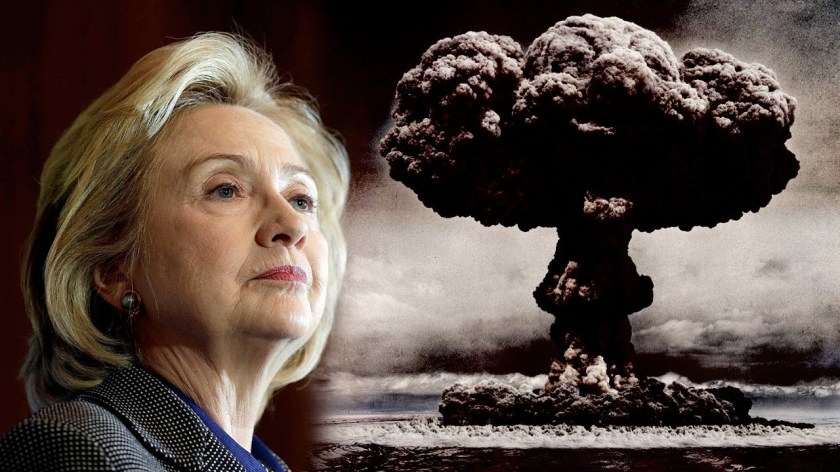
Hillary Clinton is the most qualified person to “rule the world”, if she can get around the “insane” US Constitution
OffGuardian | June 11, 2016
With the democratic nomination now officially all but certain (Sanders, quite obviously, never had a chance), the Guardian has thrown their full editorial weight – such as it is – into a pre-emptive defence of Hillary’s record and an hysterical celebration of the “progress” that the election of this particular bank-backed, corporate-bought, war-hawk would (apparently) demonstrate.
First there was Jonathan Freedland’s anaemic plea that Sanders’ voters get in line and stand with Clinton against the “true enemy”, Jill Abramson followed with gushing sentiment and simpering praise. And then? Then came Polly Toynbee, going full Guardian. Never go full Guardian.
The headline:
Those out to demonise Hillary Clinton should be careful what they wish for”
“Demonise”, in this instance, seems to mean “accurately describe her political career and possible criminal activities”. If you can demonise someone by holding a mirror up to their face, chances are that person is a demon.
“The choice of the next US president is now so stark that it’s time the left put aside its sneers and pray that this strong woman will get to rule the world”
“Rule the world?” Does the US president rule the world? I think I missed that particular UN resolution. As I recall, the POTUS doesn’t even wield supreme executive power within their own nation, the US constitution prevents that… but we’ll get to that later.
As for the starkness of the electoral field – I have to say I agree with Toynbee there. The choice between a bombastic orange billionaire, who sometimes seems to be running for president as an elaborate prank, and a proven corrupt and dangerous war-hawk, backed by lunatics like Victoria Nuland is indeed a stark one. Nuclear winter type stark. Perhaps literally.
This is a time to celebrate. At last, a woman leads a major US party to fight for the presidency.
Yes. At last, a woman. It doesn’t matter who the woman is, what she has done, how much she cheats to get there. Irrelevancies used to “demonise” her. Hillary is a woman, and thus her being president is A Good Thing… because progress. This is going to be key to Clinton’s campaign, and you will hear it a lot. It’s one of only 2 real tactics the Clinton camp have at their disposal. “What’s the other”, you ask? Simple: Lying. A lot of lying.
… as the first woman to enter the White House, she will also step through the door as by far the most qualified and experienced arrival there for generations…”
Now, this isn’t technically a lie… but only because we don’t know what Toynbee means by “qualified”. If being a shambolic Secretary of State and highly unpopular first lady makes you qualified then sure. If being proven to lie for your own benefit, time and time again, makes you “qualified”, or being firmly behind every American military intervention for the past 25 years… then I guess Hillary has qualifications to spare.
… a searing firestorm of abuse… Why so fierce, so unreasonable, so vitriolic?”
This is called a strawman. Having made a statement, one which is not backed up by any citations or quotes, she will attempt to “explain” this fictional phenomenon with some cloying cod psychology:
If you are naturally left of centre, especially if you are a woman, yet you find you instinctively dislike her, ask yourself why. There may be some good reasons…
So, liberal traitors – especially the female liberal traitors – why do you “instinctively” dislike Hillary Clinton? I mean there may be some good reasons, for example:
… she’s not as radical as Sanders; she is not a natural rabble-rouser at rallies; she is the wife of a past president; she’s called “robotic” in her careful choice of words; and as a flesh-presser she warms the cockles of few hearts.
To rephrase: You may not like her because she has no principles, is a bad public speaker, her election reeks of nepotism or she comes off as cold and sociopathic. Toynbee volunteers these facts – and we should note that these are the qualities the media list when they are trying to make her look good.
There are others: You MAY not like her because she planned and executed an illegal coup in Honduras, the destruction of Libya and execution of its head of state, she backed the Afghan and Iraq wars, she lied to cover up for a pedophile by blaming his 12 year old victim, the many alleged crimes, or any of the other callous and dreadful instances of dishonesty and self-aggrandisation she has taken part in.
These are the reasons you MAY think justify your “instinctive” hatred of this woman. But Toynbee knows better. She knows why you REALLY don’t like her – It’s because you’re a misogynist who doesn’t understand how tough it is for a woman:
If women of the left do break into the bastions of power, the sisters often view them as sell-outs to the establishment, as if permanent outsiderdom and victimhood is the only true mark of feminism.
You see? You “instinctively” dislike her, because you assume she must be a member of the establishment. That is the burden of the female “liberal”. You start a few wars, attend a few Bilderberg conferences, get a few million dollars donated to you from the most powerful banks in America, speak at the Council of Foreign Relations a few times and suddenly – BOOM – you’re viewed, unfairly, as part of the establishment.
But, putting aside the forced gendercentric argument and massive intellectual dishonesty, there’s some far more worrying agenda being whispered subliminally into the minds of Guardian readers here – Hillary’s greatest opponent is not the Republicans, it’s not the patriarchy, it’s not the other women who so resent her rise to power.
No, it is the law itself:
Unlike most, she knows how to wield the power levers, insofar as the insane US constitution allows any president to carry out their manifesto.
The United States Constitution is insane folks. I’m not sure which specific part of the most important egalitarian legal document of all time Toynbee has taken issue with – and she declined to answer when I asked her on twitter. But there’s a lot of good places to start.
For one thing: Limiting the power of the chief executive, making them answerable to the legislative body in order to prevent tyranny? That is obviously stupid when your head of state is a WOMAN who only wants to be nice. No, that has to go. The three separate branches of government should obviously be reshaped into a supreme executive with control over both legislative and judicial bodies. After all, how can you expect to implement a “manifesto” when you don’t have absolute power?
Free speech? Well, this is an antiquated notion, from a time before “progress” when people didn’t understand what was definitively correct. Now that we have reached consensus on what is “right” and what is “wrong” there is no need for freedom of speech – and in fact it is a hindrance, as people will only abuse their “right to free speech” by spreading propaganda, or broadcasting opinions which we have all agreed are wrong. As the Guardian has made clear many times, free speech is meaningless if people use it to bully and disenfranchise minorities. If free speech is being used to inflict hatred and tyranny on women, ethnic minorities or the trans community, then what use is it? Free speech doesn’t mean hate speech… but unfortunately banning hate speech DOES mean banning free speech sooo…. yeah.
Right to bear arms? Absolutely crazy. The very idea that civilians having access to firearms is important as a general principle in guarding against tyranny is foolish. There isn’t going to BE any tyranny anymore, because we’ve handed absolute power over to a woman who has banned the “tyranny” of “free speech”.
This frightening statement gives us a flash of the future – of the agenda already set in place. The US constitution has been largely ignored and misinterpreted for years to excuse totalitarian laws, such as the Patriot Act. But when Clinton is president, it will come under full-blown attack. Make no mistake: Clinton will be president, there’s no doubt about that. The election will be fixed, either literally like in 2000 and 2004, or more subtly by simply making the alternative bizarre and unelectable – as in 2008 and 2012. The latter possibility even explains the rise of Trump.
I don’t know if the man is genuine or not, I don’t know if he really believes he can win, but I understand his role. He is there to guarantee a Clinton victory. That’s why the press talks up his “violent” supporters, and balloons any and every tiny comment he makes into “racism” and “sexism”. He exists so that people like Toynbee can say this:
Outside, the world looks on aghast at any possibility America could choose a racist, sexist brute over a feminist with a long track record of standing up for the right causes.”
… and has there be a tiny kernel of truth to it. A very tiny kernel.
Consider professional wrestling. It’s fake, everybody knows that, it only just barely pretends to be otherwise. An elaborate action-based soap opera, with wild stunts and expensive tickets. That is all that American democracy has become. In wrestling it is predetermined who will win, they have labels for their wrestlers. First there is the Face, the hero, the good guy. He fights fair, he has a noble cause. He wears the American flag like a cape. When his music pipes up, we cheer because we’re supposed to. And the other guy? He’s the Heel. He’s obnoxious, he cheats, he’s mean for mean’s sake and smiles when we boo. And when your Face is Hillary Clinton, you need a HELL of a big Heel. Enter Donald Trump. A cartoon character. The caricature of the everything we’re supposed to hate about the GoP.
The fact that Clinton has still somehow contrived to be behind him in the polls tells you all you need to know about the desperate struggle the media face in turning Clinton into a believable hero.
Regardless, Clinton WILL be President. But it won’t be a sign of progress, it will be a neon display highlighting everything that has gone wrong with the American political system. It won’t be because she’s a woman, or a liberal, or an idealist. It will be because she sold her soul to finance her ambition for fleeting prestige and the appearance of power.
Rarely has any candidate so deserved their place.
In this case I tend to agree with Toynbee – never before has a candidate SO obviously worked SO hard to become president. Never before has a candidate so brazenly sold out the values they were (at best) pretending to hold dear. Never before has a candidate so artlessly and obviously lied about so many things. Never before has a candidate been so open and obvious about the Faustian pact they needed to make to get where they want to go, so obviously played the political game of the oligarchs who really run the country, in order to get her pay-off.
Editorials such as Toynbee’s will appear on the regular all through the campaign, all variations on a theme, all attempting to re-write Clinton’s history and hinging on the worst kind of puddle-deep identity politics. The truly tragic part is that they KNOW they are lying, they KNOW they will be called on it, they KNOW what they ARE, and they resent us for telling them. That’s why they say stuff like this:
And if you want a reminder of what women like her are up against, just read the comments that will no doubt follow this.
The comments, as you’d expect, were full of people commenting on her obvious bias, pointing out her half-truths and correcting her glaring factual errors. In the world the Guardian wants Clinton to build, this will be called “demonisation”.
And it will be illegal.
FBI increase use of anti-ISIS undercover agents, sting operations
RT | June 8, 2016
Sending someone undercover was once a last resort for the FBI – despite popular law dramas where it seems to happen every few weeks. But the FBI’s use of undercover agents in the fight against Islamic State has some questioning its legality.
The Federal Bureau of Investigation (FBI) has significantly increased its use of agents and informants in terrorism cases according to a report from the New York Times. In fact, the FBI uses it so intensively that it is used in about two out of three prosecutions related to suspects believed to be supporting the Islamic State (IS, formerly ISIS/ISIL).
When agents and informants go undercover, they pose as anything from weapons and arms dealers to jihadists or just friends on social media. However, defense lawyers, civil right activists and Muslim leaders have all compared the tactics used by the FBI to entrapment.
“They’re manufacturing terrorism cases,” Michael German, a former undercover agent with the FBI and national security law researcher at New York University’s Brennan Center for Justice, told the New York Times, adding: “These people are five steps away from being a danger to the United States.”
For example, Emanuel Lutchman of Rochester, New York, was arrested in relation to a plot to abduct and kill the patrons at a Rochester bar on New Year’s Eve. His grandmother, Beverley Carridice-Henry, told the Democrat and Chronicle that Lutchman had suffered from mental illness and was sent to prison when he was 16 years old. While there, he converted to Islam to gain protection after another inmate attempted to rape him.
Carridice-Henry told the Democrat and Chronicle that he had been hospitalized at least three times for suicide attempts and that his difficulties with mental health made him vulnerable to coercion, saying: “I’m not going to say he’s a saint, but the thing about him is, he’d meet somebody and they were automatically his friend,” adding, “And I told him, ‘Not everyone you meet is your friend.’ But to him they were.”
She explained her frustration with the sting operation involving her allegedly homeless grandson, saying: “They sent this guy to befriend him and set him up in a sting. How is that right? For the federal government to set up youths that they know are vulnerable?… He didn’t have money to buy Pampers for his son. How would he find money to go buy these [weapons]?”
The New York Times explained that the informant provided Lutchman with the $40 necessary to purchase the materials he needed for his plot from Wal-Mart.
Karen J. Greenberg, the director of the Center on National Security at Fordham University, told the New York Times that these tactics may not be giving the FBI the results they want. “I think the FBI is really going down the wrong path with a lot of these ISIS cases.”
The FBI has defending its methodology, saying that the warrantless use of undercover operatives and informants is justified by the accelerated timeline that causes Islamic State loyalists to attack as soon as days or weeks after their radicalization. Michael B. Steinbach, who leads the FBI’s national security branch, told The New York Times : “We’re not going to wait for the person to mobilize on his own timeline,” adding that the FBI cannot “just sit and wait knowing the individual is actively plotting.”
The FBI claims its agents go to great lengths to avoid entrapment by asking the subject of their stings to confirm their intent multiple times. In the case of James Gonzalo Medina, a convert also known as James Muhammad, he had initially attempted to distance himself from a plot to attack a synagogue.
When Medina, 40, pointed out a “David’s triangle star” outside of a synagogue, an FBI informant suggested that he attack the temple during a Jewish holiday. Medina responded to this suggestion, saying: “Now that’ll be a good day to go and bomb them.”
The informant introduced him to a person that was said to have experience with explosives. Unbeknownst to Medina, he was an undercover FBI agent. The agent told Medina: “You need to be sure, brother,” and even said: “You know you don’t have to do any of this.”
These dubious tactics have lead judges to consider whether what the FBI is doing is entrapment. In 2011, Judge Colleen McMahon, of the US District Court in Manhattan, said that a case involving four men was potentially crossing the line, saying: “I believe beyond a shadow of a doubt that there would have been no crime here, except the government instigated it, planned it and brought it to fruition.”
However, Judge McMahon upheld the charges.
US terror report on Iran a stupendous denial of Washington-Saudi terror reality
By Finian Cunningham | RT | June 7, 2016
Since 1984, the US has been labeling Iran a leading state sponsor of terrorism, a charge that was reiterated last week. However, global events explode Washington’s credibility and denial of reality.
Russia’s Defense Ministry, for example, this week reported that some 270 civilians were killed within 24 hours from shelling of Syria’s second city, Aleppo, by Al-Qaeda-affiliated terror groups.
Moscow said the surge in violence by these groups followed from the curbing of Russian air strikes at the request of Washington – purportedly to spare “moderate rebels” located in the same areas as Al-Qaeda terror brigades.
The latter include Jabhat al-Nusra and Islamic State (IS, formerly ISIS/ISIL), both of which are internationally proscribed by the United Nations Security Council.
As noted by former British ambassador to Syria, Peter Ford, the risible pretext of protecting “moderates” is a cynical cover for the unavoidable fact that the US is, in effect, siding with Al-Qaeda terrorism in Syria for the overthrow of the Assad government.
It has been reliably documented that the anti-government militia in Syria affiliated with Al-Qaeda, including Jaysh al-Islam and Ahrar al-Sham, are supported materially and politically by the governments of Saudi Arabia, Qatar and NATO-member Turkey – all close allies of Washington.
Also in the news, just as the latest US State Department report came out pillorying Iran over terrorism, the United Nations condemned the Saudi-led military coalition in Yemen for inflicting 60 percent of child deaths over the past year in the war-torn country.
The Saudi-led coalition includes the US and Britain which supplies warplanes and logistics for air raids purportedly aimed at defeating Houthi rebels who ousted the US-Saudi-backed regime in early 2015. The latest UN report also condemned the Saudi coalition for destroying hospitals and schools across Yemen, which had already been designated as the Arab region’s poorest country even before the US-Saudi military intervention began in March 2015.
Disgracefully, within days of the report being published UN Secretary General Ban Ki-Moon buckled under political pressure and removed Saudi Arabia and its coalition partners from a global blacklist of rights violations against children.
Nevertheless, while in Syria the terrorist campaign is being waged by Al-Qaeda-affiliated groups funded and weaponized indirectly by foreign governments. In Yemen a major part of the violence is attributable directly to the military forces of the same foreign governments. By any definition this is terrorism, either state-sponsored or state-directed.
In presenting its latest global terror report, the US State Department devotes the vast majority of its concern to the threat posed by Islamic State (also referred to as ISIL) and related Al-Qaeda franchises, such as Boko Haram in Nigeria and Al Shabaab in Somalia.
“ISIL remain the greatest terrorism threat globally,” said the US State Department, adding: “ISIL-aligned groups have established branches in parts of the Middle East, North Africa, West Africa, the Russian North Caucasus , and South Asia.”
In the US press briefing at least 95 per cent of the content was connected to Al-Qaeda-linked terror groups. Only about five per cent dealt with Iran and its alleged sponsorship of terrorism.
After detailing ISIS terrorism, the State Department then makes the discrepant assertion: “The United States continues to work to disrupt Iran’s support for terrorism. Iran remains the leading state sponsor of terrorism globally.”
If Iran is the “leading terror sponsor globally”, as Washington claims, then why is its latest global terror report preponderantly taken up with Al-Qaeda and various tentacle organizations?
Moreover, in the fleeting details on Iran in its report, the US bases its claim on the rather hackneyed allegation that “Iran continues to provide support to Hizballah [sic], Palestinian terrorist groups in Gaza, and various groups in Iraq and throughout the Middle East” as well as its support for “the Syrian regime.”
Iran scoffed at the allegations, saying that its support for Hezbollah in Lebanon and Hamas in Palestine is a legitimate alliance with liberation movements against US-backed Israeli state oppression.
As for Washington’s claim that Iranian support for Syria constitutes terror sponsorship, if it were a credible assessment then the US should at least be consistent in its logic and thereby should have included Russia in its latest terror report, given that Moscow is supporting the Syrian government militarily.
The US global terror report does not stand up to scrutiny. Its flagrant disconnect with reality betrays the study as having a political, or more bluntly, propaganda purpose.
The fact is that terrorist activity around the world is, by far, greatly more ascribed to Al-Qaeda-type groups. The US State Department says so itself. These groups are funded ideologically and logistically by Washington’s allies, principally Saudi Arabia. That connection of Saudi sponsorship of terror organizations has even been acknowledged previously by former US Secretary of State Hillary Clinton and the US Treasury Department, among other senior establishment sources.
Hezbollah’s, and by extension Iran’s, alleged involvement in terrorism is an equally politicized subject fraught with murky claims and counter-claims. The US and Israel designate Hezbollah as “terrorist” but the European Union and several European governments do not. Russia officially views Hezbollah as a legitimate political party, which is a member of Lebanon’s coalition government.
Washington’s antagonism to Hezbollah arises from a litany of alleged terrorist actions, including the bombing of a US marines barracks in Beirut in 1983, which killed 241 American troops – the single greatest US military loss since the Second World War.
Several US courts have convicted Hezbollah and Iran of involvement in the Beirut bomb massacre, as well as other atrocities in Lebanon. Hezbollah and Tehran reject many of these accusations. But even if there were some truth to the American claims, it could be reasonably argued that the actions constitute military combat, not terrorism. The US-backed Israeli invasions of Lebanon in 1982 and again in 2006 were themselves arguably acts of aggression, or state-terrorism.
Another disconnect in the latest US terror report highlighting Iran is the flurry of European trade agreements signed with Tehran since the conclusion of the international nuclear accord last year. Iranian Foreign Minister Mohammad Javad Zarif’s trip to Finland last week was but the latest in a host of renewed European relations.
If Iran were such a terrorist pariah, as Washington asserts, would European governments really be courting Tehran with evident diplomatic respect?
It is estimated the US owes Iran upwards of $100 billion in assets frozen since the Islamic revolution in 1979. The US is also accused of dragging its feet on implementing sanctions relief under the terms of the P5+1 nuclear accord that came into effect on January 16 this year.
It seems obvious that one way for Washington to procrastinate on implementing the nuclear accord and the financial rewards due to Iran from unfrozen assets and European trade deals would be for the US to maintain its narrative accusing Iran of “sponsoring terrorism”.
Despite Washington’s narrative sounding increasingly hollow and in denial of its own documented links to global terrorism.
Flawed Logic: Swedish Writer Knocks Common Sense Into NATO Supporters
Sputnik | June 6, 2016
Over the past years, ordinary Swedes have been under immense pressure from high-ranking politicians and conventional media, who advocate scrapping the country’s trusted policy of non-alignment in favor of joining NATO. However, minority opinions still persist.
One of the stalwart opponents of joining NATO is the famous writer and journalist Jan Guillou, who last week wittily trounced his antagonists in a column for the tabloid newspaper Aftonbladet.
NATO supporters habitually try to scare everyone out of their wits with a sneak attack on Russia’s part, yet somehow fail to explain why Russia should endeavor such an attack, even if it is one of their trump cards, argued Guillou.
The Russian attack is to be expected “within a few years,” threatened the Swedish army chief Lieutenant General Brännström only half a year ago. Liberal pundits and their trusted military columnists applauded.
“I was not the only one to demand an explanation. What would Russia gain by attacking Sweden? Conquer more forest and iron ore? On the other hand, what would Russia lose by such an attack?” wrote Guillou.
According to Guillou, this question is much easier to answer: the aftermath would be ruined foreign trade and a de facto state of war between Russia and the EU.
“Not a single Liberal could explain why on earth Russia would commit such an economic and political suicide, yet they continued with their saber-rattling as vigorously as before: Sweden should join NATO to fence off the Russian attack that would inevitably ensue if it continued outside NATO,” Jan Guillou wrote.
Of late, Sweden’s military bosses have come up with an “updated” and more nuanced threat. Now, Putin is supposedly intending to limit himself with capturing “only” the strategic island of Gotland, which lies some 100 kilometers off mainland Sweden’s coast. This scenario is part of the following theory: at some point, Russia is inevitably bound to conquer one or several Baltic states (which according to Western think-tanks is manageable in only 60 hours).
A column in the tabloid newspaper Expressen, which is one of NATO’s most keen supporters in Sweden went even on to threaten the poor islanders with Russian nuclear arms. As usual, however, the author refrained from disclosing what joy Russia would get from nuking Gotland, which is quite typical of NATO agitators.
According to Guillou, the biggest problem with a feasible NATO membership is that Sweden would have to abandon its independent foreign policy and become a cog in the US military machine.
“For the question in all its simplicity is as follows: should Sweden cede its [independent] security policy to a Washington-led system through NATO membership?” Guillou asked rhetorically.
“Considering America’s dubious track record when it comes to foolish wars in recent years, it would be a dark perspective. What about future remakes of Iraq, Afghanistan and Syria? <…> As if that were not enough, Sweden would also end up in the same military alliance with Turkey, led by a war-mad dictator, and states such as Hungary and Poland, which are moving away from democracy.”
These are real questions, which incidentally are avoided at all costs by pro-NATO debaters. Instead, they go on in circles with their increasingly stale rhetoric about Russia’s “aggression.” Sweden’s NATO campaign stinks, concluded Guillou.
Jan Guillou is a popular Swedish writer and journalist. His fame in Sweden is rooted in his best-selling detective series, as well as his time as an investigative reporter. Guillou is renowned for his consequent anti-US stance and was previously known for calling Washington “the greatest mass murderer of our time.”
Featured Video
Why the U.S. Should Pull Back From the First Island Chain
or go to
Aletho News Archives – Video-Images
Book Review
‘Why Fauci Must Rot in Prison’: A Tale of Two Diaries
By Jill Erzen | The Defender | October 13, 2026
Dr. Anthony Fauci’s private diary reveals a “mind-numbing” contradiction between what the former top U.S. infectious disease official knew about COVID-19 and what he told the public, senior White House adviser Peter Navarro, Ph.D., said last week on “American Thought Leaders.”
In his new book, “Why Fauci Must Rot in Prison,” due out Oct. 20, Navarro compares Fauci’s private entries to his own pandemic-era diary, and uses what he calls “a tale of two diaries” to argue that Fauci should face criminal prosecution.
“I show, actually, how a prosecution can and should happen … at the state level, most likely,” Navarro said. “He should wind up in prison, and we’ve got the receipts in this book to put him there.”
Navarro said Fauci repeatedly acknowledged important facts in private, then publicly pursued policies that contradicted those facts — with devastating consequences.
“What he says many times privately in his diary is so at odds with both his public behavior and public statements that it’s mind-numbing,” Navarro said.
Navarro examines the lasting damage caused by lockdowns and other pandemic policies, and the ongoing toll of long COVID.
His book also addresses questions about vaccine safety, including why healthy young people faced COVID-19 vaccination mandates despite concerns about myocarditis, and why women were not warned about miscarriage risks linked to the shots. … continue
Blog Roll
 Aletho News
- Jennifer Kavanagh: Why the U.S. Should Pull Back From the First Island Chain
- Yemen denounces international community’s silence on Saudi aggression, siege
- UAE and Saudi Arabia move toward renewed coordination against Sanaa
- How Iran’s two-week retaliatory strikes exposed cracks in US military architecture in Persian Gulf
- The mother of all propaganda: Why the hype over US MOAB strike against Iran is nothing but theater
- Iran says it possesses technology behind US 14-ton GBU bunker-buster
- Trump asks Iran not to retaliate after he strikes Pickaxe Mountain – w/ Prof. Marandi
- Vice President J.D. Vance’s Deceptive ‘Antiwar’ Campaign Speech
- Iran: Palestinians’ rights must not be compromised in Gaza’s future; US, Israel to blame for Hormuz situation
- Ongoing tales of Syrian chemical weapons
- If Americans Knew
- Israeli rabbi permits occupiers to steal Palestinian olive harvest in West Bank
- Netanyahu’s spin on latest settler attack is laughable – Daily Update
- Israeli soldiers debunk Israel’s talking points
- In West Bank, Israeli settlers are totally out of control – Daily Update
- NPR investigation finds evidence of widespread fraud at mall kiosks tied to Israeli skincare brand
- Tucker Carlson exposes Israeli Lies about the Oct 7th attack, Charlie Kirk, and the U.S.
- Israel has detained thousands of Palestinian children since Oct 7th – over half spent time in solitary, many uncharged
- Israeli Analysis: Is Netanyahu Planning an ‘October Surprise’ Attack Before Israel’s Election?
- Israeli settlers brutally attack Palestinians and Washington Post female photographer, 65
- Words Have Changed, Occupation Continues: The Reality of the Gaza Ceasefire
- No Tricks Zone
- Predictions Made By Renowned Climate Proifessor Over Past Decades Have Been Proven To Be Poor
- New Study Suggests Large Regions Of The Pacific Ocean Have Been Cooling For The Last 80 Years
- Germany’s Green Energy Debacle: High Energy Costs Force Kahla Porzellan to Close After 182 Years!
- New Study: 50 Years Of The Most Aggressive ‘Net Zero’ Policies Can Only Affect The Global Climate By 0.03°C
- US September “Heat” Was No Record…Many Records Set Decades Ago
- Latest European Green Energy Debacle; Portugal’s Largest Flagship Solar Park Insolvent!
- Green Energy Debacle: German Expert Professor Fritz Vahrenholt Warns Of Severe Economic And Social Consequences
- Two More Paleo Reconstructions Affirm Meters-Higher Sea Levels Across Ireland, Brazil 7000-6000 Years Ago
- New Study: Earth And Venus Surface Warmth Largely Explained By Convection And Lapse Rate, Not CO2 Or Radiation
- 2025 Nature Paper Claiming Worsening Global Drought Gets RETRACTED …Heavily Flawed

