The Lazy Pundit’s Guide to Which Candidate’s Lies You Shouldn’t Care About
By Jim Naureckas | FAIR | June 1, 2016
Thomas Friedman kicks off the summer punditry season with a column (New York Times, 6/1/16) explaining that while “lying is serious business,” some candidates’ lies are more serious than others. For example, “Hillary’s fibs or lack of candor are all about bad judgments she made on issues that will not impact the future of either my family or my country,” whereas “Trump and Bernie Sanders have been getting away with some full Burger King Double Whoppers that will come crashing down on the whole country if either gets the chance to do what he says.”
The Donald Trump portion of the column mainly illustrates the laziness of a wealthy pundit looking forward to beach season. Friedman explains to Trump why “we can’t carpet-bomb the terrorists without killing all the civilians around them”—forgetting, or not caring, that carpet-bombing terrorists was Ted Cruz’s line, not Trump’s.
He demands an explanation from Trump: “On Mexico, please tell me why it would pay for a multibillion-dollar wall on our border and how we would compel our neighbor to do so.” Trump has been claiming since last year, at least, that he could force Mexico to pay for the wall by blocking immigrant workers from sending home money—but Friedman seems not to have heard about it.
His attack on Sanders doesn’t display much more enterprise:
He is promising to break up the big banks. Under what legal authority? What would be the economic fallout? And how would this raise stagnant incomes for middle-class Americans? Bernie mumbles on these questions.
Here Friedman picks the most obvious target, the issue that corporate media—following the lead of the Clinton campaign—most concertedly beat up Sanders over. The problem is that many of those same outlets, when they filed follow-up stories about the controversy (e.g. New York Times, 4/6/16; Washington Post, 4/7/16; Politico, 4/14/16), walked back the criticism, acknowledging that, as the Times’ Peter Eavis put it, “Bernie Sanders probably knows more about breaking up banks than his critics give him credit for.”
Friedman also cites the Tax Policy Center’s figures for increased federal spending under Sanders’ proposals—which mostly come from the Urban Institute’s estimates for the cost of his single-payer plan, which have come under heavy criticism from experts on single-payer financing. Without rehashing the entire argument, it’s worth noting, as the Urban Institute does in its defense of its report, that the bulk of the huge numbers thrown about do not reflect new spending:
Of the $32.0 trillion in additional federal costs, only $6.6 trillion reflects new health spending in the system; the remaining $25.4 trillion is produced by shifting existing state and local government spending and private spending to the federal government.
As for why every other wealthy country can provide healthcare to all citizens and pay considerably less per capita to do so, but single-payer would supposedly raise and not lower costs in the US, the Urban Institute report offers this: “Political compromises with the entire panoply of health care stakeholders would be necessary to make the plan acceptable.” In other words, it’s impossible to do anything that would significantly change the distribution of income in the United States (other than to make it more unequal, as we have already done)—an assumption that not only the Sanders campaign but millions of Americans would certainly reject.
So those are the lies being told by Sanders and Trump, according to Thomas Friedman. What about Hillary Clinton’s “struggles with the whole truth on certain issues”? Not important. “Private email servers? Cattle futures? Goldman Sachs lectures? All really stupid, but my kids will not be harmed by those poor calls.”
Let’s put aside the issue that Goldman Sachs, the benefactor that Clinton won’t come clean about, was intimately involved in the economic crisis that certainly harmed millions of kids, though maybe not Friedman’s. Isn’t there anything else—something that even a low-information pundit like Thomas Friedman might have heard of?
Well, yeah. There is that. “Debate where she came out on Iraq and Libya, if you will, but those were considered judgment calls, and if you disagree don’t vote for her.”
Judgment calls? “I believe the facts that have brought us to this fateful vote are not in doubt,” Clinton said in her October 10, 2002, speech on the Senate floor explaining her vote for war:
In the four years since the inspectors left, intelligence reports show that Saddam Hussein has worked to rebuild his chemical and biological weapons stock, his missile delivery capability, and his nuclear program…. If left unchecked, Saddam Hussein will continue to increase his capacity to wage biological and chemical warfare, and will keep trying to develop nuclear weapons…. Now this much is undisputed.
Not only were those facts very much disputed and in doubt, they were flat-out wrong. It’s not clear why questioning cost estimates for your programs qualifies as “lying,” but maintaining that there was no debate about issues that were in fact intensely debated is merely a “judgment call.” But there’s another part of her speech that deals with events that she must have witnessed first hand—and she misrepresents those events:
When Saddam blocked the inspection process, the inspectors left. As a result, President Clinton, with the British and others, ordered an intensive four-day air assault, Operation Desert Fox, on known and suspected weapons of mass destruction sites and other military targets.
This sequence is precisely backwards: President Clinton decided to bomb Iraq, the inspectors left to facilitate that bombing, and subsequently Saddam Hussein refused to allow back in the inspectors who had been used as a pretext for bombing.
These events were reported accurately at the time; presumably Hillary Clinton observed them at close range. Her willingness to reinvent them for political purposes just four years later is a graphic example of how lies can “come crashing down on the whole country”—and why lying is, indeed, serious business.
Jim Naureckas can be followed on Twitter: @JNaureckas.
You can send a message to the New York Times at letters@nytimes.com (Twitter:@NYTimes). Please remember that respectful communication is the most effective.
Corbyn rips into BBC over biased coverage
Press TV – June 1, 2016
UK Labour leader Jeremy Corbyn has blasted the BBC for being “obsessed” with efforts to damage his leadership and accused some party members of playing into its hands.
Britain’s opposition leader made the comments in an interview with Vice News as part of a documentary about the workings of his office.
The film, which was aired on Wednesday, follows Corbyn over almost two months during the run-up to the May elections and features a series of interviews with Ben Ferguson, a Vice journalist and Labour member who voted for Corbyn.
In response to Ferguson expressing concern about Labour’s performance in May, Corbyn revealed the depth of his feelings about his portrayal in the media, launching a fierce attack against the BBC in particular.
“There is not one story on any election anywhere in the UK that the BBC will not spin into a problem for me. It is obsessive beyond belief. They are obsessed with trying to damage the leadership of the Labour party and unfortunately there are people in the Labour party that play into that,” he said.
Corbyn said one of the main lessons of being the leader is “how shallow, facile and ill-informed many of the supposed well-informed major commentators are in our media,” accusing them of shaping a debate that was “baseless and narrow.”
The Labour leader is filmed calling “utterly disgusting” a Guardian column that had accused him and his party of having an anti-Semitism problem.
The anti-Semitism row within the Labour Party became the center of media attention last month after the party suspended a number of its key figures for condemning Israeli crimes.
The latest uproar against Labour flared up when the former mayor of London, Ken Livingstone, was suspended by Corbyn over denouncing Israel’s crimes against the Palestinian people and arguing that Adolf Hitler, the former leader of Nazi Germany, was a supporter of Zionism.
As the controversy deepened, David Abrahams, a major party donor, called for Corbyn to resign, saying “Labour needs strong leadership.”
However, Corbyn said in a statement that he would propose a new code of conduct banning any forms of racism in his party.
“There is no place for anti-Semitism or any form of racism in the Labour Party, or anywhere in society,” he said.
MH17: The Continuing Charade
By James ONeill – New Eastern Outlook – 31.05.2016
The Sun Herald (Sydney) of 22 May 2016 reported that the Australian families of the MH17 disaster had “served” the European court of Human Rights (ECHR) with a claim seeking compensation of $10 million for each victim.
The report referred to the “proposed respondents” to the claim being the Russian Federation and its President Vladimir Putin. The solicitor acting for the plaintiffs was quoted in a separate report claiming, “we have facts, photographs, memorandums (sic), tonnes of stuff.” He also claimed that the claim document ran to “over 3500 pages in length.”
These reports closely followed the publication of the New South Wales Coroner’s Court report into the deaths of six of the victims who were resident in New South Wales. The Coroner’s findings closely followed those of the Report of the Dutch Safety Board of 13 October 2015, attributing the deaths of those aboard MH17 to a BUK missile detonating close to the aircraft, causing the plane to disintegrate and a consequent immediate loss of life to all aboard.
It was not part of the Coroner’s jurisdiction to attribute blame, that being the subject of a separate criminal investigation (JIT). The results of that investigation are expected to be announced later this year.
The Dutch head of the JIT investigation, Mr Fred Westerbeke wrote to all the Dutch victim’s families in February 2016 giving them an update on the investigation. A query to the Australian Federal Police as to whether the Australian families might receive a similar briefing was effectively ignored.
Something Mr Westerbeke did say that was of particular interest was that the United States had released their satellite data to the Dutch Security Services. Whether that data could be used and if so in what format, was for security reasons an unresolved issue.
Those data are of considerable significance. It is known that there were three US satellites overhead the Donbass region at the material time. They had the undoubted capability of determining exactly what was fired at MH17, from precisely where, and by whom. US Secretary of State John Kerry claimed as much in an interview with NBC shortly after the tragedy.
The American refusal to publically release the data leads to the very strong inference that it is being concealed for the reason that it does not support the “blame Russia” meme so favoured by the western media.
The incuriosity of the Australian media was again on display when they gave extensive coverage to the report of the alleged claim being filed in the ECHR.
There are a number of problems with this purported claim, accepted so uncritically be the Australian media. There was a clue in the use of the phrase “proposed respondents”. If proceedings had been filed in any court, then the respondents are not “proposed”. They either are or they are not.
A check with the ECHR website on 26 May 2016 showed that there was no record of any such claim having been filed. John Helmer, on his website reports a similarly negative result when a query was made with the ECHR’s Registrar.
The problems with the alleged claim do not stop there. As noted above, the plaintiff’s solicitor said that the claim ran to more than 3500 pages. Rule 47 of the ECHR’s Rules state that the application must contain:
(e) a concise and legible statement of the facts;
(f) a concise and legible statement of the alleged violation(s) of the Convention; and
(g) a concise and legible statement confirming the applicant’s compliance with the admissibility criteria laid down in Article 35(1) of the Convention.
Whatever else they may be, a 3500-page claim does not remotely comply with any definition of “concise.”
The ECHR Rules further provide that any additional submissions do not exceed 20 pages (Rule 47 (2) (b)) in length.
The plaintiffs have failed to provide any relevant details from their 3500 page claim (or at all) that would enable an independent observer to assess what “facts, photographs and memoranda” they have that were not available to the Dutch Safety Board Inquiry. Given the combined resources available to the Dutch led inquiry, it would be remarkable that a firm of solicitors would be able to state their claims so categorically when a major government report was not able to do so.
The plaintiff’s difficulties do not end with their lack of credibility.
The ECHR Rules further provide that any application made under Article 34 of the Convention is required to be made (Article 35(1)) within six months of the event giving rise to the application.
As the relevant event occurred on 17 July 2014, the six months expired on 17 January 2015. No explanation has been forthcoming nor any inquiry made by the incurious mainstream media as to how this potentially fatal flaw in the proceedings could be overcome.
That is not the end of the plaintiff’s woes. Rule 10(b) governs Article 34 applications to the Court. That rule requires the plaintiff to demonstrate that “the applicant has complied with the exhaustion of available domestic remedies.”
One of the plaintiffs named in the purported ECHR proceedings is Mr Tim Lauschet, a relative of one of the victims. Mr Lauschet is also the plaintiff in proceeding 2015/210056 filed in the New South Wales Supreme Court. Malaysian Airlines System Berhad is the respondent in those proceedings.
The original pleadings sought various declarations that would facilitate a claim for damages under the relevant provisions of the Civil Aviation (Carriers Liability) Act 1959. That limits liability to a maximum of special drawing rights equivalent to approximately A$215,000. There is a two year time limit for the making of such claims, so that right expires on 17 July 2016, only a few weeks away.
The purported proceedings in the ECHR makes no attempt to reconcile their $10 million claim with the liability of international air carriers which is considerably less by an order of magnitude. Neither did the media bother to ask.
The Judge politely pointed out a number of deficiencies in Mr Lauschet’s pleadings (2015) NSWSC 1365) and adjourned the matter with various timetable orders to enable the plaintiff to remedy the many deficiencies in the pleadings.
The matter has been back before the Court a further four times since that hearing, with the only apparent progress being that the plaintiff has now filed a statement of claim. It is now scheduled for a further Directions Hearing on 30 May 2016.
The conclusion for present purposes must be that Mr Lauschet has not achieved “the exhaustion of available domestic remedies.” Whether any of the other Australian plaintiffs in the purported ECHR proceeding have even started, let alone exhausted, their domestic legal remedies is unknown. But in Mr Lauschet’s case (and possibly all of the others) he therefore faces another fatal flaw.
There is one other element in this case that the mainstream media is either unaware of or has chosen to ignore. In 2012 the then Gillard government made amendments to the Social Security Act 1991 to enable payments of up to $75,000 to victims of terrorism.
Eligibility for those payments (the acronym for which is AVTOP) were backdated to 11 September 2001. A necessary pre-condition for the payment is a declaration by the Prime Minister of the day that the event concerned was a “terrorist act.”
To date there have been nine such declarations, the latest being the 13 November 2015 attacks in Paris, France. The shooting down of MH17 should qualify under most definitions as a “terrorist act.”
The relevant Prime Ministers since 17 July 2014, Tony Abbott and Malcolm Turnbull, have not made such a declaration, which would then entitle victim’s families to claim compensation under the Act.
Requests to the Prime Minister’s office for information as to whether such a declaration was going to be made, and if not, why not, were ignored. A Freedom of Information Act request has therefore been made and is currently pending.
There may be a number of reasons why such a declaration has not been made. The overwhelming weight of evidence is that only the military units of the Ukrainian armed forces had the means, motive and opportunity to shoot down MH17.
As a recently joined member of Ukrainian President Poroshenko’s “advisory council” former Prime Minister Tony Abbott would be in a difficult position if the shoot down was declared to be a terrorist act and the JIT investigation put the blame where it rightly belongs, on the Ukrainian government. It is not surprising that the announcement at the recent ASEAN-Russia meeting that Malaysia and Russia were cooperating in an investigation of the MH17 tragedy caused concern in US and Ukrainian circles.
Although the current Australian Prime Minister Turnbull has been more circumspect than his predecessor in making ill-conceived allegations against Russia and its President, he will not wish to expose himself to a finding by the JIT that does not fit the propaganda meme so assiduously pursued by the western media.
There are a number of losers in this charade, not least the victims of the atrocity and their families who deserve better than to be exploited by both politicians and dubious claims in the ECHR. The public, who might reasonably expect to be better served by their media, are also the losers.
James O’Neill is an Australian-based Barrister at Law.
The NY Times Plays the Israeli Army’s Game: Hyping Threats, Shielding Criminals
By Barbara Erickson | TimesWarp | May 30, 2016
The New York Times reports today that Israel faces “monumental security challenges” and is now caught in a debate over just how tough the military should be with those who threaten to harm its soldiers and civilians.
The story, by Isabel Kershner, is framed around “months of Palestinian attacks” that have left some 30 Israelis dead. She makes no mention anywhere of the more than 200 Palestinians killed by security forces over the same time period, nor does she say anything about the brutal conditions of the occupation that provide the impetus for Palestinian assaults.
Kershner briefly notes that Palestinian and human rights groups have accused the Israeli military of “excessive force,” but she fails to say that the charges go beyond this vague reference: In fact, numerous groups have accused Israel of carrying out “street executions” of Palestinians who posed no real threat to soldiers or civilians.
The mostly youthful Palestinian attackers over the past eight months have been armed with nothing more than knives, vehicles and even scissors, but they have carried out their assaults (some alleged, some substantiated) against an army equipped with submachine guns, drones, tanks, surveillance equipment, nuclear warheads, fighter jets, attack helicopters and naval gunboats.
In spite of this immense disparity, Kershner is able to claim that Israel faces “monumental” security challenges. It never seems to occur to her that Palestinians face immense security concerns of their own.
Moreover, she presents the Israeli Defense Force as an army operating under humane policies, which are now under attack by politicians and a vocal segment of the public. “The military chiefs have urged restraint and a strict adherence to open-fire regulations, saying a soldier should shoot to neutralize a threat, but not beyond that,” she writes.
When army officials have promoted these guidelines, she says, they have been “attacked by rightist politicians who advocate a policy based on the Talmudic lesson ‘Whoever comes to slay you, slay him first.’”
Kershner thus gives voice to army leaders who have criticized the trigger-happy responses of security forces, but she fails to quote from those human rights groups who have frequently raised the alarm over the killings of Palestinians who posed no real threat.
Readers are left with the impression that the army has been operating with restraint, following a set of humane policies, but is now being challenged by rightists who urge even tougher measures against would be attackers.
Missing from her story is the fact that army and police have operated with impunity over many years, even when cases of abuse and criminal behavior are well documented. Two recent statements by Israeli rights groups, Yesh Din and B’Tselem, bear this out.
Yesh Din, which works for structural changes in the occupied territories, reported last month that 5,500 Palestinians have been killed by Israeli forces over the past 15 years, yet not one Israeli soldier has been charged for murdering a Palestinian.
Just last week the monitoring group B’Tselem announced that after more than 25 years of cooperating with the military, sharing information on cases that merited action, it has now suspended all of these efforts because of this record of impunity.
When Israel claims to investigate charges against the military, B’Tselem said, “not only does the state manage to uphold the perception of a decent, moral law enforcement system, but also maintains the military’s image as an ethical military that takes action against [ostensibly prohibited] acts.” In fact, the organization stated, the system is nothing more than “an outward pretense,” and an effort to whitewash criminal activity.
The rights group concluded that it would “no longer play a part in the pretense posed by the military law enforcement system and will no longer refer complaints to it.” After 25 years of consistent effort, the group concluded that “there is no longer any point in pursuing justice and defending human rights by working with a system whose real function is measured by its ability to continue to successfully cover up unlawful acts and protect perpetrators.”
This is far from the impression we get from Kershner’s story. She quotes military officials who insist on the moral standards of the Israeli army without a hint of irony or any effort to challenge their claims.
The Times is a willing partner in the whitewash of Israel’s military. Its editors accepted Kershner’s characterization of the army without asking for any follow up. They were aware of the B’Tselem announcement, however, running two wire service accounts of the move online but failing to assign any reporter to the story. The newspaper made no mention of the Yesh Din findings.
Kershner’s story plays perfectly into the scenario described by B’Tselem. It provides the impression of a functioning military justice system, an army run on moral principles but under attack by “terrorists”. It is all part of the narrative of Israeli victimhood, even though its chief threat comes from teenagers armed with kitchen knives.
Follow @TimesWarp on Twitter.
25 Rules of Disinformation, Propaganda, “PSYOPS”, Debunking Techniques
By Kristan T. Harris | American Intelligence Report | May 27, 2016
25 Rules of Disinformation – Possible rules of Operation Mocking Bird
1. Hear no evil, see no evil, speak no evil. Regardless of what you know, don’t discuss it — especially if you are a public figure, news anchor, etc. If it’s not reported, it didn’t happen, and you never have to deal with the issues.
2. Become incredulous and indignant. Avoid discussing key issues and instead focus on side issues which can be used show the topic as being critical of some otherwise sacrosanct group or theme. This is also known as the “How dare you!” gambit.
3. Create rumor mongers. Avoid discussing issues by describing all charges, regardless of venue or evidence, as mere rumors and wild accusations. Other derogatory terms mutually exclusive of truth may work as well. This method works especially well with a silent press, because the only way the public can learn of the facts are through such “arguable rumors”. If you can associate the material with the Internet, use this fact to certify it a “wild rumor” which can have no basis in fact.
4. Use a straw man. Find or create a seeming element of your opponent’s argument which you can easily knock down to make yourself look good and the opponent to look bad. Either make up an issue you may safely imply exists based on your interpretation of the opponent/opponent arguments/situation, or select the weakest aspect of the weakest charges. Amplify their significance and destroy them in a way which appears to debunk all the charges, real and fabricated alike, while actually avoiding discussion of the real issues.
5. Sidetrack opponents with name calling and ridicule. This is also known as the primary attack the messenger ploy, though other methods qualify as variants of that approach. Associate opponents with unpopular titles such as “kooks”, “right-wing”, “liberal”, “left-wing”, “terrorists”, “conspiracy buffs”, “radicals”, “militia”, “racists”, “religious fanatics”, “sexual deviates”, and so forth. This makes others shrink from support out of fear of gaining the same label, and you avoid dealing with issues.
6. Hit and Run. In any public forum, make a brief attack of your opponent or the opponent position and then scamper off before an answer can be fielded, or simply ignore any answer. This works extremely well in Internet and letters-to-the-editor environments where a steady stream of new identities can be called upon without having to explain criticism reasoning — simply make an accusation or other attack, never discussing issues, and never answering any subsequent response, for that would dignify the opponent’s viewpoint.
7. Question motives. Twist or amplify any fact which could so taken to imply that the opponent operates out of a hidden personal agenda or other bias. This avoids discussing issues and forces the accuser on the defensive.
8. Invoke authority. Claim for yourself or associate yourself with authority and present your argument with enough “jargon” and “minutiae” to illustrate you are “one who knows”, and simply say it isn’t so without discussing issues or demonstrating concretely why or citing sources.
9. Play Dumb. No matter what evidence or logical argument is offered, avoid discussing issues with denial they have any credibility, make any sense, provide any proof, contain or make a point, have logic, or support a conclusion. Mix well for maximum effect.
10. Associate opponent charges with old news. A derivative of the straw man usually, in any large-scale matter of high visibility, someone will make charges early on which can be or were already easily dealt with. Where it can be foreseen, have your own side raise a straw man issue and have it dealt with early on as part of the initial contingency plans. Subsequent charges, regardless of validity or new ground uncovered, can usually them be associated with the original charge and dismissed as simply being a rehash without need to address current issues — so much the better where the opponent is or was involved with the original source.
11. Establish and rely upon fall-back positions. Using a minor matter or element of the facts, take the “high road” and “confess” with candor that some innocent mistake, in hindsight, was made — but that opponents have seized on the opportunity to blow it all out of proportion and imply greater criminalities which, “just isn’t so.” Others can reinforce this on your behalf, later. Done properly, this can garner sympathy and respect for “coming clean” and “owning up” to your mistakes without addressing more serious issues.
12. Enigmas have no solution. Drawing upon the overall umbrella of events surrounding the crime and the multitude of players and events, paint the entire affair as too complex to solve. This causes those otherwise following the matter to begin to loose interest more quickly without having to address the actual issues.
13. Alice in Wonderland Logic. Avoid discussion of the issues by reasoning backwards with an apparent deductive logic in a way that forbears any actual material fact.
14. Demand complete solutions. Avoid the issues by requiring opponents to solve the crime at hand completely, a ploy which works best for items qualifying for rule 10.
15. Fit the facts to alternate conclusions. This requires creative thinking unless the crime was planned with contingency conclusions in place.
16. Vanishing evidence and witnesses. If it does not exist, it is not fact, and you won’t have to address the issue.
17. Change the subject. Usually in connection with one of the other ploys listed here, find a way to side-track the discussion with abrasive or controversial comments in hopes of turning attention to a new, more manageable topic. This works especially well with companions who can “argue” with you over the new topic and polarize the discussion arena in order to avoid discussing more key issues.
18. Emotionalize, Antagonize, and Goad Opponents. If you can’t do anything else, chide and taunt your opponents and draw them into emotional responses which will tend to make them look foolish and overly motivated, and generally render their material somewhat less coherent. Not only will you avoid discussing the issues in the first instance, but even if their emotional response addresses the issue, you can further avoid the issues by then focusing on how “sensitive they are to criticism”.
19. Ignore proof presented, demand impossible proofs. This is perhaps a variant of the “play dumb” rule. Regardless of what material may be presented by an opponent in public forums, claim the material irrelevant and demand proof that is impossible for the opponent to come by (it may exist, but not be at his disposal, or it may be something which is known to be safely destroyed or withheld, such as a murder weapon). In order to completely avoid discussing issues may require you to categorically deny and be critical of media or books as valid sources, deny that witnesses are acceptable, or even deny that statements made by government or other authorities have any meaning or relevance.
20. False evidence. Whenever possible, introduce new facts or clues designed and manufactured to conflict with opponent presentations as useful tools to neutralize sensitive issues or impede resolution. This works best when the crime was designed with contingencies for the purpose, and the facts cannot be easily separated from the fabrications.
21. Call a Grand Jury, Special Prosecutor, or other empowered investigative body. Subvert the (process) to your benefit and effectively neutralize all sensitive issues without open discussion. Once convened, the evidence and testimony are required to be secret when properly handled. For instance, if you own the prosecuting attorney, it can insure a Grand Jury hears no useful evidence and that the evidence is sealed an unavailable to subsequent investigators. Once a favorable verdict (usually, this technique is applied to find the guilty innocent, but it can also be used to obtain charges when seeking to frame a victim) is achieved, the matter can be considered officially closed.
22. Manufacture a new truth. Create your own expert(s), group(s), author(s), leader(s) or influence existing ones willing to forge new ground via scientific, investigative, or social research or testimony which concludes favorably. In this way, if you must actually address issues, you can do so authoritatively.
23. Create bigger distractions. If the above does not seem to be working to distract from sensitive issues, or to prevent unwanted media coverage of unstoppable events such as trials, create bigger news stories (or treat them as such) to distract the multitudes.
24. Silence critics. If the above methods do not prevail, consider removing opponents from circulation by some definitive solution so that the need to address issues is removed entirely. This can be by their *****, arrest and detention, blackmail or destruction of their character by release of blackmail information, or merely by proper intimidation with blackmail or other threats.
25. Vanish. If you are a key holder of secrets or otherwise overly illuminated and you think the heat is getting too hot, to avoid the issues, vacate the kitchen.
Follow @KristanTHarris or Facebook: @American Intelligence Report
Media War Against Venezuela Kicks into High Gear
teleSUR | May 28, 2016
The media war against the democratically elected government of Venezuela kicked into high gear recently.
It is no coincidence that over the past few weeks a series of damning articles have come out touting the allegedly imminent collapse of the Venezuelan government.
These come on the heels of a recent editorial by the Washington Post that resorted to outright lies to justify its effort to promote regime change in Venezuela.
Meanwhile certain heads-of-government, such as Spain’s Mariano Rajoy and Paraguay’s Horacio Cartes who both have strong ties to Washington, have made provocative statements meant to try to isolate Venezuela in the international community.
There is stratagem afoot. Venezuela is passing through a difficult moment and the enemies of the Bolivarian Revolution smell blood.
Those old enough to remember the lead up to the 2003 U.S. invasion of Iraq know that these kinds of campaigns always predate foreign intervention.
For those quick to level the charge of conspiracy, one need only look to Brazil where analysts and pundits warned for months that the impeachment of Brazil was actually a Machiavellian coup plot to oust the president.
Many expressed doubt but the coup allegations turned out to be irrefutably true after a leaked conversation by one of the coup-plotters spelled out the plan explicitly.
teleSUR takes a look at three of the worst examples of anti-Venezuelan propaganda masquerading as journalism.
1. The Guardian’s Nick Cohen Equates Solidarity with Sex Tourism
Cohen’s piece literally opens with the line, “Radical tourism is no different from sex tourism.”
He then equates those who seek to learn from the class struggle throughout the world with those who pay for sex in foreign countries.
Cohen then cherry picks information from questionable sources to disparage a government that has consistently won elections and always acknowledged the times they lost.
Cohen talks about Venezuela as if he lived there, when of course he hasn’t. He seeks out Venezuelans like Thor Halvorssen who agree with him and back-up his claims that the true champions of the oppressed are the right-wing politicians who ignored the poor for decades, before the arrival of Hugo Chavez in 1999.
But how much credibility can a man like Cohen — who backed the invasion of Iraq — have when he calls important thinkers such as Noam Chomsky and John Pilger “half-baked pseudo-left intellectual(s)”?
2. Venezuelans Long For Days of Elite Semi-Democracy… in the NY Times
The New York Times, which recently ran an editorial calling for a return of the days when Latin America was considered the “back yard” of the United States, is one of the loudest voices pushing for the ouster of Maduro.
It has featured article after article with one-sided stories that try to paint Venezuela as a failed state. It recently ran an op-ed by Emiliana Duarte, an upper class Venezuelan living in Caracas, which claimed Venezuelans are going hungry.
Duarte writes for the notoriously anti-government Caracas Chronicles, which the Times describes simply as a website for Venezuelan news.
She seems nostalgic for the pre-Chavez Venezuela, saying the country was once “the most stable democracy in South America.” What she doesn’t mention is that so-called stability came as a result of an elite pact between the leading political parties at the time, the Social Christians and Democratic Action.
This pact deliberately excluded leftist parties from having the opportunity to govern and led the elite semi-democracy known as the Fourth Republic. She laments the loss of the Fourth Republic’s institutions, yet fails to recognize that the failure of these same institutions are partly responsible for the rise of the Bolivarian Revolution.
Duarte also talks about how she has to “fill a suitcase with bags of rice and other grains” whenever she travels, leaving out the fact that regular international air travel is a privilege reserved only for the wealthy.
The suggestion that runs throughout is that Venezuelans are suffering through a hunger crisis, when the facts suggest otherwise as Venezuela remains well above the FAO’s minimum food security level.
3. BBC Commits Journalistic Crimes to Make its Case
The BBC’s Wyre Davies dedicated an entire article to downplaying the very real threat of a foreign military intervention in Venezuela, claiming it is nothing but a “spectre.”
It wasn’t that long ago that official U.S. policy was to install dictatorships throughout the region to do the bidding of elites. While Washington now talks about its respect for democracy, it backed recent coups in Haiti, Paraguay, Honduras and Brazil, not to mention the attempted 2002 coup to oust Hugo Chavez — in Venezuela, of course.
But Davies thinks a foreign intervention is a virtual impossibility.
He belittles the recent military exercises conducted by the Venezuelan Armed Forces. He puts scare quotes around the notion of spy planes, when two alleged U.S. planes were recently caught violating Venezuelan air space.
Davies suggests the military exercises are just a cover “to divert attention from what is really happening.”
To back up his assertion, he points to nameless experts, not once but twice. First he says that “many commentators” agree with his claims without quoting a single one.
Then he says the “real reason” behind the exercises is “to create the emergency conditions that would enable the armed forces to deal with internal dissent.”
Once again he attributes the idea to “observers” but doesn’t bother to name any.
Davies also asserts that President Maduro has “vowed to use (the Armed Forces) against opposition protesters.”
This is patently false. Maduro has never said such a thing.
In fact, opposition leader Henrique Capriles is the only one making open calls to the military to act against the people and rebel against Maduro.
Beyond that, the Venezuelan people and their Armed Forces have a special relationship. It was the military that rescued Venezuelan democracy after the short-lived, U.S.-sanctioned coup briefly ousted President Chavez from power in 2002 in the kind of foreign intervention Davies thinks is a mere specter.
RELATED:
Washington Post Lies to Justify Intervention in Venezuela
6 Coups Against Latin America’s Left Since 2000
IN DEPTH:
Guardian Jump On The Extreme Weather Bandwagon Again
By Paul Homewood | Not A Lot Of People Know That | May 28, 2016

The Guardian have dredged up a US meteorologist, Paul Douglas, to come up with a list of “extreme” weather events, which he then uses to claim that climate change is making worse.
Whatever happened to normal weather? Earth has always experienced epic storms, debilitating drought, and biblical floods. But lately it seems the treadmill of disruptive weather has been set to fast-forward. God’s grandiose Symphony of the Seasons, the natural ebb and flow of the atmosphere, is playing out of tune, sounding more like a talent-free second grade orchestra, with shrill horns, violins screeching off-key, cymbal crashes coming in at the wrong time. Something has changed.
Let’s start by looking at some of his claims:
A warmer atmosphere is increasing water vapor levels overhead, juicing storms, fueling an increase in flash floods in the summer, and heavier winter snows along the East Coast of the USA. “All storms are 5 to 10 percent stronger in terms of heavy rainfall” explained Dr. Kevin Trenberth, at the National Center for Atmospheric Research in Boulder, Colorado. “It means what was a very rare event is now not quite so rare.”
Yet even the IPCC tell us they can find no evidence that floods are getting bigger or more frequent on a worldwide basis:

https://notalotofpeopleknowthat.wordpress.com/2015/12/08/the-ipcc-floods/
And as far as the US is concerned, the USGS say:
Only one of four large regions of the United States showed a significant relationship between carbon dioxide (CO2) in the atmosphere and the size of floods over the last 100 years. This was in the southwestern region, where floods have become smaller as CO2 has increased.
Storms? Surely any US meteorologist worth his salt must know that tornadoes have been getting much less frequent, and, more particularly, less violent since the 1970s.

http://www1.ncdc.noaa.gov/pub/data/cmb/images/tornado/clim/EF3-EF5.png
He goes on to rehash the thoroughly discredited theory of Jennifer Francis that Arctic warming is making the jet stream more sluggish and wavy, bringing weather blocks.
If he had bothered reading HH Lamb, he might have found out that the same sort of weather was occurring when the world was cooling after the Second World War. This was what Lamb had to say in his volume, “Climate, History and The Modern World”:
ANOTHER TURNING POINT
Over the years since the 1940’s, it has become apparent that many of the tendencies in world climate which marked the previous 50 to 80 years or more have either ceased or changed…. It was only after the Second World War that the benign trend of the climate towards general warming over those previous decades really came in for much scientific discussion and began to attract public notice.
VARIABILITY INCREASES
Such worldwide surveys as have been attempted seem to confirm the increase of variability of temperature and rainfall [since 1950].’’
In Europe, there is a curious change in the pattern of variability: from some time between 1940 and 1960 onwards, the occurrence of extreme seasons – both as regards temperature and rainfall has notably increased.
A worldwide list of the extreme seasons reported since 1960 makes impressive reading. Among the items included:
1960-9 – Driest decade in central Chile since 1770’s and 1790’s.
1962-3 Coldest winter in England since 1740.
1962-5 Driest four-year period in the eastern United States since records began in 1738.
1963-4 Driest winter in England & Wales since 1743; coldest winter over an area from the lower Volga basin and Caspian Sea to the Persian Gulf since 1745.
1965-6 Baltic Sea completely ice covered.
1968 Arctic sea ice half surrounded Iceland for the first time since 1888.
1968-73 Severest phase thus far of the prolonged drought in the Sahel, surpassing all 20thC experience.
1971-2 Coldest winter in more than 200 yrs in parts of European Russia and Turkey: River Tigris frozen over.
1972 Greatest heatwave in the long records for north Finland and northern Russia.
1973-4 Floods beyond all previous recorded experience stretching across the central Australian desert.
1974-5 Mildest winter in England since 1834.
1975-6 Great European drought produced the most severe soil moisture deficit that can be established in the London (Kew) records since 1698.
1975-6 Greatest heatwaves in the records for Denmark, Netherlands and England.
1976-7 Severest winter in the temperature records (which began in 1738) for the eastern United States.
1978-9 Severest winter and lowest temperature recorded in 200 yrs in parts of northern Europe, and perhaps in the Moscow region. Snowfalls also extreme in parts of northern Europe.
This shortened list omits most of the notable events reported in the southern hemisphere and other parts of the world where instrument records do not extend so far back. Cases affecting the intermediate seasons, the springs and autumns, have also been omitted.
These variations, perhaps more than any underlying trend to a warmer or colder climate, create difficulties for the planning age in which we live. They may be associated with the increased meridionality of the general wind circulation, the greater frequency of blocking, of stationary high and low pressure systems, giving prolonged northerly winds in one longitude and southerly winds in another longitude sector in middle latitudes.
Over both hemispheres there has been more blocking in these years… The most remarkable feature seems to be the an intensification of the cyclonic activity in high latitudes near 70-90N, all around the northern polar region. And this presumably has to do with the almost equally remarkable cooling of the Arctic since the 1950’s, which has meant an increase in the thermal gradient between high and middle latitudes.
https://notalotofpeopleknowthat.wordpress.com/2014/12/02/11646/
He then goes full Guardian !
Pick up a newspaper or turn on the TV to see signs of climate volatility sparking more weather disruption. From the mega-blaze that swept across Fort McMurray, Alberta to repeated flooding of Houston, scorching heat in India, perpetual drought from California to Australia, and a record year for global hurricanes, typhoons and cyclones in 2015, the symptoms of a warming ecosystem are becoming harder to dismiss or deny.
We already know that the so called mega blaze in Alberta is small from a historical perspective, has nothing to do with climate change and would have made little news if man had not built a city in the middle of the wilderness where such things happen all the time.
And what nonsense is this about drought?
There may have been a drought in California recently, one that is certainly not in any way unprecedented, but for the US as a whole, NOAA’s own figures show that droughts are much less common, or severe, in recent decades than they used to be in the past.

And Australia?

Not only are rainfall totals consistently higher than the past, but the percentage of land area in decile1, the driest category, is also sharply down. This indicates that the extra rainfall has been widespread, rather than simply extreme in just a few areas.

And Accumulated Cyclone Energy stats do not support the contention that global warming is making hurricanes worse.

http://models.weatherbell.com/tropical.php#!prettyPhoto
Of course, weather and climate continually change. I have little doubt that in some places and at certain times extreme weather has increased, and no doubt too that in others the reverse is true.
What is sad about these pathetic little attempts to blame everything on global warming is that they stop us having a balanced and objective debate on the subject.
The real reason, however, for this story is revealed when Douglas tells us:
In my upcoming book I interview 11 veteran television meteorologists in the United States. All of them are witnessing symptoms of climate change in their hometowns.
Fact-checking the Heralded “End of the Latin American Left”
By Peter Bolton | Council on Hemispheric Affairs | May 27, 2016
Recent political developments across the region have prompted celebratory proclamations in the mainstream Western press that Latin America’s decades-long dominance by left-leaning governments is reaching its terminal stages. The landslide victory of the Venezuelan opposition in last December’s legislative elections, the impeachment of President Dilma Rousseff in Brazil, and the triumph of center-right candidate Mauricio Macri in Argentina’s presidential election do indeed seem to point to a region-wide decline in the fortunes of the parties of the Pink Tide. But as is so often the case in the mainstream media, commentators have been too quick to make current events fit neatly into overarching seismic shifts. The cursory and often incomplete news reports on which they are based simply do not provide sufficient support for such catchall explanations. While scholars have naturally initiated a more nuanced and detailed debate to consider whether the region is indeed witnessing the end of a progressive cycle, press analyses have struck a premature and in many cases triumphalist tone by declaring the collapse of the Latin American left both imminent and beyond serious doubt.
In reality, it is the exact opposite that is beyond serious doubt: it is far too early to write off the future of the left in Latin America. Moreover, more research is needed to understand the dynamics of these movements and how things might play out in the coming months and years. But what is most disconcerting about these knee-jerk press responses is that the people making them seem to not even have a strong grasp of the basic facts surrounding the political developments on which they base their claims, let alone of the nuance needed to develop a sophisticated analysis. In a survey of the media declarations of the purportedly imminent collapse of the Latin American left, COHA has found a shocking collection of glaring and demonstrably false statements over basic matters of fact that reveal the profoundly slipshod nature of their research.
The salience of these findings can hardly be overstated: if journalists in the mainstream media cannot even get basic facts correct, they can hardly be trusted to provide a meaningful analysis of the larger picture.
Jackson Diehl
As predictable as the jeers from the DC commentariat were, perhaps the one figure within the Beltway punditry class who could have been most counted on to react gloatingly to the recent setbacks of leftist governments in Latin America was The Washington Post’s deputy editorial page editor Jackson Diehl. Having been a reliable war hawk and right-wing militarist at the Post’s op-ed section since the late 1970s, Diehl was quick to turn his wrath on Pink Tide leaders and their supposedly grave threat to U.S. national security interests. In 2010 he repeated American Enterprise Institute scholar Roger Noriega’s accusation that then-President of Venezuela Hugo Chavez was collaborating with Iran in the development of nuclear capabilities.[1] In 2013 he accused the governments of Venezuela, Nicaragua and Ecuador of “gutting democratic institutions in their countries,” and described Ecuadorian President Rafael Correa as “Latin America’s chief caudillo and Yanqui-baiter.”[2]
His characterization of the latest political developments, inexplicably posted at the Charleston-based Post and Courier rather than his home publication, fits seamlessly with this record of hysterical hyperbole and dubious accuracy. In the article’s first sentence he triumphantly announces: “The encouraging news from Latin America is that the leftist populists who for 15 years undermined the region’s democratic institutions and wrecked its economies are being pushed out — not by coups and juntas, but by democratic and constitutional means.”[3] From this outrageously loaded misrepresentation he quickly moves on to outright falsehoods by claiming that Argentina’s Cristina Fernández de Kirchner was “vanquished in a presidential election.”[4] From a simple Google search one can learn that she was in fact not even a candidate in last year’s presidential election.[5] Apparently Diehl cannot even get past his article’s second sentence without revealing his stupefying ignorance of the most basic of facts.
Aside from blatant inaccuracies, he also makes the remarkable claim that “most of the Western hemisphere is studiously ignoring this meltdown,” despite the fact that Secretary-General of the Organization of American States (OAS), Luis Almagro, has been calling for months to invoke the OAS Democratic Charter against Venezuela.[6] If he is referring not to the OAS but rather to the leaders of the region’s governments, then he is simply confusing their indifference for Washington’s isolation in its condemnations of the Maduro government. Just as the United States was completely isolated in its refusal to recognize Maduro’s election victory in 2013, so it has been alone in calling for sanctions, for which it has lobbied on the basis of largely spurious allegations of human rights violations.
To round out his diatribe, Diehl then describes the “obstacles” to getting a recall referendum to remove President Maduro as “comically steep,” despite the fact that all of the figures he cites regarding the required numbers of petition signatures (which opposition activists need to gather to trigger the recall vote) are calculated from terms set out in Venezuela’s Constitution. By representing the recall referendum as offering the “slim remaining hopes for a democratic solution,” he implies that some sort of extra-democratic methods might be necessary, and presumably also justified.[7] Keep in mind that the provision for a recall referendum to remove a sitting president is a democratic mechanism that scarcely exists in any constitution besides Venezuela’s.
Rafael Ruiz Velasco
In an article published at the PanAm Post, Rafael Ruiz Velasco is just as hasty in his passage of judgment on the fate of Latin America’s left. He announces confidently that “the results are clear: the bet on socialism in Latin America has failed.”[8] But like Diehl, Velasco makes at least one glaring factual error that undermines his already highly suspect piece. He says of Brazil: “The Olympics will be held with a politically defeated Dilma Rousseff out of office, as she faces impeachment on corruption charges.”[9] The truth of the matter is that Rousseff is in fact one of the few leading Brazilian politicians not to be facing corruption charges.[10] Her impeachment was rather premised on vague accusations of fiscal mismanagement and budgetary irregularities[11]—hardly the high crimes that under normal circumstances would merit removal from office. Her replacement Michel Temer, on the other hand, does presently stand accused of corruption, and not over minor allegations either. In addition to being implicated in the country’s ongoing Petrobras scandal, he also stands accused of illegal financing during the 2014 elections[12]; the exact kinds of things, ironically, that would normally be legitimate grounds for impeachment.
Either Velasco is conveniently ignoring these facts, or else just has a very weak understanding of the details of what is taking place in Brazilian politics. Indeed, much else in his article makes one wonder whether he is engaging in willful misrepresentation or is just plain clueless. To give just one example, Velasco describes Rousseff and her predecessor, Luiz Ignácio da Silva, as Brazil’s “figureheads of failure,” in spite of the four electoral victories they have won between them. Leveling this smear against da Silva, whose widespread popularity led to him being affectionately known as Lula, is particularly absurd given that he won both of his presidential election victories with over 60 percent of the vote and left office with 80 percent approval ratings.[13]
Antonio Sampaio
In an article for Foreign Policy magazine, provocatively titled “How Brazil’s Left Destroyed Itself,” Antonio Sampaio pulls no punches in his characterization of Rousseff’s impeachment, claiming that it “marks the final fall from grace not only of the president but also of her ruling Workers’ Party, which has run the country for 13 years.”[14] But one can only feel confounded when Sampaio concedes further down the article that “supporters of the government are right to point out that Rousseff herself is one of the few high-profile political figures who has not been accused of abusing her office for personal enrichment. (Her impeachment is related to alleged manipulation of public accounts to disguise a deficit).”[15] This stands in blatant contradiction to how he begins the article, with the claim that “the biggest corruption scandal in national history is revealing the extent to which Rousseff and her allies actively contributed to the rot of Brazil’s democratic institutions.”[16] It is simply unfathomable how he can lay the blame for the damage done to Brazil’s institutions by this scandal at the feet of Dilma Rousseff when he concedes in the same article that her impeachment has nothing to do with corruption. But in the world of Western press coverage of Latin America, this kind Orwellian doublethink does not seem to matter even when such contradictory statements are being made in the very same article.
Chicago Tribune/Orlando Sentinel
In a “Guest Editorial” in the Orlando Sentinel, the editors of the Chicago Tribune (I’m confused too) argue that the next U.S. president “will need to engage Latin America with a lot more purpose and resolve,” or else “Russia, Iran and China will.”[17] To their credit, they do concede that the recent setbacks of leftist leaders “do not necessarily mean a complete, sweeping repudiation of leftist populism,” since “the gap between the impoverished masses and the few wealthy elite still defines life for much if not all of the continent.” But rather than providing legitimate justifications for progressive policies, this grinding poverty and gross inequality apparently makes these countries “susceptible” to what they term “leftist agendas.”
But in addition to this patronizing jeer, the Tribune editors also make the exact same factual error as Jackson Diehl by claiming that Cristina Fernández de Kirchner “lost her re-election bid to Argentine center-right leader Mauricio Macri last fall.”[18] At the risk of repeating it ad nauseam, Kirchner did not stand in the election, and, moreover, was not even able to since the Argentine Constitution sets a limit of two consecutive presidential terms. Granted, her ruling Justicialist Party lost control of the executive to Macri’s rival Republican Proposal party, but the candidate for the Justicialists was Daniel Scioli[19] (a former vice-president during the administration of Cristina Fernández de Kirchner’s husband and predecessor Nestor Kirchner). To those who might try to dismiss this correction as mere nitpicking, imagine what people in the United States would have thought if a foreign newspaper had reported in November 2008 that U.S. President George W. Bush had lost his re-election bid to Barack Obama. Such shoddy journalism would have surely delivered an instantly fatal blow to the publication’s credibility. But when a U.S. publication demonstrates an exactly analogous ignorance of basic facts about Latin America, its unfounded pronouncements and flimsy arguments still get taken seriously.
Further revealing their risible political illiteracy, the Tribune editors claim that the setbacks for the Latin American left have “all happened with virtually no coddling or stoking from the U.S.”[20] Either the authors have never read anything about the United States’ covert funding of Venezuelan opposition candidates and its threats of sanctions against the Maduro government, the meetings between major regional right-wing figures and allies in the U.S. Congress,[21] and the United States’ use of international organizations to weaken left-leaning governments, or else they are being deliberately duplicitous (and presumably take their readers for a bunch of idiots to boot). The Tribune editors conclude with the unbelievably sweeping statement that the region’s populations are “fed up with failed leftist policies.”[22]
No Alternative?
This last statement neatly sums up the central message that these articles wish to communicate: that any policies that don’t fit the Anglo-American model of unfettered neoliberal capitalism “don’t work” and that though people might at first naively support them, they end up getting disillusioned and begrudgingly come to the realization that neoliberalism is the only viable economic system after all. Though they might not spell it out quite so obligingly, the message is essentially a repetition of Margaret Thatcher’s infamous claim that “there is no alternative” to free markets, free trade, and capitalist globalization. The presentation of the recent setbacks of Latin American left governments as confirmation of this seems to be a deliberate jibe directed at the many people the world over who hold up Latin America as humanity’s beacon of hope for providing a more just, generous, and sustainable way of life.
But though these setbacks of the Pink Tide should not be reflexively explained away and the diminishment in popular support for its parties should not be discounted, there are important distinctions and qualifiers that cast doubt on such a rash declaration of victory for neoliberal orthodoxy. Lest we forget, it was less than a decade ago that an economic crash plunged world economies into disarray and prompted no less a figure than Alan Greenspan to admit that free market ideology is flawed.[23]
First, it is important to make the distinction between a decline in support for the Pink Tide’s parties and support for their policies. Research has suggested that voting publics in Latin America have not become any less supportive of such policies, but rather are becoming disaffected with how they are being administered by those in charge. A poll by Poliarquía in the run up to the 2015 Argentine presidential election, for instance, found that 50 percent of respondents were in favor not of a return to the policies of the pre-Kirchner years, but rather “continuity with change.”[24] As Raanan Rein, a professor of Latin American and Spanish history at Tel Aviv University, put it: “The left lost more than the right won.”[25] He added: “It wasn’t that Macri became so popular, it was simply that his predecessors, the Kirchners, destroyed Peronism.”[26] In other words, what is needed is not a relapse back to tooth and nail neoliberalism, but rather a new and more effective leadership to build on the alternatives that were first attempted by the leftist old guard. The many achievements that resulted from these policies include: expanded access to public services such as healthcare[27] and education;[28] radically reduced poverty[29] and child malnutrition;[30] widespread construction of new homes for those in need;[31] and a significant pushback against the brutal realities of income and wealth inequality[32] that have long plagued the region. Many of these policies’ merits have been recognized by international organizations including the United Nations,[33] the Carter Center,[34] and even the World Bank.[35] Perhaps the most revolutionary of all the changes implemented by the Pink Tide governments were the drafting of new constitutions that guarantee social, political and economic rights to all citizens,[36] and also include unprecedented protections for marginalized groups such as women[37] and indigenous people,[38] and even for nature.[39]
To be sure, legitimate feelings of betrayal exist throughout the region and it is important to hold progressive governments accountable for their share of errors in confronting the economic downturn or failing to prepare for a rainy day. But though many voters might express their anger at the governing Pink Tide parties for their mistakes and lack of foresight by abstaining or even casting a protest vote for the right-wing opposition, this does not indicate a wholehearted endorsement of these parties’ proposals, far less a desire for a return to neoliberalism and the structural adjustment era of the 1980s and 1990s.
Of course, there is also the natural and universal tendency in all societies for people to gradually tire of their governments (regardless of success or failure), to take for granted the gains that were made, and to forget the bad aspects of what came before. All governments, like all human enterprises generally, are deeply imperfect and are not, in Latin America least of all, immune from risks of corruption and other malign influences. But these negative factors are hardly unique to governments of the left. After all, plenty of governments of the right throughout the region have been not just corrupt, but in some cases even murderous. From the military dictatorship of Augusto Pinochet in Chile in which thousands of people were “disappeared”[40] to the torture and extrajudicial executions that took place during Venezuela’s Andres Perez administration,[41] such governments hardly compare favorably to those of the Pink Tide.
Secondly, it is important to make a distinction between left-leaning governments and the social movements and popular sectors that thrust them into power. The continued energy of these movements demonstrates that their drive to resist neoliberalism and fight for social change is as fierce as ever. Indeed, one of the most basic mistakes of these shallow op-ed columns is their failure to consider, let alone grasp, the workings of the internal dynamics of these movements and their relationships with their national governments. If anything, the fall in support for Chavismo in Venezuela among some of its traditional base has more to do with the failure of the Maduro government to maintain its engagement with the popular sectors rather than a newfound enthusiasm on their part for a return to neoliberalism and a repeat of so-called structural adjustment.
Thirdly, it is important to remember that the parties that have opposed the Pink Tide governments have been pressed to the left and have, at least publicly, adopted much of the language and ideas of their political adversaries. During the 2012 and 2013 presidential elections in Venezuela, for instance, opposition candidate Henrique Caprilles Radonski presented himself as a social democrat and the standard-bearer of the moderate left ideas of Brazilian President Luiz Ignácio da Silva[42] (who incidentally endorsed the Chavista candidate[43] in both cases[44]). His campaign also used some of the enduring symbols of Chavismo, calling itself the “Bolivarian Command” and promising to not discontinue the social missions, but rather make them more efficient and less ideological. Though leaked documents subsequently revealed his plan was to make a swift about-face after the election and impose a brutal neoliberal agenda once in office,[45] Caprilles at least understood that the immense popularity of then-President Chavez’s policies meant that he had to publicly present himself as a center-left progressive in order to stand a chance of winning. The Venezuelan opposition has also moved to the left on social issues and even fielded three LGBT candidates in the 2015 December legislative elections.[46] Likewise, Mauricio Macri presented himself during the presidential campaign in Argentina as a pragmatist and moderate technocrat rather than a free market absolutist.[47] As was the case with Caprilles, there is good reason to think such pronouncements were insincere (he has already rekindled Argentina’s relationship with Wall Street[48] and filled his cabinet with bankers[49]), but it at least demonstrates that the political center of gravity amongst Latin American publics is way to the left of the traditional forces of the right.
Fourth, we should not forget that circumstantial factors have created problems for left-leaning governments that are not of their own making. Global drops in commodity prices have made life difficult for all leaders in a region that has long been heavily based on extractivism. Whether it be oil in Venezuela, copper and zinc in Bolivia, or soybeans in Argentina, global downturns have caused problems for these governments which would have been just as pronounced had their right-wing rivals been in power instead. Dependence on exports of raw materials long predates the Pink Tide and moving out of this legacy would have been a challenge for any government.
Fifth, there is a tendency to characterize the policies of Pink Tide governments as “unsustainable.” The unsustainability argument appeals to basic intuition but is based on a false analogy—that a country’s financial situation is akin to a household budget. One could just as easily point out that with the resource wealth and technological sophistication of today’s world, there is clearly the means to provide for every person on planet earth many times over. That we are not doing so is not a failure of the left, but rather of capitalism and explicable largely in terms of the lasting legacy of colonialism and its lingering power structures. These pressures bear particularly heavily on Latin America given its long history of colonial oppression, not to mention its proximity to the major force in the world that has worked to maintain this status quo and long treated the region as its “backyard.”
Finally, therefore, it is important to consider the superpower’s lasting impact on the region. Meddling by the region’s hegemon and its internal allies has consistently caused damage to Pink Tide governments and their efforts at social reform. The United States’ aggressive stance against them is understandable given the threat they pose to its hemispheric dominance and the preeminence of its favored international organizations. Pink Tide governments have established new international bodies to realize the vision of the decades-long struggle for regional integration and provide a buffer against U.S. imperialism. The Bolivarian Alliance for the Peoples of Our America (ALBA) and the Community of Latin American and Caribbean States (CELAC) are attempts to transcend Washington’s “free” trade orthodoxies and forge an alternative to the Organization of American States (OAS). The Union of South American Nations (UNASUR) was founded to mediate regional conflicts and could in the future provide a framework for military cooperation or freedom of movement for citizens of member nations. The monetary fund BancoSur, though still in its nascent stages, is hoped to provide an alternative source of lending free from the dictates of the IMF and the World Bank. Taken together, these organizations have provided a hope that international relations can in the future be based more on international cooperation, rather than competition, and mutual, rather than solely national, interests. This phenomenon is essentially the expression in the international realm of what Roger Harris of the Taskforce on the Americas has described as “the threat of a good example.”[50]
Though it does not completely explain away the failures on the part of progressive governments, there has nonetheless been a clear pattern in terms of the treatment they have received from United States: the more successful Pink Tide governments have become at helping their citizenry and providing an alternative to Anglo-American neoliberalism, the greater the incentive has grown to crush this threat. When the sabotage is successful it provides a double benefit for the United States and its internal allies: in addition to making a different path unviable it also makes these policies appear as intrinsically unworkable, and thereby “proving” that the neoliberal status quo is the only way forward.
Clearly this ghost of Thatcher haunts the minds of mainstream media commentators, explaining both their lazy treatment of the facts and dogmatic commitment to making all news events fit the neoliberal agenda. What is truly important, therefore, is not so much the immediate electoral fortunes of the Pink Tide governments, but rather the efforts to defend the spirit of the movements on which they are based and the intellectual legacy of their principles. A heavy burden lies on those of us who strive to counter the new neoliberal offensive and the mendacity of its propaganda foot soldiers.
[1] Jackson Diehl, “Is Hugo Chavez a real threat to the U.S.?,” The Washington Post, September 27, 2010. http://www.washingtonpost.com/wp-dyn/content/article/2010/09/26/AR2010092603334.html
[2] Jackson Diehl, “Jackson Diehl: Will the Inter-American Commission on Human Rights be gutted?,” The Washington Post, March 3, 2013. https://www.washingtonpost.com/opinions/jackson-diehl-will-the-inter-american-commission-on-human-rights-be-gutted/2013/03/03/c018f9a6-81d0-11e2-b99e-6baf4ebe42df_story.html
[3] Jackson Diehl, “Stop ignoring the implosion in Venezuela,” The Post and Courier, May 4, 2016. http://www.postandcourier.com/20160504/160509752/stop-ignoring-the-implosion-in-venezuela
[4] Ibid.
[5] Simon Romero and Jonathan Gilbert, “Election Will End Kirchner’s Presidency, Not Her Hold on Argentina,” The New York Times, October 24, 2015. http://www.nytimes.com/2015/10/25/world/americas/election-will-end-kirchners-presidency-not-her-hold-on-argentina.html
[6] http://venezuelanalysis.com/news/11815
[7] Ibid.
[8] Rafael Ruiz Velasco, “The Jury Is In: Latin America’s 21st Century Socialism Has Failed,” The PanAm Post, May 19, 2016. https://panampost.com/rafael-ruiz-velasco/2016/05/19/21st-century-socialism-has-failed/
[9] Ibid.
[10] Marina Koren, “Brazil’s Impeachment Battle,” The Atlantic, April 17, 2016. http://www.theatlantic.com/international/archive/2016/04/brazil-impeachment-dilma-rousseff/478632/
[11] Matt Sandy, “Brazil’s Senate Votes to Impeach President Dilma Rousseff: What Happens Now?,” Time magazine, May 12, 2016. http://time.com/4327408/brazil-senate-dilma-rousseff-suspended/
[12] “Brazil President Corruption Scandal,” Open Source Investigations. http://www.opensourceinvestigations.com/corruption/petrobras-scandal-catching-up-to-brazil-president/
[13] Daniela Blei, “Is the Latin American Left Dead?,” The New Republic, April 16, 2016. https://newrepublic.com/article/132779/latin-american-left-dead
[14] Antonio Sampaio, “How Brazil’s Left Destroyed Itself,” Foreign Policy, May 13, 2016. http://foreignpolicy.com/2016/05/13/how-brazils-left-destroyed-itself-dilma-rousseff-impeachment/
[15] Ibid.
[16] Ibid.
[17] “As ‘pink tide’ ebbs, U.S. must engage: Guest Editorial,” Orlando Sentinel, May 17, 2016. http://www.orlandosentinel.com/opinion/os-ed-pink-tide-latin-america-20160516-story.html
[18] Ibid.
[19] Jonathan Watts and Uki Goñi, “Argentina shifts to the right after Mauricio Macri wins presidential runoff,” The Guardian, November 23, 2016. http://www.theguardian.com/world/2015/nov/22/argentina-election-exit-polls-buenos-aires-mauricio-macri
[20] “As ‘pink tide’ ebbs, U.S. must engage: Guest Editorial,” Orlando Sentinel, May 17, 2016. http://www.orlandosentinel.com/opinion/os-ed-pink-tide-latin-america-20160516-story.html
[21] Rachael Boothroyd, “US Republican Senator Meets with Venezuelan Opposition in Caracas,” Venezuela Analysis, July 1, 2015. http://venezuelanalysis.com/news/11432
[22] “As ‘pink tide’ ebbs, U.S. must engage: Guest Editorial,” Orlando Sentinel, May 17, 2016. http://www.orlandosentinel.com/opinion/os-ed-pink-tide-latin-america-20160516-story.html -america-20160516-story.html
[23] Brian Naylor, “Greenspan Admits Free Market Ideology Flawed,” NPR.org, October 24, 2008. http://www.npr.org/templates/story/story.php?storyId=96070766
[24] Daniela Blei, “Is the Latin American Left Dead?,” The New Republic, April 16, 2016. https://newrepublic.com/article/132779/latin-american-left-dead
[25] Ibid.
[26] Ibid.
[27] http://www.worldbank.org/en/results/2014/06/24/argentina-reduces-risk-and-improves-health
[28] Mark Weisbrot, “Why Ecuador Loves Rafael Correa,” The Guardian, February 15, 2013. http://www.theguardian.com/commentisfree/2013/feb/15/rafael-correa-ecuador-elections
[29] http://cepr.net/documents/publications/weisbrot_revista_fall_2008.pdf
[30] James Suggett, “Venezuela Reduces Malnutrition in Children to 4%,” Venezuela Analysis, July 7, 2008. http://venezuelanalysis.com/news/3626
[31] “Venezuelan Social Housing Project Delivers 700,000th Home,” TeleSur, April 19, 2015. http://www.telesurtv.net/english/news/Venezuelan-Social-Housing-Project-Delivers-700000th-Home-20150419-0019.html
[32] “Venezuela, Uruguay Register Lowest Inequality in Latin America,” TeleSur, April 29, 2015. http://www.telesurtv.net/english/news/Venezuela-Uruguay-Register-Lowest-Inequality-in-Latin-America-20150429-0006.html
[33] Antony Boadle, “Brazil’s Rousseff says extreme poverty almost eradicated,” Reuters, February 13, 2013. http://www.reuters.com/article/us-brazil-poverty-idUSBRE91I14F20130219
[34] http://www.cartercenter.org/countries/ecuador-health.html
[35] http://www.worldbank.org/en/results/2014/06/24/argentina-reduces-risk-and-improves-health; http://www.worldbank.org/en/country/venezuela/overview
[36] Sarah Wagner, “Women and Venezuela’s Bolivarian Revolution,” Venezuela Analysis, January 15, 2005. http://venezuelanalysis.com/analysis/877
[37] Michael Fox, “Women and Chavismo: An Interview with Yanahir Reyes,” NACLA. https://nacla.org/article/women-and-chavismo-interview-yanahir-reyes
[39] http://therightsofnature.org/ecuador-rights/
[40] “Chile recognises 9,800 more victims of Pinochet’s rule,” BBC News, August 18, 2011. http://www.bbc.com/news/world-latin-america-14584095
[41] https://www.hrw.org/sites/default/files/reports/Venez93O.pdf p. 8
[42] “Profile: Henrique Capriles,” BBC News, October 3, 2012. http://www.bbc.com/news/world-latin-america-16811723
[44] Tamara Pearson, “Ex Brazilian President Lula Supports Venezuela’s Maduro,” Venezuela Analysis, April 3, 2013. http://venezuelanalysis.com/news/8476
[45] Jody McIntyre, “Who is Henrique Capriles Radonski?,” New Internationalist. https://newint.org/blog/2012/09/25/venezuela-elections-capriles-chavez/
[46] Corina Pons, “Venezuela’s first transgender candidate to run for Congress,” Reuters, August 8, 2015. http://uk.reuters.com/article/uk-venezuela-politics-idUKKCN0QC25P20150808
[47] Daniela Blei, “Is the Latin American Left Dead?,” The New Republic, April 16, 2016. https://newrepublic.com/article/132779/latin-american-left-dead
[48] Benedict Mander, “Argentina rekindles its relationship with Wall Street,” The Financial Times, May 12, 2016. http://www.ft.com/intl/cms/s/2/6aeb9ae2-17aa-11e6-b8d5-4c1fcdbe169f.html
[49] Astrid Prange, “Macri to take Argentina in a new, neoliberal direction,” Deutsche Welle, December 6, 2015. http://www.dw.com/en/macri-to-take-argentina-in-a-new-neoliberal-direction/a-18898041
[50] Roger Harris, “Venezuela: Supporting A Once and Future Revolution,” Counterpunch, June 26, 2013. http://www.counterpunch.org/2013/07/26/venezuela-supporting-a-once-and-future-revolution/
To download a PDF version of this article, click here.
More Game-Playing on MH-17?
By Robert Parry | Consortium News | May 24, 2016
A newly posted video showing a glimpse of a Buk missile battery rolling down a highway in eastern Ukraine has sparked a flurry of renewed accusations blaming Russia for the July 17, 2014 shoot-down of Malaysia Airlines Flight 17 killing 298 people. But the “dash-cam video” actually adds little to the MH-17 whodunit mystery because it could also support a narrative blaming the Ukrainian military for the disaster.
The fleeting image of the missile battery and its accompanying vehicles, presumably containing an armed escort, seems to have been taken by a car heading west on H-21 highway in the town of Makiivka, as the convoy passed by heading east, according to the private intelligence firm Stratfor and the “citizen journalism” Web site, Bellingcat.
However, even assuming that this Buk battery was the one that fired the missile that destroyed MH-17, its location in the video is to the west of both the site where Almaz-Antey, the Russian Buk manufacturer, calculated the missile was fired, around the village of Zaroshchenskoye (then under Ukrainian government control), and the 320-square-kilometer zone where the Dutch Safety Board speculated the fateful rocket originated (covering an area of mixed government and rebel control).
In other words, the question would be where the battery stopped before firing one of its missiles, assuming that this Buk system was the one that fired the missile. (The map below shows the location of Makiivka in red, Almaz-Antey’s suspected launch site in yellow, and the general vicinity of the Dutch Safety Board’s 320-square-kilometer launch zone in green.)
Another curious aspect of this and the other eight or so Internet images of Buk missiles collected by Bellingcat and supposedly showing a Buk battery rumbling around Ukraine on or about July 17, 2014, is that they are all headed east toward Russia, yet there have been no images of Buks heading west from Russia into Ukraine, a logical necessity if the Russians gave a Buk system to ethnic Russian rebels or dispatched one of their own Buk military units directly into Ukraine, suspicions that Russia and the rebels have denied.
The absence of a westward-traveling Buk battery fits with the assessment from Western intelligence agencies that the several operational Buk systems in eastern Ukraine on July 17, 2014, were under the control of the Ukrainian military, a disclosure contained in a Dutch intelligence report released last October and implicitly confirmed by an earlier U.S. “Government Assessment” that listed weapons systems that Russia had given the rebels but didn’t mention a Buk battery.
The Netherlands’ Military Intelligence and Security Service (MIVD) reported that the only anti-aircraft weapons in eastern Ukraine capable of bringing down MH-17 at 33,000 feet on July 17 belonged to the Ukrainian government. MIVD made that assessment in the context of explaining why commercial aircraft continued to fly over the eastern Ukrainian battle zone in summer 2014.
MIVD said that based on “state secret” information, it was known that Ukraine possessed some older but “powerful anti-aircraft systems” capable of downing a plane at that altitude and “a number of these systems were located in the eastern part of the country,” whereas the MIVD said the ethnic Russian rebels had only MANPADS that could not reach the higher altitudes.
Ukrainian Offensive
On July 17, the Ukrainian military also was mounting a strong offensive against rebel positions to the north and thus the front lines were shifting rapidly, making it hard to know exactly where the borders of government and rebel control were. To the south, where the Buk missile was believed fired, the battle lines were lightly manned and hazy – because of the concentration of forces to the north – meaning that an armed Buk convoy could probably move somewhat freely.
Also, because of the offensive, the Ukrainian government feared a full-scale Russian invasion to prevent the annihilation of the rebels, explaining why Kiev was dispatching its Buk systems toward the Russian border, to defend against potential Russian air strikes.
Just a day earlier, a Ukrainian fighter flying along the border was shot down by an air-to-air missile (presumably fired by a Russian warplane), according to last October’s Dutch Safety Board report. So, tensions were high on July 17, 2014, when MH-17, flying from Amsterdam to Kuala Lumpur, broke apart over eastern Ukraine, believed downed by a surface-to-air missile although there have been other suggestions that the plane might have been hit by an air-to-air missile.
At the time, Ukraine also was the epicenter of an “information war” that had followed a U.S.-backed coup on Feb. 22, 2014, which ousted democratically elected President Viktor Yanukovych and replaced the Russian-friendly leader with a fiercely nationalistic and anti-Russian regime in Kiev. The violent coup, in turn, prompted Crimea to vote 96 percent in a hasty referendum to secede from Ukraine and rejoin Russia. Eastern Ukraine and its large ethnic Russian population also revolted against the new authorities.
The U.S. government and much of the Western media, however, denied there had been a coup in Kiev, hailed the new regime as “legitimate,” and deemed Crimea’s secession a “Russian invasion.” The West also denounced the eastern Ukrainian resistance as “Russian aggression.” So, the propaganda war was almost as hot as the military fighting, a factor that has further distorted the pursuit of truth about the MH-17 tragedy.
Immediately after the MH-17 crash, the U.S. government sought to pin the blame on Russia as part of a propaganda drive to convince the European Union to join in imposing economic sanctions on Russia for its “annexation” of Crimea and its support of eastern Ukrainians resisting the Kiev regime.
However, a source briefed by U.S. intelligence analysts told me that the analysts could find no evidence that the Russians had supplied the rebels with a sophisticated Buk system or that the Russians had introduced a Buk battery under their own command. The source said the initial intelligence suggested that an undisciplined Ukrainian military team was responsible.
Yet, on July 20, 2014, just three days after the tragedy, Secretary of State John Kerry appeared on all Sunday morning talk shows and blamed the Russian-backed rebels and implicitly Moscow. He cited some “social media” comments and – on NBC’s “Meet the Press” – added: “We picked up the imagery of this launch. We know the trajectory. We know where it came from. We know the timing. And it was exactly at the time that this aircraft disappeared from the radar.”
Two days later, on July 22, the Obama administration released a “Government Assessment” that tried to bolster Kerry’s accusations, in part, by listing the various weapons systems that U.S. intelligence believed Russia had provided the rebels, but a Buk battery was not among them. At background briefings for selected mainstream media reporters, U.S. intelligence analysts struggled to back up the administration’s case against Russia.
For instance, the analysts suggested to a Los Angeles Times reporter that Ukrainian government soldiers manning the suspected Buk battery may have switched to the rebel side before firing the missile. The Times wrote: “U.S. intelligence agencies have so far been unable to determine the nationalities or identities of the crew that launched the missile. U.S. officials said it was possible the SA-11 [Buk anti-aircraft missile] was launched by a defector from the Ukrainian military who was trained to use similar missile systems.”
However, after that July 22 briefing — as U.S. intelligence analysts continued to pore over satellite imagery, telephonic intercepts and other data to refine their understanding of the tragedy — the U.S. government went curiously silent, refusing to make any updates or adjustments to its initial rush to judgment, a silence that has continued ever since.
Staying Silent
Meanwhile, the source who continued receiving briefings from the U.S. intelligence analysts told me that the reason for going quiet was that the more detailed evidence pointed toward a rogue element of the Ukrainian military connected to a hardline Ukrainian oligarch, with the possible motive the shooting down of President Vladimir Putin’s plane returning from a state visit to South America.
In that scenario, a Ukrainian fighter jet in the vicinity (as reported by several eyewitnesses on the ground) was there primarily as a spotter, seeking to identify the target. But Putin’s plane, with similar markings to MH-17, took a more northerly route and landed safely in Moscow.

A side-by-side comparison of the Russian presidential jetliner and the Malaysia Airlines plane.
Though I was unable to determine whether the source’s analysts represented a dissenting or consensus opinion inside the U.S. intelligence community, some of the now public evidence could fit with that narrative, including why the suspected Buk system was pushing eastward as close to or even into “rebel” territory on July 17.
If Putin was the target, the attackers would need to spread immediate confusion about who was responsible to avoid massive retaliation by Moscow. A perfect cover story would be that Putin’s plane was shot down accidentally by his ethnic Russian allies or even his own troops, the ultimate case of being hoisted on his own petard.
Such a risky operation also would prepare disinformation for release after the attack to create more of a smokescreen and to gain control of the narrative, including planting material on the Internet to be disseminated by friendly or credulous media outlets.
The Ukrainian government has denied having a fighter jet in the air at the time of the MH-17 shoot-down and has denied that any of its Buk or other anti-aircraft systems were involved.
Yet, whatever the truth, U.S. intelligence clearly knows a great deal more than it has been willing to share with the public or even with the Dutch-led investigations. Last October, more than a year after the shoot-down, the Dutch Safety Board was unable to say who was responsible and could only approximate the location of the missile firing inside a 320-square-kilometer area, whereas Kerry had claimed three days after the crash that the U.S. government knew the launch point.
Earlier this year, Fred Westerbeke, the chief prosecutor of the Dutch-led Joint Investigative Team [JIT], provided a partial update to the Dutch family members of MH-17 victims, explaining that he hoped to have a more precise fix on the firing site by the second half of 2016, i.e., possibly more than two years after the tragedy.
Westerbeke’s letter acknowledged that the investigators lacked “primary raw radar images” which could have revealed a missile or a military aircraft in the vicinity of MH-17. That apparently was because Ukrainian authorities had shut down their primary radar facilities supposedly for maintenance, leaving only secondary radar which would show commercial aircraft but not military planes or rockets.
Russian officials have said their radar data suggest that a Ukrainian warplane might have fired on MH-17 with an air-to-air missile, a possibility that is difficult to rule out without examining primary radar which has so far not been available. Primary radar data also might have picked up a ground-fired missile, Westerbeke wrote.
“Raw primary radar data could provide information on the rocket trajectory,” Westerbeke wrote. “The JIT does not have that information yet. JIT has questioned a member of the Ukrainian air traffic control and a Ukrainian radar specialist. They explained why no primary radar images were saved in Ukraine.” Westerbeke said investigators are also asking Russia about its data.
Westerbeke added that the JIT had “no video or film of the launch or the trajectory of the rocket.” Nor, he said, do the investigators have satellite photos of the rocket launch.
“The clouds on the part of the day of the downing of MH17 prevented usable pictures of the launch site from being available,” he wrote. “There are pictures from just before and just after July 17th and they are an asset in the investigation.”
Though Westerbeke provided no details, the Russian military released a number of satellite images purporting to show Ukrainian government Buk missile systems north of the eastern Ukrainian city of Donetsk before the attack, including two batteries that purportedly were shifted 50 kilometers south of Donetsk on July 17, the day of the crash, and then removed by July 18.
Russian Lt. Gen. Andrey Kartopolov called on the Ukrainian government to explain the movements of its Buk systems and why Kiev’s Kupol-M19S18 radars, which coordinate the flight of Buk missiles, showed increased activity leading up to the July 17 shoot-down.
Necessary Secrets?
Part of the reason that the MH-17 mystery has remained unsolved is that the U.S. government insists that its satellite surveillance, which includes infrared detection of heat sources as well as highly precise photographic imagery, remains a “state secret” that cannot be made public.
However, in similar past incidents, the U.S. government has declassified sensitive information. For instance, after a Soviet pilot accidentally shot down Korean Airlines Flight 007 over Russian territory in 1983, the Reagan administration revealed the U.S. capability to intercept Soviet ground-to-air military communications in order to make the Soviets look even worse by selectively editing the intercepts to present the destruction of the civilian aircraft as willful.
In that case, too, the U.S. government let its propaganda needs overwhelm any commitment to the truth, as Alvin A. Snyder, who in 1983 was director of the U.S. Information Agency’s television and film division, wrote in his 1995 book, Warriors of Disinformation.
After KAL-007 was shot down, “the Reagan administration’s spin machine began cranking up,” Snyder wrote. “The objective, quite simply, was to heap as much abuse on the Soviet Union as possible. … The American media swallowed the U.S. government line without reservation.”
On Sept. 6, 1983, the Reagan administration went so far as to present a doctored transcript of the intercepts to the United Nations Security Council. “The perception we wanted to convey was that the Soviet Union had cold-bloodedly carried out a barbaric act,” Snyder wrote.
Only a decade later, when Snyder saw the complete transcripts — including the portions that the Reagan administration had excised — would he fully realize how many of the central elements of the U.S. presentation were lies.
Snyder concluded, “The moral of the story is that all governments, including our own, lie when it suits their purposes. The key is to lie first.” [For more details on the KAL-007 deception and the history of U.S. trickery, see Consortiumnews.com’s “A Dodgy Dossier on Syrian War.”]
In the MH-17 case, the Obama administration let Kerry present the rush to judgment fingering the Russians and the rebels but then kept all the evidence secret even though the U.S. government’s satellite capabilities are well-known. By refusing to declassify any information for the MH-17 investigation, Washington has succeeded in maintaining the widespread impression that Moscow was responsible for the tragedy without having to prove it.
The source who was briefed by U.S. intelligence analysts told me that the Obama administration considered “coming clean” about the MH-17 case in March, when Thomas Schansman, the Dutch father of the only American victim, was pleading for the U.S. government’s cooperation, but administration officials ultimately decided to keep quiet because to do otherwise would have “reversed the narrative.”
In the meantime, outfits such as Bellingcat have been free to reinforce the impression of Russian guilt, even as some of those claims have proved false. For instance, Bellingcat directed a news crew from Australia’s “60 Minutes” to a location outside Luhansk (near the Russian border) that the group had identified as the site for the “getaway video” showing a Buk battery with one missile missing.
The “60 Minutes” crew went to the spot and pretended to be at the place shown in the video, but none of the landmarks matched up, which became obvious when screen grabs of the video were placed next to the scene of the Australian crew’s stand-upper. [See Consortiumnews.com’s “Fake Evidence Blaming Russia for MH-17.”]
Yet, reflecting the deep-seated mainstream media bias on the MH-17 case, the Australian program reacted angrily to my pointing out the obvious discrepancies. In a follow-up, the show denounced me but could only cite a utility pole in its footage that looked similar to a utility pole in the video.
While it’s true that utility poles tend to look alike, in this case none of the surroundings did, including the placement of the foliage and a house shown in the video that isn’t present in the Australian program’s shot. [For details, see Consortiumnews.com’s “A Reckless Stand-upper on MH-17.”]
But the impact of the nearly two years of one-sided coverage of the MH-17 case in the mainstream Western media has been considerable. In the last few days, a lawyer for the families of Australian victims announced the filing of a lawsuit against Russia and Putin in the European court for human rights seeking compensation of $10 million per passenger. Many of the West’s news articles on the lawsuit assume Russia’s guilt.
In other words, whatever the truth about the MH-17 shoot-down, the tragedy has proven to be worth its weight in propaganda gold against Russia and Putin, even as the U.S. government hides the actual proof that might show exactly who was responsible.
(Research by Assistant Editor Chelsea Gilmour.)
Investigative reporter Robert Parry broke many of the Iran-Contra stories for The Associated Press and Newsweek in the 1980s. You can buy his latest book, America’s Stolen Narrative, either in print here or as an e-book (from Amazon and barnesandnoble.com).
Why Obama Accused Russia of Showing No Interest in Nuke Reduction
Sputnik – May 23, 2016
US President Barack Obama tried to show Russia in a bad light when he said that Moscow is not doing enough to reduce its stockpile of nuclear weapons, but Russia has many reasons for not accepting Washington’s initiative, Svobodnaya Pressa asserted.
“The US president mentioned Russia, but preferred not to name other members of the official nuclear club, including China, the United Kingdom and France,” the media outlet noted, pointing out that several other nations are believed to have nuclear weapons, including India, Pakistan, Israel and North Korea.
Another major reason for Russia to keep its nukes intact involves Washington. The US has not ratified the 1996 Comprehensive Nuclear-Test-Ban Treaty (CTBT), which bans all nuclear weapons in all environments. Moscow ratified the deal in 2000, but CTBT will only enter force when all signatories ratify it.
In addition, Moscow, according to the Svobodnaya Pressa, has to consider the funds that the US allocates for defense purposes – nearly $600 billion a year. Washington’s “gargantuan” military budget, as analyst Finian Cunningham described it, exceeds those of other big spenders, including China, Russia, Saudi Arabia, France, the UK, Germany, Japan and India.
But this is not the whole picture – alliances and affiliations also matter.”Three of these countries [France, the UK and Germany] are NATO members, while Japan has been a longtime US ally. This means that the gap [in military spending] between the US and Russia is even wider,” the media outlet explained.
Last week, Obama told Japan’s public broadcaster NHK that “we can go further” in reducing the stockpiles of Russian and US nuclear weapons “but so far Russia has not shown its self interest in doing more.”
Russian lawmaker Vyacheslav Tetekin pointed out that the US foreign policy is “disingenuous.”
“Any disarmament initiatives launched by US hawks, who are pretending to be ‘doves of peace,’ serve merely as an instrument designed to weaken their opponents. The Pentagon is making every effort to deploy its missile defense system, upgrading its nuclear weapons. Meanwhile they are offering Moscow to stop,” he said.
Earlier this month, the US-made Aegis Ashore base became operational in Romania. The site is part of a larger initiative aimed at creating a missile shield to cover the US and Europe from Iranian ballistic missiles. Russian officials have called the system a threat to the country, as well as global security.In this context, Moscow has no other option than to keep its nukes. Defense analyst Mikhail Alexandrov noted that Russia’s “nuclear weapons guarantee the country’s national security.”
Read more: Kim Jong Un Vows to Avoid Using Nukes Unless Sovereignty Violated
Gaza Despair, Israeli Culpability, Unfit to Print in The NY Times
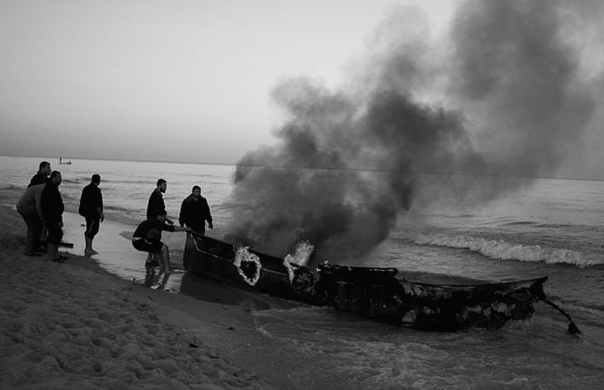
By Barbara Erickson | TimesWarp | May 23, 2016
Gaza made the front page of The New York Times recently, with an article highlighting the fears of residents who suspect Hamas of building tunnels under and near their homes. The topic was ready-made for the newspaper, fitting perfectly into the Israeli (and Times) spin on the besieged enclave.
According to the accepted narrative, the problems in Gaza are due to Hamas, and Israel is free from blame. Thus we find the tunnel story played prominently on the front page under the headline “As Hamas Tunnels Back Into Israel, Palestinians Are Afraid, Too.”
There is much cause for despair in Gaza—fishermen and farmers come under attack, drinking water is ever more scarce, patients are desperate for adequate medical care—but the Times has failed to highlight any of these issues, which are so clearly due to Israeli actions and policies.
The official Israeli line is that Hamas oppresses the residents under its control, and Israeli political leaders use this charge to help justify their airstrikes on Hamas sites and other actions, such as restrictions on the delivery of building materials to Gaza. The Times has been a willing partner in this effort.
So it is no surprise when the newspaper informs us that Hamas has rebuilt many of the tunnels it used during the assaults on Gaza in the summer of 2014, and this is causing anxiety for some Gaza residents who live near signs of underground construction work. They fear that Israel will bomb their neighborhoods to destroy the tunnels.
The story is just what the Israeli army press office ordered, and the Times willingly promotes this propaganda effort even as it shows little interest in even more urgent concerns that plague the residents of the strip. It had nothing to say, for instance, when Israel arrested 20 Gaza fishermen over less than a week this month and confiscated seven of their boats (here and here) even though they were fishing within the approved limit set by Israel.
Israeli harassment of the beleaguered fishermen has been a constant over the years: According to the Palestinian Center for Human Rights, Israeli forces detained 71 fishermen and confiscated 22 fishing boats in 2015, firing on fishing boats at least 139 times, wounding 24 fishermen and damaging 16 boats. The attacks have continued without letup this year.
The Times, however, has almost totally ignored the subject. The paper took notice briefly last month, when Israel announced new rules allowing Gaza boats to sail farther out to sea, and the story most certainly made the grade because it was a chance to show Israel in a benevolent light. The Times has been silent on the issue ever since.
Farmers with land near the border fence also face frequent attacks by Israeli soldiers who fire live ammunition at workers tending their fields, and Israel has destroyed crops and farm buildings, spraying fields of spinach and peas with herbicides and leveling land with bulldozers.
The Times has failed to report these incursions as well, although the United Nations documents them in weekly reports, and other news sources routinely tell of the assaults.
According to the UN, as of May 16, the Israeli military had made 30 incursions into Gaza this year. Its forces entered the enclave at least 56 times during 2015. These mini invasions—which include tanks, bulldozers and live fire—are breaches of the truce agreement made to end hostilities in 2014, but the Times has not seen fit to report them.
Instead, the newspaper prefers to raise the alarm about possible attacks from Gaza via the tunnels, ignoring the relevant context: the frequent shootings and other assaults by Israeli forces and the nine-year blockade, which finds not a single mention in the tunnel article.
Israel blocks the entry of needed medical supplies into Gaza, denies doctors the right to upgrade their skills in foreign countries and prevents many patients from leaving the enclave to receive the treatment they need. It has destroyed electrical equipment, wells and water treatment plants, and the lack of potable water has reached such a critical stage that only some 5 percent of the water in Gaza is safe to drink.
The Times, however, has shown no interest in exploring these crucial issues. It follows a prescribed narrative in deflecting blame from Israel and demonizing Hamas. The tunnel story fit this bill and thus merited a prime placement on page 1 above the fold.
Featured Video
Why the U.S. Should Pull Back From the First Island Chain
or go to
Aletho News Archives – Video-Images
Book Review
‘Why Fauci Must Rot in Prison’: A Tale of Two Diaries
By Jill Erzen | The Defender | October 13, 2026
Dr. Anthony Fauci’s private diary reveals a “mind-numbing” contradiction between what the former top U.S. infectious disease official knew about COVID-19 and what he told the public, senior White House adviser Peter Navarro, Ph.D., said last week on “American Thought Leaders.”
In his new book, “Why Fauci Must Rot in Prison,” due out Oct. 20, Navarro compares Fauci’s private entries to his own pandemic-era diary, and uses what he calls “a tale of two diaries” to argue that Fauci should face criminal prosecution.
“I show, actually, how a prosecution can and should happen … at the state level, most likely,” Navarro said. “He should wind up in prison, and we’ve got the receipts in this book to put him there.”
Navarro said Fauci repeatedly acknowledged important facts in private, then publicly pursued policies that contradicted those facts — with devastating consequences.
“What he says many times privately in his diary is so at odds with both his public behavior and public statements that it’s mind-numbing,” Navarro said.
Navarro examines the lasting damage caused by lockdowns and other pandemic policies, and the ongoing toll of long COVID.
His book also addresses questions about vaccine safety, including why healthy young people faced COVID-19 vaccination mandates despite concerns about myocarditis, and why women were not warned about miscarriage risks linked to the shots. … continue
Blog Roll
 Aletho News
- Jennifer Kavanagh: Why the U.S. Should Pull Back From the First Island Chain
- Yemen denounces international community’s silence on Saudi aggression, siege
- UAE and Saudi Arabia move toward renewed coordination against Sanaa
- How Iran’s two-week retaliatory strikes exposed cracks in US military architecture in Persian Gulf
- The mother of all propaganda: Why the hype over US MOAB strike against Iran is nothing but theater
- Iran says it possesses technology behind US 14-ton GBU bunker-buster
- Trump asks Iran not to retaliate after he strikes Pickaxe Mountain – w/ Prof. Marandi
- Vice President J.D. Vance’s Deceptive ‘Antiwar’ Campaign Speech
- Iran: Palestinians’ rights must not be compromised in Gaza’s future; US, Israel to blame for Hormuz situation
- Ongoing tales of Syrian chemical weapons
- If Americans Knew
- Israeli rabbi permits occupiers to steal Palestinian olive harvest in West Bank
- Netanyahu’s spin on latest settler attack is laughable – Daily Update
- Israeli soldiers debunk Israel’s talking points
- In West Bank, Israeli settlers are totally out of control – Daily Update
- NPR investigation finds evidence of widespread fraud at mall kiosks tied to Israeli skincare brand
- Tucker Carlson exposes Israeli Lies about the Oct 7th attack, Charlie Kirk, and the U.S.
- Israel has detained thousands of Palestinian children since Oct 7th – over half spent time in solitary, many uncharged
- Israeli Analysis: Is Netanyahu Planning an ‘October Surprise’ Attack Before Israel’s Election?
- Israeli settlers brutally attack Palestinians and Washington Post female photographer, 65
- Words Have Changed, Occupation Continues: The Reality of the Gaza Ceasefire
- No Tricks Zone
- Predictions Made By Renowned Climate Proifessor Over Past Decades Have Been Proven To Be Poor
- New Study Suggests Large Regions Of The Pacific Ocean Have Been Cooling For The Last 80 Years
- Germany’s Green Energy Debacle: High Energy Costs Force Kahla Porzellan to Close After 182 Years!
- New Study: 50 Years Of The Most Aggressive ‘Net Zero’ Policies Can Only Affect The Global Climate By 0.03°C
- US September “Heat” Was No Record…Many Records Set Decades Ago
- Latest European Green Energy Debacle; Portugal’s Largest Flagship Solar Park Insolvent!
- Green Energy Debacle: German Expert Professor Fritz Vahrenholt Warns Of Severe Economic And Social Consequences
- Two More Paleo Reconstructions Affirm Meters-Higher Sea Levels Across Ireland, Brazil 7000-6000 Years Ago
- New Study: Earth And Venus Surface Warmth Largely Explained By Convection And Lapse Rate, Not CO2 Or Radiation
- 2025 Nature Paper Claiming Worsening Global Drought Gets RETRACTED …Heavily Flawed


