America Should Rule the World, Says Neocon Infested Think Tank Report
By Stephen Lendman | May 22, 2016
The neocon infested Center for a New American Security (CNAS) promotes endless wars on the phony pretext of protecting US security at a time America’s only enemies are ones it invents.
Its aim is solidifying US global dominance by eliminating all sovereign independent states. Several CNAS members hold or previously held key Obama administration posts.
The organization and like minded ones threaten world peace. They publish reports on militarism, terrorism, irregular warfare and national security challenges.
Its conferences feature top US military and government officials as speakers, promoting the gospel of America the indispensable nation with a divine right to rule the world.
Extremist policies groups like CNAS endorse risk influencing policymakers to launch WW III. Unchallenged power alone matters, they believe, no matter the human and material cost.
People everywhere have cause for concern. The fate of humanity and planet earth hang in the balance.
A new CNAS report co-produced by the neocon Project for the New American Century co-founder Robert Kagan (Victoria Nuland’s husband, responsible for replacing Ukrainian democrats with Nazi-infested putschists) is titled “Extending American Power: Strategies to Expand US Engagement in a Competitive World Order.”
Kagan and former Clinton state department official James Rubin co-headed “a group of current and former government officials, strategists and scholars…with the goal of… shap(ing) the national conversation on America’s role in the world during the run-up” to the November presidential election.
They produced a thinly veiled scheme for unchallenged US world dominance – claiming American leadership “is critical to preserving and strengthening the bedrock of today’s international order,” jeopardized they believe by rival world powers Russia and China, along with radical Islamic terrorists groups – ones America created and supports, they left unexplained.
They believe it’s vital to brainwash Americans to believe US world leadership is essential to preserve and extend its new world order dominance globally.
They urge adoption of stealth corporate coup d’etat, anti-consumer, anti-worker, anti-environment, anti-fundamental freedom TPP and TTIP trade bills.
They urge America usurp sovereignty over parts of the world not its own, international law ignored. They call “the transatlantic community… both the foundation and the core of the liberal (sic) world order” – now threatened by nonexistent Russian aggression.
They support greater NATO commitment to militarism, including deploying larger numbers of combat troops near Russia’s borders.
They argue for using Ukraine as a dagger targeting its heartland, claiming it’s a way for it to “achieve political and economic stability,” controlled by Washington.
They urge supporting ISIS and like minded terrorist groups while pretending to oppose them. Assad must go, they demand, wanting him forcibly ousted, Syria partitioned on the phony pretext of creating “safe space” for its people to “relocate without fear of being killed by (his) forces.”
They endorse using Syrian territory to “arm, train, and organize” terrorist groups masquerading as moderates. They claim nonexistent Iranian aims for regional dominance must be prevented.
Neocon infested groups like CNAS and extremist policymakers they influence are the greatest threat to world peace – especially if war goddess Hillary Clinton succeeds Obama.
Stephen Lendman lives in Chicago. He can be reached at lendmanstephen@sbcglobal.net. His new book as editor and contributor is titled Flashpoint in Ukraine: US Drive for Hegemony Risks WW III.
Colombia: the Displaced & Invisible Nation
By Dan Kovalik | CounterPunch | May 20, 2016
The latest thematic report by the Inter-American Commission on Human Rights (IACHR) concerning Colombia makes for shocking though quite important reading. In short, it details human rights abuses on a massive scale, and lays the blame for these abuses chiefly upon the right-wing paramilitaries aligned with the Colombian State. Citing Colombia’s Center for Historical Memory, the IACHR concludes that Colombia, with its over 6 million internally displaced persons, is indeed “a displaced nation.”

Exhibit at Center for Historical Memory, Showing Personal Effects of “False Positive” Victim
As the IACHR explains, the paramilitaries were responsible for 72% of the attacks recorded in the first half of 2015. Incredibly, the Colombian State, along with its U.S. sponsor, insist that the paramilitaries (also known as Autodefensas) no longer exist as a result of a demobilization (largely faked) back in 2003-2006. And, it is this very denial, the IACHR points out, which allows the paramilitaries to carry out their reign of terror with near complete impunity. After all, the State will not dismantle or prosecute what it claims does not even exist.
As explained in the report, “during 2015 the IACHR has continued receiving information about actions of the illegal armed groups that emerged after the demobilization and which are identified as being related or having among their members, persons that belonged to paramilitary groups who, in many cases allegedly continue acting under the protection of State agents.”
The misdeeds the paramilitaries are carrying out under State protection include disappearances, of which there were an incredible 3,400 during the first 7 months of 2015 alone. In all, the IACHR reports that there have been a total of between 45,000 and 61,918 forced disappearances in Colombia in the past 30 years. Thus, there have potentially been more than three times the disappearances in Colombia than in Argentina during all of the Dirty War years. And, of course, with such disappearances come mass graves, of which Colombia has many – 4,519 of them to be exact, with 5,817 bodies exhumed from them so far.
Meanwhile, the IACHR reported on the fact that at least 5,736 individuals were the victims of extrajudicial executions by the Colombian State forces between 2000 and 2010 – that, is during the period of the U.S.’s major military support for Colombia known as Plan Colombia. Nearly all of these executions were “false positive” killings in which the Colombian military murdered innocent civilians – many of them young, unemployed men – and then dressed them up as guerillas to justify to the U.S. the military assistance the Colombian military was receiving for counter-insurgency purposes. And, while the rate of such killings has decreased since 2010, they nonetheless continue, with 230 reported cases since then.
To the extent Colombia is covered at all in the mainstream press these days, one rarely gets a glimpse into the horror show which is taking place in that country. And, casual visitors to places such as Bogota or Medellin would rarely get a glimpse of this either. This is so because the lion’s share of the violence described above is taking place in the more remote areas where Colombia’s Afro-Colombian and indigenous communities live, and it is these communities which are suffering the brunt of this violence.
As the IACHR explains, these communities are largely “invisible” in Colombian society, “are victims of racial discrimination and disproportionately affected by violence, forced displacement, poverty and social exclusion.” In addition, “the majority of victims of sexual violence in armed conflict are Afro-descendant and indigenous women.” And, impunity for sexual violence in Colombia is near total “given that sexual violence against women would be perpetrated mainly by paramilitary, but also by agents of the government . . . .”
As for the issue of poverty, these communities are suffering from some of the most extreme versions of it, and live in conditions of misery which residents in the major cities are often shielded from. For example, in Choco – a town nestled in between the Pacific and Caribbean coasts and populated by mostly Afro-Colombian and indigenous – the infant mortality rate is 42.69 per 1000. This figure is higher than that of post-invasion Iraq, and nearly as high as that in such countries as Burma, Bangladesh, Namibia and Haiti. Meanwhile, in Bogota, the figure is 12.88 per 1000. These figures underscore the incredible inequities and disparity in wealth which make Colombia one of the most unequal societies on earth, with a very stark divide along racial and ethnic lines.
However, the violence against Afro-Colombians and indigenous is not just the product of racism, but is also the product of the unfettered capital penetration of their rich, ancestral land. As the IACHR points out, large scale megaprojects – many of them mining projects – “have led to the appropriation of Afro-Colombian’s collective territories, and have resulted in “brutal forced displacements, massive violence and selective assassinations.”
And, of course, many of these megaprojects are owned, in whole or in part, by North American companies to which the U.S.-Colombia Free Trade Agreement (FTA) has opened Colombia wide open.
An example of such a deadly megaproject detailed in the IACHR report is the port expansion of Buenaventura, a town which is 90% Afro-Colombian. This port expansion was carried out to facilitate the trade and tourism created by the FTA. And, the struggle of the paramilitaries to control the wealth generated by the port expansion has led to the forced disappearances of hundreds of Buenaventura residents “and the operation of ‘chop houses’ (casa de pique)” where people are chopped up alive.
Like the Colombian and U.S. governments denials of the existence of the paramilitary death squads, the very failure of our mainstream media to acknowledge or discuss the existence of the above-described crimes allows them to continue. Thus, the U.S. government is able to continue supporting the Colombian military, and by extension its paramilitary allies, and North American multi-nationals are able to keep violently exploiting the Colombian people and their land by virtue of the fact that we are kept in the dark about this reality by a press corps which is failing in its duty to report on such matters of public concern. It is only by breaking this silence around these crimes that we have any chance of stopping them.
Daniel Kovalik lives in Pittsburgh and teaches International Human Rights Law at the University of Pittsburgh School of Law.
Syria White Helmets: Humanitarians or “Executioners”?
UK Column News – May 20, 2016
In this UK Column News special, Mike Robinson speaks to Vanessa Beeley about Syria’s “first responder” group, the White Helmets who are being pushed forward for nomination for a Nobel Peace Prize. Do they deserve it?
For more background on this, please see our previous interview from November last year: http://youtu.be/mLa9ztvAGWw
Also see Vanessa’s articles on 21st Century Wire:
http://21stcenturywire.com/2015/10/23…
‘Make It Look Like It’s ISIS’: A Fake Bomb, a Would-Be Terrorist, and an FBI Sting in Miami
By Benjamin Gilbert | Vice News | May 17, 2016
The FBI says it caught a terrorist trying to blow up a synagogue on the outskirts of Miami.
But the FBI supplied the bomb.
The device was fake, part of an undercover FBI sting operation that, like hundreds of controversial investigations before it, used an undercover informant to target an alleged terrorist.
In the Miami case, federal authorities accuse 40-year-old James Medina of planning to bomb the Aventura Turnberry Jewish Center north of the city.
The FBI started their investigation of Medina in March 2015 “based on his suspected desire to attack” the Jewish center, according to an affidavit filed in federal court and a statement released by the US Attorney’s Office in the Southern District of Florida.
Medina, who said he converted to Islam four years ago and referred to his alias “James Muhammad” in court, has been charged with “attempted use of a weapon of mass destruction.” He pleaded not guilty on Monday morning.
Apart from the fact that the FBI supplied Medina with the weapon that he intended to use against the Jewish center, rights activists and legal experts are troubled by the facts presented by the FBI and Justice Department. Their concern includes instances where the informant, or “confidential human source” in bureau parlance, offered to assist Medina in attacking the center, and even suggested that he link the attack to the Islamic State.
The FBI’s affidavit — which reveals only enough information to justify the criminal complaint against Medina, and does not include all of the evidence against him — says that an informant met with Medina in March and secretly recorded conversations with him after he expressed a desire to attack the Jewish center.
But the affidavit does not say how the FBI learned of Medina’s “suspected desire” to attack the Jewish center, or what initial remarks or actions led agents to believe that Medina was willing to use violence before he devised his plans with the informant.
David Shapiro, a former New Jersey prosecutor and FBI special agent who is now a professor at the John Jay College of Criminal Justice in New York, said the affidavit makes it appear that the FBI did more than a little pushing to get Medina to develop the synagogue bombing plan.
“It seems this desire was developed,” he said. “It was watered with very potent fertilizer.”
The affidavit lays out how the FBI informant took an active part in helping Medina cook up the bombing plot. It recounts how the informant drove Medina to the Jewish center and suggested that he launch the attack on a Jewish holiday.
When the two later discussed a claim of responsibility, the affidavit says that the informant “indicated that they should leave a ‘clue’ as to who was responsible and Medina concurred.” It’s the informant, rather than Medina, who suggests linking the bombing to the Islamic State, also known as ISIS, or the East African al-Qaeda affiliate al-Shabaab.
“You can, you can do all that,” the affidavit quotes Medina as saying. “Yeah, we can print up or something and make it look like it’s ISIS here in America. Just like that.”
The informant later suggested that Medina could use “untraceable” firearms instead of AK-47s that an acquaintance of Medina’s said he could provide. At another meeting, the informant “addressed the concerns of entering the synagogue with firearms and then getting shot and instead proposed leaving an unspecified object behind and leaving the scene.” The informant suggested that Medina could use a bomb with a timer, and then introduced Medina to a man described as having “explosives expertise and access.” The bomb expert was really an undercover FBI agent.
Medina didn’t do himself any favors by repeatedly telling both the FBI informant and undercover agent that he was willing to leave the bomb at the synagogue, then escape with the informant and watch as they remotely detonated it. He also repeatedly assured the undercover agent that he was willing to go forward with the plot, according to the affidavit.
When asked why, Medina answers, “Because I realize that I have a lot of love for Allah. And I know that all these, all these wars that are going on, it hurts me, too. You know? It’s my call of duty. I gotta get back, when I’m doing this, I feel that I’m doing it for a good cause for Allah.”
In a subsequent conversation, the agent asked Medina if he was okay with killing women and children. Medina appeared to say yes, but he also seemed hesitant.
Medina: I think so. I think I’m fine, Urn hmm.
Agent: You need to be sure brother.
Medina: I am pretty sure. I think so. I believe so. I’m ready bro!
Agent: Ok. Cause you know you don’t have to do any of this.
Medina: What do you mean doing it?
Agent: No, you don’t have to do it if you’re not comfortable with it.
Medina: What? I’m ready.
Agent: It’s Allah’s will but you know…
Medina: I’m up for it. I really am. This is no joke. This is serious dog. If I have the equipment, believe me, in the time is, is that day and we doin’ it, I’m up for it bro. Just like I said.
The FBI says Medina and the undercover agent decided to bomb the synagogue on Friday, April 29. Medina made three videos on the informant’s phone: One as a goodbye to his family in case he was killed, and the other two to explain why he conducted the attack.
“I am a Muslim and I don’t like what is going on in this world. I’m going to handle business here in America. Aventura, watch your back. ISIS is in the house,” he said in one video. In another, he said, “Today is gonna be a day where Muslims attack America. I’m going to set a bomb in Aventura.”
On the appointed day, the agent met with Medina, gave him the fake bomb, instructed him how to use it, and then drove him to the synagogue. Medina exited the vehicle and began to walk toward the synagogue, at which point the authorities arrested him.
The US government has convicted more than 200 people on terrorism-related charges using similar methods, according to Trevor Aaronson, executive director of the Florida Center for Investigative Reporting and author of The FBI’s Manufactured War on Terrorism. He said that the FBI “isn’t finding people with a bomb in their garage. They’re finding people who are loudmouths and they say, “Oh, we can help you in the name of al-Qaeda or the Islamic State.”
“These are sting operations where the FBI provides the means and opportunities for people to commit crimes,” Aaronson said. “And the most disturbing part is that most of these people seem to be mentally ill and do not have connections to overseas terrorists on their own.”
Medina fits this profile. The 40-year-old is divorced, single, and unemployed. He was arrested previously for behavior consistent with mental illness, including sending more than 50 text messages, some threatening violence, to his estranged family and then telling a cop about it.
Karen J. Greenberg, director of the Center on National Security at Fordham Law School, said the quoted conversations in the affidavit that are supposed to damn Medina instead make it look like he can “barely seem to string a sentence together.”
And while it appears to be clear that Medina is a bigot who harbors anti-Jewish feelings, neither of those two things is illegal. Of course, plotting to blow up a synagogue is illegal. Retired FBI counterterrorism executive David Gomez says the FBI’s investigative techniques were legitimate, even if Medina does have mental or cognitive issues.
“Just because you’re dumb doesn’t mean you’re not dangerous,” he said. “Just because you have some mental incapacitation doesn’t mean you’re not capable of murder.”
Gomez said he’s seen other cases where lonely, fringe suspects join gangs or right-wing extremist groups to gain approval, and then peer pressure or other factors leads them to commit violent acts. In cases such as Medina’s, he argued, the FBI is just getting to these suspects before other malicious actors.
“Let’s say we didn’t get a source on this person, and somebody else talks to them and says, ‘Wanna blow up some Jews?’ It doesn’t matter if you blow them up for the KKK or ISIS. Some guy says, ‘I’ll drive you there,’ and there are plenty of people out there who would do that,” Gomez said. “The FBI and others are worried about a guy who gets in with the wrong crowd.”
Greenberg questioned where the rationale for this type of investigation ends.
“If you want to look for individuals who are susceptible to some kind of inducement to violence, and who have to be told whose name the violence is in, there are countless people and countless extremist groups you could identify them with,” she said.
Gomez said that the FBI’s informants and undercover agents set up the suspect for the “next proactive move,” but don’t make them take it.
“At some point he has to have an overt act,” he said — such as taking what he thinks is a bomb onto the grounds of a synagogue with the intent to detonate it.
Under the law, this act essentially closes the door to an entrapment defense.
“Those are hard to assert in this situation,” said Hugh Handeyside, a staff attorney with the American Civil Liberties Union’s National Security Project. “That’s the situation that the FBI and DOJ are taking advantage of.”
According to Greenberg, the FBI has been using these types of investigations to send a message: “If someone approaches you and asks you if want help with a terrorist attack, you’re supposed to say no.”
Gomez notes that since 9/11, the bureau has been tasked with preventing another terrorist attack on US soil.
“The attitude is, do what you have to legally do to prevent a Paris-style attack in the US,” he said, “and I think there are a lot of prosecutors out there who would say, ‘I would rather prosecute a case and take the chance on losing on technicality or jury nullification than take a chance to not prosecute on terrorism charges.”
But most terrorism cases do not go to trial, meaning prosecutors rarely lose. Most defense lawyers encourage their clients to enter into a plea agreement in order to avoid a lengthy prison sentence.
“The threat of long-term incarceration compels people to cut their losses,” said Michael German, a former FBI agent who worked on undercover domestic terrorism investigations. “Part of reason they’re encouraged to cut losses is that when these cases go to trial, despite the judges expressing concerns about FBI methodology, the political and social climate is such that fear actually compels them to not acquit people based on entrapment or other government misconduct.”
The FBI declined to comment on the Medina case or other counterterrorism investigations like it, but said in a statement that there are “strict guidelines governing the use of undercover operations which involve extensive legal reviews and senior-level approvals.”
The bureau’s director, James B. Comey, told Congress in February that “preventing terrorist attacks remains the FBI’s top priority” as he requested more than $9 billion to fund the bureau’s operations in 2017.
Nearly half of the FBI’s 2016 budget was committed to “counterterrorism and counterintelligence” operations, along with more than 13,000 members of the bureau’s 35,000 employees.
According to German, the funding means the FBI is under pressure to show Congress that it’s using its resources to stop terror attacks.
“Is there actually a threat being resolved, or is the FBI manufacturing these terrorism cases to make its counterterrorism efforts look worthwhile?” he asked. “Knowing that there are real threats out there, are they wasting resources when the people they’re targeting don’t present an immediate threat?”
Handeyside said counterterrorism cases like Medina’s are not only a waste of resources, they might actually be making America less safe.
“It’s not only that they’re manufacturing terror plots, but also sowing fear and distrust within minority communities in ways that I think are damaging to counterterrorism efforts,” he said. “So there are not only constitutional issues, but also effectiveness issues.”
Follow Benjamin Gilbert on Twitter: @benrgilbert
Related: The FBI Suspected an Army Vet Was Plotting Attacks in the US — So They Gave Him Guns
The Danger of Demonization
By Robert Parry | Consortium News | May 17, 2016
Does any intelligent person look at a New York Times article about Russia or Vladimir Putin these days and expect to read an objective, balanced account? Or will it be laced with a predictable blend of contempt and ridicule? And is it any different at The Washington Post, NPR, MSNBC, CNN or almost any mainstream U.S. news outlet?
And it’s not just Russia. The same trend holds true for Iran, Syria, Venezuela, Nicaragua and other countries and movements that have fallen onto the U.S. government’s “enemies list.” We saw the same pattern with Saddam Hussein and Iraq before the 2003 U.S. invasion; with Muammar Gaddafi and Libya before the U.S.-orchestrated bombing campaign in 2011; and with President Viktor Yanukovych and Ukraine before the U.S.-backed coup in 2014.
That is not to say that these countries and leaders don’t deserve criticism; they do. But the proper role of the press corps – at least as I was taught during my early years at The Associated Press – was to treat all evidence objectively and all sides fairly. Just because you might not like someone doesn’t mean your feelings should show through or the facts should be forced through a prism of bias.
In those “old days,” that sort of behavior was deemed unprofessional and you would expect a senior editor to come down hard on you. Now, however, it seems that you’d only get punished if you quoted some dissident or allowed such a person onto an op-ed page or a talk show, someone who didn’t share Official Washington’s “group think” about the “enemy.” Deviation from “group think” has become the real disqualifier.
Yet, this conformity should be shocking and unacceptable in a country that prides itself on freedom of thought and speech. Indeed, much of the criticism of “enemy” states is that they supposedly practice various forms of censorship and permit only regime-friendly propaganda to reach the public.
But when was the last time you heard anyone in the U.S. mainstream say anything positive or even nuanced about Russian President Putin. He can only be portrayed as some shirtless buffoon or the devil incarnate. Former Secretary of State Hillary Clinton got widespread praise in 2014 when she likened him to Hitler.
Or when has anyone in the U.S. media been allowed to suggest that Syria’s President Bashar al-Assad and his supporters might actually have reason to fear what the U.S. press lovingly calls the “moderate” rebels – though they often operate under the military command of Sunni extremist groups, such as Al Qaeda’s Nusra Front. [See Consortiumnews.com’s “Obama’s ‘Moderate’ Syrian Deception.”]
For the first three years of the Syrian civil war, the only permissible U.S. narrative was how the brutal Assad was slaughtering peaceful “moderates,” even though Defense Intelligence Agency analysts and other insiders had long been warning about the involvement of violent jihadists in the movement from the uprising’s beginning in 2011.
But that story was kept from the American people until the Islamic State started chopping off the heads of Western hostages in 2014 – and since then, the mainstream U.S. media has only reported the fuller story in a half-hearted and garbled way. [See Consortiumnews.com’s “Hidden Origins of Syria’s Civil War.” ]
Reason for Conformity
The reason for this conformity among journalists is simple: If you repeat the conventional wisdom, you might find yourself with a lucrative gig as a big-shot foreign correspondent, a regular TV talking head, or a “visiting scholar” at a major think tank. However, if you don’t say what’s expected, your career prospects aren’t very bright.
If you somehow were to find yourself in a mainstream setting and even mildly challenged the “group think,” you should expect to be denounced as a fill-in-the-blank “apologist” or “stooge.” A well-paid avatar of the conventional wisdom might even accuse you of being on the payroll of the despised leader. And, you wouldn’t likely get invited back.
But the West’s demonization of foreign “enemies” is not only an affront to free speech and meaningful democracy, it is also dangerous because it empowers unscrupulous American and European leaders to undertake violent and ill-considered actions that get lots of people killed and that spread hatred against the West.
The most obvious recent example was the Iraq War, which was justified by a barrage of false and misleading claims about Iraq which were mostly swallowed whole by a passive and complicit Western press corps.
Key to that disaster was the demonization of Saddam Hussein, who was subjected to such unrelenting propaganda that almost no one dared question the baseless charges hurled at him about hiding WMD and collaborating with Al Qaeda. To do so would have made you a “Saddam apologist” or worse.
The few who did dare raise their voices faced accusations of treason or were subjected to character assassination. Yet, even after their skepticism was vindicated as the pre-invasion accusations collapsed, there was very little reappraisal. Most of the skeptics remained marginalized and virtually everyone who got the WMD story wrong escaped accountability.
No Accountability
For instance, Washington Post editorial-page editor Fred Hiatt, who repeatedly reported Iraq’s WMD as “flat fact,” suffered not a whit and remains in the same prestigious job, still enforcing one-sided “group thinks” about “enemies.”
An example of how Hiatt and the Post continue to play the same role as neocon propagandists was on display last year in an editorial condemning Putin’s government for shutting down Russian activities of the U.S.-funded National Endowment for Democracy and requiring foreign-funded groups seeking to influence Russian politics to register as foreign agents.
In the Post’s editorial and a companion op-ed by NED President Carl Gershman, you were led to believe that Putin was delusional, paranoid and “power mad” in his concern that outside money funneled into non-governmental organizations was a threat to Russian sovereignty.
However, the Post and Gershman left out a few salient facts, such as the fact that NED is funded by the U.S. government and was the brainchild of Ronald Reagan’s CIA Director William J. Casey in 1983 to partially replace the CIA’s historic role in creating propaganda and political fronts inside targeted nations.
Also missing was the fact that Gershman himself announced in another Post op-ed that he saw Ukraine, prior to the 2014 coup, as “the biggest prize” and a steppingstone toward achieving Putin’s ouster in Russia. The Post also forgot to mention that the Russian law about “foreign agents” was modeled after a U.S. statute entitled the Foreign Agent Registration Act. [See Consortiumnews.com’s “Why Russia Shut Down NED Fronts.”]
All those points would have given the Post’s readers a fuller and fairer understanding of why Putin and Russia acted as they did, but that would have messed up the desired propaganda narrative seeking to demonize Putin. The goal was not to inform the American people but to manipulate them into a new Cold War hostility toward Russia.
We’ve seen a similar pattern with the U.S. government’s “information warfare” around high-profile incidents. In the “old days’ – at least when I arrived in Washington in the late 1970s – there was much more skepticism among journalists about the official line from the White House or State Department. Indeed, it was a point of pride among journalists not to simply accept whatever the spokesmen or officials were saying, but to check it out.
There was plenty of enough evidence – from the Tonkin Gulf lies to the Watergate cover-up – to justify a critical examination of government claims. But that tradition has been lost, too. Despite the costly deceptions before the Iraq War, the Times, the Post and other mainstream outlets simply accept whatever accusations the U.S. government hurls against “enemies.” Beyond the gullibility, there is even hostility toward those of us who insist on seeing real evidence.
Examples of this continuing pattern include the acceptance of the U.S. government line on the sarin gas attack outside Damascus, Syria, on Aug. 21, 2013, and the shoot-down of Malaysia Airlines Flight 17 over eastern Ukraine on July 17, 2014. The first was blamed on Syria’s Assad and the second on Russia’s Putin – quite convenient even though U.S. officials refused to present any solid evidence to support their claims.
Reasons for Doubt
In both cases, there were obvious reasons to doubt the Official Story. Assad had just invited United Nations inspectors in to examine what he claimed were rebel chemical attacks, so why would he pick that time to launch a sarin attack just miles from where the inspectors were staying? Putin was trying to maintain a low profile for Russian support to Ukrainians resisting the U.S.-backed coup, but provision of a large, sophisticated and powerful anti-aircraft battery lumbering around eastern Ukraine would just have invited detection.
Further, in both cases, there was dissent among U.S. intelligence analysts, some of whom objected at least to the rushes to judgment and offered different explanations for the incidents, pointing the blame in other possible directions. The dissent caused the Obama administration to resort to a new concoction called a “Government Assessment” – essentially a propaganda document – rather than a classic “Intelligence Assessment,” which would express the consensus views of the 16 intelligence agencies and include areas of disagreement.
So, there were plenty of reasons for Washington journalists to smell a rat or at least insist upon hard evidence to make the case against Assad and Putin. Instead, given the demonized views of Assad and Putin, mainstream journalists unanimously fell in line behind the Official Story. They even ignored or buried evidence that undermined the government’s tales.
Regarding the Syrian case, there was little interest in the scientific discovery that the one sarin-laden rocket (recovered by the U.N.) had a range of only about two kilometers (destroying Washington’s claims about the Syrian government firing many rockets from eight or nine kilometers away). [See Consortiumnews.com’s “Was Turkey Behind Syria-Sarin Attack?”]
Regarding the MH-17 case, a blind eye was turned to a Dutch intelligence report that concluded that there were several operational Buk anti-aircraft missile batteries in eastern Ukraine but they were all under the control of the Ukrainian military and that the rebels had no weapon that could reach the 33,000-foot altitude where MH-17 was flying. [See Consortiumnews.com’s “The Ever-Curiouser MH-17 Case.”]
Though both those cases remain open and one cannot rule out new evidence emerging that bolsters the U.S. government’s version of events, the fact that there are substantive reasons to doubt the Official Story should be reflected in how the mainstream Western media deals with these two sensitive issues, but the inconvenient facts are instead brushed aside or ignored (much as happened with Iraq’s WMD).
In short, there has been a system-wide collapse of the Western news media as a professional entity in dealing with foreign crises. So, as the world plunges deeper into crises inside Syria and on Russia’s border, the West’s citizens are going in almost blind without the eyes and ears of independent journalists on the ground and with major news outlets delivering incessant propaganda from Washington and other capitals.
Instead of facts, the West’s mainstream media traffics in demonization.
Investigative reporter Robert Parry broke many of the Iran-Contra stories for The Associated Press and Newsweek in the 1980s. You can buy his latest book, America’s Stolen Narrative, either in print here or as an e-book (from Amazon and barnesandnoble.com).
‘No new military base in Palmyra’ – Russian Defense Ministry refutes AP report
RT | May 17, 2016
The Russian Defense Ministry has denied allegations reported by the AP that Russia is constructing an army base in the ancient city of Palmyra, which has recently been freed from Islamic State.
“There are no ‘new army bases’ on the territory of the Syrian town of Palmyra and there will never be,” Defense Ministry spokesman Major-General Igor Konashenkov said in an official statement on Tuesday.
Earlier in the day, the AP news agency came out with a report stating that the Russian military is building an army base in Palmyra within the zone listed by UNESCO as a world heritage site, and without permission from authorities. The agency cited an “American heritage organization” and a “top Syrian archaeologist” as its sources, as well as satellite images that appear to show some construction on the edge of the ancient site.
Yet, as General Konashenkov states, the pictures show something else entirely.
“The satellite pictures of this area posted by UNESCO, which were mentioned by AP, show the temporary camp of the International Demining Center of Russia’s Defense Forces, which were demining the archaeological monument of Palmyra, and now the broader area of Tadmor city.”
The installation of this temporary camp until the area is cleared of explosives has been approved at the Ministry of Culture and other official departments of the Syrian State,” Konashenkov pointed out.
Furthermore, Maamoun Abdulkarim, head of the Antiquities and Museums Department in Damascus, who the AP cited as its source, told the agency himself “that IS [Islamic State, formerly ISIS/ISIL] is close to the town and the presence of Russian and Syrian troops is important to ensure that the site remains in government hands.”
Palmyra was captured by jihadist in May of 2015. The Syrian Army backed by Russian forces managed to recapture the city on March 27th of this year, an event largely viewed as a victory and turning point in the war against the terrorists in Syria.
During 10 months of brigandry, executions, and other types of savagery, many ancient monuments were damaged to a worse extent than during all of the centuries they had stood there. A number of remarkable monuments, including the Arch of Triumph, the Temple of Baalshamin, and the iconic 2,000-year-old Bel Temple, are now in ruins.
Moreover, the city and adjacent territories were left ridden with explosive devices, which have now been largely demined by Russian sappers. A Russian-drafted resolution on the role of UNESCO in restoring the devastated ancient city of Palmyra back to its former glory was unanimously approved by the organization in April, with restoration work set to begin when the area is fully cleared of mines.
Read more:
US reporters ignore first journalist tour of liberated Palmyra organized by Russian military – MoD
Battleground Europe: The Real Reason US Wants to Invest More in Propaganda

© Flickr/ sualk61
Sputnik – May 16, 2016
The United States is contemplating investing into additional propaganda efforts targeted against Russia as mainstream Western media does not seem to be doing a very good job of getting Washington’s message across to Europe and preventing the continent from getting closer to Russia, former US diplomat Jim Jatras told RT.
The analyst was referring to a recent initiative aimed at establishing a new federal agency that will be tasked with countering Russian and Chinese “propaganda.”
The bill, known as Countering Information Warfare Act of 2016, has been in fact designed “to insure that there is no corrective to the information put out by [the US] government and then dutifully picked up by the Western media,” Jatras observed.
American media outlets, he added, “pick up like bulletin boards from government agencies very uncritically and just simply put it out there. And no other points of view are really entertained.”
The initiative is primarily focused on Europe and its warming relations with Russia, he added. US policymakers are apparently concerned that Europeans are increasingly disappointed in Washington’s stance on Russia, with some urging to lift the restrictive measures that were imposed on Moscow following the outbreak of the Ukrainian civil war.
“What I think the fear is, especially if you look at the changing mood in Europe towards, for example, the sanctions on Russia, I think that the people here in Washington feel they are losing that argument,” Jatras said.
The US policymakers’ logic, according to the analyst, is the following:
“Rather than reexamine their policy and think: ‘Well, maybe there is something wrong here, maybe we should change our course,’ they are saying: ‘They just don’t understand us well enough. We just have to make our propaganda better than it has been.'”
The bill, introduced by Senator Rob Portman, has been referred to the Committee on Foreign Relations. If passed, it would create the Center for Information Analysis and Response, armed with a $20-million budget for 2017 and 2018.
“This is especially, it seems, targeted toward Europe where there will be a $20 million over the next two fiscal years made available in the form of grants to unspecified people in Europe that one assumes in the European media to carry a story that is more in line with US policy,” Jatras explained.
Read more:
US, NATO, EU ‘Obsessed’ With ‘Highly Efficient Russian Propaganda’
Featured Video
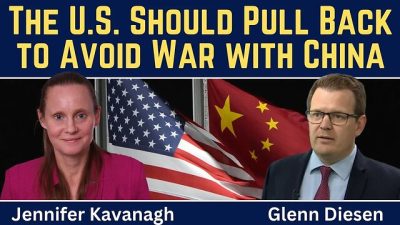
Why the U.S. Should Pull Back From the First Island Chain
or go to
Aletho News Archives – Video-Images
Book Review
‘Why Fauci Must Rot in Prison’: A Tale of Two Diaries
By Jill Erzen | The Defender | October 13, 2026
Dr. Anthony Fauci’s private diary reveals a “mind-numbing” contradiction between what the former top U.S. infectious disease official knew about COVID-19 and what he told the public, senior White House adviser Peter Navarro, Ph.D., said last week on “American Thought Leaders.”
In his new book, “Why Fauci Must Rot in Prison,” due out Oct. 20, Navarro compares Fauci’s private entries to his own pandemic-era diary, and uses what he calls “a tale of two diaries” to argue that Fauci should face criminal prosecution.
“I show, actually, how a prosecution can and should happen … at the state level, most likely,” Navarro said. “He should wind up in prison, and we’ve got the receipts in this book to put him there.”
Navarro said Fauci repeatedly acknowledged important facts in private, then publicly pursued policies that contradicted those facts — with devastating consequences.
“What he says many times privately in his diary is so at odds with both his public behavior and public statements that it’s mind-numbing,” Navarro said.
Navarro examines the lasting damage caused by lockdowns and other pandemic policies, and the ongoing toll of long COVID.
His book also addresses questions about vaccine safety, including why healthy young people faced COVID-19 vaccination mandates despite concerns about myocarditis, and why women were not warned about miscarriage risks linked to the shots. … continue
Blog Roll
 Aletho News
- Jennifer Kavanagh: Why the U.S. Should Pull Back From the First Island Chain
- Yemen denounces international community’s silence on Saudi aggression, siege
- UAE and Saudi Arabia move toward renewed coordination against Sanaa
- How Iran’s two-week retaliatory strikes exposed cracks in US military architecture in Persian Gulf
- The mother of all propaganda: Why the hype over US MOAB strike against Iran is nothing but theater
- Iran says it possesses technology behind US 14-ton GBU bunker-buster
- Trump asks Iran not to retaliate after he strikes Pickaxe Mountain – w/ Prof. Marandi
- Vice President J.D. Vance’s Deceptive ‘Antiwar’ Campaign Speech
- Iran: Palestinians’ rights must not be compromised in Gaza’s future; US, Israel to blame for Hormuz situation
- Ongoing tales of Syrian chemical weapons
- If Americans Knew
- Israeli rabbi permits occupiers to steal Palestinian olive harvest in West Bank
- Netanyahu’s spin on latest settler attack is laughable – Daily Update
- Israeli soldiers debunk Israel’s talking points
- In West Bank, Israeli settlers are totally out of control – Daily Update
- NPR investigation finds evidence of widespread fraud at mall kiosks tied to Israeli skincare brand
- Tucker Carlson exposes Israeli Lies about the Oct 7th attack, Charlie Kirk, and the U.S.
- Israel has detained thousands of Palestinian children since Oct 7th – over half spent time in solitary, many uncharged
- Israeli Analysis: Is Netanyahu Planning an ‘October Surprise’ Attack Before Israel’s Election?
- Israeli settlers brutally attack Palestinians and Washington Post female photographer, 65
- Words Have Changed, Occupation Continues: The Reality of the Gaza Ceasefire
- No Tricks Zone
- Predictions Made By Renowned Climate Proifessor Over Past Decades Have Been Proven To Be Poor
- New Study Suggests Large Regions Of The Pacific Ocean Have Been Cooling For The Last 80 Years
- Germany’s Green Energy Debacle: High Energy Costs Force Kahla Porzellan to Close After 182 Years!
- New Study: 50 Years Of The Most Aggressive ‘Net Zero’ Policies Can Only Affect The Global Climate By 0.03°C
- US September “Heat” Was No Record…Many Records Set Decades Ago
- Latest European Green Energy Debacle; Portugal’s Largest Flagship Solar Park Insolvent!
- Green Energy Debacle: German Expert Professor Fritz Vahrenholt Warns Of Severe Economic And Social Consequences
- Two More Paleo Reconstructions Affirm Meters-Higher Sea Levels Across Ireland, Brazil 7000-6000 Years Ago
- New Study: Earth And Venus Surface Warmth Largely Explained By Convection And Lapse Rate, Not CO2 Or Radiation
- 2025 Nature Paper Claiming Worsening Global Drought Gets RETRACTED …Heavily Flawed

