NYT Editors Obsessed with Getting Clinton Elected President
By Stephen Lendman | May 15, 2016
She’s recklessly pro-war, pro-business, anti-populist, a threat to world peace and stability. Her deplorable public office record shows she opposes equity, justice, rule of law principles and democratic values.
Her agenda is frightening, electing her president unthinkable, a neocon war goddess, supporting endless conflicts, deploring peace, risking direct confrontation with Russia and China.
Her finger on the nuclear trigger leaves humanity’s fate up for grabs. NYT editors support the most recklessly dangerous US presidential aspirant in modern memory while bashing Trump relentlessly.
He’s over-the-top like all duopoly power presidential aspirants, supporting the same dirty business as usual agenda. Unlike Clinton, he’d rather make money than start WW III.
The Times went to extraordinary lengths to bash his womanizing history, making “unwelcome advances,” conducting “unsettling workplace conduct over decades.”
It assigned unknown numbers of reporters to locate and interview over 50 women who worked with, dated or interacted with him socially “since his adolescence” – without explaining how any of this relates to affairs of state if he’s elected president.
Numerous past presidents had extramarital affairs, including Washington, Jefferson, Franklin Roosevelt, Dwight Eisenhower, Jack Kennedy, Lyndon Johnson and Bill Clinton, among others.
Little or nothing was said about their private lives while campaigning or throughout their tenure.
Instead of focusing solely on issues and where candidates stand, the Times dwelled on where it had no business going. Nothing it reported suggested wrongdoing.
Countless hours spent locating and interviewing dozens of women found nothing more than a “portrait of a wealthy, well-known and provocative man and the women around him, one that defies categorization,” said the Times.
“Some women found him gracious and encouraging.” Some got high-level positions in his enterprises. The Times called it “a daring move for a major real estate developer at the time.”
Who cares if he made “romantic advances.” He didn’t rape or molest anyone. “A lot of things get made up over the years,” he said. “I have always treated women with great respect. And women will tell you that.”
About all the Times could conclude was saying he had power and women he came into contact with didn’t. He had and still has “celebrity… wealth (and) connections.” Some women sought his help with their careers and stuck with him.
The lengthy article isn’t worth the time or trouble to read. It reveals more about the Times’ deplorable agenda than Trump’s.
Political reporting should focus solely on issues and pinning down candidates on where they stand. America’s money-controlled system features horse-race journalism.
Duopoly power is ignored. So is a sham political process too debauched to fix. Whether Trump or Clinton succeeds Obama, ordinary people lose.
The biggest unreported issue is avoiding global nuclear war. With Trump there’s a chance, likely little at best with Clinton.
Stephen Lendman lives in Chicago. He can be reached at lendmanstephen@sbcglobal.net.
His new book as editor and contributor is titled Flashpoint in Ukraine: US Drive for Hegemony Risks WW III.
Privacy bogeyman: Putin’s face invades London in campaign against controversial UK spy bill
RT | May 12, 2016
Warning Brits about the dangers of a new surveillance bill, UK campaigners have flooded London with sinister captioned portraits of Vladimir Putin. The choice of bogeyman however could be better, given the notoriety of Western global spying operations.
The posters and billboards which have been recently appearing all across the British capital, and also in newspapers, including the Guardian and The Telegraph, feature a very distinctive face with a caption that reads: “A government that spies on its citizens. What’s not to like?”
The Don’t Spy On Us Campaign, which is behind the billboards, is trying to warn British citizens about the danger of the UK governments’ Surveillance Bill currently going through parliament. If passed, it would give “government, intelligence agencies and police the kind of powers you would expect in an authoritarian regime,” the campaign said on its website.
The state will “snoop on our private communications and internet use,” collect and store “data about your emails, phone calls, texts and internet use,” while security agencies will be allowed to hack people’s computers and phones, campaigners stressed.
The Don’t Spy On Us Campaign, a coalition of several pro-privacy organizations, also launched an online petition urging the reformation of the surveillance bill. Photographs of Chinese and North Korean leaders were also used by campaigners, but drew less attention, RT’s Harry Fear reported from London.
“Of course, Putin’s face and the Russian brand, if you will, have resonance here in the UK given all of the demonizing in politics and the media,” Fear said. He noted however that “the British public on average knows a great deal about the American surveillance program, not the Russian or Chinese.”
Indeed many on the internet are puzzled by the choice of the Russian president as the face for the campaign, calling the whole affair “a bit peculiar.”
In particular, some mocked the campaigners’ choice of images, saying that faces of other leaders, such as US President Baraсk Obama or UK Prime Minister David Cameron would have been more suitable.
Mass surveillance practices by the US national Security Agency made headlines worldwide after they were unmasked by whistleblower, Edward Snowden, with the help of the Guardian, back in 2013.
“Some are saying that comparing the UK, perhaps, uncertain security state future to the American’s campaign and having Obama’s face instead of Putin’s face here may have been a more appropriate marketing and campaigning choice,” Fear said.
READ MORE:
Brits blindly walking into Orwellian surveillance state, survey suggests
‘Privacy is not a privilege, it’s a fundamental human right,’ top privacy expert tells RT
Good chance spies are hoovering up your personal data in bulk, documents show
Western Kim-Phobia & The Danger of War
By Caleb Maupin | New Eastern Outlook | May 11, 2016
In almost every US aligned Gulf State, you can find an autocratic monarch who rules over a small, oil-rich corner of the world via an outdated, pre-democratic legal system that grants him absolute authority. King Abdullah of Saudi Arabia, an absolute monarch with dictatorial powers, was married to 30 different women, by whom he has fathered a total of 35 children. The recently deceased King Abdullah, now replaced by Salman, was a serial human rights violating autocrat who routinely beheaded people for “insulting” him, and he was certainly not alone.
If investigative journalists in the Western press bothered to dig, they could most certainly find out the shocking details about the wealthy aristocracies of Bahrain, Kuwait, Oman, Qatar, Abu Dhabi, Dubai, and Jordan. The US-backed oil monarchies of the Middle East are known to have rooms full of trafficked sexual slaves from around the world, and to preside over populations with no human rights or freedoms.
Due to the fact that the decadent and oppressive Gulf state monarchs are allies of the United States, sell oil to Wall Street and buy weapons from the Pentagon, Western media mostly ignores their undisputed and well documented scandals and atrocities.
However, when reporting on the Democratic People’s Republic of Korea (DPRK), Western media reports every rumor and unsubstantiated claim as undisputed truth. Everything said by defectors from the northern part of the Korean peninsula is believed and uncritically repeated. Western media has embarrassed itself more than a few times in the past years, by repeating allegations that are so obviously false and easily disproven, that they must be quietly retracted.
The claim that women in the DPRK are forbidden from riding bicycles was ripped to shreds with video from inside the country. The Korean Workers Party actually prides itself on its advancement of women, with women winning Olympic gold medals and playing a prominent role in the military. The outrageous claim that the DPRK executes people by “feeding them to wild dogs” was traced to a satirical Chinese publication.
Unlike the US-aligned autocracies in the Middle East, the DPRK has a constitution and elections. Even though the Korean Workers Party promotes dialectical materialism and atheism, there are freely practicing Christian churches all throughout the northern half of the Korean peninsula. Even the DPRK’s harshest critics admit that the country has “universal housing” (no homelessness), and that it has completely wiped out illiteracy. These facts alone show that the DPRK, regardless of its flaws, is a much more humane and human rights-respecting society than Saudi Arabia, Qatar, Oman, Bahrain, Kuwait, and many other US aligned regimes.
The special, obsessive demonization of the Democratic People’s Republic of Korea in Western media, rightly called “Kim-Phobia” is not just an insult to journalistic integrity. Kim-phobia could have catastrophic consequences, not only for the Korean peninsula, but for the entire human race. US media has selected the “North Koreans” for demonization and isolation for special, strategic reasons.
“Human Rights” Testimony Given Under Duress
If mainstream US media were to start slandering Vladimir Putin or Xi Jinping by saying they were cannibals or child molesters, it’s not guaranteed that many people would automatically believe it. The governments of both Russia and China have enough respect and credibility, as well as economic ties to the United States, that such false claims would be widely dismissed and refuted. While some rightists and non-thinking war-hawks are tempted to believe whatever slanderous allegation is made, a very large percentage of the western populace would question such claims.
Likewise, wild and extreme claims against Raul Castro and the leadership of Cuba would face similar scrutiny. While the Tea Party and many Cuban exiles in Miami may accept any anti-Cuban propaganda, with many Americans visiting Cuba and prominent celebrities praising its healthcare system, not all anti-Cuban allegations are merely accepted as fact.
However, the outrageous statements and accusations against Kim Jong-Un and the Korean Workers Party can be routinely passed on without any scrutiny or filter. Why?
With tens of thousands of US troops on its border and under an economic blockade, the Democratic People’s Republic of Korea is focused on military defense, not the information war. Very few Westerners visit the northern part of the Korean peninsula. The country has made a point of strategically cutting itself off from the Western press and the Internet for military purposes. Because of these unique circumstances, Wolf Blitzer and Don Lemon can pretty much say anything about Kim Jong-Un and the Korean people without anyone fact-checking them.
The bombardment of anti-DPRK propaganda has become very effective. For example, the United Nations held hearings about “Human Rights” in the DPRK in Seoul. At these hearings, person after person stood up and accused the government in the North of horrific atrocities. What the media ignored while reporting on the human rights hearings was that this testimony was given under duress.
The government in southern Korea has its infamous “National Security Laws” which have been condemned by Human Rights Watch, Amnesty International, and other bodies. Under the National Security Laws, anyone who says or writes anything that could be interpreted as supporting or speaking positively of the DPRK can be imprisoned for decades.
These laws are not symbolic, but routinely enforced against anyone who dares utter a positive word about Kim Il Sung, Communism, Socialism, or US atrocities during the Korean war. For example, Park Geun-Jung was sentenced to 10 months in prison for activity on social media. Park is not a Communist, and was obviously being sarcastic with his tweets about his northern countryfolk, but this did not prevent him from being locked up.
The United Nations Human Rights hearings in Seoul were a violation of the UN’s own procedures. The UN received what was essentially coerced testimony from people who knew they would be imprisoned and possibly tortured if they said anything other than “North Korea is hell on earth.”
THAAD and War Danger
The United States is now installing a huge missile system in the southern part of the Korean peninsula. This is the latest measure in the “Asian Pivot” of the US military. The Terminal High Altitude Area Defense (THAAD) system’s installment has garnered objections, and not only from the DPRK. China and Russia have also raised deep concerns.
Why would China and Russia be concerned about the THAAD system? Essentially, this system gives US forces in South Korea the ability to strike both Russia and China, and to deflect any retaliatory measure.
Southern Korea can be used as a base, not just to attack the north, but also Russia and China. The THAAD system shields US missile launchers from any response, and would allow the US to continue unloading its missiles onto Russia and China.
China and Russia both now have hypersonic gliders, which could probably penetrate the THAAD system. However, it is very disturbing that the United States is looking to make south Korea, where tens of thousands of US troops are stationed, immune from Russian or Chinese retaliation. If the United States and the “Republic of Korea” are not planning an attack on Russia, China, or the DPRK, why prepare southern Korea for such a thing?
The excuse of the United States and the south Korean regime for this highly provocative move against the two largest countries in the world is “Crazy Kim made us do it.”
US audiences have been psyched up by “The Interview”, “Red Dawn”, and “Olympus Has Fallen”, along with press reports saying bizarre, unsubstantiated things like “Kim Jong Il Claims to have invented the Hamburger” into believing that the DPRK is somehow bent on world conquest. In reality, all the DPRK asks for is the peaceful democratic re-unification of the peninsula.
The anti-Kim obsession of the western press is serving to justify US preparations for war in Asia. US weapons and military personnel are pouring, not just into southern Korea, but also into the Philippines, Indonesia, and other parts of the world.
Meanwhile, US troops and military equipment are being deployed into Eastern Europe. Latvia, Lithuania, Poland, and Romania, all of which have been gutted by neoliberalism since the collapse of the USSR, are now having their homelands turned into launch pads for a third world war.
The United States is surrounding Russia and China with troops, and continuing to describe any defensive move by the two countries as “aggression.”
In such a context, hostilities on the Korean peninsula, with the USA supporting the south and Russia and China supporting the north, could easily spin way out of control. With the DPRK as such an easily demonized target, a single spark could easily light up the entire world.
The “Kim-Phobia” of the US media is very strategic. Hipster journalism about “crazy Kim” has very important public relations value for the Pentagon as it escalates its presence in Asia.
Progressive minded human beings should see how dangerous this is. “Kim-Phobia” could be setting the stage for World War Three, as more and more weapons and US military personnel pour into the region.
Leaked Memo: Jordan’s King Reveals UK SAS Forces On The Ground In Syria, Israel Supports Nusra
By Brandon Turbeville | Activist Post | May 10, 2016
According to a leaked memo obtained by the Guardian in late March, 2016 King Abdullah of Jordan apparently briefed US officials on the fact that Jordanian Special Forces would be deployed to Libya to work alongside the British SAS. In that same briefing, Abdullah also allegedly stated that British SAS had been active in Libya since early 2016.
As Randeep Ramesh wrote for the Guardian at the time,
According to the notes of the meeting in the week of 11 January, seen by the Guardian, King Abdullah confirmed his country’s own special forces “will be imbedded [sic] with British SAS” in Libya.
According to the memo, the monarch met with US congressional leaders – including John McCain, the chairman of the Senate armed services committee, and Bob Corker, the chairman of the Senate foreign relations committee. Also present was the House of Representatives speaker, Paul Ryan.
King Abdullah said UK special forces needed his soldiers’ assistance when operating on the ground in north Africa, explaining “Jordanian slang is similar to Libyan slang”.
Abdullah also allegedly pointed out that the British had been instrumental in setting up a “mechanized battalion” in Southern Syria made up of “local tribal fighters” (aka terrorists) and lead by a “local commander” for the purposes of fighting against the Syrian government forces.
The Jordanian king also stated that his troops were ready to fight side by side with the British and Kenyans for the purposes of invading Somalia.
According to the Guardian,
The full passage of the briefing notes says: “On Libya His Majesty said he expects a spike in a couple of weeks and Jordanians will be imbedded [sic] with British SAS, as Jordanian slang is similar to Libyan slang.”
The monarch’s apparent openness with the US lawmakers is an indication of just how important an ally Jordan is to the US in the region. Since the 1950s Washington has provided it with more than $15bn (£10.5bn) in economic and military aid.
However, the Jordanians had become frustrated over perceived US inaction over the Middle East in recent months. Five years of fighting in Syria have dramatically impacted on Jordan, which has absorbed more than 630,000 Syrian refugees, and the king has repeatedly called for decisive action to end the conflict.
Interestingly enough, the King also allegedly admitted that Turkey and specifically Recep Erdogan is hoping for the victory of “radical Islamists” in Syria and that Israel is tacitly supporting al-Qaeda/al-Nusra in Syria.
Ramesh summarizes the King’s alleged statements by writing:
- The Turkish president, Recep Tayyip Erdoğan, “believes in a radical Islamic solution to the problems in the region” and the “fact that terrorists are going to Europe is part of Turkish policy, and Turkey keeps getting a slap on the hand, but they get off the hook”.
- Intelligence agencies want to keep terrorist websites “open so they can use them to track extremists” and Google had told the Jordanian monarch “they have 500 people working on this”.
- Israel “looks the other way” at the al-Qaida affiliate Jabhat al-Nusra on its border with Syria because “they regard them as an opposition to Hezbollah”.
In March, Stratfor analysts reported that UK Special Forces were already in Libya and that they were “escorting MI6 teams to meet with Libyan officials about supplying weapons and training to the Syrian army and to militias against the Islamic State. The British air force bases Sentinel aircraft in Cyprus for surveillance missions around [the Isis Libyan stronghold] Sirte as well.”
The presence of Western/NATO Special Forces in Syria is by no means a revelation at this point. These forces have been present in the embattled Middle Eastern country for some time.
In October, 2015, it was announced by the White House that 50 Special Forces troops would be sent to Syria. This announcement came days after it was reported that U.S. Special Forces commandoes were working with Kurdish forces to “free prisoners of the Islamic State” in Syria. Later, the presence of U.S. Special Forces in Syria was tacitly acknowledged in 2015 when the U.S. took credit for the killing of Abu Sayyaf.
Reports circulated in October, 2014 that U.S. soldiers and Special Forces troops were fighting alongside Kurdish battalions in Kobane. An article by Christof Lehmann published in March 20, 2015 stated,
Evidence about the presence of U.S. special forces in the Syrian town Ayn al-Arab a.k.a. Kobani emerged. Troops are guiding U.S. airstrikes as part of U.S support for the Kurdish separatist group PYD and the long-established plan to establish a Kurdish corridor.
A photo taken in Ayn al-Arab shows three U.S. soldiers. One of them “Peter” is carrying a Bushnell laser rangefinder, an instrument designed to mark targets for U.S. jets, reports Ceyhun Bozkurt for Aydinlik Daily.
The photo substantiated previous BBC interviews with U.S. soldiers who are fighting alongside the Kurdish separatist group PYD in Syria.
The photo of the three U.S. troopers also substantiates a statement by PYD spokesman Polat Can from October 14, 2014, reports Aydinlik Daily. Can admitted that a special unit in Kobani provides Kurdish fighters with the coordinates of targets which then would be relayed to “coalition forces”.
The first public U.S. Special Forces raid in Syria took place in July, 2014 when Delta Force personnel allegedly attempted to rescue several Americans being held by ISIS near Raqqa. Allegedly, the soldiers stormed the facility but the terrorists had already moved the hostages. While the raid would provide evidence that U.S. Special Forces were operating in Syria in 2014, many researchers believe the story is simply fabricated by the White House to provide legitimacy to the stories of murdered hostages and thus the subsequent pro-war propaganda that ensued as well as to promote the gradual acceptance of U.S. troops on the ground in Syria.
In 2012, an article published in the Daily Star by Deborah Sherwood revealed that SAS Special Forces and MI6 agents were operating inside Syria shortly after the destabilization campaign began in earnest. Sherwood writes,
Special Forces will help protect the refugees in Syria along the borders.
Last week as the president ignored an international ceasefire, plans were being finalised to rescue thousands of Syrians.SAS troops and MI6 agents are in the country ready to help rebels if civil war breaks out as expected this weekend.
They also have hi-tech satellite computers and radios that can instantly send back photos and details of refugees and Assad’s forces as the situation develops.
Whitehall sources say it is vital they can see what is happening on the ground for themselves so Assad cannot deny atrocities or battles.
And if civil war breaks out the crack troops are on hand to help with fighting, said the insider.
. . . . .
“Safe havens would be an invasion of Syria but a chance to save lives,” said a senior Whitehall source.
“The SAS will throw an armed screen round these areas that can be set up within hours.
“There are guys in the communications unit who are signallers that can go right up front and get involved in close-quarter fighting.”
In addition, in March 2012, it was reported by Lebanon’s Daily Star that 13 French intelligence agents had been captured by the Syrian government, proving not only that Western Special Ops presence in Syria did, in fact, exist but also that it existed essentially from the start.
Brandon Turbeville – article archive here – is the author of seven books, Codex Alimentarius — The End of Health Freedom, 7 Real Conspiracies, Five Sense Solutions and Dispatches From a Dissident, volume 1 andvolume 2, The Road to Damascus: The Anglo-American Assault on Syria, and The Difference it Makes: 36 Reasons Why Hillary Clinton Should Never Be President.
How narratives killed the Syrian people
By Sharmine Narwani | RT | March 23, 2016
On March 23, 2011, at the very start of what we now call the ‘Syrian conflict,’ two young men – Sa’er Yahya Merhej and Habeel Anis Dayoub – were gunned down in the southern Syrian city of Daraa.
Merhej and Dayoub were neither civilians, nor were they in opposition to the government of Syrian President Bashar al-Assad. They were two regular soldiers in the ranks of the Syrian Arab Army (SAA).
Shot by unknown gunmen, Merhej and Dayoub were the first of eighty-eight soldiers killed throughout Syria in the first month of this conflict– in Daraa, Latakia, Douma, Banyas, Homs, Moadamiyah, Idlib, Harasta, Suweida, Talkalakh and the suburbs of Damascus.
According to the UN’s Independent International Commission of Inquiry on Syria, the combined death toll for Syrian government forces was 2,569 by March 2012, the first year of the conflict. At that time, the UN’s total casualty count for all victims of political violence in Syria was 5,000.
These numbers paint an entirely different picture of events in Syria. This was decidedly not the conflict we were reading about in our headlines – if anything, the ‘parity’ in deaths on both sides even suggests that the government used ‘proportionate’ force in thwarting the violence.
But Merhej and Dayoub’s deaths were ignored. Not a single Western media headline told their story – or that of the other dead soldiers. These deaths simply didn’t line up with the Western ‘narrative’ of the Arab uprisings and did not conform to the policy objectives of Western governments.
For American policymakers, the “Arab Spring” provided a unique opportunity to unseat the governments of adversary states in the Middle East. Syria, the most important Arab member of the Iran-led ‘Resistance Axis,’ was target number one.
To create regime-change in Syria, the themes of the “Arab Spring” needed to be employed opportunistically – and so Syrians needed to die.
The “dictator” simply had to “kill his own people” – and the rest would follow.
How words kill
Four key narratives were spun ad nauseam in every mainstream Western media outlet, beginning in March 2011 and gaining steam in the coming months.
– The Dictator is killing his “own people.”
– The protests are “peaceful.”
– The opposition is “unarmed.”
– This is a “popular revolution.”
Pro-Western governments in Tunisia and Egypt had just been ousted in rapid succession in the previous two months – and so the ‘framework’ of Arab Spring-style, grass roots-powered regime-change existed in the regional psyche. These four carefully framed ‘narratives’ that had gained meaning in Tunisia and Egypt, were now prepped and loaded to delegitimize and undermine any government at which they were lobbed.
But to employ them to their full potential in Syria, Syrians had to take to the streets in significant numbers and civilians had to die at the hands of brutal security forces. The rest could be spun into a “revolution” via the vast array of foreign and regional media outlets committed to this “Arab Spring” discourse.
Protests, however, did not kick off in Syria the way they had in Tunisia and Egypt. In those first few months, we saw gatherings that mostly numbered in the hundreds – sometimes in the thousands – to express varied degrees of political discontent. Most of these gatherings followed a pattern of incitement from Wahhabi-influenced mosques during Friday’s prayers, or after local killings that would move angry crowds to congregate at public funerals.
A member of a prominent Daraa family explained to me that there was some confusion over who was killing people in his city – the government or “hidden parties.” He explains that, at the time, Daraa’s citizens were of two minds: “One was that the regime is shooting more people to stop them and warn them to finish their protests and stop gathering. The other opinion was that hidden militias want this to continue, because if there are no funerals, there is no reason for people to gather.”
With the benefit of hindsight, let’s look at these Syria narratives five years into the conflict:
We know now that several thousand Syrian security forces were killed in the first year, beginning March 23, 2011. We therefore also know that the opposition was “armed” from the start of the conflict. We have visual evidence of gunmen entering Syria across the Lebanese border in April and May 2011. We know from the testimonies of impartial observers that gunmen were targeting civilians in acts of terrorism and that “protests” were not all “peaceful”.
The Arab League mission conducted a month-long investigation inside Syria in late 2011 and reported:
“In Homs, Idlib and Hama, the observer mission witnessed acts of violence being committed against government forces and civilians that resulted in several deaths and injuries. Examples of those acts include the bombing of a civilian bus, killing eight persons and injuring others, including women and children, and the bombing of a train carrying diesel oil. In another incident in Homs, a police bus was blown up, killing two police officers. A fuel pipeline and some small bridges were also bombed.”
Longtime Syrian resident and Dutch priest Father Frans van der Lugt, who was killed in Homs in April 2014, wrote in January 2012:
“From the start the protest movements were not purely peaceful. From the start I saw armed demonstrators marching along in the protests, who began to shoot at the police first. Very often the violence of the security forces has been a reaction to the brutal violence of the armed rebels.”
A few months earlier, in September 2011, he had observed:
“From the start there has been the problem of the armed groups, which are also part of the opposition… The opposition on the street is much stronger than any other opposition. And this opposition is armed and frequently employs brutality and violence, only in order then to blame the government.”
Furthermore, we also now know that whatever Syria was, it was no “popular revolution.” The Syrian army has remained intact, even after blanket media coverage of mass defections. Hundreds of thousands of Syrians continued to march in unreported demonstrations in support of the president. The state’s institutions and government and business elite have largely remained loyal to Assad. Minority groups – Alawites, Christians, Kurds, Druze, Shia, and the Baath Party, which is majority Sunni – did not join the opposition against the government. And the major urban areas and population centers remain under the state’s umbrella, with few exceptions.
A genuine “revolution,” after all, does not have operation rooms in Jordan and Turkey. Nor is a “popular” revolution financed, armed and assisted by Qatar, Saudi Arabia, the US, UK and France.
Sowing “Narratives” for geopolitical gain
The 2010 US military’s Special Forces Unconventional Warfare manual states:
“The intent of US [Unconventional Warfare] UW efforts is to exploit a hostile power’s political, military, economic, and psychological vulnerabilities by developing and sustaining resistance forces to accomplish US strategic objectives… For the foreseeable future, US forces will predominantly engage in irregular warfare (IW) operations.”
A secret 2006 US State Department cable reveals that Assad’s government was in a stronger position domestically and regionally than in recent years, and suggests ways to weaken it: “The following provides our summary of potential vulnerabilities and possible means to exploit them…” This is followed by a list of “vulnerabilities” – political, economic, ethnic, sectarian, military, psychological – and recommended “actions” on how to “exploit” them.
This is important. US unconventional warfare doctrine posits that populations of adversary states usually have active minorities that respectively oppose and support their government, but for a “resistance movement” to succeed, it must sway the perceptions of the large “uncommitted middle population” to turn on their leaders. Says the manual (and I borrow liberally here from a previous article of mine):
To turn the “uncommitted middle population” into supporting insurgency, UW recommends the “creation of atmosphere of wider discontent through propaganda and political and psychological efforts to discredit the government.”
As conflict escalates, so should the “intensification of propaganda; psychological preparation of the population for rebellion.”
First, there should be local and national “agitation” – the organization of boycotts, strikes, and other efforts to suggest public discontent. Then, the “infiltration of foreign organizers and advisors and foreign propaganda, material, money, weapons and equipment.”
The next level of operations would be to establish “national front organizations [i.e. the Syrian National Council] and liberation movements [i.e. the Free Syrian Army]” that would move larger segments of the population toward accepting “increased political violence and sabotage” – and encourage the mentoring of “individuals or groups that conduct acts of sabotage in urban centers.”
I wrote about foreign-backed irregular warfare strategies being employed in Syria one year into the crisis – when the overwhelming media narratives were still all about the “dictator killing his own people,” protests being “peaceful,” the opposition mostly “unarmed,” the “revolution wildly “popular,” and thousands of “civilians” being targeted exclusively by state security forces.
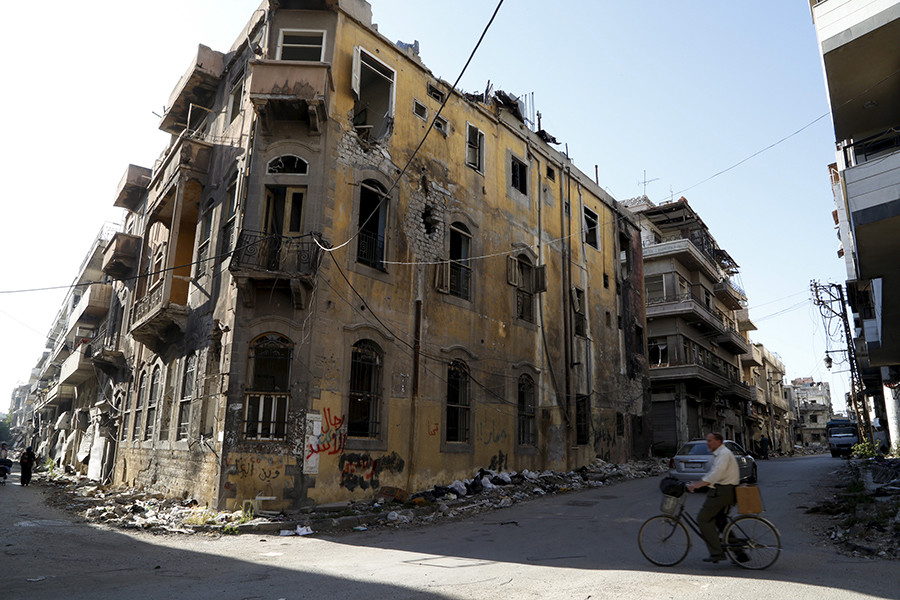
A man rides a bicycle near a building damaged during the Syrian conflict between government forces and rebels in Homs, Syria May 13, 2014 © Omar Sanadiki
Were these narratives all manufactured? Were the images we saw all staged? Or was it only necessary to fabricate some things – because the “perception” of the vast middle population, once shaped, would create its own natural momentum toward regime change?
And what do we, in the region, do with this startling new information about how wars are conducted against us – using our own populations as foot soldiers for foreign agendas?
Create our own “game”
Two can play at this narratives game.
The first lesson learned is that ideas and objectives can be crafted, framed finessed and employed to great efficacy.
The second take-away is that we need to establish more independent media and information distribution channels to disseminate our own value propositions far and wide.
Western governments can rely on a ridiculously sycophantic army of Western and regional journalists to blast us with their propaganda day and night. We don’t need to match them in numbers or outlets – we can also employ strategies to deter their disinformation campaigns. Western journalists who repeatedly publish false, inaccurate and harmful information that endanger lives must be barred from the region.
These are not journalists – I prefer to call them media combatants – and they do not deserve the liberties accorded to actual media professionals. If these Western journalists had, in the first year of the Syrian conflict, questioned the premises of any of the four narratives listed above, would 250,000-plus Syrians be dead today? Would Syria be destroyed and 12 million Syrians made homeless? Would ISIS even exist?
Free speech? No thank you – not if we have to die for someone else’s national security objectives.
Syria changed the world. It brought the Russians and Chinese (BRICS) into the fray and changed the global order from a unipolar one to a multilateral one – overnight. And it created common cause between a group of key states in the region that now form the backbone of a rising ‘Security Arc’ from the Levant to the Persian Gulf. We now have immense opportunities to re-craft the world and the Middle East in our own vision. New borders? We will draw them from inside the region. Terrorists? We will defeat them ourselves. NGOs? We will create our own, with our own nationals and our own agendas. Pipelines? We will decide where they are laid.
But let’s start building those new narratives before the ‘Other’ comes in to fill the void.
A word of caution. The worst thing we can do is to waste our time rejecting foreign narratives. That just makes us the ‘rejectionists’ in their game. And it gives their game life. What we need to do is create our own game – a rich vocabulary of homegrown narratives – one that defines ourselves, our history and aspirations, based on our own political, economic and social realities. Let the ‘Other’ reject our version, let them become the ‘rejectionists’ in our game… and give it life.
Sharmine Narwani is a commentator and analyst of Middle East geopolitics. She is a former senior associate at St. Antony’s College, Oxford University and has a master’s degree in International Relations from Columbia University. You can follow her on Twitter at @snarwani
US Ambassador to Hungary: Overthrow Assad, Let in Refugees, and Fight Russia… or Else!

US Ambassador to Hungary, Coleen Bell
By Daniel McAdams | Ron Paul Institute | May 6, 2016
If anyone wants a short course on what’s wrong with US diplomacy look no further than US Ambassador to Hungary Coleen Bell’s speech Friday to the Foreign Affairs Committee of the Hungarian Parliament. In typical diplo-speak there was plenty of flowery language about shared values, fish swimming together in the same water (?), sappy poetics like “together, out of that winter, we would force the spring,” and talk of together being “part of the world’s greatest military and political alliance.”
But make no mistake: Inside Ambassador Bell’s velvet glove is an iron fist, poised to strike should Washington’s annoyingly independent-minded Fidesz-led government step out of line on the big issues. And by “big” issues it should be understood that the US means the issues it considers in the interests of its own foreign policy, not those in Hungary’s interest.
Message to Hungary: do as we say or you will be sorry.
Ambassador Bell’s previous job was as a television soap opera producer, but raising more than two million dollars for the election of Barack Obama “earned” her the position of top US diplomat in Hungary.
The former television producer does know how to deliver her lines, though. She lectured the Hungarians about Syria, explaining to them that ISIS and Assad are both equally evil and both equally to blame for the disaster that is Syria.
ISIS has flourished in Syria, she told the Hungarians, because it “exploits the chaos of civil war in Syria, a conflict that has now claimed more than 250,000 lives.” But she does not mention that it was US backing for “regime change” in Syria — beginning at least in 2006, as we learn from a critical Wikileaks-released US Embassy Damascus memo — that created that very chaos she blames for the rise of ISIS.
In fact it is propaganda to call what is happening in Syria a “civil war,” as the forces battling the Syrian government are all sponsored by foreign powers like Saudi Arabia, Turkey, and the US. It is a proxy war against the Syrian government, not a civil war.
She then tells the Hungarians ISIS will never be defeated in Syria until Assad is overthrown:
[W]e know we won’t be able to defeat Daesh in Syria unless we also deal with the civil war and particularly with Assad. Because as long as Assad is there, he remains the most powerful magnet for foreign fighters and recruits to Daesh.
Does she assume Hungarians are so stupid that they believe that by attacking and beating ISIS back nearly to Raqqa (with Russian assistance), the Syrian government of Assad is actually benefitting ISIS? Attacking ISIS means Assad is on the side of ISIS?
“Since February, the cessation of hostilities reduced the violence in Syria, allowing millions of Syrian civilians to take the first steps toward reclaiming a normal life,” says the Ambassador, without even mentioning what brought the ceasefire about in the first place: Russian participation along with the Syrian army in the decimation of al-Qaeda and ISIS positions in northwest and central Syria. In fact it is absolutely bizarre that in the world of Ambassador Bell (and the State Department hacks who drafted her speech), the Russian intervention against al-Qaeda and ISIS simply never took place or was too inconsequential to mention.
Is any Hungarian so ill-informed that he would believe such nonsense?
Bell used the tragedy in Syria to pressure Hungary on the (largely American-made) refugee crisis. Hungary’s firebrand prime minister, Viktor Orban, has, along with several of his central European counterparts, stood up to Brussels’ (and Washington’s) demands that Hungary take in tens of thousands of migrants who heeded German Chancellor Angela Merkel’s call to come to Europe and enjoy lots of free stuff.
Last month Orban told Hungarian Radio that if he accepts the EU migrant resettlement plan, “it would be determined not in Hungary but in Brussels who we have to live together with, and how the ethnic composition of the country will look in future.” He has rejected such a notion.
“Every sovereign nation has the right and an obligation to protect its borders,” Bell told the Hungarian Parliament, “But every nation, as a part of the international community, also has a fundamental obligation to help refugee populations seeking safety.”
Translation: your sovereignty is not determined by you, but rather by us. It is a practice articulated by Orwell in 1984 whereby a person can think two completely contradictory thoughts at the same time seemingly without any mental conflict.
But here is where the iron fist inside Bell’s velvet glove glints in the sun. She pointedly condemned the Hungarian government position by praising those in Hungary who hold the opposite view, i.e. the Hungarian opposition:
We commend the humanitarian spirit of Hungarian leaders, law enforcement and military personnel, and ordinary citizens who are responding to this crisis with generosity and compassion.
Then she gives Hungary Washington’s marching orders:
We continue to stress that any solution to these migration challenges should focus on saving and protecting lives, ensuring the human rights of all migrants are respected, and promoting orderly and humane migration policies. That includes the support of all Member State governments for the refugee agreement forged between the EU and Turkey.
Translation: Hungary must support the EU agreement with Turkey which would see tens of thousands of migrants settled in EU member countries, including Hungary itself. The problem is that the Hungarian parliament explicitly rejected Brussels’ forced migrant settlement plans for Hungary and plans to hold a nationwide referendum on the subject. Bell is saying here that Hungary’s elected representatives and even the Hungarian voter must be ignored and Brussels’ dictate obeyed.
When it comes to Russia, Ambassador Bell also has some instructions for Budapest: Moscow is your enemy and don’t you forget it.
She told Hungarian parliamentarians:
As many Hungarians have reminded me, you need no introduction to the nature of Russian aggression. Your response has always been to show resolve. Our best weapons, in fact, are resolve and solidarity.
Weapons? Quite a loaded word.
Orban has been seen in Washington as insufficiently enthused about sanctions on Russia, which hurt Hungarian trade and business interests. Ambassador Bell makes it clear that Hungary must adhere to US demands of Russia, even if they are completely incoherent:
As the United States and Hungary have both stated many times, Russia has a simple choice: fully implement Minsk or continue to face sanctions. Russia must withdraw weapons and troops from the Donbas; Russia must ensure that all Ukrainian hostages are returned; Russia must allow full humanitarian access to occupied territories; Russia must support free, fair, and internationally-monitored elections in the Donbas under Ukrainian law; and most important, Russia must restore Ukraine’s sovereignty.
That last point should be taken to mean that Russia must ignore the will of the people of Crimea who voted in overwhelming numbers to re-join Russia after just 25 years as part of independent Ukraine.
Not to worry, Ambassador Bell is confident that Budapest will do everything Washington tells it to do:
More than this, Hungary is equal to the great challenges of our times, and the United States is counting on you.
To stiffen their spine, US Ambassador Bell reminds the Hungarians that they are part of “our global order” and touts the great examples set by the US, including:
Our system of international economic, political, and social norms and institutions have kept the peace and fostered prosperity for decades. Whether it is international law, environmental protection, trade regulations, anticorruption laws, child labor laws, human rights safeguards, the nonproliferation regime, public health systems, international financial institutions, UN peacekeeping, or a robust civil society – these norms and institutions give life and stability to our global order.
In the era of NSA spying on innocent Americans, Guantanamo, CIA torture, weapons sales to the world’s worst dictators (Saudi Arabia for one), destruction of the environment by the US war machine, “regime change” operations that violate the sovereignty of other states, and outright aggression in opposition to US and international law (Libya, etc.), Bell’s suggestion that “our global order” is the pinnacle of civilization should get a laugh out of most Hungarians. In fact, from Libya to Syria to Ukriane to Pakistan and Afghanistan, the US interventionist attempt to forge a global order with blood and bullets will go down in history along with the authoritarianisms of the 20th century as one of humanity’s darkest chapters.
Here is the short version of Ambassador Bell to Budapest: “to be our partner means you do what we say whether or not it is in your interest.”
Funny, that was Moscow’s message to Budapest from 1948 to 1989.
Suspect Airstrike Near Aleppo After Temporary Ceasefire Announced
By Stephen Lendman | May 6, 2016
On May 5, reports without verification said Syria’s al-Kammouneh refugee camp in Sarmada near Aleppo, close to Turkey’s border, was bombed – dozens killed or injured.
US-supported terrorists control the area. No party claimed responsibility. Witnesses allegedly reported tents on fire, widespread debris and scattered body parts.
An dubious unnamed source claimed “many martyrs and body parts… a very bloody scene. There are absolutely no armed men there. They’re all civilian refugees, homeless people living on the street.”
UK government owned and operated BBC suggested Syrian or Russian responsibility while admitting “this has not been confirmed.”
Anti-government video released raises questions – showing some tents burned, smoldering and destroyed, nearby ones unaffected.
No casualties are visible, no body parts, no bomb craters, no munitions debris. Was the incident staged anti-Assad propaganda to provide greater justification for regime change?
Were US, UK, French, Turkish, Saudi, and/or Israeli dirty hands involved? Were terrorists they support responsible for what happened? Was what happened committed on the ground, not from an aerial bombardment as reported?
The incident like many others is a war crime. Why would Syrian or Russian warplanes bomb a civilian site when their mission is liberating the country and protecting its people?
Deputy State Department spokesman Mark Toner pointed fingers the wrong way, saying “(w)e’ve seen early claims that this was a regime strike…” Backtracking he added “we want to be absolutely sure before we level blame at somebody.”
UK Foreign Secretary Philip Hammond unjustifiably blamed Syria’s military, shamelessly saying “(t)he Assad’s regime contempt for efforts to restore the cessation of hostilities is clear for all to see.”
Fighting in Aleppo province continues despite the temporary declared ceasefire. In a cable to Vladimir Putin, Assad thanked him for his courageous support, comparing the battle for Aleppo to Stalingrad during WW II, saying:
“Despite the brutality and cruelty of the enemy, and the great sacrifices and pains, our cities, towns, people and army will not be satisfied until they defeat the enemy and achieve victory serving the interests of Syria, the region and the world.”
Expressing typical American arrogance, Toner called Assad’s statement “totally unacceptable,” demanding he observe ceasefire despite continued US-supported terrorist attacks.
Russia blocked a one-way UK-drafted Security Council resolution, blaming Syria for terrorist violence in Aleppo.
Stephen Lendman lives in Chicago. He can be reached at lendmanstephen@sbcglobal.net.
His new book as editor and contributor is titled Flashpoint in Ukraine: US Drive for Hegemony Risks WW III.
If Russia Had ‘Freed’ Canada
By Joe Lauria | Consortium News | May 5, 2016
As the United States plans to move thousands of NATO troops to Russia’s borders and continues to bolster a fiercely anti-Russian regime in neighboring Ukraine, the official line in Washington and its subservient corporate media is that beneficent America is simply seeking to curtail Moscow’s “aggression.” But the U.S. government and media might look at things quite differently if the shoe were on the other foot.
What, for instance, would the U.S. reaction be if Russia instead had supported the violent overthrow of, say, Canada’s government and assisted the new Ottawa regime’s “anti-terrorist operations” against a few rebellious “pro-American” provinces, including one that voted 96 percent in a referendum to reject the new Russian-backed authorities and attach itself to the U.S.?
If the U.S. government tried to help these embattled “pro-American” Canadians – and protect the breakaway province against the Russian-installed regime – would Washington see itself as the “aggressor” or as simply helping people resist anti-democratic repression? Would it view Russian troop movements to the U.S. border as a way to stop an American “invasion” or rather an act of “aggression” and provocation by Russia against the United States?
The Ukraine Reality
Before playing out this hypothetical scenario, let’s look at the actual scene in Ukraine today as opposed to the gross distortion of reality fed the American people by the U.S. mainstream media the past two years. The reality is not the State Department’s fable of a pro-democracy “revolution” cleaning up corruption and putting Ukrainian people first.
In the real world instead, extreme right-wing nationalists took control of a popular protest by mostly western Ukrainians to spearhead a violent coup that succeeded on Feb. 22, 2014, in overthrowing President Viktor Yanukovych, a man whom I interviewed in 2013 after he had been democratically chosen in an election certified by the Organization for Security and Cooperation in Europe.
Proof of the U.S. role in the coup came in a leaked telephone conversation several weeks earlier between U.S. Assistant Secretary of State for European and Eurasian Affairs Victoria Nuland, and Geoffrey Pyatt, the U.S. ambassador to Ukraine. In the conversation, Nuland and Pyatt discussed how the U.S. could “midwife” the unconstitutional change of government and they rated which Ukrainian politicians should be put in charge, with Nuland declaring “Yats is the guy,” a reference to Arseniy Yatsenyuk.
As for the European Union’s less aggressive approach to the Ukraine situation, Nuland declared: “Fuck the E.U.”
Nevertheless, after the coup, Western governments denied there ever was a coup, peddling the line that Yanukovych simply “ran away,” as though he woke up one morning and decided he didn’t want to be president anymore.
In fact, on Feb. 21, to contain the mounting violence, Yanukovych signed a European-brokered deal to reduce his powers and to hold early elections. But the next day, as right-wing street-fighters overran government buildings, Yanukovych fled for his life – and the West moved quickly to consolidate a new government under anti-Russian politicians, including Nuland’s choice—Yats as prime minister. (Yatsenyuk remained prime minister until last month when he resigned amid complaints that his stewardship had been disastrous for the Ukrainian people.)
A Resistance Emerges
Since the vast majority of Yanukovych’s support came from the ethnically Russian eastern half of the country, some Yanukovych backers rose up to challenge the legitimacy of the coup regime and to defend Ukraine’s democratic process.
Instead the West portrayed this resistance as a Russian-instigated rebellion against the newly minted and U.S.-certified “legitimate” government that then launched a violent repression of eastern Ukrainians who were deemed “terrorists.”
When Russia supported the resisters with weapons, money and some volunteers, the West accused Russia of an “invasion” and “aggression” in the east. But there has never been satellite imagery or other proof of this alleged full-scale Russian “invasion.”
In the midst of the Kiev “anti-terrorist” offensive in the east, on July 17, 2014, a Malaysian commercial airliner, Flight MH-17, was shot out of the sky, killing all 298 people on board. The United States, again offering no proof, immediately blamed Russia.
Over the past year, the fighting has been largely contained after Russian, Ukrainian and European leaders negotiated the Minsk Accords, though they are far from being implemented and widespread violence could break out again at any time.
Throughout the entire crisis the United States has insisted its motives are pure, including its new plans for deploying some 4,000 NATO troops, including about half American, on Russia’s Eastern European borders north of Ukraine.
President Barack Obama told the U.N. General Assembly last year that the U.S. had no economic interests in Ukraine. But former State Department official Natalie Jaresko served as Ukraine’s finance minister until recently and Vice President Joe Biden’s son sits on the board of a major Ukrainian company. U.S. investment also has increased since the coup.
Yanukovych’s overthrow occurred after he chose a Russian economic plan rather than sign an association agreement with the European Union, which Ukrainian economic analysts warned would cost the country $160 billion in lost trade with Russia.
The E.U. plan would also have opened Ukraine to Western neoliberal economic strategies designed to exploit the country for the benefit of Western capital and local oligarchs (one of whom, Petro Poroshenko, emerged as the new president).
Turning the Tables
To help American readers better understand what has transpired in Ukraine, it may be useful to see what it would be like if the tables were turned. What would the story be like if Russia played the role of the U.S. and Canada the role of Ukraine? Most Americans would not be pleased.
In this reverse scenario, the world’s mainstream media would follow Moscow’s line and present the story as a U.S. “invasion” of Canada. The media would explain the movement of Russian troops to the U.S. border as nothing more than a peaceful step to deter U.S. “aggression.”
But Americans might see matters differently, siding with the breakaway Maritime provinces resisting the Moscow-engineered violent coup d’etat in Ottawa. In this scenario, Prince Edwards Islanders would have voted by over 90 percent to secede from the pro-Russian regime in Ottawa and join the United States, as Crimea did in the case of Ukraine. People in Nova Scotia and New Brunswick – stressing their close historic ties to America – also would make clear their desire not to be violently absorbed by the Ottawa coup regime.
In this alternative scenario, Moscow would condemn Prince Edwards Island’s referendum as a “sham” and vow never to accept its “illegal” secession. The popular resistance in Nova Scotia and New Brunswick would be denounced as “terrorism” justifying a brutal military crackdown by Russian-backed Canadian federal troops dispatched to crush the dissent. In this “anti-terrorist operation” against the breakaway region, residential areas would be shelled killing thousands of civilians and devastating towns and cities.
In this endeavor, the Canadian army would be joined by Russian-supported neo-fascist battalions that had played a crucial role in the overthrow of the Canadian government. In the Maritime city of Halifax, these extremists would burn alive at least 40 pro-U.S. civilians who took refugee in a trade union building. The new government in Ottawa would make no effort to protect the victims, nor conduct a serious investigation to punish the perpetrators.
Ignoring a Leak
Meanwhile, proof that Russia was behind the overthrow of the elected Canadian prime minister would be revealed in a leaked conversation between Moscow’s foreign ministry chief of the North America department and the Russian ambassador to Canada.
According to a transcript of the leaked conversation, the Moscow-based official would discuss who the new Canadian leaders should be several weeks before the coup took place. Russia would launch the coup when Canada decided to take a loan package from the U.S.-based International Monetary Fund that had fewer strings attached than a loan from Russia.
Russia’s ally in Beijing would be reluctant to back the coup. But this would seem to be of little concern to Moscow’s man who is heard on the tape saying, “Fuck China.” Although this conversation would be posted on YouTube, its contents and import would be largely ignored by the global mainstream media, which would insist there was no coup in Ottawa.
Yet, weeks before the coup, the Russian foreign ministry official would be filmed visiting protesters camped out in Parliament Square in Ottawa demanding the ouster of the prime minister. The Russian official would give out cakes to the demonstrators.
The foreign ministers of Russian-allied Belarus and Cuba would also march with the protesters through the streets of Ottawa against the government. The world’s mainstream media would portray these demands for an unconstitutional change of government as an act of “democracy” and a desire to end “corruption.”
In a speech, the Russian foreign ministry official would remind Canadian businessmen that Russia had spent $5 billion over the past decade to “bring democracy” to Canada, much of that money spent training “civil society” activists and funding anti-government “journalists.” The use of these non-governmental organizations to overthrow foreign governments that stand in the way of Russia’s economic and geo-strategic interests would have been well documented but largely ignored by the global mainstream media.
But recognizing the danger from these “color revolution” strategies, the United States would move to ban Russian NGOs from operating in the U.S., a tactic that would be denounced by Russia as America’s rejection of “democracy.”
The Coup Succeeds
The Canadian coup would take place as protesters violently clashed with police, breaking through barricades and killing a number of police officers. Snipers would fire on the police and the crowd from a nearby Parliament Square building under the control of hardline pro-Russian extremists. But the Russian government and the mainstream media would blame the killings on the embattled Canadian prime minister.
To stem the violence, the prime minister would offer to call early elections but instead would be driven from office violently by the pro-Russian street gangs. Russia and the global mainstream news media would praise the overthrow as a great step for democracy and would hail the pro-Russian street fighters who had died in the coup as the “Heavenly Hundred.”
Following the coup, Russian lawmakers would compare President Barack Obama to Adolf Hitler for allegedly sending U.S. troops into the breakaway provinces to protect the populations from violent repression, and for accepting the pleas of the people of Prince Edward Island to secede from this new Canada.
Obama would be widely accused of ordering an “American invasion” and committing an act of “American aggression” in violation of international law. But the Maritimes would note that they had long ties to the U.S. dating back to the American Revolution and didn’t want to live under a new regime imposed by a faraway foreign power.
Russia would claim intelligence proving that U.S. tanks crossed the Maine border into New Brunswick, but would fail to make the evidence public. Russia would also refuse to reveal satellite imagery supporting the charge. But the claims would still be widely accepted by the world’s mainstream news media.
For its part, Washington would deny it invaded but say some American volunteers had entered the Canadian province to join the fight, a claim met with widespread media derision. Russia’s puppet prime minister in Ottawa would offer as proof of an American invasion just six passports of U.S. soldiers found in New Brunswick.
Taking Aim at Washington
When – during one of the new regime’s “anti-terrorist” offensives – a passenger jet would be shot down over Nova Scotia killing all on board, Russia would accuse President Obama of being behind the outrage, charging that the U.S. had provided the powerful anti-aircraft missile needed to reach a plane flying at 33,000 feet.
But Moscow would refuse to release any intelligence to support its claim, which would nevertheless be accepted by the world’s mainstream media.
The plane’s shoot-down would enable Russia to rally China and other international allies into imposing a harsh economic boycott of America to punish it for its “aggression.”
To bring “good government” to Canada and to deal with its collapsing economy, a former Russian foreign ministry official would be installed as Canada’s finance minister, receiving Canadian citizenship on her first day on the job.
Of course, Russia would deny that it had economic interests in Canada, simply wanting to help the country free itself from oppressive American domination. But Russian agribusiness companies would take stakes in Albertan wheat fields and the son of Russia’s prime minister as well as other well-connected Russians would join the board of Canada’s largest oil company just weeks after the coup.
Russia’s ultimate aim, beginning with the imposition of the sanctions on the U.S. economy, would appear to be a “color revolution” in Washington, to overthrow the U.S. government and install a Russia-friendly American president.
This goal would become clear from numerous statements by Russian officials and academics. A former Russian national security adviser would say that the United States should be broken up into three countries and write that Canada would be the stepping stone to this U.S. regime change. If the U.S. loses Canada, he would declare, it would fail to control North America.
But the world’s mainstream media would continue to frame the Canadian crisis as a simple case of “American aggression.”
This fictional scenario perhaps lays bare the absurdity of the U.S. version of events in Ukraine.
Joe Lauria is a veteran foreign-affairs journalist based at the U.N. since 1990. He can be reached at joelauria@gmail.com and followed on Twitter at @unjoe.
About Bias and Propaganda on Syria
Open Letter to MSF/Doctors without Borders
By Rick Sterling | Dissident Voice | May 4, 2016
Dear MSF International President Dr. Joanne Liu,
Your organization is well regarded and influential. I appreciate that many good people work for and support MSF/Doctors Without Borders. However, I need to inquire about your independence and the consequences of your work in Syria. I believe an objective look will reveal that while you are helping in some areas, you are causing harm in others.
Following are questions on this important issue:
- As you know, Aleppo is a large city with the government forces holding western Aleppo while other parts of the city are dominated by armed opposition groups, primarily Nusra/Al Qaeda. About 1.5 to 2 million people live in the government areas with about 200 to 250 thousand in the areas controlled by armed opposition. So 80-90 % of the population is in government-controlled areas. This is rarely mentioned but seems important. Given this fact, is it true that you provide aid and support only to the opposition held areas?
On April 21 the Western and Gulf backed “High Negotiations Committee” announced they were quitting the Geneva negotiations. The next day, hundreds of mortars and bombs started being launched into western Aleppo from the zones controlled by Nusra and other terrorist groups. These bombs are powerful, wounding and killing indiscriminately. Syrian journalist Edward Dark noted that western media and groups such as MSF were silent on this even though hospitals were being hit, dozens of children and civilians killed. On twitter he reported day by day …..
* “West Aleppo is simply being obliterated by rebel shelling. A city of 2 million people is being butchered.”
* “Carnage and devastation as ‘moderate rebel’ bombs fall on west Aleppo like rain”
* “Terrorist rebel bombs are still falling like rain on west Aleppo. 15 people murdered at a mosque in Bab Faraj after Friday prayers”
* “This is the hospital where my son was born. Dabeet Hospital in W. Aleppo completely destroyed by rebel shelling.”
Has MSF denounced these killings and attacks on hospitals in western Aleppo?
The unconcern about indiscriminate attacks and killing in government-held areas of Aleppo has also been denounced by Syrian-Canadian physician Dr. Nabil Antaki. He has recently written:
With regards to recent events in Aleppo, I state very clearly that the mainstream media are lying by omission… All of us here in Aleppo are disgusted by their lack of impartiality and objectivity. They only talk about the loss of life in east of Aleppo which is entirely controlled by Al Nusra…. These are their ‘moderate rebels’ …This same media remains silent on the daily losses and suffering endured in the Western areas of Aleppo living under the rain of mortar fire from these terrorist factions. This media never mentions the continuous bombardment and the carnage we have witnessed in western Aleppo where every single sector has been targeted. On a daily basis we see dozens of people murdered….. For three days now, these media outlets have been accusing the “Assad regime” of bombing an MSF hospital to the east of Aleppo and of killing the last pediatrician in the city. This demonstrates that, for these media, the only priority is this pocket of the city where terrorists are embedded. The three quarters of Aleppo under Syrian government control, where numerous pediatricians are practicing, is of no consequence.
Dr. Liu, will you meet with Dr. Antaki? Perhaps he could give you a tour and confirm to you what he says. He is a well known and respected doctor in Aleppo and fellow Canadian citizen.
There are many discrepancies in reports about the April 27 attack on Al Quds Hospital. MSF Middle East Operations Manager Pablo Marco, interviewed the next day on CNN and PBS Newshour, said “there were two barrel bombs that fell close to the hospital …. then the third barrel bomb fell in the entrance of the hospital”. Barrel bombs are only delivered by helicopters. In contrast, your press release the same day says “the hospital was destroyed by at least one airstrike which directly hit the building, reducing it to rubble.” A CBC report continued this version, claiming “An MSF-supported hospital in the northern Syria city of Aleppo is now a pile of rubble. Airstrikes brought down the building on Wednesday.” The hospital photograph indicates it is not a “pile of rubble” and it’s unclear where the damage is. The sandbag reinforcement and damaged car in front indicate it might have been a battle scene but the rest is unclear. Which story is correct and accurate?
The number of fatalities has varied from initial death counts of 14 to later reports of over 50. How are these numbers verified?
MSF representatives Pablo Marco and Muskilda Zancada suggest it was a deliberate and intentional attack on the hospital. In an interview Ms. Zancada says “Al Quds Hospital has been functional for more than 4 years so it was basically impossible that this information was not known… The facts are pointing to this being a deliberate attack.” In contrast with Ms. Zancada’s assertions, most Aleppans have never heard of “Al Quds Hospital”. The “hospital” did not exist before the conflict and the photo shows an unidentified apartment building. Is it accurate to call this facility a “hospital”? Mr. Marco claimed that MSF supported personnel visited the hospital every other week so there must be many reports, documents and photos confirming whether it was a 34 bed hospital. Otherwise, it seems fair to say this was actually a medical clinic in the ground floor of an unmarked and largely abandoned apartment building.
- Can Mr. Marco or Ms. Zancada please identify the damage inflicted by the airstrike (or barrel bomb) at Al Quds Hospital on April 27? The Russian Ministry of Defense has released a photograph indicating the building had similar damage in October 2015.
- As you know, Nusra/Al Qaeda is considered ‘terrorist’ by all parties including the US, French, and Canadian governments. Does the Al Quds Hospital primarily or significantly serve Al Qaeda and/or other terrorist fighters? If so, are your supporters aware they are assisting fighters who launched bombs attacking western Aleppo as shown here and previously destroyed the once prized Al Kindi Hospital with a huge truck bomb as shown here? I appreciate you have a commitment to the hippocratic oath but given the widespread medical needs, why are you prioritizing assistance to Nusra/Al Qaeda?
- Many videos from Al Quds Hospital feature members of the “White Helmets”. Are you aware the White Helmets was established by the US and UK with initial training in Turkey by a UK military contractor? Are you aware the organization is not independent or neutral and has explicitly called for western intervention in Syria? The origins of the “White Helmets” is documented here . There is an online petition denouncing this clever but cynical marketing campaign here.
- Can you you please compare and contrast the videos showing attacks at MSF- supported Al Quds Hospital with videos showing attacks in western Aleppo? The videos from Al Quds Hospital are here and here with an animated one here. The attacks in western Aleppo including an attack on Al Dabeet Hospital are here, here and here. Do you see the difference between videos from armed opposition area vs. those from western Aleppo? Some look authentic and some look possibly staged.
- We know that many Western and Gulf countries are providing funds to help the armed opposition in Syria. For example in 2012 the Canadian government said “the reason the $2 million was being channeled through Canadian Relief for Syria instead of the UN or International Committee of the Red Cross was because it was intended for Syrian opposition groups and was not humanitarian aid.” Is MSF directly or indirectly receiving grants or funds from the Canadian, French or US governments to serve Syrian opposition groups?
- There has been a wave of media coverage of Al Quds Hospital and the death of Dr. Moaz (sometimes spelled Maaz). Some of the reports are clearly intended to tug at the heart and natural sympathy of people. Unfortunately propagandists can be effective in this area as they seek to manipulate public opinion. There are many examples with the Kuwaiti babies and incubators being one of the most famous frauds as it successfully won public support for Gulf War 1. Both Amnesty International and the International Red Crescent were (unwittingly) part of the fraud. My point is this: Some of the Al Quds Hospital stories are questionable and may be fraudulent. For example the letter from a fellow physician acclaiming Dr Moaz was published by “The Syria Campaign” which is the marketing creator of the “White Helmets”. The letter is supposedly from a fellow doctor who might or might not be real. They use a false name yet claim he “manages the Children’s Hospital in Aleppo”. Another questionable piece of ‘evidence’ of the death of Dr. Moaz is the video supposedly taken just before the building was hit by missile or bomb. It’s curious that the building would be destroyed and the CCTV cameras (several of them) survive and be ready for editing. Is this real or is it just another example of the “moderate rebel’ social media propaganda?
Biased media coverage on Syria serves to demonize the Assad government and prolong the conflict. It has made it easier for foreign aggressors to continue funding the proxy armies such as Nusra/Al Qaeda. There is danger of vastly increased conflict and bloodshed if foreign governments or NATO intervene directly. In fact, calls for greater aggression are increasing in the wake of publicity around the attack at Al Quds Hospital. Are you aware that the Foreign Minister of Saudi Arabia seemed to threaten an escalation of the conflict as he said “The world is not going to allow them to get away with this.”?
Dr. Liu, we agree with your insistence that medical personnel and facilities should not be attacked. That is in keeping with the Geneva Conventions on War. There are other international laws, including laws against aggression and the right of self-defense. It is clear that the Syrian government is being attacked by proxy armies funded by a coalition of foreign governments in violation of international law and the UN Charter.
Will you investigate whether the criticisms expressed in this letter are accurate and take appropriate action? It seems that current MSF actions and statements on Syria are biased and effectively serving the coalition of governments waging war on Syria in violation of international law. The bias and propaganda sustain the conflict and threaten to make it even worse.
Best regards,
Rick Sterling
Rick Sterling is a retired engineer and co-founder of Syria Solidarity Movement. He can be emailed at: rsterling1@gmail.com.
Featured Video

Why the U.S. Should Pull Back From the First Island Chain
or go to
Aletho News Archives – Video-Images
Book Review
‘Why Fauci Must Rot in Prison’: A Tale of Two Diaries
By Jill Erzen | The Defender | October 13, 2026
Dr. Anthony Fauci’s private diary reveals a “mind-numbing” contradiction between what the former top U.S. infectious disease official knew about COVID-19 and what he told the public, senior White House adviser Peter Navarro, Ph.D., said last week on “American Thought Leaders.”
In his new book, “Why Fauci Must Rot in Prison,” due out Oct. 20, Navarro compares Fauci’s private entries to his own pandemic-era diary, and uses what he calls “a tale of two diaries” to argue that Fauci should face criminal prosecution.
“I show, actually, how a prosecution can and should happen … at the state level, most likely,” Navarro said. “He should wind up in prison, and we’ve got the receipts in this book to put him there.”
Navarro said Fauci repeatedly acknowledged important facts in private, then publicly pursued policies that contradicted those facts — with devastating consequences.
“What he says many times privately in his diary is so at odds with both his public behavior and public statements that it’s mind-numbing,” Navarro said.
Navarro examines the lasting damage caused by lockdowns and other pandemic policies, and the ongoing toll of long COVID.
His book also addresses questions about vaccine safety, including why healthy young people faced COVID-19 vaccination mandates despite concerns about myocarditis, and why women were not warned about miscarriage risks linked to the shots. … continue
Blog Roll
 Aletho News
- Jennifer Kavanagh: Why the U.S. Should Pull Back From the First Island Chain
- Yemen denounces international community’s silence on Saudi aggression, siege
- UAE and Saudi Arabia move toward renewed coordination against Sanaa
- How Iran’s two-week retaliatory strikes exposed cracks in US military architecture in Persian Gulf
- The mother of all propaganda: Why the hype over US MOAB strike against Iran is nothing but theater
- Iran says it possesses technology behind US 14-ton GBU bunker-buster
- Trump asks Iran not to retaliate after he strikes Pickaxe Mountain – w/ Prof. Marandi
- Vice President J.D. Vance’s Deceptive ‘Antiwar’ Campaign Speech
- Iran: Palestinians’ rights must not be compromised in Gaza’s future; US, Israel to blame for Hormuz situation
- Ongoing tales of Syrian chemical weapons
- If Americans Knew
- Israeli rabbi permits occupiers to steal Palestinian olive harvest in West Bank
- Netanyahu’s spin on latest settler attack is laughable – Daily Update
- Israeli soldiers debunk Israel’s talking points
- In West Bank, Israeli settlers are totally out of control – Daily Update
- NPR investigation finds evidence of widespread fraud at mall kiosks tied to Israeli skincare brand
- Tucker Carlson exposes Israeli Lies about the Oct 7th attack, Charlie Kirk, and the U.S.
- Israel has detained thousands of Palestinian children since Oct 7th – over half spent time in solitary, many uncharged
- Israeli Analysis: Is Netanyahu Planning an ‘October Surprise’ Attack Before Israel’s Election?
- Israeli settlers brutally attack Palestinians and Washington Post female photographer, 65
- Words Have Changed, Occupation Continues: The Reality of the Gaza Ceasefire
- No Tricks Zone
- Predictions Made By Renowned Climate Proifessor Over Past Decades Have Been Proven To Be Poor
- New Study Suggests Large Regions Of The Pacific Ocean Have Been Cooling For The Last 80 Years
- Germany’s Green Energy Debacle: High Energy Costs Force Kahla Porzellan to Close After 182 Years!
- New Study: 50 Years Of The Most Aggressive ‘Net Zero’ Policies Can Only Affect The Global Climate By 0.03°C
- US September “Heat” Was No Record…Many Records Set Decades Ago
- Latest European Green Energy Debacle; Portugal’s Largest Flagship Solar Park Insolvent!
- Green Energy Debacle: German Expert Professor Fritz Vahrenholt Warns Of Severe Economic And Social Consequences
- Two More Paleo Reconstructions Affirm Meters-Higher Sea Levels Across Ireland, Brazil 7000-6000 Years Ago
- New Study: Earth And Venus Surface Warmth Largely Explained By Convection And Lapse Rate, Not CO2 Or Radiation
- 2025 Nature Paper Claiming Worsening Global Drought Gets RETRACTED …Heavily Flawed

