Syrian General Elections Update
By Stephen Lendman | April 14, 2016
On Thursday, 7,000 polling stations in 13 of Syria’s 15 provinces opened at 7AM, ISIS and Jabhat al-Nusra controlled Raqqa and Idlib excluded for obvious reasons.
Scheduled to remain open until 7PM, the deadline was extended to midnight to accommodate heavy turnout, results to follow when tabulations are completed.
US elections are farcical by comparison, meaningless money controlled exercises serving wealth, power and privilege exclusively.
Syrians have the real thing. Washington mocked their democratic process, saying it doesn’t reflect “the will of the people,” polar opposite reality.
Internally displaced Syrians and others in terrorist controlled areas could vote if able to get to polling stations anywhere in the country.
Washington and its rogue allies only recognize election results in countries under pro-Western regimes – including in ruthless ones like Saudi Arabia, other Gulf states, Egypt, Turkey, Israel and elsewhere.
The democratic “will of the people” is called illegitimate in sovereign independent states like Syria, Iran, Venezuela, Cuba and elsewhere.
Media scoundrels mocked Syria’s electoral process as expected, suppressing hard truths, featuring misinformation and Big Lies like always.
The New York Times mocked reality, calling Syria’s parliament “a largely powerless body… in a country where nearly every decision rests with President Bashar al-Assad.”
Thursday’s elections showed nationwide solidarity, genuine overwhelming support for Assad and his government. The Times turned truth on its head claiming they “highlight divisions and uncertainty.”
A litany of additional lies followed, including claiming low turnout in Damascus where huge crowds queued to vote, and suggesting some Assad supporters cast multiple ballot despite no evidence indicating voting irregularities.
The neocon Washington Post denounced what it called “a farce,” an utter perversion of truth. It claimed Thursday’s elections “snub(bed) Russia,” ignoring its Foreign Ministry spokeswoman Maria Zakharova, calling them a “major factor of stabilization in the country.”
Final results may be known later today. A follow-up article will discuss them.
Stephen Lendman can be reached at lendmanstephen@sbcglobal.net.
His new book as editor and contributor is titled “Flashpoint in Ukraine: US Drive for Hegemony Risks WW III.”
As in Libya, Avaaz Campaigns for Syria No-Fly Zone That Even Top Generals Oppose
By John Hanrahan | ExposeFacts | April 11, 2016
(First of two articles)
- “I worry sometimes that, when people say ‘impose a no-fly zone,’ there is this almost antiseptic view that this is an easily accomplished military task. It’s extraordinarily difficult. Having overseen imposing a no-fly zone in Libya, a force that is vastly inferior in air forces and air defenses to that which exists in Syria, it’s a pretty high-risk operation…It first entails — we should make no bones about it. It first entails killing a lot of people and destroying the Syrian air defenses and those people who are manning those systems. And then it entails destroying the Syrian air force, preferably on the ground, in the air if necessary. This is a violent combat action that results in lots of casualties and increased risk to our own personnel.” — Now-retired four-star General Carter Ham, former commander, U.S. Africa Command, who oversaw U.S. military enforcement of the Libyan no-fly zone in 2011 [CBS News]
- “It is quite frankly an act of war and it is not a trivial matter… I know it sounds stark, but what I always tell people when they talk to me about a no-fly zone is . . . it’s basically to start a war with that country because you are going to have to go in and kinetically take out their air defense capability.” — Four-star General Philip Breedlove, NATO’s current supreme allied commander, U.S. European Command [Stars and Stripes ]
- The New York Times reported that in 2012 General Martin E. Dempsey, chairman of the Joint Chiefs of Staff, told the White House that imposing a no-fly zone in Syria — in the Times paraphrasing — “would require as many as 70,000 American servicemen to dismantle Syria’s sophisticated antiaircraft system and then impose a 24-hour watch over the country.” [New York Times ] (Dismantle being a Times polite euphemism for bombing the bejeezus out of Syria’s antiaircraft defenses.)
Readers of the national edition of the June 18, 2015 New York Times were greeted with a dramatic full-page ad featuring a photo of an apparently injured baby fitted with a breathing device and being tended to by a partially visible adult beneath a big, bold-type headline: “PRESIDENT OBAMA, WHAT ARE YOU WAITING FOR?” (A partial picture of the ad can be found here.)
In smaller type, under the picture of the baby and the adult, was the message: “Trapped and under chemical attack, the Syrian people are desperate for help.”
And below that in slightly smaller type was the risky military operation that the ad’s sponsors wanted the reluctant President to undertake. To wit: “A majority of Americans support a No-Fly Zone in Syria to save lives and 1,093,775 people around the world [in an on-line petition] are calling for action now.”
The on-line petition cited in the ad also has an urgent headline calling for a “Safe zone for Syrians, now!” The body of the petition demands the establishment of an “air-exclusion zone in Northern Syria, including Aleppo, to stop the bombardment of Syria’s civilians and ensure that humanitarian aid reaches those most in need.” The petition — slightly different than the New York Times ad — was addressed not only to Obama, but also to Turkish President Recep Tayyip Erdogan, French President Francois Hollande, British Prime Minister David Cameron “and other world leaders.”
Now it’s not surprising to see such an expensive ad in the current political climate in which Syrian war fever has seized much of the U.S. political establishment. A climate in which Democratic presidential candidate Hillary Clinton (but not Bernie Sanders or Donald Trump), and every neoconservative and “humanitarian interventionist” and chicken-hawk in creation have, at the very least, called for a no-fly zone in northern Syria as part of a greater U.S. military involvement to remove President Bashar al-Assad.
What stood out about this ad, then, isn’t so much the neocon-like call to action — a move toward a wider war in Syria which could entail even more U.S. and western military air bombardments, as well as additional displacement and death for civilians — but rather the ad’s sponsors.
This ad wasn’t the product of a gaggle of bellicose Republicans or acolytes of the Brookings Institution’s war-enthusiast-in-chief Michael O’Hanlon — or even supporters of regime change advocate Hillary Clinton — offering one of their bold, armchair-military solutions to the many-sided, complex Middle East conflicts.
Rather, the ad and its supporting on-line petition were the handiwork of the Internet phenom activist organization Avaaz.org. With the staggering claimed number of 43.1-million members in 194 countries as of mid-March 2016 (anyone who has ever signed an Avaaz petition is considered by the organization to be a member), the New York City-based Avaaz is easily the largest and most influential Internet-based, international advocacy organization on the planet. (Having myself signed many Avaaz petitions over the years, I am counted as one of those 43 million.)
Avaaz, which means “voice” or “song” in many languages, was started in 2006 and officially launched in 2007 by the U.S. online powerhouse MoveOn.org Civic Action and the little known global advocacy group Res Publica. With initial significant financial backing from — and some blogger critics allege, continued influence of — financier and liberal philanthropist George Soros and his Open Society Foundations (then called Open Society Institute), Avaaz has grown at a mind-boggling pace each year. Since 2011, the organization has increased six-fold to its current membership of almost 43-million. (The second of our two articles on Avaaz will provide more background on the organization, its key issues, its founders and current officials, and funding sources.)
Although widely regarded as liberal to progressive in its campaigns, Avaaz stands alone on the left as the one major on-line activist organization to call for an escalation of the U.S. military role in Syria — just as before that it was alone on the left in 2011 in campaigning successfully for a no-fly zone for Libya, with subsequent disastrous consequences for that country. (More about this in a follow-up article.)
For this article, we submitted a series of questions to Avaaz media personnel, with an emphasis on obtaining specifics as to its rationale for its support for no-fly zones in Libya and Syria. These questions included why the organization had not informed its members of the warnings (cited above) of top U.S. generals and other experts about the potential dangers to civilians and military personnel inherent in the establishment of a no-fly zone in Syria.
After requests (and reminders) on five occasions in November, December and January, we finally received a response on February 11, but that addressed only a few of our specific questions. The organization ignored our question as to why Avaaz had not presented petition-signers with the potential dangers of a Syrian no-fly zone that the prominent generals had warned of. Our follow-up questions, submitted on February 12, have gone unanswered.
What Avaaz spokesperson Nell Greenberg did tell us is: “When it comes to Syria, millions of Avaaz members have repeatedly over the last six years demonstrated that they believe the world has an obligation to protect civilians in Syria as well as those who have fled the country as refugees. In addition to Avaaz members calling for a targeted no-fly zone back in spring of 2015, Avaaz members have called for diplomacy, negotiations and ceasefire as well as raising over a million dollars for the victims inside and outside Syria and volunteering to house and support refugees displaced by this war.”
Avaaz and signers of its no-fly zone petition, “see every human life as equally precious and deserving of protection,” Greenberg said, adding: “At the time of the Syria no-fly zone campaign, a majority* of our membership supported the call for a targeted no-fly zone in northern Syria. But there were deep questions and concerns brought up by other members of the Avaaz movement that we did not ignore. A Q and A was written to go along with the campaign that you can find here, which spoke to many of their questions and I think addresses the heart of yours: http://avaaz.org/en/syria_safe_zone_faq/. To be clear, this Q and A was written by the Avaaz Campaign Director [John Napier Tye] who developed this campaign and is his personal perspective, which is why he signed it. It is not a statement from the Avaaz community.” (* A majority of a random sample of 10,000 Avaaz members, not a majority of its entire membership, supported the campaign for a no-fly zone.)
What exactly those last two sentences of Avaaz’s statement mean is anyone’s guess. Someone ostensibly speaking for the organization is really speaking only for himself? The buck stops with John Tye and not with executive director Ricken Patel and others in the Avaaz hierarchy? And, curiously, the Q and A link cited above was disabled sometime in March and no longer worked as of this writing.
Interestingly, Tye himself is a former U.S. State Department official who upon leaving the agency in April 2014 filed a whistleblower complaint. The complaint alleged, as The New York Times reported, that the National Security Agency’s practices abroad — as authorized by Reagan-era Executive Order 12333 permitting the NSA to gather and use U.S. citizens’ communications overseas — “violated Americans’ Fourth Amendment rights” to be free from unreasonable searches and seizures. While at the State Department from 2011-2014, Tye “worked on Internet freedom issues and had top-secret clearance.” Unlike whistleblower Edward Snowden, Tye wrote in an opinion piece in The Washington Post that he had gone through channels in making his complaint and had not disclosed any classified information.
Greenberg’s response did not address my questions about the generals’ warnings about a no-fly zone in Syria. Instead, she stated: “In addition, as with all of our campaigns, the emails about this campaign included links to articles with multiple viewpoints to support deliberative discussion of the issue and provide resources for members to fact check and do more research on their own.”
Contrary to this statement, I found no link in the Avaaz materials to any article quoting the generals or other critics of imposing a no-fly zone in Syria. Nor did I see even a generic statement, suggesting this is a controversial issue that might merit further research before an Avaaz member would consider signing.
Avaaz Involved on the Ground in Syrian Conflict; Without Proof, Blamed Russians for ‘Coordinating Atrocities’ Against Journalists
It’s important to note that Avaaz’s past activities regarding Syria have gone far beyond petitions calling for a no-fly zone. In 2011-2012 (and perhaps beyond), Avaaz interjected itself into the Syrian conflict in a controversial manner not usually associated with on-line activism — spiriting several dozen western journalists in and out of Syria; helping rescue trapped journalists and other civilians; smuggling in medical supplies; training and then providing “citizen journalists” with cameras to document Syrian government forces’ war crimes; and serving as a major conduit of war information from inside Syria to western journalists outside the country.
As The New Republic’s Simon van Zuylen-Wood reported, Avaaz’s Wissam Tarif, a Lebanese activist, “helped smuggle medical supplies into Syria, as well as more than 35 western journalists… He also oversaw the training of ordinary Syrians who subsequently re-entered their country to report on what was going on. As Syria became increasingly dangerous and difficult to penetrate, Western journalists came to rely ever more on Avaaz’s daily e-mail briefings, which compiled information from 200 such Syrian ‘citizen journalists.’”
Several hundred reporters were reportedly receiving Avaaz’s email briefings at the time, putting the organization in a unique position of being the major source of anti-regime news and propaganda coming out of Syria. For example, as NPR’s Deborah Amos reported, Avaaz’s “citizen journalists” provided casualty figures that “Many media organizations, as well as United Nations officials” relied on “to track the violence inside the country.”
Amos reported in March 2012 that Avaaz “has given crucial support to the uprising and the Syrian activist networks that aim to topple the regime of President Bashar Assad.” Amos’s piece raised the question of whether Avaaz had overstepped its role by engaging in operations in which a large number of Syrian activists had been killed (as many as 23, Avaaz’s executive director Ricken Patel subsequently said).
Amos’s report appeared shortly after Avaaz, in February 2012, announced that it had coordinated the rescue of British photographer Paul Conroy of the London Sunday Times, who had been wounded when government security forces attacked the Baba Amr neighborhood in the city of Homs. Two journalists — Marie Colvin, also of the London Sunday Times, and French photographer Remi Ochlik — were killed in the attack. Conroy was evacuated by his rescuers to Lebanon. Thirteen Syrian activists were initially reported killed in the rescue operation, and Avaaz’s Patel told the BBC at the time that seven others were arrested by government forces and then “shot in the back of the head with their hands tied behind their backs.”
The Avaaz press release on the rescue said: “This operation was carried [out] by Syrians with the help of Avaaz. No other agency was involved” — a claim that Avaaz later had to retract.
Around the same time, in another interview with the BBC4 radio program PM, Patel stated that more than 50 Syrian activists had agreed to participate in the rescue operation — and 23 of them had been killed (a slightly higher number than initially cited.)
In that interview, Patel asserted that repeated attacks on the Homs media center by Assad’s forces were “targeted assassinations” of journalists — and he contended on the flimsiest of information that either the Russians or Iranians — most likely the Russians — “were coordinating these atrocities.” Asked about his evidence for this, Patel said that a drone constantly positioned over Baba Amr conducted surveillance of the area. “…(T)o our knowledge,” Patel said, “the Syrians certainly have not been able to build a drone themselves or own one, so it’s got to be coming from Russia or from Iran, actually coordinating these atrocities.”
Patel said he assumed the drone was Russian operated because the Russians were providing large amounts of military assistance to Assad. Patel said “common sense would suggest there is some sort of cooperation going on” between Russia and Syria’s government and the Russians would have to know the Syrians are “targeting citizens and civilians.”
The New Republic’s Zuylen-Wood subsequently challenged Avaaz’s initial claim of being the sole coordinator of the Conroy rescue, and got Patel to back off to correct both his earlier statement and the Avaaz press release. Patel said that he and Avaaz had made an honest mistake in the confusion and chaos of the rescue, and that the opposition Free Syria Army “played a significant role” in the operation but with substantial planning, input and backing from Avaaz. Although guilty of over-hype in claiming sole credit, Avaaz in its back-and-forth with The New Republic certainly showed that it had, indeed, played an important part in the rescue operation.
Whether this was an appropriate role for an activist organization is another question. Amos’s NPR piece raised the issue, stating: Given the deaths “of so many Syrian activists in the operation” this might suggest that “Avaaz has crossed a line, not just a border.”
For her report, Amos interviewed Randa Slim, a research fellow at the New America Foundation and a specialist in the Syrian opposition, who said: “I am not questioning their motives. But lives are at stake. Are they the right entity to do it. Is an NGO the right outlet?”
Answering press criticism at the time — and giving an indication of its success in getting the opposition’s view of the Syrian conflict to western journalists — Avaaz stated it was “proud of 18 months of outstanding work by our staff and our community to support the voices of the Syrian people to reach the world in thousands of news articles assisted by citizen journalists we have supported or helped connect to the media.”
Additionally, Avaaz commented, “Our community has donated almost $3 million for communications equipment, humanitarian aid and advocacy, and taken millions of actions including petition signatures, messages, phone calls and advocacy visits to press governments to take action to support the Syrian people.”
It is not clear whether Avaaz has continued to provide the same sort of on-the-ground assistance to opposition forces and civilians as it was offering a few years ago, although it indicated at the time that it would continue such activities.
In Forefront of Many Progressive Causes, Avaaz’s Advocacy for Military Actions in First Libya and Now Syria Seems Out of Sync
At first blush, the petition advocating for a Syria no-fly zone was a jolt to those not familiar with Avaaz’s swing toward “humanitarian” military action in recent years. It seemed surprising because Avaaz has on other occasions called for negotiated peaceful solutions to various conflicts (including in Syria itself), and has been substantially in sync with other major progressive organizations on scores of U.S. and international issues in its nine years of existence.
Based on the overwhelming majority of the hundreds of Avaaz petitions I have seen over the years and in preparation for this article, I had assumed that the organization adhered to a basic principle of nonviolence in international affairs — and it has even said so on occasion. But as one person who has had close connections to Avaaz noted to me: Although favoring diplomatic solutions, Avaaz does not rule out the use of military force, as its no-fly zone advocacy for Libya and Syria amply demonstrate.
On its website home page, Avaaz does not have an out-front display of its past campaign for a no-fly zone in Libya and its current one in Syria (and does not ever mention the ongoing disaster in Libya, or its support for a no-fly zone there). Rather, it focuses its out-front materials on its multitude of campaigns that involve nonviolent, political, diplomatic and public relations remedies. And even allowing for organizational self-hype, Avaaz has an impressive record of advocacy.
Through its petitions, street actions, billboards and newspaper ads, Avaaz has been highly visible on hundreds of issues worldwide — including Palestinian rights, support for U.S. government whistleblowers including Chelsea Manning and Edward Snowden, campaigns for endangered species, etc. This is, after all, an organization that played a major role along with 350.org and other activist groups in organizing the massive People’s Climate March in New York City in September 2014; it was also an organizer of the Global Climate March that was to coincide with the opening last November of the U.N. Climate Change Conference in France. That march was blocked by the French government in the aftermath of coordinated attacks attributed to ISIS that killed at least 130 people in Paris earlier in November.
Most — if not all — of Avaaz’s campaigns seem right in line with current day activism of various groupings on the political Left. Even on Syria, an Avaaz campaign urging the United States to take in more refugees is in a more traditional humanitarian vein (that is, one that doesn’t involve military hardware, needless to say). Typical was Avaaz’s full, back-page color ad in the March 10, 2016 Politico headlined (in a play on a Republican presidential debate topic): “IT TAKES BIG HANDS (and a Bigger Heart) TO WELCOME 25,000 SYRIAN REFUGEES.” The ad praised Canadian Prime Minister Justin Trudeau for “showing the world what it means to have a giant heart” through Canada’s acceptance and resettlement of 25,000 refugees in the previous four months — “while America debates the size of candidates’ hands” and has taken in fewer than 1,000 refugees. The ad urged President Obama and Congress to “do better, and show the world the size of our hearts, not our hands.”
Also recently, in February 2016, more than 749,000 people signed an Avaaz petition that called on members of the European Parliament (MEPs) and leaders of the United States, the United Kingdom, Canada, Germany and France to “suspend all arms deals with Saudi Arabia until they end their assaults in Yemen and begin a genuine peace process.” The campaign, which also included targeting MEPs with phone calls and personal messages, won a major success when the European Parliament voted on February 25 “for an embargo on arms sale to Saudi Arabia,” in response to a United Nations report documenting 119 Saudi violations of international law in Yemen. Because European Union states are not bound by the action, Avaaz is continuing the campaign to get the European governments and the United States to follow the European Parliament’s lead.
This Saudi campaign makes Avaaz’s repeat advocacy for a no-fly zone — first in Libya and now in Syria — appear on initial impression to be way out of sync with progressive thought and most other Avaaz campaigns, and so much in line with neocon and “humanitarian interventionist” regime-change advocates.
Avaaz Has Long Favored No-Fly Zone in Syria, Based in Part on the Dodgy Sarin Gas Story
The organization’s renewed campaign in the spring of 2015 for a Syrian no-fly zone was no sudden philosophical switch by Avaaz. In fact, as noted earlier, Avaaz had in 2011 campaigned for a no-fly zone in since-devastated Libya, and then turned its attention to a no-fly zone for Syria. It continued that Syrian effort in 2013-2014, while at the same time pushing for President Obama to get together with Iranian President Hassan Rouhani to work out a diplomatic solution. That diplomacy petition netted 1,126,000 signers.
This diplomatic approach seemed more in line with what progressive individuals and organizations could get behind. But with no such diplomatic talks forthcoming, Avaaz then continued with its no-fly zone strategy.
Even in calling for negotiations, though, as well as in points raised in its on-line advocacy for a no-fly zone, Avaaz has regularly repeated a now-questionable allegation against the Syrian government — made on numerous occasions by Secretary John Kerry and then President Obama. The U.S. leaders and war advocates used the allegation as a justification for war when it appeared that the United States was going to launch a bombing campaign against Syria in September 2013: Namely, that Assad’s forces had used sarin gas on the civilian population near Damascus in August 2013. This charge that Assad was using chemical weapons on his own people has provided a continuing emotional selling point for Avaaz and other interventionists in the campaign for upping the military ante against the Assad regime.
“Right now,” the message accompanying the Avaaz diplomacy petition stated, “the global drums of war are beating over Syria, but if enough of us make sure Rouhani and Obama know the world wants bold diplomacy, we could end the nightmare for thousands of terrified Syrian children under gas attacks. We have no time to lose…”
But as pointed out repeatedly by Robert Parry of Consortium News and a few other independent journalists over the last two years — as well as recently by an organization of former U.S. intelligence professionals, Veteran Intelligence Professionals for Sanity (VIPS) — the Obama administration has publicly offered not one shred of evidence to back up its early claims that Assad gassed his own people in August 2013.
To the contrary, recent disclosures in Turkey provide evidence that strongly suggest it was not Assad’s military that carried out the sarin gas attack.
As Parry recently wrote, summing up his findings from his earlier articles, there is “growing evidence that it was a jihadist group, possibly with the help of Turkish intelligence, that staged the outrage as a provocation to draw the U.S. military into the conflict against Syria’s military by creating the appearance that Assad had crossed Obama’s ‘red line’ on using chemical weapons.” The sarin gas attack, it should be recalled, came at a very tense time when Obama was considering military action against Assad, and seemed in the eyes of many hawks to provide final justification for attacking Syria and removing Assad from power.
The VIPS group, in a December 22, 2015 memorandum it sent to Kerry and to Foreign Minister of Russia Sergey Lavrov, noted comments made in the Turkish Parliament 12 days earlier by member Eren Erdem from the opposition Republican People’s Party. In his remarks in Parliament, and four days later in an RT television interview, Erdem confronted the Turkish government on its possible role in the sarin gas issue. He cited a closed criminal case, official reports and electronic evidence documenting a sarin gas smuggling operation that was allegedly carried out with Turkish government complicity.
In the RT interview, according to the VIPS memo, “Erdem said Turkish authorities had acquired evidence of sarin gas shipments to anti-government rebels in Syria, and did nothing to stop them.” The General Prosecutor in the Turkish city of Adana “opened a criminal case, and an indictment stated ‘chemical weapons components’ from Europe ‘were to be seamlessly shipped via a designated route through Turkey to militant labs in Syria.’” Erdem cited evidence implicating the Turkish Minister of Justice and the Turkish Mechanical and Chemical Industry Corporation in the smuggling of sarin.”
This bombshell piece of information, largely ignored by the mainstream news media, is a strong indication that the original sarin gas story linking the chemical attack to Assad’s forces is either false or at best unproven.
This information also undercuts one of the major shocking and emotion-filled underpinnings for Avaaz’s campaign for a no-fly zone — as well as the rationale repeatedly voiced by other advocates of stepped-up military action against the Syrian government.
Gassing your own people is about as low as a dictator can get. True or not, it’s a powerful piece of propaganda that provides a clinching bit of information to someone considering whether or not to sign something like the Avaaz no-fly zone petition. Since the mainstream media have ignored the Turkish Parliamentarian’s disclosures, it’s a safe bet that most of the petition signers to this day harbor no doubts about the source of the sarin gas attack, since no one in the Obama administration, much less Avaaz or other no-fly zone advocates, has ever publicly offered any contrary information to suggest it might not have been Assad who unleashed the attack.
The shaky nature of the sarin gas allegation is one of the areas about which ExposeFacts queried Avaaz further, but we have received no response to date.
Avaaz Didn’t Tell Members That Top U.S. Generals Warned Against Syria No-Fly Zone
Among our unanswered questions submitted to Avaaz were ones noting that the organization’s Syria petitions and accompanying supporting materials made no mention of the warnings by top U.S. generals (cited earlier) of the dangers inherent in establishing a no-fly zone there — including risking drastically expanding that bloody, many-sided war and thereby endangering civilians.
Without any indication of such dangers, potential petition signers could very easily get the idea that there is little down-side to a no-fly zone. And, after all, if lives could be saved and there is little down-side, isn’t that a course of action every compassionate human being could get behind? Especially if the organization calling for it has built up trust with its members through its hundreds of other liberal and progressive petitions?
Also, in information provided by Avaaz in its emails to members and on its website relating to its Syria no-fly zone petition, there was no mention of Libya, or any explanation of what Avaaz leaders thought, in retrospect, about the chaos, death, destruction, displacement and rise of ISIS there in the aftermath of the military intervention by NATO including its use of a no-fly zone. (Or, more recently, what Avaaz might think of news reports that the United States is going back into Libya with airstrikes and commando raids to counter ISIS — which did not exist in Libya until after the NATO bombing campaign and the killing of Libyan leader Muammar Gaddafi.)
Surely, you would think that the experience in Libya would limit an organization’s willingness to push once again for a no-fly zone, this time in Syria. Yet, despite that ongoing disaster in Libya, Avaaz was apparently not chastened. (See our follow-up article for an in-depth discussion of Avaaz’s advocacy for no-fly zone in Libya.)
As with our other questions, Avaaz did not answer whether the Libya experience made the organization’s leaders think twice about taking up the Syria no-fly zone issue. It was possibly obscurely referencing the Libya no-fly zone when it stated to us: “Much of what you’re asking for are reflection on past campaigns given the geopolitical landscape today. But based on the way we work, I cannot tell you how any Avaaz member would feel today about a past campaign without going back and asking them.”
Our follow-up question made it clear that we were not asking how any Avaaz member might feel about the Libya campaign, but rather how Avaaz’s leaders felt about proposing a no-fly zone for Syria when the Libya enterprise had turned out so disastrously.
No-Fly Zones As an Act of War
Regardless of the sincerity of petition-signers who believe no-fly zones can save civilians’ lives, the recent history in Iraq and Libya demonstrate that no-fly zones are actually precursors to — or accompanists of — stepped-up military action by the United States and other western powers to bring about regime change.
And many of those signing the Libya and Syria petitions — having developed trust in Avaaz after signing some of the organization’s previous, meritorious petitions — are inclined to accept Avaaz’s version of events and the benign explanation that a no-fly zone poses little risk and will save thousands of civilians’ lives.
Whatever humanitarian clothes you dress it up in, though, establishing a no-fly zone using air power is by its very nature a provocative act, an act of war, a threat to a sovereign nation (no matter how reprehensible that nation’s government might be).
It is one thing for an activist organization to push its members in support of a diplomatic solution, or to provide food, shelter and other humanitarian assistance to civilian war victims; it is quite another to buy into a dubious no-fly zone notion, which actual generals — not humanitarian armchair generals — warn would involve the deaths of multitudes of civilians.
Yet, in its petition and accompanying materials on Syria, Avaaz gives little hint that a no-fly zone is a move toward an expanded war and likely even more displacement and death for civilians. Instead, it appeals to people’s humanitarian instincts and downplays the risk to both civilians and military personnel.
Typical of the emotional appeal to members’ humanitarian instincts was a September 30, 2015 Avaaz posting that pressed the urgency of a no-fly zone even with the Russians having recently entered the air war in Syria in support of Assad’s government. On the basis of just one eyewitness to an alleged Russian bombing of civilian neighborhoods near Homs, Avaaz said this makes the further case for a no-fly zone.
The September 30 posting, in line with Avaaz’s general practice of casting the Russians as the arch-villains in the war in Syria, was headlined “Russian bombing of Syrian civilian neighbourhoods kills women and children – eyewitness,” and quoted Emma Ruby-Sachs, deputy director of Avaaz, thusly:
“Russia says it’s bombing ISIS, but eyewitnesses say their brutal attacks targeted areas way outside of ISIS control. This will only sow instability and radicalization and should be a wake-up call to the U.S. and its allies to enforce a targeted no-fly zone to save lives, counter ISIS and alleviate the refugee crisis. Syrian civilians need protection now, not further attacks from Russian bombs.”
Now it just might be that everything in this posting is true — that Russian planes bombed a bakery and a vegetable market, killing four children and two women — but we are asked to accept this on the word of just one person. We are also asked to accept that neither ISIS nor other anti-regime units operated in the area, on the basis of the one eyewitness who is apparently quoting local residents. We are also asked to believe that this is conclusive justification for going full speed ahead with a no-fly zone — never mind that the Russians might not want to give up Syrian air space without a fight and possibly send the ongoing disaster in Syria into a whole new dimension of slaughter.
Despite the lies and propaganda emitting from all of the many sides in the Syrian conflict, despite the uncertainties of just who is bombing whom in some situations, Avaaz sticks to its narrative that the Syrian regime — now along with its Russian bombing partners — are virtually alone in endangering civilians and that a no-fly zone is somehow going to make all that right without posing much of a problem, really.
The possibility that a no-fly zone could increase the likelihood of a direct U.S.-Russian confrontation and an even wider war was apparently not part of Avaaz’s equation. How the no-fly zone would counter ISIS is not explained, since ISIS does not have an air force, but Avaaz presents it and its claims of saving lives and easing the refugee crisis as some sort of sure thing.
Stephen Wrage, a professor of American foreign policy at the Naval Academy, and Scott Cooper, national security outreach director at Human Rights First and a retired Marine Corps aviator, make the point that a no-fly zone in Syria would fail in its mission to protect civilians. As they wrote last October in Defense One in an article titled, “The History of No-Fly Zones Doesn’t Bode Well for Syria”: “If the no-fly zone is a humanitarian instrument aimed at saving innocents…it will not be effective because it cannot separate the killers from their victims. Saddam and Qaddafi were constrained by geography: by Iraq’s Zagros Mountains and the Libyan Desert. In Syria, President Bashar al-Assad’s forces, now protected by Russian President Vladimir Putin’s air cover, would have no difficulty reaching the people he intends to kill.”
And as noted in the introduction to this article, the nation’s leading generals — no shrinking violets they — have repeatedly warned over the last several years of the drastic consequences of establishing a no-fly zone in Syria.
And all of these generals gave these warnings before Russian aircraft entered the fray.
It isn’t often I would say this, but in this instance of Syria the war-makers — the generals — are presenting the real-world, provocative implications of establishing a Syria no-fly zone, while Avaaz with its stated goal of protecting Syrian civilians presents a sugar-coated, little-harm version. And its petition and related materials, with a focus on the despicable Assad government’s violence against the civilian population, doesn’t adequately take into account the violence against civilians by ISIS and other opponents of Assad’s regime.
Near the end of each year, Avaaz (as do other on-line organizations) asks people on its email list to weigh in on a self-generated organizational list of priorities for the coming year. In no year has that list of priorities included setting up no-fly zones in, first, Libya, and now in Syria. The 2016 list of priorities, as voted on by members, includes a reference to peace in Syria, but no mention of a no-fly zone, stating: “Peace in Syria – campaign for the Syrian regime and all warring parties to stop brutal violence on innocent Syrian families, and ensure Syrian voices are heard in international peace talks.”
On its home page and in messages sent periodically to members to report on the organization’s campaigns and accomplishments, the call for a no-fly zone is not included as one of its showcase items. Nevertheless, Avaaz keeps raising the issue in dramatic ways throughout the year.
In an email sent to members last June, three days after publication of its New York Times ad, Avaaz renewed its call for a no-fly zone as it reported that a humanitarian worker had informed the organization that the “Syrian air force just dropped chlorine gas bombs on children.” Noting that a number of countries — including the United States, the United Kingdom, Turkey and France — were “seriously considering a safe zone in Northern Syria,” Avaaz added: “Advisors close to President Obama support it, but he is worried he won’t have public support. That’s where we come in… Let’s tell him we don’t want a world that watches as a dictator drops chemical weapons on families in the night. We want action.”
Avaaz said that the unnamed humanitarian worker told it that “I wish the world could see what I have seen with my eyes. It breaks my heart forever.”
Whatever the veracity of Avaaz’s source — and, again, it’s just one source at that moment — and whatever Avaaz’s good intentions, there is still that notion that setting up a no-fly zone is a walk in the park, rather than a dangerous move toward a wider war. The sense of frustration in that Avaaz missive is palpable: People are being slaughtered as the world watches. Something must be done. We want action!
Journalist and Middle East expert Charles Glass reported on the war in Syria in The New York Review of Books after a September 2015 trip there. Citing the United Nations’ latest “Report of the Independent International Commission of Inquiry on the Syrian Arab Republic,” Glass said the report “paints a depressing portrait of the population’s unimaginable torment at the hands of government and opposition forces alike.”
Wrote Glass: “The regime drops barrel bombs in Aleppo, and the rebels respond with gas canisters of explosives and shrapnel. ISIS rapes and brutalizes Yazidi women whom it has declared slaves to be bought and sold. The regime’s security forces practice torture on an industrial scale. Both sides besiege villages, and both sides commit massacres. The UN report’s forty-four pages of horrific war crimes should be sufficient for the outside powers to budge and call a halt to this war. What are they waiting for?”
Unlike Avaaz’s posture of diplomacy and a no-fly zone, Glass was calling strictly for diplomacy, not escalation of the violence. He was seeing the civilian population suffering “at the hands of government and opposition forces alike.”
Avaaz — unlike, for example, Human Rights Watch on occasion — does not emphasize human rights abuses or killings of civilians by all forces involved in the Syrian fighting, concentrating instead on the abuses by Assad’s forces.
In a 79-page report on Syria in March 2015, Human Rights Watch (HRW) concluded: “Opposition armed groups in Syria have indiscriminately attacked civilians in government-held territory with car bombs, mortars, and rockets…The attacks have killed and maimed hundreds of civilians and destroyed civilian infrastructure in violation of the laws of war…[The report] documents scores of attacks in heavily populated, government-controlled areas in Damascus and Homs between January 2012 and April 2014, and which continue into 2015. The findings are based primarily on victim and witness accounts, on-site investigations, publicly available videos, and information on social media sites.”
Many of the attacks, Human Rights Watch found, were indiscriminate, were carried out in areas where there were no government forces, and “seemed primarily intended to spread terror among the civilian population.”
An earlier 2013 HRW report, titled “Syria: Executions, Hostage Taking by Rebels — Planned Attacks on Civilians Constitute Crimes Against Humanity,” contained similar findings of abuses by opposition forces.
This is not about who is the worst human-rights abuser or murderer of civilians — Assad or ISIS or the various other groupings of the opposition — but rather about what a trusted organization such as Avaaz tells its members in getting them to sign a petition aimed at halting a humanitarian crisis that involves the killing and maiming of civilians. By its singular focus on Assad’s military and its supporters as the sole killers and abusers of the civilian population, Avaaz is not being straight with its members. It is holding back key information — information that just might make a potential signer think twice before opting for a military action that Avaaz is selling as a tactic that in its view would lessen a horrible humanitarian crisis.
Also absent in Avaaz’s pitch for no-fly zone signatures is any note to members that its stated humanitarian-inspired stance puts it in the company of the neocons, Democratic presidential candidate Hillary Clinton, and assorted congressional and think-tank war hawks who see a no-fly zone as part of a bigger military strategy to oust Assad from power. A no-fly zone, in the interventionists’ view, is a step toward this end, not an end in itself.
People like Anne-Marie Slaughter, a Clinton ally and president of the nonpartisan centrist think tank New America, who in an article last summer called — as she has before — for establishing a no-fly zone in Syria in order to save civilians’ lives. But that’s only the beginning. Slaughter, who was director of policy planning for the U.S. State Department for two years under Secretary Clinton, writes that the U.S. government had finally come to “the recognition that a new Syrian government is vital to defeat — or even contain — the Islamic State.”
While mentioning that civilians are also sometimes killed by rebel and Islamic State fighters, Slaughter posits that “Assad represents the greater threat, and thus will have to be removed from power before attention can be focused on defeating the Islamic State.” Hillary Clinton makes basically the same argument — and, like Slaughter, can’t really enlighten us as to what a successor Syrian government would look like.
Avaaz is thus allied with those for whom a no-fly zone is a euphemism for — a stalking horse for — regime change in Syria, regardless of the organization’s stated goal of protecting civilians and saving lives, and not of producing regime change.
But as Adam Johnson put it in an article for FAIR :
“… A no-fly zone would only be applied to Assad because anti-Assad forces don’t have an air force… While it may sound like a simple humanitarian stop gap — and that’s no doubt how it’s being sold — literally every no-fly zone in history has eventually led to regime change. Which is fair enough, but those pushing for one should at least be honest about what this means: the active removal of Assad by foreign forces. Indeed, if one recalls the NATO intervention in Libya was originally sold as a no-fly zone to prevent a potential genocide, but within a matter of weeks, NATO leaders had pivoted to full-on regime change.”
Johnson also makes the important point — in reference to the devastating, poignant picture late last summer of the drowned Syrian Kurdish refugee, 3-year-old Alan Kurdi, whose body washed up on a Turkish beach — that this boy and his family were not fleeing the Assad government’s bombing of cities. Rather, they were “escaping ISIS and the U.S. bombing of his hometown of Kobani, far from anything the Assad government is doing. A no-fly zone would not have saved his hometown…”
Since Johnson wrote that, and since Avaaz’s dramatic New York Times ad last June, the Russians entered the air war on the side of Assad and in opposition to rebel forces and ISIS. Although Russia announced its withdrawal from military action in Syria in mid-March, it is keeping in place “its powerful S-400 air defense system… That would maintain Russian dominance of Syrian airspace…” This would mean that any U.S./NATO effort to impose a no-fly zone would surely meet with Russian and Syrian resistance.
So the questions for Avaaz and other advocates of a no-fly zone in Syria include: Are you thinking beyond a no-fly zone? If not, why not? Doesn’t it matter? What comes next or in conjunction with a no-fly zone? Ousting Assad? Replacing him with whom? How? Full-scale bombardments and drone strikes that somehow miraculously avoid killing masses of civilians, and that avoid triggering more killings by Assad’s forces? More special ops assassination missions? Those “boots on the ground” so beloved of armchair militarists everywhere?
What if Turkey and Saudi Arabia invade Syria, as they have threatened to do? What happens in the fight against ISIS if Assad is out of the picture? What does Russia do? Does some minuscule crew of supposed Syrian moderates that the U.S. has identified take power, and ISIS just pauses while the new government organizes itself (or rather is organized for it by the ever-helpful United States, United Kingdom and other enlightened western governments)? What happens to Assad’s military? How will a no-fly zone affect not only government violence, but also ISIS violence, or other opposition violence, against civilians? And on and on.
Shouldn’t the still unfolding Libya tragedy make an organization like Avaaz a little gun-shy (so to speak) in calling for the same kind of policy in the even more complicated, confusing case of Syria — what with the Syrian military, various countries, the anti-Assad rebel opposition groups, ISIS and al Qaeda and al Nusra and their spinoff groups, and Kurds, and Assad loyalists all slugging it out to the death?
In a Syrian war with atrocities on all sides, isn’t there something to be learned from the Libya experience in which Gaddafi’s crimes were exaggerated to inflame the western public against his regime? As Patrick Cockburn of The Independent in London reported in November 2014, human rights groups in Libya “discovered that there was no evidence for several highly publicized atrocities supposedly carried out by Gaddafi’s forces that were used to fuel popular support for the air war in the U.S., Britain, France and elsewhere.”
These included, Cockburn continued, “the story of the mass rape of women by Gaddafi’s troops that Amnesty International exposed as being without foundation. The uniformed bodies of government soldiers were described by rebel spokesmen as being men shot because they were about to defect to the opposition. Video film showed the soldiers still alive as rebel prisoners so it must have been the rebels who had executed them and put the blame on the government.”
And, wrote Cockburn, “The majority of Libyans are demonstrably worse off today than they were under Gaddafi, notwithstanding his personality cult and authoritarian rule. The slaughter is getting worse by the month and is engulfing the entire country.”
Writing more than a year later, The New York Times reported on February 29, 2016 that in the aftermath of the killing of Gaddafi and regime change in Libya, that country “dissolved into chaos, leading to a civil war that would destabilize the region, fueling the refugee crisis in Europe and allowing the Islamic State to establish a Libyan haven that the United States in now desperately trying to contain.”
Syria, of course, is not Libya. But there is a lesson there that “humanitarian interventionists” should learn.
When Members Pushed Back, Avaaz Defended Its Syria No-Fly Zone Advocacy
Although Avaaz has ignored most of our specific questions, it did last summer post on its website a “Syria No Fly Zone Questions & Answers” page in response to “thoughtful concerns” expressed by members that, according to Avaaz, boiled down to these main objections: “a) Avaaz is relying on unverified news reports and has the facts wrong. b) Avaaz is pushing for more war in the Middle East. c) Avaaz is serving the imperial interests of western powers, notably the U.S.” (As noted earlier, the Q&A page was deleted sometime last month, and when you click on the above link you get a blank Avaaz page as of this writing.)
To this, I would again add, among other things, Avaaz completely ignoring — or not even considering — the warnings of top U.S. generals and other experts expressed earlier in this article. These warnings are not even mentioned in Avaaz’s Q&A, nor is there any mention of Avaaz’s previous disastrous “humanitarian” call (along with interventionists from across the political spectrum) for a no-fly zone in Libya.
In response to the criticisms, the previously mentioned Avaaz campaign director and former State Department official John Tye emphasized that his organization was only trying to save lives and was not seeking more war in the Middle East or doing the bidding of U.S. or other imperial interests. Tye wrote that with “more than 210,000 killed. Over 10 million people driven from their homes. More than half the country’s hospitals damaged or destroyed. Millions of children out of school. This is the worst refugee crisis since World War II… the humanitarian disaster of our generation, and it continues to crush innumerable lives.”
Tye went on to note that Avaaz had tried everything short of recommending military action to alleviate the plight of Syria’s civilians. Wrote Tye:
“… We supported civilians and non-violent activists to document human rights abuses, and gave millions of dollars for food, medicine, and humanitarian supplies and to put refugee children in school. We campaigned to stop arms dealers from sending weapons to the country, called for sanctions, and then urged the U.N. to help stop the fighting. More than a million of us from across the world called on the U.S. and Iran to come together to help craft a negotiated solution, and then once again we backed UN-sponsored negotiations. This community has worked for nearly four years to stop the war and help the needy, but the crisis continues and is spreading.”
Tye wrote that having tried all these other forums and methods, “it is up to a community like ours to continue to look for legal ways to intervene to stop the carnage.” And this is where the no-fly zone comes in.
Rather than being “the deceitful ‘pre-emptive war’ doctrine advocated by neo-conservatives looking to remake and dominate the Middle East,” Tye — presumably drawing primarily on his State Department and other governmental contacts — wrote that the Avaaz call for a no-fly zone (NFZ) “is a very serious strategy made only after intensive consultation with diplomats, regional experts, and Syrians to save tens of thousands of civilians’ lives. [My emphasis.] After four years of brutal violence on all sides, the war in Syria will be extremely difficult to end. But a NFZ could help curb the violence and bring the warring parties into peace negotiations. Right now Assad has no incentive to negotiate peace. He believes he can continue exterminating his people until they submit. A NFZ will show Assad that the world will act to stop this carnage, and it will change Assad’s calculus.”
Additionally, Tye wrote, a no-fly zone “will also provide a safe place for the Syrians who have been driven into extremists’ territory as they are fleeing from the regime’s terror. Lastly it would reinforce the international military campaign against ISIS.” He added that an NFZ “that protects civilians in northern Syria could strengthen the conditions for a negotiated, political solution to the conflict.”
Tye continued that the most common criticism of Avaaz is that it claims as fact certain allegations of Syrian government forces’ atrocities that had not been confirmed when Avaaz published them — such as Avaaz alleging chlorine gas attacks from the air killing civilians, when it lacked corroboration for the allegation. While acknowledging that “it continues to be difficult to independently and unequivocally confirm details on the ground in Syria,” Tye said the Syrian military “have relied on non-chemical weapons dropped from aircraft to kill thousands upon thousands of civilians in northern Syria. Even if, contrary to current evidence, it somehow turns out that the Assad regime was not responsible for this recent chlorine attack, it is still the case that a no-fly zone in northern Syria would dramatically reduce civilian deaths.”
As to the criticism from some Avaaz members that the organization is pushing for more war in Syria, Tye responded: “The answer is an unqualified ‘no’. U.S. and allied aircraft are already patrolling airspace in northern Syria, as part of the U.S.-led anti-IS coalition, so a no-fly zone would not require significant new deployments. Bloodshed in Syria will continue with or without a no-fly zone, but a no-fly zone would dramatically decrease civilian casualties.”
Yes, Tye is saying, take it from us that this is exactly how a no-fly zone would work out. Ignore those pesky generals who say otherwise — and I do mean ignore them. Do not let their warnings enter the Avaaz dialogue.
Avaaz’s only acknowledgement of possible dangers comes in this one paragraph from Tye: “As with any military mission, a no-fly zone may endanger the pilots enforcing it, or Assad forces trying to break it.”
Tye continued: “Those possibilities are real, but we know what will continue to happen until there is a no-fly zone: weaponized chlorine bombs will fall on sleeping families; and near daily barrel bombing will continue over Aleppo. Thousands and thousands of people will die, for years to come, if we turn away and wring our hands…Prior efforts to put an end to this, through diplomacy and sanctions, have all failed. If nothing changes, another 100,000 could be killed” in 2015 alone.
Note again, there is no mention that a no-fly zone could — and in Syria, likely would — endanger not only U.S. and NATO pilots and Assad’s forces, but the very civilians Avaaz says it wants to protect.
Responding to comparisons to U.S. involvement in Iraq, Tye said: “A no-fly zone over Syria is not the same as the disastrous war in Iraq… This campaign for Syria is not invasion or regime change, it’s about protecting defenseless families.”
As for one of the other criticisms — that Avaaz is serving U.S. and western interests “to (re)shape and exercise imperial ambitions in the Middle East,” Tye responded: “The answer again is a very definitive ‘no’. Our community regularly campaigns against morally unjustifiable foreign engagement in the Middle East, whether it be Israel’s brutal occupation of Palestinian lands or the U.S. and E.U.’s rapprochement with a new tyrant in Egypt. We understand the tragic and often cynical legacy of foreign engagement in the Middle East and North Africa.”
Tye wrote that he understands that a no-fly zone “could conjure up images of George W. Bush’s foreign policy and illegal Western interventions. This is a different thing.” In Avaaz’s vision, a targeted no-fly zone can’t just be a U.S. undertaking. “It must be an international effort, with a clear objective: the protection of civilians. And the states like Turkey, Saudi Arabia, United Arab Emirates that have openly called for a no-fly zone, and the protection of civilian populations in Syria, must take the lead in providing resources to implement it. France’s Socialist government has also voiced strong support for a targeted no-fly zone. But, these governments won’t act without some support from the United States, which has the diplomatic and military resources to serve as coordinator for a limited period of time — until the safety of civilians is secured.”
Finally, Tye said, Avaaz is a member organization and as such was responding to tens of thousands of Syrian members who were calling for a no-fly zone. It should be noted that Avaaz shows 54,000 members in Syria in a population of 23 million — which means that even if every Avaaz member supported a no-fly zone, this would still mean that only one of every 426 Syrians had “voted” for one.
Nevertheless, Tye concluded, “The Avaaz community has repeatedly stood behind the principle that defenseless civilian populations should be protected — and these tens of thousands of Syrian Avaaz members deserve no less.”
It seems an odd notion that it is “Syrian Avaaz members” — rather than Avaaz staffers in New York promulgating petitions for a no-fly zone — who are somehow responsible for the direction of this campaign. Seriously?
In its call for no-fly zones in Libya and Syria, Avaaz has turned the concept of progressive advocacy on its head and appears to be untrue to the direction it has followed in the overwhelming majority of its campaigns. Advocacy organizations should be about stopping wars, not asking their members to buy into a dubious military tactic for Syria that even leading U.S. generals say “entails killing a lot of people… [and is] a violent combat action that results in lots of casualties” for those very Syrian civilians that Avaaz argues it is trying to protect.
John Hanrahan, currently on the editorial board of ExposeFacts, is a former executive director of The Fund for Investigative Journalism and reporter for The Washington Post, The Washington Star, UPI and other news organizations. He also has extensive experience as a legal investigator. Hanrahan is the author of Government by Contract and co-author of Lost Frontier: The Marketing of Alaska. He wrote extensively for NiemanWatchdog.org, a project of the Nieman Foundation for Journalism at Harvard University.
Israel On a Rampage of Destruction In the West Bank
By Barbara Erickson | TimesWarp | April 12, 2016
Israeli bulldozers are tearing up Palestinian structures at a rapid pace this year, destroying more than 500 houses and other buildings and displacing more than 650 men, women and children in three short months. The demolition spree is outpacing last year’s rate by more than three to one, and monitoring groups are raising the alarm.
Representatives of the European Parliament have spoken out against the destruction, saying Israel is violating international law. The United Nations and the Israeli human rights group B’Tselem have issued several reports and called for a halt to the demolitions; even the U.S. state department has expressed “concern” over the campaign.
The New York Times, however, has given short shrift to this story, relegating it to wire service reports, which appear neither in print nor in the featured headlines of Middle East news on the website. Only readers who search the site for specific news about demolitions can read about the recent rampage of destruction taking place in the West Bank.
No Times reporter has found it worthwhile to visit Khirbet Tana, for instance, a herding community near Nablus. The Israeli army has carried out demolitions there four times since February of this year, most recently just this past week, when they destroyed tents, houses and animal shelters and confiscated a car, a tractor and a water tank.
Earlier, on March 2 the authorities demolished a two-room schoolhouse with its playground equipment and toilets (as well as nine homes, two tents, 16 animal shelters and one solar panel).
The Khirbet Tana school had been built in 2011 with funds donated by an Italian aid organization. According to the United Nations Office of Humanitarian Affairs, it was one of more than 100 structures “provided as humanitarian assistance to families in need,” which have been destroyed so far this year.
This has become a heated issue with many donor groups, including members of the European Parliament. After a recent EP delegation to Palestine, Irish parliamentarian Martina Anderson stated, “We are incensed by Israel’s increasing number of demolitions of humanitarian structures funded by EU taxpayers. People are losing their homes in the cold and the rain. Israeli policies violate international law and show disrespect for the EU, Israel’s biggest trade partner.”
Her words had no effect on Israeli authorities, who went on to bulldoze the school at Khirbet Tana two weeks later and then spent the next two days destroying structures in eight other communities.
Writer Amira Hass described this follow-up operation in the Israeli newspaper Haaretz: “The Israelis destroyed tents people were living in, huts, pens, herd enclosures, an access road (which makes it very hard to deliver humanitarian aid to the families), a two-kilometer pipe meant to provide water to 50 families in the area, storage facilities and a dairy. Some of the tents and the pipe were donated by international organizations. Fifty-nine people, including 28 minors, were left without a roof over their heads.”
As of April 4, according to the UN, Israel had destroyed 500 Palestinian structures and displaced 657 individuals this year, compared with 521 structures and 663 persons in all of 2015. As B’Tselem has noted, this is “an unusually massive demolition campaign.”
All this is disturbing enough, but the news that Israeli politicians are shamelessly pushing for continued destruction of the vulnerable herding communities is even more appalling. As Hass reports in Haaretz, Knesset members “have openly pressured Civil Administration officials to step up the demolitions and evict Palestinian communities from Area C.” They have also “demanded that the authorities destroy buildings that international organizations, particularly European ones, have donated.”
The Times, however, has little interest in exposing the illegal and inhumane actions of Israeli officials and the consequent suffering (and stubborn resilience) of vulnerable Palestinian families clinging to their land and livelihoods. To do so would expose the lie at the heart of the Israeli narrative—the claim that Israelis are the innocent victims of Palestinian terrorism.
The demolition campaign, however, reveals the helplessness of Palestinian communities, the cruelty of the occupation forces and the criminal actions of government officials. From the Times’ point of view it is all best left unsaid.
Would a Clinton Win Mean More Wars?
By Robert Parry | Consortium News | April 10, 2016
The Democratic Party establishment seems determined to drag Hillary Clinton’s listless campaign across the finish line of her race with Bernie Sanders and then count on Republican divisions to give her a path to the White House. But – if she gets there – the world should hold its breath.
If Clinton becomes President, she will be surrounded by a neocon-dominated American foreign policy establishment that will press her to resume its “regime change” strategies in the Middle East and escalate its new and dangerous Cold War against Russia.
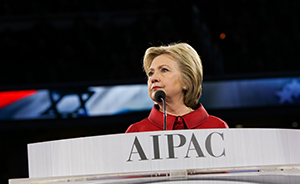
Hillary Clinton (Photo credit: AIPAC)
If Bashar al-Assad is still president of Syria, there will be demands that she finally go for the knock-out blow; there will pressure, too, for her to ratchet up sanctions on Iran pushing Tehran toward renouncing the nuclear agreement; there are already calls for deploying more U.S. troops on Russia’s border and integrating Ukraine into the NATO military structure.
President Clinton-45 would hear the clever talking points justifying these moves, the swaggering tough-guy/gal rhetoric, and the tear-jerking propaganda about evil enemies throwing babies off incubators, giving Viagra to soldiers to rape more women, and committing horrific crimes (some real but many imagined) against defenseless innocents.
Does anyone think that Hillary Clinton has the wisdom to resist these siren songs of confrontation and war, even if she were inclined to?
President Barack Obama, who – for all his faults – has a much deeper and subtler intellect than Hillary Clinton, found himself so battered by these pressures from the militaristic Washington “playbook” that he whined about his predicament to The Atlantic’s Jeffrey Goldberg, himself a neocon war hawk.
The Washington foreign policy establishment is now so profoundly in the hands of the neocons and their “liberal interventionist” sidekicks that the sitting President presumably couldn’t find anyone but a neocon to give those interviews to, even as he complained about how the U.S. capital is in the hands of warmongers.
Given this neocon domination of U.S. foreign policy – especially in the State Department bureaucracy, the major media and the big think tanks – Clinton will be buffeted by hawkish demands and plans both from outside of her administration and from within.
Already key neocons, such as the Brookings Institution’s Robert Kagan, are signaling that they expect to have substantial influence over Clinton’s foreign policy. Kagan, who has repackaged himself as a “liberal interventionist,” threw his support to Clinton, who put him on a State Department advisory board.
There is also talk in Washington that Kagan’s neocon wife, Assistant Secretary of State for European Affairs Victoria Nuland, another Clinton favorite and the architect of the “regime change” in Ukraine, would be in line for a top foreign policy job in a Clinton-45 administration.
Neocons Back in Charge
So, Clinton’s election could mean that some of the most dangerous people in American foreign policy would be whispering their schemes for war and more war directly into her ear – and her record shows that she is very susceptible to such guidance.
At every turn, as a U.S. senator and as Secretary of State, Clinton has opted for “regime change” solutions – from the Iraq invasion in 2003 to the Honduras coup in 2009 to the Libyan air war in 2011 to the Syria civil war since 2011 – or she has advocated for the escalation of conflicts, such as in Afghanistan and with Iran, rather than engaging in reasonable give-and-take negotiations.
Though her backers tout her experience as Secretary of State, the reality was that she repeatedly disdained genuine diplomacy and was constantly hectoring President Obama into adopting the most violent and confrontational options.
He sometimes did (the Afghan “surge,” the Libyan war, the Iran nuclear stand-off) but he sometimes didn’t (reversing the Afghan escalation, finally negotiating a nuclear deal with Iran after Clinton left, rejecting a direct U.S. military assault on the Syrian government, and working at times with the Russians on Iran and Syria).
In other words, Obama acted as a register or brake restraining Clinton’s hawkishness. With Clinton as the President, however, she would have no such restraints. One could expect her to endorse many if not all the harebrained neocon schemes, much as President George W. Bush did when his neocon advisers exploited his fear and fury over 9/11 to guide him into their “regime change” agenda for the Middle East.
The neocons have never given up their dreams of overthrowing Mideast governments that Israel has put on its enemies list. Iraq was only the first. To follow were Syria and Iran with the idea that by installing pro-Israeli leaders in those countries, Israel’s close-in enemies – Lebanon’s Hezbollah, Hamas and other Palestinian militant groups – could be isolated and crushed.
After Bush’s Iraq invasion in 2003, Washington’s neocons were joking about whether Iran or Syria should come next, with the punch line: “Real men go to Tehran!” But the Iraq War wasn’t the “cakewalk” that the neocons had predicted. Instead of throwing flowers at the U.S. troops, Iraqis planted IEDs.
As it turned out, a lot of “real men” and “real women” – as well as “real children” – died in Iraq, including nearly 4,500 American soldiers and hundreds of thousands of Iraqis.
So the neocon timetable took a hit but, in their view, only because of Bush’s incompetent follow-through on Iraq. If not for the botched occupation, the neocons felt they could have continued rolling up other troublesome regimes, one after another.
Professionally, the neocons also escaped the Iraq disaster largely unscathed, continuing to dominate Washington’s think tanks and the op-ed pages of major American news outlets such as The Washington Post and The New York Times. Barely missing a beat, they set about planning for the longer haul.
An Obama Mistake
Although they lost the White House in 2008, the neocons caught a break when President-elect Obama opted for a Lincoln-esque “team of rivals” on foreign policy. Instead of reaching out to Washington’s marginalized (and aging) foreign policy “realists,” Obama looked to the roster of the neocon-dominated establishment.
Obama recruited his hawkish Democratic rival, Sen. Hillary Clinton, to be Secretary of State and kept Bush’s Defense Secretary Robert Gates. Obama also left in place most of Bush’s military high command, including neocon favorite, General David Petraeus.
Obama’s naïve management strategy let the neocons and their “liberal interventionist” pals consolidate their bureaucratic control of Washington’s foreign policy bureaucracy, even though the President favored a more “realist” approach that would use America’s power more judiciously — and he was less enthralled to Israel’s right-wing government.
The behind-the-scenes neocon influence became especially pronounced at Clinton’s State Department where she tapped the likes of Nuland, a neocon ideologue and an adviser to Vice President Dick Cheney, to become the department’s spokesperson and put her on track to become Assistant Secretary of State for European Affairs (although the appointment wasn’t finalized until after Clinton left in 2013).
The neocon/liberal-hawk bias is now so strong inside the State Department that officials I know who have gone there reemerge as kind of “pod people” spouting arrogant talking points in support of U.S. intervention all over the world. By contrast, I find the CIA and the Pentagon to be places of relative realism and restraint.
Perhaps the best example of this “pod people” phenomenon was Sen. John Kerry, who replaced Clinton as Secretary of State and suddenly became the mouthpiece for the bureaucracy’s most extreme war-like rhetoric.
For instance, Kerry advocated a retaliatory bombing campaign against Syria’s military in August 2013, ignoring the intelligence community’s doubts about whether President Bashar al-Assad’s regime was responsible for a sarin-gas attack outside Damascus.
Instead of listening to the intelligence analysts, Kerry fell in line behind the neocon-driven “group think” pinning the blame on Assad, the perfect excuse for implementing the neocons’ long-delayed Syrian “regime change.” The neocons didn’t care what the facts were — and Kerry fell in line. [See Consortiumnews.com’s “What’s the Matter with John Kerry?”]
But Obama didn’t fall in line. He listened when Director of National Intelligence James Clapper told him that there was no “slam dunk” evidence implicating the Syrian military. (Ultimately, the evidence would point to a provocation carried out by Islamic extremists trying to trick the U.S. military into intervening in the war on their side.)
Obama also got help from Russian President Vladimir Putin who persuaded President Assad to surrender all his chemical weapons (while Assad still denied any role in the sarin-gas attack). Putin’s assistance infuriated the neocons who soon recognized that the Obama-Putin cooperation was a profound threat to their “regime change” enterprise.
Targeting Ukraine
Some of the smarter neocons quickly identified Ukraine as a potential wedge that could be driven between Obama and Putin. Carl Gershman, president of the National Endowment for Democracy, called Ukraine “the biggest prize” and a potential first step toward driving Putin from power in Russia.
It fell to Assistant Secretary of State Nuland to shepherd the Ukraine operation to fulfillment as she plotted with U.S. Ambassador to Ukraine Geoffrey Pyatt how to remove Ukraine’s pro-Russian President Viktor Yanukovych. Nuland and Pyatt were caught in an intercepted phone call discussing who should take over.
“Yats is the guy,” Nuland said referring to Arseniy Yatsenyuk who indeed would become the new prime minister. Nuland and Pyatt then exchanged ideas how to “glue this thing” and how to “midwife this thing.” This “thing” became the bloody Feb. 22, 2014 coup ousting elected President Yanukovych and touching off a civil war between Ukrainian “nationalists” from the west and Ukraine’s ethnic Russians in the east.
As the “nationalists,” some of them openly neo-Nazis, inflicted atrocities on ethnic Russians, Crimea voted by 96 percent to leave Ukraine and rejoin Russia. Resistance to the new Kiev regime also arose in the eastern Donbas region.
To the State Department – and the mainstream U.S. news media – this conflict was all explained as “Russian aggression” against Ukraine and a “Russian invasion” of Crimea (although Russian troops were already in Crimea as part of the Sevastopol naval base agreement). But All the Important People agreed that the Crimean referendum was a “sham” (although many polls have since confirmed the results).
When citizen Clinton weighed in on the Ukraine crisis, she compared Russian President Putin to Hitler.
So, today the neocon/liberal-hawk Washington “playbook” – as Obama would call it – calls for massing more and more U.S. troops and NATO weapons systems on Russia’s border to deter Putin’s “aggression.”
These tough guys and gals also vow to ignore Russia’s warnings against what it views as military threats to its existence. Apparently “real, real men” go to Moscow (perhaps riding a nuclear bomb like the famous seen from “Dr. Strangelove.”).
Ian Joseph Brzezinski, a State Department official under President George W. Bush and now a foreign policy expert for the Atlantic Council, a NATO think tank, has co-authored an article urging NATO to incorporate Ukrainian army units into its expansion of military operations along Russia’s border.
“High-level Ukrainian national security officials have urged the international community to be bolder in its response to Russia’s provocative military actions,” wrote Brzezinski (son of old Cold Warrior Zbigniew Brzezinski) and Ukrainian co-author Markian Bilynskyj.
“The deployment of a battle tested, Ukrainian infantry company or larger unit to reinforce the defense of NATO territory in Central Europe would be a positive contribution to the Alliance force posture in the region.”
Following the Playbook
This kind of tough-talking jargon is what the next President, whoever he or she is, can expect from Official Washington. From Obama’s interview in The Atlantic, it’s clear that he feels surrounded and embattled by these warmongering forces but takes some pride in resisting – from time to time – the Washington “playbook.”
But how would President Hillary Clinton respond? When she appeared before the American Israel Public Affairs Committee on March 21 – at a moment when it appeared she had all but nailed down the Democratic nomination – Clinton showed what you might call her true colors, fawning over how loyal she would be to Israel and promising to take the very cozy relationship between the U.S. and Israel “to the next level.”
By reviewing Clinton’s public record, one could reasonably conclude that she is herself a neocon, both in her devotion to Israel and her proclivity toward “regime change” solutions. She also follows the neocon lead in demonizing any foreign leader who gets in their way. But even if she isn’t a full-fledged neocon, she often bends to their demands.
The one possible deviation from this pattern is Clinton’s personal friendship with longtime adviser Sidney Blumenthal, who was an early critic of the neoconservatives as they emerged as a powerful force during the Reagan administration. Blumenthal and his son Max have also dared criticize Israel’s abusive treatment of the Palestinians.
However, the Israel Lobby appears to be taking no chances that Sidney Blumenthal’s voice might be heard during a Clinton-45 administration. Last month, a pro-Zionist group, The World Values Network, bought a full-page ad in The New York Times to attack Blumenthal and his son and declared that “Hillary Clinton must disavow her anti-Israel advisors.”
Though Clinton might not publicly disassociate herself from Sidney Blumenthal, the preemptive strike pushed him further toward the margins and helped clear the path for the Kagan/Nuland faction to rush to the center of Clinton’s foreign policy.
Indeed, Clinton’s primary focus if she gets elected is likely to be ensuring that she gets reelected. As a traditional politician, she would think that the way to achieve reelection is to stay on the good side of the Israeli leadership. Along those lines, she promised AIPAC that, as President, she would immediately invite Prime Minister Benjamin Netanyahu to the White House.
So, what would happen if Clinton takes the U.S.-Israeli relationship “to the next level”? Presumably that would mean taking a super-hard line against Iran over last year’s nuclear deal. Yet, already Iran is questioning whether its acceptance of extraordinary constraints on its nuclear program was worth it, given the U.S. unwillingness to grant meaningful relief on economic sanctions.
A belligerent Clinton approach – decrying Iran’s behavior and imposing new sanctions – would strengthen Iran’s hard-line faction internally and might well lead to Iran renouncing the agreement on the grounds of American bad faith. That, of course, would please the neocons and Netanyahu by putting the “bomb-bomb-bomb Iran” option back in play.
A Stunning Reversal
Clinton may have viewed her AIPAC speech as the beginning of her long-awaited “pivot to the center,” but afterwards she suffered a string of primary and caucus defeats at the hands of Sen. Bernie Sanders, most by landslide margins.
Besides those stunning defeats, Clinton’s campaign clearly has an “enthusiasm gap.” Sanders, the 74-year-old “democratic socialist” from Vermont, draws huge and excited crowds and wins younger voters by staggering percentages. Meanwhile, Clinton confronts polls showing high negatives and extraordinary public distrust.
If she gets the Democratic nomination, she may have little choice but to engage in a fiercely negative campaign since — faced with the lack of voter enthusiasm — her best chance of winning is to so demonize her Republican opponent that Democrats and independents will be driven to the polls out of fear of what the crazy GOP madman might do.
Right now, many Clinton supporters see her as the “safe” — not exciting — choice, a politician whose long résumé gives them comfort that she must know what’s she’s doing. African-American voters, who have been her most loyal constituency, apparently feel more comfortable with someone they’ve known (who has also served in the Obama administration) than Sanders who is unknown to many and is seen as someone whose ambitious programs appear less practical than Clinton’s small-bore ideas.
But a look behind Clinton’s résumé, especially her reliance on “regime change” and other interventionist schemes in the Middle East and Eastern Europe, might give all peace-loving voters pause. [See Consortiumnews.com’s “Is Hillary Clinton ‘Qualified’?”]
Savvy neocons, like Robert Kagan, have long understood that Clinton could be their Trojan Horse, pulled into the White House by Democratic voters. Kagan told The New York Times, “I feel comfortable with her on foreign policy. If she pursues a policy which we think she will pursue it’s something that might have been called neocon, but clearly her supporters are not going to call it that; they are going to call it something else.”
The same Times article noted that Clinton “remains the vessel into which many interventionists are pouring their hopes.” However, if she is that “vessel” carrying a neocon foreign policy back into the White House, this “safe” choice might prove dangerous to America and the world.
Investigative reporter Robert Parry broke many of the Iran-Contra stories for The Associated Press and Newsweek in the 1980s. You can buy his latest book, America’s Stolen Narrative, either in print here or as an e-book (from Amazon and barnesandnoble.com).
ESPN Ban Chief Wahoo

By Jacqueline Keeler – teleSUR – April 8, 2016
On Thursday morning, Bomani Jones, co-host of ESPN’s “Highly Questionable,” was asked to cover up his Cleveland “Caucasians” T-shirt he wore on another ESPN show “Mike and Mike.”
It’s hard to imagine the sports channel asking a guest to cover up a Cleveland Indians T-shirt featuring Chief Wahoo isn’t it? I mean, has that ever happened?
Twitter was filled with tweets from outraged white and even Black viewers. They were quick to jump on the idea that caricaturing white people — even to make a point, is wrong. One tweeted, “Oh and it couldn’t be more obvious you hate white people #racist.”
And that begs the question, if it’s so obvious that being turned into a mascot is wrong when it’s a white person being caricatured and stereotyped (and let’s face it, the Chief Wahoo mascot is far more grotesque than the one featured on “‘Caucasians” T-shirt) how is it Native people are still not being heard on this issue? Even after 50 years of protests?
I wrote two years ago this month a piece for Salon.com called “My life as a Cleveland Indian: The enduring disgrace of racist sports mascots” in response to the viral photo that showed a Cleveland fan in Chief Wahoo redface attempting to shake hands with a Native American protester, Rob Roche. This week, the fan, Pedro Rodriguez, returned to re-enact the picture. It was hailed as progress because this time, he came without the redface and headdress, but he still had on the shirt decorated with that smiling face of racism, Chief Wahoo.
I am, myself, a Cleveland American Indian. I was born there, the child of Relocation, a program that was a component of the Termination Act passed by Congress in 1956 to terminate tribes and relocate our people to urban centers. My parents were part of a generation of young people “went on Relocation” to go to college and find jobs not in cities that had relocation centers all over the country, Cleveland was one such city.
When my parents arrived in the 1960s, there was in Cleveland, a burgeoning Native community of some 20,000 young people from Alaska to Maine. It was from this youthful community (most were college-aged or just married) that the first protests against Chief Wahoo emerged in the late 1960s.
So this is not a new issue, not for me or my family. In fact, in 2014 my children and I, joined by members the Portland Native American community, protested at Nike World Headquarters in Beaverton, Oregon for their selling Chief Wahoo apparel. Nike responded in a press release where the company claimed that it’s powerless to stop selling Chief Wahoo because they were bound by their MLB contracts.
In this statement, Nike said, “Nike has a contractual partnership with Major League Baseball as the licensing agent for MLB team-approved marks. Each MLB team is responsible for choosing their team logos and marks and we understand that the Cleveland Indians are engaging their fans and the local community in conversation concerning their logo.”
I responded writing in response, “we feel Nike’s argument makes no sense because the logical conclusion to it is that they would sell any derogatory mascot if asked to do so — no matter how badly it reflects upon their brand. Are they really saying that if a community and a team agreed they would sell apparel with a Sambo mascot? We feel that there is a moral imperative and that since the American Indian community in Cleveland has been outspoken on the issue of Chief Wahoo for 45 years the opinions of the community have been ignored and no meaningful dialogue has occurred.”
In both Nike and ESPN’s case a double standard exists between Chief Wahoo and how other Americans of other race, creed and ethnicity are treated. I applaud Bomani Jones for taking a stand on this and not covering up his shirt. A shirt created by Shelf Life Clothing to point out the racism the Cleveland mascot promotes.
I also applaud the Cleveland City Council and leaders like Councilman Zack Reed who are taking steps to ban Chief Wahoo from the city of my birth. On Monday, opening day for the Cleveland MLB team, the city council passed an ordinance which will result in the removal of banners that feature Chief Wahoo from all downtown utility poles.
When I spoke to Reed, he compared Chief Wahoo to the Confederate flag and said that no amount of racism is acceptable to represent the city.
“You can’t scale back racism. It is what it is,” he said. “If you look up there at those banners downtown you can see Chief Wahoo and we want it gone whether big or small, we want it gone.”
I hope ESPN decides they want Chief Wahoo gone, too. No amount of racism is acceptable. And that goes for Nike, too.
Report Accusing Russia of Bombing Syrian Hospitals ‘Lacks Hard Data’
Sputnik — 07.04.2016
WASHINGTON – A new report from the US-based think tank Atlantic Council accusing Russia of deliberately bombing hospitals during its anti-terrorists campaign in Syria has no hard data to back up its questionable claims and comes from an organization notorious for its propaganda against Russia, US analysts told Sputnik.
“This publication from the Atlantic Council claims that it is based on ‘analysis of open source and social media intelligence (OSSMINT).’ This OSSMINT is a field completely invented by [report co-author Eliot] Higgins,” Helena Cobban, a leading US expert on modern Syria and veteran Middle East correspondent, said.
However, the so-called OSSMINT materials, presented on Tuesday, are a misleading mixture of unreliable sources using a methodology that has never been seriously accepted, Cobban pointed out.
“OSSMINT consists of little more than capturing and aggregating claims made by anyone [that Higgins] chooses on social media; and over any sub-sample of a time period that he chooses to focus on. It’s an echo chamber for whatever he chooses to echo,” she noted.
Higgins’ methodology in the report mixed reliable and verifiable information with unverifiable anecdotal claims of the most dubious accuracy, Cobban said.
“It’s worth underlining that by relying on both open source information and on what [Higgins] calls ‘social media intelligence,’ which is completely unverifiable, his method is completely unscientific,” she pointed out.
Serious reconnaissance photographic data about the pattern of Russia and US airstrikes over Syria was potentially available, yet the Atlantic Council report cited none whatsoever, Cobban observed.
“Every government intelligence service with constant satellite surveillance over Syria… [including the United States, Russia and Israel] would be able to provide… solid numbers and figures about the location and authorship of the major military actions taken in Syria over the past 30 months. This report uses no such data,” she said.
Higgins had a strong history of partisanship in favor of the anti-government forces in Syria and has never had, nor had he claimed any formal training in military affairs or military science, Cobban noted.
“In August 2013, [Higgins] and his blog became some of the main actors accusing the Syrian government of having used chemical weapons against the rebels near Damascus,” she pointed out.
Higgins’ false claim was widely spread and nearly catapulted the United States and United Kingdom into launching airstrikes against the Syrian government, Cobban recalled.
However, that analysis was within days challenged and disproven by a team of real specialists in ballistics led by the veteran MIT military-tech specialist Theodore Postol, Cobban added.
University of Illinois Professor of International Law Francis Boyle told Sputnik that the pattern of wild accusations using alleged evidence is based on no serious, accepted methodology reflecting the anti-Russian bias of the body that published it.
“The Atlantic Council is a well-known anti-Russian, anti-Putin propaganda organization. Caveat lector [‘Let the reader beware’]” he said.
Russia started its counter-terrorism operation in Syria in September 2015, at the request by Syrian President Bashar Assad. On March 15, Russia began withdrawing the largest bulk of its military from Syria after accomplishing its objectives.
The Russian Defense Ministry issued daily reports on the results of its air campaign in Syria and released footage showing its air force striking targets.
See also:
Reconnaissance Data Shows Airstrikes on Syrian Hospital ‘Launched by US-Led Coalition Aircraft’
Disgraceful BBC Panorama Propaganda Hides Grim Truth About Britain
By Craig Murray | April 5, 2016
Richard Bilton of the BBC today exposed himself as the most corrupt and bankrupt of state media shills – while pretending to be fronting an expose of corruption. There could not be a more perfect example of the western state and corporate media pretending to reveal the Panama leak data while actually engaging in pure misdirection.
In a BBC Panorama documentary entitled Tax Havens of the Rich and Powerful Exposed, they actually did precisely the opposite. The BBC related at length the stories of the money laundering companies of the Icelandic PM and Putin’s alleged cellist. The impression was definitely given and reinforced that these companies were in Panama.
Richard Bilton deliberately suppressed the information that all the companies involved were in fact not Panamanian but in the corrupt British colony of the British Virgin Islands. At no stage did Bilton even mention the British Virgin Islands.
Company documents were flashed momentarily on screen, in some cases for a split second, and against deliberately unclear backgrounds. There is no chance that 99.9% of viewers would notice they referred to British Virgin Islands companies. But instantly reading a glimpsed document is an essential skill for a career diplomat, and of course I happen to know immediately what BVI or Tortola mean on a document. So I have been back and got screenshots of those brief flashes.


Is it not truly, truly, astonishing the British Virgin Islands were not even mentioned when the BBC broadcast their “investigation” of these documents?
In deliberately obscuring the key role of the British money-laundering base of British Virgin Islands in these transactions, the BBC have demonstrated precisely why the entire database has to be released to the scrutiny of the people, rather than being filtered by the dubious honesty of state and corporate journalists. The BBC targeting of two very low level British minions at the end of their programme does not alter this.
The BBC could also address why their Pacific Quay HQ in Glasgow is leased for £100 million from a hidden ownership company in the Cayman Islands.
The NY Times on Gaza: Israel Is Just Trying to Help
By Barbara Erickson | TimesWarp | April 5, 2016
Now, at last, The New York Times has turned its sights on Gaza fishermen, a much beleaguered group, which has persevered under constant harassment and crippling restrictions. It has long been well under the radar as far as the newspaper’s reporting is concerned.
This week, however, we have an above-the-fold story on page 5 accompanied by a color photo of two fishermen with their nets. What has prompted this long overdue attention? It is the opportunity to present Israel as the benevolent caretaker of the besieged Gaza Strip.
Thus we find a headline announcing the following: “Israel Expands Palestinians’ Fishing Zone Off Gaza.” The story below reports the decision to increase the allowed zone from 6 to 9 nautical miles and the relief and excitement of Gaza fishermen and officials.
The article ends with a quote from Israeli officials, saying that the expansion was part of an effort to “improve the economy and foster stability” in the West Bank and Gaza, and so the story is framed around Israeli efforts to help struggling fishermen and Palestinians in general.
Thanks no doubt to the efforts of Times stringer Majd Al Waheidi of Gaza, readers find hints of the grim reality that fishermen there have actually faced over several years. We learn that Israeli gunboats have been firing on fishermen as they go to sea, and we hear the story of Ismail al-Shrafi, 62, who lost his boat five months ago when Israeli sailors confiscated it, injuring his son with live fire in the process.
The story, however, provides no data to place the case of al-Shrafi in context. Readers do not learn that during 2015, the Israeli navy fired on Gaza fishermen at least 139 times, wounding 24 fishermen and damaging 16 boats. Another 22 boats were confiscated, and 71 fishermen were detained.
According to the Palestinian Center for Human Rights, all these incidents took place within the legal 6-mile zone, but the Times notes that an army spokesperson denied that the navy had fired on boats within the permitted area.
The article, by Al Waheidi and Isabel Kershner, also states that over the weekend the navy “sank a suspected smuggling boat,” but it fails to inform readers that witnesses have contradicted this account. According to Palestinian news sources, the navy fired on several boats near Rafah, setting fire to one fishing vessel and causing it to sink.
The Times is denying readers the complete story here, but its most egregious paragraph is the final one in which officials claim that the expansion of the fishing zone was “part of a policy of loosening restrictions” to help the Palestinian economy.
In fact, Israeli policy appears to be aimed at impeding, rather than bolstering, economic progress in Gaza and the West Bank. Here are just a few examples of how Israeli actions and regulations impact the Palestinian economy:
- The same day the fishing zone was expanded from 6 to 9 miles, four Israeli military bulldozers entered the Gaza strip to destroy farmland planted with wheat.
- According to the PCHR, 35 percent of Gaza’s agricultural land “can only be accessed under high personal risk” because Israeli troops frequently fire on laborers in the fields.
- Israeli policies have caused the Palestinian telecommunications sector to lose $1 billion over the past three years, according to a World Bank report.
- Through a regime of permits, licenses and visas, Israel has cut into the Palestinian tourism industry, deflecting jobs and income to Israel.
- Israel confiscates some 80 percent of the water in the West Bank for its own use and charges Palestinian residents for the water it sells back to them.
- A United Nations report stated that in spite of the occasional loosening of restrictions, Gaza’s economy will continue to deteriorate as long as Israel maintains its blockade of the territory.
Times readers, however, are told that Israel is trying to help, loosening restrictions to “improve the economy.” Thus we find the headline this week announcing a generous move to allow fishermen more access to their own Gaza Sea.
It seems that the newspaper’s editors are credulous consumers of Israeli spin, readily quoting the self-serving claims of officials and making no attempt to verify the facts. Readers—as well as the courageous fishermen of Gaza—deserve better.
Follow @TimesWarp on Twitter
Featured Video

Why the U.S. Should Pull Back From the First Island Chain
or go to
Aletho News Archives – Video-Images
Book Review
‘Why Fauci Must Rot in Prison’: A Tale of Two Diaries
By Jill Erzen | The Defender | October 13, 2026
Dr. Anthony Fauci’s private diary reveals a “mind-numbing” contradiction between what the former top U.S. infectious disease official knew about COVID-19 and what he told the public, senior White House adviser Peter Navarro, Ph.D., said last week on “American Thought Leaders.”
In his new book, “Why Fauci Must Rot in Prison,” due out Oct. 20, Navarro compares Fauci’s private entries to his own pandemic-era diary, and uses what he calls “a tale of two diaries” to argue that Fauci should face criminal prosecution.
“I show, actually, how a prosecution can and should happen … at the state level, most likely,” Navarro said. “He should wind up in prison, and we’ve got the receipts in this book to put him there.”
Navarro said Fauci repeatedly acknowledged important facts in private, then publicly pursued policies that contradicted those facts — with devastating consequences.
“What he says many times privately in his diary is so at odds with both his public behavior and public statements that it’s mind-numbing,” Navarro said.
Navarro examines the lasting damage caused by lockdowns and other pandemic policies, and the ongoing toll of long COVID.
His book also addresses questions about vaccine safety, including why healthy young people faced COVID-19 vaccination mandates despite concerns about myocarditis, and why women were not warned about miscarriage risks linked to the shots. … continue
Blog Roll
 Aletho News
- Jennifer Kavanagh: Why the U.S. Should Pull Back From the First Island Chain
- Yemen denounces international community’s silence on Saudi aggression, siege
- UAE and Saudi Arabia move toward renewed coordination against Sanaa
- How Iran’s two-week retaliatory strikes exposed cracks in US military architecture in Persian Gulf
- The mother of all propaganda: Why the hype over US MOAB strike against Iran is nothing but theater
- Iran says it possesses technology behind US 14-ton GBU bunker-buster
- Trump asks Iran not to retaliate after he strikes Pickaxe Mountain – w/ Prof. Marandi
- Vice President J.D. Vance’s Deceptive ‘Antiwar’ Campaign Speech
- Iran: Palestinians’ rights must not be compromised in Gaza’s future; US, Israel to blame for Hormuz situation
- Ongoing tales of Syrian chemical weapons
- If Americans Knew
- Israeli rabbi permits occupiers to steal Palestinian olive harvest in West Bank
- Netanyahu’s spin on latest settler attack is laughable – Daily Update
- Israeli soldiers debunk Israel’s talking points
- In West Bank, Israeli settlers are totally out of control – Daily Update
- NPR investigation finds evidence of widespread fraud at mall kiosks tied to Israeli skincare brand
- Tucker Carlson exposes Israeli Lies about the Oct 7th attack, Charlie Kirk, and the U.S.
- Israel has detained thousands of Palestinian children since Oct 7th – over half spent time in solitary, many uncharged
- Israeli Analysis: Is Netanyahu Planning an ‘October Surprise’ Attack Before Israel’s Election?
- Israeli settlers brutally attack Palestinians and Washington Post female photographer, 65
- Words Have Changed, Occupation Continues: The Reality of the Gaza Ceasefire
- No Tricks Zone
- Predictions Made By Renowned Climate Proifessor Over Past Decades Have Been Proven To Be Poor
- New Study Suggests Large Regions Of The Pacific Ocean Have Been Cooling For The Last 80 Years
- Germany’s Green Energy Debacle: High Energy Costs Force Kahla Porzellan to Close After 182 Years!
- New Study: 50 Years Of The Most Aggressive ‘Net Zero’ Policies Can Only Affect The Global Climate By 0.03°C
- US September “Heat” Was No Record…Many Records Set Decades Ago
- Latest European Green Energy Debacle; Portugal’s Largest Flagship Solar Park Insolvent!
- Green Energy Debacle: German Expert Professor Fritz Vahrenholt Warns Of Severe Economic And Social Consequences
- Two More Paleo Reconstructions Affirm Meters-Higher Sea Levels Across Ireland, Brazil 7000-6000 Years Ago
- New Study: Earth And Venus Surface Warmth Largely Explained By Convection And Lapse Rate, Not CO2 Or Radiation
- 2025 Nature Paper Claiming Worsening Global Drought Gets RETRACTED …Heavily Flawed

