Venezuela’s Political Killings: A Sign of the Repression to Come?
By Ryan Mallett-Outtrim | Venezuelanalysis | April 4, 2016
A mayor gunned down in a drive by shooting just meters from his own doorstep. A legislator shot by paramilitaries in plain sight outside a bodega. A solidarity activist butchered in a home invasion. Two police run over by militants in a stolen bus. These are just the latest in a wave of killings in Venezuela. The motives behind most of these killings remain unclear, though it’s hard to not be disturbed by what appears to be a growing wave of political violence gripping the country. In response, Venezuela’s right-wing, the mass media and even most human rights groups are all following a well worn script that seeks to downplay these killings, or at least deflect attention away from the context behind the violence. For example, Human Rights Watch’s latest report on Venezuela is basically just a call for Venezuela’s supreme court to be stacked with supporters of the right-wing political coalition, the MUD. Another of their recent reports focused on claims that imprisoned right-wing political figure Leopoldo Lopez didn’t receive a fair trial. Their third most recent report (at the time of writing) was another complaint about the Maduro administration’s human rights record, including false claims that “security forces violently cracked down on largely peaceful protests” in 2014. As I saw myself at the time, those suppressed “largely peaceful protests” included gangs of armed right-wing militants throwing Molotovs at hospitals, sniping at civilians from rooftops and setting up barricades to hold neighbourhoods hostage. Then and now, Venezuela is increasingly becoming a dangerous place for leftists.
Indeed, all the recent victims were either leftists, or police seeking to contain violent right-wing demonstrations. The latest victim was Marco Tulio Carrillo, the socialist mayor of a municipality in Trujillo state. Other victims include Haitian-Venezuelan solidarity activist Fritz Saint Louis, Tupamaro legislator Cesar Vera, and two police officers in Tachira state.
These killings take on a new dimension when contextualised: the right-wing MUD is preparing to oust Maduro, and wrestle control of all branches of the state from the left.
If they achieve this, the worst case scenario would be a return to the repression of the 20th Century, when leftists were all too often the targets of neoliberal regimes. Today’s right-wing has repeatedly shown it not only has no interest in disavowing violence, but is willing to turn on the Venezuelan people for their own political gain. From the 2002 coup to the violence of 2014, there has always been a sector of the right-wing that has never been afraid to use terror against ordinary Venezuelans. If it takes complete power, perhaps the MUD will learn to speak out against violence such as the recent killings, or perhaps not. After all, much of the MUD is generally slow to condemn violence against leftists, if they do so at all. So if they take complete power, will the right reign in their excesses, or rule with terror?
House speaker says US, Israel key partners in war on terror
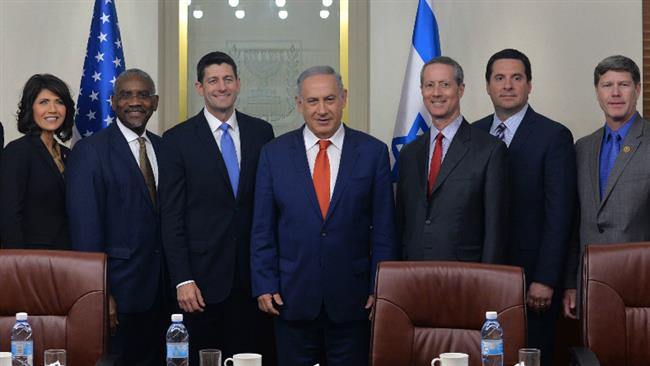
A bipartisan delegation of US lawmakers meets with Israeli Prime Minister Benjamin Netanyahu on April 4, 2016 at the premier’s office in Jerusalem al-Quds.
Press TV – April 5, 2016
Speaker of the US House of Representatives Paul Ryan led a bipartisan delegation of members of Congress to the Israeli Knesset, stressing that the alliance between Tel Aviv and Washington is “more important than ever.”
During his first official visit abroad as the House speaker, Ryan met with Knesset speaker Yuli Edelstein on Monday and said the United States will work “shoulder to shoulder” with Israel to counter their common threats.
“I wanted to come to Israel first to emphasize how important the US commitment to Israel and strong friendship with Israel is to us,” the Republican of Wisconsin said.
“Especially against the shared security threats of ISIS (Daesh) and Iran, this friendship is even more important than in the past,” he continued.
The speaker reassured his Israeli counterpart that the US Congress would rigorously push back against any boycott efforts against Israel.
Upon arriving in the occupied territories, Ryan tweeted that, “as long as I am speaker, I will not allow any legislation that divides Israel & America to come to the House floor.”
The American delegation also met with Prime Minister Benjamin Netanyahu and “expressed strong support for Israel,” the premier’s office said in a short statement on Monday.
In an interview with the Times of Israel on Sunday, Ryan said Palestinian “terrorism” directed against Israelis was no different than the terror wreaking havoc in Europe.
“They’re coming at Israel but they’re ultimately coming for us,” he said. “So we are partners in this war on terror.”
“Israel is an indispensable ally in that. Israel is on the frontline in so many ways with respects to it,” the speaker continued.
The visit comes as Ryan’s home state of Wisconsin is gearing up for its crucial presidential primary on Tuesday.
Strong congressional support for Israel has played a crucial role in Israel receiving benefits not available to any other ally.
Israel is the largest cumulative recipient of US foreign assistance since World War II.
US military aid to Israel has amounted to more than $124.3 billion since it began in 1962, according to a US congressional report, released late last year.
The NY Times Joins Israel in Whitewashing (Yet Another) Scandal
By Barbara Erickson | TimesWarp | April 4, 2016
A military scandal has rocked Israel, and The New York Times has been on hand to report developments: A soldier was arrested for killing a wounded and helpless Palestinian; the soldier was under investigation for murder, and some Israelis have protested, insisting that he is a hero.
These were the stories that made headlines in the Times after the murder was caught on video and spread through the Internet, provoking outrage worldwide. The newspaper, it seems, has been on this from the start.
But readers may not suspect that there is much more that the newspaper is withholding. After the early headlines, the Times has gone silent and has failed to report a number of developments connected with the story:
- The United Nations special rapporteur on summary executions said the video carried “all the signs of a clear case of an extrajudicial execution.”
- In spite of this assessment and the initial cries of outrage from the Israeli government and military, the charges against the soldier were reduced from murder to manslaughter.
- The accused man, Cpl. Elor Azarya, has been released from prison and allowed to move freely on base.
- Settlers have harassed and threatened to kill the Palestinian who videographed the killing.
- An Israeli rights organization has requested protection for the videographer.
- A survey of Israeli public opinion revealed that 57 percent opposed the arrest of the soldier and 68 percent thought the prime minister, defense minister and army chief of staff were wrong to condemn the killing.
- Prime Minister Benjamin Netanyahu, after first denouncing the murder, spoke with the soldier’s father and reassured him of army support.
- Senator Patrick Leahy (D-VT) and 10 other members of Congress have written to the state department, requesting an investigation into extrajudicial killings of Palestinians carried out by Israeli police and military.
All of these items appeared in media outlets, some of them disseminated widely, such as the downgrade from murder to manslaughter, which made headlines in Israel, the West and the Arab world. In the Times, however, this news became nothing but a whispered conjecture buried in an article last Thursday. Far into her piece, author Isabel Kershner briefly mentioned that prosecutors were “appearing to have backed off from the idea of a murder charge.”
Since then, the Times has had nothing more to say about the scandal, leaving readers with the impression that Israeli officials were swift and firm in their effort to bring justice to bear. As authorities backed off from the murder charge and let the soldier go free, the Times fell silent.
It seems that the newspaper has endeavored to whitewash Israeli actions—spotlighting the first cries of outrage when the video emerged, the arrest of the soldier and the talk of a murder investigation and ignoring news that might expose the reality: nearly unlimited impunity for crimes against Palestinians.
The paper had nothing to say, for instance, about Netanyahu’s change of tone. When the video first emerged, the prime minister said the killing “does not represent the values of the IDF.” Later he spoke to the accused man’s father, assuring him that he personally understood the man’s distress and saying that the family should trust the army to be “professional and fair in its investigation.”
This was reported extensively in Israel, as was the Leahy letter asking Secretary of State John Kerry to investigate a “disturbing number of reports of gross violations of human rights by security forces” in Israel and Egypt. The letter mentions several specific cases of alleged extrajudicial executions by Israeli forces.
Senator Leahy’s signature is of particular importance because his name is on a law that prohibits the United States from providing military aid to security forces that violate human rights with impunity.
Nevertheless, the Times has ignored the appeal by Leahy and 10 other members of Congress, even though the event is eminently newsworthy and the letter led to a sharp exchange between Netanyahu and Leahy.
The newspaper has also overlooked the effect of the incident on Palestinians: the threats against the videographer, the harassment of his family and initial refusals to allow Palestinian participation in conducting the autopsy.
It seems that much of the news touching on this latest Israeli scandal is unfit to print in the Times. Readers are not to see evidence that the first official reaction to the disturbing video was little more than damage control, an attempt to show the world that Israel does not condone such crimes. The Times, as usual, has fallen into line, a willing partner in the official effort to exonerate Israel of its crimes.
Kremlin Spokesman Says His Wife Never Owned Offshore Companies
Sputnik – 04.04.2016
Kremlin spokesman Dmitry Peskov said Monday that his wife, figure skating champion Tatiana Navka, had never owned any offshore companies.
According to the Panama Papers leak, Navka became the beneficial owner of British Virgin Islands-based firm Carina Global Assets Ltd. in 2014.
“I can say an important thing based on my own example. It is claimed that my wife had an offshore company from 2014 to 2015. The thing is: my wife does not and has never owned any offshore companies,” Peskov told reporters.
On Sunday, Germany’s Suddeutsche Zeitung published alleged documents from the Panamanian Mossack Fonseca company in which the newspaper confirms ties to a number of world leaders and their circles to offshore schemes.
The German publication specifically notes Chinese President Xi Jinping, Ukrainian President Petro Poroshenko, Azeri President Ilham Aliev, Moroccan King Mohammed VI, Saudi King Alman ibn Abdul-Aziz al Saud, the late father of British Prime Minister David Cameron, and a number of individuals allegedly close to Russian President Vladimir Putin.
“Based on this, I’m personally inclined to doubt the accuracy of these and other reports. I can only state what I know for sure, what has to do with me personally,” he added.
Mossack Fonseca
Xymphora – April 4, 2016
“Selective Leaks Of The #PanamaPapers Create Huge Blackmail Potential”. This is curious. The lying media spinners are certainly corruptly attempting to slur people like Assad and Putin, but what is striking is the lack of evidence against big enemies of the Empire. Nobody is going to be impressed by the fact that somebody that Putin is acquainted with, or a cousin of Assad, is on the list. Certainly, the leaker, the International Consortium of Investigative Journalists, which could be called Wikilame, is one of those criminal propaganda organizations funded by the usual suspects which cause so many problems these days. But some of the leaks are interesting, which you wouldn’t expect if it was entirely the usual scam.
“Panama Papers: Hundreds of Israeli Companies, Shareholders Listed in Leaked Documents Detailing Offshore Holdings” Gaydamak and Ofer are very interesting perps from a conspiracy point of view, and usually receive full protection from the Jew-controlled media.
“New Zealand’s FMA, the Breder Suasso Conundrum, Mossack Fonseca, and #panamapapers” The leak was actually a year ago, so the timing of the propaganda release may be a clue.
Nevada: “The Law Firm That Works with Oligarchs, Money Launderers, and Dictators”. Note the amazing – or sadly not amazing – Twitter back and forth between Silverstein and Ames, with this classic tweet:
“.@MarkAmesExiled @pierre Yeah, he and @ggreenwald both in lounge chairs at moment drinking Snowden’s Blood on the Rocks. Can’t be bothered.”
“Mossack Fonseca: The Nazi, CIA And Nevada Connections… And Why It’s Now Rothschild’s Turn”. The theory that the leak is directed at destroying (Nazi law firm) Mossack Fonseca in order to remove a major competitor to the Rothschilds in the lucrative business of using Nevada as a tax haven. That would explain the odd selectivity of the leak, with none of the prominent US crime families implicated.
Mossack Fonseca is in the business of secrecy, so a massive security breach of this nature points to an extremely high-level operation, most probably an intelligence agency.
So we’ve got:
- big names, but no really big names, and in particular no names from the American elites;
- odd delay in the release of details of an old story (with striking Crazy Pierre censorship/assholery);
- very suspicious NGO-connected propagandists involved in the leak story;
- the Nevada tax haven issue seems to be key;
- the law firm would have had top-level security, requiring top-level attack.
The Disappearance of Hillary Clinton’s Healthcare Platform
By Benjamin Day | Common Dreams | March 30, 2016
What would happen if the media lifted the curtain on Clinton’s healthcare platform and introduced any level of scrutiny to her proposed improvements on the Affordable Care Act?
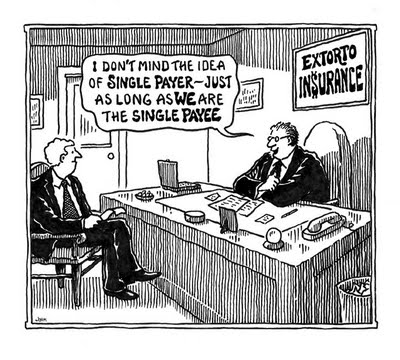
In an extraordinary magic trick, performed on a national scale, Hillary Clinton’s healthcare platform has been disappeared. While policy analysts, news anchors, and columnists have been engaged in an intense debate over Bernie Sanders’s “Medicare for All” proposal, Clinton’s incremental alternative has escaped almost all scrutiny – even among those who say they prefer it.
Combining the election-season writings of our most prolific, liberal-leaning columnists at the New York Times, Huffington Post, Vox, Mother Jones, Politico, The American Prospect, etc. you’ll find dozens of articles critiquing Sanders’s single-payer plan. None have mentioned a single Clinton healthcare proposal as a point of comparison – merely that she supports a philosphy of incremental reform.
Take Paul Krugman, a high-profile advocate of Clinton’s approach to healthcare reform. Krugman has published two op-eds in the New York Times and five additional blog posts arguing that “[progressives] should seek incremental change on health care… and focus their main efforts on other issues – that is… Bernie Sanders is wrong about this and Hillary Clinton is right.” In all seven pieces, Krugman focuses exclusively on Sanders’s single-payer proposal and fails to mention even a single Clinton policy.
The disappearance of the Clinton healthcare platform has even been carried out by pollsters. The Kaiser Health Tracking Survey included a bizarre question in its February 2016 poll, which was widely cited in the press. Respondents were asked to pick one of four possible directions for the future of U.S. healthcare. Among the choices were “The U.S. should establish guaranteed universal coverage through a single government plan” and “Lawmakers should build on the existing health care law to improve affordability and access to care.” Thirty-three percent of Democrats chose the single-payer option, while fifty-four percent chose the incremental option. The questions were clearly intended as stand-ins for the Sanders and Clinton healthcare proposals, but note that the single-payer option is a policy, whereas the incremental option mentions no actual policies, but asks respondents whether they support the (universally desirable) outcomes of improving affordability and access.
What would happen if the media lifted the curtain on Clinton’s healthcare platform and introduced any level of scrutiny to her proposed improvements on the Affordable Care Act? They would find two categories of Clinton proposals: some that are so vague they’re difficult to evaluate, and other more concrete plans that follow in the footsteps of one of Congress’s most practiced healthcare incrementalists: Senator Bernie Sanders.
For example, one of Clinton’s clearest incremental proposals is to repeal the Affordable Care Act’s poorly named “cadillac tax” on health plans with high premiums. She announced this proposal on September 29, drawing the ire of White House spokespeople. The move, however, followed in the footsteps of a Senate bill to repeal the Cadillac tax introduced by Bernie Sanders and seven Democratic Senators just a few days previously on September 24. Clinton’s position was correctly seen by reporters as necessary if she didn’t want to lose labor union support to Sanders.
“Because Clinton’s healthcare platform has received zero public scrutiny, she has had the luxury of floating other policy ideas in broad outlines, too vague to evaluate.”Many of Clinton’s well-defined healthcare proposals are rolled into a package of prescription drug reforms, which she released on September 22, 2015. They bear a striking resemblance to the Sanders prescription drug plan announced on September 1, filed as legislation on September 10. Both would legalize importation of prescription drugs from Canada, where costs for identical drugs are much lower due to Canada’s single-payer healthcare system. Sanders was a pioneer of importation, and in 1999 started driving busloads of American patients who couldn’t afford breast cancer drugs across the Canadian border. Both candidates call for empowering Medicare to negotiate drug prices – even Donald Trump jumped on board in January. Both would ban “pay-for-delay” deals between brand-name and generic drug makers, and increase prescription drug rebates for Medicaid and/or Medicare.
Because Clinton’s healthcare platform has received zero public scrutiny, she has had the luxury of floating other policy ideas in broad outlines, too vague to evaluate. Take the proposal to expand the use of Accountable Care Organizations. How? According to Clinton’s December policy brief: “In the coming months, [Clinton] will provide full detail on her plans for delivery system reforms that drive down costs.” With the primaries drawing to a close, no such details have been released. The same could be said of another proposal to “create a fallback process” to review insurance premium rate hikes in states that don’t already review rates. There has been no explanation of how such a plan would work, or whether it would require new legislation.
This is the double standard at work in almost all national coverage of Clinton and Sanders on healthcare reform: Clinton has been taken at her word that her incremental plans will be politically feasible, succeed in improving affordability and access to care, and are not shared by her opponent. Sanders on the other hand received intense public pressure to release details of his single-payer healthcare proposal, and when he did the proposal was subject to an avalanche of public analysis and scrutiny.
This double standard is all the more remarkable because single-payer healthcare is an established policy, practiced in one form or another in almost every developed nation in the world. Incremental reforms that work within the market-based healthcare system of the U.S. are far more uncertain, and deserve greater scrutiny. They are easier to enact but dramatically more likely to fall short of their goals. This is because incremental reforms in the United States usually focus on expanding access to care, without significant cost controls, in order to avoid opposition from the healthcare industry. The resulting policies are often unsustainable; make little headway against national trends of rising costs and eroding access; or simply move costs around (e.g. from premiums to deductibles and co-payments, or vice versa).
Previous national trends in incremental healthcare reform – from managed care through pharmacy benefit management, chronic disease management, narrow networks, and beyond – have often created lucrative new industries, but had dubious impacts on underlying healthcare costs or access to care. Most of Clinton’s healthcare platform falls exactly into these danger zones, and should be received with a critical eye.
The national discussion of single-payer healthcare reform is long overdue. However, when the full range of national media outlets force one candidate to run on real policies, while allowing another to run on values and aspirations, we aren’t having a real discussion of systemic vs. incremental reform, we are merely aiding the corrosion of informed democracy.
Benjamin Day is the Executive Director of Healthcare-NOW.
Kunduz Killers Go Free

Media Lens | March 31, 2016
On the night of October 3, 2015, a United States Air Force AC-130 gunship repeatedly attacked a Médecins Sans Frontières (MSF) hospital in Kunduz, Afghanistan. Forty-two people were killed and dozens wounded. The US military plane had conducted five strafing runs over the course of more than an hour despite MSF pleas to Afghan, US and Nato officials to call off the attack.
As we reported at the time, MSF were unequivocal in their condemnation of the American attack. The hospital was ‘intentionally targeted’ in ‘a premeditated massacre’; it was a ‘war crime’. The medical charity rejected US assurances of three inquiries by the US, Nato and the Afghan government. MSF demanded instead an independent international investigation. It was to no avail. The US ignored public outrage and went ahead with its standard whitewashing procedures when it commits war crimes that get exposed. The outcome was announced on March 18. BBC News reported:
‘The US military has disciplined more than a dozen service members after an air strike on a Medecins Sans Frontieres (MSF) hospital in Afghanistan killed 42 people last year.
‘The Pentagon has acknowledged that the clinic was targeted by mistake, but no personnel will face criminal charges.’
Note that the BBC wording – ‘the Pentagon has acknowledged that the clinic was targeted by mistake’ – is deceptive bias. The BBC made no mention that MSF had presented strong evidence that the clinic was ‘deliberately targeted’, that the attack was a ‘war crime’, and that there was an urgent need for an independent inquiry.
The BBC continued:
‘the sanctions, which were not made public, were mostly administrative.
‘Some received formal reprimands while others were suspended from duty.
‘Both officers and enlisted personnel were disciplined, but no generals were punished.’
MSF said that they would not comment until the Pentagon makes the details of its report public. (At the time of writing, this has yet to happen).
On the morning of March 18, we noted that the BBC’s report was, for a while at least, linked from the front page of its news website. But it was soon removed from this prominent position and instead buried deep in the international news section. This is not unusual when reporting the crimes of the West; if they are reported at all.
Our subsequent online searches revealed just four low-key, relatively brief newspaper reports in the British press that US personnel had been ‘punished’ for the Kunduz bombing: in the Independent, the Daily Mail, the Telegraph and the Guardian. The Telegraph reported that the Pentagon would shortly ‘publish a version of its report on the attack. It will be redacted to remove classified material.’ In other words: anything too embarrassing or damaging to US interests.
A few days later, on March 23, a tiny news item on page 34 of The Times carried the headline ‘US commander sorry for hospital attack’. The entirety of the piece, all of 61 words, was this:
‘The new commander of US-Nato forces in Afghanistan has apologised for a mistaken attack on a hospital in Kunduz last October that killed 42 people. General John Nicholson of the US army went to the northern city to meet relatives of those who died at the hospital run by the charity Médecins Sans Frontières. He said the incident was a “horrible tragedy”.’
As ever, Western atrocities are described as ‘tragedy’ rather than ‘war crime’. No other UK national newspaper, as far as we could see, even reported General Nicholson’s ‘apology’.
The New York Times did better, and included this telling quote from Zabiullah Niazi, a nurse who had lost an eye, a finger and the use of one hand, as well as suffering other injuries in the US attack:
‘They hit us six months ago and are apologizing now. The head of the provincial council and other officials who said we accept the apology, they wouldn’t have said it if they had lost their own son and eaten ashes, as we did.’
According to Mr. Niazi, General Nicholson did not even appear at an arranged meeting in the governor’s office with two survivors and male members of victims’ families. Instead, he made a speech in a packed auditorium where family members and survivors did not get a chance to speak. As a further sign of the tightly stage-managed proceedings, the general’s wife stopped by ‘for one minute to say hello and express sorrow’, said Mr Niazi. She spent more time – five minutes – with female survivors and family members in a separate room.
The general’s ‘apology’ was similarly dismissed by an Afghani doctor whose brother, also a doctor, was killed in the US attack. Dr. Karim Bajaouri said:
‘They are asking forgiveness for killing civilians?! They’re only making an apology? First they fire on civilians and then apologize. Personally, I don’t need such apologies, I do not accept them. Our moral wounds cannot be healed this way.’
The Guardian made a recent passing reference to Kunduz in an article by Simon Tisdall, an assistant editor and foreign affairs columnist. The focus of the piece was on Afghanistan as an election issue in the US Presidential race:
‘The fact that the most memorable US contribution to the battle for Kunduz was the destruction of a Médecins Sans Frontières hospital with the loss of at least 22 lives, none of them insurgents, only emphasised how hapless and haphazard the US mission in Afghanistan has become.’
(Oddly, Tisdall’s article was originally published on October 15, 2015, but then updated on March 29, 2016; presumably to include the above line.)
Once again, compliant ‘liberal’ journalism is marked by its readiness to label war crimes as merely ‘hapless’ and ‘haphazard’.
In the wake of the Pentagon’s announcement of ‘punishments’ for the Kunduz killers, an article on the Foreign Policy website noted:
‘Human rights advocates denounced the U.S. military’s decision not to file criminal charges against troops’.
Andrea Prasow of Human Rights Watch told Foreign Policy:
‘It’s incredibly disappointing and discouraging. We have come up with our own analysis of the case, and we think there should be a criminal investigation.’
As Prasow observed, the American military ‘has a vested interest in protecting its own’.
HRW added:
‘For good reason the victims’ family members will see this as both an injustice and an insult: the US military investigated itself and decided no crimes had been committed’.
The statement continued:
‘The failure to criminally investigate senior officials liable for the attack is not only an affront to the lives lost at the MSF hospital, but a blow against the rule of law in Afghanistan and elsewhere.’
Such comments contrast starkly with the bland indifference of the ‘liberal’ press.
Summing up, then, the reaction to the Pentagon’s ‘punishment’ of the Kunduz killers in the ‘mainstream’ press was as instructive as ever. True to form, we found not a single editorial or column denouncing this latest US whitewashing of US crimes.
Then again, it is standard practice for the Western media to mock Official Enemies, while being blind to the crimes of ‘our’ own Glorious Leaders.
International Injustice: the Conviction of Radovan Karadzic
By Diana Johnstone | CounterPunch | March 30, 2016
Last Thursday, news reports were largely devoted to the March 22 Brussels terror bombings and the US primary campaigns. And so little attention was paid to the verdict of the International Criminal Tribunal for (former) Yugoslavia (ICTY) finding Bosnian Serb leader Radovan Karadzic guilty of every crime it could come up with, including “genocide”. It was a “ho-hum” bit of news. Karadzic had already been convicted by the media of every possible crime, and nobody ever imagined that he would be declared innocent by the single-issue court set up in The Hague essentially to judge the Serb side in the 1990s civil wars that tore apart the once independent country of Yugoslavia.
Although it bears the UN stamp of approval, thanks to the influence of the Western powers, ICTY is essentially a NATO tribunal, with proceedings in English according to a jurisprudence invented as it goes along. Its international judges are vetted by Washington officials. The presiding judge in the Karadzic case was a South Korean, O-Gon Kwon, selected surely less for his grasp of ethnic subtleties in the Balkans than for the fact that he holds a degree from Harvard Law School. Of the other two judges on the panel, one was British and the other was a retired judge from Trinidad and Tobago.
As is the habit with the ICTY, the non-jury trial dragged on for years – seven and a half years to be precise. Horror stories heavily laced with hearsay, denials, more or less far fetched interpretations end up “drowning the fish” as the saying goes. A proper trial would narrow the charges to facts which can clearly be proved or not proved, but these sprawling proceedings defy any notion of relevance. Nobody who has not devoted a lifetime to following these proceedings can tell what real evidence supports the final judgment. The media stayed away from the marathon, and only showed up to report the inevitable “guilty” verdict condemning the bad guy. The verdict reads a bit like, “they said, he said, and we believe them not him.”
There was a civil war in Bosnia-Herzegovina from April 1992 to December 1995. Wars are terrible things, civil wars especially. Let us agree with David Swanson that “War is a crime”. But this was a civil war, with three armed parties to the conflict, plus outside interference. The “crime” was not one-sided.
Muslim False Flags
The most amazing passage in the rambling verdict by Judge O-Gon Kwan consists of these throw-away lines:
“With respect to the Accused’s argument that the Bosnian Muslim side targeted its own civilians, the Chamber accepts that the Bosnian Muslim side was intent on provoking the international community to act on its behalf and, as a result, at times, engaged in targeting UN personnel in the city or opening fire on territory under its control in order to lay blame on the Bosnian Serbs.”
This is quite extraordinary. The ICTY judges are actually acknowledging that the Bosnian Muslim side engaged in “false flag” operations, not only targeting UN personnel but actually “opening fire on territory under its control”. Except that that should read, “opening fire on  civilians under its control”. UN peace keeping officers have insisted for years that the notorious Sarajevo “marketplace massacres”, which were blamed on the Serbs and used to gain condemnation of the Serbs in the United Nations, were actually carried out by the Muslim side in order to gain international support.
This is extremely treacherous behavior. The Muslim side was, as stated, “intent on provoking the international community to act on its behalf”, and it succeeded! The ICTY is living proof of that success: a tribunal set up to punish Serbs. But there has been no move to expose and put on trial Muslim leaders responsible for their false flag operations.
The Judge quickly brushed this off: “However, the evidence indicates that the occasions on which this happened pale in significance when compared to the evidence relating to [Bosnian Serb] fire on the city” (Sarajevo).
How can such deceitful attacks “pale in significance” when they cast doubt precisely on the extent of Bosnian Serb “fire on the city”?
The “Joint Criminal Enterprise” Label
ICTY’s main judicial trick is to have imported from US criminal justice the concept of a “Joint Criminal Enterprise (JCE)”, used originally as a means to indict gangsters. The trick is to identify the side we are against as a JCE, which makes it possible to accuse anyone on that side of being a member of the JCE. The JCE institutionalizes guilt by association. Note that in Yugoslavia, there was never any law against Joint Criminal Enterprises, and so the application is purely retroactive.
Bosnia-Herzegovina was a state (called “republic”) within Yugoslavia based on joint rule by three official peoples: Muslims, Serbs and Croats. Any major decision was supposed to have the consent of all three. After Slovenia and Croatia broke away from Yugoslavia, the Muslims and Croats of Bosnia voted to secede from Yugoslavia, but this was opposed by Bosnian Serbs who claimed it was unconstitutional. The European Union devised a compromise that would allow each of the three people self-rule in its own territory. However, the Muslim leader, Alija Izetbegovic, was encouraged by the United States to renege on the compromise deal, in the hope that Muslims, as the largest group, could control the whole territory. War thus broke out in April 1992.
Now, if you asked the Bosnian Serbs what their war aims were, they would answer that they wanted to preserve the independence of Serb territory within Bosnia rather than become a minority in a State ruled by the Muslim majority. Psychiatrist Radovan Karadzic was the elected President of the Bosnian Serb territory, “Republika Srpska”. However, according to ICTY the objective of the Serbian mini-republic was to “permanently remove Bosnian Muslims and Bosnian Croats from Serb-claimed territory … through the crimes charged”, described as the “Overarching Joint Criminal Enterprise”, leading to several subsidiary JCEs. Certainly, such expulsions took place, but they were rather the means to the end of securing the Bosnian Serb State rather than its overarching objective. The problem here is not that such crimes did not take place – they did – but that they were part of an “overarching civil war” with crimes committed by the forces of all three sides.
If anything is a “joint criminal enterprise”, I should think that plotting and carrying out false flag operations should qualify. ICTY does not seem interested in that. The Muslims are the good guys, even though some of the Muslim fighters were quite ruthless foreign Islamists, with ties to Osama bin Laden.
One of the subsidiary JCEs attributed to Karadzic was the fact that between late May and mid-June of 1995, Bosnian Serb troops fended off threatened NATO air strikes by taking some 200 UN peacekeepers and military observers hostage. It is hard to see why this temporary defensive move, which caused no physical harm, is more of a “Joint Criminal Enterprise” than the fact of having “targeted UN personnel”, as the Muslim side did.
The final JCE in the Karadzic verdict was of course the July 1995 massacre of prisoners by Bosnian forces after capturing the town of Srebrenica. That is the basis of conviction for “genocide”. The Karadzic conviction rests essentially on two other ICTY trials: the currently ongoing ICTY trial of Bosnian Serb military commander General Ratko Mladic, who led the capture of Srebrenica, and the twelve-year-old judgment in the trial of Bosnian Serb General Radislav Krstic.
The Karadzic verdict pretty much summarizes the case against General Mladic, leaving little doubt where that trial is heading. Karadzic was a political, not a military leader, who persistently claims that he neither ordered nor approved the massacres and indeed knew nothing about them. Many well informed Western and Muslim witnesses testify to the fact that the Serb takeover was the unexpected result of finding the town undefended. This makes the claim that this was a well planned crime highly doubtful. The conclusion that Karadzic was aware of what was happening is inferred from telephone calls. In the final stages of the war, it seems unlikely that the Bosnian Serb political leader would compromise his cause by calling on his troops to massacre prisoners. One can only speculate as to what “a jury of peers” would have concluded. ICTY’s constant bias (it refused to investigate NATO bombing of civilian targets in Serbia in 1999, and acquitted notorious anti-Serb Bosnian and Kosovo Albanian killers) drastically reduces its credibility.
What exactly happened around Srebrenica in 1995 remains disputed. But the major remaining controversy does not concern the numbers of victims or who is responsible. The major remaining controversy is whether or not Srebrenica truly qualifies as “genocide”. That claim owes its legal basis solely to the 2004 ICTY judgment in the Krstic case, subsequently echoed (but never investigated) by the International Court of Justice.
“Procreative Implications”
That judgment was very strange. The conclusion of “genocide” depended solely on the “expert” opinion of a sociologist. It was echoed again in the Karadzic case. ICTY reiterated its earlier judgment that the “killings demonstrate a clear intent to kill every able-bodied Bosnian Muslim male from Srebrenica. Noting that killing every able-bodied male of a group results in severe procreative implications that may lead to the group’s extinction, the Chamber finds that the only reasonable inference is that members of the Bosnian Serb Forces orchestrating this operation intended to destroy the Bosnian Muslims in Srebrenica as such.”
In other words, even though women and children were spared, Srebrenica was a unique genocide, due to the “severe procreative implications” of a lack of men. The ICTY concluded that “the members of the Srebrenica JCE… intended to kill all the able-bodied Bosnian Muslim males, which intent in the circumstances is tantamount to the intent to destroy the Bosnian Muslims in Srebrenica.” Thus genocide in one small town.
This judgment is widely accepted without being critically examined. Since wars have traditionally involved deliberately killing men on the enemy side, with this definition, “genocide” comes close to being synonymous with war.
In fact, not all Srebrenica men were massacred; some have lived to be witnesses blaming the Bosnian Muslim leadership for luring the Serbs into a moral trap. Moreover, there were many Muslim soldiers temporarily stationed in Srebrenica who were not natives of the town, and thus their tragic fate had nothing to do with destroying the future of the town.
Never mind. ICTY did its job. Karadzic, aged 70, was sentenced to 40 years in prison. As if to make a point, the verdict was announced on the 17th anniversary of the start of NATO bombing of what was left of Yugoslavia, in order to detach Kosovo from Serbia. Just a reminder that it’s not enough for the Serbs to lose the war, they must be criminalized as well.
The verdict is political and its effects are political. First of all, it helps dim the prospects of future peace and reconciliation in the Balkans. Serbs readily admit that war crimes were committed when Bosnian Serb forces killed prisoners in Srebrenica. If Muslims had to face the fact that crimes were also committed by men fighting on their side, this could be a basis for the two peoples to deplore the past and seek a better future together. As it is, the Muslims are encouraged to see themselves as pure victims, while the Serbs feel resentment at the constant double standards. Muslim groups constantly stress that no verdict can possibly assuage their suffering – an attitude that actually feeds international anti-Western sentiment among Muslims, even though the immediate result is to maintain the Yugoslav successor states as mutually hostile satellites of NATO.
The other political result is to remind the world that if you get into a fight with the United States and NATO, you will not only lose, but will be treated as a common criminal. The US-led NATO war machine is always innocent, its adversaries are always guilty. The Roman Empire led the leaders it defeated into slavery. The United States Empire puts them in jail.
Diana Johnstone is the author of Fools’ Crusade: Yugoslavia, NATO, and Western Delusions. Her new book is Queen of Chaos: the Misadventures of Hillary Clinton. She can be reached at diana.johnstone@wanadoo.fr
Anti-Trump NYT Blasts His Foreign Policy
By Stephen Lendman | March 30, 2016
He’s a serious presidential contender with unorthodox views on some issues – making him appear anti-establishment, worrying duopoly power brokers and media scoundrels supporting them.
Wide-ranging interviews with NYT and Washington Post editors, as well as opinions expressed separately, showed his foreign policy views differ considerably from other candidates.
“I want to get along with Russia,” he said, calling good relations “very good… I’d get along very well with Vladimir Putin.”
“I want to get along with all countries, and we will,” he said, calling his approach to world affairs “unabashedly noninterventionist.”
He opposes expensive worldwide nation-building projects while America’s infrastructure deteriorates.
He’s against massive US military buildups in Europe and East Asia. “We certainly can’t afford to do this anymore. NATO is costing us a fortune…”
“Why are we (risking) potentially (a) third world war with Russia?” He questions involvement in protecting allies like Japan and South Korea, wanting them to do more on their own.
US intervention abroad caused more problems than solutions, notably in the Middle East, he said.
“Every bad decision that you could make in the Middle East was made.” If Obama and Bush “just (went) to the beach and enjoyed the ocean and the sun, we would’ve been much better off… than all of this tremendous death, destruction, and… monetary loss. It’s just incredible,” he stressed.
He called NATO obsolete, preferring an alternative organization focusing on counterterrorism. He questioned the benefit of America’s global empire of bases.
He called nuclear weapons “the biggest problem the world has,” saying he’d use them only as “an absolute last step,” instead of renouncing them altogether.
The New York Times is America’s leading establishment media organization – supporting policies favoring wealth and power interests exclusively.
It editors called Trump’s foreign policy views “dangerous babble,” uneasy about an administration under his stewardship curbing its warmaking appetite – hyping nonexistent “Russia(n) aggressive movements in Ukraine and threats to the Baltics…”
Saying “this is no time (for) Washington” to restrain its global militarism. Trump’s views “are contradictory and shockingly ignorant.”
Times editors support US military involvement worldwide, its wars of aggression in multiple theaters.
They call today’s world “dangerous,” failing to explain Washington allied with Israel and other rogue states bear full responsibility for its deplorable state.
Trump if elected president will differ from traditional candidates largely in style. At the same time, if he favors more cooperation and less confrontation with other nations, “that’s a good thing” as he puts it in his own words.
Stephen Lendman lives in Chicago. He can be reached at lendmanstephen@sbcglobal.net.
His new book as editor and contributor is titled “Flashpoint in Ukraine: US Drive for Hegemony Risks WW III.”
Featured Video
Why the U.S. Should Pull Back From the First Island Chain
or go to
Aletho News Archives – Video-Images
Book Review
‘Why Fauci Must Rot in Prison’: A Tale of Two Diaries
By Jill Erzen | The Defender | October 13, 2026
Dr. Anthony Fauci’s private diary reveals a “mind-numbing” contradiction between what the former top U.S. infectious disease official knew about COVID-19 and what he told the public, senior White House adviser Peter Navarro, Ph.D., said last week on “American Thought Leaders.”
In his new book, “Why Fauci Must Rot in Prison,” due out Oct. 20, Navarro compares Fauci’s private entries to his own pandemic-era diary, and uses what he calls “a tale of two diaries” to argue that Fauci should face criminal prosecution.
“I show, actually, how a prosecution can and should happen … at the state level, most likely,” Navarro said. “He should wind up in prison, and we’ve got the receipts in this book to put him there.”
Navarro said Fauci repeatedly acknowledged important facts in private, then publicly pursued policies that contradicted those facts — with devastating consequences.
“What he says many times privately in his diary is so at odds with both his public behavior and public statements that it’s mind-numbing,” Navarro said.
Navarro examines the lasting damage caused by lockdowns and other pandemic policies, and the ongoing toll of long COVID.
His book also addresses questions about vaccine safety, including why healthy young people faced COVID-19 vaccination mandates despite concerns about myocarditis, and why women were not warned about miscarriage risks linked to the shots. … continue
Blog Roll
 Aletho News
- Jennifer Kavanagh: Why the U.S. Should Pull Back From the First Island Chain
- Yemen denounces international community’s silence on Saudi aggression, siege
- UAE and Saudi Arabia move toward renewed coordination against Sanaa
- How Iran’s two-week retaliatory strikes exposed cracks in US military architecture in Persian Gulf
- The mother of all propaganda: Why the hype over US MOAB strike against Iran is nothing but theater
- Iran says it possesses technology behind US 14-ton GBU bunker-buster
- Trump asks Iran not to retaliate after he strikes Pickaxe Mountain – w/ Prof. Marandi
- Vice President J.D. Vance’s Deceptive ‘Antiwar’ Campaign Speech
- Iran: Palestinians’ rights must not be compromised in Gaza’s future; US, Israel to blame for Hormuz situation
- Ongoing tales of Syrian chemical weapons
- If Americans Knew
- Israeli rabbi permits occupiers to steal Palestinian olive harvest in West Bank
- Netanyahu’s spin on latest settler attack is laughable – Daily Update
- Israeli soldiers debunk Israel’s talking points
- In West Bank, Israeli settlers are totally out of control – Daily Update
- NPR investigation finds evidence of widespread fraud at mall kiosks tied to Israeli skincare brand
- Tucker Carlson exposes Israeli Lies about the Oct 7th attack, Charlie Kirk, and the U.S.
- Israel has detained thousands of Palestinian children since Oct 7th – over half spent time in solitary, many uncharged
- Israeli Analysis: Is Netanyahu Planning an ‘October Surprise’ Attack Before Israel’s Election?
- Israeli settlers brutally attack Palestinians and Washington Post female photographer, 65
- Words Have Changed, Occupation Continues: The Reality of the Gaza Ceasefire
- No Tricks Zone
- Predictions Made By Renowned Climate Proifessor Over Past Decades Have Been Proven To Be Poor
- New Study Suggests Large Regions Of The Pacific Ocean Have Been Cooling For The Last 80 Years
- Germany’s Green Energy Debacle: High Energy Costs Force Kahla Porzellan to Close After 182 Years!
- New Study: 50 Years Of The Most Aggressive ‘Net Zero’ Policies Can Only Affect The Global Climate By 0.03°C
- US September “Heat” Was No Record…Many Records Set Decades Ago
- Latest European Green Energy Debacle; Portugal’s Largest Flagship Solar Park Insolvent!
- Green Energy Debacle: German Expert Professor Fritz Vahrenholt Warns Of Severe Economic And Social Consequences
- Two More Paleo Reconstructions Affirm Meters-Higher Sea Levels Across Ireland, Brazil 7000-6000 Years Ago
- New Study: Earth And Venus Surface Warmth Largely Explained By Convection And Lapse Rate, Not CO2 Or Radiation
- 2025 Nature Paper Claiming Worsening Global Drought Gets RETRACTED …Heavily Flawed

