Recep Tayyip Erdoğan: Terrorist Unleashed
By James Petras | October 20, 2015
The October 12, 2015 terror bombing in Ankara, resulting in the death of 127 trade unionists, peace activists, Kurdish advocates and progressives, has been attributed either to the Recep Tayyip Erdoğan regime or to ISIS terrorists.
The Erdoğan regime’s ‘hypothesis’ is that ISIS or the Kurdish Workers Party (PKK) was responsible for the terrorist attack, a position echoed by all of the NATO governments and dutifully repeated by all of the Western mass media. Their most recent claim is that a Turkish member of ISIS carried out the massacre – in a ‘copy-cat action’ after his brother, blamed by the Turkish government for an earlier bombing which left 33 young pro-Kurdish activists dead in July in Suruc, on the Syrian border.
The alternative hypothesis, voiced by the majority of the Turkish opposition, is that the Erdoğan regime was directly or indirectly involved in organizing the terrorist attack or allowing it to happen.
In testing each hypothesis it is necessary to examine which of the two best accounts for the facts leading up to the killing and who benefits from the mayhem.
Our approach is to examine those behind various acts of violence preceding, accompanying and following the massacre in Ankara. We will examine the politics of both the victims and the Erdoğan regime, and their conception of political governance, especially in light of the forthcoming November 2015 national elections.
Antecedents to the Ankara Terror Bombing
Over the past several years the Erdoğan regime has been engaged in a violent crackdown of civil society activity. In 2013, massive police action broke-up a major social protest in the center of Istanbul, killing 8 demonstrators and injuring 8,500 environmental and civil society activists defending Taksim Gezi Park from government-linked ‘developers’. In May 2014, over 300 Turkish coal miners in Soma were killed in an underground explosion in a mine owned by an Erdoğan supporter. Subsequent demonstrations were brutally suppressed by the state. The formerly state-owned mine had been privatized by Erdoğan in 2005 – many questioned the legality of the sale to regime cronies.
Prior to and after these violent police actions against civilian demonstrators, thousands of officials and public figures were arrested, fired, and investigated by the Erdoğan regime for allegedly being supporters of a legal Islamic social organization – the so-called Gülen movement.
Hundreds of journalists, human rights activists, publishers and other media workers were arrested, fired, and blacklisted at the behest of the Erdoğan regime, for criticizing high level corruption in the Erdoğan cabinet.
The Erdoğan regime escalated its domestic repression of the secular opposition in order to concentrate power in the hands of an Islamist cult-ruler. This was particularly the case after the government deepened its support of thousands of foreign jihadi extremists and mercenaries streaming into Turkey on their way to the Syrian jihad.
From the beginning of the armed uprising in Syria, Turkey became the main training ground, arms depot and entry-point for armed Islamist terrorists (AIT) entering Syria. The Erdoğan regime directed the AIT to attack, dispossess and destroy the Syrian and Iraqi Kurds whose fighters had liberated a significant section of northern Syria and Iraq and served as an ‘example of self-government’ for Turkish Kurds.
The Erdoğan regime has joined the brutal Saudi monarchy in financing and arming AIT groups and especially training them in urban terror warfare against the secular government in Damascus and the Shiite regime in Baghdad. They specialized in bombing populated sites occupied by Erdogan’s enemies or the Saudi targets especially secular Kurds, leftists, trade unionists and Shiites allied with Iran.
The Erdogan regime’s intervention in Syria was motivated by its desire to expand Turkish influence (neo-Ottomanism) and to destroy the successful Kurdish autonomous government and movement in Northern Syria and Iraq.
To those ends, Erdoğan combined four policies:
(1) He vastly expanded Turkish support for and recruitment of Islamic terrorists from around the world, including Libya and Chechnya.
(2) He facilitated their entry into Syria, and encouraged them to attack villages and towns in the ethnic Kurdish regions.
(3) He broke off peace negotiations with the PKK and re-launched a full-scale war against the militant Kurds.
(4) He organized a covert terrorist campaign against the legal, secular, pro-Kurdish electoral party, the People’s Democratic Party (HDP).
The Erdoğan regime sought to consolidate dictatorial powers to pursue and deepen its ‘Islamization’ of Turkish society and to project his version of Turkish hegemony over Syria and the Kurdish regions inside and outside Turkey. To accomplish these ambitious and far reaching goals, Erdoğan needed to purge his Administration of any rival power centers.
He started with the jailing and expulsion of secular, nationalist Kemalist military figures. He continued with a purge of his former supporters in the Gülen organization.
Failing to gain a majority in national elections because of the growth of the HDP, he proceeded with a systematic terror campaign: organizing street mobs made up of his followers in the ‘Justice and Development Party’, who burned and wrecked HDP offices and beat up activists. Erdoğan’s terror campaign culminated with the July 2015 bombing of a leftist youth meeting in Suruc whose activists were aiding Syrian Kurdish refugees and the beleaguered fighters resisting Islamist terrorists in Korbani, a large Syrian town across the border controlled by the Erdoğan-backed ISIS. Over 33 activists were murdered and 104 were wounded. Two Turkish covert intelligence officers or ‘policemen’, who knew in advance of the bombing, were captured, interrogated and executed by the PKK. This retaliation for what was widely believed to be a state-sponsored massacre provided Erdoğan with a pretext to re-launch his war on the Kurds. Erdoğan immediately declared war on both the armed and unarmed Kurdish movements.
The Erdoğan regime trotted out the claim that the Suruç terrorist attack was committed by ISIS suicide bombers, ignoring the regime’s ties to ISIS. He announced a large-scale investigation. In fact it was a perfunctory round up and release of suspects of no consequence.
If ISIS was involved in this and the Ankara massacres, it did so at the command and direction of Turkish Intelligence under orders of President Erdoğan.
The Suruç Massacre: A Dress Rehearsal for Ankara
Suruç was a ‘dress rehearsal’ for Erdoğan’s terrorist attack in Ankara, three months later.
Once again the main target was the Kurdish opposition electoral party (the HDP) as well as the major progressive trade unions, professional associations, and anti-war activists.
Once again Erdoğan blamed ISIS, without acknowledging his ties to ISIS. Certain facts point to Turkish state complicity:
1) Why were the bombs placed in the midst of the unarmed demonstrators and not next to the police and intelligence headquarters within a block of the carnage?
2) Why did Erdoğan’s police attack and prevent emergency medical assistance to the demonstrators in the immediate aftermath of the bombing?
3) Why did he block popular leaders, independent investigators and representatives from targeted groups from examining the bombing site?
4) Why did Erdoğan immediately reject a cease-fire offer from the PKK and launch a vast military operation while promoting rabidly chauvinistic street demonstrators against Kurds engaged in legal political campaigning?
5) Why did the police attack mourners at the subsequent funerals?
Who Benefited from the Terror Attacks?
The terror attacks benefited Erdoğan’s immediate and long-range strategic political goals – and no one else!
First and foremost, they killed activists from the HDP party, anti-war leftists and trade unionists. The violent government attacks against the HDP in the aftermath of the massacre has increased Erdoğan’s chances of securing the electoral majority that he needs in order to change the Turkish constitution so he can assume dictatorial powers.
Secondly, it was aimed at (1) reducing the ties between the Turkish and Syrian Kurds; (2) breaking the ties between progressive Turkish trade unions, secular professionals, peace activists and the Kurdish Democratic Party; (3) mobilizing the right-wing ultra-nationalist Turkish street mobs to attack and destroy the electoral offices of the HDP; (4) intimidating pro-democracy activists and progressives and silencing dissent to Erdoğan’s domestic power grab and intervention in Syria.
To the question of who is responsible for serial violent attacks on civil society organizations, opposition political parties, and purges and arrests of independent officials in the lead-up to the terror attack? The answer is Erdoğan.
Who was behind the campaign of violence and bombing in Kurdish neighborhoods in Istanbul and elsewhere leading up to the Suruç and Ankara terrorist attacks? The answer is Erdoğan.
Conclusion
We originally counter-posed two hypotheses regarding the terrorist attack in Ankara: The Erdoğan regime’s hypothesis that ISIS – as a force independent of the Turkish government – or even the PKK were responsible for brutally killing key activists in Turkish and Kurdish civil organizations; and the opposite hypothesis that the Erdoğan regime was the mastermind.
After reviewing the motives, actions, beneficiaries, and interests of the two hypothetical suspects, the hypothesis, which most elegantly and thoroughly accounts for and makes sense of the facts is that the Erdoğan regime was directly responsible for the planning and organization of the massacres through its intelligence operatives.
A subsidiary hypothesis is that the execution – the placing of the bombs – may have been by an ISIS terrorist, but under the control of Erdoğan’s police apparatus.
Faking the Terrorist Threat
And demonizing Russia at the same time
By Philip Giraldi • Unz Review • October 20, 2015
A short-lived story appeared in the mainstream media two weeks ago describing how the United States government is working hard to keep everyone safe. The Associated Press (AP) original coverage was headlined “Smugglers busted trying to sell nuclear material to ISIS.” The Boston Herald’s version of the AP story reported it as “Nuclear Material Sellers Target U.S.: Nuclear Material Shopped to ISIS.” The article was also picked up worldwide including by the CNN and the BBC and was replayed in Israel as “ISIS Looking to Build Nuclear Weapons, Turning to Moldovan Gangs for Materials.”
The story is focused on Moldova, a relatively impoverished former Soviet republic, where the mainstream western media is unlikely to have a regular correspondent. The original AP version includes interviews with some of the participants in the police operation while also reviewing the documents and photos relating to the case. Nevertheless, one has to suspect that AP did not just happen to come across the story. The news agency might have been tipped off to pursue it through a leak arranged by the Federal Bureau of Investigation (FBI) or White House, intended to inform the public that there is a major threat coming from terrorists seeking weapons of mass destruction but U.S. law enforcement is aware of the danger and is working effectively against it.
The media account of what took place goes something like this: Eastern European smugglers have somehow obtained access to nuclear materials from the former Soviet Union weapons arsenals and labs and have been trying to sell them to terrorists, most particularly to ISIS, for use against the United States. There have been multiple attempts in the past five years, all of which were thwarted though the key players were not arrested and the presumed stolen material was not recovered by the authorities. The FBI worked closely with the Moldovan authorities throughout, providing technical services and other support for an undercover sting operation that was instrumental in producing a relatively successful outcome.
As I read the story it occurred to me that something was not quite right. The various security and police organs of the United States government have long faced a public relations dilemma. On one hand, they have sought to exaggerate the threat coming from international terrorism because it is good for the morale of their employees to be seen fighting a formidable enemy while it also induces Congress and the public to support substantial increases in budgets and other funding. But, at the same time, too much cheerleading emphasizing the ability of the bad guys to innovate rather suggests that national security is being undermined or, worse still, that the police and intelligence agencies are not doing their jobs very well to “keep us safe.” This has meant in practice that a fine balance has to be obtained in reporting the threat while at the same time making clear that everyone in government is working hard and very effectively to counter it.
This article about Moldova might indeed be one such story floated to reassure the public but, as it was not current news, its appearance at the present time would seem to be somewhat contrived and possibly even agenda driven. According to the article, there have been four attempts to sell smuggled radioactive material in the past five years, none of them recent, the latest one dating to February. One clue to a possible secondary agenda was the linkage of the criminals in the story to Russia, a country very much seen in adversarial terms by Washington at the present time. The article states that some of the criminal gangs in Moldova have “ties to the Russian KGB’s successor agency,” that Russia has a “vast store of radioactive material – an unknown quantity of which has leached into the black market,” and that the goods were offered by a “shadowy Russian named Alexandr Agheenco, ‘the colonel’ to his cohorts, whom Moldovan authorities believe to be an officer with the Russian FSB, previously known as the KGB.”
So the story is possibly about casting Russia in a negative light as it is about bombs or terrorists. And the bombs themselves are somewhat elusive. The article states that there is a “thriving black market in nuclear materials” in Moldova but it does not indicate where the contraband wound up and who bought it. One version of the AP story claims that a small amount of weapons grade enriched uranium was produced as bona fides prior to an attempt transaction in 2010 but that is contradicted by a Moldovan police assertion that only “one vial [of radioactive cesium was] ultimately recovered” from the smugglers. The article concedes that the cesium was not suitable for building a nuclear weapon and was not even radioactive enough to construct a so-called “dirty bomb.” Cesium, it should be noted, is used in its radioactive form in medical and laboratory applications. A dirty bomb uses nuclear waste or biological and chemical agents combined with conventional explosives to produce widespread contamination. It can be deadly and nasty, but it is not Hiroshima and it is not technically related to an atom bomb.
So the sting operation arrested some low level criminals who claimed to have access to weapons grade nuclear materials but the alleged materials were not actually found. Could it be that it was all a scam, seeking to sell something that the scammers assumed to be in demand but which they did not actually possess? And as for the final point that produced the alarming headlines, what was the role of ISIS in all of this? The article provides no evidence to indicate that ISIS was actually seeking nuclear materials, nor that it desires to do so linked to intentions to attack the United States. Constructing an actual nuclear weapon would be well beyond its engineering and technical capabilities in any event and if it wanted to build a dirty bomb it already has the nuclear waste from hospitals in the area that it controls to do so as well as chemical weapons stocks captured in Iraq.
The article states that “ISIS has made clear its ambition to use weapons of mass destruction” even though no evidence is presented confirming that to be the case. Nor is there any suggestion that the Moldovan smugglers actually contacted ISIS or that ISIS in any way sought to contact the Moldovans.
One smuggler, who allegedly repeatedly “ranted his hatred for America,” said in a wiretapped conversation that he “really want[ed] an Islamic buyer because they will bomb the Americans.” But since the middleman smuggler was trying to sell his product to what he thought to be an ISIS buyer it would be a no brainer for him to express his anti-American animus. And that evidence, such as it is, is far from a solid case that ISIS was seeking a nuclear weapon or dirty bomb to use against Washington, presumably to be detonated within the United States which is what the article implies. In fact, it does not necessarily mean anything at all.
So the alarming story of ISIS’s seeking a nuclear weapons to attack America turns out to be something considerably less, a bit of propaganda to justify continuation and even expansion of the U.S. war on terror. And there is a bit of evil Russia thrown in to explain how it is all happening. In reality, the United States and Russia were cooperating quite well on securing the former Soviet nuclear arsenal until the U.S. Congress in a January 2015 fit of pique cut off funding for the program. As is often the case, if there is a problem developing anywhere in the world, in this case over possible nuclear proliferation to terrorist groups, it is because the woefully ignorant elected officials representing us Americans have consistently failed to act responsibly.
The MH17 Report: Caveat Emptor
By Srdja Trifkovic | Chronicles | October 15, 2015
Reports by various commissions of inquiry – national as well as international – into politically significant tragic events tend to be distorted by politics. The Dutch-led inquiry report into last year’s downing of the Malaysian Airlines flight MH17 over eastern Ukraine, released on October 13, is no exception.
The British Lusitania Inquiry, chaired by Lord Mersey one hundred years ago, provides an early example of the problem. It concluded, in July 1915, that the loss of the ship and 1,197 of its passengers two months earlier – including 123 Americans – was “caused by torpedoes fired by a submarine of German nationality whereby the ship sank.” In its opinion this was done not merely with the intention of sinking the ship, but also “with the intention of destroying the lives of the people on board.” In other words premeditated murder most foul. German claims that the Lusitania was a legal and legitimate target because it was carrying ordnance for Britain were dismissed out of hand as “propaganda” on both sides of the Atlantic.
When a survivor of the disaster, Professor Joseph Marichal (a former French army officer), testified at the Inquiry that the ship had sunk in a matter of minutes in all probability because a hidden cargo of munitions had triggered a massive second explosion after the torpedo struck, his testimony was duly dismissed. The British authorities went out of their way to undermine Marichal’s credibility, and especially his insistence that as a military man he knew the difference in sound, speed and magnitude between the main boiler’s bursting pipes (as officially claimed) and the detonation of high-power explosives. Marichal was killed on the Western Front in 1916, but the suspicion of foul play did not die with him.
In the United States a case was filed against Cunard Line by 68 American survivors and heirs of the dead. Judge Julius Mayer decided in 1918 – by which time the United States was at war with Germany – that no question could be raised in his court regarding whether Lusitania had been armed or carrying troops or ammunition. He ruled that “the cause of the sinking was the illegal act of the Imperial German Government,” and that any claims for compensation should be therefore addressed to Berlin.
Fast-forward to 1982, when the start of a salvage operation on the wreck of the Lusitania caused consternation in London, prompting a senior Foreign Office official to warn that the ship could still “literally blow up on us.” UK government files declassified only last year reveal that the Ministry of Defence warned the divers in August 1982 of “danger to life and limb” from previously undeclared war munitions and explosives still resting inside the wreck. The Foreign Office voiced concerns that a final British admission that there were high explosives on the Lusitania could still trigger serious political repercussions – in relations with the United States in particular – the passage of almost 70 years notwithstanding. “Successive British governments have always maintained that there was no munitions on board the Lusitania and that the Germans were therefore in the wrong to claim to the contrary as an excuse for sinking the ship,” wrote Noel Marshall, head of the Foreign Office North America department, on July 30, 1982:
“The facts are that there is a large amount of ammunition in the wreck, some of which is highly dangerous. The Treasury have decided that they must inform the salvage company of this fact in the interests of the safety of all concerned. Although there have been rumours in the press that the previous denial of the presence of munitions was untrue, this would be the first acknowledgement of the facts by HMG.” Marshall said the disclosure of the true nature of the Lusitania’s cargo was likely to spark a public, academic and journalistic debate. He also reveals that Treasury solicitors had even gone so far as to consider whether the relatives of American victims of the sinking could still sue the British government if it was shown the German claims were well-founded.
“The facts are that there is a large amount of ammunition in the wreck,” Mr. Marshall stated rather blandly – as if the matter was common knowledge among his Whitehall peers – and later that summer it was agreed at the highest level of the British government to stick to the old official fib that there had been no military-grade munitions aboard. A piquant element of the story concerns the well-grounded suspicion that British intelligence agents in the U.S. deliberately allowed their German counterparts to obtain information that the Lusitania was carrying that “large amount of ammunition” to Britain, in order to prompt them to intercept and destroy her.
Cui bono? The Lusitania affair helped turn the public opinion in the United States rapidly and drastically against Germany. In conjunction with Admiral Tirpitz’s renewal of unrestricted submarine warfare, it prepared the ground for a previously isolationist Congress to declare war on the Kaiserreich in April 1917. In the attainment of that outcome, the Lusitania was pure gold for the British propaganda machine and its American interventionist constituency.
The MH17 affair and its mainstream media treatment have replicated many features of the Lusitania affair. Of course America, Britain and their allies are not in a shooting war with Russia (not for now, thank God, but that could change if the War Party lunatics in Washington have their way). They are in an escalating global geopolitical and propaganda contest with her, however. It is in this context that the results of the Dutch-led inquiry into the shooting down of the Malaysian plane need to be scrutinized. Its most important undisputed finding is that the air space above the war zone in eastern Ukraine was left inexplicably open to civilian air traffic by the Kiev authorities. To what end, and with what expectations? Again, cui bono? On October 13 the New York Times described this potentially crucial question as a “stray detail.” That in itself highlights its importance.
Atrocity management pays immediate political dividends, and it rarely matters if the facts that eventually emerge turn out to be different from the official narrative (remember Pearl Harbor!). Caveat emptor.
The Democrats’ Presidential Debates: Underway and Underwhelming
By Ralph Nader | October 16, 2015
Who thought this up – Giving a private corporation (CNN) control of a presidential debate? In the most recent Democratic presidential debate, CNN controlled which candidates were invited, who asked what questions, and the location, Las Vegas – the glittering, gambling center of America. This is a mirror image of the control Fox News exercised during their Republican candidates’ circus. Corporatism aside, the debate with Bernie Sanders, Hillary Clinton, Martin O’Malley, Jim Webb and Lincoln Chafee was not a debate. With few exceptions – most notably Hillary Clinton going after Bernie Sanders on gun control, about which she is reborn – the stage was the setting for a series of interview questions to each candidate by Anderson Cooper and his colleagues.
Granted, the quality of the questions was higher than has been the case with other debate spectacles in recent years. Yet CNN’s self-censorship – in part reflected in the content of the questions and the favored positioning given to Hillary Clinton and Bernie Sanders – was not obscured.
For example, our country has been plagued by a corporate crime wave from Wall Street to Houston. These crimes are regular occurrences, often with recidivist corporations such as giant oil, drug, auto, banking, munitions producers, and mining companies corrupting our politics. Such chronic violations are reported more often than they are properly prosecuted.
Corporate crimes affect American as workers, consumers, taxpayers, and community residents. Unfortunately, corporate criminal law is woefully weak, prosecutions are minor, and enforcement budgets are scandalously tiny. Moreover, corporate lobbyists ensure that corporate privileges and immunity are preserved and expanded in corporate-occupied Washington, D.C.
Somehow, in presidential debate after presidential debate “corporate crime and punishment” or “law and order for corporations” almost never get mentioned either by questioner or candidate. Bernie Sanders – break this taboo in the next five scheduled Democratic debates.
Another perennial omission is the question of how the candidates plan to give more power to the people, since all of them are saying that Washington isn’t working. I have always thought that this is the crucial question voters should ask every candidate for public office. Imagine asking a candidate: “How are you specifically going to make ‘we the people’ a political reality, and how are you going to give more voice and power to people like me over elected representatives like you?” Watch politicians squirm over this basic inquiry.
The most remarkable part of the Democrats’ “debate” was how Hillary Clinton got away with her assertions and then got rewarded – though not in the subsequent polls, but by the pundits and malleable critics like the Washington Post’s usually cynical Dana Milbank who fell very hard for the Clintonian blarney.
Well-prepared and battle-tested in many political debates, Hillary knows how to impress conventional political reporters, while limiting their follow-up questions. She started with her latest political transformation early on. “I don’t take a backseat to anyone when it comes to progressive commitment…. I’m a progressive.”
And the moon is made of blue cheese. Hillary Clinton, a progressive? She is the arch Wall Street corporatist, who hobnobs with criminal firms like Goldman Sachs for $250,000 a speech, and goes around the country telling closed-door business conventions what they want to hear for $5,000 a minute!
As a senator, she did not challenge the large banks and insurance companies whose avarice, willful deceptions, and thefts set the stage for the economy’s collapse in 2008-2009. In fact she supported Bill Clinton’s deregulation of Wall Street with its resulting painful consequences for single mothers and children who suffered the most from the deep recession.
A progressive would not have waited year after year, while receiving the entreaties of women’s and children’s assistance groups to endorse a modest minimum wage to $10.10 per hour over three years by her own Democratic Party in Congress. She finally took the plunge and endorsed it in April 2014, during a speech to the United Methodist Women in Boston. If the Democratic lovefest were a real debate, Bernie Sanders, who voiced domestic progressive positions all evening long, would have intervened and sent her packing. What everlasting hubris do the Clintons exude! (See Peter Schweizer’s new book, Clinton Cash: The Untold Story of How and Why Foreign Governments and Businesses Helped make Bill and Hillary Rich. Harper Collins, 2015)
As an embedded militarist, during her tenure as Senator and Secretary of State, Hillary Clinton never saw a boondoggle, obsolete weapons system, or boomeranging war she didn’t like. She delivered belligerent speeches against China, and scared Secretary of Defense Robert Gates by overruling his opposition through her White House contracts to overthrow the Libyan dictator. This illegal war opened up the savage chaos, bloodshed, and havoc in Libya that continued to spread into huge areas of central Africa.
Hillary’s war didn’t seem to interest anyone on stage except former Senator and Governor Lincoln Chafee (D-RI) – an anti-war stalwart – who was promptly marginalized despite making much sense in his brief declarations.
Senator Bernie Sanders missed opportunities to highlight Hillary Clinton’s true corporatist and militarist identity. Most unfortunately, she placed him on the defensive with the socialist/capitalist questioning. Next time, Bernie Sanders should tell the millions of voters watching the “debates” that local socialism is as American as apple pie, going back to the 18th Century, by mentioning post offices, public highways, public drinking water systems, public libraries, public schools, public universities, and public electric companies as examples.
He then could add that global corporations are destroying competitive capitalism with their corporate state or crony capitalism, despised by both conservatives and progressives.
There was one question – “which enemy are you most proud of?” – that Hillary Clinton did not anticipate and had about a minute to ponder. Her answer: “Well in addition to the NRA, the health insurance companies, the drug companies, the Iranians.” Iranians? An entire people, her enemy? Is this what her self-touted, foreign affairs experience has taught her?
For more information on what debates could be, visit www.opendebates.org.
The Imaginary Cuban Troops in Syria
By Matt Peppe | Just the Facts Blog | October 17, 2015
Fair-and-balanced Fox News reported on Wednesday that “Cuban military operatives reportedly have been spotted in Syria, where sources believe they are advising President Bashar al-Assad’s soldiers and may be preparing to man Russian-made tanks to aid Damascus in fighting rebel forces backed by the U.S.” Fox’s claim of an imaginary enemy alliance relies on two sources: the University of Miami’s Institute for Cuban and Cuban-American Studies and an anonymous U.S. official.
The source at the Miami Institute indicated that “An Arab military officer at the Damascus airport reportedly witnessed two Russian planes arrive there with Cuban military personnel on board. When the officer questioned the Cubans, they told him they were there to assist Assad because they are experts at operating Russian tanks.”
It is unclear what nationality the “Arab” officer was. Perhaps, said Arab determined the people aboard the Russian plane were Cubans because he saw them smoking cigars and drinking mojitos. The Cuban soldiers then volunteered – supposedly – they were “there to assist Assad” because of their expertise manning Russian tanks. However improbable this may seem to an unbiased observer, the source from the Miami Institute said that “it doesn’t surprise me.”
The supposed U.S. official – who Fox grants anonymity to without giving a reason why – related “evidence” from “intelligence reports” that Cuban troops “may” have trained in Russia and “may have” come to Syria in Russian planes. Sounds legit.
Despite the thinness of the report’s sourcing and the improbability of its content, other news organizations were quick to parrot its claims. Spanish newspaper ABC noted the next day that media from Germany to Argentina to the Middle East had echoed the Fox News report, while ABC did the same themselves.
By Friday, the story had gained enough traction that it was raised at a White House briefing. In a response that should have been enough to put the story to rest, the White House Press Secretary said “we’ve seen no evidence to indicate that those reports are true.”
But a few hours later, the Daily Beast had definitively declared in a headline that: “Cuba Is Intervening in Syria to Help Russia. It’s Not the First Time Havana’s Assisted Moscow.”
Progressive concern troll James Bloodworth turned Fox’s rumors into fact and wrote that “Not for the first time Cuban forces are doing Russia’s dirty work, this time in Syria… Obama has been holding his hand out in a gesture of goodwill to America’s adversaries only for them to blow him a raspberry back in his face – while standing atop a pile of Syrian corpses.”
In reality, Obama’s “gesture of goodwill” is little more than behaving less overtly hostile after decades of American aggression against Cuba and Iran. If you are choking someone unprovoked and you loosen your grip, it is far from a gesture of goodwill.
Bloodworth also tries to make an historical argument that Cuba’s (imaginary) military actions in Syria are consistent with their “bloody” interventions elsewhere. He decries “Cuban terror in Ethiopia” that resulted in hundreds of thousands of people being killed. “The tragedy was largely a consequence of the policies pursued by the Communist dictatorship that ruled Ethiopia at the time – a regime propped up by Cuba and the Soviet Union.”
In 1977, Somalia had invaded Ethiopia in an attack that “had been encouraged by ambivalent signals from Washington,” according to historian Piero Gleijeses in his book Visions of Freedom. [1] Initially reluctant to become involved, Fidel Castro finally agreed to Ethiopian requests to send troops to repel the Somali invasion.
Gleijeses found in his extensive review of formerly classified military documents that Cuba’s motives in aiding Ethiopia were sincere:
With hindsight, we know that Mengistu’s policies resulted in disaster, but this was not clear in 1977: though the process was undeniably bloody, the Ethiopian junta had decreed a radical agrarian reform and taken unprecedented steps to foster the cultural rights of the non-Amhara population… The evidence indicates that the Cubans intervened because they believed, as Cuban intelligence stated in March 1977, that ‘the social and economic measures adopted by Ethiopia’s leadership are the most progressive we have seen in any underdeveloped country since the triumph of the Cuban revolution.’ [2] In addition to correcting the record on Ethiopia, Gleijeses’ study also serves to set the record straight on Cuba’s historical modus operandi in its military interventions abroad. Cuba did maintain a large military presence in Angola for nearly 15 years, starting in 1975.
Castro first sent troops in November 1975 after Angolan President Agostinho Neto warned of a South African invasion of the country already underway which would inevitably topple the nascent government without outside support. Cuba agreed to send soldiers to Angola right away. Several months later, they would repel the apartheid army back to Pretoria. They remained in Angola at Neto’s bequest to prevent further incursions from the racist South African army into the country’s sovereign territory.
At the same time, there was an ongoing civil war between Neto’s MPLA, the largest and most popular of the guerilla groups, and the South African and American-backed UNITA guerillas led by former Portuguese collaborator Jonas Savimbi.
Castro was adamant that Cuban troops would be responsible for preventing a South African invasion, while Angolan troops should deal with their own internal conflict. In meetings with Neto, Castro “kept hammering away on the need to fight the bandits … He explained to us that the fight against the bandits was necessarily and without question the responsibility of the Angolans, that we could not wage this war, that it was their war.” [3]
Cuba’s position during the Angolan conflict is consistent with the diplomatic approach they have repeatedly espoused in Syria, that the Syrian conflict is a domestic problem for the Syrian people and government to resolve themselves, while the international community works to achieve a peaceful solution.
“Cuba reiterates that international cooperation, based on the principles of objectivity, impartiality and non-selectivity, is the only way to effectively promote and protect all human rights,” Cuban representative to the UN Human Rights Council Rodolfo Reyes said at a meeting in Switzerland. He added that “Cuba is confident of the capacity of the Syrian people and government to solve their domestic problems without foreign interference.”
Unreliable Sources
That the Fox News could cause such a stir is a testament to the refusal of mainstream news organizations to verify sources. In all of the iterations of the “Cuban troops in Syria” fantasy, there are no new sources cited. The original Fox News report cites one anonymous U.S. official who may, or may not, even exist. The only source on record with their incredulous claims is someone from the Institute for Cuban and Cuban-American Studies (ICCAS) at the University of Miami.
ICCAS is notorious for its reactionary, anti-Communist politics revered among the fanatically right-wing Cuban and Cuban-American population in Miami. Their academic research includes a conspiracy theory that appears to implicate Fidel Castro in the assassination of John F. Kennedy.
Another ICCAS report claims “the often-repeated view in many countries that the United States is an evil power, guilty for much of the problems and sufferings of the developing world, is owed in great part to the propaganda efforts of Fidel Castro” – not, rather, to decades of direct U.S. military intervention; profligate support to fascist military dictatorships; and predatory, neo-colonial lending policies that demand neoliberal structural adjustment programs which funnel public assets and resources to creditor interests, at the expense of the employment, health and well-being of the vast majority of local populations.
ICCAS is also home to the Cuba Transition Project whose mission is “to study and make recommendations for the reconstruction of Cuba once the post-Castro transition begins in earnest.” CTP acknowledges on its Web site that “the project was established in 2002 and supported by grants from the U.S. Agency for International Development (USAID) until 2010.” It’s funding indicates it is at least indirectly an arm of the U.S. government’s destabilization and subversion efforts dedicated to regime change of the politically and economically independent Cuban government.
Cuban Prensa Latina reporter in Syria Miguel Fernández noted that ICCAS has reported six or seven times since 2006 that Fidel Castro has died. He suggested reports such as those originating with ICCAS about Cuban troops in Syria were part of the campaigns of reactionary groups opposed to normalization to tarnish the new relations between Cuba and the United States.
The Cuban Embassy in Damascus reportedly “laughed” at the report of Cuban troops in Syria, and told Sputnik News : “It’s pure lunacy. It is as if they were claiming that Russia had sent its troops to Madagascar to protect lemurs.”
Despite claims of Cuban troops in Syria contradicting Cuba’s stated policy and historical modus operandi, and the fact that now four days have passed without a single piece of corroborating evidence to the laughable Fox News report, the imaginary Cuban troops in Syria are likely to morph into more outrageous fantasies of media who have shown themselves primarily interested in fabricating tales of intrigue about America’s evil enemies rather than reporting actual verifiable facts.
References
[1] Gleijeses, Piero. Visions of Freedom: Havana, Washington, Pretoria, and the Struggle for Southern Africa, 1976-1991. The University of North Carolina Press, 2013. Kindle edition.
[2] Ibid.
[3] as quoted in Gleijeses, 2013
Open Letter to Samantha Power, US Ambassador to UN
By Kaveh L. Afrasiabi | CASMII | October 18, 2015
US Ambassador to the United Nations, Samantha Power, has made serious errors of law by insisting publicly that Iran’s recent missile test “was a clear violation of U.N. Security Council Resolution 1929.” But, this reflects a basic ignorance of the UN-backed Joint Comprehensive Plan of Action (JCPOA), which clearly states that with the new UN Security Council resolution endorsing the JCPOA, all the previous UN Security Council resolutions on Iran “will be terminated.”
Indeed, it is quite odd, and highly uncommon, that a top US diplomat should display such a grave ignorance of the content of an international agreement that has been endorsed by her government and in effect codified by the UN through the UN Security Council Resolution 2231, which was prefigured and explicitly anticipated by the JCPOA. According to the JCPOA’s “Annex on Implementation” (18.1),
“In accordance with the UN Security Council resolution endorsing the JCPOA, the provisions imposed
in UN Security Council resolutions…1929 (2010) will be terminated.”
In essence, this means that with the passage of Resolution 2231 (July, 2015), all the previous resolutions including 1929 have been rendered moot and, from the prism of UN laws, cannot be invoked by any UN member state, simply because those resolutions have been superseded by the new post-JCPOA resolution. Ambassador Power may need to consult with the law dictionary on the legal definition of “supersede”: Supersede “means to take the place of, as by reason of superior worth or right. A recently enacted statute that repeals an older law is said to supersede the prior legislation.”
Unfortunately, Ambassador Power’s errors are not limited to the careless oversight of the JCPOA’s content and extends to the new UNSC resolution as well. In her public statements denouncing the October 10th Iranian missile test, Ambassador Power has given the erroneous impression that the resolution 1929 “remains valid” until the JCPOA “goes into effect.” The mere fact that resolution 2231 has endorsed the JCPOA, which as stated above renders moot the previous resolutions including 1929, flatly contradicts this position of the US Ambassador, which reflects a serious oversight of the primacy of UN and international law. With the legal significance of resolution 2231 thus escaping her attention, Ambassador Power has clung to an untenable position that in effect makes a mockery of the Security Council and undermines its legitimacy.
According to the veteran US missile expert, professor Theodore Postol of Massachusetts Institute of Technology, the US’s claim against Iran is “technical nonsense… We know the White House has made technically false statements about Iran in the past and it is astonishing that the US keeps engaging in this pattern that undermines US’s credibility.”
With respect to Ambassador Power’s categorical claim that Iran’s missile test represents a “violation of its international obligations,” suffice to say the following: First, Iran is among 30 nations in the world today that possess missile technology and no one ever accuses the other nations of flouting international norms and obligations by exercising their right of self-defense through missiles. Second, Ambassador Power has ignored the subtle language of resolution 2231 that imposes an 8-year ban on nuclear-related missile activity on Iran’s part and in Annex B calls upon Iran “not to undertake any activity related to ballistic missiles designed to be capable of delivering nuclear weapons, including launches using such ballistic missile technology.” Even the veteran US nuclear expert Anthony Cordesman has indirectly taken issue with Power’s position by admitting that the language of the new resolution is specific and raises the issue of purposeful design for nuclear warheads.
Indeed, the nub of the problem with the US’s condemnation of Iran’s missile test is that there is no tangible empirical and physical evidence to corroborate the accusation that Iran’s ballistic missiles are designed to be capable of carrying nuclear payload. As various Western nuclear experts have readily admitted, substantial technical modifications are necessary in order to substitute nuclear warheads for conventional warheads on Iran’s missiles. As the US’s own experience with the conventional modifications of the Trident missiles has shown, this is a formidable, and costly, task that requires a nuanced technical conceptualization — that is sadly lacking in the Iran-bashing discourse of Ambassador Power and other US officials who have made a giant leap of faith by misrepresenting Iran’s flight-test of its new generation of Emad conventional missile as “inherently nuclear-capable.” Attaching the latter label is clearly a clever public relations ploy rather than an apt, and sustainable, diplomatic move. Resolution 2231 Revisited Clearly, this resolution remains the new foundation of the UN’s approach to the Iran nuclear issue. The US’s interpretation led by Ambassador Power holds that the resolution requires a complete halt of all Iranian ballistic missile tests. Yet, this is not consistent with, nor mandated by, a straightforward reading of the text. If the Security Council is now poised, as a result of the US complaint, to revisit the provisions of resolution 2231, important evidence and interpretive tools on how that resolution should be read need to be examined. For one thing, the US interpretation omits the drafting history of JCPOA, that triggered the 2231, and was strictly narrow-focused on the nuclear issue and did not extend to the issue of Iran’s conventional arms (and their delivery systems). Also, parallel language in other UNSC resolutions, such as 242, can be used to shed light on the meaning of resolution 2231.
Specifically, this resolution’s nuanced and unambiguous language on the ballistic missiles “designed to be capable of delivering nuclear weapons” suggests that the text has a fixed meaning, in light of the fact that “designed” is synonymous with a purposeful activity. In fact, what is lacking in the US claim against Iran above-mentioned is a “plain meaning” interpretation of resolution 2231 — that refers to deliberate design of any nuclear-capable missile. There is a full array of UN precedents and opino juris that supports Iran’s position that the resolution’s prohibition on missile tests is not absolute. In other words, the mere allegation that Iran’s conventional missiles can be, technically speaking, converted to nuclear-capable missiles, is not sufficient. By using unambiguous wording, the resolution has clearly implied a distinction between conventional missiles and those that are deliberately designed to be nuclear-capable, yet somehow this important yet delicate difference has evaded the US diplomats, whose arguments are based mostly on an illicit inference, one that generalizes a specific prohibited activity.
But, because Iran’s conventional missiles are not brared under international norms and require flight tests as part of routine upgrade, they do not fall under the prohibitions of nuclear-related tests envisioned in the new UNSC resolution. Any attempt to deprive Iran of its important missile defense capability would not only be illegal, from the prism of international law, it would also be a stab at regional stability, given the crucial role of Iran’s missiles in the context of regional arms race and the imbalances resulting from the sanctions on Iran and the huge arms sales to Iran’s Arab neighbors in Persian Gulf. Iran’s new precision-guided missiles represent a qualitative improvement in terms of the responsiveness, range, speed, precision, lethality, and freedom of maneuver, which cannot possibly be achieved without conducting flight-tests. As important and vital components of the nation’s strategic deterrence, these missiles cannot be put on the UN’s black list simply because a Western superpower might dislike their deterrent value and seek to target them through the UN machinery.
“ISRAELI ARMY BEGINS DEPLOYING IN JERUSALEM AGAINST ATTACKS” – Deconstructing AP bias
By Alison Weir | Associated Press Deconstructed | October 15, 2015
Once again, the Associated Press provides a blatantly slanted news report on Israel-Palestine. The problem is, AP’s slant is only blatant to those who know the full facts. This is the article that hundreds of newspaper wire editors around the US, most of whom have never visited the region and whose information comes largely from AP, are seeing. Below I will discuss AP’s October 14 news report. I will quote the AP report in full, commenting below each section about what it contains and does not contain.
By Aron Heller
As is typical, AP’s story is written by an individual with strong connections to Israel. Aron Heller grew up in Israel, graduated from Tel Aviv University, and may be an Israeli citizen. It is likely that he or members of his family have served in the Israeli military. None of this is disclosed to AP readers. [We’ve noticed that, hours after this appeared, the byline for this same basic story is now given as “Tia Goldenberg,” who is probably updating it.]
JERUSALEM (AP) — The Israeli military began deploying hundreds of troops in cities across the country on Wednesday to assist police forces in countering a wave of deadly Palestinian shooting and stabbing attacks that have created panic across the country.
According to what seem to be the figures at the time of the article, Israelis have killed 30 Palestinians and injured somewhere between 1,100 and 1,400 since the beginning of the current violence, while Palestinians have killed 7 or 8 Israelis and injured about 30. Yet, Heller’s focus is on Israelis.
Israel was created in 1948 through violently pushing off their ancestral land hundreds of thousands of the Muslims and Christians who originally constituted the large majority of the population on the land (these are the Palestinians; the Palestinians who stayed within the borders of what is now Israel are called by Israelis and those who follow the Israeli line “Israeli Arabs”).
Since 1967 Israel has maintained an illegal and often brutal occupation of Jerusalem, the West Bank and Gaza. The human rights of Palestinians both inside the Green Line (Israel) and in the Occupied Territories (the West Bank and Gaza) are frequently violated, and over the decades thousands have been rounded up and imprisoned, often with minimal if any judicial processes. None of this context is included in Heller’s story.
The military’s planned deployment of six companies marks the first implementation of measures by Israel’s security Cabinet to counter the attacks that have intensified dramatically in recent days.
Heller continues his focus on Israelis. In the past few days Israelis have killed eight Palestinians, including a three-year-old, a thirteen-year-old, a fifteen-year-old, and a 26-year-old pregnant woman. Yet, these appear of no concern to Heller.
The Cabinet met late into the night and announced steps early Wednesday that included allowing police to seal off points of friction or incitement.
Heller fails to report that the original incitement came from the Israeli government; see below.
Many of the recent attackers have come from Arab areas of Jerusalem, prompting calls to seal off those neighborhoods to contain potential attackers. In a new step, Israeli forces placed makeshift checkpoints in Palestinian neighborhoods in Jerusalem to monitor traffic leaving the areas.
As in most US media reports, readers are not told that Israel’s acquisition of Jerusalem was done through unlawful military actions. Nor are readers informed that the Palestinians in Jerusalem originally constituted the large majority of Jerusalem’s inhabitants, a population that Israel has attempted through the years to push out as it works to “Judaize” the area.
The Cabinet, which was meeting again Wednesday, also decided to strip residency rights and demolish homes of some attackers and draft hundreds more security guards to secure public transport.
Heller fails to note that destroying family homes – which in addition to containing the spouse and children of alleged attackers, also often contain grandparents, cousins etc – constitutes collective punishment, making large numbers of men, women and children who are innocent of any alleged crime homeless. Collective punishment is illegal under the Geneva Conventions.
Israeli police said 300 soldiers had already been incorporated into their deployment on the streets of east Jerusalem, where many of the assailants are from.
Heller neglects to mention that Israeli forces have assailed large numbers of Palestinian men, women, and children. Again, he focuses on Palestinian violence, not the greater amount of violence perpetrated by Israel.
In new violence Wednesday, Israeli police said they shot and killed an Arab man after he pulled out a knife and attempted to stab them. His identity was not immediately known.
Heller reports the Israeli version of this death without bothering to confirm it with eyewitnesses. He doesn’t even bother to learn the dead man’s age or anything about the human being that Israeli police just killed. He also uses Israel’s term “Arab,” rather than calling the man Palestinian, a more accurate terminology that also implies a history of the area that Israel has tried to erase.
In recent weeks, eight Israelis have died in a string of stabbings, shootings and the stoning of a car, while 30 Palestinians have been killed – 13 of them identified by Israel as attackers, the rest killed in stone-throwing clashes with Israeli forces.
Finally, in the eighth paragraph, Heller mentions that Israelis have killed 30 Palestinians. And it finally comes out – put another way, but certainly not the way Heller chooses – that Israeli forces have killed at least 17 people that even Israeli spokespeople don’t accuse of criminality.
Heller fails to note that crowd control in most civilized nations does not usually consist of live ammunition. Such a lethal method of crowd control is used by Israel only against non-Jews. When extremist Jewish Israelis riot and throw stones, Israeli forces do not have a policy of using live ammunition in which people are shot in the head. In some instances Israeli claims that those killed had stabbed or were about to stab Israelis have been refuted by video and eyewitness testimony.
In addition, Heller errs in saying that all the other Palestinians killed by Israel were killed in stone-throwing clashes. Some were killed at close range, for example; another was killed by an Israeli airstrike in Gaza. Much of this is documented by the Palestinian Centre for Human Rights. However, it appears that Heller relies entirely on Israeli military reports for his information and does not seek additional information.
Heller also fails to note that the term “clashes” largely denotes Israeli soldiers in full combat gear with the latest weaponry firing at unarmed protesters.
Israel’s internal security minister said Wednesday that the bodies of dead Palestinian attackers would not be returned to their families for burial.
Again, Heller takes Israeli officials’ word that these were all “attackers,” even though eyewitnesses and videos have refuted this claim in a number of cases.
Gilad Erdan said the funeral processions of Palestinians who killed Israelis often turn into “an exhibition of support for terror and incitement to murder.” He said Israel should not allow them to “enjoy respect and ceremonies” after their deaths.
Heller fails to report that to many Palestinians and others these are resistance fighters defending their population. Instead, Heller quotes the Israeli official view without interviewing Palestinians or others to report their viewpoint and information, which has been reported widely in the Palestinian media. Heller appears to only use official Israeli sources.
The funerals are a frequent flashpoint for clashes and often include calls for revenge. Erdan suggested the attackers be buried without fanfare in distant cemeteries where previous Palestinian killers have been buried.
Israel provides no proof that those it kills and buries in its sometimes secret cemeteries were actually attackers. Second, as discussed above, those who actually were combatants could validly be seen as members of a resistance movement fighting a far more powerful force illegally occupying their land. Yet, Heller calls them “Palestinian killers.” He never refers to Israelis who have killed Palestinians – in fact, far more – as “Israeli killers.”
The comments come after a particularly bloody day Tuesday in which a pair of Palestinian stabbing and shooting attacks in Jerusalem killed three Israelis and another two attacks took place in the normally quiet Israeli city of Raanana. Three Palestinians, including two attackers, were also killed.
A few days ago Israelis killed five Palestinians, including a 10-year-old; a few days before that Israelis killed six Palestinians; and not long before that they killed seven Palestinians in one day. However, for Heller It is only the day in which three Israelis are killed that is “particularly bloody.”
The government has been unable to stop the violence, carried out mostly by young Palestinians unaffiliated with known militant groups and apparently acting on their own. The violence erupted a month ago over the Jewish New Year, fueled by rumors that Israel was plotting to take over Jerusalem’s most sensitive holy site, sacred to both Muslims and Jews. Israel has adamantly denied the allegations.
Heller leaves out an event that took place five days before the Jewish New Year: Thousands of Palestinians gathered at a village in the occupied West Bank to mourn the excruciating death of a young mother burned in an arson attack by Israeli settlers. The attack had also killed her husband and infant son. Her four-year-old son, while burned on 60 percent of his body, has so far survived. Israel, worried that Palestinians would demonstrate at Jerusalem’s Al Aqsa Mosque, restricted access to the Mosque, one of the holiest sites in Islam.
This was just one of what the Israeli newspaper Ha’aretz reports were a spate of “nationalist hate crimes, known as ‘price-tag’ attacks, by suspected Jewish settlers. Such groups have warned in the past there would be a price to pay for any action by Israeli authorities they regard as hostile to the Jewish settlement movement or to far-right religious beliefs.”
None of this makes it into Heller’s story.
Heller also leaves out many other incidents that took place in the days before the Jewish New Year, including:
- The Israeli Tax Authority rejected a claim for compensation by officials of the Catholic Church demanding compensation for the burnt Church of Multiplication of Loaves and Fishes, which was burnt in an Israeli terrorist arson attack, last June.
- Dozens of Palestinians, including children, were injured on Friday evening and early night hours, in Silwan town, in occupied East Jerusalem, during clashes that took place after Israeli fanatics assaulted an 8-year-old child, while Israeli soldiers invaded homes and fired gas bombs, concussion grenades and rubber-coated metal bullets.
- Israeli Defense Minister, Moshe Ya’alon confirmed, on Wednesday, that Israeli occupation authorities know who burned the house of the Dawabsha family, in July, but failed to identify them.
- Palestinian medical sources reported, Friday, that four young men were wounded, one moderately, after Israeli soldiers assaulted the weekly protest in Kufur Qaddoum, near the northern West Bank city of Qalqilia.
- Israeli soldiers assaulted, on Friday, the weekly nonviolent protest against the illegal Israeli Annexation Wall and colonies, in Bil’in village, near the central West Bank city of Ramallah, leading to scores of injuries.
- The Palestinian Detainees’ Committee has reported, Thursday, that detainee Bilal Kayed is ongoing with the hunger strike he started on September 5, demanding his removal from solitary confinement.
- The Israeli Prison Authority renewed, Thursday, the Administrative Detention order against a hunger striking Palestinian journalist, for three additional months, without charges or trial.
- Israeli soldiers kidnapped, on Thursday morning, five Palestinians in different parts of the occupied West Bank, including a teenager walking to school in Jerusalem.
- Israeli soldiers invaded, on Thursday morning, the al-‘Arroub refugee camp, north of the southern West Bank city of Hebron, and clashed with scores of students as they were heading to school.
- Several Palestinians fishing boats were attacked, on Thursday morning, by Israeli navy fire close to the shore in the Sudaniyya Sea, northwest of Gaza City.
- Reporters from RT (Russia Today) traveled to Gaza to look into last year’s report that 90% of Gaza’s water is undrinkable. As they sampled water from different parts of the coastal Strip, they found that the report is accurate – the water throughout Gaza is dirty, salty and undrinkable.
- Israeli forces, on Wednesday morning, threw teargas grenades on the Kharabtha Boys School, near Ramallah, causing tens of suffocation cases among students.
- A group of Israeli extremists, living in illegal Israeli colonies in the northern West Bank district of Nablus, burnt on Wednesday at dawn, Palestinian olive orchards and farmlands.
- About five Israeli military machines, Tuesday night, entered the town of Khuza’a near Khan Younis city, southern Gaza Strip, to raze agricultural lands.
- Report on Israeli actions Sept 12-13.
- etc.
Heller mentions Palestinian concerns about Israeli changes to the status quote at one of the holiest sites in Islam and reports they were denied by Israel, but fails to inform readers that Jordan, Egypt, the Arab League, and the UN also protested Israeli actions at the site. Heller also omitted information that Jewish extremists openly call for the destruction of the site. He also fails to mention “Israel’s numerous efforts to restrict Muslim prayer at the mosque and the increasing presence of Jewish worshippers, who are protected by troops when they visit the compound,” as journalist Barbara Erickson reports in an analysis on the New York Times‘ similar pattern of omissions. Erickson reports:
“In recent weeks, for instance, Israel has prevented women from entering the Al Aqsa area, retained the identify cards of worshippers, allowed Jewish extremists to enter the mosque compound for “tours,” restricted the entry of students attending schools in the Al Aqsa compound and confiscated land in an Islamic cemetery next to the mosque.
“After the latest incursion, the director of the mosque compound, Sheikh Omar al-Kiswani, said that Israel occupation authorities “have imposed their sovereignty over [the mosque compound] by power of force.” Israel controls who enters and exists, he said, and officials use force against anyone who challenges them.
“This is a cry of alarm from a site revered by millions of Muslims throughout the world, but it found no mention in the Times. Instead, we receive the Israeli spin on this tragic saga as the newspaper glosses over the expansionist aims of a Zionist state.”
None of this is in Heller’s story, which only reports, as usual, an Israeli official statement denying Israeli culpability, and suggests that Palestinian views are illusory. Heller omits the statement by the heads of Christian churches in Jerusalem expressing concern at Israel’s violations at Al-Aqsa Mosque.
Israel says the violence has been fueled by what it says is rampant incitement against Jews and Israelis on social media spread by Islamic groups and the Palestinian leadership. In a briefing to foreign journalists Wednesday, Israeli Cabinet minister Yuval Steinitz said it had less to do with political differences and more with anti-Semitic incitement to create a religious war.
He showed Palestinian videos and animations that glorified the stabbings of Jews in the Old City of Jerusalem and the killing of a Jewish settler couple in the West Bank in front of their children.
He also quoted Palestinian President Mahmoud Abbas’ recent statement where he blessed “every drop of blood spilled for Allah” and that Jews desecrated a Jerusalem holy site with their “filthy feet.”
“This is not new. It is just a new wave of terrorism and violence and this time it’s totally clear that the main approach here is a religious approach,” Steinitz said. “It’s all about horrible, anti-Jewish, racist incitement.”
Heller reports, without question or context virulent accusations by an Israeli official, while failing to provide counter statements by Palestinian officials and others.
He fails to mention the Palestinian boy with head injuries and broken legs lying on the ground whom Israeli soldiers reportedly let bleed while Israeli spectators looked on, cursing him. (More details and video here.)
Also missing from Heller’s report are Israeli attacks on Palestinian hospitals and medics, a Palestinian woman who was shot dead by Israeli forces while her hands were up, the 10-year-old Palestinian boy kidnapped and blindfolded by Israeli soldiers, and the 13-year-old boy whose leg was scheduled to be amputated after he was shot by Israeli soldiers. There is virtually no mention of Palestinians injured and maimed by Israelis, even though there are over 1,400.
Palestinians say the violence, coming at a time when prospects for gaining independence appear nil, is the result of years of occupation and failed peace efforts.
Finally, in his 18th paragraph, Heller provides Palestinian information.
“Israel is an occupier in Jerusalem. It should end its occupation. This is the key to peace and stability,” said Saeb Erekat, a top Palestinian official.
“Decisions such as the ones adopted by the Israeli Cabinet pour gasoline on the fire,” he added. ” Measures of collective punishment and killings and arrests and demolishing houses and confiscation of lands will only lead to the escalation of the situation.”
For the first and only time in his very long article, in the final quarter of his story, Heller quotes Palestinians.
The clashes erupted last month when young Palestinians barricaded themselves inside the Al-Aqsa Mosque compound in Jerusalem’s Old City, hurling stones and firebombs at police.
Heller leaves out the dozens of Israeli soldiers and settlers who assaulted Al-Aqsa Mosque. He ignores the mother and infant burned to death the previous month, and the ongoing Israeli attacks, kidnappings and destruction that have taken place week after week, month after month, year after year against Palestinians.
Israeli attacks against Palestinian men, women, and children, it appears, simply don’t matter to AP on the same scale as attacks on Israelis.
For history on Israel-Palestine see The Origin of the Palestine-Israel Conflict and Against Our Better Judgment: The Hidden History of How the U.S. Was Used to Create Israel.
For a statistical study of AP coverage see: Deadly Distortion: Associated Press Coverage of Israeli and Palestinian Deaths
Alison Weir is executive director of If Americans Knew and president of the Council for the National Interest.
UPDATE:
The PLO Negotiations Affairs Department has issued a report on the violence from Sept 13-Oct 13 that shows that Israeli forces committed 29 confirmed killings, 1,100+ injuries, 398 raids, 607 detentions, 316 temporary detentions, 482 flying checkpoints, 735 Israeli gunfire attacks, 6 home demolitions, 81 destruction/confiscations of properties, 10 assaults on medical sector, 197 incidents of settler terrorism/violence.
The report states:
Over the past month, Israel has killed 29 Palestinians. According to Amnesty International some of the recorded cases amount to “extrajudicial killings.”
On September 22nd at 7:43 am, an Israeli soldier shot several bullets at Hadil Hashlamon and killed her for allegedly ‘holding a knife’ when she stopped to pass one of the many checkpoints inside Hebron’s old city. Israeli officials refuse to release the video footage that shows the entire sequence of events.
Marcel Leme, a Brazilian national and an International Human Rights Observer, was a few meters from the scene. He presented a written report with still photos of his testimony (published on Blog Sanaúd-Voltaremos). Leme said: “The woman remained froze on the other side of the metal barrier, behind her there was a wall. She did not move, speak, scream or react. She has never tried to attack any soldiers and did not even get closer to them. Then the Israeli soldiers started opening fire at her some five or six times. The soldiers were now about 3 meters away from her.”
Since the beginning of October, many Palestinians have been killed in cold blood for allegedly holding a knife. So far, not one investigation has been launched to determine the truth. Other Palestinians have been killed by “Israel’s indiscriminate an even deliberate” use of fire on demonstrators according to Human Rights Watch.
The report provides the names of the 29 Palestinians killed by Israel during the past month:
Hadeel Saleh Al-Hashlamoun 18 Hebron 22 September 2015 2 Ahmad Izat Khattatbah 26 Beit Foriek/ Nablus 24 September 2015 3 Muhanad Shafik Halabi 19 Jerusalem 3 October 2015 4 Fadi Samir Alloun 19 Jerusalem 4 October 2015 5 Hufaytha Othman Suliman 18 Tulkarm 4 October 2015 6 Abdel Rahman Shadi Obidulalah 11 Bethlehem 5 October 2015 7 Amjad hatim Al Jundi 17 Hebron 7 October 2015 8 Wisam Jamal Faraj 20 Jerusalem 8 October 2015 9 Thaer Abu Ghazaleh 19 Jerusalem 8 October 2015 10 Ahmad Jamal Salah 20 Jerusalem 9 October 2015 11 Mohammad Al-Ja’bari 19 Hebron 9 October 2015 12 Abdel-Majid Al-Waheedi 20 North Gaza 9 October 2015 13 Ahmad Al-Hirbawi 20 Central Gaza 9 October 2015 14 Shadi Husam Dolah 20 Gaza 9 October 2015 15 Zeiad Nabil Sharaf 20 Gaza 9 October 2015 16 Mohammad Hisham Al-Raqab 15 Khan Yunis 9 October 2015 17 Adnan Abu Aliyan 22 Khan yunis 9 October 2015
INJURIES
According to the Palestinian Ministry of Health, more than 1,100 Palestinians have been injured, including 200 children, since the beginning of October. Additionally 400 Palestinians have been shot with live ammunition and 700 with rubber-coated bullets. The following examples highlight incidents where the Israeli army fired on children: ๏ On September 15th at Al-Ram’s North junction, Israeli forces shot three persons, including two children, during a protest against the Israeli occupation and the continued storming of Al-Aqsa Mosque Compound by extremist Jewish settlers. Israeli forces started by shooting rubber-coated metal bullets, sound bombs and tear gas canisters at unarmed Palestinian civilians leading to the wounding of: Basil Ayoub Mohammed Al-Salaymeh (17 years old), Mahmoud Shaker (15 years old), and Qusai Mohammed Abed Rabbo. They were all sent to the hospital for treatment. ๏ On September 18th near Al-Jalazoun Refugee Camp the Israeli forces fired rubber-coated metal bullets, sound bombs and tear gas canisters at Palestinian protestors. As a result Mohammad Safi (16 years old) was injured. ๏ On October 11h The Israeli military launched missiles (in 2 consecutive strikes) on Al –Zaytouneh neighbourhood located in southeast Gaza and in southwest Gaza. This resulted in the injury of four members of the same family including a child: Mohammad Hassan (5 years old). Israel claimed that it targeted a training area for Palestinian gunmen.
ISRAELI RAIDS AND ARRESTS OF PALESTINIANS
Israeli forces have carried out at least 400 raids in the State of Palestine over the past month. Additionally, more than 600 Palestinians have been arrested. This includes the detention of a security guard at Al-Aqsa mosque compound – and the assaulting of Sheik Omar Kiswani, the director of Al-Aqsa Mosque, and another Security guard – to allow the Israeli Minister of Agriculture Uri Ariel, accompanied by several Israeli settlers to enter the holy site.
NO. NAME AGE DISTRICT DATE
18 Jihad Zayed Obied 22 Central Gaza 9 October 2015 19 Ishaq Badran 16 Jerusalem 10 October 2015 20 Mohammad Saed Ali 19 Jerusalem 10 October 2015 21 Ibrahim Ahmad Awwad 28 Hebron 10 October 2015 22 Rahaf Yahia Hassan 2 Gaza 11 October 2015 23 Noor Rasmi Hassan (5months pregnant) 30 Gaza 11 October 2015 24 Marwan Hisham Barbahk 10 Khan Yunis 10 October 2015 25 Khalil Omar Othman 15 Khan Yunis 10 October 2015 26 Ahmad Abdallah Sabah Sharkah 15 Ramallah 11 October 2015 27 Mohammad Nathmi Shmasnah 23 Jerusalem 12 October 2015 28 Hasan Khaled Manasra 15 Jerusalem 12 October 2015 29 Mustafa Adel Khatib 17 Jerusalem 12 October 2015
NYT Plays Games with MH-17 Tragedy
By Robert Parry | Consortium News | October 15, 2015
In its single-minded propaganda campaign against Russia, The New York Times has no interest in irony, but if it had, it might note that some of the most important advances made by the Dutch Safety Board’s report on the shoot-down of Malaysia Airlines Flight 17 came because the Russian government declassified sensitive details about its anti-aircraft weaponry.
The irony is that the Obama administration has steadfastly refused to declassify its intelligence information on the tragedy, which presumably could answer some of the key remaining mysteries, such as where the missile was fired and who might have fired it. While merrily bashing the Russians, the Times has failed to join in demands for the U.S. government to make public what it knows about the tragedy that killed 298 people on July 17, 2014.
In other words, through its hypocritical approach to this atrocity, the Times has been aiding and abetting a cover-up of crucial evidence, all the better to score some propaganda points against the Russ-kies, the antithesis of what an honest news organization would do.
In its editorial on Thursday, The Times also continues to play on the assumed ignorance of its readers by hyping the fact that the likely weapon, a Buk surface-to-air missile, was “Russian-made,” which while true, is not probative of which side fired it. Ukraine, a former Soviet republic, is armed with Russian-made weapons, too.
But that obvious fact is skirted by the Times highlighting in its lead paragraph that the plane was shot down “by a Russian-made Buk surface-to-air missile,” adding: “Even Russia, which has spent much of those [past] 15 months generating all kinds of implausible theories that put the blame … on Ukraine, and doing its best to thwart investigations, has had to acknowledge that this is what happened.”
Though some misinformed Times’ readers might be duped into finding that sentence persuasive, the reality is that Russia has long considered it likely that a Buk or other anti-aircraft missile was involved in downing MH-17. That’s why Russia declassified so many details about its Buk systems for the Dutch investigation – something governments are loath to do – and the Russian manufacturer issued a report on the likely Buk role last June.
But the Times pretends that the Russians have now been cornered with the truth, writing that Russia “now argues that the fatal missile was an older model that the Russian armed forces no longer use, and that it was fired from territory controlled by the Ukrainian government.” Yet, much of that information was provided by the Russian missile manufacturer a long time ago and was the subject of a June press conference.
Blinded by Bias
If the Times editors weren’t blinded by their anti-Russian bias, they also might have noted that the Dutch Safety Board and the Russian manufacturer of the Buk anti-missile system are in substantial agreement over the older Buk model type that apparently brought down MH-17.
Almaz-Antey, the Russian Buk manufacturer, said last June that its analysis of the plane’s wreckage revealed that MH-17 had been attacked by a “9M38M1 of the Buk M1 system.” The company’s Chief Executive Officer Yan Novikov said the missile was last produced in 1999.
The Dutch report, released Tuesday, said: “The damage observed on the wreckage in amount of damage, type of damage, boundary and impact angles of damage, number and density of hits, size of penetrations and bowtie fragments found in the wreckage, is consistent with the damage caused by the 9N314M warhead used in the 9M38 and 9M38M1 BUK surface-to-air missile.”
Also on Tuesday, the manufacturer expanded on its findings saying that the warhead at issue had not been produced since 1982 and was long out of Russia’s military arsenal, but adding that as of 2005 there were 991 9M38M1 Buk missiles and 502 9M38 missiles in Ukraine’s inventory. Company executives said they knew this because of discussions regarding the possible life-extension of the missiles.
Based on other information regarding how the warhead apparently struck near the cockpit of MH-17, the manufacturer calculated the missile’s likely flight path and firing location, placing it in the eastern Ukrainian village of Zakharchenko, a few miles south of route H21 and about four miles southwest of the town of Shakhtars’k, a lightly populated rural part of Donetsk province that the Russians claim was then under Ukrainian government control.
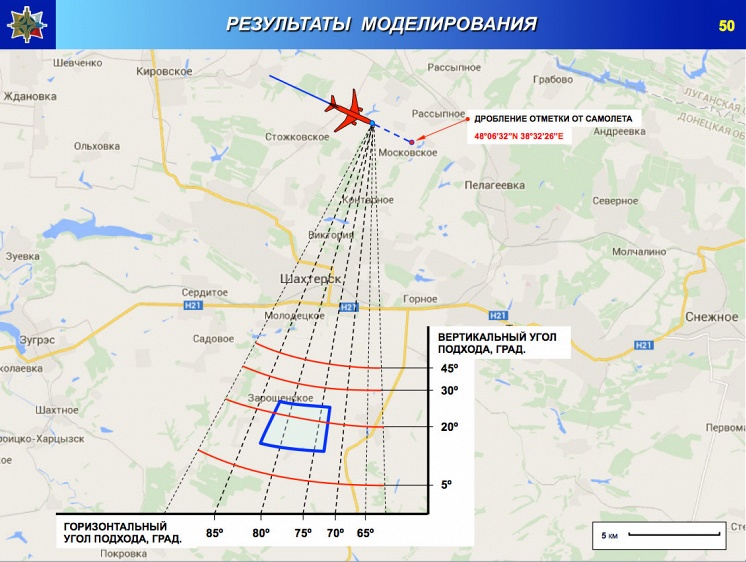
Calculation by the Buk manufacturer, Almaz-Antay, showing what it considered the likely area of the launch that took down Malaysia Airlines Flight 17.
The area is about three miles west of the 320-square-kilometer zone that the Dutch report established as the likely area from which the missile was fired. In July 2014, control of that area was being contested although most of the fighting was occurring about 100 kilometers to the north, meaning that the southern sector was more poorly defined and open to the possibility of a mobile system crossing from one side to the other.
Almaz-Antay CEO Novikov said the company’s calculations placed the missile site in Zakharchenko with “great accuracy,” a possible firing zone that “does not exceed three to four kilometers in length and four kilometers in width.” However, Ukrainian authorities said their calculations placed the firing location farther to the east, deeper into rebel-controlled territory.
Thus, the importance of the U.S. intelligence data that Secretary of State John Kerry claimed to possess just three days after the plane was shot down. Appearing on NBC’s “Meet the Press” on July 20, 2014, Kerry declared, “we picked up the imagery of this launch. We know the trajectory. We know where it came from. We know the timing. And it was exactly at the time that this aircraft disappeared from the radar.”
But the U.S. government has released none of its evidence on the shoot-down. A U.S. intelligence source told me that CIA analysts briefed the Dutch investigators but under conditions of tight secrecy. None of the U.S. information was included in the report and Dutch officials have refused to discuss any U.S. intelligence information on the grounds of national security.
In the weeks after the shoot-down, I was told by another source briefed by U.S. intelligence analysts that they had concluded that a rogue element of the Ukrainian government – tied to one of the oligarchs – was responsible for the attack, while absolving senior Ukrainian leaders including President Petro Poroshenko and Prime Minister Arseniy Yatsenyuk. But I wasn’t able to determine whether this U.S. analysis was a consensus or a dissident opinion.
Last October, Der Spiegel reported that German intelligence, the BND, concluded that the Russian government was not the source of the missile battery – that it had been captured from a Ukrainian military base – but the BND blamed the ethnic Russian rebels for firing it. However, a European source told me that the BND’s analysis was not as conclusive as Der Spiegel had described.
Prior to the MH-17 crash, ethnic Russian rebels in eastern Ukraine were reported to have captured a Buk system after overrunning a government air base, but Ukrainian authorities said the system was not operational, as recounted in the Dutch report. The rebels also denied possessing a functioning Buk system.
Who Has These Buks?
As for whether the 9M38 Buk system is still in the Ukrainian military arsenal, government officials in Kiev claimed to have sold their stockpile of older Buks to Georgia, but Ukraine appears to still possess the 9M38 Buk system, based on photographs of Ukrainian weapons displays. In other words, Ukrainian authorities appear to be lying about this crucial point.
It should be noted, too, that just because Russia no longer deploys the outmoded Buks doesn’t mean that it might not have some mothballed in warehouses that could be pulled out and distributed in a sub rosa fashion, although both the Ukrainian rebels and Russian officials deny this possibility. According to the Ukrainian government, the rebels were only known to have shoulder-fired “manpads” in July 2014 – and that weapon lacked the range to destroy a civilian airliner flying at 33,000 feet.
Yet, rather than delve into this important mystery, The New York Times’ editorial simply repeats the Western “group think” that took shape in the days after the MH-17 tragedy, that somehow the rebels shot down the plane with a Buk missile supplied by Russia. The other possibility that the missile was fired by some element of the Ukrainian security forces was given short-shrift despite the fact that Ukraine had moved some of its Buk batteries into eastern Ukraine presumably to shoot down possible Russian aircraft incursions.
As described in the Dutch report, this Ukrainian concern was quite real in the days before the MH-17 shoot-down. On July 16 – just one day before the tragedy – a Ukrainian SU-25 jet fighter was shot down by what Ukrainian authorities concluded was an air-to-air missile presumably fired by a Russian warplane patrolling the Russia-Ukraine border.
Thus, it would make sense that the Ukrainian air-defense forces would have moved their Buk batteries close to the border and would have been on the lookout for possible Russian intruders entering or leaving Ukrainian air space. So, one possibility is that a poorly organized Ukrainian air-defense force mistook MH-17 for a hostile Russian aircraft high-tailing it back to Russia and fired.
Another theory that I’m told U.S. intelligence analysts examined was the possibility that a rogue Ukrainian element – linked to a fiercely anti-Russian oligarch – may have hoped that President Vladimir Putin’s official plane was in Ukrainian air space en route home from a state visit to South America. Putin’s jet and MH-17 had very similar markings. But Putin used a different route and had already landed in Moscow.

A side-by-side comparison of the Russian presidential jetliner and the Malaysia Airlines plane.
A third possibility, which I’m told at least some U.S. analysts think makes the most sense, was that the attack on MH-17 was a premeditated provocation by a team working for a hard-line oligarch with the goal of getting Russia blamed and heightening Western animosity toward Putin.
Obama’s Secrets
But whatever your preferred scenario – whether you think the Russians or the Ukrainians did it – the solution to the mystery could clearly benefit from President Barack Obama doing what Putin has done: declassify relevant intelligence and defense information.
One might think that the Times’ editors would be at the forefront of demanding transparency from the U.S. government, especially since senior U.S. officials rushed out of the gate in the days after the tragedy to put the blame on the Russians. Yet, since five days after the shoot-down, the Obama administration has refused to update or refine its claims.
Earlier this year, a spokesperson for Director for National Intelligence James Clapper told me that the DNI would not provide additional information out of concern that it might influence the Dutch investigation, a claim that lacked credibility because the Dutch investigation began within a day of the MH-17 crash and the DNI issued a sketchy white paper on the case four days later.
In other words, the initial U.S. rush to judgment already had prejudiced the investigation by indicating which way the United States, a NATO ally of the Netherlands, wanted the inquiry to go: blame the Russians. Later, withholding more refined intelligence data also concealed whatever contrary analyses had evolved within the U.S. intelligence community after Kerry and the DNI had jumped to their hasty conclusions.
Yet, The New York Times took note of none of that, simply piling on the Russians again and hailing a dubious online publication called Bellingcat, which has consistently taken whatever the U.S. propaganda line is on international incidents and has systematically screwed up key facts.
In 2013, Bellingcat’s founder Eliot Higgins got the firing location wrong for the sarin gas attack outside Damascus, Syria. He foisted the blame on Bashar al-Assad’s forces in line with U.S. propaganda but it turned out that the missile’s range was way too short for his analysis to be correct. [See Consortiumnews.com’s “The Collapsing Syria-Sarin Case.”]
Then, earlier this year, Higgins fed Australia’s “60 Minutes” program wrong coordinates for the location of the so-called “Buk-getaway video” in eastern Ukraine. Though the program treated Higgins’s analysis as gospel, the images from the video and from the supposed location clearly didn’t match, leading the program to engage in a journalistic fraud to pretend otherwise. [See Consortiumnews.com’s “A Reckless Stand-upper on MH-17.”]
But the Times’ editorial board simply gushed all over Bellingcat, promoting the Web site as if it’s a credible source, writing that the Dutch report “is consistent with theories advanced by the United States and Ukraine as well as evidence collected by the independent investigative website Bellingcat.com, which hold that the fatal missile was fired from territory controlled by Russian-backed rebels in eastern Ukraine.”
The Times then distorted the findings of the Buk manufacturer to present them as somehow contradicted by the Dutch report, which substantially relied on the declassified information from the manufacturer to reach roughly the same conclusion, that the missile was an older-model Buk.
However, without irony, the Times writes, “This fact is not something Russians are likely to learn; Russian television has presented only the Kremlin’s disinformation of what is going on in Ukraine and, for that matter, Syria. … Creating an alternative reality has been a big reason for President Vladimir Putin’s boundless popularity among Russians. He sees no reason to come clean for the shooting down of the Boeing 777.”
Yet, the actual reality is that Russia has provided much more information and shown much greater transparency than President Obama and the U.S. government have. The Dutch report also ignored one of the key questions asked by Russian authorities in the days after the MH-17 shoot-down: why did Ukraine’s air defense turn on the radar used to guide Buk missiles?
But the Times remains wedded to its propaganda narrative and doesn’t want inconvenient facts to get in the way. Rather than demand that Obama “come clean” about what the U.S. intelligence agencies know about the MH-17 case, the newspaper of record chooses to mislead its readers about the facts.
Investigative reporter Robert Parry broke many of the Iran-Contra stories for The Associated Press and Newsweek in the 1980s. You can buy his latest book, America’s Stolen Narrative, either in print here or as an e-book (from Amazon and barnesandnoble.com).
Why Big Oil Supports a Carbon Tax, NYT Misleads Again
By David Addison | Seeking Alpha | October 14, 2015
… Internationally, many oil and gas majors which need higher energy prices have rallied around the implementation of a carbon tax. Recently, managements of Total, Shell, BP, BG Group, Repsol, Eni, and other state-run firms called for a carbon tax at a climate change conference in Paris.
While a New York Times editorial has suggested that these companies are finally experiencing the global awakening of the collective environmental consciousness, this move is patently self-serving to higher-cost producers who are struggling and will continue to struggle under a lower commodity price regime.
A tax on carbon emissions would incent utilities to shift from coal toward natural gas, thereby providing price uplift to these companies’ products. Also, such a tax would not likely cost the industry anything since regulatory costs would be passed to consumers. However, it would likely require hosts of compliance specialists, placing a disproportionate amount of stress on smaller, more thinly capitalized endeavors. Driving smaller players out of the business with increased regulation would serve two purposes: it allows the larger players to capture market share; and, it would put upward pressure on energy prices as supply would be driven out. … Full article
Radiation and Cancer: Risks of Leukemia in Nuclear Workers More Than Double Previous Estimate
By Ian Fairlie | CounterPunch | October 16, 2015
In 2013, I discussed several epidemiological studies providing good evidence of radiogenic risks at very low exposure levels.
A powerful new study has been published in Lancet Haematology [1] which adds to this evidence. However the study’s findings are more important than the previous studies, for several reasons.
First, it provides “strong evidence”, as stated by the authors, of a “dose-response relationship between cumulative, external, chronic, low-dose, exposures to radiation and leukaemia”.
Second, it finds radiogenic risks of leukemia among nuclear workers to be more than double the risk found in a previous similar study in 2005. The excess relative risk of leukaemia mortality (excluding workers exposed to neutrons) was 4.19 per Gy.
In 2005, a similar study [2] among nuclear workers (also excluding those exposed to neutrons) in 15 countries by several of the same authors found an ERR of 1·93 per Sv. In other words, the new study’s risk estimates are 117% higher than the older study. The clincher is that the new study’s estimated risks are much more precise than before.
Third, it confirms risks even at very low doses (mean = 1·1 mGy per year). Unlike the Japanese bomb survivors’ study, it observes risks at low dose rates rather than extrapolating them from high levels.
Fourth, it finds risks do not depend on dose rate thus contradicting the ICRP’s use of a Dose Rate Effectiveness Factor (DREF) which acts to reduce (by half) the ICRP’s published radiation risks.
Fifth, it finds radiogenic leukemia risks decline linearly with dose, contradicting earlier studies suggesting a lower, linear-quadratic relationship for leukemia. It strengthens the Linear No Threshold (LNT) model of radiogenic risks, as it now applies to leukemias as well as solid cancers.
Sixth, the study finds no evidence of a threshold below which no effects are seen (apart from zero dose).
Seventh, the study uses 90% confidence intervals and one-sided p-values. In the past, 95% intervals and two-sided p-values were often incorrectly used which had made it harder to establish statistical significance.
Explanation for change
In an earlier version of this blog posted on 29th June 2015, I’d written that the increase between the 2005 study and the present study was 50%, ie up from 1.93 to 2.96 per Gy. This was because the study’s ‘Discussion’ section specifically compared these two studies and their risks, stating the older study’s leukemia risk was smaller and less precise.
However a detailed examination of the report reveals the following sentence in the para immediately before the Discussion section:
“We assessed the effect of excluding people who had recorded neutron exposures; we showed a positive association for leukaemia … (ERR per Gy 4·19, 90% CI 1·42-7·80, 453 deaths)…”.
To make sure readers get the point, the risk is greater when neutron exposed workers are excluded. This is important because the 2005 study excluded workers exposed to neutrons. Therefore the correct comparison is between the risks for non-neutron workers, that is between 4.19 and 1.93 per Gy – an increase of 117%, rather than 50%.
I’ve written to the report’s authors about this but have not received any replies yet. I shall keep readers up-to-date on any progress.
Study’s credentials
The study’s credentials are pretty impeccable. It’s a huge study of over 300,000 nuclear workers adding up to over 8 million person years, thus ensuring its findings are statistically significant, ie with very low probability of occurring by chance.
Also, it’s an international study by 13 respected scientists from national health institutes in the US, UK, and France, as follows.
*Centers for Disease Control and Prevention, US
*National Institute for Occupational Safety and Health, US
*Department of Health and Human Services, US
*University of North Carolina, US
*Drexel University School of Public Health, US
*Public Health England, UK
*Institut de Radioprotection et de Sûreté Nucléaire, France
*Center for Research in Environmental Epidemiology, Spain
*UN International Agency for Research on Cancer, France
Funding was provided by many institutions, including US Centers for Disease Control and Prevention, US National Institute for Occupational Safety and Health, US Department of Energy, US Department of Health and Human Services, Japanese Ministry of Health Labour and Welfare, French Institut de Radioprotection et de Sûreté Nucléaire, and the UK’s Public Health England.
My conclusions
This study powerfully contradicts the views of ill-informed and inexperienced journalists (including the UK writer George Monbiot) [3] and self-styled scientists who argue that radiation risks are over-estimated and even that radiation is somehow good for you.
Hormetic effects are neither found nor discussed in this study: such irrelevant effects are regarded by real scientists as beneath their consideration.
The impressive list of contributing scientists and their national institutions here should serve to make radiation risk deniers reconsider their views. This is particularly the case for US risk deniers, in view of the many US agencies and US scientists backing the study.
The study pointedly comments that:
“At present, radiation protection systems are based on a model derived from acute exposures, and assumes that the risk of leukaemia per unit dose progressively diminishes at lower doses and dose rates.”
The study shows this assumption is incorrect. The authors therefore join with WHO and UNSCEAR scientists in their views that DREFs should not be used. The question remains whether the ICRP will accept this powerful evidence and scrap their adherence to using DREFs. I advise readers not to hold their breaths.
As regards the implications of their study, the authors interestingly choose to comment – not on exposures from the nuclear industry – but from medical exposures. They state:
“Occupational and environmental sources of radiation exposure are important; however, the largest contributor to this trend is medical radiation exposure. In 1982, the average yearly dose of ionising radiation from medical exposures was about 0·5 mGy per person in the USA; by 2006, it had increased to 3·0 mGy.
“A similar pattern exists in other high-income countries: use of diagnostic procedures involving radiation in the UK more than doubled over that period and more than tripled in Australia. Because ionising radiation is a carcinogen, its use in medical practice must be balanced against the risks associated with patient exposure.
This is all correct and worrying, especially the revelation that medical radiation doses increased 6-fold in the US and doubled in the UK between 1982 and 2006. The authors add:
“This finding shows the importance of adherence to the basic principles of radiation protection – to optimise protection to reduce exposures as much as reasonably achievable and – in the case of patient exposure – to justify that the exposure does more good than harm.”
The same, of course, applies to exposures from the nuclear industry – the actual subject of their research.
Dr Ian Fairlie is an independent consultant on radioactivity in the environment. He has a degree in radiation biology from Bart’s Hospital in London and his doctoral studies at Imperial College in London and Princeton University in the US concerned the radiological hazards of nuclear fuel reprocessing. Ian was formerly a DEFRA civil servant on radiation risks from nuclear power stations. From 2000 to 2004, he was head of the Secretariat to the UK Government’s CERRIE Committee on internal radiation risks. Since retiring from Government service, he has acted as consultant to the European Parliament, local and regional governments, environmental NGOs, and private individuals.
How “Progressive Media” Go Wrong: The Case of Jeffrey Sterling
By Sam Husseini | October 15, 2015
Just helped organize a news conference with Holly Sterling, the wife of jailed CIA whistleblower Jeffrey Sterling and a number of press freedom advocates and whistleblowers.
Just prior to the news conference this morning, Democracy Now was good enough to have Norman Solomon (my boss) and Holly Sterling on the program.
The problem is how Democracy Now introed — and therefore, framed — the segment: “Sterling is serving a three-and-a-half-year sentence for leaking classified information to New York Times reporter James Risen about a failed U.S. effort to undermine Iran’s nuclear program. Risen later exposed how the risky operation could have actually aided the Iranian nuclear program.”
That is a very benign way to describe what Operation Merlin (the program in question) was about.
There’s real evidence that the intention of the operation was not to forestall Iran’s nuclear weapons capabilities, but rather, the program may have been to give Iran — and Iraq — nuclear weapons information that could then be used as a pretext to attack those countries for having such information.
I had some suspicions along these lines, and had been cautioning people from accepting the keystone kop narrative without definitive evidence, but David Swanson is the person who really moved the ball on this. His piece “In Convicting Jeff Sterling, CIA Revealed More Than It Accused Him of Revealing,” which analyzes a secret cable that was made public in the course of the Sterling trial. Swanson writes: “During the course of Sterling’s trial, the CIA itself made public a bigger story than the one it pinned on Sterling. The CIA revealed, unintentionally no doubt, that just after the nuclear weapons plans had been dropped off for the Iranians, the CIA had proposed to the same asset that he next approach the Iraqi government for the same purpose.”
Swanson wrote back in January: “CIA on Trial in Virginia for Planting Nuke Evidence in Iran,” which states: “The stated motivation for Operation Merlin is patent nonsense that cannot be explained by any level of incompetence or bureaucratic dysfunction or group think.
“Here’s another explanation of both Operation Merlin and of the defensiveness of the prosecution and its witnesses … at the prosecution of Jeffrey Sterling which is thus far failing to prosecute Jeffrey Sterling. This was an effort to plant nuke plans on Iran.” (I featured David and former CIA analyst Ray McGovern — and noted some interesting insights from Marcy Wheeler in “Operation Merlin: Did CIA Seek to “Plant a Nuclear Gun” on Iran and Iraq?“
Featured Video

Liberty Cannot Exist Inside a Panopticon
or go to
Aletho News Archives – Video-Images
From the Archives
Left-leaning despisers of 9/11 Truth movement: Do you really believe in miracles?
David Ray Griffin | Global Research | 06 Jul 2010
An Open Letter to Terry Allen, Noam Chomsky, Alexander Cockburn, David Corn, Chris Hayes, George Monbiot, Matthew Rothschild, and Matt Taibbi.
[1]According to several left-leaning critics of the 9/11 Truth Movement, some of its central claims, especially about the destruction of the World Trade Center, show its members to be scientifically challenged. In the opinion of some of these critics, moreover, claims made by members of this movement are sometimes unscientific in the strongest possible sense, implying an acceptance of magic and miracles. … Full article
Blog Roll
 Aletho News
- White House envoy declares kinetic action against Yemen ‘fruitless’
- Ukraine deployed thousands of microdrones in Iraqi Kurdistan: Tasnim
- Iran calls for emergency UNSC meeting over Trump’s ‘brazen’ bomb talk, Israeli threats
- Iranian sources reveal details of Russia-China Hormuz proposal
- Plan for more US-Israel integration puts our military tech at risk
- Another Round Against Iran Will Break What Is Left of the Gulf
- SVR Report on Ukraine’s Mexican Drug Gang Links Could Pressure Zelensky, Won’t Change US Policy
- British Government Employees Were Fact-Checking the News at the BBC. Nobody Told You.
- Albania on fire: who’s behind the riots?
- Egypt’s Civil Democratic Movement rejects involvement in regional war
- If Americans Knew
- Mysterious bot accounts reportedly spread fake ‘man on the street’ videos for Michigan Senate candidate
- Israeli Defense Minister Katz Says Over 60 Lebanon Villages Have Been Destroyed
- Why Is Israel Running TV Ads in Iowa Ahead of the Midterms?
- Hind Rajab’s Alleged Killer Is in the United States. HRF Demands His Arrest.
- US Officials Face Fresh Pressure After Another American ‘Brutalized’ by Israeli Settlers in West Bank
- Israel-Backed Palestinian Militias Terrorize Displaced Families in Gaza
- FBI subpoenas pro-Palestine activists over Israeli weapons plant disruption
- Fourth winter arrives in wartorn Gaza, too early – Daily Update
- More on how Bari Weiss is using CBS on behalf of Israel
- What the UK Is Doing to Pro-Palestine Novelist Sally Rooney Is an Act of Orwellian Villainy
- No Tricks Zone
- Predictions Made By Renowned Climate Proifessor Over Past Decades Have Been Proven To Be Poor
- New Study Suggests Large Regions Of The Pacific Ocean Have Been Cooling For The Last 80 Years
- Germany’s Green Energy Debacle: High Energy Costs Force Kahla Porzellan to Close After 182 Years!
- New Study: 50 Years Of The Most Aggressive ‘Net Zero’ Policies Can Only Affect The Global Climate By 0.03°C
- US September “Heat” Was No Record…Many Records Set Decades Ago
- Latest European Green Energy Debacle; Portugal’s Largest Flagship Solar Park Insolvent!
- Green Energy Debacle: German Expert Professor Fritz Vahrenholt Warns Of Severe Economic And Social Consequences
- Two More Paleo Reconstructions Affirm Meters-Higher Sea Levels Across Ireland, Brazil 7000-6000 Years Ago
- New Study: Earth And Venus Surface Warmth Largely Explained By Convection And Lapse Rate, Not CO2 Or Radiation
- 2025 Nature Paper Claiming Worsening Global Drought Gets RETRACTED …Heavily Flawed

