Stunning poll results showing Ukrainians’ dissatisfied with government, economy and war
New Cold War | August 26, 2015
The International Republican Institute in the United States has published results of polling of attitudes of Ukrainians on the key issues facing the country. The polling was conducted in the latter two weeks of July 2015 by Rating Group Ukraine on behalf of the IRI.
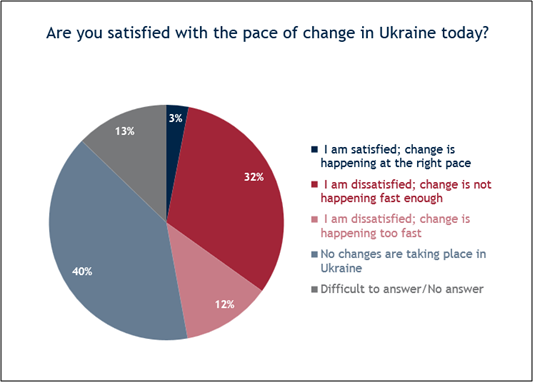
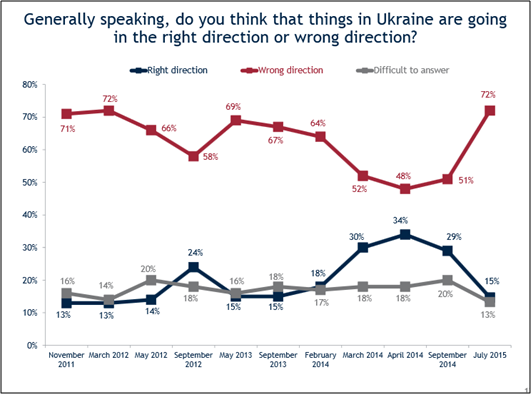 The poll provides more evidence of deepgoing and growing political dissatisfaction and alienation in Ukraine. Absolute or relative majorities of Ukrainians now express unfavorable views of all major government leaders and politicians from major parties in Ukraine.
The people of the rebel region of Donbas are not included in the poll, which means that the levels of dissatisfaction of Ukrainian residents are even higher than what is reported by the IRI.
The poll results are unlikely to be reported in Western mainstream media, even though the poll is commissioned and published by a right-wing U.S. institute. That’s because the results fly in the face of the “news” and editorial opinions peddled by Western media. It proves that media is lying to its readers and grossly misleading them when it inaccurately presents the war in eastern Ukraine as a virtuous war against an aggressive Russia that is supported by the majority of the Ukrainian people.
Media also chooses to be silent about the profound economic crisis that is wracking Ukraine as a result of the Kyiv regime’s turn to austerity association with the European Union, and about the massive human rights violations accompanying the civil war of the Kyiv regime against the people in the eastern and southern regions of the country. The IRI poll shows extremely high levels of dissatisfaction with the economic crisis and the war.
The poll will also be ignored by the Russophobes in the governments and mainstream political parties in the NATO member countries who decry “Russian aggression” and “Russian imperialism” in Ukraine, and by the many pseudo-lefts in the international arena who are acting as echo chambers of that messaging.
Similarly stunning results of polling of the Crimean people in late 2014 and early 2015 were ignored by the same constellation of forces. That polling showed extraordinarily high levels of satisfaction with the democratic decision of Crimeans in March 2014 to secede from Ukraine. The polls contradict the ongoing stories of Russian “annexation” of Crimea.
The 71-page report International Republican Institute polling report can be read here. Enclosed below are 11 selected charts from the poll:




Sexual Identity and American Diplomacy
State Department is hobbled by identity politics
Philip Giraldi • Unz Review • August 25, 2015
The pending normalization of full diplomatic relations with Cuba is long overdue and it is to be hoped that the agreement to limit Iran’s nuclear program will survive a congressional onslaught next month. That is all to the good and the administration of President Barack Obama deserves full credit for persevering in spite of nearly incessant attacks from the Israeli and Cuban lobbies both in congress and the media.
But even as the dust begins to settle the New York Times is reporting on a new existential crisis: same-sex marriages in the Foreign Service explored in an article entitled “State Department Fights for Rights of Gay Envoys.” Not that the Gray Lady is opposed to same-sex marriages for diplomats, quite the contrary. Its concern is that many highly qualified diplomats are turning down assignments because some benighted countries do not recognize same-sex unions and therefore do not accept that a man plus man or woman plus woman relationship actually qualifies as a diplomatic family. Which means that some Foreign Ministries are denying visas or accreditation for same-sex spouses. Worse still, as many countries regard homosexual behavior as a criminal offense, it suggests the possibility that some categories of Embassy and Consular family members not covered by full diplomatic immunity might find themselves arrested.
The Obama Administration is predictably outraged and is reported to be frantically working on the problem with the State Department making “securing the rights of gay, lesbian, bisexual and transgender people around the world a priority” (my emphasis). But to my mind the fundamental problem is not same-sex marriage per se, which most Americans now no longer oppose, but the failure to comprehend what Embassies and Consular posts are supposed to do coupled with a characteristic inability to understand that American principles and rules, such as they are, do not have universal applicability. This is particularly true in the case of gay marriage, which impacts on sincerely held religious views and which is still a bone of contention even in the relatively tolerant United States and Western Europe.
Government at the White House level frequently does not understand how the great federal bureaucracies actually work. Contrary to the Times headline, being part of a diplomatic mission is a privilege, not a universal right, and both by law and convention the host country pretty much sets the rules on who may enter and under what conditions.
The article quotes Michael Guest, a gay former ambassador to Romania, who said “It’s increasingly a problem, as some countries have wanted to take a stand on the issue of marriage equality that isn’t really theirs to take.” He is wrong. The Vienna Convention on diplomatic relations stipulates that any country can expel or refuse to accept the presence of a foreign diplomat without providing any reasons whatsoever. Article 9 includes “The receiving State may at any time and without having to explain its decision, notify the sending State that the head of the mission or any member of the diplomatic staff of the mission is persona non grata or that any other member of the staff of the mission is not acceptable.” This is an option that the United States has exercised frequently in espionage cases as well as more recently in refusing to issue a visa to a proposed Iranian Ambassador to the United Nations in New York, for which the U.S. is the host nation.
The United States has also somewhat more questionably taken steps to restrict the travels of accredited diplomats with whom it is uncomfortable. Soviet era dips from Eastern Europe and Russia were generally required to get approval for traveling more than 25 miles outside of New York City or Washington and there have been similar restrictions on the movement of both Palestinian and Iranian representatives. So the host country is not obligated to accept anyone else’s standards and can in many respects set whatever rules it wishes within its sovereign territory.
Past U.S. determinations of who or what was acceptable were based on what were deemed to be security issues but the same sex marriage problem is something quite different. To be sure there have been homosexuals in government since the time of Pharaoh Khufu, and the United States Department of State has long had considerably more than its share with the once-upon-a-time understanding that it was best to stay in the closet. This was the rule in post-World War 2 America, both for diplomats and intelligence personnel, and it was largely justified by the danger of blackmail or the creation of diplomatic “incidents” as homosexual activity was illegal almost everywhere. When I served in the Rome Embassy in the 1970s one particularly flamboyant political officer who was almost but not quite out of the closet was generally accepted until he was observed regularly cruising at odd hours in the nearby Villa Borghese Park, leading to his being warned to cool his jets lest he come to the attention of the Carabinieri, who at that time staged regular roundups at gay gatherings to target what was then regarded as public indecency.
But one’s sexual preferences were rarely a problem in Italy back then and even less so now as homosexual relations have been legal since 1890. Civil unions that guarantee property rights, pensions or inheritance without regard to gender do not, however, exist in law, which means there are no same-sex marriages. One imagines that same-sex couples who go to diplomatic posts in Italy do so with a wink and a nod from the authorities at the Foreign Ministry, who are not likely to make an issue out of it. But Italian deliberate ambiguity about what constitutes a marriage is not the norm everywhere else. By one estimate 50% of all Foreign Service posts do not recognize or accept same-sex diplomatic or official couples.
The State Department sensibly insists that all of its employees should be free to accept assignments anywhere in the world, but not so sensibly it has appointed a Special Envoy for the Rights of Gay, Bisexual and Transgender people, both politicizing the issue and turning American diplomats into promoters of personal choices that many foreigners consider immoral as well as illegal. And Congress has predictably jumped on the band wagon with 100 Congressmen (99 Democrats and one Republican) calling on State to reciprocate by denying visas for families of diplomats from countries that discriminate against homosexuals.
In tackling the LGBT issue as a global crusade while also making it a major concern for U.S. embassies the White House and Democrats in Congress are not really doing anyone any favors. Overseas diplomatic missions exist to benefit broad American national interests, not to promote specific group agendas or to confront the host country on its laws and customs. Ambassadors traditionally enabled dialogue and established communications channels among nations while the consular services provided a mechanism to help ensure that American travelers and businessmen would be treated fairly by the local authorities. Having an embassy did not mean that Americans should not be subject to local laws, nor did it serve as a blunt instrument to demand that the foreigners be required to accept American values and customs.
But that vision of diplomacy was all before “democracy promotion,” much loved by Democratic presidents enamored of social engineering, for whom LGBT is almost certainly seen as a subset of democracy. And if past experience of government is anything to go by, this Obama initiative will probably morph into a War on Homophobia under President Hillary Clinton complete with a Czar and a substantial budget to pay for lots of first class travel to hotspots like Copenhagen to participate in conferences convened by gay rights activists.
In truth, the democracy cum human rights agenda has undeniably done a great deal of damage to the United States. It is still falsely cited as the one benefit that came out of the invasion of Iraq and is also used to justify the continued presence in Afghanistan. It led to the unfortunate intervention in Libya, fueled the drive to “do something” in Syria, overthrew an elected government in Ukraine and it is also behind much of the criticism of Russia and its president Vladimir Putin. In reality all the frenetic activity to turn the world into Peoria has produced little beyond trillions of dollars of debt, thousands of dead Americans and quite likely millions of dead foreigners.
And the focus on cultural and social issues is frequently a perversion of diplomacy. Some recent Ambassadorial appointees, to include Michael McFaul in Russia and Robert Ford in Syria, were intended to confront the domestic policies of local governments that Washington disapproved of rather than to engage with them in dialogue. Beyond that, America’s roving mischief makers to include the State Department’s Victoria Nuland and various Senators named McCain and Graham showed up regularly in troubled regions to harass the local authorities. To put it mildly, that is not what diplomacy is all about. Diplomacy is a process whereby no one wins everything while no one loses completely producing a result that everyone can live with. It is not about “We are right. Take it or leave it.”
It is indeed acceptable for a national government to urge greater tolerance as President Obama did on his recent trip to Africa but creating a bureaucracy to assert the global primacy of American values to include what constitutes a marriage benefits no one, least of all those being “protected,” as in many countries that would only serve to enable labeling the sexual dissidents as American agents. And the idea of punishing the families of diplomats from countries that see marriage differently is completely absurd as it will produce retaliation, damaging to genuine American interests and potentially threatening the security of U.S. diplomats overseas.
The entire feel good process of instructing others how to live derives from a peculiar American sense that we somehow understand important things better than anyone else and everyone should follow our lead. It is a dangerous conceit as it breeds resentment and inevitably leads to tit-for-tat responses that serve no purpose. The United States is already viewed negatively by a large part of the world. Adding fuel to the fire by complaining about others’ values while promoting marginal causes that inevitably will be controversial is not what most American citizens should expect from their government. Unfortunately it is all too often what we wind up getting.
As Gaza Lies in Ruins, The NY Times Blames the Victims
By Barbara Erickson | TimesWarp | August 24, 2015
Israel’s attacks on Gaza ended a year ago, but the strip remains an expanse of rubble and devastation. Who’s to blame for this outrage? The New York Times has an answer: everyone but Israel.
Jodi Rudoren comes up with this response in a story that aims to whitewash Israel’s brutal treatment of Gaza by blaming the Palestinian victims along with the international community for the lack of rebuilding. It is all summed up in the story’s subhead, “Political Infighting and Lack of Funds Stymie a Reconstruction Mechanism.”
Her article takes pains to present the process as a collaborative project between the Palestinian Authority, Israel and the United Nations, and she is hazy about Israel’s role, describing it as nothing more than “involvement in approving projects and participants.”
Rudoren furthers her efforts in a single paragraph that absolves Israel completely: “[The Palestinian minister of housing], other Palestinian leaders and United Nations representatives all said that Israel had done its part in reasonable time and allowed cement into Gaza. Empty coffers, they said, are the primary problem.”
Times readers, however, never learn the direct quotes or the names of the “leaders” and “representatives” that would help substantiate this claim, nor does Rudoren explain what “Israel’s part” actually refers to here.
In fact, Israel controls everything that goes into Gaza, from people to foodstuffs to building material, and the agreed-on process for rebuilding the strip—the “reconstruction mechanism” referred to in the subhead—is built solely on Israeli demands. (Israel also blocks Gaza traffic by sea and has the full cooperation of the Egyptian government on that border as well.)
Although the United Nations and the Palestinian Authority have roles in the process, Israel determines who gets building materials, what they get and in what amounts. As Harvard-based Gaza expert Sara Roy notes, the two major documents outlining the reconstruction process “read like security plans, carefully laying out Israeli concerns and the ways in which the United Nations will accommodate them.”
Roy adds, “Israel will have to approve all projects and their locations and will be able to veto any part of the process on security grounds.” Moreover, she writes, “No mechanism for accountability or transparency will apply to Israel.”
Without doubt, Palestinian bureaucracy, donor fears of yet another attack on Gaza and other factors come into play in reconstruction efforts, but Rudoren ignores the major element, which is the Israeli blockade.
Her story, in fact, never refers to the eight-year blockade of Gaza and makes only vague mention of Israeli “control” of the enclave. Readers are left without any relevant context.
Rudoren’s article also omits other details that would place Israel’s role in a different light: the fact that by July of this year it had allowed the passage less than 1 percent of the construction materials needed to adequately house Gaza residents or that as of May, a total of 20 schools (kindergarten to college level) completely destroyed by Israel had yet to be repaired.
Readers never learn, for instance, that aid agencies in Gaza were forced to rely on temporary building materials as the Israeli-mandated process kept concrete, cement and steel supplies to a trickle. They also never learn the sequel to this chapter: that Israel stepped in to squelch the effort just as it was gaining momentum.
The project was run by Catholic Relief Services, which began using lumber to build temporary homes for the displaced residents this year, and media reports in February and March stated that 70 had been built and 40 families had moved into the new houses. CRS had plans to construct more than 100 additional wooden homes, but in April the program came to an end when Israel suddenly banned all lumber for housing.
Here we can see how Israel actually operates in the opaque rebuilding process mentioned in Rudoren’s piece. Times readers, however, never learn of this sad narrative nor of many others that would reveal how Israeli actions are destroying the economy and depressing the living conditions in Gaza.
And yet, the Times story would have us believe that Israel has “done its part” in the reconstruction of Gaza, ignoring the obvious: that Israel alone has complete control of its borders with the strip, and if Israel so willed, Gaza residents would have moved out of the rubble long ago.
New York Times is Crimea Tourism News for Dummies
By Phil Butler – New Eastern Outlook – 24.08.2015
A post by the New York Times this week, is a woeful reminder what poor losers Americans can be. Have a read here, and discover how low publisher Arthur Sulzberger’s newspaper has sunk. The latest formed and fashioned feature against Mr. Putin, it is a crummy bit of journalistic license entitled, “Russia’s Pitch to Vacationers: Crimea Is for Patriots.” […]
On August 19th a writer named Neil MacFarquhar skillfully crafted a story about tourism in Crimea. It is a story timed to coincide with the visit of Vladimir Putin, and Dmitry Medvedev to that peninsula on business, and for pleasure. Putin, with a multiplicity of missions there including efforts on behalf of the Russian Geographic Society, draws negative reportage from the NYTs daily. This time MacFarquhar ventures farther astray than most other NYTs writers though, as the author paints a grim, grimy, and gray touristic destination out of this resort area. Here’s a section of his dispatch on Russia tourism to Americans. Speaking of the coastal town of Saky, the writer explains:
“The dreary shoreline with its view of rusted dredging equipment was perhaps less appealing than previous holiday destinations in Turkey and Europe, she said, but patriotism drove her choice this summer.”
So there you have the framing of a horrid picture, one capitalized by a carefully chosen image of two elderly ladies sitting by what appears to be the seashore. Oh but wait, this story is intensely misleading, a lie, for all intents and purposes. If you research the images MacFarquhar uses, or maybe call friends in Crimea like I have, geography and reality will slap you awake from this gifted storyteller’s fairy tale. Right here it’s necessary to profile MacFarquhar for you, as the Moscow based has a habit of being where the action is, or where the New York Times wants it to be. A former United Nations bureau chief, MacFarquhar’s stories intriguingly coincide with upheaval and/or diatribe, against individuals portrayed as “enemies” of America.
An expert on the Middle East, wherever US military forces go around the 40th parallel North, Neil MacFarquhar offers up editorial support. When the US helped unseat Libya’s Col. Muammar el-Qaddafi, the New York Times reporter who spent part of his childhood in Libya was the “go to” man to tell America about the dictator’s violent death, and to help justify it. Over a year before the west alleged Syria’s leader Assad used chemical weapons at Ghouta against his own people, MacFarquhar was reporting for the NYTs on alleged Syrian threats to use such weapons. And if you follow that story from 2012, you’ll find a familiar face of Western hegemony cited too. MacFarquhar and one Victoria Nuland (of Ukraine infamy) do tend to occupy the same pages of the grand old New York Times fairly frequently. The fact is, anytime one of America’s “enemies” is in the crosshairs, MacFarquhar is there, start to finish, telling of the evil deeds, and then of the justifiable demise of tyrants. He helped paint the terror portrait of Iraq’s Saddam Hussein, and then wrote the man’s epitaph too. MacFarquhar profiled Osama Bin Laden on September 26th, 2001 right after the 9/11 attacks, and then profiled his possible successors for us.
I’m hesitant to go on here, for fear a good leader in Russia may be doomed just on account of being in the reports of this specter of the New York Times. Instead, maybe it’s better to announce the impending doom of Crimea tourism. Alas there is hope though, for my contacts on the ground there tell me business is booming! Let’s just hope the US State Department has not come up with some touristic alert to ruin Summer by the sea for Russians. If you’ll excuse the sarcasm briefly, MacFarquhar’s uncanny tendency of being surrounded with death and chaos is spooky indeed. Just how such a gifted writer came to discussing beach blanket bingo on the Black Sea, it baffles me actually. Instead, let’s move on to a bullshit finale to a story propped up by incorrect imagery, geography, and statistics.
The two images MacFarquhar uses to show us a pitiful Crimea touristic drought are all wrong. The two old ladies alone by the seaside, they are not actually on the sea. The ladies you see sitting, looking out across the water, they’re sitting the Sevastopol harbor, not exactly beach bunny Mecca, if you know what I mean. Rather than show New York Times readers the real beach of Saky, where his story is supposedly situated, it’s more appropriate somehow to show lonely old ladies marooned on one of the most industrialized harbors on the Black Sea. The misdirect is brilliant, if you want to paint Crimea as deserted of tourists, that is.
Skillfully, the veteran wordsmith draws the reader in. Illuminating “rusted” dredging equipment along the salt lake at Saky, MacFarquhar takes strategic advantage of a readership that has never laid eyes on the Black Sea, let alone mineral salt baths in Crimea. Being an expert on the Middle East, MacFarguhar has no doubt seen dredges on the Dead Sea, or along other ancient shorelines where therapy is sought? Maybe he’s unaware of the high concentrations of salt along these Crimean lakes’ shores, and of the effects of high saline concentrations on ferrous metals? No matter, the author’s second photo from clear across the peninsula, it shows an overweight sun bather choosing from empty beach chairs, his spot along a beach in Livadia, Crimea. Abandoned beach chairs in Livadia? “This cannot be right,” I thought.
 Unfortunately for the New York Times, many of the resorts in Crimea have live webcams. Maybe MacFarquhar is unaware of Russians’ affinity for real-time, but facts are facts. The stream you will find at the therapeutic spa Poltava Crimea in Saky, it reveals normal tourist activity on the beach there. The screenshot provided is from 11:34 and 54 seconds, on the main beach at the resort town. Comparing this photo, with the resort’s promotional photos of their beach, anyone can determine for themselves the health spa is running true to form. Furthermore, my friend and colleague, Graham Phillips is in Yalta at this very moment, broadcasting live the buzzing resort MacFarguhar tells his American audience is dead as a door nail. I called Graham to help me illuminate the seeming darkness surrounding this Summer in Yalta and Crimea. For those who do not know, Graham is fairly famous for his reportage refuting incorrect Western news on the Ukraine conflict. Our chat today proved no less interesting for me, and for readers of the New York Times too. As it happens, Graham just filmed a video at the end of this link shot this week in Yalta. Not only does the footage refute the aforementioned Times story, but it also shows Graham meeting up with at least one tourist from Kiev. If we relied on the NYT and other mainstream media for our understanding of this region, then we’d surely believe Ukrainians are ALL dead set on killing Russians, rather than vacationing with them. But don’t take my word for any of this, follow the links and do your own 5 minute “truth” research. For more Crimea spa experience, this other Saky therapy resort called Sanatorium “Yurmino” posts almost daily photos of guests living it up in the mud baths via their VK profile.
In conclusion, the reader here should formulate his or her own opinion of what ANY truth about Crimea, Ukraine, or Russia is, from ALL the sources of information available. While American news and other media is dominated by entities like The New York Times, there are always good alternatives. Mr. MacFarquhar, and noteworthy journalists like him, they’ve been relied upon too much in my estimation. As anyone knows, ideas and methods in any profession are influenced heavily by resource and the prevalent mind set. That said, any skilled reporter can paint whatever picture is desired. Manipulating imagery, inserting well crafted words and inflection, and a Miami Beach bikini contest can become a cellulite extravaganza not worth attending. This is where we are in the world of so-called “news” – caught in between fact and a fabricated agenda. And believe you me, the New York Times’ is the tippy top pinnacle, of a fashioned corporate agenda against Mother Russia and her people.
Western complicity in Yemen genocide met with media silence
By Finian Cunningham | RT | August 24, 2015
In the latest atrocity in Yemen, Saudi warplanes bombed a residential area, killing at least 65 people. Most of the victims are reported to be civilians from the Salah district of Taiz, Yemen’s third largest city.
The apparent war crime committed has tragically become an almost daily occurrence during five months of relentless aerial bombardment of Yemen by a Western-backed coalition of foreign powers.
In recent days, there were similar air strikes on civilian centers in the Red Sea port city of Hodeida and the northern province of Saada. In the Hodeida strike, which killed several dock workers, the British charity Save the Children said it believed the attack was a deliberate bid by the Saudis to sabotage aid supplies to the civilian population.
Surely, this should be front page news, with CNN, the BBC and France 24, among other big Western media outlets, splashing it as their top story. The onus is on them because their governments are implicated in grave crimes. However, there has been no news coverage of the tragic events. Aside from some brief, vague reports of a generalized humanitarian crisis, there has been a wall of silence as to how the Western-backed Saudi-led coalition is pulverizing Yemeni civilians and creating the crisis. That suggests a deliberate blackout by Western media.
To date, the death toll in the country has reached near 4,500, according to the World Health Organization. This week, the United Nations put the total number of children who have been killed at 400. Yemeni sources say the civilian casualties are much higher, but can’t verify because of the widespread mayhem.
Meanwhile, the International Committee of the Red Cross (ICRC) and the World Food Program say the country is on the brink of cataclysmic famine, with over 50 percent of the 24 million population at immediate risk.
Yemen was already the Arab region’s poorest country even before the US-backed and Saudi-led military coalition began bombing on March 26. In just five months, the country is crumbling into a “Syria-level crisis,” according to the ICRC.
What’s happening in Yemen cannot be described as anything less than “foreign aggression” on a sovereign country, where civilians are being slaughtered by American-supplied “precision bombs” and F-16 fighter jets. The systematic starvation of people by denying them food, water and medical aid as a result of an air and sea blockade on the country adds to the barbarity. This is genocide by any legal definition of the word.
Despite the horror and complicity of Western governments in that horror, the Western news media avoid providing informative reports on the carnage in Yemen. When the media do give occasional brief reports, they routinely distort the nature of the violence as if it is being perpetrated by two warring sides: on the one hand, “Saudi coalition forces”; and on the other, “Iranian-backed Houthi rebels”.
Let’s quickly dispense with that self-serving distortion. The Houthi rebels are not Iranian-backed. How could they be when Yemen is blockaded by Saudi and American forces? The Houthis are in alliance with the Yemeni national army and other rebel groups, called Popular Committees. Earlier this year, the revolutionary front kicked out the US and Saudi-backed puppet-president Abded Rabbo Mansour Hadi, taking over much of the country’s territory, including the capital Sana’a.
That is why the Saudis and their Persian Gulf Arab dictator cronies, plus the Egyptian dictatorship of Abdel Fattah el-Sisi, joined forces to bomb Yemen. They claim to be defending the “legitimate government of Yemen” represented by Hadi and his corrupt clique who are exiled in the Saudi capital Riyadh. No doubt the region’s dictatorships fear the spread of revolutionary contagion, as do the Western patrons of these despotic regimes.
Washington, along with Britain and France, is supporting the Saudi-led bombing coalition, not just politically and diplomatically, but with the supply of warplanes, missiles and logistics. The US has set up a fusion center in Saudi Arabia for the purpose of coordinating the Arab-piloted F-16s.
Germany is also implicated as, according to Der Spiegel, it is the fourth biggest arms supplier to Saudi Arabia, after France, Britain and Italy.
On the ground in Yemen, there are remnant supporters of the deposed Hadi regime. Clashes between these loyalists and the revolutionary forces have indeed contributed to the civilian death toll. But, again, Western media attempts at portraying the conflict as some kind of civil war are grossly misleading.
Among the pro-Hadi forces are troops from Saudi Arabia and the United Arab Emirates. Several Saudi and Emirati soldiers have been confirmed killed in recent battles in the southern areas around the port city of Aden, as well as in fire fights across Yemen’s northern border with Saudi Arabia. The Saudi-led coalition has expanded its involvement in the ground war over the past month with the arrival of artillery and armored vehicles and up to 3,000 Saudi and UAE troops, according to the Financial Times.
Also among the pro-Hadi forces are Jihadist mercenaries from across the region that have been trafficked into Yemen by the Saudis, according to Yemeni civilian and military sources. This is the same strategy that the Saudis and the Persian Gulf Arab regimes have been using in Syria over the past four years to overthrow the Assad government, along with covert support from Turkey, Jordan, Israel and Western governments.
Western media have, of course, given copious coverage of the Syrian war, with false narratives about “moderate rebels” fighting against a “despotic regime”. Syria gets covered because Washington, London and Paris want to implement regime change there for strategic reasons to do with undermining Assad’s allies in Russia and Iran. Whereas in Yemen “regime re-installation” of a corrupt exiled clique doesn’t quite have the same story appeal. Therefore, the Western media just ignore Yemen.
The jihadists fighting in Yemen are linked to the Sunni extremists of Al-Qaeda and the Islamic State network, specializing in suicide bomb attacks on mosques frequented by the Shia Houthis.
Washington and its Western allies are thus heavily involved in an illegal war of aggression against Yemen, prosecuted by Saudi Arabia and other Arab dictatorships working in collusion with Islamist terror networks. Adding “efficacy” to this state-sponsored terrorism is the humanitarian siege imposed on the population.
What is happening in Yemen is truly a heinous crime against humanity committed by Western governments. It is an unspeakable crime. And that is why the Western media will not dare talk about it. The Western media are obliged to ignore, obfuscate and distort the shocking truth of what their governments are committing in Yemen.
This makes the Western media just as complicit in the appalling criminality.
Misleading AP tales can’t damage ‘Teflon Iran’
By Sharmine Narwani | RT | August 22, 2015
When a US media outlet broke a misleading story on the Iran nuclear file this week, many in the West found themselves rushing to defend the Iranian position. Only a few months ago, they would have been the ones to leak, seed and spread the disinformation.
The Associated Press (AP) on Wednesday published an “exclusive,” claiming to have seen a draft of a hotly debated ‘confidential agreement’ between Iran and the International Atomic Energy Agency (IAEA), the monitoring organization that safeguards the peaceful nature of member-states’ nuclear programs.
AP’s “unsigned draft” heavily suggests that Iran will, in effect, be investigating its own controversial military facility – Parchin – on behalf of the IAEA.
This made the deal’s critics howl with outrage. US politicians and pundits opposing the Vienna agreement between the UN Security Council P5+1 and Iran, quickly hit the media circuit – with AP’s sketchy details – to cement their case against the historic nuclear deal.
But then what followed was quite instructive on The New Order Of Things.
US administration officials, the director general of the IAEA, former IAEA officials and a whole host of American media outlets stepped in to make the counter-argument. On behalf of the Iranians, mind you.
Not much was heard from the Islamic Republic itself.
Before the Joint Comprehensive Plan of Action (JCPOA) was concluded on July 14, Iran stood alone in what amounted to a global ‘public diplomacy’ onslaught against its peaceful nuclear program. No matter what information, data points, sampling or intrusive inspections Tehran offered up since 2002, it was always one more ‘question mark’ behind its accusers.
I recall a frustrated letter penned by Iran’s permanent representative to the IAEA, Ali Asghar Soltanieh, to the Agency’s board of governors on June 17, 2009, in which he argued:
“After six years of the most robust and intrusive inspection in the history of the Agency, and in spite of the continuous declaration of the Director General (of the IAEA) in over 20 reports to the Board of Governors, that there is no evidence of diversion of nuclear materials and activities to prohibited purposes (i.e., weaponization), the issue is still on the agenda. The simple question is: Why?”
He goes on to allege that the issue of Iran’s nuclear program remains on the table because of the political motivations of a few nations, who would like to turn the Agency into a “watchdog, with maximum intrusiveness in safeguards in order to interfere in the national security… of member states, under the pretext of proliferation.” Read his September 4 letter which outlines Iran’s grievances in detail.
Laptops, dossiers, dodgy foreign scientists, secret nuclear sites… the whole gamut of Hollywood-inspired smoking guns were tossed Iran’s way – usually seeded by the Israelis, Americans, Brits or the Mujaheddin-e Khalq (MEK), a formerly US-designated terrorist group now happily embraced by Congress.
The problem with much of this manufactured evidence on Iran’s nuclear program was that the IAEA would use it as a pretext for more questions – often without allowing the Iranians to review the material in order to “protect” their sources. How could the Iranians respond to something they couldn’t examine?
All this changed when the JCPOA was agreed upon in Vienna in July. But the Americans have spent over a decade creating a cottage industry of flimsy evidence focused on Iranian “nuclear bombs” and “terrorism,” and Washington is now facing the monster it spawned.
An Iranian official explained this to me in Vienna, before the deal: “These are not real issues. This is more a matter of the US trying to prove the credibility of past issues. It was wrong, they know they were wrong, but they have a need to stick to the script.”
Twelve years of American credibility on the Iran ‘story’ is on the line, after all.
Some Facts about the IAEA and Parchin
On the issue of inspections at Parchin – this is a military facility that allegedly, pre-2003, dabbled in something the Americans ‘find suspect.’ In 2005, on two separate occasions, the Islamic Republic “voluntarily provided access” to the IAEA to inspect the site.
Since then, Western sources allege that Parchin has been “swept” and remodeled. So, either way, there is nothing anybody is going to find there 10 years later. Access to the site for a final inspection is more an exercise for Washington to tick a box for public consumption.
Nevertheless, the IAEA is a technically professional agency that has politically served western P5 (US, UK, France) interests for much of the past decade, and so it isn’t going to do this job haphazardly.
The IAEA says it has “hundreds” of confidential agreements with member-states. They manage access to non-standard sites all the time – the difference is only in how the access is customized to suit the needs of both parties. The Agency’s head Yukiya Amano, says:
“I can state that the arrangements (with Iran) are technically sound and consistent with our long-established practices. They do not compromise our safeguards standards in any way. The Road-map between Iran and the IAEA is a very robust agreement, with strict timelines, which will help us to clarify past and present outstanding issues regarding Iran’s nuclear programme.”
Whatever the process, the IAEA will obtain Parchin environmental samples whose origins and sanctity are unimpeachable. IAEA Inspectors could oversee the sampling, GPS-tracking devices could be strapped onto local inspectors – who knows? The Agency is bound by confidentiality to its agreements with members. Those are the rules.
Where’s the media interest in IAEA safeguards outside of the Iran inspections regime? The Agency has, over the years, amassed considerable tools and networks to ensure the quality of its results. These include a sprawling inventory of 45,000 pieces of equipment of 140 different varieties, 20 qualified laboratories worldwide, access to satellite data to supplement physical analysis, and 850 staff members from 95 different countries. Furthermore, the Agency has 182 safeguard agreements in force with member-states, has conducted more than 2,700 inspections, generated 3,000 safeguards statements and reports, and currently has more than 193,500 ‘significant quantities’ of nuclear materials under safeguard.
So the AP story claiming ‘self-inspection’ has already been challenged by experts galore this week – by former IAEA officials and inspectors here and here, and by Amano himself, who expressed dismay at the “misleading” information circulating about the Parchin inspection in a rare public statement on this issue.
The IAEA safeguards practices continue to evolve, both according to the challenges they confront and to improve efficiencies. A member of an IAEA team assembled to test the viability of off-site environmental sampling told me recently that they had conducted an exercise in a Mideast state to take samples from outside the perimeter of a target facility. Perhaps some of those lessons will have already been applied to the Parchin inspection protocol – but likely only if the process was found to meet IAEA standards.
More facts, less spin
Hot button issues like Parchin and other ‘possible military dimensions’ (PMDs) of Iran’s nuclear program will not go away anytime soon. But the debate has changed already with the entrance of atypical ‘deal defenders’ – a crop of elite, Western establishment politicians, journalists and analysts – who are pitching the arguments that Iran has previously been unable to make heard.
JCPOA opponents are short of material to fling at deal defenders these days. The Vienna agreement is basically a fair one (if implemented according to its stated intent) that has been scrutinized ad infinitum by six world powers and the Islamic Republic of Iran, after all.
So silly minutiae, non-issues that play well to the suggestible masses, grabs the headlines instead. Take another issue that has had some airtime on social media and in the US press recently: Three weeks ago, another AP report headlined that Iran will not allow US (and Canadian) IAEA inspectors to visit its nuclear facilities. Newsweek magazine said, for JCPOA opponents, this step “will only compound doubts over whether the IAEA will be able to oversee the terms of the deal.”
But Iran’s Deputy Foreign Minister Abbas Araghchi insisted the Vienna agreement mentions that inspectors “should be from countries that have diplomatic relations with the Islamic Republic of Iran.”
And an IAEA spokesperson provided further context by referencing an August 28, 1961 memorandum by the Agency’s director general on “inspectors,” which states:
“The (member) State shall inform the Director General, within 30 days of receipt of such a proposal, whether it accepts the designation of that inspector… If a State, either upon proposal of a designation or at any time after a designation has been made, objects to the designation of an Agency inspector for that State, it shall inform the Director General of its objection. In this event, the Director General shall propose to the State an alternative designation or designations.”
This is standard procedure for member states of the IAEA – nothing suspect or unusual here. It is common sense that a nation will not allow nationals from adversarial or hostile states to inspect its national security-related or prized technological sites.
It is highly unlikely that Iran will veer from the letter and intent of the JCPOA now or in the foreseeable future. The Islamic Republic has been subject to the most intrusive inspections in the history of the IAEA and has taken tremendous hits from an international sanctions regime that sought to strangle Iran’s economic and political systems – all in service of cleaving to its “inalienable right” to pursue an indigenous civilian nuclear program.
In Iran’s view, “international law” serves the country best – and Tehran’s public and private fights are mostly about foreign actions that circumvent the rule of law as applied to relations between states – via illegal or unjust sanctions, sabotage, propaganda, blackmail, assassination, etc.
The JCPOA helps Iran plod along its desired nuclear and economic trajectory with legally-binding ‘safeguards’ against the external trickery and ploys it has been subjected to in the past. Providing, of course, those same Western parties don’t exploit loopholes and revert back to their old tricks, as Iranian conservatives constantly warn.
In its past nuclear-file battles, Tehran usually lacked two key weapons: the ability to fight back against evidence it was not allowed to see, and the ability to communicate its messages to a global audience.
In one fell swoop, the Vienna agreement provided both tools. Buried in the details of the JCPOA is one line regarding any concerns the IAEA has about undeclared nuclear materials, activities or locations: “The IAEA will provide Iran the basis for such concerns and request clarification.”
An Iranian negotiator privately told me in Vienna that the deal must provide Tehran with direct access to any evidence suggesting inconsistency in its nuclear activities. Iran has been denied this in the past. With evidence to touch and feel, it will be much easier for Iran to refute or disprove allegations against it.
Post-deal – and as long as US administration calculations remain pro-deal – Iran’s opponents no longer have an unfettered ability to use the UNSC P5 and IAEA to float unsubstantiated charges against Tehran. This is why we can expect the charges to now come hard and fast through media channels and “leaks.”
And that brings us to Iran’s second “gain” in the aftermath of the Vienna agreement. Having bought into and become fully vested in the JCPOA, the six powerful members of the P5+1 will act, in a sense, as a communications channel for the Iranians, whose ‘facts’ have long been ignored in the media. It is currently in the interest of the P5+1 to make this deal ‘stick’ – and so Iran has experienced enormous relief in its counter-messaging activities related to its nuclear file.
The Islamic Republic just became ‘Teflon Iran.” And Western punditry and establishment figures seeking to spoil the JCPOA environment can now expect a lot more mutiny from within.
Until the Western political pendulum swings back the other way.
Sharmine Narwani is a former senior associate at St. Antony’s College, Oxford University and has a master’s degree in International Relations from Columbia University.
Florida Man Arrested in FBI/ISIS-Inspired Plot to Bomb a Beach
By Peter Van Buren | We Meant Well | August 21, 2015
 So you be the judge: which organization, the FBI or ISIS, had more to do with this supposed “threat” to the “Homeland”?
The FBI has arrested a man who allegedly wanted to detonate a bomb in what authorities describe as an ISIS-inspired terror attack, officials said.
Harlem Suarez, 23, of Key West, Florida, (pictured, and do note the Batman T-shirt) has been charged with attempting to use a weapon of mass destruction in the United States.
So Terrorist Suarez first came onto the FBI’s radar in April, after he posted whatever “extremist rhetoric” and pro-ISIS messages are on Facebook, according to the Justice Department. Facebook, yep, everything people post on Facebook is serious sh*t, man, no boasting or false bravado online, ever. Everybody always means exactly what they say.
Anyway, after creeping Suarez on Facebook, the FBI then sent in an FBI-employed “confidential source” who for months allegedly talked with Suarez online and in person about plans to attack the United States. Not that any of that would have encouraged or emboldened someone whose previous plans would have otherwise never left his bedroom.
In May, according to the FBI, Suarez recorded his own video, declaring: “We will destroy America and divide it into two. We will raise our black flag on top of your White House and any president on duty.”
Nice touch– “any president on duty.” Man, Suarez was obviously well-informed.
The FBI said that in subsequent meetings with the FBI informant, Suarez discussed plans for an attack around the July 4 holiday and said he would “cook American in cages” — an apparent reference to the ISIS video of a captured Jordanian pilot being burned alive while in a cage.
Last week, Suarez allegedly gave the informant two boxes of nails, a cell phone, a backpack and $100 to build a bomb. In the most recent discussions, Suarez talked about bombing a public beach in Key West and placing explosive devices under police cars, according to charging documents filed by the FBI.
Note that without some actual explosive material and the knowledge to build a bomb without first blowing yourself up (yeah, yeah, it’s all online, but so is a lot of stuff. Reading stuff online and actually safely handling explosives and ensuring they work remotely is a whole ‘nother story.)
And seriously, a backpack bomb, is that really a weapon of mass destruction?
Also note that at no point was anyone in America in danger in any way whatsoever.
“There is no room for failure when it comes to investigating the potential use of a weapon of mass destruction,” said Special Agent in Charge George Piro, head of the FBI’s Miami Field Office.
Let’s Bomb Libya Again!
By Brian CLOUGHLEY – Strategic Culture Foundation – 15.08.2015
The British prime minister, David Cameron, places great emphasis on how he is regarded by the public at home and internationally. His personal promotion machine is extensive and highly-paid and his staff feed the media diligently with what they imagine to be positive slants on his character and actions (and with carefully selected photographs of his pretty wife). They provide advance copies of his speeches to favoured journalists with the annoying consequence that news broadcasts rarely report what the prime minister has just said on a topic. They are futuristic and use the infuriating phrase “the prime minister will say today that” he will propose something or other.
The reason for this is that if there should be adverse reaction to whatever sparkling new initiative he wants to put forward to the public, then the spin-doctors can make hasty amendments in order to avoid upsetting people. It is school playground stuff, but then a great deal of British politics is playground oriented.
Unfortunately for his image, Cameron sometimes says things without first putting a finger in the water to test the temperature, and he also says things that betray his appalling ignorance of life.
One of the unrehearsed things he said that he may well regret in future concerns his unscripted policy on bombing people. It was reported on 27 July that he said “he was ready to order air strikes on Islamist militant targets in Libya and Syria to prevent attacks on the streets of Britain as he stepped up his rhetoric against Islamic State insurgents.” From this it is clear the British prime minister wants his country to go to war again and bomb Libya as it did last time he ordered air strikes on that ill-fated country.
It was Cameron who was responsible for Britain’s enthusiastic participation in the 2011 aerial bombing and rocketing that destroyed Libya. In March 2011 he declared that “Tough action is needed to ensure that people in Libya can lead their lives without fear and with access to the basic needs of life. That is what the Security Council requires, that is what we are seeking to deliver.” And he and his fellow thugs delivered catastrophe.
When the US-NATO onslaught ceased, after the murder of Libya’s president, we were told that the war had been successful in achieving democracy by bombing. It might be summed up in the sniggering proclamation of Ms Hillary Clinton, on CBS on 20 October 2011 that so far as the killing of Gaddafi was concerned “We came, we saw, he died.” What a truly civilised statement from the likely next president of the United States.
Two weeks before Ms Clinton’s humorous observation Mr Cameron said “I’m an optimist about Libya; I’ve been an optimist all the way through and I’m optimistic about the National Transitional Council and what they are able to achieve. I think when you look at Tripoli today, yes, of course, there are huge challenges — getting water to that city, making sure there is law and order — but actually so far, the cynics and the armchair generals have been proved wrong.”
The “cynics and armchair generals” — who might be better described as experienced realists — were right in predicting that the country’s collapse was inevitable; just as they had been right about forecasting chaos in Iraq and Afghanistan. On the other hand, two highly placed intellectuals, Ivo Daalder, who was the US Permanent Representative on the NATO Council during the US-NATO war, and Admiral James G (“Zorba”) Stavridis, who was at that time US Supreme Allied Commander Europe (the military commander of NATO), agreed wholeheartedly with Cameron and wrote in 2012 in the journal Foreign Affairs that:
“NATO’s operation in Libya has rightly been hailed as a model intervention. The alliance responded rapidly to a deteriorating situation that threatened hundreds of thousands of civilians rebelling against an oppressive regime. It succeeded in protecting those civilians and, ultimately, in providing the time and space necessary for local forces to overthrow Muammar al-Gaddafi.”
According to these expert analysts, Libya was liberated and became a free country thanks to US-NATO. And they were supported by columnists like Nicholas Kristof of the New York Times who wrote that “Libya is a reminder that sometimes it is possible to use military tools to advance humanitarian causes.” What a bunch of buffoons. Their statements would be hilarious were they not so obscenely bizarre, because Libya has collapsed into anarchic ruin — as forecast by the “armchair generals” so despised by Cameron and all the others who have never heard a shot fired in anger.
In April 2015 the saintly International Red Cross observed that “The violence shows no sign of abating. Libya remains a patchwork of conflict, fuelled by a plethora of armed groups with varying allegiances and diverse agendas. Thousands have been killed; hundreds of thousands more have been displaced. The humanitarian situation continues to deteriorate.”
The unelected rabble that is supposed to be a government in Libya has its very own set of Guantanamo Bays in which Human Rights Watch reported that “the Libyan Army and the Interior Ministry’s Counter Terrorism Unit are holding about 450 “security detainees” in connection with the current conflict. Of those visited, 35 detainees told Human Rights Watch that they were tortured on arrest, under interrogation, or during their detention. Thirty-one said interrogators forced them to “confess” to crimes; four said that the authorities then broadcast their “confessions” on TV, leading to reprisal attacks on their families. All of the detainees Human Rights Watch interviewed said they had not been given access to lawyers, taken before a judge, or formally charged despite many months of detention.” From what freedom-loving democracy could the Libyans have learned to keep people in detention indefinitely without trial?
There have been no comments on the anarchic shambles in Libya by such as Nicholas Kristoff who rejoiced in 2011 that he had “Just arrived in Tripoli, Libya, after a wild ride from the Tunisian border. But Tripoli is festive, joyful and reasonably secure, its streets full of shoppers and honking cars, celebrating the end of Ramadan and the end of dictatorship. People are hugely welcoming to an American, and very grateful.”
When Gaddafi ruled Libya its citizens had ample water from many sources, not least being his “Great Man-Made River” which brought water from southern aquifers to the dense population of the coastal north. But the US-NATO blitz damaged or destroyed so many power stations and pipeline facilities that this supply has all but ceased.
Amnesty International reports savage religious persecution (unknown in Gaddafi’s time) and records that “the international community has stood and watched as Libya has descended into chaos since the 2011 NATO military campaign ended, effectively allowing militias and armed groups to run amok.” The Christian organisation Open Doors records that “Since the downfall of Gaddafi, the situation for Christians in Libya has deteriorated. The government claims all Libyans are Sunni Muslims; it is illegal to bring Arabic Bibles into the country or to evangelise.”
So much for David Cameron’s idiotic statement that “I’ve been an optimist all the way through” about Libya. This is the man who declared in 2011 that his bombing would ensure that Libyan citizens would have “access to the basic needs of life.”
During their war on Libya, Obama and Cameron jointly declared that “We are convinced that better times lie ahead for the people of Libya.” Tell that to the millions of Libyans whose lives have been wrecked by NATO’s “model intervention” as it’s described by the two imbeciles, Daalder and Stavridis, who did so much to destroy a nation.
Yet David Cameron imagines that more bombing will solve all the problems, and on 26 July the UK’s Daily Telegraph, whose editors and journalists are in the pockets of Cameron’s spin-doctors, was happy to disclose that “Mr Cameron has ordered officials to begin planning for a new intervention in Libya, which has become a haven for Isil jihadists.” Cameron “was asked if there was a case for strikes on Isil in Libya, where the gunman who massacred Britons in Tunisia was trained,” and replied “That is my job, my duty as Prime Minister if there is a specific threat and you can act to stop it, you should act to stop it wherever it is and you are allowed under international law to do exactly that. I think that is very important.”
The reason Libya has become a haven for fanatical loonies is because it was struck mercilessly in a seven month aerial blitz that destroyed its government and social infrastructure. And the solution, according to those who attacked it in 2011, is to bomb, bomb and bomb again.
We live in a world of madness.
The Douma Market Attack: a Fabricated Pretext for Intervention?
By Eric Draitser | CounterPunch | August 21, 2015
The August 16, 2015 attack on a market in the Syrian town of Douma, just outside the capital Damascus, has caused international outrage. Condemnations of the Syrian government have poured in from seemingly all corners of the globe as President Assad and the Syrian military have been declared responsible for the attack, convicted in the court of media opinion. Interestingly, such declarations have come well before any investigation has been conducted, and without any tangible evidence other than the assertions of the rebel spokespersons and anti-government sources. Indeed, there has been an embarrassing dearth of investigative questions asked as corporate media, who have been far from objective these last four and half years, have rushed to fit the facts to their long-standing narrative of “Assad the Butcher.”
This author fully understands that, in asking difficult questions, he will be called an “apologist,” an “Assad propagandist,” or some other such nonsense. Frankly, such name-calling means very little when compared to the suffering of Syrian people, and the untold brutality that will be visited upon them if the western corporate media and warmongers get their way and yet another imperialist so-called intervention is carried out in the name of “humanitarianism.” The goal is to ask the right questions, to cast doubt on the already solidifying propaganda narrative that will undoubtedly be used to justify still more war.
Those who work for peace must be prepared to interrogate the received truths of the media machine, to confront head on that which is uncomfortable, and to do so knowing that their motives are just. The victims of this war, both past and future, deserve nothing less.
Questioning the Douma Narrative
When carefully scrutinizing the documentary evidence of the attack, and comparing that to the claims made throughout western media, some troubling irregularities emerge. Not only do the claims seem to be exaggerated, but when placed within the historical context of this war, they seem to fit into a clear pattern of distortion and misinformation disseminated for political purposes, rather than objective reportage. Indeed, the raw footage taken on the scene goes a long way to contradicting some of the claims made by witnesses and “activists” (an interesting term in itself) often quoted in the media.
First, there is the allegation that more than 100 civilians were killed in an airstrike carried out by the Syrian military. There are certainly plenty of pictures that seem to bolster that claim, with debris scattered everywhere, aid workers carrying victims, and frightened civilians rushing around the destroyed marketplace. However, when one looks at the videos, even those provided by outlets such as The Guardian in the above linked article, one curious thing seems to be missing: bodies.
Indeed, it does seem odd that an airstrike could obliterate a crowded market on a Sunday, killing over a hundred people, and no videos or images would show bodies torn apart by the blast? One would expect to see mangled corpses, limbs scattered on the ground, pools of blood, etc. None of that seems visible.
Compare the Douma videos to those from Gaza on July 30, 2014 during Israel’s vicious war. An Israeli airstrike, which killed 15 people and injured more than 150, also hit a crowded market and caused horrific destruction. And in the videos, one sees bloodied bodies missing limbs, pools of blood on the street, and other gut-wrenching images. Or compare the Douma videos to those of the Christmas 2013 bombing of a crowded Baghdad market. The videos of that attack are gruesome, showing victims with heads partially blown off their bodies, legs attached to bodies by skin alone, lifeless corpses of children and other truly disturbing images.
All of these are conspicuously absent from any of the footage of the airstrike on Douma. Why? The various footage from the scene, repeated on both anti-Assad media (as seen here), and on mainstream western media (as seen here), shows no such images. Raw videos taken in the immediate aftermath of the attack also show no bodies (as seen here and here). There is footage showing bodies, however there is no discernible evidence that they were victims of the airstrike. Interestingly, all the victims shown in this video were military age males, rather curious if indeed this was an attack on a crowded market where presumably women and children would have been present. Indeed, in the midst of the ongoing war, there are fighters being killed on a daily basis, and it is entirely plausible that the wrapped bodies shown were fighters killed in some other fashion and simply presented to the camera as if they were victims of the airstrike.
To be fair, hours of research did uncover a total of one video, taken after the blast, showing the bodies of a handful of male victims. However, none of the signs of death by airstrike are visible; the bodies are all whole, no missing limbs, very little blood (unlike in the Gaza and Baghdad videos). A logical conclusion based on the available evidence would be that the men seen in the video died from the collapse of a building, presumably the destroyed building behind them.
While impossible to say exactly what happened, there is certainly no definitive evidence of an airstrike as a “deliberate massacre,” the argument trumpeted by western media and their Saudi- and Qatari-funded counterparts in the region. An objective examination of the evidence yields the distinct possibility that an airstrike was carried out on a building adjacent to the market. And yet, within hours of the attack, the narrative was seemingly already written: Assad carries out retribution against innocent civilians – a clear war crime.
Another important question that bears close scrutiny has to do with the victims themselves. Naturally, one does not want to make light of anyone killed or wounded in a war, but in trying to discern what is real and what is not, one must closely examine all evidence. And the victim list, as well as the treatment of the bodies raises more questions than it answers.
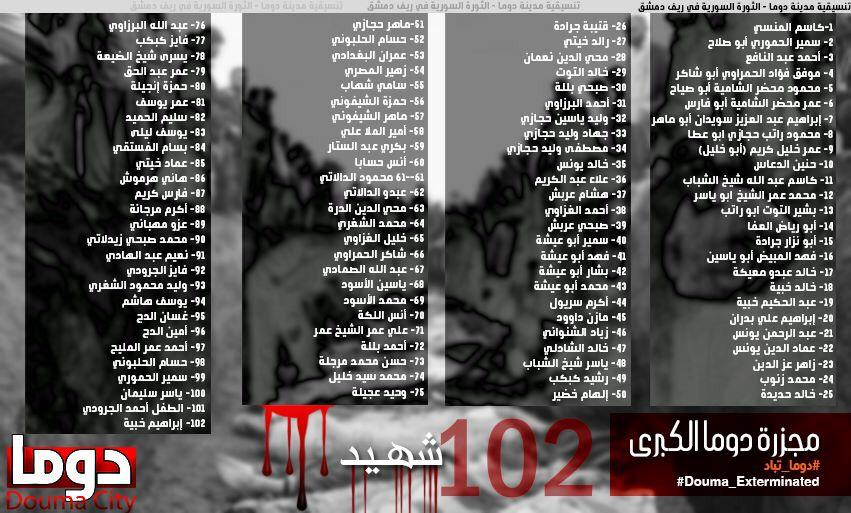
According to a list of victims names published in Arabic by the Doumaa Coordinating Committee, a pro-rebel group, there were 102 victims of the airstrike. After a translation, it is clear that the list reveals a grand total of three women among the 102 victims. It strains credulity that in a crowded market on a Sunday, with an alleged airstrike that could not distinguish between genders, there would be only three women among the dead. How is this possible? It seems likely that, as mentioned above, the list includes dead fighters who may have been killed in some other fashion – in battle, targeted by the Syrian military, etc. – who have simply been added to the list in order to bolster the narrative of a “massacre” in the market.
Additionally, we hear of the burial of victims in mass graves, still another puzzling development. As Reuters reported the day after the incident:
Sixty bodies were buried on Sunday night in two mass graves, said a spokesman for the Syrian Civil Defense force in Douma, a rescue service operating in rebel-held areas. Another 35 were buried on Monday, and the death toll was over 100, he said. “It was really difficult to identify the bodies of the martyrs. Some of them were burned to the bone, so we couldn’t add them to the documented list,” said the 28-year-old spokesman, who declined to give his real name for security reasons. His house was destroyed in the bombing, he added.
Naturally, the grizzly description given in the article elicits a strong emotional and visceral response. However, there is the troubling question as to why, if the Doumaa Coordinating Committee was able to compile a list of all the victims with their names, so many were still buried unceremoniously in mass graves. Even assuming that the number killed was correct, if it was difficult to identify the bodies with some so badly burned, they still managed to somehow identify them. If one accepts that this is true, then surely these bodies would have been given to the local families for burial. Yet they were not. Why not?
Typically the use of mass graves indicates a desire to quickly hide bodies which, if the media narrative on Douma were true, would seem unnecessary. At the very least, a real investigation into this incident would probe into the use of mass graves for the purposes of hiding key information, namely the identities of those killed.
An alternative theory, one which is supported by the evidence available, is that the Syrian military carried out an airstrike in the rebel stronghold town of Douma, and that the strike hit its target, a building housing a terrorist faction long since known to be in the city. This would explain the preponderance of men among the dead, the need for secrecy in burying the bodies, and the motive for the Syrian military striking the target.
Moreover, it is no secret exactly who has been operating in Douma and why they would be targeted. As the Carnegie Endowment noted in 2013:
The city of Douma has long been a stronghold of the insurgency, and several armed factions are active in the area, many of them with an Islamist bent. One, the Islam Brigade of the Alloush family, has over time grown quite a bit bigger than the others, particularly after it claimed responsibility for the July 18, 2012 attack against the National Security Office in Damascus, which killed several leading Syrian security figures. In March 2013, the main factions of the area joined forces in a local body called the Douma Mujahedin Council. The new group included the Islam Brigade, the Douma Martyrs’ Brigade, the Ghouta Lions Brigade, the East Ghouta Revolutionaries’ Brigade, the Lions of God Brigade, the Tawhid al-Islam Brigade, the Farouq Brigade [Liwa al-Farouq], the Shabab al-Hoda Brigade, the Seif al-Omawi Battalions, the Military Police Battalion, the Regime Protection Battalion, and the al-Ishara Battalion.
This key information is entirely omitted from the western media narrative about what happened in Douma, for obvious reasons. Namely, it undermines the meme that Assad’s forces carried out a criminal massacre of civilians as a form of collective punishment. Instead, it bolsters the claims by Syrian military spokespeople that the military targeted terrorist elements inside the city, just as they had done on a number of previous occasions, including as recently as June 2015. This point is critical because it demonstrates that this latest incident is part of an ongoing battle with these Douma factions, one which has seen countless rockets fired at Damascus from Douma and other surrounding suburbs.
Furthering this point is the fact that this attack in Douma was by no means the only incident of the day. There were in fact a series of clashes throughout the Damascus suburbs on Sunday August 16, the day of the incident. According to military sources, there were fierce clashes in East Ghouta with both Jaysh al-Islam (Army of Islam) and Faylaq al-Rahman (Al-Rahman Corps) which resulted in 11 Syrian soldiers killed and 21 militants killed. In addition, the city of Harasta, adjacent to Douma, was the scene of major clashes between the army and rebels.
Were one to present all these facts clearly, it becomes inescapable that whatever happened in Douma was part of an ongoing battle between the Syrian military and anti-government “rebels” in control of the town. But that fact is not at all convenient for the war narrative. It presents no justification for an expansion of the international campaign against Syria; it provides no pretext for the US or its allies to invoke their wretched, and utterly discredited, “Responsibility to Protect” doctrine. And ultimately that is the goal.
Exposing the “Humanitarian” Warmongers
The sad fact is that the dead in Douma are little more than props for those who would attempt to orchestrate yet another US-led war in the Middle East. These purported humanitarians would like to transform the incident into viable political currency to expand the war already raging in order to achieve the longed for regime change in Syria that thus far has been unattainable.
Kenneth Roth, Executive Director of Human Rights Watch, has been vocal in his support for a full scale war on Syria in the name of humanitarianism. Roth has repeatedly called for intervention against the legal government of Syria, having recently tweeted statements such as “Like Sarajevo, could Douma market slaughter finally force Assad to stop targeting civilians?” (@KenRoth, Aug 16). The implication of the statement is quite clear: there should be military intervention, such as the US-NATO war on Yugoslavia and later Serbia, in order to stop the “slaughter” of civilians. It should be noted that this tweet was posted within hours of the news of the incident in Douma long before any investigation.
Roth, and by extension his organization Human Rights Watch, further discredits whatever vestiges of impartiality he and HRW might have had with inane tweets such as “Douma market killings show how Assad chooses to fight this war: deliberately against civilians,” (@KenRoth, Aug 16), an obviously biased, and utterly unsubstantiated allegation. Roth could have absolutely no knowledge of either the identities of the dead, or the Syrian government’s motives, when he released the tweet the same day as the attack. He reveals himself here to be little more than a lackey for imperialism, a war hawk masquerading as a human rights defender.
Such dishonesty is nothing new for Roth and HRW however. As this author has previously argued, HRW is an utterly discredited organization that has on multiple occasions published blatantly false allegations about the war in Syria in order to justify a US-NATO intervention. One should of course recall the laughable, and now completely debunked, 2013 report from HRW entitled Attacks on Ghouta: Analysis of Alleged Use of Chemical Weapons in Syria, which falsely claimed that the Syrian government carried out the infamous chemical weapons attack of August 21, 2013.
The report, cited by many of the leading warmongers itching for intervention in Syria, has since been thoroughly discredited by the work of former UN weapons inspector Richard Lloyd and Prof. Theodore Postol of MIT who published their findings in a report entitled Possible Implications of Faulty US Technical Intelligence in the Damascus Nerve Agent Attack of August 21, 2013 which demonstrated unequivocally that the Syrian government could not have carried out the attack.
Additionally, Roth and HRW’s false narrative was again obliterated when Pulitzer Prize winning journalist Seymour Hersh published his exposé The Red Line and the Rat Line which firmly established the fact that the rebels were indeed capable of carrying out the attack on East Ghouta, and that they had help from Turkey, Saudi Arabia, and possibly other regional actors. This critical fact completely contradicted the assertions by Roth, HRW and the chorus of others who emphatically declared that only Assad’s forces were capable of carrying out the attack. Oops. Sorry Kenny, but your war pretext fell flat that time. One can only hope that it will once again.
But Roth and HRW are not the only ones making spurious claims in pursuit of the war agenda. Leave it to the Nobel Peace Prize winner President Obama and his White House to never let any tragedy go to waste. The day after the attack, National Security Council spokesperson Ned Price, speaking on behalf of the President, issued an official statement which “strongly condemns the deadly airstrikes yesterday by the Asad regime on a market in the Damascus suburb of Douma, where more than 100 people were killed and hundreds more injured, including scores of innocent women and children… These abhorrent actions underscore that the Asad regime has lost legitimacy and that the international community must do more to enable a genuine political transition.”
It is interesting to note here that the White House had already determined that “scores of innocent women and children” had been killed or injured. Where did this information come from? Certainly the casualty list released by the anti-Assad rebels did not indicate scores of dead women and children, nor did any of the videos of incident. It seems that, rather than conveying factual information, the White House was merely using the emotionally charged phrase “women and children” for propagandistic purposes, in order to be able to justify a possible military escalation against Damascus.
It is equally interesting to recall that just like Roth and HRW, the White House attempted to similarly capitalize on the August 21, 2013 chemical weapons attack for the purposes of pushing the US into war on Syria. In its now also debunked U.S. Government Assessment of the Syrian Government’s Use of Chemical Weapons on August 21, 2013, the White House stated that “The United States Government assesses with high confidence that the Syrian government carried out a chemical weapons attack in the Damascus suburbs on August 21, 2013. We further assess that the regime used a nerve agent in the attack.” Oops again.
But why should this author pick on the August 21, 2013 chemical weapons incident in attempting to critically examine the recent attack on Douma? Because it was at that moment, in the late summer of 2013, exactly two years ago, that the United States was on the verge of all out war against Syria and the Syrian people; because a narrative built on lies and distortions almost, yet again, pushed the US into war. Because this author marched in Times Square, New York City demanding that there be no war on Syria, then or ever. And because today, with so many lives already lost over these last four and half bloody years in Syria, peace-minded people cannot sit by and allow the US-NATO war machine and its human rights complex toadies to drag us into war.
It is clear that the Douma incident has been portrayed as an “official massacre” not because of any aspect of the attack itself. Rather, it has been presented this way in order to justify a pre-conceived war narrative, one that has repeatedly collapsed in the past, but one which the rapacious warmongers and strategic planners refuse to give up on. It’s not about the dead, nor is it even really about Assad. It is about destroying Syria and achieving geopolitical objectives which have been thus far unattainable due to the stubborn resolve of Damascus and its military. Ultimately, this war is about remaking the Middle East, no matter how many bodies it takes. Sadly, the dead of Douma are little more than tinder to those desperate to set Syria and the region ablaze.
Deadly Cheering for War in Ukraine by Western Press
By Roger Annis | CounterPunch | August 21, 2015
Two weeks ago, the Washington Post published an editorial saying that the governments of the NATO military alliance are being too soft on Russia over the crisis in Ukraine. The editors want even more aggressive support to the governing regime in Kyiv than what is already being given.
In particular, the newspaper objects to the ceasefire agreement that it says beleaguered Kyiv was pressured to sign in Minsk, Belarus on February 15, 2015. The editorial was headlined, ‘Putting Ukraine in an untenable position’ and its reads, “Yet now the German and French governments have enlisted the help of the Obama administration in seeking unilateral Ukrainian compliance with Minsk 2’s onerous political terms, which if fully implemented would implant a Russian-controlled entity inside Ukraine’s political system.”
The editors of the Post are pulling off a ruse. Kyiv has not abided by a single clause of Minsk-2, and the regime’s foreign backers, including in the editorial offices of the nearly all of Western media, keep a careful silence on the subject.
Points ten, eleven and twelve of the Minsk-2 agreement read as follows:
10. Pullout of all foreign armed formations, military equipment, and also mercenaries from the territory of Ukraine under OSCE supervision. Disarmament of all illegal groups.
11. Constitutional reform in Ukraine, with a new constitution to come into effect by the end of 2015, the key element of which is decentralisation (taking into account peculiarities of particular districts of Donetsk and Luhansk oblasts, agreed with representatives of these districts), and also approval of permanent legislation on the special status of particular districts of Donetsk and Luhansk oblasts in accordance with the measures spelt out in the attached footnote, by the end of 2015.
12. Based on the Law of Ukraine “On temporary Order of Local Self-Governance in Particular Districts of Donetsk and Luhansk Oblasts”, questions related to local elections will be discussed and agreed upon with representatives of particular districts of Donetsk and Luhansk oblasts in the framework of the Trilateral Contact Group. Elections will be held in accordance with relevant OSCE standards and monitored by OSCE/ODIHR.
So the obligations are clear, but they are being utterly disregarded by Kyiv and, as we see, by its foreign backers.
The Post‘s editorial is also a clear example of the ‘two worlds, two realities’ which prevail in the world today over the Ukraine crisis. One view sees an extreme, right-wing government in Kyiv waging a civil war against a population in the east of Ukraine which rejects Kyiv’s anti-Russia, intolerant nationalism and Kyiv’s pro-austerity embrace of the European Union. The opposite view sees ongoing Russian “invasions”, “occupations” and intervention in Ukraine. Most regretfully, the latter view is shared by a sizable body of liberal, social democratic and even pseudo-Marxist opinion in the West.
The Post editorial describes the present situation in eastern Ukraine as follows: “[Russia’s] forces continue to shell and rocket Ukrainian positions on a daily basis. Far from pulling back heavy weapons or withdrawing its troops as required by the agreement, it has built military bases and deployed 9,000 troops inside Ukraine and stationed another 50,000 just outside the border, according to Ukrainian and NATO officials.”
Funny, on the Post‘s extensive ‘Ukraine crisis‘ compilation of articles, one searches in vain for a single news report confirming the editors’ claims of Russian military intervention in eastern Ukraine and ongoing shelling and bombardment. The closest we get to that are reports by Post journalists embedded with the Ukrainian army. But their reports do not come close to verifying the editors’ claims; they consist merely of war-tourism style observations and photos.
So let’s pause for a moment to reflect. The Washington Post (and some other mainstream media) publishes articles and photo stories by journalists in and around Kyiv-controlled eastern Ukraine. But the Post‘s journalists can’t seem to provide examples of how “Russia’s forces continue to shell and rocket Ukrainian positions on a daily basis”. Surely, if the situation is that severe, there must be no shortage of visual examples to provide to readers? And surely the U.S. government can provide satellite images to mainstream media of the “9,000 Russian soldiers” in eastern Ukraine as well as other examples of Russian intervention?
Unless… it’s all, or mostly, make believe.
On the rebel side of eastern Ukraine, there is no shortage of examples of grim, daily shelling by Ukrainian armed forces, which are backed by NATO. Alas, and not by accident, such reports never, ever grace the pages of the Western media.
Canadian opposition parties cheer for more war
The blind, anti-Russia stand of the Washington Post is shared by the parties of the political mainstreams in the United States and Canada.
In Canada, the two main opposition parties are not only aligned with the pro-Kyiv, Conservative Party government in Ottawa. Similar to the Post editors in the U.S., they criticize the federal government in Ottawa for being too soft on Russia.
The New Cold War.org website has recently reported the pro-war views of the leader of the social-democratic New Democratic Party. Tom Mulcair presented his views to the first televised debate of the federal election in Canada on August 6. “We are proud members of NATO,” he declared. Mulcair criticized Canadian Prime Minister Stephen Harper for not adding even more Russian government and business leaders on the government’s war-threatening sanctions list. (The Canadian election will take place on October 19.)
Concerning the Liberal Party in Canada, it appreciates and backs the Harper government’s support of Kyiv, but it also criticizes both the government and the NDP for being too soft on Russia and the “pro-Russian separatists” in eastern Ukraine.
Key ideologues of Liberal Party foreign policy spoke to a public forum on Ukraine in Toronto on August 11. You can view excerpts of the forum here on YouTube, and you can read a favourable print report of the event here. A key demand on the Liberal Party wish-list for Ukraine is that the Canadian government begin to provide heavy weaponry to the Ukrainian army.
One of Canada’s better-known journalists, Dianne Francis, provides a particularly zany version of the “soft on Russia” argument in an article published by the neo-conservative Atlantic Council on August 17. She writes: “World attention focuses on ISIS and Iran, with its half an atomic weapon. But the biggest geopolitical issue is Vladimir Putin, backed by thousands of nuclear weapons, who is gradually conquering Ukraine, a democracy with 45 million people the size of Germany and Poland combined.
“In just over a year, Russia has seized nine per cent of Ukraine, killed 6,200, wounded 30,000, displaced 1.38 million people and shot down a commercial airliner with 298 people aboard.
“Even so, European and American retaliation has been soft, and ineffective…”
Only last month, Francis published several articles praising as heroes Ukraine’s extreme-right and neo-Nazi paramilitary battalions. She is Distinguished Professor at the Ted Rogers School of Management at Ryerson University in Toronto and a former editor of the National Post.
Canada is already providing military training to Ukraine’s army, along with non-lethal (sic) military equipment and spying and communication equipment and data. The government and the media support or turn a blind eye to the fundraising going on in Canada by Ukrainian ultranationalists to purchase military equipment for the war. Some of the purchased or supplied equipment serves the ongoing shelling of civilian areas of eastern Ukraine.
The Minsk-2 ceasefire provides a roadmap to end the hostilities in eastern Ukraine. A real ceasefire could open the road to resolution of the large social, economic and political issues that have split Ukraine politically and driven a sizable portion of the its population into revolt. But for now, the cheering for war taking place in Western capitals and editorial offices is a major obstacle for achieving all this.
Roger Annis is an editor of the website The New Cold War: Ukraine and beyond. On June 12, he gave a talk in Vancouver, Canada reporting on his visit to Donetsk, eastern Ukraine in April 2015 as part of a media tour group. A video broadcast of that talk is here: The NATO offensive in eastern Europe and the class and the national dynamics of the war in eastern Ukraine.
Propaganda, Intelligence and MH-17
By Ray McGovern | Consortium News | August 17, 2015
During a recent interview, I was asked to express my conclusions about the July 17, 2014 shoot-down of Malaysia Airlines Flight 17 over Ukraine, prompting me to take another hard look at Official Washington’s dubious claims – pointing the finger of blame at eastern Ukrainian rebels and Moscow – based on shaky evidence regarding who was responsible for this terrible tragedy.
Unlike serious professional investigative reporters, intelligence analysts often are required by policymakers to reach rapid judgments without the twin luxuries of enough time and conclusive evidence. Having spent almost 30 years in the business of intelligence analysis, I have faced that uncomfortable challenge more times than I wish to remember.
So, I know what it feels like to confront issues of considerable consequence like the shoot-down of MH-17 and the killing of 298 passengers and crew amid intense pressure to choreograph the judgments to the propagandistic music favored by senior officials who want the U.S. “enemy” – in this case, nuclear-armed Russia and its Western-demonized President Vladimir Putin – to somehow be responsible. In such situations, the easiest and safest (career-wise) move is to twirl your analysis to the preferred tune or at least sit this jig out.
But the trust-us-it-was-Putin marathon dance has now run for 13 months – and it’s getting tiresome to hear the P.R. people in the office of Director of National Intelligence James Clapper still claiming that the U.S. intelligence community has not revised or updated its analysis of the incident since July 22, 2014, just five days after the crash.
Back then, Clapper’s office, trying to back up Secretary of State John Kerry’s anti-Russian rush to judgment, cited very sketchy evidence – in both senses of the word – drawn heavily from “social media” accounts. Obviously, the high-priced and high-caliber U.S. intelligence community has learned much more about this very sensitive case since that time, but the administration won’t tell the American people and the world. The DNI’s office still refers inquiring reporters back to the outdated report from more than a year ago.
None of this behavior would make much sense if the later U.S. intelligence data supported the hasty finger-pointing toward Putin and the rebels. If more solid and persuasive intelligence corroborated those initial assumptions, you’d think U.S. government officials would be falling over themselves to leak the evidence and declare “we told you so.” And the DNI office’s claim that it doesn’t want to prejudice the MH-17 investigation doesn’t hold water either – since the initial rush to judgment did exactly that.
So, despite the discomfort attached to making judgments with little reliable evidence – and at the risk of sounding like former Defense Secretary Donald Rumsfeld – it seems high time to address what we know, what we don’t know, and why it may be that we don’t know what we don’t know.
Those caveats notwithstanding I would say it is a safe bet that the hard technical intelligence evidence upon which professional intelligence analysts prefer to rely does not support Secretary of State Kerry’s unseemly rush to judgment in blaming the Russian side just three days after the shoot-down.
‘An Extraordinary Tool’?
When the tragedy occurred U.S. intelligence collection assets were focused laser-like on the Ukraine-Russia border region where the passenger plane crashed. Besides collection from overhead imagery and sensors, U.S. intelligence presumably would have electronic intercepts of communications as well as information from human sources inside many of the various factions.
That would mean that hundreds of intelligence analysts are likely to have precise knowledge regarding how MH-17 was shot down and by whom. Though there may be some difference of opinion among analysts about how to read the evidence – as there often is – it is out of the question that the intelligence community would withhold this data from President Barack Obama, Secretary of State Kerry and other top officials.
Thus, it is a virtual certainty that the Obama administration has far more conclusive evidence than the “social media” cited by Kerry in casting suspicions on the rebels and Moscow when he made the rounds of Sunday talk shows just three days after the crash. On NBC’s “Meet the Press,” Kerry told David Gregory that “social media” is an “extraordinary tool.” The question is, a tool for what?
The DNI report two days later rehashed many of the “social media” references that Kerry cited and added some circumstantial evidence about Russia providing other forms of military equipment to the rebels. But the DNI report contains no mention of Russia supplying a Buk anti-aircraft missile system that Kerry and the DNI cited as the suspected weapon that downed the plane.
So, why does the administration continue refusing to go beyond such dubious sources and shaky information in attributing blame for the shoot-down? Why not fill in the many blanks with actual and hard U.S. intelligence data that would have been available and examined over the following days and weeks? Did the Russians supply a Buk or other missile battery that would be capable of hitting MH-17 flying at 33,000 feet? Yes or no.
If not supplied by the Russians, did the rebels capture a Buk or similar missile battery from the Ukrainians who had them in their own inventory? Or did some element of the Ukrainian government – possibly associated with one of Ukraine’s corrupt oligarchs – fire the missile, either mistaking the Malaysian plane for a Russian one or calculating how the tragedy could be played for propaganda purposes? Or was it some other sinister motive?
Without doubt, the U.S. government has evidence that could support or refute any one of those possibilities, but it won’t tell you even in some declassified summary form. Why? Is it somehow unpatriotic to speculate that John Kerry, with his checkered reputation for truth-telling regarding Syria and other foreign crises, chose right off the bat to turn the MH-17 tragedy to Washington’s propaganda advantage, an exercise in “soft power” to throw Putin on the defensive and rally Europe behind U.S. economic sanctions to punish Russia for supporting ethnic Russians in Crimea and eastern Ukraine resisting the new U.S.-arranged political order in Kiev?
By taking a leaf out of the Bush-Cheney-Tony-Blair playbook, Kerry could “fix the intelligence around the policy” of Putin-bashing. Given the anti-Putin bias rampant in the mainstream Western media, that wouldn’t be a hard sell. And, it wasn’t. The “mainstream” stenographers/journalists quickly accepted that “social media” was indeed a dandy source to rely on – and have never pressed the U.S. government to release any of its intelligence data.
Yet, in the immediate aftermath of the MH-17 shoot-down, there were signs that honest intelligence analysts were not comfortable letting themselves be used as they and other colleagues had been before the invasion of Iraq in 2003.
To buttress Kerry’s shaky case, DNI Clapper arranged a flimsy “Government Assessment” – reprising many of Kerry’s references to “social media” – that was briefed to a few hand-picked Establishment reporters two days after Kerry starred on Sunday TV. The little-noticed distinction was that this report was not the customary “Intelligence Assessment” (the genre that has been de rigueur in such circumstances in the past).
The key difference between the traditional “Intelligence Assessment” and this relatively new creation, a “Government Assessment,” is that the latter genre is put together by senior White House bureaucrats or other political appointees, not senior intelligence analysts. Another significant difference is that an “Intelligence Assessment” often includes alternative views, either in the text or in footnotes, detailing disagreements among intelligence analysts, thus revealing where the case may be weak or in dispute.
The absence of an “Intelligence Assessment” suggested that honest intelligence analysts were resisting a knee-jerk indictment of Russia – just as they did after the first time Kerry pulled this “Government Assessment” arrow out of his quiver trying to stick the blame for an Aug. 21, 2013 sarin gas attack outside Damascus on the Syrian government.
Kerry cited this pseudo-intelligence product, which contained not a single verifiable fact, to take the United States to the brink of war against President Bashar al-Assad’s military, a fateful decision that was only headed off at the last minute after President Barack Obama was made aware of grave doubts among U.S. intelligence analysts about whodunit. Kerry’s sarin case has since collapsed. [See Consortiumnews.com’s “The Collapsing Syria-Sarin Case”]
The sarin and MH-17 cases reveal the continuing struggles between opportunistic political operatives and professional intelligence analysts over how to deal with geopolitical information that can either inform U.S. foreign policy objectively or be exploited to advance some propaganda agenda. Clearly, this struggle did not end after CIA analysts were pressured into giving President George W. Bush the fraudulent – not “mistaken” – evidence that he used to make the case for invading Iraq in 2003.
But so soon after that disgraceful episode, the White House and State Department run the risk that some honest intelligence analysts would blow the whistle, especially given the dangerously blasé attitude in Establishment Washington toward the dangers of escalating the Ukraine confrontation with nuclear-armed Russia. Given the very high stakes, perhaps an intelligence professional or two will summon the courage to step up to this challenge.
Falling in Line
For now, the rest of us are told to be satisfied with the Sunday media circus orchestrated by Kerry on July 20, 2014, with the able assistance of eager-to-please pundits. A review of the transcripts of the CBS, NBC, and ABC Sunday follies reveals a remarkable – if not unprecedented — consistency in approach by CBS’s Bob Schieffer, NBC’s David Gregory (ably egged on by Andrea Mitchell), and ABC’s George Stephanopoulos, all of whom hewed faithfully to a script apparently given them with two main talking points: (1) blame Putin; and (2) frame the shoot-down as a “wake-up call” (Kerry used the words repeatedly) for European governments to impose tight economic sanctions on Russia.
If the U.S. government’s hope was that the combination of Kerry’s hasty judgment and the DNI’s supportive “Government Assessment” would pin the P.R. blame for MH-17 on Putin and Russia, the gambit clearly worked. The U.S. had imposed serious economic sanctions on Russia the day before the shoot-down – but the Europeans were hesitant. Yet, in the MH-17 aftermath, both U.S. and European media were filled with outrage against Putin for supposedly murdering 298 innocents.
German Chancellor Angela Merkel and other European leaders, who had been resisting imposing strong economic sanctions because of Germany’s and the European Union’s lucrative trade with Russia, let themselves be bulldozed, just two weeks after the shoot-down, into going along with mutually harmful sanctions that have hurt Russia but also have shaken the EU’s fragile economic recovery.
Thus started a new, noxious phase in the burgeoning confrontation between Russia and the West, a crisis that was originally precipitated by a Western-orchestrated coup d’état in Kiev on Feb. 22, 2014, ousting Ukraine’s elected President Viktor Yanukovych and touching off the current civil war that has witnessed some of the worst bloodshed inside Europe in decades.
It may seem odd that those European leaders allowed themselves to be snookered so swiftly. Did their own intelligence services not caution them against acquiescing over “intelligence” from social media? But the tidal wave of anti-Putin fury in the MH-17 aftermath was hard if not impossible for any Western politician to resist.
Just One Specific Question?
Yet, can the U.S. concealment of its MH-17 intelligence continue indefinitely? Some points beg for answers. For instance, besides describing social media as “an extraordinary tool,” Kerry told David Gregory on July 20, 2014: “We picked up the imagery of this launch. We know the trajectory. We know where it came from. We know the timing. And it was exactly at the time that this aircraft disappeared from the radar.”
Odd that neither Gregory nor other “mainstream” stenographers have thought to ask Kerry, then or since, to share what he says he “knows” with the American people and the world – if only out of, well, a decent respect for the opinions of mankind. If Kerry has sources beyond “social media” for what he claims to “know” and they support his instant claims of Russian culpability, then the importance of his accusations dictates that he describe exactly what he pretends to know and how. But Kerry has been silent on this topic.
If, on the other hand, the real intelligence does not support the brief that Kerry argued right after the shoot-down, well, the truth will ultimately be hard to suppress. Angela Merkel and other leaders with damaged trade ties with Russia may ultimately demand an explanation. Can it be that it will take current European leaders a couple of years to realize they’ve been had — again?
The U.S. government also is likely to face growing public skepticism for using social media to pin the blame on Moscow for the downing of MH-17 – not only to justify imposing economic sanctions, but also to stoke increased hostility toward Russia.
The Obama administration and the mainstream media may try to pretend that no doubt exists – that the “group think” on Russia’s guilt is ironclad. And it seems likely that the official investigations now being conducted by the U.S.-propped-up government in Ukraine and other close U.S. allies will struggle to build a circumstantial case keeping the Putin-did-it narrative alive.
But chickens have a way of coming home to roost.
Guardian on Russia: None of the news that’s fit to print
OFFGuardian | August 18, 2015
The Guardian’s coverage of Russia is, famously, rather petty these days. Petty and confusing and full of conflicting assertions from various people with differing sizes of axe to grind. On the one hand you have Luke Harding interviewing “entrepreneurial” oligarchs and believing every self-serving lie that comes out of their mouth, and on the other you have decreasing poverty statistics portrayed as (somehow) “a bad thing”.
And then you have this kind of thing. A non-story, writ large on the front page. Without merit, or analysis, or even sources (save the Guardian itself, you gotta love the way they do that).
Nobody really cares – save the half dozen lost souls who patrol BTL on Russia stories making jokes about vodka and polonium. But God fordbid you try and draw attention to the actual news, about Russia, Ukraine and the developments in the chaos out there. As this man did:

That link is actually to our site – this story. Thanks for that Jeff, whoever you are – but be warned that links to our site are loca non grata these days. As you can see:

Yup. There is no civil war in Ukraine anymore. It’s not worth discussing, reporting, or even acknowledging. But Russia is awful. And also vodka.
Those posters BTL who endeavoured to point out that GCHQ has been proven to carry out similar activities are met with a predictable response:

For example, this story, about Government twitter accounts being used to spread propaganda – is tucked well away in the psychology section. There’s also this one from last year – which, again, was hardly front page news.
Feel free to scream “WHATABOUT!” in the comments.
Featured Video

Liberty Cannot Exist Inside a Panopticon
or go to
Aletho News Archives – Video-Images
From the Archives
Left-leaning despisers of 9/11 Truth movement: Do you really believe in miracles?
David Ray Griffin | Global Research | 06 Jul 2010
An Open Letter to Terry Allen, Noam Chomsky, Alexander Cockburn, David Corn, Chris Hayes, George Monbiot, Matthew Rothschild, and Matt Taibbi.
[1]According to several left-leaning critics of the 9/11 Truth Movement, some of its central claims, especially about the destruction of the World Trade Center, show its members to be scientifically challenged. In the opinion of some of these critics, moreover, claims made by members of this movement are sometimes unscientific in the strongest possible sense, implying an acceptance of magic and miracles. … Full article
Blog Roll
 Aletho News
- White House envoy declares kinetic action against Yemen ‘fruitless’
- Ukraine deployed thousands of microdrones in Iraqi Kurdistan: Tasnim
- Iran calls for emergency UNSC meeting over Trump’s ‘brazen’ bomb talk, Israeli threats
- Iranian sources reveal details of Russia-China Hormuz proposal
- Plan for more US-Israel integration puts our military tech at risk
- Another Round Against Iran Will Break What Is Left of the Gulf
- SVR Report on Ukraine’s Mexican Drug Gang Links Could Pressure Zelensky, Won’t Change US Policy
- British Government Employees Were Fact-Checking the News at the BBC. Nobody Told You.
- Albania on fire: who’s behind the riots?
- Egypt’s Civil Democratic Movement rejects involvement in regional war
- If Americans Knew
- Mysterious bot accounts reportedly spread fake ‘man on the street’ videos for Michigan Senate candidate
- Israeli Defense Minister Katz Says Over 60 Lebanon Villages Have Been Destroyed
- Why Is Israel Running TV Ads in Iowa Ahead of the Midterms?
- Hind Rajab’s Alleged Killer Is in the United States. HRF Demands His Arrest.
- US Officials Face Fresh Pressure After Another American ‘Brutalized’ by Israeli Settlers in West Bank
- Israel-Backed Palestinian Militias Terrorize Displaced Families in Gaza
- FBI subpoenas pro-Palestine activists over Israeli weapons plant disruption
- Fourth winter arrives in wartorn Gaza, too early – Daily Update
- More on how Bari Weiss is using CBS on behalf of Israel
- What the UK Is Doing to Pro-Palestine Novelist Sally Rooney Is an Act of Orwellian Villainy
- No Tricks Zone
- Predictions Made By Renowned Climate Proifessor Over Past Decades Have Been Proven To Be Poor
- New Study Suggests Large Regions Of The Pacific Ocean Have Been Cooling For The Last 80 Years
- Germany’s Green Energy Debacle: High Energy Costs Force Kahla Porzellan to Close After 182 Years!
- New Study: 50 Years Of The Most Aggressive ‘Net Zero’ Policies Can Only Affect The Global Climate By 0.03°C
- US September “Heat” Was No Record…Many Records Set Decades Ago
- Latest European Green Energy Debacle; Portugal’s Largest Flagship Solar Park Insolvent!
- Green Energy Debacle: German Expert Professor Fritz Vahrenholt Warns Of Severe Economic And Social Consequences
- Two More Paleo Reconstructions Affirm Meters-Higher Sea Levels Across Ireland, Brazil 7000-6000 Years Ago
- New Study: Earth And Venus Surface Warmth Largely Explained By Convection And Lapse Rate, Not CO2 Or Radiation
- 2025 Nature Paper Claiming Worsening Global Drought Gets RETRACTED …Heavily Flawed