Mainstream Media Stock Prices Collapsing as People Choose Internet Over TV
Nick Bernabe | ANTIMEDIA |August 7, 2015
The long-term decline in viewership for America’s big TV outlets is finally starting to catch up to their stock prices. Since 2009, media stocks have been some of the best performers in S&P 500, but the last few days have seen $50 billion wiped from these companies.
According to Bloomberg, “Ignited by a plunge in Walt Disney Co., shares tracked by the 15-company S&P 500 Media Index have tumbled 8.2 percent in two days, the biggest slump for the group since 2008…In just five stocks — Disney, Time Warner Inc., Fox, CBS and Comcast Corp. — almost $50 billion of value was erased in two days. Viacom slid 14 percent on Thursday alone, its biggest drop since October 2008.”
Stock analysts say the reason behind the drop is simple on the surface: many of the media companies missed their profit projections, prompting investors to drop their stocks. Disney has lowered its growth projections for its sports brand, ESPN, while Viacom reported lower revenues than expected, which triggered a sell-off.
However, there is a larger trend at play here—one that the mainstream media—which is owned by these very companies facing the stock beat-down—doesn’t want to talk about. People are simply outgrowing the old media paradigm, and instead, are turning to the internet for both their news and entertainment at a break-neck pace. As we reported last month, Netflix will have more viewers than ABC, CBS, NBC, or Fox by 2016.
Viewership of television media is dropping — and it’s left the old media scrambling for answers. According to the Huffington Post,
“Though overall video viewing is up thanks to a plethora of new online services, fewer people are sitting down in front of a television set and a growing number of households — roughly 2.6 million, or 2.8 percent — are becoming ‘broadband only,’ forgoing cable and broadcast signals altogether. In the third quarter of 2014, the average viewer watched 141 hours of TV a month, down 6 hours from the same time last year, and a full 12 minutes less per day.
Digital, on the other hand, has shown strong growth over the past year across all age groups, with viewership up 53 percent among people 18-49, up 62 percent among people 25-54, and up 55 percent among those 55 and older since the third quarter of 2013.”
In the past, TV news outlets relied on a virtual monopoly between the big six companies that own 90% of the media to make their numbers. This left viewers with no choice but to consume media from one of these companies if they watched TV.

But now, as people have multiple sources and choices of news thanks to the internet and independent media, the monopoly is coming under pressure. Aging generations, which will probably never break their TV habits, are now the only reliable audiences for the likes of CNN, Fox News, NBC, CBS, and the rest of the mainstream media. Members of the internet age would rather have choices and read or watch news from sources they both trust and believe in. This is major problem for the old media, as poll after poll has shown eroding trust in the big six. According to Gallup polling numbers, Americans’ confidence in the media’s ability to report “the news fully, accurately, and fairly” reached an all-time low of 40% in 2014.
The reason for the falling ratings and trust in the media is not mentioned in the poll, but one could speculate that younger generations have become disillusioned by endless war mongering, partisanship, racial bias, politician and police worship, reality TV, and celebrity media frenzies that have become the trademarks of TV news. However, one thing is clear: television media will soon suffer the same fate as the near-extinct newspaper industry—barring some unexpected miracle—and that is a positive development for the well being of the political and social conversation in America. America’s new media is becoming more like America as a whole: diverse.
Hillary’s Libyan Torturers

By Daniel McAdams | Ron Paul Institute | August 4, 2015
Remember when then-Secretary of State Hillary Clinton was so intent on a US attack on Libya that she disregarded the US Intelligence Community, the Pentagon, and even her colleagues in the Obama Administration to force her “humanitarian intervention”? Clinton was so distrusted by the Pentagon that they opened up their own lines of communication with Libyan officials — they knew she was feeding them and the State Department boldfaced lies.
Even members of Hillary’s own party in Congress were skeptical of her claims.
Gaddafi’s son and presumed heir, Saif, told then-Rep. Dennis Kucinich (an RPI Board Member) that Hillary was using false information to justify the coming US attack on his country. (Thankfully, Mr. Kucinich understood his Constitutional obligation to act as member of an equal branch of government and did his own investigation of Hillary’s claims.)
Saif told Kucinich that Hillary’s “information” about Libya was:
[L]ike the WMDs in Iraq. It was based on a false report. Libyan airplanes bombing demonstrators, Libyan airplanes bombing districts in Tripoli, Libyan army killed thousands, etc., etc., and now the whole world found there is no single evidence that such things happened in Libya.
Hillary’s rebels, according to Saif were, as a Washington Times article reports, “not freedom fighters” but rather jihadists whom he described as “gangsters and terrorists.”
Hillary got her war. The Washington Post, ever the lickspittle in the service of the US regime, shortly after the attack praised Hillary’s great foresight in forcing the US war on Libya:
Seven months later, with longtime U.S. nemesis Moammar Gaddafi dead and Libya’s onetime rebels now in charge, the coalition air campaign has emerged as a foreign policy success for the Obama administration and its most famous Cabinet member, Secretary of State Hillary Rodham Clinton.
What a success! Libya is now in the hands of ISIS and various Islamist terror gangs. The population is devastated. Saif was right: they were a bunch of terrorist jihadists.
Gaddafi’s other son, Saadi, is currently being held by “Libyan Dawn,” an al-Qaeda group that has emerged since the US “liberation” and has taken control of key parts of Libya. This week we see in a new video that Hillary’s humanitarian freedom fighters have taken to torturing Saadi Gaddafi in the must un-humanitarian manner (warning, graphic). Hillary’s humanitarians are a bunch of torturing thugs, and it’s all there on the tape. Will she be challenged on this? Don’t bet on it.
Meanwhile, another group of Hillary’s extremists have sentenced Saif to death in a mass trial with scores of others from the previous government. The trials were so bad they were even condemned by the International Criminal Court, which would also like to get its hands on Saif. The defendants had little access to legal council in what was a textbook show trial.
Hillary Clinton squealed with joy when Muammar Gaddafi was sodomized with a knife and murdered by her rebels. Is she likewise giggling somewhere as Gaddafi’s son has his feet beaten to a pulp with a metal rod while he is bound and slapped in the face and his other son is sentenced to death in a trial with no semblance to actual rule of law?
This is human rights, Hillary-style.
‘War is Peace’: US Neocons Urge Washington to Flood Ukraine With Weapons
Sputnik – 06.08.2015
American hawks are calling upon the US government to “flood” Ukraine with weapons because they are more concerned about their own wallets than about European security, US journalist Lee Fang points out.
Although the United States Institute of Peace and its chairman Stephen Hadley profess that they promote international peace through nonviolent conflict resolution, it is not what they are actually doing, US journalist and writer Lee Fang underscores.
“Stephen Hadley is a relentless hawk whose advocacy for greater military intervention often dovetails closely with the interests of Raytheon, a major defense contractor that pays him handsomely as a member of its board of directors,” the journalist revealed.
In June, during his speech at Poland’s Wroclaw Global Forum, the Institute of Peace chairman insisted that Washington should provide weapons to Kiev in order to “raise the cost for what Russia is doing in Ukraine.”
“[E]ven President Putin is sensitive to body bags — it sounds coarse to say, but it’s true — but body bags of Russian soldiers who have been killed,” Hadley stressed, not bothering to present any evidence to confirm his statement about Russia’s “invasion” of Ukraine.
“The call to flood Ukraine with weapons not only contrasts sharply with the stated mission of the Institute of Peace, but many scholars believe doing so would provoke more conflict,” Fang remarked, adding that Hadley also urged European governments to boost their military spending substantially.
Although Hadley’s statement sounds downright Orwellian, there is an obvious explanation for his illogical behavior: Stephen Hadley also serves as a highly paid board member of Raytheon, a major American defense contractor.
“Hadley has been a Raytheon board member since 2009 and was paid cash and stock awards worth $290,025 in 2014 alone,” the journalist highlighted, adding that for companies like Raytheon, regional strife and intervention have always been “good for business.”
The conflict in Ukraine is obviously playing into hands of Raytheon and other US defense manufacturers. Remarkably, Raytheon has recently announced that “strong international demand” for its weaponry had resulted in unexpectedly high quarterly revenues, making its shares significantly higher.
Raytheon’s Chief Executive Tom Kennedy elaborated that the international orders reached a record 44 percent of the defense contractor’s backlog at the end of the second quarter, in contrast with 38 percent a year ago.
Citing Raytheon’s chief financial officer Dave Wajsgras, Lee Fang pointed out that European states are increasing their defense spending due to the ongoing turmoil in Ukraine, facilitating the company’s revenues growth.
Curiously enough, it is not the first time the US Institute of Peace has joined the chorus of American hawks and warmongers. Fang pointed out that in the 1980s the institute’s first president, Robert Turner, expressed his active support for the Contras, right-wing insurgents in Nicaragua. The Contras were infamous for using terrorist tactics in their war against the Nicaraguan government, but nevertheless they received financial and military support from Washington.
Today the institute’s neoconservative board members call for the invasion of Middle Eastern countries, particularly Iran, as well as for the deployment of nuclear weapons in Eastern European NATO members — former Warsaw Pact states — in order to confront Russia.
However, arming Ukraine is a very bad idea the journalist noted, citing Stephen Walt, Professor of International Affairs at Harvard University.
“The core problem is that Ukraine’s political alignment is a vital interest for Russia, which is why it intervened in the first place. It is right next door to Russia, which means Moscow both cares more about the outcome and can escalate there much more easily than we can. Doubling down now will intensify and prolong the fighting and get more Ukrainians killed,” Walt stressed, as cited by Lee Fang.
IAEA Director General’s Appearance Before U.S. Senate a Major Error in Judgment
By William O. Beeman | Dissident Voice | August 6, 2015
This decision by Director General Yukia Amano to appear before the U.S. Senate Committee on Foreign Relations to testify on Iran’s nuclear program is regrettable, but it is also not surprising. Amano has been consulting with the U.S. Government on a regular basis ever since his appointment as Director General. This is well documented.
The dramatic change in the language of IAEA reports after Amano took over from Mohammad el-Baradei (whom the U.S. tried to kick out of office until he won the Nobel Peace Prize) shows the direct influence of the United States and Israel trying to indict Iran for nuclear weapons activity. Amano’s directorship resulted in a sudden eruption of meaningless, tortured weasel-word language about “not being able to verify” that Iran was “not” engaging in technology that might lead to military activity. This language contradicted every previous report under previous directors Hans Blix and el-Baradei.
But in the end the IAEA in every report issued under Amano verified that Iran had “not diverted fissile material for any military purpose.”
Amano has simply been a tool of U.S. officials bent on making hostile accusations toward Iran, looking for “expert” evidence to support their specious claims. Specifically, the agency’s tortured language has been twisted by U.S. opponents of an accord with Iran to bolster their claims that Iran was making nuclear weapons–claims that, despite the Amano-influenced IAEA reports — remained utterly unsubstantiated by any evidence anywhere.
It is also noteworthy that Amano expressed confidence that his office could carry out the inspections activities mandated by the accords. Thus he was caught in a bit of a bind–seeming to imply that Iranian activities were suspect and “unable to be verified as peaceful” and at the same time asserting the effectiveness of his agency–and his leadership–in carrying out the inspections. So which is it? Is the IAEA capable or incapable of carrying out its duties under his leadership? Honestly, I think Amano needs to step down. He appears to have lost all credibility as an independent administrator of his agency.
I have no doubt that Amano’s testimony continued the mealy-mouthed, but not-quite-definitive support for attacking the Vienna accords favored by President Obama’s detractors, and those who still want to bomb bomb bomb bomb bomb Iran.
William O. Beeman is a Professor, Department of Anthropology at the University of Minnesota. Visit William’s website.
Shame on UK for Sham Litvinenko Trial
By William DUNKERLEY | Oriental Review | Aug 3, 2015
What started off as a massive fabrication in 2006 just received a great boost from a complicit British government. The mysterious polonium death of reputed former KGB spy Alexander Litvinenko is the focus.
An inexplicably long series of official UK hearings on this nearly 9 year old case has just concluded. That’s prompted a new flurry of sensational media reports.
A recent Daily Mail headline reads “Putin ‘personally ordered Litvinenko’s murder.’” The Irish Independent said, “Vladimir Putin should be held responsible for the murder of Alexander Litvinenko.” BBC reported, “Vladimir Putin ‘ordered killing’, Litvinenko [official UK] inquiry hears.”
They support a premise that’s been around since the beginning. It implicates Russian president Vladimir Putin in the yet-to-be explained death.
You might think that reliable evidence has been presented to back up all the accusations. But careful examination shows the reports are no more than unsubstantiated allegations. No reliable facts are reported. Meanwhile, there is an abundance of evidence that this has been a nefarious witch hunt all along.
The official UK hearing has been made out to be a kind of trial, one aimed at bringing justice in the mysterious death case. The widow Marina Litvinenko told BBC, “The truth has finally been uncovered.”
That’s actually quite the opposite of the truth. Here are some facts:
–The prosecutor in the case was unable to unearth any incriminating factual evidence, only “grave suspicions” about Russian culpability. He never had a sufficient case to bring to trial.
–The current official inquiry has no capability to mete out justice. It hasn’t been a real trial at all. There are accused individuals. But they have no right to question their accusers. The inquiry doesn’t have the ability to convict anybody.
–No coroner has ever ruled that Litvinenko’s death was even a homicide. That leaves open the possibility of accidental poisoning or suicide.
–The KGB spy moniker given Litvinenko in the media is fallacious; he never did espionage work. But it added spice to all the misleading headlines.
–Litvinenko himself is on record believing an Italian named Mario Scaramella poisoned him.
–The “Putin did it” scenario that went mainstream was a highly successful fraud of massive proportion. It was instigated by Putin arch enemy Boris Berezovsky, a Russian robber baron who was hiding out in London from criminal prosecution back home. Berezovsky was angling to see Putin overthrown in a violent revolution and replaced by a monarch. No kidding. I’m not just alleging that. He said so in his own words.
–A rogue coroner dodged his statutory duty to rule on the manner and cause of death, and instead conducted a Berezovskyesque witch hunt for Russian culpability.
–He subsequently was told by Home Secretary Theresa May to cut out the witch hunt and perform his duty to rule on the manner and cause of death. She also told him that any further official inquiry was unnecessary.
–That would have ended the folly for good. But instead Prime Minister David Cameron reversed the Home Secretary and reopened the witch hunt. This came amidst the sanctions frenzy against Putin over the Ukraine crisis. It was a highly politicized move, not a search for justice.
–The result has been the just-concluded hearings, part of Cameron’s official inquiry.
Cameron has charged forward despite the obvious speciousness of the case. It’s not hard to see that fraud has been afoot all along. For instance, there was a widely-reported deathbed statement dictated by Litvinenko. News of it didn’t come out until after Litvinenko’s death. The statement blames Putin for the poisoning.
But I’ve found that Litvinenko never dictated any such statement. The story was a hoax. The hoaxer has even confessed that the words were his own, and that he had no factual basis for his allegation.
Isn’t Cameron aware of these specious claims in the Litvinenko case? If there is a real evidentiary basis, why is the record founded on outright fabrications like the deathbed statement? The case is replete with nonsense like the deathbed hoax.
So the truth that needs to be known is that the Litvinenko case has been a fraud right from the start, and continues as such to this day. I don’t know whether or not Putin or any other Russian had complicity in the death. But I do know that principals behind the accusations have been lying.
The biggest news here is that Cameron has put the weight of the UK government behind the fraud. What an extravagant affront to justice. He should be ashamed of himself.
William Dunkerley is a media analyst and a Senior Fellow at the American University in Moscow.
The Soft Power Hoax
By Mike Lofgren | Consortium News | August 2, 2015
A recurrent buzz phrase of the Washington mandarinate in the last two decades has been “soft power.” The term was coined by Joseph Nye, a Harvard academic, in his 1990 book, Bound to Lead: The Changing Nature of American Power. What he meant by the term is that “when one country gets other countries to want what it wants [it] might be called co-optive or soft power in contrast with the hard or command power of ordering others to do what it wants.”
Soft power he defined as the putatively attractive political, social and cultural traits of a country that induce admiration in a target people, and, presumably, a desire both to emulate those traits and to willingly comply with the wishes of the country projecting the soft power.
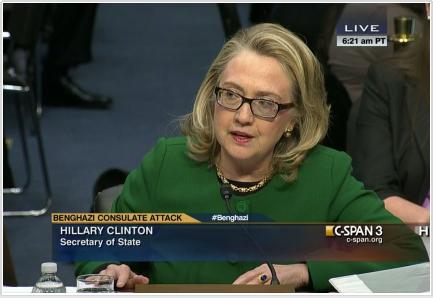
Secretary of State Hillary Clinton testifies before Congress about the fatal attack on the U.S. mission in Benghazi, Libya. (Photo from C-SPAN coverage)
The term has gotten a workout by American politicians and national security bureaucrats, particularly since the manifest failure of military power to make Iraqis love us. Former Secretary of Defense Robert Gates has used the term, saying he would like to augment U.S. soft power by “a dramatic increase in spending on the civilian instruments of national security – diplomacy, strategic communications, foreign assistance, civic action and economic reconstruction and development.”
As might be expected, the idea is most loved by State Department officials, principally because they believe it could give them a leg up in the Washington budget battles with their colossal rival, DOD, the repository of “hard” power. A Google search of “Hillary Clinton smart power” gets about 3.7 million hits. Smart power is the former Secretary of State’s pet term for a fusion of hard and soft power. John Kerry is also fond of the concept.
It is easy to see why the national security establishment, casting about for some alternative to the usual bluster leading to military action, would be drawn to the magical notion that our presumed cultural attractiveness, combined with a really cool Twitter feed, could advance American interests (as the Beltway elite defines them) throughout the world.
Democrats, in particular, looking for some substitute to the brain-dead neoconservative policies that some of them were briefly enamored of when President George W. Bush was Stockholm Syndroming them, are magnetically pulled to a concept that sounds like the first cousin to the dorm room philosophizing that so many of their kind indulged in during their formative years in the Ivy League.
“If we just explain our policies to them in the right way in a Facebook post, and maybe open an Apple Store in downtown Chișinău, ordinary Moldovans will be clamoring to join NATO!”
It is surely preferable to think in this manner than to act like a warmongering troglodyte, even if some soft power ploys, like John Kerry bringing James “You’ve Got a Friend” Taylor to Paris to console them after a terrorist attack, seem frivolous if not embarrassing – one can hardly picture Charles Francis Adams or George Kennan doing likewise.
Yet soft power, while less pernicious, still springs from the same roots as neoconservative militarism. It arises from the near-universal belief among the Beltway illuminati in American Exceptionalism, the fairy tale that the United States dwells outside the normal processes of history and has a duty as a global redeemer. It is what H.L. Mencken would have classified as “the bilge of American idealism,” and it ranks right up there with intelligent design and a conviction that real estate will always go up among the foolish things Americans have believed in.
Was the invasion of Iraq and the whole Bush-era nightmare really the polar opposite of what the soft power advocates wanted? With the fall of Baghdad, a military campaign that took only a month, the whole soft power apparatus swung into action: passing out soccer balls to children, rebuilding the municipal sewer system, and opening a Baghdad stock market on the assumption that the benighted Iraqi masses were pining for the fruits of American-style capitalism.
In 2015, vastly more Iraqis speak English than in 2003. The Department of State and the U.S. Agency for International Development spent $50 billion in the country. Yet has all that money and all the cultural export of Americana accomplished anything? And could we not draw the identical conclusion about Afghanistan?
The whole soft power hallucination was born of the end of the Cold War in a particularly hubristic moment of American triumphalism. It was at that time that Francis Fukuyama wrote his extraordinarily silly discourse prophesying the end of history and the ushering in of a capitalist-consumerist utopia – a kind of upside-down Marxist dialectic.
That is the fallacy at the heart of soft power: the belief that consumer goods, or some latent yearning for a Disney-fied lifestyle, or some technological gimmick like Snapchat, will liberate the foreign masses yearning to breathe free.
In the 1990s, one could see the apotheosis of this mentality in the pontifications of The New York Times’ Thomas Friedman, who claimed that no two countries that had McDonald’s franchises would go to war with each other – a thesis that has proven false several times. But one can see why Corporate America might love the idea of soft power as a way of selling Philadelphia cheese steaks in Burundi. They might even get an Export-Import Bank loan to facilitate peddling their wares because of the alleged diplomatic value.
We have seen the fruits of this delusion in the Middle East. Saddam’s Iraq, a secular if tyrannical government, at least allowed unveiled women to attend university and beer to be served in outdoor cafes. Tariq Aziz, Saddam’s longtime foreign minister, was a Chaldean Catholic. Iraq is now a far more dogmatically Muslim country than it was 15 years ago.
The same could apply to most of the Middle East: blue jeans, smartphones, and contact with Westerners did not make most Middle Eastern peoples more Western psychologically, it did just the opposite. The botched Washington reaction to the so-called Arab spring was a case in point: mesmerized by the fact that the Tahrir Square demonstrators used social media, Foggy Bottom could not quite grasp that the popular democracy demanded by the Cairo throng may have had little in common with the vision of democracy of Kennedy School of Government professors.
The fact that Saudi princes drive Bugatti Veyrons, own flats in Mayfair, and get their cholesterol checked at the Cleveland Clinic, does not stay them from lopping off the heads of those they deem miscreants or sorcerers at a record rate.
It is precisely the money grubbing, pop-culture aspect of American soft power that has made it such a hard sell in the Middle East. Sayyid Qutb, a leading figure in the Muslim Brotherhood in early post-World War II Egypt, attended university in Colorado, where he was repelled by what he saw as the rampant materialism and superficiality of American life. He went back to Egypt determined to reverse the growing Westernization of his country. So much for the Kumbaya effect of cultural exchange.
It is common for educated, progressive Americans to be appalled by the increasing intolerance of Muslim societies and their treatment of women, and to declare that these are broken, dysfunctional societies. There may be some validity in that judgment. But they ought to reflect that the antics of the Kardashians, Duck Dynasty, and the World Wrestling Federation, not even to mention the candidacy of Donald Trump, do not exactly broadcast to the world the image of America as the Last, Best Hope of Mankind.
We should have known that dressing up the outer man in Gap clothing does not change the inner man. One of the most profoundly exotic societies in the Nineteenth Century, from a Western point of view, was Japan.
Yet in an amazingly short time, the Japanese adopted the outward, physical trappings of a Western society. Their naval personnel donned U.S. Navy-style uniforms and their officers grew addicted to playing bridge as if they were barnacle-encrusted old English seadogs at the Admiralty. Their diplomats strutted around in wing collars, frock coats, and top hats like any respectable gentleman at the Court of Saint James. They adopted the superficial accoutrements of parliamentary rule. The Japanese industrialized rapidly. Babe Ruth turned them into baseball fans.
Yet Japan simultaneously became a violently aggressive country whose militarism astonished the world. Parallel with its outward “Westernization,” Japan’s elites confected a jingoistic Shinto emperor worship that was at once reactionary and yet new: an arresting analogue to the increasingly violent brands of Islam that have arisen in recent decades along with rising contact with the West. And these same Islamic fanatics, namely in ISIS, are now experts in social media, a talent that is giving the FBI director fits.
Soft power, the hula hoop craze of a segment of the national security establishment, is one more peculiar aspect of American parochialism and ethnocentrism, such as hewing to the English system of weights and measures, or the archaic use of a.m. and p.m. on airline schedules rather than the more rational 24-hour clock.
It is no substitute for traditional diplomacy that emphasizes horse-trading, reciprocity, and the fact that other countries just might, after all, have legitimate interests. A bucket of Kentucky Fried Chicken is no suitable door prize for peoples whose sense of cultural pride could very well be as strong as our own.
~
Mike Lofgren is a former congressional staff member who served on both the House and Senate budget committees. His book about Congress, The Party is Over: How Republicans Went Crazy, Democrats Became Useless, and the Middle Class Got Shafted, appeared in paperback on August 27, 2013. His new book, The Deep State: The Fall of the Constitution and the Rise of a Shadow Government, will be published in January 2016.
60 Minutes Provides Platform for US Military to Hype Imaginary China and Russia Threat
By Matt Peppe | Just the Facts | August 2, 2015
The CBS news program 60 Minutes on Sunday aired an extended segment titled “The Battle Above” that relayed the concerns of various US military personnel that China and Russia could pose a threat to the vast system of American satellites that are used for military purposes and for commercial use by banks, telecommunications companies, farmers and others.
“Top military and intelligence leaders are now worried those satellites are vulnerable to attack. They say China, in particular, has been actively testing anti-satellite weapons that could, in effect, knock out America’s eyes and ears,” said correspondent David Martin.
Gen. John Hyten, head of the 38,000-person Space Command unit of the US Air Force, tells all his troops that there is a “contested environment” in space with multiple countries not allied with the U.S. possessing capabilities that could potentially threaten American satellites. “It’s a competition that I wish wasn’t occurring, but it is. And if we’re threatened in space, we have the right to self-defense, and we’ll make sure we can execute that right,” Hyten says.
While the Pentagon admits spending $10 billion per year on space, 60 Minutes reports that when you add in other indirect costs the actual total reaches $25 billion. And Air Force Secretary Deborah Lee James says the Pentagon plans to spend an additional $5 billion over the next 5 years on protecting its satellites.
Hyten describes the ambitions and activities of foreign actors in space as essentially an existential threat not just to the U.S. military but to the American economy. This is a useful narrative for an agency that is seeking billions of dollars to extend its current dominance.
Without a discernible threat, it would be difficult to justify such outlandish expenditures as the X-37B space plane. The plane is able to return to earth after voyaging for 20 months into space, allowing anything included in the payload to be later retrieved. The purpose of the plane is as yet undisclosed. But Hyten’s response when asked if it will one day be used as a weapons system – that he can’t answer – is revealing.
The military officials interviewed by 60 Minutes frame the issue as one in which the U.S. is acting purely in self-defense and within international law. Martin mentions that there is a 1967 U.N. treaty that calls for the peaceful use of space, but says in practice it does not resolve much. When he asks if this means it’s every country for himself, Lee James says, “Pretty much.”
60 Minutes makes much of anti-satellite weapons tests that China conducted in 2007, nearly a decade ago. China’s foreign ministry told the news program that it has not conducted any tests since and is “committed to the peaceful use of outer space.”
Are China’s declarations just empty rhetoric to conceal their true ambitions? And what threat do Russia and other countries like North Korea actually pose?
60 Minutes fails to mention that the United Nations has actively been dealing with the threat of weapons in space, and it is the United States itself – not China or Russia – that has been most forceful in rejecting limits on weapons programs and an arms race in space.
In its most recent session, the UN General Assembly passed two resolutions directly related to the use of weapons in space – one of which the U.S. government outright opposed and the other which it abstained from voting on.
UNGA resolution 69/31, “Prevention of an arms race in outer space” passed by a margin of 178-0 with 2 abstentions (the United States and Israel). The resolution affirmed that “the exploration and use of outer space, including the Moon and other celestial bodies, shall be for peaceful purposes and shall be carried out for the benefit and in the interest of all countries” and recalled that all States must “observe the provisions of the Charter of the United Nations regarding the use or threat of use of force in their international relations, including in their space activities.”
The General Assembly also passed resolution 69/32, “No first placement of weapons in outer space,” passed by a margin of 126-4 with 26 abstentions. China, Russia, North Korea and Iran all voted in favor of this measure, while the United States, Israel and US allies Georgia and Ukraine were the only nations voting against it.
The resolution “urges an early start of substantive work based on the updated draft treaty on the prevention of the placement of weapons in outer space and of the threat or use of force against outer space” that was submitted at the Conference on Disarmament. The draft treaty was submitted by two states: China and Russia.
In their story, 60 Minutes serves the role of Pentagon PR mouthpiece, allowing US military officials to hype the threat of China and Russia by presenting a narrative based on little more than their own paranoia.
If they wanted to realistically assess the threat of an arms race in space and determine who is responsible, 60 Minutes would have examined the extensive actions and voting record of the United States, China, Russia, and other states in the diplomatic arena to deal with such a threat. This would demonstrate emphatically that the United States has stood virtually alone in the world in opposing peaceful cooperation and de-escalation of military action in space. But apparently 60 Minutes finds it easier to simply take the Pentagon’s arguments and analysis at face value.
The DoD’s scare tactics of creating an imaginary threat – in the form Washington’s familiar punching bags China and Russia – allow them to frame their space program as an imperative reaction to legitimate national security threats, rather than as a superfluous, aggressive expansion of their unchallenged hegemony that extends not just around the globe, but thousands of miles into the reaches of outer space.
Vox’s “Plutonium Plant”: Explainer Site Still Doesn’t Understand Arak
By Nima Shirazi | Wide Asleep In America | July 17, 2015
On the heels of the recently announced historic multilateral agreement over Iran’s nuclear program, self-described explanatory journalism outlet Vox.com has posted a number of infographics to explain certain parameters of the deal. The images were produced by Vox‘s graphics editor Javier Zarracina, who previously worked at the Los Angeles Times and the Boston Globe. The text accompanying the graphics, however, appears to derive largely from previous Vox posts, most likely ones penned by the site’s content manager Max Fisher.
While the post is not as error-laden as some of the site’s previous articles and supposedly explanatory maps, one mistake is glaring and deserves both attention and correction.
In its copious coverage of the Iranian nuclear program, Vox – and Mr. Fisher in particular – routinely refers to Iran’s heavy water research reactor at Arak as a “plutonium plant,” a description that is not only factually inaccurate but also deliberately alarmist. The new post is unfortunately no different.
In its brief section on the nuclear facilities Iran will continue to operate under deal and the specific restrictions agreed to pertaining to these facilities, Zarracina produced the following map:
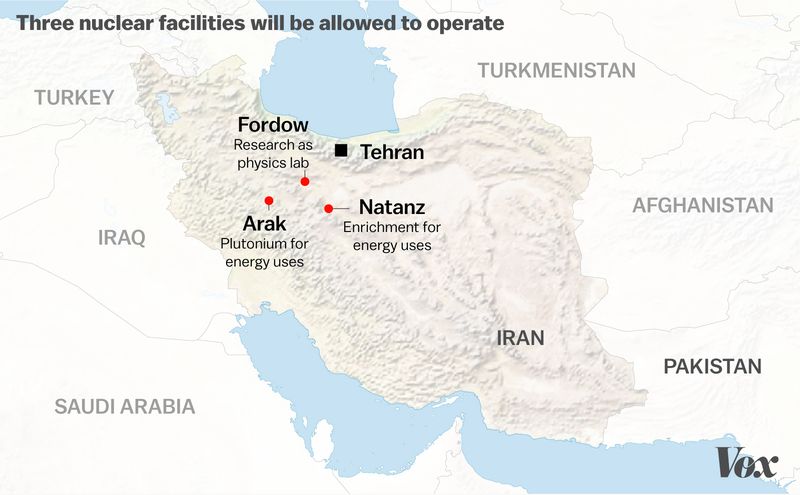
The bold text at the top of the map above is misleading. Iran currently has 18 nuclear facilities and nine additional locations (all hospitals) where nuclear material is used. All of these facilities – not just three, as Vox says – will continue to operate. All of them have long been declared to the International Atomic Energy Agency (IAEA) and all are under agency safeguards and open to regular monitoring and inspection. At least four times a year for the past dozen years, the IAEA has consistently continued to “verify the non-diversion of declared nuclear material at these facilities” to military and weaponization programs.
The three facilities Zarracina focuses on, however, are especially important. Two – Natanz and Fordow – are operational enrichment facilities; the other is a nuclear research reactor still under construction at the Arak complex.
In his explanation of the limitations Iran has accepted on its nuclear program, Zarracina claims the following:
The Arak facility matters because Iran has used it to develop plutonium, another nuclear fuel that can be used for energy or for a weapons program. Iran will be required to restructure its plutonium plant at Arak such that it will only make energy-grade plutonium, and will ship out its spent plutonium. The Arak facility will also be monitored.
Each of Zarracina’s three sentences contains either egregious errors or is explicitly misleading. His explanation is, as a result, just the opposite – an embarrassing exercise in ignorance and disinformation.
Let’s take the sentences one by one:
“The Arak facility matters because Iran has used it to develop plutonium, another nuclear fuel that can be used for energy or for a weapons program.”
For starters, the reactor at Arak remains under construction and has never been operational; therefore, Iran has never – ever – “used it to develop plutonium.” The reactor has in fact never been “used” to do anything. It’s never even been turned on.
Zarracina is clearly confused as to what facilities Arak contains, what those facilities do, and what Iran has done with these facilities. At Iran’s Arak complex, two facilities are relevant in this discussion: one is the IR-40 heavy water research reactor, the other is a heavy water production plant (HWPP). There is no such thing as a “plutonium plant” on the site.
The half-built IR-40 reactor is under full IAEA safeguards and is visited regularly by inspectors; the production plant, however, is not under safeguards and thus not legally subject to inspections. This is less alarming than it might sound and here’s why: heavy water is not nuclear material, it merely acts as a moderator and coolant in nuclear reactors that use natural uranium rather than enriched uranium. Still, Iran voluntarily provided IAEA inspectors access to HWPP in August 2011 and again in December 2013, even though this exceeded Iran’s legal obligations to the agency.
The IR-40 reactor at Arak – like all reactors – produces energy, not nuclear fuel. It runs on nuclear fuel. And once that fuel is used, it becomes irradiated and must be extracted from the reactor and replaced with new fuel.
All reactors that use uranium (natural or enriched) as fuel produce plutonium as a waste product. Ever heard of nuclear waste? Yeah, that includes plutonium, which hypothetically can be used to produce nuclear weapons. The amount of weapons-capable plutonium produced as a byproduct in the spent nuclear fuel of a heavy water reactor is usually more than what naturally occurs in the spent fuel from light water reactors, which run on enriched uranium and use normal water as coolant. This is why the Arak reactor in particular is considered by some to be an unacceptable proliferation risk.
But there’s more: weapons-grade plutonium present in irradiated (used) fuel must be extracted through a process known as reprocessing before it can be used for anything else. Iran has no reprocessing facility and has for years agreed never to build one. The new Iran deal simply reaffirms this past decision.
As nuclear expert Martin Sevior has explained, “Going the plutonium route to nuclear weapons is more difficult than using highly enriched uranium” because Iran “would have to build a sophisticated reprocessing plant which would be very hard to conceal while constructing, and requires even greater skill to conceal while operating.” Considering Iran has the single most scrutinized nuclear energy program on the planet and is constantly spied on by its adversaries,
Vox‘s writers seem to think that once a heavy water reactor is switched on, out pops weapons-grade plutonium, ready to be loaded into the nose cone of a ballistic missile bound for Tel Aviv or Boca Raton. This is not the case.
“Iran will be required to restructure its plutonium plant at Arak such that it will only make energy-grade plutonium, and will ship out its spent plutonium.”
Ok, again, there is no such thing as a “plutonium plant at Arak,” so that’s wrong. As part of the final agreement between Iran and its six negotiating partners, the Arak reactor will be redesigned and rebuilt so that it runs on 3.67% enriched uranium, not natural uranium, and no longer produces weapons-grade plutonium as a waste product. This essentially means Arak will be converted from a heavy water reactor to a light water reactor.
Once operational, the Arak reactor will be used for “peaceful nuclear research and radioisotope production for medical and industrial purposes,” just as Iran originally intended.
Zarracina compounds his misunderstanding of what nuclear reactors do and what they produce with the claim that Iran “will ship out its spent plutonium.” Reactors don’t produce “spent plutonium.” They produce spent uranium, the substance that actual fuels reactors, which, after irradiation, contains (along with many other radioactive byproducts) both plutonium isotopes Pu-239, which is suitable for weapons, and Pu-241, which is not. Plutonium enriched to more than 97% Pu-239 is dangerous; the more it is contaminated by Pu-241, the less danger it poses. The length of time nuclear fuel stays in a reactor determines how much of each plutonium isotope is leftover once the fuel is used up and removed from the reactor core. The longer the fuel stays in the less Pu-239 there is and the more Pu-241 there is. That’s why Pu-239, which is combustible, is referred to as “weapons grade,” while Pu-241 is known as “reactor-” or “energy-grade” plutonium. None of this plutonium, in whatever form, is used to fuel reactors; it is the byproduct of fuel, not the fuel itself.
And, again, for this plutonium byproduct to ever be used in a nuclear weapon, it must first be isolated and extracted from the spent fuel through reprocessing, which Iran is not incapable of – and not interested in – doing.
“The Arak facility will also be monitored.”
Ok, here’s an easy one. In simple terms, yes, Zarracina is correct. Arak will be monitored. But this statement is misleading without context. As mentioned already, Arak is already monitored by the IAEA – this is not a new development as a positive consequence of the Iran deal. Zarracina makes it sound like Iran finally agreed to put Arak under IAEA safeguards, but that’s not even remotely true.
In truth, even before Hassan Rouhani was elected president, Iran’s delegates to the IAEA under Mahmoud Ahmadinejad were urging international “nuclear monitors to use powerful new detection technologies to dispel international concern that the Persian Gulf country is seeking to build atomic weapons,” reported Bloomberg News. “We always welcome the agency to have more sophisticated equipment, to have more accuracy in their measurements, so that technical matters will not be politicized,” Iranian Ambassador to the IAEA Ali Asghar Soltanieh said in early June 2013, adding that Iran “won’t object to IAEA monitors using new technologies to determine whether plutonium is being extracted from spent fuel at its new reactor in Arak.”
Ignoring Facts and Avoiding Responsibility
Writers and editors at Vox have a responsibility not to mislead their readers. Sure, nuclear technology is complex and journalists on deadline don’t always have time to study a lot of the details. But once errors are pointed out, Vox‘s editors should do their best to own up to and correct their mistakes and those of their writers. When it comes to their Iran coverage, this tends not to happen at Vox. Quite the contrary, fact-checking Vox on Iran’s nuclear program often results in hostility and dismissal from Vox staff.
At the very least, Vox should immediately stop referring to the research reactor at Arak as a “plutonium plant.” This is easy to do: call it what it is and stop misleading readers. Instead, due to either a stubborn allegiance to ignorance or extreme laziness, Vox has continued to misinform it audience about the Iranian nuclear program. Unless facile and faulty explanations are its editorial mission, Vox should do better.
Erodoğan and Netanyahu Declare War
By James Petras :: 07.31.2015
The rulers of the two most powerful authoritarian regimes in the Middle East are launching major wars to reconfigure the Middle East. Israeli Prime Minister Netanyahu has declared war by proxy on Iran, announcing full-scale military mobilization within Israel (July 27 -29) and organizing the biggest political campaign of ultra Zionist Jews in Washington.
The purpose of this two-pronged propaganda blitz is to defeat the recently signed US-Iranian agreement and start another major Middle East war. Ultimately, Netanyahu intends to take care of his ‘Palestinian Problem’ for good: complete the conquest and occupation of Palestine and expelling the Palestinian people from their homeland – the single most important foreign policy and domestic goal of the Jewish state. In order to do this, Israeli leaders have had to systematically campaign for the destruction of the Palestinians regional supporters and sympathizers – Iraq, Libya, Syria, Lebanon and Iran.
Erodogan’ s Multiple Wars
At the same time, Turkish Prime Minister Erodogan has launched a major war against the Kurdish people and their aspirations for a Kurdish state. This has followed closely on several recent incidents beginning with the bombing (with cooperation from Turkish intelligence ) of a Kurdish youth camp, killing and wounding scores of young secular activists. Within days of the massacre of Turkish-Kurdish youth, Erodogan ordered his air force to bomb and strafe Kurdish bases within the sovereign territories of Iraq and Syria and Turkish security police have assaulted and arrested thousands of Kurdish nationalists and Turkish leftist sympathizers throughout the country. This has all occurred with the support of the US and NATO who provide cover for Erodogan’s plans to seize Syrian territory, displace Kurdish civilians and fighters and colonize the northern border of Syria – under the pretext of needing a ‘buffer zone’ to protect Turkish sovereignty. Such a massive land grab of hundreds of square kilometers will end the long standing support and interaction among Syrian, Iraqi and Turkish Kurdish populations who have been among the most effective opponents of radical Islamist groups.
Erdogan’s newly declared war on the Kurds has complex domestic and regional components (Financial Times 7/28/15, p 9): Within Turkey, the repression is directed against the emerging electoral-political power of the Kurdish People’s Democratic Party. Erodogan plans to discredit or outright ban this political party, which had won a surprising number of seats in the recent parliamentary election, call for new elections, secure a ‘majority’ in Parliament and assume dictatorial ‘executive powers’.
Regionally, Erodogan’s invasion of Syria is part of his strategy to expand Turkey’s borders southward and westward and to provide a platform from which Turkey’s favorite jihadi clients can launch assaults on the secular government in Damascus and Aleppo. The bombing of Kurdish villages and camps in Iraq and Syria are designed to reverse the Kurd’s military victories against ISIS and will justify greater repression of Kurdish activists backing autonomy in southeastern Turkey.
Erodogan is counting on Turkey’s agreements with the US and NATO for overt and covert collaboration against the Kurds and against Syrian national sovereignty.
Netanyahu’s Proxy Wars
Netanyahu’s multifaceted political offensive is designed to drag the US into a war with Iran. His strategy operates at many levels and in complex complimentary ways. The immediate target is the nuclear agreement recently signed between the White House and Iran. Part of the longer-term strategy to destroy Iran includes the formation of a coalition of Middle East states, especially Gulf monarchies, to encircle, confront and provoke war with Iran. This political-military strategy is being pushed by leading Zionists within the highest circles of the US Government.
All the major Israeli political parties, and most Israeli voters support this dangerous policy against Iran. The Presidents of the 52 Major American Jewish Organizations in the US have been mobilized to bully, bribe and bludgeon the majority of Congress into following Netanyahu’s dictates. Every US Congressperson is being ‘visited’ and presented with propaganda sheets by leaders, activists and full time functionaries of AIPAC, the Jewish Confederations and their billionaire political donors. All the major US press and TV media parrot Netanyahu’s call for ‘war on the peace accord’ despite massive US public opinion against any escalation of the conflict.
At the highest levels of US Executive decision-making top Zionist officials avoid association with AIPAC’s public polemics and thuggish bluster, all the while promoting their own political-military ‘final solution’ … for eliminating Iran as an adversary to Israeli-Jewish supremacy in the Middle East. In the State Department and Departments of Commerce, Defense and Treasury, US-Israeli agents acting as special Middle East advisers, ambassadors and insiders push Netanyahu’s policies to undermine any normalization of relations between the US and Iran.
A recent proposal written by Professor Phillip Zelikow in the Financial Times (7/23/15, p. 9 ) entitled “To Balance (sic) the Nuclear Deal, Defeat ISIS and Confront Iran” is chilling.
The former ‘Executive Director of the ‘9/11 Commission Investigation Report’, uber-insider Zelikow promotes the formation of an ingenious coalition, in the name of fighting ISIS, but whose real purpose is to “confront Iranian ambitions”. Zelikow’s “coalition” includes Turkey, which will be assigned to attack Iran’s regional allies in Syria and Lebanon (Hezbollah) – all in the name of “fighting ISIS”.
The bland, bespectacled and most respectable Professor Zelikow lays out Netanyahu’s own bloody hit list down to the most minute detail – but tidied up with a thin veneer of ‘confronting ISIS’ to obscure his real agenda. This is no blustering AIPAC thug or open Neo-Con war monger beating the drums…
Zelikow’s ‘anti-ISIS coalition’ will ultimately go after the Iraqi Shia militia and their main supporters among Iran’s Revolutionary Guard – hewing closely to Netanyahu’s strategy!
Zelikow was a major inside advocate of the 2003 invasion of Iraq. Twelve years after the US invaded, occupied and destroyed Iraq, Zelikow pops up again to promote a policy of sending US combat troops to serve Israel’s regional interest. He writes, “The military side [of the ‘coalition’] will need more Americans on the ground to offer meaningful combat support among the coalition”. (FT ibid).
Zelikow is clearly aware of US public opinion in favor of diplomacy with Iran and against the US engaging in more ground wars in the Middle East, when he writes that a ‘military effort is not an alternative to diplomacy.” Zelikow and his bosses in the Israeli Foreign Office know any US military intervention with such a “coalition” would lead to the destruction of the US-Iran Agreement and another major ground war with US troops fighting for Israel once again!
Considering his position as a highly connected insider, Zelikow’s attempts to sabotage the Iran-US agreement presents a far greater danger to world peace than all the noisy lobbying by the 52 Zionist organizations active in Congress.
Zelikow has been a highly influential security adviser to the US Executive and State Department since the early 1980’s under Reagan. He was appointed ‘special adviser to the State Department’ in 2007, a position held earlier by Neo-Con operative Wendy Sherman and followed by war-monger, Victoria Nuland. In 2011 President Obama appointed him to the President’s Intelligence Advisory Board.
He came to national prominence when President Bush appointed him Executive Director of the 9/11 Commission where he directed the highly controversial (and highly censored) 9/11 Commission Report against much public opposition. The appointment was made after Bush first choice of Henry Kissinger had created a media storm – Kissinger was never a serious choice with an insider-gatekeeper like Zelikow waiting in the wings. He was a controversial choice because of his role as intimate advisor to Condaleeza Rice and his authorship of the notorious Bush national security strategy promoting pre-emptive war, published in September 2002.
Phillip Zelikow suppressed any discussion of Israel’s role as a major catalyst for US involvements in the Afghan and Iraq wars. As executive-director of the 9/11 Commission Report, Zelikow assumed the role of editor and censor. He ignored the history of Israeli Mossad operations in the US, especially in the run-up to the attack on September 11, 2001. The report made no mention the fake ‘moving’ van filled with Israeli spies arrested on September 11, 2001 while celebrating and photographing the destruction of the World Trade Center complex. Nor did he discuss the quiet ‘deportation’ of the Israeli agents. The report contains no discussion of the scores of phony Israel “art students” who operated in South Florida around US military installations and in the vicinity of the apartment of the alleged 9-11 hijackers. They too were quietly arrested and deported.
He also suppressed discussion of the Defense Department’s ‘Able Danger Project’, which showed US intelligence awareness of the hijackers presence and activities much earlier dating back to 1997.
In October 2001, the first ‘anthrax attack’ occurred – first sickening and killing a photojournalist at a scandal sheet in Florida. National news programs featured an interview with… the re-packaged ‘al Qaeda’ and ‘bioterrorism’ expert Professor Zelikow (his lack of Arabic and scientific credentials notwithstanding…) who declared the anthrax to be ‘weapons grade’ and ‘definitely from a state sponsored military lab’, implying Iraq. (He was correct in the ‘military lab’ part of his declaration – only the facility was the US Weapons Lab at Fort Detrick. Zelikow’s role in accusing the embargoed and beleaguered regime of Iraqi President Saddam Hussein of the anthrax hysteria was crucial in the public build-up for the case to invade Iraq, echoed Israeli Prime Minister Ariel Sharon’s call for the destruction of Iraq. Master-performance complete, ‘scientist’ Zelikow’s interview (among others) has disappeared from the ‘web’.
Zelikow’s ‘expertise’ (such as it is) and usefulness to Israel derives from his articles on the political usefulness of ‘false flags’ and catastrophes – events concocted or instigated by imperialist powers to push a traumatized public into unpopular wars and draconian domestic police state policies. His work has centered on the manipulation and exploitation of ‘events’ to push public policy – and include the Cuban Missile Crisis, the re-unification of Germany, policing Northern Ireland, (but not Middle East studies or bio-weaponry’). His expertise is in the historical use of the ‘public myth’- whether the Riechstag Fire or Pearl Harbor. In Foreign Affairs, November-December 1998, he co-authored an article with the current US Defense Secretary Ashton Carter, entitled Catastrophe Terrorism where a ‘watershed event’ could result in ‘horror and chaos’ pushing the US public to accept the destruction of ‘their civil liberties, wide-spread surveillance, detention and use of deadly force…’
Zelikow continues to push the “false flag” script: In 2001 with the “anthrax hysteria” and now with the “Iran threat hysteria” . . . What is not surprising is that in both instances he hews closely to Israel’s strategic goal of utterly destroying countries, which have opposed Israel’s dispossession, occupation and expulsion of Palestinians – Iraq, Syria, Libya, Lebanon and now Iran.
Zelikow is a long-term, major asset for Israel, working quietly and effectively while the AIPAC bullies break down the doors of Congress. He never held a prominent position in the Cabinet or White House post like the brazen Zion-Cons Wolfowitz, Feith, Libby, Perle, Abrams and Levey who aggressively pushed the country into war with Iraq. Wolfowitz and company have scuttled back into obscurity under the cover of lucrative private positions while Zelikow continues to work inside pushing the Iran war agenda out of the limelight.
Zelikow’s role is far more discrete and important to Israel over the long haul than the loudmouths and thugs of AIPAC and other Zionist fronts. On the surface he pursues his academic and university administrative career (an excellent cover) while repeatedly inserting himself into crucial public discussions and quietly assuming strategic positions to advise on events or policies which have ‘turning point’ consequences and where his deep ties to Israel are never discussed.
Zelikow has one asset, which his bullying and blustering Zionist comrades lack and another which he shares with them. Zelikow is a great con-man – claiming knowledge about anthrax, Middle East relations, and military strategy. He spouts …. pure unadulterated rubbish with authoritative finesse!.. Claiming legal and investigative expertise he controlled the 9/11 Commission Report and denied the American people any open and relevant discussion of the event. He even likened the Commission Report skeptics to ‘an infection’ within American public opinion – apparently relying on his ‘expertise’ in biological warfare…
What Zelikow does have in common with the raging bulls of Zionism is his constant resort to vituperation against any country or movement identified as a target by Israel. He consistently refers to the secular government of Syria (under attack by jihadi terrorists) as a “terrorist regime”. He calls the Iraqi militia fighting ISIS “Shia torture squads”. This is part of a build-up to push the US into ground war for Israel against Iran and its allies.
Unlike Turkey’s Erodogan who uses his own armed forces to launch an all-out war to dispossess, terrorize and colonize ethnic Kurdish territories in Syria, Iraq and Turkey, Israel’s Netanyahu relies on his overseas (US) high level operatives to set in motion the wheels of war. Within days of attacks of September 11, 2001, Israel’s leading mouthpiece in the US Senate, Joseph Lieberman presented the roadmap for US wars for the next decade and a half – declaring that “the US must declare war on Iraq, Syria, Libya, Lebanon and Iran”, despite the complete absence of these countries’ involvement in the event.
Is he a prophet or just a highly successful agent? Zelikow will push for a ‘coalition’ of Middle East dictators and monarchs to fulfill Israel’s dream as dictated by Joseph Lieberman in September 2001. This is a dream of waging devastating war against Iran leading to its partition, similar to the de facto partition of Iraq, Syria and Libya, resulting in a Middle East forever ravaged by sectarian strife, foreign occupations, balkanized and devoid of any possibility of regaining civilized life. Israel can then carry out its brutal final solution: the dispossession and expulsion of all Palestinians and establishment an expanded, purely Jewish state – surrounded by unspeakable destruction and destitution…
Conclusion
Erodogan expands ‘Turkoman frontier’ into Syria and Iraq – despite the fact that Turkey has never shown any interest in the Turkoman minorities. To that end, he allies with ISIS terrorists to uproot Kurds, everywhere extending into Turkey. Erodogan, like, Netanyahu, wants a ‘pure’ ethnic state – one Jewish, the other Turkish! Both brutal leaders have no regard for the sovereignty of neighboring states, let alone the security of their civilian populations. Both depend on the military support of the US. Both are in the process of igniting wider and more destructive wars in the Middle East. Netanyahu and Erodogan want to reconfigure the Middle East: Turkey seizes Kurdistan and Syria; Netanyahu expands military dominance in the Persian Gulf through the destruction of Iran.
These two leaders appear to hate each other because they are so similar in arrogance and action… But according to Professor Zelikow, the US will step in ‘god-like’ to ‘mediate’ the different power grabs among what he mindlessly refers to as the ‘partners of the coalition’.
Why Russia Shut Down NED Fronts
By Robert Parry | Consortium News | July 30, 2015
The Washington Post’s descent into the depths of neoconservative propaganda – willfully misleading its readers on matters of grave importance – apparently knows no bounds as was demonstrated with two deceptive articles regarding Russian President Vladimir Putin and why his government is cracking down on “foreign agents.”
If you read the Post’s editorial on Wednesday and a companion op-ed by National Endowment for Democracy President Carl Gershman, you would have been led to believe that Putin is delusional, paranoid and “power mad” in his concern that outside money funneled into non-governmental organizations represents a threat to Russian sovereignty.
The Post and Gershman were especially outraged that the Russians have enacted laws requiring NGOs financed from abroad and seeking to influence Russian policies to register as “foreign agents” – and that one of the first funding operations to fall prey to these tightened rules was Gershman’s NED.
The Post’s editors wrote that Putin’s “latest move, announced Tuesday, is to declare the NED an ‘undesirable’ organization under the terms of a law that Mr. Putin signed in May. The law bans groups from abroad who are deemed a ‘threat to the foundations of the constitutional system of the Russian Federation, its defense capabilities and its national security.’
“The charge against the NED is patently ridiculous. The NED’s grantees in Russia last year ran the gamut of civil society. They advocated transparency in public affairs, fought corruption and promoted human rights, freedom of information and freedom of association, among other things. All these activities make for a healthy democracy but are seen as threatening from the Kremlin’s ramparts. …
“The new law on ‘undesirables’ comes in addition to one signed in 2012 that gave authorities the power to declare organizations ‘foreign agents’ if they engaged in any kind of politics and receive money from abroad. The designation, from the Stalin era, implies espionage.”
But there are several salient facts that the Post’s editors surely know but don’t want you to know. The first is that NED is a U.S. government-funded organization created in 1983 to do what the Central Intelligence Agency previously had done in financing organizations inside target countries to advance U.S. policy interests and, if needed, help in “regime change.”
The secret hand behind NED’s creation was CIA Director William J. Casey who worked with senior CIA covert operation specialist Walter Raymond Jr. to establish NED in 1983. Casey – from the CIA – and Raymond – from his assignment inside President Ronald Reagan’s National Security Council – focused on creating a funding mechanism to support groups inside foreign countries that would engage in propaganda and political action that the CIA had historically organized and paid for covertly. To partially replace that CIA role, the idea emerged for a congressionally funded entity that would serve as a conduit for this money.
But Casey recognized the need to hide the strings being pulled by the CIA. “Obviously we here [at CIA] should not get out front in the development of such an organization, nor should we appear to be a sponsor or advocate,” Casey said in one undated letter to then-White House counselor Edwin Meese III – as Casey urged creation of a “National Endowment.”
NED Is Born
The National Endowment for Democracy took shape in late 1983 as Congress decided to also set aside pots of money — within NED — for the Republican and Democratic parties and for organized labor, creating enough bipartisan largesse that passage was assured. But some in Congress thought it was important to wall the NED off from any association with the CIA, so a provision was included to bar the participation of any current or former CIA official, according to one congressional aide who helped write the legislation.
This aide told me that one night late in the 1983 session, as the bill was about to go to the House floor, the CIA’s congressional liaison came pounding at the door to the office of Rep. Dante Fascell, a senior Democrat on the House Foreign Affairs Committee and a chief sponsor of the bill. The frantic CIA official conveyed a single message from CIA Director Casey: the language barring the participation of CIA personnel must be struck from the bill, the aide recalled, noting that Fascell consented, not fully recognizing the significance of the demand.
The aide said Fascell also consented to the Reagan administration’s choice of Carl Gershman to head the National Endowment for Democracy, again not recognizing how this decision would affect the future of the new entity and American foreign policy. Gershman, who had followed the classic neoconservative path from youthful socialism to fierce anticommunism, became NED’s first (and, to this day, only) president.
Though NED is technically independent of U.S. foreign policy, Gershman in the early years coordinated decisions on grants with Raymond at the NSC. For instance, on Jan. 2, 1985, Raymond wrote to two NSC Asian experts that “Carl Gershman has called concerning a possible grant to the Chinese Alliance for Democracy (CAD). I am concerned about the political dimension to this request. We should not find ourselves in a position where we have to respond to pressure, but this request poses a real problem to Carl.”
Currently, Gershman’s NED dispenses more than $100 million a year in U.S. government funds to various NGOs, media outlets and activists around the world. The NED also has found itself in the middle of political destabilization campaigns against governments that have gotten on the wrong side of U.S. foreign policy. For instance, prior to the February 2014 coup in Ukraine, overthrowing elected President Viktor Yanukovych and installing an anti-Russian regime in Kiev, NED was funding scores of projects.
A second point left out of the Post’s editorial was the fact that Gershman took a personal hand in the Ukraine crisis and recognized it as an interim step toward regime change in Moscow. On Sept. 26, 2013, Gershman published an op-ed in the Washington Post that called Ukraine “the biggest prize” and explained how pulling it into the Western camp could contribute to the ultimate defeat of Russian President Putin.
“Ukraine’s choice to join Europe will accelerate the demise of the ideology of Russian imperialism that Putin represents,” Gershman wrote. “Russians, too, face a choice, and Putin may find himself on the losing end not just in the near abroad but within Russia itself.” In other words, NED is a U.S. government-financed entity that has set its sights on ousting Russia’s current government.
A third point that the Post ignored is that the Russian law requiring outside-funded political organizations to register as “foreign agents” was modeled on a U.S. law, the Foreign Agent Registration Act. In other words, the U.S. government also requires individuals and entities working for foreign interests and seeking to influence U.S. policies to disclose those relationships with the U.S. Justice Department or face prison.
If the Post’s editors had included any or all of these three relevant factors, you would have come away with a more balanced understanding of why Russia is acting as it is. You might still object but at least you would be aware of the full story. By concealing all three points, the Post’s editors were tricking you and other readers into accepting a propagandistic viewpoint – that the Russian actions were crazy and that Putin was, according to the Post’s headline, “power mad.”
Gershman’s Op-Ed
But you might think that Gershman would at least acknowledge some of these points in his Post op-ed, surely admitting that NED is financed by the U.S. government. But Gershman didn’t. He simply portrayed Russia’s actions as despicable and desperate.
“Russia’s newest anti-NGO law, under which the National Endowment for Democracy on Tuesday was declared an “undesirable organization” prohibited from operating in Russia, is the latest evidence that the regime of President Vladimir Putin faces a worsening crisis of political legitimacy,” Gershman wrote, adding:
“This is the context in which Russia has passed the law prohibiting Russian democrats from getting any international assistance to promote freedom of expression, the rule of law and a democratic political system. Significantly, democrats have not backed down. They have not been deterred by the criminal penalties contained in the ‘foreign agents’ law and other repressive laws. They know that these laws contradict international law, which allows for such aid, and that the laws are meant to block a better future for Russia.”
The reference to how a “foreign agents” registration law conflicts with international law might have been a good place for Gershman to explain why what is good for the goose in the United States isn’t good for the gander in Russia. But hypocrisy is a hard thing to rationalize and would have undermined the propagandistic impact of the op-ed.
So would an acknowledgement of where NED’s money comes from. How many governments would allow a hostile foreign power to sponsor politicians and civic organizations whose mission is to undermine and overthrow the existing government and put in someone who would be compliant to that foreign power?
Not surprisingly, Gershman couldn’t find the space to include any balance in his op-ed – and the Post’s editors didn’t insist on any.
~
Investigative reporter Robert Parry broke many of the Iran-Contra stories for The Associated Press and Newsweek in the 1980s. You can buy his latest book, America’s Stolen Narrative, either in print here or as an e-book (from Amazon and barnesandnoble.com).
In NY Times the Fate of One Israeli Soldier Trumps Massive Suffering in Gaza
By Barbara Erickson | Times Warp | July 30, 2015
“Black Friday: Carnage in Rafah,” a new report by Amnesty International, has drawn international media attention with its accounts of destruction and suffering during four days of the Gaza conflict last year. Headlines worldwide announce charges of Israeli war crimes, and photos present readers with towering columns of smoke, smoldering ruins and grieving Palestinians.
It is a story of suffering on a massive scale, but in reporting this narrative The New York Times has chosen to look not at Gaza and its agony but, once again, at Israel. Thus we find an article that gives focus to Israeli losses—a soldier missing in action, his comrades at arms and his bereaved family. The photo is of two Israeli parents grieving by a tombstone.
In her story, “Signs of War Crimes Seen in Israeli Hunt for Ambushed Soldier,” Isabel Kershner imposes this twist on a story of Palestinian suffering and Israeli atrocities by overplaying one element of the narrative: The attacks on the southern Gaza city of Rafah came after Lt. Hadar Goldin was captured on Aug. 1 and were a response to this event.
After Lt. Goldin was seized and taken into a tunnel, the Israeli army put its notorious “Hannibal Directive” into effect. This, in the words of the Amnesty report, is “a controversial command designed to deal with captures of soldiers by unleashing massive firepower on persons, vehicles and buildings in the vicinity of the attack, despite the risk to civilians and the captured soldier(s).”
Kershner builds her story not around the findings of the report, but the capture of Lt. Goldin and the reactions of his family and comrades. Thus, the article opens with the moment his unit realized he was missing, it refers to him throughout and ends with the comments of his grieving parents.
In all, Kershner mentions Lt. Goldin in some 13 paragraphs, nearly half the article. Readers find news of the report in her piece, including the most vehement condemnations by Amnesty officials, but her angle undercuts the thrust of the document. (Readers might want to compare accounts in The Independent, Al Jazeera or Newsweek, among others.)
The report is the work of Amnesty and Forensic Architecture, a British research group. It presents a meticulous analysis of the attacks on Rafah from Aug. 1 through Aug. 4 last year, describing numerous assaults that left at least 135 dead, including 75 children. It contains chilling accounts of events on the ground: desperate attempts to escape, strikes on ambulances and residents blasted into fragments.
The investigation found “overwhelming evidence that Israeli forces committed disproportionate, or otherwise indiscriminate attacks, which killed scores of civilians in their homes, on the streets or in vehicles, and injured many more.” It goes on to say, “In some cases there are indications that they directly fired at and killed civilians, including people fleeing.”
These findings provide “strong evidence” of “serious violations of international humanitarian law,” the report states, as well as “other war crimes.” Kershner, however, attempts to cast doubt on the aims of the report in one sentence that steps outside the bounds of reporting into editorializing.
She writes, “[The report] tries to offer the most detailed reconstruction of the events of Black Friday to date, in hopes of bolstering allegations against Israel that are now the subject of a preliminary investigation before the International Criminal Court in The Hague.”
In other words, Kershner says, Amnesty and Forensic Architecture are motivated by a desire to delegitimize Israel, and their analysis is merely an attempt to be “the most detailed.”
It seems that the Times was reluctant to tell this story. The problem, once again, was how to report the news of yet another damning report and at the same time to shield Israel, and so we have an awkward piece, one that tries to mesh two opposing narratives: the fate of Lt. Goldin and the disclosure of Israeli war crimes in Rafah.
The result is a confusing combination of reporting and obfuscation, a frequent outcome of the Times’ effort to serve Israeli interests over those of the reading public.
Featured Video

Liberty Cannot Exist Inside a Panopticon
or go to
Aletho News Archives – Video-Images
From the Archives
Left-leaning despisers of 9/11 Truth movement: Do you really believe in miracles?
David Ray Griffin | Global Research | 06 Jul 2010
An Open Letter to Terry Allen, Noam Chomsky, Alexander Cockburn, David Corn, Chris Hayes, George Monbiot, Matthew Rothschild, and Matt Taibbi.
[1]According to several left-leaning critics of the 9/11 Truth Movement, some of its central claims, especially about the destruction of the World Trade Center, show its members to be scientifically challenged. In the opinion of some of these critics, moreover, claims made by members of this movement are sometimes unscientific in the strongest possible sense, implying an acceptance of magic and miracles. … Full article
Blog Roll
 Aletho News
- White House envoy declares kinetic action against Yemen ‘fruitless’
- Ukraine deployed thousands of microdrones in Iraqi Kurdistan: Tasnim
- Iran calls for emergency UNSC meeting over Trump’s ‘brazen’ bomb talk, Israeli threats
- Iranian sources reveal details of Russia-China Hormuz proposal
- Plan for more US-Israel integration puts our military tech at risk
- Another Round Against Iran Will Break What Is Left of the Gulf
- SVR Report on Ukraine’s Mexican Drug Gang Links Could Pressure Zelensky, Won’t Change US Policy
- British Government Employees Were Fact-Checking the News at the BBC. Nobody Told You.
- Albania on fire: who’s behind the riots?
- Egypt’s Civil Democratic Movement rejects involvement in regional war
- If Americans Knew
- Mysterious bot accounts reportedly spread fake ‘man on the street’ videos for Michigan Senate candidate
- Israeli Defense Minister Katz Says Over 60 Lebanon Villages Have Been Destroyed
- Why Is Israel Running TV Ads in Iowa Ahead of the Midterms?
- Hind Rajab’s Alleged Killer Is in the United States. HRF Demands His Arrest.
- US Officials Face Fresh Pressure After Another American ‘Brutalized’ by Israeli Settlers in West Bank
- Israel-Backed Palestinian Militias Terrorize Displaced Families in Gaza
- FBI subpoenas pro-Palestine activists over Israeli weapons plant disruption
- Fourth winter arrives in wartorn Gaza, too early – Daily Update
- More on how Bari Weiss is using CBS on behalf of Israel
- What the UK Is Doing to Pro-Palestine Novelist Sally Rooney Is an Act of Orwellian Villainy
- No Tricks Zone
- Predictions Made By Renowned Climate Proifessor Over Past Decades Have Been Proven To Be Poor
- New Study Suggests Large Regions Of The Pacific Ocean Have Been Cooling For The Last 80 Years
- Germany’s Green Energy Debacle: High Energy Costs Force Kahla Porzellan to Close After 182 Years!
- New Study: 50 Years Of The Most Aggressive ‘Net Zero’ Policies Can Only Affect The Global Climate By 0.03°C
- US September “Heat” Was No Record…Many Records Set Decades Ago
- Latest European Green Energy Debacle; Portugal’s Largest Flagship Solar Park Insolvent!
- Green Energy Debacle: German Expert Professor Fritz Vahrenholt Warns Of Severe Economic And Social Consequences
- Two More Paleo Reconstructions Affirm Meters-Higher Sea Levels Across Ireland, Brazil 7000-6000 Years Ago
- New Study: Earth And Venus Surface Warmth Largely Explained By Convection And Lapse Rate, Not CO2 Or Radiation
- 2025 Nature Paper Claiming Worsening Global Drought Gets RETRACTED …Heavily Flawed