Obama and Kerry Play with Fire on Iran Agreement
By Sheldon Richman | Free Association | July 29, 2015
Barack Obama and John Kerry are playing with fire. They presumably want Congress and the American public to accept the nuclear agreement they and four other governments struck with Iran, but they work against their own objective by accepting the false premise of their opponents: namely, that Iran’s regime is untrustworthy, dangerous, bent on becoming a nuclear power — and containable only by a U.S. readiness to wage war.
Who knows if the president and secretary of state really believe this? But they ought to know that this premise is wrong.
Their incentive to accept the false premise is obvious. Neither wants his obituary to declare that his greatest achievement was to persuade Iran not to develop a weapon it had no intention of developing.
On announcing the deal Obama said, “Today, because America negotiated from a position of strength and principle, we have stopped the spread of nuclear weapons in this region. Because of this deal, the international community will be able to verify that the Islamic Republic of Iran will not develop a nuclear weapon.”
Likewise in remarks to the Senate Foreign Relations Committee last week, Kerry said, “So this isn’t a question of giving them [Iran] what they want. I mean it’s a question of how do you hold their program back, how do you dismantle their weapons program….”
Hence, Obama and Kerry endorse the claim that Iran was seeking to build nuclear weapons. The long negotiating process was based on that premise. So they must now insist that the agreement contains leak-proof verification, because like their opponents, Obama and Kerry say the Iranians cannot be trusted. But the hawks demagogically ignore that part of the administration’s case and claim the agreement does depend on trust; Iran can and will cheat, the hawks say, no matter what verification measures are in place. They can even quote Wendy Sherman, leader of the U.S. negotiating team, who once told a Senate committee, “We know that deception is part of the [Iranian] DNA.”
That’s some great way for Obama and Kerry to sell their agreement.
It would be better for Obama and Kerry to tell the truth for once: Iran has not been seeking a nuclear bomb. This has long been well-understood by American and Israeli intelligence and military agencies. As former CIA analyst Ray McGovern points out, George W. Bush had to give up plans to attack Iran in 2007 because a National Intelligence Estimate signed by all 16 U.S. intelligence agencies found that Iran had stopped (alleged) research on nukes four years earlier. This conclusion was renewed regularly in subsequent years. In fact, as Gareth Porter notes, “US national intelligence estimates during the Bush administration concluding that Iran had run such a program, including the most famous estimate issued in November 2007, were based on inference, not on hard intelligence.”
We have many other indications of Iran’s non-interest in nukes, all of which are documented by Porter, the man who literally wrote the book on the case. (See Manufactured Crisis: The Untold Story of the Iran Nuclear Scare.) We know, for example, that Iran’s Supreme Leader, Ali Khamenei, issued a religious edict (fatwa) against nuclear weapons. We know that when Iran could have bought weapons-related equipment from an illegal Pakistani network, it did not. We know that for years Iran tried every way to avoid having to enrich uranium for its power plants but was thwarted each time by the U.S. government. Finally, we know that when the Iranian government could have made chemical weapons to retaliate for Iraq’s U.S.-backed chemical warfare against Iran in the 1980s, then-Supreme Leader Ruhollah Khomeini forbade it on religious grounds.
Despite this, it is open season on Iran. Most everyone feels he can level any charge against it without providing a scintilla of evidence. Most common is the charge that Iran is the “chief state sponsor of terrorism.” But does anyone bother to prove it? It requires no proof. It’s the Big Lie, and it serves the war party’s agenda. (For evidence to the contrary see these two pieces by Ted Snider.
The P5+1 agreement, though unnecessary, is preferable to war. Obama and Kerry should stop thinking about their legacies and start leveling with us.
Russia to veto MH17 tribunal draft at UN Security Council
RT | July 29, 2015
Russia is expected veto a draft UN Security Council resolution calling for an international tribunal to be formed to probe the downing of a Malaysian airliner last year. President Putin said he regretted that a compromise deal could not be worked out.
The Russian president explained to Dutch Prime Minister Mark Rutte why Russia would not support the establishment of a tribunal into the downing of Malaysia Airlines flight MH17 in a phone call, the Kremlin said.
Moscow opposed the draft document submitted by Malaysia and supported by several nations, including The Netherlands and Ukraine, saying that its description of the tragedy as a threat to international security is a strained interpretation meant to subject it to the council’s authority.
“We believe it is not in the UN charter. The UN Security Council is not supposed to deal with issues like this,” Russian UN envoy Vitaly Churkin said, adding that Russia would veto the document.
The Security Council ordered creation of special tribunals to tackle several cases, including war crimes committed during the Balkan wars and the genocide in Rwanda. But Russia believes it would be wrong to treat the MH17 downing differently from other similar incidents with civilian aircraft, such as the downing of Iran Air flight 655 by the US in 1988 or the downing of Korean Air Lines flight 007 by Soviet Union in 1983. The call for a tribunal is confrontational, Moscow believes.
An alternative draft resolution proposed by Russia and seen by RT called for more transparency in the ongoing investigation of the MH17 incident by the Dutch authorities. It also criticized UN Secretary General Ban Ki-moon for a failure to appoint a special representative to tackle the case.
Malaysia Airlines flight MH17 was shot down on July 21 as it was flying over a war zone, where Ukrainian armed forces were fighting against rebels, who rejected the new government imposed by an armed coup in Kiev. The tragedy has been the subject of much speculation, with Kiev and its foreign sponsors accusing the rebels of taking down the plane with a Russia-supplied missile.
The rebels rejected the accusations and blamed the Ukrainian army for the downing. Moscow denied supplying anti-aircraft missiles to the rebels and made public evidence of Ukrainian military activities in the area.
A preliminary report by the Dutch investigators in September 2014 confirmed that the Boeing airliner was taken down by an outside force, but did not indicate which side could have carried out such an attack even what kind of weapon was used. The final report is still being completed.
READ MORE: ‘A year without truth’: MH17 relatives, independent investigators want ‘facts not propaganda’
China’s NGO Law: Countering Western Soft Power and Subversion
By Eric Draitser – New Eastern Outlook – 25.07.2015
China has recently taken an important step in more tightly regulating foreign non-governmental organizations (NGOs) inside the country. Despite condemnation from so called human rights groups in the West, China’s move should be understood as a critical decision to assert sovereignty over its own political space. Naturally, the shrill cries of “repression” and “hostility toward civil society” from western NGOs have done little to shake the resolve of Beijing as the government has recognized the critical importance of cutting off all avenues for political and social destabilization.
The predictable argument, once again being made against China’s Overseas NGO Management Law, is that it is a restriction on freedom of association and expression, and a means of stifling the burgeoning civil society sector in China. The NGO advocates portray this proposed legislation as another example of the violation of human rights in China, and further evidence of Beijing’s lack of commitment to them. They posit that China is moving to further entrench an authoritarian government by closing off the democratic space which has emerged in recent years.
However, amid all the hand-wringing about human rights and democracy, what is conveniently left out of the narrative is the simple fact that foreign NGOs, and domestic ones funded by foreign money, are, to a large extent, agents of foreign interests, and are quite used as soft power weapons for destabilization. And this is no mere conspiracy theory as the documented record of the role of NGOs in recent political unrest in China is voluminous. It would not be a stretch to say that Beijing has finally recognized, just as Russia has before it, that in order to maintain political stability and true sovereignty, it must be able to control the civil society space otherwise manipulated by the US and its allies.
‘Soft Power’ and the Destabilization of China
Joseph Nye famously defined ‘soft power’ as the ability of a country to persuade others and/or manipulate events without force or coercion in order to achieve politically desirable outcomes. And one of the main tools of modern soft power is civil society and the NGOs that dominate it. With financial backing from some of the most powerful individuals and institutions in the world, these NGOs use the cover of “democracy promotion” and human rights to further the agenda of their patrons. And China has been particularly victimized by precisely this sort of strategy.
Human Rights Watch, and the NGO complex at large, has condemned China’s Overseas NGO Management Law because they quite rightly believe that it will severely hamper their efforts to act independently of Beijing. However, contrary to the irreproachable expression of innocence that such organizations masquerade behind, the reality is that they act as a de facto arm of western intelligence agencies and governments, and they have played a central role in the destabilization of China in recent years.
Undoubtedly the most highly publicized example of just such political meddling took place in 2014 with the much hyped “Occupy Central” movement in Hong Kong, also known as the Umbrella Movement. The Western media fed uninformed news consumers story after story about a “pro-democracy” movement seeking to give voice to, as White House spokesman Josh Earnest cynically articulated, “…the aspirations of the Hong Kong people.” But such vacuous rhetoric was only part of the story.
What the corporate media in the West failed to mention were the deeply rooted connections between the Occupy Central movement and key organs of US soft power. The oft touted leader of Occupy Central was a pro-Western academic named Benny Tai, a law professor at the University of Hong Kong. Though he presented himself as the leader of a grassroots mass movement, Mr. Tai has for years been partnered with the National Democratic Institute (NDI), a nominal NGO which is actually directly funded by the US State Department via the National Endowment for Democracy (NED). In fact, the NDI has been one of the leading advocates (and financial backers presumably) of the Center for Comparative and Public Law at the University of Hong Kong, a program with which Benny Tai has been intimately connected, including as a board member since 2006. So, far from being merely an emerging leader, Tai was a carefully selected point person for a US-sponsored color revolution-style movement.
Two other high profile figures involved with Occupy Central were Audrey Eu, founder of the Civic Party in Hong Kong, and Martin Lee, founding chairman of the Democrat Party of Hong Kong. Both Eu and Lee have long-standing ties to the US government through the NED and NDI, with Eu having been a frequent contributor to NDI sponsored panels and programs, and Lee having the glorious distinction of having both been a recipient of awards from NED and NDI, as well as meeting with US Vice President Joe Biden in 2014 along with anti-Beijing advocate Anson Chan.
It does not take exceptional powers of deduction to see that, to varying degrees, Tai, Eu, Lee, and Chan each act as the public face of a US Government-sponsored initiative to destabilize the political situation in Hong Kong, one of China’s most economically and politically important regions. Through the intermediary of the NGO, Washington is able to promote an anti-Beijing line under the auspices of “democracy promotion,” just as it has done everywhere from Ukraine to Venezuela. Luckily for China, the movement was not supported by either the bulk of the working class in Hong Kong and China, or even by many of the middle class who saw it as little more than an inconvenience at best. However, it required swift government action to contain the public relations and media fiasco that could have resulted from the movement, a fact of which Beijing, no doubt, took note.
As a spokesperson for the National People’s Congress explained in April, the NGO law is necessary for “safeguarding national security and maintaining social stability.” Indeed, in late 2014, in the wake of the Occupy Central protests, Chinese President Xi Jinping traveled to Macau and spoke of the need to ensure that Macau walked on the “right path.” In a thinly veiled reference to Hong Kong, Xi praised Macau for continuing to follow the “one country, two systems” policy under which the special administrative regions of Macau and Hong Kong have greater autonomy but are still subject to Chinese law. Essentially, Xi made it quite clear that, despite the foreign NGO-manufactured movement in Hong Kong, Beijing remained firmly in control. And this is precisely the issue: control.
NGOs, Soft Power, and Terror in Xinjiang
The NGO ‘soft power’ weapon is not relegated solely to Hong Kong however. In fact, the western Chinese province of Xinjiang, one of the most volatile regions in the country, has seen active destabilization and subversion by soft power elements consistently over recent years. Home to the majority Muslim Uighur ethnic group, Xinjiang has been repeatedly attacked both with terrorism and vile propaganda that has sought to paint to China as the oppressor and enemy of Uighurs, and Muslims generally.
Xinjiang has been victim to a number of deadly terrorist attacks in recent years, including the heinous drive-by bombings that killed dozens and injured over 100 people in May 2014, the mass stabbings and bombings of November 2014, and the deadly attack by Uighur terrorists on a traffic checkpoint just last month which left 18 people dead. Were such attacks, which claimed the lives of scores of innocent Chinese citizens, to have been carried out against, say, Americans, the western media would be all but declaring holy jihad against the entire world. However, since they’ve happened in China, these are merely isolated incidents that are due to the “marginalization” and “oppression” of the Uighur people by the big bad Chinese authorities.
Such a sickeningly biased narrative is in no small part due to the NGO penetration of the Uighur community and a vast public relations network funded directly by the US Government. The same National Endowment for Democracy (NED) which has disbursed funds to the NDI and other organizations involved in the Hong Kong destabilization of “Occupy Central,” has been a primary funder of the Uighur NGO complex.
The following organizations have each received significant financial support from the NED through the years: World Uighur Congress, Uighur American Association, International Uighur Human rights and Democracy Foundation, and the International Uighur PEN Club, among others. These NGOs are quite often the sources cited by western media for comments on anything related to Xinjiang and are almost always quick to demonize Beijing for all problems in the region, including terrorism.
Perhaps the best example of just such propaganda and dishonesty came in the last few weeks as western media was flooded with stories making the spurious allegation that China had banned the observance of Ramadan in Xinjiang. Indeed, there were literally hundreds of articles condemning China for this “restriction of religious freedom,” portraying the Chinese government as repressive and a violator of human rights. Interestingly, the primary source for the claim was none other than the NED-funded World Uighur Congress.
Moreover, in mid July, on the day of Eid al-Fitr (the final day of Ramadan), the Wall Street Journal ran a story covering the media push-back from China which has sought in recent weeks to publicize the fact that Xinjiang, and all of China, has celebrated openly for Ramadan. And, as one should come to expect, the anti-China source cited is, as usual, a representative of the World Uighur Congress. It seems that this organization, far from being merely a human rights advocate, is in fact a mouthpiece for US propaganda against China. And when the propaganda is challenged and discredited by China, well that just invites new and more blistering propaganda.
The Geopolitical Footprints
All of this demonization has taken on a clear geopolitical and strategic significance as Turkey has stepped into the fray condemning China for its alleged “persecution” of Uighur Muslims, whom Ankara sees as Turks from its neo-Ottoman revanchist perspective. The Turkish Foreign ministry said in a statement that “Our people have been saddened over the news that Uighur Turks have been banned from fasting or carrying out other religious duties in the Xinjiang region… Our deep concern over these reports have been conveyed to China’s ambassador in Ankara.”
China responded to what it deemed to be inappropriate comments from Turkey’s Foreign Ministry, especially in light of Turkey’s absurd characterization of the Uighurs (who are Chinese citizens) as “Turks.” China’s Foreign Ministry Spokeswoman Hua Chunying stated, “China has already demanded that Turkey clarify these reports and we have expressed concern about the statement from the Turkish foreign ministry… You should know that all the people of Xinjiang enjoy the freedom of religious belief accorded to them by the Chinese constitution.”
While the Chinese government, as it almost always does, used decidedly muted language to express its displeasure, the implications of the statement were not lost on keen political observers with some understanding of the China-Turkey relationship. Although the two countries have many aligned interests, as evidenced by Turkey’s repeatedly expressed desire to join the Shanghai Cooperation Organization (SCO), the little known fact is that Turkey is one of the major facilitators of terrorism in China.
Though it received almost no fanfare from international media, in January 2015 Chinese authorities arrested at least ten Turkish suspects alleged to have organized and facilitated the illegal border crossings of a number of Uighur extremists. It has further been revealed that these extremists were planning to travel to Syria, Afghanistan, and Pakistan to train and fight with fellow jihadis.
The story is still further evidence of a well-funded, well-organized international terror network operated and/or facilitated by Turkish intelligence. According to the Turkish Foreign Ministry, the ten Turkish citizens were arrested in Shanghai on November 17, 2014 for facilitating illegal immigration. While the formal charges against them range from forging documents to actually aiding illegal migration, it is the larger question of international terrorism that lurks beneath the surface. Because of course, as the evidence seems to indicate, these Uighur immigrants were not merely traveling to see loved ones in another country. On the contrary, they were likely part of a previously documented trend of Uighur extremists traveling to the Middle East to train and fight with the Islamic State or other terror groups.
It is these same extremist networks that carried out the aforementioned deadly bombing in Urumqi, capital of Xinjiang. In fact, precisely this trend was exposed two months earlier in September 2014 when Reuters reported that Beijing formally accused militant Uighurs from Xinjiang of having traveled to Islamic State-controlled territory to receive training. Further corroborating these accusations, the Jakarta Post of Indonesia reported that four Chinese Uighur jihadists had been arrested in Indonesia after having travelled from Xinjiang through Malaysia. Other, similar reports have also surfaced in recent months, painting a picture of a concerted campaign to help Uighur extremists travel throughout Asia, communicating and collaborating with transnational terror groups such as the Islamic State.
So, Uighur terrorists with forged documents provided by sources inside Turkey are implicated as being part of the same terror networks that carried out a series of deadly attacks on Chinese citizens and police. No wonder China is not exactly bending over backwards to dry Erdogan’s and the Turkish government’s crocodile tears. And yet, despite the terror war, the US-funded Uighur NGOs continue to portray China as responsible for the terrorism.
The destabilization of China takes many forms. From a manufactured protest movement in Hong Kong sponsored by NGOs connected to the US government, to a fabricated propaganda war peddled by other NGOs sponsored by the US government, to a terror war fomented by a NATO member, China is a nation under assault by soft and hard power. That Beijing is finally taking steps to curb the pernicious influence of such NGOs, and the forces they represent, is not only a positive step, it’s an absolutely necessary one. The national security and national sovereignty of the People’s Republic of China requires nothing less.
New York Times: Outcry Over Susiya Nothing but Clever PR
By Barbara Erickson | Times Warp | July 24, 2015
Susiya, a West Bank village under threat of demolition, has now made it into the pages of The New York Times news section, and we are permitted a view of how Israel wants us to see this disturbing story: All the fuss about Susiya is little more than the result of clever marketing on the part of the villagers.
Thus we find a story today by Diaa Hadid titled (in the online version) “How a Palestinian Hamlet of 340 Drew Global Attention.” This primes readers from the start to expect a tale of simple villagers who devised a winning media strategy, and it distracts from the real issue, which is nothing less than ethnic cleansing: Susiya is to be destroyed to make way for Jewish settlers.
High in her story Hadid writes, in a telling phrase, that “the cause of [this] tiny village” has become “outsized,” in other words overblown, as if Susiya, with its population of 300 or so, is not worth the fuss.
The village first got notice when “sympathetic” foreigners visited Susiya some 20 years ago and took up its cause, Hadid states. By that time the residents had been forced out of their original homes and were living near the centuries-old site that had belonged to their ancestors.
Jewish settlers had taken over the original village in 1986, she writes, and Israeli forces made them move on again them in 1990 “for unknown reasons.” They were expelled once more in 2001, according to Hadid, “as collective punishment over the shooting death of a Jewish settler.”
Her story omits a crucial detail: The authorities knew that the villagers were innocent of the killing but used the incident as an excuse to harass the Susiya residents once more. The Times account leaves the impression that a Susiya resident was responsible for the settler’s death.
Hadid quotes a staff member of B’Tselem, an Israeli rights group, who notes that residents “have managed to place Susiya on the international agenda in ways that other villages have not managed to do,” and her story goes on to say that “years of advocacy appeared to pay off when Susiya’s residents began warning early this month that their village was under threat.”
As a result, the story reports, Susiya received visits from a European Union delegation, Israeli activists and American consular officials. Then, a week ago, the U.S. State Department mentioned Susiya in a press briefing and urged Israel to spare the village.
The Times story suggests that Susiya has received this backing because of its skill in winning attention, and by imposing this angle on the story, the newspaper is attempting to divert readers from the real issues at play: the fact that Israel’s treatment of the villagers is blatantly racist and defies the norms of international and humanitarian law.
Also missing is the context of occupation and dispossession that is crushing Susiya and other villages. Hadid fails to give any sense of this. She writes only that activists have used the village as a symbol of how Israel “has sought to maintain control over large parts of the occupied West Bank.”
We find the word “occupied” here, as usual in Times reporting, but it is devoid of meaning. Readers do not hear that the West Bank is Palestinian territory; that Israel is there as an invading military force; and that the settlements violate international law, which forbids an occupying power from transferring its own population into the foreign territory.
The Times story makes no reference to international law, but it does quote an Israeli military spokesman who says Susiya “was built illegally.” Thus Hadid emphasizes the pretext of legality Israel draws over its defiance of international norms while she ignores the flagrant breaches of the Geneva Convention and other standards.
Readers can pick up some revealing details in the story: the ousted villagers’ descriptions of sleeping outside “in the wild, in the rain,” the fact that they can no longer access two- thirds of their original land because of the settlers, the expectation that if Susiya goes, other vulnerable villages will also fall to Israel’s greed for Palestinian land.
But the story glosses over these details to present the Susiya’s case as above all a successful publicity effort. The Times would have us believe that the real story here is how the village became an “outsized” international cause, through “years of advocacy.”
Susiya is just one of many villages in Israel’s Negev and in the occupied West Bank where Israel is determined to ethnically cleanse certain areas of their indigenous inhabitants and install Jewish residents in their place. Times readers are finally learning about Susiya only because international attention has forced the newspaper to acknowledge the issue.
The village should have been known to readers long before now, just as they should also know of dozens more facing annihilation: Al Araqib, Umm Al Kher and Khirbet Yarza, to name just a few. In the South Hebron Hills alone, where Susiya is located, some 30 villages are faced with demolition.
But even now the Times can’t just tell the story of a village nearly helpless under the weight of Israeli might, a community faced with extinction after centuries of living on the land. Instead we find an effort to play down the tragedy, to present it as an overblown cause, not really worth our concern.
Israel Clears the Bench in Iran Fight
By Robert Parry | Consortium News | July 24, 2015
Israel’s Ambassador to the United States Ron Dermer, acting like the coach of a football team, instructed congressional Republicans to “leave everything on the field” in the fight to defeat the international agreement with Iran over its nuclear energy program, a sign of how openly Israel now feels it controls the GOP.
Israel wants the Iran deal killed so it can keep open options for bombing Iran and imposing “regime change.” And, immediately after Dermer’s locker-room-style pep talk, Republican members of Congress began falling into line, lashing out at Secretary of State John Kerry and other senior officials who negotiated the agreement reached earlier this month between six world powers and Iran.
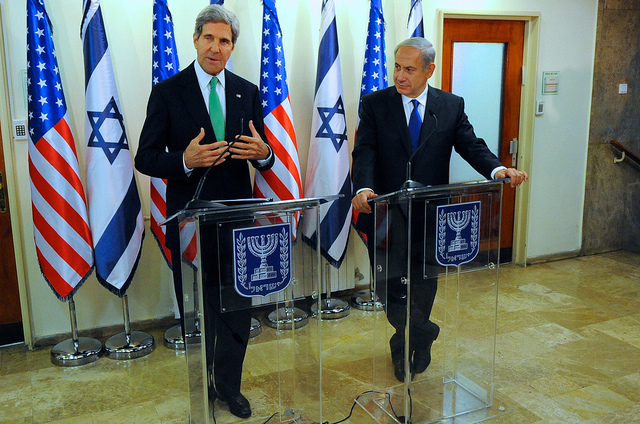
John Kerry and Benjamin Netanyahu. (State Department photo)
House Speaker John Boehner announced that he would “do everything possible to stop” the deal. Senate Foreign Relations Committee Chairman Bob Corker told Kerry that he’d been “fleeced.” Sen. Marco Rubio, a Republican candidate for president, said the next president – presumably meaning himself if he’s successful – could overturn the deal because it’s not a binding treaty.
All this was remarkable even to The New York Times, which usually looks the other way when Israel flexes its muscles in Official Washington. A Times article by Jonathan Weisman noted the extraordinary image of the Israeli ambassador using sports analogies to rile up Republican congressmen to overturn a key foreign policy initiative of the U.S. president.
“Mr. Dermer’s plea — which is widely expected to be followed by a mail, television and radio assault in Democratic districts during the August recess — demonstrates the power that the Israeli government and supportive interest groups in Washington maintain over congressional Republicans,” Weisman wrote.
Obviously, some of this Republican opposition is driven by a deep-seated animus toward President Barack Obama, but the confidence that Dermer, a onetime aide to former Republican House Speaker Newt Gingrich, showed in rallying Republicans to Israel’s foreign policy priority of hostility toward Iran reveals the degree to which the GOP as a party now ties its agenda in the Mideast to Israel.
Connections between Republicans and right-wing Israelis have grown tighter since the presidency of George W. Bush who began implementing Israeli Prime Minister Benjamin Netanyahu’s strategy of “regime change” against countries on his enemies list, starting with Iraq in 2003. [See Consortiumnews.com’s “The Mysterious Why of the Iraq War.”]
Since then, wealthy Israeli backers, such as casino magnate Sheldon Adelson, have funneled huge sums of money into Republican campaigns. In 2012, Netanyahu virtually endorsed GOP presidential nominee Mitt Romney. And, on March 3, House Speaker Boehner invited Netanyahu to deliver a speech to a joint session of Congress that was remarkable in its overt appeal to American lawmakers to embrace Israel’s foreign policy regarding Iran – over the head of the sitting U.S. president.
Clearing the Bench
In its current pull-out-all-the-stops to show who controls the U.S. political/media process, Israel also is throwing other key assets into this high-stakes fight. For instance, Steven Emerson, who has long posed as a professional journalist and then as a terrorism expert, was a featured speaker at a Times Square rally urging not only death to the nuclear deal but death to Iran.
“So now we have the situation that unless Congress acts, I believe ultimately, it’s going to be left up to a military strike to take out the Iranian capabilities to take out the world,” Emerson told a cheering crowd of a couple of thousand. “If we don’t take out Iran, they will take out us. … Because if you don’t your children will never forgive you – never forgive you for not protecting this country from a holocaust. For not protecting the state of Israel from a holocaust that will occur assuredly just as it did 70 years ago.
“Rarely in our lives do we have an opportunity to change history. Now is the time to do it, and it’s your responsibility all of ours, to go do it.”
Earlier this year, Emerson, who has longstanding close ties to right-wing Israeli officials, was caught in a blatant falsehood – and slur – about British Muslims. Appearing on Fox News as a “terrorism expert,” claimed that Birmingham, England, is now a “Muslim-only city” and that in parts of London “Muslim religious police … beat and actually wound seriously anyone who doesn’t dress according to religious Muslim attire.”
Emerson asserted that Muslim areas have become “no-go zones” for non-Muslims and cited as an example “actual cities like Birmingham that are totally Muslim, where non-Muslims just simply don’t go in.” Yet, Birmingham, Great Britain’s second-largest city of more than one million people, is nearly half Christian, with the Muslim population less than one-quarter and with significant numbers of Sikhs, Hindus, Jews and non-religious.
As Emerson’s Muslim-bashing remarks drew criticism from the media watchdog group FAIR and ridicule across the United Kingdom, he acknowledged that his “comments about Birmingham were totally in error” and vowed not to blame someone else for his slander.
“I do not intend to justify or mitigate my mistake by stating that I had relied on other sources because I should have been much more careful,” Emerson said in an apparent attempt to do exactly that, shift the blame to some unnamed source for supposedly misleading him. [For more on Emerson’s history of distortion, see Consortiumnews.com’s “The Sorry Record of a Muslim Basher.”]
The heated debate over the Iran nuclear deal is bringing out of the woodwork other longstanding alarmists about Iran’s nuclear program, which has not produced a single bomb, even as some of these same “experts” have studiously ignored the reality of Israel’s rogue nuclear arsenal.
For instance, David Albright, the president of the Institute for Science and International Security (with the now unfortunate acronym ISIS), is back in the pages of the mainstream media warning about possible gaps in the Iranian nuclear deal.
Albright was sought out for comment by the Times’ neocon national security writer Michael R. Gordon, who co-authored the infamous “aluminum tube” story in 2002 that was used to frighten Americans about “mushroom clouds” if they didn’t support an invasion of Iraq. On Thursday, Gordon’s latest story quoting Albright was entitled, online, “Verification Process in Iran Deal Is Questioned by Some Experts.”
An Iraq War Reunion
At times, this Israeli-driven battle to stop the Iran deal almost seems like a reunion of discredited journalists and “experts” who helped guide the United States into the disastrous Iraq War. In 2002, around the same time Gordon, along with Judith Miller, was penning his “aluminum tube” story, Albright and his ISIS were key figures in stoking the hysteria for invading Iraq around other false allegations of its WMD program.
At the end of summer 2002, as Bush was beginning his advertising roll-out for the Iraq invasion and dispatching his top aides to the Sunday talk shows to cite Gordon’s “aluminum tube” article and warn about “smoking guns” and “mushroom clouds,” Albright co-authored a Sept. 10, 2002, article – entitled “Is the Activity at Al Qaim Related to Nuclear Efforts?” – which declared:
“High-resolution commercial satellite imagery shows an apparently operational facility at the site of Iraq’s al Qaim phosphate plant and uranium extraction facility … This site was where Iraq extracted uranium for its nuclear weapons program in the 1980s. … This image raises questions about whether Iraq has rebuilt a uranium extraction facility at the site, possibly even underground. … The uranium could be used in a clandestine nuclear weapons effort.”
Albright’s alarming allegations fit neatly with Bush’s propaganda barrage, although as the months wore on – with Bush’s warnings about aluminum tubes and yellowcake from Africa growing more outlandish – Albright did display more skepticism about the existence of a revived Iraqi nuclear program. Still, he remained a “go-to” expert on other Iraqi purported WMD, such as chemical and biological weapons. In a typical quote on Oct. 5, 2002, Albright told CNN: “In terms of the chemical and biological weapons, Iraq has those now.”
After Bush launched the Iraq invasion in March 2003 and Iraq’s secret WMD caches didn’t materialize, Albright admitted that he had been conned, explaining to the Los Angeles Times : “If there are no weapons of mass destruction, I’ll be mad as hell. I certainly accepted the administration claims on chemical and biological weapons. I figured they were telling the truth. If there is no [unconventional weapons program], I will feel taken, because they asserted these things with such assurance.” [See FAIR’s “The Great WMD Hunt,”]
Albright may have been “mad as hell” for being “taken” but he suffered little, especially compared to the nearly 4,500 U.S. soldiers who died in Iraq and the hundreds of thousands of slain Iraqis, not to mention the millions of others who have suffered from the chaos that the likes of Emerson, Gordon and Albright helped unleash across the Middle East.
In recent years, Albright and his institute have adopted a similarly alarmist role regarding Iran and its purported pursuit of a nuclear weapon, even though U.S. intelligence agencies say Iran terminated that weapons project in 2003.
Nevertheless, Albright transformed his organization into a sparkplug for a new confrontation with Iran. Though Albright insists that he is an objective professional, his ISIS has published hundreds of articles about Iran, which has not produced a single nuclear bomb, while barely mentioning Israel’s hundreds of bombs.
An examination of the ISIS Web site reveals only a few technical articles relating to Israel’s nukes while Albright’s ISIS expanded its coverage of Iran’s nuclear program so much that it was moved onto a separate Web site. The articles have not only hyped developments in Iran but also have attacked U.S. media critics who questioned the fear-mongering about Iran.
A few years ago when a non-mainstream journalist confronted Albright about the disparity between his institute’s concentration on Iran and de minimis coverage of Israel, he angrily responded that he was working on a report about Israel’s nuclear program. But there is still no substantive assessment of Israel’s large nuclear arsenal on the ISIS Web site, which goes back to 1993.
Despite this evidence of bias, mainstream U.S. news outlets typically present Albright as a neutral analyst. They also ignore his checkered past, for instance, his prominent role in promoting President Bush’s pre-invasion case that Iraq possessed stockpiles of WMD.
However, since Albright and these other propagandists/operatives were never held accountable for the Iraq catastrophe, they are now rushing back into the game to try to block the Iran nuclear deal – and potentially turn the ball over in pursuit of another Mideast war. Netanyahu and his team appear to be clearing the bench for a goal-line stand.
~
Investigative reporter Robert Parry broke many of the Iran-Contra stories for The Associated Press and Newsweek in the 1980s. You can buy his latest book, America’s Stolen Narrative, either in print here or as an e-book (from Amazon and barnesandnoble.com).
George Clooney Opposes War Profiteering While African
By David Swanson | World Beyond War
George Clooney is being paid by the world’s top two war profiteers, Lockheed-Martin and Boeing, to oppose war profiteering by Africans disloyal to the U.S. government’s agenda.
Way back yonder before World War II, war profiteering was widely frowned on in the United States. Those of us trying to bring back that attitude, and working for barely-funded peace organizations, ought to be thrilled when a wealthy celebrity like George Clooney decides to take on war profiteering, and the corporate media laps it up.
“Real leverage for peace and human rights will come when the people who benefit from war will pay a price for the damage they cause,” said Clooney — without encountering anything like the blowback Donald Trump received when he criticized John McCain.
Really, is that all it takes to give peace a chance, a celebrity? Will the media now cover the matter of who funds opponents of the Iran deal, and who funds supporters of the wars in Iraq, Syria, Afghanistan, etc.?
Well, no, not really.
It turns out Clooney opposes, not war profiteering in general, but war profiteering while African. In fact, Clooney’s concern is limited, at least thus far, to five African nations: Sudan, South Sudan, Somalia, the Central African Republic, and the Democratic Republic of Congo, though these are not the only nations in Africa or the world with serious wars underway.
Of the top 100 weapons makers in the world, not a single one is based in Africa. Only 1 is in South or Central America. Fifteen are in Western allies and protectorates in Asia (and China is not included in the list). Three are in Israel, one in Ukraine, and 13 in Russia. Sixty-six are in the United States, Western Europe, and Canada. Forty are in the U.S. alone. Seventeen of the top 30 are in the U.S. Six of the top 10 mega-profiteers are in the U.S. The other four in the top 10 are in Western Europe.
Clooney’s new organization, “The Sentry,” is part of The Enough Project, which is part of the Center for American Progress, which is a leading backer of “humanitarian” wars, and various other wars for that matter — and which is funded by the world’s top war profiteer, Lockheed Martin, and by number-two Boeing, among other war profiteers.
According to the Congressional Research Service, in the most recent edition of an annual report that it has now discontinued, 79% of all weapons transfers to poor nations are from the United States. That doesn’t include U.S. weapons in the hands of the U.S. military, which has now moved into nearly every nation in Africa. When drugs flow north the United States focuses on the supply end of the exchange as an excuse for wars. When weapons flow south, George Clooney announces that we’ll stop backward violence at the demand side by exposing African corruption.
The spreading of the U.S. empire through militarism is most often justified by the example of Rwanda as a place where the opportunity for a humanitarian war, to prevent the Rwanda Genocide, was supposedly missed. But the United States backed an invasion of Rwanda in 1990 by a Ugandan army led by U.S.-trained killers, and supported their attacks for three-and-a-half years, applying more pressure through the World Bank, International Monetary Fund (IMF), and USAID. U.S.-backed and U.S.-trained war-maker Paul Kagame — now president of Rwanda — is the leading suspect behind the shooting down of a plane carrying the then-presidents of Rwanda and Burundi on April 6, 1994. As chaos followed, the U.N. might have sent in peacekeepers (not the same thing, be it noted, as dropping bombs) but Washington was opposed. President Bill Clinton wanted Kagame in power, and Kagame has now taken the war into the Democratic Republic of Congo (DRC), with U.S. aid and weapons, where 6 million have been killed. And yet nobody ever says “We must prevent another Congo!”
What does George Clooney’s new organization say about the DRC? A very different story from that told by Friends of the Congo. According to Clooney’s group the killing in the Congo happens “despite years of international attention,” not because of it. Clooney’s organization also promotes this argument for more U.S. warmaking in the DRC from Kathryn Bigelow, best known for producing the CIA propaganda film Zero Dark Thirty.
On Sudan as well, there’s no blame for U.S. interference; instead Clooney’s crew has produced a brief for regime change.
On South Sudan, there’s no acknowledgement of U.S. warmongering in Ethiopia and Kenya, but a plea for more U.S. involvement.
The Central African Republic gets the same diagnosis as the others: local ahistorical spontaneous corruption and backwardness leading to war.
Clooney’s co-founder of the Sentry (dictionary definition of “Sentry” is “A guard, especially a soldier posted at a given spot to prevent the passage of unauthorized persons”) is John Prendergast, former Africa director for the National Security Council. Watch Prendergast find himself awkwardly in a debate with an informed person here.
Clooney’s wife, incidentally, works for U.S.-friendly dictators and brutal killers in places like Bahrain and Libya.
More nations could soon be spotted by The Sentry. The President of Nigeria was at the U.S. Institute of “Peace” this week pleading for weapons. U.S. troops are in Cameroon this week training fighters.
If the peace organization I work for had 0.0001% the financial support of The Sentry, perhaps the debate would change. So, one thing you can do is support the right antiwar efforts.
Another is to let The Sentry know what it’s missing. It asks for anonymous tips when you spot war profiteering. Have you ever turned on C-Span? If you see something, say something. Let The Sentry know about the Pentagon.
Wrong on the Facts, Wrong on the Law: Israeli’s False Claims of “Self-Defense” in Gaza War
By James Marc Leas | CounterPunch | July 23, 2015
Although the facts, the law, and admissions by Israeli government officials all pointed otherwise, during the July-August 2014 Israeli assault on Gaza, the Israeli government was successful in promoting its self-defense claim with western news media and in persuading certain U.S. politicians that Israel was implementing its right to defend itself.
Claims of “self-defense” against Hamas rocket fire were invoked by Israeli Prime Minister Benjamin Netanyahu, U.S. President Barack Obama, U.S. Secretary of State John Kerry, and the United States Senate, and not only as justification for the Israeli assault. “Self-defense” against the rockets also served to deflect allegations that Israeli forces committed war crimes by targeting civilians and civilian property in Gaza.
Public relations campaigns based on self-defense have been critical to Israeli officials avoiding accountability after each of the six major assaults on Gaza since Israel withdrew its settlers from Gaza in 2005. Notwithstanding the reports of war crimes committed by Israeli forces, the remarkable success of those self-defense based public relations campaigns continued to provide Israeli officials with impunity: the freedom to strike militarily again.
That impunity may come to an end if the Prosecutor of the International Criminal Court (ICC) decides to open an investigation into the situation in Palestine and prosecutions follow. However, immediately after the Prosecutor announced that she was launching a “preliminary examination” on January 16, 2015, Netanyahu launched a multi-pronged “public diplomacy campaign to discredit the legitimacy of the International Criminal Court’s (ICC) recent decision to start an inquiry into what the Palestinians call Israeli ‘war crimes’ in the disputed territories.” The public diplomacy campaign is based entirely on Israel’s claim that it acted in self-defense. The Israeli campaign also included a threat to disregard the decision of the court, a threat to the funding of the court, and the announcement that Israel was freezing transfer of more than $100 million a month in taxes Israel collects for the Palestinian Authority in retaliation for the State of Palestine joining the ICC and requesting the ICC inquiry.
A new 63 page report, “Neither facts nor law support Israel’s self-defense claim regarding its 2014 assault on Gaza,” submitted to the ICC Prosecutor on behalf of the Palestine Subcommittee of the National Lawyers Guild (“the ICC submission”), uses both authoritative contemporaneous Israeli and Palestinian reports and newly released reports and documents to demonstrate that Israeli claims of “self-defense” for its 2014 attack on Gaza are unsupported in both fact and law. The ICC submission notes that the unusual strategy implemented by Israeli officials to publically discredit the court inquiry demonstrated a distinct departure from the traditional method of respectfully presenting evidence and persuasive arguments to the court.
The facts don’t fit Israel’s self-defense claim
Among the material considered in the ICC submission is the 277 page Israeli government report, “The 2014 Gaza Conflict: Factual and Legal Aspects” that was released by the Israeli government on June 14, 2015. Although the Israeli government report builds its case around self-defense, to its credit, the Israeli government report openly acknowledges that Israeli military forces (a) had been striking Gaza during 2013 and early 2014, (b) had launched a massive attack on the West Bank in mid-June 2014, and (c) had launched an aerial strike on a tunnel in Gaza on July 5, 2014. However, the Israeli government report omits mention that all these dates were before the night of July 7, 2014, the date a contemporaneous report from an authoritative Israeli source said “For the first time since Operation Pillar of Defense [November 21, 2012], Hamas participated in and claimed responsibility for rocket fire” (emphasis in the original). The contemporaneous report was issued by the Meir Amit Intelligence and Terrorism Information Center (ITIC), a private Israeli think tank that the Washington Post says “has close ties with the country’s military leadership.”
While the Israeli government report acknowledged the aerial strike on the tunnel in Gaza, it omitted mention of the extent of Israeli attacks on Gaza during the night before Hamas participated and claimed responsibility for its first rocket fire since 2012: The contemporaneous ITIC July 2 – July 8, 2014 weekly report states that on July 7 “approximately 50 terrorist targets in the Gaza Strip were struck,” by Israeli forces, including strikes that killed six Hamas members in the tunnel.
The Israeli government report states:
On July 7, 2014, after more than 60 rockets and mortars were fired into Israel from the Gaza Strip on a single day, the Government of Israel was left with no choice but to initiate a concerted aerial operation against Hamas and other terrorist organisations in order adequately to defend Israel’s civilian population.
Thus, the Israeli government report claims that the government was acting to defend Israel’s civilian population notwithstanding the fact that it had just admitted to an Israeli government attack that preceded the Hamas rocket fire on July 7. The attack on the tunnel that the ITIC reported killed the six Hamas members.
In a minute by minute timeline of events that day, the Israeli daily newspaper Ha’aretz reported the Israeli attacks that began during the night of July 6 and continued in the early morning hours of July 7 that showed that the Israeli attack on the tunnel preceded the Hamas rockets:
at 2:24 a.m. on July 7:
Hamas reports an additional four militants died in a second Israeli air strike in Gaza, bringing Sunday night’s death total to six. This is the biggest single Israeli hit against Hamas since 2012’s Operation Pillar of Defense.
at 9:37 p.m. on July 7 Ha’aretz reported:
Hamas claims responsibility for the rockets fired at Ashdod, Ofakim, Ashkelon and Netivot. Some 20 rockets exploded in open areas in the last hour.
Thus, an authoritative contemporaneous Israeli report acknowledged the fact that Hamas started firing its rockets some 20 hours after Israeli forces launched the attack on Gaza and killed the six Hamas members.
The Israeli government report couches the more than 60 rockets launched at Israel on the night of July 7 as giving the government of Israel no choice but to escalate aerial operations. But the report fails to mention that Israel actually had a choice as to whether or not to launch its prior lethal attack on the night of July 6 and the early morning hours of July 7. By omitting mention of the timing and the lethal effects of its attack on the tunnel, the Israeli government report avoids recognizing that its killing of the six Hamas members provoked the Hamas rocket fire.
While the Israeli government report mentions strikes on Gaza during 2013 and 2014, it omits mention of the number of Palestinians killed by Israeli attacks during 2013 and the increased rate of such killing during the first three months of 2014.
According to a report issued by the Palestinian Center for Human Rights, “PCHR Annual Report 2013:”
The number of Palestinians who were killed by Israeli forces was 46 victims in circumstances where no threats were posed to the lives of Israeli soldiers. Five of these victims died of wounds they had sustained in previous years. Of the total number of victims, there were 41 civilians, 33 of whom were in the West Bank and eight in the Gaza Strip, including six children, two women; and five non-civilians, including one in the West Bank and the other four in the Gaza Strip. In 2013, 496 Palestinians sustained various wounds, 430 of them in the West Bank and 66 in the Gaza Strip, including 142 children and 10 women.
An escalation of Israeli violence against Palestinians in early 2014 compared to the rate for the entire year 2013 is evident from PCHR’s “Report on the Human Rights Situation in the Occupied Palestinian Territories, 1st Quarter of 2014.”Among the violations presented in the report, 20 Palestinians were killed by Israeli forces during the first three months of 2014, including 11 civilians of whom two were children; 259 were wounded, of whom 255 were civilians, including 53 children. “The majority of these Palestinians, 198, were wounded during peaceful protests and clashes with Israeli forces.”
Nor does the Israeli government report mention any of the lethal Israeli government attacks on the West Bank and Gaza in the days and weeks before three Israeli teenagers were kidnapped and killed on the West Bank on June 12, 2014:
* Israeli forces shot 9 teenagers demonstrating on the West Bank on May 15, killing two.
* Israeli forces wounded nine Palestinian civilians, including a child during the week of June 5 to June 11.
* Israeli forces launched an extrajudicial execution on June 11 in Gaza that killed one and wounded three.
Nor does the Israeli government report describe the extent of casualties inflicted by the June 13 to June 30 military offensive on the West Bank, Operation Brothers Keeper, in which Israeli forces killed 11 Palestinians and wounded 51, according to the contemporaneous weekly reports issued by the Palestinian Center for Human Rights.
In addition, the Israeli government’s 277 page report omits mention of admissions by Prime Minister Netanyahu of other military and political purposes for its assault on the West Bank, described in a contemporaneous report in the Israeli daily newspaper Yediot Aharonot, on June 15, 2014: to capture Hamas members (some of whom the Israeli government had previously released in a prisoner exchange and some of whom were Parliamentarians in the new Palestinian unity government), create “severe repercussions,” and punish the Palestinian Authority and Hamas for forming a unity government. Importantly, although he accused “Hamas people” of carrying out the kidnapping of the three Israeli teenagers, Netanyahu made no mention of stopping rocket fire. The non-mention of rocket fire by Netanyahu is consistent with the ITIC report of no rocket fire at that time.
Similarly, after describing the Israeli operations that caused Hamas to pay a “heavy price” on the West Bank, as shown in a video of his speech at the US Ambassador’s residence in Tel Aviv on July 4, Netanyahu acknowledged that “in Gaza we hit dozens of Hamas activists and destroyed outposts and facilities that served Hamas terrorists.” Thus Netanyahu himself acknowledged major Israeli military operations in Gaza preceding the launching of Hamas rockets on July 7.
Media collaboration
Facilitating the Israeli and U.S. government campaign to pin responsibility on Hamas and support an Israeli self-defense claim, certain western news media, including the New York Times, published an incorrect timeline. The timeline published by the New York Times dated the start of the war to July 8, the first full day of Hamas rocket barrages, and more than a day after Israeli forces had escalated their aerial attack on Gaza killing the six Hamas members. The Times timeline simply omits mention of the lethal Israeli attacks on the night of July 6 and early morning hours on July 7 that Ha’aretz said preceded the Hamas barrage of rockets on the night of July 7. The New York Times timeline also omits mention of the 24 days of “Operation Bring Back Our Brothers,” that began on June 13, the June 11 extra-judicial execution of a Hamas member in Gaza, the June 13 attack on the “terrorist facility and a weapons storehouse in the southern Gaza Strip,” and the killing of the two Palestinian teenagers and wounding of seven other Palestinians who were demonstrating on May 15. The New York Times timeline also omits mention of the lethal Israeli attacks in 2013 and the escalation of those attacks in early 2014 that the Israeli government report admitted under the euphemism “targeted efforts to prevent future attacks.”
The law doesn’t fit Israel’s self-defense claim
Not just facts and admissions stand in the way of Israel’s self-defense claim. In a 2004 decision rejecting Israel’s self-defense claim for the wall, a relatively passive structure crossing occupied Palestinian territory, the International Court of Justice (ICJ) held that, under the UN Charter, self-defense under Article 51 of the UN Charter is inapplicable to measures taken by an occupying power within occupied territory. While the ICJ recognized Israel’s right and its duty to protect its citizens, it said “The measures taken are bound nonetheless to remain in conformity with applicable international law.” While the Israeli government report includes mention of a law review article that relies on an ICJ holding favorable to an Israeli position on another issue, the Israeli government report omits mention of the directly on point ICJ case regarding applicability of self-defense to Israel as occupying power in Gaza.
But even if Israel could overcome the facts showing that Israeli forces initiated the combat, and even if Israel was not the occupying power in Gaza and did not have to address the law regarding self-defense for an occupying power presented in the ICJ decision, Israel’s claim to self-defense would still be invalidated if its assault extended beyond what was necessary and proportionate to deal with an armed attack it was purportedly facing, as more fully described in the ICC submission.
Necessity was contradicted by the data provided by the ITIC showing that Israel had been wildly successful at stopping and/or preventing rocket fire by agreeing to and at least partially observing a ceasefire, while Israel consistently dialed up rocket fire with each of its major assaults on Gaza since 2006. By contrast, as shown in the ICC submission, hundreds of times more rockets were falling on Israel during each day of each of the major assaults on Gaza than were falling in the periods before Israeli forces attacked or after the assault ended with a new ceasefire.
Necessity was also contradicted by an article in the May 2013 Jerusalem Post, “IDF source: Hamas working to stop Gaza rockets,” quoting the IDF General who commands the army’s Gaza Division who said that Hamas had been policing other groups in Gaza “to thwart rocket attacks from the strip.” The Hamas observance of the ceasefire and its policing of other groups to prevent rocket fire demonstrated an effective alternative to an Israeli assault. The Israeli attacks on the West Bank and Gaza during the period between June 13 and the early morning hours of July 7, 2014 put that ceasefire and that Hamas policing of other groups at risk. Israel could have more effectively protected its citizens from rocket fire by continuing to at least partially observe the successful cease-fire in place before Israel escalated its assaults on the West Bank and Gaza. So the necessity for the escalation on June 13 and the further escalation on July 7 to protect Israeli citizens from rocket fire has not been shown.
The necessity and proportionality requirements for a self-defense claim were also contradicted by evidence that actions by Israeli forces during the assault on Gaza went outside the laws of war by directly targeting Palestinian civilians and Palestinian civilian property. The proportionality requirement was further contradicted by evidence of widespread Israeli attacks that harmed civilians or civilian property disproportionate to the military advantage Israeli forces received from the attacks. The evidence for such war crimes cited in the ICC submission comes from reports of investigations conducted by the UN Human Rights Council Commission of Inquiry (June 22, 2015); the Al Mezan Center for Human Rights, Lawyers for Palestinian for Human Rights (LPHR), and Medical Aid for Palestinians (MAP) (June 26, 2015); the UN Human Rights Council (December 26, 2014); Defense for Children International Palestine (April 2015); Physicians for Human Rights-Israel (PHR-Israel) (January 20, 2015); Al-Haq (August 19, 2014); the United Nations Office for the Coordination of Humanitarian Affairs (OCHA) (September 4, 2014); Breaking the Silence (May 3, 2015); The Guardian (May 4, 2015); The International Federation for Human Rights (FIDH) (March 27, 2015), and contemporaneous and periodic reports issued by the Palestinian Center for Human Rights.
Along with support from top U.S. officials, the enormously successful public relations campaigns based on claimed self-defense that Israeli officials mounted during and after each of the Israeli assaults on Gaza allowed Israel to avoid accountability, maintain impunity, and launch subsequent attacks. In view of that successful record, the effectiveness of Israel’s “public diplomacy campaign to discredit the ICC inquiry” based on the same self-defense claims should not be underestimated. Widespread recognition that Israel’s self-defense claim is deeply flawed is needed to counter the intense pressure Israeli officials and their allies are exerting on the ICC so the court may resist that pressure and base its decisions strictly on the facts and law.
James Marc Leas is a patent attorney and a past co-chair of the National Lawyers Guild Palestine Subcommittee. He collected evidence in Gaza immediately after Operation Pillar of Defense in November 2012 as part of a 20 member delegation from the U.S. and Europe and authored or co-authored four articles for Counterpunch describing findings, including Why the Self-Defense Doctrine Doesn’t Legitimize Israel’s Assault on Gaza. He also participated in the February 2009 National Lawyers Guild delegation to Gaza immediately after Operation Cast Lead and contributed to its report, “Onslaught: Israel’s Attack on Gaza and the Rule of Law.”
Gays who swallow unverified anti-Iran propaganda will be partly responsible if Iran is turned into another Iraq
Uprooted Palestinians | July 23, 2015
Gay hanging in Iran: Atrocities and impersonations
By Scot Long
Everybody on earth knows that last week a deal on Iran’s nuclear program was announced. Everybody also knows that this apparent step toward peace launched a new stage in an old war: of propaganda. Proponents praise the possibility of a historic opening. Opponents — who include Israel, Saudi Arabia, and the Republican Party — warn of disaster. Both sides want to expand their constituencies. In Western countries, gay communities — small but politically influential — are more and more the target for just this courtship and recruitment.
The right-wing pundit Amir Taheri greeted the nuclear deal with a storm of tweets and screeds condemning it. One 140-character charge drew special attention.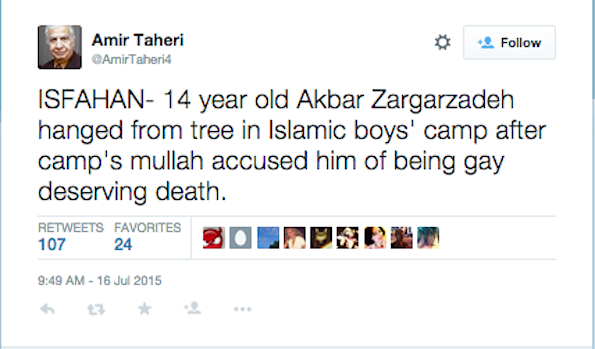 Anyone’s first reaction would be some version of “My God.” It sounded horrible. I wrote to Taheri asking for more information — and so, judging from Twitter, did at least three other people.
But the story quickly began to show cracks. Taheri didn’t reply to me, or anybody. I sat down that night with a Farsi-speaking friend and began searching for the story in the Iranian press: under the youth’s name, under various other key words. It didn’t turn up anywhere. I wrote to the Toronto-based Iranian Queer Organization (IRQO), a diaspora-based group of LGBT Iranian activists with which I’ve worked closely over the years. They searched the media as well and found no sign of it. They also reached out to contacts in Isfahan. On Friday morning, they told me no one there had heard of the story, either.
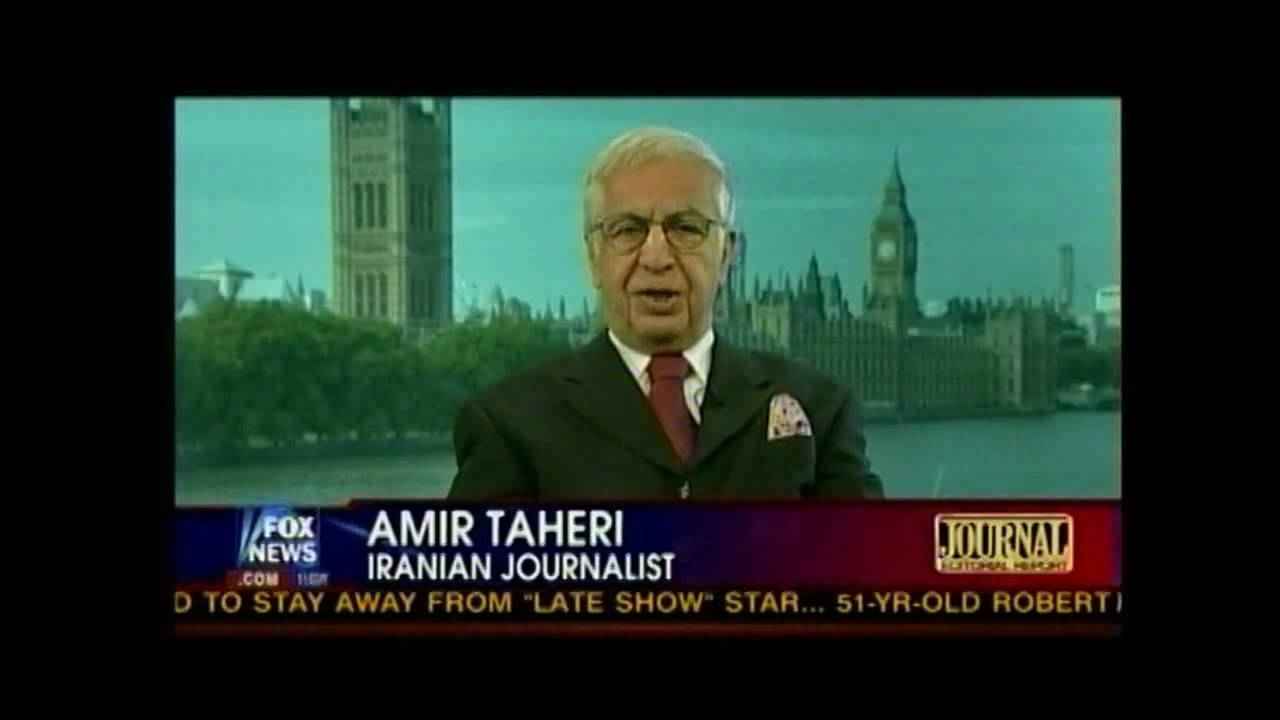
Amir Taheri lies a lot. Eight years ago, Jonathan Schwartz called him “one of the strangest ingredients in America’s media soup,” adding, “There may not be anyone else who simply makes things up as regularly as he does, with so few consequences.” An arch-conservative protege of the Pahlavis, an editor of the Tehran daily Kayhan under the Shah, he repeatedly fabricates stories about Iran to please right-wingers in his adoptive West. Most famously, in 2006 he claimed in Canada’s National Post that a new dress-code law in Iran would impose special clothes on religious minorities, including yellow badges for Jews. Many conservatives swallowed the story; even the Canadian Prime Minister repeated it. But it was a complete falsehood, and after a huge furor the National Post retracted it and apologized: “It is now clear the story is not true. … We apologize for the mistake and for the consternation it has caused.” (The Post also noted that Taheri went “unreachable” after his fiction was exposed, rather as he did on Twitter.) Undeterred, in 2008 Taheri concocted a quote from Ayatollah Khomeini, complete with a fake citation of an invented source; American neoconservative luminaries duly repeated it. In 2002, Taheri claimed that “Osama bin Laden is dead …. the fugitive died in December and was buried in the mountains of southeast Afghanistan.” The list of his duplicities goes on and on. In 1989, an academic reviewing one of Taheri’s books
detailed case after case in which Taheri cited nonexistent sources, concocted nonexistent substance in cases where the sources existed and distorted the substance beyond recognition when it was present. … [The reviewer] concluded that Nest of Spies was “the sort of book that gives contemporary history a bad name.”
Larry Cohler-Esses condemns Taheri as a “journalistic felon,” part of a “media machine intent on priming the public for war with Iran.”
There are ample grounds for skepticism about stories Taheri spreads.
But skepticism doesn’t make headlines. Propaganda’s best friend is the ambition of the press. On Thursday, a reporter for the UK-based Gay Star News also tweeted to Taheri.
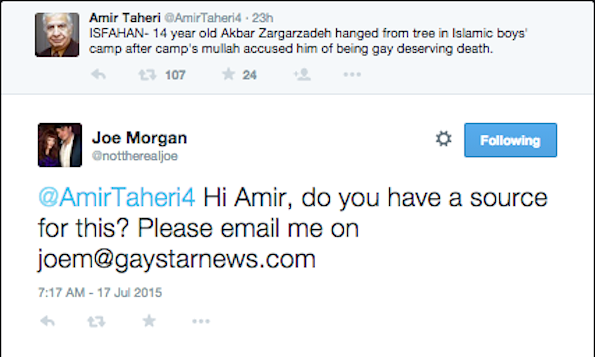
Taheri didn’t answer him, either. I know this because the reporter didn’t wait for a source. About 25 minutes later, his story — “GAY TEEN, 14, ‘HANGED FROM TREE’” — topped the website of Gay Star News, and it said Taheri hadn’t told them anything. In other words, their entire account was based on one single tweet with no evidence behind it. This tweet was special, though. The topic of gay killings in Iran has shown its passionate drawing power over a decade, its ability to keep queers clicking. GSN wanted the clicks for itself.
The reporter clearly never asked Iranian LGBT activists or groups for their take. It was more important to get the headline out there. I wrote to Tris Reid-Smith, GSN’s editor, and asked “Is this standard practice — to run a story based on a single, unsourced, unconfirmed tweet from someone who declines to answer follow-up questions?” Tris rather cannily refused to reply in writing; he wanted to talk by phone. My phone in Cairo is tapped; I declined. I wanted this on the record, but not State Security’s record. If Tris still wants to answer my question, he is welcome to do so here. GSN has since added a few sentences to its story, saying:
we should note Iranian LGBTI networks have not confirmed the story. Some critics have questioned Taheri’s reliability. … UPDATE: For clarity, GSN has noted from the outset this report has not been independently verified. Taheri is yet to reply to our questions seeking to substantiate his claims. We urge caution but feel it is in the public interest to report the claims, given they are gaining traction on social media.
Let that final sentence revolve in your mind. What defines news these days isn’t truth. It’s traffic. (I’ve saved a screenshot of GSN’s original article, prior to the caution-urging, here.)
And of course the story spread. Neoconservative propagandist Ben Weinthal tweeted it manifold times:
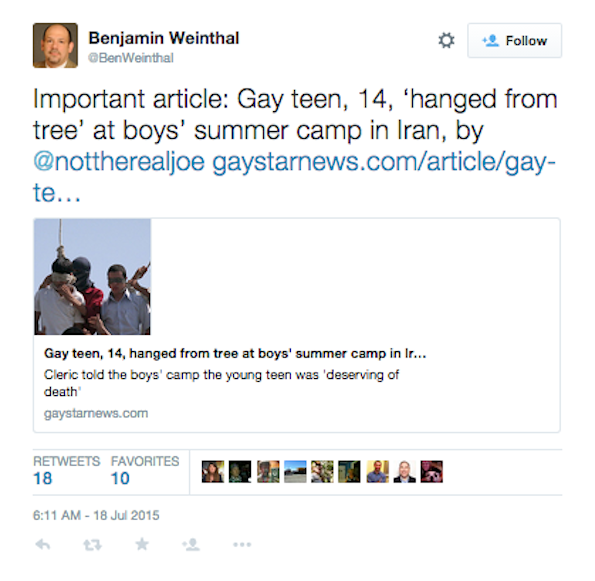 Weinthal is a lobbyist for the right-wing, pro-Israel Foundation for Defense of Democracies. One of his jobs is to drum up support in gay communities for hardline policies against Iran. I’ve detailed some of his many misrepresentations here. His desperate drive to ensure Taheri’s tweet gets coverage suggests what the motives at work are.
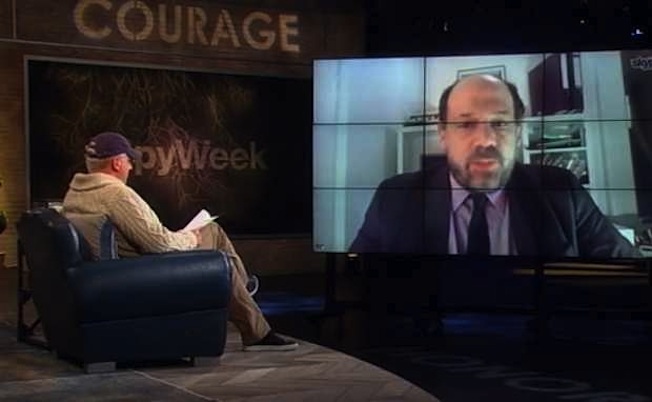
No one should ever minimize the real, documented, and terrible human rights abuses in Iran. But credulity for suspicious stories devalues the true ones. Given Taheri’s record, and the tangled political context, there is no reason to credit this tale without corroboration.
And here’s the thing: we’ve been through this before, and learned nothing. Look at the photo GSN attached to its article.
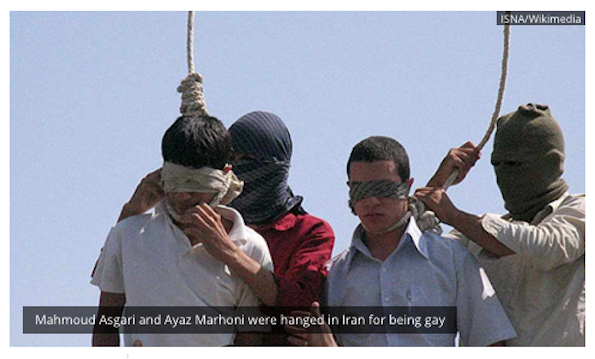 That famous image, exactly ten years old, reverberates with misery and horror. And cynics and opportunists know it as proven clickbait. In fact, the two youths were not executed simply for “being gay.” They were convicted of the rape, at knifepoint, of a 13-year-old boy. Claims that they were gay lovers circulated widely among Western activists; but no clear evidence materialized to confirm them.
International tension shaped the context, then as now. In June 2005, Mahmoud Ahmadinejad was elected President of Iran. The religious hardliner’s victory intensified foreign fears of Iran’s nuclear plans; Ahmadinejad moved quickly to quash negotiations with European powers and smear reformists as appeasers. Western conservatives stoked those fears, and rumors roiled. Immediately after the vote, a website affiliated with the Mujahedin e Khalq claimed Ahmadinejad had participated in the 1979 seizure of the US embassy in Tehran. The Mujahedin is a wealthy, cult-like Iranian exile group widely despised in the diaspora, but closely tied to many Western politicians. Amir Taheri leapt in; he alleged in print that that Javad Zarif — then Iran’s UN ambassador, now its foreign minister — had joined the hostage-taking. (Another fabrication: Zarif was studying in the US at the time.) That summer, a charged, familiar storm-cloud of fact, anxiety, and speculation swirled round the subject of Iran.
On July 19, 2005, the two teenagers were hanged in Mashhad. Reports in the local and national Iranian media said clearly they had been tried for tajavoz (rape) or lavat beh onf (“sodomy by force,” or male rape); the Quds newspaper in Mashhad quoted both the 13-year-old victim and his father. Another website of the Mujahedin e Khalq, however, published a piece on the execution aimed at Western audiences, and omitted the rape charge. Almost certainly the Mujahedin pointed out the story to lone-ranger UK activist Peter Tatchell — who had a record of publicity-seeking animosity to Iran and political Islam — and proposed the “gay” angle. On July 21, Tatchell’s OutRage website blared, “IRAN EXECUTES GAY TEENAGERS,” above the pictures taken from the Iranian press. Tatchell claimed, falsely, that Iranian media had not mentioned the rape, and that the pair were originally charged with consensual sex: setting in motion a stream of fictions that didn’t stop for months.
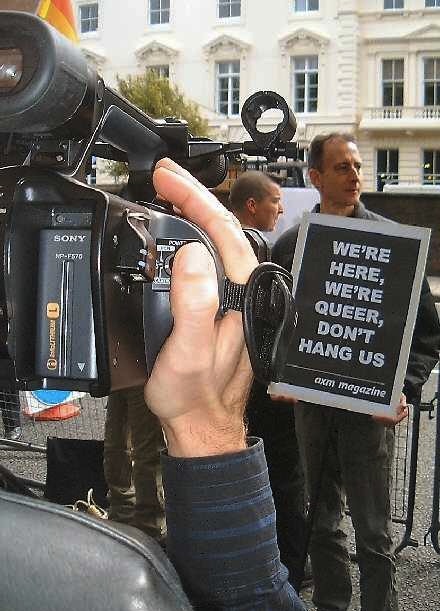
With panic over Iran already in the air, the photos went vastly viral. If politics motivated some to promote the story, for others it was publicity. (Doug Ireland, a gay US writer with no prior knowledge of Iran who nonetheless rode the story to a new journalistic job, told me his blog got 60,000 hits the first day he carried the pictures.) As more facts came out and the tale seemed less plausible, its proponents got aggressive: not only with doubters, but with the protagonists. Tatchell, for instance, belittled the alleged rape and suggested the victim wanted it: “It could be the 13-year-old was a willing participant.” Meanwhile, the story’s popularity led to a desperate search for sequels, for new “gay victims,” that stretched for years. Virtually any execution for rape reported in the Iranian media — even of male rapists of women — could be arrogated or mistranslated as a punishment for consensual gay sex. In a grim and grotesque irony, the quest helped produce the dead. In 2007, Tatchell intervened in the last-ditch appeal of an Iranian prisoner on death row, also for the rape of a 13-year-old. Makwan Mouloudzadeh had been framed in a village vendetta; there was no real evidence he’d had sexual relations with the child, much less any other male. Instead of maintaining Makwan’s innocence, though, Tatchell falsely alleged the child was Makwan’s “partner.” Allies of Tatchell started a letter-writing campaign to Ahmadeinjad pleading for the “young homosexual Makvan,” arguing explicitly that he was “‘guilty’ of having loved a peer when he was 13 and having sexual intercourse with him.” They incriminated the man they were trying to save. Makwan, neither homosexual nor a rapist, was hanged.
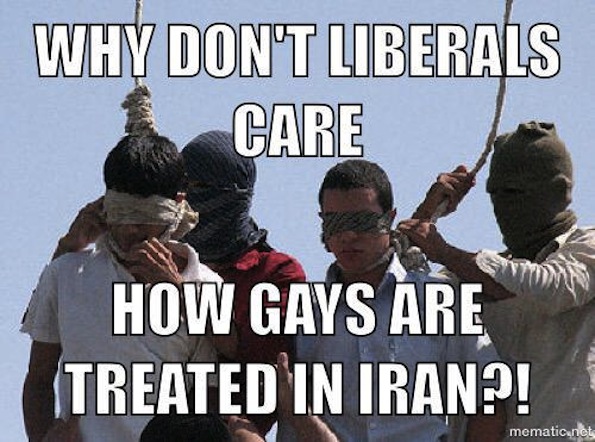
The Mashhad story survives, immune to its malign consequences. Taheri certainly knows it — he surely suspected a 14-year-old victim would make his tweet go viral. The youths’ images are memed and manipulated everywhere. Sometimes the uses are political:
 Sometimes they’re mythological figures, as if the kitsch of Shi’ite religious iconography melded with the preoccupations of San Francisco.
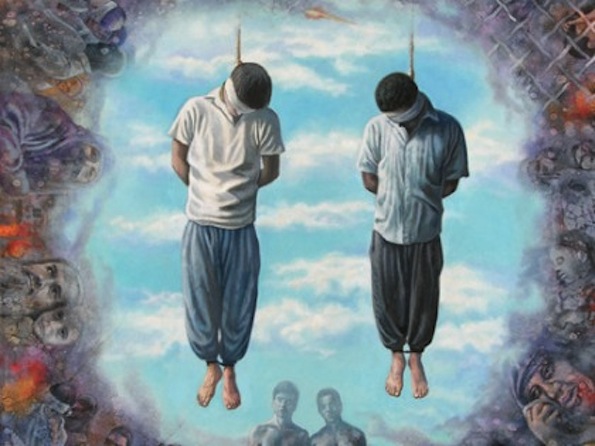
But they remain, always, “the sacred gay martyrs of Iran.”
An hour or two after the Gay Star News story appeared, Tatchell seized the opportunity, announcing a “vigil” to commemorate the tenth anniversary of the youth’s deaths.
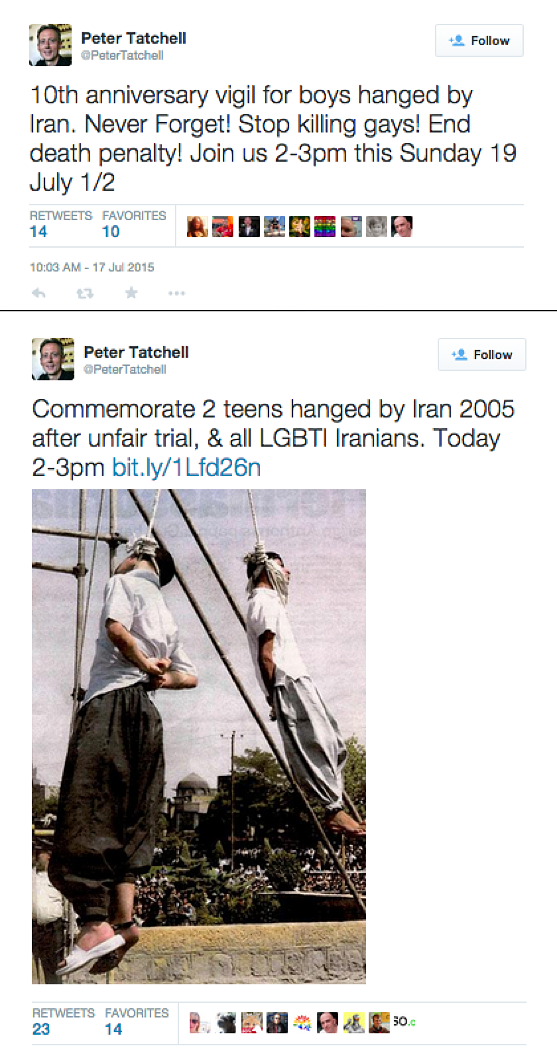 “On 19 July, we stand for life, liberty and love,” Tatchell said at the demo. But think what that rhetoric obliterates. If their 13-year-old victim’s story was true, what would he say about those words? Most human rights activists know that you can oppose grave abuses, like the appalling execution of children, without spinning narratives of absolute innocence or “love.” But to do that requires abjuring sentimentality, and acquiring maturity.
A deep narcissism lies pooled here. What does “never forget” them mean, when you never knew anything about them in the first place? No one has ever seriously sought to learn facts (rather than weave romances) about the youths’ lives; no one ever showed the least interest in the 13-year-old they allegedly brutalized; no one has ever tried to find their families, and hear what they think of their sons’ pictures being broadcast in this way, or inserted into a foreign story about “gayness.” The boys are silent. Their muteness is their appeal. They offer a clean field for Western political and erotic fantasies; they’ve withered to ventriloquist’s dolls for Western voices. The indignities they suffered before death have been succeeded by a further descent, the indignity of being erased in the imperial name of memory. What Tatchell wants remembered is not the murdered youths. It’s himself.
II.
Strangely, I took two different tacks with Amir Taheri. The day after I politely asked him for information, you could have found me on Twitter writing in quite a different tone:
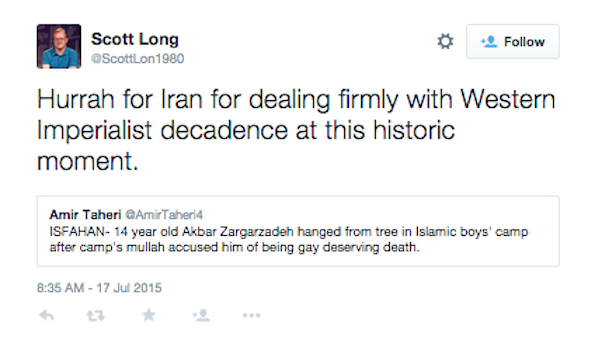 Except that wasn’t me. It was an account someone set up under my name about a week ago, which has been firing off tweets to Egyptians and various right-wing Westerners ever since. It says I’m a pro-Iran Islamist. It uses an old picture of me, and the inevitable photo of the hanged Iranian youth.
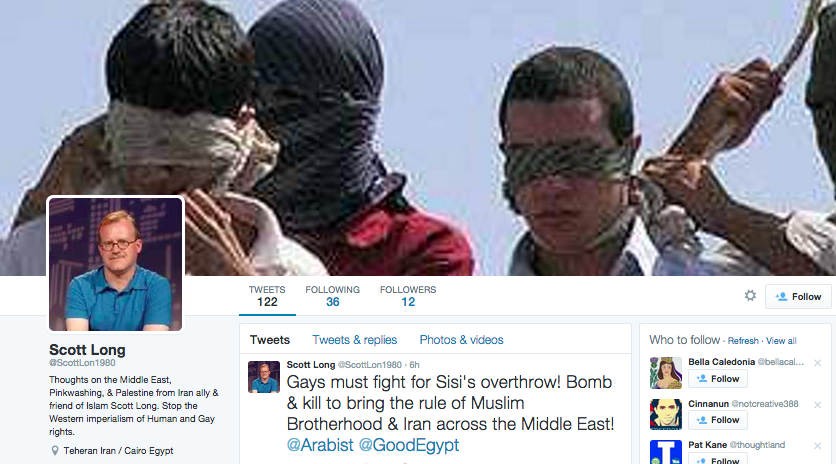
The account isn’t a “parody.” Not just that it isn’t funny: it’s trying to get me arrested. It makes out that I support banned insurgent movements and want the Egyptian government overthrown. These messages it forwards to Egyptian tweeters, including government accounts.
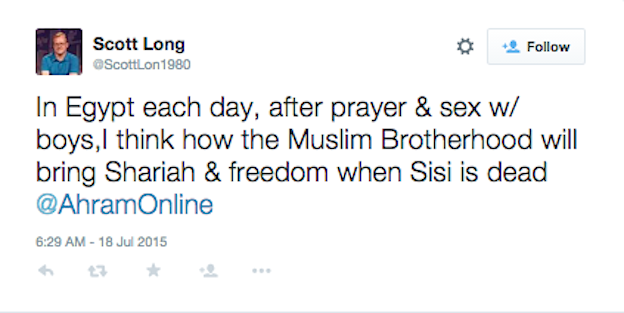
That one tweet could easily lead to a few decades in prison here. And the person who put my name to it appears quite conscious of the fact.
Who’s behind this thing? I have no idea. But I know who likes it. Here are the account’s followers when I checked it on July 16:
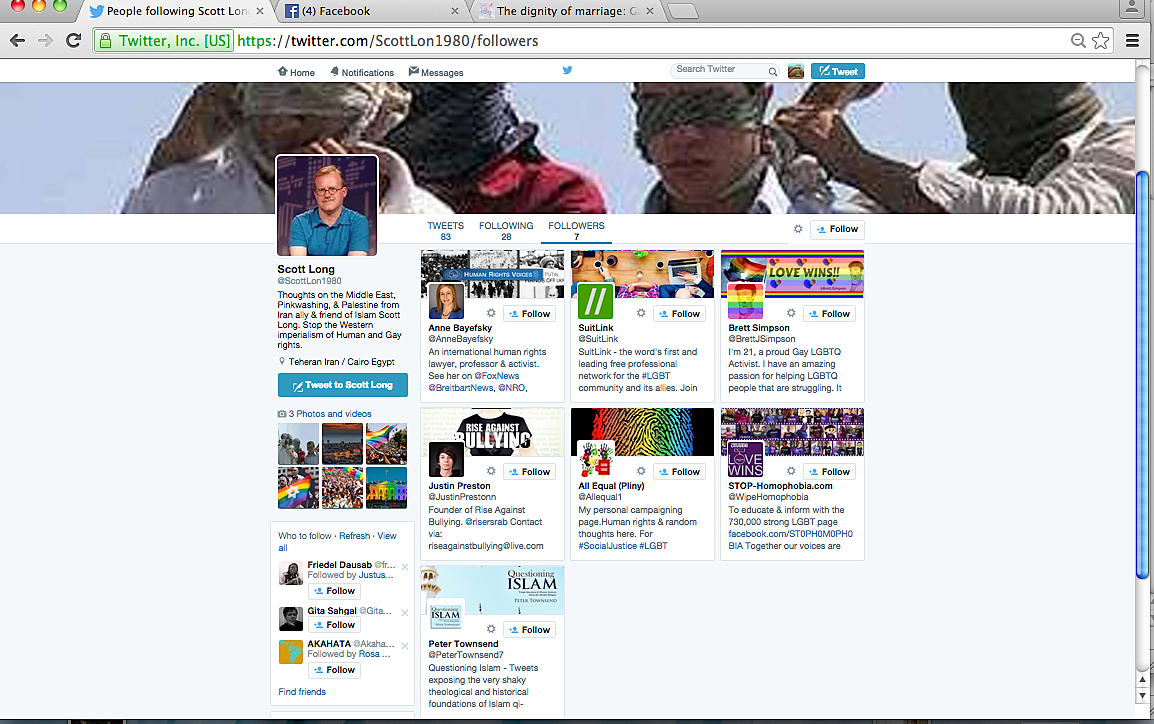
The third person who’d followed the account — out of seven at the time — was “All Equal.” That’s the Twitter of Pliny Soocoormanee, who happens to be the personal assistant of Peter Tatchell, director of the Peter Tatchell Foundation. How he found out about this obscure account when no one else knew of it, and why it interested him so much, is a fascinating question. I can’t imagine the answer.
The morning after I criticized the Taheri story on Twitter, the account exploded with vengeful drivel, directed at people inside and outside Egypt (the one at top went to the country’s Ministry of Foreign Affairs):
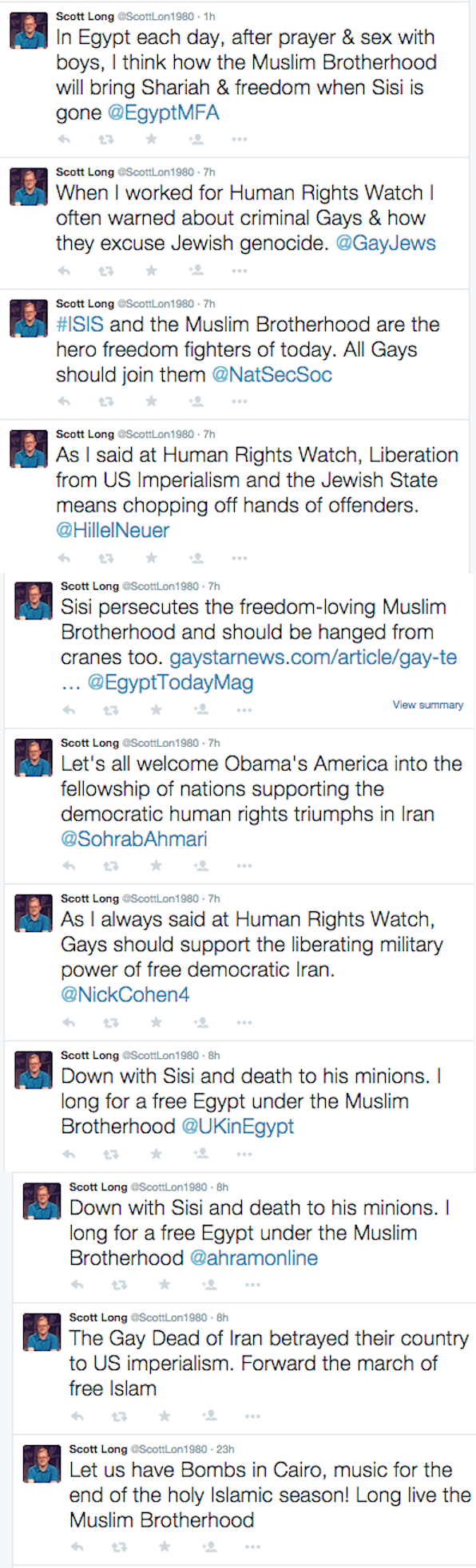 But this BS is merely typical. Apparently I work for the Brotherhood, an illegal organization here:
 My motives appear to be erotic as well as pecuniary.
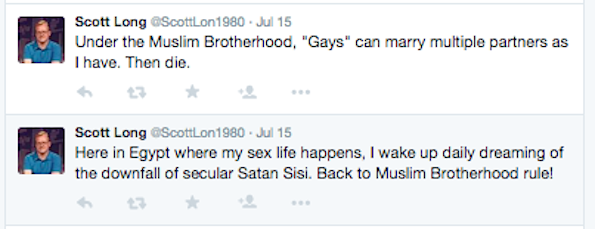 I’m also an informer.
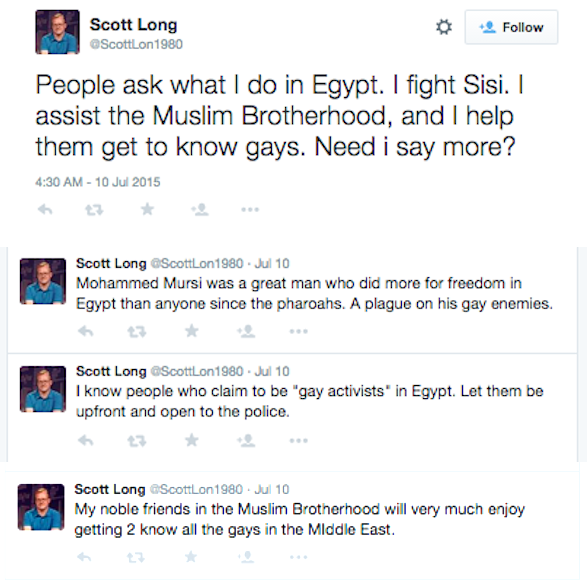
But mostly the account just strives to identify me with vicious anti-Semitic ravings, marking the intrinsic fascism of its maker’s mind. (Fascism is the politics of a cynical, corrosive narcissism. The mark of fascism is that it imagines all other opinions are as fascist as itself.)
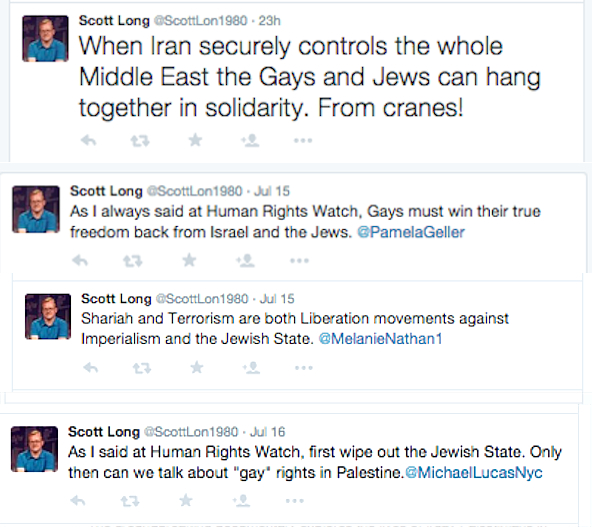
The account is pretty much coeval with the nuclear deal with Iran. Its first three tweets:

I wouldn’t pay attention to this crude fakery if it weren’t trying explicitly to incriminate me to Egypt’s government — which is arresting gay foreigners, and may not know the difference, or want to. I never cease to be surprised by the retributory malice of the Iran- and Islam-obsessed crowd, whether driven by ideology or the sheer love of headlines. They never stop.
Back in 2006, when Amir Taheri’s lies about Iran’s dress-code law were exposed, The Nation spoke to his PR agent. Accuracy on Iran is “a luxury,” she said. “As much as being accurate is important, in the end it’s important to side with what’s right. What’s wrong is siding with the terrorists.” You see? It’s us or them. Loyalty trumps truth. To expose useful lies is to take the terrorists’ side. And by that standard I am, of course, a terrorist.
Why does it matter? Because LGBT Iranians shouldn’t be exploited for propaganda. They lead lives seamed by danger, distinguished by courage; they deserve better than to be backgammon pieces, passive tokens stacked and shifted in a great-power political game. LGBT people should speak in their own voices, be masters and heroes of their own lives. That is what the liberation struggle is about.
The fact that nobody — not Tatchell, not Ben Weinthal, not Gay Star News — bothered to ask LGBT Iranian activists or groups what the truth was, or whether they wanted a demonstration, is appalling. But it’s typical. The story of Western engagement with LGBT rights in Iran has been one of occupation and ventriloquism, not freedom. It’s long past time for the sick game to stop.

NOTE: The fake account seems to have been taken down not long after I posted this: I don’t know whether by its maker or by Twitter (of course I complained). But, in some form or another, they’ll be back.
UK Establishment Closes Ranks on Anti-War Labour Leadership Front Runner
By Michaela Whitton | ANTIMEDIA | July 22, 2015
United Kingdom — Anyone peeking behind the smokescreen of the British press this weekend (and not distracted by what the Queen did when she was five or by David Cameron’s extremism rhetoric) may have noticed that despite the U.K. Parliament’s explicit rejection of military intervention, the U.K. has been involved in the bombing of Syria since September— and Cameron has known the whole time.
Those with eyes to see may have also noticed the establishment closing ranks on veteran left-winger, Labour MP Jeremy Corbyn. After emerging as a front-runner in the Labour leadership campaign, Corbyn appears to have become the victim of a murderous media and political attack, with first prize for slanderous onslaught going to Tory mouthpiece, The Telegraph, and a piece penned by Islam-obsessed Andrew Gilligan.
Sixteen million people chose not to vote in Britain’s general election in May. With many crippled by the thought of another five years of Tory rule, a buzz of hope is in the air at whether Corbyn’s radical spirit can rescue the people from the dark abyss of British politics.
It comes as no surprise that the establishment appears to be zoning in on him.
Apparently, Corbyn is so left-wing that even his own party is panicking, with pressure group Labour First urging party members to vote for the other candidates. Group secretary Luke Akehurst said, “We clearly do not share Jeremy Corbyn’s politics and believe these would destroy Labour’s chances of electability.’’
The last 30 years have been harsh for Labour. Born out of the Trade Union movement, the aim was always to give a voice to the British working classes, but 17 years of Thatcherism took its toll. Additional years of hollow and watered down Tory policies imposed by Blair and Brown made it almost game over. More recently, weak and compromised former leader Ed Miliband didn’t manage to reach the disenfranchised, who either gave up on British politics completely or edged toward UKIP or the Greens.
On Sunday, the Independent reported that some Labour MPs plan to mount a coup if Corbyn gets in with one member, claiming, “We cannot just allow our party, a credible party of government, to be hijacked in this summer of madness. There would be no problem in getting names. We could do this before Christmas.”
‘’Hijacked?’’ Elected in 1983, principled socialist Corbyn is in favour of free education and a living wage. A believer in the scrapping of nuclear weapons, the welfare state, solid trade unions and a stable NHS, he vehemently opposed the invasions of Afghanistan and Iraq —interventions that destroyed the reputations of the U.K. and Labour.
As a proponent of a free Palestine, last summer Corbyn was marching through London with thousands of others to condemn Israel’s assault on Gaza. As national chair of the Campaign for Nuclear Disarmament and a patron of the Palestine Solidarity Campaign, he regularly speaks out against British military intervention in the Middle East at human rights conferences across the globe.
His refusal to compromise and his calls for conflict resolution through peaceful negotiations—rather than the bombing of foreign countries—has earned him the title of friend to Hamas, Iran and extremists.
With a private poll putting him ahead in the Leadership campaign by 15 points, attempts to smear and discredit Corbyn are to be expected. As his principles grip the imaginations of a weary and desperate public, there are accounts of hundreds of Brits paying £3 to sign up online as Labour Party supporters, just for a chance to vote for him in September’s election.
It remains to be seen whether or not he will appeal to those 16 million disillusioned non-voters and those feeling abandoned by Labour—or if he can reclaim territory the party has lost over the last few years. As he continues to challenge the dominant themes running through the pro-war veins of British politics, there is one certainty—the knives will continue to twist in his back as the establishment-run media attempts to control narratives and influence opinion.
‘Winning the Cold War with propaganda’: New Dutch-Polish ‘content factory’ to challenge Russia
RT | July 22, 2015
Poland and the Netherlands are joining forces to counter so-called “Russian propaganda” with a new Russian-language “content factory,” after US Senator John McCain insisted that propaganda is key to “winning the Cold War” without a single shot.
The Dutch-Polish news agency will offer TV, radio, and online content in the Russian-language across the countries of Russia and eastern Europe. It is planned that the agency will start working next year, with the Netherlands and Poland hoping that other EU States will join them.
The project will “give the tools and the capacities for Russian language [media] and Russian social media to work on the basis of objective information … with the exchange of different viewpoints”, said Bert Koenders, the Dutch foreign minister. Koenders added that that there was “broad support” for the endeavor from EU foreign ministers.
The new news agency will be “something which doesn’t use the language of propaganda or aggression, but which has real, reliable information,” said Polish Foreign Minister, Grzegorz Schetyna. He added that a donor conference for the initiative will kick off in Warsaw in September with the Hague hopefully hosting another fundraising later this year.
The idea to create a Russian-language news agency stems from a Dutch-funded study on counter-propaganda by the European Endowment for Democracy (EED). The EED, a “brainchild of the Polish government,” as the Carnegie institute calls it, was established in October 2012 to support pro-democracy activists and organizations in Eastern Europe. In December 2014, EDD decided to expand their reach into Russia.
In May the organization recommended creating a “news hub” to exchange news material among leading Russian language media and launch a “content factory,” as well as a research center to study audience behavior.
A source within the project at EED told the EU observer that the new agency will be a “content factory” working as “a kind of European BBC”. The publication also reports that foreign service agencies from other EU states are also “taking action” since March to “challenge Russia’s … disinformation campaigns.”
So far five experts, from the Czech Republic, Denmark, Estonia, Latvia, and the UK, have been employed to lead a new communications cell called East StratCom Team.
In an interview with Carnegie Europe, Jerzy Pomianowski, the EDDs executive director said that the organization is working with a group of 90 experts and media representatives to analyze their target audience and “what kind of content is needed.”
“With the support of a grant from the Dutch government, we have launched a feasibility study on Russian-language media initiatives. This is about providing Russian-language alternatives to Russian state broadcasting for societies in the Eastern Partnership countries and beyond,” Pomianowski said in March.
Meanwhile at stateside, US Senator John McCain has once again called on Washington and the US Broadcasting Board of Governors (BBG) to spread its outreach to counter Russian messaging. In June, McCain co-sponsored a bill requesting $728.2 million for the BBG to carry out international communications campaigns. That is in an addition to BBG’s $15.4 million request in April to expand its Russian-language programming and social media content projects.
“I love our folks in Prague and Radio Free Europe and all that, but we have got to catch up. We’ve got to catch up and understand that this is also a message of loyalties and truth. And we’re going to need to do a lot more,” McCain said in a speech to the Hudson Institute.
The Senator stressed that Russia’s news outreach could be countered by propaganda means alone, something that was done during the Cold War.
“One of the key elements of winning the Cold War without firing a shot… is the propaganda – the message, the social networking,” he said. “My friends, there is an inundation today in the Baltic, in Moldova, in Romania, and Poland even of Russian constant, incessant sophisticated messages that we have to counter.”
Russia’s Foreign Ministry earlier criticized EU drafted information warfare initiatives to target so-called Russian propaganda. According to the ministry such activity is “clearly aimed at pushing out Russia’s presence in the international media field.”
Last month it was reported that EU has drafted a plan to counter what it sees as “Russian disinformation activities” calling for the promotion of EU policies in the post-Soviet space and the implementation of measures against Russian media, including RT.
READ MORE:
EU drafts plan to counter Russian media ‘disinformation’, targeting RT
For propaganda & ‘democracy promotion’: State Dept seeks budget to counter RT
Featured Video

Liberty Cannot Exist Inside a Panopticon
or go to
Aletho News Archives – Video-Images
From the Archives
Left-leaning despisers of 9/11 Truth movement: Do you really believe in miracles?
David Ray Griffin | Global Research | 06 Jul 2010
An Open Letter to Terry Allen, Noam Chomsky, Alexander Cockburn, David Corn, Chris Hayes, George Monbiot, Matthew Rothschild, and Matt Taibbi.
[1]According to several left-leaning critics of the 9/11 Truth Movement, some of its central claims, especially about the destruction of the World Trade Center, show its members to be scientifically challenged. In the opinion of some of these critics, moreover, claims made by members of this movement are sometimes unscientific in the strongest possible sense, implying an acceptance of magic and miracles. … Full article
Blog Roll
 Aletho News
- White House envoy declares kinetic action against Yemen ‘fruitless’
- Ukraine deployed thousands of microdrones in Iraqi Kurdistan: Tasnim
- Iran calls for emergency UNSC meeting over Trump’s ‘brazen’ bomb talk, Israeli threats
- Iranian sources reveal details of Russia-China Hormuz proposal
- Plan for more US-Israel integration puts our military tech at risk
- Another Round Against Iran Will Break What Is Left of the Gulf
- SVR Report on Ukraine’s Mexican Drug Gang Links Could Pressure Zelensky, Won’t Change US Policy
- British Government Employees Were Fact-Checking the News at the BBC. Nobody Told You.
- Albania on fire: who’s behind the riots?
- Egypt’s Civil Democratic Movement rejects involvement in regional war
- If Americans Knew
- Mysterious bot accounts reportedly spread fake ‘man on the street’ videos for Michigan Senate candidate
- Israeli Defense Minister Katz Says Over 60 Lebanon Villages Have Been Destroyed
- Why Is Israel Running TV Ads in Iowa Ahead of the Midterms?
- Hind Rajab’s Alleged Killer Is in the United States. HRF Demands His Arrest.
- US Officials Face Fresh Pressure After Another American ‘Brutalized’ by Israeli Settlers in West Bank
- Israel-Backed Palestinian Militias Terrorize Displaced Families in Gaza
- FBI subpoenas pro-Palestine activists over Israeli weapons plant disruption
- Fourth winter arrives in wartorn Gaza, too early – Daily Update
- More on how Bari Weiss is using CBS on behalf of Israel
- What the UK Is Doing to Pro-Palestine Novelist Sally Rooney Is an Act of Orwellian Villainy
- No Tricks Zone
- Predictions Made By Renowned Climate Proifessor Over Past Decades Have Been Proven To Be Poor
- New Study Suggests Large Regions Of The Pacific Ocean Have Been Cooling For The Last 80 Years
- Germany’s Green Energy Debacle: High Energy Costs Force Kahla Porzellan to Close After 182 Years!
- New Study: 50 Years Of The Most Aggressive ‘Net Zero’ Policies Can Only Affect The Global Climate By 0.03°C
- US September “Heat” Was No Record…Many Records Set Decades Ago
- Latest European Green Energy Debacle; Portugal’s Largest Flagship Solar Park Insolvent!
- Green Energy Debacle: German Expert Professor Fritz Vahrenholt Warns Of Severe Economic And Social Consequences
- Two More Paleo Reconstructions Affirm Meters-Higher Sea Levels Across Ireland, Brazil 7000-6000 Years Ago
- New Study: Earth And Venus Surface Warmth Largely Explained By Convection And Lapse Rate, Not CO2 Or Radiation
- 2025 Nature Paper Claiming Worsening Global Drought Gets RETRACTED …Heavily Flawed

