Anna-Marie Slaughter demonstrates that you need not scratch a “humanitarian interventionist” much to uncover the warmongering neoconservative just below the surface.
In an essay today, titled, “Stopping Russia Starts in Syria,” she argues that “the solution to the crisis in Ukraine lies in part in Syria.” President Obama must “demonstrate that he can order the offensive use of force in circumstances other than secret drone attacks or covert operations,” she writes.
Translation: to get Putin back for his supposed actions in Ukraine, Slaughter calls for President Obama to bomb Syria.
Slaughter recognizes the view of “Assad as the lesser evil compared to the Al Qaeda-affiliated members of the opposition” and admits that “the Syrian government does appear to be slowly giving up its chemical weapons, as it agreed last September to do.”
Nevertheless, she writes, “it is time to change Putin’s calculations, and Syria is the place to do it.”
“It is impossible to strike Syria legally so long as Russia sits on the United Nations Security Council,” she writes, so her solution is simply to do it illegally. She suggests that the US should begin bombing Syria to enforce UN Security Council Resolution 2139, even though that is not a “Chapter VII” resolution authorizing force.
It is ironic and highlights the cruel depravity of Slaughter that she suggests the bombing of Syria to enforce UNSC 2139, which was drawn up to facilitate the delivery of humanitarian relief to the war-ravaged Syrian people.
Using a humanitarian relief UN resolution as a cover for the most anti-humanitarian of all acts — dropping bombs — reveals the true colors of the “humanitarian interventionist” and “responsibility to protect” crowd.
Anne-Marie Slaughter embodies the disturbing trend of US government operatives (she was Director of Policy Planning for the U.S. State Department from January 2009 until February 2011) who move into the “non-governmental” sector while directing public-private “non-profit” resources toward the promotion of US government foreign policy.
In her current position as president of the New America Foundation, she is in active partnership with the US government to develop new tools to help promote regime-change overseas. According to the New York Times, the New America Foundation has been awarded a three year contract by the US Agency for International Development (USAID) to develop a kind of underground Internet system for Cuba.
Readers recall that USAID was recently embroiled in controversy when it covertly developed a “Cuban Twitter” platform whose purpose was to foment regime change in the Caribbean island nation.
Does anyone doubt that Slaughter’s New America Foundation is developing USAID’s “Cuban Internet” program for any reason other than to use it to further US regime change policy?
Anne-Marie Slaughter ends her preposterous “bomb Syria” essay with a phrase that could have been — and perhaps was — uttered by the likes of Sens. John McCain and Lindsay Graham:
Obama took office with the aim of ending wars, not starting them. But if the US meets bullets with words, tyrants will draw their own conclusions.
Bombs for peace. That is the neocon/humanitarian-interventionist war cry.
April 25, 2014
Posted by aletho |
Mainstream Media, Warmongering, Militarism, War Crimes | Anna-Marie Slaughter, New America Foundation, R2P, Syria, Ukraine, United States, US Agency for International Development, USAID |
Leave a comment
By Robert Parry | Consortium News | April 23, 2014
Two days after the New York Times led its editions with a one-sided article about photos supposedly proving that Russian special forces were behind the popular uprisings in eastern Ukraine, the Times published what you might call a modified, limited retraction.
Buried deep inside the Wednesday editions (page 9 in my paper), the article by Michael R. Gordon and Andrew E. Kramer – two of the three authors from the earlier story – has this curious beginning: “A collection of photographs that Ukraine says shows the presence of Russian forces in the eastern part of the country, and which the United States cited as evidence of Russian involvement, has come under scrutiny.”

In the old days of journalism, we used to apply the scrutiny before we published a story on the front page or on any other page, especially if it had implications toward war or peace, whether people would live or die. However, in this case – fitting with the anti-Russian bias that has pervaded the mainstream U.S. press corps – the scrutiny was set aside long enough for this powerful propaganda theme to be put in play and to sweep across the media landscape.
Only now do we belatedly learn what should have been obvious: the blurry photographs provided by the coup regime in Kiev and endorsed by the Obama administration don’t really prove anything. There were obvious alternative explanations to the photos that were ignored by the Times, such as the possibility that these were military veterans who are no longer associated with the Russian military. Or that some photos are not of the same person.
And, one of the photos featured by the Times in its Monday lead article, purportedly showing some of the armed men in Russia, was actually shot in the Ukrainian town of Slovyansk, according to Maxim Dondyuk, the freelance photographer who took the picture and posted it on his Instagram account.
Here is the tortured way the Times treated that embarrassing lapse in its journalistic standards: “A packet of American briefing materials that was prepared for the Geneva meeting asserts that the photograph was taken in Russia. The same men are also shown in photographs taken in Ukraine.
“Their appearance in both photographs was presented as evidence of Russian involvement in eastern Ukraine. The packet was later provided by American officials to The New York Times, which included that description of the group photograph in an article and caption that was published on Monday. … The dispute over the group photograph cast a cloud over one particularly vivid and highly publicized piece of evidence.”
Then, after noting Dondyuk’s denial that the photo was snapped in Russia, the Times quoted State Department spokeswoman Jen Psaki as acknowledging “that the assertion that the photograph in the American briefing materials had been taken in Russia was incorrect. But she said that the photograph was included in a ‘draft version’ of a briefing packet and that the information has since been corrected.”
But the misidentification of the photo’s location as Russia, not Ukraine, was not some minor mistake. If the photo was taken in Ukraine, then the whole premise of the claim that these same guys were operating in Russia and have since moved to Ukraine collapses.
Note how the Times framed this point in its Monday article: “Some of the men photographed in Ukraine have been identified in other photos clearly taken among Russian troops in other settings.” Then, the cut-line below the photo read: “Soldiers in a group photo of a reconnaissance unit, which was taken in Russia, were later photographed operating in towns in eastern Ukraine.” There was no attribution. The location is stated as flat fact.
Still, the Obama administration is not going to let its sloppy mistake get in the way of a potent propaganda theme. According to the Times, Psaki insisted that there was plenty of other classified and unclassified evidence proving that the Russians are behind the eastern Ukrainian uprisings, but none of that supposed evidence was included in Wednesday’s story.
The problem for the Times, however, is different. Many of the flaws in the photographic evidence were there to see before Monday’s front-page article, but the newspaper was apparently blinded by its anti-Russian bias.
For instance, the article devoted much attention to the Russian skill at “masking” the presence of its troops, but that claim would seem to be contradicted by these allegedly secret warriors posing for public photos.
The Times also ignored the fact that the U.S. Special Forces – and indeed the special forces of many other nations – also seek to blend in with the populations by growing beards and wearing local clothing. This is not some unique tactic employed by the nefarious Russians.
[For more on this topic, see Consortiumnews.com’s “Another NYT-Michael Gordon Special?”]
~
Investigative reporter Robert Parry broke many of the Iran-Contra stories for The Associated Press and Newsweek in the 1980s. You can buy his new book, America’s Stolen Narrative, either in print here or as an e-book (from Amazon and barnesandnoble.com).
April 24, 2014
Posted by aletho |
Deception, Mainstream Media, Warmongering | New York Times, Russia, Ukraine, United States |
Leave a comment
You can understand a lot about journalists and journalism by examining our professional nervous tics. We all have them – and they tell you a lot about the hidden assumptions that drive the news agenda.
Peter Beaumont, the Guardian’s new Jerusalem bureau chief, and a veteran reporter, is a good liberal journalist with both a broad and deep understanding of the region. In the article below he tells us about the long-awaited reconciliation pact between Fatah and Hamas.
But what does the following little tic tell us, not so much about him but about the news agenda he serves?
After the agreement was announced, Israel cancelled a planned session of peace negotiations with the Palestinians. It also launched an air strike on a site in the north of the Gaza Strip, wounding 12 people including children, which underscored the deep mutual suspicion and hostility that persists.
Israel launched an unprovoked and, it seems, largely indiscriminate attack on Gaza that injured only civilians (as Haaretz reports) because two Palestinian factions signed a piece of paper. And that apparently “underscores the deep mutual suspicion” between Israel and the Palestinians.
Peter, here’s another thing the attack may underscore: Israel’s cynical and determined effort to break the agreement before it has time to take hold.
Talking of comments revealing a lack of self-awareness, how about this corker in the same article from Jen Psaki, a state department official, who called the unity pact “disappointing”?
It is hard to see how Israel can be expected to negotiate with a government that doesn’t believe in its right to exist.
And yet the US seems quite happy to have the Palestinians negotiate with a government, Israel, that has never shown any indication that it believes in the right of Palestine to exist.
www.theguardian.com/world/2014/apr/23/plo-hamas-agree-unity-pact-form-government
April 24, 2014
Posted by aletho |
Ethnic Cleansing, Racism, Zionism, Mainstream Media, Warmongering | Israel, Palestine, Zionism |
Leave a comment
In Bjørn Lomborg’s latest oped: Global Warming’s Upside-Down Narrative Lomborg points out the following:
- The IPCC says unmitigated climate change will cost 0.2-2% GDP/year in 2070.
- The IPCC says climate policies in 2070 will cost more than 3.4% and likely much more than that.
This is why climate mitigation makes no economic sense: the cure costs more than the disease.
But, wait, “Skeptical Science” tank driver Dana Nuccitelli has an op-ed today in the Guardian where he claims the IPCC uses only a select range of measures: the 0.2-2% is expressed in “annual global economic losses”, while the other is expressed “as a slightly slowed global consumption growth”.
He only achieves that by cutting out the actual quote from IPCC report, as you can see in the screen cap helpfully provided by Lomborg in his Twitter feed that compares texts. Note the ellipsis:

Source: [ https://twitter.com/BjornLomborg/status/458628793825890305 ]
And that’s why we label the Dana Nuccitelli/John Cook “skeptical science” enterprise in our blogroll as a category all their own, “Unreliable”.
Nuccitelli eliminated the full text of that section of the third IPCC report so he could bolster his headline claim “preventing global warming is the cheap option”.
Imagine the screaming if any climate skeptic did something like that in an MSM venue.
Meanwhile Lomborg in his op-ed points out what is really worth worrying about, and it isn’t the beloved global warming “crisis” of the Skeptical Science Kids.
We live in a world where one in six deaths are caused by easily curable infectious diseases; one in eight deaths stem from air pollution, mostly from cooking indoors with dung and twigs; and billions of people live in abject poverty, with no electricity and little food. We ought never to have entertained the notion that the world’s greatest challenge could be to reduce temperature rises in our generation by a fraction of a degree.
Read more at
http://www.project-syndicate.org/commentary/bj-rn-lomborg-says-that-the-un-climate-panel-s-latest-report-tells-a-story-that-politicians-would-prefer-to-ignore#bd8cy6Bgh00L3roM.99We live in a world where one in six deaths are caused by easily curable infectious diseases; one in eight deaths stem from air pollution, mostly from cooking indoors with dung and twigs; and billions of people live in abject poverty, with no electricity and little food. We ought never to have entertained the notion that the world’s greatest challenge could be to reduce temperature rises in our generation by a fraction of a degree.
Read more at
http://www.project-syndicate.org/commentary/bj-rn-lomborg-says-that-the-un-climate-panel-s-latest-report-tells-a-story-that-politicians-would-prefer-to-ignore#bd8cy6Bgh00L3roM.99We live in a world where one in six deaths are caused by easily curable infectious diseases; one in eight deaths stem from air pollution, mostly from cooking indoors with dung and twigs; and billions of people live in abject poverty, with no electricity and little food. We ought never to have entertained the notion that the world’s greatest challenge could be to reduce temperature rises in our generation by a fraction of a degree.
Lomborg makes more humanistic sense than Nuccitelli, and he doesn’t have to make lies of omission to get his point across.
April 23, 2014
Posted by aletho |
Deception, Mainstream Media, Warmongering, Science and Pseudo-Science | Dana Nuccitelli, The Guardian |
Leave a comment
Between the anti-Russian propaganda pouring forth from the Obama administration and the deeply biased coverage from the U.S. news media, the American people are being prepared to accept and perhaps even cheer a massacre of eastern Ukrainians who have risen up against the coup regime in Kiev.
The protesters who have seized government buildings in ten towns in eastern Ukraine are being casually dubbed “terrorists” by both the Kiev regime and some American journalists. Meanwhile, it’s become conventional wisdom in Official Washington to assume that the protesters are led by Russian special forces because of some dubious photographs of armed men, accepted as “proof” with few questions asked by the mainstream U.S. news media.
While the U.S. news media is treating these blurry photos as the slam-dunk evidence of direct Russian control of the eastern Ukrainian protests – despite denials by the Russian government and the protesters – the BBC was among the few news agencies that provided a more objective assessment, noting that the photos are open to a variety of interpretations.
However, in Official Washington, the stage is now set for what could be a massacre of Ukrainian civilians who have risen up against the putschists who seized control of Kiev in a Feb. 22 coup that overthrew elected President Viktor Yanukovych. The violent putsch was spearheaded by neo-Nazi militias, some of which have now been incorporated into Ukraine’s National Guard and dispatched to the front lines in eastern Ukraine.
If the slaughter of the eastern Ukrainian protesters does come, you can expect Official Washington to be supportive. Whereas the Kiev protesters who seized government buildings in February were deemed “pro-democracy” activists even as they overthrew a democratically elected leader, the eastern Ukrainian protesters, who still consider Yanukovych their legitimate president, are dismissed as “terrorists.” And, we all know what happens to “terrorists.”
The Biased Media
If you doubt the bias of the U.S. press corps, consider this interview by the Washington Post’s Lally Weymouth with Arsen Avakov, the Ukrainian coup regime’s minister of internal affairs. As published in Tuesday’s Washington Post, the interview quoted Avakov as saying the protesters “will be punished severely” and included an exchange reflecting how thoroughly U.S. journalists have bought into the coup regime’s narrative:
Weymouth: Do you think the Russians will actually release the [government] buildings, as they said they would in last week’s Geneva meeting?
Avakov: Russia is taking advantage of the depressed condition of the local economy of these regions. … But even in spite of that situation, in the city of Kramatorsk [the Russians] did not have the level of support that they expected. We do not behave radically there for one reason.
Weymouth: When you say ‘radically,’ do you mean you don’t fight the terrorists?
Avakov: We are not acting radically in that region for two reasons. One is we do not want to hurt the peaceful population. And the second reason is we don’t want to turn the population against the central government. But that does not mean it will stay like this forever.
Weymouth: Then what happens?
Avakov: We will act.
Weymouth: What will you do?
Avakov: We will start liberating people from the terrorists. … We are going to take full control over the roads, irrespective of the resistance of some groups.
What was journalistically remarkable about this interview was that it was Weymouth who began describing the eastern Ukrainian protesters as “terrorists,” though these people who have seized government buildings have not engaged in what we would traditionally call “terrorism.” Their actions have been no more violent – and indeed much less violent – than the “pro-democracy” activists in Kiev. In February, the neo-Nazi militias killed more than a dozen police officers with firebombs and light weapons.
‘Pro-Democracy’ Putschists
And, when the “pro-democracy” protesters seized government buildings in Kiev, including the City Hall, they decked them out in Nazi symbols and a Confederate battle flag as the international expression of white supremacy. But the U.S. news media never described those acts as “terrorism.” [For more on the Ukrainian neo-Nazis, watch this report from the BBC.]
Indeed, it is now considered unacceptable to mention the key role played by the neo-Nazis in overthrowing Yanukovych, even though the neo-Nazis themselves are quite proud of what they did and got four government ministries as a reward. One of those positions is the chief of national security, Andriy Parubiy, who announced last week that some of those militias had been incorporated into the National Guard and sent to the front lines of eastern Ukraine.
For their part, those eastern protesters have said they are resisting the imposition of power from Kiev, which has included the appointment of billionaire “oligarchs” as regional administrators, and are rejecting a harsh austerity plan from the International Monetary Fund that will make their hard lives even harder.
Yet, Official Washington has largely banished those realities to the great memory hole. Many in the U.S. government and the mainstream press corps seem to be licking their lips over the prospect of unleashing hell on the eastern Ukrainians.
The preferred U.S. narrative has even edged into the conspiracy theory that Russian President Vladimir Putin somehow engineered the entire Ukraine crisis as part of a Hitler-like plot to reclaim Russian territory lost when the Soviet Union collapsed in 1991. This theory ignores the absurdity of Putin somehow arranging the protests and coup against Yanukovych.
The reality is that Putin was caught off-guard by the events in Ukraine, in part because he was distracted by the Sochi Olympics and the threat of terrorism against the games. As the Ukraine crisis deepened, Putin supported the Feb. 21 agreement, brokered by three European countries, that had Yanukovych agree to limit his powers, move up an election to vote him out of office and, most fatefully, pull back the police.
The police withdrawal opened the way for the neo-Nazi militias, well-organized in 100-man brigades and well-armed with weapons looted from government stockpiles, to launch the final Feb. 22 assault.
Instead of standing behind the Feb. 21 agreement, the United States and the European Union hailed the overthrow of Yanukovych and – after recognizing that the neo-Nazis were in effective control of Kiev – supported the quick formation of a new government, headed by U.S. favorite, the new Prime Minister Arseniy Yatsenyuk.
Rather than some mastermind planning everything in advance, Putin reacted to the fast-moving crisis on the fly, adlibbing his response, including responding to the majority will of Crimea to bail out of this failed Ukrainian state and rejoin Russia. He also got approval from the Russian legislature to defend ethnic Russians in eastern Ukraine if necessary.
Yet, rather than assess these events objectively, the U.S. government and the mainstream U.S. news media have slid into a neo-Cold War madness, which may be sated only by the blood of the eastern Ukrainian “terrorists.” That, however, could force Putin’s hand again and take this unnecessary crisis to a whole new level.
~
Investigative reporter Robert Parry broke many of the Iran-Contra stories for The Associated Press and Newsweek in the 1980s. You can buy his new book, America’s Stolen Narrative, either in print here or as an e-book (from Amazon and barnesandnoble.com).
April 23, 2014
Posted by aletho |
Deception, Mainstream Media, Warmongering | Lally Weymouth, Ukraine, United States, Washington Post |
Leave a comment
Russian authorities have denied reports that Ukrainian MP and former Crimean Tatar leader Mustafa Dzhemilev had been slapped with a 5-year entrance ban to Crimea. Dzhemilev claims he was given a travel restriction order on the Russia-Ukraine border.
A spokesman for the Russian Federal Migration Service (FMS) told Ukrinform that the agency does not have any information on the travel ban imposed on the Ukranian MP from the Batkivshina Party and a former head of the Crimean Tatar Mejlis, Mustafa Dzhemilev, to enter Russian territory.
“We do not have such information. Therefore, why do you think that we have banned him from entering the Russian Federation? I can send you the same document, you can also send it to me. I’ve seen it, and there is really nothing to comment on here.”
The FMS representative called the ‘document’ that Dzhemilev claims he was handed on Tuesday and posted on Mejlis website “just a piece of paper.”
“It’s just a piece of paper that someone wrote to someone without attaching an official seal or a signature,” said the spokesman, as cited by Ukrinform. “We do not comment on such papers.”
The Crimean parliament has also denied allegations of issuing such a ban on Dzhemilev, saying that his name is not included in the officially compiled travel restriction list which now has over 340 names.
“The State Council did not take any decisions restricting entry and exit of Mustafa Dzhemilev to the territory of Crimea,” the Deputy Chairman of the Crimean parliament Konstantin Baharev told Ria Novosti.
“Earlier, the Presidium of the Crimean parliament formed a list of more than 300 persona non grata from Ukrainian MPs who opposed the Crimean initiative to hold a referendum on self-determination.”
The apparently fake ‘Notification of non-permission of entry to the Russian Federation’ without any official insignia or seal was allegedly handed over to Dzhemilev early on Tuesday morning on the border of Russia and Ukraine when the MP was en route from Crimea to Kiev.
Unsigned and without letterhead, the paper said that “Mustafa Dzhemilev … citizen of Ukraine” was barred entry to Russia on the basis of federal law for five years or until April 19, 2019.
Dzhemilev was quick to spread the forged paper online commenting that the alleged ban serves to show “nothing more than an indicator of how ‘civilized’ is the state we’re dealing with,” referring to Russia, local media quoted him as saying.
But speaking to Ukraine’s Channel 5 TV, Dzhimilev acknowledged the lack of signature and said he was not certain that the document came from the Russian government, because the man who handed over the alleged ban did not identify himself. He said he intends to continue his travels to Crimea.
Premature accusations of Russia being behind the ban is “cheap anti-Russian populism and nothing more,” member of the Presidential Council on Civil Society and Human Rights, Vladimir Shaposhnikov told Ria, adding the MP should first get acquainted with the document he received, double check the laws, and then make accusations.
“Now I can only see much ado about nothing. Before raising the cry Mr. Dzhimilev is should have first of all checked the law ‘On the Procedure for Exit from the Russian Federation and Entry into the Russian Federation’ and read the article on the basis of which he was allegedly denied entry,” said Shaposhnikov.
But Washington was quick to support Dzhimilev’s statements that he has made after his return from Crimea, in particular accusations the Russian Security Service is keeping a close watch on the Tatar poulation of Crimea.
“Today, Crimean Tatar community leader, Mustafa Dzhemilev, who has been in Washington a couple weeks ago and had meetings here in this building, gave some alarming remarks. And he said that – warned today that possible bloodshed in Crimea and southern Ukraine is coming up, and he also stated that some of the FSB officers from Moscow who hope to promote new deportation of the Tatars,” State Department’s spokeswoman Jen Psaki told reporter on Tuesday.
On Monday president Vladimir Putin signed a decree ruling Stalin’s 1940s deportation of Crimean Tatars and other ethnic minorities on the peninsula was illegal.
“We must make sure that as part of Crimea’s integration into Russia, Crimean Tatars are rehabilitated and their historic rights restored,” the Russian leader said during an official meeting in Moscow. The decree also allowed Tatar education in their native language.
This is not the first time over the last few weeks the US has backed its rhetorical comments for the Western media with questionable documents presented as hard evidence. … Full article
April 23, 2014
Posted by aletho |
Deception, Mainstream Media, Warmongering | Human rights, Ukraine, United States |
Leave a comment
The New York Times publishes pablum about the IPCC.
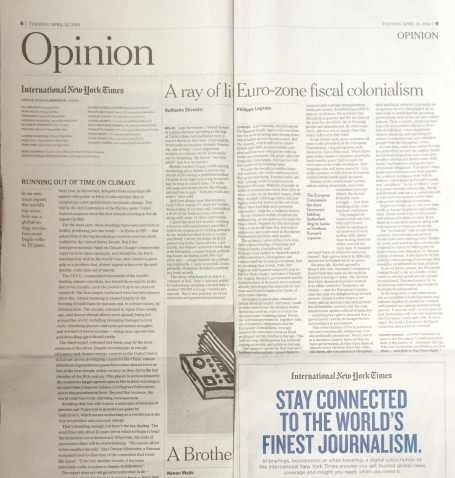
The international edition of today’s New York Times is entertaining if you examine pages eight and nine together.
On the right (page nine), there’s an ad for the newspaper, in which it claims to be “the world’s finest journalism” and urges people to purchase a digital subscription that will “ensure” access to “trusted global news coverage and insight.” On the left (page eight) the Times runs a single editorial. Editorials are the official voice of any newspaper.
The sub-headline that accompanies today’s editorial refers to the latest findings of the Intergovernmental Panel on Climate Change (IPCC):
In an ominous report, the world’s top scientists say a global energy revolution must begin within 15 years [bold added]
Three paragraphs down, we read that:
The I.P.C.C. is composed of thousands of the world’s leading climate scientists… [bold added]
Yes, a newspaper that thinks it’s producing the world’s finest journalism still hasn’t noticed that
- The IPCC provides no proof whatsoever that it is composed of the world’s top scientists. In fact, it declines to make public the CVs of its personnel.
- Certain IPCC lead authors and chapter leaders have historically been graduate students a decade or more away from earning their PhD (see here and here)
- Other IPCC lead authors are poorly qualified individuals from obscure nations, who were selected to give the report an international flavour.
- 60% of the people who helped produce this latest report have never worked with the IPCC before (see the bottom of p. 3 of this PDF). Was there really a 60% turnover rate in the world’s top scientists since the last IPCC report appeared in 2007?
- IPCC personnel have so little power, they aren’t able to alter their chapter title by a single word. In reality, these people are mere cogs in a large, bureaucratic, UN machine.
- Many IPCC personnel are not “scientists” in the way that term is normally understood. They are, instead, economists, geographers, policy wonks, UN employees, and activists.
The New York Times is demonstrably not offering what it claims to be offering: trustworthy news and insight.
Whoever wrote and approved today’s editorial is years out-of-date. There’s no meaty analysis here, just mindless parroting of the IPCC party line.
Times readers deserve better than this.
April 22, 2014
Posted by aletho |
Deception, Mainstream Media, Warmongering, Science and Pseudo-Science | New York Times |
Leave a comment
The US, Kiev, their EU allies and their media echo chamber are up to their invariable game of rewriting last week’s Geneva Statement to mean not what it says but what they want it to say.
To repeat the Geneva Statement contains NO time line (see my previous post where I discussed what the Geneva Statement actually says). It does NOT require buildings and public places in the east to be evacuated before buildings and public places in the west. It does not require people in the east to disarm before people disarm in the west. Above all it does NOT require the vacation of buildings and public places in the east and the disarmament of the people there before the start of negotiations on constitutional change or make the vacation of buildings and public places in the east or the disarmament of the people there a pre condition for the start of the negotiations on constitutional change.
I make this point because that is how Kiev and its present supporters are currently trying to misrepresent the Geneva Statement. Needless to say if the buildings and public spaces in the east were vacated and the people there disarmed the pressure there currently is to start serious negotiations on constitutional change would abate with the strong probability that negotiations would then never take place at all. In reality there is nothing in the Geneva Statement that says that negotiations cannot start right away whilst the buildings and public places in the east remain occupied and the people there remain armed with the buildings and public places in the east (and the west) and the people in the east (and the west) disarming as part of an overall settlement achieved as a result of the negotiations. Given the history of broken agreements on the part of Kiev and its western sponsors (eg. the 21st February 2014 agreement) the continuing mobilisation of the people of the east whilst the negotiations are underway and until an agreement is reached and secured would seem to be a basic precaution.
I would remind everybody that the people who currently form the regime consistently refused to vacate Maidan whilst they were negotiating with Yanukovitch and he (wrongly in my opinion) never insisted that they do so.
I make this point because so far there is no sign from Kiev of any attempt to begin negotiations at all. We have not even had the announcement of a negotiating team or discussions about the venue for talks. Instead Kiev and the US administration are hiding behind the continuing occupation of the buildings and public spaces in the east and the presence of armed men there as a pretext for not starting talks. It needs to be said clearly and unequivocally that this is a false pretext and that there is no reason or excuse to delay the start of talks on constitutional change which is the overriding priority at the moment if this crisis is to be brought to a peaceful and satisfactory end.
April 22, 2014
Posted by aletho |
Deception, Mainstream Media, Warmongering | Ukraine, United States |
Leave a comment
There is now a pattern to New York Times “investigative” stories that seek to pin the blame on some nefarious foreign enemy, as in the 2002 article on Iraq buying aluminum tubes for nuclear centrifuges; the 2013 “vector analysis” tracing sarin-laden rockets to a Syrian military base; and now a photographic analysis proving that Russian soldiers are behind unrest in eastern Ukraine.
All these stories draw hard conclusions from very murky evidence while ignoring or brushing aside alternative explanations. They also pile up supportive acclamations for their conclusions from self-interested sources while treating any doubters as rubes. And, these three articles all involved reporter Michael R. Gordon.
The infamous aluminum tube story of Sept. 8, 2002, which Gordon co-wrote with Judith Miller, relied on U.S. intelligence sources and Iraqi defectors to frighten Americans with images of “mushroom clouds” if they didn’t support President George W. Bush’s invasion of Iraq. The timing played perfectly into the administration’s advertising “rollout” for the Iraq War.
Of course, the story turned out to be false and to have unfairly downplayed skeptics of the nuclear-centrifuge scenario. The aluminum tubes actually were meant for artillery, not for centrifuges. But the article provided a great impetus toward the Iraq War, which ended up killing nearly 4,500 U.S. soldiers and hundreds of thousands of Iraqis.
Gordon’s co-author, Judith Miller, became the only U.S. journalist known to have lost a job over the reckless and shoddy reporting that contributed to the Iraq disaster. For his part, Gordon continued serving as a respected Pentagon correspondent.
Gordon’s name also showed up in a supporting role on the Times’ botched “vector analysis” of Sept. 17, 2013, which nearly helped get the United States into another Mideast war, with Syria. That story traced the flight paths of two rockets, recovered in suburbs of Damascus after the Aug. 21 sarin gas attack, back to a Syrian military base 9.5 kilometers away.
The article became the “slam-dunk” evidence that the Syrian government was lying when it denied launching the sarin attack that killed several hundred people.
However, like the aluminum tube story, the Times’ ”vector analysis” also ignored contrary evidence, such as the unreliability of one azimuth from a rocket that landed in Moadamiya because it had struck a building in its descent. That rocket also was found to contain no sarin, so it’s inclusion in the vectoring of two sarin-laden rockets made no sense.
But the Times’ story ultimately fell apart when rocket scientists analyzed the one sarin-laden rocket that had landed in the Zamalka area and determined that it had a maximum range of about two kilometers, meaning that it could not have originated from the Syrian military base.
C.J. Chivers, one of the co-authors of the article, waited until Dec. 28 to publish a halfhearted semi-retraction. [See Consortiumnews.com’s “NYT Backs Off Its Syria-Sarin Analysis.”]
Grainy Photos
Now, the New York Times has led its Monday editions with an article supposedly proving that Russian military special forces are secretly directing the popular uprisings in eastern Ukraine in resistance to the Kiev regime, which took power after the violent overthrow of elected President Viktor Yanukovych on Feb. 22.
The Times based its story on grainy photographs provided by the Kiev regime supposedly showing the same armed “green men” involved in actions with the Russian military earlier and now with the pro-Russian protesters who have seized government buildings in towns in eastern Ukraine.

From the New York Times graphic package of photos in support of its article accusing Russia of sending special forces soldiers into eastern Ukraine
The Times reported:
“Now, photographs and descriptions from eastern Ukraine endorsed by the Obama administration on Sunday suggest that many of the green men are indeed Russian military and intelligence forces — equipped in the same fashion as Russian special operations troops involved in annexing the Crimea region in February. Some of the men photographed in Ukraine have been identified in other photos clearly taken among Russian troops in other settings.”
The Times apparently accepts the photos as legitimate in terms of where and when they were taken, but that requires first trusting the source, the post-coup regime in Kiev which has a strong motive for making this argument as a prelude to violently crushing the eastern Ukrainian protests.
Secondly, one has to believe that the fuzzy photographs of the circled faces are the same individuals. They may be, but it is difficult to be sure from what is displayed. The principal figure shown is a man with a long beard and a cap sometimes pulled down over his forehead. He could be a Russian special forces soldier or a character from “Duck Dynasty.”
And the resemblance of some uniforms to those worn by Russian soldiers is also circumstantial, since military gear often looks similar or it could have been sold to civilians, or the men could be veterans who kept their old uniforms after leaving the military. The fact that these men are adept at handling weapons also could mean that they have prior military experience, not that they are still active.
For the Times to cite the Obama administration’s endorsement of the Kiev regime’s claims as some kind of verification is also silly. Anyone who has followed the Ukraine crisis knows that the U.S. government is wholeheartedly on the side of the post-coup regime, trumpeting its propaganda and dismissing any counterclaims from the Yanukovych camp or from Moscow.
Masked Men
There’s other silliness in the Times article, such as the notion that the Russians are unusual in “masking” their special forces when U.S. military and intelligence services have been doing the same for decades. In contradicting Russian denials that the Kremlin has dispatched undercover soldiers, the Times wrote:
“But masking the identity of its forces, and clouding the possibilities for international denunciation, is a central part of the Russian strategy, developed over years of conflict in the former Soviet sphere, Ukrainian and American officials say.”
Is it possible that the Times’ reporters, including Pentagon correspondent Gordon, don’t know that U.S. Special Forces and CIA officers routinely grow beards and wear local garb to blend in when they are operating in places like Afghanistan, Iraq, Central America, etc.?
When I was covering Central America policy in the 1980s, I knew American mercenaries, including former U.S. Special Forces soldiers, who provided training and other assistance to the region’s security forces. Sometimes, these veterans coordinated their actions with the U.S. government and sometimes they were simply making money.
More recently, there have been the various permutations of Blackwater, a private security firm that employs former U.S. military personnel and makes them available to governments around the world, sometimes in support of American interests but sometimes not.
All these are factors that should be considered when making claims about whether military men who show up in Kiev or eastern Ukraine or anywhere else are on assignment for a specific government or are working for a local “oligarch” or are simply inspired by nationalism. But these nuances are missing from the Times story as it jumps to its preferred conclusion.
Plus, you have to wonder how skillful the Russians really are at “masking” if they have their special forces troops wear uniforms that can be so easily traced back to Russia.
That is not to say that these “green men” might not be Russian special forces. I have one longtime source who is convinced that they are Russian soldiers (though he has not seen any proof), and another source who insists that the Russian government did not want the uprisings in eastern Ukraine and did not dispatch these men.
But the Times should have learned from its previous blunders and taken care to include alternative scenarios or point to evidentiary holes in what the Kiev regime claimed. Instead, the Times has again acted like a prosecutor determined to make a case, not a fair-minded judge weighing the evidence.
It is also an indictment of the Times’ professionalism that this newspaper of record can’t seem to detect neo-Nazis in the post-coup regime, when some have open histories of pro-Nazi behavior, while it goes to dubious lengths to discredit the eastern Ukrainians who are resisting the imposition of authority from an unelected administration in Kiev.
Just like the “aluminum tube” story that justified killing so many Iraqis and the “vector analysis” that almost unleashed a devastating U.S. bombing campaign on Syria, the Times’ “green men” piece may be the prelude to a bloodbath in eastern Ukraine. [For more on the U.S. propaganda, see “Ukraine. Through the US ‘Looking Glass.’”]
~
Investigative reporter Robert Parry broke many of the Iran-Contra stories for The Associated Press and Newsweek in the 1980s. You can buy his new book, America’s Stolen Narrative, either in print here or as an e-book (from Amazon and barnesandnoble.com).
April 21, 2014
Posted by aletho |
Deception, Mainstream Media, Warmongering | New York Times, Russia, Ukraine |
Leave a comment
![The Syrian Civil War has devastated entire cities and towns as fighting between the rebels and Syrian Army spreads from neighborhood to neighborhood [Xinhua]](https://i0.wp.com/thebricspost.com/wp-content/uploads/2014/04/219858479_8-e1397921219172.jpg)
An examination of texts published by Father Frans van der Lugt in 2011 and 2012 shows that the late Dutch Jesuit priest had a dim view of the Syrian rebellion, which he held to be the work of a violent minority, and favored a process of political reform in Syria to be implemented by the current government under President Bashar Al-Assad.
Father Frans was murdered under still unclarified circumstances in the embattled Syrian city of Homs earlier this month.
Opposition sources have blamed the Syrian government for his death. But it is widely believed that Father Frans was killed by hard-line Islamist members of one of the rebel factions that have taken control of his Bustan al-Diwan neighborhood in Homs.
The texts of Father Frans, who had lived in Syria since 1966, provide an eyewitness account of the origins of the anti-Assad rebellion and the gradual hardening of the front between opposing rebel and government forces in Homs.
In many respects, the Father’s observations contrast sharply with what has become the standard view of the rebellion in Western media.
Perhaps most notably, whereas the rebellion is typically held to have been sparked by the violent repression of peaceful protests, according to Father Frans, the “protest movement” contained an armed and violent element “from the start” and the violent opposition quickly gained the ascendancy over the peaceful opposition.
Thus, in a letter published in January 2012 on the Dutch-Flemish Mediawerkgroep Syrië website, Father Frans wrote:
From the start, the protest movements were not purely peaceful. From the start I saw armed demonstrators marching along in the protests, who began to shoot at the police first. Very often the violence of the security forces has been a reaction to the brutal violence of the armed rebels.
In the same letter, Father Frans insisted that what was occurring in Syria could not be described as a “popular uprising,” since the majority of Syrians do not support the opposition and “certainly not” its armed component.
Already in September 2011, Father Frans had made similar observations in a guest post on a Belgian blog, going so far as to accuse armed opposition groups of blaming the regime for their own acts of violence.
Having noted the splintering of the opposition among Islamists, “liberals and democrats”, communists and so on, Father Frans continued:
Moreover, from the start there has been the problem of the armed groups, which are also part of the opposition….The opposition of the street is much stronger than any other opposition. And this opposition is armed and frequently employs brutality and violence, only in order then to blame the government. Many representatives of the government [regeringsmensen – Father Frans might also be referring to supporters of the government] have been tortured and shot dead by them.
“Personally,” Father Frans concluded, “I expect little good to come from the opposition, which, moreover, has been instigated and paid by foreign interests.”
Favoring political reform
Faced with a choice between an opposition as so described and the current Syrian government, Father Frans clearly favored a process of political reform undertaken by the latter and not the “regime change” that has been favored by the West.
“Personally,” he wrote in September 2011, “I think this government has to stay, despite all difficulties, and proceed along the path of reforms.”
In his January 2012 letter, he outlined a similar course of action, noting that the current government is “perhaps more democratic than possible replacements.”
In particular, he regarded the current regime as the best guarantee against the spread of sectarian violence in Syria.
Whereas Western press reports have emphasized his efforts to promote understanding among Christians and Muslims, Father Frans identified the main sectarian fault-line in Syria as that running between two Muslim communities: Sunnis, who make up the majority of the population, and the Alawite minority, which is not only associated with the current regime but whose members are regarded as apostates by radical Sunni currents.
In January 2012, Father Frans warned that the Syrian army was the only thing standing in the way of a full-fledged civil war between Sunnis and Alawites in Homs.
In the same letter, he noted that most Christian leaders in Syria support Assad, “because they are convinced that they would be worse off with another solution.”
In his critical observations on the Syrian crisis, Father Frans did not spare the Western media, which he accused of distortion and bias.
In September 2011 he wrote that he was disturbed by Western coverage of the Syrian crisis because there was “never a good word” published about the current government.
He said that Western media blamed the Syrian government “for things that it had not done”. He went on:
Our experience with the government has not been so negative. In my case, they always helped my projects and supported my idea of being of service to Sunnis and Alawites. They wanted an ever greater separation of church and state and were enthusiastic about projects that were non-denominational.
According to the Dutch daily de Volkskrant, the help provided by the Syrian government to Father Frans included a grant of over 100 acres of land for the Father’s agricultural projects.
Lords and masters
Ironically, by March 2012, Father Frans found himself living under siege by the forces of the very Syrian government he supported. In the meanwhile, rebel forces, which had briefly taken control of Bustan al-Diwan in September 2011, were back again and this time they were there for the long-term.
Now, as Father Frans noted in an eyewitness report for the Flemish monthly Streven, the rebel forces were “much better organized” and “called themselves ‘the Free Syrian Army.’”
“They had an abundance of food,” he continued, “and they also distributed it to poor people. They are financially and militarily supported by foreign interests.”
“For now,” Father Frans concluded, referring to both the Bustan al-Diwan and Hamidiyeh neighborhoods of Homs, “the Free [Syrian] Army is lord and master of our Christian neighborhoods….”
In late March, Father Frans’s own car was destroyed by a missile or mortar fired into Bustan al-Diwan by the Syrian army. “The army was aiming for a restaurant not far from us where the FSA has its headquarters,” he explained to the Swiss Catholic new agency APIC.
“There is a Greek Orthodox church right next door, which was also damaged.”
Father Frans told APIC that ninety percent of the Christian population of Homs had already fled the city, because of the fighting.
“They were not chased out by the Sunni militias,” Father Frans took care to add, “This needs to be emphasized! The Syrian army was first driven from the neighborhood by the FSA and now it’s the FSA that is being bombed.”
In his contribution to Streven, Father Frans wrote about the futility of the army’s bombing campaign and its disastrous effects upon the remaining Christian population:
… [T]he only result is that many Christian homes and also churches… have been bombed and partially or wholly destroyed, while the soldiers of the Free [Syrian] Army remain unharmed. The latter hide in the cellars of the Christian homes to protect themselves from the bombing.
Nonetheless, Father Frans remained clear about where he believed the ultimate responsibility for the disaster lay. “There is no excusing the fact,” he wrote, “that the Free Syrian Army has taken the Christian neighborhoods in order to use them as a battlefield for combating the government army.”
But not even the experience of siege and bombardment by government forces could shake Father Frans’s conviction that distorted, one-sided coverage of the Syrian crisis in the media was itself a major obstacle to peace.
Reflecting on the way forward in the conclusion to his contribution to Streven, Father Frans warned:
In the first place, it has to be said that it is very difficult to provide a nuanced and objective account of what is happening. Many journalists fall into describing matters in black and white. For them, good and evil are not interwoven, but are clearly separated. They demonize the one side and glorify the other. Thus, for example, it is not true that our [the Syrian] government has only bad sides and the opposition only good ones. But because the US, Europe and certain Arab countries support the opposition, they endeavor, whether consciously or unconsciously, to idealize it as much as possible, without engaging in any careful analysis of the real situation. Certain interests are obscuring our view of the real situation and contaminating the description of it.
The author of this article John Rosenthal is a European-based journalist and political analyst who writes on European politics and transatlantic issues. His articles have appeared in such publications as Al-Monitor, World Affairs, The Wall Street Journal Europe, Les Temps Modernes, and Die Weltwoche. He is the author of the recent book The Jihadist Plot: The Untold Story of Al-Qaeda and the Libyan Rebellion. You can follow his work at www.trans-int.com or on Facebook
April 20, 2014
Posted by aletho |
Mainstream Media, Warmongering, Timeless or most popular |
Leave a comment
A letter urging the Jews of Donetsk to get registered, which the US Secretary of State cited in Geneva, is a fake says a man whose signature appears on the communication.
Following the four-side meeting on the Ukrainian crisis in Geneva on Wednesday, John Kerry lashed out at a letter that was allegedly sent to Jewish citizens in Ukraine’s eastern town of Donetsk, asking them to register and report all their property, or be stripped of citizenship and face expulsion.
“In year 2014, after all of the miles traveled in all the journey of history, this is not just intolerable, it’s grotesque… beyond unacceptable,” he stated.
Images of the letter have been circulating online.
The letter was stamped and signed by Denis Pushilin, who was identified on it as the “People’s Governor.”
However, Pushilin denied he had anything to do with the letter, claiming it was a fake.
“There are similar letters not only addressed to Jews, but also to businessmen, foreign students, people of certain other occupations,” he told RT. “This is actually a fake, and not a good one. There’s a sign “People’s Governor”. First of all, no one calls me by that title, no one elected me. Secondly, the stamp is the former mayor’s. Everything’s photoshopped.”
Although the letter’s authenticity is questionable, the fact that it was mentioned by a top US official has quickly sent the “Letter to Jews” story viral. It struck a very sensitive chord with audiences worldwide and cast a grave shadow over anti-government protesters in Donetsk.
Meanwhile, a Ukrainian MP who has visited the turbulent region, Boris Kolesnikov of the Party of Regions, has urged that information coming from Ukraine should be double-checked.
He believes that Ukrainian law enforcement agencies aren’t being totally honest when they describe the people participating in the protests and claim there are Russian servicemen among them.
Kolesnikov specifically referred to a video which earlier appeared online. In it a man in a military uniform told police officers, who switched sides in the city of Gorlovka and joined protesters, that he was Russian lieutenant-colonel from Simpheropol, Crimea. The man was later identified by Gorlovka residents as the former director of a local cemetery.
“Officially, I’ve only seen one Russian serviceman,” Kolesnikov said. “The next day he appeared to be the ex-director of the Gorlovka cemetery, fired 2 years ago for selling 38 fences, stealing a monument and extorting money from old women for new graves. There are Interior Ministry and intelligence services in the country, which should give us truthful information.”
He added it was quite obvious that the protesters in Donetsk did not represent any danger to civilians and called for negotiations with the activists. These talks would explain Kiev’s position and that the government is ready to make amendments to the constitution.
The US appears to be relying on information from Kiev, while ignoring alternative points of view. And so it seems that a top US official picked up and railed about a letter of questionable authenticity.
Earlier in April, spokesperson for the US Department of State, Jen Psaki, said that protest events in eastern Ukraine “appeared to be a carefully orchestrated campaign with Russian support.”
She was then asked if the department was only relying on Kiev in its assessment of the situation, or was using some independent sources.
“Well, of course we remain very closely in touch with the Ukrainian Government, and that’s who we work closely with, and of course, they are on the ground, so their information is often very relevant and current,” was the reply.
April 18, 2014
Posted by aletho |
Deception, Mainstream Media, Warmongering | Russia, Ukraine, USA |
Leave a comment
Seven months after the end of the Syrian chemical weapons crisis, the Syrian army is making progress in the Damascus countryside and the opposition is exerting all its military might to achieve a strategic victory in Aleppo. Recently, news of the regime using poison gas against the opposition has reemerged with Israel leading the charge.
All the voices calling for organizing the Geneva III conference for negotiations between the Syrian government and the opposition have faded. The circumstances on the ground that allowed the regime not to give concessions at Geneva II still hold. The Syrian army continues, with its allies, to make progress on the ground. This allows the regime, once again, not to give any serious concessions in any negotiations that will take place in the foreseeable future. It is on this basis that the opposition’s latest battles in Quneitra, Daraa, Kassab, Idlib and Aleppo have been waged.
Until now, it appears that of all the battles, the battle of Aleppo stands in a class of its own. In the battles of Damascus, its countryside (Eastern Ghouta and Qalamoun), Homs and its nearby surroundings, the opposition forces acknowledged their loss. They put up a strong fight just to make the other side pay a heavy price. All the other battles do not make up, in military or moral terms, for losing in Damascus and the central region, except the battle for Aleppo. That is why we see the opposition forces’ massive mobilization in the economic capital of Syria.
The opposition is not merely talking about making progress in Aleppo but is promising to take complete control of the largest city in the north. Based on its discussions, the opposition wants to achieve a quick victory in Aleppo before the regime and its allies finish their battles in Damascus and Homs. Achieving stability in the capital and the central region for the regime will free up a large segment of the elite forces and will allow the Syrian army and its allies to move towards other active fronts. It would then be very difficult for the opposition to achieve progress of any strategic value in the north or the south. Until today, the al-Qaeda-inspired fighters have not been able to make a strategic breakthrough in the north. In Aleppo, the war is led by Jaish al-Muhajireen wal-Ansar (Army of Foreign Fighters and Supporters) which includes mostly Caucasian fighters who are well-trained and have combat experience.
Against this background, news has emerged once again that the Syrian army has used chemical weapons. Last August, the Syrian government asked for an investigation of an incident whereby militants used chemical weapons in Khan al-Asal in Aleppo. But after the attack on Eastern Ghouta, the regime was accused by Western forces of using poison gas against the opposition. Washington led a campaign threatening an attack on Syria until Russia proposed a solution that required Syria to give up its chemical arsenal. This time, the Syrian government sent a letter to the United Nations on March 25 saying that it monitored communications between the opposition in Jobar, which is adjacent to the capital, indicating that “the terrorist organizations are going to launch attacks by using poison gas with the aim of framing government forces.”
While the opposition has remained silent, Israel this time led the charge of accusing the regime of using chemical weapons. On April 7, the Israeli Channel 10 website reported a “major Israeli security source” saying that the Syrian army has gone back to using chemical weapons against the opposition forces. It used it at least in one case on March 17 in Harasta, eastern Damascus. According to the Israeli security source, the material used was not deadly chemical weapons found on the list of prohibited materials based on the agreement with the West, but rather substances that cripple those exposed to it for several hours.
After four days, the Syrian opposition grabbed the accusation and ran with it. The Syrian National Coalition issued a statement asking the international community to investigate the use of poison gas by the regime in Harasta. The Western press started again to play the tune of the regime using chemical weapons. Yesterday, the regime and the opposition exchanged accusations about using poison gas in the town of Kfar Zita in the Hama countryside.
Washington has distanced itself from this debate so far. The State Department’s spokesperson, Jennifer Psaki, said yesterday that her country does not have proof of chemical weapons use. The British and the French seem more excited than others to take up the issue. Western diplomatic sources in Paris say that since the failure of the Geneva II conference, the French authorities have been talking about the possibility of the Syrian regime using chemical weapons that are not internationally prohibited and that the international community must act to deter the regime.
The source likened this claim to the audio recording of a secret meeting of the Turkish Prime Minister Recep Tayyip Erdogan’s work team published on March 27 in which they talked about creating a pretext that would allow Turkey to intervene militarily in Syria. But intervention does not seem possible at this point. According to a source close to the regime in Syria, the goal of “this intimidation is twofold. Exonerating the opposition of what it is doing and a desperate attempt to draw red lines in front of the the Syrian army and its allies in their battle in the Damascus countryside so the opposition can make some progress in the north.”
April 14, 2014
Posted by aletho |
Deception, Mainstream Media, Warmongering | France, Israel, Syria, Zionism |
Leave a comment