Provocation: Murky forces instigating Odessa violence?
RT | May 5, 2014
Video footage filmed during the bloody events in Odessa that claimed dozens of lives on Friday shows a more complicated picture, with provocateurs instigating the violence.
Ukrainian authorities blamed the pro-autonomy activists for starting the clashes that led to the tragic fire at the House of Trade Unions. The interior ministry stated that anti-Kiev activists attacked supporters of Kiev authorities before retreating to the building for shelter, and threw petrol bombs at the crowd triggering the fire.
Russia’s Channel One television reconstructed the chronological order of events using publicly available YouTube videos detailing what happened in Odessa on Friday.
It began with a football match between two teams – Chernomorets Odessa and Metalist Kharkov. Despite the high political tensions in the region, authorities still allowed the match to take place, realizing that a few thousand pro-Kiev football fans would be arriving to the city.
Following the match, around 1,500 supporters of the Kiev authorities and football ultras came together for a march in support of Ukraine’s unity. The rally was sanctioned by local authorities.
Nationalists made their way towards the center of the city chanting “Glory to Ukraine” and “Death to enemies,” as well as “Knife the Moskals (derogatory for Russians).” Some people in the group wore ultra-nationalist movement insignia. They were armed with chains and bats, and carried shields.
The violence started when the pro-Kiev crowd was met by what looked like anti-government activists. They were wearing St. George ribbons – identifying them as pro-autonomy – and red bands around their sleeves. Some of the riot police officers present at the scene were wearing the same red bands around their sleeves.
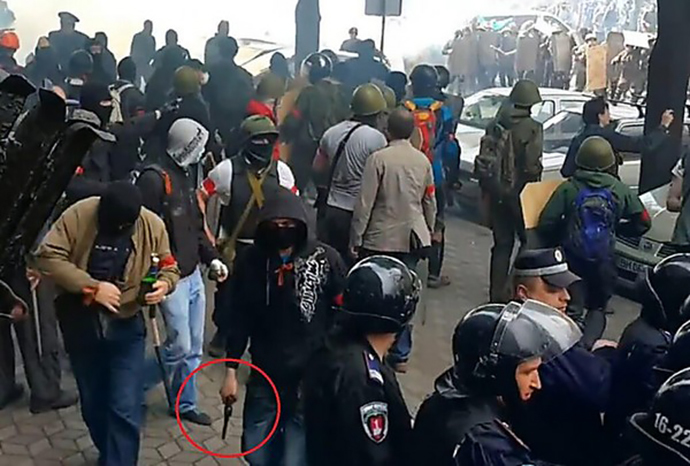
Image from ontimer.livejournal.com
Then the visibly smaller group of alleged anti-Kiev activists started to attack the march, apparently provoking the demonstrators. Footage then shows a smaller group of men wearing red bands luring the pro-Kiev crowd into a different direction.
At some point, the police line opened up to let the men wearing red bands through and closed back up again. A video then shows a man standing behind the police lines shooting at the pro-Kiev crowd.
The provocations succeeded in triggering clashes, as both sides began to throw stones, and shots were heard.
The alleged anti-Kiev activists then disappeared and angry pro-Kiev supporters headed to the opposition camp based in front of the House of Trade Unions.
However, none of the original attackers with the red bands were there. Instead, a few dozen pro-autonomy activists were surrounding the camp. When the activists saw the angry mob approaching, they took shelter inside the House of Trade Unions.
Survivors of the fire say they had to barricade themselves inside the House of Trade Unions to hide from the agitated mob, which torched their tent camp.
Radicals then began throwing Molotov cocktails at the Trade Unions building, setting it on fire. Witnesses say those who managed to escape the blaze were severely beaten outside by the besiegers of the burning building.
But the Ukrainian Interior Ministry offers a different version of events, saying the victims of the violent unrest started the fire themselves when they began throwing Molotov cocktails from the upper floor.
Multiple videos of the incident, however, show Molotov cocktails flying from outside the building. Another video shows that some radical pro-Kiev elements were also inside the building, waving a Ukrainian flag.
The evidence leads one to conclude that the football fans could have been manipulated while unknown forces instigated the violence.

Which insignia has this “pro-russian activist of united Ukraine” forgotten to take off? (at left – the band of ukrainian flag; at right – the George band (glory anti-fascist world war 2)
A further point from Da Russophile :
The conduct of the British media in response to this massacre has been beyond appalling. So far not a single British newspaper has editorialised about the massacre. Following the sniper attacks on Kiev the British media had no hesitation in putting the blame on Yanukovitch though the evidence (to put it mildly) was far from conclusive. At an earlier stage in the Maidan protests sections of the British media devoted a phenomenal amount of time, reporting and commentary to the attack on Chornovil with all sorts of unsubstantiated speculations that Yanukovitch was personally behind it though evidence of that there was none.
Not only has the British media failed to give the Odessa massacre anything remotely approaching the amount of reporting the scale of the massacre justifies but it persists in pretending that there are uncertainties about who was responsible even though film and eye witness evidence is conclusive and even though (as I understand it) persons involved in the pro Maidan organisations involved in the massacre have openly bragged about it. Instead the Guardian in its editorial the day after the massacre preferred to editorialise about the wickedness of Russia holding a May Day party on Red Square
We had an article in the Daily Telegraph calling the local people who demanded the release of the surviving anti government activists saved from the fire and arrested by the Odessa police following the massacre a “mob” threatening Odessa with “anarchy”
We have an article in the Guardian today calling readers who post comments on Comment is Free critical of its pro Maidan editorial line “Kremlin trolls”.
Whilst The Times editorialises that Putin must stop his campaign of “subversion and coercion” against the Ukraine which has in Odessa has “inspired separatists” into “acts of war”.
I invite people to imagine how the British media would have reported this massacre if roles had been reversed and if it had been Maidan supporters who were burnt alive in the Trade Union building with an anti Maidan crowd filmed throwing in Molotov calls and baying for blood outside.
‘Free Press’? USAID Increases Funding to Pro-Kiev Media
By Daniel McAdams | Ron Paul Institute | May 3, 2014
In the name of a “free and independent media,” the US government through its Agency for International Development (USAID) has announced that it will dedicate an additional $1.25 million to subsidize the Ukrainian media in advance of the May 25th presidential election.
Through its multi-year “U-Media” project, USAID has been a major sponsor of the Ukrainian press. It goes without saying that the media outlets and organizations underwritten by the US government in Ukraine adhere closely to the US government’s foreign policy position in the country and region.
The infusion of more than a million dollars into US government-friendly media outlets and NGOs in Ukraine just weeks before the presidential election should be seen for what it is: direct external manipulation of the democratic process in Ukraine.
Nevertheless, the US interference is advertised as “supporting platforms for free and open communications.”
But USAID makes it clear which side this project is intended to support:
USAID is supporting the Government of Ukraine as it implements constitutional and electoral reforms that fulfill its stated goal of becoming a fully inclusive and economically stable democracy.
It is an attack on language itself for the US government to claim that the media it funds is “independent,” as that belies the meaning of the term. Nevertheless the State Department continues to waterboard the English language:
‘USAID supports a strong and independent media in Ukraine,’ said Paige Alexander, Assistant Administrator for the Bureau for Europe and Eurasia (E&E). ‘This additional funding will help to protect vulnerable journalists while also advancing press freedoms and democratic governance in Ukraine.’
At a time when US Secretary of State John Kerry and his State Department continues to attack the Russian-government funded station RT for being state supported, it should be instructive to witness the hundreds of pro-Washington media outlets that are funded by the US government overseas. It should be instructive to see the electoral processes that are manipulated by the US government’s cash infusion to the side it favors.
Pot. Kettle. Black.
Another NYT ‘Sort of’ Retraction on Ukraine
By Robert Parry | Consortium News | May 4, 2014
The New York Times, which has asserted for weeks that the Russian government is behind the unrest in Ukraine’s east, finally sent some reporters to the region to dig up the proof, but all they found were eastern Ukrainians upset by the coup regime in Kiev that replaced President Viktor Yanukovych.
The Times, which has been an unapologetic promoter of the “pro-democracy” uprising that ousted the democratically elected president through violent extra-constitutional means, has recently been promoting the “theme” that Ukrainians would be happy with their new unelected government if only the Russians weren’t “destabilizing eastern Ukraine.”
Times’ editors thought they had the goods two weeks ago with a front-page scoop featuring photographs supposedly proving the presence of Russian special forces troops. According to the Times, the photos “clearly” showed Russian special forces in Russia and then the same soldiers in eastern Ukraine.
However, only two days later, the scoop unraveled when it turned out that a key photo – supposedly showing a group of soldiers in Russia who later appeared in eastern Ukraine – was actually taken in Ukraine, destroying the premise of the entire story.
So, the Times belatedly dispatched reporters C.J. Chivers and Noah Sneider to Slovyansk in eastern Ukraine to talk with the militants who are opposing the coup regime in Kiev. To their credit, the two reporters actually seem to have recounted what they found, albeit with some of the anti-Russian bias that is now deeply embedded in the Western media narrative.
Noting that Moscow says the Ukrainian militants are not part of the Russian armed forces while “Western officials and the Ukrainian government insist that Russians have led, organized and equipped the fighters,” the reporters write:
“A deeper look at the 12th Company [of the People’s Militia] — during more than a week of visiting its checkpoints, interviewing its fighters and observing them in action against a Ukrainian military advance here on Friday — shows that in its case neither portrayal captures the full story.
“The rebels of the 12th Company appear to be Ukrainians but, like many in the region, have deep ties to and affinity for Russia. They are veterans of the Soviet, Ukrainian or Russian Armies, and some have families on the other side of the border. Theirs is a tangled mix of identities and loyalties.
“Further complicating the picture, while the fighters share a passionate distrust of Ukraine’s government and the Western powers that support it, they disagree among themselves about their ultimate goals. They argue about whether Ukraine should redistribute power via greater federalization or whether the region should be annexed by Russia, and they harbor different views about which side might claim Kiev, the capital, and even about where the border of a divided Ukraine might lie.”
Chuckling at Kiev
The Times reporters cited one unit leader named Yuri as chuckling “at the claims by officials in Kiev and the West that his operations had been guided by Russian military intelligence officers. There is no Russian master, he said. ‘We have no Muscovites here,’ he said. ‘I have experience enough.’ That experience, he and his fighters say, includes four years as a Soviet small-unit commander in Kandahar, Afghanistan, in the 1980s.
“The 119 fighters he said he leads, who appear to range in age from their 20s to their 50s, all speak of prior service in Soviet or Ukrainian infantry, airborne, special forces or air-defense units.”
The reporters also discovered mostly well-worn and dated weaponry, not the newer and more sophisticated equipment that is available to Russian forces.
“During the fighting on Friday, two of the fighters carried hunting shotguns, and the heaviest visible weapon was a sole rocket-propelled grenade,” Chivers and Sneider wrote. “Much of their stock was identical to the weapons seen in the hands of Ukrainian soldiers and Interior Ministry special forces troops at government positions outside the city. These included 9-millimeter Makarov pistols, Kalashnikov assault rifles and a few Dragunov sniper rifles, RPK light machine guns and portable antitank rockets, including some with production stamps from the 1980s and early 1990s.”
Other Western journalists, who have bothered to report from eastern Ukraine rather than just accept handouts from the U.S. Embassy in Kiev or the State Department in Washington, discovered a similar reality.
For instance, on April 17, Washington Post correspondent Anthony Faiola reported from Donetsk that many of the eastern Ukrainians whom he interviewed said the unrest in their region was driven by fear over “economic hardship” and the IMF austerity plan that will make their lives even harder.
“At a most dangerous and delicate time, just as it battles Moscow for hearts and minds across the east, the pro-Western government is set to initiate a shock therapy of economic measures to meet the demands of an emergency bailout from the International Monetary Fund,” Faiola reported.
But this on-the-ground reality of legitimate and understandable concerns among the eastern Ukrainians has been missing from the U.S. propaganda barrage, which has overwhelmed the mainstream press as thoroughly as a similar P.R. campaign did during the run-up to the Iraq War, if not more so. Official Washington’s “group think” now is all about blaming Russian President Vladimir Putin for the Ukraine crisis.
One of the more preposterous theories that I have heard from Washington punditry and officialdom is that Putin arranged the Ukraine chaos as part of a scheme to reclaim land lost after the collapse of the Soviet Union in 1991. Though this notion of Putin as the aggressor plotting to reassert Russian imperialism has become something of a “conventional wisdom,” it is fully unsupported by the facts.
To believe that Putin instigated the Ukraine crisis, you would have to believe that he organized the Maidan protests, that he built up the neo-Nazi militias that spearheaded the Feb. 22 coup, and that he intentionally overthrew his ally, Yanukovych, whom Putin seemed to be trying to save. Though this conspiracy theory is ludicrous, it is now widespread in Official Washington.
Caught Off-Guard
The reality was that Putin was caught off-guard by the events in Ukraine, in part, because he was preoccupied with the Sochi Winter Olympics and the threat that the games would be marred by a major terrorist attack. He spent a great deal of time in Sochi personally overseeing the security.
Meanwhile, the Maidan uprising was unfolding in Kiev, cheered on by U.S. Assistant Secretary of State for European Affairs Victoria Nuland and partly financed by American entities, such as the U.S.-funded National Endowment for Democracy, whose longtime president Carl Gershman deemed Ukraine “the biggest prize” in a Washington Post op-ed published in late September, months before the current crisis erupted.
Though many of the protesters from western Ukraine had legitimate grievances over the pervasive corruption in Ukrainian politics and the inordinate power of a handful of wealthy oligarchs, the final violent coup was carried out by well-trained neo-Nazi militias organized in 100-man brigades, known as “the hundreds.”
After the Feb. 22 putsch when Yanukovych and many of his officials were forced to flee for their lives, Putin began reacting to this deteriorating situation on Russia’s border. What he was doing was “crisis management,” not implementing some Machiavellian scheme that had long been contemplated.
But the demonization of Putin in the Western media has been so total that anyone who dares question the most extreme interpretations of his behavior is denounced as a “Putin apologist.” Indeed, any attempt to present a nuanced narrative of what has happened in Ukraine is dismissed as somehow promoting Russian imperialism or spreading Russian propaganda.
This oppressive “group think” has, in turn, made formulating any rational policy toward Russia and Ukraine politically impossible in Official Washington.
In this context of asking who’s the real propagandist, it’s worth looking back on another New York Times front-page story from mid-April by David M. Herszenhorn, who accused the Russian government of engaging in a propaganda war.
In the article entitled “Russia Is Quick To Bend Truth About Ukraine,” Herszenhorn mocked Russian Prime Minister Dmitri Medvedev for making a Facebook posting that “was bleak and full of dread,” including noting that “blood has been spilled in Ukraine again” and adding that “the threat of civil war looms.”
The Times article continued, “He [Medvedev] pleaded with Ukrainians to decide their own future ‘without usurpers, nationalists and bandits, without tanks or armored vehicles – and without secret visits by the C.I.A. director.’ And so began another day of bluster and hyperbole, of the misinformation, exaggerations, conspiracy theories, overheated rhetoric and, occasionally, outright lies about the political crisis in Ukraine that have emanated from the highest echelons of the Kremlin and reverberated on state-controlled Russian television, hour after hour, day after day, week after week.”
This argumentative “news” story spilled from the front page to the top half of an inside page, but Herszenhorn never managed to mention that there was nothing false in what Medvedev wrote. Indeed, as the bloodshed has grown worse and a civil war has become more apparent, you might say Medvedev was tragically prescient.
It was also the much-maligned Russian press that first reported the secret visit of CIA Director John Brennan to Kiev. Though the White House later confirmed that report, Herszenhorn cited Medvedev’s reference to it in the context of “misinformation” and “conspiracy theories.” Nowhere in the long article did the Times inform its readers that, yes, the CIA director did make a secret visit to Ukraine.
Perhaps, the Chivers-Sneider story about the backgrounds of the fighters in the People’s Militia of eastern Ukraine – what looks like another New York Times’ “sort of” retraction of its earlier claims – will give some pause to the U.S. propaganda stampede into another unnecessary war. [For more details, see Consortiumnews.com’s “Ukraine, Though the US ‘Looking Glass.’”]
~
Investigative reporter Robert Parry broke many of the Iran-Contra stories for The Associated Press and Newsweek in the 1980s. You can buy his new book, America’s Stolen Narrative, either in print here or as an e-book (from Amazon and barnesandnoble.com).
Avoiding facts? MSM uncertain who is behind deadly Odessa blaze
RT | May 4, 2014
Despite clear evidence that the pro-Kiev radicals set Odessa’s House of Trade Unions ablaze on Friday killing dozens, the mainstream media is being ambiguous about the causes of the tragedy.
On Friday, Ukraine’s eastern town of Odessa saw brutal street battles between pro-autonomy activists and nationalist radicals which left 46 people dead. The majority of the victims died in the Trade Unions House that was set on fire by pro-Kiev radicals.
Very carefully worded commentary on the tragedy in Odessa came from the mainstream Western media, as if they were trying to avoid assigning the blame to those who actually set the building on fire. Their coverage of the event was heavily reliant on statements from Kiev that blamed the violence on pro-autonomy activists, as well as witness accounts given by the nationalist Right Sector members.
Based on their reports, it may seem that the House of Trade Unions just caught fire.
“At some stage yesterday – and it still unclear exactly how this started – but there were rival pro-Russian and pro-Ukrainian protests here. It led to fierce street clashes, which culminated in a huge fire in a building last night,” reported Sky News.
“Violence is escalating in Ukraine. Police in normally calm Odessa say a clash between pro-Russians and government supporters led to a fire that killed at least 31 people,” said a report by Fox News.
But the actual video footage from the scene of the incident clearly shows how pro-Kiev radicals are throwing Molotov cocktails into the Trade Unions House where pro-autonomy activists were trapped.
Asked by the Washington Post who had thrown Molotov cocktails, a pro-Ukrainian activist Diana Berg admitted “Our people — but now they are helping them to escape the building.”
The BBC website merely quoted the regional office of Ukraine’s Interior Ministry, writing that “it did not give details of how the blaze started,” stressing that “the exact sequence of events is still unclear.”
Reuters news agency reported that “a pro-Kiev march was ambushed, petrol bombs, stones, explosive devices were thrown, police soon lost control and the building was later set on fire.”
CNN covered the incident by stating that it was “unclear exactly what may have caused it [the fire].” Later, however, the channel acknowledged the fire was started by Kiev supporters throwing Molotov cocktails at the building.
The New York Times goes with the headline: ‘Ukraine Presses Pro-Russia Militants After Fighting Spreads to a Port City.’ The words “pro-Russian militants” could create the impression that those were not just ordinary people and anti-Kiev demonstrators trapped inside a burning building, but militants. And that kind of wording can almost justify the act of killing, notes RT’s Gayane Chichakyan.
The Guardian quotes a member of extreme-right nationalist group Right Sector as saying “The aim is to completely clear Odessa [of pro-Russians]… They are all paid Russian separatists.”
Such statements – be they from Right Sector, or the coup-imposed government – perpetuates a narrative that whoever opposes the Kiev authority and feels strong ties with Russia is simply a puppet of Moscow. And this narrative is just perfectly in line with how the US and European officials see the situation. They have firmly sided themselves with the authorities in Kiev and are ready to justify and defend whatever action Kiev takes against the protesters, says Chichakyan.
Will Ukraine Be NYT’s Waterloo?
By Robert Parry | Consortium News | May 3, 2014
For Americans interested in foreign policy, the New York Times has become the last U.S. newspaper to continue devoting substantial resources to covering the world. But the Times increasingly betrays its responsibility to deliver anything approaching honest journalism on overseas crises especially when Official Washington has a strong stake in the outcome.
The Times’ failures in the run-up to the disastrous Iraq War are, of course, well known, particularly the infamous “aluminum tube” story by Michael R. Gordon and Judith Miller. And, the Times has shown similar bias on the Syrian conflict, such as last year’s debunked Times’ “vector analysis” tracing a sarin-laden rocket back to a Syrian military base when the rocket had less than one-third the necessary range.
But the Times’ prejudice over the Ukraine crisis has reached new levels of extreme as the “newspaper of record” routinely carries water for the neocons and other hawks who still dominate the U.S. State Department. Everything that the Times writes about Ukraine is so polluted with propaganda that it requires a very strong filter, along with additives from more independent news sources, to get anything approaching an accurate understanding of events.
From the beginning of the crisis, the Times sided with the “pro-democracy” demonstrators in Kiev’s Maidan square as they sought to topple democratically elected President Viktor Yanukovych, who had rebuffed a set of Western demands that would have required Ukraine to swallow harsh austerity measures prescribed by the International Monetary Fund. Yanukovych opted for a more generous offer from Russia of a $15 billion loan with few strings attached.
Along with almost the entire U.S. mainstream media, the Times cheered on the violent overthrow of Yanukovych on Feb. 22 and downplayed the crucial role played by well-organized neo-Nazi militias that surged to the front of the Maidan protests in the final violent days. Then, with Yanukovych out and a new coup regime in, led by U.S. hand-picked Prime Minister Arseniy Yatsenyuk, the IMF austerity plan was promptly approved.
Since the early days of the coup, the Times has behaved as essentially a propaganda organ for the new regime in Kiev and for the State Department, pushing “themes” blaming Russia and President Vladimir Putin for the crisis. [For details, see Consortiumnews.com’s “Ukraine, Though the US ‘Looking Glass.’”]
In the Times’ haste to perform this function, there have been some notable journalistic embarrassments such as the Times’ front-page story touting photographs that supposedly showed Russian special forces in Russia and then the same soldiers in eastern Ukraine, allegedly proving that the popular resistance to the coup regime was simply clumsily disguised Russian aggression.
Any serious journalist would have recognized the holes in the story – since it wasn’t clear where the photos were taken or whether the blurry images were even the same people – but that didn’t bother the Times, which led with the scoop. However, only two days later, the scoop blew up when it turned out that a key photo – supposedly showing a group of soldiers in Russia who later appeared in eastern Ukraine – was actually taken in Ukraine, destroying the premise of the entire story.
Soldiering On
The Times, however, continued to soldier on with its bias, playing up stories that made Russia and the ethnic Russians of eastern Ukraine look bad and playing down anything that might make the post-coup regime in Kiev look bad.
On Saturday, for instance, the dominant story from Ukraine was the killing of more than 30 ethnic Russian protesters by fire and smoke inhalation in Ukraine’s southern port city of Odessa. They had taken refuge in a union building after a clash with a pro-Kiev mob which reportedly included right-wing thugs.
Even the neocon-dominated Washington Post led its Saturday editions with the story of “Dozens killed in Ukraine fighting” and described the fatal incident this way: “Friday evening, a pro-Ukrainian mob attacked a camp where the pro-Russian supporters had pitched tents, forcing them to flee to a nearby government building, a witness said. The mob then threw gasoline bombs into the building. Police said 31 people were killed when they choked on smoke or jumped out of windows.
“Asked who had thrown the Molotov cocktails, pro-Ukrainian activist Diana Berg said, ‘Our people – but now they are helping them [the survivors] escape the building.’”
By contrast, here is how the New York Times reported the event in its Saturday editions as part of a story by C.J. Chivers and Noah Sneider focused on the successes of the pro-coup armed forces in overrunning some eastern Ukrainian rebel positions.
“Violence also erupted Friday in the previously calmer port city of Odessa, on the Black Sea, where dozens of people died in a fire related to clashes that broke out between protesters holding a march for Ukrainian unity and pro-Russian activists. The fighting itself left four dead and 12 wounded, Ukraine’s Interior Ministry said. Ukrainian and Russian news media showed images of buildings and debris burning, fire bombs being thrown and men armed with pistols.”
Note how the Times evades placing any responsibility on the pro-coup mob for trying to burn the “pro-Russian activists” out of a building, an act that resulted in the highest single-day death toll since the actual coup which left more than 80 people dead from Feb. 20-22. From reading the Times, you wouldn’t know who had died in the building and who had set the fire.
Normally, I would simply attribute this deficient story to some reporters and editors having a bad day and not bothering to assemble relevant facts. However, when put in the context of the Times’ unrelenting bias in its coverage of the Ukraine crisis – how the Times hypes every fact (and even non-facts) that reflect negatively on the anti-coup side – you have to think that the Times is spinning its readers, again.
For those who write for the Times – and the many more people who read it – the question must be whether the Times is so committed to its prejudices here that the newspaper will risk whatever credibility it has left. The coup regime from Kiev may succeed in slaughtering many ethnic Russians in the rebellious east — as the Times signals its approval — but will this bloody offensive become a Waterloo for whatever’s left of the newspaper’s journalistic integrity?
~
Investigative reporter Robert Parry broke many of the Iran-Contra stories for The Associated Press and Newsweek in the 1980s. You can buy his new book, America’s Stolen Narrative, either in print here or as an e-book (from Amazon and barnesandnoble.com).
SUSTAINED AND ABSOLUTE INCOMPETENCE
Da Russophile | May 1, 2014
Monday 21st: front page story on NYT “Photos Link Masked Men in East Ukraine to Russia”, ah hah! proof at last!; a bit of doubt surfaces on Wednesday; entire story trashed Thursday: “Aftermath of Ukraine Photo Story Shows Need for More Caution”. When I was a kid, CIA confections lasted a lot longer than a couple of days. So, into the bin along with the Jewish registration letter, captured “OSCE observers” and soon to be followed by the new intercepts. All I see from Washington is desperation piled on incompetence: none of this has turned out the way it was supposed to and no one has any idea of what to do next. So turn the volume up, desperately clutch at any story, hysterically accuse RT of propaganda when all it’s doing is accurately quoting you, announce more sanctions based on the dopey assumption that Putin has billions stashed in the West and move military forces to irrelevant places like Poland or Romania. The Micawber school of diplomacy.
- “Containment” is the new mantra for dealing with Russia in Washington these days. But has anyone there read the original? (Original telegram, subsequent article). Apart from the fact that George Kennan was strongly against NATO expansion, which is one of the two Original Sins of today’s Ukrainian catastrophe, the conditions Kennan saw in 1946 simply do not apply today. In essence Kennan was arguing that the inner constructions and logical implications of the Marxist-Leninist ideology did not correspond well with reality and therefore, over the long haul, it would not survive. Assuming that the USA would survive because it was better connected to reality, he expected the USA to outlast the USSR, given patience and prudence. This proved correct over the next half-century. Who believes this to be the case today other than the few crazies who still think Marxism-Leninism rules in Russia? And, speaking of perception of reality, one might compare any statement by Lavrov with Slaughter’s article below or any bloviation from Kerry. Or, thinking long-term as Kennan did, who can be confident that the USA will be Number One in 50 years? Or 25? Or even 10? They say China is about to become the premier economy this year. Deng’s reforms began only 35 years ago… What will the world look like in another 35?
- To give you an idea of the level of impassioned lunacy in Washington these days, read “Stopping Russia Starts in Syria”. Essentially the argument is that Obama should bomb Syria in order to show Putin he is serious about using force. Or something. “Striking Syria might not end the civil war there, but it could prevent the eruption of a new one in Ukraine”. Gibbering nonsense, eh? And incoherently erected on idiotic assumptions. But the author is not some bizarro from the outer fringes of the Net; it is Anne-Marie Slaughter, academic and quondam director of policy planning in the US State Department and now President of the New America Foundation. Mainstream madness.
KIEV’S WEAKNESS
Another US official visits, another “anti-terrorist operation”, another fizzle. This piece (rather poorly translated) gives a clue why. We have already seen in previous events that what remains of the Ukrainian Armed Forces are unwilling to get involved – even the supposedly elite airborne forces handed over their weapons rather than shoot. The so-called special forces are no better. The local police sympathise with the rebels. Now we see the ineffectiveness of the new “National Guard” made up of western Ukrainian nationalists: not even they, under-equipped, unfed and unpaid, are willing or competent. Kiev simply hasn’t got anyone to do its will no matter how much Biden and Brennan might prod it. And a couple of nights ago a riot between two different flavours of super-nationalists in Kiev itself. “Ukraine” no longer exists; Washington and Brussels have broken it in half.
NAVY
Russia has handed over to Ukraine 13 of the 70 Ukrainian Navy warships it acquired when their crews switched sides.
CONSEQUENCES
Debka (which I regard as not always wrong) claims Putin has approved the sale of the S-400 SAM system to China. Said to be pretty advanced; here’s some marketing porn for it. And other signs of closeness: big investment, naval exercise. The first fruits of the many unintended consequences of Victoria Nuland’s grand scheme.
© Patrick Armstrong Analysis, Ottawa, Canada (http://www.russiaotherpointsofview.com/ http://us-russia.org/)
The Fool, the Demagogue and the Former KGB Colonel
By Edward S. Herman • Z Magazine • May, 2014
The fool is John Kerry, who has looked bad in his rushing around between Washington and Tel Aviv trying to get in place a “framework” agreement between Israel and the Palestinians that would show progress in the efforts of the honest broker, assailing Nicholas Maduro of Venezuela for his “terror campaign against his own people,” and, of course, denouncing the Russians for their “aggression” against the coup-regime of Ukraine. His statement that “You just don’t in the 21st century behave in 19th century fashion by invading another country on a completely trumped-up pretext,” has to be regarded as an Orwellian classic, and may be his signifier in future history books, in the unlikely event that he makes it at all. His punch line has been the subject of many jokes and laughs in the dissident media, but the mainstream media have hardly mentioned it and certainly haven’t made it the butt of jokes and a basis for discrediting the man (just as there has been no discrediting of Madeleine Albright based on her statement on national TV that killing 500,000 Iraqi children via the sanctions of mass destruction in the 1990s, which she helped engineer, “was worth it”).
Of course, it is possible that Kerry really believed he was speaking truths, having internalized the assumptions that flow from U.S. “exceptionalism,” which make words like “invasion,” “aggression” and “international law” inapplicable to us as the world’s policeman; and what might be a “completely trumped up pretext” if offered by the Russians is only a slight and excusable error or misjudgment when we do it. And after all the New York Times quickly used the word “aggression” in editorializing on the Crimea events (“Russia’s Aggression,” March 2, 2014), whereas it never used the word to describe the invasion-occupation of Iraq, nor did it mention the words “UN Charter” or “international law” in its 70 editorials on Iraq from September 11, 2001 to March 21, 2003.1
A bit more subtle but more calculated, dishonest, hypocritical, often absurd, and demagogic were the words of President Barack Obama, speaking in Belgium, as he tried to confute the charges of hypocrisy that Russian President Vladimir Putin leveled against Western denunciations of the Crimean independence vote and subsequent Russian absorption of Crimea. (“Remarks by the President in Address to European Youth,” Brussels, March 23, 2014). It is amusing to see how outrageously he can twist history and his own record. According to Obama our founding fathers put into our “founding documents” the beautiful concept that “all men—and women—are created equal.” He apparently forgot about slavery and the 3/5th value per slave for the South’s representation credit, and that women didn’t get the vote till the twentieth century. He speaks about the ideal of “uncensored information” that will “allow individuals to make their own decisions,” but this is the man who has worked hard to control the flow of information and to make it costly for whistleblowers to break through a growing wall of government secrecy.
Obama is aghast at “the belief among some that bigger nations can bully smaller ones to get their way—that rejected maxim that might somehow makes right.” The United States has its immense military budget and 800-plus military bases not to allow it to bully smaller nations but for its national security! He is also impressed with Russia’s “challenging truths that only a few weeks ago seemed self-evident… [including] that international law matters.” This statement is brazen given that U.S. officials (e.g., Dean Acheson, Madeleine Albright) have explicitly stated that they don’t take international law seriously in fixing U.S. policy; that Obama’s predecessor George W. Bush dismissed it as a joke — “International law? I better call my lawyer; he didn’t bring that up to me” — and we can observe a steady, even growing, stream of actions that violate international law, including many engineered by Obama. Violating international law is as American as apple pie.
Putin, of course, pointed this out in reference to Iraq, but Obama answers him: ”Now it is true that the Iraq war was a subject of vigorous debate not just around the world but in the United States as well. I participated in that debate and I opposed our military intervention there. But even in Iraq, America sought to work within the international system. We did not claim or annex Iraq’s territory. We did not grab its resources for our own gain. Instead we ended our war and left Iraq to its people and a fully sovereign Iraqi state that could make decisions about its own future.”
We may note the laughable evasion of the issue of “international law,” which he has said really “matters” in considering Russian actions, but dodges in addressing the U.S. case. His mentioning a “vigorous debate” is not only irrelevant to the question of law violation, it is also highly deceptive, as it is well established that Bush and his small coterie of advisers had determined to attack Iraq long before any public discussion of the subject, and they picked on “weapons of mass destruction” as the excuse on the basis of its saleability. So it was an aggression built on a lie and then ultimately in a “trumped up case.” On the “working within the international system,” the UN Charter is basic to a meaningful international system, and the invasion was a gross violation of that key ingredient. He brags that we didn’t steal their resources and eventually got out. He doesn’t point out that we got out only after many years of killing and destruction which actually helped create a resistance that, in effect, pushed us out. He doesn’t mention that our major international law violation in Iraq was responsible for the death of probably a million people, the creation of four million refugees, and huge material destruction. By contrast, that awful Russian action in the Crimea seems to have resulted in fewer than half a dozen deaths.
Obama also fails to mention that Iraq is far away from the United States, and the U.S. attack there was an acknowledged “war of choice” that had nothing to do with protecting U.S. security. Crimea, by contrast, is adjacent to Russia, its people are linguistically and culturally close to Russia, it houses a major Russian naval base, and the coup in Kiev, engineered with the support of the United States and other NATO powers, posed a genuine security threat to Russia. Its leaders were taken unawares by the coup and threat to its naval base, and its moves were arguably defensive and a “war of necessity.”
 The referendum carried out in Crimea, which produced an overwhelming vote supporting secession from Ukraine and integration into Russia, would seem like a relatively democratic procedure and consistent with the principle of self-determination. Obama and company found it a violation of Ukraine’s sovereignty and a violation of international law. Here we have two principles seemingly at odds with one another, and in this case the United States and its allies chose the one that serves their interest and the Russians go for the other. But Putin points out that in the case of Kosovo as part of Serbia, the NATO alliance strongly supported a secession on self-determination principles.
Obama tries to rebut Putin’s mentioning of Kosovo, saying “But NATO only intervened after the people of Kosovo were systematically brutalized and killed for years. And Kosovo only left Serbia after a referendum was organized not outside the boundaries of international law, but in careful cooperation with the United Nations and with Kosovo’s neighbors. None of that even came close to happening in Crimea.” But NATO didn’t just “intervene,” it carried out a massive bombing war that was itself a violation of the UN Charter and hence of that sacred “international law” to which Obama is so devoted. Obama ignores the fact that the CIA had been training KLA terrorists in Kosovo for some time (and they had been designated “terrorists” by U.S. officials) and the KLA was well aware that actions that induced Serb retaliation would serve their interests in helping justify a NATO attack. The day before the NATO bombing war began the British Defence Minister told the British Parliament that the KLA had probably killed more civilians in Kosovo than the Serb army.
Obama also lies on an alleged referendum in Kosovo—none took place. On February 17, 2008, the Kosovo Albanian-dominated parliament issued its Declaration of Independence, and that sufficed for the United States and its closest allies, now so indignant at the Crimea referendum. That Kosovo vote also took place after a NATO war and Kosovo Albanian actions had driven large numbers of Serb and Roma residents out of Kosovo. The United States constructed a huge military base in Kosovo during its war and occupation of Kosovo, which was not agreed to by Serbia or by any vote of the Kosovo or Serbian population. Russia had a naval base in the Crimea by long-standing agreement with the Ukraine government. It didn’t bomb the Ukraine as a prelude to the referendum vote and the vote was essentially uncontested and unprotested by any local constituencies. So as Obama says, there is no comparison between the two cases.
Obama draws a picture of the freedom loving West, with NATO standing as a vigilant sentinel, with the dark and evil forces behind the Iron Curtain being kept at bay. “The United States and NATO do not seek any conflict with Russia… Since the end of the Cold War, we have worked with Russia under successive administrations to build ties of culture and commerce and international community.” But he admonishes that Russia must be a “responsible” power. “Just because Russia has a deep history with Ukraine doesn’t mean it should be able to dictate Ukraine’s future. On the fundamental principle that is at stake here—the ability of nations and peoples to make their own choices—there can be no going back. It’s not America that filled the Maiden with protesters—it was Ukrainians. No foreign forces compelled the citizens of Tunis and Tripoli to rise up—they did so on their own.”
Obama fails to mention that since the end of the Cold War NATO has worked steadily, in violation of a pledge by U.S. officials not to move “one inch” toward the Russian borders, to encircle Russia, to press up against its borders, and to support border regime leaders openly hostile to Russia. So Western support of a regime hostile to Russia in Ukraine would have to be regarded by Russian officials as an unfriendly and threatening action. Obama’s claim that it was only Ukrainians who were protesting in Maiden twists the evidence, as the United States was actively supporting some of them, including the most violent, and was therefore itself trying to “dictate Ukraine’s future.” It is notorious that a compromise transition government plan negotiated between Ukrainian factions, with EU support, was quickly overturned by violent protesters, leading immediately to the coup government headed by Victoria Nuland’s first choice, and effectively “fucking the EU’s” effort to end the strife peaceably. The unelected government then in place, loaded with right wingers in strategic positions, represented a non-Russian “dictation” of Ukraine’s government, and one that definitely threatened Russians within Ukraine and the Russian state. In that context the Crimean referendum represented an important and justifiable case of where the ability of “peoples to make their own choices” (Obama) was applicable.
An argument can be made that the Western, and mainly U.S., intervention and role in overthrowing the elected government of Ukraine was a form of aggression against Russia, which would make Russian actions actually a response to aggression. An important modern form of Western-sponsored regime change has been via encouragement, training and material and propaganda aid to dissident groups that disorganize and discredit a target government and help dislodge it from power. This is done under the PR heading of “democracy promotion,” but it is often de facto “democracy demotion.” This is not done in Bahrain or Saudi Arabia, but rather in Serbia, Ukraine and Venezuela. The government displaced in Ukraine was elected; the coup government that has replaced it was not. In his Brussels speech Obama mentions that ”Latin American nations rejected dictatorship and built new democracies,” but he fails to point out that scads of those dictatorships were U.S. sponsored, and that while it supported tyranny in Venezuela for many years, the United States has been consistently hostile to the left-oriented Bolivarian democracy that has been in place for more than a decade; and that while Obama was speaking in Brussels his government was encouraging the often violent protesters in Caracas, denouncing Maduro, and threatening sanctions and more in the traditional U.S. “democratic demotion” mode. (See Kerry’s pugnacious statement of March 13, 2014 before the House Foreign Affairs Committee on “Advancing U.S. Interests Abroad: The FY 2015 Foreign Affairs Budget.”)
Comparing Vladimir Putin’s address to the Russian Federation on March 18, 2014 dealing with the Crimean referendum and associated crisis with Obama’s March 23rd address in Brussels is no contest—Putin wins hands down. This, I believe, is a result of the fact that Russia is under serious attack and threat by the United States, which is a still expanding empire that cannot tolerate serious rivals and actually turns them into enemies that must resist. This is mainly Russia and China, and U.S.-NATO actions have succeeded in transforming Russia from a virtual client in the Yeltsin era to the enemy and ”aggressor” today. It is amazing to see how the mainstream media and intellectuals can fail to see the security threat to Russia posed by the Western-underwritten change in government in Kiev, and the continuity in the extension of this threat in NATO’s steady expansion on Russia’s borders. And the double standard on aggression and international law is breath-taking. Putin sardonically notes , “Firstly, it’s a good thing that they at least remember that there exists such a thing as international law—better late than never.” He makes his point in low key and with wit. Obama is never funny in Brussels and his stream of clichés and misrepresentations is painful. He is defending the indefensible, and his target looks good by comparison, both intellectually and morally.
But Putin is the loser in mainstream America. He is a victim of the standard demonization process that is applied to any challenger or target of the imperial state. It is amusing to see him so often referred to as the “former KGB colonel”—can you imagine the U.S. media regularly referring to George Bush-1 as the “former head of the CIA”? And, of course, every blemish in his career, and they are real—Chechnya, his position on gay rights, the weakness of Russian democracy and power of the oligarchs (which he inherited from the U.S.-supported Yeltsin)—is featured regularly. But underneath this all is the fact that he represents Russian national interests, which conflict with the outward drive and interests of the U.S. imperial elite.
For just a tiny illustration of the bias. We may consider the media treatment of the Pussy Riot band, jailed after an action in a major Moscow church, and made into virtual saints in the U.S. media. They feature the badness of Putin and his Russia. The New York Times had 23 articles featuring the Pussy Riot band from January 1, 2014 through March 31, a number of them with pictures of the band visiting various places in New York. They met with the Times editorial board and were honored by Amnesty International and Human Rights Watch, among others. They are not good musicians and often do things that would land them in jail in the United States, but they denounce Putin.
One of them, Maria Alyokhina, was even given op ed space in the paper (“Sochi Under Siege,” February 21). Two interesting contrasts: John Mearsheimer, a University of Chicago political scientist and author of several important books on foreign affairs, wrote an op ed column “Getting Ukraine Wrong,” published on March 14 in the International New York Times, but not in the U.S. print edition. His message was too strong for the main NYT vehicle as he argued that “The taproot of the current crisis is NATO’s expansion… and is motivated by the same geopolitical considerations that influence all great powers, including the United States.” This is not opinion and analysis fit to print.
Another interesting comparison is this: in February 2014, while the trials and opinions of Pussy Riot were hot news, the 84 year old nun, Sister Megan Rice, was sentenced to four years in prison for having entered a nuclear weapons site in July 2012 and carried out a symbolic action there. The New York Times gave this news a tiny mention in its National Briefing items under the title “Tennessee Nun is Sentenced for Peace Protest,” on February 19, 2014 on page A12. Megan Rice was not invited to visit the Times editorial board or write an opinion column. Her sentencing was news barely fit to even marginalize.
- Howard Friel and Richard Falk, The Record of the Paper, chap. 1.
What ‘Destruction of Israel’?

Netanyahu’s ‘destruction of Israel’ mantra should not be taken seriously. (Photo: Wikimedia Commons)
By John V. Whitbeck | Palestine Chronicle | April 29, 2014
When, in response to the threat of potential Palestinian reconciliation and unity, the Israeli government suspended “negotiations” with the Palestine Liberation Organization on April 24 (five days before they were due to terminate in any event), Prime Minister Netanyahu’s office issued a statement asserting: “Instead of choosing peace, Abu Mazen formed an alliance with a murderous terrorist organization that calls for the destruction of Israel.”
In a series of related media appearances, Netanyahu hammered repeatedly on the “destruction of Israel” theme as a way of blaming Palestine for the predictable failure of the latest round of the seemingly perpetual “peace process”.
The extreme subjectivity of the epithet “terrorist” has been highlighted by two recent absurdities – the Egyptian military regime’s labeling of the Muslim Brotherhood, which has won all Egyptian elections since the overthrow of Hosni Mubarak, as a “terrorist” organization and the labeling by the de facto Ukrainian authorities, who came to power through illegally occupying government buildings in Kiev, of those opposing them by illegally occupying government buildings in eastern Ukraine as “terrorists”. In both cases, those who have overthrown democratically elected governments are labeling those who object to their coups as “terrorists”.
It is increasingly understood that the word “terrorist”, which has no agreed definition, is so subjective as to be devoid of any inherent meaning and that it is commonly abused by governments and others who apply it to whomever or whatever they hate in the hope of demonizing their adversaries, thereby discouraging and avoiding rational thought and discussion and, frequently, excusing their own illegal and immoral behavior.
Netanyahu’s assertion that Hamas “calls for the destruction of Israel” requires rational analysis as well.
He is not the only guilty party in this regard. The mainstream media in the West habitually attaches the phrase “pledged to the destruction of Israel” to each first mention of Hamas, almost as though it were part of Hamas’s name.
In the real world, what does the “destruction of Israel” actually mean? The land? The people? The ethno-religious-supremacist regime?
There can be no doubt that virtually all Palestinians – and probably still a significant number of Native Americans – wish that foreign colonists had never arrived in their homelands to ethnically cleanse them and take away their land and that some may even lay awake at night dreaming that they might, somehow, be able to turn back the clock or reverse history.
However, in the real world, Hamas is not remotely close to being in a position to cause Israel’s territory to sink beneath the Mediterranean or to wipe out its population or even to compel the Israeli regime to transform itself into a fully democratic state pledged to equal rights and dignity for all who live there. It is presumably the latter threat – the dreaded “bi-national state” – that Netanyahu has in mind when he speaks of the “destruction of Israel”.
For propaganda purposes, “destruction” sounds much less reasonable and desirable than “democracy” even when one is speaking about the same thing.
In the real world, Hamas has long made clear, notwithstanding its view that continuing negotiations within the framework of the American-monopolized “peace process” is pointless and a waste of time, that it does not object to the PLO’s trying to reach a two-state agreement with Israel; provided only that, to be accepted and respected by Hamas, any agreement reached would need to be submitted to and approved by the Palestinian people in a referendum.
In the real world, the Hamas vision (like the Fatah vision) of peaceful coexistence in Israel/Palestine is much closer to the “international consensus” on what a permanent peace should look like, as well as to international law and relevant UN resolutions, than the Israeli vision – to the extent that one can even discern the Israeli vision, since no Israeli government has ever seen fit to publicly reveal what its vision, if any exists beyond maintaining and managing the status quo indefinitely, actually looks like.
As the Fatah and Hamas visions have converged in recent years, the principal divergence has become Hamas’s insistence (entirely consistent with international law and relevant UN resolutions) that Israel must withdraw from the entire territory of the State of Palestine, which is defined in the UN General Assembly resolution of November 29, 2012, recognizing Palestine’s state status as “the Palestinian Territory occupied since 1967” (including, significantly, the definite article “the” missing from “withdraw from territories” in the arguably ambiguous UN Security Council Resolution 242), in contrast to Fatah’s more flexible willingness to consider agreed land swaps equal in size and value.
After winning the last Palestinian elections and after seven years of responsibility for governing Gaza under exceptionally difficult circumstances, Hamas has become a relatively “moderate” establishment party, struggling to rein in more radical groups and prevent them from firing artisanal rockets into southern Israel, a counterproductive symbolic gesture which Israeli governments publicly condemn but secretly welcome (and often seek to incite in response to their own more lethal violence) as evidence of Palestinian belligerence justifying their own intransigence.
Netanyahu’s “destruction of Israel” mantra should not be taken seriously, either by Western governments or by any thinking person. It is long overdue for the Western mainstream media to cease recycling mindless – and genuinely destructive – propaganda and to adapt their reporting to reality, and it is long overdue for Western governments to cease demonizing Hamas as an excuse for doing nothing constructive to end a brutal occupation which has now endured for almost 47 years.
The Sickly Smell of Lies and Death
By John Chuckman | Dissident Voice | April 26, 2014
Only the other day, Benjamin Netanyahu earned a small note of immortality when he said the peace talks were ended by the new arrangements between the Palestine Authority and Hamas: Netanyahu’s announcement bundled a record number of lies into one mouthful of words. There, of course, never was anything properly called peace talks with Israel. There has been only a long series of closed-door personal, and security-scrambled telephonic, exchanges with America’s superbly ineffectual John Kerry, exchanges in which the Palestinians played virtually no role and in which Mr. Netanyahu had absolutely no interest. Netanyahu was always setting an impossible set of conditions as prerequisites to anything happening precisely because he does not want anything to happen, while undoubtedly periodically raging with one of his mind-numbing harangues which are impossible to answer rationally for the simple reason they are not rational.
Netanyahu’s announcement is larded with layers of lies much like layers of rock in stratigraphic formations. Perhaps the chief of these being that Hamas – that democratically elected party led by middle-class professionals whose only concerns have been to obtain a fair deal for Palestinians and to provide clean government after the long-term corruption of Fatah – is a dreadful terrorist organization. Of course, you do have to say something along those lines to excuse your warring on civilians, blockading their needs (starting with a viciously-calculated minimal calorie allowance per person), cutting off services, piracy on the high seas, denying fishing rights, kidnapping and murdering politicians, and constant menaces. You wouldn’t do all that to people just trying to run a democratic, clean government, now would you? You might if you viewed the Palestinians in Gaza as a nightmare (a past Israeli prime minister’s actual word), as a source of constant fear, resembling fears in the Old South of revolt in the slave quarters some dark night, something which caused uneasy sleep for plantation families with pistols and knives tucked under their pillows.
Israel, despite the meaningless outpourings and rages of Netanyahu, is not looking for clean government and it certainly isn’t looking for democracy in any of its neighbors’ arrangements. Israel loved thirty years of corrupt and completely undemocratic government in Egypt, and it is Israel’s silent influence with the United States that has returned Egypt’s eighty million people, after one year of democratic government, to tyranny and openly corrupt arrangements. Israel also likes the absolute government of Saudi Arabia because it makes many secret deals with the Saudi princes, eager themselves to suppress democratic tendencies in the region. Saudi Arabia, with its Islamic fundamentalism, once was viewed as an implacable enemy of Israel, but the less-than-idealistic gritty interests of both states have nicely, quietly meshed in recent years with the fabulously wealthy aristocracy of Saudi Arabia viewing democracy and clean government through the same lens as the Middle East’s Crusader garrison state.
Israel is not even looking for peace, peace as any thoughtful, disinterested person in the world would define it. Netanyahu has given new ferocity to an old strategy towards what every past leader of Israel regarded as the problem of the Palestinians, and that involves the goal either of making them so miserable that they will leave en masse or become so compliant they will agree to arrangements which assure their perpetual isolation, inferiority, and servitude. Either or any combination of those two outcomes is what Netanyahu understands as peace. There is no other way of interpreting years of appallingly abusive behavior and law-breaking and injustice on a scale affecting millions. And there is no other way to interpret the American government’s tolerance for the abuse and law-breaking and injustice beyond its secretly sharing the same hopes as Israel’s malevolent leaders, being sick and tired of having to hear about and deal with a grotesque situation involving a few million people in a world where it tries to direct the destinies of billions.
Israel’s limited dealings with the Palestinian Authority – a kind of quasi-government formed out of the Oslo Accords of 1993 for the purpose of managing basic local services and negotiating with Israel – are themselves built on lies. The existing head of that quasi-government, Mahmoud Abbas, was last elected to serve as president until 2009, but with the connivance of the United States and Israel he regularly extends his term, never receiving the least recrimination for doing so, another demonstration of Israel’s love for democracy and clean government. His democratic credentials are further enhanced by the fact that he “governs” only in the West Bank – at least in those portions not yet seized by Israel – having been driven out of Gaza. Yet he is the only one of the Palestinians even admitted to symbolic membership in the “peace talks.” The reason for this is simple: up until very recently, Abbas has been a passive figure who offers Israel no open challenge to the huge injustices of the status quo, very much in contrast to the late Yasser Arafat, who is believed by many to have been assassinated by Israel after an extended period of abuse and threats including the shelling of his house and denying his even attending religious services. Netanyahu, by the way, is on record as having vigorously denounced as unworkable the now pretty much failed Oslo Accords, a case of self-fulfilling prophecy.
Analyzing “the peace talks,” discovering their rotten construction and the dishonest motives of those involved, yields unpleasant surprises much like those from stumbling accidentally upon a rotten timber and seeing a myriad of critters scrambling and flying off in all directions. John Kerry carries on his charade in the Middle East while at the same time lying about Russian news sources and threatening a red line for Russia to make it pay dearly for its “transgressions” in Ukraine. And there is still the hypocritical pretence about the induced horrors of Syria for which Mr. Kerry along with his boss bear direct responsibility.
Russia Today, the media Kerry recently publicly criticized, can have nothing to its shame to compare with The New York Times which one day published images supposedly proving Russian soldiers were active in Eastern Ukraine and shortly after retracted when the lie was hurled in its face. The same New York Times, it was revealed, passes its reportage on Israel through Israeli censors before publication, providing a standard of journalistic integrity it would be hard to match. What Kerry and Company are actually upset about is Russia’s new, sophisticated use of the press and broadcasting. Gone are the not-believable voices of the Soviet era, words by apparatchiks featuring such colorful expressions as “running dogs.” Instead we find thoughtful reportage and analysis reaching out to people in the West, correcting misrepresentations imposed by their own leaders through outlets like the New York Times and America’s major networks. America’s Cold War era monopoly on “credible press” is gone (in fact, it never was that credible, only seeming so by contrast to the old Soviet efforts). With the monopoly’s disappearance, America’s unrestricted ability to “get a story out there,” as someone from the CIA might say, also has suffered, and Mr. Kerry clearly isn’t happy about the fact.
As for Kerry’s comments about red lines and making Russia pay, it would be difficult to come up with a poorer example of diplomacy from America’s supposed chief of diplomacy. Of course, the last time we heard the expression “red line” concerned the use of chemical weapons by Syria’s government, something that never happened, but the American official words about a red line served as a kind of segue to the actual, totally-immoral use of such chemicals by some of the fanatics America secretly supports. And just a short while before that use of “red line,” we had the world’s most predictable liar talking about red lines for Iran, a country he threatened and continues to threaten but which has never threatened him.
Kerry’s public face on the situation in Ukraine is just as rankly dishonest as his “peace talks” in the Middle East and his words about Syria. The fact is the Ukrainian groups America has supported secretly for years with massive amounts of CIA-infiltrated money, overthrew an elected government, and they did so before previously-agreed arrangements for new elections which were intended to appease the divided factions in Ukraine. Part of the way these groups seized power was through the dirty work of right-wing thugs, who, among other acts, served as snipers shooting many hundreds of people dead in the streets of Kiev. Now, we see this self-proclaimed government receiving visits by America’s CIA Director and Vice President for unexplained reasons. Was there ever a less honest effort at pretending democratic forces are at work in a crisis? Please, Mr. Kerry, who is it that you think you are convincing of anything, beyond your own dishonesty and remarkably limited diplomatic skills?
Russian planes have not entered Ukrainian airspace – Moscow
RT | April 26, 2014
Russian military aircraft have not breached any state borders, including those of Ukraine, Russia’s Defense Ministry has said. Ukraine’s acting defense minister has also retracted claims by Kiev that Russian jets “violated Ukrainian airspace seven times.”
“Russia’s means of objective airspace situation control did not record any violations of air boundaries of the states adjacent to Russia, including those of Ukraine,” Russian Defense Ministry said in a statement Saturday.
Pentagon officials quoted by US media Friday claimed that “Russian fighter jets flew into Ukrainian airspace a handful of times over the last 24 hours,” calling it “a continued provocation.” The officials were not named.
“The unfounded claims of Pentagon officials on the alleged ‘breaching of airspace of Ukraine by Russian fighter jets’ appears to have been based on rumors and speculation,” a Russian Defense Ministry spokesman told Itar-Tass on Saturday.
“Those media allegations are populist in nature, they contain no information on the time and place of the incident, as well as no data on altitude, speed and the direction of aircraft, as well as no other objective parameters,” the spokesman said.
The US sources must have “dreamed it all up,” or “a little bird told them that,” the spokesman added.
The Defense Ministry spokesman called on Pentagon officials to stop “spreading unverified ‘facts’ through the media,” saying that “it does not at all help de-escalate the situation in Ukraine.”
Instead, the US Defense Department should “use the many years’ experience of cooperation on information interchange” with the Russian side.
The Ukrainian coup-imposed acting defense minister, Mikhail Koval, on Saturday told journalists that no violations of state borders by the Russian aircraft or troops have been recorded.
“Four [Russian] transport airplanes Il-76 were flying along our state border but they did not cross the borderline,” Koval was quoted as saying by Interfax-Ukraine.
The “peak of activity” of the Russian Armed Forces conducting military exercises near the Ukrainian border was recorded on April 24-25, he said. The closest that the Russian troops came to the Ukrainian border was 2-3 kilometers, Koval said.
According to the Ukrainian official, the Russian drills were meant to discourage Kiev from continuing with the so-called “anti-terrorist operation” in three southeastern regions of Ukraine. However, he added, the military operation continues “although its pace is not high.”
Koval’s statements made during the Saturday briefing apparently contradicted the allegations earlier waged by the Kiev government against Russia.
“Russian military aircraft today at night crossed and violated Ukrainian airspace seven times. The only reason is to provoke Ukraine… and to accuse Ukraine of waging war against Russia,” the coup-imposed Ukrainian Prime Minister Arseny Yatsenyuk claimed during his visit to the Italian capital Rome. Yatseniuk, who had previously made similar unfounded allegations of “Russian tanks in Crimea” and “nuclear weapons in Iran,” chose to voice the claims in English.
‘Years of Living Dangerously’ shouts climate fire! But, data says their shouting is simply noise
By Jim Steele* | Watts Up With That? | April 25, 2014
Yelling “fire” in a crowded room is the iconic example used to distinguish free speech from license. Falsely claiming there was a fire in a crowded room would be punishable license because it could cause a panicked stampede resulting in injury. Episode 2 of Years of Living Dangerously treads dangerously close to license, as the producers present a completely one-sided biased view of forest fires purposely trying to incite climate panic. Those of us who have studied forest ecology for the past few decades have understood that bigger more destructive fires have been the result of fire suppression and a growing population. As the USA added 100 million people since 1970, more and more people moved into more forested areas and changes in fire frequency are skewed by the number of fires ignited by humans.
For example the Arbor Day Foundation reports that more than 83% of forest fires in 2006 were started by human activities, accounting for the burning of nearly 4.4 million acres. In 2004, wildfires in Alaska burned more than 5 million acres, the worst year for Alaskan fires. However 426 fires were started by humans and only 275 were natural fires ignited by lightning. In 2003 California’s “Fire Siege” the first of several fires was set during military artillery practice. The biggest fire, the Cedar Fire, happened when a signal fire got out of control.
While using movie stars to bludgeon us with the idea that all bad things must be due CO2 climate change, “Years of Living Dangerously” committed huge sins of omission.
There is a wealth of scientific research regards the effects of fire suppression and natural cycles. Instead Arnold Schwarzenegger yuks it up with firefighters on the front-line.

The episode then exploits human tragedy by highlighting the recent death of a “hot shot” crew. And Arnold (scientist?) then marries the tragedies by telling us CO2 climate change is making fires bigger, more frequent, and more dangerous.
But Arnold never tells us forests that naturally experienced fires every 5 to 40 years, had built up dangerously high fuel loads. During the 20th century era of fire suppression the US Forest Service’s “10 AM rule” dominated, and every attempt was made to extinguish all small fires by 10 AM the next day. Normally those small fires would burn longer and spread further and create a mosaic of forest patches. The remaining forest patches were then buffered from any new fires that started in a neighboring patch and large catastrophic fires are very rare in mosaic habitats. A patchy forest also prevents widespread beetle infestations.1 Until the media’s recent attempts to promote climate fear, forest ecologists had always complained fire suppression was promoting larger beetle infestations. A list of research on the effects of logging, fire suppression and natural cycles on beetle infestations can be found here. Yet “Years of Living Dangerously” simply blames climate change.
In 1996 one of the fire experts interviewed in “Years of Living Dangerously”, Thomas Swetnam wrote:
“The paradox of fire management in conifer forests is that, if in the short term we are effective at reducing fire occurrence below a certain level, then sooner or later catastrophically destructive wildfires will occur. Even the most efficient and technologically advanced fire fighting efforts can only forestall this inevitable result. It is clear from many years of study and published works that the thinning action of pre-settlement surface fires maintained open stand conditions and thereby prevented the historically anomalous occurrence of catastrophic crown fires that we are experiencing in today’s Southwestern forests”2
[emphasis added]
However there are other forests at higher elevation that naturally burn every 100 to 300 years. Over that time fuel loads naturally build to dangerous levels. When those forests burn it is usually catastrophic. So Swetnam also co-authored a paper with Westerling, suggesting the increase in fires since 1970s is likely do climate change and that paper became the “scientific basis” for this episode of “Years of Living Dangerously”. They cited warm temperatures and dry weather associated with those large catastrophic fires but they confused weather for climate and their paper only diagnosed 3 decades of trends and only the largest fires (see graph below). However the authors did admit, “Whether the changes observed in western hydro-climate and wildfire are the result of greenhouse gas–induced global warming or only an unusual natural fluctuation is beyond the scope of this work.” [emphasis added] Nonetheless instead of providing a greater historical framework to critique natural cycles that last 60 to 200 years, they promoted untested speculation and simply reported that all the models predict more fires due to CO2 warming in the future.

Figure from Westerling 2006
But all catastrophic fires for the past several centuries have been associated with warm dry conditions. Months of dry weather accelerated the biggest fires in written history. Swetnam himself had published papers showing southwest forest fires were far larger and far more frequent between 1700 and 1900 as seen in his published graph (Fig.5 below) Other authors echoed the same findings. Estimated from early journalists’ accounts of fire throughout the Rocky Mountain region, modern fires burn less than one-fourth of the land that had burned historically. Fire ecologists debating how great an area needs to be burned to restore the natural fire regimes reported a “comprehensive assessment of burning in the contiguous United States and estimated that approximately 3 to 6 times more area must be burned to restore historical fire regimes.”1 The Westerling paper shows a peak in 1988, driven largely by the Yellowstone fires that burnt about 800,000 acres. In comparison The Great Fire of 1910 was a wildfire that burned about three million acres (approximately the size of Connecticut) in northeast Washington, northern Idaho, and western Montana. From a historical point of view, the Yellowstone fire was modest.
The Peshtigo Fire of 1871 (in and around Peshtigo, Wisconsin) caused an estimated 1,500 deaths possibly as many as 2,500. It consumed about 1.5 million acres, an area approximately twice the size of Rhode Island. The combination of wind, topography and fire that created the firestorm that is now known as the Peshtigo Paradigm. Those elements that created the fire were studied and recreated by the American and British military during World War II for the fire bombings of German and Japanese cities. Nonetheless the Peshtigo fire happened the same time as the Great Chicago Fire, so it did not get a lot of media attention. However the combination of those catastrophic fires prompted a fearful public to speculate that comets, meteorites or aliens were behind those firestorms, and one must wonder if blaming CO2 for recent fires is driven by the same lack of scientific understanding.

The USA embarked on an era of fire suppression as early as 1886 when the U.S. Army began to patrol the newly created National Parks. But fire suppression to preserve natural resources had unintended consequences. The consensus among fire experts is “Fires generally become less frequent and more severe with active suppression on the landscape” “Modern wildfires on late seral landscapes tend to be larger, more intense, and more severe because of high biomass loadings, multilayer stand structures, and the high connectivity of the biomass at the stand and landscape level.” “The end result of fire exclusion in fire-prone forests is increasingly synchronous landscapes dominated by large, catastrophic disturbance regimes.”1
The Westerling paper argued that the greatest absolute increase in large wildfires occurred in Northern Rockies forests where fire exclusion has had little impact on natural fire regimes because those forest had only burned every 100 to 300 years and the era of fire suppression was too short to play a significant role. So they suggested that earlier springs due to climate change had caused the increase in catastrophic fires in that region. However a study by the US Forest service concluded fire suppression has played a major role in the Rocky Mountains.1 A picture near the Yellowstone River from 1871 shows a landscape dominated by grasslands and a mosaic of forest patches (Figure 1C below). After a century of suppression, a photograph of the same area from 1981 (Figure 1D below) shows a vast expanse of interconnected forest with a high fuel load now dominating landscape and primed for a huge fire. Until that landscape recovered from the 1800s fires, large catastrophic fires would impossible.
Large fires have always been a natural occurrence in these regions. What is unprecedented in recent decades are tremendous swathes of dense forest. (Also notice contrary to global warming theory, trees confined to the higher elevations had migrated to lower elevations.) Furthermore the sudden uptick in recent forest fires beginning in the 1970s correlates with a change in forest management. Land managers now recognized the importance of natural fires and the mosaic the prevented devastating fires and promoted biodiversity. The “10 AM” rule was dropped and small fires were allowed to burn. The 3 decades of fire suppression simply delayed the inevitable as forests recovered. Catastrophic fires in Yellowstone were the result of small fires that were now allowed to burn.6

The American West also experiences decades of drought driven by natural ocean cycles. Most extreme climate events occur when a La Niña and a cold Pacific Decadal Oscillation (PDO) phase coincide, or when an EL Niño and a warm PDO phase coincide. When a La Niña and a cold PDO coincide, the southwestern United States experiences its severest droughts and heightened fire danger. For example, each phase of the PDO persists for about 20-30 years, but cycles of El Niño and La Niña alternate every two to seven years. Thus the coincidence of both a La Niña and the cool phase of the PDO has only occurred about 29% of the time. However since the 1700s that 29% coincided with 70% of all major fires in Rocky Mountain National Park. Colorado’s 2012 wildfire season was no exception.5 Snow fall and the timing of Spring’s arrival is als0 largely driven the Pacific Decadal Oscillation.6 Informing the public about those natural cycles would help them prepare better for the weather it brings, but this episode prefer fear mongering.
“Years of Living Dangerously” justifies yelling fire and promoting climate fear based on Westerling paper that reports all the models show rising CO2 will cause warmer and drier weather in some places (but wetter elsewhere). However those models have failed horribly in replicating natural ocean cycles. Several researchers have shown that the warmth and drought predicted by CO2 driven models may have mistakenly modeled the climate effects of ocean cycles but blamed the results on CO2. One study from climate experts at Los Alamos National Laboratories explored the climate impacts of the PDO and Atlantic Multidecadal Oscillation on the American Southwest.
They concluded,
“The late twentieth century warming was about equally influenced by increasing concentration of atmospheric greenhouse gases (GHGs) and a positive phase of the AMO [Atlantic Multidecadal Oscillation].” “A strong warming and severe drought predicted on the basis of the ensemble mean of the CMIP climate models simulations is supported by our regression analysis only in a very unlikely case of the continually increasing AMO at a rate similar to its 1970–2010 increase”7
The 17 year hiatus global warming is likewise being attributed to those same ocean cycles, and ardent advocates of CO2 climate change like Kevin Trenberth now admit, “The IPCC has not paid enough attention to natural variability, on several time scales, especially El Niños and La Niñas, the Pacific Ocean phenomena that are not yet captured by climate models, and the longer term Pacific Decadal Oscillation (PDO) and Atlantic Multidecadal Oscillation (AMO) which have cycle lengths of about 60 years.”
“Years of Living Dangerously” takes great liberties with the truth about forest fires. Such a one-sided presentation attempting to incite climate fear borders on license. It is also the second episode in which they discuss lost rainforests that were burned for Palm Oil. Yet despite Harrison Ford’s expose on corrupt government officials, the episode has still failed to mention the European Union alone has provided $11 billion dollars in biofuel subsidies and the bulk of that has subsidized palm oil for the biodiesel industry .
Is such distorted truth liberty or license? I suppose if no one is listening the question is moot.
Literature Cited
1. Keane, et al (2002) Cascading Effects of Fire Exclusion in
Rocky Mountain Ecosystems:A Literature Review. USDA Forest Service RMRS GTR-91.
2. Swetnam, T. W.; Baisan, C. H. 1996. Historical fire regime patterns
in the Southwestern United States since AD 1700
3. Westerling et al (2006) Warming and Earlier Spring Increase Western U.S. Forest Wildfire Activity Science, vol. 313
4. Schoennagel, T., (2005) ENSO and PDO Variability Affect Drought‑induced Fire Occurrence in Rocky Mountain Subalpine Forests. Ecological Applications, vol. 15, pp. 2000-2014
5. McCabe, G., et al., (2011) Influences of the El Niño Southern Oscillation and the Pacific Decadal Oscillation on the timing of the North American spring. International Journal of Climatology, doi:10.1002/joc.3400
6. Romme (1989) Historical Perspective on the Yellowstone Fires of 1988 Bioscienc, vol. 39
7. Chylek et al (2013) Imprint of the Atlantic multi-decadal oscillation and Pacific decadal oscillation on southwestern US climate: past, present, and future Climate Dynamics DOI 10.1007/s00382-013-1933-3
* Jim Steele is a Director emeritus Sierra Nevada Field Campus, San Francisco State University and author of Landscapes and Cycles: An Environmentalist’s Journey to Climate Skepticism
Featured Video

Iran’s Next Strike May Not Explode. It Could Shut You Down
or go to
Aletho News Archives – Video-Images
From the Archive
Zionism’s Violent Legacy
By Donald Neff | Washington Report On Middle East Affairs | January 1996
On January 4, 1948, Jewish terrorists drove a truck loaded with explosives into the center of the all Arab city of Jaffa and detonated it, killing 26 and wounding around 100 Palestinian men, women and children.[1] The attack was the work of the Irgun Zvai Leumi – the “National Military Organization,” also known by the Hebrew letters Etzel – the largest Jewish terrorist group in Palestine. The Irgun was headed by Revisionist Zionist Menachem Begin and had been killing and maiming Arabs, Britons and even Jews for the previous ten years in its efforts to establish a Jewish state.
This terror campaign meant that at the core of Revisionist Zionism there existed a philosophical embrace of violence. … continue
Blog Roll
 Aletho News
- Riyadh Says Its Oil System Is Intact. The Numbers Say Otherwise.
- Trump and Netanyahu Want to “Finish the Job” on Iran
- US ‘one-sided dictation’ not Iran’s beliefs makes rational talks impossible: Baghaei
- Iran’s Next Strike May Not Explode. It Could Shut You Down /Col Doug Macgregor
- Iran: US political targets legitimate if assassinations return
- Iraq shuts key border crossing with Iran under US pressure: Report
- Undersea Internet cables could be targeted in retaliation for attacks on Iran: IRGC deputy chief
- EU sending ‘biased’ observers to interfere in Serbian election – president
- White House envoy declares kinetic action against Yemen ‘fruitless’
- Ukraine deployed thousands of microdrones in Iraqi Kurdistan: Tasnim
- If Americans Knew
- An error has occurred; the feed is probably down. Try again later.
- No Tricks Zone
- E-Cars Reduce CO2 Emissions By Only 41% Compared To Internal Combustion Engine Vehicles
- Predictions Made By Renowned Climate Professor Over Past Decades Have Been Proven To Be Poor
- New Study Suggests Large Regions Of The Pacific Ocean Have Been Cooling For The Last 80 Years
- Germany’s Green Energy Debacle: High Energy Costs Force Kahla Porzellan to Close After 182 Years!
- New Study: 50 Years Of The Most Aggressive ‘Net Zero’ Policies Can Only Affect The Global Climate By 0.03°C
- US September “Heat” Was No Record…Many Records Set Decades Ago
- Latest European Green Energy Debacle; Portugal’s Largest Flagship Solar Park Insolvent!
- Green Energy Debacle: German Expert Professor Fritz Vahrenholt Warns Of Severe Economic And Social Consequences
- Two More Paleo Reconstructions Affirm Meters-Higher Sea Levels Across Ireland, Brazil 7000-6000 Years Ago
- New Study: Earth And Venus Surface Warmth Largely Explained By Convection And Lapse Rate, Not CO2 Or Radiation


