Outside Forces Seeking Palestinian-Hezbollah Conflict
By Franklin Lamb | Al-Manar | January 23, 2014
Ain el Helweh camp, Lebanon – It isn’t just the Zionist regime still occupying Palestine six decades after the Nakba; one can sense the carnivorous drooling from Tel Aviv to Amman, from Riyadh and the Gulf Kingdoms all the way to Washington DC and beyond—drooling and salivation over their project to promote tensions between the Palestinian Resistance and what is in some respects its historic offspring—Hezbollah.
The hostile forces gathered against the Tehran-Damascus-Hezbollah-Palestine Resistance alliance are reportedly hard at work on yet another scheme to weaken, and possibly destroy, all four. It won’t be easy, but it is a key game plan among those still seeking regime change in Syria.
Even as some of these governments deceptively play down their central goal of regime change in public, they appear to be fantasizing that by building up the Lebanese army—with a pledged $3 billion from Riyadh—that Lebanese troops can be induced to confront Hezbollah and its allies, this in what seems to be a “beat em or bleed em” strategy.
Patrick Cockburn, writing recently in the UK Independent and Counterpunch, gave a digest of anti-Shia hate propaganda being spread by Sunni religious figures, clerics financially backed by, and in some cases based in, Saudi Arabia and the Gulf monarchies. Cockburn noted accurately that what is being painstaking laid is the groundwork for a sectarian civil war engulfing the entire Muslim world.
Efforts to egg on a confrontation between Palestinians and Hezbollah have increased over the past three months in Lebanon’s camps, stemming principally from some of the local Sunni and Christian power centers. Support is being seen for various “militia of the month” groups, those terrorizing the population of the Syrian Arab Republic.
Moreover, the Takfiri Al-Nusra Front leader Abou Mohammed al-Joulani insists his organization is active on Lebanese soil in order to help the Sunnis, including Palestinians, face the “injustice” of Shiite Hezbollah. “Lebanon’s Sunni are requesting that the mujahideen intervene to lift up the injustice they are suffering from at the hands of Hezbollah and similar militias,” he said recently in an interview on Al-Jazeera.
Shiite-populated areas across Lebanon have been the target of terror attacks even before Hezbollah entered the fighting on the side of the Syrian government in May 2013, but those terror attacks have intensified recently. Four car bombings have targeted southern Beirut in recent months, while a number of IED attacks have occurred in Lebanon’s Beqaa Valley.
The head of the Islamic Jihadist Movement in Ain al-Hilweh camp voiced fears on January 8 of a possible armed sectarian confrontation between Hezbollah and Palestinian refugees in Lebanon if the party did not revise its policies at home and in Syria. Sheikh Jamal Khattab told the Daily Star that should fighting erupt between Palestinians and Hezbollah the conflict could be even worse than the “war of the camps” (read: massacres) of the 1980s, when that conflict was not considered particularly sectarian. Today, says Sheikh Khattab, it would be different. Today it would be a Sunni vs. Shia war, with regional and international consequences, given the poisonous sea-change in sectarian relations since the invasion of Iraq in 2003.
In Ain al-Hilweh and other camps, posters of local men killed while fighting alongside Takfiri groups in Syria, or against U.S. troops in Iraq, are tacked up throughout the camp. Lebanese security sources claim that Palestinian Islamist groups in Ain al-Hilweh have all finalized preparations to for a possible conflict with the Hezbollah’s organized and trained “Resistance Brigades.” These organizations include Usbat al-Ansar, Jund al-Sham, Fatah al-Islam, and other Salafist groups, and supporters of the controversial fugitive Sheikh Ahmad al-Assir, and rumors abound that some of these elements are being financed by certain of the six Gulf Cooperation Council states as well as some Lebanese pro-Western March 14 parties. Apparently the consideration among such groups and their sponsors is that conditions in Lebanon are ripe for an expanded war against “Shia infidels,” and reportedly plans are now in place to bring it here, with several groups that are now fighting in Syria pledging to widen the Sunni-Shia war into Lebanon.
For their part, some pro-Hezbollah groups and many Lebanese citizens are suspicious of possible Palestinian involvement in recent terror attacks in Dahiyeh and the recent bombing of the Iranian Embassy. In point of fact, one of the two suicide bombers who attacked the Iranian Embassy on November 17 was Mouin Abu Dahr, a known pro-Palestinian whose mother is a Shiite and his father a Sunni. Ain al-Hilweh of course has also been in the spotlight with the arrest of Majed al-Majed, the leader of the Al-Qaeda-affiliated Abdullah Azzam Brigades. Majed is believed to have lived in the camp since 2012.
Clearly Israel and its new—as well as its longtime—allies seek a Sunni-Shia war, and the sooner the better. Also favored is a continuation of the Syria crisis for the reason that they consider Hezbollah to be squandering some of its best fighters and commanders and well as its weapons stores. Western Diplomats have spoken about US-Israeli hopes that Syria will be Hezbollah’s Achilles heel and Iran’s Vietnam, and Israeli media have commented on views by some officials that Hezbollah has shifted its attention toward Syria and away from the southern front with occupied Palestine.
Time will tell.
Hezbollah maintains it is using only five percent of its capacity to confront Israel, and according to one source close to the Resistance: Hezbollah has self-sufficiency when it comes to the missiles, strategic and non-strategic weapons. All these weapons are quite abundant. Any additional equipment will constitute a negative factor because there is no need for them. All the weapons that are manufactured by Iran or owned by Syria are also available for Hezbollah. The land forces and the Special Forces fighting in Syria have acquired a lot of practical and intelligence related experience and a force of maneuvering on the land. This experience will be used when the war with Israel begins again.
The Sunni and the Shia, just as with the Palestinians and Hezbollah, need each other for many reasons, including confronting growing Islamophobia, anti-Arab hate propaganda, and the deepening and broadening apartheid occupation of Palestine.
All must work to tamp down their differences publicly and privately while endeavoring to neutralize sectarian provocateurs, Sunni as well as Shia—domestic and regional as well as international—provocateurs that today are seeking internecine and sectarian violence in order to weaken both sects, and even all of Islam.
Related article

A New Year Just Like the Old Year
Jennifer Rubin Wants More War
By Philip Giraldi • The Unz Review • January 16, 2014
Israel’s friends frequently claim that critics hold Tel Aviv to a higher standard than they do other countries that have similar or worse records on human rights. Actually the truth is quite the reverse, with Israel frequently able to escape censure for actions that would normally result in the imposition of sanctions by the United Nations Security Council and condemnation by other international bodies. I am of course referring to the continued brutal Israeli occupation of much of what remains of Palestine and the ongoing colonization of land that is being appropriated illegally, activity that is only allowed to continue because of Washington’s willingness to protect Israel no matter what cost to other American interests.
Some of the gyrations that Israel’s supporters engage in would be describable as comic if the consequences of their obfuscation were not so serious. And there is no one better at throwing mud than Jennifer Rubin, the Washington Post’s designated “Right Turn” blogger who is one of those folks who believe that being in love with Israel is a core conservative value. Rubin can hardly write about any current issue without somehow turning the discussion to poor little Israel, or, alternatively, to evil Iran.
On January 5th, Rubin produced what for her might be considered a ruminative piece entitled “What mattered in 2013.” She found “two developments… more significant” than anything else that happened in the past year, namely gay marriage and the continued perfidy of those danged Muslims. Leaving the gay marriage issue aside, Jennifer sees “Iran and its junior partner Syria in ascendancy” while Bashar Al-Assad of Syria “murdered more than 130,000” of his own people and crossed red lines with “near impunity,” a “monstrous event [that] Elliott Abrams tells us, has ramifications far beyond Syria.”
Abrams, a convicted felon and notorious liar but true blue for Israel, believes that inaction in Syria “has been noted in Jerusalem” and will send a signal and encourage Moscow and Beijing to challenge Washington.
Hezbollah meanwhile has “expanded its missile cache” and obtained “a strategic victory” together with Iran and will win in Syria while the US president “thinks up reasons not to act.”
Iran is behind all the instability, benefiting from “advanced centrifuges” and “international acquiescence” it is “on the cusp of obtaining a nuclear arms capability” even as it “pursues terrorism.” Rubin notes that “Sanctions have not dislodged the regime nor caused it to rethink its nuclear arms ambitions” but then goes on to recommend that “Congress can pass sanctions over White House objections and thereby force Iran to capitulate” because “If Congress finds a nuclear-armed Iran horrifying and wants to avoid a Middle East war it will need to pass a final sanctions bill, the last chance to peacefully disarm that mullahs.”
In another blog item posted on the following day, Jennifer is at it again, describing “Middle East bedlam.” She excoriates Secretary of State John Kerry for his eminently sensible suggestion “that Iran might join Syrian peace talks in Geneva” which she describes as “rewarding bad behavior” before stating that Washington has “no will to check Iranian hegemonic ambitions in the region.”
Three hours later, Rubin was at it again explaining how “Iran sanctions opponents [are] desperate,” noting that as of that time 49 senators had signed on to the new Iran bill, which would put an end to talks intended to resolve outstanding issues relating to the Iranian nuclear program. Interestingly, she observes that four “traditionally pro-Israel democrats” had yet to sign, suggesting that she appreciates very well that all the rationalizations about how Iran is a threat to the US are bogus and that it is all about Israel, just as it always is for her.
Rubin observes that the “anti-sanctions crowd remains a gaggle made up of far-left activists, State Department sycophants and reluctant Democratic chairmen dragooned into opposing the measure by the White House.” The lefties, apparently, have been suborned into opposing the measure by a “hit squad and consistently anti-Israel gang” in the progressive media while the “small cadre of ex-State Department and intelligence community hacks” fill out the roster of those who hate American National Security, apparently a subset of American Exceptionalism. Thank God true American heroes like Senators Schumer, Gillibrand, Cardin and Menendez are “showing fortitude on sanctions” and doing what it takes to “dismantle [Iran’s] illegal nuclear weapons program.”
Three days later Rubin again describes how “Obama Iran gambit is unraveling.” She describes the negotiations in Geneva as “a giant stall by Iran to allow it to progress with its nuclear weapons program while getting sanctions relief.” How does she know that? She quotes no less an authority than Mark Dubowitz, a Canadian who claims to be an expert on the Middle East because he lived there but it turns out that he only resided in Israel. He is currently president of the neocon Foundation for Defense of Democracies and heads a staff of 32 dedicated to finding more punishing ways to sanction Iran. Dubowitz claims that “Iran is building an industrial-size nuclear infrastructure that will give it multiple overt and covert pathways to a bomb.” Rubin adds that “either president Obama was snookered or he is snookering us” before quoting Josh Block, a former AIPAC communications director currently heading The Israel Project, who claims that “the ‘interim deal’ is actually just another stalling tactic by Iran… [but] Congress is not fooled. The American people are not fooled. Iran is playing us for the fool.” Block, for what it’s worth, is an Israel Firster who believes that anyone who uses the expression Israel Firster is a “borderline anti-Semite.”
Rubin concludes by warning that “… Congress needs to step forward and exercise leadership. If not, Iran will have gotten the bomb, relief from sanctions, encouragement for its hegemonic ambitions and a nuclear blackmail card. In fact, it’s most of the way there.”
First of all, it is perhaps not surprising that everywhere one turns with Jennifer Rubin Israel comes up, but she lacks the integrity required to appreciate that most of the criticisms she levels against the feckless Arabs and Iranians would apply equally or even more to Israel’s behavior. I sometimes think that it would be a wake-up call for her and her associates if one were able to arrange for all 100 Senators to vote anonymously, without fear of being exposed, on whether or not they really think that Iran threatens the United States. I would bet that an overwhelming number would indicate “no.” But, unfortunately, congress does not vote secretly. A veto proof majority of Senators now appear to be willing to vote for new Iran sanctions, the result of “a massive phone campaign by Concerned Women for America (CWA), a 500,000-member Christian and Zionist conservative group” and by the Emergency Committee for Israel. The White House is correctly warning that voting for new sanctions equates to voting for war.
So the question becomes “Why is the United States inching away from a possible agreement with Iran, a country that has been unfairly designated enemy number one since 1978?” I would suggest that Jennifer Rubin and the hacks (her term) that she assembles to say what she wants to hear have been a major element in pressuring congress and the rest of the media to line up squarely behind Israel, no matter what the issue and no matter what the genuine US interests might be. Rubin proudly reports that former Senator Scott Brown recently e-mailed her “One of the things I miss most [since leaving the Senate] is not being able to fight for Israel.” One has to wonder why any American Senator should be saying anything like that, but the irony apparently eludes Rubin.
And Jennifer is not above repeating over and over again her basic themes: that Iran wants to destroy Israel, that it has a nuclear weapons program, and that its intentions are both aggressive and hegemonic. Unfortunately all of her power points are either flat out false or not demonstrated by available evidence. According to the US intelligence community, Iran abandoned plans for a nuclear weapon in 2003 and does not currently have a program to develop one. Even Israeli intelligence agrees that is so. And Iran has never actually threatened to attack Israel. In fact, it hasn’t attacked anyone since the seventeenth century.
When Rubin launches her diatribes, she assumes that the reader agrees that Iran has a nuclear weapons program and that it is a somehow a threat to the rest of the Middle East as well as to Europe and the United States. She piles surmise upon innuendo while making no real effort to explain how Iran with its miniscule military budget and surrounded by enemies is actually a threat, possibly because it is an impossible case to make. And as for poor beleaguered Israel, with its more than 200 secret nukes and delivery systems, she certainly must know that Iran could be destroyed in a matter of hours if Prime Minister Benjamin Netanyahu should choose to give the order. Given the fact that the breathtakingly belligerent Netanyahu is far nuttier than anyone running around loose in Iran, he is the real threat to peace that comes out of the Middle East, but it is a tale that Jennifer Rubin is unlikely to tell.
Related articles
MIT study of Ghouta chemical attack challenges US intelligence
RT | January 16, 2014
A new MIT report is challenging the US claim that Assad forces used chemical weapons in an attack last August, highlighting that the range of the improvised rocket was way too short to have been launched from government controlled areas.
In the report titled “Possible Implications of Faulty US Technical Intelligence,” Richard Lloyd, a former UN weapons inspector, and Theodore Postol, a professor at the Massachusetts Institute of Technology (MIT), examined the delivery rocket’s design and calculated possible trajectories based on the payload of the cargo.
The authors concluded that sarin gas “could not possibly have been fired at East Ghouta from the ‘heart’, or from the Eastern edge, of the Syrian government controlled area shown in the intelligence map published by the White House on August 30, 2013.”
Based on mathematical calculations, Lloyd and Postol estimate the rocket with such aerodynamics could not travel more than 2 kilometers. To illustrate their conclusion, the authors included the original White House map that depicted areas under Assad control and those held by the opposition. Based on the firing range and troop locations on August 21, the authors conclude that all possible launching points within the 2 km radius were in rebel-held areas.
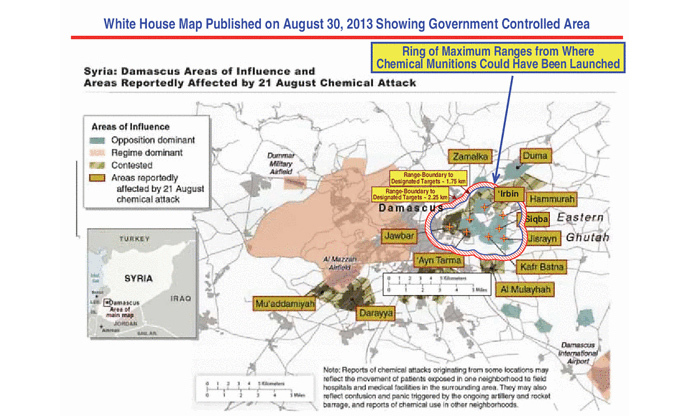
“This mistaken intelligence could have led to an unjustified US military action based on false intelligence. A proper vetting of the fact that the munition was of such short range would have led to a completely different assessment of the situation from the gathered data,” the report states.
The authors emphasize that the UN independent assessment of the range of the chemical munition is in “exact agreement” with their findings.
The report goes on to challenge the US Secretary of State’s key assessments of the chemical attack that he presented to the American people on August 30th and to the Foreign Relations Committee on September 3rd in an effort to muster a military attack on Syria.
“My view when I started this process was that it couldn’t be anything but the Syrian government behind the attack. But now I’m not sure of anything. The administration narrative was not even close to reality. Our intelligence cannot possibly be correct,” Postol told McClatchy news.

“The Syrian rebels most definitely have the ability to make these weapons,” he said. “I think they might have more ability than the Syrian government.”
It also remains a mystery why the particular type of rocket that was used in the attack was not declared by the Syrian government as part of its chemical weapons arsenal when it agreed to destroy its chemical weapons and their delivery methods. OPCW inspectors charged with implementing the agreement also did not discover such a rocket in possession of government forces.
Syria agreed to the destruction of its chemical weapons through a deal brokered by Russia and the US after a sarin gas attack on August 21. Western nations blamed the deadly attack on President Bashar Assad’s forces, while Damascus accused the rebels for the incident. The UN fact-finding mission had no mandate to find out who carried out the attack.
Under the UN-backed plan, all of the country’s declared 1,290 tons of toxic agents should be destroyed by June 30. Initially, the first batch of the most dangerous materials was to be moved out of Syria on December 31.
However, the deadline was missed because of the ongoing war in Syria and technical issues. It was only on January 7 that “priority chemical materials” left the Syrian port of Latakia on a Danish ship for international waters.
Related article

The Whitewashing of Ariel Sharon
By Ramzy Baroud | Palestine Chronicle | January 13, 2014
The death of former Israeli leader Ariel Sharon enlivened US media’s interest in the legacy of a man considered by many a war criminal, and by some a hero. In fact, the supposed heroism of Sharon was at the heart of CNN coverage of his death on January 11.
Sharon spent his last eight years in a coma, but apparently not long enough for US corporate media to wake up from its own moral coma. CNN online’s coverage presented Sharon as a man of heroic stature, who was forced to make tough choices for the sake of his own people. “Throughout, he was called ‘The Bulldozer’, a fearless leader who got things done,” wrote Alan Duke.
In his article, “Ariel Sharon, former Israeli Prime Minister, dead at 85″, Duke appeared to be confronting Sharon’s past head on. In reality, he cleverly whitewashed the man’s horrendous crimes, while finding every opportunity to recount his fictional virtue. “Many in the Arab world called Sharon ‘the Butcher of Beirut’ after he oversaw Israel’s 1982 invasion of Lebanon while serving as defense minister,” Duke wrote.
Nevertheless, Sharon was not called the “The Bulldozer” for being “a fearless leader” nor do Arabs call him “the Butcher of Beirut” for simply “overseeing” the invasion of Lebanon. Duke is either ignorant or oblivious to the facts, but the blame is not his alone, since references to Sharon’s heroism was a staple in CNN’s coverage.
Sharon’s demise however, and the flood of robust eulogies will neither change the facts of his blood-soaked history, nor erase the “facts on the ground” – as in the many illegal colonies that Sharon so dedicatedly erected on occupied Palestinian land.
Following the Israeli occupation of Gaza along with the rest of Palestine in 1967, Sharon was entrusted with the bloody task of “pacifying” the headstrong Strip as he was the head of the southern command of the Israel Defense Forces. Sharon was dubbed the “Bulldozer” for he understood that pacifying Gaza would require heavy armored vehicles, and Gaza’s crowded neighborhoods and alleyways weaving through its destitute refugee camps were not suited for heavy machinery.
Therefore, he resolved to bulldoze thousands of homes, preparing the way for tanks and bulldozers to move in and topple even more homes. Modest estimates put the number of homes destroyed in August 1970 alone at 2,000. Over 16,000 Palestinians were made homeless and thousands were forced to relocate from one refugee camp into another.
The Beach Refugee Camp near Gaza City sustained most of the damage. Many fled for their lives, taking refuge in mosques and UN schools and tents. Sharon’s declared objective was targeting the terrorist infrastructure. What he in fact meant was targeting the very population that resisted and aided the resistance, for they indeed were the very infrastructure he harshly pounded for many days and weeks.
Sharon’s bloody sweep also resulted in the execution of 104 resistance fighters and the deportation of hundreds of others. Some were sent to Jordan, others to Lebanon, and the rest were simply left to rot in the Sinai desert.
Sharon’s violence was part of an equally disturbing logic. He believed that any strategic long-term plan to secure Israel must have at its heart a violent campaign aimed at disorienting Palestinians. He was quick to capitalize on the Allon plan, named after Yigal Allon, a former general and minister in the Israeli government, who took on the task of drawing an Israeli vision for the newly conquered Palestinian territories.
Sharon recounted standing on a dune near Gaza with cabinet ministers, explaining that along with military measures to control the Strip he wanted “fingers” of settlements separating its cities, chopping the region in four. Another “finger” would thrust through the edge of Sinai, helping create a “Jewish buffer zone between Gaza and Sinai to cut off the flow of weapons” and divide the two regions in case the rest of Sinai was ever returned to Egypt. That legacy disfigured and isolated Gaza, even years after Sharon implemented his policy of unilateral “disengagement” in 2005. He relocated the settlers to other illegal colonies in the West Bank and imposed a hermetic siege on the Strip, the consequences of which remain suffocating and deadly.
Sharon was keen on espousing or exploiting the division of his enemies. He moved against Lebanon in 1982, when the country was at its weakest point, exhausted by civil war. And when Israeli forces finally occupied Lebanon in 1982, as Palestine Liberation Organization fighters were shipped by sea to many countries around the Middle East, a triumphant Sharon permitted his Christian Phalangist allies to enter the defenseless Sabra and Shatilla refugee camps.
In the days between September 16-18, 1982, as Israeli troops completely besieged the camps, the Phalangists entered the area and carried out a massacre that gruesomely defined both the Lebanese civil war and the Israeli invasion, killing thousands of Palestinian refugees, mostly butchered with knives, but also gunned down.
Although Sharon was partly discredited after his disastrous war in Lebanon, Israeli voters brought him back repeatedly, to lead the rightwing Likud party in May 1999 and as a prime minister of Israel in February 2001. The aim was to subdue rebelling Palestinians during the Second Intifada. In fact, it was Sharon’s provocative “visit” to one of Islam’s holiest shrines a few months earlier that sparked anger among Palestinians and, among other factors, started the uprising.
Sharon attempted to crush the uprising with the support and blessings of the US, but he failed. By the end of August 2001, 495 Palestinians and 154 Israelis were killed. International attempts at sending UN observer forces were thwarted by a US veto on March 27, thus paving the way for the Israeli army to thrash its way into Palestinian refugee camps and other areas formerly controlled by the Palestinian Authority.
In March and April 2002, Sharon ordered Operation “Defensive Wall”, which resulted in major military incursions into most West Bank cities, causing massive destruction and unprecedented bloodletting. The Israeli operation led to the killing of hundreds of Palestinians, the reoccupation of major Palestinian towns, the destruction of Arafat’s headquarters in Ramallah, and the subsequent besiegement of the Palestinian leader in his barely standing office.
Sharon was no hero. It is time for US media to wake up from its own coma, and confront reality through commonsense and the most basic human rights values. It should not be looking through the prism of the most rightwing, if not fascist elements of Israeli society.
– Ramzy Baroud is an internationally-syndicated columnist, a media consultant and the editor of PalestineChronicle.com. His latest book is My Father Was a Freedom Fighter: Gaza’s Untold Story (Pluto Press, London).
Related article
Lights, Camera… Covert Action: The Deep Politics of Hollywood
By Matthew Alford and Robbie Graham | Global Research | January 21, 2009
Here we build a prima facae case supporting the idea that Hollywood continues to be a target for infiltration and subversion by a variety of state agencies, in particular the CIA. Academic debates on cinematic propaganda are almost entirely retrospective, and whilst a number of commentators have drawn attention to Hollywood’s longstanding and open relationship with the Pentagon, little of substance has been written about the more clandestine influences working through Hollywood in the post-9/11 world. As such, our work delves into the field of what Peter Dale Scott calls “deep politics”; namely, activities which cannot currently be fully understood due to the covert influence of shadowy power players.
The Latest Picture
A variety of state agencies have liaison offices in Hollywood today, from the FBI, to NASA and the Secret Service. Few of these agencies, though, have much to offer in exchange for favourable storylines, and so their influence in Hollywood is minimal. The major exception here is the Department of Defense, which has an ‘open’ but barely publicized relationship with Tinsel Town, whereby, in exchange for advice, men and invaluable equipment, such as aircraft carriers and helicopters, the Pentagon routinely demands flattering script alterations. Examples of this policy include changing the true identity of a heroic military character in Black Hawk Down (2001) due to his real-life status as a child rapist; the removal of a joke about “losing Vietnam” from the James Bond film Tomorrow Never Dies (1997), and cutting images of Marines taking gold teeth from dead Japanese soldiers in Windtalkers (2002). Instances such as these are innumerable, and the Pentagon has granted its coveted “full cooperation” to a long list of contemporary pictures including Top Gun (1986), True Lies (1994), Executive Decision (1996), Air Force One (1997), The Sum of All Fears (2002), Transformers (2007), Iron Man (2008), as well as TV series such as JAG (1995-2005).
Such government activity, whilst morally dubious and barely advertised, has at least occurred within the public domain. This much cannot be said of the CIA’s dealings with Hollywood, which, until recently, went largely unacknowledged by the Agency. In 1996, the CIA announced with little fanfare the dry remit of its newly established Media Liaison Office, headed by veteran operative Chase Brandon. As part of its new stance, the CIA would now openly collaborate on Hollywood productions, supposedly in a strictly ‘advisory’ capacity.
The Agency’s decision to work publicly with Hollywood was preceded by the 1991 “Task Force Report on Greater CIA Openness,” compiled by CIA Director Robert Gates’ newly appointed ‘Openness Task Force,’ which secretly debated –ironically– whether the Agency should be less secretive. The report acknowledges that the CIA “now has relationships with reporters from every major wire service, newspaper, news weekly, and television network in the nation,” and the authors of the report note that this helped them “turn some ‘intelligence failure’ stories into ‘intelligence success’ stories, and has contributed to the accuracy of countless others.” It goes on to reveal that the CIA has in the past “persuaded reporters to postpone, change, hold, or even scrap stories that could have adversely affected national security interests…”
These admissions add weight to several reports and Congressional hearings from the 1970s which indicated that the CIA once maintained a deep-rooted and covert presence in national and international media, informally dubbed “Operation Mockingbird.” In its 1991 report, the CIA acknowledged that it had, in fact, “reviewed some film scripts about the Agency, documentary and fictional, at the request of filmmakers seeking guidance on accuracy and authenticity.” But the report is at pains to state that, although the CIA has “facilitated the filming of a few scenes on Agency premises,” it does “not seek to play a role in filmmaking ventures.” But it seems highly implausible that the CIA, whilst maintaining a decades-long presence in media and academia, would have shown no interest in the hugely influential Cinema industry.
Indeed, it should come as no surprise that the CIA has been involved in a number of recent blockbusters and TV series.The 2001 CBS TV series, The Agency, executive produced by Wolfgang Petersen (Das Boot, Air Force One) was actually co-written by ex-CIA agent and Marine Bazzel Baz, with additional ex-CIA agents working as consultants. The CIA gladly opened its doors to the production, and facilitated both external and internal shots of its Langley headquarters as the camera gazed lovingly at the CIA seal. This arrangement was comparable to the Feds’ efforts on the popular TV series The FBI (1965-74) which was shaped by the Bureau in cooperation with ABC and which thanked J. Edgar Hoover in the credits of each episode. Similarly, The Agency glorified the actions of US spooks as they fought predictable villains including the Russian military, Arab and German terrorists, Columbian drug dealers, and Iraqis. One episode even shows the CIA saving the life of Fidel Castro; ironically, since the CIA in real life had made repeated attempts to assassinate the Cuban President. Promos for the show traded on 9/11, which had occurred just prior to its premiere, with tag lines like “Now, more than ever, we need the CIA.”
A TV movie, In the Company of Spies (1999) starring Tom Berenger depicted a retired CIA operative returning to duty to save captured Agency officers held by North Korea. The CIA was so enthusiastic about this product that it hosted its presentation, cooperated during production, facilitated filming at Langley, and provided fifty off-duty officers as extras, according to its website.
Espionage novelist Tom Clancy has enjoyed an especially close relationship with the CIA. In 1984, Clancy was invited to Langley after writing The Hunt for Red October, which was later turned into the 1990 film. The Agency invited him again when he was working on Patriot Games (1992), and the movie adaptation was, in turn,granted access to Langley facilities. More recently, The Sum of All Fears (2002) depicted the CIA as tracking down terrorists who detonate a nuclear weapon on US soil. For this production, CIA director George Tenet gave the filmmakers a personal tour of the Langley HQ; the film’s star, Ben Affleck also consulted with Agency analysts, and Chase Brandon served as on-set advisor.
Media sources indicate that the CIA also worked on the Anthony Hopkins/Chris Rock feature Bad Company (2002) and the Jerry Bruckheimer blockbuster Enemy of the State (2001). However, no details whatsoever about these appear to be in the public domain. Similarly, Spy Game director Tony Scott’s DVD commentary for said film indicates that he visited Langley whilst in pre-production but, according to one report, endorsement appeared to have been withheld after Chase Brandon read the final draft of the script.
More details than usual emerged about CIA involvement in the Tom Hanks movie Charlie Wilsons War (2007) and Robert De Niro’s The Good Shepherd (2006) – but not many. Milt Beardon had traveled to the Moscow Film Festival with De Niro and claims the pair then “disappeared and hung out with the mob and KGB crowd for a while. I introduced him to generals and colonels, the old guys I had been locked with for so many years.” De Niro later tagged along with Beardon to Pakistan. “We wandered around the North-West Frontier Province,” Bearden recalls, “crossed the bridge [to Afghanistan] I built years ago, hung out with a bunch of guys firing off machine guns and drinking tea.” Still, The Good Shepherd didn’t fulfill the CIA’s earnest hopes of being the CIA equivalent of Flags of Our Fathers (2006), which the Agency’s official historian says it should have been – all in the interests of what he calls a “culture of truth.”
Charlie Wilson’s War depicted the United States’ covert efforts to supply arms to Afghanistan to fight the Soviet Union in the 1980s which had the real-life consequence of America’s old ally turned against it in the form of al-Qaeda (as Crile explains in the book of the film). However, Beardon, who was the CIA agent who supplied the weapons, worked as consultant on the film and said prior to its release that it “will put aside the notion that because we did that, we had 9/11.” CIA involvement in the film therefore appears to have paid dividends.
The real reasons for the CIA adopting an “advisory” role on all of these productions are thrown into sharp relief by a solitary comment from former Associate General Counsel to the CIA, Paul Kelbaugh. In 2007, whilst at a College in Virginia, Kelbaugh delivered a lecture on the CIA’s relationship with Hollywood, at which a local journalist was present. The journalist (who now wishes to remain anonymous) wrote a review of the lecture which related Kelbaugh’s discussion of the 2003 thriller The Recruit, starring Al Pacino. The review noted that, according to Kelbaugh, a CIA agent was on set for the duration of the shoot under the guise of a consultant, but that his real job was to misdirect the filmmakers: “We didn’t want Hollywood getting too close to the truth,” the journalist quoted Kelbaugh as saying.
Peculiarly, in a strongly-worded email to the authors, Kelbaugh emphatically denied having made the public statement and claimed that he remembered “very specific discussions with senior [CIA] management that no one was ever to misrepresent to affect [film] content – EVER.” The journalist considers Kelbaugh’s denial “weird,” and told us that “after the story came out, he [Kelbaugh] emailed me and loved it… I think maybe it’s just that because [the lecture] was ‘just in Lynchburg’ he was okay with it – you know, like, no one in Lynchburg is really going to pay much attention to it, I guess. Maybe that’s why he said it, and maybe that’s why he’s denying it now.” The journalist stands by the original report, and Kelbaugh has pointedly refused to engage us in further discussion on the matter.
Early Screening
Clandestine agencies have a long history of interference in the cinema industry. Letters discovered in the Eisenhower Presidential Library from the secret agent Luigi G. Luraschi (identified by British academic John Eldridge), the Paramount executive who worked for the CIA’s Psychological Strategy Board (PSB), reveal just how far the CIA was able to reach into the film industry in the early days of the Cold War, despite its claims that it sought no such influence. For instance, Luraschi reported that he had secured the agreement of several casting directors to subtly plant “well dressed negroes” into films, including “a dignified negro butler” who has lines “indicating he is a free man” in Sangaree (1953) and in a golf club scene in the Dean Martin/Jerry Lewis vehicle The Caddy (1953). Elsewhere, CIA arranged the removal of key scenes from the film Arrowhead (1953), which questioned America’s treatment of Apache Indians, including a sequence where a tribe is forcibly shipped and tagged by the US Army. Such changes were not part of a ham-fisted campaign to instill what we now call “political correctness” in the populace. Rather, they were specifically enacted to hamper the Soviets’ ability to exploit its enemy’s poor record in race relations and served to create a peculiarly anodyne impression of America, which was, at that time, still mired in an era of racial segregation.
Other efforts were made. The PSB tried –unsuccessfully– to commission Frank Capra to direct Why We Fight the Cold War and to provide details to filmmakers about conditions in the USSR in the hope that they would use them in their movies. More successfully, in 1950, the CIA –along with other secretive organizations like the Office of Policy Coordination (OPC) and aided by the PSB– bought the rights to and invested in the cartoon of George Orwell’s Animal Farm (1954), which was given an anti-Soviet spin to satisfy its covert investors. Author Daniel Leab has pointed to the fact it took decades for the rumours about CIA involvement in Animal Farm to be properly documented; this, he observes, “Speaks volumes about the ability of a government agency to keep its activities covert.”
Additionally, the production of the Michael Redgrave feature Nineteen-Eighty Four (1956) was in turn overseen by the American Committee for Cultural Freedom, which was supervised by the CIA. Key points in the movie were altered to demonise the Soviets.
The CIA also tampered with the 1958 film version of The Quiet American, provoking the author, Graham Greene, to denounce the film. US Air Force Colonel Edward Lansdale, the CIA operative behind Operation Mongoose (the CIA sabotage and assassination campaign against Cuba) had entered into production correspondence with director Joseph L. Mankiewicz, who accepted his ideas. These included a change to the final scene in which we learn that Redgrave’s anti-hero has been hoodwinked by the Communists into murdering the suspicious American, who turns out not to be a bomb-maker as we had been led to believe, but instead a manufacturer of children’s toys.
Behind the Scenes
It would be a mistake to regard the CIA as unique in its involvement in Hollywood. The industry is in fact fundamentally open to manipulation by a range of state agencies. In 2000, it emerged that the White House’s drug war officers had spent tens of millions of dollars paying the major US networks to inject anti-drug plots into the scripts of primetime series such as ER, The Practice, Sabrina the Teenage Witch and Chicago Hope. Despite criticism for this blatant propagandizing, the government continued to employ this method of spreading its message on drugs.
The White House went to Tinsel Town again the following year when, on November 11, 2001 a meeting was held in Hollywood between President Bush’s then Deputy Chief of Staff, Karl Rove, and representatives of each of the major Hollywood studios to discuss how the film industry might contribute to the ‘War on Terror.’ Jack Valenti, president of the Motion Picture Association of America said with a straight face that, “content was off the table”, but Rove had clearly outlined a series of requests. It is hard to gauge the consequences of the meeting, but a Rambo sequel, for instance, was certainly discussed, and duly produced. Similarly, several series with national security themes emerged within a short time of the meeting including She Spies (2002-2004) and Threat Matrix (2003).
The meeting was, in fact, just one in a series between Hollywood and the White House from October to December, 2001. On October 17, in response to 9/11, the White House announced the formation of its “Arts and Entertainment Task Force,” and by November, Valenti had assumed leadership of Hollywood’s new role in the ‘War on Terror’. As a direct result of meetings, Congress sought advice from Hollywood insiders on how to shape an effective wartime message to America and to the world. In November 2001, John Romano, writer-producer of the popular US TV series Third Watch, advised the House International Relations Committee that the content of Hollywood productions was a key part of shaping foreign perceptions of America.
On December 5, 2001, the powerful Academy of Television Arts & Sciences convened its own panel entitled “Hollywood Goes to War?” to discuss what the industry might do in response to 9/11. Representing the government at the meeting were Mark McKinnon, a White House advisor, and the Pentagon’s chief entertainment liaison, Phil Strub. Also in attendance, among others, were Jeff Zucker, President of NBC Entertainment, and Aaron Sorkin, creator and writer of the White House drama The West Wing (1999-2006). Immediately after, Sorkin and his team set about producing a special episode of the show dealing with a massive terrorist threat to America entitled “Isaac and Ishmael”. The episode was given top priority and was successfully completed and aired within just ten days of the meeting. The product championed the superiority of American values whilst brimming with rage against the Islamist jihadists.
The interlocking of Hollywood and national security apparatuses remains as tight as ever: ex-CIA agent Bob Baer told us, “There’s a symbiosis between the CIA and Hollywood” and revealed that former CIA director George Tenet is currently, “out in Hollywood, talking to studios.” Baer’s claims are given weight by the Sun Valley meetings, annual get-togethers in Idaho’s Sun Valley in which several hundred of the biggest names in American media –including every major Hollywood studio executive– convene to discuss collective media strategy for the coming year. Against the idyllic backdrop of expansive golf courses, pine forests and clear fishing lakes, deals are struck, contracts are signed, and the face of the American media is quietly altered. The press has yet to be granted permission to report on these corporate media gatherings and so the exact nature of what is discussed at the events has never been publicly disclosed. It is known, however, that Tenet was keynote speaker at Sun Valley in 2003 (whilst still CIA head) and again in 2005.
Conclusions
Many would recoil at the thought of modern Hollywood cinema being used as a propagandist tool, but the facts seem to speak for themselves. Do agencies such as the CIA have the power, like the Pentagon, to affect movie content by providing much-sought-after expertise, locations and other benefits? Or are they able to affect script changes through simple persuasion, or even coercion? Do they continue to carry out covert actions in Hollywood as they did so extensively in the 1950s, and, beyond cinema, might covert government influence play some part in the creation of national security messages in TV series such as 24 and Alias (the star of the latter, Jennifer Garner, even made an unpaid recruitment video for the CIA)? The notion that covert agencies aspire to be more open is hard to take seriously when they provide such scant information about their role within the media, even regarding activities from decades past. The spy may have come in from the cold, but he continues to shelter in the shadows of the movie theatre.
U.S. Human Radiation Experiments Covered up by Public Broadcasting

By William Boardman | Reader Supported News | January 8, 2014
The bomb will not start a chain reaction in the water, converting it all to gas and letting all the ships on all the oceans drop down to the bottom. It will not blow out the bottom of the sea and let all the water run down the hole. It will not destroy gravity. I am not an atomic playboy.
– Vice Admiral William P. Blandy, Bikini bomb test commander, July 25, 1946
When the military scientists of an advanced technological nation deliberately explode their largest nuclear bomb (and 66 others) over Pacific islands and use the opportunities to study the effects of radiation on nearby native people, which group is best described as “savage”? And what should you call the people who prevent a documentary about these American post-war crimes from reaching a wide audience in the United States?
Nuclear Savage is a recent documentary film that explores American nuclear weapons testing in the Marshall Islands, 1946-1958, and particularly the secret Project 4.1: an American experiment in exposing Pacific Islanders to overdoses of radiation – deliberate human radiation poisoning – just to get better data on this method of maiming and killing people. The public broadcasting establishment has spent more that two years keeping this story off the air.
The preview reel of Nuclear Savage includes a clip with a stentorian newsreel announcer reporting on the American treatment of Marshall Islanders in April 1957, and explaining to his predominantly American audience:
The Marshallese caught by fallout got 175 roentgens of radiation. These are fishing people, savages by our standards, so a cross-section was brought to Chicago for testing. The first was John, the mayor of Rongelap Atoll…. John, as we said, is a savage, but a happy, amenable savage.
So how serious is 175 roentgens (assuming the measurement is accurate)? In 1950, the International Commission on Radiological Protection (ICRP) recommended that human radiation contact should not exceed 0.3 roentgen per week for whole-body exposure [“roentgen” as a measure of radiation dose has since been replaced by “rem” (for “roentgen equivalent man”)]. It’s not clear how long the Marshallese were exposed to radiation levels of 175 roentgens – or on how many occasions – but that amount was more than 580 times what was then considered a safe weekly exposure.
Public broadcasting paid for this film – and is now suppressing it
In 2005, director Adam Horowitz started work on Nuclear Savage, his second documentary about the American military use and abuse of the Marshall Islands. Horowitz has a contract with Pacific Islanders in Communications (PIC), which describes itself as “a national non-profit media arts organization” whose mission “is to support, advance and develop programming that enhances public recognition of and appreciation for Pacific Islander history, culture, and society. In keeping with the mission, PIC provides funding for new programs primarily for public television. We work with independent producers to create and distribute programs about Pacific Islanders that bring new audiences to public television, advance issues and represent diverse voices and points of view not usually seen on public or commercial television.”
Among its efforts to carry out this mission, PIC supported the production of Nuclear Savage with $100,000 passed through to Horowitz from the Corporation for Public Broadcasting (CPB). Horowitz delivered a completed, 87-minute version of Nuclear Savage in October 2011 – the same month it was nominated for Best Environmental Film at the Amsterdam International Documentary Film Festival. That was also the same month various public broadcasting officials started putting up roadblocks to keep the movie off the air, a delaying tactic that continues into 2014. FAIR (Fairness & Accuracy in Reporting) reported the story in detail as “Nuclear Stalemate” in Extra!
One of the first requests, from Leanne Ferrer at PIC, was for a shorter version at 60 minutes. Rather than have Horowitz cut his film by 27 minutes, PIC hired its own editor and controlled the editing process. Part of Ferrer’s concern reportedly was a sort of politically correct reverse racism, her objection that there was too much of Horowitz in the film and he’s not a Pacific Islander. The shorter version has less of Horowitz. And the PIC web site pitches Nuclear Savage: The Islands of Secret Project 4.1 as a “portrait of Pacific Islanders struggling for dignity and survival after decades of intentional radiation poisoning by the U.S. government.”
PIC summarizes the film this way:
Some use the term ‘savage’ to refer to people from primitive cultures, but nuclear experimentation pushed savagery to new levels. In the 1950s, the U.S. conducted 67 atomic and hydrogen bomb tests in the Marshall Islands, vaporizing islands and exposing entire populations to fallout. The islanders on Rongelap received near fatal doses of radiation from one test, and were then moved onto a highly contaminated island to serve as human guinea pigs for 30 years. Filmmaker Adam Jonas Horowitz spent 25 years collecting material – including original footage, archival clips, and unpublished secret documents – to create this unforgettable and ironic portrait of American cynicism, arrogance, and racism. Winner of festival awards in Paris, Chicago and Mexico City.
PBS canceled scheduled broadcasts without public explanation
In 2013, PBS World Channel scheduled Nuclear Savage for four showings on May 28 and 29 – and PBS executive Tom Davison emailed Horowitz in advance, saying “Congratulations on this airing.” When the airing failed to take place, without explanation from PBS, Horowitz was unable to get a straight answer from Davison, Ferrer, or anyone else in the public broadcasting food chain, although PIC executive Amber McClure wrote with Orwellian deceit: “Your program has not been declined by PBS.”
Outright rejection by PBS is required by Horowitz’s contract in order for him to regain independent control of his film. In December 2013, in his original letter to the editor of the Santa Fe Reporter, Horowitz summed up his experience to date this way:
PBS ‘World Channel’ executives accepted, scheduled and advertised the show nationally, only to reverse their decision and cancel the show at the last minute. The show was originally accepted and then later rejected by two different branches of PBS, on three different occasions. PBS executives promised to deliver to me, a list of the precise points in the film that they felt represented ‘bias,’ or questions of ‘fact,’ and I promised to work with them to fix any problems. But PBS has still never delivered any specifics whatsoever of their complaints about the film, a film by the way that they have already completely reworked with their own editors.
The project has also had support from private foundations, including the Kindle Project, where:
We support whistleblowers and rabble-rousers. We give grants to peacemakers and seed savers. We make awards to artists and activists. We support people and projects working towards solutions and alternatives to systems in transition. We seek out the strange, the bizarre, the unpolished, the less likely to receive funding. We fund individuals and initiatives that may seem risky or radical to mainstream funding sources….
Public information is not always well known by the public
The unsigned Notes on Nuclear Savage: The Islands of Secret Project 4.1 on the Kindle Project web site from April 2012 talks about the ways the film was succeeding, despite unofficial quasi-government censorship and beyond “the glamorous festival circuit”:
Heartbreaking is the most poignant word that could be used to describe this film, and in my conversations with Adam this word has been uttered more than once. I’ve often wondered how he has the stamina for this subject matter; the stamina to expose himself to the worst kinds of atrocities that humans inflict on one another. The people of the Marshall Islands have faced similar catastrophic fates as the victims who underwent Nazi medical tests during WWII. Adam was there to tell the world about it. These days, his perseverance comes from the success of the film – not just from the attention it’s getting from the international circuit, but from what’s happening in the Islands themselves.
What was happening in the islands was that Nuclear Savage was being shown again and again on local and national television channels. It was shown at the Pacific Island conference of Presidents. People were copying and bootlegging the film across the region, with bootleg copies sometimes turning up on television. And Marshallese activists were using the film to resist U.S. government efforts to re-re-settle some populations back to their home islands that were still dangerously radioactive.
“As of now, no one has moved back,” Horowitz told an audience after showing Nuclear Savage at the International Uranium Film Festival in Window Rock, Arizona, last December. Despite the American effort to re-re-settle the forced Marshallese refugees on their former home islands, Horowitz said the effort had amounted to “just a bunch of empty houses.”
Horowitz has been angry about American treatment of the Marshall Islands for a long time. In late 2013 he told a reporter the U.S. “destroyed an entire country that we were not at war with, that we were at peace with. Not only did they blow up all these islands, but they purposely contaminated all these people as human experiments. It’s a very unknown story here.”
The story was classified top secret until the 1990s, when the Clinton administration declassified documents related to nuclear testing that included previously unknown information on the Project 4.1 program to use Pacific Islanders as human guinea pigs for assessing the impact of ionizing radiation. Even the official historian of U.C. nuclear testing, Barton Hacker, who tries to minimize the criminality of Project 4.1, ended up writing in 1994 that an “unfortunate choice of terminology may help explain later charges that the AEC [Atomic Energy Commission] had deliberately exposed the Marshallese to observe the effects. Like the American radium dial painters of the 1920s and the Japanese of Hiroshima and Nagasaki in 1945, the Marshallese of 1954 inadvertently were to provide otherwise unobtainable data on the human consequences of high radiation exposures.”
The U.S. was an occupying power, and effectively still is
Europeans “discovered” these Pacific Islands in the 1520s (they were named the Marshall Islands after the British explorer John Marshall). In 1874 they became part of the Spanish East Indies. In 1884 Germany bought them as part of German New Guinea. During World War I, the Japanese occupied the islands and later ruled them under a League of Nations mandate. During World War II, the United States took the islands from the Japanese and has effectively occupied them ever since.
In 1946, the U.S. evacuated the entire population of Bikini Atoll (167 people) and logged the first of 23 atomic weapons explosions that have made what’s left of the atoll (part of it was vaporized) a largely uninhabitable radioactive tourist destination [one report says 4-6 “caretakers” live there]. Most of the 167 original residents have died, but their descendants number more than 4,000. A 1975 federal lawsuit (seeking roughly $750 million in compensation promised but not paid by the U.S.) was denied review by the U.S. Supreme Court in April 2010, but the effort to make the U.S. provide just compensation continues.
Later in 2010, UNESCO named Bikini a “world heritage site” as a symbol of the “dawn of the nuclear age.” The U.S. Environmental Protection Agency has said that Bikini is close to the “safe” radiation level of 15 millirems – but according to the U.S. Department of Energy, the “safe” level is really 100 millirems, and the contradiction remains unreconciled.
In 1947, the United Nations included the Marshall Islands in a Trust Territory controlled by the U.S., whose obligations included the duty to “protect the inhabitants against the loss of their lands and resources.” Later in the year the U.S. evacuated the entire population of Enewetak Atoll, where it would explode another 44 atomic weapons, the last series in 1958.
On March 1, 1954, the U.S. exploded its first deliverable hydrogen bomb that, at 15 megatons, was more than 1,000 times as powerful as the Hiroshima bomb of 1945. The official story, which the U.S. government still defends, is that it was an “accident” that the bomb dumped so much radiation on downwind populations, and that Project 4.1 was initiated after the blast in order to help the victims as well as study them.
The record includes one reference to Project 4.1 prior to March 1 [the government says someone put it there after the fact]. More troubling is the undisputed evidence that the U.S. was aware that the weather had changed, that the wind was blowing toward populated areas, but they went ahead with the test anyway. After the radiation came down like “snow” on Rongelap and other islands, the Navy evacuated American personnel quickly, but left the “happy, amenable savages” to absorb more radiation for another two days.
As early as 1956, the Atomic Energy Commission had characterized the Marshall Islands as “by far the most contaminated place in the world.”
For the victor, justice is only optional, not enforceable
In 1979, the U.S. allowed the Marshall Islands to become “self-governing,” while the U.S. reserved the sole control of military use and defense of the territory. In 1986 the U.S. granted the Republic of the Marshall Islands “sovereignty” under the Orwellian-named Compact of Free Association, which left the U.S. in military control and free to use Kwajalein Atoll as a missile testing range. Four years later the U.N. ended the “nation’s” Trusteeship status. The CIA estimates that the Marshall Islands’ GDP is $182 million, of which the U.S. provides $70 million in aid payments, according to the State Department. Both the CIA and State Department omit unpaid compensation from their public summaries of the Marshall Islands.
Nuclear Savage includes U.S. Ambassador Greta Morris making a wooden public statement of “deep regrets” for the “hardships” the Marshallese have suffered “as a result of the testing program, as well as the accidental downwind injuries caused by one test, Bravo” – which is the official version of the 1954 H-bomb Castle Bravo. Later Greta Morris is asked at a public event to discuss U.S. “government policy” – the ambassador refuses to talk on camera.
In March 2012, at an event commemorating the anniversary of the H-bomb test, Marshall Islands foreign minister Phillip Muller called on the U.S. to pay more than $2 billion in awards already made by the Nuclear Claims Tribunal, which was created and underwritten by the U.S. The U.S. moral and financial obligation continues to grow, as the Marshall Islands are reportedly seeing a continually rising cancer rate more than half a century later. An the same event, according to Overseas Territories Review:
U.S. Ambassador to the Marshall Islands Martha Campbell told the event in Majuro Thursday evening that ‘the United States has provided nearly $600 million in compensation and assistance to the Republic of the Marshall Islands to help the affected communities overcome the effects of nuclear testing,’ and noted that the U.S. and Marshall Islands governments had agreed to ‘a full and final settlement of all nuclear-related claims’ in 1983 [an apparent reference to the Compact of Free Association and its side agreements].
In 1998, staff from the U.S. Centers for Disease Control and Prevention (CDC) made a comparison study to compare the amount of radioactive Iodine-131 at four different radiation-polluted sites, measured in curies (1,000 curies of Cesium-137, as found in a radiation therapy machine, could produce serious health effects in a direct exposure of just a few minutes). The CDC team reported its finding that the atmospheric release of curies of Iodine-137 at the Hanford nuclear processing plant was 739,000 curies; at Chernobyl the release was 40 million curies; at the Nevada bomb test site, 150 million curies; and in the Marshall Islands, 6.3 billion curies (more that 30 times as much radiation as the other three sites combined).
The Republic of the Marshall Islands is ranked #5 in the world among countries with the highest health costs as a percentage of GDP – behind Liberia, Sierra Leone, Tuvalu, and the United States.
The history of the treatment of the radiation victims of the Marshall Islands is essentially a paradigm for the treatment of radiation victims everywhere. The perpetrators of radiation-exposure lose patience with the seemingly endless effects of their acts and so they tend to abandon all responsibility for them. So far at least, the Marshall Islands history appears to be foreshadowing Fukushima’s future.
Given the unpalatibility this story might have for an American television audience, it’s little wonder that public broadcasting executives are content to spend public money to keep the public under-informed.
Iraq: The ‘Liberation’ Neocons Would Rather Forget
By Ron Paul | January 5, 2014
Remember Fallujah? Shortly after the 2003 invasion of Iraq, the US military fired on unarmed protestors, killing as many as 20 and wounding dozens. In retaliation, local Iraqis attacked a convoy of US military contractors, killing four. The US then launched a full attack on Fallujah to regain control, which left perhaps 700 Iraqis dead and the city virtually destroyed.
According to press reports last weekend, Fallujah is now under the control of al-Qaeda affiliates. The Anbar province, where Fallujah is located, is under siege by al-Qaeda. During the 2007 “surge,” more than 1,000 US troops were killed “pacifying” the Anbar province. Although al-Qaeda was not in Iraq before the US invasion, it is now conducting its own surge in Anbar.
For Iraq, the US “liberation” is proving far worse than the authoritarianism of Saddam Hussein, and it keeps getting worse. Last year was Iraq’s deadliest in five years. In 2013, fighting and bomb blasts claimed the lives of 7,818 civilians and 1,050 members of the security forces. In December alone nearly a thousand people were killed.
I remember sitting through many hearings in the House International Relations Committee praising the “surge,” which we were told secured a US victory in Iraq. They also praised the so-called “Awakening,” which was really an agreement by insurgents to stop fighting in exchange for US dollars. I always wondered what would happen when those dollars stopped coming.
Where are the surge and awakening cheerleaders now?
One of them, Richard Perle, was interviewed last year on NPR and asked whether the Iraq invasion that he pushed was worth it. He replied:
I’ve got to say I think that is not a reasonable question. What we did at the time was done in the belief that it was necessary to protect this nation. You can’t a decade later go back and say, well, we shouldn’t have done that.
Many of us were saying all along that we shouldn’t have done that – before we did it. Unfortunately the Bush Administration took the advice of the neocons pushing for war and promising it would be a “cakewalk.” We continue to see the results of that terrible mistake, and it is only getting worse.
Last month the US shipped nearly a hundred air-to-ground missiles to the Iraqi air force to help combat the surging al-Qaeda. Ironically, the same al-Qaeda groups the US is helping the Iraqis combat are benefiting from the US covert and overt war to overthrow Assad next door in Syria. Why can’t the US government learn from its mistakes?
The neocons may be on the run from their earlier positions on Iraq, but that does not mean they have given up. They were the ones pushing for an attack on Syria this summer. Thankfully they were not successful. They are now making every effort to derail President Obama’s efforts to negotiate with the Iranians. Just last week William Kristol urged Israel to attack Iran with the hope we would then get involved. Neoconservative Senators from both parties recently introduced the Nuclear Weapon Free Iran Act of 2013, which would also bring us back on war-footing with Iran.
Next time the neocons tell us we must attack, just think “Iraq.”
The Guardian Laments Sharon
By Gilad Atzmon | January 4, 2014
In a uniquely dishonest piece, The Guardian’s Jonathan Freedland paid a tribute today to Israel’s veteran PM Ariel Sharon.
According to Freedland, Sharon, “as one of Israel’s founders… had the credibility to give up occupied territory – and even to face the demons of 1948”. Freedland speculates also that “Sharon’s final mission might well have been peace.” This is indeed a big statement, but how does Freedland support his creative historical account?
“Sharon’s final act” says Freedland, “was to dismantle some of the very settlements he had sponsored. In 2005 he ordered Israel’s disengagement from Gaza, seized in the 1967 war in which Sharon had been a crucial, if maverick, commander.”
Let alone the fact that Freedland comes short of reminding his readers about Sharon’s colossal war crimes, he actually completely distorts the political narrative that led Sharon to the 2005 unilateral disengagement.
Did Sharon have a plan to reconcile with the Palestinians and to address their plight or their right to return to their land? Not at all, we do not have any evidence of Sharon’s remorse. The logic behind Sharon’s disengagement is simple on the verge of banal. Sharon knew very well that if Israel insisted to maintain itself as the ‘Jewish State’, it would have to rid itself immediately of Arabs. Late Sharon was becoming aware of the possible implications of the ‘Palestinian demographic bomb’. The Palestinians were becoming a majority in areas controlled by Israel.
Ridding Israel of the highly populated Gaza strip was a perfect start. In a single political and territorial move, Sharon freed Israel of 1.5 million Palestinians and liberated Israel of growing complex security issues. Sharon was a pragmatist politician, he’s always been one and his disengagement wasn’t at all an attempt to “face the demons of 1948” as Freedland suggests: It was a Judeo-centric attempt to maintain the Jewishness of the Jewish State.
Freedland’s biased inclinations continue till the end of today’s piece: “an intriguing habit of Sharon’s was to refer to places in Israel by their original, Arabic names – thereby acknowledging the truth that usually lies buried beneath the soil.” Is this right? Did Sharon really pay tribute to the eradicated Palestinian civilisation by uttering some words in Arabic? Not at all: Sharon was born in the British Mandate of Palestine. He was raised in a country scattered with Palestinian villages and cities. Sharon and Israelis of his generation tended to pepper their Hebrew with a few Arabic words because such an act filled their existence with an authentic sense of belonging and a bond to an imaginary soil. I hope in that context, the laughable Freedland doesn’t also think when Israelis eat Falafel they try to express empathy towards 6 million Palestinian refugees: After all, Falafel also belongs to Palestine.
Freedland probably waited for Ariel Sharon to die in order to spread his laughable reading of history, just to make sure that the ‘immortal Sharon’ would not bounce back and dismiss this gross interpretation as complete nonsense.
The only question that is still left open is why The Guardian, once a respected paper, is publishing such low quality Hasbara drivel? Is it really The Guardian of the truth or has it become The Guardian of Zion?
How the Washington Post Distorts Colombia
What Dana Priest Left Out
By JACK L. LAUN | CounterPunch | January 2, 2014
On December 21, 2013 the Washington Post published an article titled “Covert action in Colombia” by reporter Dana Priest. Ms. Priest is a veteran reporter who has over the course of her career produced significant reports on important topics. However, in her report on the role of the United States government in supporting the Colombian state’s war on the FARC guerrillas she has overlooked or ignored some very basic aspects of this relationship.
The most significant of these is that she ignores the nature and history of the paramilitary forces’ activities and the link of these to the United States government. As Father Javier Giraldo, S.J., correctly observed years ago, the paramilitaries in Colombia are a strategy of the Colombian state. Furthermore, this strategy was suggested to the Colombian government by a United States military mission to Colombia in February 1962, in response to fear of the spread of influence of the Castro Revolution in Cuba. The mission was led by Lieutenant General William Yarborough, the Commander of the U.S. Army Special Warfare Center. A Wikipedia entry cites a secret report to the Joint Chiefs of Staff quoting Yarborough as recommending “development of a civilian and military structure…to pressure for reforms known to be needed, perform counter-agent and counter-propaganda functions and as necessary execute paramilitary, sabotage and/or terrorist activities against known Communist proponents. It should be backed by the United States.” (See this citation and more information at Wikipedia.org/wiki/William_P_Yarborough.) The basic idea behind the reliance upon paramilitaries has been to keep the Colombian military from being involved directly in the Colombian government’s dirty war against the guerrillas and rural noncombatants and thus avoid having “dirty hands”. As Father Giraldo observed back in 1996, “Paramilitarism becomes, then, the keystone of a strategy of “Dirty War”, where the “dirty” actions cannot be attributed to persons on behalf of the State because they have been delegated, passed along or projected upon confused bodies of armed civilians.” (Colombia: The Genocidal Democracy, Common Courage Press, 1996, p. 81). There are many examples of the paramilitary death squad actions. One of these was a terrible slaughter by machetes and chainsaws of an estimated 30 civilians in the town of Mapiripan in Meta Department on July 15-20, 1997, in which paramilitary forces under the command of Carlos Castano in northern Colombia were allowed to travel by airplane with Colombian military acquiescence to reach their target community in southeast Colombia. A second example of the vicious attacks of paramilitary forces upon civilians was the slaughter on February 21, 2005 of 8 persons of the Peace Community of San Jose de Apartado in Antioquia Department, including a founder and leader of that Community, Luis Eduardo Guerra. The latter massacre was carried out with the assistance of Colombian Army soldiers from the Seventeenth and Eleventh Brigades.
While Ms. Priest approvingly suggests that Colombia “with its vibrant economy and swanky Bogota social scene” is far removed from Afghanistan, she fails to recognize that most of Bogota’s nearly 8 million residents are very poor, while a great majority of the country’s rural residents are impoverished. To be accurate in her portrayal of present-day Colombia, Ms. Priest should recognize and acknowledge that the distribution of land among Colombia’s population is the second worst in South America, after Paraguay, and the 11th worst in the world. (Oxfam Research Reports, “Divide and Purchase: How land ownership is being concentrated in Colombia”, 2013, p.7. See http://www.oxfam.org.) In rural areas paramilitary forces, supposedly demobilized in a sham proceeding during Alvaro Uribe’s Presidency, continue to threaten and murder campesinos (small-scale farmers) and force them and their families off their lands, so they can be taken over by large landowners or multinational corporations with mining and petroleum plans encouraged by the government of President Juan Manuel Santos. Paramilitary activity also continues to account for murders of labor union leaders and organizers, more of whom are killed in Colombia year after year than in any other country in the world.
It is also disappointing that Ms. Priest makes no mention of the fact that there are some 6 million internally-displaced persons in Colombia, more than any other country in the world. In his December 27-29 article in Counterpunch, titled “Mythmaking in the Washington Post: Washington’s Real Aims in Colombia”, Nick Alexandrov correctly calls attention to Ms. Priest’s failure to take into account these displaced persons. And he also properly focuses criticism upon Ms. Priest’s failure correctly to acknowledge one of the most important links of the United State to Colombia and one of the most damaging: the drug trade and the effects of coca crop spraying (fumigation) upon Colombia’s rural population. Here again the responsibility of the United States government is clear and direct. As Mr. Alexandrov points out, tens of thousands of Colombia’s campesinos have been decimated economically as their legal food crops are destroyed through fumigation under direct control of the United States government. As a Colombia Support Network delegation was told by U. S. Embassy personnel while Anne Patterson was Ambassador there, the crop-spraying campaign using Round-Up Ultra has been controlled from the Embassy itself. Indeed, mayors of towns in Putumayo Department (province) told us they are not informed in advance and have no control over when fumigation of farm fields in their municipalities occurs.
Furthermore, the assertion that the FARC are principally responsible for Colombia’s production of illicit drugs is questionable. Right-wing paramilitaries, protected by the Colombian Army and linked to many Colombian political figures, have been involved in the drug trade for decades, and continue to benefit from this trade, as do their benefactors in the private sector, such as owners of large cattle ranches, merchants, and banana plantation owners. And the United States government has supported and even idealized one of the persons most responsible for corruption of the political process in Colombia, Alvaro Uribe Velez. Before his election as President in 2002, Alvaro Uribe had been identified by the United States government as linked to drug-trafficking. As Virginia Vallejo, a Colombian television journalist and sometime love interest of Pablo Escobar, suggested to me in a telephone conversation and mentioned in her book, Amando a Pablo, Odiando a Escobar (Random House Mondadori, September 2007), Alvaro Uribe was favored by Escobar. He allegedly approved the opening of drug-transit airstrips as Director of Civil Aeronautics. Later, as Governor of Antioquia Department, Uribe promoted the formation of so-called “self-defense” forces, which morphed into cut-throat, illegal paramilitaries who ravaged the countryside. His cousin Mario Uribe, with whom he has been particularly close, was convicted of corrupt actions and spent time in prison, while his brother Santiago Uribe Velez is about to be prosecuted for organizing and training illegal paramilitary forces on a Uribe family ranch. When Alvaro Uribe ran for re-election in 2004, his agents bribed Congresswoman Yidis Medina to get her to change her vote in committee so that Uribe could be re-elected (not permitted at that time by the Colombian Constitution). Yidis Medina went to prison for having received the bribe, but neither Alvaro Uribe nor his staff members who offered the bribe have been convicted and sentenced for the offenses they committed.
What was the reaction of the United States government to President Uribe’s alleged promotion of illegal activities? He was awarded the Presidential Medal of Freedom by President George W. Bush, the highest honor a President can convey upon any person! (For a detailed account of Alvaro Uribe’s purported misdeeds, see the Master’s thesis of Francisco Simon Conejos at the University of Valencia, Spain, of December 2012, titled, in English translation, “Crimes Against Humanity in Colombia: Elements to Implicate Ex-President Alvaro Uribe Velez before Universal Justice and the International Criminal Court”.)
No analysis of the United States’ role in Colombia can properly ignore the relationships and responsibilities outlined above. But even beyond these points if one is to consider whether the United States’ actions toward and in Colombia have been beneficial for that country and its people, one must look at the effect of the United States government’s support for corporate interests of companies from this country and their actions in Colombia. The policies of Presidents Clinton, Bush and Obama in the past two decades have advanced the agendas of mining and petroleum companies— such as Exxon Mobil, Occidental Petroleum, and Drummond— and food companies— such as Chiquita Banana and, most recently, Cargill— while these companies’ activities in rural Colombia have caused environmental damage, massive displacement of residents of these areas and destruction of the campesino economy. One wishes that Ms. Priest had treated the Colombian context much more broadly to provide a much more complete and honest view of how United States government actions and policies have affected the population of this important country, with Latin America’s third largest population (after Brazil and Mexico).
John I. Laun is president of the Colombia Support Network.
Happy ‘News Year’: Decline of the ‘News’
By Danny Schechter | Consortium News | January 1, 2014
At year end, the news agenda fills up with stories about top stories, a chance for networks to repackage footage or highlight favorite newsmakers. These stories rarely look at the news system that picks them or why.
There are two news systems in America. The more prominent one is the official parody of journalism that represents most of what the mainstream – or what some call the “lame stream” – media offers. These are the “products” of an “official” news business, an industry under growing pressure from within and without to maintain a semblance of credibility with a global audience that now has many other divergent sources to rely on.
A part of a global entertainment combine, the advertising-sponsored “news biz” also spends inordinate amounts of money marketing itself and referencing its own output. It is that system that has become one of the major pillars of established power, like the institutions of government and the office holders that the mainstream media covers to a fault. Official news tells us what politicians say.
Some of the stars from the news world move into politics, just as ex-politicians become pundits who define for us what the news is supposed to mean. The system is interconnected and symbiotic. It looks diverse but U.S. mainstream news operates in an ideological framework as surely as Chinese news does. No wonder critics now speak of a military-industrial-media complex.
News has become a publicity machine for those in power but also a shaper of the narratives and myths we live by. It is not surprising that two-thirds of the graduates of journalism schools find jobs not in news but in PR and lobbying firms. And many of the mainstream journalists function increasingly like stenographers, offering up only the news that they and their news executives consider fit to print while the audience increasingly turns away, or migrates to visual media and social media, abandoning most “serious” newspapers and magazines all together.
One of the reasons is a sense – well documented by many media critics – that news is almost processed to leave out as much as it includes. Investigative journalist Russ Baker of the website whowhatwhere.com puts it this way:
“It’s not so much a challenge to identify important stories the media missed. They are to be found everywhere. What’s hard is to find transformative or substantial stories the media actually got right — really right, by being bold and going wide and deep. Truth be told, the media misses most of the real stories — or at least the stories behind the facile, thin inquiries that prop up wobbly headlines.”
This may be one reason traditional news in the center of the media system is losing its appeal with more critical consumers turning to specialized or even international outlets that have entered the U.S. media space, by offering what we used to call “hard news” and analysis that most U.S. news outlets underplay or abandon.
Welcome Al Jazeera America, RT, and Sahara Reporters as well as Arise TV to tell us the stories that are often conspicuous by their absence. Some U.S. alternative media outlets are looking for market share, too, like Link TV, Democracy Now, The Real News Network, and individuals like Laura Flanders and Bill Moyers.
Free Speech TV tells us:
“Over the last six months, conservatives have begun to direct vast resources into new right-wing media outlets to supplement the conservative programming of Fox News Channel. For example, Glenn Beck’s The Blaze Television Network is now available in more than 15 million homes. Then there was the launch of One America’s News Network, a new conservative broadcast news network whose stated mission is to provide a platform ‘for a broader spectrum of voices on the right than Fox now offers.’ Meanwhile, progressive media outlets are closing their doors…”
While that may be true, non-news platforms like Facebook and Twitter (and their many competitors), as well as an array of news websites are pumping out more stories than ever across the spectrum. The “leaks” of whistleblowers like Julian Assange, Chelsea Manning and Edward Snowden have had more impact than media investigations. News consumers are becoming their own editors, selecting the stories they want to read from sources that didn’t exist years ago. Add in the aggregators, the Diggs and Reddits; there’s just not enough time in the day to take it all in.
Increasingly the news that has the most impact is the news satirizing the news. In many ways the Comedy Channel has become the most respected news channel, offering a hard-hitting take or a parody of a parody. Saturday Night Live’s take-offs get as much attention as the events and personalities they satirize. Attitude seems to trump information in a culture with a “context of no context.” No wonder so many young people laugh at the news. Mockumentaries may be making more money than documentaries.
And now, even big-budget movies compete with characters that make fun of a news media that many feel deserves it. Hilarious and punchy films like Anchorman and Anchorman 2 lampoon news practices in a way that resonates with audiences. In the end of his latest send-up on the news, fictional news anchor. “Ron Burgundy” – played by Will Farrell – gets his highest ratings when he denounces his own newscast on the air and then walks off the set.
At the same time, reality-based programming seems more popular than newsy shows about reality. The more serious TV series on cable channels or distributors like Netflix are “edgy” dramas that, in the words of the New York Times, only offer “hints of reality.” Those “hints” feature political scandals and the terror wars. They may be more attractive to people in power than the real thing.
The Times reports that President Obama is drawn to programs that showcase, “wars, terrorism, economic struggles and mass shootings.” Obama, whose own speechwriter once wrote fiction for a living, seems to prefer these “dark” character–based shows. He was especially drawn to programs like The Wire, set in Baltimore, that pitted the police against drug dealers and urban gangsters.
The author, former newspaperman David Simon, became a TV producer to popularize what he learned about the world. I am sure he is pleased that Obama likes his work, but his evolving underlying ideas have few outlets outside the world of entertainment and none in the White House.
A recent essay by Simon appeared in The Guardian with an indictment of inequality and American capitalism. He calls his country “a horror show,” arguing in terms that his fan Obama would publicly have to reject. He even calls for a rereading of Karl Marx.
Simon wrote:
“Right now capital has effectively purchased the government, and you witnessed it again with the healthcare debacle in terms of the $450m that was heaved into Congress, the most broken part of my government, in order that the popular will never actually emerge in any of that legislative process. So I don’t know what we do if we can’t actually control the representative government that we claim will manifest the popular will.”
Simon has given up on the press and may soon be giving up on the media. That’s not an optimistic note with which to begin a new “news year.”
News Dissector Danny Schechter has worked in network news and written about his experience critically. He edits the media watchdog site, Mediachannel.org, and blogs at newsdissector,net. His latest book is Madiba AtoZ: The Many Faces of Nelson Mandela. Comments to dissector@mediachannel.org.
Panic, Predictions and Propaganda: Endless Empty Estimates on Iran’s Nuclear Program
By Nima Shirazi | Wide Asleep in America | December 31, 2013
“As you know, Iran is just a week away from a nuclear weapon. ‘They have been for the past 20 years…,’ says people who would like to bomb Iran.” – Jon Stewart, The Daily Show, November 12, 2013
It has been three years since I published “The Phantom Menace: Fantasies, Falsehoods, and Fear-Mongering about Iran’s Nuclear Program,” a timeline of constant American, Israeli, and European assertions regarding the supposed inevitability and imminence of a nuclear-armed Iran – hysterical allegations that have been made repeatedly for the past three decades, none of which has ever come true.
So far, through August 2013, 80 updates cataloging new alarmist claims and dire predictions have been added to the original piece (they can all be read here). More extensive follow-up catalogs were posted in November 2011 and October 2012.
Over the past few months, new estimates and predictions have poured in. Below are some of them.
While reading, please remember that any estimate given for a potential Iranian “breakout” scenario in which Iran makes a “dash” for a nuclear weapon (or simply just enriching enough uranium to weapons grade levels for a single bomb) relies on the presumption that Iran:
1. has a nuclear weapons program;
2. wants to build nuclear weapons or acquire sufficient capability to be able to quickly develop a bomb;
3. and has made or will soon make a decision to militarize its fully legal, strictly safeguarded and constantly monitored civilian nuclear energy program.
Not a single one of these assertions is confirmed and there is overwhelming evidence that argues that each assumption is demonstrably false.
The consensus view of all 16 American intelligence agencies has maintained since 2007 that, by 2003, Iran ceased whatever research (if any) into nuclear weaponization it may have conducted up until that point, and has never resumed that work. This determination has been consistently reaffirmed ever since (in 2009, 2010, and again in 2011).
The United States intelligence community and its allies, including Israel, have long assessed that Iran is not and never has been in possession of nuclear weapons, is not building nuclear weapons, and its leadership has not even made the political decision to do so.
In early 2012, James Clapper, Director of National Intelligence, stated in testimony before the Senate Armed Services Committee, “We do not know…if Iran will eventually decide to build nuclear weapons.”
The same day, Defense Intelligence Agency Director Ronald Burgess said that “the agency assesses Iran is unlikely to initiate or intentionally provoke a conflict” and maintained that Iran’s military doctrine is defensive in nature and designed only for deterrence.
Clapper repeated this conclusion verbatim a number of times this past year.
Moreover, the IAEA itself continually confirms that Iran has no active nuclear weapons program and has stated it has “no concrete proof that Iran has or has ever had a nuclear weapons program.”(emphasis added) Beyond this, IAEA inspectors have never found evidence of illegal nuclear activity in Iran, even after Iran voluntarily accepted the intrusive inspections of the IAEA’s Additional Protocol for over two years.
In November 2003, the IAEA affirmed that “to date, there is no evidence that the previously undeclared nuclear material and activities referred to above were related to a nuclear weapons programme.” And the following year, after extensive inspections of Iran’s nuclear facilities were conducted under the auspices of the Additional Protocol, the IAEA again concluded that “all the declared nuclear material in Iran has been accounted for, and therefore such material is not diverted to prohibited activities.”
Even if Iran were to technically acquire the capability to make nuclear bombs and stopped short of militarizing its program, far from being a rogue outlier, it would be joining a nuclear club of dozens of other nations that currently have the materials and knowledge to rapidly produce nuclear weapons.
The alarming time frames dished out constantly are all hypothetical, not actual. The beginning of each worrying countdown to any potential Iranian bomb must start after a decision is made by the Iranian leadership to actually start developing weapons grade fuel, which it is not currently doing.
It is like predicting it would take only a year to learn how to speak French fluently once one actually begins using Rosetta Stone, except without ever making the decision, let alone move, to actually buy the program. The year time frame, in that case, doesn’t make sense. You’ll always be a year away from something that supposedly will take a year if you never actually start the process of accomplishing whatever it is.
As senior Iranian officials have confirmed constantly for decades, that decision will never be made (and if it were, the move to weaponize would be immediately detected by the international community), which means that the timelines are all fantasies based on a starting point that will never occur.
With this in mind, sit back and enjoy:
SEPTEMBER 2013
On September 5, Jasmin Ramsey of Inter Press Service (IPS) reported, “U.S. and Israeli fears that Iran could achieve the capability to dash toward a nuclear weapon by as early as 2014 according to worst-case assessments,” though she added, “To date, the U.S. intelligence community has assessed that Iran has not made the decision to pursue nuclear weapons.”
Ramsey quoted Colin Kahl, Obama’s former senior Middle East advisor at the Pentagon, as saying, “The issue then is not whether Iran will make the decision in 2014 to dash for nuclear weapons. We don’t know whether they will or whether they want to and probably the probability is that they won’t, but they might.”
On September 8, perennial Israeli hysteric Yuval Steinitz – currently Netanyahu’s International Relations, Intelligence and Strategic Affairs Minister – warned against Iranian President Hassan Rouhani’s “offensive of friendliness and moderation toward the West,” which he deemed to be a ruse to charm and deceive world leaders and the media and “calm fears over a nuclear Iran.” Rouhani’s real plan, Steinitz announced at an annual conference held by Israel’s Institute for Counter-Terrorism, is to “laugh all the way to the bomb.”
“The centrifuges continue to spin. The heavy water facility [at Arak] continues to work. Make no mistake; Iran must be judged on its actions, not on its words,” Steinitz declared. If one were to judge Steinitz by his own words, however, one might point out that not a single one of Iran’s centrifuges produces weapons-grade uranium, all are under strict international inspection, and that the operational heavy water production plant at Arak is not a nuclear site. The heavy water nuclear reactor at Arak, however, is still under construction and is not yet up and running.
On September 10, the routinely hilarious Gregory S. Jones published another speculative analysis on Iran’s breakout capacity, again based solely on fantastical notions that Iran would be able to somehow convert its entire stockpile of low enriched uranium to weapons-grade in the blink of an eye and without detection or international intervention.
This time around, Jones uses a fancy calculator and elaborate daydreams to surmise that “Iran can produce enough HEU for a nuclear weapon in just six weeks and its entire stockpile of enriched uranium can be used to produce enough HEU for three weapons in four months.” Moreover, Jones asserts that, were Iran to have some “clandestine enrichment facility specifically designed to enrich uranium from 20% to 90%,” it could then “produce enough HEU for a nuclear weapon in just three weeks.”
Jones writes that, while using a secret enrichment lair has the “disadvantage” of “violating IAEA safeguards,” he points out that “the time needed for Iran to produce HEU by this method is so short as to make it very doubtful that any effective counteraction could be taken before Iran obtained a nuclear weapon.”
The fact that enriching uranium to weapons-grade is not the same thing as producing a deliverable nuclear weapon is irrelevant to Jones, as are over a decade of consistent IAEA inspections and safeguards that have never once detected any move by Iran to militarize its civilian nuclear program.
On September 20, Reuters quoted Yuval Steinitz as saying, “There is no more time to hold negotiations” with Iran over its nuclear program. “If the Iranians continue to run, in another half a year they will have bomb capability,” he told the right-wing, Sheldon Adelson-owned Israel Hayom daily in an interview.
The same day, in an apparent attempt to prove just how dedicated he is to spouting nonsensical propaganda, New York Times reporter David Sanger wrote, “Unless a good deal of the current infrastructure is dismantled, Iran will be able to maintain a threshold nuclear capability — that is, it will be just a few weeks, and a few screwdriver turns, from building a weapon. It is unclear whether Mr. Obama can live with that; the Israelis say they cannot.”
Also on September 20, a post by the Foreign Policy Initiative (FPI), a right-wing, pro-war outfit that is effectively one of the neoconservative successors to the Project for a New American Century, declared that nothing – diplomacy, sanctions, threats – has caused Iran “to halt its drive to nuclear weapons-making capability. Instead, the potential threat posed by Iran’s nuclear program has only grown.”
The post, penned by Robert Zarate, continues, “Even if it is true that Iranian leaders have not made the final decision to assemble a nuclear weapon, Iran not only holds all of the raw ingredients required that for an atomic bomb, but also is making technical advances that could rapidly shorten the amount of time it would need to build a nuclear weapon to a matter of months, if not weeks.”
On September 22, The New York Times reported, “American intelligence experts believe Iran is still many months, if not years, away from having such a [nuclear] weapon.”
An Israeli intelligence assessment, leaked to and published by The Washington Post on September 23, concluded that “[t]he current Iranian charm offensive aims at reaching a deal with the international community… will preserve Iran’s ability to rapidly build a nuclear weapon at a time of its choosing — the so-called breakout option.” It adds that Iran has continued to “move full-steam ahead toward attaining a nuclear weapons capability.”
The same day, Brookings analyst Kenneth Pollack wrote in The New Republic that, were Iran’s “enrichment capability” to be “capped and constrained by intrusive inspections” (which, mind you, it already is) and “its ability to work on weaponization is precluded by those same inspections,” it would then “take Iran at least six months and probably more like a year to assemble a crude nuclear device, once it decided to do so, and it would be highly likely that the inspectors would discover such a gambit long before it came close to fruition.”
In a one minute-long video message, issued on September 24, in response to U.S. President Barack Obama’s speech at the United Nations General Assembly, Israeli Prime Minister Benjamin Netanyahu said, “Iran thinks that soothing words and token actions will enable it to continue on its path to the bomb.” He added, “Israel will welcome a genuine diplomatic solution that truly dismantles Iran’s capacity to develop nuclear weapons, but we will not be fooled by half measures that merely provide a smokescreen for Iran’s continued pursuit of nuclear weapons and the world will not be fooled either.”
On September 27, Maariv reporter Shalom Yerushalmi quoted anonymous Israeli “government security sources up to date on development in Iran” as telling him, “It’s too late for Israel [to prevent an Iranian bomb]. Iran has crossed all the borders and all the constraints, and it has a first nuclear bomb in its possession, and maybe more than that.”
The same day, Ehud Yaari, an analyst for Israel’s popular Channel 2 TV News, said on the air that Iran was no more than “one to two months away” from having a sufficient amount of highly-enriched uranium with which to build its first bomb. He added that, if Iran begins using more advanced centrifuges, that time frame could be cut to merely “two or three weeks.”
On September 28, New York Times Jerusalem Bureau Chief Jodi Rudoren wrote that Israeli and Arab leaders “worry about Iran’s sincerity, and fear that Mr. Obama’s desire for a diplomatic deal will only buy Iran time to continue a march toward building a nuclear weapon.” Yuval Steinitz – who else? – was quoted as saying, “The most critical problem with Iran is its aim of achieving nuclear weapons, but the problem with Iran is wider. Iran is not a peace-seeking country or regime — on the contrary. Iran is maybe the most aggressive country in the world, and it’s not just against Israel.”
Rudoren also gave space to other Israeli analysts who oppose diplomacy. Their “main concern now is that four to six months of negotiations would allow Iran to get to the breakout point for developing a bomb,” she wrote, before quoting Jonathan Spyer of the Interdisciplinary Center in Herzliya as warning, “It’s not just that forever we go on with an Iranian nuclear program that never reaches conclusion, it’s that diplomacy can be a way of helping it get to the finishing line.”
Paper of record, people, paper of record.
On September 29, Britain’s Sunday Times reported that, at their upcoming meeting at the White House, Netanyahu would provide Obama “with an intelligence report asserting that Iran has amassed enough enriched uranium to produce a nuclear weapon,” according to the Times of Israel.
The same day, Iran’s Foreign Minister Mohammad Javad Zarif told ABC News‘ George Stephanopolous, “Mr. Netanyahu and his colleagues have been saying since 1991 — and you can refer to your records — that Iran is six months away from a nuclear weapon. And we are how many years, 22 years after that and they are still saying we’re six months away from nuclear weapons.”
“We’re not seeking nuclear weapons. So, we’re not six months, six years, sixty years away from nuclear weapons. We don’t want nuclear weapons,” he added.
The next day, on September 30, FPI board member Bill Kristol wrote in his Weekly Standard column that “the accommodation of the Islamic Republic of Iran’s quest for nuclear weapons lies ahead as surely as the accommodation of Nazi Germany’s expansionist dreams,” and shamelessly continued, “As Iran moves closer to nuclear weapons, undeterred by the West’s leading power, a 21st-century tragedy threatens to unfold.”
OCTOBER 2013
On October 1, Iran’s Foreign Minister Mohammad Javad Zarif said in an interview on Iranian television, “We have seen nothing from Netanyahu but lies and actions to deceive and scare, and international public opinion will not let these lies go unanswered.”
“For 22 years, the Zionist regime has been lying by repeating endlessly that Iran will have the atomic bomb in six months,” Zarif said, speaking from the United Nations in New York City. “After all these years, the world must understand the reality of these lies and not allow them to be repeated.”
On October 4, Kurt Eichenwald wrote a cover story for the first online issue of Newsweek entitled, “The Phantom Menace” (sound familiar?), in which he called out all the speculation and fear-mongering over Iran as “hysteria,” explaining:
Interviews with military strategists and foreign and domestic intelligence officers, and a review of the 34 years of warnings about the Iranians’ threat to America’s vital interests, all show that the doomsaying is based on suspicion, supposition and precious little hard data. It is, in many ways, a repeat of the supposed threat from Iraq that led to war – except this time, the intelligence world knows there are no weapons of mass destruction.
Eichenwald cites the view of Christopher J. Bolan, a former army intelligence officer who served as a national security advisor to both Al Gore and Dick Cheney and who now teaches military strategy at the prestigious United States Army War College: “Iran is not a threat to American vital interests. They don’t want nuclear weapons. I think it has just been overly alarmist when folks are advocating a more aggressive reaction,” Bolan said “Even if they manage to get sufficient enriched uranium, it is going to be years before they can weaponize it. The timeline is not urgent. We have years, if that is the objective of the government, which, again, I think is a pretty questionable claim.”
In an interview with the Associated Press on October 5, President Barack Obama stated that the current “U.S. intelligence assessment” maintains that Iran “continues to be a year or more away” from being able to produce a nuclear bomb. “And in fact, actually, our estimate is probably more conservative than the estimates of Israeli intelligence services,” he added.
AP itself, in its interview of the American president, inadvertently revealed just how tedious and interchangeable these constant, recycled predictions really are. The question posed to Obama – the one eliciting the above response – was set up with the following statement: “Israeli Prime Minister Benjamin Netanyahu said this week that Iran is about six months away from being able to produce a nuclear weapon.”
This wasn’t true, it was a misinterpreted reiteration of something stupid Netanyahu said a year ago. Note the correction issued by AP in its transcript of the interview:

Last year. Most. Needed to produce. All gibberish, signifying nothing.
On October 6, French Foreign Minister Fabius Laurent said in a radio interview with Europe 1 that nuclear negotiations with Iran must bear fruit quickly lest Iranian facilities be allowed to progress to a point beyond which they can be bombed into oblivion. If the heavy water reactor at Arak, for example, were to become operational, “we wouldn’t be able to destroy it because if you bomb plutonium it will leak. This means it’s a race against time,” he said, continuing that there is “roughly a year” before this becomes a possibility.
The next day, on October 7, Reuters quoted an unnamed “Israeli official” in reaction to Obama’s “year or more” timeframe as saying, “If Iran decides to complete uranium enrichment, it would be able to do so within a few weeks from the moment of decision.”
On October 17, BuzzFeed‘s Sheera Frenkel quoted an anonymous “Israeli diplomat” as telling her that a nuclear-armed Iran “is not a far off possibility but a very near, almost actualized thing.” In an exceptionally alarmist post entitled, “What If Iran Already Has a Nuke?” – which reads more like an Israeli Foreign Ministry press release than an independent news report – Frenkel writes of another recent Maariv article by Shalom Yerushalmi that claimed Israeli officials believe Iran already has a nuclear warhead.
“They made it very clear that Iran already had the uranium for one bomb, and it was very very probable that they had put that one bomb together,” Yerushalmi told Frenkel. “This opinion is growing though many are afraid to say it too loudly because they would then be admitting that Israel, specifically Netanyahu, has failed the central mission of his political life.”
Relaying what an unnamed Israeli official told him, Yerusalmi said, “This is no longer about how to prevent a bomb but about how to prevent its being launched, and what to do if and when.”
Meanwhile, Gary Samore, a former advisor to Obama and longtime pro-Israel hawk, told Frenkel, “We have seen a number of significant changes in the last few weeks that have suggested that Iran is closer, much closer to a bomb than ever before,” adding, “We can’t be precise about the timeline, nobody can because there are too many factors. What we can say is that they are very close and there is nothing standing in their way other than international pressure.”
On October 22, Israeli ambassador to the United Nations Ron Prosor delivered a speech before the UN Security Council during which he declared that “Iran is marching towards a bomb,” and warned, “The clock is ticking and time is running out.”
On October 24, David Albright and his colleagues at the Institute for Science and International Security (ISIS) issued a new report estimating Iranian nuclear “breakout” capacity. They write that Iran could potentially produce one nuclear bomb’s worth of weapons grade uranium (WGU) in about a month or two, depending on the specific stockpile and method used. “It is possible that Iran could use a covert plant to break out in as little as approximately one to two weeks,” the report claims.
The authors also note that “the estimates in this report do not include the additional time that Iran would need to convert WGU into weapons components and manufacture a nuclear weapon.”
This report was publicized in an error-filled USA Today article by Oren Dorell on October 25, headlined, “Iran may be month away from bomb.”
The same day, Ian Bremmer, president of the consulting firm Eurasia Group, wrote a commentary for Reuters in which he stated, “Iran is getting significantly closer to nuclear weapons capability” and cited an International Atomic Energy Agency’s (IAEA) report from August as claiming that Iran “is on pace to become nuclear-weapons capable in 2014 or 2015 — and that window could narrow further.”
Bremmer added, “Iran is approaching nuclear breakout capacity, the point at which it could conceivably race to produce sufficient material for a nuclear weapon and hide it in a secure location before the U.S. or Israel could amass a military response to stop them. A realistic worst-case scenario could see breakout time drop to around 10 days — a span too short to assemble an effective response — by the middle of next year.”
NOVEMBER 2013
A series of infographics provided by the New York Times on November 8 used David Albright’s hypothetical estimates to promote the dire assessments that “Iran has the technology and material to produce fuel for power or a weapon” and “Iran could quickly move to a nuclear ‘breakout.'” The graphics, created by Sergio Peçanha, illustrate potential measures, outlined in the Institute for Science and International Security report, “that could elevate the breakout time to more than six months.”

One of the graphics (seen above) shows Iran having 19,000 centrifuges, but does not note that roughly half of those, while installed, are not operational.
In testimony before the House Foreign Relations Committee on November 13, Mark Dubowitz of the Foundation for Defense of Democracies, a hawkish, Iran-obsessed think tank, said that if Iran is able to continue construction of its heavy water reactor at Arak over the next six months, “Tehran will gain an extra six months to develop the capacity to produce a plutonium bomb.” He added, that “while keeping all existing sanctions in place, Iran should be given an ultimatum” to suspend its enrichment at both the Natanz and Fordow facilities, where, he said, “nuclear experts estimate that Iran is no more than eight months from achieving an undetectable nuclear breakout.”
The chairman of the committee, Congressman Ed Royce of California, declared during the same hearing, “Only when the Iranian regime is forced to decide between economic collapse or compromise on its rush to develop a nuclear weapons capability, do we have a chance to avoid that terrible outcome.”
At the hearing, Colin Kahl, Obama’s former Deputy Assistant Secretary of Defense for the Middle East, made the case for diplomacy, citing ISIS estimates for emphasis. “The Institute for Science and International Security estimates it would currently take Iran as little as 1.3-2.3 months to produce one bomb’s worth of weapons-grade uranium using a combination of its 3.5 percent and 20 percent uranium stockpile,” he said. “However, if Iran stops 20 percent enrichment and neutralizes most of its 20 percent stockpile, this would lengthen the breakout time for weapons-grade uranium to 3.1-3.5 months.”
Later in the hearing, Kahl explained that, if accepted and implemented, the deal proposed to Iran by the P5+1, would thus “double Iran’s breakout time.”
The same day, November 13, top U.S. officials – including Secretary of State John Kerry, Undersecretary Wendy Sherman, Vice President Joe Biden, and others – met with members of the Senate Banking Committee in a closed-door session to convince them of the benefit of working toward a nuclear deal with Iran and dispel rumors about potential sanctions relief floated by the Israeli government and their lobbyists in Washington.
Senator Mark Kirk, a leading Iran hawk who has stated, “It’s okay to take the food out of the mouths of the citizens” of Iran and who, in 2010, received vastly more money from pro-Israel lobbying groups than any other politician, was unhappy with what he heard from Kerry.
The presentation, Kirk told reporters after the meeting, was “very unconvincing” and “fairly anti-Israeli. I was supposed to disbelieve everything the Israelis had just told me, and I think the Israelis probably have a pretty good intelligence service.”
Presumably, he was referring to the same Israelis who have insisted Iran has been on the brink of having a nuclear bomb for over two decades now.
Kirk added that the Israelis had told him that the “total changes proposed set back the program by 24 days.”
On November 14, Adiv Sternman of the Times of Israel wrote, “Responding to an International Atomic Energy Agency report claiming that Iran had substantially cut uranium enrichment since the election of President Hassan Rouhani last June, [Israeli Prime Minister Benjamin] Netanyahu said he was ‘not impressed,’ and that Iran still strives to acquire nuclear weapons.”
Netanyahu continued, “Iran is not expanding its nuclear program because it already has the foundations needed for nuclear weapons. The question is not whether they are expanding the program, but how to stop the Iranian military nuclear program.”
On November 24, New York Times reporter David Sanger – who has a dubious history of writing ignorant and incorrect things about Iran – doubled-down on his complete misunderstanding of Iran’s nuclear program (or any nuclear program or weapons development whatsoever), writing of the “deep suspicion inside Mr. Netanyahu’s government that Mr. Obama will settle for a final agreement that leaves Iran a few screwdriver turns short of a weapon.”
Sanger also wrote that the just-inked interim nuclear deal, “according to American intelligence estimates, would slow Iran’s dash time by only a month to a few months,” and added that “it will take Iran several months to produce weapons-grade fuel from its current stocks, and perhaps a year or more to fashion that fuel into a usable weapon and shrink it to fit atop one of the country’s Shahab missiles.”
In a November 25 op-ed for the Washington Post about the tenets of the interim nuclear deal signed in Geneva between Iran and six world powers and the voluntarily accepted limitations on the Iranian program, ISIS head David Albright wrote, “If Iran used all of its installed centrifuges, the time it would need to produce a weapon would expand to at least 1.9 to 2.2 months, up from at least 1 month to 1.6 months.”
On November 26, Siegfried Hecker, a fellow at Stanford University’s Center for International Security and Cooperation, claimed that Iran was “[v]ery close, possibly weeks away from making sufficient highly enriched uranium bomb fuel, and six months or so away from building a nuclear weapon.” He further suggested that “Iran had likely previously done most of the work necessary to build nuclear weapons once it obtained the capacity to produce bomb fuel. Iran’s extensive missile development and testing program also points to Tehran pursuing the option of missile deliverable nuclear weapons.”
On November 27, a report from the Israeli daily Maariv claimed “that Israeli experts have estimated that Tehran’s schedule for nuclear enrichment has only been delayed for up to two weeks.”
A summary of the report by the Israeli settler-run news outlet Arutz Sheva confused Iran’s hypothetical capacity to enrich one bomb’s worth of uranium to weapons grade levels with Iran’s ability to manufacture a deliverable nuclear warhead, issuing the screaming headline, “Estimate: Iran Could Produce a Nuclear Weapon Within 36 Days.”

DECEMBER 2013
In a grossly misleading and disingenuous December 2 op-ed in the Wall Street Journal, former U.S. secretaries of state Henry Kissinger and George Shultz wrote that the recently-signed “interim agreement leaves Iran, hopefully only temporarily, in the position of a nuclear threshold power—a country that can achieve a military nuclear capability within months of its choosing to do so.”
Speaking at the pro-Israel Saban Center’s annual conference in Washington D.C. on December 7, President Barack Obama said that aspects of Iran’s nuclear infrastructure “cannot justify simply wanting some peaceful nuclear power, but frankly hint at a desire to have breakout capacity and go right to the edge of breakout capacity.” He later stated that, without an interim deal that slows Iran’s nuclear progress, “all the breakout capacity we’re concerned about will accelerate in the next six months… They would be that much closer to breakout capacity six months from now.”
Later that day, John Kerry addressed the same conference and reiterated the White House line. “Iran’s breakout time, the period required to produce enough weapons-grade material intended for nuclear weapons, will have been increased because of our diplomacy,” he said.
On December 10, Fredrik Dahl of Reuters wrote, “Last month’s preliminary accord reached after marathon talks in Geneva is seen as a first step towards resolving a decade-old standoff over suspicions Iran might be covertly pursuing a nuclear weapons ‘breakout’ capability, a perception that has raised the risk of a wider Middle East war.”
On December 11, the Sydney Morning Herald reported that Israeli Economy Minister Naftali Bennett had told Australian Prime Minister Tony Abbott to leverage its temporary membership on the United Nations Security Council to scuttle the nascent diplomacy over the Iranian nuclear program. After absurdly stating that “Iran is on the verge of having to give up its nuclear production because of the economic sanctions,” Bennett said, “Our objective is to dismantle effectively all their centrifuges so the time they need for a nuclear break-out is not six weeks but three years.”
On December 19, French Foreign Minister Fabius Laurent cast doubt on the ability to reach a final deal with Iran over the latter’s nuclear program. “It is unclear if the Iranians will accept to definitively abandon any capacity of getting a weapon or only agree to interrupt the nuclear programme,” he said, “What is at stake is to ensure that there is no breakout capacity.”
In a December 30 interview with the Times of Israel, former Israeli ambassador to the United States Michael Oren said that Iran already has “enough in their 3.5% stockpile for more than four bombs,” and that Iran could “breakout” as a nuclear weapons state in a matter of “weeks.”
On December 30, former Senator Joe Lieberman, now with the right-wing American Enterprise Institute, issued his own rabid predication for the next twelve months. Speaking on FOX News, Lieberman declared, “tougher sanctions will not convince Iran to find a diplomatic way to end their nuclear weapons project and I think there is a better than even chance that before the end of 2014 the U.S. and/or Israel will take military action to disable Iran’s nuclear program.”
A NEW YEAR, A RESOLUTION?
Despite so much incessant nonsense, the year thankfully ended on a high note. Writing for the indispensable LobeLog on December 31, 2013 – New Year’s Eve – François Nicoullaud, a career diplomat and former French ambassador to Iran, addressed the claim that, with its current technical capabilities, Iran “would be able to produce the fissile material necessary for a bomb in just a few weeks.”
“But what is the practical value of such estimates?,” Nicoullaud rhetorically asks, before laying out some important facts:
First, having the material for the bomb does not mean having the bomb. Several months, possibly a good year or more, would still be necessary to manufacture and test a first nuclear explosive device. Second, to maintain a minimal deterrent effect after an initial test, at least two or three bombs should be kept in stock. To obtain such a deterrent, however, would significantly add to the time needed for enrichment to 90%. Some argue that as soon as this highly enriched uranium would be produced, and subsequently diverted, it would escape the safeguards of the IAEA, making it much more difficult for the international community to react. But why? The whole country would still be there, both as a possible target for increased sanctions and more. And if a few weeks are theoretically enough for a successful breakout, a few days should be enough to deploy and deliver an adequate response.
The entire article is worth reading, if only to rinse the awful taste of hysteria with some effervescent and much-needed rationality and honesty.
Just a day earlier, on December 30, Iranian President Hassan Rouhani published an article that was syndicated around the world. In addition to talk of rejuvenating the Iranian economy, improving relations with European and North American nations, and working toward a peaceful end to the bloody civil war in Syria, Rouhani wrote clearly about “Iran’s peaceful nuclear energy programme which has been subject to enormous hype in recent decades.”
Since the early 1990s, one prediction after another regarding how close Iran was to acquiring a nuclear bomb has proved baseless. Throughout this period, alarmists tried to paint Iran as a threat to the Middle East and the world.
We all know who the chief agitator is, and what purposes are to be served by hyping this issue. We know also that this claim fluctuates in proportion to the amount of international pressure to stop settlement construction and end the occupation of Palestinian lands. These false alarms continue, despite US national intelligence estimates according to which Iran has not decided to build a nuclear weapon.
In fact, we are committed not to work toward developing and producing a nuclear bomb. As enunciated in the fatwa issued by supreme leader Ayatollah Ali Khamenei, we strongly believe that the development, production, stockpiling and use of nuclear weapons are contrary to Islamic norms. We never even contemplated the option of acquiring nuclear weapons, because we believe that such weapons could undermine our national security interests; as a result, they have no place in Iran’s security doctrine. Even the perception that Iran may develop nuclear weapons is detrimental to our security and overall national interest.
Don’t expect Rohani’s statements to temper the obsessive rhetoric so frequently published in our mainstream media. It would be imprudent to anticipate 2014 will see fewer platforms for anti-Iran propaganda in the press and less lies from Israeli and American politicians.
Nevertheless, with both the Rouhani and Obama administrations current and continuing dedication to diplomacy, we can hope that the new year will finally bring out a verifiable resolution to the ridiculous impasse over Iran’s nuclear program.
Until then, the least we can demand is the truth and less scare-mongering.
Happy New Year, dear readers.
Let’s hope it’s a good one, as the man says. Without any fear.
War is over, if we want it.
Featured Video

Iran’s Next Strike May Not Explode. It Could Shut You Down
or go to
Aletho News Archives – Video-Images
From the Archive
Zionism’s Violent Legacy
By Donald Neff | Washington Report On Middle East Affairs | January 1996
On January 4, 1948, Jewish terrorists drove a truck loaded with explosives into the center of the all Arab city of Jaffa and detonated it, killing 26 and wounding around 100 Palestinian men, women and children.[1] The attack was the work of the Irgun Zvai Leumi – the “National Military Organization,” also known by the Hebrew letters Etzel – the largest Jewish terrorist group in Palestine. The Irgun was headed by Revisionist Zionist Menachem Begin and had been killing and maiming Arabs, Britons and even Jews for the previous ten years in its efforts to establish a Jewish state.
This terror campaign meant that at the core of Revisionist Zionism there existed a philosophical embrace of violence. … continue
Blog Roll
 Aletho News
- Trump’s Iran war is on an Israeli leash
- Saudi oil boss issues global supply warning
- Riyadh Says Its Oil System Is Intact. The Numbers Say Otherwise.
- Trump and Netanyahu Want to “Finish the Job” on Iran
- US ‘one-sided dictation’ not Iran’s beliefs makes rational talks impossible: Baghaei
- Iran’s Next Strike May Not Explode. It Could Shut You Down /Col Doug Macgregor
- Iran: US political targets legitimate if assassinations return
- Iraq shuts key border crossing with Iran under US pressure: Report
- Undersea Internet cables could be targeted in retaliation for attacks on Iran: IRGC deputy chief
- EU sending ‘biased’ observers to interfere in Serbian election – president
- If Americans Knew
- Heidi Levine recounts how Palestinian youths helped save her in settler attack
- DAILY UPDATE: Latest essential news on Palestine, Israel, & region
- Trump’s Intensifying Sabotage of the ICC, for Israel’s Sake
- Israeli military detain US and UK volunteers in West Bank including Democratic NY politician Brad Lander
- Americans at National Conservatism Conference held in Israel this year criticize Israel
- Christiane Amanpour exits CNN with a legacy shaped by the debate over Israel
- Israel’s war on Iran is the final move in a decades-old strategy
- Israel Denies Entry to French Journalist, U.S. Researcher Amid Rise in Entry Denials
- Gaza’s hospitals are running out of life-saving fuel – Daily Update
- Mysterious bot accounts reportedly spread fake ‘man on the street’ videos for Michigan Senate candidate
- No Tricks Zone
- E-Cars Reduce CO2 Emissions By Only 41% Compared To Internal Combustion Engine Vehicles
- Predictions Made By Renowned Climate Professor Over Past Decades Have Been Proven To Be Poor
- New Study Suggests Large Regions Of The Pacific Ocean Have Been Cooling For The Last 80 Years
- Germany’s Green Energy Debacle: High Energy Costs Force Kahla Porzellan to Close After 182 Years!
- New Study: 50 Years Of The Most Aggressive ‘Net Zero’ Policies Can Only Affect The Global Climate By 0.03°C
- US September “Heat” Was No Record…Many Records Set Decades Ago
- Latest European Green Energy Debacle; Portugal’s Largest Flagship Solar Park Insolvent!
- Green Energy Debacle: German Expert Professor Fritz Vahrenholt Warns Of Severe Economic And Social Consequences
- Two More Paleo Reconstructions Affirm Meters-Higher Sea Levels Across Ireland, Brazil 7000-6000 Years Ago
- New Study: Earth And Venus Surface Warmth Largely Explained By Convection And Lapse Rate, Not CO2 Or Radiation

