NYTimes Op-Ed Never Appeared in US Edition
NYTimes eXaminer · September 26, 2013
Dear Public Editor,
Many activists who follow the nuclear weapons issue, and the tortured path to nuclear disarmament, were really gratified to see, that for the first time Israel’s nuclear arsenal was discussed in the NY Times in the context of present events in Syria and Iran. However, I was shocked and disappointed to see that this educational op-ed, which sheds so much light on the nuclear disarmament situation today, only appeared in the International Edition of the NY Times, and the people in the US remain ignorant and unenlightened about a significant provocation in the middle east. This news should be published so American citizens can have a broader understanding of what’s involved in actually getting rid of nuclear weapons and stopping further proliferation.
Sincerely,
Alice Slater
Op-Ed that never made it to the US edition:
Let’s Be Honest About Israel’s Nukes
By VICTOR GILINSKY and HENRY D. SOKOLSKI
THE recent agreement between the United States and Russia on Syria’s chemical weapons made clear what should have been obvious long ago: President Obama’s effort to uphold international norms against weapons of mass destruction in the Middle East will entangle the United States in a diplomatic and strategic maze that is about much more than Syria’s chemical arsenal. … Read more
Iran news agency slams CNN for ‘fabricating’ Rouhani’s Holocaust remarks
RT | September 26, 2013
Iran’s state-owned Fars News Agency (FNA) claims that CNN has ‘fabricated’ the remarks made by President Hassan Rouhani in response to the question about the Holocaust. The US news channel added to or changed parts of his remarks, the agency said.
On Tuesday, the newly elected Iranian president gave his first English-language TV message in an interview with CNN’s Christiane Amanpour. The interview made international headlines with hundreds of news agencies worldwide boasting titles like “Iran’s President Rouhani calls Holocaust ‘reprehensible’ crime against Jews” or “Rouhani recognizes the Holocaust as crime against Jews”.
Asking about Rouhani’s take on the Holocaust, Amanpour noted that his predecessor, President Ahmadinejad, infamously denied the Holocaust. “Do you accept what it was, and what was it?” the US journalist asked.
However, according to Iran’s FNA, the news channel made up parts of Rouhani’s answers, adding the word ‘Holocaust’ among other placatory remarks to its translation from the answers given in Farsi.
According to the exact English translation provided by FNA, the Iranian President said,
“I have said before that I am not a historian and historians should specify, state and explain the aspects of historical events, but generally we fully condemn any kind of crime committed against humanity throughout history, including the crime committed by the Nazis both against the Jews and non-Jews, the same way that if today any crime is committed against any nation or any religion or any people or any belief, we condemn that crime and genocide. Therefore, what the Nazis did is condemned, [but] the aspects that you talk about, clarification of these aspects is a duty of the historians and researchers, I am not a history scholar.”
Meanwhile, the CNN translation of Rouhani’s answer stated:
“I’ve said before that I am not a historian and then, when it comes to speaking of the dimensions of the Holocaust, it is the historians that should reflect on it. But in general I can tell you that any crime that happens in history against humanity, including the crime that Nazis committed towards the Jews as well as non-Jews is reprehensible and condemnable. Whatever criminality they committed against the Jews, we condemn, the taking of human life is contemptible, it makes no difference whether that life is Jewish life, Christian or Muslim, for us it is the same, but taking the human life is something our religion rejects but this doesn’t mean that on the other hand you can say Nazis committed crime against a group now therefore, they must usurp the land of another group and occupy it. This too is an act that should be condemned. There should be an even-handed discussion.”
According to FNA, the word ‘Holocaust’ as well as the statement “whatever criminality they committed against the Jews, we condemn” are “the worst parts of the fabrications which totally change what President Rouhani has said.”
National Geographic rising sea level prophecy – cause for concern or absurd fairytale?
By Prof. Don J. Easterbrook | Watts Up With That? | September 25, 2013
The September issue of National Geographic shows sea level midway up the Statue of Liberty, 214 feet above present sea level (Fig. 1) and contains dire images of impending catastrophic sea level rise. Anthony’s excellent responses (http://wattsupwiththat.com/?s=national+geographic) and
(http://wattsupwiththat.com/2010/11/28/freaking-out-about-nyc-sea-level-rise-is-easy-to-do-when-you-dont-pay-attention-to-history/) have demonstrated the utter absurdity of the National Geographic portrayal.

Figure 1. Cover of October issue of National Geographic.
As Anthony points out, at the rate of sea level rise shown by tide gauge records since 1856 at The Battery 1.7 miles away, for sea level to reach that high up the Statue of Liberty would take 23,538 years!
But what about the other assertions in the National Geographic article, such as (1) many graphic images of that the future holds, (2) smaller, but still unreasonable sea level rise, (3) doomed cities (Miami and London gone), (4) flooded coastal areas (most of southern Florida submerged), (5) more frequent storm surge disasters due to sea level rise, and (6) various other catastrophic scenarios? Are any these cause for concern or are they also just unfounded, fear-mongering scenarios aimed at getting attention? Let’s look at some the contentions in the National Geographic scenarios.
1. “By releasing carbon dioxide and other heat-trapping gases into the atmosphere, we have warmed the Earth by more than a full degree Fahrenheit over the past century and raised sea level by about eight inches. Even if we stopped burning all fossil fuels tomorrow, the existing greenhouse gases would continue to warm the Earth for centuries. We have irreversibly committed future generations to a hotter world and rising seas.”
2. “…the big concern for the future is the giant ice sheets in Greenland and Antarctica.” “If the Thwaites Glacier breaks free from its rocky berth, that would liberate enough ice to raise sea level by three meters—nearly ten feet.”
3. “by the time we get to the end of the 21st century, we could see sea-level rise of as much as six feet globally instead of two to three feet. Last year an expert panel convened by the National Oceanic and Atmospheric Administration adopted 6.6 feet (two meters) as its highest of four scenarios for 2100. The U.S. Army Corps of Engineers recommends that planners consider a high scenario of five feet.” “we’re already locked in to at least several feet of sea-level rise, and perhaps several dozens of feet”
4. “Inexorably rising oceans will gradually inundate low-lying areas” “By the next century, if not sooner, large numbers of people will have to abandon coastal areas in Florida and other parts of the world.” “With seas four feet higher than they are today—a distinct possibility by 2100—about two-thirds of southeastern Florida is inundated. The Florida Keys have almost vanished. Miami is an island.”
5. “A profoundly altered planet is what our fossil-fuel-driven civilization is creating, a planet where Sandy-scale flooding will become more common and more destructive for the world’s coastal cities.” “…higher seas will extend the ruinous reach of storm surges. The threat will never go away; it will only worsen. By the end of the century a hundred-year storm surge like Sandy’s might occur every decade or less.”
6. “…carbon dioxide in the atmosphere will reach around a thousand parts per million by the end of the century,” “According to the U.S. Geological Survey, sea level on an iceless Earth would be as much as 216 feet higher than it is today. It might take thousands of years and more than a thousand parts per million to create such a world—but if we burn all the fossil fuels, we will get there.”
7. “by 2070, 150 million people in the world’s large port cities will be at risk from coastal flooding, along with $35 trillion worth of property.”
These 7 statements are not as obviously ridiculous as the depiction of a 216 foot sea level rise at the Statue of Liberty, but all carry ominous consequences if true. Are any of these contentions realistic? Let’s consider real-time scientific data for each of them.
1. Has carbon dioxide warmed the Earth by more 1º F over the past century?
Carbon dioxide is a trace gas that makes up only 0.039% of the atmosphere, accounts for only 3.6% of the greenhouse effect, and has increased by only 0.009% since 1950. By itself, it is incapable of warming the climate by more than a fraction of a degree. With no physical evidence that CO2 causes significant atmospheric warming, the IPCC rely solely on computer models, but because the effect of CO2 is so small, they introduce an increase in water vapor (which is responsible for 95% of greenhouse warming), claiming that as CO2 goes up so does water vapor. For models to be valid, a real-world atmospheric water vapor must go up, but just the opposite is true—water vapor has gone down since 1947 (Fig. 2). Thus, climate models have been an utter failure (Fig. 3)


Figure 2. Declining atmospheric water Figure 3. Failure of climate models to match reality. vapor since 1947. Dark line is average temperature predictions of 44 models; red and blue lines are actual temperatures.
The National Geographic claims that CO2 has caused 1º F of warming this century. But CO2 didn’t begin to rise sharply until after 1945 so cannot have been a factor before then. Temperature data shows that 0.7° C of warming occurred from 1900 to 1945, before CO2 could have been the cause and while CO2 emissions soared from 1945 to 1977, global temperatures declined (just the opposite of what should have occurred if CO2 causes warming), and only 0.5°C warming from 1978 to present coincided with rising CO2 (and that is very likely coincidental).

Figure. 4. Temperature changes during the past century.
Much additional data showing the CO2 is of little significance in global warming is summarized in the Nongovernmental International Panel on Climate Change 2013 report “Climate Change Reconsidered II: Physical Science.” This 1200 page report convincingly and systematically challenges IPCC claims that carbon dioxide is causing “dangerous” global warming and that IPCC computer models can be relied on for future climate forecasts.
Conclusions: National Geographic’s statement that CO2 caused 1º F of global warming this century is contrary to scientific evidence and is thus false.
2. “…the big concern for the future is the giant ice sheets in Greenland and Antarctica.” “If the Thwaites Glacier breaks free from its rocky berth, that would liberate enough ice to raise sea level by three meters—nearly ten feet.”
That this is not going to happen is shown by (1) there is no evidence that this has ever happened in the past and several factors insure that it won’t happen any time soon, (2) Antarctic glaciers are frozen to their base and move by internal flowage of ice, not by basal sliding, (3) these ice sheets lie in basins, and (4) the Greenland ice sheet is behaving just as it has in the geologic past and there is nothing unusual happening to it now.
Conclusion: The likelihood of ice sheets in Greenland and Antarctic sliding into the sea is essentially zero.
3. “by the time we get to the end of the 21st century, we could see sea-level rise of as much as six feet globally instead of two to three feet. Last year an expert panel convened by the National Oceanic and Atmospheric Administration (NOAA) adopted 6.6 feet (two meters) as its highest of four scenarios for 2100. The U.S. Army Corps of Engineers recommends that planners consider a high scenario of five feet.” “we’re already locked in to at least several feet of sea-level rise, and perhaps several dozens of feet.”
How realistic are these predictions of sea level rise of six feet to several dozens of feet? To answer that, all we have to do is look at the sea level rise for the past century and compare it with the National Geographic projection. Sea level has risen 7 inches in the past century at a relatively constant rate of 1.7 mm/yr from 1900 to 2000 (Fig. 5) and has actually shown signs of decline in the past few years (Fig. 6).


Figure 5. Sea level rise of 1.7 mm/yr from 1900 to 2000. Figure 6. Sea level rise since 1993.

Figure 7. Sea level rise over the past century (lower left), sea level rise projected at this rate (black line, lower part of graph), and IPCC predicted sea level rise (red).
The difference between the sea level rise projected from actual rise over the past century and the catastrophic scenario of the National Geographic is 15 times the rate of sea level rise over the past century! Two questions immediately arise: (1) what is going to cause such accelerated sea level rise and (2) where is all the water going to come from? The accelerated rise is based on postulated accelerated warming but there has been no warming in the past 15 years (in fact, the climate has cooled during that time (Figure 8). So no climatic warming means no accelerated sea level rise as postulated by the National Geographic .

Figure 8. Cooling of -0.23°C per century over the past decade. (modified from Monckton, 2013)
In order to get the accelerated sea level rise postulated by National Geographic, much of the Greenland and Antarctic ice sheets would have to melt. However the Antarctic ice cap is growing, not melting, and the Greenland ice cap was about the same size as at present during the Holocene Climatic Optimum. Morner (2011) has pointed out that, even during warming 20 times more intense than recent warming, melting of the massive Pleistocene ice sheets that covered vast areas resulted in sea level rise no greater than one meter per century. Thus, now that these great ice sheets are gone, there is no source of water for sea level rise even approaching one meter, so any prediction of sea level greater than that cannot be considered credible. The National Geographic scenario of the rate of sea level rise of six feet would require a rate of sea level rise of 20 mm/yr. in contrast to the rate of 1.7 mm over the past century.
Conclusion: These data demonstrate that the scenario painted by the National Geographic of very large rise of sea level by 2100 is contrary to all physical scientific data and therefore its credibility must be totally rejected.
4. “Inexorably rising oceans will gradually inundate low-lying areas” “By the next century, if not sooner, large numbers of people will have to abandon coastal areas in Florida and other parts of the world.” “With seas four feet higher than they are today—a distinct possibility by 2100—about two-thirds of southeastern Florida is inundated. The Florida Keys have almost vanished. Miami is an island.”
How credible is submergence of two thirds of Florida by 2100, leaving Miami as an island? Figure 9 shows that sea level rose 7 inches at a constant rate (2.24 mm/yr) during the past century at Key West (which is representative of southern Florida sea level rise). Projection of that rate to 2100 (Fig. 9) would result in a sea level rise of 6 inches by then. Contrast this with the National Geographic projected sea level rise of 21 mm/yr. What could possibly cause such a huge, sudden change in the rate of sea level rise? The answer is that it is not even close to being credible because (1) with no global warming in the past 17 years there is no reason for such a change, (2) there is no source of water–the East Antarctica ice sheet is not melting and Greenland has been warmer for thousands of years in the past without melting its ice sheet, (3) Antarctic sea ice is increasing, setting records, and (4) even during the rapid, intense melting of huge ice sheet at the end of the last Ice Age, sea level didn’t rise this fast. Continuation of sea level at the constant rate of the past century would result only in a sea level rise of about 3-4 inches per generation.

Figure 9. Sea level rise at Key West, Florida from tidal gauge records (Blue curve); sea level rise projected to 2100 at the rate over the past century; sea level rise postulated by National Geographic (red line).
Conclusion: The National Geographic projection that two thirds of Florida will be submerge by 2100 is contrary to data and lacks any possible mechanism to increase sea levels more than a few inches. The National Geographic scenario is therefore totally without any credibility.
5. Are the National Geographic statements “…higher seas will extend the ruinous reach of storm surges.” and “By the end of the century a hundred-year storm surge like Sandy’s might occur every decade or less.” credible?
There is no scientific evidence that storm frequency or intensity has increased over the past century. Figure 10 shows no increase in hurricane power dissipation index since 1900 and the US has experienced the longest period with no hurricanes making landfall (the Sandy storm was not strong enough to be considered a hurricane).

Figure 10. Hurricane index for the US since 1900.
Conclusion: The National Geographic conclusion that higher sea levels “higher seas will extend the ruinous reach of storm surges” is not credible because (1) sea level rise is too small to significantly affect storm surges, and (2) the hurricane strength index is now lower than it was earlier in the century.
6. “by 2070, 150 million people in the world’s large port cities will be at risk from coastal flooding, along with $35 trillion worth of property.”
As shown in the data presented above, none of the National Geographic sea level projections are even remotely believable and sea level projections based on tide gauge records for the past century indicate that sea level will most likely rise 4-6 inches by 2070.
Conclusion: The National Geographic contention that 150 million people and $35 trillion worth of property is nothing more than a fairytale, totally contrary to data that indicates that sea level will rise only a few inches by 2070.
7. “…carbon dioxide in the atmosphere will reach around a thousand parts per million by the end of the century,” “According to the U.S. Geological Survey, sea level on an iceless Earth would be as much as 216 feet higher than it is today. It might take thousands of years and more than a thousand parts per million to create such a world—but if we burn all the fossil fuels, we will get there.”
The National Geographic issue contains many elaborately constructed images under the header of “If all the ice melted,” depicting submergence of extensive coastal areas all over the world and contending that “if we burn all the fossil fuels, we will get there.” What’s wrong with this? For openers, it would require melting of the entire Antarctic ice sheet, the Greenland ice sheet, and all of the world’s ice caps and alpine glaciers. Is this possible? Considering the data presented above, it is, of course ridiculous with no trace of credibility. In addition, the Antarctic ice sheet has not melted in 15 million years, including during many interglacial periods when global temperatures were significantly higher than at present for thousands of years.
Summary of conclusions: From the evidence presented above, the obvious conclusion is that the National Geographic article is an absurd fairytale, completely unsupported by any real scientific data and directly contrary to a mountain of contrary evidence.
Related article
- Has National Geographic Sullied Its Reputation? (dddusmma.wordpress.com)
Do Doctors Really Lose Money on Medicare Patients or Do They Lie to New York Times Reporters?
CEPR | September 24, 2013
That is undoubtedly the question that many NYT readers were asking when they read an article warning that insurance companies in the exchanges were not paying enough money to attract many doctors. At one point the piece told readers;
“Dr. Barbara L. McAneny, a cancer specialist in Albuquerque, said that insurers in the New Mexico exchange were generally paying doctors at Medicare levels, which she said were ‘often below our cost of doing business, and definitely below commercial rates.'”
The claim that Medicare payments are “below our cost of doing business” might seem rather dubious to readers since most doctors accept Medicare patients. The median earnings of physicians are well over $200,000 a year (net of malpractice insurance), which means they are heavily represented in the one percent. Given their extraordinary incomes, which they vigorously protect by excluding foreign and domestic competition, it seems implausible that many doctors are willing to lose money by treating Medicare patients.
It is more likely that doctors are getting less than their desired pay when they treat Medicare patients, but still pocketing far more money than the overwhelming majority workers for their time. It would have been useful to clarify this point for readers rather than letting Doctor McAneny’s assertion pass unchallenged.
Related article
- Study debunks myth of doctors fleeing Medicare (dailykos.com)
Iran Nuclear Weapons Claims Still Need Correcting
By Peter Hart | FAIR | September 23, 2013

Hassan Rouhani
Yesterday in USA Today (9/22/13), Aamer Madhani wrote this about the challenges facing Barack Obama:
The president is also trying to take advantage of a diplomatic opening–created by the installation of a new, more moderate president in Iran–to persuade Tehran to abandon its nuclear weapons program.
As you might know by now, this is misleading; Iran is suspected by some governments of having a nuclear weapons program, but there is no solid intelligence that such a program exists.
USA Today made a similar claim a few months ago; when FAIR activists wrote to the paper, it eventually got around to issuing a correction. But good luck figuring that out; the paper had originally claimed that new Iranian President Hassan Rouhani was “known for his negotiating skill over the country’s nuclear weapons program.” The paper’s correction read:
A June 17 story on Iranian President-elect Hassan Rouhani misstated his previous position. He was a negotiator over Iran’s nuclear program.
There’s basically no chance that any reader of the paper would have been able to know what was being corrected. But if the paper is actually interested in accuracy, they might want to run another correction.
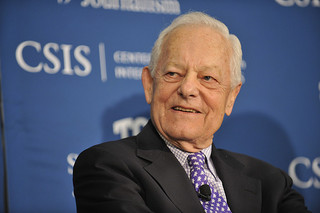
Bob Schieffer (photo: CSIS)
They’re not the only ones who should consider clarifying the record. Here’s CBS Face the Nation host Bob Schieffer (9/22/13):
Rouhani says that Iran does not want and is not pursuing a nuclear weapon. Does anybody take that at face value?
Actually, the burden of proof should be the other way around: Politicians who claim that Iran has such a program should have to prove it. Schieffer obviously doesn’t see the world that way. He’s interviewed people like Israeli Prime Minister Benjamin Netanyahu and failed to challenge their claims about Iran’s weapons. Indeed, Schieffer presented them as facts, telling viewers about Iran’s “continuing effort to build a nuclear weapon” (FAIR Blog, 7/15/13).
So Schieffer is indeed skeptical of government claims. Iran‘s government, that is.
The Syria Chemical Weapons Attack: Human Rights Watch is Manipulating the Facts
By Richard Lightbown | Global Research | September 24, 2013
On 21 August 2013 a series of chemical attacks were perpetrated in the Ghouta suburbs of eastern Damascus. Sources say that between 281 and 1,729 civilians were killed, while Medecins Sans Frontiers reported around 3,600 were injured in the attacks. [1] On the same day UN Secretary-General Ban Ki-moon instructed the UN Mission already in Syria to investigate allegations of chemical weapons use in Khan al-Asal, Sheik Maqsoos and Saraqueb to focus their efforts on the Ghouta allegations. [2]
Before the UN Mission had reported its preliminary findings, Human Rights Watch (HRW) jumped the gun on 10 September with its own report written by Peter Bouckaert, the organisation’s Emergencies Director. [3]
The report admits that HRW did not have physical access to the site and had based its study on Skype interviews with ‘More than 10 witnesses and survivors’ made over a period of two weeks between 22 August and 6 September. These were supplemented by video and photo footage and other data from an unnamed source or sources. It is unclear then, exactly how many exposed survivors were interviewed by HRW or who the other witnesses were.
In compiling the report HRW had also drawn on the technical services of Keith B. Ward Ph.D., an expert on the detection and effects of chemical warfare agents. However the organisation did not disclose that Dr Ward is employed by Homeland Security Advanced Research Projects Agency of the United States government. [4] The HRW investigation was also ‘assisted by arms experts including Nic Jenzen-Jones […] as well as Eliot Higgins […] who collected and analysed photos and videos from the attacks.’ [5]
Mr Jenzen-Jones’s LinkedIn profile does not list any training or experience with armaments, and his only qualifications appear to be ‘certified armourer and ammunition collector’ – which probably relates to the Firearms Amendment (Ammunition control) Act 2012 of the state of New South Wales, Australia. [6] In reports on the story on his own blog ‘The Rogue Adventurer’, Mr Jenzen-Jones relies on data taken uncritically from sources such as the New York Times and even a Los Angeles Times article based on Israeli intelligence [7] Apparently he is not familiar with Israeli falsified reports such as the alleged use of guns by passengers on the Mavi Marmara against Israeli commandos (which remain uncorroborated despite Israeli forces seizing virtually all photographic data from the more than 600 passengers, along with film from security cameras located throughout the ship and Israel’s own constant infra-red surveillance from boats on both sides of the ship and from at least two aircraft). As former CIA director Stansfield Turner is reputed to have said, Mossad excels in PR, and not in intelligence. [8]
HRW’s other expert, Eliot Higgins is an untrained analyst who was recently talked-up into some kind of expert by Matthew Weaver in the Guardian. [9] On his Brown Moses Blog of 28 August 2013 Mr Higgins featured a video sent to him by a source allegedly showing the type of munition linked to the chemical attacks being fired close to Al-Mezzah Airport near Daraya. The video has been filmed at some distance and none of the upwards of 20 men roaming around the site can be clearly seen. An unmarked Mercedes semi-trailer lorry apparently delivers the rocket which is loaded (this is not seen) onto an unmarked white rigid lorry on which the launcher is mounted. The men aimlessly roaming around are mostly wearing army fatigues, although others, including some on the launcher, are in civilian clothes. A number of those in military uniform are wearing red berets. Based solely on this headgear, and the fact that the Syrian Republic Guard as well as the military police are issued with red berets, Mr Higgins is emboldened to state that ‘…this video shows the munition being used by the government forces […].[10]


Stills taken from the video analysed by Eliot Higgins. Mr Higgins has deduced that this is a Syrian Army operation entirely from the red berets worn by some of the personnel. The rocket shown can also carry conventional explosives.
In a previous posting on 26 August, Mr Higgins estimated from shadows that a rocket shown in photographs between Zamalka and Ein Tarma had been fired from north of the site, and he set about trying to locate the launch site with the help of correspondents. Hoping to find the exact location, he speculated that the 155th Brigade missile base was a possible site for the crime. [11] This line of investigation quietly disappeared after the UN Mission reported that the missile they had examined at Zamalka/Ein Tarma was pointing precisely in a bearing of 285 degrees, i.e. nearer west than north. [12]
Meanwhile Mr Bouckaert in his report two weeks later reported that two of his witnesses told HRW that the rockets came from the direction of the Mezzeh Military Airport. [13] These accounts also became inconvenient later when, as we shall see, HRW seized on the azimuths provided by the UN Mission and dashed off on a new wild goose chase. Apparently HRW now considered that nearly 20 per cent of the ‘witnesses and survivors’ it had interviewed were no longer credible regarding the direction of the rockets.
Nevertheless on page 1 of his report Mr Bouckaert felt confident enough to declare,
Based on the available evidence, Human Rights Watch finds that Syrian government forces were almost certainly responsible for the August 21 attacks, and that a weapons-grade nerve agent was delivered during the attack using specially designed rocket delivery systems.
The ‘evidence’ produced on p20 of the report amounts to nothing more than supposition. Mr Bouckaert merely states his scepticism that the rebels could have fired surface-to-surface rockets at two different locations in the Damascus suburbs; he asserts that the types of rockets thought to have been used are not reported to be in possession of the opposition nor is there any footage showing that they have mobile launchers suitable; and he states that the large amounts of dangerous nerve agent would require sophisticated techniques beyond the capabilities of the rebels. No actual evidence is cited to show that this weaponry is Syrian Army equipment. On the contrary the Soviet 140 mm rocket referred to on p15 requires a BM-14 rocket launcher, first produced in the late 1940s.
The Syrian Army equipment list produced by Global Security shows none of this obsolete weaponry in stock but instead lists around 300 of the BM-21 launcher which replaced it. The BM-21 launches a 122mm rocket, so the Army would be unable to fire the 140mm rocket that rebels found and the UN Mission inspected at Moadamiyah. [14] [15] Mr Bouckaert might also recall that Israel has a common border to Syria and is known to have stocks of sarin amongst the vast collection of illegal chemical and biological weaponry amassed by the Israel Institute for Biological Research (IIBR) at Nes Ziona. [16] YouTube videos also show Syrian rebels in possession of mobile rocket launchers. [17] HRW really did assemble a Mickey Mouse team of researchers when they cobbled together this report.
Nevertheless HRW’s reputation and distribution ensured that their allegation was distributed by agencies such as the Associated Press [18] and reported by outlets which included the BBC [19], CBS [20], New York Post [21] and other international media such as the Tasmanian newspaper The Examiner [22] and the Jakarta Post [23]. None of these outlets questioned the veracity of this very serious allegation against the Syrian Army.
On 11 September, a day after the HRW report was published, the International Support Team for Mussalaha in Syria published its unique and important analysis of documentation nominated by US intelligence. [24] Having carefully and thoughtfully analysed the data, including a number of images also published in the Bouckaert report, the study discovered not only widespread manipulation of evidence, but in the tradition of BBC reporting in Syria, [25] they also discovered that photographs of victims in Cairo had been described as victims of a chemical attack in Syria. This preliminary study concludes that there has been gross media manipulation and calls for an independent and unbiased International Commission to identify the children who were killed and try to find the truth of the case. This writer has not seen any HRW document which refers to the ISTEAMS study.
The UN Mission report was published six days after the Bouckaert report on 16 September. This disclosed that the Mission had been allowed a total of only seven-and-a-half hours on-site in the two suburbs which are both located in opposition-controlled areas. During that period they had experienced repeated threats of harm and one actual attack by an unidentified sniper on 26 August. [26] Nevertheless they had collected samples and ‘a considerable amount of information’ along with ‘primary statements from more than fifty exposed survivors including patients, health workers and first-responders.’ In fact the statements had been taken in interviews with nine nurses, seven doctors and 36 survivors. [27] The Mission concluded that there was ‘definitive evidence of exposure to Sarin by a large proportion of the survivors assessed’ [28] and it stated that it had been informed that victims began suffering effects following an artillery barrage on 21 August 2013. All interviews, sampling and documentation followed procedures developed by the Organisation for the Prohibition of Chemical Weapons and the World Health Organisation.
The report states that ‘several surface to surface rockets capable of delivering significant chemical payloads were identified and recorded at the investigated sites’ but only five impact sites in total were investigated by the Mission (presumably because of the time constraints imposed on them by those who controlled the areas).
The UN report is not without its contradictions. In a summary in their Letter of Transmittal the authors wrote ‘In particular, the environmental, chemical and medical samples, we have collected, provide clear and convincing evidence that surface-to-surface rockets containing the nerve agent sarin were used in Ein Tarma, Moadamiyah and Zamalka…’.
And yet none of the 13 environmental samples taken from Moadamiyah were found to have any traces of sarin, although one of the two laboratories conducting the analyses found degradation products of sarin in four of the thirteen samples while a further sample was found to contain degradation products by the other lab. Although two of the samples were unspecified metal fragments, none of the samples was specifically described as being part of a rocket. [29] Does the discovery of degradation products in 38 per cent of the samples (and only 23 per cent of the tests) along with a complete absence of the chemical agent itself constitute ‘clear and convincing evidence’ that Moadamiyah was attacked by surface-to-surface rockets containing sarin?
Most important however are the two caveats included in the report. On p 18 the inspectors wrote concerning the Moadamiyah site.
The sites have been well travelled by other individuals both before and during the investigation Fragments and other possible evidence have clearly been handled/moved prior to the arrival of the investigation team.
Similar tampering of the evidence was noted at the other site as the report notes on p22
During the time spent at these locations, individuals arrived carrying other suspected munitions indicating that such potential evidence is being moved and possibly manipulated.
HRW was quick to seize on the UN report to substantiate its own allegations, although some adjustments were now necessary to get their allegations to dovetail neatly into the report’s findings. On 17 September Josh Lyons used the azimuths cited for the rockets in Appendix 5 of the Mission report to produce a cross reference which suggested that the military base of the Republican Guard 104th Brigade had been the launch site for the chemical weapons. [30] (Mr Lyons called this ‘Connecting the dots’. By coincidence, when referring to the Sellström Report on 19 September, John Kerry said ‘But anybody who reads the facts and puts the dots together, which is easy to do, and they made it easy to do, understands what those facts mean.’? [31] ‘Facts’ can mean anything if distorted enough, Mr Kerry.)
Once again no supporting evidence was provided to explain why HRW blames the Syrian Army, and all previous locations suggested for the launch were conveniently forgotten. To recap, Peter Bouckaert reported two witness statements that the rockets came from the direction of the Mezzeh Military Airport (more than 6 kilometres from the Republican Guard base) and HRW’s ‘expert’ Eliot Higgins was convinced that they were fired from north of the target sites.
To make his case Mr Lyons is being dishonest. Referring to unspecified ‘declassified reference guides’ he tells us that the 140mm artillery rocket could have reached Moadamiya, 9.5Km from the Republican Guard’s base. Yet even if a seventy-year old rocket system could indeed fly that far, Mr Lyons is forgetting that the Syrian Army no longer has these outdated systems. It therefore no longer has 140mm rockets, one of which is alleged to have been responsible for part of this crime against humanity. He is also forgetting that no actual chemical agent was found at Moadamiya, so it is premature to start producing cross references from that site. And above all he is deliberately omitting to tell his readers about the caveats written for both target sites by the UN inspectors that clearly and unequivocally suggest that the evidence has been tampered with at both sites which are located in opposition-controlled areas.
None of these inconvenient truths have stopped the HRW juggernaut. On 20 September the Guardian published an article by HRW staffer Sarah Margon promoting both the Bouckaert report and the Lyons’ calculations (apparently unaware of the contradiction between the two). She ended up by calling for an Obama/Kerry commitment to ensure there is ‘accountability for those who would use the world’s most heinous weapons against the world’s most vulnerable people’. [32] But of course she was not writing about Fellujah or Gaza or the IIBR at Nes Ziona.
Notes
[1] Wikipedia; Ghouta chemical attacks. http://en.wikipedia.org/wiki/Ghouta_chemical_attacks (Accessed 23 September 2013)
[2] Sellström, Åke. et al., 13 September 2013; United Nations Mission to Investigate Allegations of the Use of Chemical Weapons in the Syrian Arab Republic – Report on the Alleged Use of Chemical Weapons in the Ghouta Area of Damascus on 21 August 2013; United Nations; para 15, p3.
http://www.un.org/disarmament/content/slideshow/Secretary_General_Report_of_CW_Investigation.pdf
[3] Bouckaert, Peter, 10 September 2013; Attacks on Ghouta, Analysis of Alleged Use of Chemical Weapons in Syria; Human Rights Watch. http://www.hrw.org/sites/default/files/reports/syria_cw0913_web_1.pdf
[4] http://www.docstoc.com/docs/24131911/Notes-from-Department-of-Homeland-Security-HSARPA-Best-Practices (Accessed 23 September 2013)
[5] Attacks on Ghouta; op.cit. pp. 1 and 2.
[6] http://au.linkedin.com/in/nrjenzenjones (Accessed 23 September 2013)
[7] http://rogueadventurer.com/2013/08/29/alleged-cw-munitions-in-syria-fired-from-iranian-falaq-2-type-launchers/ (Accessed 22 September 2013)
[8] AbuKhalil, As’ad, 7 September 2011; The Mossad in Hollywood Movies; alakhbar English. http://english.al-akhbar.com/node/530 (Accessed 22 September 2013)
[9] Weaver, Matthew, 21 March 2013; How Brown Moses exposed Syrian arms trafficking from his front room; The Guardian. http://www.theguardian.com/world/2013/mar/21/frontroom-blogger-analyses-weapons-syria-frontline (Accessed 21 September 2013)
[10] http://brown-moses.blogspot.co.uk/2013/08/the-smoking-gun-video-shows-assads.html (Accessed 23 September 2013)
[11] http://brown-moses.blogspot.co.uk/2013/08/finding-exact-location-of-alleged.html (Accessed 23 September 2013)
[12] Sellström, Åke. et al.; p23.
[13] Attacks on Ghouta; op.cit., p6.
[14] http://weaponsystems.net/weapon.php?weapon=DD05%20-%20BM-14 (Accessed 23 September 2013)
[15] http://www.globalsecurity.org/military/world/syria/army-equipment.htm (Accessed 23 September 2013)
[16] Abu-Sitta, Salman; Traces of poison; Al-Ahram 27Feb – 5 March 2003, Issue No. 627.
[17] For example http://www.youtube.com/watch?v=iKoYg9xEGMs, http://www.youtube.com/watch?v=6JEElw-ea5k, http://www.youtube.com/watch?v=g6w68OqA4HM (h/t timbercrown)
[18] http://nypost.com/2013/09/10/human-rights-watch-condemns-assad-for-alleged-chemical-attack/ (Accessed 22 September 2013)
[19] http://www.bbc.co.uk/news/world-middle-east-23927399 (Accessed 22 September 2013)
[20] http://www.cbsnews.com/8301-202_162-57602150/human-rights-watch-says-evidence-strongly-suggests-assad-used-chemical-weapons/ (Accessed 22 September 2013)
[21] http://nypost.com/2013/09/10/human-rights-watch-condemns-assad-for-alleged-chemical-attack/ (Accessed 22 September 2013)
[22] http://www.examiner.com.au/story/1768398/syrian-government-forces-almost-certainly-responsible-for-chemical-attacks-human-rights-watch-report/ (Accessed 22 September 2013)
[23] http://www.thejakartapost.com/news/2013/09/10/rights-group-syrian-regime-behind-chemical-attack.html (Accessed 22 September 2013)
[24] Mother Agnes Mariam of the Cross, 11 September 2013; THE CHEMICAL ATTACKS ON EAST GHOUTA TO JUSTIFY MILITARY RIGHT TO PROTECT INTERVENTION IN SYRIA; ISTEAMS. http://www.globalresearch.ca/STUDY_THE_VIDEOS_THAT_SPEAKS_ABOUT_CHEMICALS_BETA_VERSION.pdf
[25] Lightbown, Richard, 18 June 2012; Syria: Media Lies, Hidden Agendas and Strange Alliances; Global Research. http://www.globalresearch.ca/syria-media-lies-hidden-agendas-and-strange-alliances/31491
[26] Sellström, Åke. et al.; para 18.
[27] Sellström, Åke. et al.; paras. 18, 19 and 21, Appendix 7.
[28] Sellström, Åke. et al.; p17.
[29] Sellström, Åke. et al.; pp. 24/5 and 27-29.
[30] Lyons, Josh, 17 September 2013 ; Dispatches : Mapping the Sarin Flight Path; Human Rights Watch. https://www.hrw.org/news/2013/09/17/dispatches-mapping-sarin-flight-path (Accessed 21 September 2013)
[31] Kerry: U.N. report confirms Assad responsible for chemical attack http://www.cbsnews.com/video/watch/?id=50155432n (Accessed 22 September 2013)
[32] Margon, Sarah, 20 September 2013; The sarin gas attack is just one Syrian atrocity the ICC should pursue’; The Guardian. http://www.theguardian.com/commentisfree/2013/sep/20/sarin-gas-syria-icc (Accessed 22 September 2013)
Richard Lightbown is a researcher and occasional writer on human rights issues, particularly relating to the Middle East.
Related article
- Human Rights Watch Misinformation on Syria (thepeoplesvoice.org)
Potential US war on Syria based on a snuff movie
By Finian Cunningham | Press TV | September 21, 2013
The American war footing towards Syria plumbs a new diabolical depth.
Not only is it an act of criminal aggression against an innocent country – the supreme crime according to Nuremberg Principles – but that transgression would itself be based on another vile crime – the deliberate killing of children for propaganda purposes.
The notorious videos purporting to show the half-clothed bodies of dozens of lifeless Syrian children are the central component of US claims for launching a war against Syria. Suspiciously, this footage gained wide circulation on the internet and on international television news bulletins within hours of the alleged toxic gas attack on 21 August near Damascus.
Now it appears that those videos are part of an elaborate, diabolical fabrication, the circumstances of which are very different from what they are meant to assign.
Nobody is questioning the fact that the children are dead. But what transpires is that the children seem to have been murdered by some form of intoxication and that their deaths were then recorded by their killers – with the calculated intention of producing a propaganda video.
That propaganda purports to blame the Syrian government forces of using chemical weapons causing massive civilian casualties. That in turn is aimed at provoking outrage among world public opinion, which would underpin US military intervention on the basis of President Obama’s so-called red line on the use of chemical weapons in Syria.
In other words, the world is being pushed into acquiescing to a US-led criminal war on Syria based on a vile “snuff movie.”
In the world of vice, there can be few acts more criminal and morally depraved than that of making snuff movies. This illegal genre of film is where some unwitting victim is murdered on screen for the perverse gratification of those behind the camera and the eventual underground audience who indulge in such odious entertainment.
Usually, in the making of snuff movies, the persons recording the scene of death are the killers or their accomplices. These movies are, needless to say, highly illegal and confined to a secretive subculture. Those who make snuff movies and watch them are complicit in murder, and the videos are in effect indictable evidence of their crime.
On close examination of the alleged gas attack videos that came out of Syria on 21 August, the blunt assessment is that the footage is nothing less than a snuff movie.
This is the shocking conclusion from an independent study carried out by Syrian Christian leader Mother Agnes Mariam el-Salib. Under the auspices of the Geneva-based International Institute of Peace, Justice and Human Rights, the study concludes that the infamous gas-attack videos showing dead children is a fabrication. That is, the children were not killed, as alleged, by Syrian government forces firing chemical weapons on the Ghouta suburb of Damascus.
According to the authors: “From the moment when some families of abducted children contacted us to inform us that they recognized the children among those who are presented in the videos as victims of the chemical attacks of east Ghouta, we decided to examine the videos thoroughly.”
Mother Agnes’ investigation goes on to say chillingly: “Our first concern was the fate of the children we see in the footages. Those angels are always alone in the hands of adult males that seem to be elements of armed gangs. The children that trespassed remain without their families and unidentified all the way until they are wrapped in the white shrouds of the burial. Moreover, our study highlights without any doubt that their little bodies were manipulated and disposed with theatrical arrangements to figure in the screening.”
The authors add: “Thus we want to raise awareness toward the humanitarian case of this criminal use of children in the political propaganda of the east Ghouta chemical weapons attack.”
Mother Agnes and her co-authors have submitted their findings to the UN Human Rights Committee in Geneva. But, tellingly, the report, which was published earlier this week, has received negligible coverage in the Western mainstream media.
It is not determined who actually killed the children and by what method. Some observers have pointed out that the victims appear to have tourniquets on their arms. That would suggest that they received a lethal injection.
It also appears that the children are not from the location of Ghouta. It is believed that many of them were abducted by the foreign-backed militants during raids on pro-government villages in the Latakia area of northwest Syria during the weeks prior to 21 August.
That confers on the crime in Ghouta on 21 August the most hideous proportions. For what is deduced is that dozens of children were abducted for the fate of cold-blooded murder, to be videoed with the purpose of fabricating a crime falsely attributed to others for propaganda effect – propaganda to precipitate a war.
When we look at the choreographed way in which the US government and its Western allies have reacted to the incident and the videos, it is suggestive of collusion at some level. Several reports have tied the involvement of Saudi, Turk and Israeli intelligence with the supply of toxic chemicals to the foreign-backed militants fighting in Syria for the Western agenda of regime change against the government of President Assad. These intelligence agencies are closely aligned with those of the US, Britain and France.
The fundamental importance of the alleged gas-attack videos to the US and Western case for military intervention in Syria raises the question of how much do these governments know about the exact circumstances of the child deaths that ostensibly occurred in Ghouta on 21 August.
Apart from flawed interpretation of the inconclusive UN chemical inspectors’ report released earlier this week, the other component of the US government’s case for a military attack on Syria are the videos purporting to show the aftermath of a chemical weapons incident in Ghouta.
Appealing to Congress for military strikes on Syria earlier this month, US Secretary of State John F Kerry described those images as “sickening,” and added that “the world must act on such horror.”
Affecting an air of privileged briefing, members of Congress were taken into closed-door sessions. There, they watched the videos showing lifeless children lying in gaunt rooms in an unknown location, apparently having died from exposure to sarin or some other toxic gas.
It appears that US lawmakers viewed the same video footage that the rest of the world has also accessed via the internet and on television news bulletins. The viewing of such distressing scenes paved the way for the US Senate Committee on Foreign Relations to vote for resolution 2021 backing President Obama’s military attack on Syria.
While the momentum for war has abated in the past week because of the Russian-brokered deal to decommission Syrian government chemical weapons, nevertheless the US continues to threaten that military strikes still remain an option on the table.
US-led wars in the past have notoriously relied on false flags and pretexts, such as the sinking of the USS Maine, the Gulf of Tonkin incident and 9/11. But if the US commits to war on Syria, its lawlessness will have reached a new low. In that event, it will be a war of aggression based on a snuff movie.
~
Finian Cunningham, originally from Belfast, Ireland, was born in 1963. He is a prominent expert in international affairs. The author and media commentator was expelled from Bahrain in June 2011 for his critical journalism in which he highlighted human rights violations by the Western-backed regime. He is a Master’s graduate in Agricultural Chemistry and worked as a scientific editor for the Royal Society of Chemistry, Cambridge, England, before pursuing a career in journalism. He is also a musician and songwriter. For many years, he worked as an editor and writer in the mainstream news media, including The Mirror, Irish Times and Independent. He is now based in East Africa where he is writing a book on Bahrain and the Arab Spring.He co-hosts a weekly current affairs programme, Sunday at 3pm GMT on Bandung Radio.
Lavrov: US pressuring Russia into passing UN resolution on Syria under Chapter 7
RT | September 22, 2013
The US is pushing Russia into approving a UN resolution that would allow for military intervention in Syria, in exchange for American support of Syria’s accession to OPCW, Russian Foreign Minister Sergey Lavrov has said.
“Our American partners are starting to blackmail us: ‘If Russia does not support a resolution under Chapter 7, then we will withdraw our support for Syria’s entry into the Organization for the Prohibition of Chemical Weapons (OPCW). This is a complete departure from what I agreed with Secretary of State John Kerry’,” Russian Foreign Minister Sergey Lavrov told Channel 1’s Sunday Time program.
Chapter 7 of the UN charter would allow for potential military intervention in Syria.
Western countries blinded by ‘Assad must go’ attitude
The head of Russia’s Foreign Ministry went on to say he was surprised by the West’s “negligent” approach to the conflict.
“Our partners are blinded by an ideological mission for regime change,” said Lavrov. “They cannot admit they have made another mistake.”
Slamming the West’s intervention in Libya and Iraq, the foreign minister stated that military intervention could only lead to a catastrophe in the region. Moreover, he stressed that if the West really was interested in a peaceful solution to the conflict that has raged for over two years, they would now be pushing for Syria’s entry into the OPCW in the first place, not for the ouster of President Bashar Assad.
“I am convinced that the West is doing this to demonstrate that they call the shots in the Middle East. This is a totally politicized approach,” said Lavrov.
‘A repeat of Geneva 2012’
Lavrov harked back to last year’s Geneva accord which was agreed upon by the international community, including Russia and the US. However, when the resolution went to the Security Council the US demanded that Chapter 7 be included.
“History is repeating itself. Once again in Geneva an agreement has been reached which does not contain any mention of Chapter 7. But the Security Council wants to redo the document in their own way to include it.”
He called on the West to observe international law and stop writing resolutions motivated by their “geopolitical ambitions.”
‘Both sides must hand over chemical weapons’
Sergey Lavrov has also insisted that opposition forces take part in the decommissioning of Syria’s chemical weapons stockpiles.
“The solutions currently being worked out at the OPCW suggest that all stocks of Syrian chemical weapons must be brought under control and ultimately destroyed.”
Lavrov further charged that the West was “not telling the whole story” by asserting that chemical weapons are only possessed by the regime, and not the opposition.
He added that the available information provided by the Israelis confirmed that on at least two occasions, the rebels had seized areas in which chemical weapons were stored and those arms might have fallen into their hands.
“According to our estimates, there is a strong probability that in addition to home-grown labs in which militants are trying to cook up harmful and deadly concoctions, the data provided by the Israelis is true,” the Russian FM said.
“Preparatory work for OPCW inspectors to assume control of chemical weapons storage sites requires that those who fund and sponsor opposition groups – including extremists – demand that they hand over the [arms] which have been seized so that they can be destroyed, pursuant to the Convention on the Prohibition of Chemical Weapons.”
Lavrov added that Russia was not a guarantor for the disarmament of Syria’s chemical weapons, as Syria’s commitments fell under the auspices of the Chemical Weapons Convention, which is internationally administered by the OPCW.
Lavrov said Russia and the US were working out a draft resolution to be submitted to the OPCW, although several points were yet to be agreed upon.
Logistics of destruction
Sergey Lavrov said that the time frame for the elimination of Syria’s chemical weapons was not unrealistic.
“The overwhelming majority of the figures as per timing, term, beginning, finishing of the mission have been suggested by the American side,” he added.
Even if the time frame is feasible, there remains disagreement on the cost of the venture.
Earlier this week, President Assad said the destruction of Syria’s chemical weapons arsenal would be a costly venture.
“It needs a lot of money, it needs about one billion [US dollars]. It’s very detrimental to the environment. If the American administration is ready to pay the money, and to take responsibility of bringing toxic materials to the United States, why don’t they do it?” Assad told Fox News
Lavrov said he had heard of the cost estimate, although during his negotiations with his US counterpart in Geneva last week, the figure was much lower. Lavrov said the discrepancy stemmed from the fact that a professional estimate was in order.
“When OPCW experts visit Syria and view the storage sites for chemical weapons, they will understand what can be destroyed on the spot (and this is also possible) with the use of mobile equipment which a number of states have, and those where special factories need to be built, as we did when destroying Soviet chemical weapons stockpiles. But for those which need to be taken out of the country – toxic substances – will require a special decision, because the convention considers it essential that the destruction takes place on the territory of that country which possesses the chemical weapons,” he said.
Lavrov said legal grounds would need to be found to move forward in this case, but if all sides could agree in principle, then drawing up a legally binding document will not be hard.
He further noted the difficulties that would be faced in assuring the security of both the Syrian and international experts tasked with bringing the chemical weapons under control and laying the groundwork for their ultimate destruction.
“We’ve considered that an international presence will be demanded in those areas where experts are working. We are prepared to allocate our own servicemen or military police to take part in those efforts. I do not believe it is necessary to send in a strong [military] contingency. It seems to me that it will be sufficient to send in military observers. It will be necessary to do it in such a way that the observers will come from all permanent members of the UN Security Council, Arab states and Turkey, so that all conflicting sides in Syria understand that this contingent represents all external forces who are collaborating with one or the other conflicting sides in Syria…so that they don’t resort to provocations,” he said.
Lavrov reiterated previous statements made during his negotiations with Secretary of State John Kerry following their talks in Geneva last week that the opposition was equally responsible for providing for the safety of OPCW and UN experts in the country and not allowing for any “provocations.”
Related articles
Israel’s latest Syria ‘game-changer’ — ‘The al-Qaeda-Assad alliance’
By Maidhc Ó Cathail | The Passionate Attachment | September 21, 2013
In a highly speculative September 12 report entitled “Game-Changer: Signs of the al-Qaeda-Assad Alliance,” PJ Media’s Washington editor Bridget Johnson attempts to turn conventional wisdom about the current Syria debate on its head by asserting that “al-Qaeda is working not against Bashar al-Assad but in concert with the dictator.”
In support of this rather tendentious claim, Johnson cites a “student dissident” named Ahed Al Hendi whom she says fled Syria five years ago after imprisonment and torture by the Assad regime. According to Al Hendi, Damascus was secretly collaborating with Al-Qaeda during the Iraq War even as it sought to convince the U.S. that it was serious about fighting terrorism. That covert alliance persists to this day, asserts Johnson:
Assad appears OK with losing a building now and then by a car bomb — bombings that never hit too close to his home and that come with ample warning anyway. Al-Qaeda units, meanwhile, get left alone by Assad’s forces. “They never touch them,” Al Hendi said.
PJ Media’s spurious effort to persuade readers that Al-Qaeda is an ally rather than a foe of Assad makes a lot more sense, however, when you know that both the “conservative” American website and its seemingly objective Syrian source both have intimate ties to the country that has done most to induce Washington to use military force against Syria.
The effort to raise the $3.5 million in venture capital to start Pajamas Media [the original name for PJ Media] was led by Aubrey Chernick. A former trustee of the Washington Institute for Near East Policy, a think tank created by the American-Israel Public Affairs Committee, Chernick provides funding for a broad spectrum of pro-Israel organizations from the supposedly liberal Anti-Defamation League to the extremist Islamophobia-promoting Jihad Watch.
Ahed Al Hendi is Arabic Program Manager for a organization called Cyberdissidents.org. As I wrote in a May 2011 piece entitled “Arab Dissidents’ Strange Bedfellows”:
CyberDissidents.org is a project launched in 2008 by the Jerusalem-based Adelson Institute for Strategic Studies “to research and focus attention on the online activities of democracy advocates and dissidents in the Middle East, in the hope of empowering them at home and raising awareness of their plight abroad.” Until its demise in 2009, the Adelson Institute was located at the Shalem Center, a controversial research institute associated with right wing Zionist causes.
While Israel and its media assets might like Americans to believe that Assad and al-Qaeda are allies, there is far more reason to suspect an al-Qaeda-Israeli alliance in Syria. As Israel’s outgoing ambassador to the U.S. Michael Oren recently admitted to the Jerusalem Post:
“The initial message about the Syrian issue was that we always wanted [President] Bashar Assad to go, we always preferred the bad guys who weren’t backed by Iran to the bad guys who were backed by Iran,” he said.
This was the case, he said, even if the other “bad guys” were affiliated to al-Qaida.
Maidhc Ó Cathail is an investigative journalist and Middle East analyst. He is also the creator and editor of The Passionate Attachment blog, which focuses primarily on the U.S.-Israeli relationship. You can follow him on Facebook and Twitter @O_Cathail.
Related articles
- Syria and the ‘devious’ Israeli connection – Dr. Olmert doth protest too much, methinks (alethonews.wordpress.com)
- Was Kerry’s ‘Munich moment’ on Syria created by a protégé of the Israel lobby? (alethonews.wordpress.com)
- Israelis Flying Aid to Syrian Rebels Under the Cover of Humanitarianism (thepassionateattachment.com)
Western lies, criminality unraveling in Syria
By Finian Cunningham | Press TV | September 19, 2013
The US has accused Russia of “swimming against the tide” in persisting with its claims that foreign-backed militants in Syria committed the chemical weapons attacks, not the Syrian armed forces, as the Western governments have asserted.
In a sense, the US is correct. Russia is indeed swimming against a tide – a powerful tide of fabrication and propaganda promulgated by Washington, its Western allies and their dutiful news media.
But that tide is now subsiding, by the day, as more facts emerge about what really happened in Syria with regard to the use of chemical weapons. If Russia was swimming against a tide, the position of the US and its allies is now sinking from lies and criminality.
As each day passes, it becomes clear that Western states tried to railroad a guilty verdict on the Syrian government and thereby trigger a desired military aggression.
The Western propaganda operation went into full speed on Monday following the release of the report by the United Nations chemical weapons team, led by Swedish scientist Ake Sellstrom. No sooner had that report been published than the US, British and French governments were crowing that it provided “conclusive proof” of their allegations that Syrian President Bashar al-Assad’s forces had committed the mass killings on 21 August near the capital, Damascus.
The UN team did not actually state who perpetrated the chemical gas attack, but its inferences allowed others to point the finger of accusation at the Syrian army. So too did the tone of UN Secretary General Ban Ki-Moon who called for sanctions against those who commit such crimes “against your own people”.
So, they all lined up in familiar choreography to denounce the Syrian government. The US, British and French said they were justified in calling for military strikes and that they intended incorporating such action in the recent chemical decommissioning deal worked out by Washington and Moscow. For a day or two, it seemed that the Western governments had gained the psychological upper hand.
But it is increasingly clear that the Western “certainty” over Syrian chemical weapons is an edifice built on sand. The initial Western claims were never supported by verifiable evidence, only “secret intelligence”. Now it turns out that the UN inspectors’ report upon which the Western governments have rested their case is fatally flawed.
By its own admission, the UN study was carried out hurriedly under duress and in circumstances tampered with by the Western-backed anti-government militants. In a word, its putative evidence is unreliable.
More damning is the new disclosure by the Syrian government purporting to show that the culpable party for the gas attack near Damascus is the insurgents. Syria shared this “factual evidence” with Russian Deputy Foreign Minister Sergei Ryabkov, who was in Damascus this week. Syria and Russia are to submit this information to the UN.
What is disturbing is that this latest evidence, which includes ballistic charts and chemical analysis data, was already presented to the UN team led by Sellstrom. Russia has also said that other evidence and information presented to the UN team during the investigation was ignored in its final report. That suggests that the UN team was compromised to accommodate Western political interests.
Another disclosure this week is that Moscow confirmed that it never supplied Syria with sarin gas, not even during the years of the former Soviet Union. The significance of this is that Western governments flagged up the finding in the Sellstrom report that the inspectors had recovered remains of unusual rockets with Cyrillic (Russian) lettering. The inference was that Russia supplied Syria with chemical weapons, which the Syrian army had used.
But the Kremlin denied that it has ever delivered such munitions to Syria. It said that Soviet-era rockets with Cyrillic markings of the type cited in the Sellstrom report were supplied in the past to Libya. Given that Libya is a major arms supply conduit to the Western-backed so-called rebels in Syria, this again lends credibility to the Russian and Syrian claims that the chemical gas attacks near Damascus were carried out by these groups in a provocation to elicit Western military intervention.
There are many other unanswered perturbing questions about the chemical weapons attack near Damascus last month. Who were those dead children in the videos that the West has based so much of its emotive claims on? Why were they dressed in day clothes if they were supposedly killed in the middle of the night when they should have been in their beds? Why were their corpses arranged in such an orderly way, suggesting the scene was organized for an anticipated video recording? Why are there so few adult female victims in the apparent gas attack? Where are the grieving mothers and fathers of the little ones whose bodies are stacked up in death shrouds?
More chilling is a study led by Syrian Christian figure, Mother Agnes Mariam, which cites relatives of the dead who claim that the children were abducted by militants during earlier attacks in the northwest Latakia area. In that case, the children may have been poisoned, not by rockets filled with sarin, but by premeditated murder, with the purpose of fabricating a chemical gas attack.
What this demonstrates is that the exact circumstances of the atrocity near Damascus are far from known. But what is clear is that Western governments are shamelessly contriving partial and unsubstantiated data to fit political objectives.
The rush to railroad a guilty verdict on the Syrian government shows once again that the Western objective is regime change. That objective is criminal and the means to achieve it – fabricating lies and fomenting acts of war – gravely compound the criminality.
Related article
NY Times Doesn’t Think That NSA Sharing Raw Communications With Israel Is Newsworthy
By Mike Masnick | Techdirt | September 16, 2013
Last week, we were among those who wrote about the latest revelations via the Guardian about how the NSA was sharing raw communications it had collected with Israeli intelligence. This is a big story for any number of reasons, but apparently the NY Times doesn’t think so. When Public Editor Margaret Sullivan asked why, the managing editor basically said the story wasn’t newsworthy:
He told me that The Times had chosen not to follow the story because its level of significance did not demand it.
“I didn’t think it was a significant or surprising story,” he said. “I think the more energy we put into chasing the small ones, the less time we have to break our own. Not to mention cover the turmoil in Syria.”
So, I asked him, by e-mail, was this essentially a question of reporting resources? After all, The Times could have published an article written by a wire service, like Reuters or The Associated Press.
“I’d say resources and news judgment,” he responded.
The resources issue is one I can understand totally. Here at Techdirt, we probably cover about one quarter to one third the number of stories we’d like to (which is also why I have about a thousand open tabs of stories I’m “hoping” to get to one of these days). But to claim that it’s not “significant” or “surprising” or somehow newsworthy is pretty crazy. This is a major part of the story — where the NSA keeps insisting that it is exceptionally careful with the data it collects, yet here it is handing off a ton of communications, including those of Americans, off to a foreign intelligence agency with basically no oversight. If the NY Times doesn’t think that’s newsworthy, the NY Times needs to recalibrate its newsworthy scale.
Related article
Featured Video

Iran’s Next Strike May Not Explode. It Could Shut You Down
or go to
Aletho News Archives – Video-Images
From the Archive
Zionism’s Violent Legacy
By Donald Neff | Washington Report On Middle East Affairs | January 1996
On January 4, 1948, Jewish terrorists drove a truck loaded with explosives into the center of the all Arab city of Jaffa and detonated it, killing 26 and wounding around 100 Palestinian men, women and children.[1] The attack was the work of the Irgun Zvai Leumi – the “National Military Organization,” also known by the Hebrew letters Etzel – the largest Jewish terrorist group in Palestine. The Irgun was headed by Revisionist Zionist Menachem Begin and had been killing and maiming Arabs, Britons and even Jews for the previous ten years in its efforts to establish a Jewish state.
This terror campaign meant that at the core of Revisionist Zionism there existed a philosophical embrace of violence. … continue
Blog Roll
 Aletho News
- Trump’s Iran war is on an Israeli leash
- Saudi oil boss issues global supply warning
- Riyadh Says Its Oil System Is Intact. The Numbers Say Otherwise.
- Trump and Netanyahu Want to “Finish the Job” on Iran
- US ‘one-sided dictation’ not Iran’s beliefs makes rational talks impossible: Baghaei
- Iran’s Next Strike May Not Explode. It Could Shut You Down /Col Doug Macgregor
- Iran: US political targets legitimate if assassinations return
- Iraq shuts key border crossing with Iran under US pressure: Report
- Undersea Internet cables could be targeted in retaliation for attacks on Iran: IRGC deputy chief
- EU sending ‘biased’ observers to interfere in Serbian election – president
- If Americans Knew
- Israel’s vision of regional security rests on keeping Arab states weak
- Heidi Levine recounts how Palestinian youths helped save her in settler attack
- DAILY UPDATE: Latest essential news on Palestine, Israel, & region
- Trump’s Intensifying Sabotage of the ICC, for Israel’s Sake
- Israeli military detain US and UK volunteers in West Bank including Democratic NY politician Brad Lander
- Americans at National Conservatism Conference held in Israel this year criticize Israel
- Christiane Amanpour exits CNN with a legacy shaped by the debate over Israel
- Israel’s war on Iran is the final move in a decades-old strategy
- Israel Denies Entry to French Journalist, U.S. Researcher Amid Rise in Entry Denials
- Gaza’s hospitals are running out of life-saving fuel – Daily Update
- No Tricks Zone
- E-Cars Reduce CO2 Emissions By Only 41% Compared To Internal Combustion Engine Vehicles
- Predictions Made By Renowned Climate Professor Over Past Decades Have Been Proven To Be Poor
- New Study Suggests Large Regions Of The Pacific Ocean Have Been Cooling For The Last 80 Years
- Germany’s Green Energy Debacle: High Energy Costs Force Kahla Porzellan to Close After 182 Years!
- New Study: 50 Years Of The Most Aggressive ‘Net Zero’ Policies Can Only Affect The Global Climate By 0.03°C
- US September “Heat” Was No Record…Many Records Set Decades Ago
- Latest European Green Energy Debacle; Portugal’s Largest Flagship Solar Park Insolvent!
- Green Energy Debacle: German Expert Professor Fritz Vahrenholt Warns Of Severe Economic And Social Consequences
- Two More Paleo Reconstructions Affirm Meters-Higher Sea Levels Across Ireland, Brazil 7000-6000 Years Ago
- New Study: Earth And Venus Surface Warmth Largely Explained By Convection And Lapse Rate, Not CO2 Or Radiation

