The Ugly Truth Behind Obama’s Cyber-War
By ALFREDO LOPEZ | CounterPunch | March 22, 2013
Last week, a top U.S. government intelligence official named James Clapper warned Congress that the threat of somebody using the Internet to attack the United States is “even more pressing than an attack by global terrorist networks”. At about the same time, Keith Alexander, the head of the National Security Agency, announced that the government is forming 13 teams to conduct an international “cyber offensive” to pre-empt or answer “Internet attacks” on this country.
This, as they say, means war.
Clapper issued his melodramatic assessment during an appearance before the Senate Intelligence Committee. As Director of National Intelligence, he testified jointly with the heads of the CIA and FBI as part of their annual “Threat To the Nation” assessment report.
While undoubtedly important, these “threat assessment” appearances are usually a substitute for sleeping pills. The panel of Intelligence honchos parades out a list of “threats” ranked by a combination of potential harm and probability of attack. Since they began giving this report (shortly after 9/11), “Islamic fundamentalist terrorist networks” have consistently ranked number one. Hence the sleep-provoking predictability of it all.
But Clapper’s ranking of “cyber terrorism” as the number one threat would wake up Rip Van Winkle.
“Attacks, which might involve cyber and financial weapons, can be deniable and unattributable,” he intoned. “Destruction can be invisible, latent and progressive.” After probably provoking a skipped heartbeat in a Senator or two, he added that he didn’t think any major attack of this type was imminent or even feasible at this point.
So why use such “end of the world” rhetoric to make an unfeasible threat number one?
The answer perhaps was to be found in the House of Representatives where, on that same day, Gen. Alexander was testifying before the Armed Services Committee about, you got it, “cyber-war”.
Besides being head of the NSA, Alexander directs the United States Cyber Command. I’m not joking. Since 2010, the United States military has had a “Cyber Command”, comprised of a large network of “teams” some of whose purpose is to plan and implement what he called “an offensive strategy”.
Up to now, the Obama Administration’s stated policy has been to prioritize protection and defense of its own Internet and data systems and, unsurprisingly, those of U.S. corporations. Now we realize that the President has been cooking another dish on the back burner. When these military leaders talk about “offensive strategy”, they mean war and in warfare, the rules change and warriors see democracy as a stumbling block at least and a potential threat at worst.
Is there a “cyber threat”? Sure, just like there’s a “personal security threat” at your front door. You live among other humans and a few of them sometimes rob people. The Internet is a neighborhood of two billion people in constant communication. To do what it was developed to do, it has to be an open, world-wide communications system and people can exploit that by harming your website or stealing your data if you don’t protect these things adequately. Developing protections is part of what technologists in every setting, including government services, do every day and they do it well, minimizing the incidence of an on-line hack.
That’s contemporary society. You lock the door to your house, turn on your car alarm on and protect your computer’s data. Most of the time it’s unnecessary but you do it for those rare occasions that it might be called for.
You do not, however, break into a thief’s home, kill him or her and wipe out everyone in the house. That’s what President Obama is proposing. No longer is this Administration interested in just “protection of data”; it now plans to pre-emptively attack data operations and Internet systems in other countries. The non-euphemistic term for this kind of “offensive strategy” is hacking and hacking takes two forms: data theft and disruption of service. In other words, the government plans to do what it throws people in jail for doing.
Clearly, this isn’t only about data theft or service disruption. It’s entwined with the political conflicts Washington has with other countries like China and Iran. The Internet is now another battlefield and this offensive strategy gives our government another weapon in its ceaseless war on the world.
While this weapon might sound benign, almost game-like, compared to other military adventures, it is actually a vicious and punishing strategy promising a festival of unavoidable collateral damage.
A “cyber offensive” can target just about anything in a country (like the computers running an Iranian power plant) and, depending on how the Internet systems are inter-connected, almost automatically cut service to people, schools, hospitals, security services and governments themselves. This is the digital version of nuclear warfare, horrific for its impact and its fundamental immorality.
When the announcements were made, the mainstream media flew into a frenzy of evaluation and analysis. Is this cyber threat real, commentators asked? Most of them found that, at this point, it isn’t. But that’s not the point and it isn’t the real threat.
The carefully planned and coordinated Clapper/Alexander testimony provides a pretext for the array of repressive Internet-governing laws, strategies and programs the Administration already has in place. Their purpose is a ratcheting control of the Internet by the government, a redefinition of our constitutional rights and the eviscerating of our, and the world’s, freedoms. Now, with this “cyber war” scenario, these measures can be more easily defended and made permanent.
We can group those laws and programs into three categories.
”Extreme Data Collection”
The Obama Administration is building a huge data center in Bluffdale, Utah whose role is to capture and store all data everyone in this country (and most of the world) transmits. You read that right.
“Flowing through its servers and routers and stored in near-bottomless databases will be all forms of communication,” wrote James Bamford in Wired Magazine, “including the complete contents of private emails, cell phone calls, and Google searches, as well as all sorts of personal data trails — parking receipts, travel itineraries, bookstore purchases, and other digital ‘pocket litter.’”
While having your entire on-line life tracked and stored in Utah is pretty creepy, the more pressing issue is how government officials plan to use this data and how they are collecting it. To mine its value, they need to order it to make searches, filtering and lists possible. You need a strategy and while Obama officials have been pretty open about what they’re building, they are closed-mouth about what they intend to do with it.
We know they are working hard on developing code-breaking technology which would allow them to read data which is super-encrypted, the last wall of privacy and protection we have. We also know that, to get this data, they have a remarkable system of surveillance that includes direct capture (capturing data from your on-line sessions), satellite surveillance and the tapping (through easily available data captures) of major information gatherers like Google and Yahoo. The fact that they plan to open this center in September, 2013 means that the intense surveillance and data gathering is in place. You are now never alone.
This is the kind of information on “the enemy” they need in a cyber-war but this information is about us and so the question pertains: who is the enemy here?
“Internet Usage Restriction”
If you’re conducting a war, you can’t have people running around the battlefield trading information and distributing it because, after all, you need secrecy. But collecting and distributing information is entirely what the Internet is about.
No reasonable person expects the entire shut-down of the Internet but the curtailment of on-line expression is now happening and getting worse, re-defining the meaning of free speech and making it an embattled concept.
Under the law, for instance, any corporation or individual can claim you are violating their copyright and demand you remove offending material from a website. You can challenge and litigate that but it doesn’t really matter because, under the Digital Millenium Copyright Act your web hosting service faces huge penalties if they keep the site on-line and the copyright violation is proven. So, to avoid the legal fees and the risk, they’ll just wipe your website. This happens all the time.
If the hosting service stands strong — as some progressive providers do — the people claiming the violation will just go “upstream” to the company that provides your web hosting service’s connection to the Internet and, to avoid legal problems, that “upstream provider” will just unplug the server. Servers host many websites, sometimes in the hundreds, and other services and so not only do you lose your site but everyone else on the server has theirs taken off-line. And this happens without even going in front of a judge.
Sure, there is still robustly exercised “freedom of speech” on the Internet. But the laws are in place to curtail it and, if the government wants, it can (and will) curtail. It’s a modern-day version of benevolent dictatorship which can, as history demonstrates, become pretty darn malevolent pretty fast.
“Selective Repression”
There are hundreds of criminal cases against Internet activists world-wide right now and scores in the United States. The ones most of us are most familiar with, those involving Aaron Swartz and Bradley Manning, are only the tip of the frightening iceberg.
A day after the testimony before Congress, for example, federal authorities announced the case of a techie named Matthew Keys . Keys, who worked for a TV station in Los Angeles owned by the Tribune Company, is accused of leaking a username and password to an activist from the well-known hacker organization Anonymous. Authorities say the Anonymous activist used that user/password combo to satirically alter a headline on the website of the Tribune-owned Los Angeles Times.
Keys is now charged with conspiracy to transmit information to damage a protected computer; transmitting information to damage a protected computer and attempted transmission of information to damage a protected computer. Each count carries a 10 year jail sentence, three years of supervised release and a fine of $250,000. For giving someone who changed a headline a username and password!
Last year, we at May First/People Link were raided by the FBI which literally stole a server from one of our server installations in New York City. They were investigating terroristic emails from some lunatic to people at the University of Pittsburgh and the dozens of servers this bozo used included one of ours. We have some anonymous servers which means there are no records of who used them, no traces… no information about the person sending the email; it’s to protect whistle-blowers and others needing total anonymity.
The FBI knew this but they stole the server anyway and then, about a week later, put it back. They never informed us of any of this. We found out because one of our techies went into the server installation and found one of the servers gone and installed a hidden camera which caught the agents when they returned the machine.
If all these developments seem disturbing to you, that’s justified. These repressive and intrusive measures target the very essence and purpose of the Internet. Created as a way for people to communicate with each other world-wide, this marvel of human interaction is now being turned into a field across which countries shoot programming bombs at each other while repressing and even punishing ordinary people’s communication: dividing us, perpetuating the feeling of loneliness that’s a constant in today’s societies and crippling the struggles for change that combat the division and loneliness and depend on the Internet to do it.
The Internet’s true purpose is to bring the world’s people closer to each other. The Obama Administration is doing just the opposite. It would advisable for those of us who have consistently opposed and fought against wars of all kinds to view this “cyber war” as an equally dangerous and destructive threat.
ALFREDO LOPEZ is the newest member of the TCBH! collective. A long-time political activist and radical journalist, and founding member of the progressive web-hosting media service MayFirst/PeopleLink, he lives in Brooklyn, NY
Related articles
How to Read Stories About Israel in the NY Times (Hint: Very Carefully)
By Peter Hart | FAIR | March 21, 2013
Some days the Newspaper of Record says a lot–not always in ways you might expect.
Today (3/21/13) a story by Mark Landler and Rick Gladstone about allegations of chemical weapons in Syria includes something you see often–anonymous government sources. That can often be a bad thing; but today it’s pretty useful:
Two senior Israeli officials, speaking on the condition of anonymity because they were not authorized to speak, said that Israel was sure that chemicals were used, but did not have details about what type of weapons were used, where they came from, when they were deployed, or by whom.
A third senior official, also refusing to be identified, said, “It is possible that chemical weapons were used, or some concoction of chemical substances,” but he said he had not “seen clear confirmation.”
Why is this helpful? Because other Israeli officials, speaking publicly and for attribution, pretended to be more certain. From the very same Times piece:
Two senior ministers in Israel’s new cabinet said publicly on Wednesday that chemical weapons had been used, and several government officials said in interviews that Israel had credible evidence of an attack. The ministers, Tzipi Livni and Yuval Steinetz, were among those who met with Mr. Obama here on the first day of his trip.
and:
Israeli officials provided no proof of their assertions but appeared more confident that chemical weapons had been used.
Ms. Livni, the new Israeli justice minister, said in an interview with CNN, “It’s clear for us here in Israel that it’s being used,” adding, “This, I believe, should be on the table in the discussions.”
Mr. Steinetz, the minister for strategic affairs, said on Israel’s Army Radio, “It’s apparently clear that chemical weapons have been used against civilians by the rebels or the government.”
So is the Times, in its own way, telling us not to trust the officials speaking on the record? That’s certainly one way to read the piece.
Elsewhere in the paper we learn that part of Barack Obama’s visit to Israel includes a look at the country’s “Iron Dome” missile defense system, which is funded by the U.S. government. In one story, by Mark Landler and Jodi Rudoren, we read this:
Mr. Obama was driven across the tarmac to inspect a battery of the Iron Dome air-defense system. The system, built by Israeli companies but financed by the United States, is credited with intercepting more than 400 rockets fired from Gaza at Israeli towns….
Israeli officials say that Iron Dome has been a huge success, intercepting 86 percent of the 521 incoming rockets it engaged in the Gaza conflict. Some American missile-defense experts have questioned that figure, putting the hit rate at closer to 10 percent.
So they either knock down almost every rocket, or almost none. That’s pretty unhelpful; but the Times has another piece that actually digs into the evidence (“Weapons Experts Raise Doubts About Israel’s Antimissile System”). According to this account, “a growing chorus of weapons experts in the United States and in Israel…suggest that Iron Dome destroyed no more than 40 percent of incoming warheads and perhaps far fewer.”
One former Pentagon official says there’s no system that is 90 percent effective. And the article, by William Broad, includes this:
Theodore A. Postol, a physicist at M.I.T. who helped reveal the Patriot antimissile failures of 1991, analyzed the new videos and found that Iron Dome repeatedly failed to hit its targets head-on. He concluded that the many dives, loops and curls of the interceptors resulted in diverse angles of attack that made it nearly impossible to destroy enemy warheads.
“It’s very hard to see how it could be more than 5 or 10 percent,” Dr. Postol said.
Mordechai Shefer, an Israeli rocket scientist formerly with Rafael, Iron Dome’s maker, studied nearly two dozen videos and, in a paper last month, concluded that the kill rate was zero.
Reading all of that, it’s hard to imagine anyone could really believe the Israeli claims about Iron Dome’s success rate.
So if you want to get a handle on Iron Dome, ignore the story on page 10 and pay attention to the story on page 11. And if you’re trying to figure out which Israeli officials to trust on the Syria chemical weapons story, the unnamed sources seem to be the ones who are more forthright about what they know.
That’s a lot to ask of readers, isn’t it?
Related articles
Looking Back at Iraq With… Michael Gordon?
By Peter Hart | FAIR | March 20, 2013
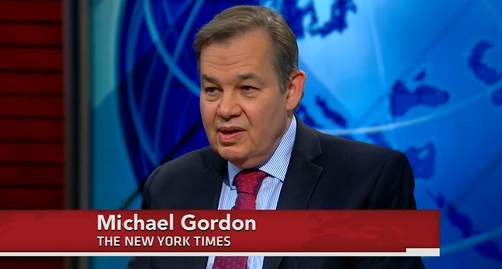
The performance of the corporate media is one of the principal failures of the Iraq War. There are almost too many examples to name; but most critics agree that one of the most instrumental single pieces that made the false case for war was the front-page New York Times story (9/8/02) hyping the idea that Iraq was trying to procure special aluminum tubes for its nuclear weapons program.
Last night in its 10-years-later segment, the PBS NewsHour (3/19/13) made a rather stunning judgment: One of the two expert journalists was the guy who co-authored that piece.
New York Times reporter Michael Gordon was the lead author on that infamous tubes article, but his record goes deeper than that. A few days into the U.S. bombing (3/25/13), Gordon appeared on CNN to endorse the bombing of Iraqi TV’s offices, calling it “an appropriate target,” since “we’re trying to send the exact opposite message.”
When U.S. politicians began to seriously consider a withdrawal of U.S. troops, Gordon criticized that policy, especially in one article (11/15/06) headlined, “Get Out of Iraq Now? Not So Fast, Experts Say” (FAIR Media Advisory, 12/4/06). He went on the Charlie Rose show (1/18/07) to endorse a troop surge. (Even the Washington Post admits that the idea that the surge succeeded is a “myth”–3/15/13.) And in early 2007, Gordon wrote articles, relying heavily on anonymous U.S. sources, alleging that the Iranian government was sending weapons into Iraq (Action Alert, 2/16/07).
So why would Gordon be someone you’d want to listen to about the Iraq War? That’s hard to say, really. But Gordon had plenty to tell PBS viewers. He complained that the Obama White House wasn’t interested enough in Iraq–leading to “the decline of American influence.” As he put it:
I think they view Iraq as just another country. They don’t have the same emotional or psychological or even foreign policy stake in it that the previous administration had.
Gordon added that the U.S. military “see a lot of early mistakes in the first years” of the war, but that “I do think the surge, as a military operation and military strategy, was effective and was essential.”
When one of the hosts, Judy Woodruff, asked about the war’s legacy, he replied: “Well, I think the military learned how to do counterinsurgency. The public opinion may no longer support that, but forever is a long time. And I think you can’t say we won’t have to do that again at some point in the future.”
And if there is ever another moment that requires reporters to faithfully record the views of anonymous U.S. officials as they make their case for war, it’s a safe bet that Michael Gordon will be there to do that job.
Related video
31% of Americans Have Abandoned News Outlets Due to Perceived Decline in Quality
By Noel Brinkerhoff and Danny Biederman | AllGov | March 20, 2013
News organizations have lost a significant share of their audience due to budget cuts that have impacted the quality and quantity of reporting.
A new poll from the Pew Research Center found that 31% of respondents said they had stopped using a particular news outlet because it was no longer providing the same kind of news and information as in the past.
Pew researchers said that those most likely to stop using news sources were better educated, wealthier and older than those who still used them—“in other words, they are people who tend to be most prone to consume and pay for news,” Pew’s The State of the News Media 2013 read.
Losses of subscribers and ad revenues have negatively impacted many news organizations in recent years, forcing layoffs and reduced coverage. Most of the people to whom Pew researchers talked were either largely or entirely unaware of this situation, the survey revealed.
There is, however, a glimmer of hope for the embattled newspaper industry, which has been under financial duress since the onset of the recession in 2007 and growing competition from online news services. The Pew study reports that a trend of stabilizing revenue is evidenced by news organizations’ use of social media to support advertisers, digital pay plans, increased investor interest, and across-the-board advertising growth attributed to a modestly improving economy.
The Pew authors concede, however, that these positive signs “are, for the time being, mostly promise rather than performance,” and that the overall prognosis still appears grim.
Related articles
- U.S. news industry unprepared to uncover news and challenge claims, report says
- In the End, Awful Journalism
- On Venezuela, The New Yorker’s Jon Lee Anderson Fails at Arithmetic
- Chavez Is Dead, the Media Are Alive and Kicking
- Time’s Ticking Clock on War With Iran
- AP: Chavez Wasted His Money on Healthcare When He Could Have Built Gigantic Skyscrapers
Venezuelan Electoral Authority Rejects U.S. Government Statements
Telesur – March 19, 2013
Tibisay Lucena, the president of Venezuela’s National Electoral Council (CNE) rejected statements on Sunday by U.S. State Department Assistant Secretary for Latin America Roberta Jacobson, who said it would be “a little difficult” for Venezuela to have “clean and transparent elections,” next month on April 14.
“We roundly reject the naïve statements of Ms. Roberta Jacobson, for their meddling and disrespectful content,” Lucena said during a speech at the CNE headquarters in Caracas, Venezuela. “Jacobson said that the elections in Venezuela should be free and fair, causing some to believe that Venezuelan elections do not comply with the basic conditions, when our electoral system has been recognized nationally and internationally, both by voters at home and abroad by experts like former President Jimmy Carter, who said that ‘Venezuela has the best electoral system in the world,’” she said.
Lucena called the statements imprudent, “especially when they come from the United States, a country with a fragile and unsafe electoral system that increasingly excludes minorities and low-income sectors.”
She said that Venezuela has an electoral system that guarantees the sovereign decision of voters “and while we audit 54% of the electoral booths at the end of the day, in the United States the results aren’t audited. For a long time, citizens’ groups have been fighting to be allowed to audit three to five percent of the booths after voting.”
She said that Venezuela’s fully automated electoral system, “more than just a technological platform, is the instrument of the expression of all our people.”
Lucena also announced Sunday that tests have already been carried out on the electoral platform ahead of the April 14 presidential vote “and we can guarantee that the machinery is working properly.”
“We guarantee trustworthy, transparent results and the integrity of the Venezuelan electoral system,” she said.
During the testing of the voting equipment, Lucena added, electoral accompaniers were present from the Inter-American Union of Electoral Bodies (UNIORE) and the Union of South American Nations (UNASUR).
The CNE announced the date of the upcoming elections on March 9, and began accepting candidacies the next day. Campaigning will occur from April 2 to 11 at midnight.
Related article
- New Venezuelan Presidential Elections Set for 14 April (venezuelanalysis.com)
Two Sides to Every Drone Death
By Peter Hart | FAIR | March 18, 2013

A March 15 piece in the Washington Post tells us that the UN’s special human rights envoy found that the CIA’s drone strikes in Pakistan violate that country’s sovereignty. It also told readers that the drones had “resulted in far more civilian casualties than the U.S. government has recognized.”
Unfortunately, that message was muddled by reporter Richard Leiby‘s he said/she said approach to the question of civilian deaths:
Estimates of total militant deaths and civilian casualties vary widely. Independent confirmation is difficult in part because the strikes often occur in remote, dangerous tribal areas where Taliban insurgents and Al-Qaeda and its allied militants are active.
The Bureau of Investigative Journalism in London has estimated that at least 411 civilians–or as many as 884–were among some 2,536 to 3,577 people killed in the CIA strikes in Pakistan. But Sen. Dianne Feinstein (D), who chaired the Senate Select Committee on Intelligence hearings last month that confirmed new CIA Director John O. Brennan, put the number of civilian deaths considerably lower.
“The figures we have obtained from the executive branch, which we have done our utmost to verify, confirm that the number of civilian casualties that have resulted from such strikes each year has typically been in the single digits,” she said.
So, on the one hand, the Bureau has done extensive work documenting drone strikes. But then again you have a senator who heard from the government that it’s much lower.
There is, of course, a way to report the difference between Feinstein’s claim and other estimates. Conor Friesdorf did so in the Atlantic (2/11/13), contrasting the Bureau‘s totals with those of the New America Foundation and other researchers. None of these projects supports Feinstein’s claim. His conclusion:
There is no reason to treat Feinstein’s claim about civilians killed as if it is credible. All the publicly available evidence is arrayed against her position.
Yet she’s treated by the Post as one of two sides of the drone deaths debate.
Related article
- Dianne Feinstein’s shocking lies about the number of civilians killed by U.S. drone program (poorrichards-blog.blogspot.com)
UK Media Morality
By John Andrews | Dissident Voice | March 18th, 2013
The editorial page of last Saturday’s Times led with the following headline: “Arm the Rebels”.
Editorials seldom have the name of the writer attached to them, which is possibly very useful in the case of this particular article. The piece refers to the suggestion that the British government is poised to begin (officially) supplying military hardware to the militants who are at war with the Syrian government. The article insists that the government get on with doing so… and that, my friends, is incitement to break international law. Chapter one of the UN Charter (an international law), article two, paragraph 4 reads:
“All Members shall refrain in their international relations from the threat or use of force against the territorial integrity or political independence of any state, or in any other manner inconsistent with the Purposes of the United Nations.”
No resolution demanding the overthrow of President Assad has been passed by the general assembly of the United Nations – nor even its cynical “security” council. The UK is a founder member of the United Nations and it really ought not to be breaking its own laws: what sort of example is that to be setting to the plebs? Of course lawyers would argue that the law does not specifically forbid the provision of military hardware to militant anti-government extremists. However, such an action could be said to be an “other manner inconsistent with the Purposes of the United Nations” – one of which is clearly stated in article one paragraph one as “to maintain peace and security”.
The Times editorial opens its argument with a subheading that reads:
“It is no longer strategically or morally tenable to stand by while Iran and Russia ship weapons to the Assad regime for use against Syrian rebels and civilians.”
As with so many articles in the Times, the content fails to deliver what is promised in the heading. We see not one word of evidence to justify the use of the word “strategically”. Why is the situation in Syria of any “strategic” importance to the interests of sixty million people in a country 3,000 miles away, with no significant economic or diplomatic links? The Times gives no answer.
As for morality, well… what can you say? Here we are being lectured on morality by someone who is openly calling for our government to break international law; and a quick glance at Britain’s “allies” in its disgraceful adventure in Syria is instructive. The anti-Assad militants are said to be resourced extensively from icons of freedom and democracy such as Bahrain and Saudi Arabia which, by the way, just happened to be carrying out some routine executions of some men convicted of theft (some of whom were just juveniles when the crimes were committed) during a chummy visit by Prince Charles. But the morality of making allies of dictatorial tyrants who routinely murder their own country’s children doesn’t seem overly to trouble the Times. Who said satire was dead?
As for the argument about standing by “while Iran and Russia ship weapons to the Assad regime” … there’s one small flaw in that point. The Assad “regime” happens to be the legitimate government of Syria. It’s perfectly within its rights to buy whatever it likes from whomever it likes – cynical trade sanctions notwithstanding, obviously.
You have to wonder what the Times leader-writer would say if there were armed extremists from foreign lands running wild around Britain, murdering, raping and looting; and some foreign country with a sizable interest in selling military hardware and a known fondness for looting distant lands demanded the right to supply those extremists with their wares on the grounds that the British government, whilst trying to do its job to protect its people, was using some military equipment known to be supplied from the United States. Would The Times also support the right of that country to supply those extremists, I wonder, for the sake of morality.
The Times is no stranger to the courtroom. Its legal experts will know, just as our trusted political leaders who’re supporting the outrageous events in Syria know, that having a law is one thing, enforcing it is something quite different. You can quite literally get away with murder if no one is able to stop you or call you to account; and you can break international laws with just as much impunity, if the world’s only superpower says it’s O.K. But that doesn’t make the thing right, does it. Still, what could I possibly know about morality; I’m sure The Times knows much more about the subject than I do.
~
John Andrews is a writer whose latest book is The People’s Constitution. He can be contacted through his website.
On Venezuela, The New Yorker’s Jon Lee Anderson Fails at Arithmetic
By Keane Bhatt | NACLA blog | March 17th 2013
In the face of Venezuelan President Hugo Chávez’s ill health and subsequent death on March 5, the U.S. press—including its most unabashedly liberal wing—jumped at the opportunity to disparage him and his legacy, often on spurious grounds. Jon Lee Anderson of the urbane New Yorker magazine epitomized this tendency.
As the magazine’s corespondent for Venezuela and author of a January piece on the country that stretched to over 10,000 words, Anderson was the subject of withering ridicule. Jim Naureckas of Fairness and Accuracy in Reporting wrote that Anderson’s article appeared “almost like a parody of corporate media coverage of an official enemy state.” Economist Mark Weisbrot similarly noted that Anderson wasn’t “letting commonly agreed-upon facts and numbers get in the way” of his plodding diatribe against Chávez’s failures. Those criticisms remain independent from others who have observed his increasingly bizarre Twitter outbursts against critics.
Anderson’s article, “Slumlord: What Has Hugo Chávez Wrought in Venezuela?,” is indeed filled with blatant misrepresentations. The New Yorker’s vaunted fact checkers somehow permitted the publication of the following statement: “Chavez suggested to me that he had embraced the far left as a way of preventing a coup like the one that put him in office.” While it is true that in 1992, Chávez attempted a coup against an administration that had deployed security forces to massacre hundreds, perhaps thousands of civilian protesters, Anderson is misleading his readers. Chávez was “put in office” much later, in 1999, through a free and fair election—not a coup—a fact which he did not see fit to include in his piece. He instead wrote, vaguely, that Chávez “assumed” power in 1999.
In a Spanish-language interview with the BBC on March 9, Anderson also accused the deceased Venezuelan president of having been machista, or sexist, “but in a cultural sense. Women tended to be hosts at parties, for example, not political advisers.” If true, that would be news to Erika Farías, the recently departed head of the Office of the Presidency; Adina Bastidas, Chávez’s vice president from 2000-2002; Cilia Flores, currently the country’s attorney general; Gabriela del Mar Ramírez, currently public defender; Edmée Betancourt, head of the Ministry of Commerce; and scores of others. At present, women direct three of the five branches of the Venezuelan government.
Even more damning is the number of Anderson’s falsehoods exposed through simple arithmetic. For instance, in a NewYorker.com piece published before Venezuela’s elections, he wrote in error that “Venezuela leads Latin America in homicides.” The most recently available United Nations data show that Honduras, with 91.6 killings per 100,000 in 2011, has twice the rate of homicides as Venezuela, which recorded 45.1 in 2010. (El Salvador has 69.2.) When confronted with these facts on Twitter in February, Anderson admitted his mistake publicly, addressing even his editors at The New Yorker, and agreed to offer a correction. Over a month later, however, neither Anderson nor his editors have fixed his invented claim.
In his NewYorker.com “postscript” for the death of Hugo Chávez on March 5, he published yet another factual inaccuracy, claiming that Venezuela “is the same Venezuela as ever: one of the world’s most oil-rich but socially unequal countries.” Impressively, in just 16 words, he managed to err on two counts: First, under Chávez, inequality did not stay “the same as ever,” but rather fell enormously. Publicly available UN data confirm that Venezuela’s Gini index, a standard measure of inequality, fell from 49.8 to 39.7 between 1999 and 2011. Secondly, this decline made Venezuela anything but one of the world’s most socially unequal countries; according to the UN, it is now Latin America’s least unequal country. This reduction resulted from governmental priorities which halved poverty and unemployment over the past 10 years, while living standards improved through a healthy 2.5% annual per capita income growth since 2004. These massive reductions in poverty, which even many anti-Chávez editorials have noted, have never been reported by Anderson. Instead, he deceptively points to “extremely high levels of poverty and unemployment” in order to stress “the magnitude of the mess that Venezuela finds itself in.”

Finally, Anderson’s criticisms over Caracas’s slums suffer from flagrant omissions of chronology. He pinpointed the “height of [Caracas’s] allure” in 1983—it was a “boring, pristine, very North American” city, “buzzing along in modernity.” Yes, he admitted, there were “shacks on the hills, but not too many at the time.” “Now,” he says, “the slums are kind of everywhere.” It is “extraordinary” that “la revolución couldn’t tackle this” given that “the slums are still there 14 years later.” Anderson is performing sleight of hand with arithmetic here. He is excluding 16 disastrous years of economic history in which Chávez was never in office: from 1983 through 1998, real per capita income actually fell substantially, exacerbating poverty and housing insecurity to an unprecedented degree.
In a February panel discussion for the Frontline Club in London, he wondered “how to quantify the improvement in the standard of living in a city or in a place where people are still living in slums.” One way to do it is by looking at UN data, or other publicly available data on income, poverty, employment, and other social indicators that are heavily scrutinized and widely used by social scientists. Another way to do so is by acknowledging critics’ corrections to his false socioeconomic assertions, rather than referring to them on Twitter as “trolls” and “scum.” He should follow their advice, and complement his impressionistic firsthand reporting with empirical evidence.
[For those who would like to see The New Yorker take responsibility for factual errors in Anderson’s reporting, email tny.newsdesk@gmail.com, and tweet to @TNYnewsdeskand @jonleeanderson.]
Keane Bhatt is an activist in Washington, D.C. He has worked in the United States and Latin America on a variety of campaigns related to community development and social justice. He is the author of the NACLA blog “Manufacturing Contempt,” which critically analyzes the U.S. press and its portrayal of the hemisphere. Connect with him on Twitter: @KeaneBhatt
Related articles
Armistice’s Day Is Done–Contrary to NYT
By Jim Naureckas | FAIR | March 13, 2013
The New York Times (3/8/13), writing about Korean tensions, reported:
The North said this week that it considered the 1953 armistice agreement that halted the Korean War to be null and void as of Monday because of the joint military exercises. The North has threatened to terminate that agreement before, but American and South Korean military officials pointed out that legally, no party [to an] armistice can unilaterally terminate or alter its terms.
“Nonsense,” says Francis Boyle, professor of international law at the University of Illinois (Institute for Public Accuracy, 3/13/13):
An armistice agreement is governed by the laws of war and the state of war still remains in effect despite the armistice agreement, even if the armistice text itself says additions have to be mutually agreed upon by the parties. Termination is not an addition.
Boyle pointed to both U.S. military regulations and international law as evidence that the Times’ claim was wrong:
Under the U.S. Army Field Manual 27-10 and the Hague Regulations, the only requirement for termination of the Korean War Armistice Agreement is suitable notice so as to avoid the charge of “perfidy.” North Korea has given that notice. The armistice is dead.
The Army Field Manual states, “In case it [the armistice] is indefinite, a belligerent may resume operations at any time after notice.” Article 36 of the Hague Regulations says:
An armistice suspends military operations by mutual agreement between the belligerent parties. If its duration is not fixed, the belligerent parties can resume operations at any time, provided always the enemy is warned within the time agreed upon, in accordance with the terms of the armistice.
The New York Times should let its readers know that it allowed anonymous officials to mislead them.
Chavez in the Crosshairs
By Laura Carlsen | Americas Program | March 12, 2013
You could almost hear the sigh of relief coming out of Washington at the news of Hugo Chavez’s death on March 5.
President Obama issued a brief statement that failed even to offer condolences, forcing a senior State Department official to patch over the evident callousness and breach of diplomacy by offering his personal condolences the following day.
Within moments of Chavez’s death, commercial media and mouthpieces for the U.S. government were verbally dancing on his grave and predicting the imminent demise of Chavismo—Chavez’s political legacy in Venezuela and abroad.
Time headlined its article “Death of a Demagogue.” The New York Times, which bent over backwards to minimize Chavez’s overwhelming victory in Venezuela’s October elections—and later to portray his battle with cancer as a cover-up, mimicking opposition claims—proclaimed that Chávez’s death“casts into doubt the future of his socialist revolution” and “alters the political balance not only in Venezuela, the fourth-largest supplier of foreign oil to the United States, but also in Latin America”—and this in a news article with no sourcing provided.
The Inter-American Dialogue, a U.S. think tank, concluded that “Chavez’s legacy, and the damage he left behind, will not be easily undone,” and predicted that the social gains and regional institutions Chavez built over his political lifetime will soon fall apart and things will soon return to normal—that is, with the United States back in the hemispheric driver’s seat.
Congressman Ed Royce (R-CA) came right out and said “Hugo Chávez was a tyrant who forced the people of Venezuela to live in fear. His death dents the alliance of anti-U.S. leftist leaders in South America. Good riddance to this dictator.”
So why did Washington hate this guy so much?
It never helped that the South American president had a penchant for insulting his adversaries personally. But one supposes that diplomacy rises above name-calling, even if the other guy did it first. The anti-Chavez current in Washington goes far deeper than personal enmity or even political differences.
What scared Washington most about Chavez was not his failures or idiosyncrasies. It was his success.
The official reasons given for demonizing Hugo Chavez don’t hold water. Chavez is accused of restraining freedom of the press in a nation known for its ferociously anti-Chavez private media. And while his Yankee critics called him a dictator, Chavez and his policies won election after election in exemplary electoral processes. You can disagree with his reform to permit unlimited terms in office, but this is the practice of many nations deemed democratic by the U.S. government and considered close allies. And the criticisms of Chavez’s social programs as “patronage” cannot ignore the millions of lives tangibly improved.
Before Chavez turned Venezuela away from the neoliberal model, the nation was a basket case. But throughout his tenure, social indicators that measure real human suffering showed steady improvement. Between 1998, when he was first elected, to 2013 when he died in office, people living in poverty dropped from 43 percent of the population to 27 percent. Extreme poverty dropped from 16.8 percent of the population to 7 percent. According to UNESCO, illiteracy—nearly 10 percent when Chavez took office—has been eliminated. Chavez also reduced childhood malnutrition, initiated pensions for the elderly, and launched education and health programs for the poor.
Venezuela’s human development ranking subsequently climbed significantly under Chavez, reaching the “high” human development category. The programs that Washington scorned as “government handouts” made people’s lives longer, healthier, and fuller in Venezuela.
Now that Chavez is dead, the U.S. press has revived the State Department’s practice of designating the “good left” and the “bad left” in Latin America. Chavez, of course, embodied the “bad left,” while Brazil’s Lula was unilaterally and unwillingly designated the “good left”.
Yet it was Lula da Silva who defended his friend and made the case for Chavez’s lasting positive legacy in the pages of the New York Times. He eulogized the leader and predicted, “The multilateral institutions Mr. Chávez helped create will also help ensure the consecration of South American unity.”
In fact, Chavez’s success in building institutions for alternative regional integration is one of the big reasons Washington hated him. The self-declared anti-capitalist led Venezuela as it joined with regional powerhouse Brazil and other southern cone countries to make a bid to crack the Monroe Doctrine. Along with Andean nations, they also sought, in varying degrees, to wrest control of significant natural resource wealth from transnational corporations to fund state redistribution programs for the poor.
In 2005, Chavez helped scuttle the U.S. goal of a Free Trade Area of the Americas. Later he spearheaded the formation of the Union of South American Nations (Unasur) in 2008. As a Latin American alternative to the U.S.-dominated Organization of American States, the 12-member Unasur proved its value by successfully mediating the Colombia-Ecuador conflict and the Bolivian separatist crisis in 2008. In 2010, Chavez again played a major role with the creation of the Community of Latin American and Caribbean States, made up of hemispheric partners, excluding the United States and Canada.
The Bank of the South, also promoted by Chavez, seeks greater South-South monetary and financial autonomy. As Lula writes in his editorial on Chavez´s death, the Bank offers an alternative to the World Bank and IMF, which “have not been sufficiently responsive to the realities of today’s multipolar world”.
With stops and starts, these initiatives have moved regional integration forward outside the historic model of U.S. hegemony.
U.S. Moves and the Principle of Self-Determination
What happens next? Venezuela held an emotional funeral on March 8 and is planning for April elections. Most predict that Vice President Nicolas Maduro, selected by Chavez as his successor, will win easily. He has the advantage of Chavez’s blessing: a common slogan in Caracas these days is “Chavez, te juro, que voto por Maduro” (“Chavez, I swear, my vote is for Maduro”). Another sign that Chavismo lives on was the thousands of people at the funeral chanting “Chavez didn’t die; he multiplied.”
The State Department views dimly the prospect of an improved U.S.-Venezuela relationship under Maduro. On March 6, the State Department held a press call on which “Senior Official One” (a State Department practice for “background” when its officials apparently don’t want to be identified with their own public statements) said the department was optimistic following Chavez’ death, but that “yesterday’s first press conference, if you will, the first address, was not encouraging in that respect. It disappointed us.”
He referred to a 90-minute address by Maduro, stating that “the enemy” attacked Chavez’s health. The Venezuelan government also announced the expulsion of two U.S. military personnel in Venezuela, allegedly for having contacted members of the Venezuela military to stir up an insurrection.
The State Department noted that it plans “to move ahead in this relationship” by holding conversations in areas of common interest, citing “counternarcotics, counterterrorism, economic or commercial issues including energy.” It added, “We are going to continue to speak out when we believe there are issues of democratic principle that need to be talked about, that need to be highlighted.”
During the Chavez years, U.S. officials and the press went into contortions to avoid congruency with the basic principle that democracy is measured by elections. With Chavez having indisputably won some thirteen elections, the U.S. government applied new criteria to Venezuela along the lines of “democracy can be wrong.” Despite his broad-based support, many went so far as to dub Chavez a “dictator.”
The U.S. government’s commitment to democracy falters when Washington doesn’t like the results. It supported the failed coup against Chavez in 2002 and blocked the return of Honduras’s elected president after the 2009 coup there.
Now all eyes will be on Washington to see whether it upholds another value reiterated by President Obama—the right to self-determination. Will U.S. “democracy-promotion programs” under NED, IRI, and other regime-change schemes resist the temptation to meddle in Venezuela’s April 14 elections? Venezuela without Chavez will be a test of moral and diplomatic integrity for the second Obama administration and John Kerry’s State Department, and a challenge for Congress and the citizenry to monitor and prevent covert activities that interfere with the exercise of democracy.
Related articles
- Unprecedented Show of Support and Honor at the Historic Funeral of Hugo Chávez (alethonews.wordpress.com)
- Chavez Is Dead, the Media Are Alive and Kicking (alethonews.wordpress.com)
- U.S. and Canada Isolated as Latin American Leaders Acknowledge Chávez’s Regional Leadership (venezuelanalysis.com)
Featured Video

Iran’s Next Strike May Not Explode. It Could Shut You Down
or go to
Aletho News Archives – Video-Images
From the Archive
Zionism’s Violent Legacy
By Donald Neff | Washington Report On Middle East Affairs | January 1996
On January 4, 1948, Jewish terrorists drove a truck loaded with explosives into the center of the all Arab city of Jaffa and detonated it, killing 26 and wounding around 100 Palestinian men, women and children.[1] The attack was the work of the Irgun Zvai Leumi – the “National Military Organization,” also known by the Hebrew letters Etzel – the largest Jewish terrorist group in Palestine. The Irgun was headed by Revisionist Zionist Menachem Begin and had been killing and maiming Arabs, Britons and even Jews for the previous ten years in its efforts to establish a Jewish state.
This terror campaign meant that at the core of Revisionist Zionism there existed a philosophical embrace of violence. … continue
Blog Roll
 Aletho News
- Trump’s Iran war is on an Israeli leash
- Saudi oil boss issues global supply warning
- Riyadh Says Its Oil System Is Intact. The Numbers Say Otherwise.
- Trump and Netanyahu Want to “Finish the Job” on Iran
- US ‘one-sided dictation’ not Iran’s beliefs makes rational talks impossible: Baghaei
- Iran’s Next Strike May Not Explode. It Could Shut You Down /Col Doug Macgregor
- Iran: US political targets legitimate if assassinations return
- Iraq shuts key border crossing with Iran under US pressure: Report
- Undersea Internet cables could be targeted in retaliation for attacks on Iran: IRGC deputy chief
- EU sending ‘biased’ observers to interfere in Serbian election – president
- If Americans Knew
- The Israel Lobby’s Changing Fortunes
- AIPAC has become such a political liability that it’s shifting to a more “nimble” approach to buying politicians
- At least 160 Israeli settler attacks in 2 weeks
- Will Gaza’s Ancient Christian Community Disappear Forever?
- Israel’s vision of regional security rests on keeping Arab states weak
- Heidi Levine recounts how Palestinian youths helped save her in settler attack
- DAILY UPDATE: Latest essential news on Palestine, Israel, & region
- Trump’s Intensifying Sabotage of the ICC, for Israel’s Sake
- Israeli military detain US and UK volunteers in West Bank including Democratic NY politician Brad Lander
- Americans at National Conservatism Conference held in Israel this year criticize Israel
- No Tricks Zone
- E-Cars Reduce CO2 Emissions By Only 41% Compared To Internal Combustion Engine Vehicles
- Predictions Made By Renowned Climate Professor Over Past Decades Have Been Proven To Be Poor
- New Study Suggests Large Regions Of The Pacific Ocean Have Been Cooling For The Last 80 Years
- Germany’s Green Energy Debacle: High Energy Costs Force Kahla Porzellan to Close After 182 Years!
- New Study: 50 Years Of The Most Aggressive ‘Net Zero’ Policies Can Only Affect The Global Climate By 0.03°C
- US September “Heat” Was No Record…Many Records Set Decades Ago
- Latest European Green Energy Debacle; Portugal’s Largest Flagship Solar Park Insolvent!
- Green Energy Debacle: German Expert Professor Fritz Vahrenholt Warns Of Severe Economic And Social Consequences
- Two More Paleo Reconstructions Affirm Meters-Higher Sea Levels Across Ireland, Brazil 7000-6000 Years Ago
- New Study: Earth And Venus Surface Warmth Largely Explained By Convection And Lapse Rate, Not CO2 Or Radiation

