Robert Samuelson Shows that the Post Has no Fact Checkers on Its Opinion Pages
By Dean Baker | Beat the Press | April 8, 2012
Social Security and Medicare are hugely important for the security of the non-rich population of the United States. For this reason, Robert Samuelson and the Washington Post hate them.
As we know, this is a question of basic political philosophy. In the view of Samuelson and the Post, a dollar that it is in the pocket of low or middle class people is a dollar that could be in the pocket of the rich. And Medicare and Social Security are keeping many dollars in the pockets of low and middle class people.
Today’s column by Robert Samuelson tries to tell us that Franklin Roosevelt would be appalled by the current state of the Social Security program. Of course, he produces not a single iota of evidence to support this position, although it is very clear that Samuelson doesn’t like Social Security.
Samuelson begins by telling us that:
“It [Social Security] has become what was then called ‘the dole’ and is now known as ‘welfare.’ This forgotten history clarifies why America’s budget problems are so intractable.”
He later adds:
“Millions of Americans believe (falsely) that their payroll taxes have been segregated to pay for their benefits and that, therefore, they ‘earned’ these benefits. To reduce them would be to take something that is rightfully theirs.”
Of course Samuelson is 100 percent wrong here. Payroll taxes have been segregated. That is the point of the Social Security trust fund and the Social Security trustees report. These institutions would make no sense if the funds were not segregated.
Samuelson is welcome to not like the way in which the funds were segregated, in the same way that I don’t like the Yankees, but that doesn’t change the fact that the Yankees have a very good baseball team. Since its beginnings, the government has maintained a separate Social Security account. Under the law, no money can be paid out in Social Security benefits unless the Trust Fund has the money to pay for them.
In this sense, the funds are absolutely segregated. Samuelson doesn’t like this, but why should any of the rest of us care? The rest of the piece shows the same dishonesty and lack of respect for facts.
Samuelson later tells readers:
“But now, demographics are unfriendly. In 1960, there were five workers per recipient; today, there are three, and by 2025 the ratio will approach two. Roosevelt’s fear has materialized. Paying all benefits requires higher taxes, cuts in other programs or large deficits.”
Okay, let’s think about this for a minute. We went from five workers per retiree in the 1960s to roughly three workers for each retiree in the 90s. This ratio is projected to fall to roughly two workers per retiree by 2030 (not 2025, as readers of the Trustees report know).
On average we were much richer in the 90s than in the sixties, in spite of the fall in the ratio of workers to retirees. The same will be true in 2030, even assuming that we see the projected decline in the ratio of workers to retirees.
A small fact that Samuelson never mentions in this piece is that the Congressional Budget Office projects the program to be fully funded through 2038, with no changes whatsoever (i.e. no new taxes, contra Samuelson). If we want to make the program fully solvent for the rest of the century, a tax increase that is equal to 5 percent of projected wage growth over the next three decades should be roughly sufficient to do the trick. Are you scared yet?
There is an issue that most workers have not shared in the economy’s growth over the last three decades. This is indeed a problem. If recent trends in inequality persist then any increase in Social Security taxes will be a burden, but the problem here are the policies that have brought about this upward redistribution of income, not Social Security.
Then Samuelson gives us his coup de grace:
“Although new recipients have paid payroll taxes higher and longer than their predecessors, their benefits still exceed taxes paid even assuming (again, fictitiously) that they had been invested. A two-earner couple with average wages retiring in 2010 would receive lifetime Social Security and Medicare benefits worth $906,000 compared with taxes of $704,000, estimate Steuerle and Rennane.”
Okay, this is a really nice trick. Remember we were talking about Social Security? Note that Samuelson refers to “lifetime Social Security and Medicare benefits.” It wasn’t an accident that he brought Medicare into this discussion. That is because Steuerle and Rennane’s calculations show that this average earning couple would get back less in Social Security benefits than what they paid in taxes. That would not fit well with Samuelson’s story, so he brings in Medicare (remember this is the Washington Post).
And, the high cost of Medicare benefits is not due to their great generosity. The high cost is due to the fact that we pay our doctors, our drug companies, and our medical equipment suppliers way more than do people in any other country, and we have no better outcomes. If our per person costs for health care were comparable to costs in Germany, Canada, the UK or any other wealthy country, then workers would be paying far more for their Medicare benefits than the cost of what they are getting in care.
The story here is that Samuelson wants to punish ordinary workers for the fact that we pay doctors and the other big winners in this story too much. That may not make sense, but they don’t call this paper “Fox on 15th Street” for nothing.
Related articles
- Heaven Mourns Every Day the Washington Post Liquidation Is Delayed… (delong.typepad.com)
- Stan Collender Thinks Robert Samuelson Is a Reason the Washington Post Should Shut Its Doors Immediately (delong.typepad.com)
US-Israel War on Iran: The Myth of Limited Warfare
By James Petras :: 04.04.2012
Introduction
The mounting threat of a US-Israeli military attack against Iran is based on several factors including: (1) the recent military history of both countries in the region, (2) public pronouncements by US and Israeli political leaders, (3) recent and on-going attacks on Lebanon and Syria, prominent allies of Iran, (4) armed attacks and assassinations of Iranian scientists and security officials by proxy and/or terrorist groups under US or Mossad control, (5) the failure of economic sanctions and diplomatic coercion, (6) escalating hysteria and extreme demands for Iran to end legal, civilian use-related uranium enrichment, (7) provocative military ‘exercises’ on Iran’s borders and war games designed for intimidation and a dress rehearsal for a preemptive attack, (8) powerful pro-war pressure groups in both Washington and Tel Aviv including the major Israeli political parties and the powerful AIPAC in the US, (9) and lastly the 2012 National Defense Authorization Act (Obama’s Orwellian Emergency Decree, March 16, 2012).
The US propaganda war operates along two tracks: (1) the dominant message emphasizes the proximity of war and the willingness of the US to use force and violence. This message is directed at Iran and coincides with Israeli announcements of war preparations. (2) The second track targets the ‘liberal public’ with a handful of marginal ‘knowledgeable academics’ (or State Department progressives) playing down the war threat and arguing that reasonable policy makers in Tel Aviv and Washington are aware that Iran does not possess nuclear weapons or any capacity to produce them now or in the near future. The purpose of this liberal backpedaling is to confuse and undermine the majority public opinion, which is clearly opposed to more war preparations, and to derail the burgeoning anti-war movement.
Needless to say the pronouncements of the ‘rational’ warmongers use a ‘double discourse’ based on the facile dismissal of all the historical and empirical evidence to the contrary. When the US and Israel talk of war, prepare for war and engage in pre-war provocations – they intend to go to war – just as they did against Iraq in 2003. Under present international political and military conditions an attack on Iran, initially by Israel with US support, is extremely likely, even as world economic conditions should dictate otherwise and even as the negative strategic consequences will most likely reverberate throughout the world for decades to come.
US and Israeli Military Calculations on Iran’s Capability
American and Israeli strategic policy makers do not agree on the consequences of Iran’s retaliation against an attack. For their part, the Israeli leaders minimize Iran’s military capacity to attack and damage the Jewish state, which is their only consideration. They count on their distance, their anti-missile shield and protection from US air and naval forces in the Gulf to cover their sneak attack. On the other hand, US military strategists know the Iranians are capable of inflicting substantial casualties on US warships, which would have to attack Iranian coastal installations in order to support or protect the Israelis.
Israel intelligence is best known for its capacity to organize the assassination of individuals around the world: Mossad has organized successful overseas terrorist acts against Palestinian, Syrian, and Lebanese leaders. On the other hand Israeli intelligence has a very poor track record with regard to its estimates of major military and political undertakings. They seriously underestimated the popular support, military strength and organizational capacity of Hezbollah during the 2006 war in Lebanon. Likewise, Israel intelligence misunderstood the strength and capacity of the Egyptian popular democratic movement as it rose up and overthrew Tel Aviv’s strategic regional ally, the Mubarak dictatorship. While Israeli leaders ‘feign paranoia’ – tossing clichés about ‘existential threats’– they are blinded by their narcissistic arrogance and racism, repeatedly underestimating the technical expertise and political sophistication of their Arab and regional Islamic foes. This is undoubtedly true in their facile dismissal of Iran’s capacity to retaliate against a planned Israeli air assault.
The US government has now overtly committed itself to supporting an Israeli assault on Iran when it is launched. More specifically, Washington claims it will come to Israel’s defense ‘unconditionally’ if it is “attacked.” How can Israel avoid being ‘attacked’ when its planes are raining bombs and missiles on Iranian installations, military defenses and support systems, not to mention Iranian cities, ports and strategic infrastructure? Moreover, given the Pentagon’s collaboration and coordinated intelligence systems with the Israel forces, its role in identifying targets, routes and incoming missiles, as well as integrated weapons and ordinance supply chains will be critical to an Israeli attack. There is no way that the US can dissociate itself from the Jewish State’s war on Iran, once the attack has begun.
The Myths of ‘Limited War’: Geography
Washington and Tel Aviv claim and appear to believe that their planned assault on Iran will be a “limited war”, targeting limited objectives and lasting a few days or weeks – with no serious consequences.
We are told Israel’s brilliant generals have identified all the critical nuclear research facilities, which their surgical air strikes will eliminate without horrific collateral damage to the surrounding population. Once the alleged ‘nuclear weapons’ program is destroyed, all Israelis can resume their lives in full security knowing that another ‘existential’ threat has been eliminated. The Israeli notion of a war, limited in ‘time and space’, is absurd and dangerous – and underlines the arrogance, stupidity and racism of its authors.
To approach Iran’s nuclear facilities Israeli and US forces will confront well-equipped and defended bases, missile installations, maritime defenses and large-scale fortifications directed by the Revolutionary Guards and the Iranian Armed Forces. Moreover, the defense systems protecting the nuclear facilities are linked by civilian highways, airfields, ports, and backed by a dual purpose (civilian-military) infrastructure, which includes oil refineries and a huge network of administrative offices. To ‘knock out’ the alleged nuclear sites will require expanding the geographic scope of the war. The scientific-technological capacity of the Iranian civilian nuclear program involves a wide swath of its research facilities, including universities, laboratories, manufacturing sites, and design centers. To destroy Iran’s civilian nuclear program would require Israel (and thus the US) to attack much more than research facilities or laboratories hidden under a remote mountain. It would require multiple, widespread assaults on targets throughout the country, in other words, a generalized war.
Iran’s Supreme leader Ayatollah Ali Khamenei has stated that Iran will retaliate with a war of equivalence. Iran will match the breadth and scope of any attack with a corresponding counter-attack: ‘We will attack them at the same level as they attack us’. That means Iran will not confine its retaliation to merely trying to shoot down US and Israeli bombers in its airspace or launch missiles at offshore US warships in its waters but will take the war to equivalent targets in Israel and in US-occupied countries in and around the Gulf. Israel’s ‘limited war’ will become a generalized war extending throughout the Middle East and beyond.
Israel’s current delusional fetish about its elaborate missile defense system will be exposed as hundreds of high-powered missiles are launched from Teheran, Southern Lebanon and just beyond the Golan Heights.
The Myth of Limited War: Time Frame
Israeli military experts confidently expect to polish off their Iranian targets in a few days – some might think a mere weekend – and perhaps without the loss of even a single pilot. They expect the Jewish state will celebrate its brilliant victory in the streets of Tel Aviv and Washington. They are deluded by their own sense of superiority. Iran did not fight a brutal, decade-long war against the US-supplied Iraqi invaders and its western/Israeli military advisers, to just turn over and passively submit to a limited number of air and missile attacks by Israel. Iran is a young, educated mobilized society, which can draw on millions of reservists from across the political, ethnic, gender, religious spectrum, galvanized in support of their nation under attack. In a war to defend the homeland all internal differences disappear to confront the unprovoked Israeli-US attack threatening their entire civilization – its 5,000-year culture and traditions, as well as its modern scientific advances and institutions. The first wave of US-Israeli attacks will lead to ferocious retaliation, which will not be confined to the original areas of conflict, nor will any such act of Israeli aggression end when and if Iran’s nuclear research facilities are destroyed and some of its scientists, technicians and skilled workers killed. The war will continue in time and extend geographically.
Multiple Points of Conflict
Just as any US-Israeli attack on Iran will involve multiple targets, the Iranian military will also have a plethora of easily accessible strategic targets. Though it is difficult to predict exactly where and how Iran will retaliate, one thing is clear: The initial US-Israeli strike will not go unanswered.
Given Israeli-US supremacy in long and medium range sea and air power, Iran will probably rely on short-range objectives. These would include the highly valued US military facilities and supply routes in adjoining terrain (Iraq, Kuwait and Afghanistan) and Israeli targets with missiles launched from Southern Lebanon and possibly Syria. If a few Iranian long-range missiles escape the Jewish State’s much vaunted ‘anti-missile dome’, Israeli population centers may pay a heavy price for their leaders’ recklessness and arrogance.
The Iranian counter-strike will lead to an escalation by US-Israeli forces, extending and deepening their air and sea war to the entire Iranian national security system – military bases, ports, communication systems, command posts and government administrative centers – many in densely populated cities. Iran will counter by launching its greatest strategic asset: a coordinated ground attack involving the Revolutionary Guards together with their allies among the Iraqi Shia troops, against US forces in Iraq. It will coordinate attacks against US facilities in Afghanistan and Pakistan with the growing nationalist-Islamic armed resistance.
The initial conflict, centered on so-called military objectives (scientific research facilities), will spread rapidly to economic targets, or what US and Israeli military strategists refer to as “dual civilian-military” targets. This would include oil fields, highways, factories, communications networks, television stations, water treatment facilities, reservoirs, power stations and administrative offices, such as the Defense Ministry and headquarters of the Republican Guard. Iran, faced with imminent destruction of its entire economy and infrastructure (which occurred in neighboring Iraq with the unprovoked US invasion of 2003), would retaliate by blocking the Straits of Hormuz and sending short range missiles in the direction of the principle oil fields and refineries of the Gulf States including Kuwait and Saudi Arabia, a mere 10 minute distance, crippling the flow of oil to Europe, Asia and the United States and plunging the world economy into deep depression.
It should not be forgotten that the Iranians are probably more aware than anyone in the region of the total devastation suffered by Iraqis after the US invasion, which plunged that nation into total chaos and devastated its advanced infrastructure and civilian administrative apparatus, not to mention the systematic obliteration of its highly educated scientific and technical elite. The waves of Mossad-sponsored assassinations of Iranian scientists, academics and engineers are just a foretaste of what the Israelis have in mind for Iran’s outstanding scientists, intellectuals and highly skilled technical workers. Iranians should have no illusions about the Americans and Israelis who seek to thrust Iran into the brutal dark ages of Afghanistan and Iraq. They will have no more role in a devastated Iran than their counterparts had in post-Saddam Iraq.
According to US General Mathis, who commands all US forces in the Middle East, Persian Gulf and Southwest Asia, ‘an Israeli first strike would be likely to have dire consequences across the region and for the United States there’ (NY Times, 3/19/12). General Mathis “dire cost” estimate only takes account of the US military losses, likely several hundred sailors on warships within missile distance of Iranian gunners.
However the most delusional and self-serving assessment of the outcome and consequences of an Israeli air attack on Iran, emanates from top Israeli leaders, academics and intelligence experts, who claim superior intelligence, superior defenses and supreme (if also racist) insight into the ‘Iranian mind’. Typical is Israeli Defense Minister Barak who boasts that any Iranian retaliation will at worst inflict minimal casualties on the Israeli population.
The ‘Judeo-centric’ view of re-ordering the balance of power in the region, which is prevalent in leading Israeli war circles, overlooks the likelihood that war will not be decided by Israeli air strikes and anti-missile defenses. Iran’s missiles cannot be easily contained, especially if they arrive several hundred a minute from three directions, Iran, Lebanon, Syria and possibly from Iranian submarines. Secondly, the collapse of its oil imports will devastate Israel’s highly energy dependent economy. Thirdly, Israel’s principle allies, especially the US and the EU, will be severely strained as they are dragged into Israel’s war and find themselves defending the straits of Hormuz, their army garrisons in Iraq and Afghanistan, and their oil fields and military bases in the Gulf. Such a conflict could ignite the Shia majorities in Bahrain and in the strategic oil-rich provinces of Saudi Arabia. The generalized war will have a devastating effect on the price of oil and the world economy. It will provoke the fury of consumers and workers rage everywhere as factories close and powerful shocks throughout the fragile financial system result in a world depression.
Israel’s pathological ‘superiority complex’ results in its racist leaders consistently overestimating their own intellectual, technical and military capabilities, while underestimating the knowledge, capacity and courage of their regional, Islamic (in this case Iranian) adversaries. They ignore Iran’s proven capacity to sustain a prolonged, complex multi-front defensive war and to recover from an initial assault and develop appropriate modern weaponry to inflict severe damage on its attackers. And Iran will have the unconditional and active support of the world’s Muslim population, and perhaps the diplomatic backing of Russia and China, who will obviously view an attack on Iran as another dress rehearsal to contain their growing power.
Conclusion
War, especially an Israeli-US war against Iran is indissolubly linked to the asymmetrical US-Israeli relationship, which sidelines and censors any critical US military and political analysis. Because Israel’s Zionist power configuration in the US can now harness US military power in support of Israel’s drive for regional dominance, Israeli leaders and most of their military feel free to engage in the most outrageous military and destructive adventures, knowing full well that in the first and last instance they can rely on the US to support them with American blood and treasure. But after all of this grotesque servitude to a racist, isolated country, who will rescue the United States? Who will prevent the sinking of its ships in the Gulf and the death and maiming of hundreds of its sailors and thousands of its soldiers? And where will the Israelis and US Zionists be when Iraq is overrun by elite Iranian troops and their Iraqi Shia allies and a generalized uprising occurs in Afghanistan?
The self-centered Israeli policy-makers overlook the likely collapse of the world oil supply as a result of their planned war against Iran. Do their Zionist agents in the US realize that as a result of dragging the US into Israel’s war, that the Iranian nation will be forced to set the Persian Gulf oilfields ablaze?
How cheap has it become to ‘buy a war’ in the US? For a mere few million dollars in campaign contributions to corrupt politicians, and through the deliberate penetration of Israel-First agents, academics and politicians into the war-making machinery of the US government, and through the moral cowardice and self-censorship of leading critics, writers and journalists who refuse to name Israel and its agents as the key decision makers in our country’s Mid East policy, we head directly toward a war far beyond any regional military conflagration and toward the collapse of the world economy and the brutal impoverishment of hundreds of millions of people North and South, East and West.
Related articles
- UK bows to Tel Aviv after warning it against attack on Iran (alethonews.wordpress.com)
- The Real Nuclear Outlaws (alethonews.wordpress.com)
- Israel snubs warnings against Iran attack (alethonews.wordpress.com)
- Israeli Experts Mum on Iran Attack to Support Bibi’s Bluff (middleeastatemporal.wordpress.com)
Iranian Diplomat Says IAEA Undermined Recent Talks to Satisfy Israel and West
TheRealNews | April 3, 2012
Gareth Porter: IAEA demanded to see Parchin on recent visit ahead of schedule to make Iran look uncooperative
Related articles
Reuters fails to rectify manipulated report on female Iranian ninjas
Press TV – April 2, 2012
Reuters has failed to provide its viewers with a solid explanation on the publication of a manipulated report by the London-based news agency on female Iranian ninjas.
On February 18, Reuters showed a number of Iranian girls practicing martial arts in a city near Tehran, claiming Iran was training more than 3,000 female ninjas to kill any possible foreign invaders.
The report claimed that the athletes are undercover assassins in the service of the Islamic Republic.
Following Press TV’s contact with the Tehran office of the British news agency, Reuters posted an advisory with some corrections on February 26 but refused to apologize for slander.
Editor-in-chief Stephen J. Adler said that the error “was promptly corrected the same day it came to our attention,” but failed to mention the eight-day interval between the first publication of the story and the posting of the advisory with minor corrections.
During the eight-day interval, the distorted Reuters report was picked up by other British media outlets, thus adding to the damage already caused by the misleading report.
The advisory was posted in Reuters Video Point, which is an accompanying website for Reuters broadcast video service.
The athletes have condemned the report, saying the misleading report can definitely be a problem to their professional sport career.
“It can harm our chances to travel to other countries to take part in global tournaments and international championships because Reuters is considered by many to be a reliable source,” Raheleh Davoudzadeh said.
Akbar Faraji, who established Ninjutsu in Iran over 22 years ago, condemned the British media accusations, saying his students will pursue their legal action against Reuters to the end.
“We have filed a defamation lawsuit against Reuters and we intend to pursue it as far as necessary because it is a matter of reputation,” he said.
~
See also:
Western Psy-ops against Syria: When Mrs. Al-Assad’s ’’shopping’’ becomes a ’’crime against humanity’’
By Finian Cunningham | Global Research | March 27, 2012
Michelle Obama, the fashion style icon wife of US President Obama, is to have travel sanctions imposed on her by member countries of the Shanghai Cooperation Organization, including Russia, China and SCO associate state Iran.
Mrs. Obama’s annual six-figure budget for designer clothes and accessories is seen as an affront to moral decency at a time when her husband is overseeing foreign wars of aggression, mass murder in several territories using aerial drones, and ordering the assassination of individuals such as nuclear scientists in Iran.
The equally fashionista-conscious wives of British and French premiers, David Cameron and Nicolas Sarkozy, are also reportedly lined up for sanctions in several Middle East and Central Asian countries owing to these leaders supporting the illegal and murderous US-led NATO bombing campaign on Libya.
By now, the reader will have spotted the above “report” to be a spoof.
However, when it comes to the real world, the European Union is applying such unprecedented measures against the wife of Syria’s President Bashar Al Assad.
“EU slaps Sanctions on al-Assad’s Wife,” read several newspaper headlines after Europe’s foreign ministers banned British born Asma al-Assad from traveling to EU states, and ordered the freezing of her personal assets.
Describing the 36-year-old Syrian First Lady as stylish and glamorous… the combined lurid portrayal was aimed at presenting Mrs. Al-Assad as an insensitive bimbo in the face of her country’s ongoing violence and misery.
The Washington Post called her Syria’s Marie Antoinette, alleging that “while bloodshed continues, she shops for crystal-encrusted shoes”.
Despite the defamatory wording in the mainstream media written as if it were factual, it turns out that the hype about Mrs. Al-Assad, is based on “a trove” of emails obtained by the British Guardian newspaper allegedly from the private correspondence of the Assad family.
Even the Guardian puts in a disclaimer about the veracity of the emails, which it says were supplied by “Syrian oppositionists”. There is more than a fair chance that the emails are bogus and forged by intelligence groups well-versed in the black arts of slander, such as MI6.
Suspicions are raised even further when such banal, personal matters such as a woman’s alleged internet shopping habits become the subject of foreign ministerial diplomacy.
British-born Mrs Assad is reputed to have splurged more than €40,000 on household and fashion items. Following the EU sanctions, which came into effect at the weekend, British foreign minister William Hague said: “It’s a sign of the determination of all the nations of the European Union and of the European Union as a whole to intensify the pressure, the diplomatic and economic stranglehold on this regime.”
Meanwhile, France’s foreign affairs minister Alain Juppé commented: “We had a certain number of indications – I am sure it has not escaped you – how the wife of President al-Assad uses her money. It is perhaps this that pushed us to toughen the sanctions.” Juppé’s concern with financial probity is particularly rich given that he was convicted in 2004 by a French court of “abusing public funds” and sentenced to an 18-month suspended jail term.
When one newspaper’s highlighting of a dodgy dossier of emails is regurgitated by all and sundry in the mainstream media, including so-called quality titles, and when that dodgy dossier forms the basis for EU ministerial sanctions, then there is the unmistakable whiff of a psy-ops job.
This is all the more so perceptible given that the Western governments and the slavish mainstream media have spent the most part of a year grossly distorting the reality of violence and conflict in Syria, with a view to destabilizing the alliance between Damascus and Tehran. President Bashar Al-Assad has been relentlessly accused of “butchering” his own people, despite growing evidence that his government’s forces are more accurately acting to protect the civilian population from terrorist groups armed and directed by the US, Britain, France,”Israel”, Turkey and the al-Qaeda-affiliated Gulf monarchies.
The Western campaign of demonizing the government of Syria has now been extended somewhat ludicrously to portraying Mrs. al-Assad as a “callous shopaholic” who must be banned from the High Streets of all decent, law-abiding civilizations.
The irony is that the derisory cynical move by the European Union should actually be applied against known war criminals. There is ample evidence to convict past and present American and European leaders of war crimes and crimes against humanity regarding military aggression in Afghanistan, Iraq, Libya and ongoing towards Iran.
On the basis of legal and criminal facts, sanctions against Michelle Obama, Samantha Cameron and Carla Bruni make far greater sense.
Related articles
- Cohen: America needs to lead on Syria (goerie.com)
- West’s anti-Assad tirade grows shriller (thehindu.com)
Double Speak from Benjamin Netanyahu
By Philip Giraldi | The Passionate Attachment | March 28, 2012
The New York Times’ Isabel Kershner reporting from Jerusalem on March 20th described Israeli government rage at a comment made by the European Union’s foreign policy chief Catherine Ashton relating to the killing of three Jewish children in Toulouse France on the previous day. Ashton decried the killing but then tied it in to equally unfortunate deaths of children in other places, including Gaza. Her comment caused Netanyahu to explode, saying he was “infuriated” by the “comparison between a deliberate massacre of children and the defensive, surgical actions” of the Israeli Defense Forces hitting “…terrorists who use children as a human shield.” Israeli Foreign Minister Avigdor Lieberman quickly joined in, saying that Ashton should instead be thinking about the “children of southern Israel who live in constant fear of rocket attacks from Gaza.”
Where to begin? Israel’s surgical attacks have killed thousands of Gazans, including many children, and the stories about children as human shields comes from – you guessed it – Israeli government sources. The Goldstone report uncovered no evidence that there had been any use of civilians by Hamas militants. Israel has deliberately attacked schools and refugee camps, with little regard for who ends up dying. In its most recent bombings of Gaza, Israel has killed 26 Palestinians, including two children. No Israelis were injured when the Palestinians responded with homemade rockets. In 2011, 105 Palestinians were killed in Gaza, at least 37 of whom were undeniably civilians. This was up from 68 killed in 2010.
In Operation Cast Lead in January 2009, the Israelis killed at least 1,100 Palestinians, using phosphorous shells and other weapons considered to be forbidden under international law. Ten Israeli soldiers died as well as 3 civilians, a Palestinian-to-Israeli rate of mortality approaching 100 to one.
The fact that Netanyahu and Lieberman can be taken seriously and reported in the New York Times when they rant about how humane the Israeli Army is demonstrates that there is an operating assumption in the media that the American public can believe just about anything when it comes to Israel. It recalls the foppish French “philosopher” Bernard Henri-Levy’s assertion that the Israeli Army is the world’s most moral. After years of being subjected to intense propaganda, maybe it’s true that the public in Europe and America have been completely brainwashed when it comes to Israel’s bad behavior.
Related articles
- Gaza: Boy Dies of Wounds Sustained on Monday; Jet Fighters Bomb Gaza City (alethonews.wordpress.com)
- Baroness Ashton and Jewish Sensitivities (alethonews.wordpress.com)
- No pretense of an excuse for continued Israeli attacks on Gaza (alethonews.wordpress.com)
- Israel using Gaza as testing field for weapons: Meshaal (alethonews.wordpress.com)
Afghan War ‘Just Needs a Better Sales Pitch’
By Peter Hart – FAIR – 03/27/2012
The big New York Times story on the Afghan War today (3/27/12) focuses on public opinion in the United States, which is now dramatically anti-war: 69 percent think we shouldn’t be there.
An interesting point argument is raised later in the piece, when two sources make the argument that the war wouldn’t be so unpopular if Barack Obama would just do a better job of selling it:
Peter Feaver of Duke University, who has long studied public opinion about war and worked in the administration of President George W. Bush, said that in his view there would be more support for the war if President Obama talked more about it. “He has not expended much political capital in defense of his policy,” Mr. Feaver said. “He doesn’t talk about winning in 2014; he talks about leaving in 2014. In a sense that protects him from an attack from the left, but I would think it has the pernicious effect of softening political support for the existing policy.”
And later we get this from Brookings Institution hawk Michael O’Hanlon:
“I honestly believe if more people understood that there is a strategy and intended sequence of events with an end in sight, they would be tolerant,” Mr. O’Hanlon said. “The overall image of this war is of U.S. troops mired in quicksand and getting blown up and arbitrarily waiting until 2014 to come home. Of course you’d be against it.”
This is a pretty widespread belief in recent press coverage of Afghanistan– that somehow Obama could better explain the Afghan War if he’d just decide to do so. Here’s Liz Marlantes of the Christian Science Monitor (Chris Matthews Show, 3/18/12):
The criticism that you keep hearing from Republicans, and I think there’s some validity to this, is that the president also didn’t really spend any political capital selling this mission to the public. I’m not sure the public really understands what the mission is there anymore. Once bin Laden was dead, I think a lot of Americans feel like, “OK, we’ve solved our main problem over there.” In terms of our goals there, it keeps getting defined down. We’re not going to, you know, build a perfect democracy there anymore. And so I think people are thinking, “Well, why are we even there anymore?”
The Washington Post editorial page (3/20/12):
Mr. Obama must do more to build support in the United States for his policy. The president has given just a handful of speeches on Afghanistan during his first term, and his recent public comments have focused on bringing troops home, rather than completing their mission.
And Washington Post columnist Michael Gerson (3/22/12):
Obama has made broadly responsible decisions on Afghanistan. He bears the private burdens of wartime leadership with dignity as he comforts the families of the fallen. He has a strong national security team, a serious military strategy and measurable successes to highlight. But with a nation in need of rallying, his public voice is weak.
The assumption, of course, is that there is, in fact, an Afghan War “strategy” to defend. And that if Americans really understood what their country was doing there, they would support it.
Related articles
- Record number of Americans oppose Afghan war (capitolhillblue.com)
Israel leading smear campaign against Hezbollah
Press TV – March 25, 2012
Lebanese resistance movement Hezbollah has rejected allegations made by right-wing Israeli and American activists accusing the movement of involvement in illegal activities, Press TV reports.
The US and Israeli activists have recently stepped up their propaganda campaign against the resistance movement and its finances, accusing Hezbollah of being involved in illegal activities, including drug trafficking and money laundering.
The Israeli daily Yediot Ahranot has recently claimed that Hezbollah is attempting to take control of Lebanon’s finance sector and banking system. This report was simultaneous with a high profile visit to Beirut by the US treasury undersecretary for terrorism and financial intelligence David Cohen.
”The US Zionist lobby has a big role to play in whipping up the congress and the US government with the power that they have in the government to send these officials to rattle the cage of the central bank, to send a message to the Lebanese that you’re vulnerable,” said Franklin Lamb with the Americans concerned for ME Peace.
High ranking Republican congressmen have also accused Hezbollah of involvement in a full range of criminal activities in the US to raise money. US Congressman Peter King, who last year accused the American Muslim community of a growing radicalization, described the Hezbollah movement as a violent murder gang, saying that it represents a growing threat to US national security.
”All of a sudden there is focus on the criminal aspect of drug dealing, money laundering, without specific facts to terrorism. Remember it was terrorism, terrorism, terrorism. It still is but that’s shopworn, that doesn’t have the credibility,” Lamb pointed out.
Hezbollah has, however, strongly denied any involvement in criminal activities, saying it is being targeted because of its stiff resistance against Israel and also because Tel Aviv failed to defeat the movement militarily in 2006.
Since that time Hezbollah appears to have grown both militarily and politically and is still seen by many as a legitimate resistance and liberating force.
Related articles
- Hezbollah: US Claims of Money Laundering Aim to Tarnish Resistance’s Image (alethonews.wordpress.com)
- Who was Behind the Delhi Bombing? (alethonews.wordpress.com)
- Hezbollah calls for political solution to Syrian crisis (altahrir.wordpress.com)
- Resistance will continue until liberation of al-Quds: Nasrallah (altahrir.wordpress.com)
An Attack on Iran Would Be Illegal. What Does the UK Media Say?
News Unspun, 23 March 2012
The ‘option’ of a military attack on Iran by Israel, the UK and the US has been increasingly discussed in the UK media since 2011.
Government threats of military action have come in various forms, with Israel warning of potential air strikes against Iran in the next few months, and Obama and Cameron stating that ‘no options are off the table’.
This is combined with what could at best be described as ambiguous reporting on Iran’s nuclear programme, at times baselessly claiming that Iran has nuclear weapons, and, at others, relying on repetition of snippets like ‘the US and its allies believe Iran is trying to develop nuclear weapons – a charge Iran denies.’
In the media, one fact is not (yet) up for debate (despite the attempts of the Telegraph’s Dan Hodges [below]): that any invasion of Iran would be a violation of international law – even if Iran was in the process of developing nuclear weapons. The United Nations Charter also outlaws the ‘threat of the use of force’, an act in which much of the media, in its uncritical stance towards government threats, has made itself complicit.
The solution to these awkward details, it seems, is to ignore them almost completely. Failure to reinforce the illegality of such an act of war has resulted in much coverage discussing the ‘inevitability’ of a war on Iran.
This study looks at the news, blogs and comment articles about Iran since October 2011 – around the time that aggressive official rhetoric towards Iran upped a notch – and seeks to answer a simple question:
How often do the British media inform us that a military attack on Iran would be illegal?
Four online news providers were studied – BBC News, The Guardian, The Independent, and The Telegraph*. In total, there were 4 mentions of the fact that an invasion would be illegal. The results, in summary, are as follows:
BBC News
One mention of the illegality of an invasion of Iran is made on the BBC news website. In an analysis article, ‘How would Iran respond to an Israeli attack?’ (7 March 2012), Jonathan Marcus states:
For all the uncertainties as to whether Israel would attack Iran and indeed how Iran might respond, one thing is clear – in terms of international law, such a strike would be illegal.
This article was a balance to a previous analysis article that Marcus wrote, entitled ‘How Israel might strike at Iran’ (27 February 2012). Preoccupied with presenting the reader with dotted bomber flight path lines from Israel to Iran and military hardware specification sheets, this report failed to raise the issue of legality.
In contrast, the BBC News website has run 9 articles which have relayed politician’s musings (Hague, Clegg, Hammond and US officials) which insinuated violation of international law on the part of Iran.
The Guardian
The ‘News’ section of The Guardian did not make any mention of the illegality of an attack on Iran. The ‘Comment is Free’ section ran three articles which correctly pointed out that an invasion would violate international law.
Abbas Edalat wrote on 1 December 2011:
But Iran itself has been targeted for many years by a series of western and UK policies that are gross violations of international law. Repeatedly threatening Iran with a military attack, thinly disguised under the phrase “all options are on the table” and publicly announcing that the west must use covert operations to sabotage Iran’s nuclear programme (as John Sawers, the head of MI6, demanded two years ago), are only two examples of the UK’s disrespect for the UN charter.
On 21 February 2012, Seumas Milne wrote, in an article entitled ‘An attack on Iran would be an act of criminal stupidity’:
If an attack is launched by Israel or the US, it would not just be an act of criminal aggression, but of wanton destructive stupidity. As Michael Clarke, director of the British defence establishment’s Royal United Services Institute, points out, such an attack would be entirely illegal: “There is no basis in international law for preventative, rather than pre-emptive, war.”
On 12 March 2012 in a Q&A piece, Saeed Kamali Denghan responds to a question about the threat from Iran as follows:
Well, bombing Iran is illegal under international law in the first place. Little has been said about the legality of the issue, so one might mistake it as to be justified, where as it is not.
In contrast, The Guardian website has run 14 articles which have insinuated violation of international law on the part of Iran.
The Independent
No mention of the illegality of an attack on Iran was found in The Independent for this time period.
In contrast, The Independent website has run 6 articles which have insinuated violation of international law on the part of Iran.
The Telegraph
No mention of the illegality of an attack on Iran was found in The Telegraph for this time period.
In contrast, The Telegraph website has run 2 articles which insinuated violation of international law on the part of Iran. In addition, Dan Hodges argues in his Telegraph Blog that under international law there ‘probably is a case for’ an attack on Iran:
There is then the question of pre-emptive action. Again, Prof Blix is a Juris Doctor in International Law, and I have two A-levels and a grade 2 CSE in French. But I would hazard a guess that under international law there probably is a case for taking some form of pre-emptive action against an aggressor who expresses a public desire to wipe you off the map. Sorry, there’s that unfortunate phrase again. It just keeps popping up, doesn’t it?
Conclusion
Apart from a few admirable exceptions, the media takes little interest in informing us that threats of war, and war itself, are illegal. This fact is only found once in a BBC analysis article, and three times in the Guardian’s Comment section. Government claims that Iran has either acted or is threatening to act outside of international law are, however, free to flourish and propagate their way through the mainstream.
Suggestions that attack on Iran would violate international law: 4
Suggestions that Iran has, could have, or might violate international law: 31
How the dataset was created:
BBC News – search results for the term ‘Iran’ from 1 Oct 2011 (534 articles)
The Guardian – articles in the ‘Iran’ category from 1 Oct 2011 (500 articles)
The Independent – search results for the term ‘Iran’ from 1 Oct 2011 (584 articles)
The Telegraph – search results for the term ‘Iran’ from 1 Oct 2011, as well as all articles from ‘Iran’ category page.
* The Telegraph website’s search engine did not pick up all articles containing the word, and the category page dated back to 9th Feb, resulting in a somewhat limited dataset (261 articles).
Please contact us if you would like to see a copy of the data used for this study.
Featured Video
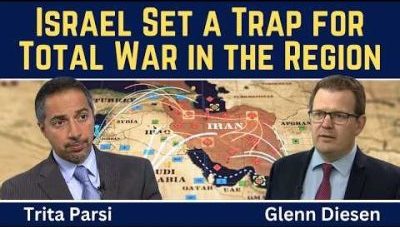
Trita Parsi: Israel Set a Trap for Total War in the Region
or go to
Aletho News Archives – Video-Images
From the Archive
Zionism’s Violent Legacy
By Donald Neff | Washington Report On Middle East Affairs | January 1996
On January 4, 1948, Jewish terrorists drove a truck loaded with explosives into the center of the all Arab city of Jaffa and detonated it, killing 26 and wounding around 100 Palestinian men, women and children.[1] The attack was the work of the Irgun Zvai Leumi – the “National Military Organization,” also known by the Hebrew letters Etzel – the largest Jewish terrorist group in Palestine. The Irgun was headed by Revisionist Zionist Menachem Begin and had been killing and maiming Arabs, Britons and even Jews for the previous ten years in its efforts to establish a Jewish state.
This terror campaign meant that at the core of Revisionist Zionism there existed a philosophical embrace of violence. … continue
Blog Roll
 Aletho News
- Trita Parsi: Israel Set a Trap for Total War in the Region
- Trump’s Iran war is on an Israeli leash
- Saudi oil boss issues global supply warning
- Riyadh Says Its Oil System Is Intact. The Numbers Say Otherwise.
- Trump and Netanyahu Want to “Finish the Job” on Iran
- US ‘one-sided dictation’ not Iran’s beliefs makes rational talks impossible: Baghaei
- Iran’s Next Strike May Not Explode. It Could Shut You Down /Col Doug Macgregor
- Iran: US political targets legitimate if assassinations return
- Iraq shuts key border crossing with Iran under US pressure: Report
- Undersea Internet cables could be targeted in retaliation for attacks on Iran: IRGC deputy chief
- If Americans Knew
- The Israel Lobby’s Changing Fortunes
- AIPAC has become such a political liability that it’s shifting to a more “nimble” approach to buying politicians
- At least 160 Israeli settler attacks in 2 weeks
- Will Gaza’s Ancient Christian Community Disappear Forever?
- Israel’s vision of regional security rests on keeping Arab states weak
- Heidi Levine recounts how Palestinian youths helped save her in settler attack
- DAILY UPDATE: Latest essential news on Palestine, Israel, & region
- Trump’s Intensifying Sabotage of the ICC, for Israel’s Sake
- Israeli military detain US and UK volunteers in West Bank including Democratic NY politician Brad Lander
- Americans at National Conservatism Conference held in Israel this year criticize Israel
- No Tricks Zone
- E-Cars Reduce CO2 Emissions By Only 41% Compared To Internal Combustion Engine Vehicles
- Predictions Made By Renowned Climate Professor Over Past Decades Have Been Proven To Be Poor
- New Study Suggests Large Regions Of The Pacific Ocean Have Been Cooling For The Last 80 Years
- Germany’s Green Energy Debacle: High Energy Costs Force Kahla Porzellan to Close After 182 Years!
- New Study: 50 Years Of The Most Aggressive ‘Net Zero’ Policies Can Only Affect The Global Climate By 0.03°C
- US September “Heat” Was No Record…Many Records Set Decades Ago
- Latest European Green Energy Debacle; Portugal’s Largest Flagship Solar Park Insolvent!
- Green Energy Debacle: German Expert Professor Fritz Vahrenholt Warns Of Severe Economic And Social Consequences
- Two More Paleo Reconstructions Affirm Meters-Higher Sea Levels Across Ireland, Brazil 7000-6000 Years Ago
- New Study: Earth And Venus Surface Warmth Largely Explained By Convection And Lapse Rate, Not CO2 Or Radiation

