Amnesty International, George Clooney and the Bidding of Empire
By JOHN VINCENT | CounterPunch | March 21, 2012
In March this year Frank S. Jannuzi was named Washington DC office head at Amnesty International USA (AIUSA). Frank, a former staffer with the Senate Foreign Relations Committee, is Hitachi International Affairs Fellow at the Council on Foreign Relations (CFR).
The Council on Foreign Relations (CFR), the most powerful foreign policy pressure group in the world. Over the years, CFR’s membership has included 22 US secretaries of state.
Those on CFR’s Board of Directors today include Robert E. Rubin, former CEO of Goldman Sachs, Secretary of the Treasury under Clinton and special advisor to the Obama Administration; Madeleine Albright, former Secretary of State who when on 60 Minutes was asked by Lesley Stahl on the effects of U.S. sanctions against Iraq: “We have heard that a half million children have died. I mean, that’s more children than died in Hiroshima. And, you know, is the price worth it?” Secretary of State Madeleine Albright replied: “I think this is a very hard choice, but the price–we think the price is worth it”; Peter G. Peterson, of the Peter G. Peterson Foundation, who has been pushing for the destruction of Social Security for over ten years; and Penny Pritzker, Chairman and CEO of PSP Capital, who besides being one of Chicago’s wealthiest women is also on the Chicago School Board closing public schools in the poorest parts of the city.
These are names not typically associated with humanitarian causes.
In taking his new position Jannuzi is quoted on AIUSA’s website as saying: “I am thrilled to be joining Amnesty International and look forward to connecting the passion and expertise of AIUSA with the policy-making community in Washington that I know well.”
And how might that work?
In a CFR moderated discussion George Clooney discussed the plight of the Sudanese in the Nuba Mountains who are caught up in the country’s civil war. Not surprising the area includes a proposed pipeline route that will carry oil to a seaport in the north.
So George gets arrested on Friday March 16th, and on Monday the 19th AIUSA begins an email campaign calling for Sudanese President al-Bashir to be brought to justice with the banner: What was actor George Clooney doing in jail, while Sudan’s president and indicted war crimes suspect Omar al-Bashir runs free?
Interestingly, March 16th was the day AIUSA announced Jannuzi’s new position with the organization.
So is AIUSA, along with George Clooney and Hollywood in general, supporting the CFR in their effort to manage the American peoples’ perceptions of Africa for the purpose of furthering their government’s foreign policy objectives in the region?
Why does AIUSA mount campaigns focused on Africa – Kony 2012, Sudan’s al-Bashir, and the investigation of civilian deaths in Libya – but not promote similar campaigns within the borders of the US calling for the arrest of its known war criminals?
And why doesn’t AIUSA mount campaigns to stop US humanitarian crimes before they occur? The Iran war is the next human rights catastrophe that will be unleashed on the world, but AIUSA isn’t trying to stop it. Why not?
Are AIUSA’s commendable humanitarian efforts being used as a screen for the organization’s work in the service of the American empire?
UNDER THE THREAT OF WAR, IRANIANS AFFIRM THEIR SUPPORT FOR THE ISLAMIC REPUBLIC
By Flynt Leverett and Hillary Mann Leverett | The Race for Iran | March 18, 2012

Iranians vote in Teheran
As we have discussed in multiple posts, major Western media outlets brought an agenda-driven and intellectually sloppy approach to their coverage of the Islamic Republic’s 2009 presidential election. From their coverage of the Islamic Republic’s recent parliamentary elections, it would seem that there has not been much of a learning curve.
One all-too-typical example is The New York Times’ main “analytic” piece about the parliamentary elections, see here; the article, entitled “Elections in Iran Favors Ayatollah’s Allies, Dealing Blow to President and his Office,” was filed by Neil Macfarquhar from Beirut. This specimen of bad journalism cites a former reformist parliamentary now living in the United States, an editor for the opposition Rooz online, and the Washington commentator Karim Sadjadpour (who favors the Islamic Republic’s overthrow), to assert that the elections were carefully stage managed (by Ayatollah Khamenei’s son, Mojtaba, working on behalf of his father) as part of an ever increasing dictatorship to abolish the presidency and turn the Islamic Republic into a parliamentary-based, prime ministerial system. One can find these themes in many other Western media stories about the elections.
To re-introduce a note of terrestrial reality into international discussion of Iran’s parliamentary elections, we asked our colleague, Seyed Mohammad Marandi of the University of Tehran, to offer his observations. We are pleased to present Mohammad’s article below.
**********
UNDER THE THREAT OF WAR, IRANIANS AFFIRM THEIR SUPPORT FOR THE ISLAMIC REPUBLIC
By Seyed Mohammad Marandi
Most of the Western so-called reporting on the Islamic Republic’s recent parliamentary election displayed very limited direct knowledge about Iran and often, as its authors’ acknowledged, derived its their information primarily from Western-backed opponents of the Islamic Republic. As long as this goes on, Western countries will continue to miscalculate about the Islamic Republic’s internal politics and foreign policy—and then be left wondering, again and again, why they always get things wrong.
Five points of fact illustrate the shortcomings in this approach to “understanding” Iranian politics. First of all, contrary to unsubstantiated “green” propaganda intended to damage the Supreme Leader, Ayatollah Khamenei’s son Mojtaba is not an important political figure. Claims of this sort that are recycled in the Western media have little effect inside Iran. Regardless of what they think about his policies and beliefs, Ayatollah Khamenei is recognized even by his opponents (like Ataollah Mohajerani) as super clean. Moreover, people recognize that, if Mojtaba had such an important role, he would be seen regularly involved in politics and high-level decision-making processes and institutions. He isn’t.
Second, changing the structure of government by removing the presidency would require a change in the Constitution, a process that has little to do with this year’s parliamentary elections. It would require a referendum—not a decree from Parliament. The current parliament has had somewhat poor relations with the incumbent President; if the parliament to be formed out of this year’s elections also turns out to be critical of the President, this will neither be new nor have anything to do with changing the Constitution. And, in any case, Ayatollah Khamenei never spoke about any imminent change in the Constitution. A few months ago, in a question-and-answer session with students and academics, he said in response to a question that there could be changes in the constitution in the distant future if it were concluded that a different governmental structure would work more effectively. He then gave the example of the current presidential system.
It is also inaccurate to suggest that eliminating the presidency would make the elected branches of government weaker. If Iran were to have a prime minister it would make the parliament even more powerful. Either way, it would have no effect on the combined scope of authority of the executive and legislative branches.
Third, the turnout was very high in the recent parliamentary election, around 65 percent. In fact, the turnout in Iran was much higher than in analogous off-year congressional elections in the United States (for example, turnout was just under 38 percent in the 2010 American congressional elections), and higher even than in U.S. presidential elections (turnout was just under 57 percent in the last American presidential election, in 2008).
The decisions of former Presidents Khatami and Rafsanjani to participate, along with other reformists like Majeed Ansari, Seyed Mehdi Emam Jamarani, Kazam Mousavi Bojnourdi, and Ayatollah Khomeini’s grandson Hassan Khomeini, reflect this. If turnout had been low, why would they vote and increase the “legitimacy” of the voting process and of the election results? (This assumes, of course, that they are opposed to the current political order as implied by much of the Western media, for which there is no evidence and which I don’t agree.) If turnout had been low, why would they want to be seen standing apart from the majority who did not vote?
In fact, they knew that turnout was going to be high; they also recognized that such high turnout shows that the public trusts the voting process, that people feel their votes count, and that they are deeply committed to the Islamic Republic. By casting their ballots these reformist leaders have stated that they accept the accuracy, validity, and legitimacy of the voting process and that they have no link to the “greens.” If they believed the results were unreliable, why would they vote, thereby strengthening a “corrupt” system? Instead, they have effectively stated that they do not accept claims that the 2009 presidential election or any previous presidential election was fraudulent, even though the voting process has not changed. Merely through their participation, they have given the voting process a clear vote of confidence.
Other major reformists who campaigned to win seats had different calculations. People like Mostafa Kavakebian (who lost), Mohammad Reza Khabaz (who lost), Masoud Pezeshkian (who won), and Mohammad Reza Tabesh (who won) wanted a high turnout from the very start. While they are Reformists, they wanted a display of unity and strength among Iranians against what is widely seen in Iran as Western acts of war against ordinary Iranians through embargos and sanctions. Indeed, there is evidence from polls and follow-up panels that the publication on election day in Iran of President Barack Obama’s interview, in which he proclaimed “I don’t bluff” in the context of a military attack on the Islamic Republic, may have driven up turnout, at least in Tehran, among those who might otherwise have stayed home.
Fourth, the fact that Ahmadinejad’s sister participated and lost (by a small margin), that many independents won seats, that reformist candidates stood for seats, and that there were numerous “principlist” coalitions taking part in the elections (e.g., Jebheye Motahed, Jebheye Paydari, Jebheye Eestadegi, Sedaye Edalat, each with a different list of candidates) and that many independents won seats shows that the elections were meaningful. There was a broad choice of candidates and the counting process is trusted and reliable.
Fifth, I do not know who will be the next speaker of parliament. But, contrary to uninformed Western speculation, Ayatollah Khamenei never involves himself in such issues. If, as many Western analysts and reporters claim, the Leader is out to have a subordinated parliament under the speakership of Gholam Haddad-Adel, then based on this logic he would have told Ali Larijani four years ago not to stand against then-parliament speaker Haddad-Adel and, as Mr. Larijani is an ally of the Leader, he would have acceded. In fact, the reason why the majority of parliamentarians voted to make Mr. Larijani their speaker four years ago was their perception that he would be more critical of President Ahmadinejad. If, as Western pundits now commonly assert, the Leader wants to weaken Ahmadinejad, he should support Mr. Larijani’s continuation as speaker. The logic underlying such speculation is clearly flawed—in no small part because it is based on information produced in the imaginary world of Western-based and funded greens and anti-government commentators.
Despite sanctions and other forms of international pressure, the Islamic Republic has the strong support of the public. In contrast to many countries allied to the West, it has meaningful elections that include candidates with very different political views. In my view, there is no doubt that the Islamic Republic is here to stay and that it will outlast the dying dictatorial regimes on the other side of the Persian Gulf.
Press TV chief in Syria denies alleged e-mail correspondence with Assad
Press TV – March 16, 2012
The head of Iran’s international news channels’ offices in Syria has rejected allegations by some Western media that he has sent e-mails to Syrian President Bashar al-Assad, Press TV reports.
Accusing Western media of fabricating news, Hussein Mortada, who runs local offices of Press TV and al-Alam news channels in the Syrian capital, Damascus, said the Western media claims about his e-mails to Assad were false.
He also emphasized that recent CNN claims about Mortada failing to respond to its contacts about the authenticity of e-mails attributed to him were baseless as he has never been contacted by CNN.
Mortada stressed if contacted by CNN, he would be willing to respond to any question about the e-mails.
He stated that Western news channels were trying to falsify facts and fabricate news in order to embroil Iran and the Lebanese Hezbollah in Syria’s events.
Mortada also rejected rumors that he is a businessman, saying, “I am only a journalist and head of Press TV and al-Alam news channels offices in Damascus.”
He said his job is to convey the true image of what is happening on the ground in Syria, adding that he has already visited important areas such as al-Zabadani, Jisr al-Shughour, Dara, Baba Amr and other critical areas in Syria.
On Wednesday, some British and American media outlets reported that a trove of e-mails belonging to the Syrian President Assad and his family has been obtained.
They claimed that the e-mails included those sent by Mortada to one of Assad’s aides in which he allegedly gave Damascus advice on how to quell the ongoing unrest in Syria.
Dealing With Iran
By ISMAEL HOSSEIN-ZADEH | CounterPunch | March 16, 2012
Dr. James Zogby, president of the Arab American Institute and brother of the well-known pollster John Zogby, recently published an article on “Dealing with Iran” in Huffington Post that is problematic on a number of grounds.
To begin with, Dr. Zogby claims that Iran harbors “aspirations for regional hegemony,” and it is therefore a “threat” to its neighbors: “Make no mistake, the regime in Tehran is a meddlesome menace and their aspirations for regional hegemony do pose a threat, not to Israel . . . but to the Arab Gulf States.” Dr. Zogby goes even one step further, arguing that Iran is more than just a threat; it is “the real danger to its … neighbors.”
Israel’s Education Minister Gideon Sa’ar recently admitted (boastfully) that the Israeli government had succeeded in distracting the attention of the entire world away from the Palestinians to the Iranians. Dr. Zogby’s argument that Iran is “the real danger to its neighbors” shows that Mr. Sa’ar is, indeed, justified in boasting about the fantastic success of Israel’s policy of distraction. Instead of blaming the US-Israeli axis of aggression for the never-ending and escalating turbulence in the Middle East, Dr. Zogby blames Iran!
But let us examine Dr. Zogby’s allegation in light of reality: (1) Iran has not invaded (or threatened invasion of) any country for over 250 years. (2) Iran was invaded in 1980 by Saddam Hussein, which culminated in the devastating 8-year war—a war that was instigated, supported and sustained by Western powers and their proxy regimes in the Persian Gulf region. (3) The “Arab Gulf States,” headed by the Saudi kingdom, are collaborating with the US-Israeli axis of aggression in their efforts to destabilize and overthrow the Iranian government. (4) The “Arab Gulf States,” not Iran, serve (literally) as military bases of Western powers that support Israel and its policies of settlements and occupation.
Against this background, Dr. Zogby’s claim that Iran is a “meddlesome menace” is obviously counterfactual and preposterous.
Ironically, Dr. Zogby’s claim that Iran poses “the real danger to its neighbors” is flatly rejected by the Arab people. Public opinion polls have consistently shown that the overwhelming majority of the Arab neighbors of Iran view the U.S. and Israel as the real threats, not Iran. For example, the most recent recent (2011) and most comprehensive public opinion survey to date, which covered 12 Arab/Muslim counties and 16,731 face-to-face interviews, and which was conducted by the Arab Center for Research and Policy Studies (ACRPS), found that “by a 15-1 ratio, Israel and the US are seen as more threatening than Iran.”
Since Dr. Zogby does not tell his readers why or how Iran is “the real danger to its neighbors,” let me offer an explanation for his allegation. The “threat” he is talking about is not a military threat. Nor is it a threat to Arab people or their territory—Iran has no territorial ambitions. It is, rather, the threat to the autocratic Arab rulers; a threat that results from Iran’s example or model of national sovereignty, not its “aspirations for regional hegemony,” as Dr. Zogby claims. As Iran’s policies of national independence and resistance to external pressure make the client Arab regimes look bad in the eyes of the Arab people, they tend to discredit and threaten their dictatorial rulers. And as those policies earn respect from the Arab people, they also earn the wrath of the Arab leaders. This means that Dr. Zogby’s arguments against the Iranian government reflect the views of the dictatorial Arab leaders, and their imperialist backers, not those of the Arab people.
One salutary point in Dr. Zogby’s article seems to be his advice against military threats against Iran. Unfortunately, he does so for the wrong reasons; he opposes military actions against Iran not because such actions would be unlawful and immoral, but because (a) military threats “only serve to embolden Iran,” which is not clear why or how; and (b) “continued targeted sanctions… are having a real impact.”
Dr. Zogby is either uniformed about the sanctions on Iran, or uses a peculiar definition of targeted sanctions. The brutal sanctions imposed on Iran are way beyond targeted sanctions; they are a most comprehensive sanctions, designed to be “crippling” as they include Iran’s oil exports and its banks, which, in effect, means its international trade. Targeted sanctions are almost always expanded to broader, comprehensive sanctions, as has been the case with Iran. Furthermore, sanctions are essentially a disguised and an insidious form of war whose primary victims are the poor, the children, the elderly, and the infirm. And when sanctions fail to bring about “regime change,” military actions follow logically “to do the job.”
In his article Dr. Zogby also writes (with a dash of sarcasm): “What, one might ask the leaders of Iran, will they do with their nuclear program and their provocation? Can it feed their people, rebuild their neglected and decayed infrastructure, give hope to their unemployed young, or secure their role in the community of nations? . . . As the Gulf States make significant progress, providing a model for development and growth, Iran remains trapped in an archaic system which feeds off of fear and anger, and goes nowhere.”
It is only fair to ask Dr. Zogby: how can “Arab Gulf States provide a model of development for Iran” when they are essentially consumer markets for foreign products? What product line, manufacturing process or technological know-how can Iran learn from these states? Dr. Zogby seems to confuse financial services, extravagant consumerism (made possible by abundant oil and smaller populations), unrestricted import of luxury goods from abroad, glossy shopping malls, ballooning skyscrapers, and man-made islands with manufacturing, industrialization, labor productivity and real development. With the exception of oil, which is produced, processed and managed largely with the help foreign experts, Persian Gulf kingdoms do not produce much of what they consume.
By contrast, Iran produces much of what it needs or consumes. It has made considerable progress in scientific research and technological know-how. It has taken advantage of the imperialist sanctions and boycotts to become self-reliant in many technological areas.
For example, Iran is now self-sufficient in producing many of its industrial products such as home and electric appliances (television sets, washers and dryers, refrigerators, washing machines, and the like), textiles, leather products, pharmaceuticals, agricultural products, processed food, and beverage products. The country has also made considerable progress in manufacturing steel, copper products, paper, rubber products, telecommunications equipment, cement, and industrial machinery. Iran has the largest operational stock of industrial robots in West Asia.
Iran’s progress in automobile and other motor vehicle production has especially been impressive. Motor vehicles, including farming equipment, now count among Iran’s exports. Most remarkable of Iran’s industrial progress, however, can be seen in the manufacture of various types of its armaments needs. Iran’s defense industry has taken great strides in the past few decades, and now manufactures many types of arms and equipment. Iran’s Defense Industries Organization (DIO) now produces its own tanks, armored personnel carriers, guided missiles, radar systems, military vessels, submarines, fighter planes, and more. Despite these achievements, Iran’s military spending is relatively modest. For example, while Iran’s military spending is currently about $7 billion, or nearly 2% of its GDP, that of Saudi Arabia is about $43 billion, or nearly 11.2% of its GDP, and that of Israel is about $13 billion, or 6.3% of its GDP. And while Iran produces most of its military equipment at home, Saudi Arabia imports its military hardware.
Contrary to Dr. Zogby’s claims, Iran’s military preparedness and its nuclear program, have not meant neglect of its infrastructure. Iran has, indeed, invested considerably in both physical infrastructures (such as transportation and communication) and soft/social infrastructures (such as education and healthcare services). Health care is free for those who can’t pay. All public education, including university, is free.
Although women are required to comply with the official dress code, they are encouraged (both by their families and the government) to excel in educational and professional pursuits. The results have been quite impressive. Women now constitute the majority of university students. Despite the very high level of unemployment, which is largely due to the criminal economic sanctions and military threats from abroad, more and more women are joining the workforce. They are doctors, engineers, teachers, scientists, writers, artists, business owners, salespersons, firefighters and taxi drivers. Working women in Iran are entitled to 90 days of maternity leave at two-thirds pay, with the right to return to their previous jobs. Women in the US do not have these benefits. Sex change operations and abortion under certain circumstances (and before the ensoulment, i.e. during the first four months of pregnancy) are legal.
In a number of the “Arab Gulf States,” by contrast, women can’t hold public office, are denied the right to vote, cannot get a university education, drive a car, or even leave home without a chaperone. How or why Dr. Zogby thinks that these states can “provide a model of development and progress for Iran” is unfathomable.
Dr. Zogby also chides Iran for not supporting the ongoing efforts by the US and its allies, including the “Arab Gulf States,” to overthrow the Syrian regime. Yet, there is undeniable evidence that the Syrian opposition is hatched largely by NATO, Israel and their cringing allies in the Arab League. “The Free Syria Army (FSA) fighting against Assad inside Syria is a creation of NATO. Sources indicate 600 to 1,500 fighters from the Islamic Fighting Group in Libya, now known as al-Qaeda in Libya, are working with the FSA to topple the Assad regime. An Arab League report revealed last month that Mossad, MI6, the CIA, and British SAS are in Syria working with the Free Syrian Army and the Syrian National Council.” It is a shame that Dr. Zogby would allow himself to support this orgy of mercenary forces, benignly called the “Syrian opposition.”
In his Article Dr. Zogby refers to the Persian Gulf simply as the “Gulf,” without the word “Persian.” I suspect this omission is not fortuitous. Let me explain why. As mentioned earlier, Iran’s resistance to US-Israeli axis of aggression infuriates the autocratic Arab rulers as such resistance to injustice, which Dr. Zogby calls Iran’s “provocations,” exposes the complicity of these rulers with the imperialist-Zionist powers in the occupation and militarization of their lands. To counter this “problem” and to turn the Arab public opinion against Iran, the Arab client regimes (with the help of their imperialist patrons) have in recent years cooked up a scheme that is based on a harebrained idea that the word “Persian” should be dropped from the name of Persian Gulf and replaced with the word “Arab,” that is, it should be the Arab Gulf, not the Persian Gulf! The scheme is, obviously, part of an insidious strategy that is designed to pit the Persians/Iranians against the Arabs and the Shias against the Sunnis. Regrettably, Dr. Zogby seems to have fallen for this age-old divide-and-conquer ploy.
~
Ismael Hossein-zadeh is Professor Emeritus of Economics, Drake University, Des Moines, Iowa. He is the author of The Political Economy of U.S. Militarism (Palgrave – Macmillan 2007) and the Soviet Non-capitalist Development: The Case of Nasser’s Egypt (Praeger Publishers 1989). He is a contributor to Hopeless: Barack Obama and the Politics of Illusion, forthcoming from AK Press.
Related articles
- SWIFT cuts financial ties with Iran over EU sanctions (alethonews.wordpress.com)
- Arabs: Israel, US Our Main Concern, Not Iran (alethonews.wordpress.com)
South Africa Must Resist Sanctions on Iran
By Iqbal Jassat | Palestine Chronicle | March 15, 2012
South Africa’s latest corruption scandal is once again linked to high profile politicians and their close business associates.
However, unlike earlier cases of fraud, the murkiness of current allegations implicating deputy president Kgalema Motlanthe’s partner Gugu Mtshali is entirely clouded as a result of the involvement of a foreign intelligence agency, the CIA.
And amazingly, instead of being alarmed or at the least being curious, media seems to have ignored the questionable role of America’s spooks in South Africa.
The foremost question that requires probing is the timing of leaks in relation to an Israeli-inspired frenzy led by the Obama administration to impose sanctions on the Islamic Republic of Iran.
As this scandal allegedly centers on so-called sanctions busting, it is entirely inappropriate to accept a narrative framed by the American government that would have South Africa believe it is guilty of a heinous crime by doing business with Iran.
Quite distinct from the basis of this new round of sensational reports which are quite damning if true for they reveal the nature of deals constructed by being close or connected to political heavyweights, concerns raised by me relate to the ability of foreign entities to attack South Africa’s economy!
So by setting aside allegations of fraud and corruption as a matter for investigation by the office of the Public Protector, a challenge facing media is to investigate the role of foreign agencies allied to American/Israeli interests intent on undermining South Africa’s legitimate trade ties with Iran.
Unless it becomes clear that the ANC government has accepted US demands on sanctions that inevitably will destabilize South Africa’s economy and retard efforts at job creation, it would be irresponsible for media to ignore this.
If India, despite its close strategic ties with America, is able to place its national interest above the Israeli manipulated economic sabotage by resisting sanctions on Iran, surely South Africa can do so too.
– Iqbal Jassat is an executive member of the Media Review Network in Johannesburg, South Africa.
Iran War Debate: Media Failure or Undisclosed Bias?
By Maidhc Ó Cathail | The Passionate Attachment | March 16, 2012
Comparing the media handling of the debate over Iran with the lead-up to the war on Iraq, Stephen M. Walt observes in a recent Foreign Policy column that “most mainstream news organizations have let us down again.” In his “Top Ten Media Failures in the 2012 Iran War Scare,” Prof. Walt singles out five journalists for particular criticism:
#1: Mainstreaming the war. As I’ve written before, when prominent media organizations keep publishing alarmist pieces about how war is imminent, likely, inevitable, etc., this may convince the public that it is going to happen sooner or later and it discourages people from looking for better alternatives. Exhibits A and B for this problem are Jeffrey Goldberg’s September 2010 article in The Atlantic Monthly and Ronan Bergman’s February 2012 article in the New York Times Magazine. Both articles reported that top Israeli leaders believed time was running out and suggested that an attack might come soon.
[…]
#8: Letting spinmeisters play fast and loose with facts. Journalists have to let officials and experts express their views, but they shouldn’t let them spout falsehoods without pushing back. Unfortunately, there have been some egregious cases where prominent journalists allowed politicians or government officials to utter howlers without being called on it. When Rick Santorum announced on Meet the Press that “there were no inspectors” in Iran, for example, host David Gregory didn’t challenge this obvious error. (In fact, Iran may be the most heavily inspected country in the history of the IAEA).
Even worse, when Israeli ambassador Michael Oren appeared on MSNBC last week, he offered the following set of dubious claims, without challenge:
“[Iran] has built an underground nuclear facility trying to hide its activities from the world. It has been enriching uranium to a high rate [sic.] that has no explanation other than a military nuclear program – that has been confirmed by the International Atomic Energy Agency now several times. It is advancing very quickly on an intercontinental ballistic missile system that’s capable of carrying nuclear warheads.”
Unfortunately, MSNBC host Andrea Mitchell apparently didn’t know that Oren’s claims were either false or misleading. 1) Iran’s underground facility was built to make it hard to destroy, not to “hide its activities,” and IAEA inspectors have already been inside it. 2) Iran is not enriching at a “high rate” (i.e., to weapons-grade); it is currently enriching to only 20% (which is not high enough to build a bomb). 3) Lastly, Western intelligence experts do not think Iran is anywhere near to having an ICBM capability.
In another interview on NPR, Oren falsely accused Iran of “killing hundreds, if not thousands of American troops,” a claim that NPR host Robert Siegel did not challenge.
Every one of those Walt identifies as examples of “media failures” — Jeffrey Goldberg, Ronen Bergman, David Gregory, Andrea Mitchell and Robert Siegel — either already has Israeli citizenship or would probably qualify for it under the Law of Return, which accords any Jew the legal right to assisted immigration and settlement in Israel, as well as Israeli citizenship.
Of course, being Jewish doesn’t necessarily mean that one is more susceptible to Israeli falsehoods about the alleged “Iranian threat.” After all, Glenn Greenwald is one of the journalists that Walt singles out for praise in countering the war propaganda. But we still need to ask if this is simply another case of “media failure”? Or are those in the media with an undisclosed bias helping to take America to another disastrous war for Israel?
Related articles
- BBC loses its “impartiality” yet again over the west-Iran standoff (alethonews.wordpress.com)
American Morlocks: Another Civilian Massacre and the Savagery of Our Soldiers
By Nima Shiraz | Wide Asleep in America | March 11, 2012
“Great shapes like big machines rose out of the dimness, and cast grotesque black shadows, in which dim spectral Morlocks sheltered from the glare…there was an altogether new element in the sickening quality of the Morlocks — a something inhuman and malign…I wondered vaguely what foul villainy it might be that the Morlocks did under the new moon.”
– H.G. Wells, The Time Machine, 1895
Nearly eight years ago, on April 1, 2004, former speech writer and Special Assistant to Ronald Reagan, Peggy Noonan wrote an article for the Wall Street Journal, where she was a contributing editor. It began like this (emphasis in original):
The world is used to bad news and always has been, but now and then there occurs something so brutal, so outside the normal limits of what used to be called man’s inhumanity to man, that you have to look away. Then you force yourself to look and see and only one thought is possible: This must stop now. You wonder, how can we do it? And your mind says, immediately: Whatever it takes.
The brutal, inhuman event she was referring to was the killing in the Iraqi city of Fallujah of four American civilian contractors, whose SUV was ambushed by rocket-propelled grenades the day before. The four men, all employees of the infamous mercenary outfit Blackwater, were shot, their bodies burned, mutilated, and dragged through the streets in celebration. The charred corpses of two of those killed that day were strung up on a bridge over the Euphrates River. The news, and accompanying photographs, sent shockwaves of horror and disgust through the United States and prompted endless editorials from coast to coast.
Noonan described “the brutalization of their corpses” as “savage, primitive, unacceptable” and decried that the “terrible glee of the young men in the crowds, and the sadism they evinced, reminds us of the special power of the ignorant to impede the good.” She wrote that the Iraqis responsible for such gruesome actions “take pleasure in evil, and they were not shy to show it. They are arrogant. They think barbarity is their right.”
White House spokesman Scott McClellan condemned the killings as “despicable, horrific attacks” and “cowardly, hateful acts,” saying, “it was inexcusable the way those individuals were treated.” He called those responsible for the deaths “terrorists” and “a collection of killers” and vowed that “America will never be intimidated by thugs and assassins.”
A few days later in the San Diego Union-Tribune, editor Robert J. Caldwell wrote of the “grisly horror,” the “shocking slaughter,” the “barbarism” and “butchery,” the “homicidal hatred,” and insisted that “if we permit atrocities like the one in Fallujah to drive the U.S.-led coalition into retreat and premature withdrawal” and “[i]f we falter in Iraq, we let the mob in Fallujah win.” Similarly, Noonan suggested,
It would be good not only for elemental justice but for Iraq and its future if a large force of coalition troops led by U.S. Marines would go into Fallujah, find the young men, arrest them or kill them, and, to make sure the point isn’t lost on them, blow up the bridge.
Whatever the long-term impact of the charred bodies the short term response must be a message to Fallujah and to all the young men of Iraq: the violent and unlawful will be broken. Savagery is yesterday; it left with Saddam.
In fact, in retaliation, savagery returned with a vengeance as United States Marines immediately bombarded Fallujah, killing over 600 Iraqis, most of them women, children, and the elderly in the very first week of the assault in early April 2004, eleven months after George W. Bush declared “Mission Accomplished.” By the end of the year, after two massive assaults on the city by the U.S. military, over 2,000 Iraqis, including hundreds of women and children, had been killed by American soldiers, thousands more injured and at least 300,000 displaced.
Such is the American capacity for blood-thirsty revenge.
Nowhere has this vengeance been more tragically demonstrated than Afghanistan and upon an innocent and terrorized civilian population that bares absolutely no responsibility for the events that led the United States to invade and occupy the country over a decade ago.
According to the official U.S. government story, the attacks of September 11, 2001 were carried out by 19 hijackers, none of whom were from Afghanistan. Fifteen were from Saudi Arabia, two from the United Arab Emirates, one from Egypt and another from Lebanon. None of them lived in Afghanistan. They lived in Hamburg, Germany. They didn’t train in Afghanistan, but rather in Sarasota, Florida. They didn’t attend flight school in Afghanistan; their school was in Minnesota. The attacks were reportedly planned in many places, including Falls Church, Virginia and Paris, France, but not in Afghanistan.
Soon after the 9/11 attacks, the Taliban leadership in Afghanistan offered repeatedly “to hand bin Laden over to a neutral Islamic country for trial, if there is proof of his crimes.” In response, George W. Bush replied, “We know he’s guilty. Turn him over.”
On October 1, 2001, the Taliban repeated their offer, telling reporters in Pakistan, “We are ready for negotiations. It is up to the other side to agree or not. Only negotiation will solve our problems.” The next day, when Bush was asked about this offer at a press conference, he replied: “There’s no negotiations. There’s no calendar. We’ll act on our time.” Refusing to provide any evidence of bin Laden’s guilt, U.S. officials stated that the Taliban offer was “inadequate” and instead “dispatched war planes and ships towards Afghanistan,” beginning its illegal bombing campaign on October 7, 2001.
By early December 2001, over 6,500 tons of munitions had been dropped on Afghanistan by US-led NATO forces, including approximately 12,000 bombs and missiles. By the end of March 2002, over 21,000 bombs and missiles had been dropped, murdering well over 3,000 Afghan civilians in air strikes. In the first two months alone, Afghan civilians were killed at an average rate of 45 per day.
The killing has continued unabated for over ten years and is routinely ignored by the mainstream media, which choose instead to praise American soldiers for their duty, their heroism, and their sacrifice.
Just last month, on February 8, 2012, a NATO air strike killed several children in the eastern Kapinsa province of Afghanistan, with “young Afghans of varying ages” identified among the casualties. Similar strikes were responsible for the murders of nearly 200 civilians last year alone. Furthermore, in less than ten months from 2010 to early 2011, well over 1,500 Afghan civilians were killed by U.S. and NATO forces in night raids, a brutal occupation tactic that has been embraced – along with drone attacks – by Barack Obama. According to a September 2011 study by the Open Society Foundation, “An estimated 12 to 20 night raids now occur per night, resulting in thousands of detentions per year, many of whom are non-combatants.” These raids produce heavy civilian casualties and often target the wrong people.
And earlier today, Sunday March 11, 2012, Reuters reported,
Western forces shot dead 16 civilians including nine children in southern Kandahar province on Sunday, Afghan officials said, in a rampage that witnesses said was carried out by American soldiers who were laughing and appeared drunk.
One Afghan father who said his children were killed in the shooting spree accused soldiers of later burning the bodies.
Witnesses told Reuters they saw a group of U.S. soldiers arrive at their village in Kandahar’s Panjwayi district at around 2 am, enter homes and open fire.
The New York Times reported that “a United States Army sergeant methodically killed at least 16 civilians, 9 of them children,” after “[s]talking from home to home.”
Residents of three villages in the Panjwai district of Kandahar Province described a terrifying string of attacks in which the soldier, who had walked more than a mile from his base, tried door after door, eventually breaking in to kill within three separate houses. At the first, the man gathered 11 bodies, including those of four girls younger than 6, and set fire to them, villagers said.
The Guardian added, “Among the dead was a young girl in a green and red dress who had been shot in the forehead. The bodies of other victims appeared partially burned. A villager claimed they had been wrapped in blankets and set on fire by the killer.”
The mainstream media was quick to follow the lead of “U.S. military officials” who “stressed that the shooting was carried out by a lone, rogue soldier, differentiating it from past instances in which civilians were killed accidentally during military operations.”
While Reuters noted that, while ” U.S. officials” asserted “that a lone soldier was responsible,” this conflicted with “witnesses’ accounts that several U.S. soldiers were present.”
“I saw that all 11 of my relatives were killed, including my children and grandchildren,” said a weeping Haji Samad, who said he had left his home a day earlier.
The walls of the house were blood-splattered.
“They (Americans) poured chemicals over their dead bodies and burned them,” Samad told Reuters at the scene.
Neighbors said they had awoken to crackling gunfire from American soldiers, who they described as laughing and drunk.
“They were all drunk and shooting all over the place,” said neighbor Agha Lala, who visited one of the homes where killings took place.
“Their (the victims’) bodies were riddled with bullets.”
A senior U.S. defense official in Washington rejected witness accounts that several apparently drunk soldiers were involved. “Based on the preliminary information we have this account is flatly wrong,” the official said. “We believe one U.S. service member acted alone, not a group of U.S. soldiers.”
“Some villagers reported that more than one US soldier was involved,” wrote Emma Graham-Harrison, The Guardian‘s Kabul-based correspondent, “but Afghan officials and the NATO-led coalition said they believed the killer worked alone.”
The Washington Post quoted Fazal Mohammad Esaqzai, deputy chief of the Kandahar provincial council, as saying, “They entered the room where the women and children were sleeping, and they were all shot in the head. They were all shot in the head.” Esaqzai was “doubtful of the U.S. account suggesting that the killings were the work of a lone gunman…About an hour later, residents in a nearby village heard gunshots, and they later discovered the corpses of five men inside two houses located near each other, Esaqzai said.”
A reporter for The New York Times “inspected bodies that had been taken to the nearby American military base counted 16 dead, and saw burns on some of the children’s legs and heads. ‘All the family members were killed, the dead put in a room, and blankets were put over the corpses and they were burned,’ said Anar Gula, an elderly neighbor who rushed to the house after the soldier had left. ‘We put out the fire.'”
One of the survivors from the attack, Abdul Hadi, 40, said he was at home when a soldier broke down the door.“My father went out to find out what was happening, and he was killed,” he said. “I was trying to go out and find out about the shooting, but someone told me not to move, and I was covered by the women in my family in my room, so that is why I survived.”
U.S. officials were also quick to express their “deep sadness” as they described the “individual act” as an “isolated episode.” Lt. Gen. Adrian J. Bradshaw, deputy commander of the international coalition in Afghanistan, called the murders “callous.” Secretary of Defense Leon Panetta told Afghan president Hamid Karzai, “I condemn such violence and am shocked and saddened that a U.S. service member is alleged to be involved.” U.S. President Barack Obama declared, “I offer my condolences to the families and loved ones of those who lost their lives, and to the people of Afghanistan, who have endured too much violence and suffering. This incident…does not represent the exceptional character of our military and the respect that the United States has for the people of Afghanistan.”
These isolated incidents and that kind of respect have been obliterating the lives of Afghan civilians for over a decade. Such exceptional character was responsible for the premeditated murders of at least three Afghan civilians in Kandanhar in the first half of 2010. Between January and May 2010, members of a U.S. Army Stryker brigade, who called themselves the “Kill Team,” executed three Afghans, staged combat situations to cover-up the killings, took commemorative and celebratory photographs with the murdered corpses, and took fingers and teeth as trophies. To date, eleven soldiers have been convicted in connection to the murders. Last year, one of the soldiers, Specialist Jeremy Morlock of Wasilla, Alaska was sentenced to 24 years in prison for his role in the killings. One of the leaked Kill Team photos shows “Morlock smiling as he holds a dead man up by the hair on his head.” At the beginning of his court-martial, Morlock bluntly told the judge, “The plan was to kill people, sir.” Nevertheless, he may be eligible for parole in less than seven years.
Last month, a video posted online showed four giddy U.S. Marines urinating on the bodies of three slain Afghan men while saying things like “Have a good day, buddy” and “Golden like a shower.” One of the soldiers was the platoon’s commanding officer. Just a few weeks later, American troops at Bagram Air Base deliberately incinerated numerous copies of the Qur’an and other religious texts, sparking mass riots across Afghanistan and leading to a rash of killings of U.S. and NATO soldiers by Afghans armed and trained by NATO. Just two days ago, in the eastern Afghan province of Kapisa, “NATO helicopters apparently hunting Taliban insurgents instead fired on civilians, killing four and wounding three others.”
A 2011 military report determined – shockingly – that the treatment of Afghans by the occupying armies was one reason why members of the Afghan National Security Force sometimes kill their NATO comrades. The report credited such actions to “a crisis of trust and cultural incompatibility.” One would hope that night raids, drone strikes, the willful execution of men, women, and children, mutilating, desecrating and pissing on corpses would be “incompatible” with any “culture.”
In the wake of the Qur’an burnings, White House spokesman Jay Carney told reporters, “We can’t forget what the mission is – the need to disrupt, dismantle and defeat al-Qaeda remains,” and stressed that “the overall importance of defeating al-Qaeda remains.”
Carney said this despite the fact that, in late June 2010, then-CIA Director Leon Panetta judged that the number of al-Qaeda militants in Afghanistan was “at most…maybe 50 to 100, maybe less.” In April 2011, General David Petraeus told reporters in Kabul that al-Qaeda’s total strength in Afghanistan is “generally assessed at less than 100 or so” combatants, of whom only “a handful” were seen to pose a threat to Western countries. Months later, in November 2011, The Washington Post quoted a “senior U.S. counterterrorism official” as saying, “We have rendered the organization that brought us 9/11 operationally ineffective.” The official also stated that al-Qaeda’s entire leadership consisted only of two top positions and described the group as having none of “the world-class terrorists they once had.”
As such, the U.S. military and its coalition partners have been waging a war against a civilian population, allegedly in pursuit of what remains of a leaderless and powerless band of potential terrorists affiliated with the group accused (but never charged, tried or convicted) of planning and executing the 9/11 attacks.
To make matters even more appalling, hardly any Afghans even know the “reason” why foreign armies have invaded and occupied their land and have been killing their family and friends for years. A survey released by the International Council on Security and Development in November 2010 revealed that, “in Kandahar and Helmand provinces, the two provinces currently suffering the most violence” and where Obama had recently sent thousands of American soldiers, “92% of respondents in the south are unaware of the events of 9/11 or that they triggered the current international presence in Afghanistan,” after being read a three-paragraph description of the attacks. Furthermore, of those interviewed (one thousand Afghan men ages fifteen to thirty), 40% “believe the international forces are there to destroy Islam, or to occupy or destroy Afghanistan.” Chances are, incinerating their holy scripture and bombing their villages don’t help challenge this perception.
Consequently, when American missiles and bullets tear through villages, rooftops, windshields, and the living, breathing bodies of Afghan men, women, boys and girls, the carnage is devoid of “context” – not that a deadly attack on U.S. soil over a decade ago can possibly, in any conceivable, legal, or human way, justify the atrocities, trauma, terror, dehumanization and devastation that have befallen the Afghan people at the orders and hands of American soldiers, officers, and commanders-in chief.
Such criminal brutality is obviously not limited to Afghanistan. Sunday’s massacre of 16 human beings in Kandahar recalls the massacre in Haditha, Iraq on November 19, 2005. Following the death of one soldier (and wounding of two others) by a roadside bomb, a squad of Marines killed 24 unarmed Iraqi civilians, including women, an elderly man, children, some of them toddlers.
Led by Staff Sergeant Frank Wuterich (who told his men to “shoot first and ask questions later”), Marines ordered a taxi driver and four students at the Technical Institute in Saqlawiyah out of their car and shot them dead in the street, the Marines raided three nearby homes, slaughtering everyone they came in contact with.
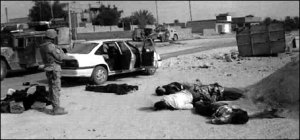
Haditha Massacre, Iraq, 2005

Along with his 66-year-old wife Khamisa Tuma Ali, three grown sons, a 32-year-old woman and a four-year-old child, 76-year-old, wheelchair-bound Abdul Hamid Hassan Ali was killed in his own home after having his chest and abdomen riddled with bullets. Nine-year-old Eman Walid witnessed the slaughter of her family. “First, they went into my father’s room, where he was reading the Koran and we heard shots,” she said. “I couldn’t see their faces very well—only their guns sticking into the doorway. I watched them shoot my grandfather, first in the chest and then in the head. Then they killed my granny.”
Younis Salim Khafif, 43, his wife Aida Yasin Ahmed, 41, their 8-year-old son Muhammad, 14-year-old daughter Noor, 10-year-old daughter Sabaa, 5-year-old daughter Zainab, 3-year-old daughter Aisha and a one-year-old baby girl who was staying at their home were all attacked with hand grenades and shot to death at close range. In the third house, four adult brothers, Jamal, Marwan, Qahtan and Chasib Ahmed were all killed by the Marines. Another brother, Yousif, who survived the attack, recalled, “The Americans gathered my four brothers and took them inside my father’s bedroom, to a closet. They killed them inside the closet.” The soldiers then took photos of the dead and desecrated their bodies by urinating on them.
Despite overwhelming evidence, only a single solider, Wuterich, stood trial for these murders. All charges against the other Marines who committed these atrocities were dropped or dismissed. Wuterich, whose own charges of assault and manslaughter were also dropped, was convicted on January 24, 2012 of only negligent dereliction of duty. He got a demotion and a pay cut. His sentence did not include any jail time.
This kind of American impunity is hardly surprising.
Over the past decade, the United States military has invaded and occupied two foreign countries (illegally bombing and drone striking at least four others), and has overseen the kidnapping, indefinite detention without charge or trial, and the physical and psychological torture of thousands of people, including at places like Guantanamo, Bagram, and Abu Ghraib, where detainees were raped by their American captors. Prisoners held by the United States in Afghanistan and Guantanamo, in addition to being “chained to the ceiling, shackled so tightly that the blood flow stops, kept naked and hooded and kicked to keep them awake for days on end,” have also been beaten to death by their American interrogators. Of the fifteen soldiers charged with detainee abuse ranging from “dereliction of duty to maiming and involuntary manslaughter,” all but three have been acquitted. Those three received written reprimands and served, at most, 75 days in prison for their war crimes and crimes against humanity.
In response to the lethal rampage in Kandahar today, the Taliban condemned the “sick minded American savages” and vowed to “take revenge from the invaders and the savage murderers for every single martyr.” The official Taliban statement continued,
A large number from amongst the victims are innocent children, women and the elderly, martyred by the American barbarians who mercilessly robbed them of their precious lives and drenched their hands with their innocent blood.
The American terrorists want to come up with an excuse for the perpetrator of this inhumane crime by claiming that this immoral culprit was mentally ill.
If the perpetrators of this massacre were in fact mentally ill then this testifies to yet another moral transgression by the American military because they are arming lunatics in Afghanistan who turn their weapons against the defenceless Afghans without giving a second thought.
The words could be Peggy Noonan’s. One would assume, as the victims of this latest massacre were not trained, uniformed combat troops, heavily-armed and armored, serving in a military occupation of an invaded and destroyed foreign country, but rather innocent civilians, many of them children, that the Noonans of the world would similarly cry out for justice, for vengeance, for retribution.
But don’t hold your breath.
Their silence – or worse, equivocation – will be thunderous.
Related articles
Syria blames terrorist gangs for massacre in Homs
Press TV – March 12, 2012
Syria’s information minister has blamed “terrorist gangs” for the massacre in the central city of Homs, describing the killings as part of plans to increase international pressure on the Damascus government.
Information Minister Adnan Mahmoud said on Monday that terrorist groups carried out the massacre in the Karm el-Zaytoun neighborhood of Homs to tarnish the image of the Syrian government.
“Terrorist gangs carried out the most horrible massacre in the Karm el-Zaytoun neighborhood of Homs … in order to incite international reaction against Syria,” Adnan Mahmoud told AFP news agency.
The Syrian minister also accused Saudi Arabia and Qatar of supporting “armed terrorist gangs” operating in Syria and hold them responsible for the killings in the country.
“Some of the countries backing armed terrorist gangs, such as Saudi Arabia and Qatar, are accomplices to the terrorism targeting the Syrian people… and bear responsibility for the bloodletting,” Mahmoud said.
At least 45 people, including women and children, were tortured and killed in Karm el-Zaytoun on Sunday night.
Relatives of a number of victims have announced that they were kidnapped by armed groups several months ago.
Opposition activists, however, have blamed the pro-government forces for the killings.
Arabs: Israel, US Our Main Concern, Not Iran
By Sami Zaatari | Palestine Chronicle | March 10, 2012
The Arab Centre for Research and Policy Studies (ACRPS) has recently published their preliminary report on a major survey they conducted on Arab opinion, over the course of their project they covered 12 Arab countries, and interviewed over 16,000 Arabs on a wide range of subjects to try and gauge the Arab opinion.
The results of the survey were very interesting to say the least, particularly when it came to the question of whom they viewed to be the major threat to the region, America, Israel, or Iran? A total of 73% viewed America and Israel as the major threat to the region, 51% in regards to Israel, 22% in regards to America, and when it came to Iran a meager 5% viewed Iran as the major threat to the region. On any given day of the week, one would not be too surprised by these statistics, but context is important here which is why these results are very important.
For the past few years the American establishment has been creating a massive propaganda effort against Iran, warning that Iran poses a major threat to everyone in the Middle East, especially with their supposed intentions of having a nuclear weapon. America has been doing everything possible to sway Arab opinion, to try and build a joint Arab-American coalition united in combating Iran. This of course perfectly aligns with Israel’s agenda. Israel has been on a war path with Iran, Israeli leaders have constantly likened the current Iranian regime to that of Nazi Germany, calling Iran a major threat to the world, and a major threat to both Arabs and Israelis. Within the media itself there has been a lot of talk about an unthinkable alliance between the Arabs and Israel, two major foes who are now united in the face of an Iranian threat, and this is precisely what the American establishment has been trying to set up. So therefore within this context, the results of this survey are a major blow to the American establishment’s plan of trying to sway Arab opinion towards their own [Zionist] anti-Iranian agenda.
The Arab perception of Israel and America being the major threat to the Middle East is also purely logical and rational, one must only look at the facts on the ground, and look at events through the eyes of the Arabs themselves. Currently it is Israel that occupies Arab lands, Israel occupies Palestinian land, occupies Lebanese land, occupies Syrian land, and for a while even occupied Egyptian land. In the case of the Palestinian occupation, the Israelis not only occupy a land that does not belong to them, they also occupy the inhabitants of the land, Palestinians live under very tight Israeli restrictions, and are virtually a people with no rights thanks to Israel. Israel has also routinely attacked Arab states such as Egypt, Syria, Iraq, Lebanon, and almost routine attacks on the Palestinians. And then to top it off, it is Israel that actually possesses hundreds of nuclear weapons, as well as other deadly chemical and biological weapons within its arsenal. So based on all of these facts, why would the Arabs view Iran as a bigger threat than Israel? The irony is that all the claims that America makes against Iran are actual realities for Israel.
Then when it comes to America itself, is it any wonder that the Arabs view them as the second major threat to the region? America is the country that is firmly behind Israel, and as Obama recently said, America will always have Israel’s back no matter what. On top of this America has also been heavily involved in meddling in Arab affairs for their own interest, and this meddling includes military action as well, such as the invasion of Iraq which tore the country apart and led to major instability throughout the entire Middle East region. So with all the actual realities of what both Israel and America have done in the Middle East, is it any real surprise or wonder that the Arabs view Israel and America as the major threats to the region, and not Iran?
America and Israel’s effort in trying to build an Arab coalition against Iran is all part of a divide and conquer strategy, and many Arabs are fully aware of this. An Arab-Iranian, Sunni-Shia sectarian war would be the greatest calamity for both Arabs and Iranians, and such a conflict would simply benefit both Israel and America. But as this recent report has found, if it is up to the Arab people, no such conflict will ever take place.
– Sami Zaatari is a writer, and a public speaker who has taken part in public events of inter-faith and inter-community discussions. Zaatari also holds an MSc in the field of Middle East Politics.
Related articles
- Haniyeh to Iranian People: You Are Partners in Arab Victories (alethonews.wordpress.com)
Featured Video

Trita Parsi: Israel Set a Trap for Total War in the Region
or go to
Aletho News Archives – Video-Images
From the Archive
Zionism’s Violent Legacy
By Donald Neff | Washington Report On Middle East Affairs | January 1996
On January 4, 1948, Jewish terrorists drove a truck loaded with explosives into the center of the all Arab city of Jaffa and detonated it, killing 26 and wounding around 100 Palestinian men, women and children.[1] The attack was the work of the Irgun Zvai Leumi – the “National Military Organization,” also known by the Hebrew letters Etzel – the largest Jewish terrorist group in Palestine. The Irgun was headed by Revisionist Zionist Menachem Begin and had been killing and maiming Arabs, Britons and even Jews for the previous ten years in its efforts to establish a Jewish state.
This terror campaign meant that at the core of Revisionist Zionism there existed a philosophical embrace of violence. … continue
Blog Roll
 Aletho News
- Trita Parsi: Israel Set a Trap for Total War in the Region
- Trump’s Iran war is on an Israeli leash
- Saudi oil boss issues global supply warning
- Riyadh Says Its Oil System Is Intact. The Numbers Say Otherwise.
- Trump and Netanyahu Want to “Finish the Job” on Iran
- US ‘one-sided dictation’ not Iran’s beliefs makes rational talks impossible: Baghaei
- Iran’s Next Strike May Not Explode. It Could Shut You Down /Col Doug Macgregor
- Iran: US political targets legitimate if assassinations return
- Iraq shuts key border crossing with Iran under US pressure: Report
- Undersea Internet cables could be targeted in retaliation for attacks on Iran: IRGC deputy chief
- If Americans Knew
- The Israel Lobby’s Changing Fortunes
- AIPAC has become such a political liability that it’s shifting to a more “nimble” approach to buying politicians
- At least 160 Israeli settler attacks in 2 weeks
- Will Gaza’s Ancient Christian Community Disappear Forever?
- Israel’s vision of regional security rests on keeping Arab states weak
- Heidi Levine recounts how Palestinian youths helped save her in settler attack
- DAILY UPDATE: Latest essential news on Palestine, Israel, & region
- Trump’s Intensifying Sabotage of the ICC, for Israel’s Sake
- Israeli military detain US and UK volunteers in West Bank including Democratic NY politician Brad Lander
- Americans at National Conservatism Conference held in Israel this year criticize Israel
- No Tricks Zone
- E-Cars Reduce CO2 Emissions By Only 41% Compared To Internal Combustion Engine Vehicles
- Predictions Made By Renowned Climate Professor Over Past Decades Have Been Proven To Be Poor
- New Study Suggests Large Regions Of The Pacific Ocean Have Been Cooling For The Last 80 Years
- Germany’s Green Energy Debacle: High Energy Costs Force Kahla Porzellan to Close After 182 Years!
- New Study: 50 Years Of The Most Aggressive ‘Net Zero’ Policies Can Only Affect The Global Climate By 0.03°C
- US September “Heat” Was No Record…Many Records Set Decades Ago
- Latest European Green Energy Debacle; Portugal’s Largest Flagship Solar Park Insolvent!
- Green Energy Debacle: German Expert Professor Fritz Vahrenholt Warns Of Severe Economic And Social Consequences
- Two More Paleo Reconstructions Affirm Meters-Higher Sea Levels Across Ireland, Brazil 7000-6000 Years Ago
- New Study: Earth And Venus Surface Warmth Largely Explained By Convection And Lapse Rate, Not CO2 Or Radiation

