The Completely Fraudulent “Levelized Cost Of Electricity”
By Francis Menton | Manhattan Contrarian | August 18, 2022
My last post on Tuesday reported on the Soho Forum climate change debate that had taken place the previous day. Debater Andrew Dessler, arguing in favor of rapid reductions in human greenhouse gas emissions by the method of vastly increasing electricity production from wind and solar generators, had heavily relied on the assertion that wind and solar are now the cheapest ways to generate electricity. An important slide in his presentation showed comparative costs of generation from various sources, with wind and solar clearly shown as least expensive. At the bottom of the slide, the acronym “LCOE” was legible.
LCOE stands for Levelized Cost of Electricity. I first encountered this term a couple of years ago, and thought that I should get on top of it to understand its significance. It took me about a half hour to figure out that this metric was completely inapplicable and invalid for purposes of comparing the costs of using dispatchable versus non-dispatchable generators as the predominant sources to power an electrical grid that works. The reasons are not complicated, but do take some minutes of thought if the matter has not previously been explained to you. In Tuesday’s post, I asked as to Dessler’s reliance on this LCOE metric:
[I]s he aware of this [inapplicability of LCOE] and therefore intentionally trying to deceive the audience? Or, alternatively, is he innumerate, and does not understand how this works quantitatively?
Some commenters on the post were quite harsh in their judgments of Dessler. They argued for the inference of intentional deception, on the basis that no one claiming expertise in this field could really be so obtuse as to think LCOE was a valid metric for the purpose for which Dessler was using it.
So today I thought to look at how others go about comparing the costs of generation of electricity from wind and solar versus dispatchable sources like fossil fuels or nuclear. I can’t say that I was surprised to learn that LCOE is everywhere as the metric of choice for the comparison. Moreover, it is almost impossible to find any discussion of why LCOE is completely misleading when comparing the cost of a grid powered predominantly by dispatchable sources to the cost of a grid powered predominantly by intermittent wind and solar sources backed up by storage.
Consider, for example, the International Renewable Energy Agency, going by the acronym IRENA. IRENA is a UN offshoot, launched in 2009 and based in Abu Dhabi, that currently has 168 member countries including all the big ones. IRENA’s mission is to advocate for and promote “renewables” as the way to go for the world’s energy system. Surely, with all the big countries (and most of the small ones) backing its efforts, IRENA’s utterances can be relied upon as definitive.
IRENA puts out annual reports on the costs of renewable power generation. The latest one, titled “Renewable Power Generation Costs in 2021,” just came out in July. Here is the press release, dated July 13, 2022. Excerpt from the press release:
New IRENA report shows almost two-thirds of renewable power added in 2021 had lower costs than the cheapest coal-fired options in G20 countries. . . . IRENA’s new report confirms the critical role that cost-competitive renewables play in addressing today’s energy and climate emergencies by accelerating the transition in line with the 1.5°C warming limit and the Paris Agreement goals. . . . “Renewables are by far the cheapest form of power today,” Francesco La Camera, Director-General of IRENA said. “2022 is a stark example of just how economically viable new renewable power generation has become.”
Amid the excited claims that renewables are “by far the cheapest” sources of power, the term LCOE does not appear anywhere in the press release. To find that that is the metric being used to make these “by far the cheapest” claims, you need to go to the main Report. Excerpt:
The global weighted average levelised cost of electricity (LCOE) of new utility-scale solar PV projects commissioned in 2021 fell by 13% year-on-year, from USD 0.055/kWh to USD 0.048/kWh. . . . The global weighted average LCOE of new onshore wind projects added in 2021 fell by 15%, year-on-year, from USD 0.039/kilowatt hour (kWh) in 2020 to USD 0.033/kWh.
Here is the featured chart, showing that costs of power from solar PV cells have now fallen well below the costs of power from natural gas:
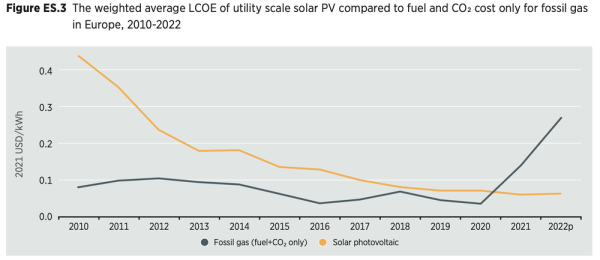
You can see right there that here in 2022 power from natural gas is at least three times as expensive as power from solar PV cells. But the title of the chart gives away that the metric for comparison is LCOE.
Look around for others making cost comparisons of ways to produce electricity, and you will find more and more of same. From Bloomberg, June 30, 2022, “Renewable Power Costs Rise, Just Not as Much as Fossil Fuels”:
The costs for renewable plants plunged for a decade as production of solar and wind equipment surged and technologies improved, but the supply-chain chaos triggered by the pandemic ended those steady declines last year, according to BNEF’s biannual survey of the levelized cost of energy. . . . New onshore wind now costs about $46 per megawatt-hour, while large-scale solar plants cost $45 per megawatt-hour. In comparison, new coal-fired plants cost $74 per MWh, while gas plants are $81 per MWh.
From the Guardian, June 23, 2021 (citing last year’s report from IRENA — also based on LCOE):
Almost two-thirds of wind and solar projects built globally last year will be able to generate cheaper electricity than even the world’s cheapest new coal plants, according to a report from the International Renewable Energy Agency (Irena). . . . Francesco La Camera, Irena’s director general, said . . . “ “Today renewables are the cheapest source of power.”
So it’s not just Dessler. Some big international agency of “experts” adopts LCOE for making these cost comparisons, and everybody just nods along without ever putting in the 30 or so minutes of critical thinking that would be needed to figure out that this is completely wrong.
To reiterate points previously made, the LCOE metric assumes that wind and solar generators are essentially the same kind of thing as dispatchable fossil fuel-powered generation plants. Just build about the same amount of nameplate capacity, and everything will work out just fine. But in fact a predominantly wind/solar system requires vastly more infrastructure to make a fully-functioning reliable grid: some combination of a 4x or 5x overbuild of generators, vastly more transmission lines, and 20 or 30 days of battery storage. These elements could easily multiply the cost of electricity to the consumer by a factor of 5 or 10 or more. Nobody knows, because there is no functioning demonstration project from which reasonably precise costs can be extrapolated. And frankly, there never will be such a demonstration project, because the costs are so enormous that it can never be done. Meanwhile, everyone just nods along as if LCOE comparisons are meaningful.
Dr. Robert Malone sues The Washington Post who accused him of spreading “misinformation” online
By Christina Maas | Reclaim The Net | August 22, 2022
Dr. Robert Malone, an expert in mRNA technology and a vocal Covid vaccines critic who has been consistently censored by Big Tech, is suing the Washington Post for defamation. The lawsuit alleges that the news outlet made defamatory statements against him in an article published on January 24.
The article claimed that Dr. Malone spread “misinformation” in a speech where he said the vaccines “are not working” against the Omicron variant. As evidence the statement was false, the Post cited a paper by the CDC that found that booster shots were protecting people against severe disease.
The Post omitted the part where Dr. Malone said that vaccines, “do not prevent Omicron infection, viral replication, or spread to others.”
Speaking to The Epoch Times, Dr. Malone said: “I said nothing about disease and death at that point in time.” He went on to accuse the Post of selective misquoting and using the CDC study to counter a claim he never made.
The Epoch Times obtained an interview between the article’s writer, Timothy Bella and Dr. Malone, before the article was written. Bella told Dr. Malone, “I have respect for you and your body of work,” and that he was hoping to shadow the doctor during his stay in DC where he gave a speech at a protest against Covid mandates.
Malone initially sent a notice to the Post threatening legal action if the article was not removed or the defamatory statements retracted. When the outlet refused, he filed a lawsuit at a federal court in Virginia.
According to the lawsuit, the article made 10 defamatory statements against Dr. Malone, including that he has been “discredited,” his claims are “not only wrong, but also dangerous,” and that he “repeated falsehoods that have garnered him legions of followers.”
We obtained a copy of the complaint for you here.
“The qualities WaPo disparaged—Dr. Malone’s honesty, veracity, integrity, competence, judgment, morals, and ethics as a licensed medical doctor and scientist—are peculiarly valuable to Dr. Malone and are absolutely necessary in the practice and profession of any medical doctor and scientist. WaPo ascribes to Dr. Malone conduct, characteristics, and conditions, including fraud, disinformation, misinformation, deception, and dishonesty, that would adversely affect his fitness to be a medical professional and to conduct the business of a medical doctor,” the suit states.
“Dr. Malone’s statements concerning COVID-19 and the purported ‘vaccines’ were 100% factually accurate. He has never committed fraud on [sic] engaged in any medical disinformation or misinformation. Further, the so-called ‘vaccines’ do not work, as is abundantly clear from both the scientific and anecdotal evidence to date,” it also says.
Dr. Malone is also currently involved in a lawsuit against Twitter over its censorship.
US taunts Russia to escalate in Ukraine

An UAV hit the roof of the headquarters of Russia’s Black Sea Fleet, Sevastopol, Crimea, August 20, 2022
BY M. K. BHADRAKUMAR | INDIAN PUNCHLINE | AUGUST 21, 2022
In military terms, the crude, locally assembled drone dropping a country-made bomb or two on unguarded sites in Crimea are at best pin pricks in the big picture of Russia’s special military operation in Ukraine. But it can be profoundly consequential in certain other ways.
For a start, this escalation has Washington’s approval. A senior Biden administration official told NatSec Daily the US supports strikes on Crimea if Kiev deems them necessary. “We don’t select targets, of course, and everything we’ve provided is for self-defence purposes. Any target they choose to pursue on sovereign Ukrainian soil is by definition self defense,” this person said.
But Washington knows — and Moscow knows — that like any sophistry, this one too is a clever argument but inherently fallacious and deceptive. The New York Times has interpreted the drone attack on Crimea as a challenge to the leadership of President Vladimir Putin. The Times wrote that the Crimea attacks “put domestic political pressure on the Kremlin, with criticism and debate about the war increasingly being unleashed on social media and underscoring that even what the Russian government considers to be Russian territory is not safe.”
The Times claimed that “as images of antiaircraft fire streaking through the blue Crimean sky ricocheted through social media, the visceral reality of war was becoming more and more apparent to Russians — many of whom have rallied behind the Kremlin’s line, hammered home in state media, that the “special military operation” to save Ukraine from Nazi domination is going smoothly and according to plan.”
The paper quoted a prominent establishment think tanker in Moscow acknowledging that the Crimean attack is a “serious” development insofar as “People are beginning to feel that the war is coming to them.” The Ukrainian president Volodymyr Zelensky claimed in a nationwide address on Saturday, “One can literally feel in the air of Crimea that the occupation there is temporary, and Ukraine is returning.”
Once again, while Russia is steadily winning the ground war in Ukraine, the US is determined not to lose the information war. In Washington’s reckoning, in this Internet Age, the war is to be ultimately won in the Russian people’s minds. Therefore, this studied escalation by Washington puts Moscow in a dilemma, since if it is unanswered, Zelensky may target the 19-km long Crimean Bridge connecting the Taman Peninsula of Krasnodar in mainland Russia with the Kerch Peninsula of Crimea.
In fact, it is a near certainty. The point is, the Kerch bridge is “Putin’s bridge” in the Russian people’s consciousness. While formally opening the bridge to car traffic in May 2018, Putin was quoted as telling the workers, “In different historical epochs, even under the tsar priests, people dreamed of building this bridge. Then they returned to this in the 1930s, the 40s, the 50s. And finally, thanks to your work and your talent, the miracle has happened.”
Therefore, there is no better way to puncture the halo around Putin than by despatching at least a bit of the Kerch bridge to the bottom of the Black Sea. Meanwhile, from the US perspective, Kiev’s drone attacks on Crimea already serve three purposes.
First, this is meant to be a blow to the Russian morale. Indeed, Putin’s towering popularity within Russia has become an eyesore for the Biden Administration. Putin’s masterly navigation of the Russian economy out of crisis mode is an incredible feat that defied all logic of power in the American calculus — inflation is steadily falling (in contrast with the European countries and the US); the GDP decline is narrowing; foreign reserves are swelling; the current account is on the plus side; and lo and behold, the Biden Administration’s so-called “nuclear option” — Russia’s removal from the SWIFT messaging system — failed to cripple foreign trade.
Second, both Washington and Kiev are desperately scrambling for “success” stories to distract attention. The Times playing up the story speaks for itself. In reality, Russia’s Donbass offensive has created a new momentum and is steadily grinding the Ukrainian forces. Within the week, Russian forces will have encircled the lynchpin of the Ukrainian defence line, Bakhmut city, which is a communication hub for troop movements and supply logistics in Donbass. Russian forces have reached the city outskirts from the north, east and south. The fall of Bakhmut will be a crushing defeat for Zelensky.
On the other hand, even two months after Zelensky promised a “counteroffensive” on Kherson near Crimea, it is nowhere in sight. Even his most ardent votaries in the western media feel let down. To be sure, there is growing disenchantment in Europe.
The Hungarian PM Viktor Orban, undoubtedly the smartest European politician today (with an economy registering over 6% growth when the rest of the continent is mired in recession), told German magazine Tichys Einblick in an interview last week that this war marked the end of “western superiority.” Interestingly, he named Big Oil as “war profiteers” and singled out that Exxon doubled its profits, Chevron quadrupled, and ConocoPhillips’ profits have shot up manifold. (Of course, all three are American companies.) Orban’s message was clear: America has weakened the EU. This thought must be troubling many a European politician today.
Third, Washington has thrown down the gauntlet in a measured way. But there is no way the war can be brought into the drawing rooms of the average Americans the way Times says is happening in Russia. Twenty Americans were killed in Kharkiv two days ago in a high-precision Russian missile strike, but there aren’t going to be any body bags returning to Arlington Cemetery; nor does it make headlines in the cooperative American media.
The US plans to go further up on the escalation ladder. Escalation is the Biden Administration’s last chance to stall a Russian victory. The American strategic thinker and academic John Mearsheimer has written that the risk of a disastrous escalation is “substantially greater than the conventional wisdom holds. And given that the consequences of escalation could include a major war in Europe and possibly even nuclear annihilation, there is good reason for extra concern.”
Moscow’s preference is to avoid any escalation, since the special military operation is achieving results. Whereas, it is the US that is in some visible despair, and in immediate terms, Russia’s plans to hold referendums in Kherson and Zaporozhye in September must be stalled. Herein lies the danger.
The US’ current build-up over Zaporozhye Nuclear Power Plant points toward a hidden agenda to intervene in the war at some point directly. Kiev’s attempt to arrange a nuclear explosion in Zaporozhye can only be seen in this light. Moscow seems to anticipate such an eventuality.
Defence Minister Sergey Shoigu disclosed yesterday that Russia has begun mass production of Tsirkon hypersonic cruise missiles and is already deploying them. The US lacks the capability to counter Tsirkon, which is estimated to be 11 times faster than Tomahawk with far superior target-penetration characteristics. Shoigu may have given a stark warning that Russia will not be cowed down if there’s a NATO intervention in Ukraine.
Is That True Or Did You Hear It On The BBC?
By Paul Homewood | Not A Lot Of People Know That | August 19, 2022
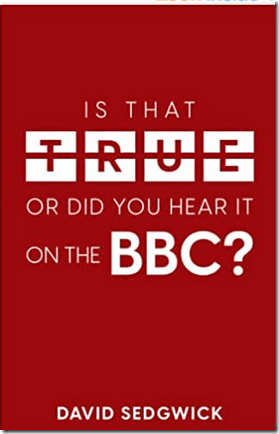 I have just bought this book, which includes some good stuff on the BBC’s climate lies and misinformation.
I have only read the first couple of chapters, but I would thoroughly recommend it.
This is the Amazon summary:
… not only does the BBC diligently protect power from scrutiny, it attacks and attempts to discredit those who dare to challenge the status quo.
Formed in 1922 by the British establishment, the BBC has always been a reliable ally of ultra-wealthy and powerful interests. Indeed, the broadcaster occupies a pivotal position within an international corporate-political alliance which promotes only those narratives which consolidate the ‘global order.’
Using multiple examples of BBC reporting, the author argues that the tax-payer funded broadcaster is a proxy which acts on behalf of a tiny, but very powerful clique – a role which compels it to pump out disinformation on an industrial scale, misleading all those who consume its content.
The book includes sections on:
- Climate Change
- Brexit
- COVID
- Trump
- NHS
Sedgwick’s premise is an interesting one that the BBC has always protected the establishment. One implication from this is that this same establishment has morphed over the years, from a reactionary one of the past to the left wing, big government, global world order one of today.
NYT Smears Dr. Mercola Again With Classic Orwellian Doublespeak
Video link
By Dr. Mercola | August 18, 2022
In July 2021, The New York Times (NYT) published the hit piece,1 “The Most Influential Spreader of Coronavirus Misinformation Online,” in which they made several blatantly false claims about me. Now, the NYT is upping the ante with an entire documentary dedicated to yours truly, titled “Superspreader.”
Ever since my book “The Truth About COVID-19” came out, the global cabal seems to have lost their collective minds. The New York Times has printed demonstrably false information about me on multiple occasions, CNN reporters have invaded my office and pursued me on my bicycle with unmarked vehicles, the president of the United States has utilized his federal agencies to target me — and my personal and business bank accounts were closed.
Twitter has banned anyone from sharing any link to my website, YouTube banned my account with over 15 years of content, while Facebook and Google have done everything possible to make me disappear. It certainly would be much easier to cave under the pressure, but if we don’t stand up for our rights and freedom now — when will it be too late? I will continue ‘superspreading’ truth and health until my last days.
NYT Hit Parade Continues With ‘Superspreader’
In an August 5, 2022, TV review, Alex Reif writes:2
“News can spread like a virus. In our fast-paced world, it doesn’t take long for either to spread around, which is why it’s so important to get your information from a good source.
In the latest installment of the FX series The New York Times Presents, viewers will get a perfect example of this with ‘Superspreader,’ which takes a look at one doctor with a massive following, who is credited as being the top spreader of misinformation regarding the COVID-19 and vaccine in the wellness industry …
One of the pre-credit notes at the end of the documentary states that FDA Commissioner Robert Califf considers misinformation to be the leading cause of death in the country and because of this …
[A]nother highlight of the film is an interview with Imran Ahmed, CEO of the Center for Encountering Digital Hate who ranked Mercola at the top of ‘The Disinformation Dozen,’ a numbers-based list of the twelve most influential people leading the COVID-19 anti-vaccination effort.
We also see how Mercola was de-platformed by several social media companies and how that hasn’t done all that much to stop the spread of misinformation.
At face value, The New York Times Presents ‘Superspreader’ is about Dr. Joseph Mercola, the empire he built, and the people who believe everything he says without question. But what viewers ultimately walk away with is a reminder that if something seems too good to be true, it most surely is.”
The NYT documentary premieres Friday, August 19, 2022, at 10 p.m. Eastern and 10 p.m. Pacific time, on FX and Hulu.
Truth Tellers Are Being Vindicated Every Day
In the NYT’s July 2021 hit piece, the author, Sheera Frenkel, cited an article I’d published in which she says I questioned “the legal definition of vaccines” and declared the COVID shots were “a medical fraud,” for the simple reason that they don’t prevent infections, they don’t provide immunity and don’t stop transmission of the infection.
According to Frenkel, that was misinformation. According to the U.S. government and its “experts,” the COVID jabs worked like any other vaccine. Check out the short video for a sampling of what Bill Gates, the Centers for Disease Control and Prevention, mainstream media, Dr. Anthony Fauci and President Biden were saying about the shots in early 2021.
The clear message — the promise — was that if you got the shots, you would not get COVID and you would not transmit it to others. Getting the population “vaccinated” would end the pandemic, for sure. Fast-forward to today, and the reality of the situation is beyond self-evident.
Biden, fully vaxxed and boosted has had COVID twice. Ditto for Fauci and a long list of government officials around the world. Outbreaks have repeatedly occurred at events where every single person present was fully vaxxed. So, the reality is that, back in February 2021, I warned that a medical fraud was being committed, and today, evidence from around the world show I was correct.
The shots do not prevent you from being infected, and they don’t prevent you from spreading it to others. As such, the COVID shots do not function as a vaccine at all, and mass vaccination cannot end the pandemic because you’re just as infectious if you get the shot and contract COVID as you would be if you were unjabbed.
Yet, despite the fact that time has vindicated me, the NYT has decided to double down and put out an entire documentary to cement the “superspreader of misinformation” label to my name when it really should be permanently attached to their own. It probably is important to note that they started their efforts on this video last year, in 2021.
‘Easily Disprovable’ Assertions Are in Fact True
In her 2021 hit piece, Frenkel also highlighted my comments about the COVID shots’ ability to “alter your genetic coding, essentially turning you into a bioweapon spike protein factory that has no off-switch.” According to Frenkel, these assertions “were easily disprovable.”
But did she disprove them? No. Here’s the reality: mRNA vaccines are by definition a genetic instruction set. That’s what messenger RNA (mRNA) is. And the mRNA created by Pfizer or Moderna are synthetic instructions that have never before existed in humans.
This is true for a variety of reasons, but the primary one is the substitution of pseudouridine for uridine to prevent the mRNA from being degraded. Natural mRNA is normally rapidly destroyed and this is by design as your body is very precise about producing proteins and does not produce them willy-nilly.
So is there an off switch? Absolutely not. There’s no off-switch programmed into these jabs. They are relying on your body’s normal degradation systems. The biotech industry has even referred to this reprogramming of your body as turning you into a “human bioreactor.”3
If an off-switch existed, the manufacturers would have assured us of that fact by now. In fact, they probably would have used the existence of a timed off-switch as the justification for boosters, but that has never come up. We know for sure that the mRNA jabs last at least 60 days and that is all we have for hard data. They more than likely last for six months and in some cases could last for years.
Asking Pointed, Nuanced Questions Is Bad?
Next, Frenkel went on to state that:4
“When the coronavirus hit last year, Dr. Mercola jumped on the news, with posts questioning the origins of the disease. In December, he used a study that examined mask-wearing by doctors to argue that masks did not stop the spread of the virus …
[R]ather than directly stating online that vaccines don’t work, Dr. Mercola’s posts often ask pointed questions about their safety and discuss studies that other doctors have refuted. Facebook and Twitter have allowed some of his posts to remain up with caution labels, and the companies have struggled to create rules to pull down posts that have nuance …”
So, I not only committed the “sin” of correctly warning people about the vaccine fraud committed, and had the audacity to follow science and reference published research, but I was also guilty of the “crime” of asking pointed, nuanced questions?
When merely asking questions is deemed a dangerous, if not criminal, act, you know you’re living under an authoritarian regime. It’s certainly far outside the accepted norms of “democracy” and “freedom” that the United States has been a beacon of since its inception.
Ineptitude at Its Finest
Further on in her hit piece, Frenkel makes a truly crucial error that no respectable journalist would ever dare make:
“In an email, Dr. Mercola said it was ‘quite peculiar to me that I am named as the #1 superspreader of misinformation.’ Some of his Facebook posts were only liked by hundreds of people, he said, so he didn’t understand ‘how the relatively small number of shares could possibly cause such calamity to Biden’s multibillion dollar vaccination campaign.’
The efforts against him are political, Dr. Mercola added, and he accused the White House of ‘illegal censorship by colluding with social media companies.’ He did not address whether his coronavirus claims were factual.
‘I am the lead author of a peer reviewed publication regarding vitamin D and the risk of COVID-19 and I have every right to inform the public by sharing my medical research,’ he said. He did not identify the publication, and The Times was unable to verify his claim.”
The problem with Frenkel’s assertion is that I did identify the publication. In fact, I emailed her the direct link. So, she lied. Secondly, my paper is beyond easy to locate. Just put my name into PubMed and you’ll find it. Believe it or not, you can even find it using the most biased search engine on earth, Google.
Daniel Engber, senior editor at the typically highly progressive mainstream media outlet, The Atlantic, commented on Frenkel’s clear ineptitude or malicious prevarication in a tweet:5
“A truly bizarre moment in the NYT piece on Joseph Mercola … you can literally verify the existence of this peer-reviewed publication in one second via googling. pubmed.ncbi.nlm.nih.gov/33142828/“
Legal Notice Sent to NYT
July 26, 2021, my attorneys sent the following legal notice to Frenkel at the NYT, demanding a retraction of her false statements:6
“Dear Ms. Frenkel,
The undersigned law firm represents Dr. Joseph Mercola in connection with the attached article that was widely published on July 24, 2021. We are providing notice that you have made several false and defamatory statements in this article:
1.You identified that you could not validate that Dr. Mercola published a peer reviewed study on Vitamin D in the severity of COVID-19. Dr. Mercola provided the direct link in response to you (attached) and any journalist or fact checker would simply find the study by searching “Mercola” in PubMed.
2.Your article falsely states Dr. Mercola has been fined “millions” by the FDA. This is completely fabricated, Dr. Mercola has never been fined by the FDA.
… On behalf of Dr. Mercola, we hereby demand you immediately retract the article. We also request that you preserve all communications and documents that relate to Dr. Mercola.”
Where’s the Proof That I Am the ‘No. 1’ Misinformant?
To this day, the NYT insists I’m the No.1 spreader of misinformation online, based on the fabrications of a group called Center for Countering Digital Hate (CCDH) — a “foreign dark money group,” to quote Missouri Sen. Josh Hawley,7 which sprang out of nowhere to create lists of people to be censored into oblivion.
The CCDH’s data gathering is so questionable, even ultra-biased Facebook ended up publicly criticizing it. In an August 18, 2021, Facebook report, Monika Bickert, vice president of Facebook content policy, set the record straight:8
“In recent weeks, there has been a debate about whether the global problem of COVID-19 vaccine misinformation can be solved simply by removing 12 people from social media platforms. People who have advanced this narrative contend that these 12 people are responsible for 73% of online vaccine misinformation on Facebook. There isn’t any evidence to support this claim …
In fact, these 12 people are responsible for about just 0.05% of all views of vaccine-related content on Facebook. This includes all vaccine-related posts they’ve shared, whether true or false, as well as URLs associated with these people.”
At the time that Frenkel made her accusations, a Crowdtangle search for Facebook posts about the COVID jabs, from mid-June to mid-July 2021, also confirmed that my online reach was negligible. Topping the list of top performing Facebook posts expressing negative views about the COVID jabs was Candace Owens, followed by the mainstream news outlet ABC World News Tonight.9
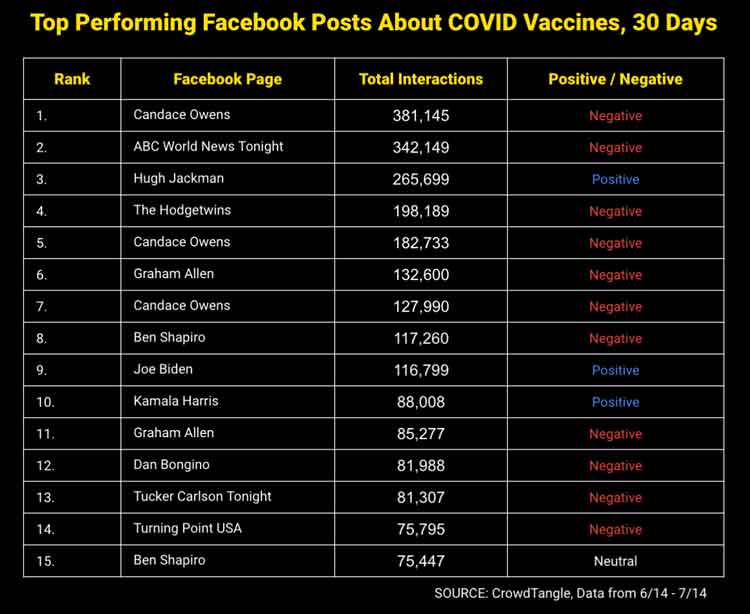
The befuddling reality here is that most of the people identified as “top spreaders of misinformation” actually have negligible reach — at least compared to the people on this Crowdtangle list. None of the CCDH’s “top vaccine misinformants” are on the list above, and our reach certainly has not improved or expanded since then.
If You’re Targeted, You’re On-Target
This naturally raises the question, why were we targeted in the first place? Is it because we have high credibility from being one of the first natural health sites on the web with the most followers? Is it because we’ve spent a quarter of a century gaining people’s trust by mostly being correct about the health care system and criminal Big Pharma behavior?
Is it because we, more than others, have well-established credibility and are directly over the target? Is it because we have the experience and know-how to make accurate predictions? Is it because we see and explain the bigger picture?
Or is it some other reason entirely? It’s a mystery, really, but what is clear is that we’ve been deemed a threat to the official propaganda narrative, and I, for whatever reason, am at the very top of that threat identification list. Well, I’ve said this before, and I’ll say it again: I’m beyond truly honored to have been widely disparaged by one of the arms of the U.S. military and intelligence operations.
Being targeted in this fashion — tedious as it may be — is in fact a badge of honor. It tells me I’m doing the right thing, and that I’ve not misinterpreted the intentions behind the COVID machinations. More so than any intuition, it tells me I’m on target.
In the bright light of undeniable reality — as it is, a year later — it’s clear that Frenkel’s hit piece has not aged well. I doubt the NYT’s “Superspreader” documentary will fare much better. In the final analysis, if you want any hope of controlling your health, and that of your family, you’d be wise to understand legacy media speaks in Orwellian Doublespeak and reality is the opposite of virtually everything they are telling you.
Sources and References
Climate change is not making children obese
BY MARY HARRINGTON | UNHERD | AUGUST 15, 2022
If you’re a hammer, everything looks like a nail. And if you’re a media ecosystem with a fixation on hammers, you will do your best to make anything look like a nail.
This is the inescapable conclusion from the reporting around a recent study, published in the peer-reviewed journal Temperature, which looked at the relationship between climate change and children’s fitness — and reported the findings entirely backwards to fit a pre-existing political narrative.
The study pointed out that children’s aerobic physical fitness is 30% lower than that of their parents at the same age, arguing that this is a problem because aerobic physical fitness is vital for tolerating higher temperatures. This in turn means that where climate change is causing temperatures to increase, obese individuals will find it harder to cope.
This is sensible stuff — but the study was reported as stating that climate change had caused reduced fitness in children. The study itself pointed to Covid lockdown measures, among many other factors, as having exacerbated an already-existing issue of poor fitness in children. But headlines suggested children are staying indoors because it’s too hot and that this is why they’re less fit than their parents.
You don’t have to be a scientist to know that reduced aerobic fitness in this generation of children long precedes measurably rising outdoor temperatures of the kind that could be attributed to climate change. Here’s a report from 2013 on the topic, for example, that describes aerobic fitness in children decreasing every decade from 1975 onward.
Nor do you have to be a scientist to come up with multiple factors that are plausibly contributing to this unhappy situation. Anyone with young children, or just rudimentary powers of observation, needs only a moment’s reflection to think of multiple ways in which 21st-century life militates against physically active childhood, compared to the world just a few decades ago. But we mustn’t let minor considerations like the patent absurdity of a claim, or its rampant misreading of an actual scientific paper, get in the way of a clickbait mass-media narrative on a much-hyped topic.
A sensible paper discussing the importance of physical fitness in ensuring resilience in the face of changing climate has been reported entirely backwards. Obesity, discussed as a cause of difficulty in adapting to climate change, is reported as the effect of climate change itself, while ignoring politically inconvenient factors cited in the paper itself as contributing to poor fitness.
But this is only an especially egregious example of how even supposedly respectable media can’t be relied on to read even the abstract of a research paper, before editorialising on it in terms that align with established political narratives. And arguably whether or not such specious editorialising qualifies as “misinformation” mostly depends on your political priors.
Given this, the now-widespread cynicism that increasingly greets “expert” opinion in the press is perhaps understandable. It’s all very well saying “follow the science” – but the average Joe may be forgiven for concluding that “the science” is not so much a reliable source of truth as a pick n’mix array of talking-points for a pre-determined political agenda.
A Drought In Germany Gets The Media Overexcited
By Paul Homewood | Not A Lot Of People Know That | August 14, 2022
There is a drought in Germany, and naturally the media has gone into hyperdrive to link it to global warming:
Drought hits Germany’s Rhine River: ‘We have 30cm of water left’
This report is all over the media, and all with virtually the same wording, suggesting a carefully coordinated, manufactured story, almost certainly from one of the well funded, climate misinformation organisations.
The BBC headline is grossly misleading, as the 30cm is the water under the boat; As Captain Kempl comments, the river depth is actually 1.5m.
The river gauge measurement of 42cm at Kaub is also widely reported, but is equally misleading, as this measurement is taken near the river bank, rather than at the deepest part of the stream.
In none of the dozens of reports I have read is there any actual historical data to compare against this event, whether rainfall or water level data. We are told this is the lowest water level since 2018, as if this means anything at all. There is no evidence presented to show that this drought is in any way unprecedented, or that droughts are becoming more extreme; merely this claim that appears in most of the articles:
“HGK and other shipping companies are preparing for a “new normal” in which low water levels become more common as global warming makes droughts more severe, sapping water along the length of the Rhine from the Swiss Alps to the North Sea.
“There’s no denying climate change and the industry is adjusting to it,”
However, annual rainfall trends at Mainz, which is just upstream of Kalb, show that while recent years have been drier than the 1980s and 90s, they are no drier than the 1950s. We also see exactly the same trends with April to September rainfall:


And finally, WUWT offers an insight to some of the megadroughts in Germany in the past, notably in 1540.
There is therefore nothing to suggest that this is not just another weather event.
The Mainstream Media is Gaslighting Us About Climate Change
BY CHRIS MORRISON | THE DAILY SCEPTIC | AUGUST 12, 2022
In 2013, the CNN presenter Deborah Feyerick asked if asteroids falling to earth were caused by climate change. Earlier this year, CBS anchor Nate Burleson commented on the Tonga earthquake by saying: “We talk about climate change… these stories are a harsh reality of what we are going through. We have to do our part because these are more frequent.” Last week, the academic networking blog The Conversation discussed the Fagradalsfjall volcano eruption in Iceland and asked: “Is climate change causing more eruptions?”, adding that it had the potential to increase volcanic eruptions and affect their size.
Dear God – they’ll be telling us that climate change causes lightning next. Wait, hang on – “Washington DC lightning strike that killed two serves as climate warning” – Reuters, August 5th.
In the climate change show, jumping the shark is now a daily occurrence, particularly in the mainstream media. Gaslighting on a global scale is evident as the media push the command-and-control Net Zero agenda. Bad weather incidents and natural disasters are catastrophised to promote this increasingly hard-left political agenda. But the distinguished atmospheric scientist Emeritus Professor Richard Lindzen of MIT recently voiced the views of an increasing number of people when he said the current climate narrative was “absurd”. Yet he acknowledged that it had universal acceptance, despite the fact that in a normal world the counter-arguments would be compelling. “Perhaps it is the trillions of dollars being diverted into every green project under the sun, and the relentless propaganda from grant-dependent academics and agenda-driven journalists, along with the political control offered to elite groups in society by Net Zero, that currently says it is not absurd,” he speculated.
The Daily Sceptic has written numerous articles presenting evidence that global warming started to run out of steam over 20 years ago, despite the frequent, back-dated and upward temperature adjustments made by state-funded weather services. No science paper exists that proves conclusively that humans cause noticeable changes in the climate by burning fossil fuel. Despite years of research, scientists are no nearer knowing how much temperatures will rise if carbon dioxide doubles in the atmosphere. No link has been shown directly connecting temperatures and CO2 rises (and falls) over the entire paleoclimatic record. Countless natural processes play a part in determining climate conditions. And attempts to link individual weather events to long-term changes in the climate are produced by climate modellers and green activists giving vent to wishful thinking.
In the absence of credible science, there has been a resort to the name-calling, shaming and appeals to authority, common in previous ages. The recent news that the Great Barrier Reef (GBR) had returned to blooming health, and was showing record growth, was a disaster for most mainstream media outlets. All parts had reported for years that the coral was on its last legs due to human-induced climate change. During this time, the GBR observer Professor Peter Ridd was vilified for stating that the reef was a vibrant and healthy ecosystem. He was fired from his post at James Cook University for pointing out the deficiencies in the output of reef science institutions.
In August 2019, the Guardian reported that the former Australian chief scientist Ian Chubb had accused Ridd of “misrepresenting robust science” about the plight of the GBR. Shamefully, it repeated without comment Chubb’s slur that Ridd was relying on the “strategy used by the tobacco industry to raise doubts about the impact of smoking”.
Professor Ridd emerges from the whole sorry affair with his reputation restored and an acknowledgement that true scientists report their findings without fear of the mob, or seeking the favour of the Establishment.
Just days before the news was confirmed that the GBR was continuing to grow back in record amounts, the Guardian ran a long article saying that scientists had demonstrated “beyond any doubt” that humanity is forcing the climate to disastrous new extremes, They hadn’t, of course, and “beyond any doubt” is a phrase borrowed from the criminal law, not science. Professor Terry Hughes from the National Coral Bleaching Taskforce estimated that close to 50% of the GBR coral is already dead. Attribution science is said to show that the hot March weather in 2016 that caused a “catastrophic die-off” in 2016 was made “at least 175 times more likely” by the human influence on the climate. A more realistic explanation, invariably ignored in mainstream media, is that the powerful El Nino experienced in that year warmed sea waters temporarily, and led to a natural burst of bleaching. Full reef health was quickly restored when the effect of the natural oscillation was removed.
The global media gaslighting over political climate change is easier to understand if you follow the money. Earlier this year, the Daily Sceptic reported that the Associated Press was adding two dozen journalists to cover “climate issues”. Five billionaire foundations, including the left-wing Rockefeller operation, supplied $8 million. AP now says over 50 jobs are funded from these sources. The BBC and the Guardian regularly receive multi-million dollar contributions from the trusts of wealthy donors. It is estimated that Bill Gates has given more than $300 million over the past decade to a wide variety of media outlets. Democrat power couple James and Kathryn Murdoch also help pay the staff’s wages at AP. On their Foundation web site, it is noted that there is an investment in Climate Central, where meteorologists are used as “trusted messengers” of the links between extreme weather and climate change.
Meanwhile, the foundation of the green technology-funding Spanish bank BBVA hands out annual €100,000 payments. Last year the cash went to Marlow Hood of Agence France-Presse, who describes himself as the “Herald of the Anthropocene”, the latter being a political renaming of the current Holocene era. In 2019 Matt McGrath of the BBC took home the annual prize, while in 2020 it ended up in the coffers of the Guardian.
The White Queen tried to believe in six impossible things before breakfast. It’s a shame climate change wasn’t around in Alice’s day.
Chris Morrison is the Daily Sceptic’s Environment Editor
Featured Video

Bombing Hitler’s Hometown
or go to
Aletho News Archives – Video-Images
From the Archives
The Biggest Threat to Peace in Middle East
By Dr. Elias Akleh* | Sabbah Report | May 24, 2010
A build up of heightened tension in the Middle East is escalating in the last few weeks. American and Israeli postures towards Lebanon, Syria, and Iran have become more threatening. Listening to speeches of political leaders one hears talks only about war not peace. Iranians and Israelis are continuously training hard for a possible showdown. Both sides are conducting extensive war games every month. This led Syrians to claim that Israel is preparing for a soon-to-come another war. The Jordanians also are warning that current stalemate of the peace process is an indication of a war breaking out this summer. The Russian President and his army chief hinted, a few months ago, that the US and Israel were planning for an attack on Iran.
Indeed Iran is, as it has been for last few years, the target of most of the threats and accusations of supporting terrorism. Escalating incitement against Iran the American Defense Department sent last month (April) to Congress a report on Iran’s military claiming Iran could develop intercontinental ballistic missiles capable of reaching the US by 2015.
Ignoring the fact that N. Korea, India, Pakistan, and Israel are proven to have nuclear weapons while Iran does not, the US Secretary of State Hillary Clinton chose in her speech, to the nuclear Non-Proliferation Treaty review conference at the UN, to focus on Iran’s alleged nuclear ambitions putting the whole world at risk as she put it. According to Clinton Iran’s acquisition of nuclear weapons, rather than Israel’s more than 200 nuclear bombs, is destabilizing the Middle East. She called on the world’s nations to rally around US efforts to hold Iran, not other nuclear countries, to account.
The accusation that Usama Bin Laden is living comfortably in Iran had received a boost after the broadcast of a documentary called “Feathered Cocaine”. This echoed the June 2003 claims of the Italian newspaper Corre de la Sierra that Bin Laden was in Iran according to some intelligence report, and according to Richard Miniter’s book “Shadow War”. … continue
Blog Roll
 Aletho News
- Bombing Hitler’s Hometown
- German journalist threatened with homelessness as German court upholds EU sanctions in landmark free speech case
- US Tells Allies That Ukraine-Bound Arms Could be Sent to Middle East
- Organized terrorism: Iran condemns killing of its diplomats in Lebanon
- Why could Gaza enter the regional war?
- Hamas official rejects Mladenov Plan linking disarmament to Gaza reconstruction
- Two Primary Elections for the Soul of ‘America First’
- Japan Clings to US Vassalage Despite Energy Crunch Caused By Iran War
- US Seeks Control Over Global Energy Infrastructure – Kremlin
- US senators target Orban government for standing up to Zelensky
- If Americans Knew
- Researchers at Human Rights Watch Resign Over Blocked Report on Palestinian Refugee Return
- Jewish Groups Are Backing a War Americans Don’t Want
- Eric Fingerhut Thinks He’s the President of the Jews
- Top Jewish Philanthropists, Rabbis Urge Israeli President to Take Action Against ‘Jewish Extremists’
- Don’t Be Fooled. Zionist Leaders Have Always Wanted to Control Southern Lebanon
- Israel’s widespread use of torture is a core element of its genocide against the Palestinian people
- In Israel’s War on Iran, Many Middle East US Bases Rendered “All But Uninhabitable”
- ‘Burn the lawn’: Israel pursues ‘Rafah model’ in southern Lebanon
- A genocide here, an amputation there
- Reports: Iran mobilizing 1M fighters, Israel-US run low on ammo, Israeli army faces shortage – Not a ceasefire Day 168
- No Tricks Zone
- Devastating Assessment Of Comirnaty Vaccine By Former Senior Pfizer Europe Toxicologist
- New Study: CO2 Is ‘Effectively Negligible’ As An Explanatory Climate Change Factor Since 2000
- Former Pfizer Toxicologist Dr. Helmut Sterz Tells Bundestag Hearing Pfizer Vaccine Should Have Never Been Approved
- Energy Expert: Germany’s Nuclear Phaseout Was A “500 Billion Euro Mistake”
- New Research: South Australia’s Mid-Holocene Sea Surface Temperatures Were 4°C Warmer Than Today
- Storing Green Energy To Last Germany 10 Days Would Require A 60-Million Tonne Battery
- New Studies: UK Sea Levels Were 4 Meters Higher Than Today During The Mid-Holocene
- Destructive Green New Deal: German Energy And Metal Group Warns Of Drastic Crisis
- New Study Documents A 20-Year Pause In Arctic Sea Ice Decline – Driven By Internal Variability
- Wake-up Call: Survey Shows Majority Of Germans Now Favor Postponing Climate Targets!
 Aletho News