Naughty Russians
BY PHILIP GIRALDI • UNZ REVIEW • NOVEMBER 6, 2022
According to the New York Times those naughty Russians are at it again.
Today’s online lead story entitled “Russia Reactivates Its Trolls and Bots Ahead of Tuesday’s Midterms” with the subtitle “Researchers have identified a series of Russian information operations to influence American elections and, perhaps, erode support for Ukraine” marks a new low in what the Gray Lady, self-designated as one of America’s “newspapers of record,” prefers to call “journalism.” The author of the piece, clearly somewhat biased over Russia and Putin, is one “Steven Lee Myers [who] covers misinformation for The Times. He is also the author of ‘The New Tsar: The Rise and Reign of Vladimir Putin.’”
Here is what it is all about: “The user on Gab who identifies as Nora Berka resurfaced in August after a yearlong silence on the social media platform, reposting a handful of messages with sharply conservative political themes before writing a stream of original vitriol. The posts mostly denigrated President Biden and other prominent Democrats, sometimes obscenely. They also lamented the use of taxpayer dollars to support Ukraine in its war against invading Russian forces, depicting Ukraine’s president as a caricature straight out of Russian propaganda.”
Per the Times, “The goal, as before, is to stoke anger among conservative voters and to undermine trust in the American electoral system. This time, it also appears intended to undermine the Biden administration’s extensive military assistance to Ukraine.”
Well, one might object that Ukraine’s president is indeed a figure tailor-made for ridicule as he used to play a piano with his penis, but that is perhaps a secondary issue. The more significant theme is that people who oppose the Ukraine war, for any number of reasons, and, particularly if they are conservatives, are becoming trolls for Russia in part due to the disinformation efforts and are being influenced by way of discussion fora like Gab. The targets “are generally US conservatives who are maybe more accepting of conspiratorial claims” according to one of the cybersecurity experts consulted by the author. The Times links Berka, who might indeed be a made-up identity “posing as an outraged American,” to the secretive Russian Internet Research Agency in St Petersburg which it claims was involved in interfering in both the 2016 and 2020 US elections.
The Times also names another site that it links to Russia, electiontruth.net “For its contact information, electiontruth.net lists a cafe inside a converted gas station in Cotter, Ark., a town of 900 people on a bend in the White River. The cafe has closed, however… No one at Election Truth responded to a request for comment submitted through the site.”
One might object that neither Berka nor electiontruth.net would appear to be a major disinformation threat sponsored by a foreign government intended to bring down the Republic. Nevertheless, the article clearly adheres to the view that anyone objecting to the continuing war in Ukraine is a Russian dupe. It cites Liz Cheney, who has called the few Republicans who want to cut funding for the war as “the Putin wing of the Republican Party,” and Myers observes that the disinformation unfortunately echoes “a theme that has gained some traction among Republican lawmakers and voters who have questioned the delivery of weapons and other military assistance.”
Another “expert” cited in the article, one Edward P. Perez, a board member with the OSET Institute, a self-described “nonpartisan election security organization,” called the Russian efforts “manufactured chaos” in the country’s body politic – in part because the divisions in American society are already such fertile soil for disinformation. “Since 2016, it appears that foreign states can afford to take some of the foot off the gas because they have already created such sufficient division that there are many domestic actors to carry the water of disinformation for them.”
Myers and his agenda driven quoted “experts” do not consider for a moment that there are a lot of good reasons for opposing US involvement in the fighting in Ukraine, many of which are rooted in a conservative view of what is America’s appropriate role in what is becoming a multipolar world. First, the United States has no national interest at stake that compels it to enter the fighting on behalf of Ukraine. Second, the war itself could have been averted if the United States and Europeans had been willing to address and negotiate Russian national security concerns in a serious way before the fighting broke out. Third, even now, a push by the US and its allies would likely bring the two sides to the negotiating table and a truce could be arranged. Fourth, the United States would in fact be playing a positive role if it would opt to do whatever it takes to end the slaughter taking place. Fifth and finally, expansion of a US direct role in the conflict could prove catastrophic if someone blinks and the war goes nuclear.
So, the compelling need for the continuation of an unnecessary war is the main point being made by Mr. Myers’ featured article, which clearly reflects the views of the New York Times editorial staff. And the enemy characteristically comes from within – Americans who oppose the involvement of the United States in the war against Russia and are accused of being little more than “domestic actors” who are peddling disinformation provided by the Kremlin. Given that this article has appeared two days before national elections, the intent is clear. The Russians are, per the Times, generating disinformation about Ukraine and Americans who go along with the lies are being manipulated. Moscow is again interfering in a US national election! Vote for the Democratic candidates as they will be the ones that can be relied upon to keep the war going! Three cheers for Joe Biden!
The climate scaremongers: Health chief’s nonsensical warning of doom
By Paul Homewood | TCW Defending Freedom | November 4, 2022
We are used to silly, irresponsible climate scare stories from the BBC and the papers, but when they come from the chief executive of the UK Health Security Agency it is quite another matter.
According to the Guardian last week: ‘The climate crisis poses a “significant and growing threat” to health in the UK, the country’s most senior public health expert has warned.
‘Professor Dame Jenny Harries, the chief executive of the UK Health Security Agency, said there was a common misconception that a warmer climate would bring net health benefits due to milder winters. But the climate emergency would bring far wider-reaching health impacts, she said, with food security, flooding and mosquito-borne diseases posing threats.
‘Referring to the recent floods in Pakistan, Harries said the UK needed to build resilience to protect the population from the health impacts of extreme weather events. “Colleagues from Pakistan . . . are suffering from the impacts of flooding. They are dealing with stagnant water, higher risks of sewage overflowing into publicly accessible water spaces,” she said. “We are seeing some of the things that could be happening in the UK”.’
She went on to repeat the fake claims that this summer’s heatwave had killed 2,800 people, a claim already exposed as a sham on TCW. And she warned us that we would have to stay indoors in the middle of the day in summer, and have longer summer holidays for schools. She even ridiculously claimed that we would soon have outbreaks of dengue fever.
The comparison with Pakistan is utterly absurd, and there’s no evidence that summers in England are getting wetter, or for that matter drier.

Indeed, even her claim that we would soon be having Mediterranean summers is just as ridiculous. The simple fact is that even this summer was not as hot as 1976. The average summer temperature may have increased, as cold summers become less frequent, but even with the wall-to-wall sunshine we had this year, summers show no sign of breaking through that 16C barrier:

By contrast, average summer temperatures in the south of France are typically six or seven degrees higher.
Harries’s comments about dengue are particularly misleading. The spread of dengue globally has not been because of climate change, as one of the world’s leading experts on infectious diseases, Professor Duane Gubler, has explained.
According to him, the principal drivers are urbanisation, globalisation and lack of effective mosquito control. The mosquitoes which carry the virus thrive in urban habitats, where dengue quickly spreads, while air travel provides the ideal mechanism for transport of viruses to new cities, regions and continents. The result, he says, is epidemic dengue.
The World Health Organisation also notes that the mosquito which has brought the dengue virus to Europe is actually adapted to cold weather: ‘Aedes albopictus, a secondary dengue vector in Asia, has spread to North America and more than 25 countries in the European Region, largely due to the international trade in used tyres (a breeding habitat) and other goods (e.g. lucky bamboo). Aedes albopictus is highly adaptive and, therefore, can survive in cooler temperate regions of Europe.’
Britain is no stranger to mosquito-borne diseases such as dengue. Large epidemics of dengue have been recorded here and elsewhere in Europe since the 18th century. One massive epidemic, estimated at one million cases with at least 1,000 deaths, occurred in Greece in 1927-28. Climate change has nothing to do with the spread of dengue.
And what about this ‘food security’ Harries is waffling on about? Agricultural output has been rising since the BSE scare of the 1990s:

https://www.fao.org/faostat/en/#compare
If the professor is worried about Britain’s food security, maybe she should be objecting to the government’s plans to rewild large swathes of our countryside, to attack the dairy and meat industry and to build solar farms on prime agricultural land.
BBC’s Arctic warming trick
ACCORDING to a BBC report, Svalbard, the Norwegian archipelago deep inside the Arctic Circle, is heating at six times the global average. (The BBC and Guardian now routinely call it ‘heating’ rather than ‘warming’, though I don’t think the Svalbarders would call average annual temperatures of 1C ‘hot’!)
The report, Svalbard: The race to save the fastest-warming place on Earth, states: ‘Svalbard is home to the world’s northernmost permanent settlement, Longyearbyen, which is estimated to be heating at six times the global average. So what is being done to save it?
‘Svalbard’s church is a blood-red wooden building with bright white trim – the most northerly place of worship in the world. Its priest, Siv Limstrand, has been here for only three years but is shocked by the impact of climate change she has witnessed in that time. “Every Sunday when we gather for worship, a part of our intercessions is always about climate change and its threats,” explains Limstrand. “We know that the clock is ticking.”
‘You feel on borrowed time here in what successive scientific studies have found is the fastest-warming place on Earth. Experts from the Norwegian Polar Institute are among those who calculate it is heating six times faster than the global average. The consensus is that the temperature in Svalbard has jumped 4C in the past 50 years. Wildlife and human life are now in a struggle to survive. This is why Limstrand’s congregation is praying for help.’
Obviously a priest who has been there three years is an expert on Svalbard’s climate!
But as this is the BBC, they tell you only half the story. In line with most of the Arctic, Svalbard was virtually as warm as now in the 1930s and 40s, as the chart for Bjoernoeya (Bear Island) shows:

https://www.ecad.eu/indicesextremes/customquerytimeseriesplots.php
In between, as the chart highlights, Svalbard went through a drastic cooling episode in the 1960s and 70s. It is from this unusually cold base period that the BBC claim their 4C of warming. That extreme cold interval affected much of the Arctic, and had a particularly catastrophic effect on countries like Iceland. Trausti Jonsson, senior researcher at the Iceland Met Office, lived through those times and said this:
‘In 1965 there was a real and very sudden climatic change in Iceland (deterioration). It was larger in the north than in the south and affected both the agriculture and fishing – and therefore also the whole of society with soaring unemployment rates and a 50 per cent devaluation of the local currency,’
Going further back in time, ice core studies have shown that Svalbard was as warm as now, if not warmer, in the 1300s, before temperatures plunged in the Little Ice Age. The 1800s were the coldest period of the lot in the last 1,000 years.
There is nothing unprecedented or unusual about Svalbard’s climate nowadays. But the BBC would rather the inhabitants return to the freezing days of the 1960s!
Another Extraordinary Murder in Washington D.C.
Mary Mahoney was allegedly the victim of a botched robbery in the Georgetown Starbucks

Mary Mahoney, murdered on July 7, 1997
By John Leake | Courageous Discourse | November 6, 2022
When Seth Rich was murdered in Washington D.C. on July 10, 2016, the Metropolitan Police Department immediately proposed that it was a “botched robbery.” The case reminded me of the murder of Mary Mahoney in a Georgetown Starbucks on July 7, 1997.
Mary Mahoney was an intern in Bill Clinton’s White House during his first term. She then got a job working as a manager of Starbucks in Georgetown, which was frequented by many notable figures in the Washington political establishment. Her murder (along with her two coworkers) was the first triple murder in the neighborhood’s history. Prior to the crime, not a single homicide had been committed in Georgetown for eighteen months.
Robbery appeared an unlikely motive, as none of the day’s cash proceeds had been taken from the store. Mahoney’s murder occurred during the same period that Newsweek reporter Mike Isikoff was investigating allegations that President Clinton had sexually harassed White House employees—an investigation that would ultimately lead him to Monica Lewinsky. Attorneys for Paula Jones were also seeking corroborating cases of Clinton’s sexual harassment of young women.
A year after the murder occurred, the police received a tip to examine a man named Carl D. Cooper from a woman who had just watched an America’s Most Wanted episode on the triple homicide. For several months, investigators found no evidence linking Cooper to the crime. Then another informant came forth—a former drug addict named Eric Butera, who was himself later murdered in “a robbery gone wrong.”
Based on information gleaned from Butera’s associates, Carl Cooper was arrested. After a grueling four-day interrogation, Cooper confessed, stating that the triple homicide was a “botched robbery” (which just happened to be the official working hypothesis). While held at gunpoint, Mary, refused to give Cooper the keys to the safe—a heroic act to save her 50 billion market cap employer from losing a few thousand dollars. Because Mary refused to give Cooper the keys, he shot her five times, including a shot to the back of the head. He then shot her two coworkers, and then left the store without taking a dime.
Cooper was convicted on the grounds of his confession to the Metropolitan Police. However, in a subsequent interview with an FBI investigator, Cooper recanted his confession. Although the FBI investigator unequivocally stated this in his testimony, the court concluded that Cooper’s initial confession was sufficient for his conviction. Cooper was initially represented by a court-appointed attorney, but after his trial began, his court-appointed attorney was joined by the prominent Washington D.C. defender, Francis D. Carter, who initially represented Monica Lewinsky when Monica stated her willingness to remain silent about her affair with Clinton. Carter drafted an affidavit for Monica in which she stated that she had NOT had an affair with the president. Carter was forced to withdraw this affidavit after Monica made statements to Lynda Tripp (equipped with a secret recording device) confirming her affair with Clinton.
That Carter joined the Carl Cooper defense team strikes me as very peculiar, especially given that Carter did not change the defense strategy. I wonder if Carter’s primarily job was—under cover of client-attorney confidentiality—to deliver a message to Carter pertaining to his sentencing prospects and what he might reasonably expect for his wife (to whom he was apparently very attached) if he stuck with his confession.
Clinton Attorney General Janet Reno initially sought the death penalty for Cooper— the first death-penalty matter brought to trial in the District in nearly 30 years, but federal prosecutors later withdrew this request. To date, no evidence has been found linking Cooper to the triple homicide.
In a related case, the District of Columbia was successfully sued for the wrongful death of Metropolitan Police informant, Eric Butera, as the jury concluded the police had been negligent in protecting him during an undercover operation to obtain more information about the Starbucks triple slaying. The woman who gave the initial tip to America’s Most Wanted later publicly accused the police of refusing to protect her and fell under suspicion for being motivated primarily by the reward money offered by the show.
Since the murders occurred, the crime has been the subject of extensive media coverage, several documentary television features, and hundreds of online commentators. Conventional newspaper coverage of the crimes—primarily conducted by the Washington Post and the Washington Times—consisted entirely of straightforward reporting of information provided by police and judicial officers.
Given the controversial nature of the police investigation and judicial proceedings against the man who was charged for committing the crime, it is surprising how little the mainstream media questioned official accounts. Likewise, the TV documentaries simply presented narratives provided by law officers as though they contained nothing that was questionable. This is particularly notable given that substantial details of the official narrative, provided by the same investigating officers, are represented differently in different documentaries. Moreover, some of officers’ statements in the documentaries pertaining to Starbucks procedures and security protocols are NOT consistent with what a veteran Starbucks manager told me.
I would like to interview Carl D. Cooper in prison, but I cannot find him in the federal prison system. Though I have not had the time and resources to dig deep into this component of the story, my preliminary research suggests that his whereabouts in the federal prison system have been concealed.
In 2016, the lead homicide detective in the Mary Mahoney case — Detective James Trainium — published a book titled How the Police Generate False Confessions. It’s a detailed examination of how the police obtain false confessions, and the author is clearly writing from personal experience.
How the US regime attempts to control public perception of its aid to Ukraine
By Scott Ritter | RT | November 5, 2022
NBC News has reported that, according to four people familiar with the incident, a phone call between US President Joe Biden and his Ukrainian counterpart, Vladimir Zelensky, turned testy after the Ukrainian leader pressed Biden for more assistance.
On June 15, Biden called Zelensky to inform him of the recent release of some $1 billion in assistance (this included the drawdown of arms and equipment from US Department of Defense inventories valued at $350 million, and $650 million in additional assistance under the department’s Ukraine Security Assistance Initiative). This type of person-to-person communication had become commonplace since Russia’s decision to send troops into Ukraine in February 2022, with Biden informing Zelensky of each major assistance allocation in a program that had, as of June 15, seen the dispatch of some $5.6 billion in American military aid.
This time, however, rather than thank the US president, as had been the previous practice, Zelensky proceeded to ask for more assistance, citing specific requests for equipment that had not been included in the June allocation of aid. At this point, NBC’s sources say, Biden lost his temper. “The American people were being quite generous, and his administration and the US military were working hard to help Ukraine, he said, raising his voice, and Zelensky could show a little more gratitude,” the NBC story reports.
According to NBC, the source of Biden’s anger went beyond the lack of gratitude shown by Zelensky (NBC reports that the two leaders have since warmed to one another), but rather the growing realization on the part of the Biden White House that support for the blank check being written for Ukraine’s war effort is waning among members of Congress on both sides of the aisle. With the Republicans expected to retake control of the House of Representatives and positioned to do the same in the Senate in the upcoming mid-term elections, the Biden administration appears poised to try to squeeze out another $40-60 billion in aid during the lame duck session between the election and when the present term of Congress expires next January. It is expected that this new aid package will be challenged by the Republicans, who will seek to have its consideration postponed until the new Republican-controlled Congress is sworn in.
Shortly before NBC News broke the story of the contentious Biden-Zelensky phone call, The New Yorker ran a glowing review of the state of US-Ukrainian military cooperation. Entitled ‘Inside the US Effort to Arm Ukraine, the piece, authored by Joshua Yaffa, a contributing writer for the magazine, provides an expansive and yet intimate look at the complex interaction between the US and Ukraine about not only the provision of military equipment, but also the active cooperation between US and Ukrainian military and intelligence officials concerning the actual conduct of the conflict, including the provision of targeting data in support of US-provided artillery systems such as the M777 howitzer and the HIMARS multiple rocket launch system.
Its two main messages can be summarized as follows: first, American weapons are helping Ukraine stand up to Russia and showing the world Putin can be defeated, and second, the US is taking every care not to cross any lines that would escalate the conflict into a direct confrontation with Moscow.
Yaffa is an accomplished writer on Russian affairs. His most recent book, ‘Between Two Fires: Truth, Ambition, and Compromise in Putin’s Russia’, has won several prizes, and he has published numerous articles in The New Yorker about the Russia-Ukraine conflict. But even this extensive journalistic record doesn’t prepare one for the scope and scale of the sources Yaffa was able to draw upon in writing his most recent article. It is a ‘who’s who’ of US and Ukrainian officialdom, both named and unnamed, all of whom are well positioned to provide Yaffa with the kind of inside information that makes his article so attractive, both from an informational aspect, and readability.
On the Ukrainian side, Yaffa interviewed Aleksey Reznikov, Ukraine’s defense minister; Mikhail Podoliak, a top adviser to Zelensky; Aleksey Danilov, Secretary of the Ukrainian National Security and Defense Council; and “a senior Ukrainian military official” close to the commander in chief of the military, Valery Zaluzhny. Ukrainian officials habitually interact with Western journalists as part of their effort to shape the narrative about the ongoing conflict with Russia. The surprise isn’t that Yaffa was able to interview these individuals, but rather what they were willing to open up about – the hitherto obscure details of the sensitive cooperation between the US and Ukraine in the actual conduct of the conflict.
The US is very controlling about the release of information about classified cooperation with other nations. This reticence to be transparent extends not only to the US officials involved, but also to the foreign nationals participating in the secret work. In short, there is no way the three Ukrainians would have agreed to sit down and talk to Yaffa about these issues unless their participation had been green-lighted by the Biden administration beforehand.
The extent to which the Biden administration was behind the decision to cooperate with Yaffa on this story becomes clear upon closer examination of the anonymous sources drawn upon for the article. “A Biden administration official involved in Ukraine policy”; “a senior official at the Defense Department”; “a person familiar with Biden White House discussions of Ukraine”; “an administration official”; “a senior US official”; “a US military official” close to Chairman of the Joint Chiefs of Staff General Milley; “a senior Biden administration official”; and “a senior US intelligence official.”
Numerous other sources, both named and unnamed, were also interviewed by Yaffa.
Anyone with any experience with sensitive national security activities knows that there are two hard-fast truths when it comes to such activities – they are highly classified and compartmentalized, and any unauthorized release of information pertaining to such activities is a serious violation of the law, subject to prosecution and imprisonment for anyone caught leaking such information to the press.
Accordingly, either every source cited by Yaffa had been simultaneously overcome with a Lemming-like desire to jump off a figurative cliff, risking losing their careers and going to prison in order to help the young New Yorker contributing writer pull off the scoop of a lifetime, or the Yaffa article was part and parcel of a Biden administration information operation designed to inject a positive narrative about US-Ukrainian military relations into the mainstream discussion on Ukraine in a concerted effort to shape public perception in the lead-up to the mid-term elections.
My money is on the latter.
Good journalism is all about ‘bottom-up’ reporting, where a reporter conceives a story and then runs it to the ground by seeking out interviews with relevant sources. Stenography is about having a story spoon fed to you by sources for the purpose of serving an agenda that has nothing to do with the pursuit of fact-based truth, but rather shaping public opinion about a matter of importance.
Yaffa’s ‘Inside the US Effort to Arm Ukraine’ is a clever piece of government-dictated stenography disguised as journalism and should be treated as such by all who read it.
Russia Says “Top Priority” Is To Avoid Nuclear Clash, Reiterates Purely Defensive Use
By Tyler Durden | Zero Hedge | November 2, 2022
Russia on Wednesday warned that the world’s “top priority” should be the nuclear-armed super powers avoiding confrontation at all costs or else this would lead to “catastrophic consequences.”
“We are firmly convinced that in the current difficult and turbulent situation — a consequence of irresponsible and shameless actions aimed at undermining our national security — the top priority is to prevent any military clash of nuclear powers,” a Foreign Ministry statement said.
While not naming its chief nuclear-armed rivals the United States or the United Kingdom specifically, the Kremlin called on all other nuclear states to “abandon dangerous attempts to infringe on each other’s vital interests.”
The statement reiterated a key tenet of Russia’s official nuclear doctrine, saying, “Russia is strictly and consistently guided by the tenet that a nuclear war cannot be won and must never be fought.” It reemphasized a nuclear doctrine that is “purely defensive in nature” – which only allows deployment of nuclear arms “when the very existence of our state is threatened.”
In a statement early last month, President Joe Biden expressed that he doesn’t think Russia’s Vladimir Putin will use nuclear weapons in Ukraine. “Well, I don’t think he will,” Biden previously said in a CNN interview. “But I think that it’s irresponsible for him to talk about it.”
Also on Wednesday The New York Times has published some hugely significant claims…
Senior Russian military leaders recently had conversations to discuss when and how Moscow might use a tactical nuclear weapon in Ukraine, contributing to heightened concern in Washington and allied capitals, according to multiple senior American officials.
President Vladimir V. Putin was not a part of the conversations, which were held against the backdrop of Russia’s intensifying nuclear rhetoric and battlefield setbacks.
But the fact that senior Russian military leaders were even having the discussions alarmed the Biden administration because it showed how frustrated Russian generals were about their failures on the ground, and suggests that Mr. Putin’s veiled threats to use nuclear weapons might not just be words.
According to follow-up reporting in CNN, the alleged Kremlin discussion among top officials of using tactical nukes against Ukraine is based on a US intelligence assessment.
But importantly, CNN cites that there remain dissenting opinions within the US intelligence community. CNN’s reporting begins, “Russian military officials have discussed how and under what conditions Russia would use a tactical nuclear weapon on the battlefield in Ukraine, according to a US intelligence assessment described to CNN by multiple sources who have read it.”
“The assessment, drafted by the National Intelligence Council, is not a high confidence product and is not raw intelligence but rather analysis, multiple people who have read it told CNN,” the report continues, before emphasizing: “For that reason, some officials believe the conversations reflected in the document may have been taken out of context, and do not necessarily indicate that Russia is preparing to use a nuclear weapon.”
It is a significant and eye-brow raising moment when CNN spotlights the likelihood of intelligence ‘cherry picking’ in a story which relates to Russia, which indeed casts serious doubt on the original NYT Times reporting and claims by unnamed US intelligence officials.
On The Worship Of Sacred Cows
The strange death of real journalism
Health Advisory & Recovery Team | November 1, 2022
One of the extraordinary things about the past few years is the extent to which data which very obviously suggests one thing has been reinterpreted to suggest something else, merely to fit the “approved” narrative.
For no subject is this more apparent than that of the miracle covid injections. As a society we strained to attribute as many deaths as possible to “covid” — however unlikely they seemed to be connected. When discussing the vaccines, however, many defenders of the covid-cult seem willing and able to twist themselves into ludicrous contortions in an attempt to explain away any observations which don’t fully support the “safe and effective” (and necessary) official narrative.
This week has actually seen a flurry of such articles, of which the three below are just a selection.
Firstly, Canadian TV News excitedly reported on a study published in JAMA which found that the more severe the symptoms after mRNA vaccination, the higher the antibody levels generated.
This is, of course no surprise whatsoever, though is of questionable relevance given that even the CDC has said that there are “no correlates of protection” in terms of antibody levels. This is amply illustrated by the fact that despite extremely high Spike protein antibody levels in the population, seasonal waves of covid infections still appear to come and go in highly vaccinated countries, and triple (or more) vaccinated people still seem to be getting severely ill and even dying from covid.
The authors, all US clinicians or scientists, conclude their paper thus:
“In conclusion, these findings support reframing post vaccination symptoms as signals of vaccine effectiveness and reinforce guidelines for vaccine boosters in older adults.”
So, despite a complete lack of evidence for the clinical relevance of the raised antibody levels, they’re essentially saying “tell them that the more ill you are, the better it is working”.
Aside from the dubious ethics of this approach given the lack of supportive evidence of clinical relevance, this would of course discourage recipients from reporting adverse events, further compromising proper safety surveillance and signal detection in relation to these products, not that regulators appear to have actually performed any such useful analysis.
Lest those NOT experiencing side-effects be concerned about a lack of protection, CTVNews was of course happy to reassure them, apparently unaware of the contradiction with their main “message”, stating that:
But even though some people may have small, localized side effects or no symptoms at all, the vaccine still elicits robust immune responses in them too. Nearly all study participants exhibited a positive antibody response after completing a two-dose Pfizer/BioNTech or Moderna vaccine series.
Our second example of delusional thinking this week is from the UK’s Daily Telegraph. Their staff writer Sarah Knapton, who has fairly reliably been against the lockdowns and other restrictions, still cannot bring herself to question the “vaccine is our saviour” story, as evidenced in this bizarre piece, claiming, “Covid vaccines appear to work better for active people… suggesting that hard lockdowns were counterproductive.”
It is of course well known that fit and healthy and regularly active people were always at much lower risk from covid and stopping people exercising during lockdowns was just one of the more ridiculous features of such policies.
Hence it is difficult to see why this observation by a researcher in South Africa should come as a surprise to anyone:
“In terms of policy, retrospectively we can say those hard lockdowns were counterproductive from an immune point of view, and trying to facilitate exercise is beneficial.”
The paper’s authors, writing in the British Journal of Sports Medicine, conclude that:
“Public health messaging should encourage physical activity as a simple, cost-effective way of enhancing vaccine effectiveness to mitigate the risk of severe Covid-19 illness requiring hospital admission.”
So, apparently, the reason exercise works in reducing covid mortality is by “enhancing vaccine effectiveness”? It seems hard to believe that anyone could fail to see the ridiculousness in that conclusion. However, Sarah clearly doesn’t want to miss an opportunity to promote the vaccines, hence, combining her disdain for lockdowns with her cult-like devotion to the vaccines, she gives her piece the title:
Covid vaccine study finding contradicts lockdown rule
Later, she states that:
A new study by South African researchers has found that people who got the most exercise responded better to the vaccine, with fewer ending up in hospital following the jab.
So basically: lockdowns are bad as they reduce vaccine effectiveness.
You really cannot make this stuff up (well, apart from the fact that some people are making this stuff up).
Finally, this week also saw the publication of a major analysis of the waning over time of vaccine efficacy (for both Astrazeneca and Pfizer mRNA products) in the United Kingdom in the International Journal of Epidemiology.
This was a “target trial”, which seeks to emulate a “real” trial by identifying naturally occuring exposure groups. The study is notable for its size, covering 12.9m people.
Here is not the place to delve into the results in detail, except to mention that within the period of the study vaccine efficacy became negative (meaning an increased risk over the unvaccinated) for deaths and hospitalisation within just a few months of injection for all doses except the 2nd dose of the Pfizer product.
The results are summarised here:
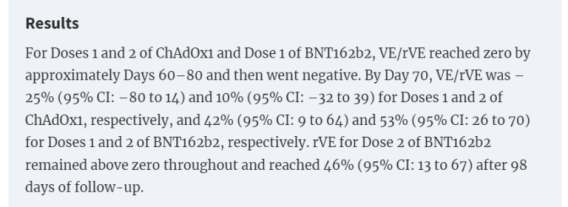
The curious reader may ask why they are combining deaths and hospitalizations into a single metric; if there had actually been any reduction specifically in deaths (or the waning for protection against death had been less), the authors would surely have highlighted that.
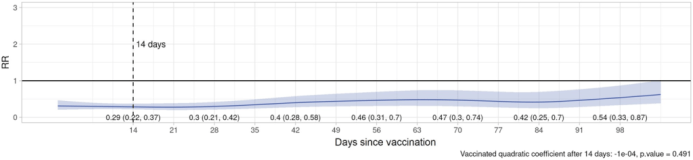
The next point about this is that when they say the vaccine efficacy remained above zero “throughout” what they mean is “throughout the period observed”, which was stated to be 98 days (although in the graphs the data appears to extend approximately another week or so beyond that).
It can clearly be seen from the graph below that efficacy is tending consistently downwards (as the RR, or relative risk, trends upwards towards 1), and by eye one can estimate that it too would turn negative after around 120 days, or 4 months.
No mention of this is made in the paper.
The final point to make is that in attempting to explain away this phenomenon, the authors claim that:
We believe that the most likely explanation for negative VE/rVE is that vaccination caused recipients to believe they were protected, leading them to change their behaviour in ways that increase their chance of contracting the infection.
Aside from there being no evidence for this assertion (or “belief” as they quite rightly call it), it is to be noted that most of the severe illness is seen within the elderly and frail, and it is hard to imagine these people deciding suddenly to start partying after vaccination.
In fact, a notable feature of the vaccination campaign was that, in the elderly at least, the level of fear and apprehension about the virus appeared to be largely unchanged afterwards.
Moreover, for the authors’ explanation to have any credence, the vaccinees’ confidence would have had to have increased over time since injection, to account for the direction of travel of vaccine efficacy, whereas surely the opposite would seem more likely.
Stop Press:
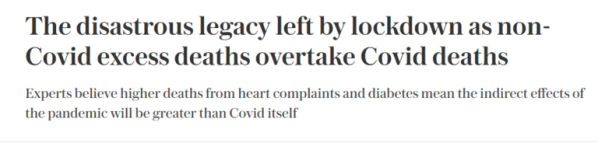
Sarah Knapton has written a further piece for the Daily Telegraph. The headline and byline are below. The word “vaccine” does not appear anywhere in the article, despite the plethora of published papers now linking the mRNA vaccines to cardiac issues.
Alberta’s New Premier Under Attack For Refusing To Associate With WEF
By Tyler Durden | Zero Hedge | October 31, 2022
Recently noted as an opponent of vaccine and mask mandates, new Alberta Premier Danielle Smith is breaking previously established ties with the World Economic Forum, which has been deeply involved in a “health consulting agreement” revolving around the province’s covid response.
“I find it distasteful when billionaires brag about how much control they have over political leaders,” Smith said at a news conference Monday after her new cabinet was sworn in. “That is offensive … the people who should be directing government are the people who vote for them.”
The United Conservative Party premier said she is in lockstep with federal Conservative Leader Pierre Poilievre, who has stated he and his caucus will be having nothing to do with the World Economic Forum. Earlier this month, on her first day as premier, Smith stated that people not vaccinated against covid are the most discriminated group she has seen in her lifetime.
In response, the Canadian mainstream media is pursuing a thorough hatchet campaign against Smith, consistently referring to all opposition to the WEF as being based in “conspiracy theory.” As they say, if you want to know who is really in power, all you have to do is find out who you are not allowed to criticize.

After two years of authoritarian lockdowns and attempts to enforce vaccine passports in Canada, Alberta was one of the only regions in the country that asserted political opposition to executive dictates. This helped to support the anti-passport protests by truckers and other Canadians, and led to Justin Trudeau using provisions for terrorism to confiscate donations to the movement. Alberta’s covid averages in terms of infections and deaths are no worse than provinces with strict mandates, proving once again that the mandates achieved nothing in terms of safety, but everything in terms of control.
The Canadian Press and other media outlets claim that criticism of the WEF is built on “online conspiracy accusations, unproven and debunked, that the forum is fronting a global cabal of string-pullers exploiting the pandemic to dismantle capitalism and introduce damaging socialist systems and social control measures, such as forcing people to take vaccines with tracking chips.”
Every “conspiracy” noted in that statement is true – none of them have been “debunked” except perhaps the “tracking chip” claim, which is unnecessary because the WEF was already encouraging governments to use cell phone tracking apps to monitor the vaccine status and movements of their respective populations. Many of these apps were approved by the CDC in the US, and in countries like China they are mandatory.
The World Economic Forum, acting as a kind of globalist think-tank for future policy initiatives, was instrumental in promoting many of the failed restrictions used by various national governments during the pandemic.
WEF head Klaus Schwab specifically mentions in his writings that the institution saw covid as a perfect “opportunity” to implement what he calls the “Great Reset” which includes the concept of the “Shared Economy,” a global socialist technocracy meant to replace free markets and end capitalism as we know it. As the WEF states, you will “own nothing, have no privacy” and you will like it.
This is not conspiracy theory. This is openly admitted conspiracy fact. It is undeniable.
The use of the “conspiracy theory” label is generally a tactic designed to circumvent fair debate based on facts and evidence. If the Canadian Press was forced to defend their position based on the information at hand, they would lose. So, they instead try to inoculate their readers to opposing arguments by calling them “conspiracy theory” in the hope that those readers will never research the information further.
The Canadian media then cites quotations that specifically argue that not working with the WEF would put the Alberta public at a disadvantage because it would cut them off from information that the WEF provides.
It’s important to mention that there is no evidence that the WEF has provided any life saving health information to date concerning the covid pandemic. In fact, there is no evidence that the WEF is useful to the Canadian public in any way. The mainstream media’s bizarre and antagonistic reaction to Smith’s shunning of a foreign organization of elitists that has no loyalty to the Canadian citizenry suggests that they may be operating from a foundation of bias.
Danielle Smith’s bravery in cutting off WEF influence from Alberta is being met with a dishonest media response, but in the long run, she is making the best decision possible. Taking advice from a potential parasite is not good leadership.
Journalists Continue Their Valiant Struggle to Make Monkeypox a Thing
eugyppius | a plague chronicle | october 28, 2022
Remember that scary rash-cum-fever from Africa that was going to be The Next Pandemic before it turned out to infect almost exclusively gay men having unprotected sex with other gay men? Well, you’ll be happy to know that there are still a few media outlets out there trying to make somebody care about it:
Monkeypox is causing devastating outcomes for people with severely weakened immune systems, even as new cases continue to decline in the United States, according to a federal report released Wednesday. At least 10 people hospitalized with monkeypox have died.
More than 28,000 cases of monkeypox have been reported since the U.S. outbreak began in May. While the vast majority recover within weeks, some patients with untreated HIV experienced especially dire consequences, such as losing function of their brain or spinal cord, eyes and lungs despite being given antiviral medication.
The report by the Centers for Disease Control and Prevention is based on the agency’s consultations with clinicians treating 57 U.S. patients hospitalized with monkeypox complications from the outbreak’s peak in mid-August through Oct. 10. It presents the most comprehensive picture of the severe consequences of infection and who is most at risk for serious complications.
You know what other viruses cause “devastating outcomes for people with severely weakened immune systems”? Basically all of them. If you’re sick and dying even the common cold can be dangerous, and here monkeypox is the least of anyone’s worries. Ten deaths (of which seven are still “under investigation” with no officially determined cause) from 28,000 cases works out to a case fatality rate of .036%.
But wait! Monkeypox might still turn out to be bad, somehow, maybe! The outbreak might “accelerate and affect increasingly wider communities,” if it could only be persuaded to circulate among heterosexuals! Or maybe “the virus could get established in an animal host”! Just don’t ask how that could happen! (And who knew the Post would stoop to such unsavoury homophobia?)
It’s funny to laugh at these guys, but sobering to consider how ramped up the pandemic panic machine must be, that even this obvious non-starter got the mileage that it did. This bodes poorly for the future.
The BBC’s Hurricane Unreality Checked
By Paul Homewood |October 26, 2022
I have collaborated with Net Zero Watch to produce this video on hurricanes.
The MSM’s cancer ‘cure’ stories are bio-firm hype, not hope
By Guy Hatchard | TCW Defending Freedom | October 26, 2022
GLOBALISED mainstream media equates not just with a uniform, poorly-informed world, but a manipulated world.
In Britain, the Times runs a story entitled: After centuries of cut, burn and poison, could a jab cure cancer? by Tom Whipple. Eleven thousand miles away in New Zealand, the same story appears in Stuff newspaper.
This is one of those ‘isn’t it wonderful?’ reassuring stories that unfortunately don’t look quite so rosy after close scrutiny, but like bad pennies are turning up everywhere. On the surface informative and exciting, underneath sadly lacking in that investigative depth we were expecting – and certainly over-hyped.
This particular story would not be out of place in a glossy brochure seeking investment funds for BioNTech. According to the Times article, RNA vaccine technology is rather like buying a piece of furniture from Ikea. Each person could very soon have their own personalised cancer vaccine off the shelf. What could possibly go wrong?
The tremendously hopeful note that the story strikes is based on a lot of over-simplified theory and the success (???) of the Pfizer Covid vaccine co-developed with BioNTech. It sounds reassuringly easy to design mRNA vaccines that rush to your aid and eliminate those nasty cancer cells.
Ugur Sahin and Ozlem Tureci, founders of BioNTech, are pictured in white coats, and are quoted promising: ‘We stimulate the immune system, do something magic, and the tumour disappears.’
Heady stuff, but the cited evidence is less than thin. A decorated cancer researcher who was diagnosed with pancreatic cancer in 2007, then tried all his innovative ideas out on himself, and died in 2011. In 2020, 16 patients with pancreatic cancer were treated by BioNTech. Eighteen months later, eight have died and eight are cancer-free after 18 months. The details are sadly lacking.
What stage were they at and how does that compare with their expected prognosis? The missing piece of the jigsaw is the article’s lack of scrutiny of the safety of BioNTech’s only commercialised mRNA vaccine product – the Pfizer Covid vaccine.
If you want to ask questions and also seek answers, you will need to turn to a completely different kind of journalism. Igor Chudov is a mathematician – like the Times author – but he writes on Substack and is therefore not constrained by any editorial policy or any no-go areas dictated by the newspaper owners, their advertisers, or subtly imposed government guidelines.
Chudov has published a very different cancer story, headlined: Cancer rates are Increasing and may get much worse. Wiped out immune systems take time to manifest.
According to the article, we are seeing the first ripple of a coming storm of cancer deaths. Chudov reports the work of the Ethical Skeptic (another Substack researcher) whose analysis of figures from the Centers for Disease Control and Prevention – the public health agency of the US – has shown that the rate of US cancer deaths accelerated in 2021 and 2022, coinciding with the rollout of the Pfizer/BioNTech mRNA Covid vaccine and other biotech vaccines.
It is the effect size that is surprising – 9 sigma. What does this mean? Well perhaps you can remember from your school maths lessons that for a Bell curve, two-thirds of data points lie within one standard deviation of the mean, that is known as 1 sigma. Ninety-five per cent lie within two standard deviations (2 sigma) and 99.7 per cent lie within 3 sigma.
I’m going to translate for you what the observed 9 sigma deviation from the prior pattern of cancer deaths probably implies in very simple layman terms:
1. A hugely statistically surprising number of people already infected with cancer have suffered a rapid progression of their condition to death. Covid vaccination reduced their likely longevity.
2. Some people who previously had no evidence of cancer, and possibly no lifetime expectation of cancer, are becoming ill and dying in the weeks and months following Covid vaccination. And it is not due to Covid infection – it didn’t happen in 2020.
Read Chudov’s article. It is a long read, but well worth the effort. In addition to the US data, he looks at the official UK cancer mortality data, which shows a similar increase. He also quotes another Substack author, A Midwestern Doctor, who analyses and references in detail what it is about mRNA vaccines that causes cancer. The approach is investigative, as we should expect it.
There are concerning issues that Whipple, author of the fawning Times article, chooses not to address. He failed to discuss questions that constitute the normal substance of scientific debate, but his piece was beamed around the world.
We expect the Times to ask questions, but it is not doing so. It has quietly rolled over and followed the biotech PR line. It is not alone – the mainstream media are collectively failing the sniff test.
We are being manipulated. If you want real journalism, it is flourishing elsewhere. GLOBE (the Campaign for Global Legislation Outlawing Biotechnology Experimentation) and other independents are asking vital questions that few are prepared to countenance.
Featured Video

Anthrax War – CBC The Passionate Eye
or go to
Aletho News Archives – Video-Images
Book Review
Shattered Dreams: The HPV Vaccine Exposed (2019)
By Christina England – 30 Q&As – Book Review & Summary
Lies are Unbekoming | September 4, 2026
… Gardasil received FDA fast-track approval in 2006, Cervarix followed in 2009, and Gardasil 9 was approved in December 2014 with more than double the aluminium adjuvant content of the original. The commercial context is specific. Merck was about to lose patent protection on Zocor and faced $18 billion in Vioxx injury claims from a cardiovascular drug the company had marketed while suppressing its own data showing a five-times increase in heart attacks. Analysts projected the global HPV vaccine market at $4 billion by 2011, contingent on government-funded national programs for teenage girls. The 1986 National Childhood Vaccine Injury Act had already granted manufacturers complete liability immunity. By 2013, Japan had withdrawn its HPV vaccine recommendation after cataloguing severe adverse reactions in hundreds of girls. No Western government followed. The establishment position across the UK, US, Australia, and most of Europe held, and still holds, that the vaccines are safe and effective, that reported injuries are coincidental, and that cervical cancer prevention justifies the program. The book was published into this position, not against a vacuum.
Shattered Dreams sits alongside Mary Holland’s The HPV Vaccine On Trial and Viera Scheibner’s foundational vaccination work as part of the documented record on what has been done to a generation of teenage girls under the banner of cancer prevention. The full summary unpacks three specific findings: that Merck used the aluminium adjuvant itself as the “placebo” control in 92.5% of trial subjects, making it structurally impossible to detect excess reactions from the adjuvant; that Dr. Sin Hang Lee found HPV DNA fragments bound to aluminium in every one of sixteen Gardasil samples tested, and in the blood and spleen of a New Zealand girl six months after her third dose; and that in every country with high vaccination coverage, including Australia, the UK, Norway, and Sweden, cervical cancer rates have stopped declining and started rising specifically in the vaccinated cohort. Martínez-Lavín’s 2017 calculation puts the number needed to seriously harm with Gardasil 9 at 140, and the number needed to vaccinate to prevent one case at 1,757. Thirteen young women are seriously harmed for every one who benefits. The vaccine was approved on the basis of trials that could not detect what the trials were supposed to detect, and it is still being given to twelve-year-olds today. … Read full review
Blog Roll
 Aletho News
- Georgia’s Largest Healthcare System Will Fire Employees Who Refuse Flu Vaccine
- The Five-Year Fuel Crisis: Why the World Economy Is Paying for a War It Thinks Is Ending
- Trump’s Big Bluff on Iran
- Swiss scammed out of millions by Ukraine-linked call centers – media
- Germany facing potential ‘violent conflict’ with Russia – spy chief
- Ukraine’s EU neighbors reject new plea from Kiev – Politico
- British Transport Police Facial Recognition Trial Scanned 926,912 People With Zero Arrests
- House Bill Would Ban Federal Use of Flock ALPR Data
- Can a Spice Rival a Drug? 10 Head-to-Head Trials Put It to the Test.
- The oil routes around Hormuz face their own chokepoints
- If Americans Knew
- “We See Our Homes Now From A Satellite, Like Strangers”
- Watch “Gaza: Doctors Under Attack”, originally censored by BBC
- NAZA: Israeli embassies in UK and US promote rival documentary to challenge Gaza genocide allegations
- David Ellison appoints Israeli to lead merged Paramount-Warner studios
- Turkish Red Crescent helps elderly Gaza man walk again after Israel confiscates his prosthetic limb
- Four Palestinians Killed in Israeli Attacks in Gaza
- Two Palestinian youths killed and village razed as Israeli attacks on West Bank continue
- Two more Christian women victims of Israeli raids on Gaza
- Cruelty, Deprivation, Indignity: A Journalist’s 22 Months in Israeli Prison
- New IDF Website Frames Slain Gaza Journalists as Terrorists
- No Tricks Zone
- Latest European Green Energy Debacle; Portugal’s Largest Flagship Solar Park Insolvent!
- Green Energy Debacle: German Expert Professor Fritz Vahrenholt Warns Of Severe Economic And Social Consequences
- Two More Paleo Reconstructions Affirm Meters-Higher Sea Levels Across Ireland, Brazil 7000-6000 Years Ago
- New Study: Earth And Venus Surface Warmth Largely Explained By Convection And Lapse Rate, Not CO2 Or Radiation
- 2025 Nature Paper Claiming Worsening Global Drought Gets RETRACTED …Heavily Flawed
- New Study: ‘Global Drought Shows No Detectable Recent Acceleration Under Climate Warming’
- Economic Masterminds: German Socialists Suggest Taxing Productivity Gains Stemming From Using AI
- The South China Sea Has Not Been Cooperating With The Climate Change Narrative
- Energy Crisis: Germany Enters Heating Season With Historically Low Gas Reserve Fill Levels
- New Study: The Antarctic Ice Sheet Gained Mass From 2020-2024 Due To Staggering Snow And Ice Accumulation

