A Tale of Two Pills: Media bias in reporting Ivermectin and ensitrelvir
By Guy Gin | Making (Covid) Waves in Japan | October 21, 2022
Last month, Japanese pharma company Kowa put out a press release of the results of its 1030-person double-blind randomised control trial (RCT) of Ivermectin conducted at 54 institutions in Japan and 2 in Thailand.
Here’s how the results were reported in The Japan Times.

Not effective, you hear! I mean, look at the photo. You don’t get Ivermectin from a pharmacy; you get it from a farmer. Anyway, on to the trial.
A clinical trial was unable to prove the efficacy of the antiparasitic medicine ivermectin against coronavirus variants, according to Japanese drugmaker Kowa Co., which has indicated that it will no longer seek approval for the drug as a COVID-19 treatment.
So this means that not only has IVM not been widely used in Japan (despite what many people outside Japan think) but probably never will be. So what happened? Did the people who took the anti-vaxers’ favourite veterinary medicine all get sick?
In the trial, 1,030 patients with mild COVID-19 were orally administered the drug daily for three days and then compared to others given a placebo.
Ivermectin was found to be safe and few people given the drug developed severe symptoms, Kowa said. But both the group given the drug and the one administered a placebo saw improvements in symptoms, meaning the trial did not show the drug’s efficacy over the placebo as a COVID-19 treatment.
So the reason Kowa was “unable to prove the efficacy” wasn’t because IVM is “not effective”; it was because almost everyone in the placebo group got better quickly too. According to Kowa’s press release, “Both intervention and placebo arms showed milder symptoms around 4 days after the start of administration” and “There were no deaths and hardly any severe cases.”
Although Kowa hasn’t released the full trial details or results, the 0% mortality rate among the 500+ participants in the placebo arm suggests they were mostly at very low risk of severe disease. So the results don’t show IVM was ineffective; they show no medication was necessary for these participants to prevent symptoms worsening or for them to recover quickly.
This a not a new issue in studies on early treatments. Yale epidemiologist Harvey Risch noted the same thing in RCTs showing non-significant effects for another “controversial” drug, hydroxychloroquine.
The RCT studies proclaimed supposedly as definitively showing no benefit of HCQ use in outpatients have all involved almost entirely low-risk subjects with virtually no hospitalization or mortality events and are uninformative and irrelevant for bearing upon these risks according to HCQ use in high-risk outpatients.
When tested on larger numbers of people for mortality benefit, IVM often performs a bit better.

Next, let’s compare how the JT reported Kowa’s IVM trial press release with how Reuters reported Shionogi’s press release for its 1821-person RCT of its anti-Covid drug ensitrelvir.

Japan’s Shionogi & Co Ltd said on Wednesday its oral treatment for COVID-19 demonstrated a significant reduction in symptoms compared with a placebo in a Phase III trial in Asia.
The drug, a protease inhibitor known as ensitrelvir, met its primary endpoint in a trial conducted among predominantly vaccinated patients with mild to moderate cases of COVID-19, the company said in a statement.
A significant reduction in symptoms! So how many people were kept out of the ICU? Well, the Reuters article didn’t clarify what the main result was, so here it is from Shionogi’s press release.
the median time to resolution of the five COVID-19 symptoms [stuffy or runny nose, sore throat, cough, feeling hot or feverish, and low energy or tiredness] was significantly reduced in those treated with the low dose of ensitrelvir (the dose level submitted for approval in Japan) compared to placebo: 167.9 hours versus 192.2 hours, a statistically significant difference of 24 hours (p=0.04).
Yep, ensitrelvir cleared runny noses 1 day quicker than a placebo. So the media reporting of Shionogi’s results wasn’t dishonest, but it wasn’t exactly candid.
Similar to in Kowa’s IVM trial, no deaths were reported among the 900+ placebo recipients in Shionogi’s trial, which again suggests they were very low risk. So these results give us no idea about whether ensitrelvir will prevent the progression to severe disease in high-risk immunocompromised people, which is what actually matters.
Shionogi also reported that no serious adverse events occurred in the intervention arm. But one problem with not trialing a medication on the type of high-risk people who will actually need it is that the trial probably won’t pick up major safety signals that become clear later.

But as El Gato Malo has said, pharma doesn’t make mistakes in trial design; it makes choices.

“Experts” now admit you will NEVER be “fully vaccinated”
By Kit Knightly | OffGuardian | October 22, 2022
We at OffG – and many of our fellow alt media sites – have been reporting for over a year now that the Covid “vaccination” campaign will never end.
In short, you will NEVER be “fully vaccinated”.
That much was obvious once health institutions around the world started “updating” their definition of the term.
Israel. America. Britain. New Zealand. Australia… they all did it, and it came as no surprise.
From the beginning, the “pandemic” has been created, policed, enforced and perpetuated through nothing but rhetorical tricks and manipulative language. New names for old things. New definitions for old words.
“Covid” has always been nothing but a pandemic of terminology. The fluid nature of “fully vaccinated” is just another example.
It has already ballooned from “double-jabbed” to “boosted” and “double-boosted”, and with new “vaccines” expected for all the variants, it doesn’t look like any end is on the horizon.
As I said, you’ll never really be “fully vaccinated”… and now they’re admitting it.
In yet another attempt at control through language manipulation, there’s a push on to completely scrub the term “fully vaccinated” from the Covid discourse.
Yesterday NBC News ran this piece, which headlines:
It’s time to stop saying ‘fully vaccinated’ for Covid, experts say—here’s why
Before going on to claim:
If you still say “fully vaccinated” for Covid, it’s time to stop. With new boosters on the market and an ever-evolving virus, experts say the term no longer means being the most protected you can be. They point to two, far more appropriate alternatives to use in this current phase of the pandemic
They also recommend “adjusting your vocabulary” with their suggested new alternative: “up to date”, a frank admission that the Covid boosters will keep on coming, potentially forever.
Essentially, having spent 18 months convincing millions of people to get “fully vaccinated”, they’re now messing with language again to reverse course and strip that designation away.
Meaning all those people who dutifully took their clot shots are not only no longer considered “fully vaccinated”, but never will be, and are now not even allowed to use that phrase because it creates a false impression.
The good news is that vaccine uptake is slowing – it has been for months – and this transparent effort to lay the ground for future booster campaigns will likely fall flat on its face.
And finally, to all the (formerly) “fully vaccinated” out there, we are sorry… but we did try to tell you this would happen.
WHEN IT COMES TO UKRAINE, THE CIA IS A CLOWN SHOW
By Larry Johnson | A Son Of The New American Revolution | October 21, 2022
The CIA, thanks to Hollywood and fanboys, enjoys an undeserved reputation for competence in carrying out espionage and covert actions. I am fascinated by the delusional punditry offered by former CIA officers, such as Douglas London and Steven Hall. Full disclosure, Hall was a young 20 something in my Career Trainee class (we entered on duty in September 1985). He is emblematic, in my opinion, of the problems that have plagued the CIA over the last thirty years–he was a legacy, i.e. got into the agency in part because his Daddy preceded him. Steve, if you recall, was one of the liars who signed a letter declaring that Hunter Biden’s laptop had all the earmarks of Russian disinformation. Attaching himself to such a libelous letter (he was impugning the character of John Paul Mac Isaac) highlights his tendency to follow the herd and eschew critical thinking.
But I want to focus on Douglas London. He is popping up all over media, especially CNN and the Wall Street Journal, and offering analysis that ranges from the banal to the delusional. Consider this snippet, published in the Wall Street Journal, in March:
I spent 34 years in the Central Intelligence Agency’s clandestine service, and watching Vladimir Putin’s brutal war in Ukraine from the sidelines fills me with both sadness and a sense of opportunity. Espionage is a predatory business, and there’s blood in the water. Mr. Putin’s self-inflicted damage has done more to turn his own people against him than anything the West could have done. . . .
Russian mystique is gone. Mr. Putin has proved his country is the declining power that the best-informed Russia watchers claimed it was. Fewer pundits will wax poetic over Mr. Putin’s cunning and strategic brilliance. He might have been a capable operations officer during his KGB career, but he clearly missed the classes on self-awareness and counterintelligence. The more he tightens the security screws and covers Russia’s window to the world, the more likely those he depends on will turn against him.
Got that? Russia, whose economy is clicking along nicely in contrast to the implosion underway in Europe, is a declining power in Mr. London’s fanciful world. Since the start of the Special Military Operation last February, Putin has frustrated Western attempts to paint him as Hitler reincarnated and has forged closer ties with China, India, Saudi Arabia and Brazil. Oh, did I mention he enjoys popular support among the Russian people:
The proportion of Russian citizens’ confidence in President Vladimir Putin stood at over 80%, according to the All-Russian Public Opinion Research Center that published the results of a survey conducted from October 3 to 9 among 1,600 respondents aged over 18, reports TASS.
“When asked about trust in Putin, 80.9% of respondents answered positively (-0.2% over the week), the approval rate of the Russian president’s work was 75.6% (-1.3 % over the week),” the pollsters noted.
I want to remind you of the desperation of the West to portray Putin as a loser bereft of popular support. Five years ago, Statista claimed that Putin was losing popular support:
According to a Pew Research Center survey released last week, Russians still have a high level of confidence in President Putin’s ability to do the right thing regarding world affairs. Despite his high overall approval rating, however, Putin is actually losing public support on many key issues. Support for his handling of relations with Ukraine and the EU have dropped 20 and 15 percentage points respectively since 2015. Russians are also increasingly dissatisfied with the way their president is handing relations with the United States.
If you thought that an experienced spook like London would take the time to actually gather some facts and compare them to history, think again. Sure looks like Mr. London is not about to let facts get in his way. London believes that his ability to speak Russian grants him special insight into the mind of Vladimir Putin. Here is his keen analysis from a recent column in Just Security :
Policymakers would do well to remember three fundamentals that guide Putin’s decision-making: 1) he is the product of the 1970’s and 1980’s KGB and stood witness in then-East Germany in 1991, when the world as he knew it ceased to exist; 2) ego, survival, greed, and ambition direct his moral compass; and 3) he has come to believe his own propaganda.
Unlike all other political leaders, Putin is driven by “ego, survival, greed, and ambition.” Excuse me, but good grief!! Thank God that neither Bill Clinton nor Barack Obama nor Boris Johnson were motivated to run for office because of “ego, survival, greed, and ambition.” Any further question why I deride London as banal. Hell, Mr. London does not even understand himself, i.e., what motivates him. Apart from Jesus Christ, I have not had the privilege of knowing any political leader of substance that was free of ego, self-preservation, greed and ambition. This kind of superficial, shallow thinking is part of the reason that officers like London wormed their way up the ranks of the CIA bureaucracy. As long as you mouth platitudes and do not rock the boat of established thinking, you get a great Personal Appraisal Report (aka PAR), and are promoted in accordance with the Peter Principle.
The London Express asked Mr. London about Putin’s decision to name General Surovikin as Supreme Commander of the Military Operation in Ukraine:
Douglas London, . . . believes Vladimir Putin did not appoint Surovikin on merit but because the Russian Air Force Commander lacks the connections within the military to launch a coup. Putin installed Surovikin, nicknamed “General Armageddon,” to oversee Russian operations in Ukraine this month after a run of heavy defeats at the hands of Ukrainian forces in Kherson and Kharkiv. . . .
General Surovikin previously headed up Russian operations during the Syrian Civil War when Moscow propped up the regime of Bashir Al-Assad against Islamist rebel forces.
He was credited with masterminding the recapture of large swathes of Syria from rebel hands, the use of overwhelming firepower, and scant regard for collateral damage.
Surovikin’s appointment as the top Russian commander in Ukraine coincided with the use of widespread suicide drones to target Ukrainian energy infrastructure.
Got that? Surovikin is without “merit”, yet he is credited with capturing large portions of Syria from Islamic rebels. If Douglas London really had any analytical talent at all–along with some intellectual honesty–he could have at least acknowledged that Putin’s choice of Surovikin was in fact grounded in merit. Putin was not looking for some boot licking toady to kiss his ass and tell him what a wonderful dictator he is. Putin selected a General with experience in running a combined arms operation with a clear track record of success. I don’t know if London is just stupid and ignorant or if he sincerely believes the nonsense he is spouting. Could it be that his own experience as a boot licker is clouding his judgment?
U.S. policymakers, when it comes to Russia, are an ignorant lot with little appreciation for history. They are blinded by ideology and tend to view present day Russia through the expired constructs of the Cold War. Putin and Russia are inept. They are bumbling. They are backward. Etc.,etc. etc.
None take into account the remarkable transformation of life in Russia under Putin during the last 22 years. Russia was a genuine shit hole in 1999. Rather than spend Russian tax dollars on disastrous foreign policy expeditions like Iraq and Afghanistan, under Putin’s leadership the creaky, rotten infrastructure left by the Soviet regime was renovated and modernized. Russia’s military services also were upgraded dramatically and its technological skills, particularly in the realm of space exploration, surpassed that of the West. The vast majority of people in the United States fail to appreciate the implications of Russia’s role in providing the rockets and space craft that ferried U.S. astronauts to the Space Station.
Back in 2004, President Bush announced that NASA’s aging space shuttle program would be retired in 2010 and — eventually — replaced by a plan to return to the moon. At the time, NASA realized there would be a four-year gap between the space-shuttle retirement and when the new manned space transport system would be in place.
But at that point, it didn’t seem like a big problem for NASA to ask Russia to transport US astronauts to and from the space station in the interim. Relations between the two countries were friendly — Bush was telling reporters that he’d looked into Putin’s eyes and “got a sense of his soul.” What’s more, NASA had relied on Russian transport for 29 months after the Columbia disaster in 2003, when the shuttle program was put on hold.
Development of NASA’s replacement vessels, however, has taken much longer than anticipated — the agency won’t have a replacement for the shuttle until 2017. There are a few reasons for that. Bush’s moon program was cancelled by Obama in 2010 and replaced with a plan for private companies to shuttle astronauts. Meanwhile, NASA’s budget requests to pay for the new program were repeatedly underfunded by Congress.
https://www.vox.com/2014/5/5/5674744/how-nasa-became-utterly-dependent-on-russia-for-space-travel
Just to be clear. The incompetent, inept, backward, technologically unsophisticated Russians have been the Uber driver for the United States, carrying U.S. astronauts to and from the International Space Station. But when it comes to running military operations in Ukraine, the Russians supposedly cannot pour piss out of a boot. I offer this as the clearest example of the delusion that blinds the minds of supposed super spies like Douglas London and Steve Hall and others. Instead of acknowledging that Russia, notwithstanding its relatively small population compared to other countries, is a certified leader in sophisticated, complex technology, Western intelligence officials and politicians only see the bad old days of the Soviet Union and the craven party politics that sundered the Soviet empire. The West fails to understand that there is a new kid on the block who is not going to buckle or cower in the face of belligerent threats from the cretins in the West. A failure to know one’s opponent (or enemy) is a recipe for disaster. Sadly, I fear the West is consumed by that recipe and will continue to fight a figment of their collective imagination that no longer exists.
No balanced coverage of covid vaccines in legacy media, says Peter Doshi
By Maryanne Demasi, PhD | October 16, 2022
Peter Doshi, associate professor at the University of Maryland School of Pharmacy and senior editor at The BMJ, has spoken out about how the mainstream media has ignored important data on covid-19 vaccines.
In a recent interview with German TV, Doshi said, “Our legacy media has not done a good job in providing balanced coverage about the vaccines.”
He said there has been “a lot of nervousness” about how to communicate vaccine harms to people and is concerned that “we’re not getting the information we need to make better choices and to have a more informed understanding of risk and benefit.”
Doshi’s concerns extended to the over-confidence of public health authorities engaged in promoting the covid-19 vaccines.
“It was very unfortunate, that from the beginning, what was presented to us by public health officials was a picture of great certainty… but the reality was that there were extremely important unknowns,” said Doshi who has written and spoken about these unknowns, highlighting that even public health officials were aware of these limitations.
“We entered a situation where essentially the stakes became too high to later present that uncertainty to people.” He added, “I think that’s what set us off on the wrong foot. Public officials should have been a lot more forthright about the gaps in our knowledge.”
Doshi was part of an international group of eminent academic researchers and physicians who went back and re-analysed the safety data from the original randomised clinical trials that underpinned the FDA’s decision to authorise the mRNA vaccines in December 2020.
I reported on the pre-print study, but since then, it has been published in the peer-reviewed journal, Vaccine.
The authors focused on serious adverse events that occurred in the Moderna and Pfizer vaccine trials, events the sponsors classified as “serious” generally because they resulted in hospitalisation.
In short, their analysis showed that mRNA vaccines were associated with 1 additional serious adverse event for every 800 people vaccinated, which Doshi said is “much more common” than what we’ve traditionally observed for other vaccines where the adverse event rate is in the range of 1 to 2 per million vaccinees.
“Just to put that in some perspective, a rate like that in past years has had vaccines taken off the market. In 1976, we saw Guillain Barre Syndrome after influenza vaccines that were then withdrawn.”
The authors of the study also found the trial data showed that the increase in serious adverse events following mRNA vaccination surpassed the reduction in risk of ending up hospitalised with covid-19.
Despite public assurances that covid-19 vaccines would save lives and protect the community by preventing transmission, Doshi knew from the outset that it was never properly tested. In Oct 2020, Doshi published an article in The BMJ:
Hospital admissions and deaths from covid-19 are simply too uncommon in the population being studied for an effective vaccine to demonstrate statistically significant differences in a trial of 30 000 people. The same is true of its ability to save lives or prevent transmission: the trials are not designed to find out [emphasis added]
It was, therefore, unsurprising to Doshi that the vaccines failed to stop the spread.
“One of the big reasons is that it’s an intramuscular vaccine, and this doesn’t produce mucosal immunity. Infections of covid, influenza and other acute respiratory infections, start in the mucosal membranes, a place where these vaccines are not particularly good, historically, at producing immunity antibodies” said Doshi.
Doshi and his colleagues have called on public health authorities and drug manufacturers to release the raw data so that we can better understand who is most at risk of a serious adverse event.
“There’s no reason to think that these risks are going away and if it’s in the low-risk population, that’s very bad news, because low-risk people have much less to potentially gain from covid vaccines, so the side effect profile in such people has to be extremely low,” said Doshi, pointing out that Denmark now recommends against routine covid-19 vaccination for people under 50.
The FDA and the vaccine manufacturers have the raw ‘patient level’ data, but they have not released it and we’re now almost 2 years into the roll out of the product.
“They should immediately be warning people about this safety signal that we found, and they should immediately be replicating our analysis — the data are indicating there’s increased risk at a level that is much higher than has previously been realised,” said Doshi.
Throughout the pandemic, we’ve been told to “trust the science” but Doshi says, “How can one recommend responsibly that these products are based on science if the data are not available? Science is about sharing data. We’re in an era of open science, not secret science.”
Doshi and colleagues have penned an open letter to the CEOs of the vaccine companies asking for the raw data, but as yet, they have not received a reply.
See the full interview on mdr.de
The majority of Americans are against Big Tech’s plan to censor before the election
By Cindy Harper | Reclaim The Net | October 20, 2022
A survey conducted by Susquehanna Polling and Research, on behalf of The Federalist, found that two-thirds of voters oppose Big Tech’s censorship of political content ahead of the midterms.
Respondents of the survey were asked: “Do you approve or disapprove of Big Tech companies such as Twitter, Facebook, and Google censoring news stories and preventing users from sharing articles and information related to the upcoming election in November?”
66% of the respondents said they oppose the censorship of political content by social media companies. Only 24% said they approve of the censorship, while the rest were undecided or had no opinion.
44% of those who identified as Democrats disapprove of the censorship while 39% support it.
51% of those who approve of Joe Biden’s performance oppose the censorship, while 35% support it.
The survey also asked respondents if they “trust the corporate news media to tell the truth” or if the media “misrepresent the facts to push a political agenda.”
77% said they think the media do not tell the truth, with only 13% saying they believe the media. Along political affiliation, 59% of Democrats, 79% of independents, and 91% of Republicans said they do not think the media tells the truth.
Majority of US voters say the media is a threat to democracy
By Christina Maas | Reclaim The Net | October 20, 2022
While the media often suggests that social media posts are a threat to democracy, a poll commissioned by the New York Times found that a majority of registered voters believe that the media is a threat.
71% of respondents said that “American democracy is currently under threat.” Of those, 59% said that the media is a “major threat to democracy and 25% said the media is a “minor threat to democracy.” A measly 15% did not think that the media is a threat to democracy.
70% of Democrats, 83% of independents, and 95% of Republicans said the the media poses some sort of threat to democracy. Only 38% of Democrats believe the media is a major threat to democracy, compared to 53% of independents and 80% of Republicans.
The media outranked former President Donald Trump, President Joe Biden, the Electoral College, voting machines, voting by mail, and the Supreme Court as major threats to democracy.
Republicans mentioned voting machines, voting by mail and the federal government as threats to democracy. Democrats cited the Electoral College and the Supreme Court.
Moscow comments on alleged military use of Iranian drones
Samizdat | October 18, 2022
All weapons used by troops have Russian designations, Kremlin spokesman, Dmitry Peskov has said, reiterating a denial of reports that Moscow was using Iranian-supplied drones against Kiev.
“No, we have no such information. Russian hardware is being used. You know it well. It has Russian designations. All further questions can be addressed to the Defense Ministry,” Peskov said on Tuesday.
American and Ukrainian officials have claimed on many occasions that Russia received various unmanned aerial vehicles (UAV) from Iran and was using them in the conflict with Ukraine.
On Monday, multiple drones were spotted flying over the Ukrainian capital Kiev, with troops desperately trying to shoot them down with small arms, according to videos from the scene.
At least one “kamikaze drone” was reportedly hit and crashed into an apartment block, setting off a deadly explosion. A soldier interviewed by Ukrainian television claimed that he was among those who managed to divert the aircraft off its course with gunfire, adding that he later helped rescue people from under the rubble at the crash site.
The mayor of Kiev, Vitaly Klitschko, said that Russia attacked the city with 28 drones on Monday morning and that the Ukrainian military managed to intercept “most” of them. He reported a total of five explosions, including the one at the residential building. Other drones apparently reached their intended targets, including energy infrastructure facilities.
The drones, designated Geran-2 in Russia, are allegedly a localized version of the Iranian-made Shahed-136. Ukrainian President Vladimir Zelensky claimed last week that Russia had acquired as many as 2,400 Shahed UAVs, as he asked G7 members to provide more air defense systems.
Last month Ukraine cut diplomatic ties with Iran over the alleged supply of weapons to Russia. Neither Moscow nor Tehran confirmed the purported purchase.
Kiev reportedly urged Israel to ramp up intelligence-sharing in response to Moscow’s alleged deal with Iran. Israeli Minister of Diaspora Affairs Nachman Shai said last Sunday that he supported taking Kiev’s side because of the claimed Iranian involvement.
Submission to Canada’s Public Order Emergency Commission

Fearless Canada | October 16, 2022
As a non-partisan, volunteer activist group, Fearless Canada was present at the beginning and on several other occasions during the Freedom Convoy protest in Ottawa. As such, many of our members witnessed first-hand what the situation looked like on the ground and how it all began. We took extensive video footage of the events during the first weekend from the moment when truckers were being directed toward Parliament by Ottawa police. We have decided to submit our evaluation of the events as well as our strongly held view that the invocation of the Emergency Measures Act (hereafter referred to as “EMA”) by the Trudeau government was not only inappropriate, but also unlawful and unconstitutional.
We must first unequivocally state that, in our view, the Trudeau government’s decision to invoke the EMA in no way met the legal threshold to do so. The usage of the EMA is reserved for exceptional circumstances in which a serious foreign or existential threat imperils the security of the nation. Such security threats would be typically related to war, as the older, subsequently replaced War Measures Act aimed to address. In no conceivable way could the temporary discomfort or inconvenience borne by Ottawa citizens or businesses justify the use of an Act that is meant to aid the government in protecting the nation against threats of an incalculably larger scale. As such, the purpose of the Commission is not to determine whether the invocation of the EMA served the Trudeau government in its objective to deescalate the so-called “occupation” of Ottawa’s downtown core, but rather to assess whether the legal threshold for its invocation was met.
The Early Days in Ottawa
Our group arrived in Ottawa in the early afternoon of January 28, 2022. The first thing we noticed was Ottawa police directing truckers and their rigs onto Wellington Street towards Parliament. The atmosphere was festive and light despite the frigid weather. As more protesters arrived in Ottawa over the course of the weekend, we would quickly observe that the crowds were both peaceful and diverse. Men, women, and children from all different backgrounds and walks of life gathered in the capital with a common goal. They demanded that the Trudeau government lift measures that, in their view, were both unjustified and discriminatory in nature. As a result of those measures, the majority of protesters in Ottawa were themselves directly impacted in profound and often irreversible ways.
In talking with dozens of truckers and protesters, we learned that many had lost their jobs, connections to loved ones, access to essential services, and much more. While speaking with police officers, we learned that many felt they were unlawfully coerced into taking a COVID vaccine in order to keep their jobs. Our impression on the ground was that the majority of police officers were in fact aligned with the goals of the protest. They, too, wanted to see an immediate end to damaging and ineffective policies that divided our nation along medical lines previously acknowledged as a matter of private and personal concern.
Legacy Media and the Trudeau Government’s Portrayal of the Freedom Convoy
While in Ottawa, our group kept an eye on the news coming out of legacy media outlets such as the CBC, CTV News, and Global News. It became impossible not to notice that a concerted narrative had quickly taken shape to misrepresent the situation and characterize protesters as far-right extremists, racists, antisemites, and more. The unjustified slander of protesters directly conflicted with our experience on the ground. What we saw was a festive and peaceful rally, replete with volunteers offering food and shelter from the cold, routinely cleaning streets and sidewalks, and organizing fun activities for the kids. At no time did we spot a single racist or Nazi in the vast crowds, as was incessantly suggested by both the Liberal government and the mainstream media. From what we could tell, these characterizations were fabricated in order to serve a narrative that aimed to discredit the legitimacy and lawfulness of the protest.
As time went on, the media’s portrayal of the situation continued to unhinge itself from reality. The press published stories about imminent violence, a van loaded with illegal firearms, and more. None of these allegations turned out to be true. Yet, the misrepresentation of the situation had already reached the eyes and ears of Canadians from coast to coast, very few of which witnessed the event themselves. But by then, the damage had already been done, just as it seemed to have been intended.
The Invocation of the EMA
At the moment the Trudeau government invoked the EMA, it must be noted that the protest in Ottawa was already in the process of de-escalation. The protest organizers and their lawyers had already brokered a dismantlement deal with the Ottawa mayor and police services. Truckers were already on their way out of the downtown core and the blockades at two Canadian points of entry had already long-since been dismantled. Yet rather than follow an organized de-escalation plan agreed to by all factions, Ottawa police and the Trudeau government instead opted to escalate the situation by using violence and propaganda against Canadian citizens. The impacts of the invocation of the EMA were profound and unwarranted.
Immediately ensuing the invocation of the EMA, police and governmental authorities froze protesters’ bank accounts and deployed violent anti-riot squads all over the downtown core of Ottawa. Several protesters were injured as police again escalated tensions using all manner of crowd dispersal techniques. In the days following the invocation of the EMA, Finance Minister Chrystia Freeland wasted no time in announcing that certain aspects of the EMA would be written into law, granting broad and unconstitutional powers to government without the requisite EMA enacted. It had become clear that the Trudeau government had a predetermined objective in enacting the EMA, one that would grant greater leverage over political dissidents and, more broadly, Canadians that disagreed with its ideology. This in itself represents an egregious misuse of the EMA in order to further a political agenda.
Conclusion
The volunteer activists at Fearless Canada include Canadian scholars, lawyers, professors, small business owners, and artists. We unanimously and unequivocally feel that the Trudeau government’s invocation of the EMA as a response to ongoing protests in Ottawa was both unlawful and unconstitutional. We submit that the government manipulated public opinion by fabricating evidence of unlawful activity in Ottawa and invoked the EMA under false pretenses in order to abet their predetermined agenda. We believe that the evidence overwhelmingly supports our position, and we look forward to seeing all of it brought to light during the Commission’s discovery process.
This statement was authored by the executive of Fearless Canada and endorsed by members.
The statement has been submitted to the Public Order Emergency Commission of Canada, which began public hearings on Thursday, October 13, which will run every weekday until November 25. Live hearings can be viewed here, and True North Centre publishes a recap for each day.
EU trying to play the arbiter of alleged Russian ‘war crimes’ in Ukraine
EU judicial institutions never showed interest in investigating the nearly decade-long mass murder of civilians in Donbass
By Drago Bosnic | October 17, 2022
Ever since Russia started its counteroffensive against NATO aggression in Eastern Europe, the political West has been parroting the narrative that Moscow is allegedly committing war crimes in Ukraine. Although there has been virtually zero evidence to support such claims, the mainstream propaganda machine refuses to give up. The Kiev regime and its geopolitical puppet masters in Washington DC and Brussels are also resorting to false flags and so-called deep fakes to create and maintain the narrative that Russian forces are deliberately targeting civilians. And yet, the Western mainstream propaganda machine often gets caught in its own web of lies. On October 11, The New York Times published an op-ed by Mike Ives in which he made the following claim:
“The Russian missile and drone attacks that killed at least 19 people across Ukraine on Monday were traumatic and wide-ranging, but they were not as deadly as they could have been… …That has renewed questions over the quality of Russia’s weapons and about the capacity of its forces to carry out President Vladimir V. Putin’s military designs.”
The claim clearly indicates that Russia’s recent missile strikes targeting the Kiev regime’s critical military infrastructure are somehow seen as “ineffective” because there were “too few” casualties. Such a sadistic claim serves as proof that propaganda pushed by the political West has no limits. Russia has been using advanced long-range precision weapons to target key military units and infrastructure of the Kiev regime forces. This approach is a result of both high-tech aspects of the Russian military and the fact that Moscow’s special military operation is still prioritizing the reduction of civilian casualties. And yet, even though the Western propaganda machine acknowledges this reality, the narrative of alleged Russian “war crimes” in Ukraine needs to be pushed into the mainstream. This is especially true when it comes to giving these false claims a legal and judicial aspect.
In recent days multiple reports have been published, claiming the European Union and Eurojust, the bloc’s agency dealing with judicial cooperation in criminal matters among agencies of the member states, have been working to create the judicial framework for dozens of fabricated reports of supposed Russian “war crimes” in Ukraine. According to Eurojust’s October 13 press release, this was the central theme of the 16th meeting of the Consultative Forum of Prosecutors General of EU Member States. Prosecutors General and Directors of Public Prosecutions discussed the self-appointed “expanded role” of Eurojust in matters of alleged war crimes and crimes against humanity. They also met with their new Kiev regime counterpart Andriy Kostin and the Prosecutor of the International Criminal Court Karim A.A. Khan KC.
Olivier Christen, Director of Criminal Affairs and Pardons of France, stated that the EU “remains fully committed” to identifying and prosecuting the perpetrators of the atrocities taking place in Ukraine. He further pointed out that Eurojust has “expanded its prerogatives” in order to improve the “fight against impunity for war crimes.” Eurojust President Ladislav Hamran stated that “never in the history of armed conflict has the legal community responded with such commitment and determination” and that the meeting “will further fuel the joint ambition to bring justice to the Ukrainian people.” Apart from alleged Russian “war crimes”, the panel members discussed what they called the “disinformation via cyberspace”, which was further expanded to include notes on “practical experiences and challenges in relation to the prosecution of violations of the current EU sanctions against Russian and Belarusian individuals and companies.”
In another press release, also published on October 13, Eurojust announced that Romania also became a member of the joint investigation team (JIT) on alleged war crimes in Ukraine. Romania was the seventh member of the JIT, which was set up on 25 March 2022 by Lithuania, Poland and Ukraine and later joined by Estonia, Latvia and Slovakia. In April of this year, the Office of the Prosecutor at the International Criminal Court (ICC) became a participant in the JIT. The relevant meeting was held just prior to the aforementioned 16th Meeting of the Consultative Forum of Prosecutors General. According to their own admission, Eurojust is also providing “essential logistical and operational support” to the JIT partners, including to “investigators” on the ground in Ukraine.
Needless to say, there was no mention of the Kiev regime death squads operating in the Kharkov, Zaporozhye, Kherson and Donbass. The meeting members discussed only alleged Russian “war crimes” and the supposed Moscow’s “disinformation campaign”, despite the fact that the Neo-Nazi junta henchmen are openly boasting about “killing traitors”. Numerous Telegram channels have already published gruesome videos showing the Neo-Nazi death squads killing civilians and then throwing them into mass graves. In doing so, the Kiev regime accomplishes at least two goals – it gets rid of “noncompliant” or “pro-Russian” civilians and also gets to accuse Russian troops of killing them. The propaganda machine of the political West then comes into play, while EU agencies such as Eurojust cement the narrative from a judicial and legal perspective.
It would be naive, to say the least, to believe that the EU or any other entity of the political West would ever objectively investigate actual war crimes taking place in Ukraine. Charades such as the ones in Bucha and recently in the Kharkov region serve as a testament to that. None of the so-called “international” judicial institutions, such as the aforementioned ICC, ever showed interest in investigating the nearly decade-long mass murder of civilians in Donbass. Despite approximately 15,000 deaths from 2014 to 2022, with hundreds or even thousands more in recent months, as the Kiev regime forces never stopped shelling Donetsk and other towns and areas, the mainstream propaganda machine has been successful in suppressing most information on this.
What’s more, the Neo-Nazi junta has been using NATO-supplied weapons to target civilians beyond Donbass, in Kherson and Zaporozhye regions, killing hundreds in recent months. Will Eurojust and JIT investigate those already documented war crimes or are their actions reserved only to further reinforce the Kiev regime’s propaganda war?
Drago Bosnic is an independent geopolitical and military analyst.
Corona is a Flat Circle
For the third autumn in a row, the German press screeches about overwhelmed hospitals, and there’s no reason to think they’ll ever stop.
eugyppius | October 15, 2022
It’s virus season, and the headlines are already here: Many New Corona Infections: Hospitals Demand Indoor Mask Mandate — Lauterbach Already Hopes for Corona Restrictions — High Covid Incidences: Medical Association Wants Compulsory FFP2 Masks Indoors — Corona: Baden-Württemberg Health Minister Considers Mask Mandate Possible. I could add a dozen more, but you get the idea. It’s the same reheated pablum from last year. Hospital staff have their backs against the wall; a new tide of Corona patients threatens to overwhelm their meagre resources; the Apocalypse threatens if we don’t immediately return to indoor plastic face coverings.
If you look at hospitalisations, though, you’ll have a hard time finding any crisis at all. Here, for example, are hospitalisations for severe acute respiratory infections since 2017, as published last week by the Robert Koch Institut:
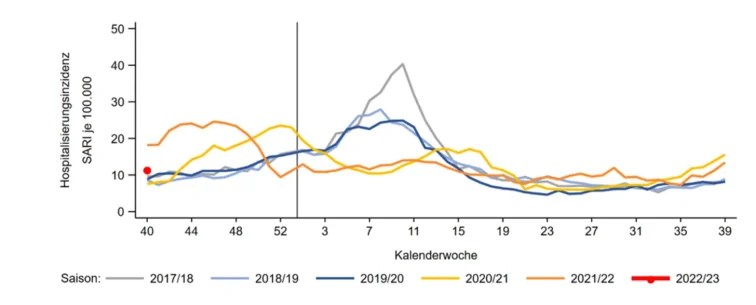
The red dot is where we are right now. Admissions are totally in line with the pre-pandemic era. The ICU admissions tell exactly the same story:
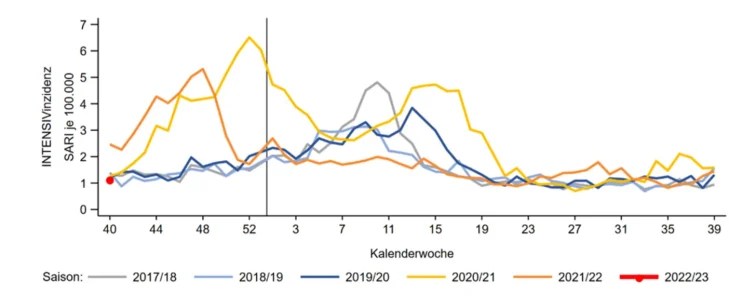
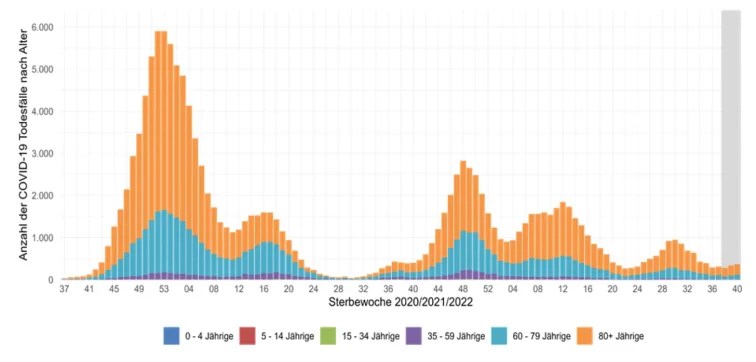
Nor is anybody really dying at the moment:
To the extent that there is any crisis at all here, it’s of our own making. Hospital patients with Corona diagnoses have to be treated according to strict isolation protocols, in special wards. These rituals are staff-intensive, and they effectively reduce across-the-board hospital capacity. It’s the same as our quarantine laws, which induce worker shortages by forcing millions of otherwise healthy Germans into isolation whenever they test positive. We could declare a rhinovirus pandemic tomorrow and suffer all the same problems from the common cold, and by the same token we could end all of this ourselves in an instant, by abolishing our foolishness and choosing to ignore SARS-2. Instead, we insist that this virus is dangerous and through our own behaviour we make it so.
The most onerous part of all this, is the inability of the German press to find a new narrative, ask new questions, or to change their reporting in any way at all — despite the totally different behaviour of Omicron and the near-universal levels of immune exposure to SARS-2. I know some of you complain that I repeat the same themes and arguments overmuch, but Germany has descended into some kind of purgatorial alternate reality, where it’s always March 2020, and our hospitals are always on the verge of melting down, and we never have enough information, so we just have to try masking and social distancing and hope for the best. They’re wrong about everything and they just keep telling the same lies over and over.
As the Climate Refuses to Break Down on Cue, the Pseudoscience of ‘Attribution Studies’ Rises Up to Plug the Holes
BY CHRIS MORRISON | THE DAILY SCEPTIC | OCTOBER 14, 2022
The last few years have seen the climate alarmist industry go all in on ‘attributing’ bad weather to humans causing the climate to change. As global warming goes off the boil and the climate resolutely fails to break down on cue, an entire industry of pseudoscience has sprung up to scour the world and catastrophise every unusual natural weather event or disaster. It will not come as a surprise to discover that such attribution is based on climate models. As we shall see, the models do nothing more than produce worthless guesses.
When Professor Richard Lindzen of MIT noted that the current climate narrative is “absurd”, but trillions of dollars says it is not “absurd”, he was undoubtedly thinking of the product of climate models. Roger Pielke, a noted science writer and a professor at the University of Colorado Boulder, is particularly scathing about attribution work: “I can think of no other area of research where the relaxing of rigour and standards has been encouraged by researchers in order to generate claims more friendly to headlines, political advocacy and even lawsuits. But there you go.”
It is simple to explain what ‘attribution’ models do. First they simulate a climate with no human involvement that does not exist, and then compare it with another simulation that is supposed to reflect the involvement of humans burning fossil fuel. Any weather event at a local level that is magnified in the second is, abracadabra, said to be due to human-caused climate change.
To take such results seriously it must be assumed that the models have correct information in the first place. An inability over 40 years for climate models to predict an accurate temperature would seem to indicate they are work in progress. Ignorance of the equilibrium climate sensitivity (ECS) number – the amount the Earth will warm if carbon dioxide is doubled in the atmosphere – would be considered another handicap. In addition, it is interesting to observe some academics attempting to produce a perfect model capable of such precision when they are mapping a climate system that is non-linear with numerous, only partially understood, powerful forces at work. How anyone can take the results seriously, with all the inevitable ‘garbage in-garbage out’ possibilities, is a mystery. Measuring cats in a sack might be considered a marginally easier task.
Attribution studies fail the falsification principle outlined by the science philosopher Karl Popper. This is held to be the test that differentiates real science from pseudoscience. Any hypothesis must be testable and conceivably proved false. Unless a suggestion can be tested in this way, it is opinion, guesswork, or, more uncharitably, crystal ball-gazing. Stating, for instance, that a bad storm was caused by humans when a natural explanation is also available, or calculating that wildfires will consume so many more acres than before, is unprovable. It therefore fails the test to be termed science.
Of course, the attribution claims are all over the popular prints. Within just a few days of last July’s U.K. brief heatwave, the Guardian was reporting: “Climate breakdown made U.K. heatwave 10 times more likely, study finds.” Of course there was a natural explanation for the soaring summer temperature, caused by southern winds being supercharged by an adjacent intense low pressure system. Friederike Otto from the Grantham Institute at Imperial, an operation partly-funded by the green billionaire investor Jeremy Grantham, said the 10 times finding was worrying, and if carbon emissions were not rapidly cut it could be “even worse” than previously thought.
According to Roger Pielke, the rise of individual ‘event attribution’ studies coincides with frustration that the IPCC has not ”definitively concluded” that many types of extreme weather have become commonplace. In his view they offer “comfort and support” to those focused on climate advocacy. Since they fill a strong demand in politics, Pielke suggests they are “here to stay”.
Friederike Otto is at the forefront of such studies and is the co-lead of World Weather Attribution (WWA), a body that specialises in near-instant weather attributions. On her Grantham CV, Otto claims WWA provides “timely scientific evidence” on single events, “paving the way for new sustainability litigation”.
Meanwhile any scientific work that, by suggesting the climate is not breaking down, is inconvenient for those promoting the command-and-control Net Zero political project, is be suppressed. Otto was one of four “experts” used by state-owned Agence France-Presse in a footling ‘fact check’ of a recent paper from four leading Italian scientists. They argued that a climate emergency is not supported by the data. She said the authors, including two physics professors, were “of course” not writing in good faith. “If the journal cares about science they should withdraw it loudly and publicly, saying that it should never have been published,” she demanded.
Contacted by the Daily Sceptic, she added that the paper was “bad science”. She obviously feels able to try to cancel professorial physics authorities since she has a “diploma” in physics from the University of Potsdam. Otto’s doctorate was in the philosophy of science, and before joining Grantham she spent 10 years teaching in the School of Geography at Oxford University. “I am not trying to ban anyone and I do not think it is relevant whether their first degree is in art history or physics,” she explained
Otto is also behind a WWA guide for journalists titled: “Reporting extreme weather and climate change“. In a foreword, the former BBC Today editor Sarah Sands bemoans the time when the former U.K. Chancellor Nigel Lawson managed to suggest there had been no increase in what she called extreme weather. I wish we had this guide for journalists to help us mount a more effective challenge to his claim, wrote Sands. These days , she enthused, attribution studies have given us significant insight into the horsemen of the climate apocalypse.
“In this way we are able to move from anecdote and conjecture, from superstition and wishful thinking, to science. We have evidence and we have facts. They are a secure foundation for news,” she said.
Science? Unverified guesswork would be more accurate. Popper must be turning in his grave.
Chris Morrison is the Daily Sceptic’s Environment Editor.
Featured Video

Anthrax War – CBC The Passionate Eye
or go to
Aletho News Archives – Video-Images
Book Review
Shattered Dreams: The HPV Vaccine Exposed (2019)
By Christina England – 30 Q&As – Book Review & Summary
Lies are Unbekoming | September 4, 2026
… Gardasil received FDA fast-track approval in 2006, Cervarix followed in 2009, and Gardasil 9 was approved in December 2014 with more than double the aluminium adjuvant content of the original. The commercial context is specific. Merck was about to lose patent protection on Zocor and faced $18 billion in Vioxx injury claims from a cardiovascular drug the company had marketed while suppressing its own data showing a five-times increase in heart attacks. Analysts projected the global HPV vaccine market at $4 billion by 2011, contingent on government-funded national programs for teenage girls. The 1986 National Childhood Vaccine Injury Act had already granted manufacturers complete liability immunity. By 2013, Japan had withdrawn its HPV vaccine recommendation after cataloguing severe adverse reactions in hundreds of girls. No Western government followed. The establishment position across the UK, US, Australia, and most of Europe held, and still holds, that the vaccines are safe and effective, that reported injuries are coincidental, and that cervical cancer prevention justifies the program. The book was published into this position, not against a vacuum.
Shattered Dreams sits alongside Mary Holland’s The HPV Vaccine On Trial and Viera Scheibner’s foundational vaccination work as part of the documented record on what has been done to a generation of teenage girls under the banner of cancer prevention. The full summary unpacks three specific findings: that Merck used the aluminium adjuvant itself as the “placebo” control in 92.5% of trial subjects, making it structurally impossible to detect excess reactions from the adjuvant; that Dr. Sin Hang Lee found HPV DNA fragments bound to aluminium in every one of sixteen Gardasil samples tested, and in the blood and spleen of a New Zealand girl six months after her third dose; and that in every country with high vaccination coverage, including Australia, the UK, Norway, and Sweden, cervical cancer rates have stopped declining and started rising specifically in the vaccinated cohort. Martínez-Lavín’s 2017 calculation puts the number needed to seriously harm with Gardasil 9 at 140, and the number needed to vaccinate to prevent one case at 1,757. Thirteen young women are seriously harmed for every one who benefits. The vaccine was approved on the basis of trials that could not detect what the trials were supposed to detect, and it is still being given to twelve-year-olds today. … Read full review
Blog Roll
 Aletho News
- Georgia’s Largest Healthcare System Will Fire Employees Who Refuse Flu Vaccine
- The Five-Year Fuel Crisis: Why the World Economy Is Paying for a War It Thinks Is Ending
- Trump’s Big Bluff on Iran
- Swiss scammed out of millions by Ukraine-linked call centers – media
- Germany facing potential ‘violent conflict’ with Russia – spy chief
- Ukraine’s EU neighbors reject new plea from Kiev – Politico
- British Transport Police Facial Recognition Trial Scanned 926,912 People With Zero Arrests
- House Bill Would Ban Federal Use of Flock ALPR Data
- Can a Spice Rival a Drug? 10 Head-to-Head Trials Put It to the Test.
- The oil routes around Hormuz face their own chokepoints
- If Americans Knew
- “We See Our Homes Now From A Satellite, Like Strangers”
- Watch “Gaza: Doctors Under Attack”, originally censored by BBC
- NAZA: Israeli embassies in UK and US promote rival documentary to challenge Gaza genocide allegations
- David Ellison appoints Israeli to lead merged Paramount-Warner studios
- Turkish Red Crescent helps elderly Gaza man walk again after Israel confiscates his prosthetic limb
- Four Palestinians Killed in Israeli Attacks in Gaza
- Two Palestinian youths killed and village razed as Israeli attacks on West Bank continue
- Two more Christian women victims of Israeli raids on Gaza
- Cruelty, Deprivation, Indignity: A Journalist’s 22 Months in Israeli Prison
- New IDF Website Frames Slain Gaza Journalists as Terrorists
- No Tricks Zone
- Latest European Green Energy Debacle; Portugal’s Largest Flagship Solar Park Insolvent!
- Green Energy Debacle: German Expert Professor Fritz Vahrenholt Warns Of Severe Economic And Social Consequences
- Two More Paleo Reconstructions Affirm Meters-Higher Sea Levels Across Ireland, Brazil 7000-6000 Years Ago
- New Study: Earth And Venus Surface Warmth Largely Explained By Convection And Lapse Rate, Not CO2 Or Radiation
- 2025 Nature Paper Claiming Worsening Global Drought Gets RETRACTED …Heavily Flawed
- New Study: ‘Global Drought Shows No Detectable Recent Acceleration Under Climate Warming’
- Economic Masterminds: German Socialists Suggest Taxing Productivity Gains Stemming From Using AI
- The South China Sea Has Not Been Cooperating With The Climate Change Narrative
- Energy Crisis: Germany Enters Heating Season With Historically Low Gas Reserve Fill Levels
- New Study: The Antarctic Ice Sheet Gained Mass From 2020-2024 Due To Staggering Snow And Ice Accumulation

