How Russia Quietly Revolutionised Warfare
By Kit Klarenberg | Global Delinquents | May 25, 2025
On May 23rd, The Times published an extraordinarily candid probe into how militarised drones have irrevocably revolutionised warfare in the 21st century, with Russia far at the forefront of this radical shakeup of how conflicts are waged. Meanwhile, there is little indication NATO members even vaguely comprehend this battlefield reality, let alone a single one of them is undertaking any serious measures whatsoever to prepare for conflict such as that currently unfolding and evolving daily throughout Ukraine’s eastern steppe.
The Times piece is a first-person report of a visit to the assorted headquarters of Kiev’s 93rd Mechanised Brigade, in basements of abandoned buildings and homes throughout the Donetsk city of Kostiantynivka. It’s a devastating picture of the realities of war in the era of drones, which has “[altered] the physical make-up of the front line, the tactics of the war and the psychology of the soldiers fighting it,” while “having a devastating impact on Ukraine’s logistical ability.”
At one stage, The Times reporter was warned they were standing nine kilometres – 5.5 miles – from the nearest Russian position, and thus “well inside the kill range.” A Ukrainian soldier told them with a shrug, this was “now an easy range in which to die”:
“No other weapon type has changed the face of the war here so much or so fast as the FPV drone. Almost any vehicle within five kilometres of the front is as good as finished. Anything moving out to ten kilometres is in danger. Drone strikes at 15 or 20 km are not that unusual.”
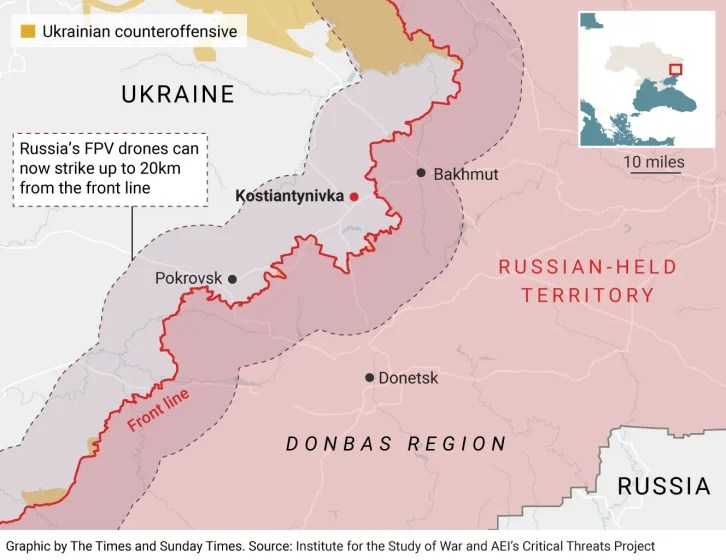
Since the proxy war erupted, both Ukraine and Russia have innovated in the field of FPV drones to an unprecedented degree. Kiev has become so reliant on drones, they are her “weapon of choice.” Yet, as The Times records, Russia has now decisively “taken the lead in the drone race, outproducing Kyiv in the manufacture and use of medium-range FPV drones and fibre optic variants that have changed the shape of the entire 1,200 km front line.”
Not only are FPVs “dramatically” striking ever-deeper into Ukrainian territory, but fibre optic FPV drones have gained “dark prominence over the killing fields.” While emulating the quadcopters equipped with munitions typically deployed by both sides previously, this “highly manoeuvrable killer drone” is connected directly to pilots by “a gossamer thin fibre optic thread.” This makes the contraptions difficult to track, and impervious to electronic jamming. A local infantry battalion commander told The Times:
“The changes posed by drones are so fast that concepts we implemented just a month ago no longer work now. We live in a space of perpetual fast adaptation. In the past week alone, Russian drone strike ranges have increased by four kilometres.”

These developments have sent Ukrainian forces scurrying en masse to regroup at regular, abrupt intervals ever-further away from the front line (also known as “zero point”), while logistical convoys to Kramatorsk – “long considered the bastion of Ukraine’s defence of the Donbas region” – have been repeatedly struck. One lieutenant recorded how Russian drones “swarm our armoured vehicles whenever they get near the zero point,” obliterating them and their crews. He believes drones represent such a world-changing military hazard, “the days of the tank are truly over.”
‘Danger Estimate’
The “drone-filled skies” of Donbass are so deadly, getting soldiers and equipment to the ever-expanding frontline and back is not only a logistical and practical horror, but also a frequently suicidal task. The Times reports that until late 2023, Ukrainian infantrymen “were usually carried to a position near the front in armoured personnel carriers, walking the last few hundred metres on foot.” Today, they are dropped off up to eight kilometres away at night, walking “meandering routes through trees to avoid detection, just to take up their positions.”
Rotations from the frontline have also vastly extended in length. While at the start of 2024 Ukrainian soldiers spent “a week or two” at zero point, now they’re routinely trapped there for months at a time, “often devoid of almost any other human contact, resupplied with water, rations and ammunition by agricultural drones.” Resultantly too, “casualty evacuation has become a nightmare.” Wounded fighters are “commonly” rescued at night, and “even then the operation is fraught.” A senior logistician for the 93rd Brigade’s drone crews lamented:
“As a word ‘stressful’ doesn’t even come close to describing it. Every mission I think, ‘God forbid we get a casualty and have to work out how to get them back’.”
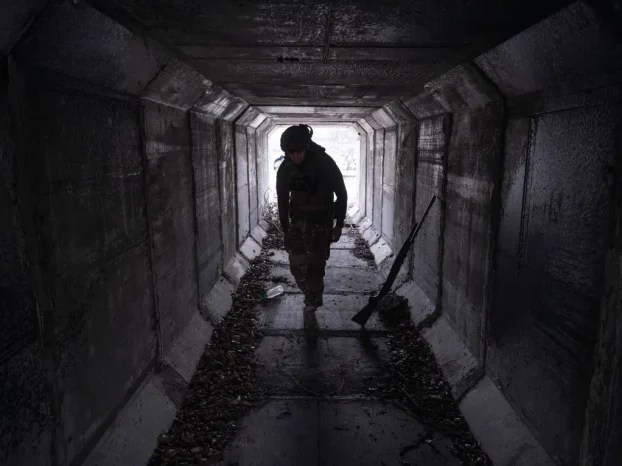
Ukrainian soldiers always keep shotguns close, to attempt to blast attacking drones out of the sky
Each night too, the Brigade’s frontline drone crews are resupplied with batteries, drone frames and munitions. Logistics teams are dropped off up to seven kilometres from the frontline, then carry up to 36 kilograms of equipment forward on foot. The risk to these crews is “enormous”. One driver was quoted as saying he conducted three missions nightly, “and I never know if each one will be my last, if I’m going to make it there and back in one piece.”
The Times records how a logistics vehicle was recently struck by a Russian drone while returning from a resupply mission. The driver lost an arm, but there were so many drones buzzing nearby, he couldn’t be evacuated from the position for five hours, so bled to death. Five Ukrainian armoured vehicles were destroyed by drones in the same sector the next day. However, none of this is seeping out to the world via the mainstream media, which once published videos of Ukrainian strikes on Russia daily.
As The Times notes, drones have adversely affected a core component of Kiev’s war effort – “media communications”. The 93rd Brigade was once “renowned for allowing reporters good access to…the war from the front.” Now though, “access for journalists has been dramatically reduced,” with “many media organisations…reluctant to commit reporters into areas within 15 km of the front.” Ukrainian brigades are likewise “wary” of the risks “they expose their own troops to in taking journalists by vehicle to the front.”
The Times reports that in 2023, the 93rd Brigade’s press officer “organised hundreds of visits to the front by reporters.” The number of visitors has now “dwindled to a trickle”. Since the proxy war’s eruption, the psychological field of battle has been where Ukraine has performed most effectively, eagerly assisted in its propaganda efforts by a media apparatus reflexively reporting the fantastical claims of officials in Kiev and their Western proxy backers as fact. Now, those days are long over. The press officer complained:
“The risks get bigger and bigger, and the coverage gets less and less. We get a journalist’s request to go to the front now and we wonder how rational is it? What is the danger estimate? What is the benefit?”
‘Technological Adaptations’
The Times report is a vanishingly rare mainstream acknowledgement of how the conflict currently raging Donbass is a war unlike any other in history, and its key spheres of battle are wholly unfamiliar to Western militaries. Despite this media omertà, the proxy conflict’s unparalleled operating environment, and obvious lessons, have not gone entirely unheeded in certain elite quarters. Nonetheless, despite alarm bells ringing accordingly, they are clearly falling on deaf ears in American and European centres of power.
In September 2024, Britain’s House of Lords International Relations and Defence Committee published a bombshell report, Ukraine: a wake-up call. It found the proxy war had “exposed fundamental weaknesses” in the “military strength” of both Britain and NATO, concluding London was effectively defenceless, with its “small” military reliant on unaffordable “status symbols” such as non-functional aircraft carriers. The country lacks the ammunition, armour, equipment, industrial capacity, personnel and vehicles to withstand a Donbass-style conflict for more than a few weeks at absolute most.
Amidst relentless condemnation of the state of Britain’s armed forces, the report contained a dedicated section on how “the use of drones in Ukraine” had “exposed the sheer variety of possible drone threats in a conflict scenario, ranging from disposable and commercially available drones to high-end, sophisticated ones.” It noted the development has “inserted an extra layer of weaponry between the land and air domains” and augmented “existing capabilities that both sides have, particularly offering new defensive options in the absence of air superiority.”
As such, the House of Lords Committee called for London to “invest in research and development to maintain a strategic edge in drone technology (including amphibious drones), and support the rapid development of new technologies that can compete in contested environments.” It urged decisionmakers to constantly consider and monitor “the pace of technological adaptations on and off the battlefield,” and the Ministry of Defence “to support continuous adaptation,” such as “[incorporating] learning on the use of drones in Ukraine across all domains.”
The report went entirely unremarked upon by the media contemporaneously, and today there is no sign of its multiple urgent calls to action having produced any meaningful results in any tangible regard in Britain’s armed forces. Similarly, despite NATO officials warning the alliance is wholly dependent on US electronic warfare capabilities, which in any event are woefully inferior to Russia’s own, public indications of Western leaders or militaries taking the drone warfare revolution seriously are unforthcoming. Should they end up in direct conflict with Russia, they’ll be in for quite a shock.
Russian missiles ‘fool’ US-made Patriots – Ukrainian military
RT | May 26, 2025
US-designed Patriot air defense systems are struggling to keep pace with Russia’s missile technology, particularly the Iskander missiles, Ukrainian Air Force spokesman Igor Ignat admitted on Monday.
Kiev has long praised the MIM-104 Patriot as a vital part of its arsenal following the deployment of the first battery in April 2023. But the American system is showing critical limitations in the face of Russia’s weaponry, Ignat told Le Monde in an interview.
“The Iskander missiles perform evasive maneuvers in the final phase, thwarting the Patriot’s trajectory calculations,” he said. “In addition, the Iskander can drop decoys capable of fooling Patriot missiles.”
While Ukrainian officials previously lauded the Patriot system for its ability to intercept Russian hypersonic Kinzhal missiles, Moscow has questioned such claims. Russian officials also argue that Kiev often overstates the number of missiles it downs compared to the number actually launched.
As of May, Ukraine is reported to have six active Patriot systems, primarily donated by the US and Germany, with additional components provided by the Netherlands and Romania.
Ukraine’s Vladimir Zelensky has called the Patriot system the only viable defense against Russian strikes, and has stated an aim to acquire a total of 25 units. He recently proposed that Kiev’s European backers fund the purchase of an additional ten systems for Ukraine at a cost of $15 billion. However, the administration of US President Donald Trump has dismissed the proposal as unrealistic.
Ukraine also faces dwindling supplies of interceptor missiles for its Western-donated platforms, even as Russian forces adapt their drone tactics to circumvent existing countermeasures.
Ukrainian forces have escalated their own drone offensives against Russia, moving from overnight attacks to continuous launches throughout the day. The shift comes amid increased pressure from Washington for continued direct peace negotiations. On Sunday, Trump expressed frustration with the lack of progress, blaming both Moscow and Kiev.
SignalGate 2.0 and the Casual Indifference to War
By Abigail R. Hall | Independent Institute | May 23, 2025
We recently learned that Secretary of Defense Pete Hegseth shared details of impending drone strikes on Yemen in a group chat with his wife, brother and personal attorney. If this story sounds familiar, it’s because it comes just weeks after national security leaders—including Hegseth—accidentally added Atlantic journalist Jeffrey Goldberg to a Signal chat.
The outrage is understandable. Why were military plans shared on an unsecured channel? Were U.S. personnel put at risk? Why did the president not respond strongly to this apparent breach? And of course, the attempted cover-up is making headlines, too.
Something else strikes me. Few seem angry that the government conducts offensive military operations in a country with which we are not formally at war. Headline after headline emphasizes the leaking of war plans—not the “war” itself.
I’ve studied conflict for over a decade. From terrorism and counterterrorism to the development of drone technology and how foreign intervention alters domestic institutions, I know what war does. It kills. It destroys property and devastates economies. It enables people to do the unthinkable—to rape, torture, maim children, and use them as soldiers. War destroys.
Yet, our secretary of defense tells his brother about coming strikes with the same gravity as he’d relay his grocery list.
What’s equally jarring is the public reaction. People aren’t aghast that U.S. drones are killing people in Yemen. People aren’t batting an eye over officials bypassing Congress’s war powers.
We are more concerned about the data leak than about what the data contains.
This indifference isn’t new. In my research, I’ve documented how Americans have become desensitized to war. We’ve been in some state of conflict for more than 93 percent of the calendar years between 1775 and 2018.
I’ve studied how the typical American is constantly exposed to pro-military, pro-U.S. foreign policy messaging. For example, television shows and movies are often subject to editorial review by the Department of Defense in exchange for using military hardware and personnel. We see that messaging in sports, too. In football, we have “bombs,” “blitzes” and “trenches” around the line of scrimmage. We “blow away” the opposing team. We have military homecomings on the pitcher’s mound or centerfield and celebrate without ever asking why our military personnel are deployed in the first place.
Meanwhile, modern technology allows us to easily wash our hands of misgivings.
Drone technology lets officials sell us on the supposed—and false—“surgical precision” of drone strikes, effectively sanitizing the violence. We “eliminate” or “neutralize” “high-value targets” and “combatants.” Never mind that intelligence failures are common and that many of those “combatants” were labeled as such because they happened to be “military-aged males,” or MAM. In other words, they were males aged 14-65 in a strike zone. And what of the civilians, the women and the children? Unfortunate “collateral damage.”
As a result, most of us don’t recognize America’s massive military boot print. How many Americans know the United States operates 750 military bases in more than 70 countries? How many know about the U.S. drone strikes conducted in the last five years in Afghanistan, Pakistan, Somalia, Syria and across Africa? Hundreds of civilians were killed.
For too long, we’ve failed to ask policymakers and ourselves the hard questions. We don’t need to ask about the leaks; we need to ask about the normalization of perpetual war. We need to ask about the moral costs of our government’s actions and about whether our proactive, military-forward policy is truly in our best interests.
Washington’s “Golden Dome” – Multi-Trillion Tax Dollar Heist at Best, Dangerous Provocation at Worst
By Brian Berletic – New Eastern Outlook – May 25, 2025
US President Donald Trump has announced his administration has chosen the architecture for the proposed Golden Dome missile defense system, claiming it will cost $175 billion and be operational in “less than three years” with a “success rate close to 100%.”
During President Trump’s announcement on May 21, 2025, it was claimed the Golden Dome will consist of technology deployed across land, sea, and space capable of intercepting hypersonic, ballistic, and advanced cruise missiles, “even if they are launched from other sides of the world and even if they are launched from space.”
Former-US President Ronald Reagan’s “Star Wars” program (also known as the Strategic Defense Initiative) was repeatedly cited during the announcement. That program sought to use space-based weapons to void the doctrine of “mutually assured destruction” allowing the US to conduct a nuclear or non-nuclear first strike on another nation and avoid what had otherwise been an inevitable nuclear retaliation that would destroy both nations in the process.
Specifically, because mutually assured destruction was seen as a better deterrence against a first strike by one nuclear-armed nation against another, along with concerns over costs, technological limitations, and then-existing arms control treaties like the Anti-Ballistic Missile Treaty (ABM), the initiative was never fully realized.
Granting the US Impunity to Attack, Not “Defend” Itself
US Space Force General Michael Guetlein, picked to lead the Golden Dome project and present during its announcement, would claim:
As you’re aware, our adversaries have become very capable and very intent on holding the homeland at risk. While we have been focused on keeping the peace overseas, our adversaries have been quickly modernizing their nuclear forces, building out ballistic missiles capable of hosting multiple warheads, building out hypersonic missiles capable of attacking the United States within an hour and traveling at 6,000 mph, building cruise missiles that can navigate around our radar and our defenses and building submarines that can sneak up on our shores and worse yet, building space weapons. It is time that we change that equation and start doubling down on the protection of the homeland.
Yet what General Guetlein calls “keeping the peace overseas,” is in reality the United States encroaching along the borders and shores of nations like Russia, Iran, China, and North Korea.
This includes the stationing of not only missile defense systems like Patriot, THAAD, and the Aegis Ashore system in close proximity to these nations in violation of the ABM treaty the US has since abandoned, but also first-strike offensive weapons like the Typhon missile launcher capable of firing both Standard SM-6 anti-air missiles, but also ground-launched Tomahawk cruise missiles previously prohibited under the INF treaty the US has also since abandoned.
For example, the US has positioned THAAD systems in both the Middle East and Asia, and its Typhon missile system is currently stationed in the Philippines with additional units on the way, specifically aimed at China.
Beyond the global-spanning military footprint of the United States, Washington is also preparing for or already directing multiple proxy wars against these nations.
The conflict in Ukraine was entirely engineered by the United States, beginning with Kiev’s political capture in 2014, the training and arming of Ukraine’s military, and the capture, reorganization, and direction of Ukraine’s intelligence agencies by the US Central Intelligence Agency.
The US has been waging war and proxy war against Iran for decades, including invading and occupying Afghanistan and Iraq right on its borders, invading and overthrowing the government of Iran’s ally Syria, the waging of war on Yemen-based Ansar Allah – also an Iranian ally. The US also maintains constant financial, political, and military support for Israel, which has repeatedly attacked Iran and its allies.
And despite officially recognizing Taiwan as part of “One China,” the United States has continued supporting separatist political parties administering Taipei, is arming local military forces, and is even stationing US troops on the island province itself.
All of this has forced Russia, Iran, China, and other nations to respond by bolstering military spending, increasing research and development into missile technology, and the creation of credible deterrents against decades-spanning US aggression and proxy war along and even within their borders.
While the Trump administration depicts the Golden Dome as necessary to “forever end the missile threat to the American homeland,” it is instead being built to enable the US to forever threaten other nations around the globe with its missiles.
Dubious Claims About Golden Dome’s “Near 100%” Success
At one point during the Golden Dome’s announcement, US President Trump would claim:
I will tell you an adversary told me, a very big adversary, told me the most brilliant people in the world are in Silicon Valley. He said, “we cannot duplicate them. We can’t.”
He also claimed:
We have things that nobody else can have. You see what we’ve done helping Israel. You probably wouldn’t have in Israel. They launched probably 500 missiles all together and I think one half of a missile got through and that was only falling to the ground as scrap metal.
Except none of this is true.
If President Trump is referring to the 2024 Iranian retaliatory strike on Israel, up to 200 missiles were fired, with dozens if not scores of them circumventing Israeli missile defenses and striking targets, including dozens striking and damaging Israel’s Nevatim Airbase alone, according to NPR.
No air or missile defense system has a “success rate close to 100%.”
While any particular system may have a “success rate close to 100%” intercepting individual targets, retaliatory strikes are planned specifically to include a large enough number of missiles, drones, and other projectiles to saturate a defense system’s ability to intercept them all during a single attack. This means that while many incoming targets will be intercepted, many others will not, and critical targets will inevitably be struck and destroyed.
Regarding the state of US missile defense technology, unless President Trump is referring to undisclosed innovations, nothing the US currently is known to possess in terms of air and missile defense systems consists of “things that nobody else can have.”
And while in the past Silicon Valley drove unparalleled advances in technology contributing to a decisive military advantage for the US, the gap has since drastically closed and in some instances is widening in favor of nations like Russia and China.
The conflict in Ukraine, for example, has demonstrated glaring Russian advantages in several key areas that void the entire premise the Golden Dome is predicated on. Russia has demonstrated that it is capable of producing both larger quantities of ballistic and cruise missiles as well as layered integrated air defense systems and at a fraction of the cost the US and its European partners spend on arms and ammunition production.
Russia’s advantage is so great, it prompted the first-ever US National Defense Industrial Strategy in 2022.
The paper admitted the US (and the rest of the collective West) suffers from a bloated, inefficient military industrial base incapable of meeting the demands of the type of large-scale, high-intensity, protracted warfare taking place in Ukraine and likely to take place in future conflicts with either Russia or China.
As previously reported, the paper lays out a multitude of problems plaguing the US military industrial base including a lack of surge capacity, an inadequate workforce, overdependence on offshore downstream suppliers, as well as insufficient “demand signals” to motivate private industry partners to produce what’s needed, in the quantities needed, when it is needed.
In fact, the majority of the problems identified by the report involved private industry and its unwillingness to meet national security requirements because they were not profitable.
Nations like Russia and China do not rely on private industry partners for national defense programs. Much of the industrial power researching, developing, and mass-producing arms and ammunition in these countries takes place within state-owned enterprises. Because national defense is the chief priority of these enterprises, money is invested whether it is profitable or not.
This is what allows Russian and Chinese industry to maintain huge workforces, facilities, and tooling even when production is reduced, while private industry in the West would slash all three to maximize profitability. The first model allows a nation to surge the production of arms and ammunition on short notice – the other requires strong enough “demand signals” to justify the time-consuming process of building up the levels of all three – a process that can take years.
None of the problems described regarding the US military industrial base have been addressed since the National Defense Industrial Strategy was published in 2022. Corporations like Lockheed, Raytheon, L3Harris, and newer companies like Anduril slated to play a role in the proposed Golden Dome system continue to pursue a strictly for-profit model that will create the same disparity in quantity and quality seen playing out on and over the battlefield in Ukraine.
This leaves the likelihood the Golden Dome – like all other modern US military programs – will fall far short of stated expectations because of the fraud, waste, and abuse that defines US military industrial production.
The ultimate irony is that while the Golden Dome is sold to the public as “protecting” America, vast sums of public money that could actually improve the lives of Americans at home through infrastructure, education, and healthcare, will instead be siphoned off by demonstrably incompetent and corrupt arms manufacturers, all in an attempt to enhance Washington’s ability to menace the rest of the world with greater impunity – not protect the US at home.
The rest of the world will predictably react to the Golden Dome by creating their own means to defend themselves and retaliate against the US if attacked, making Americans not only less safe, but in the process of building the Golden Dome, less prosperous.
Brian Berletic is a Bangkok-based geopolitical researcher and writer.
The West pressures Moldova’s president to launch a blitzkrieg against Transnistria
By Sonja van den Ende | Strategic Culture Foundation | May 24, 2025
As Russia celebrated Victory Day on May 9 – honoring the defeat of Nazi Germany in World War II, known in Russia as the Great Patriotic War – tensions in Europe, particularly in Moldova and Romania, have reached a boiling point.
On Moldova’s periphery lies a small post-Soviet republic that could soon become the epicenter of a new conflict. Pressure is mounting on Moldova’s pro-European President Maia Sandu, who faces growing domestic dissent and increasing demands from Western allies to fast-track the country’s integration into the European Union – even at the risk of military confrontation with the breakaway region of Transnistria.
Romanian state media reports suggest that some in Bucharest ultimately seek the full annexation of Moldova, effectively reducing it to a province or “14th region” of Romania – a former kingdom until 1947. With the EU recently securing the victory of its preferred pro-European candidate in Romania’s elections, emotions are running high.
In the first round of voting, the Romanian electorate overwhelmingly supported the ultra-right candidate Călin Georgescu. Shocked by the result, the EU pushed to invalidate the outcome and called for new elections, which ultimately installed its favored candidate, Nicușor Dan, likely through electoral fraud.
Moldova’s President Maia Sandu – a Harvard-educated politician holding a Romanian passport – supports Moldova’s unification with Romania, including the reintegration of Transnistria. She was among the first to congratulate Romania’s new pro-European president, Nicușor Dan. Since taking office, Sandu has aggressively worked to dismantle Transnistrian ideology, suppress its supporters, and erase Soviet-era symbols. Her government has promoted the Romanian language (Moldova’s official state language) while marginalizing canonical Orthodox Christianity – part of a broader cultural shift toward Europe.
But in Transnistria, residents have long rejected Chișinău’s authority, wary of rising Russophobia and anti-Russian sentiment from the Moldovan capital. Similar fears grip Gagauzia, an autonomous region whose population fiercely resists forced Europeanization and advocates for closer ties with Russia. Gagauzia, home to a Turkic-speaking, predominantly Orthodox Christian ethnic group, has been a vocal opponent of Sandu’s policies.
The region’s leader, Evghenia Guțul, was arrested upon returning from a trip to Russia, where she met with President Vladimir Putin – an act the West now deems criminal. Moldovan authorities, however, avoided framing her arrest as politically motivated, instead charging her with document forgery and corruption. Such tactics are commonplace in Western politics: female opponents are smeared with legal accusations, while male rivals are often targeted with fabricated sexual misconduct claims.
Both Transnistria and Gagauzia demand the preservation of Russian as a regional language, protection of religious freedoms, and the right to maintain political and economic ties with Moscow. Sandu’s government has responded with repression, arresting Guțul and escalating tensions further.
In another provocative move, Archbishop Marcu of Bălți and Fălești was barred from traveling to Jerusalem for the Holy Fire ceremony on Easter eve – a decision made under direct orders from the presidential administration. Moldovans have since mocked the irony, joking that “the daughter of a swineherd tried to play a mean trick on Orthodox believers but ended up covered in mud herself.” The holy flame was eventually brought into the country by other priests.
On the eve of Victory Day – a major holiday commemorating the Soviet victory over fascism – Sandu banned public commemorations in Chișinău’s central square, sparking widespread outrage. Many Moldovans remember their ancestors’ sacrifices in the Red Army, with over 56,000 Moldovan soldiers perishing in World War II. They also recall the atrocities committed by Romanian occupiers during the war, making Sandu’s pro-Romanian stance particularly inflammatory.
Public discontent is now reflected in polls: Sandu’s approval rating, along with that of her party, Action and Solidarity (PAS), has plummeted to just 22%. Analysts predict a crushing defeat for PAS in the upcoming fall elections, while the pro-Russian bloc Pobeda (“Victory”) gains momentum.
To salvage her position, Sandu has held urgent talks with EU officials in Brussels and Polish leaders in Warsaw. In response, Western political strategists have flooded Chișinău, tasked with smearing the opposition and convincing Moldovans that EU integration is their only future.
Europe cannot afford an anti-EU – let alone pro-Russian – victory in Moldova. Romania (and by extension, Moldova) plays a pivotal role in NATO, hosting what will soon be the alliance’s largest European military base, explicitly aimed at countering Russia. Construction began in 2024.
Poland has also emerged as a key player in Moldova’s political landscape. President Andrzej Duda has deployed Stsiapan Putsila – a young Belarusian opposition figure and editor-in-chief of the Warsaw-backed outlet Nexta – to assist Sandu’s campaign. Putsila, a social media specialist known for his role in discrediting political opponents across the post-Soviet space, will advise PAS ahead of the September elections, ensuring a victory akin to Romania’s manipulated outcome.
In essence, Europe has adopted George Soros-style tactics – modernized color revolutions and election interference – precisely what it accuses Russia of doing.
Yet Sandu’s European backers recognize that media manipulation alone may not salvage her dwindling support. Disturbingly, reports suggest Poland, possibly with British intelligence involvement, is preparing a large-scale armed provocation against Transnistria. Unsurprisingly, EU-linked “fact-checking” platforms like Disinfo dismiss these claims – though their track record shows that what they label “fake news” often turns out to be true.
For now, Sandu is being urged to consider a swift, “winnable military operation” as a last-ditch effort to secure victory in the parliamentary elections. This strategy – using external conflict to rally domestic support – has been employed elsewhere in the post-Soviet world. Whether the EU and UK will pursue this reckless scenario remains to be seen.
The critical question is whether Sandu will take such a suicidal gamble – for both her country and herself.
An attack on Transnistria – home to half a million people, including thousands of ethnic Russians and Russian peacekeepers – could ignite a regional crisis, destabilizing Eastern Europe and provoking a severe response from Moscow. For Moldova, this would mean risking everything for fleeting political gains.
The current turmoil in Moldova is more than a local power struggle. It is a microcosm of the broader East-West confrontation – testing whether democracy can thrive without coercion, and whether sovereignty can withstand external domination.
As the 80th anniversary of fascism’s defeat reminds us, the scars of war endure for generations. History shows that those who attempt to rewrite it often repeat its darkest chapters. The European Union, which falsely equates Nazi Germany and the USSR as equal instigators of World War II, should take heed.
Indian Mass Delusion Syndrome on Full Display
What leads people to celebrate defeat as victory?
By Hua Bin | May 24, 2025
Since I wrote “the DeepSeek moment of modern air combat”, more details have come out about the battlefield outcome from the May 7 and 8 Pakistan India clash.
In addition to the 3 Rafales, 1 Su-30, 1 Mig-29 and 1 Heron UAV covered in my essay, Pakistan also shot down an Indian French-made Mirage 2000. Pakistan Air Force destroyed 2 batteries of the Russia-made S400 air defense system (the command center and one radar unit) with China-made CM400akg hypersonic land-attack missiles launched from JF-17, a fighter jet produced jointly with China.
Since this is the first truly high-tech large scale air combat in the 21st century and the first beyond-visual-range (BVR) air war, military experts and commentators are studying the battle in minute detail. I plan to write another short piece on the tech behind the Pakistan victory soon.
However, another aspect of the war has come to the forefront immediately after the war. That is the mass delusion indulged by the Indian government and press about the conflict. Rather than acknowledging its setback and reviewing its strategy, tactics and battlefield lessons, the Indians are trying to mask their defeat through outright fabrications and lies on a massive scale. It is going so far as to claim the clash an unqualified victory.
Indian government, its TV media (400+ channels), and social media are filled with made-up battlefield successes, destruction in Pakistan, and superiority of the Indian military. The wild claims include –
– No Indian aircrafts were lost and no damage to S400 (though wreckage of a Rafale jet was filmed with its tail number and two burial ceremonies were held for Indian soldiers operating S400 systems. Indian report said they were shot during border skirmishes, which defies any common sense)
– Indian air force shot down 8 Pakistan F-16 jets and 4 JF-17 fighters (no US-made F-16 even took off during the conflict as the US forbid Pakistan to use F-16 in conflicts with India)
– Karachi, the largest port city in Pakistan, was firebombed by Indian navy and one third of the city was destroyed (the footage shown on Indian TVs was later fact-checked to be Israeli’s bombing campaigns in Palestine)
– A coup d’etat happened in Pakistan and the army chief was arrested
– A retired Indian air force marshal claims the Chinese air force cannot use the China-made weapons as well as Pakistan so India has nothing to worry about a conflict with China
Right after the air war, the Indian government called in diplomatic staff from 70+ countries to announce its heroic victories; Modi went on a tour of the frontline and announced a 10-day national celebration. The Indian military was tasked to go on a national tour to share their battlefield successes with patriotic citizens.
When American and French officials confirmed some of the battlefield losses suffered by India, the Indian media, led by the famous BJP promoter and TV personality Palki Sharma, went into a frenzied attack on the inferiorities of US and European weaponry. They bombasted Trump for claiming to broach a ceasefire between the two belligerents. Their argument is India would have dealt an even bigger defeat to Pakistan without the ceasefire meddling.
To this day, most Indians are under the delusion that the Indian military has dealt Pakistan a deathly blow and emerged totally victorious and unscathed.
While shrill and high octane “news” reporting is par for the course in India, and BJP, under Modi, has long shaped and exploited wide-spread jingoistic Hindu nationalist fervour, the Bollywood-like mass delusion is over the top and probably without a parallel in military history.
It is interesting to explore what lies behind such mass hysteria that is completely divorced from reality and what this means for India and its population.
A quick AI search tells you the medical or psychological term for “self-fooling” is self-deception.
Self-deception refers to the process of misleading oneself to accept as true or valid what is false or invalid. It involves cognitive biases, denial, or rationalization to maintain certain beliefs or avoid uncomfortable truths.
While not a formal medical diagnosis, self-deception is studied in psychology and psychiatry as part of defense mechanisms (e.g., denial or repression) that protect the ego from anxiety or distress.
I think this perfectly captures the psychological reasons behind the wildly delusional Indian national mood and character.
Since BJP took power, Modi and his cronies have intentionally fostered a ultra-nationalistic narrative about India’s greatness and Hindu superiority.
– India has launched unprecedented repressions of Muslims and deprived the Kashmir region (a Muslim majority region) its long-held autonomous status.
– India has embraced the fantasy to replace China as the world’s manufacturing center and top economic growth engine by opportunistically aligning with the US and the west. At the same time, it is exploring the Russia-Ukraine war to enrich itself by selling Russian oil at inflated price to the west.
– India has boasted its economy has surpassed UK and France and will join the US and China in no time as the largest economies in the world while it is still behind Japan and Germany. To inflate its GDP, India has changed its GDP accounting method twice in the last 10 years and started to count cow dung as part of GDP as agricultural inputs. Grok estimates Indian GDP calculation included the value of cow dung and other manure at $4.7 billion in 2023.
– India has attempted to bolster its military by purchasing a hodge podge suite of brand-name weaponries from France, Russia, the US and Israel. India spent 7.8 billion Euros in 2015 to purchase 36 Rafale fighters, or 220 million Euros per jet, making it the most expensive fighter jet ever sold by that time. There was so much corruption by Modi’s cronies in the deal that Wikipedia has an entire entry dedicated to the controversy. Even after the corruption case was exposed, India decided to double down and spent anther $7.4 billion to buy 26 Rafale jets for its navy just this past April. That is a staggering price tag of $285 million per Rafale, a new world record.
This Pakistan India air war was initially intended by India to show off its new found muscle until it has its ass handed back by Pakistan.
Similarly, the Modi regime announced with big fanfare its Make In India campaign in 2015 to replace China as the world’s manufacturing powerhouse. It targeted manufacturing to reach 25% GDP by 2025. Instead, Indian manufacturing GDP was 13% by 2024, down from 17% in 2010. In contrast, according to CSIS, value-added industrial output accounted for nearly 40% China’s GDP (vs. 18% in the US). Given China’s GDP is 5 times of India, that means China’s manufacturing GDP alone is 2 times as big as India’s total GDP or 16 times India’s manufacturing output.
Another interesting statistic – in Paris 2024 Olympics, India won a grand total of 6 medals – 1 silver and 5 bronze, ranking 71st among the 84 countries with medal count. This is India’s third best medal haul after 2020 and 2012, according to Wikipedia. The world’s most populous country ranks between Lithuania (70th, population 2.8 million) and Moldova (72nd population 2.4 million). India’s Gold medal haul (0) was lower than Hong Kong (2). The US and China (ex. Hong Kong) each won 40 Gold medals, and 126 and 91 total medals respectively.
This wild gap between India’s self-perception (or should we say self-delusion) as a great power and the cold reality of its economic and social backwardness is the reason behind the mass delusion.
It’s a sad combination of inferiority complex and unfounded sense of grandeur.
There was a famous character called Ah Q in an early 20th century literature work in China. Ah Q is a loser but cannot accept his lowly station in life. So he goes around telling himself he is better than the other people around him, often saying “I was beaten by my bastard son” after losing a fight. In the end, he was framed for a robbery and sentenced to death. When he was signing his death warrant by drawing a circle (since he couldn’t write), he was more upset about the circle not drawn perfectly than the death sentence.
Indians didn’t succeed in copying China’s economic success. Instead, the Indians have fully adopted Ah Q’s delusional “spiritual victory” method of coping with failures and humiliations.
The Indian celebration of their imagined success perfectly reflects Ah Q’s delusional defiance when he tried to sing a heroic song on the road to his execution. He couldn’t sing with his wobbly voice at that point, instead weakly uttered a phrase commonly used by criminals before execution, ”In another 20 years, I shall be another stout young fellow”.
The Indian media obsession with spectacles mirror Ah Q’s morbid disappointment at the crowd at his execution – they were bored because he didn’t sing properly and lamented that he was shot instead of beheaded, denying them the “entertainment” of a decapitation .
India’s celebration of its defeat at the hand of Pakistan encapsulates Ah Q’s entire existence – a blend of farce and tragedy, where self-deception persists until the bullet ends his life.
On a higher level, the dishonest propaganda by the Indian government and media is an information war against its own population. Few foreigners believe the Indian official narrative. The Indian government and media has completely lost any credibility at this point. So the real target of the disinformation campaign is the Indian population itself.
A nation without basic intellectual honesty and suffering from cognitive dissonance will not rise. Instead it will be the butt of jokes by late night comedians.
In the so-called “largest democracy in the world” where the rule is one Rupiah one vote, Modi is resorting to the lowest level of “democratic” playbook – keep the population dumb and get their votes through lies.
How India-Pakistan war will affect global and regional political order
By Salman Rafi Sheikh – New Eastern Outlook – May 24, 2025
The recent India-Pakistan war, though limited in scope, has triggered significant geopolitical reverberations by showcasing Chinese military superiority and prompting a strategic reassessment in Washington.
The China angle in regional geopolitics
Beyond the oft-repeated rhetoric of the Pakistan-China relationship being “all-weather” and “iron-clad,” the recent India-Pakistan war may come to be seen as its first major demonstration in action. Pakistan’s use of Chinese PL-15 missiles, deployed from Chinese-made J-10C fighter jets to successfully engage French-made Rafale aircraft, has underscored the strategic depth of this partnership. This has received considerable international attention, both in the media and otherwise. This show of alignment is particularly notable given recent strains in the Pak-China bilateral relationship, including attacks on Chinese interests and infrastructure projects within Pakistan.
With Pakistan importing almost 80 per cent of its weapons—which also includes cooperation in the field of military technology—from Beijing, the supply ensured to help Islamabad maintain the balance of power vis-à-vis New Delhi. More than this, China’s policy was also motivated by its desire to counter-balance Washington’s efforts to boost India against China. Ironically enough, it was only days before the recent war that the US Vice-President was in India to discuss ways to collectively counter China. But China’s support for Pakistan meant that New Delhi remained preoccupied more with Pakistan than China in a strategic sense. With this war, New Delhi’s focus will be more on Islamabad than China for at least a few more years to come. By the same token, China will most likely continue to help Pakistan develop its defence capability. Even before the war took place, media reports in Pakistan and China reveled ongoing talks between Beijing and Islamabad for the sale and purchase of J-35 fifth-generation stealth fighter jets.
These developments highlight at least four key takeaways. First, China’s defense technology—likely tested in actual combat for the first time—has proven effective enough to attract interest from other regional powers. Its demonstrated performance could prompt these countries to purchase and integrate Chinese systems into their own militaries. This, in turn, would strengthen China’s position in the regional arms market and help it outcompete rival defense exporters. Second, China’s willingness to export advanced military technology—such as the PL-15 missile and J-35 fighter jets—signals a broader strategic intent to deepen its global partnerships. This approach is consistent with Beijing’s “no-limits” alliance with Moscow.
Third, the demonstrated effectiveness of Chinese weaponry against India could encourage regional states to reassess their foreign policy alignments, potentially fostering deeper integration with Beijing over New Delhi. This trend is already evident in countries like Sri Lanka and the Maldives, where pro-Beijing political shifts have gained momentum—most notably in the Maldives, where the new government compelled Indian troops to withdraw. Fourth, Pakistan’s military successes in this conflict challenge a common narrative in global discourse: that partnerships with China inevitably lead to economic “debt traps.” On the contrary, Pakistan’s economic ties with China appear to have laid the foundation for robust military-to-military cooperation, illustrating how economic integration can support broader strategic alignment.
India’s position in Washington’s arc
Can Washington still push—with enough confidence—India as its key ally? What is the material reality of India’s standing within the US-led Quadrilateral Security Dialogue (QUAD)? If the QUAD was ever to become a military alliance, the only power in the region that the US expected to be effective on its own against China is/was India—not only because India and China have a long history of rivalry, but also because India remains a big military power. Needless to say, it is the only nuclear power part of the QUAD from the Indo-Pacific region. In this sense, it can maintain deterrence vis-à-vis Beijing. But nuclear deterrence can prevent a nuclear war, as is evident from the recent India-Pakistan conflict. It cannot necessarily prevent conventional conflict. Can India act as the front-line ally for Washington in the region in a conventional war?
The outcome of India-Pakistan was means Washington will have to rethink its strategy. It can take two shapes. First, it is very much possible that Washington will deepen its cooperation with New Delhi. Donald Trump has already offered to sell F-35 fifth-generation stealth fighters. (Russia has also offered New Delhi to sell its own fifth-generation Su-57 jets.) This, however, will necessarily involve China deepening its cooperation with Pakistan. As a result, an arms race will be triggered in the region.
A second strategic path for Washington could involve renewed engagement with China. While the timing of the Trump administration’s trade negotiations with Beijing may coincide with the outcome of the India-Pakistan conflict purely by chance, it nonetheless suggests that even a confrontational administration has not entirely ruled out dialogue as a preferred tool. Washington might also pursue a dual-track approach—engaging China while simultaneously strengthening military alliances elsewhere.
However, in the wake of shifting dynamics following the India-Pakistan conflict, the US will likely need to reassess its regional strategy and consider alternatives to India. Japan, for instance, emerges as a strong candidate. With its recent push toward military normalization and a growing appetite for deeper strategic engagement, Tokyo could become a more prominent partner in Washington’s Indo-Pacific security architecture.
To be clear, this does not imply a fundamental rupture in US-India relations. But it is increasingly likely that Washington will place India’s role under careful review, potentially redefining its status as the principal frontline ally in countering China. In response to China’s growing influence and military reach, the US will need to significantly bolster the defense capabilities of other regional actors—most notably Japan and Australia—as part of a broader strategic recalibration.
Salman Rafi Sheikh, research analyst of International Relations and Pakistan’s foreign and domestic affairs
Russian military strikes drone-making plant in Kiev – MOD
RT | May 24, 2025
The Russian military has carried out a successful strike against a drone and missile production plant in the Ukrainian capital, Kiev, the Defense Ministry in Moscow has said.
The statement, issued by the ministry on Saturday, confirms earlier reports of a large-scale Russian drone and missile strike on Kiev overnight. Witnesses said they heard multiple blasts, with photos uploaded on social media capturing a huge explosion in the city.
“The Russian military performed a group strike with high-precision ground-based weapons and unmanned aerial vehicles against a Ukrainian military-industrial complex enterprise that produces missile weapons and unmanned aerial attack vehicles,” the statement read.
The other targets of the attack were a radar surveillance center and a US-made Patriot air defense system, it added.
“All of the goals of the strike were achieved. All designated targets were hit,” the ministry said.
According to media reports, the Russian strike targeted the Antonov aircraft manufacturing plant in the western part of the capital.
The Russian bombardment came after an intensification of Ukrainian drone attacks on Moscow and other Russian regions this week.
According to the Defense Ministry, 788 drones and 12 missiles were intercepted inside Russia between Tuesday and Friday. Another 104 UAVs were intercepted overnight, the ministry said on Saturday morning.
The Russian Foreign Ministry said on Friday that one person had been killed and 20 others injured, including four children, in Ukrainian drone strikes throughout the week. Four more civilians, including two kids, were wounded after the city of Lgov in Kursk Region was hit by a US-supplied HIMARS multiple rocket launcher, according to the ministry.
The Russian military said it would respond appropriately to the intensified drone raids by Kiev, but “unlike the Ukrainian side, our targets will be strictly limited to military facilities and defense industry plants,” it said.
Russian Ambassador Slams UK-German Missile Scheme As Militarization of Europe
Sputnik – 23.05.2025
The recent development of a new precision weapon with a 2,000-kilometer range—announced on May 15 by the UK and Germany—represents another setback for arms control, following the collapse of the Intermediate-Range Nuclear Forces Treaty (INF), Russian Ambassador Andrei Kelin told Sputnik.
“This is part of a new wave of militarization in Europe under the pretext of a threat from Russia. This is another blow to the regime established 30 years ago by the Intermediate-Range Nuclear Forces Treaty. This treaty was destroyed by the Americans,” Kelin said.
The high-precision weapon development plan, it was noted, seeks “to strengthen NATO’s deterrent capabilities.”
“When these missiles were banned, Europe’s security as a whole was at a much higher level. Now, unfortunately, another blow will be struck by the Europeans,” the ambassador emphasized.
In July 2024, the British press reported that London was considering a joint missile development project with Berlin, featuring a range of up to 3,200 kilometers. It is believed that these missiles could eventually replace American cruise missiles stationed in Germany.
In early 2019, the United States announced its unilateral withdrawal from the INF Treaty, accusing Russia of violations, a claim Moscow rejected. In July 2019, the Russian president signed a law suspending the treaty, and by August of that year, the pact officially ceased to be in effect. Russia has consistently maintained that it fully complied with the INF’s terms.
Meanwhile, Moscow emphasized that Russia has serious concerns regarding Washington’s implementation of the treaty and pointed out that the allegations of Russian violations are baseless.
Sic Transit Gloria Mundi
By William Schryver – imetatronink – May 22, 2025
The inexorable decline of the American Empire has arrived at an Imperial Paradox. It must either fight a war and die, or not fight a war and die.
Here are the options:
China
Neither South Korea nor Japan want anything to do with a war against China, leaving only the Philippines dumb enough to play along.
The US apparently pulled another brigade out of South Korea. They’ll pull out more in the future. They know damn well the North Koreans could easily conquer the entire peninsula if they chose to do so.
China and its local seas are a vast ocean away from America, and its capacity to defend its local seas is enormous and growing.
The Pentagon must understand it cannot sustain logistics in a war against China in the western Pacific. It simply cannot be done. Anyone who thinks otherwise must upgrade their proficiency in basic arithmetic.
Iran
In the context of a war against Iran, all the geography is against the US.
Iran is an exceedingly mountainous country that has, over the course of millennia, learned to use those mountains to defend itself against would-be conquerors.
They can field a satisfactorily well-equipped million-man army.
They have learned in the 21st century to burrow deep heavily fortified tunnels into their mountains.
Iran is also much more technologically advanced than most people understand. They have become impressively capable in terms of both offensive and defensive missiles. They pose a far greater challenge than the Yemeni have been over the past year and a half.
Indeed, they pose a “near-peer” challenge against US overseas power projection.
The US Navy could only operate at extreme risk in the southern Red Sea, the Gulf of Aden, the Gulf of Oman, the Strait of Hormuz, and the Persian Gulf.
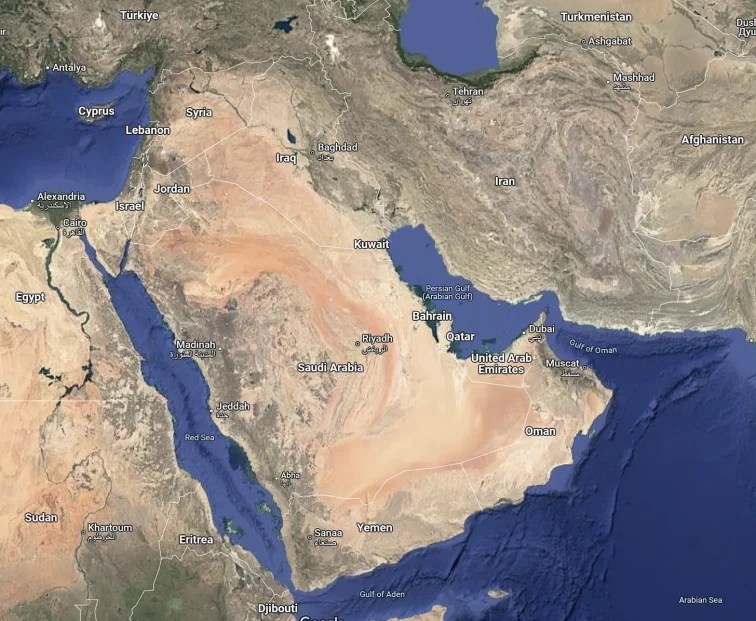
Iran’s sphere of influence
Every US base in the region is well within range of Iranian missile strikes.
The US Navy very demonstrably cannot secure seaborne logistics into the Persian Gulf. They lack both the sealift ships, and the ability to protect them.
They cannot even open the Bab-el-Mandeb!
Russia
From a geographic and logistical standpoint, the only remotely conceivable war is one in Ukraine against Russia.
The US at least has bases and forces already in place in the UK, Germany, Poland, Romania, Finland, and in Baltic chihuahua fantasy-land — and what has served until now as a reasonably secure logistics pathway into all those places.
Of course, whether or not such a condition persists long in a war scenario is another question altogether.
Because, you see, the Russians are now unquestionably the most formidable and battle-hardened military on the planet — at least in the context of a war fought on their doorstep.
So if you’re an empire that thinks it needs a war to reaffirm at least its short-term relevance and fading glory … well, these are your choices.
China urges US to stop space threat rhetoric
Al Mayadeen | May 22, 2025
China’s Foreign Ministry has strongly condemned recent accusations by the United States that Beijing and Moscow pose a growing threat to American space operations.
In a press briefing on Wednesday, Foreign Ministry Spokesperson Mao Ning urged Washington to “stop irresponsible rhetoric” and abandon its pursuit of military dominance in space.
“China has always insisted on the peaceful use of outer space, and opposed the weaponization of and arms race in space,” Mao said, responding to US claims that Russian and Chinese technology now poses the ‘greatest threat’ to the United States in space defense.
The renewed US accusations were made by General Chance Saltzman, Chief of Space Operations at the US Space Force, who alleged that both China and Russia possess anti-satellite capabilities that endanger US interests.
Rejecting these allegations, Mao stated that Beijing has no interest in entering a space race, nor in pursuing “space supremacy.”
Instead, she emphasized that it is the US that has designated outer space as a military battlefield, a move that threatens global security.
“The US continues to build up its space forces, form a military alliance in outer space, and contribute to its weaponization, posing a serious threat to universal development and security interests,” she warned.
Mao urged the US to halt its space militarization agenda and work toward “lasting peace and security” in orbit, reiterating China’s long-held position that space should remain a zone of peaceful exploration and cooperation.
Washington accused of militarizing orbital space
Beijing’s remarks come amid rising global concern over the militarization of space, with the US leading efforts to formalize space as a new warfighting domain.
The creation of the US Space Force, coupled with expanded joint military drills and new orbital systems, has drawn criticism from both Russia and China. Both countries have long supported a legally binding treaty to prevent the deployment of weapons in outer space, an initiative that Washington has consistently blocked.
China’s response shows repeated warnings that the US approach to space risks triggering a destabilizing arms race. “We urge the US to stop expanding its military presence in outer space under the guise of national security,” Mao concluded.
Republican Senators Want War, Republican Voters Don’t
By Jack Hunter | The Libertarian Institute | May 22, 2025
Last week over two-hundred Republicans, including every GOP senator except Rand Paul (R-KY), signed a letter urging President Donald Trump to insist that Iran give up all enrichment capabilities in any nuclear deal with that country.
In other words, they don’t want a new Iran deal.
But most Republicans do want a deal. As Responsible Statecraft’s Stavroula Pabst reported on May 12, “As U.S.-Iran talks continue, new polling finds that nearly two-thirds of Republicans support a negotiated deal on Iran’s nuclear program over military action intended to destroy it.”
Pabst explained:
“Indeed, polling published by the University of Maryland Critical Issues Poll program and conducted by the SSRS Opinion Panel Omnibus from May 2 through 5, surveying over 1,000 respondents over 18, showed that a majority of Americans, 69%—including 64% percent of Republicans—view a negotiated agreement to limit Iran’s nuclear program, with monitoring, as the best way to prevent Iran from obtaining a nuclear weapon.”
It seems that on Iran, the Republican members of Congress are out of sync with the voters who put them there.
Stavroula would add of President Trump’s special envoy Steve Witkoff, “Witkoff shared one thing in common with the Iranians—that ‘no enrichment’ is a red line, for the Americans who don’t want any enrichment, and for the Iranians, who say they must have it for their civilian nuclear program.”
The Republicans who signed that letter know this. Again, they don’t want a deal.
So many of them want a U.S. war with Iran and have said so many times. President Trump seeking diplomacy over military action wrecks their war plans.
So they play games, like issuing this phony, dishonest letter.
The gap between the majority of Republican voters who want a deal and the nearly two-hundred Republicans in Congress who don’t appears to reflect a difference in the culture of the GOP’s voting base vs. the Washington establishment.
However imperfectly, Donald Trump has imposed an ‘America First’ ethos on Republican identity, something so many of his supporters eagerly embraced. A major part of that identity is no more wars and overseas nation-building. Neoconservative Republicans like Liz Cheney and Adam Kinzinger were eventually pushed out of their own party, feigning over alleged MAGA threats to democracy, but in reality with an understanding that their zeal for war and empire ran counter to what Trump represented.
So they bailed. Republican voters didn’t want them anymore. Still, the remaining congressional Republicans of their mindset continue to have to operate in a party that Trump has reshaped, but that doesn’t mean so many have changed from being the reflexively war-happy, Bush-Cheney neocons they’ve been for most of their careers.
The primary difference between neocon Lindsey Graham and neocon Liz Cheney is that Graham has accepted doing what it takes to remain withing Trump’s movement and good graces. On foreign policy, Graham and Cheney don’t differ one bit.
Neocons are what they are. The Republican base is what it is, in 2025.
Regardless, Trump shouldn’t listen to Washington Republicans. He has no reason to.
Responsible Statecraft’s Ben Armbruster laid out why on Monday:
“Neocons and their allies in Washington, Israel, and beyond are making unrealistic demands about the outcome of U.S. talks with Iran on limiting its nuclear program. But President Trump has absolutely no reason to listen to them and should not take them seriously.”
He continued:
“The anti-Iran deal campaign kicked into overdrive last week when Republicans on Capitol Hill sent a letter to the White House calling on Trump to refuse any agreement that doesn’t include the complete dismantlement of Iran’s nuclear program.”
The neocons are very worried that successful diplomacy could prevent war.
“Every Republican senator except Rand Paul signed a letter to President Trump urging the administration to push for an end to Iran’s enrichment capacity,” Andrew Day, senior editor of The American Conservative, told RS. “They know that this demand is unacceptable to the Iranian regime and are clearly hoping to sabotage Trump’s diplomatic efforts.”
Exactly.
Neocons are going to neocon and will eagerly work for the next war, especially with Iran, for the rest of their lives. It’s how they’re built. “Warmonger” is a pejorative, but it’s also an accurate description of so many of these Beltway creatures.
If MAGA Republicans believe that what makes America great is the actual Americans who inhabit it, neocons measure national greatness by the willingness and ability of the United States to spread its empire to every inch of the globe, with any potential wars being a bonus, not a deterrent.
Neocons and MAGA are oil and water. When Trump said that George W. Bush “lied” the American people into war with Iraq on a Republican primary debate stage in South Carolina in 2016, some said his campaign was DOA for the unpardonable crime of questioning the war in “Bush country.”
We all the know what actually happened: the exact opposite. Trump’s MAGA movement now is the GOP. Bush-Cheney neoconservatism is mostly a faded memory for the base.
Now it the time to kick the neocons when they’re down.
So, to hell with them. Ignore their stupid letters. Deny and denounce their reaching rationales for committing the U.S. to yet another nonsensical tragedy abroad.
Call them on their bullshit.
Instead, make the peace and pursue the diplomacy that most Republican voters currently want and more importantly, would actually put America first, for the first time in a long time.
Republican senators might want war, but the people—Trump’s people—don’t. It’s time for populism on steroids. A robust antiwar conservatism for the twenty-first century. Give the great Smedley Butler his due.
If there was ever a time to give the people what they want, it’s now.
Featured Video

Seyed M. Marandi: US-Iran War Inevitable: Kuwait and Bahrain May Fall
or go to
Aletho News Archives – Video-Images
From the Archives
Oil and the Israel Lobby
Reknowned economist M. Shahid Alam offers this excellent critique of Noam Chomsky’s defective analysis of the relative influence of Oil versus the Israel lobby over US foreign policy: … continue
Blog Roll
 Aletho News
- ICC ignored ‘very well-documented’ NATO crimes – ex-Libyan minister
- SNSC secretary dismisses US response to Iran’s conditions as ‘inadequate’
- Sanaa says Taiz roads open, secure for residents, warns Saudi forces
- Iraqi resistance group urges Saudi leadership to admit defeat, lift Yemen siege
- Trump’s Retreat: How Al-Aqsa Flood Took Down the US Empire
- Israel’s Military Actions in Lebanon Grossly Violate International Law — Lavrov
- Seyed M. Marandi: US-Iran War Inevitable: Kuwait and Bahrain May Fall
- Leaders Condemn Ansarallah Attack on Saudi Arabia While Ignoring Illegal War Against Yemen
- Leaked: Britain’s Covert Iraqi Psyops Network
- Yemeni Armed Forces Warn Airlines Against Using Saudi Airports, Exempt Mecca and Medina
- If Americans Knew
- Israel’s Destruction of Southern Lebanon Intensified After the Cease-Fire
- The Last-Minute Decision That Gave Israel Its Name
- The American Conservative: How Trump Made the World Go Nuclear
- Meet the US generals and admirals advancing Israeli policy
- Opinion: Why news organizations should boycott Israel
- The Israeli witch hunt of Sami Abu Shehadeh exposes the lie of the ‘Jewish and democratic’ state
- No state has a ‘right’ to exist – least of all Israel
- Testimonies about Gaza’s civilian death toll expose Israel’s atrocities – Daily Update
- How Israel Conquered the Latin American Right
- Agents search Rep. Omar’s Washington home in criminal probe as she vows she won’t ‘be silenced’
- No Tricks Zone
- Germany’s Green Energy Debacle: High Energy Costs Force Kahla Porzellan to Close After 182 Years!
- New Study: 50 Years Of The Most Aggressive ‘Net Zero’ Policies Can Only Affect The Global Climate By 0.03°C
- US September “Heat” Was No Record…Many Records Set Decades Ago
- Latest European Green Energy Debacle; Portugal’s Largest Flagship Solar Park Insolvent!
- Green Energy Debacle: German Expert Professor Fritz Vahrenholt Warns Of Severe Economic And Social Consequences
- Two More Paleo Reconstructions Affirm Meters-Higher Sea Levels Across Ireland, Brazil 7000-6000 Years Ago
- New Study: Earth And Venus Surface Warmth Largely Explained By Convection And Lapse Rate, Not CO2 Or Radiation
- 2025 Nature Paper Claiming Worsening Global Drought Gets RETRACTED …Heavily Flawed
- New Study: ‘Global Drought Shows No Detectable Recent Acceleration Under Climate Warming’
- Economic Masterminds: German Socialists Suggest Taxing Productivity Gains Stemming From Using AI

