Despite its shortcomings, UNSC vote will tie Israel’s hands
By MK Bhadrakumar | The Cradle | December 25, 2023
The adoption of a resolution by the United Nations Security Council (UNSC) on Friday with focus on a pause in the fighting in Gaza to allow for the delivery of more humanitarian aid can be seen as a turning point in the tortuous journey toward imposing a sustainable ceasefire.
But a caveat must be added that the ultimate litmus test lies in the implementation of the UNSC resolution, as the past history of such resolutions on Palestine does not give cause for optimism.
In fact, Israel’s defiance was in full view already. As the Security Council passed the resolution, Israeli forces pushed ahead with their offensive into Gaza on Friday and ordered residents in Al Bureij — an area in central Gaza where Israel had not previously focused its offensive — to evacuate. The Israeli military’s chief spokesman Rear Adm. Daniel Hagari said on Thursday: “Our forces continue to intensify ground operations in northern and southern Gaza.”
UN Secretary General António Guterres was spot on when he told reporters after the resolution was passed that “a humanitarian ceasefire is the only way to begin to meet the desperate needs of people in Gaza and end their ongoing nightmare.”
The resolution itself is the outcome of week-long intense negotiations between the United States and the Arab countries that sponsored it — the UAE and Egypt, in particular — to settle for the lowest denominator, which meant accepting a Washington-friendly text that enabled the Biden administration to evade responsibility for another veto, for the third time since 7 October.
Unsurprisingly, the US negotiators brazenly resorted to pressure tactics by drawing on their usual diplomatic tool box — blackmail, arm-twisting and ultimatums — to water down the text to the extent that important provisions relating to a ceasefire and a UN mechanism to facilitate the delivery of humanitarian aid to Gaza and ensure its monitoring were abandoned.
And, yet, the US abstained in the vote at the end of the day, registering its reservations — principally, that the resolution was silent on the attack by Hamas on 7 October.
The unkindest cut of all is that the resolution accommodated the US diktat to replace the language describing an immediate cessation of violence with an ambiguous phrase calling on the parties to “create conditions for a cessation of hostilities.” The wording meets the Israeli requirement to have a free hand to continue with its barbaric military operations.
This anomaly, coupled with the absence of any reference to the condemnation of indiscriminate attacks by the Israeli military against civilians almost delivers the wrong signal that the Security Council is effectively becoming an accomplice to the destruction of Gaza — a misnomer that agitated Russia so much that it proposed a last-minute amendment to replace the phraseology in the resolution: “to create the conditions for a sustainable cessation of hostilities” with the unambiguous call “for urgent steps toward a sustainable cessation of hostilities.”
Russia’s demand for an immediate ceasefire was in line with a resolution overwhelmingly passed by the UN General Assembly recently, but the Americans would have nothing of that sort. The unfortunate part is that the Arab sponsors of the resolution caved in to US blackmail to veto the resolution. What transpired between the protagonists behind the scenes is not known.
The paradox is that, in reality, the Americans themselves were desperately keen to avoid casting a veto — the third in as many months — that would have made a mockery of President Joe Biden’s bombastic remark in his September speech at the UN last year that the permanent members of the Security Council should cast vetoes only under “rare, extraordinary situations to ensure the council remains credible and effective.”
All indications are that the US is acutely conscious of finding itself “diplomatically isolated and in a defensive crouch,” as the New York Times put it in an acerbic commentary on the Biden administration’s plight as “an increasingly lonely protector of Israel … (that) puts it at odds with even staunch allies such as France, Canada, Australia, and Japan.”
The commentary says that what rankles most is that first, when the US seems to have green-lit a massive Israeli military response to 7 October “without guardrails,” it:
“painfully confirmed to many in the (global) south this sense that there was a double standard” — and second, even more, “the Russian strategy works, because beyond the United Nations what everyone sees is Russia standing up for international law — and the US standing against it.”
The crux of the matter is that Israel’s Gaza operation is running into a Cornelian dilemma (dilemme cornélien) where sooner rather than later, it is obliged to choose one option from a range of options, all of which reveals a detrimental effect on itself.
Hamas’ top leaders have evaded capture so far, and Gaza’s armed resistance groups have continued to fire rockets into Israel, including two barrages that reached Tel Aviv and its environs last week.
According to another New York Times report,“ political commentators and some military experts have been lowering expectations for a quick and decisive Israeli victory.
“Nobody should imagine that there will be a situation where we put a flag on top of a hill and say: OK, we won, and now Gaza will be peaceful and safe. It will not happen,” said Gabi Siboni, a colonel in the reserves and a fellow at the conservative-leaning Jerusalem Institute for Strategy and Security. “The reality is that we are going to be fighting in Gaza for years to come.”
But is that sustainable — even if Israel controls the US Congress? Conceivably, Israel’s main goal in Gaza was to ethnically cleanse the Strip and drive the Palestinian population to Egypt and Jordan by killing and starving them and making Gaza unlivable.
The real significance of the UNSC resolution, therefore, lies in that such an Israeli game plan will not fly. By not vetoing the resolution, the US may also have signaled that it will not allow the ethnic cleansing. There seems to be an understanding on this score between the US and the Arab protagonists at the political level — Egypt, in particular.
On the other hand, can Israel really destroy Hamas while the Palestinian population remains in Gaza? No, it will not be possible. Now, there is reason to believe that Hamas is inflicting significant damage to the Israeli military. The retreat of the Golani Brigade from the Gaza operation also points in that direction.
The bottom line is that the Israeli operation in Gaza will have to take a different form during the next several weeks — one that is anchored on surgical strikes rather than continuing with the extended ground operation and open-ended Israeli occupation. With warts and all, the Security Council resolution that was passed on Friday paves the way for such a transition.
IRGC’s veteran military advisor in Syria martyred in Israeli strike

Press TV – December 25, 2023
A veteran member of Iran’s Islamic Revolution Guards Corps (IRGC), who was serving as a military advisor in Syria, has been martyred in an Israeli airstrike in the Sayyeda Zeinab neighborhood of Damascus.
The senior IRGC commander, Seyyed Razi Mousavi, was martyred by the Israeli regime on Monday while on an advisory mission, Press TV’s correspondent in Damascus reported.
Mousavi was one of the companions of Iran’s top anti-terror commander, Lieutenant General Qassem Soleimani, who was assassinated by the US in Iraq four years ago.
General Soleimani, commander of the Quds Force of the IRGC, and his Iraqi trenchmate Abu Mahdi al-Muhandis, the second-in-command of Iraq’s Popular Mobilization Units (PMU), were martyred along with their companions in a US drone strike on January 3, 2020.
The Israeli regime has for years targeted what it calls Iran-linked positions in Syria.
In a statement, the IRGC said Mousavi was martyred in a criminal missile attack by the “fake and child-killing Zionist regime” adding that the usurping and savage Israeli regime would undoubtedly pay the price for this crime.
Russian Troops Fully Liberate Strategic DPR Settlement of Maryinka
By Ilya Tsukanov – Sputnik – 25.12.2023
The heavily-fortified settlement, situated on the outskirts of the city of Donetsk, was used by Ukrainian forces to indiscriminately shell the Donetsk People’s Republic’s capital for nearly ten years before finally being liberated by Russian forces.
The Russian Army has completed the liberation of Maryinka, Defense Minister Sergei Shoigu has announced.
“In the course of offensive operations, assault detachments from the Southern Group of Forces completely liberated the settlement of Maryinka southwest of Donetsk,” Shoigu told Russian President Vladimir Putin in a briefing on Monday.
“I would like to congratulate you. This is a success. Pass on the words of gratitude to all the staff and fighters who took part at different times and at different stages [in the settlement’s liberation, ed.],” Putin replied.
The president expressed confidence that control of the settlement will allow Russian forces to push Ukrainian positions further back from Donetsk.
Shoigu concurred, saying Maryinka’s liberation will also make it possible to more effectively protect the city of Donetsk from Ukrainian fire.
The defense minister said that troops from the 150th Motorized Rifle Division distinguished themselves in the settlement’s capture. During WWII, it was the 150th Division which famously captured the Reichstag building in Berlin.
“The liberation of this settlement naturally reduces the defense capabilities of the Ukrainian Armed Forces and gives us additional opportunities for further actions,” he said.
Maryinka had been turned into a fortress over the past nine years, connected by a network of underground passages, with fortifications on almost every one of its streets, Shoigu said.
Putin asked the defense minister to distribute medals to soldiers who distinguished themselves in the strategic settlement’s liberation, and instructed him to promote the commander overseeing its capture to the rank of major.
“By breaking into this fortification, which the enemy has factually been building up since 2014…our troops have the opportunity to enter a wider operational area. But, of course, this is a matter for local commanders and specialists from the General Staff and the Defense Ministry. This is a separate issue, but in any case, this opportunity arises in this area,” Putin said.
Maryinka was first captured by Donbass militias seeking to break off from Kiev’s control in April 2014, after the Ukrainian government installed in the February 2014 coup launched an ‘Anti-Terrorist Operation’ against them meant to crush the rebellion by force. Ukrainian forces, including paramilitaries from the infamous neo-Nazi Azov Regiment, recaptured Maryinka in August 2014. From that time on, the strategic town, situated directly on the western outskirts of Donetsk City, was turned into a seemingly impenetrable fortress, and used by Ukrainian forces to launch regular, indiscriminate attacks against the militia-controlled city. Battles for the settlement by Donetsk People’s Republic militias, now backed by the regular Russian military, began immediately after the start of Russia’s special military operation in February 2022. Images of the settlement today show that it has been turned into a pile of ruins, with most civilians living in the town leaving after 2014, and the rest evacuated after 2022.
Russian Forces Wipe Out First French-Donated Crotale NG Missile System in Ukraine
By Svetlana Ekimenko – Sputnik – 25.12.2023
In the course of the ongoing special military operation in Ukraine, the Russian Armed Forces have been successfully delivering high-precision strikes targeting foreign equipment and ammunition provided to the Kiev regime by Washington and its NATO allies, obliterating the much-touted sophisticated weaponry.
Russia’s Armed Forces operating in the special military operation zone have destroyed several Norwegian-made NASAMS (National Advanced Surface-to-Air Missile System) and one French Crotale NG short-range air defense system that the Kiev regime received from its Western patrons, the Russian Defense Ministry said on Sunday. The NATO-donated weapons systems were stationed at the Starokonstantinov Airfield in the Khmelnitsky region.
This is believed to be the first recorded instance of a Crotale NG being obliterated in combat, and serves as further proof that NATO’s state-of-the-art equipment is fair game for Russia’s military.
The Russian military carried out a coordinated assault that involved tactical aircraft, missile troops, artillery units, and unmanned aerial vehicles (UAVs). Besides neutralizing the air defense systems, the attack inflicted damage on the Kiev regime’s aircraft equipment, flight navigation sysems, and aviation ammunition stored at the airfields in Kanatovo, Kirovograd region, and Dnepr, Dnepropetrovsk region. Furthermore, military personnel and equipment of the Ukrainian Armed Forces was destroyed in 127 districts.
The strategic impact of Russian strikes on Ukraine’s air defense capabilities is expected to be significant, Army Recognition, an online Western military outlet, acknowledged, commenting the MoD announcement. It clarified that the destruction of enemy air defense capabilities enables Russia’s military to gain even greater control over the airspace. While reducing the risk to their own aircraft, it boosts their ability to carry out air operations such as strategic bombing, providing close air support to ground forces, and conducting reconnaissance missions.
As part of NATO’s ongoing proxy war against Russia in Ukraine, France has supplied Ukraine with two Crotale NG air defense batteries, the military outlet underscored.
The French Crotale NG (New Generation) missile system is a modernized version of the Crotale air defense system designed for short-to-medium range air defense. Equipped with the VT1 missile with an engagement range of around 11 kilometers (6.8 miles), it is touted as providing effective defense against aircraft, helicopters, various precision-guided weapons, and unmanned aerial vehicles (UAVs). The system can engage targets at altitudes up to 6,000 meters.
As far as NASAMS are concerned, a number of countries have delivered these systems to Ukraine. Thus, Belgium has purportedly contributed an undisclosed number of AIM-120 NASAMS missiles, Lithuania has delivered two launchers, while Canada has supplied Kiev with one NASAMS air defense battery along with AIM-120 missiles.
The NASAMS utilizes the AIM-120 Advanced Medium-Range Air-to-Air Missiles (AMRAAM), capable of engaging targets at distances of up to 25 kilometers. This renders the NASAMS effective for medium-range air defense scenarios.
The United States reportedly sent eight NASAMS batteries as part of its billions’ worth of military assistance to Ukraine, while the UK has donated NASAMS missiles.
Despite the vast amounts of military aid being provided by the West, Ukraine’s much-hyped 2023 counteroffensive that began in June of this year failed to produce any tangible battlefield results. As the country’s military losses have mounted, public support for Ukrainian President Volodymyr Zelensky has also waned in recent months.
Political developments have suggested that support for Ukraine is dwindling in the United States as well, where President Joe Biden’s massive funding package for Kiev has stalled in Congress. Republicans have insisted on incorporating funding for border security. In Europe, “Ukraine fatigue” is also gaining momentum, as EU states face depleted stocks from funneling military aid to Kiev, and repercussions from self-harming anti-Russia sanctions.
Since Western countries ramped up military support for the Kiev regime, Moscow officials have consistently warned that such moves do not bode well for Ukraine, and only prolong the conflict. NATO weaponry, no matter how sophisticated, will eventually be destroyed, the Kremlin underscored, and vehicles carrying supplied weapons are a legitimate target for the Russian army.
Europe betrayed by US and Ukraine – Minsk talks negotiator
By Lucas Leiroz | December 25, 2023
The current conflict in Ukraine is a direct result of the failure of the Minsk Agreements. Between 2014 and 2015, Russia and the European Union mediated negotiations between the breakaway republics of Donbass and the Kiev government, reaching a mutually beneficial protocol that was expected to guarantee regional peace. However, the terms of the pact were never respected by the Ukrainian regime, which continued to constantly attack the republics and advance its project of “de-Russification” and ethnic cleansing.
According to former German prime minister, Angela Merkel, the Agreements did not fail, but fulfilled their real objective: to prepare Ukraine for a war against Russia in the near future. Commenting on the beginning of Moscow’s special military operation and the escalation of the conflict in Donbass, the German former official stated that this confrontation was expected from the very beginning, with the ceasefire established in Minsk only working as a way to temporarily alleviate tensions, enabling Kiev to gain time.
However, this does not appear to be the opinion of some other insiders who were also deeply involved in negotiations in the Belarusian capital. I recently had the opportunity to visit the Donbass region as a war correspondent. There I interviewed several local leaders, politicians and state officials, including the Minister of Foreign Affairs of the People’s Republic of Lugansk, Vladislav Deinego, who was one of the negotiators in the Minsk process.
In our conversation, I asked the Minister his opinion on the failure of the Minsk Agreements and heard from him a long explanation about how the situation got out of control and escalated to the current status of war. According to Deinego, Merkel is lying when she claims that the plan has always been to simply prepare Ukraine. For him, Europe had a genuine interest in achieving regional peace and stabilizing its relations with Russia, avoiding a military escalation that would put the entire continental security architecture at risk.
Deinego claims that Kiev wanted total war from the beginning. The Minister explains that, before the Minsk Accords were established, the separatists tried to resolve the situation diplomatically in several ways. After non-military means failed, the republics proposed to Kiev that the fighting be somewhat limited to avoid civilian casualties.
First, a ban on the use of artillery and aviation was proposed, which Kiev quickly denied. Next, Donbass’ leaders attempted to establish security zones, limiting the use of heavy weapons according to their distance to civilian areas. In this model, artillery would be allowed only in regions far from inhabited cities, while in the “zero line” combat would be limited to the regular use of infantry, preventing civilians from being hit by heavy weapons. Even so, Ukraine denied signing such a deal.
This insistence by the neo-Nazi regime on waging all-out war against the separatists, according to the minister, generated real concerns among Europeans. The deeper the Ukrainian incursions were, the closer the attacks would come to Russian borders, worsening the security crisis. In practice, the situation could at any time escalate into a situation of absolute violence in which Moscow would be forced to intervene, generating a major conflict in Europe. This worried EU members, especially Germany, which was very dependent on the partnership with Russia.
Being a major importer of Russian gas and depending on friendship with Moscow to guarantee its economic and social stability, Berlin engaged deeply in the diplomatic process to try to end, or at least freeze, the conflict. For this reason, Germany was the main negotiator on Kiev’s side in Minsk, while Russia negotiated in support for the Donbass’ republics. In this sense, after many negotiations, the pact was finally signed, establishing measures such as ceasefire, release of prisoners and respect for the political autonomy of Russian-speaking regions.
Deinego believes that actual compliance with the Agreements would be the best scenario for Europeans as it would guarantee stability in Russia-EU relations, despite Ukrainian hostility towards Moscow. However, as well known, Kiev never obeyed the Minsk’s terms and continued violence in the region – even though the intensity of the fighting obviously decreased. Deinego thinks that this was never in the European interest and that, in fact, the direction taken by the conflict showed the failure of European diplomacy.
Indeed, at the time Russia-EU relations were prosperous, despite ideological and geopolitical rivalry. There was no reason for Europeans to agree to participate in a war plan in which they would be severely harmed. This leads us to believe that other actors worked to escalate the crisis, without considering European interests. Certainly, the US, which always wanted war with Russia, was responsible for this.
The circumstances show that Washington probably took advantage of the “stability” generated by the Minsk Agreements to prepare Kiev to act as a proxy against Russia. The Europeans never participated in this plan and were betrayed by NATO just like the Russians. Currently, Europe continues to be a victim of NATO’s war plans, being forced by the US to impose suicidal sanctions against Russia, affecting its own economy.
The opinion of an insider of the Minsk process is vital to show the real reasons for the conflict. In practice, Deinego presents proof of how relations between the US and EU are semi-colonial, with Europeans being used by Washington in war plans, without having their interests respected.
Lucas Leiroz, journalist, researcher at the Center for Geostrategic Studies, geopolitical consultant.
You can follow Lucas on X (former Twitter) and Telegram.
Israeli deaths mount in Gaza as Tel Aviv plans ground withdrawal
The Cradle | December 24, 2023
At least ten Israeli soldiers were killed in intense battles across the Gaza Strip on 23 December, bringing the official death toll for this weekend to 14 soldiers.
Five soldiers in the Combat Engineering Corps and an army medic were killed by an anti-tank guided missile in southern Gaza, the military said. Four others were killed in explosive attacks carried out by the Palestinian resistance.
“Ten soldiers were killed on Saturday,” the Times of Israel reported on 24 December.
The army announced the deaths of four other soldiers on Friday, 22 December.
Since the launch of a full-scale assault into Gaza, the Israeli army has admitted to the deaths of 153 soldiers. However, hospital records indicate that Tel Aviv is significantly underreporting casualties.
Israel’s Channel 13 reported three days ago that the army’s elite Golani Brigade withdrew from Gaza following 60 days of fighting to “reorganize its ranks” after facing unprecedented losses.
According to retired Israeli general Moshe Kaplinsky, the Golani Brigade lost 88 soldiers since 7 October. Seventy-two were killed on the first day of the war – amounting to a quarter of the entire brigade, Kaplinsky said.
As Israeli casualties continue to mount, the Israeli Broadcasting Authority revealed this week plans within the government to switch to a new phase of the war “in the coming weeks,” bringing an end to ground operations and shifting the focus to continued heavy airstrikes on the Gaza Strip.
Local reports say the Israeli army has already begun withdrawing from specific areas.
The US and Israel face a powerful new enemy in the Middle East conflict
By Robert Inlakesh | RT | December 23, 2023
In yet another case of blowback, reflecting the failure of Western military interventionism in West Asia, Yemen’s Ansarallah (Houthi) movement has inserted itself as an active participant in the ongoing war between Israel and Gaza. First launching batches of loitering munitions, ballistic and cruise missiles towards Israel, Ansarallah then moved on to prevent the passage of Israeli-owned or operated ships through the Red Sea, before announcing a complete closure of the shipping route for any vessels destined to dock at the port of Eilat.
After the Houthis seized a number of ships, while attacking others with drone strikes, activity at Eilat has dropped some 85%. International and Israeli shipping companies have opted to take the long route, which in some cases takes an additional 12 days, to reach Israel with their cargo, a costly diversion to say the least. In opposition to this, US Defense Secretary Lloyd Austin traveled to the region and announced the formation of a multinational naval task force to be deployed in the Red Sea. Despite talk of the coalition including Saudi Arabia, Egypt, and even the United Arab Emirates, the only Arab nation that joined was Bahrain.
So, without a United Nations Security Council (UNSC) resolution to back them up, usually required to make the militarisation of a territory legal under international law, the US has launched yet another foreign intervention. This one is significant because it failed to convince any major regional players to join, demonstrating the decline in American influence, but has also elevated the status of Yemen’s Ansarallah.
Under former US President Barack Obama, Washington backed the Saudi-led coalition’s intervention in Yemen back in 2015. Since then, some 377,000 people have died, largely as a result of the deadly blockade imposed on the majority of the country’s population, while some 15,000 civilians have died due to direct conflict. The objective of the Saudi-led intervention, which received the backing of the US and UK, was to remove Ansarallah from power in the nation’s capital, Sanaa. Although the group does not enjoy international recognition as Yemen’s governing force, it rules over more than 80% of the population, has the support of two-thirds of the nation’s armed forces, and operates a government out of Sanaa.
Ansarallah came to power following a popular revolution against then-Yemeni President Abdrabbuh Mansour Hadi in 2014. Months later, Hadi resigned and fled the country after Ansarallah militants had decided to take over by force. In the midst of a seven-year war, the political, social and armed movement that is often referred to as “the Houthi rebels” operates as the de facto government of Yemen, but is yet to receive recognition at the UN, which instead recognises the ‘Presidential Leadership Council’ that was created in Riyadh, Saudi Arabia, in 2022.
The context above is crucial for understanding the capabilities of Yemen’s Ansarallah, which was downplayed as a band of “Iran-backed rebels” in Western corporate media for years. While the governments of the collective West have tried to pretend that the Yemeni group is insignificant, Washington’s recent decision to form a multi-national naval coalition to confront the Houthis is an admission that they are a major regional actor. In fact, Ansarallah is the only Arab movement that controls state assets and a standing army that is participating in the ongoing war with Israel.
The reality that the US is now confronting is something that both Saudi Arabia and the UAE came to realize early last year. Following two separate drone and missile attacks on Abu Dhabi and Dubai in January of 2022, it became apparent that the West’s current level of support could not provide sufficient security for the UAE. Up until a nationwide ceasefire was brokered in April 2022, Ansarallah had also demonstrated its developed missile and drone capabilities, striking valuable economic targets inside Saudi Arabia too.
Despite receiving a lot less attention than it deserved, Ansarallah forces strategically timed their second attack on the UAE to coincide with the arrival of Israeli President Isaac Herzog in the country. This was a clear message to the Emirati and Saudi leaderships that Western support will not provide sufficient security. It’s likely because of this threat from Yemen that Riyadh sought a security pact with the US, in order to make a normalization agreement with Israel possible. Such a security pact would have stipulated that an attack on one is an attack on all, hence dragging the Americans into a direct war against Yemen in the event that the conflict was to flare up again.
The US attempted to help topple the current government in Sanaa, but ended up creating a battle-hardened group that has domestically developed capabilities well beyond those it possessed at the start of the conflict in 2015. In his first foreign policy address after taking office in 2021, US President Joe Biden pledged to end the war in Yemen. However, instead of pursuing a Yemen-Saudi deal, the White House abandoned its pledge and sought to broker a Saudi-Israeli deal instead. That fatal decision is coming back to bite policymakers in Washington.
Backing the Israelis to the hilt in their war on Gaza, spelling out that there are no red lines as to how far the government of Benjamin Netanyahu can go, the US has allowed a Palestine-Israel war to expand into a broader regional Arab-Israeli conflict. The threat of escalation between the Israeli army and Lebanese Hezbollah is growing by the day, while Ansarallah leader Abdul-Malik al-Houthi has stated that his forces “will not stand idly by if the Americans have a tendency to escalate and commit foolishness by targeting our country.”
By every metric, US diplomatic stock has dropped internationally as a result of its handling of Israel’s war on Gaza. It has failed to convince any major regional actors in West Asia to back its escalatory agenda, all of which are standing on the same side as Russia and China in calling for a ceasefire. The world sees the hypocrisy of Washington. For the sake of comparison, the death toll in Gaza today is said to have exceeded 23,000, the majority being women and children. Israel has killed this many people in just over two months, while in the first two years of the ISIS/Daesh insurgency in Iraq, the UN estimated that the terrorist group killed some 18,800 civilians. The total number of civilians killed by ISIS in Syria is set at just over 5,000.
The level of human suffering being inflicted in Gaza is without precedent, breaking records in modern history for the tonnage of explosives dropped on such a small territory, in addition to the highest number of journalists, medical workers, and children killed in a single conflict. In reaction, the US government has repeatedly blocked ceasefire resolutions at the UNSC, gives Israel unlimited support unconditionally, and now threatens to drag a coalition of Western nations into a war on Yemen. The solution here is very simple: Ansarallah has said the blockade on ships to Israel will end when the war on Gaza ends. Washington has the ability to stop the war, but refuses to do so, while its threats against Yemen will not work to achieve any result beyond further escalation.
Robert Inlakesh is a political analyst, journalist and documentary filmmaker currently based in London, UK. He has reported from and lived in the Palestinian territories and currently works with Quds News. Director of ‘Steal of the Century: Trump’s Palestine-Israel Catastrophe’.
US’ ‘Hypocritical’ Reversal on Saudi Arms Ban Won’t Knock Riyadh’s Peace Push Off Course
By Ilya Tsukanov – Sputnik – 22.12.2023
The Biden administration is reportedly preparing to ease restrictions on the sale of offensive weaponry to Saudi Arabia, reversing a decision made in 2021 in a bid to put the Yemeni crisis to bed. The reversal is aimed at pulling Riyadh into Washington’s confrontation with the Houthis, but will surely fail, a Saudi foreign affairs observer says.
Washington is having trouble lining up allies to join its anti-Houthi Red Sea coalition.
The US-led alliance, formed to conduct a military operation dubbed Operation Prosperity Guardian in the Red Sea and the Gulf of Aden against Yemen’s Houthi militia, currently consists of a handful of countries, including the UK, Canada, Denmark, France, Greece, Italy, the Netherlands, and Norway, plus Bahrain and the Seychelles. Some members’ participation seems purely decorative, with Norway reportedly planning to send 10 officers, the Netherlands two, and Denmark just one, to assist in the mission.
Spain has taken by far the most curious position to date, first backing an EU-level mission, but then changing its position and apparently vetoing the decision without explanation.
US AUKUS ally Australia has similarly dismissed requests to join Operation Prosperity Guardian in any major way, limiting its involvement to 11 military personnel.
Washington was pressed into forming its ‘new coalition of the willing’ in the wake of a string of Houthi hijackings and missile attacks on commercial cargo vessels thought [?] to be affiliated with Israel amid Tel Aviv’s ongoing war in Gaza. The attacks have caused multiple major global shipping companies to halt commercial transit through the Red Sea, with over $60 billion in cargoes already diverted to alternative routes, and losses expected to continue mounting.
US preparations for war against the Houthis mark a major reversal of policy for the current administration, which cut off US weapons support for the Saudi-led coalition’s campaign against the Yemeni militia in 2021, and delisted them as a ‘terrorist’ group. This, together with a series of other factors, pushed Riyadh into a major shakeup in its foreign policy, including peace talks with the Houthis, the normalization of ties with long-time regional rival Iran, and, most recently, joining the BRICS bloc.
Washington has accompanied its Houthi-related policy reversal with plans to lift an offensive weapons sales ban targeting Riyadh, presumably in a bid to get on Crown Prince Mohammed bin Salman’s good side and perhaps even rope him into supporting or even joining the US-led Red Sea coalition.
But Riyadh-based political analyst Dr. Ahmed Al Ibrahim doesn’t expect Washington’s sweet talking to have any substantive impact on Saudi Arabia’s stance vis-à-vis escalating regional tensions.
“Saudi Arabia is doing what’s best for Saudi Arabia. It does not matter whether this is for the US administration or for anybody else. As you know, MBS is trying to zero out the whole region from any conflict, and yet we are being challenged periodically with the concerns of the militias in the region like Hamas, Hezbollah and Houthis,” Al Ibrahim told Sputnik.
Characterizing the US deployment of warships to the region as “a kind of hypocrisy” in the wake of the Biden administration’s previous attempts to starve Riyadh of military equipment to fight the Houthis, Al Ibrahim stressed that Saudi Arabia is doing its best to “move forward” instead of getting bogged down in another quagmire thanks to the US.
“Controlling the Houthis is now the US mandate. They need to deal with them,” Al Ibrahim emphasized. “I doubt if the United States will basically pull Saudi Arabia into the Houthi conflict. Saudi Arabia is a sovereign country and it will assess the situation. And I don’t think Saudi Arabia is going to contribute to that. Having Saudi Arabia involved in that, it’s one day [until] you get blamed by actually protecting your border and your security by the Americans. And if you don’t, also, you will get blamed. So I think Saudi Arabia is not going to get dragged into any war. Saudi Arabia has an economic vision that they need to be rich, and they will choose any day, anytime peace.”
If the US fails to play its cards right, the Saudi analyst predicts another power vacuum in the region like those left in Afghanistan and Iraq, and even further loss of support among Muslim countries by Washington.
“As you can see, the tone of the Middle East has risen against the United States because of the whole wrongdoing that the United States is doing to the region. But we are fed up with war,” Al Ibrahim stressed.
“America needs to restructure itself. They need to know what their goals are and who their allies are. And they need to understand the region much better because they’re losing a lot of ground to their competitors, unfortunately,” the observer said, citing China and Russia as two examples.
As far as Saudi Arabia’s cooperation with Russia is concerned, Al Ibrahim doesn’t expect any fledging security ties between the two countries to be frayed by Washington’s reversal on weapons sales. Trust with the Biden administration has been broken, and the bad taste left from the bad blood between the US president and MBS hasn’t gone anywhere, in his estimation.
“Maybe we get delayed spare parts for some of the jets, some of the weapons that Saudi Arabia needs. But we’ll see after the election of 2024,” Al Ibrahim summed up, hinting that a change of power may be necessary in Washington before Riyadh will consider restoring close ties.
US ‘Builds Trap for Itself’ in Red Sea
By Scott Ritter – Sputnik – 22.12.2023
On December 18, following a tour of the Middle East with stops in Kuwait, Bahrain, Qatar and Israel, US Defense Secretary Lloyd Austin announced the establishment of Operation Prosperity Guardian, under the umbrella of Combined Task Force (CTF) 153, which focuses on security in the Red Sea, to protect maritime shipping.
Back on November 19, Yemen’s Houthi rebels, operating in solidarity with the Palestinians of Gaza, took over an Israeli-linked cargo ship, the Galaxy Leader. The Houthis announced that they would block all shipping transiting the Red Sea toward Israel—in effect establishing a blockade of Israel—until Israel allowed humanitarian aid into Gaza.
The Houthis have subsequently attacked numerous vessels passing through the Bab al-Mandeb Strait, a narrow passageway leading into the Red Sea and further on to the Suez Canal, threatening global trade as major oil and shipping giants, including BP, MSC, Evergreen, OOCL, and Maersk, suspended operations through the Red Sea. The damage to the Israeli economy done by the Houthi blockage is estimated to run into the billions of dollars, and Israel’s Prime Minister Benjamin Netanyahu has threatened to use military force against the Houthis if the United States does not intervene on its behalf.
CTF 153, which has operated under both US and Egyptian command, is tasked with international maritime security and capacity-building efforts in the Red Sea, Bab al-Mandeb, and Gulf of Aden. Its compliment of four ships—three US destroyers (the USS Carney, USS Mason, and USS Thomas Hudner) and the UK Royal Navy guided-missile destroyer HMS Diamond) have all been involved in intercepting Houthi missiles and drones fired against either Israel or merchant shipping operating in the Red Sea.
Austin also ordered Carrier Strike Group 2, consisting of aircraft carrier the USS Dwight D. Eisenhower and three escorts (a cruiser and two destroyers), to join up with CTF 153 as part of Operation Prosperity Guardian. Ohio-class submarine the USS Florida, equipped with 154 Tomahawk cruise missiles, is also operating in the region.
Austin announced that the US and UK would be joined by Bahrain, Canada, France, Italy, the Netherlands, Norway, Seychelles, and Spain as part of Operation Prosperity Guardian. Notable absentees include Arab nations like Egypt and Saudi Arabia. Australia was asked to provide a warship, but offered [13] personnel only.
French Navy guided-missile frigate the FS Languedoc is already operating in the Red Sea and, like its US and UK counterparts, has been involved in the shooting down of Houthi drones and missiles. However, France has stated that the Languedoc will operate under French command, complicating its relationship with CTF 153.
Italy’s Defense Ministry has announced that it will deploy naval frigate the Virginio Fasanto the Red Sea. Its command relationship with CTF 153 remains unclear as of the present time.
The military problem facing CTF 153 is threefold. First, there is a need to establish a barrier defense against the Houthi missile and drone attacks. This will require that the guided missile destroyers and frigates establish a picket line along the eastern channel of the Bab al-Mandeb Straight which will screen shipping from any Houthi attack. Second, CTF 153 will need to engage in aggressive patrolling designed to deter and repel any Houthi efforts to repeat their hijacking of the Galaxy Leader. Lastly, CTF 153 will need to provide mine clearance capabilities to deal with any sea mines that the Houthis may place in the narrow waters of the Bab al-Mandeb.
These missions alone will be taxing, and difficult to accomplish. As things stand, while the CTF 153 ships have shot down dozens of Houthi drones and missiles, scores have gotten through, striking targets in Israel and hitting shipping in the Red Sea. Simply put, CTF 153 doesn’t have enough ships to adequately screen either Israel or maritime shipping from Houthi attack. And given the lack of mine warfare ships in the CTF 153 organization, any deployment of sea mines by the Houthis will effectively close the region from commercial shipping, and threaten military deployments in the area, until demining capability can be deployed.
The only way that Operation Prosperity Guardian could possibly keep the Bab al-Mandeb Straight open is to launch strikes against the Houthi capability of launching missiles and drones in hopes of interdicting them before they can be used. Here the plot thickens—the Houthis have made it clear that if attacked, they will expand the conflict to include Saudi and UAE oil production, threatening global energy supplies. Moreover, targeting mobile missile and drone launchers is no simple task—Saudi Arabia, using US intelligence support to assist in targeting, was unable to prevent the Houthis from launching missiles and drones against Saudi targets during the entirety of its ongoing conflict with the Houthis. The US would likely run into similar problems.
In short, by initiating Operation Prosperity Guardian, the US appears to have built a trap for itself, where it is damned if it doesn’t attack the Houthi (since the Red Sea would remain blocked to all Israeli traffic), and damned if it does (since it wouldn’t be able to stop the Houthi attacks, and such action would likely expand the scope and scale of the conflict to the detriment of US interests.)
Keep in mind that all of this could have been solved with a single phone call from US President Joe Biden to Israeli Prime Minister Benjamin Netanyahu directing Israel to accept a ceasefire and allow humanitarian aid to be sent to the Palestinian residents of Gaza. Instead, the United States is destroying its moral standing in the world by openly facilitating the ongoing slaughter of Palestinian civilians at the hands of the Israel Defense Forces, while simultaneously undermining the credibility of US military deterrence by getting itself mired in a tar baby of its own making.
The deployment of the USS Dwight D. Eisenhower into the Sea of Aden comes on the heels of its brief foray into the Persian Gulf, where it was closely monitored by Iran. The US has also deployed a second carrier battlegroup, consisting of the USS Gerald R. Ford and its six escorts, in the eastern Mediterranean Sea. Meanwhile, the USS Carl Vinson and its five escorts operate just over the horizon, in the South China Sea.
Never in the history of the American Navy have so many carrier battlegroups been moved around the globe with so little impact.
The reality of modern warfare is that small nations and non-state actors such as the Houthis can be armed with modern military weaponry which negates the military impact of multibillion-dollar investments such as the carrier battlegroup. It costs the Houthis tens of thousands of dollars to fire its drones and missiles against Israel and maritime shipping; it costs the US Navy millions of dollars to shoot them down. Moreover, it costs the US navy hundreds of millions of dollars just to keep a carrier battle group deployed and operating, while the Houthis can credibly threaten to sink a carrier using weapons that cost hundreds of thousands of dollars.
The final score card regarding Operation Prosperity Guardian has yet to be written. But the reality is that it will most likely not succeed in its mission of preventing Houthi attacks against either Israel or maritime shipping. This failure goes far beyond the issue of security for the Red Sea. The United States has long maintained that it could guarantee that if Iran ever sought to close the strategic Straight of Hormuz, the US Navy would be able to reopen it in a very short period. Operation Prosperity Guardian puts a lie to that claim. The fact is, the world balance of power has changed dramatically, and legacy systems like the carrier battlegroup are no longer the dominant means of power projection they once were. The US has, in effect, put all its eggs in one basket through its over-reliance upon the carrier battlegroup when it comes to force projection.
The looming failure of Operation Prosperity Guardian exposes the impotence of the US when it comes to being able to accomplish its plans for regional dominance in the Persian Gulf, South Pacific, and Taiwan, and signals a new era where the appearance of an American fleet of the shores of a far way land no longer inspires fear and intimidation. For a nation like the United States, which has premised so much of its foreign and national security on the notion of strength-based deterrence, the revelation that its military power projection capabilities are more bark than bite undermines its credibility as an ally and partner in a world largely defined by conflicts created by, or on behalf of, the United States.
Time to admit US and NATO bit off more than they can chew in Ukraine proxy war
Thousands of Ukrainians die on the battlefield as the war with Russia continues, but Washington and London are unwilling to admit defeat
By Oscar van Heerden | news 24 | September 29, 2023
How many Ukrainians must die before the US and its Western allies grow a conscience?
It’s wrong what they are doing to the Ukrainian people, and all this under the guise that the protracted war with Russia is what the Ukrainians want. Ukrainians, I’m sure, did not sign up for a war of attrition with Russia where hundreds of thousands of mainly Ukrainian men are injured and/or dying. The fact that everyone on both sides of the war chooses to remain numb to the figures of the dead suggests that the numbers are very high.
Why, then, is the Ukrainian government forcing young and old men on the streets of Kyiv to enlist and go to the front lines to be butchered by Russian forces? Why is the Ukrainian government, led by President Volodymyr Zelensky, requesting European governments to send Ukrainian men, who are legal immigrants and refugees in such countries, back to Ukraine against their will so they may be enlisted to go to the front lines of this war?
According to the website visitukraine.today, a new procedure for keeping military records of men was approved in Ukraine.
“One of the clauses of the resolution obliges foreign embassies to inform Ukrainian citizens abroad about the start of new conscription and to facilitate their return home if mobilisation is taking place in the motherland. After the changes in the legislation, they began to discuss the possible deportation of Ukrainians from the EU,” the website states.
Ukrainians are dying terribly in this war, and no one seems to care.
No one wants to stop the war
Apportioning blame to Russia is one way of dealing with this conflict, but the reality is that no one seems to want to put a stop to it.
If indeed Zelensky cared about his fellow citizens’ welfare and lives, surely by now he would have realised that this war is going nowhere, that the much-touted counter-offensive has failed, and that by starting negotiations with the Russians he can end this carnage once and for all.
However, under martial law, he has passed legislation making it illegal to negotiate peace with Russia while Vladimir Putin remains Russia’s president.
It’s a cop-out position to state that Russia can at any time stop this war if it withdraws all its troops from Ukrainian land. Why would Russia do that when it claims to be winning the war? And why would it do that if it started this conflict because of NATO’s expansion and when it claimed the people of the Donbas region were being persecuted by their own government while the rest of Europe did nothing? Not even the UN-adopted “responsibility to protect” is being invoked…
We’ve seen how the West can be trusted regarding agreements and negotiations. Former German chancellor Angela Merkel admitted last year in an interview with Germany’s Zeit magazine that the Minsk agreements were an attempt to “give Ukraine time” to build up its defences. We’ve seen that even when negotiations were concluded and signed in Turkey just weeks before the war broke out, it was not honoured by the Zelensky government.
So, tell me, why would Russia want to now, yet again, put its trust in the “collective West” and agree to what exactly? Whichever way you slice this matter, the truth is that Russia has been begging NATO not to expand eastwards for decades. To justify NATO’s continuous existence, it must, one, have a common enemy and why not the old foe, the Soviet Union, in its reincarnation? Two, it must continue expanding to enlarge and encircle the so-called enemy, Russia.
Zelensky’s US trip
Russia was weak in the early 1990s and hence expansion could not be stopped. Ten eastern European countries were allowed into NATO, most of them bordering Russia, and then a second expansion took place. Russia did nothing but complain, and it was clear what the intention was. Russia could see it too, and it prepared because it knew that the final straw would be Ukraine.
Strategically, with regard to Black Sea access, Ukraine joining NATO would pose a direct threat to the sovereignty and national security of Russia. The 2014 popular uprising that saw former Ukrainian president Viktor Yanukovich forced from office was the starting block towards conflict, which saw Russia annexing Crimea because of its strategic location. The rest is history, meaning we all know what has happened since then and here we are today – witnessing an ongoing war of attrition, with both sides doing everything they can to win.
Earlier this week, Zelensky took a wartime trip to the US to appear before the UN General Assembly. He also visited Canada.
House of Representatives Speaker Kevin McCarthy refused to allow Zelensky to address the joint sitting of the House as was the case in the past, citing time constraints. it appears McCarthy is walking a thin line within his party as many Republicans and some Democrats are not eager and downright hostile to any suggestion of additional aid for Zelensky’s government, asking questions about the accountability of previous billions sent to Ukraine.
Weapons systems, artillery and ammunitions all came to nought even though the American people and European parliaments were all promised that the counter-offensive would deliver victory, or at the very least significant advances by the Ukrainians.
Earlier this year, The Washington Post reported that Zelensky was more than happy to use risky military actions such as occupying Russian villages to gain leverage over Moscow; bombing a pipeline that transfers Russian oil to Hungary, a NATO member; and privately pining for long-range missiles to hit targets inside Russia’s borders. This is contained in classified US intelligence documents detailing Zelensky’s internal communications with top aides and military leaders. The authenticity of the materials has not been disputed.
The one man standing and supporting Zelensky is US President Joe Biden.
Why, you might wonder. Well, it’s because of the upcoming presidential election in 2024. Biden must be seen as strong and resolute with regard to this war. Being seen as faltering in this regard will not bode well for him and the Democratic Party.
The reality is that Biden, Canadian Prime Minister Justin Trudeau, UK Prime Minister Rishi Sunak, French Prime Minister Emmanuel Macron and German Chancellor Olaf Scholz all realise that their chosen actor, Zelensky, who was once compared with Winston Churchill nogal, is a failure; a walking disaster going around with a begging bowl for a war that seems unwinnable.
Clampdown
“Fighting for freedom” and “sovereignty” are being bandied around, but these are elements that were elusive in Ukraine even before this war. In fact, before the war, there was a clampdown on all alternative voices and media outlets in the country.
According to Reuters, the Ukrainian government in 2021 restricted media and the freedoms of expression and peaceful assembly, violating international law. Eleven opposition parties were suspended during the period of martial law due to alleged links to Russia and now Zelensky has indefinitely postponed the next general election, where, in my opinion, he knows he will certainly be voted out for failing his people.
The harsh sanctions against Russia have not worked. In fact, the Russian economy is growing, unlike most European economies that are going into recession. Russia’s oil and gas sales are through the roof, and everyone is buying despite sanctions, including European countries themselves. Liquified gas sales to Europe have been up by 35% over the past few months.
Why not acknowledge the obvious – the US and NATO bit off more than they can chew. Zelensky’s kicking and screaming over the past few days did have at least some success. A few Abrams tanks from the US have arrived, combat-ready. I fear what we will see over the next few weeks is footage of these very sophisticated tanks burning on the battlefield just like all the other impressive equipment received from Ukraine’s sponsors. Ukrainian troops are only receiving weeks of training for intricate weapons systems instead of the months that are required to make them field-ready.
But it seems peace efforts from African leaders, Chinese leaders and even the Pope all fall on deaf ears. By all accounts, Washington and London want this war to continue.
The International Criminal Court (ICC) was quick to issue an arrest warrant for a particular atrocity against Putin, but is conspicuously silent when it comes to alleged atrocities by Zelensky, Biden, Sunak and others.
The US sent controversial cluster munitions and depleted uranium shells to Ukraine, yet ICC chief prosecutor Karim Asad Ahmad Khan remains silent. Surely, double-standards are at play?
This is yet another reminder to us in the global south that the rules which govern the world order were not written by us. This war must stop … It’s terrible what is happening to our fellow brothers and sisters in both Ukraine and Russia.
Oscar van Heerden is a senior research fellow for African diplomacy and leadership at the University of Johannesburg.
Can Japanese ‘Patriot’ missiles help Kiev regime?
By Drago Bosnic | December 22, 2023
For nearly two years, the political West has been spreading all sorts of propaganda nonsense about the Russian military running out of food, fuel, shells, missiles (essentially all types of munitions), etc. Moscow supposedly had to “beg” Iran, China and North Korea for weapons in order to keep its special military operation (SMO) running. And yet, not only has all this been debunked a long time ago, but it turns out the opposite is true. While Moscow is packed with everything it needs, the United States is forced to turn to its vassals and satellite states to keep supplying the Kiev regime with enough weapons. The situation is so bad that their field commanders are allowed to call in artillery support only against large Russian formations, as engaging smaller ones is considered a “waste of shells”.
In order to ameliorate its lack of production capacity (the result of decades of outsourcing manufacturing), the political West has to turn to countries such as Japan and South Korea. Tokyo has a sizeable stockpile of all sorts of American missiles, while Seoul is apparently producing more shells than the entire NATO. As Japanese laws severely restrict the possibility of arms sales, Tokyo is now working on setting up a new legal framework that would allow the transfer of air defense missiles to the Neo-Nazi junta. Officially, this policy shift should enable the export of “Patriot” missiles to the US, supposedly to help with Washington DC’s shortages. On December 20, local media reported that the Japanese government made the decision under US pressure. Hardly surprising, given the nature of their relations.
Namely, Tokyo has been an American vassal for nearly 80 years now. Given its advanced technological base, many American companies, particularly those from their infamous Military Industrial Complex, have allowed licensed domestic production of their weapons and munitions in Japan. The US is now looking to tap into such a resource in order to help the Kiev regime that was forced to go on the defense in the aftermath of its failed counteroffensive. Various American media claim that the move includes the export of PAC-2 and PAC-3 interceptors. The mainstream propaganda machine admits that this is a significant departure from Tokyo’s current laws that prohibit the export of weapons to countries in conflict. Such claims immediately indicate that the actual customer is the Neo-Nazi junta.
In other words, if we know that the US is currently not in conflict with any nation (officially, at least), Japan shouldn’t have a problem with exporting its missiles to the belligerent thalassocracy. Obviously, unless the customer is “someone else”. Given the losses of “Patriot” SAM (surface-to-air missile) systems in Ukraine, one could wonder why doesn’t Tokyo simply send the entire system instead of just interceptors. American sources claim that the existing legal framework allows only the transfer of separate components for equipment produced under a US license, as the export of whole systems is not allowed. However, a much more likely scenario is that Washington DC is simply trying to avoid the possible destruction of the entire Japanese-built “Patriots” in Ukraine.
The Russian military has repeatedly demonstrated the ability to target and destroy supplies of Western weapons with its long-range precision-guided munitions (PGMs). This is a particularly important issue, as the Kiev regime’s air defense capabilities have been degraded significantly. Its massive Soviet-era stockpile of SAMs has mostly been exhausted, while the salad of Western systems it got is inferior in both qualitative and quantitative sense. The escalating conflict in the Middle East has only exacerbated this issue, but the Neo-Nazi junta will need to make do with what its NATO overlords provide. However, will this be enough to protect strategically important military infrastructure? Obviously, the question is rhetorical, as several “Patriots” have already been destroyed.
Nonetheless, the mainstream propaganda machine keeps insisting these missiles will make a difference. The Kiev regime is also trying its best to contribute to these myths with regular reports of alleged shootdowns of advanced Russian weapons, including hypersonic missiles. However, the sheer magnitude of panic unleashed among the Neo-Nazi junta forces and their NATO overlords whenever a MiG-31K/I lifts off tells a completely different story. Russia has a plethora of possibilities to saturate an area with strike weapons, be it missiles, drones or decoys that invariably force the Kiev regime troops to expend their dwindling stockpile of air defense missiles. There are zero reasons to think that Japanese-built “Patriot” SAMs will perform better than the US-made ones that were previously destroyed.
After all, they’re based on the same flawed technology that has been failing everywhere for over three decades now, be it against Iraq during the (First) Gulf War or against Houthi missiles and drones targeting Saudi Arabia. The system is so bad that NATO member Turkey chose the Russian-built S-400 over the “Patriot”. It should be noted that the export version of this system is less capable than the one used by the Russian military. Ankara still opted for it, despite the threat of being expelled from the F-35 program, although this could be considered a blessing of sorts, given that this extremely overhyped US fighter jet is actually an even worse failure than the “Patriot”. Either way, the Kiev regime will most likely get these missiles, while the country and whatever’s left of its military is falling apart.
Drago Bosnic is an independent geopolitical and military analyst.
Qassam Brigades kill Ukrainian mercenaries in Gaza
The Cradle | December 21, 2023
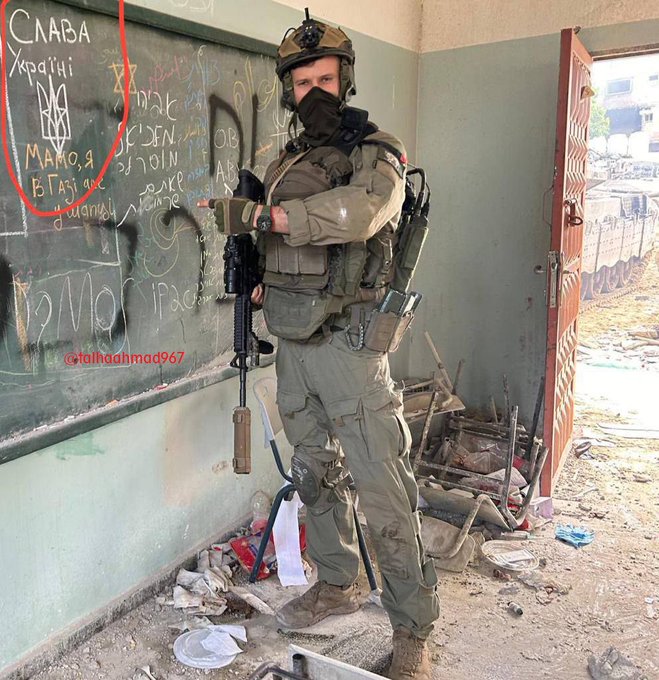
Fighters from Qassam Brigades, the armed wing of Hamas, ambushed and killed at least seven Ukrainian mercenaries who were fighting with the Israeli army in Gaza, Quds News Network reported on 21 December.
According to sources speaking with the network, Qassam fighters targeted the mercenaries on 14 November after spotting them on Hassanein Street in the Shujaiya neighborhood, one of the main centers of Palestinian resistance to the ongoing Israeli ground invasion.
The sources added that “the occupation army did not include the dead among the numbers it acknowledges about its losses among soldiers in Gaza,” and that the ambush killed soldiers from the Israeli army as well.
According to the sources, a video that circulated on social media of a unit of Ukrainian mercenaries in a Shujaiya school was recorded on the same day as the attack.
The video showed one mercenary writing in the Ukrainian language on a chalk board in the school.
It also showed a group of Ukrainian mercenaries in a neighborhood of Gaza City, hiding behind a wall.
Ukrainians fighting for Israel is a reversal of a dynamic that appeared in 2022, as reports emerged of hundreds of Ukrainian-born Israelis and several native Israelis traveling to Ukraine to join volunteer units after the Russian invasion.
The Quds Network report comes as the Israeli military announced the deaths of three additional soldiers on Thursday, Lavi Gehati, Omri Schwartz, and Yacoub Elian, during battles in the Gaza Strip. This brings the number of Israeli soldiers killed to more than 136, according to Israel, since the start of its ground invasion in Gaza on 27 October.
However, as The Cradle has reported, Israeli military leaders seeks to hide many of their soldiers’ deaths, and the number killed and wounded is likely much higher than the military’s official acknowledgements.
Hamas has released a flurry of combat videos in the past week showing its fighters targeting Israeli troops, armored personnel carriers, and tanks. This indicates that while Israel has caused massive destruction in Gaza, the Qassam Brigades are still strong militarily and are inflicting heavy losses on the Israeli army.
Featured Video

Matt Bracken: US Plans Massive MOAB Strike on Iran?
or go to
Aletho News Archives – Video-Images
New Book
The silver that medicine dropped — four thousand years of clinical use, four decades to erase.
Colloidal Silver — First Edition, 2026, Paperback
Lies are Unbekoming | October 16, 2026
Silver was medicine. Not alternative medicine. Not folk medicine. Medicine. In surgery. In obstetrics. In the burn ward. In water treatment. In the household medicine chest. Every physician before 1938 knew this.
By the 1870s, silver nitrate was standard in surgical wound care across the leading hospitals of Britain, Germany, and the United States. Colloidal silver preparations — Collargol, Argyrol, Protargol — entered European and American practice through the 1890s and early 1900s and became standard antiseptics in military field medicine. By the time Fleming grew his first penicillin mould in 1928, silver was the first-line antimicrobial of the Western pharmacopoeia. The Lancet and the British Medical Journal carried the clinical reports in volume. The practice ran continuously through the Victorian era, the Edwardian era, the First World War, the interwar period. By 1980, almost all of it was gone.
What has not been treated at book length, until now, is how a four-thousand-year clinical record disappeared from mainstream medicine within four decades of the Flexner Report — and what the honest account of silver looks like once that record is reassembled.
Colloidal Silver reconstructs the pre-1938 record from The Lancet, the British Medical Journal, and the primary literature of the era; recovers Robert Becker’s bioelectric framework from the regeneration research the pharmaceutical model buried; and places silver inside a practical terrain-paradigm guide to its current place — in water, on the body, inside the body, and in the chronic conditions where antibiotics have failed. … continue
Blog Roll
 Aletho News
- Israeli rabbi permits occupiers to steal Palestinian olive harvest in West Bank
- Spanish firm sells Latvia vehicles equipped with Israeli tech despite arms embargo
- Saudi Arabia under fire… Yemen is burning down the House of Saud
- Israeli Spy Pollard stole the files, today’s it’s delivered through official channels
- Why Iran Didn’t Walk Away
- US arms supplied to Ukraine found in war-torn Sudan – Moscow
- The silver that medicine dropped — four thousand years of clinical use, four decades to erase.
- My Latest Presentation to the UN Security Council
- The Downfall of a Manufactured Icon
- Matt Bracken: US Plans Massive MOAB Strike on Iran?
- If Americans Knew
- An error has occurred; the feed is probably down. Try again later.
- No Tricks Zone
- New Study Suggests Large Regions Of The Pacific Ocean Have Been Cooling For The Last 80 Years
- Germany’s Green Energy Debacle: High Energy Costs Force Kahla Porzellan to Close After 182 Years!
- New Study: 50 Years Of The Most Aggressive ‘Net Zero’ Policies Can Only Affect The Global Climate By 0.03°C
- US September “Heat” Was No Record…Many Records Set Decades Ago
- Latest European Green Energy Debacle; Portugal’s Largest Flagship Solar Park Insolvent!
- Green Energy Debacle: German Expert Professor Fritz Vahrenholt Warns Of Severe Economic And Social Consequences
- Two More Paleo Reconstructions Affirm Meters-Higher Sea Levels Across Ireland, Brazil 7000-6000 Years Ago
- New Study: Earth And Venus Surface Warmth Largely Explained By Convection And Lapse Rate, Not CO2 Or Radiation
- 2025 Nature Paper Claiming Worsening Global Drought Gets RETRACTED …Heavily Flawed
- New Study: ‘Global Drought Shows No Detectable Recent Acceleration Under Climate Warming’

