US response to Russia-China naval patrol exposes glaring hypocrisy
By Timur Fomenko | RT | August 8, 2023
Last week, the US sent a group of warships and a reconnaissance plane to waters off the coast of Alaska after Chinese and Russian vessels conducted a joint naval patrol in the area.
A former US Navy captain and analyst for right-wing think tank the Heritage Foundation described the patrol as “highly provocative.” Because the US and its allies would never, ever do something like that, right?
The US is engaged in the full-blown militarisation of the peripheries of both China and Russia in a manner that implies it has an unconditional right to do so. This behaviour has not only provoked one war, in Ukraine, but risks triggering a second one, over the Taiwan Strait, too. The reality, of course, is that neither Russia nor China poses any threat to Alaska whatsoever, because the conflict, or risk thereof, is at their own front doors, not America’s.
The US is the most militaristic and aggressive country in modern history. It has established a global military presence that spans every single continent with hundreds of military bases. In doing so, it claims it supports the freedom and self-determination of others. In reality, it provocatively encircles states that it deems rivals to its own global dominance, escalates tensions, and then when these states respond to the situation, subsequently brands them as the “aggressors,” thus affirming and even expanding its military footprint in these given regions.
With Russia, the US has pursued a relentless expansion of NATO eastwards since the Cold War, absorbing former members of the Soviet Union’s alliance system even when Russia had no will to compete with it. NATO has evolved from a unit of collective self-defence in a specific geographic region into an increasingly global ideological crusade which serves the goals of the US. The words “North Atlantic” in its name are increasingly redundant as Washington even endeavours to broaden its reach to Asia and the Pacific.
Which leads to the next point, China. The US is pushing for a full-scale military and naval encirclement around China’s eastern periphery, deliberately using the Taiwan independence issue as a wedge to ramp up tensions despite the One China Policy and giving the island region more and more arms. While doing this, it is forcing more and more countries to accept a greater American military presence. This recently included the Philippines, where the US gained access to a number of bases, as well as Papua New Guinea, where a defence cooperation agreement was recently signed. At the same time, the US constantly sails warships through the South China Sea and the Taiwan Strait, citing so-called “freedom of navigation” from a law which it does not even ratify. China’s retaliatory actions are then branded “aggressive” and threatening the peace of the region.
If this constitutes normal behaviour and a sovereign right of the US, why can China and Russia not sail patrols up to Alaskan waters? Why is one behaviour described as “freedom of navigation” but the other is labelled “highly provocative”? The reality is that because both countries are concerned about the US on their doorsteps, they have little interest in ever waging war as far afield in Alaska. The same cannot be said about US actions on their doorsteps, whereby the threat of war is very, very real and is being cranked up even higher by Washington. The US deems it has rights which other countries do not, which leads to the double standards voiced in the media regarding these seemingly equal actions.
China-Russia military cooperation is a product of the US antagonising them both, rather than so-called “provocative behaviour.” In the geographic sphere of Northeast Asia, the two countries have shared strategic interests which concern checking the expansion of US military power in Japan and the Korean Peninsula. This extends to the Northern Pacific. Neither country has any specific ambitions regarding Alaska. Neither China nor Russia is attempting to foster an independence or separatist movement there, unlike what the US is doing with Taiwan, and then groom it into a military partner hostile to Washington. Therein lies the difference between the two sets of military behaviour. China and Russia may cooperate for common strategic objectives, but they are not exerting aggression in the process. On the other hand, the US’ military presence and patrols are designed to upend a region and turn countries against other, provoke strife, and of course advance its economic goals. The irony is that media discourse presents this as entirely normal and justified, but then depicts Russia-China cooperation as a potential threat to Alaska.
Professor John Mearsheimer on the Ukraine War
Why didn’t the West negotiate an Austrian-style neutrality deal with Russia?
By JOHN LEAKE | COURAGEOUS DISCOURSE | AUGUST 6, 2023
The Canadian writer and journalist, Aaron Maté, just published what strikes me as the most intelligent and illuminating conversation about the war in Ukraine I’ve heard thus far.
I have studied European history for forty years and lived in Austria for a total of 15. For the last 18 months I have tried in vain to answer the question: Why didn’t the United States at least try to negotiate with Russia for an Austrian-style neutrality deal for Ukraine?
Consider that if a neutrality deal was struck and the Russians subsequently violated it, THAT would be clear grounds for war. Instead, the United States government has simply and and steadfastly dismissed Russia’s view of the matter—a view that Russia has plainly and repeatedly stated since at least 2008.
Note that the arrogant and dismissive attitude of the U.S. government towards Russia since 2008 was in spite of the fact that Cold War eminences such as George Kennan urged the United States government to abandon its harebrained NATO expansion plan in 1997. As Kennan put it in a February 5, 1997 New York Times essay titled “A Fateful Error:”
Why, with all the hopeful possibilities engendered by the end of the Cold War, should East-West relations become centered on the question of who would be allied with whom and, by implication, against whom in some fanciful, totally unforeseeable and most improbable future military conflict?
[B]luntly stated… expanding NATO would be the most fateful error of American policy in the entire post-Cold War era. Such a decision may be expected to inflame the nationalistic, anti-Western and militaristic tendencies in Russian opinion; to have an adverse effect on the development of Russian democracy; to restore the atmosphere of the cold war to East-West relations, and to impel Russian foreign policy in directions decidedly not to our liking …
Several of Kennan’s fellow Cold Warriors, including Robert McNamara and Paul Nitze, agreed wholeheartedly with him, as is evidenced by their June 26, 1997 letter to President Bill Clinton.
Back to the central question of this essay: for those unfamiliar with the 1955 State Treaty and Austrian Neutrality:
The treaty forbade unification with Germany or restoration of the Habsburgs and provided safeguards for Austria’s Croat and Slovene minorities. Austrian neutrality and a ban on foreign military bases in Austria were later incorporated into the Austrian constitution by the Law of October 26, 1955. The 40,000 Soviet troops in Austria were withdrawn by late September. The small number of Western troops that remained were withdrawn by late October.
Austrian neutrality has been honored ever since and has served the Austrian people very well. The Austrian capital, Vienna, is routinely ranked as having the highest quality of life on earth. To be sure, there is a handful of incredibly stupid and venal people in Austria who claim they wish to abandon Austrian neutrality, but they merit so little attention that I almost didn’t write this sentence.
So, why didn’t the United States government negotiate with Russia for an Austrian-style neutrality for Ukraine? Professor Mearsheimer suspects that only sheer stupidity can explain it. Aaron Maté suspects cynicism.
I suspect it’s a combination of stupidity, ignorance, cynicism, greed, bloody-mindedness, narcissism, sadism, contempt, misanthropy, and recklessness—in a word, depravity. Holders of high political office who prefer to send hundreds of thousands of young men to their deaths without at least trying diplomacy are simply terrible people in every respect.
NATO Instructors Trained Neo-Nazi Azov Battalion Soldiers in 2021
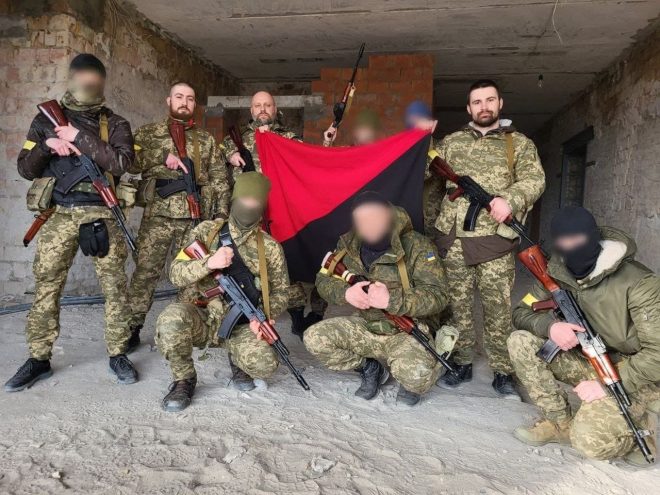
Sputnik – 06.08.2023
NATO military instructors from Denmark and the United Kingdom trained Ukrainian soldiers at a base of the nationalist Azov battalion, despite Azov’s exclusion from US military funding due to its radicalism, according to documents from the Danish embassy in Kiev seen by Sputnik on Sunday.
A note from the Danish embassy dated May 21, 2021, informed the Ukrainian Defense Ministry of the arrival of six instructors for the 56-th Ukrainian army brigade in Berdyansk and Urzuf, where Azov’s main base was located.
“These sites were previously investigated by Russian law enforcement officers, and the materials found there directly point to intensive training of mobilized Ukrainian citizens by Western officers, using criminal methods of warfare, which the Azovs were fluent in,” a law enforcement officer told Sputnik.
The instructors of the UK’s OP ORBITAL training team had already been present in Ukraine before, the document showed.
“Operation ORBITAL is the code name of a UK program to train Ukrainian army servicepeople from the mobilization reserve. I note that these officers, as stated in the text of the document, have access to classified information, which indicates that Ukraine has provided access to information constituting state secrets, including mobilization planning documents,” the officer said.
Despite the fact that the Azov battalion has been recognized by the United States as a neo-Nazi organization, NATO forces were directly involved in training of nationalist armed formations, they noted.
“This is evidence of Kiev’s intensive preparations for active combat operations under NATO’s supervision,” the law enforcement officer concluded.
In August 2022, the Russian Supreme Court designated Azov as a terrorist organization. The Russian Prosecutor General’s Office said that Azov militants use prohibited means and methods of warfare and are complicit in the torture of civilians and the killing of children.
Iran responds to US military moves with more firepower
RT | August 6, 2023
Iran has beefed up the weaponry of its naval forces, arming them with such tools as additional drones and precision missiles with ranges up to 1,000 kilometers (620 miles), amid rising tensions with the US over shipping traffic through the world oil market’s most crucial bottleneck.
The Iran Revolutionary Guard Corps (IRGC) Navy officially took possession of the new gear at a ceremony on Saturday, state-run media outlets reported. The systems include reconnaissance and combat drones, as well as electronic warfare equipment, truck-mounted missile launchers, and hundreds of cruise and ballistic missiles.
The announcement came after reports earlier this week that US military officials had drawn up unprecedented plans to place armed troops on commercial trips in the Strait of Hormuz. Just last month, the Pentagon announced deployments of additional fighter jets and naval assets to the Persian Gulf region in response to “alarming events,” such as Iranian seizures of commercial vessels.
Brigadier General Abolfazi Shekarchi, a spokesman for the Iranian military, denounced Washington’s proposed deployment of troops on private ships. “What do the Persian Gulf, the Gulf of Oman and the Indian Ocean have to do with America?” he told Iran’s Tasnim news agency. “What is your business here?”
About 20% of the world’s oil supplies, or one-third of all seaborne crude shipments, go through the Strait of Hormuz, the narrow passage that connects the Persian Gulf to the Gulf of Oman and the Arabian Sea. Tehran typically accuses the operators of detained ships of shipping violations, such as oil smuggling. Some of the vessels have only been released after other countries free detained Iranian tankers.
The new missiles give the IRGC Navy better accuracy and longer range than it previously had available, commander Alireza Tangsiri said. “The cruise missiles can attack several targets simultaneously, and the commands can be altered after takeoff,” he added.
US-Iran tensions have risen since Washington pulled out of the Iran nuclear deal in 2018. Efforts to revive the agreement, known officially as the Joint Comprehensive Plan of Action (JCPOA), have failed, despite the change in US leadership when Joe Biden succeeded Donald Trump as president in January 2021.
African neighbors finalize Niger war plans
RT | August 4, 2023
The militaries of several ECOWAS members have agreed on a plan for military intervention in Niger and are waiting for a final political decision, a senior official of the bloc said on Friday.
The Economic Community of West African States has already sanctioned the junta in Niamey over last week’s military coup and demanded the restoration of ousted president Mohamed Bazoum before Sunday.
Even as Nigeria sent diplomats to its northern neighbor, its capital Abuja was hosting a planning meeting of ECOWAS chiefs of staff. Notably absent were Mali, Burkina Faso, Chad, and Guinea.
“All the elements that will go into any eventual intervention have been worked out here, including the resources needed, the how and when we are going [to] deploy the force,” said Abdel-Fatau Musah, ECOWAS commissioner for political affairs, peace and security.
Musah added that the final decision will be made at the political level, but that ECOWAS will not telegraph when and where it will strike.
“ECOWAS will not be used for coups. Democracy is what we stand for and democracy is what we will sustain,” General Christopher Gwabin Musa, chief of Nigeria’s defense staff, told AP.
On Thursday, Bazoum appealed directly to the US to intervene. Washington has some 1,000 troops in Niger, engaged in counter-terrorism operations against Islamist groups that arose after NATO’s 2011 regime change intervention in Libya. Niger’s former colonial master France has another 1,500 troops on the same mission.
The Nigerien junta repudiated all military treaties with France on Thursday, and sacked the country’s ambassadors to the US, France, Togo and Nigeria. Paris and Washington have said they do not intend to remove their troops from the country, and only recognized Bazoum as the legitimate leader.
Niamey has warned both the West and ECOWAS that any military intervention will be met with deadly force. “All aggression or attempt at aggression against the state of Niger will see an immediate response,” junta spokesman Colonel Amadou Abdramane, said on Friday.
In a joint statement earlier this week, Burkina Faso and Mali said that an ECOWAS incursion into Niger will be taken as a declaration of war against them as well.
Disinformation War
Tales of the American Empire | August 3, 2023
Americans hear about a new “information war” strategy, formally known as wartime propaganda. Most don’t realize that it is a disinformation war, and they are the target. Most Americans don’t understand that the corporate media does not exist to inform them, but to mislead them. The US military has formed huge propaganda units, with each service training thousands of military personnel and paying contractors to influence social media. They post information on-line and make comments as regular anonymous folks to support the official government narrative. They demean truth tellers, target them with complaints that they violate comment guidelines, and pressure websites to censor comments.
________________________________
“The War You Don’t See; Why Propaganda Hides the True Face of War”; John Pilger; 2010;  • The War You Don’t See: Why Propaganda…
Related Tales: Vietnam War playlist; • The Vietnam War
“This is Devastating for western war propagandists”; Redacted; June 8, 2023; • This is DEVASTATING for the western w…
“Glenn Greenwald’s Ukraine War Warning: Propaganda Repeats Itself”; Katie Halper; July 15, 2023; • Glenn Greenwald’s Ukraine Warning: Pr…
Related Tales: “The Anglo-American War on Russia”; • The Anglo-American War on Russia
New Short-Range Missiles for Su-57 Outpace US Developments
Sputnik – 04.08.2023
MOSCOW — Russia’s fifth-generation Su-57 fighter has been equipped with new short-range missiles, the RVV-MD2, which outperform similar American munitions, representatives of the developer company, JSC GosMKB Vympel, said in an article for the Arsenal Otechestva (lit. Arsenal of the Fatherland) magazine.
“It is a fact that Russia’s development of the fifth generation of ‘air-to-air’ missiles, now in industrial production, is five to ten years ahead of similar developments in the United States,” the report stated.
The authors emphasized that, unlike the United States, Russia has managed to develop and test these missiles quickly, and the stage of their introduction into service has already begun.
The RVV-MD2 can be installed in the internal fuselage compartments of the fifth-generation Su-57 fighter, the specialists explained.
The RVV-MD2 is the first short-range missile to use an inertial guidance system to control and stabilize the missile during autonomous flight, the magazine’s editor-in-chief, Viktor Murakhovskiy, pointed out.
The inertial system allows the munition to autonomously determine its coordinates in space without relying on external references or signals.
In addition, Murakhovskiy noted that the RVV-MD2 is equipped with a radio correction line, which allows the aircraft to refine target coordinates from onboard, increasing the likelihood of hitting enemy aircraft.
According to the editor-in-chief of “Arsenal Otechestva,” another advantage of the new missile is its multi-element dual-band infrared homing head with improved anti-jamming capabilities.
The new missile is capable of attacking targets from all angles, including from the rear. In other words, the RVV-MD2 is launched forward, maneuvers in the air and engages the enemy aircraft located behind the Su-57, Murakhovsky explained.
Military bloat and empire as a way of life
Recalling William Appleman Williams final work
By Patrick Mazza | The Raven | June 3, 2023
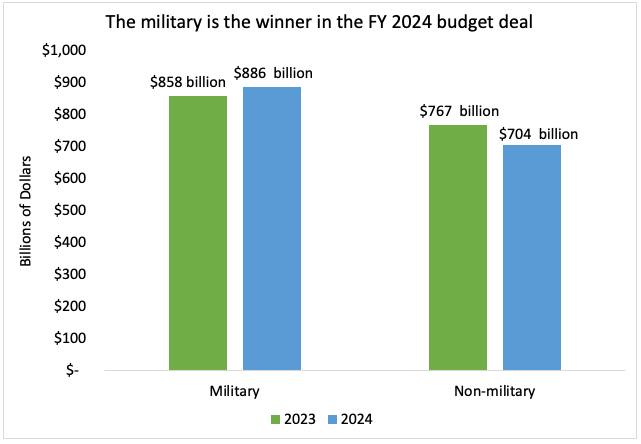
Once again, while other needs are squeezed, a federal budget deal will literally starve the poor to feed the military. While new work requirements are placed on SNAP recipients that will drive some from the food support program, the military budget (never call it defense) remains untouched. The recent debt ceiling deal leaves Joe Biden’s $886 billion 2024 Pentagon budget request intact while domestic programs are slashed. The above graph from the National Priorities Project tells the story.
In real terms it is the largest military budget in U.S. history, the only exceptions being World War II and the height of the Iraq and Afghanistan wars that came after 9-11. Larger by far than during the Korean and Vietnam Wars, or the Reagan military buildup. Again, from the National Priorities Project:
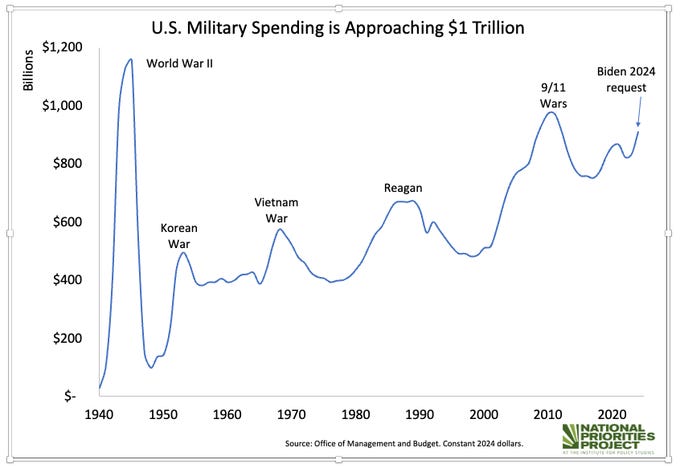
The real military budget is even higher. Adding in nuclear weapons, foreign military aid and “intelligence,” the project puts the current 2023 budget at $920 billion. That is still an undercount. William Hartung, an expert on military spending, calculates that even in fiscal year 2020 the total military expenditure was $1.25 trillion, adding in other costs such as support for veterans and debt service. It’s easily pushing $1.5 trillion by now.
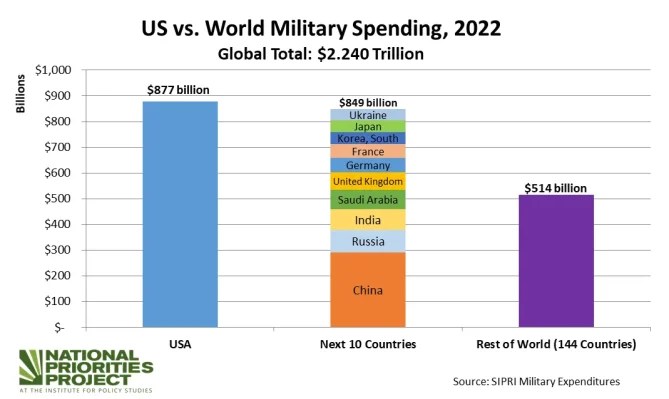
The U.S. by far is the biggest military spender on Earth, with 39% of the total, exceeding the next 10 nations combined, as this chart shows:
Most warlike nation
So why is the military budget so unassailable? Why, no matter how often bloated military spending is denounced, does the budget climb toward ever greater heights? Even after Dwight Eisenhower made the famous warning in his farewell address:
“In the councils of government, we must guard against the acquisition of unwarranted influence, whether sought or unsought, by the military-industrial complex. The potential for the disastrous rise of misplaced power exists and will persist. We must never let the weight of this combination endanger our liberties or democratic processes. We should take nothing for granted. Only an alert and knowledgeable citizenry can compel the proper meshing of the huge industrial and military machinery of defense with our peaceful methods and goals, so that security and liberty may prosper together.”
Ike would have known, being one of the progenitors of that complex as the general leading U.S. forces that invaded Europe during D-Day and as the president during the nuclear buildup of much of the early Cold War. One clue as to why his warning went unheeded is in the fact he originally wanted to call it the military-industrial-congressional complex, the “iron triangle” that keeps pumping up military expenditures. As Hartung writes, Congress is bought by the weapons industry. It is a kind of money laundering scheme where increased military spending comes back as campaign donations, a perfect example of the legalized bribery that is the real governing system of the U.S.
But there are deeper reasons, explaining why that “alert and knowledgeable citizenry” for which Ike called has never appeared, at least to the level able to tie back the power of the complex. War and militarism are rooted deep in the U.S. of American experience. As former President Jimmy Carter said, “If you go around the world and ask people which is the most warlike country on Earth, which one do you think they would respond? The United States. Since we left the Second World War, and even before, the United States has constantly been at war in some part of the world. We’ve been in about 30 combats with other countries since the Second World War . . . So I would say that the military-industrial complex, the manufacturers of all kinds of weapons, are very influential in the country and the Congress as well.”
Carter noted that the U.S. hasn’t been at war with someone only 16 years of its 242-year history. (Even that is doubtful since even during Carter’s so-called peaceful years the U.S. was stirring up trouble in Afghanistan in a successful effort to give the Soviets “their own Vietnam,” as his National Security Adviser, Zbignew Brzezinski, has confessed.) The list is extensive. If the U.S. was not fighting with some European or Asian power, it was warring on some native nation or another on the frontier. War has worked for the United States, historian Geoffrey Perrett noted in his 1989 history of major U.S. conflicts, Country Made by War.
“Since 1775 no nation on Earth has had as much experience of war as the United States: nine major wars in nine generations. And in between the wars have come other armed conflicts such as the Philippine insurgency and clashes in the Persian Gulf. America’s wars have been like the rungs on a ladder by which it rose to greatness. No other nation has triumphed so long, so consistently, or on such as vast scale, through force of arms.”
Although conflicts since World War II have not been so successful, nonetheless they failed to dislodge the fundamental U.S triumph in that war, which left it overwhelmingly dominant over all other powers, each of which had been ravaged in the war. As historian Alfred McCoy noted in his recent work, To Govern the Globe, it left the U.S. in the unprecedented position of holding sway on both European and Asian ends of Eurasia. If this hegemony is eroding with the rise of China and other powers, the U.S. still remains in a powerful position.
To all this one must ask the more fundamental question. Why has the U.S. been the most warlike, most continually at war? For the answer we can look to historian William Appleman Williams and the title of his final book which summarized his substantial life work, published in 1980, Empire as a Way of Life. Williams was the dean of what came to be known as the revisionist school of U.S. history that penetrated the myth of American exceptionalism with the facts of history, that the U.S. was an empire from its colonial roots, and behaved much as any other empire.
First let Williams define his terms. “. . . a way of life is the combination of patterns of thought and action that, as it becomes habitual and institutionalized, defines the thrust and character of a culture and society.” Then, empire, a system in which, “The will, and power, of one element asserts its superiority.” In some cases empire “concerns the forcible subjugation of formerly independent people by a wholly external power.” Such as native peoples or those who lived in the former northern half of Mexico.
Williams does not let the mass of U.S. of Americans off. We are enmeshed in the ways of empire.
“Empire became so intrinsically our American way of life that we rationalized and suppressed the nature of our means in the euphoria of the enjoyment of the ends . . . It is perhaps a bit too extreme, but only by a whisker, to say that imperialism has been the opiate of the American people.”
The U.S. was “born and bred” of another empire, the British. “The 19th– and 20th-century empire known as the United States of America began as a gleam in the eyes of various 16th century critics of, and advisers to, Elizabeth I,” Williams explains. At that time, “England was then a backward and underdeveloped small island” outclassed by other powers emerging in the Atlantic fringe, Portugal, Spain, France and The Netherlands, who were already commencing the age of European world conquest.
England concluded that “domestic welfare and social peace required vigorous imperial expansion,” and began first by consolidating the internal empire on the British Isles in Scotland and Ireland, and then in the 1600s expanding to the North American coast. “. . . the most significant aspect of the empire was the success in transforming the American colonies from tiny, insecure outposts into dynamic societies generating their own progress . . . It produced another culture based on the proposition that expansion was the key to freedom, prosperity, and social peace.”
Inevitably, tensions rose between the ruling class of the home isles and the rising elites of the colonies. Benjamin Franklin believed the weight of development would eventually move the center of the British Empire to North America (which it finally did in 1945, but that comes later in the story), and until nearly the time of the split recommended that course. “But the British feared that such a policy would lead to the loss of control and profits, and Americans increasingly asserted their own claims to their own empire,” Williams writes.
That culminated in the Revolutionary War and the successful creation of the United States. But a weak central government seemed unable to fully press forward what George Washington would call “a rising empire” – the founders were not shy about using that kind of language. It appeared the union would fray into two or more nations, while uprisings such as Shay’s Rebellion threatened to shatter social peace. So the new national elites came together to create a framework to ensure continued expansion under a strong central government, the Constitution. Writes Williams, “. . . the Constitution was an instrument of imperial government at home and abroad.”
The Constitution was founded on a clever turnaround of a fundamental political understanding architected by one of its key authors, James Madison. The general belief to that point had been exposited by French political philosopher Montesquieu “that liberty could only exist in a small state. Madison boldly argued the opposite: that empire was essential for freedom.” Madison needed to make that argument because many citizens of the new nation, burned by their experience with Britain, wanted nothing to do with a strong central government.
Madison made his case in a letter to Thomas Jefferson. “This form of government, in order to effect its purpose, must operate not within a small but extensive sphere . . . Extend the sphere, and you take in a greater variety of parties and interests; you make it less probable that a majority of the whole will have a common motive to invade the rights of other citizens; or if such a common motive exists, it will be more difficult for all to feel it . . . to act in unison with each other.”
Williams writes, “He was arguing that surplus social space and surplus resources were necessary to maintain economic welfare, social stability, freedom and representative government.” A strong central government would be needed to expand land for agriculture, to expand and protect exports, and to promote manufacturing.
With the Louisiana Purchase and the Lewis & Clark Expedition to the Pacific, Jefferson fully embraced Madison’s understanding. “I am persuaded that no constitution was ever before as well calculated as ours for extensive empire and self-government,” he said as he left the presidency. “Jeffersonian Democracy, as it came to be called, was a creature of imperial expansion,” Williams writes. “He, perhaps even more than Madison, established it as a way of life, and most Americans embraced it because it gave them personal and social rewards.”
So much for the “alert and knowledgeable citizenry.”
“. . . once people begin to acquire and enjoy and take for granted and waste surplus resources and space as a routine part of their lives,” Williams writes, “and to view them as a sign of God’s favor, then it requires a genius to make a career – let alone a culture – on the basis of agreeing upon limits. Especially when several continents lie largely naked off your shores.”
The myth of empty continents and the racism it embodies has always been part of the story. “Racism . . . began and survived as a psychologically justifying and economically profitable fairy tale. It provided the gloss for the harsh truth that empire . . . is the child of an inability or unwillingness to live within one’s own means. Empire as a way of life is predicated upon having more than one needs.”
Next: Coming installments will review how imperial expansionism is rooted in a misguided sense of mission and compulsive drive for security, and how empire as a way of life continued to unfold after the era of the founders.
US Long Violating Letter, Spirit of New START – Russian Ambassador Antonov
Sputnik – 03.08.2023
WASHINGTON – Russia in February suspended participation in New START, the only bilateral nuclear arms control treaty in place at the time, and conditioned its resumption of participation on an understanding of how NATO’s combined strike capability would be accounted for.
The United States has long been violating the New START Treaty, Russian Ambassador to Washington Anatoly Antonov said.
“Washington has long been violating the letter and the spirit of the agreement. It has not only abandoned the principles embedded in the Preamble to New START, but also breached the central limits of the Treaty that restrict the number of strategic weapons. It illegitimately removed from accountability under the Treaty about a hundred strategic offensive arms: SLBM launchers and heavy bombers. Russia’s repeated demands to resolve the problem have been ignored,” Antonov told reporters.
He said there was another factor that has led to the current crisis.
“Even more important factor that has led to the current crisis over the agreement is the [US] Administration’s hybrid war against our country aimed at imposing on us a strategic defeat. Washington’s calls for addressing the New START issues separately from the overall geopolitical situation do not stand up to criticism,” Antonov said.
“The real goal of the United States is to gain access to Russia’s nuclear weapons bases in order to obtain information about the development of our strategic arsenal,” he said.
In February, Moscow announced the suspension of its participation in the New Strategic Arms Reduction Treaty (New START), which was signed by Russia and the US in 2010 and envisaged mutual inspections of the strategic nuclear facilities of the two countries.
Russian President Vladimir Putin said in his annual address to the Russian parliament then that the US had demanded that Russia unconditionally fulfill its obligations under the treaty while itself being arbitrary about its own obligations.
British Arms Industry Giant Reaps Huge Windfall, Amid West’s Tensions with Russia and China
By Connor Freeman | The Libertarian Institute | August 2, 2023
Amid the surge in NATO members’ military spending as a result of the war in Ukraine, BAE Systems announced that – during the first half of this year – its net profits soared with a 57 percent increase. The British arms industry giant reported its huge windfall on Wednesday.
BAE Systems stated its revenue swelled to 11 billion pounds, an increase of 13 percent, while profits after taxes increased to 965 million pounds ($1.2 billion) during the first six months of 2023. This is compared with 615 million pounds in the same period last year.
Chief Executive Charles Woodburn declared “Our global footprint… and leading technologies enable us to effectively support the national security requirements and multi-domain ambitions of our government customers in an increasingly uncertain world.”
In a separate video that accompanies the company’s earnings statement, he acknowledges the profits are directly related to global destabilization and Western foreign policies, particularly those of London and Washington, aimed at Russia and China. Woodburn says “I’m particularly proud of our support to Ukraine… We’ve delivered an excellent set of results.”
In November, Chairman of the Joint Chiefs of Staff Gen. Mark Milley said that Ukrainian forces had already suffered over 100,000 casualties, killed or wounded, so far in the proxy war with Russia, along with thousands more civilians killed.
Woodburn’s euphoria regarding the “excellent results” notwithstanding, Ukraine has lost approximately 20 percent of its territory since the Russian invasion began last February. Moreover, Kiev’s long awaited counteroffensive has seen massive losses in military equipment and armor, as well as personnel no doubt, while no significant gains have been made.
Last month, the Wall Street Journal reported “When Ukraine launched its big counteroffensive this spring, Western military officials knew [Kiev] didn’t have all the training or weapons — from shells to warplanes — that it needed to dislodge Russian forces. But they hoped Ukrainian courage and resourcefulness would carry the day. They haven’t. Deep and deadly minefields, extensive fortifications and Russian air power have combined to largely block significant advances by Ukrainian troops. Instead, the campaign risks descending into a stalemate with the potential to burn through lives and equipment.”
The video continues with Woodburn boasting of further profits which will be reaped as a result of BAE’s role in the major military buildup in the Asia-Pacific targeting Beijing. “We’ve secured significant orders for combat vehicles… and the selection of the UK’s design for AUKUS.”
AUKUS is a trilateral military pact formed in 2021 between Washington, London, and Canberra which will see Canberra acquiring nuclear-powered attack submarines which will be used to patrol waters near China’s shores. The three countries are currently carrying out the largest iteration of the US-Australia Talisman Sabre war games, again eyeing Beijing. AUKUS will seriously undermine the Non-Proliferation Treaty as these submarines run on 90 percent or more enriched uranium, weapons-grade levels.
The most profitable policies for the arms industry are often the most destructive for civilians, such was the case in Saudia Arabia’s genocidal war against the Yemeni people, strongly supported by Washington and London. According to the UN, at least 377,000 people have been killed in this war, including mostly children and infants, as a result of the full blockade imposed by Riyadh on northern Yemen and its devastating bombing campaign against civilian infrastructure.
In 2020, The Guardian reported “Britain’s leading arms manufacturer BAE Systems sold £15bn worth of arms and services to the Saudi military during the last five years, the period covered by Riyadh’s involvement in the deadly bombing campaign in the war in Yemen.” By the following year, BAE’s sales to Riyadh, since the Gulf kingdom launched its invasion, had increased by 2.5 billion pounds.
According to The Defense Post, subsequent to the company’s announcement on Wednesday, shares in BAE rallied 4.5 percent in early London trading. Andy Chambers, a director at the research group Edison, affirmed “Leading [defense] contractor BAE Systems posted a very strong set of results… benefiting from a general rearmament among NATO countries as the war in Ukraine grinds on.”
In January, the Bulletin of Atomic Scientists admonished that the risk of nuclear annihilation has never been higher.
Connor Freeman is the assistant editor and a writer at the Libertarian Institute, primarily covering foreign policy. He is a co-host on Conflicts of Interest.
Hiroshima, Nagasaki Bombings Were Needless, Said World War II’s Top US Military Leaders
Mythology about these mass civilian slaughters warps thinking about US militarism
Stark Realities with Brian McGlinchey | July 31, 2023
The anniversaries of the atomic bombings of Hiroshima and Nagasaki present an opportunity to demolish a cornerstone myth of American history — that those twin acts of mass civilian slaughter were necessary to bring about Japan’s surrender, and spare a half-million US soldiers who’d have otherwise died in a military conquest of the empire’s home islands.
Those who attack this mythology are often reflexively dismissed as unpatriotic, ill-informed or both. However, the most compelling witnesses against the conventional wisdom were patriots with a unique grasp on the state of affairs in August 1945 — America’s senior military leaders of World War II.
Let’s first hear what they had to say, and then examine key facts that led them to their little-publicized convictions:
- General Dwight Eisenhower on learning of the planned bombings: “I had been conscious of a feeling of depression and voiced to [Secretary of War Stimson] my grave misgivings, first on the basis of my belief that Japan was already defeated and that dropping the bomb was completely unnecessary, and secondly because I thought that our country should avoid shocking world opinion by the use of a weapon whose employment was, I thought, no longer mandatory as a measure to save American lives. It was my belief that Japan was, at that very moment, seeking some way to surrender with a minimum loss of ‘face’.”
- Admiral William Leahy, Truman’s Chief of Staff: “The use of this barbarous weapon…was of no material assistance in our war against Japan. The Japanese were already defeated and ready to surrender because of the effective sea blockade and the successful bombing with conventional weapons.”
- Major General Curtis LeMay, 21st Bomber Command: “The war would have been over in two weeks without the Russians entering and without the atomic bomb… The atomic bomb had nothing to do with the end of the war at all.”
- General Hap Arnold, US Army Air Forces: “The Japanese position was hopeless even before the first atomic bomb fell, because the Japanese had lost control of their own air.” “It always appeared to us that, atomic bomb or no atomic bomb, the Japanese were already on the verge of collapse.”
- Ralph Bird, Under Secretary of the Navy: “The Japanese were ready for peace, and they already had approached the Russians and the Swiss… In my opinion, the Japanese war was really won before we ever used the atom bomb.”
- Brigadier General Carter Clarke, military intelligence officer who prepared summaries of intercepted cables for Truman: “When we didn’t need to do it, and we knew we didn’t need to do it…we used [Hiroshima and Nagasaki] as an experiment for two atomic bombs. Many other high-level military officers concurred.”
- Fleet Admiral Chester Nimitz, Pacific Fleet commander: “The use of atomic bombs at Hiroshima and Nagasaki was of no material assistance in our war against Japan. The Japanese were already defeated and ready to surrender.”
Putting out feelers through third-party diplomatic channels, the Japanese were seeking to end the war weeks before the atomic bombings on August 6 and 9, 1945. Japan’s navy and air forces were decimated, and its homeland subjected to a sea blockade and allied bombing carried out against little resistance.
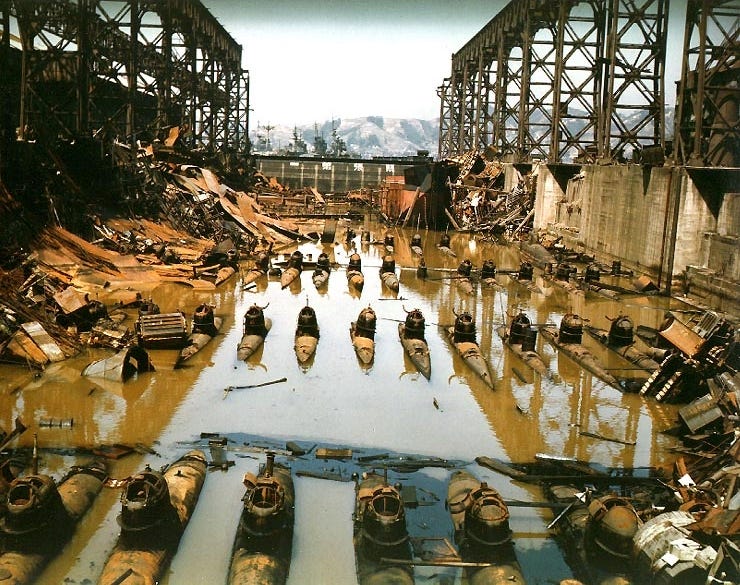
Full of midget submarines, a drydock in the port city of Kure, Japan lies in ruins
The Americans knew of Japan’s intent to surrender, having intercepted a July 12 cable from Japanese Foreign Minister Shigenori Togo, informing Japanese ambassador to Russia Naotake Sato that “we are now secretly giving consideration to the termination of the war because of the pressing situation which confronts Japan both at home and abroad.”
Togo told Sato to “sound [Russian diplomat Vyacheslav Molotov] out on the extent to which it is possible to make use of Russia in ending the war.” Togo initially told Sato to obscure Japan’s interest in using Russia to end the war, but just hours later, he withdrew that instruction, saying it would be “suitable to make clear to the Russians our general attitude on ending the war”— to include Japan’s having “absolutely no idea of annexing or holding the territories which she occupied during the war.”
Japan’s central concern was the retention of its emperor, Hirohito, who was considered a demigod. Even knowing this — and with many US officials feeling the retention of the emperor could help Japanese society through its postwar transition —the Truman administration continued issuing demands for unconditional surrender, offering no assurance that the emperor would be spared humiliation or worse.
In a July 2 memorandum, Secretary of War Henry Stimson drafted a terms-of-surrender proclamation to be issued at the conclusion of that month’s Potsdam Conference. He advised Truman that, “if… we should add that we do not exclude a constitutional monarchy under her present dynasty, it would substantially add to the chances of acceptance.”
Truman and Secretary of State James Byrne, however, continued rejecting recommendations to give assurances about the emperor. The final Potsdam Declaration, issued July 26, omitted Stimson’s recommended language, sternly declaring, “Following are our terms. We will not deviate from them.”
One of those terms could reasonably be interpreted as jeopardizing the emperor: “There must be eliminated for all time the authority and influence of those who have deceived and misled the people of Japan into embarking on world conquest.”
At the same time the United States was preparing to deploy its formidable new weapons, the Soviet Union was moving armies from the European front to northeast Asia.
In May, Stalin told the US ambassador that Soviet forces should be positioned to attack the Japanese in Manchuria by August 8. In July, Truman predicted the impact of the Soviets opening a new front. In a diary entry made during the Potsdam Conference, he wrote that Stalin assured him “he’ll be in the Jap War on August 15th. Fini Japs when that comes about.”
Right on Stalin’s original schedule, the Soviet Union declared war on Japan two days after the August 6 bombing of Hiroshima. That same day — August 8 — Emperor Hirohito told the country’s civilian leaders that he still wanted to pursue a negotiated surrender that would preserve his reign.
On August 9, Soviet attacks commenced on three fronts. News of Stalin’s invasion of Manchuria prompted Hirohito to call a new meeting to discuss surrender — at 10 am, one hour before the strike on Nagasaki. The final surrender decision came on August 10.

Three-year old Shinichi Tetsutani, burned as he was riding this tricycle when the atomic bomb hit Hiroshima, died a painful death that night (Hiroki Kobayashi/National Geographic)
The Soviet timeline makes the atomic bombings all the more troubling: One would think a US government that’s appropriately hesitant to incinerate and irradiate hundreds of thousands of civilians would want to first see how a Soviet declaration of war affected Japan’s calculus.
As it turns out, the Japanese surrender indeed appears to have been prompted by the Soviet entry into the war on Japan — not by the atomic bombs. “The Japanese leadership never had photo or video evidence of the atomic blast and considered the destruction of Hiroshima to be similar to the dozens of conventional strikes Japan had already suffered,” wrote Josiah Lippincott at The American Conservative.
Sadly, the evidence points to a US government determined to drop atomic bombs on Japanese cities as an end in itself, to such an extent that it not only ignored Japan’s interest in surrender, but worked to ensure that surrender was delayed until after upwards of 210,000 people — disproportionately women, children and elderly — were killed in the two cities.
Make no mistake: This was a deliberate targeting of civilian populations. Hiroshima and Nagasaki were chosen because they were pristine, and could thus fully showcase the bombs’ power. Hiroshima was home to a small military headquarters, but the fact that both cities had gone untouched by a strategic bombing campaign that began 14 months earlier certifies their military and industrial insignificance.
“The Japanese were ready to surrender and it wasn’t necessary to hit them with that awful thing,” Eisenhower would later say. “I hated to see our country be the first to use such a weapon.”
According to his pilot, General Douglas MacArthur, commander of US Army Forces Pacific, was “appalled and depressed by this Frankenstein monster.”
“When I asked General MacArthur about the decision to drop the bomb,” wrote journalist Norman Cousins, “I was surprised to learn he had not even been consulted…He saw no military justification for the dropping of the bomb. The war might have ended weeks earlier, he said, if the United States had agreed, as it later did anyway, to the retention of the institution of the emperor.”
What then, was the purpose of devastating Hiroshima and Nagasaki with atomic bombs?
A key insight comes from Manhattan Project physicist Leo Szilard. In 1945, Szilard organized a petition, signed by 70 Manhattan Project scientists, urging Truman not to use atomic bombs against Japan without first giving the country a chance to surrender, on terms that were made public.
In May 1945, Szilard met with Secretary of State Byrnes to urge atomic restraint. Byrnes wasn’t receptive to the plea. Szilard — the scientist who’d drafted the pivotal 1939 letter from Albert Einstein urging FDR to develop an atomic bomb — recounted:
“[Byrnes] was concerned about Russia’s postwar behavior. Russian troops had moved into Hungary and Rumania, and Byrnes thought it would be very difficult to persuade Russia to withdraw her troops from these countries, that Russia might be more manageable if impressed by American military might, and that a demonstration of the bomb might impress Russia.“

Burned to impress Stalin: A victim of the US atomic bombing of Hiroshima (AP /The Association of the Photographers of the Atomic Bomb Destruction of Hiroshima, Yotsugi Kawahara)
Whether the atomic bomb’s audience was in Tokyo or Moscow, some in the military establishment championed alternative ways to demonstrate its power.
Lewis Strauss, Special Assistant to the Navy Secretary, said he proposed “that the weapon should be demonstrated over… a large forest of cryptomeria trees not far from Tokyo. The cryptomeria tree is the Japanese version of our redwood… [It] would lay the trees out in windrows from the center of the explosion in all directions as though they were matchsticks, and, of course, set them afire in the center. It seemed to me that a demonstration of this sort would prove to the Japanese that we could destroy any of their cities at will.”
Strauss said Navy Secretary Forrestal “agreed wholeheartedly,” but Truman ultimately decided an optimal demonstration required burning hundreds of thousands of noncombatants and laying waste to their cities. The buck stops there.
The particular means of inflicting these mass murders — a solitary object dropped from a plane at 31,000 feet — helps warp Americans’ evaluation of its morality. Using an analogy, historian Robert Raico cultivates ethical clarity:
“Suppose that, when we invaded Germany in early 1945, our leaders had believed that executing all the inhabitants of Aachen, or Trier, or some other Rhineland city would finally break the will of the Germans and lead them to surrender. In this way, the war might have ended quickly, saving the lives of many Allied soldiers. Would that then have justified shooting tens of thousands of German civilians, including women and children?”
The claim that dropping the atomic bombs saved a half-million American lives is more than just empty: Truman’s stubborn refusal to provide advance assurances about the retention of Japan’s emperor arguably cost American lives.
That’s true not only of a war against Japan that lasted longer than it needed to, but also of a Korean War precipitated by the US-invited Soviet invasion of Japanese-held territory in northeast Asia. More than 36,000 US service members died in the Korean War — among a staggering 2.5 million total military and civilian dead on both sides of the 38th Parallel.
We like to think of our system as one in which the supremacy of civilian leaders acts as a rational, moderating force on military decisions. The needless atomic bombing of Hiroshima and Nagasaki — against the wishes of World War II’s most revered military leaders — tells us otherwise.
Sadly, the destructive effects of the Hiroshima myth aren’t confined to Americans’ understanding of events in August 1945. “There are hints and notes of the Hiroshima myth that persist all through modern times,” State Department whistleblower and author Peter Van Buren said on The Scott Horton Show.
The Hiroshima myth fosters a depraved indifference to civilian casualties associated with US actions abroad, whether it’s women and children slaughtered in a drone strike in Afghanistan, hundreds of thousands dead in an unwarranted invasion of Iraq, or a baby who dies for lack of imported medicine in US-sanctioned Iran.
Ultimately, to embrace the Hiroshima myth is to embrace a truly sinister principle: That, in the correct circumstances, it’s right for governments to intentionally harm innocent civilians. Whether the harm is inflicted by bombs or sanctions, it’s a philosophy that mirrors the morality of al Qaeda.
That’s not the only thread connecting 1945 to 2023, as Truman’s insistence on unconditional surrender is echoed by the Biden administration’s utter disinterest in pursuing a negotiated peace in Ukraine.
Today, confronting an adversary with 6,000 nuclear warheads — each a thousand times more powerful than the bombs dropped on Japan — Biden’s own stubborn perpetuation of war puts us all at risk of sharing the fate of Hiroshima and Nagasaki’s innocents.
Featured Video

John Mearsheimer Talking Iran with Iran
or go to
Aletho News Archives – Video-Images
New Book
The silver that medicine dropped — four thousand years of clinical use, four decades to erase.
Colloidal Silver — First Edition, 2026, Paperback
Lies are Unbekoming | October 16, 2026
Silver was medicine. Not alternative medicine. Not folk medicine. Medicine. In surgery. In obstetrics. In the burn ward. In water treatment. In the household medicine chest. Every physician before 1938 knew this.
By the 1870s, silver nitrate was standard in surgical wound care across the leading hospitals of Britain, Germany, and the United States. Colloidal silver preparations — Collargol, Argyrol, Protargol — entered European and American practice through the 1890s and early 1900s and became standard antiseptics in military field medicine. By the time Fleming grew his first penicillin mould in 1928, silver was the first-line antimicrobial of the Western pharmacopoeia. The Lancet and the British Medical Journal carried the clinical reports in volume. The practice ran continuously through the Victorian era, the Edwardian era, the First World War, the interwar period. By 1980, almost all of it was gone.
What has not been treated at book length, until now, is how a four-thousand-year clinical record disappeared from mainstream medicine within four decades of the Flexner Report — and what the honest account of silver looks like once that record is reassembled.
Colloidal Silver reconstructs the pre-1938 record from The Lancet, the British Medical Journal, and the primary literature of the era; recovers Robert Becker’s bioelectric framework from the regeneration research the pharmaceutical model buried; and places silver inside a practical terrain-paradigm guide to its current place — in water, on the body, inside the body, and in the chronic conditions where antibiotics have failed. … continue
Blog Roll
 Aletho News
- Pharma- and Gates-Funded GAVI Seeks to Assure Parents
- John Mearsheimer Talking Iran with Iran
- Inside Bill C-22, Canada’s Patriot Act.
- China’s FM: Palestinian cause is ‘greatest injustice of the century’
- US sympathy for Palestinians surpasses support for Israelis
- Israeli rabbi permits occupiers to steal Palestinian olive harvest in West Bank
- Spanish firm sells Latvia vehicles equipped with Israeli tech despite arms embargo
- Saudi Arabia under fire… Yemen is burning down the House of Saud
- Israeli Spy Pollard stole the files, today’s it’s delivered through official channels
- Why Iran Didn’t Walk Away
- If Americans Knew
- NPR investigation finds evidence of widespread fraud at mall kiosks tied to Israeli skincare brand
- Tucker Carlson exposes Israeli Lies about the Oct 7th attack, Charlie Kirk, and the U.S.
- Israel has detained thousands of Palestinian children since Oct 7th – over half spent time in solitary, many uncharged
- Israeli Analysis: Is Netanyahu Planning an ‘October Surprise’ Attack Before Israel’s Election?
- Israeli settlers brutally attack Palestinians and Washington Post female photographer, 65
- Words Have Changed, Occupation Continues: The Reality of the Gaza Ceasefire
- Gaza’s child amputees are growing faster than their prosthetics allow
- Israel keeps Palestinians struggling just to survive–Daily Update
- Israeli firm used online ads to run vast spy operation, researchers say
- No, the world zionist movement is not an antisemitic conspiracy theory
- No Tricks Zone
- New Study Suggests Large Regions Of The Pacific Ocean Have Been Cooling For The Last 80 Years
- Germany’s Green Energy Debacle: High Energy Costs Force Kahla Porzellan to Close After 182 Years!
- New Study: 50 Years Of The Most Aggressive ‘Net Zero’ Policies Can Only Affect The Global Climate By 0.03°C
- US September “Heat” Was No Record…Many Records Set Decades Ago
- Latest European Green Energy Debacle; Portugal’s Largest Flagship Solar Park Insolvent!
- Green Energy Debacle: German Expert Professor Fritz Vahrenholt Warns Of Severe Economic And Social Consequences
- Two More Paleo Reconstructions Affirm Meters-Higher Sea Levels Across Ireland, Brazil 7000-6000 Years Ago
- New Study: Earth And Venus Surface Warmth Largely Explained By Convection And Lapse Rate, Not CO2 Or Radiation
- 2025 Nature Paper Claiming Worsening Global Drought Gets RETRACTED …Heavily Flawed
- New Study: ‘Global Drought Shows No Detectable Recent Acceleration Under Climate Warming’

