Biden team has ‘deeply rooted hatred for Russia’ – US congressman

RT February 24, 2023
Senior officials at the US State Department are attempting to get the country “involved in another world war” with Russia, Arizona Congressman Paul Gosar tweeted on Friday. Gosar, Twitter CEO Elon Musk, and former president Donald Trump, have all named Victoria Nuland as the most dangerous among this group in recent days.
Responding to an RT article on Musk accusing Nuland of “pushing this war” in Ukraine, Gosar declared that the billionaire “is correct.”
“Both Nuland and Blinken have a deeply rooted irrational hatred of Russia, and they seek to get the US involved in another world war,” he continued. “These are dangerous fools who can get us all killed.”
In a follow-up tweet, Gosar wrote that “as a non-soldier, Nuland is quite willing to endorse violence and war.” The Republican lawmaker then quoted the article, which stated that Nuland had “endorsed regime change in Russia, celebrated the US’ destruction of the Nord Stream pipelines, and called for the indefinite flow of arms into Ukraine.”
As assistant secretary of state for European and Eurasian Affairs in 2014, Nuland was largely responsible for orchestrating the pro-Western coup that unseated democratically elected president Viktor Yanukovich. Nuland traveled to Kiev and promised military aid to the rioters, and was recorded plotting to install a successor to Yanukovich.
As Biden’s secretary of state, Blinken has promised to keep weapons flowing into Ukraine “for as long as it takes,” and advised Kiev in December not to seek the kind of negotiated settlement that would liken to a “phony peace.”
Gosar has been a persistent critic of the Biden administration’s Ukraine policy since Russia’s military operation began a year ago on Friday. However, although the Republican Party now controls the House of Representatives, there is little the Arizona congressman can do to change the administration’s course. A significant bipartisan majority supports continued military aid to Ukraine, with only 11 Republicans, Gosar included, sponsoring legislation that would cut funding for Kiev.
These Republicans are all allies of former president Donald Trump. In a campaign video released on Tuesday, Trump blamed the situation in Ukraine on Nuland and “others like her” in the Biden administration. Nuland, he said, was “obsessed with pushing Ukraine towards NATO,” adding that the conflict would have “never happened if I was your president.”
Time for US Pull-Out: GOP Congressman Warns About Risk of Kinetic Conflict With Russia in Syria
By Ekaterina Blinova – Sputnik – 23.02.2023
GOP Representative Matt Gaetz has introduced a resolution seeking to direct President Joe Biden to remove all US troops from Syria. The House must vote on Gaetz’s proposal within 18 days of its introduction due to the bill’s war powers status.
“[T]he purpose of my legislation is to force members of Congress to vote on record regarding whether they think we ought to continue Obama’s war in Syria. President Obama kicked off our involvement (…) and now we still find ourselves in the middle of a Syrian civil war with Russia and Turkey and Iran, all present in a very confined neighborhood,” Congressman Matt Gaetz, R-Fla., told the US press earlier this week.
Gaetz, a House Armed Services Committee member, filed the War Powers Resolution on February 22 after he learned that four US military servicemen and a working dog were wounded in a US and Syrian Democratic Forces (SDF) helicopter raid in northeastern Syria.
Speaking to the US press, Gaetz shared his concerns with regard to the US president’s ability to handle Syrian matters. The congressman quoted Biden’s August 2021 interview in which the president claimed that the US “[doesn’t] have military in Syria to make sure that we’re going to be protected.” However, according to the American media at the time of Biden’s comment, there were at least 900 troops in Syria who were helping their SDF proxies on the ground.
Gaetz has also drawn attention to reports alleging that Russian and US personnel get into very close proximity with one another. “[T]he risk of an accident or miscalculation or just misuse of authority could lead to direct kinetic conflict between the United States and Russia in Syria,” the lawmaker insisted.
In addition, Congress has never authorized the use of military force in Syria, the congressman argued. “America First means actually putting the people of our country first — not the interests of the military industrial complex,” he said.
Gaetz’s resolution has been filed under the War Powers Act of 1973, which was designed to limit the president’s authority to wage war and reasserted Congress’ authority over foreign wars. Notably, at the time of the 1973 bill’s introduction, then President Richard Nixon tried to veto it. However, Congress overrode his veto, and the resolution became law following the US pullout from Vietnam in early 1973.
If Gaetz’s legislative initiative passes, US military personnel must be removed from the Syrian Arab Republic within 15 days.
Meanwhile, the lawmaker lamented the fact that Democratic progressives who used to be anti-war activists have become “cheerleaders” for the US’s overseas conflicts. “‘The Squad’ used to be anti-war. Now, they’re waving their pom poms for NATO,” he said.
The representative believes that the upcoming vote on his resolution will show who the real patriot of America is and who continues to stick to Middle Eastern adventurism.
Biden’s predecessor, Donald Trump, was the first who sought to pull US troops out of Syria. Nonetheless, he later insisted that some of the contingent should stay in place to “protect” the Syrian oil fields occupied by the US-backed Kurdish-dominated SDF. Trump was also misled about the actual number of US servicemen in Syria. US Syria envoy Ambassador Jim Jeffrey admitted in November 2020 he was “always playing shell games to not make clear to our leadership how many troops we had there.”
Biden & Nuland Are Leading US Into Nuclear Armageddon, Former FBI Agent Says
Sputnik – 22.02.2023
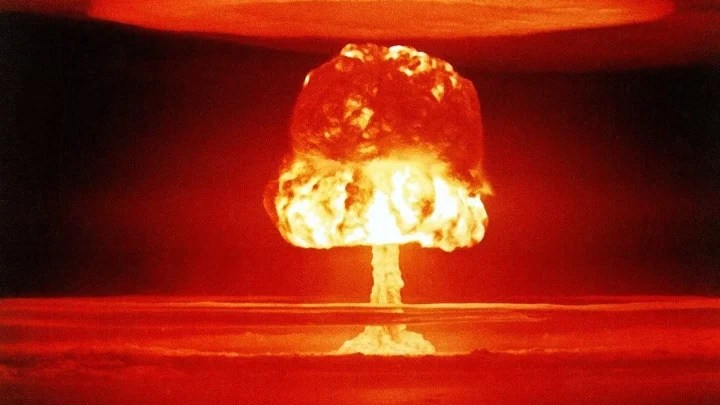
WASHINGTON – US President Joe Biden and senior White House and State Department officials are leading the United States and the world into nuclear annihilation, former FBI Special Agent Coleen Rowley told Sputnik.
Russian President Vladimir Putin officially announced Moscow was pulling out of its long-running talks with the United States for a new START treaty during his Tuesday address to the Federal Assembly. He also accused the United States of developing new types of nuclear weapons and considering new nuclear weapons tests.
“The neocons’ hell-bent plans for ‘full spectrum dominance’ have been a long time in the making, having even been publicly announced decades ago, but now… we’ve truly reached the eve of destruction,” Rowley, a Time magazine Whistleblower of the Year, said.
In addition to Biden, senior State Department official Victoria Nuland, Secretary of State Antony Blinken, and White House security aide Jake Sullivan, are leading oblivious Americans right into “nuclear Armageddon,” Rowley added.
The United States was far closer to catastrophic global war than the American people realized, Rowley said.
“The situation is just so 11th hour and 59 minutes’ bad,” she warned.
Earlier in the day, Biden described Russia’s decision as a “big mistake” as the presidents of Romania, Slovakia and Poland greeted him at the Bucharest Nine meeting. This came after Biden earlier in the week delivered a fiery speech in Poland intended to rally NATO to back Ukraine against Russia.
New START, in effect since February 5, 2011, is the last remaining legally binding arms agreement between the United States and Russia – the two countries with the largest nuclear capabilities.
Under the treaty, the United States and Russia have been required to reduce their nuclear arsenal to a total of 700 missiles, 800 launchers, and 1,550 deployed warheads.
Top politician calls on Scholz to ‘stop’ German foreign minister
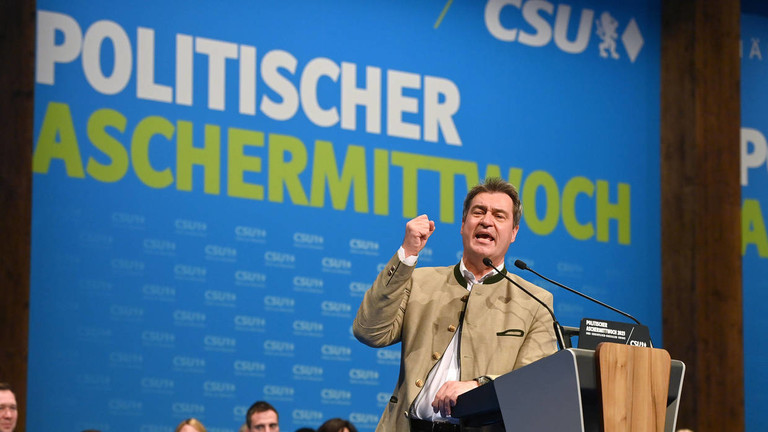
Bavarian Prime Minister Markus Soeder at a Political Ash Wednesday event in Passau, Germany, February 22, 2023. © Global Look Press / IMAGO / Frank Hoermann / Sven Simo
RT | February 22, 2023
German Chancellor Olaf Scholz must “stop” Foreign Minister Annalena Baerbock before she becomes a “security risk” and pushes Berlin towards a conflict with Moscow with her “thoughtless statements,” Bavaria’s Prime Minister Markus Soeder said on Wednesday during a German political festival.
The foreign minister and her party – Alliance 90/The Greens – are talking themselves into a “war frenzy” amid the ongoing conflict between Russia and Ukraine, Soeder told a crowd of cheering supporters during what is known in Germany as Political Ash Wednesday. Having originated in Bavaria, the 100-year old event allows German politicians to vent and pull no punches about the perceived shortcomings of their political rivals.
Soeder referred in particular to when Baerbock told the European Council back in January that the EU was “fighting a war against Russia,” words that sparked uproar at the time. In mid-February, Baerbock herself conceded that the remark was a mistake.
“A foreign minister has to be careful what she says,” Soeder warned during the event in Bavaria’s Passau, adding that “an escalation of words can quickly lead to the escalation of violence.” Germany is helping Ukraine but is not at war with Russia, he maintained.
“Mr. Scholz, finally stop Ms. Baerbock,” Soeder said, adding the foreign minister’s “thoughtless statements” are often “to the detriment of our country.”
Baerbock has emerged as one of the most hardline supporters of Kiev in the German government, repeatedly arguing for increased military aid to Ukraine and criticizing Chancellor Olaf Scholz for supposedly not doing enough. She has also supported tougher sanctions against Russia and opposed any compromises with Moscow.
In October 2022, she said that any concessions to Russia in the ongoing conflict would be “naïve.” The minister also maintained that the West should not settle for any peace agreement that would result in Ukraine losing to Russia any territory that it recognizes as Kiev’s.
Soeder, who has been a prominent figure in the German opposition, previously criticized Berlin for prioritizing military aid to Ukraine over the nation’s own security. In particular, he argued that Germany should not have sent IRIS-T air defense systems to Ukraine and should have instead used them to enhance its own national defense.
State Department globalists responsible for Ukraine coup – Trump
RT | February 21, 2023
Former US president Donald Trump has blamed “warmongers and ‘America Last’ globalists” at the State Department for pushing Ukraine toward conflict. Trump, who is running for office in 2024, promised to rid Washington of “warmongers, frauds and failures” if elected again.
In a campaign video released on Tuesday, Trump warned that “World War III has never been closer than it is right now,” and laid the blame on “all the warmongers and ‘America Last’ globalists in the Deep State, the Pentagon, the State Department and the national security industrial complex.”
The former president singled out Victoria Nuland, the US Deputy Secretary of State for Political Affairs, whom he said was “obsessed with pushing Ukraine towards NATO.”
 Trump declared that Nuland and “others just like her” at the State Department supported the 2014 “uprisings” in Ukraine that saw democratically-elected former president Viktor Yanukovych replaced with the pro-Western Petro Poroshenko, who then began a campaign of military repression against the people of Donetsk and Lugansk.
Nuland met with rioters in Kiev in 2014, where she promised pro-Western politicians a billion dollar loan guarantee program and military assistance. In an infamous leaked call between Nuland and the US’s then-ambassador to Ukraine, Geoffrey Pyatt, the pair discussed selecting a leader to replace Yanukovych from a list of opposition politicians.
Trump claimed, as he has on several occasions over the last year, that the conflict in Ukraine would have “never happened if I was your president.”
“I was the only president who rejected the catastrophic advice of many of Washington’s generals, bureaucrats and so-called diplomats who only know how to get us into conflicts,” he continued, adding that “we need to get rid of the corrupt globalist establishment that has botched every major foreign policy decision for decades.”
“The State Department, Pentagon, and national security establishment will be a very different place by the end of my administration,” Trump said, claiming that “the warmongers, frauds and failures in the senior ranks of our government will all be gone.”
Opposition to America’s “forever wars” was a core component of Trump’s 2016 platform. Although Trump was the first president in decades not to involve the US in a new foreign conflict, he was criticized by his base for briefly hiring noted war-hawk John Bolton as his national security adviser, and for authorizing missile strikes on Syria.
While President Joe Biden has pledged to indefinitely supply Kiev with weapons, Trump has claimed that he would call Ukrainian President Vladimir Zelensky and Russian President Vladimir Putin if elected and “have a deal made in 24 hours.”
How Long Did Americans Support America’s Longest War?
By Jacob G. Hornberger | FFF | February 21, 2023
In an op-ed in today’s Los Angeles Times, Alexander J. Moytyl, a professor of political science at Rutgers, asks, “How long will Russians tolerate Putin’s costly war?” After pointing out the many negative consequences of Russia’s invasion of Ukraine, Moytyl makes a pointed observation: “And yet, almost a year after the invasion of Ukraine, Russians continue to support strongman Putin and the war.” Moytyl just cannot understand how this can be.
Well, maybe if we look inward, which Moytyl certainly does not do in his op-ed, we can figure out the answer.
Let’s consider, for example, the U.S. government’s wars against Afghanistan and Iraq. There were lots of negative aspects of those two wars, beginning with the fact the U.S. invasions of both countries were illegal, both under International law and U.S. law.
It is undisputed that neither Afghanistan nor Iraq ever attacked the United States. That means that the U.S. was the aggressor in both wars.
Yes, I know, defenders of the Afghanistan invasion point to the fact that Osama bin Laden, who was accused of orchestrating the 9/11 attacks, was supposedly living in Afghanistan. Nonetheless, under International law, the U.S. had no legitimate legal authority to invade Afghanistan to arrest or kill him.
It is also undisputed that there was no extradition treaty between Afghanistan and the United States. Therefore, when President Bush demanded that the Afghan government extradite bin Laden to the U.S., under international law Afghanistan had the legitimate authority to say no. Under international law, Bush had no legitimate authority to invade the country simply because Afghanistan rejected his unconditional extradition demand.
It is also undisputed that neither the Iraqi people nor the Iraqi government had any connection to the 9/11 attacks. The U.S. invasion of that country was a pure war of aggression, one based on the flagrant and fraudulent pretense of uncovering non-existent “weapons of mass destruction.”
It is also undisputed that there was no declaration of war issued by Congress against either Afghanistan or Iraq, as required by the U.S. Constitution. That made both invasions illegal under our form of constitutional government.
It is impossible to know exactly how many people in Afghanistan and Iraq were tortured, injured, or killed by U.S. forces in those two wars of aggression. That’s because, early on, the Pentagon announced that it would not keep track of enemy dead. That’s because the lives of Afghans and Iraqis didn’t count.
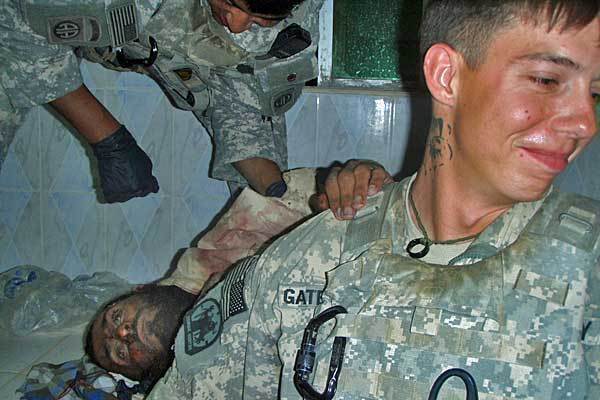 However, according to the Watson Institute at Brown University, “Nearly 20 years after the United States’ invasion of Afghanistan, the cost of its global war on terror stands at $8 trillion and 900,000 deaths.”
That is a lot of money. And that is a lot of dead people. I would estimate that 99 percent of those dead people had nothing to do with the 9/11 attacks.
Yet, many Americans supported their government throughout all this mayhem, just as the Russian people are standing with their government during its current mayhem. In fact, I remember church ministers all across the United States beseeching their congregations for years to “support the troops, especially those in harm’s way in Afghanistan and Iraq.” I also recall how we were all encouraged to “thank the troops for their service” whenever we saw them in uniform. I also remember all those critical things that were said against those of us who opposed these wars of aggression and resulting occupations.
Supporting their government in time of war is what most citizens do in every nation, including Russia, the United States, and Germany. Most citizens are forced into the state’s educational system at a very young age, where their minds are molded to blindly come to the support of their regime during wartime. Children are inculcated with mindsets of deference to authority and blind trust in their political, military, and intelligence officials. That mindset continues well into adulthood. In the run-up to the U.S. invasion of Iraq, I recall many people, including commentators in the mainstream press, exclaiming, “We need to trust our officials. They have access to information that we don’t have.”
So, what befuddles me is why Alexander J. Moytyl is befuddled by the overwhelming support by Russian citizens of their regime during wartime. If American citizens blindly support their regime during wartime, why would anyone expect that Russian citizens would respond differently?
Biden’s Kiev trip ‘a slap in the face’ to America – US Congressman
RT | February 21, 2023
US President Joe Biden’s trip to Ukraine was “a slap in the face to every American,” Republican Rep. Paul Gosar declared on Monday. Already under fire over the hundreds of billions of dollars he’s handed Kiev, Biden is now being savaged by Republicans for his handling of a disastrous chemical accident on US soil.
Biden made an unannounced visit to Kiev on Monday, where he told Ukrainian President Vladimir Zelensky that his administration was readying a $500 million military aid package for his forces. Biden’s administration has handed Zelensky almost $30 billion in military aid since last February, and has set aside more than $110 billion for continued military and economic assistance to Ukraine.
“Joe Biden visiting Ukraine is a slap in the face to every American, especially the people of East Palestine, Ohio,” Gosar tweeted. “Ukraine is not our friend, and Russia is not our enemy.”
Gosar has bitterly opposed Biden’s bankrolling of Ukraine, and sponsored a resolution earlier this month that would halt US aid to Kiev. The resolution, signed by 11 members of the anti-interventionist ‘Freedom Caucus’, calls on Russia and Ukraine to reach a peace agreement.
Republicans from the Freedom Caucus and beyond have hammered Biden for his handling of the East Palestine chemical spill. A train carrying vinyl chloride and other hazardous chemicals derailed in this small Ohio town earlier this month, and a controlled burn of these substances blanketed the town in a cloud of black smoke.

Biden has not visited East Palestine, nor has he approved a disaster declaration. Biden’s transportation secretary blamed the derailment on former President Donald Trump, and although Biden has sent Environmental Protection Agency and Health and Human Services officials to the location to declare it safe, residents have complained of alarming physical symptoms as well as dead pets, livestock and fish.
“That was the biggest slap in the face,” East Palestine Mayor Trent Conway said of Biden’s trip to Kiev. “That tells you right now he doesn’t care about us. He can send every agency he wants to, but I found out this morning that he was in Ukraine giving millions of dollars away to people over there and not to us…on President’s Day in our country, so I’m furious,” he told Fox News.
Mass demo in Munich against war
Free West Media | February 21, 2023
While Annalena Baerbock and US VP Kamala Harris discussed the further escalation of the war in Ukraine at the Munich Security Conference convened in the Bayerischer Hof, thousands demonstrated peacefully against war on the Königsplatz.
Several demonstrations took place in Munich on Saturday on the fringes of the Security Conference directed against the meeting itself. The organizers of one group, Munich Stand Up! counted between 20,000 to 25,000 of their participants.
Protesters followed the call by the Munich AfD on Saturday morning to the Old Botanical Garden, where they could be seen with peace signs and Russian flags.
According to the police, there was a scuffle and verbal confrontations with a small group of left-wing counter-demonstrators. They shouted “Fascist pack” and “Nazi plague”. Around noon, many participants in the AfD demo joined the protest on the Königsplatz, the largest gathering.
Right and left come together
Regardless of whether they were right-wing or left-wing: in terms of symbolism, both groups held flags displaying peace signs and Russian colours.
Slogans criticized NATO and the press as “warmongers” or drew parallels with the Corona pandemic, which many believe had been staged for nefarious purposes. The speakers included the left-wing politician Dieter Dehm and the former CDU politician Jürgen Todenhöfer.
Dehm spoke of “Ukrainian killer gangs and Nazi fascists” while Todenhöfer said in his speech: “The West wanted this war.” He accused the federal government of “madness”.
The final rally of the big “Anti-SiKo-Demo” took place on Marienplatz. As every year, the Munich “Action Alliance against the NATO Security Conference” had called for the demonstration. The opponents, who came mainly from the left-wing spectrum, had gathered at the Stachus shortly after noon.
The demonstrators called to “Create peace without weapons” on posters. Rainbow flags with the words “Pace” (Italian for peace) were displayed next to the dove of peace.
Confronting Ukraine supporters
As in previous years, peace demonstrators walked through the city center, where they passed a gathering at Odeonsplatz – a small band of supporters of Ukraine.
On the stage in front of the Feldherrnhalle, the members of the Bundestag Anton Hofreiter (Greens) and Marie-Agnes Strack-Zimmermann (FDP) spoke, and again called for the escalation of the war in Ukraine. Jamila Schäfer (Greens) expressed her satisfaction that the government had now initiated the delivery of battle tanks.
When the two protest camps met, it remained peaceful. However, it got a bit loud because both sides started chanting their slogans.
Some Ukrainian supporters burst into tears when they saw the peace posters: “Negotiate instead of shooting” was written on them.
Nazis for Ukraine
At the Feldherrnhalle, the site of Hitler’s putsch in 1923, the war supporters demonstrated for the Zelensky regime.
President Zelensky has banned all opposition media and parties in Ukraine and is openly cooperating with neo-Nazi militias and, according to recent photographs taken by die Associated Press, also with ISIS commanders.
Before the conference, he had even demanded the delivery of banned cluster bombs.
Thousands of police officers
According to the police, around 4,500 officers from Bavaria and other federal states as well as 300 federal police officers were on duty around the conference. At the international meeting of experts from Friday to Sunday, the main focus was on arming Ukraine. In addition, there were also debates about other conflicts such as in the Middle East, Yemen or Iran.
In support of the conference therefore, a few people demonstrated loudly for regime change in Iran in the morning on Odeonsplatz. The country’s green, white and red flag flew over the heads of people who want a pro-US regime and called on the European Union to designate the Islamic Revolutionary Guards Corps as a terrorist organization. The “National Council of Resistance of Iran” had called for the protest.
Clear majority of Austrians say no to war
Free West Media | February 21, 2023
VIENNA – According to a recent survey by Unique Research, 65 percent of Austrians want Ukraine to stop fighting. They want peace talks. It is interesting to also note that only Green voters want fighting to continue.
The effects of the war are becoming more and more dramatic. A current survey done for the magazine Heute is therefore unsurprisingly very clear: the Austrians have had enough. They feel that Ukraine should finally sit down at the negotiating table with Russia, even if that means giving up territory.
Escalation spiral continues
“There are no compromises with the Russians,” according to Ukrainian President Zelensky. Not only has he demanded battle tanks, but Kiev wants cluster munitions and phosphorus bombs. The reason for the constant escalation lies not least in the situation at the front. After months of fighting with thousands of dead, the Donbass “fortress” Bakhmut is about to fall.
Only Greens are still for war
While many European politicians (and much of the media) continue their warmongering, a peace movement is therefore sweeping through Austria. The war is only still popular among the Greens. Some 49 percent of the former pacifist party want Ukraine to keep fighting while 48 percent want peace – the rest are unsure.
Only 21 percent of respondents believe that Ukraine should continue fighting, while 65 percent have called on Kiev to negotiate. The call for peace was most pronounced among FPÖ voters, with 86 percent in favor of a speedy end to the war, even if Ukraine would have to make concessions to do so.
Similarly, 63 percent of SPÖ voters want to go down the path of diplomacy and 59 percent of ÖVP supporters call for peace. Among Neos voters, 54 percent are in favor of immediate negotiations.
Russia issues warning about future of Ukraine conflict
RT | February 21, 2023
Western elites “intend” to transform the conflict in Ukraine from a regional to a global one, Russian President Vladimir Putin has said. Moscow perceives this as an existential threat and will react accordingly, he said.
The goal of those in power in the US and other Western nations is to “end us once and for all,” the Russian leader stated during a keynote speech on Tuesday. They are using Ukraine as a “battering ram” against Russia and don’t care how many people will die as a result, he said.
“They intend to turn a local conflict into a phase of global confrontation. That is how we understand things and will react accordingly. Because the issue here is the existence of our state,” Putin said.
The Ukraine conflict was unleashed by the West when it supported an armed coup in Kiev in 2014, the Russian president noted. Western powers then poured resources into the new regime, even as it used the military against its own population and became increasingly nationalist and extreme.
Western elites “don’t care who they are betting on in their fight against us, their fight against Russia. They just want them to go to war,” Putin observed. The current Ukrainian government is “alien” to the people it governs and serves Western interests, he believes.
“Nobody among them counts the loss of human lives and tragedies, because trillions of dollars are at stake, an opportunity to keep robbing everyone under the cover of rhetoric of democracy and freedoms,” the Russian leader warned.
He said that ultimately Russia’s opponents must realize that the country cannot be defeated on the battlefield. That is why they target it in different ways, trying to undermine its unity via historical revisionism and attacks on Russian traditional values, Putin explained.
The remarks were part of the president’s address to the Federal Assembly, as both chambers of the Russian parliament are called, as well to as senior Russian officials and public figures.
Putin Announces Suspension of New START Treaty, Orders New Strategic Systems Be Put on Combat Duty
Sputnik – 21.02.2023
Russia will be suspending its participation in the New Strategic Arms Reduction (New START) Treaty, President Vladimir Putin has announced.
The Russian president made the announcement during the course of a major annual address to lawmakers on Tuesday that focused on the security crisis in Ukraine and the broader global tensions between the West and Russia.
“They [the West] seek to inflict a strategic defeat on us and to creep onto our nuclear sites. In connection with this, I am forced to announce today that Russia is suspending its participation in the New START Treaty. I repeat – not exiting from the treaty, but suspending its participation,” Putin said, speaking to gathered lawmakers in Moscow during his speech to the Federal Assembly.
Putin explained that “at the start of February, the North Atlantic Alliance made a statement factually demanding that Russia ‘return to the implementation of the strategic offensive arms treaty,’ including the admission of inspections to our nuclear and defense facilities.”
“I don’t even know what to call this – some kind of theater of the absurd. We know that the West is involved directly in attempts of the Kiev regime to strike the bases of our strategic aviation,” Putin said, pointing to recent Ukrainian drone attacks on Russia’s Engels Air Base, home to part of the airborne contingent of Russia’s nuclear triad.
The drones used in these attacks were “equipped and modernized with the assistance of NATO specialists,” Putin said. “And now they want to inspect our defense facilities. In the current conditions and today’s confrontation, this simply sounds like some kind of nonsense.”
“A week ago, I signed a decree putting new ground-based strategic weapons systems on combat duty. Are they going to stick their nose in there too?” Putin asked.
The Russian president suggested that NATO’s collective statement essentially amounted to an application to join the New START Treaty, and said Moscow would only welcome such a move.
“We agree, please go ahead. Furthermore, we think that such a formulation of the issue is long overdue. After all, NATO contains not just one nuclear power – the USA. Britain and France also have nuclear arsenals, which are being developed and improved, and which are also directed against us, against Russia,” Putin said.
Slamming the US and NATO over the “hypocrisy” of their demands, Putin recalled how the Western bloc has attempted to assure Moscow that “there is no connection between issues related to strategic offensive arms and, say, the conflict in Ukraine, or other hostile actions against our country,” while at the same time seeking to “defeat” Russia militarily.
“This is either the height of hypocrisy and cynicism, or the height of stupidity. You can’t call them idiots, they are not stupid people: they want to inflict a strategic defeat on us,” the president said.
What is New START and Why Is It Important?
The New START Treaty is the last major strategic arms limitation agreement between the nuclear superpowers – Russia and the United States. The agreement, drafted in 2009 and signed by then-Russian and US Presidents Dmitry Medvedev and Barack Obama in Prague, Czech Republic in 2010, limits the two countries’ deployed arsenals of strategic weapons and nuke stockpiles, and features a series of measures aimed at increased transparency and trust, including the broadcast of telemetry data, limits to missile testing activities, and the exchange of other information.
The Trump administration threatened to let the clock run out on New START in late 2020 after withdrawing from the Intermediate-Range Nuclear Forces Treaty – a late Cold War-era pact which eliminated Soviet and US ground-based nuclear missiles in the 500-5,500 km range, in 2019. The Biden administration agreed to renew New START for five years in early 2021. Pentagon planners have repeatedly criticized the strategic treaty for its failure to account for the nuclear arsenal of China. Beijing has said that it would be happy to sign a nuclear agreement with Washington if the US reduced the size of its nuclear arsenal to China’s level.
The post-Cold War strategic security order began to be dismantled in late 2001, when the George W. Bush administration announced that it would scrap the Anti-Ballistic Missile Treaty – a landmark 1972 agreement designed to limit anti-missile defenses and thus reduce the danger of a global nuclear war. Washington quit the treaty despite proposals by Moscow at the time to establish a joint missile defense system in the Caucasus to eliminate any threats posed to the US or Europe.
Featured Video

Trump asks Iran not to retaliate after he strikes Pickaxe Mountain
or go to
Aletho News Archives – Video-Images
Book Review & Summary
Calling of an Angel: The True Story of Rene Caisse and an Indian Herbal Medicine Called Essiac (1988)
Dr. Gary L. Glum – 30 Q&As – Book Review & Summary
Lies are Unbekoming | October 17, 2026
On June 10, 1975, Dr. Chester Stock, a vice president at Memorial Sloan-Kettering Institute for Cancer Research, wrote to a Canadian nurse named Rene Caisse: “Enclosed are test data in two experiments indicating some regressions in sarcoma 180 of mice treated with Essiac.” The sentence sat in a letter from one of the world’s largest private cancer research centers, concerning an herbal tea an elderly English woman had learned from an Ojibwa medicine man at a northern Ontario mining camp in the 1890s. The tests were terminated the following year after Sloan-Kettering admitted, in sworn affidavit three years later, that they had prepared the injectable solution improperly from the dried material supplied — freezing and thawing the herb rather than boiling it as Rene had instructed. By the time Calling of an Angel was published in 1988, Rene Caisse had been dead for a decade, having treated thousands of cancer patients across fifty-six years in her Bracebridge, Ontario kitchen, never charging a fee, and refusing every offer — from Memorial Sloan-Kettering, the National Cancer Institute, Merck, Parke Davis, and private corporations dangling contracts up to $1 million — to release her formula before the medical establishment admitted her remedy had merit. … continue
Blog Roll
 Aletho News
- Trump asks Iran not to retaliate after he strikes Pickaxe Mountain – w/ Prof. Marandi
- Vice President J.D. Vance’s Deceptive ‘Antiwar’ Campaign Speech
- Iran: Palestinians’ rights must not be compromised in Gaza’s future; US, Israel to blame for Hormuz situation
- Ongoing tales of Syrian chemical weapons
- Moscow blasts UN for ignoring torture of Russian POWs
- Millions of Books Could Have Been Destroyed in Lebanon During Israeli Bombings
- Moscow warns of ‘hunt for Russians’
- Calling of an Angel: The True Story of Rene Caisse and an Indian Herbal Medicine Called Essiac (1988)
- South Korean Assistance to the U.S. in the War with Iran: Between Allied Duty and National Interests
- Pharma- and Gates-Funded GAVI Seeks to Assure Parents
- If Americans Knew
- Israeli soldiers debunk Israel’s talking points
- In West Bank, Israeli settlers are totally out of control – Daily Update
- NPR investigation finds evidence of widespread fraud at mall kiosks tied to Israeli skincare brand
- Tucker Carlson exposes Israeli Lies about the Oct 7th attack, Charlie Kirk, and the U.S.
- Israel has detained thousands of Palestinian children since Oct 7th – over half spent time in solitary, many uncharged
- Israeli Analysis: Is Netanyahu Planning an ‘October Surprise’ Attack Before Israel’s Election?
- Israeli settlers brutally attack Palestinians and Washington Post female photographer, 65
- Words Have Changed, Occupation Continues: The Reality of the Gaza Ceasefire
- Gaza’s child amputees are growing faster than their prosthetics allow
- Israel keeps Palestinians struggling just to survive–Daily Update
- No Tricks Zone
- New Study Suggests Large Regions Of The Pacific Ocean Have Been Cooling For The Last 80 Years
- Germany’s Green Energy Debacle: High Energy Costs Force Kahla Porzellan to Close After 182 Years!
- New Study: 50 Years Of The Most Aggressive ‘Net Zero’ Policies Can Only Affect The Global Climate By 0.03°C
- US September “Heat” Was No Record…Many Records Set Decades Ago
- Latest European Green Energy Debacle; Portugal’s Largest Flagship Solar Park Insolvent!
- Green Energy Debacle: German Expert Professor Fritz Vahrenholt Warns Of Severe Economic And Social Consequences
- Two More Paleo Reconstructions Affirm Meters-Higher Sea Levels Across Ireland, Brazil 7000-6000 Years Ago
- New Study: Earth And Venus Surface Warmth Largely Explained By Convection And Lapse Rate, Not CO2 Or Radiation
- 2025 Nature Paper Claiming Worsening Global Drought Gets RETRACTED …Heavily Flawed
- New Study: ‘Global Drought Shows No Detectable Recent Acceleration Under Climate Warming’

