Luhansk Military Says Civilian Wounded in Ukraine’s Drone Attack
Sputnik – 04.04.2021
LUHANSK – A civilian man has been hospitalized with multiple shrapnel wounds after an explosive device dropped from a drone by Ukrainian forces detonated in the self-proclaimed Luhansk People’s Republic (LPR), the LPR forces said on Sunday.
The report comes amid the rise in ceasefire violations in Ukraine’s breakaway region of Donbass. On Saturday, Donetsk People’s Republic reported that a pre-school child was killed and a woman was injured in a Ukrainian drone attack in Oleksandrivske on Saturday. After the tragedy, Russian lower house speaker Viacheslav Volodin suggested that it is time to expel Ukraine from the Council of Europe.
According to the Luhansk forces, the fresh attack took place on a bank of the Siverskyi Donets River near the village of Mykolaivka. The explosive-laden unmanned aerial vehicle is said to have been launched by servicemen of the 80th brigade of Ukraine’s armed forces.
The wounded man was taken to a hospital.
The militia specified that since additional ceasefire measures took effect in Donbas in late July, it has registered six cases of Ukraine’s combat drone launches into the breakaway region. As a result, two members of the people’s militia were injured.
The militia went on to call on international observers and the global community to “pay close attention to the terrorist actions of the Ukrainian side, which amount to a violation of the Geneva convention.”
Moscow warns of ‘measures’ against any Western troop deployment in Ukraine, as Kiev cites guarantees of US support
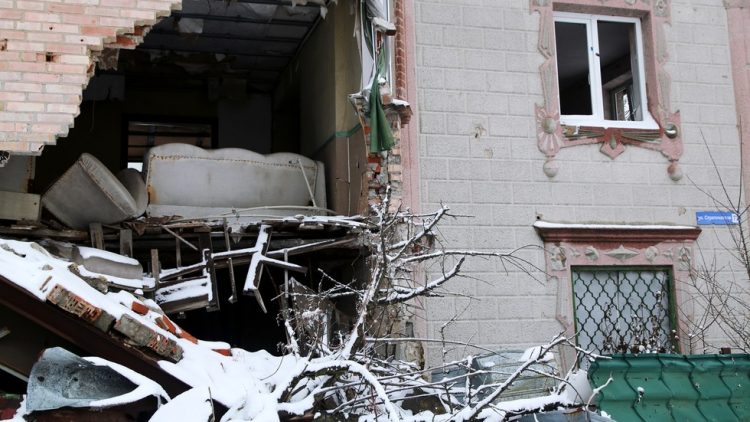
A house on Stratonautov Street in the village of Veseloye, Donetsk region, which was damaged during the fighting in the DPR. © RIA
RT | April 2, 2021
Russia has warned that it would regard any deployment of Western troops in Ukraine as a serious provocation, after Kiev asked NATO to step up its local combat readiness and claimed the US would come to its aid in any future war.
On Friday, the Ukrainian Defense Ministry issued a statement saying that it had received guarantees of American support after a telephone call with Washington’s top military official, Pentagon chief Lloyd Austen. “The US Secretary of Defense stressed that in the event of an escalation of Russian aggression, the United States will not leave Ukraine alone,” the Ministry said.
Asked about the prospects of a standoff in the region, Peskov warned that this could begin a potentially dangerous chain of events. The Kremlin official said that “undoubtedly, such a developing scenario would lead to a further increase in tensions near Russia’s borders. Of course, this will require additional measures from the Russian side to ensure its security.”
When pressed on what those measures might be, the official said only that the country would do “everything that is needed.”
The public spat comes amid rising tensions between Russia and Ukraine, after a series of reported clashes in the east of the country between Kiev’s forces and militias, who receive support from Moscow. Peskov called the escalations “quite frightening.”
His comments came as US President Joe Biden expressed Washington’s “unwavering support” for Kiev in the face of what he called “Russia’s ongoing aggression in the Donbass and Crimea.” In his Friday phone call with Ukraine’s President Volodymyr Zelensky, he also said his administration is committed to revitalizing the “strategic partnership” between the two nations.
Zelensky responded by saying that Kiev and Washington “stand shoulder to shoulder when it comes to preservation of our democracies” and called partnership with the US “crucial for Ukrainians.”
Ukraine has appealed to the US-led military bloc to increase its presence in the region. A call transcript published on Friday showed that Roman Mashovets, Deputy Head of the Office of the President, said that it’s been requested that the bloc consider “joint activities, including military exercises of Ukraine and NATO.” These activities, the transcript said, “should include land, naval and air components. In addition, it is advisable to increase the level of combat readiness of troops in NATO countries bordering Ukraine.”
In February, the country’s Ministry of Infrastructure invited warplanes operated by the US-led bloc to fly missions near Crimea, which it claims as part of its sovereign territory. Officials proposed that the skies be “used for NATO air operations in the airspace… which includes airspace over the sovereign territory of Ukraine and over open waters, such as the Black Sea, where the responsibility for air traffic services is delegated to Ukraine by international treaties.” Russia regards the region as its own after it was reabsorbed in 2014.
Moscow has previously described Ukraine’s membership of NATO and the deployment of troops there as a red line for the country. The situation has echoes of the 1962 Cuban Missile Crisis, when Soviet weaponry was deployed on the Caribbean island off the Atlantic coast of America, sparking a crisis that led the two superpowers close to nuclear war.
Kremlin calls Donbass situation ‘frightening’ as Ukraine asks NATO & US for support in event of conflict with Russia

A window broken in recent shelling in the village of Vesyoloye in the Donetsk Region, self-proclaimed Donetsk People’s Republic, Eastern Ukraine. © Sputnik
RT | April 2, 2021
Moscow has warned that fighting is escalating in eastern Ukraine, insisting that the region must avoid a full-scale conflict, as Kiev asks NATO to step up its local combat readiness and says the US would come to its aid in a war.
Speaking to journalists on Friday, Kremlin spokesman Dmitry Peskov said that a series of military clashes in the Donbass region was a cause for concern. “Unfortunately for us,” he said, “the reality on the line of contact is quite frightening, and not just one, but many, provocations by the Ukrainian Armed Forces are taking place.”
Kiev insists that Russia is building up troops near the shared border and blames separatists, who have previously received support from Moscow, for breaking a ceasefire. “Russia’s current escalation is systemic, [the] largest in recent years,” Ukrainian Foreign Minister Dimitry Kuleba said in a statement issued earlier this week. Kiev officials last week said that four of its soldiers had been killed by shelling during clashes with rebels in the east of the country.
Andrey Rudenko, Russia’s deputy foreign minister, denied that Moscow had anything to gain from an increase in tensions. “I am sure that all the talk about some upcoming conflict between Ukraine and Russia is an example of another fake spread primarily by the Ukrainian authorities,” he said. “Russia is not interested in any conflict with Ukraine, let alone a military one.”
In a statement released on Friday, it was confirmed that an adviser to Ukrainian President Volodymyr Zelensky had proposed that NATO should increase its presence in the country. As part of a call with representatives from two of the US-led military bloc’s member states, Roman Mashovets, deputy head of the Office of the President, said that “such actions of the Russian Federation pose a challenge to the security of Ukraine and NATO, which must be balanced by joint efforts.”
The missive revealed that one option Mashovets put forward was “joint activities, including military exercises of Ukraine and NATO.” These activities, it added “should include land, naval and air components. In addition, it is advisable to increase the level of combat readiness of troops in NATO countries bordering Ukraine.”
Warships & submarines entering zone of Nord Stream 2 pipeline in ‘planned & prepared provocations’ to obstruct work
By Jonny Tickle | RT | April 1, 2021
With the controversial Nord Stream 2 gas pipeline nearing completion and US sanctions against contractors failing to stop its construction, its operator has reported an increased “provocative” activity of warships in the area.
According to Moscow news agency TASS, Nord Stream 2 AG’s branch director, Andrey Minin, claimed that the last three months have seen a growth in military presence in the area.
“After the resumption of Nord Stream 2 offshore construction in January 2021, there has been an increase in activity of military ships, planes, and helicopters, as well as civilian ships of foreign countries, whose actions are often provocative in nature,” Minin said, noting that the presence of these vessels could damage the pipeline.
According to Minin, there is a 1.5-mile (2.4-km) safety zone around the site that boats not involved in the construction should not enter.
Nevertheless, foreign military ships are regularly seen nearby. He also noted that a Polish anti-submarine aircraft regularly circles the area at a low altitude.
Minin listed several incidents that occurred in the last few days, including an unidentified submarine passing just a mile away from the anchor of ‘Fortuna’, the pipe-laying ship. Recent weeks have also seen fishing vessels enter the work protection zone.
“We are talking about clearly planned and prepared provocations, both with the use of fishing vessels and warships, submarines and aircraft in order to obstruct the economic project,” he said. “This is perhaps the first and unprecedented case of its kind in history.”
Nord Stream 2 will connect Germany directly to Russia via the Baltic Sea. It aims to protect Berlin’s energy security and make it less reliant on third countries to transit gas, also lowering prices. Much of the European Union’s energy comes from Russia via Ukraine, and Kiev receives hefty fees for pipeline usage.
The project has been constantly opposed by Washington, which claims it is a threat to the energy security of Europe. In an attempt to stop its completion, the White House has imposed sanctions on companies involved in its construction. Thus far, 95% of the pipeline has been built.
MILITARY INDUSTRIAL BOONDOGGLE
By Paul Robinson | IRRUSSIANALITY | March 29, 2021
Today in my defence policy course my students and I shall be spending some time discussing defence procurement. As luck would have it, as I was munching on my morning bread and marmalade, a highly relevant article swam into view in the op-ed page of my local rag, The Ottawa Citizen, after which I then discovered a new US report on a similar topic.
The Citizen article concerns Canada’s shockingly badly managed naval shipbuilding program. Written by a former Assistant Deputy Minister of Defence, Alan Williams, the article declares that ‘Canada’s Warship Program is Sinking Fast.’ In this Williams reports that Canada’s plan to build 15 new surface combatants originally had
an estimated cost of $26 billion, with deliveries to begin in the early 2020s. Today, the forecasted costs to build these ships is far beyond that. Deliveries are to start in the early 2030s, a decade later than scheduled … [The Parliamentary Budget Office] estimates that it will cost $77.3 billion … to maintain these ships over their expected total life-cycle would amount to an additional $208 billion, for a total life-cycle cost of $286 billion. In comparison, the funds available in DND’s [Department of National Defence] budget over the next 30 years to acquire and maintain its capital goods for the army, navy and air force combined is only $240 billion. This program alone would bankrupt the department’s capital and maintenance accounts for the next 30 years.
Despite this, DND insists that, ‘It will neither entertain a new design nor undertake a new procurement process.’ Williams adds that the United States is building very similar ships for about one-third of the price of the Canadian ones, and also that DND rejected an offer by the Italian company Fincantieri to build the ships in Canada ‘at a fixed cost of $30 billion’, less than half what DND is now paying. ‘As currently planned, these ships will likely never be built. They are simply unaffordable,’ concludes Williams.
But could the government cancel such a project after throwing so much money at it? That’s where the US report comes in. Published by the American Enterprise Institute, and entitled The 2020s Tri-Service Modernization Crunch, the report mentions how the shift in priorities during the War on Terror led the USA to cancel a whole series of projects originally designed for fighting wars of a different type. You can see the details in this chart, showing cancelled projects from 2002 to 2012 alone.

The ‘Sunk Cost’ column shows how much the US government had already spent on the project by the time it was cancelled. For instance, the Future Combat System, designed to revolutionize the US army by equipping it with networked vehicles, cost a staggering $22 billion before it was scrubbed. In total, in just one decade 2002-2012, projects were cancelled that had cost $81 billion. That’s $81 billion of taxpayers’ money that produced absolutely nothing! Nadda. Think about that for a second.
Waste on this scale is quite staggering. You’d think people would be outraged. But for whatever reason, it seems like nobody cares very much. It’s as if it’s just assumed that this is the cost of doing business.
Meanwhile, some people are doing very well out of it, namely defence industries. They, no doubt, would tell us all that the money isn’t wasted, because it all helps to stimulate the economy. ‘Money spent on defence boosts growth’ they tell us. But does it? I decide to check, and discovered this little table that summarizes economists’ research into the multiplier effect of defence spending.
For those of you without economics training, the multiplier effect is a measurement of how much the economy grows as a result of expenditure. The idea is that if the state spends some money on x, then that produces spending on y, which in turn produces spending on z, so that for every buck you spend, you stimulate the economy as a whole by several bucks. So what’s the multiplier of defence spending? The table tells us.

As you can see, research on the matter suggests strongly that for every dollar spend on defence, you get less than a dollar’s growth in the economy, with most studies showing a multiplier of around 0.6.
So, defence spending isn’t so great for the economy after all. I can’t say that I’m surprised. Yet somehow, we allow huge sums of money to be squandered on unnecessary and grotesquely overpriced military projects. I don’t know about you, but it suggests to me that there’s something seriously wrong with our democracy.
PS. An article published yesterday in Sputnik News tells us that the Russian Navy is planning to test its new Zircon hypersonic missile at the start of the summer. Coming on top of the deployment of Russia’s Avangard intercontinental hypersonic glide missile, this puts Russia well ahead of the rest of the world in the realm of hypersonic technology. Russia’s defence spending is about three times that of Canada in raw dollar terms (about $65 v. $22 billion). Yet, it’s in a completely different league. We can’t build a few ships. They can develop hypersonic missiles. All of which makes me think that raw numbers of defence spending don’t tell us everything. Just as important is how effectively the money is spent. From that perspective, we don’t seem to be doing so well.
Stoltenberg Comes Clean on China ‘Opportunity’ for NATO
By Finian Cunningham | Strategic Culture Foundation | March 28, 2021
In an unguarded moment, NATO’s secretary-general Jens Stoltenberg let the cat out of the bag when he described the rise of China as both a challenge and “an opportunity”. What he was admitting unintentionally is that a confrontational policy toward China gives the military alliance some badly needed new purpose.
Stoltenberg was giving an exclusive interview to Deutsche Welle to mark the first ministerial NATO summit attended by the Biden administration. The two-day summit held on March 23-24 at NATO headquarters in Brussels involved in-person participation of U.S. secretary of state Antony Blinken as well as other foreign ministers of the 30-nation military alliance.
The NATO meeting comes as the United States and its European allies are ramping up a coordinated policy of sanctions against China and Russia over alleged human rights issues. This week saw an unprecedented coordination by the U.S., Canada, Britain and the European Union in implementing new sanctions against Beijing and Moscow. It is no coincidence that this provocative development comes after high-profile international meetings, both in-person and via videoconferencing, by the Biden administration calling for allies to adopt a more adversarial and unified position toward China and Russia.
The Biden administration has changed tack from the predecessor Trump “America First” policy to vigorously advocate for a “revitalized” transatlantic relationship. Washington views a more unified U.S.-Europe axis as a more effective strategic way to challenge China and Russia. And NATO is providing a renewed coordinating vehicle.
But in seeking unity, the Biden administration is by necessity having to push a much more aggressive policy toward China and Russia, portraying them as greater threats. This means the American military alliance takes on greater responsibility for spearheading Washington’s policy. A NATO joint statement this week affirmed the alliance’s unity in the face of Russian “aggression”. Moscow slammed the statement, saying that Russia threatened no nation, and that NATO was trying to justify its existence.
Senior Russian lawmaker Leonid Slutsky said that NATO’s claims about being a defensive alliance are a “blatant lie”, pointing to wars and interventions it has launched in former Yugoslavia, Afghanistan, Iraq, Libya and Syria.
America’s top diplomat Antony Blinken this week claimed that China’s rise and Russia’s attempts to destabilize the West were “threats” that required NATO to come together. Blinken added disingenuously that the U.S. won’t force its allies into making an “us or them choice” with China. That’s exactly what the U.S. is doing.
Jens Stoltenberg and other European leaders have been swooning over the “new chapter” in transatlantic relations under the Biden administration. After four years of dealing with vulgar-mouth Donald Trump and his relentless hectoring over military budgets, some European leaders are sighing with relief at Biden’s seemingly dulcet assurances that “America is back”.
Of course people like Stoltenberg, a former Norwegian prime minister who has been the civilian head of NATO since 2014, are reliant on pushing a stronger alliance for their comfy livelihoods and no doubt for future sinecures at corporate-funded think-tanks. Stoltenberg is constantly striving to find a new vision and mission for NATO, an organization founded over 70 years ago at the start of the Cold War, and which has been expanding ever since despite the official end of the Cold War three decades ago. The buzz phrase he uses is to make the alliance “future-proof” – that is to find a permanent pretext for the U.S.-led military organization to continue its existence regardless of real-world security needs.
In his interview with Deutsche Welle this week, Stoltenberg commented on the rise of China. He said, inferring something menacing: “China is coming closer to us, investing in our critical infrastructure.”
Well maybe that’s because China is the world’s biggest trading partner with the European Union and a major foreign direct investor in European nations which have become bankrupt from decades of neoliberal capitalism and austerity.
Stoltenberg went on: “There’s no way we can avoid addressing the security consequences for our regional alliance of the rise of China and the shift in the global balance of power.”
And then the usually cautious, wooden Stoltenberg let it slip: China, he said, provided “a unique opportunity to open a new chapter in the relationship between North America — the United States — and Europe.”
Voila! So the real strategic value of China being presented as a “threat” or an “adversary” is to give a new purpose to the U.S.-led NATO bloc which subordinates Europe to Washington’s geopolitical objective of hegemony. The emphasis here is on China “being presented as a threat” and not what the real relationship actually is, that is, one of a vital economic partner. (Same for Russia and its vast energy partnership with Europe.)
The United States in pursuit of global dominance by its corporations and its capitalist order must, by definition, thwart a multipolar global political economy which the rise of China and Russia embody.
The fiendish political problem, however, is that Washington and its European surrogates cannot justify such a stance based on the normal and natural relations that exist. For in doing that, they would be seen as obnoxious, unwarranted aggressors. It is imperative therefore to conflate China and Russia as “security threats” to the presumed Western “rules-based order”.
Never mind that the Western “rules-based order” has seen NATO powers trashing rules and order by invading countries all around the world, waging criminal wars and subversions, killing millions of people and unleashing terrorism and other security threats stemming from collapsing nations and mass migration.
Forget about China, or Russia, being an alleged threat. They are in actual fact an “opportunity” for NATO and U.S. imperialism, which the alliance ultimately serves, to find an excuse for their criminal existence and conduct. Just ask the secretary-general Jens Stoltenberg (who, as the jokes goes, is more secretary than he is general).
Crashing Saudi Oil Economy Explains Urgent Yemeni Peace Offer
By Finian Cunningham | Strategic Culture Foundation | March 26, 2021
After six years of blowing up Yemen and blockading its southern neighbor, the Saudi rulers are now saying they are committed to finding peace. The move is less about genuine peace than economic survival for the oil kingdom.
The Saudi monarchy say they want “all guns to fall completely silent”. Washington, which has been a crucial enabler of the Saudi war on Yemen, has backed the latest “peace offer”. Secretary of State Antony Blinken this week endorsed the initiative from the Saudi rulers, saying he had spoken with them “on our work together to end the conflict in Yemen, facilitate humanitarian access and aid for the Yemeni people”.
The Saudi foreign ministry stated: “The initiative aims to end the human suffering of the brotherly Yemeni people, and affirms the kingdom’s support for efforts to reach a comprehensive political resolution.”
Can you believe this sickening duplicity from the Saudis and the Americans?
So, after six years of relentless aerial bombing in Yemen causing the world’s worst humanitarian crisis, according to the United Nations, the Saudis and their American military supplier, seem to have developed a conscience for peace and ending suffering.
The real reason for trying to end the conflict is the perilous state of the Saudi oil-dependent economy. Saudi Aramco, the state-owned oil, gas and petroleum industry, recently announced that its profits have slumped by nearly half in 2020 compared with the year before. Down from $88 billion to $49 billion.
Given that its oil economy provides nearly 90 per cent of state budget that is a stupendous hit on the Saudi finances. The Saudi rulers rely on hefty state subsidies to keep its 34 million population content. With income from the oil industry nosediving that means state deficits will explode to maintain public spending, or else risk social unrest from dire cutbacks.
Saudi Arabia remains the biggest oil exporter, but due to the Covid-19 pandemic and world economies going into recession crude oil prices have plummeted. At one point oil prices fell to around $20 a barrel. The Saudi economy needs an oil price of around $70 a barrel to reel in a profit.
The upshot is the Saudi war in Yemen has become a critical drain on state finances and potentially jeopardizing the superficial stability of the absolute monarchy.
Of further alarm is the increasing missile and drone attacks by the Houthi rebels in Yemen on key Saudi locations, including the capital Riyadh.
The Yemeni rebels are escalating airstrikes on Aramco installations at its headquarters in Dhahran and Dammam in Eastern Province, as well as in the cities of Abha, Azir, Jazan, and Ras Tanura. The targets include oil refineries and export terminals. The Saudis claim they have intercepted a lot of the missiles with U.S.-made Patriot defense systems. Nevertheless, the mere fact that the Yemenis can hit key parts of the Saudi oil economy over a distance of 1,000 kilometers is a grave security concern undermining investor confidence.
The first major strike was in September 2019 when Houthi drones hit the huge refinery complex at Abqaiq. That caused Saudi oil production to temporarily shut down by half. It also delayed an Initial Public Offering of Aramco shares on the stock market as investors took fright over political risk.
At a time when the Saudi oil economy is contracting severely due to worldwide circumstances, an additional debilitating threat is the intensifying campaign of Houthi airstrikes. They are taking the war into Saudi heartland.
The Biden administration has condemned the Houthi missile attacks on Saudi Arabia as “unacceptable”. Such American concern is derisory given how Washington has been providing warplanes, missiles and logistics for the Saudis to indiscriminately bomb Yemen causing tens of thousands of deaths. The Americans also enable the Saudis to impose a blockade on Yemen’s sea and airports, which has prevented vital food and medicines from being supplied to the country. Nearly 80 per cent of Yemen’s 30 million population are dependent on foreign aid deliveries. The blockade is a war crime, a crime against humanity, and the Americans are fully complicit.
President Joe Biden has said he is ending U.S. military support for Saudi Arabia’s war in Yemen. It was an election promise. However, it is not clear what military support the U.S. has actually stopped, if at all. The Saudi bombing of food depots continues and the blockade on the country could not be maintained without essential American logistics.
More cynically, the Biden administration realizes that the Saudis started a war back in March 2015, when Obama was president and Biden was vice-president, that has turned into an un-winnable quagmire whose horrendous human suffering has become a vile stain on America’s international image.
That’s why Biden and his diplomats have been urging the Saudi rulers to sue for peace. Now it seems the Saudi monarchy realizes that the reckless war launched by “defense minister” Crown Prince Mohammed bin Salman has come with a price that they can’t afford to sustain if they want to preserve their rickety house of cards, known as the House of Saud.
On the latest peace proposal, the Yemeni rebels have rejected it out of hand. They say it contains “nothing new”. The Houthis say the only way to end the war is for the Saudis and their American sponsors to end the aggression on their country. There is no “deal”. It is a case of the Saudis and the Americans just getting out.
Meantime, the airstrikes on Saudi oil infrastructure are going to continue with ever-increasing damage to the royal coffers. Thus, the Saudi rulers have no choice but to unconditionally surrender in this criminal war. They are facing a humiliating defeat as the Yemenis take revenge and Uncle Sam washes his hands of blood.
US/EU Russia Bashing
By Stephen Lendman | March 26, 2021
On Wednesday after talks with interventionist Blinken, EU foreign policy chief Borrell said the following:
“We agreed to coordinate our efforts in addressing Russia’s confrontational behavior (sic) and encourage Russia to abandon this path (sic).”
No Russian “confrontational behavior” exists — how the US-dominated West operates, not Moscow.
A hostile joint statement by Blinken and Borrell said the following:
They’re “determin(ed) to further address, in a coordinated manner, Russia’s challenging behavior (sic), including its ongoing aggression against Ukraine and Georgia (sic); hybrid threats, such as disinformation (sic); interference in electoral processes (sic); malicious cyber activities (sic; and military posturing (sic).
All of the above reflect US/EU war on Russia by other means — for its freedom from Western control, unrelated to alleged threats that don’t exist.
The above misinformation, disinformation, fake news, and bald-faced Big Lies also aim to distract attention from US-led Western war on humanity internally against their own people and abroad against nations free from their control.
Blinken and Borrell continued their war of words on Russia as follows:
They “decided to coordinate their response to the shrinking space in Russia for independent political voices (sic), civil society (sic), media freedom (sic), and the dwindling respect for human rights and the rule of law (sic).
All of the above reflect how the hostile to peace and stability US and EU operate.
Russia pursues higher standards, according to the rule of law — what the US-dominated West long ago abandoned.
If global war 3.0 is launched, it’ll be made-in-the-USA, a major threat to humanity that could happen by willful design.
The US-dominated West poses an unparalleled threat to everyone everywhere.
On all things related to Russia, China, and other nations free from its control, Borrell operates as a US imperial tool, bending to its will.
Along with the Biden regime, he threatened more illegal EU sanctions on Russia.
In response to hostile US/EU actions, head of Russia’s Delegation to the Vienna Negotiations on Military Security and Arms Control Konstantin Gavrilov said the following:
US-dominated NATO can’t “have its cake and eat it too.”
The alliance must choose between cooperative dialogue with Russia or confrontation, adding:
“It is obvious to us that it is impossible to build trust in the military field when the North Atlantic Alliance goes ahead with its activity and builds up presence along Russia’s borders.”
“In these conditions, collective persuasions to support the ‘package’ of proposals put forward by 34 OSCE member states to modernize the VD (Vienna Document 2011) are futile and will have no effect.”
Separately, head of Russia’s UN Human Rights Council in Geneva delegation Dmitry Vorobyov slammed the UNHRC’s resolution on Syria.
As US-led aggression enters its 11th year — resolution unattainable because its hardline belligerents reject restoration of peace and stability to the war-torn country — Russia called the UNHRC resolution “utterly biased, based on unproven stories and false thinking, distorts reality and can be characterized as blatantly politicized.”
Syria’s representative in Geneva Hussam al-Din Ala, said that states sponsoring terrorism, occupying parts of the country and impose unilateral measures that rise to the level of crimes against humanity, have no political or moral legitimacy to submit resolutions about the human rights status in Syria, adding:
US imperial partner Britain, “the main sponsor of the (UNHRC) resolution… fabricat(ed) allegations and circulat(ed) political and media campaigns against the Syrian government (in support of the pro-Western) commission of Inquiry on Syria whose reports” falsely blame its ruling authorities for US-led aggression.
US pressure, bullying, threats and bribes got 27 of 47 UNHRC member states to support what demanded opposition.
“Russia, Armenia, Bolivia, China, Cuba and Venezuela resolutely denounced it, 14 countries abstained.
The Biden regime upped the stakes further in Syria by sending a convoy of around 80 trucks carrying weapons, humvee armored vehicles and supplies to the country’s northeast.
Jihadists armed with Western weapons accompanied what was sent to continue endless US-led aggression on Syria and its people.
Much the same is ongoing in Afghanistan, Yemen, and intermittently in Iraq — part of endless US war on humanity.
‘Gangster-like logic’: North Korea rejects Biden’s missile launch criticism, points to Washington’s own saber-rattling
RT | March 26, 2021
Responding to American criticism of its recent missile launch, North Korea has accused Washington of denying its right to self-defense, even as the US holds war games at the country’s doorstep and tests advanced weaponry.
“It’s a gangster-like logic that it is allowable for the US to ship the strategic nuclear assets into the Korean peninsula and launch ICBMs any time it wants but not allowable for the DPRK, its belligerent party, to conduct even a test of a tactical weapon,” senior North Korean official Ri Pyong-chol said in statement on Saturday.
The comments came after US President Joe Biden condemned a series of missile launches by Pyongyang, which test-fired several newly developed “tactical guided missiles” on Thursday, with the US leader vowing to “respond accordingly” if North Korea opted to “escalate.”
Defending the launches, Ri argued that the guided missile test was merely an “exercise of the full-fledged right of a sovereign state to self-defense,” given that the US and its allies routinely flex their military muscles in the region with “dangerous war exercises” and are happy to arm themselves with advanced weapons.
Ri appeared to reject speculation that the rocket launches, all conducted within a span of a week in the run-up to Biden’s much-anticipated first solo press conference on Thursday, were meant to send a signal to the new administration.
“We are by no means developing weapons to draw someone’s attention or influence his policy,” the official said. Ri, who according to North Korea’s state media, oversaw the latest launch, went on to denounce Biden’s vow of retaliation as “an undisguised encroachment” on North Korea’s right to self-defense and “provocation,” warning that the US “may be faced with something that is not good” if it continued such rhetoric.
The missiles test-fired on Thursday were described by the Japanese and South Korean militaries as ballistic missiles. While North Korea is banned from testing ballistic missiles under UN Security Council resolutions, Washington is not bound by such constraints. Last month, the US military fired an unarmed LGM-30G Minuteman III intercontinental ballistic missile (ICBM) from a California base, with the US Air Force saying that the launch showed that Washington’s “strategic deterrent is safe, secure and effective.”
“Our nation’s ICBM fleet stands ready 24/7,” Lieutenant General Anthony Cotton, deputy commander of the Air Force’s Global Strike Command, said at the time.
Earlier this month, the US and South Korea held a nine-day joint military exercise that was scaled back this year due to the Covid-19 pandemic. The scope of the annual computer-simulated drills has been limited since the previous US administration attempted to strike a denuclearization agreement with Pyongyang, though the effort ultimately failed after Washington refused to provide any sanctions relief until North Korea carried out “complete and irreversible” denuclearization.
Featured Video
From Anthrax to Iraq
or go to
Aletho News Archives – Video-Images
Book Review
New paperback: Butchered by “Healthcare”
Lies are Unbekoming | October 20, 2026
 Butchered by “Healthcare” is Robert Yoho’s plain-spoken account of how American medicine stopped being a profession and became an industry. 341 pages. Over a thousand references. Thirty-eight chapters.
“Screening Tests Are Useless”, on tests that find diseases that would never have hurt you. “The FDA Protects the Big Drug Companies”, on an agency funded by the companies it regulates. “The Journals’ Sins Are the Editors’ Sins”, on ghostwritten studies and captured peer review. “Opioids and ‘Pain Management’”, on how a generation was prescribed its way into addiction. “Prozac and Relatives” and “Antipsychotics Are Disastrous”, on what psychiatry does to adults and children. “Surgery: Money Before Patients”. “Failed Cancer Treatments”. “Futile CPR and Overprescribing”. “Billing Scams & Specialty Warfare”. “Hospitals Are Sharks”. Each with a Patient Tips section at the end on how to survive it.
If you have ever walked out of a doctor’s office with a prescription you didn’t ask for, or watched a parent put through a treatment that made them worse, this is the book you want on your shelf before the next appointment. … Full review
Butchered by “Healthcare” is available on Lulu now.
Blog Roll
 Aletho News
- EU sending ‘biased’ observers to interfere in Serbian election – president
- White House envoy declares kinetic action against Yemen ‘fruitless’
- Ukraine deployed thousands of microdrones in Iraqi Kurdistan: Tasnim
- Iran calls for emergency UNSC meeting over Trump’s ‘brazen’ bomb talk, Israeli threats
- Iranian sources reveal details of Russia-China Hormuz proposal
- Plan for more US-Israel integration puts our military tech at risk
- Another Round Against Iran Will Break What Is Left of the Gulf
- SVR Report on Ukraine’s Mexican Drug Gang Links Could Pressure Zelensky, Won’t Change US Policy
- British Government Employees Were Fact-Checking the News at the BBC. Nobody Told You.
- Albania on fire: who’s behind the riots?
- If Americans Knew
- Mysterious bot accounts reportedly spread fake ‘man on the street’ videos for Michigan Senate candidate
- Israeli Defense Minister Katz Says Over 60 Lebanon Villages Have Been Destroyed
- Why Is Israel Running TV Ads in Iowa Ahead of the Midterms?
- Hind Rajab’s Alleged Killer Is in the United States. HRF Demands His Arrest.
- US Officials Face Fresh Pressure After Another American ‘Brutalized’ by Israeli Settlers in West Bank
- Israel-Backed Palestinian Militias Terrorize Displaced Families in Gaza
- FBI subpoenas pro-Palestine activists over Israeli weapons plant disruption
- Fourth winter arrives in wartorn Gaza, too early – Daily Update
- More on how Bari Weiss is using CBS on behalf of Israel
- What the UK Is Doing to Pro-Palestine Novelist Sally Rooney Is an Act of Orwellian Villainy
- No Tricks Zone
- Predictions Made By Renowned Climate Proifessor Over Past Decades Have Been Proven To Be Poor
- New Study Suggests Large Regions Of The Pacific Ocean Have Been Cooling For The Last 80 Years
- Germany’s Green Energy Debacle: High Energy Costs Force Kahla Porzellan to Close After 182 Years!
- New Study: 50 Years Of The Most Aggressive ‘Net Zero’ Policies Can Only Affect The Global Climate By 0.03°C
- US September “Heat” Was No Record…Many Records Set Decades Ago
- Latest European Green Energy Debacle; Portugal’s Largest Flagship Solar Park Insolvent!
- Green Energy Debacle: German Expert Professor Fritz Vahrenholt Warns Of Severe Economic And Social Consequences
- Two More Paleo Reconstructions Affirm Meters-Higher Sea Levels Across Ireland, Brazil 7000-6000 Years Ago
- New Study: Earth And Venus Surface Warmth Largely Explained By Convection And Lapse Rate, Not CO2 Or Radiation
- 2025 Nature Paper Claiming Worsening Global Drought Gets RETRACTED …Heavily Flawed

