Arranging The Middle East Narrative To Push The Agenda Forward
South Front | February 11, 2021
The United States is returning to a level of activity in the Middle East unseen in nearly 4 years. This development has become obvious over the weeks since Joe Biden became US President, firstly with a large deployment into Syria, and subsequently with smaller ones.
On February 9th, the Pentagon said that it was no longer in Syria to protect and exploit oil fields.
It is now back to hunting ISIS. Back to the square one of 2014 and the Obama era. ISIS somehow obliged by ramping up their activities throughout Syria.
It is a mystery that they were able to make such a sharp and sudden resurgence. It should also be noted that the Kurdish-led Syrian Democratic Forces allegedly have about 10,000 ISIS terrorists imprisoned.
This statement of intent denotes a massive shift in posture for the US. When defending the oil fields the US troops were mostly static, when hunting ISIS they can, once again, roam around and carry out various operations.
It appears likely that Idlib is now also in focus – US combat drones were observed surveying Greater Idlib. Idlib is a mixed bag – it has Turkish troops, Russians, the Syrian Arab Army along with terrorists and the moderate opposition, although confusing these two groups can be forgiven. The newest, future, US ally is there – the soon-to-be-rebranded Hay’at Tahrir al-Sham.
An indication of expected escalations and attacks are the Russian and Syrian military drills being carried out near Aleppo during effective wartime. Russia, separately, carried out a naval drill near Tartus.
And, as if by design, long-range missiles attempted to strike Russia’s forces at the Hmeimim Air Base. Drones occasionally attempt to infiltrate its airspace, but missiles are a rare sight.
Meanwhile in Western Daraa, the rebel leaders submitted to Damascus, likely fearing the upcoming chaos and wanting to choose a side.
Finally, the Biden administration is also working to secure Israeli support. The State Department said it doesn’t endorse Trump’s recognition of Israeli sovereignty over the Golan Heights, but doesn’t oppose it. It also provided a $9bn weapon sale as consolation. Tel Aviv is likely to use these weapons to counter its nemesis – Iran. It does so by targeting alleged Iranian interests in Syria.
Syria remains the lynchpin of US Middle East policy but the US posture in Iraq and Afghanistan has also changed. Withdrawing from the region is now out of the question – ISIS is making a resurgence, and there are other groups targeting American forces and convoys.
In Afghanistan, specifically, if the withdrawal does not move forward, the Taliban are also likely to begin targeting the US again.
The democrats are back in control and back to spreading democracy in the Middle East.
Lithuania is training the Ukrainian military despite its own inexperience
By Paul Antonopoulos | February 3, 2021
Lithuanian military instructors trained the Ukrainian Armed Forces (UBS) last month as a group of specialists from the National Defense Volunteer Force, the Training Doctrine Headquarters, the GKS Air Base and the Engineering Battalion went to Ukraine. The Lithuanian Ministry of Defense is attempting to bring the Ukrainian army closer to NATO standards by helping the reformation of military education and fund the training of Ukrainian officers at the Baltic Defense College. Decisionmakers in the Lithuanian capital of Vilnius think they can assist Ukraine in joining NATO.
NATO granted Ukraine enhanced partnership status in June 2020 and the UBS switched to NATO’s military rank system in January this year. This increased Ukraine’s access to Alliance programs and military maneuvers. The Ukrainian Defense Ministry set a goal – to bring the Ukrainian military into compliance with NATO requirements. Ukrainian soldiers even began to learn English. This Lithuanian leadership over Ukraine is strange considering the vast differences between their military capabilities.
In the Global Firepower military ranking for 2021, Ukraine ranks 25th in the world despite supposedly having outdated standards. Lithuania is ranked 85th. For 2021, Kiev will spend $9.6 billion dollars on its military and Lithuania only $880 million. The UBS has 255,000 soldiers in their ranks, and Lithuania has only 20,565. Ukrainian warplanes and tanks are incomparable to Lithuania’s fleet. In addition, Ukraine has a defense industry, something the Baltic country does not. This huge difference in ranking and data brings to question why Lithuania is “teaching” Ukraine about military matters.
If specific quantitative indicators are ignored and some abstract NATO standards are prioritized, the Alliance’s operations in Afghanistan, Iraq, Syria, Libya and elsewhere are considered catastrophic failures as they did not achieve any peace or stability after the Alliance’s regime change operations. Lithuania’s planned participation in NATO’s 2021 international operations in Afghanistan, Iraq, Bahrain, Central African Republic, Mali and Kosovo is very modest with only 170 soldiers – this hardly constitutes as major wartime experience. In fact, Ukraine has more military experience than Lithuania when we consider the conflict in Donbass.
Lithuania will help Ukraine adapt to NATO standards, but despite Kiev’s loud statements about full membership by 2030, it is unlikely to be achieved. Replacing weapons and training hundreds of thousands of soldiers to NATO standards is a very complex, expensive and time-consuming process. As an example, Poland, which has been in the Alliance for 20 years, has not yet been able to completely get rid of its Soviet-era weaponry.
The problem of technological disadvantage also applies to the Lithuanian Armed Forces. Lithuania’s military-political ambitions, its desire to become NATO’s main center in the Baltic region against Russia, and becoming the main trainer of the UBS goes beyond their actual capabilities. Lithuania’s military spending exceeds 2% of GDP per year and is one of the very few countries to actually meet this criterion. However, the entirety of Lithuania’s GDP is only $54.63 billion, tiny compared to Ukraine’s $154 billion or Russia’s $1.7 trillion. Lithuania plans to increase its military spending to 2.5% of GDP. Although Lithuania is extremely ambitious, the reality is that NATO only views the Baltic country as a bridgehead against Kaliningrad in a potential war against Russia.
The indefinite stay of foreign military forces in Lithuania has been ongoing since 2017. Lithuania has the largest number of NATO military facilities in the region and the significant foreign presence demonstrates the powerlessness of their military despite their constant provocations against Russia and even Belarus. Lithuania has no tanks and most of their armored personnel carriers and military transport helicopters are Soviet remnants. In addition, Lithuania’s Naval Forces were formed by purchasing scrapped British trawlers and patrol cutters without missile armaments, something that is hardly up to NATO standards.
Lithuania joined NATO in 2004, long before Crimea reunited with Russia, and the militarization and utilization of the Baltic country’s sovereignty began immediately after they joined the Alliance.
An example of Lithuania’s military weakness is the 2006 agreement with Denmark, in which their only brigade at the time, the so-called Iron Wolf, was part of a Danish division and hence subordinated to foreigners. The brigade was eventually relocated to a German division, but the Danish division received a new Lithuanian brigade. Apparently, Lithuania’s military, which depends on the decisions of foreign commanders, is now capable of training and instructing the Ukrainian military.
The reality is that the strategic security of the Baltics is determined not by NATO forces in Lithuania, Latvia and Estonia, but by good neighborly relations with Russia that has expressed endlessly that it has no interest in a military conflict. Vilnius however refuses to take this into account while it increases its military budget and facilitates Ukraine’s attempt to join NATO.
Paul Antonopoulos is an independent geopolitical analyst.
Meet Mr. New World Order, Joe Biden
By Timothy Alexander Guzman | Silent Crow News | January 31, 2021
Some call it the New World Order, others call it ‘the liberal international order’ or Globalism. Whatever they call it, the idea is real and it is not a conspiracy theory, it is a plan that has been pushed by the establishment to rule the world for quite some time. Several politicians including former US President George H.W. Bush, Henry Kissinger to banking moguls such as David Rockefeller to the mainstream-media all have said at one time or another that the New World Order is inevitable. Last November, The New York Times published an opinion piece ‘The New World Order That President Biden Will Inherit’ concluded that the idea of a new world order will return to the White House with Biden at the helm, “President-elect Biden has signaled that he intends to lead America back into the international arena, and whatever their qualms or doubts, America’s friends and allies should not wait to join forces in tackling the business of the day — a global pandemic and the future of the planet, to name just two items on the agenda.”
In 2017, as vice-president under then-President Obama, Biden gave his last speech at the World Economic Forum in Davos, Switzerland on the accomplishments of the New World Order led by the US and its European allies, “For the past seven decades, the choices we have made—particularly the United States and our Allies in Europe—have steered our world down a clear path” he said. Biden claimed that the world actually “enjoyed” what he termed the “liberal international order”, “Our careful attention to building and sustaining a liberal international order—with the United States and Europe at its core—was the bedrock of the success the world enjoyed in the second half of the 20th Century.” He said that it was the US together with Europe who has pushed the world into a “just direction”, “After World War II, we drew a line under centuries of conflict and took steps to bend the arc of history in a more just direction.” However, since 1945, the US has bombed numerous countries including Korea (1950-53),Vietnam, Laos and Cambodia (1955-75), Yugoslavia–Serbia (1999), Iraq (1997-present), Afghanistan (2001-present), Libya (2011) and Syria (2014-present) and many other nations since the end of World War II including US-backed coups, imposing harsh economic sanctions and assassinating political leaders. Yet, Biden said the world is much safer than ever before with the US and its European allies in charge of the order, “If you look at the long sweep of history, or even just the trend lines in wars and other incidents of large-scale violence over the past 50, 60, 70 years—as a practical matter, we are probably safer than ever, But it doesn’t feel that way” he says. Yes, it does not feel that way because the US and its allies have created chaos and destruction with their regime change policies and interventions around the world since the end of WWII. “Daily images of violence and unrest from all over the world are shared directly on our televisions and smart phones—images we rarely would have seen in a pre-digital age.” Here is where his hypocrisy shines “It’s fostered a feeling of perpetual chaos—of being overrun by outside forces.” The “outside forces” he claimed that were responsible for creating “perpetual chaos” were mostly conducted by his own CIA and the Military-Industrial Complex.
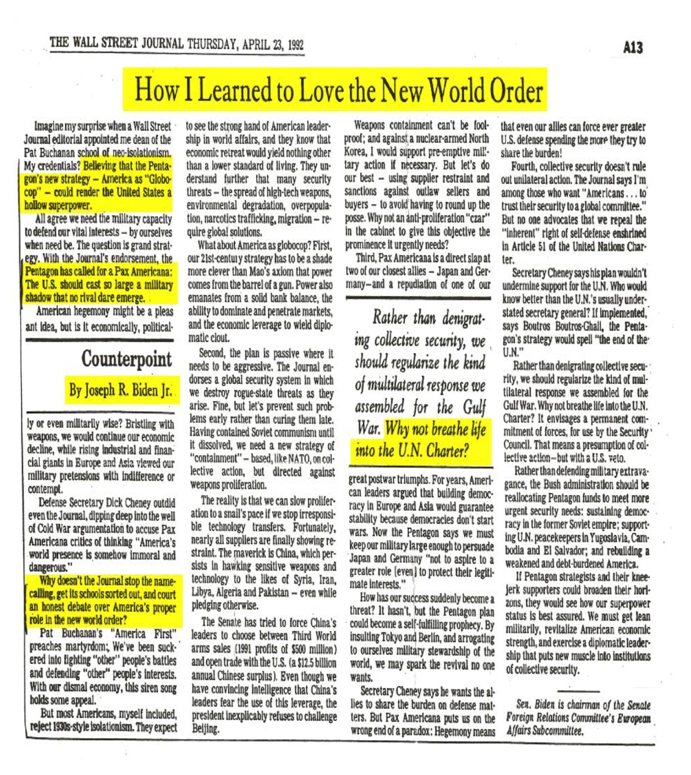
In 1992, The Wall Street Journal tapped then Senator Joseph Biden to write an article ‘How I Learned to Love the New World Order’ where he said that “Imagine my surprise when a Wall Street Journal editorial appointed me dean of the Pat Buchanan school of neo-isolationism.” Biden was referring to Patrick Buchanan, a long-time anti-globalist who worked as a senior advisor to three presidents and was a two-time presidential nominee for the Republican Party and a presidential nominee for the reform party in 2000. He is a journalist and has authored numerous books including ‘A Republic, Not an Empire: Reclaiming America’s Destiny‘ An interesting article from 2013 on Buchanan’s website http://www.buchanan.org ‘ titled ‘Why Neo-Isolationism Is Soaring’ quotes what Buchanan thought about globalism or the New World Order, “Neo-isolationism is the direct product of foolish globalism. … Compared to people who thought they could run the universe, or at least the globe, I am neo-isolationist and proud of it.” Buchanan is clearly adamant about ending the US empire:
The roots of the new isolationism are not difficult to discern. There is, first, the end of the Cold War, the liberation of the captive nations of Europe, the dissolution of our great adversary, the Soviet Empire, and the breakup of the Soviet Union. The Cold War, our war, was over. Time to come home. The Bushes and Bill Clinton said no. So we let the New World Order crowd have its run in the yard. We invaded Panama, intervened in Haiti and Mogadishu, launched Desert Storm to liberate Kuwait, bombed Serbia for 78 days to force it to surrender its cradle province of Kosovo.
Came then the blowback of 9/11, following which we had the Afghan war to overthrow the Taliban and create a new democracy in the Hindu Kush, the invasion and occupation of Iraq to strip Saddam Hussein of weapons of mass destruction he did not have, and the air war on Libya. Others may celebrate the fruits of these wars but consider the costs:
A decade of bleeding with 8,000 U.S. dead, 40,000 wounded, $2 trillion sunk, Iraq and Libya disintegrating in tribal, civil and sectarian war, Afghanistan on the precipice, and al-Qaida no longer confined to Tora Bora but active in Pakistan, Libya, Iraq, Yemen and Syria
Biden basically mocked Buchanan’s ideas of being an isolationist at the time. Many people in Washington, D.C. did not agree with Buchanan’s assessment of ending the US empire around the world. Biden is the complete opposite, he wrote “Believing that the Pentagon’s new strategy-America as globo-cop-could render the United States a hollow superpower.” He continued “all agree we need the military to defend our vital interests-by ourselves when need be, The question is grand strategy. With the journal’s endorsement, the pentagon has called for a Pax-Americana: The U.S. should cast so large a military shadow that no rival dare emerge.” As Biden continued his argument for a US-led world order, he rejected Buchanan’s “America First” isolationist policy:
Pat Buchanan’s “America First” preaches martyrdom: We’ve been suckered into fighting “other” people’s battles and defending “other” people’s interests. With our dismal economy, this siren song holds some appeal.
But most Americans, myself included, reject 1930s-style isolationism. They expect to see the strong hand of American leadership in world affairs, and they know that economic retreat would yield nothing other than a lower standard of living. They understand further that many security threats — the spread of high-tech weapons, environmental degradation, overpopulation, narcotics trafficking, migration — require global solutions
Biden said that being a “globocop” comes with the ability to use its economic influence as a diplomatic tool and by using NATO’s containment policy as a strategy. Biden asked the question, “What about America as globocop?” he continued ” First, our 21st-century strategy has to be a shade more clever than Mao’s axiom that power comes from the barrel of a gun. Power also emanates from a solid bank balance, the ability to dominate and penetrate markets, and the economic leverage to wield diplomatic clout.” Biden also called for an aggressive foreign policy against those who are considered rogue states or simply put, those who don’t follow the rules:
Second, the plan is passive where it needs to be aggressive. The Journal endorses a global security system in which we destroy rogue-state threats as they arise. Fine, but let’s prevent such problems early rather than curing them late. Having contained Soviet communism until it dissolved, we need a new strategy of “containment” — based, like NATO, on collective action, but directed against weapons proliferation.
The reality is that we can slow proliferation to a snail’s pace if we stop irresponsible technology transfers. Fortunately, nearly all suppliers are finally showing restraint. The maverick is China, which persists in hawking sensitive weapons and technology to the likes of Syria, Iran, Libya, Algeria and Pakistan — even while pledging otherwise
Biden’s conclusion on how the U.S. and its allies can succeed in establishing a world order through a revised United Nations charter:
Rather than denigrating collective security, we should regularize the kind of multilateral response we assembled for the Gulf War. Why not breathe life into the U.N. Charter? It envisages a permanent commitment of forces, for use by the Security Council. That means a presumption of collective action — but with a U.S. veto.
Rather than defending military extravagance, the Bush administration should be reallocating Pentagon funds to meet more urgent security needs: sustaining democracy in the former Soviet empire; supporting U.N. peacekeepers in Yugoslavia, Cambodia and El Salvador; and rebuilding a weakened and debt-burdened America.
If Pentagon strategists and their kneejerk supporters could broaden their horizons, they would see how our superpower status is best assured. We must get lean militarily, revitalize American economic strength, and exercise a diplomatic leadership that puts new muscle into institutions of collective security
During the George W. Bush administration, then Senator Joe Biden was the chair of the Senate Committee on Foreign Relations supported the Authorization for Use of Military Force Against Iraq Resolution of 2002 that granted President Bush the authority to invade Iraq. The war in Iraq has killed more than a million Iraqis with millions more injured including those who suffer from post-traumatic stress disorder (PTSD) from the horrors of war. There are over 4,800 US military deaths and 10s of thousands more seriously injured. Many US soldiers also suffer from PTSD who eventually end up committing suicide. Biden also supported the wars against Serbia in 1999 followed by his support for the wars in Libya and then Syria.
In his Wall Street Journal piece, President Biden said that the liberal international order establishment faces many obstacles including security threats such as the proliferation of high-tech weaponry, the environment, overpopulation, immigration issues on south of the US border and drug trafficking, all “require global solutions.” One of his main issues he spoke about was overpopulation. CNN recently reported with enthusiasm ‘Biden signs memorandum reversing Trump abortion access restrictions’ said that “President Joe Biden signed a presidential memorandum on Thursday to reverse restrictions on abortion access domestically and abroad imposed and expanded by the Trump administration.”
According to the report:
“The memorandum will “reverse my predecessor’s attack on women’s health access” and that it “relates to protecting women’s health at home and abroad, and it reinstates the changes that were made to Title X and other things making it harder for women to have access to affordable health care as it relates to their reproductive rights.” The memorandum reverses the Mexico City Policy which is “a ban on US government funding for foreign nonprofits that perform or promote abortions.”
Obviously, abortions reduce population growth and that’s a goal of the establishment because with less people on the planet, it is much easier to control the remaining population. A dream come true for the establishment.
Who knows how long Biden has in office since his mental capabilities are in decline, but it is certain that he will introduce many aspects of his liberal international order while he’s still in office. Rest assured, Biden, Kamala Harris or whoever takes his position will continue to implement policies that will complement the establishment who seeks to rule the world by coercion or even by force, if needed.
References:
*Joe Biden Calls For A New World Order At The 2014 U S Air Force Academy Graduation May 29, 2014
Biden Regime Puts The Brakes On Trump’s Germany Troop Draw Down
By Tyler Durden | Zero Hedge | January 29, 2021
Perhaps as expected, it didn’t take long for the Biden administration to begin putting the brakes on Trump’s previously ordered troop draw downs which occurred in the last two months of his presidency, particularly in Germany, Iraq, and Afghanistan.
The defense analysis and news site Military.com is reporting that new defense secretary under the Biden administration Lloyd Austin is reviewing the withdrawal of 12,000 US troops from Germany:
Defense Secretary Lloyd Austin has voiced his commitment to shoring up close ties with NATO ally Germany that were strained under the Trump administration, and suggested that the plan to withdraw 12,000 U.S. troops from the country is open to discussion.
The prior Trump plan to cut nearly one-third of total American military personnel from the country was predictably fought from Congressional corners known for being hawkish on Russia, with even some American and European security officials having called the move a “gift to Putin”.
Later in December the 2021 National Defense Authorization Act attempted to override the draw down order, and according to German officials early this year there’s yet to be significant movement of troops from the country.
Defense Secretary Lloyd Austin this week held phone calls with NATO allied officials in Europe. The Military.com report continues:
In a phone call to his German counterpart, Defense Minister Annegret Kramp-Karrenbauer, Austin “expressed his gratitude to Germany for continuing to serve as a great host for U.S. forces, and expressed his desire for a continued dialogue on U.S. force posture in Germany,” according to a Pentagon readout of the call released Wednesday.
He also sought “to reinforce the value the United States places on the bilateral defense relationship with one of our closest NATO Allies,” the readout from Pentagon Press Secretary John Kirby states.
By all appearances the some 36,000 total American troops in Germany have gone nowhere despite the plan initiated under Esper.
Recent polling of the German public also suggests half or more want to see US troops gone, after being there since World War II.
As the report concludes of Defense Secretary Austin’s phone call, it is “the latest sign of the Biden administration’s intent to reverse or water down the policies of former President Donald Trump, who repeatedly questioned NATO’s worth to the U.S. and rattled allies with demands for more defense spending.”
NATO Secretary General sounds alarm over ‘Russian aggression’, encourages members to increase military spending
RT | January 28, 2021
NATO’s top official has warned that its member states face existential threats to their safety, democracy and way of life from both terrorism and nations like Russia and China.
Secretary General Jens Stoltenberg made the remarks at a meeting of the bosses of the bloc’s armed forces on Wednesday. His comments were reported in a statement by Air Chief Marshal Sir Stuart Peach, the British chairman of NATO’s military committee.
According to the communique, Stoltenberg “urged Allies to continue to increase defense spending, invest in modern capabilities and to ensure our military remains ready to deal with challenges such as Russia’s aggressive actions, terrorism and the risks posed by the rise of China.”
He also stressed that “our democracies, our values, and the rules-based order are being challenged.” Stoltenberg’s rhetoric, however, failed to account for the fact its members include five nations that the US government-funded Freedom House says are not democratic states: Albania, Hungary, Montenegro, Macedonia and Turkey.
As well as rival states in the East, the missive also pointed to the evolving threat of terrorism as evidenced by the rise of IS (Islamic State, formerly ISIS), as well as conflicts in Afghanistan and Iraq. It urged its members to step up the funding for their armed forces, adding that “NATO is the world’s most successful military alliance because we adapt.”
Russia has previously warned that NATO activity near its borders has increased in recent months. In December, Russian Deputy Defense Minister Alexander Fomin told local media that there had been a number of close calls when vessels and warplanes came close to the country’s borders.
“In 2020, the activity of [NATO’s] air and naval forces has increased significantly, and situations that can lead to serious incidents are increasingly emerging,” Fomin said. “These actions were openly provocative. The incidents were avoided only thanks to the high level of professional training of Russian pilots and sailors.”
The month before, a US-led exercise in Romania that saw missiles land in the Black Sea caused alarm on the Crimean Peninsula. American troops airlifted in M142 High Mobility Artillery Rocket (HIMARS) launchers from their bases in Germany specifically for the drills. The deputy speaker of the Crimean parliament claimed at the time that it had created an impression that NATO was preparing for “an armed invasion of the territory of the Russian Federation.”
Late last year, the bloc said that it had set its sights firmly on Russia. An analysis published by Stoltenberg’s office argued that Moscow engages in “assertive policies and aggressive action,” which has “negatively impacted the security of the Euro-Atlantic area.”
“In the long term until 2030, Russia is likely to remain the main military threat to the North Atlantic Alliance,” the authors of the report said.
Netanyahu to dispatch Mossad chief to meet Biden & outline Israel’s demands for Iran nuclear deal overhaul
RT | January 24, 2021
Mossad chief Yossi Cohen may become the first top Israeli official to meet new US president Joe Biden amid concerns in Tel Aviv that his administration is set to revive the Obama-era international nuclear pact with Iran.
The head of Israeli secret service and one of PM Benjamin Netanyahu’s most trusted allies, Cohen, is heading to Washington sometime next month to brief the Biden administration on a set of terms regarding any potential nuclear deal with Tehran, Channel 12 reported on Saturday, citing “communications” between Israel and the new US administration.
Cohen is also expected to meet with the CIA chief and once again present an intelligence assessment of Iran’s nuclear program, which according to Israelis is secretly aimed at obtaining nukes.
Cohen’s team is reportedly set to demand a “radical overhaul” of the agreement, far more strict for Tehran, including a full halt of uranium enrichment and production of advanced centrifuges. On top of that, Israel wants Iran to stop “supporting terror groups” and “end its military presence in Iraq, Syria and Yemen.”
Iran’s president this week reiterated his country’s willingness to return to the terms of deal, but said it’s up to the Biden administration to make the necessary concessions. Cohen’s team is reportedly set to demand a “radical overhaul” of the agreement, with far more strict commitments from Tehran.
The Joint Comprehensive Plan of Action (JCPOA) was signed between Iran and the six major global powers in 2015 and put constraints on Tehran’s nuclear ambitions [the Western signatories never honored their commitments since 2015]. Israel lobbied the Obama administration hard against joining the JCPOA, and once Donald Trump took office, continued this effort, this time succeeding in getting Trump to withdraw and reintroduce crippling sanctions against Iran.
Since then, amid ever-escalating tensions with the US while criticizing other JCPOA signatories for their failure to bring Washington to its senses, Tehran chose to gradually renege on their side of the deal too.
In January, Iran began enriching uranium to 20 percent, drifting further away from the parameters of the deal. While higher than the 3.67 percent level agreed in the 2015 pact, the new figure is still below the 90 percent level that is considered weapons-grade.
Iran has also issued a symbolic ultimatum, with an Iranian spokesperson stating that the Biden administration will have one month, until February 21 to reverse sanctions. The director general of the International Atomic Energy Agency, which is tasked with monitoring Iran’s compliance, warned that time is running out with “only weeks left” to save JCPOA.
President Biden’s New Administration, Old Aggression
Strategic Culture Foundation | January 22, 2021
The day after President Joe Biden’s inauguration this week the White House announced that it was seeking a five-year extension of the New START treaty with Russia. The treaty was set to expire on February 4 after a 10-year run. Russia in recent months repeatedly urged the United States to renew the accord, which the former Trump administration had ignored.
Therefore, the new administration’s willingness to save New START is welcome. (But it is not clear cut, as explained below.) If the treaty had expired, there was a grave risk of relapse into a nuclear arms race. Given that the U.S. has already pulled out of several arms controls treaties, it is of paramount importance to maintain the last remaining pact, which specifically limits the bilateral arsenal of intercontinental warheads.
In announcing the Biden administration’s decision on extending New START, Pentagon spokesman John Kirby stated: “Just as we engage Russia in ways that advance American interests, we in the Department will remain clear-eyed about the challenges Russia poses and committed to defending the nation against their reckless and adversarial actions.” (Our emphasis.)
White House spokeswoman Jan Psaki articulated a similar testy rationale, saying that despite the extension proposal the Biden administration would hold Russia to “account for reckless and adversarial actions”. (Our emphasis.)
Please note the casual assertion of provocative claims as if they are proven facts. And this, ironically, from a new administration that has piously proclaimed to bring “facts” to public announcements in place of the Trumpian habit of peddling falsehoods and “alternate facts”.
It was then announced that President Biden has ordered his top intelligence officers to carry out a review into allegations of Russian malign conduct. In particular, allegations of a massive cyber attack – the so-called SolarWinds hack – on American government departments and commerce; the alleged poison assassination of Russian dissident figure Alexei Navalny; allegations of Russian interference in the 2020 presidential election; and, lastly, the allegations of Russian military intelligence running bounty-hunter plots in Afghanistan to murder U.S. soldiers. (We can be sure the conclusions are already foregone, only awaiting new media spin.)
Curiously though, the allegation of Russian interference in the 2020 election seems to be a new one for the archive of outlandish anti-Russian accusations. It is not clear what it refers to specifically. Earlier this week, Biden’s Democratic allies House Speaker Nancy Pelosi and former presidential candidate Hillary Clinton made ludicrous assertions that Russian President Vladimir Putin may have helped Donald Trump in trying to overthrow the electoral process with the violent assault on the Capitol by Trump supporters on January 6.
In any case, Russia has refuted all these absurd allegations as “baseless” and without evidence. This charade of accusing Russia has been intensifying since the 2016 election when Trump was elected. It now looks set to continue under the Biden presidency. Kremlin spokesman Dmitry Peskov says such fables betray a Cold War mentality of Russophobia which seems to be endemic in the American political establishment.
So Biden’s proposed extension of New START is not the offer of an olive branch to Russia, as it may first appear. It is being done with a cold hand of raw self-interest and in a wider context of continuing and intensifying antagonism towards Russia.
Indeed, in reporting the move on the nuclear pact, the New York Times quoted Biden aides saying that the new administration had no interest in establishing a “reset” in American relations with Russia.
This week also revealed other indications of aggressive mindset in the new administration. During confirmation hearings in the Senate for Biden’s Cabinet and national security team, the recurring theme was how the United States would stand up to purported adversaries. Russia, China and Iran were chief among the targets for American power interest, all described in pejorative terms as enemies.
Avril Haines was confirmed as Director of National Intelligence. Ridiculously, she declared that she would “speak truth to power” and ensure that “intelligence would not be politicized”. This is the same Avril Haines who helped mastermind drone assassinations while formerly serving as deputy director of the CIA and who this week vowed to take a more aggressive stance towards China. Antony Blinken and Lloyd Austin are set to become Secretaries of State and Defense. Other members of the Biden team, Victoria Nuland, Wendy Sherman and William Burns (who is to head the CIA) are also alumni of the past Obama administrations (2008-2016) in which Biden himself served as vice president.
All of them are indelibly complicit in propagating illegal wars, regime-change operations and the disastrous 2014 coup d’état in the Ukraine. In fact, Blinken during his Senate hearings this week affirmed that he is in favor of increasing lethal U.S. military supplies to Ukraine.
Joe Biden has a long and sordid record as a former Senator of supporting dozens of U.S. wars and aggressions, going back to the bloody invasions of Grenada in 1983 and Panama in 1989 and the bombing of former Yugoslavia in 1999, among others. But it was his pivotal support for the U.S. war on Iraq in 2003 which marks his most vile act as a warmonger and surrogate for American imperialism.
Biden has indulged the Russophobic fantasies of “Russiagate”, alleging collusion between the Kremlin and former president Trump, which have poisoned U.S.-Russia relations. Biden has even resorted to cheap ad hominem attacks on Putin calling the Russian leader a “thug”. How rich is that for someone who caused over one million deaths in his sponsorship of one war alone in Iraq, never mind dozens of others.
Alas, unfortunately, what we are seeing in Washington is a new administration with old aggression.
The cognitive dissonance afflicting America is something to behold. U.S. media this week were swooning over the inauguration of Democrat President Joe Biden as a “return to normal” after four years of turmoil under Donald Trump. The “adults have returned” goes the saying among pundits. More accurately, that should be the adult psychopaths and imperialist warmongers have returned.
In other matters, Biden announced a “war-time effort” to control the coronavirus pandemic which has devastated the United States. The American death toll from the disease [allegedly] stands at over 400,000 as of this week and is set to reach half a million by next month. The U.S. has the biggest [contrived] death toll in the world, accounting for 20 per cent of all Covid-19 deaths. Concurrent with the U.S. public health crisis is an economic crisis of poverty, unemployment, homelessness and inequality. It makes you wonder how it is that the Biden administration can devote so much interest on “foreign enemies” amid such catastrophe at home.
One dubious blessing perhaps is that United States will be so preoccupied with salvaging its own domestic woes that its warmongering politicians might not have the stomach nor nerve for overseas adventurism and wars. Although, don’t bet on it.
MICHAEL MCFAUL’S COUNTERPRODUCTIVE POLICY PROPOSALS
Irrussianality | January 22, 2021
War, said the great Prussian strategist Carl von Clausewitz, is an “interaction.” It is “not the action of a living force upon a lifeless mass, but always the collision of two living forces.” One might say the same thing about international politics. Whatever you do always involves others, who have a will of their own and who act in ways which impede the fulfilment of your plans.
The good strategist doesn’t assume that others will simply comply with his demands. Rather he considers their likely response, and if it is probable that they will respond in a way that harms his own interests, he jettisons his plan and looks for another.
Joe Biden’s victory against Donald Trump in the recent US presidential election has led to a slew of articles suggesting the policies that the new administration should pursue towards Russia. All too often, instead of considering how Russia will respond, they treat it as a “lifeless mass” which can be pushed in the desired direction by pressing the correct buttons. Experience, however, suggests that this is not the case, and the Russian reaction to the proposed policies is not likely to be what the United States desires.
An example is an article by the former US ambassador to Moscow Michael McFaul, published this week in the magazine Foreign Affairs. Full of suggestions for ramping up the pressure on Russia, it fails to take into consideration how Moscow is likely to respond to such pressure. Consequently, it ends up proposing a line that if put into practice would probably be entirely counterproductive.
McFaul accuses Russian president Vladimir Putin of leading an “assault on democracy, liberalism, and multilateral institutions,” with the objective of “the destruction” of the international order. From this McFaul concludes that the United States “must deter and contain Putin’s Russia for the long haul.” He then makes several suggestions as to what this policy should involve.
First, he suggests that NATO build up its armed forces on Russia’s border, “especially on its vulnerable southern flank”. Why precisely this is “vulnerable” McFaul doesn’t say, but he does tell us that NATO “needs new weapons systems, including frigates with antisubmarine technologies, nuclear and conventionally powered submarines, and patrol aircraft.”
Second, he argues that America must increase its support to Ukraine. “A successful, democratic Ukraine will inspire new democratic possibilities in Russia,” he says, as if a “successful, democratic Ukraine” is something that can simply be wished into existence. But McFaul wants to do more than just help Ukraine; he also wants to punish Russia. “As long as Putin continues to occupy Ukrainian territory, sanctions should continue to ratchet up,” he says.
Third, McFaul wants the US to get more deeply involved in other countries on Russia’s borders. “Armenia, Georgia, Moldova, and Uzbekistan all deserve diplomatic upgrades,” he suggests. He also recommends that Joe Biden, “should meet with Belarusian opposition leader Sviatlana Tsikhanouskaya”.
Fourth, McFaul wishes to venture into the world of censorship. America and other Western democracies, “should develop a common set of laws and protocols for regulating Russian government controlled-media,” he says. To this end, he argues that Biden should get social media to “downgrade the information Russia distributes through its propaganda channels.” If a search engine produces a link to RT, “a BBC story should pop up next to it,” he says.
Finally, McFaul says that the United States should bypass the Russian government to forge contacts with the Russian people, so as to “undermine Putin’s anti-American propaganda.” The USA should also train Russian journalists as part of an effort to “support independent journalism and anticorruption efforts in Russia.”
Strategy, as Clausewitz, pointed out, is about using tactics to achieve the political aim. But it is almost impossible to see how the tactics McFaul proposes could help the United States achieve any useful objective. The simple reason is that Russia is hardly likely to react to them in a positive fashion.
Let us look at them from a Russian point of view. How will the Russian government see them?
Sanctions are to “ratchet up” in perpetuity (as they must if they are connected to Russia’s possession of Crimea, which no Russian government will ever surrender); NATO will deploy more and more forces on Russia’s frontier; America will interfere ever more in Russian internal affairs, building up what will undoubtedly be considered a “fifth column” of US-trained journalists and opposition activists; the USA will intensify efforts to detach Russia from its allies and build up a ring up of hostile states around it; and finally, America will launch all-out information warfare to bend the international media to its will.
What does McFaul imagine Russia will do when it sees all this? Put up its hands and surrender? If he does, then it’s clear that in a lifetime studying Russia, he’s managed to learn nothing.
In reality, the response would probably be not at all to his liking. The growing sense of external and internal threat would lead to an increase in repressive measures at home, undermining the very democracy and liberty McFaul claims to be supporting. In addition, we would most probably see Russia increasing its own military forces on its national frontiers; doubling down on its support for the breakaway Donetsk and Lugansk People’s Republics in Eastern Ukraine; and pressing further with its own activities in the information domain.
In short, the Russian response would involve Russia doing all the things that McFaul dislikes, but even more so. It is hard to see how his strategy could be deemed to be a sensible one.
If it was just McFaul, it would probably not matter too much. But he is far from the only person saying these things. The general theme among supporters of the new Biden administration is that Trump was too soft on Russia, and that America needs to take a more robust line. This does not bode well for the next few years.
“Know your enemy and know yourself,” said another great strategist, Sun Tzu. Unfortunately, Americans seem to have forgotten this advice. They would do well to heed it.
Featured Video
From Anthrax to Iraq
or go to
Aletho News Archives – Video-Images
Book Review
New paperback: Butchered by “Healthcare”
Lies are Unbekoming | October 20, 2026
 Butchered by “Healthcare” is Robert Yoho’s plain-spoken account of how American medicine stopped being a profession and became an industry. 341 pages. Over a thousand references. Thirty-eight chapters.
“Screening Tests Are Useless”, on tests that find diseases that would never have hurt you. “The FDA Protects the Big Drug Companies”, on an agency funded by the companies it regulates. “The Journals’ Sins Are the Editors’ Sins”, on ghostwritten studies and captured peer review. “Opioids and ‘Pain Management’”, on how a generation was prescribed its way into addiction. “Prozac and Relatives” and “Antipsychotics Are Disastrous”, on what psychiatry does to adults and children. “Surgery: Money Before Patients”. “Failed Cancer Treatments”. “Futile CPR and Overprescribing”. “Billing Scams & Specialty Warfare”. “Hospitals Are Sharks”. Each with a Patient Tips section at the end on how to survive it.
If you have ever walked out of a doctor’s office with a prescription you didn’t ask for, or watched a parent put through a treatment that made them worse, this is the book you want on your shelf before the next appointment. … Full review
Butchered by “Healthcare” is available on Lulu now.
Blog Roll
 Aletho News
- Undersea Internet cables could be targeted in retaliation for attacks on Iran: IRGC deputy chief
- EU sending ‘biased’ observers to interfere in Serbian election – president
- White House envoy declares kinetic action against Yemen ‘fruitless’
- Ukraine deployed thousands of microdrones in Iraqi Kurdistan: Tasnim
- Iran calls for emergency UNSC meeting over Trump’s ‘brazen’ bomb talk, Israeli threats
- Iranian sources reveal details of Russia-China Hormuz proposal
- Plan for more US-Israel integration puts our military tech at risk
- Another Round Against Iran Will Break What Is Left of the Gulf
- SVR Report on Ukraine’s Mexican Drug Gang Links Could Pressure Zelensky, Won’t Change US Policy
- British Government Employees Were Fact-Checking the News at the BBC. Nobody Told You.
- If Americans Knew
- Israel Denies Entry to French Journalist, U.S. Researcher Amid Rise in Entry Denials
- Gaza’s hospitals are running out of life-saving fuel – Daily Update
- Mysterious bot accounts reportedly spread fake ‘man on the street’ videos for Michigan Senate candidate
- Israeli Defense Minister Katz Says Over 60 Lebanon Villages Have Been Destroyed
- Why Is Israel Running TV Ads in Iowa Ahead of the Midterms?
- Hind Rajab’s Alleged Killer Is in the United States. HRF Demands His Arrest.
- US Officials Face Fresh Pressure After Another American ‘Brutalized’ by Israeli Settlers in West Bank
- Israel-Backed Palestinian Militias Terrorize Displaced Families in Gaza
- FBI subpoenas pro-Palestine activists over Israeli weapons plant disruption
- Fourth winter arrives in wartorn Gaza, too early – Daily Update
- No Tricks Zone
- Predictions Made By Renowned Climate Proifessor Over Past Decades Have Been Proven To Be Poor
- New Study Suggests Large Regions Of The Pacific Ocean Have Been Cooling For The Last 80 Years
- Germany’s Green Energy Debacle: High Energy Costs Force Kahla Porzellan to Close After 182 Years!
- New Study: 50 Years Of The Most Aggressive ‘Net Zero’ Policies Can Only Affect The Global Climate By 0.03°C
- US September “Heat” Was No Record…Many Records Set Decades Ago
- Latest European Green Energy Debacle; Portugal’s Largest Flagship Solar Park Insolvent!
- Green Energy Debacle: German Expert Professor Fritz Vahrenholt Warns Of Severe Economic And Social Consequences
- Two More Paleo Reconstructions Affirm Meters-Higher Sea Levels Across Ireland, Brazil 7000-6000 Years Ago
- New Study: Earth And Venus Surface Warmth Largely Explained By Convection And Lapse Rate, Not CO2 Or Radiation
- 2025 Nature Paper Claiming Worsening Global Drought Gets RETRACTED …Heavily Flawed

