Why isn’t NDP critic Randall Garrison questioning $200 billion navy procurement?
By Yves Engler · January 8, 2021
The job of the opposition in Parliament is to hold the government accountable, in part by asking questions. The role of an NDP critic should be to criticize from the left. So why the silence from Randall Garrison after Canada’s leading military reporter David Pugliese published a 5,000 word expose on the Canadian Surface Combatant headlined, “Billions in trouble: How the crown jewel of Canada’s shipbuilding strategy became a possible financial disaster waiting in the wings.”
Despite revelations over the past month of costs growing to over $200 billion, extreme secrecy, the addition of ballistic ‘missile defence’ and Tomahawk missiles that travel 1,700 kilometers, there has been nary a comment from the NDP defence critic on the 15 new frigates.
Initially pegged at $14 billion, the official price tag for the frigates later rose to $26 billion and now sits at $60 billion. In 2019 the Parliamentary Budget Officer put the cost about $10 billion higher and an updated frigates cost estimate next month is expected to reach $80 billion. To keep information about the swelling costs under wraps the military has resorted to extreme secrecy, reported Pugliese in the expose.
The recent winner of a lifetime achievement award from the Canadian Committee for World Press Freedom followed his investigation into the cost and secrecy surrounding the frigates with a story about government officials criticizing companies for speaking out. Subsequently, Pugliese published a story headlined “Top of the line Canadian-made naval equipment shut out of $70-billion warship program” about government subsidized firms cut out of the Lockheed Martin led consortium set to build the frigates. As a result, Thales Canada’s government funded naval radar, which is being used on German, Danish and Dutch warships, won’t be part of the Canadian Surface Combatant.
In response to Pugliese’s reporting, the Ottawa Citizen editorial board criticized the frigate purchase in “Choppy waters for Canada’s warship program”. In November the Hill Times also published a commentary titled “Canada’s surface combatant costs might be taking on water” and a front-page story titled “DND says budget for Surface Combatants remains unchanged; PBO report expected in late February”. Two days before Christmas CBC reported an astounding estimate for the lifecycle cost of the frigates. Initially detailed in Esprit de Corps, former defence official Alan Williams’ concludes that the 15 frigates will cost $213 – 219 billion over 40 years!
One explanation for the astronomical cost of the 15 frigates is the radar system that’s been chosen. According to a CBC story from early December, the radar can be easily upgraded to a ballistic missile defence system, which successive Canadian governments have resisted joining. In the mid 2000s the Canadian Peace Alliance, Échec à la guerre, Ceasefire.ca and others forced the Liberal government to shelve its plan to formally join the US Ballistic Missile Defence. (It’s called “missile defence” because it’s designed to defend US missiles when they use them in offensive wars.)
In November a number of military focused publications reported on the weaponry expected on the vessels. “Canada’s New Frigate Will Be Brimming With Missiles”, is how The Drive described the ships. In a first outside the US, Canada’s surface combatants look set to be outfitted with Tomahawk cruise missiles capable of striking land targets up to 1,700 kilometers away. As such, the frigates could be near London and hit Berlin or, more plausibly, docked in Panama City and strike Caracas, Venezuela.
As I recently detailed in Jacobin, Ottawa has long used naval force as a “diplomatic” tool. Early Canadian ‘gunboat diplomacy’ included pressing Costa Rica to repay the Royal Bank in 1921 and helping a dictator as he was massacring peasants in El Salvador in 1932. In recent years Canadian warships have gone to war with Libya and Iraq.
Amidst growing media criticism, NDP defence critic Randall Garrison has said nothing regarding the frigates’ cost, secrecy or weaponry. He hasn’t released a single tweet (or retweet) about any of the recent stories on the surface combatant vessels.
This is abysmal. What is the point of having an NDP defence critic if they are unwilling to question or challenge the largest procurement in Canadian history?
At the NDP convention in April members need to press Garrison to clarify his position on these violent, $200 billion frigates.
Unexploded bombs at military site hinder Australian firefighters tackling enormous ‘life-threatening’ blaze
RT | January 5, 2021
Firefighters in Western Australia are being prevented from reaching at-risk homes due to unexploded bombs buried in the ground, as they tackle a huge blaze that has ripped through more than 9,000 hectares of land since Saturday.
The fire is located near the town of Lancelin, some 160km north of Perth, and is advancing at a pace of about 3.5km an hour towards the mainland settlement of Wedge Island, where a bombing range contains explosives buried underground.
The Department of Fire & Emergency Services (DFES) told local residents on Tuesday to “act immediately to survive” and ordered them to evacuate the area amid the “threat to lives and homes.”
A community meeting with DFES officials determined it would be too dangerous for fire crews to enter the old Lancelin bombing range surrounding the Wedge Island mainland settlement due to the unexploded ordinances.
The coastal dune area has been used in the past by the SAS for counter-terrorism practice, and for navy diver explosives-clearance training.
More than 200 firefighters are tackling the fire, which broke out in the Red Gully area of the shire of Gingin on Saturday and has spread rapidly, helped by winds of 20 to 30km/h.
So-called ‘spot fires’ are also being ignited by embers blown hundreds of meters away from the main blaze, with dry conditions set to continue amid highs of 40 degrees Celsius this week.
A DEFS statement on Tuesday warned people in the affected areas not to delay evacuating, as “leaving at the last minute is deadly,” adding that people who find themselves unable to leave should brace for sheltering inside.
No homes are reported to have been destroyed, according to local media. The DFES said the fire had been started accidentally.
Sergey Lavrov’s Reality Check
By Stephen Lendman | January 4, 2020
Lavrov and Iranian Foreign Minister Mohammad Javad Zarif are the preeminent diplomats of our time.
Respected for their straight talk candor and support for the rule of law and cooperative relations with other countries, their agendas are polar opposite how their Western counterparts operate.
Lavrov stressed that Russia “has a peaceful and predictable foreign policy,” adding:
“We remain open to joint efforts, based on mutual respect, with anyone who is willing to reciprocate.”
“We are not playing zero sum geopolitical games, and we are not acting in the spirit of an archaic concept of spheres of influence.”
“Quite the contrary. We are taking practical action to implement the idea that large-scale trans-border problems can only be settled through joint efforts based on the principle of solidarity.”
The above is worlds apart from politicized actions by the US and its imperial partners in pursuing their interests at the expense of nations they seek dominance over.
Russia’s higher standard based on the rule of law and multi-world polarity rejects their war on humanity, their diabolical hegemonic aims.
Russia is open to dialogue with all nations, including the US if it ceases “lecturing and the policy of blackmail and ultimatums,” said Lavrov.
Clearly it’s not in the cards. Notably it won’t happen when [or if] Biden/Harris replace Trump.
Russia strongly favors extending New START to halt Washington’s reckless arms race that threatens world peace and stability.
Trump regime hardliners rejected what the vast majority of nations support.
Despite Biden’s rhetorical support for extending New START, it’s unclear if he’ll pursue it responsibly when taking office.
Little time remains. New START expires on February 5 if not renewed.
Lavrov explained that Republicans and Dems are hellbent for ensuring military superiority over other nations — no matter the cost and risk to world peace and stability.
“The arms control system has fallen victim to (Washington’s) destructive policy,” Lavrov stressed, adding:
“The Americans have destroyed a number of vital agreements and are doing their best to promote initiatives that would benefit them alone.”
“At the same time, they have shown complete disregard for the security interests of other countries.”
New START is the last remaining Russia/US arms control agreement.
It limits “the nuclear missile potential of the world’s two largest nuclear powers and ensures predictability and verifiability of their activities in this sphere,” said Lavrov.
Russia responsibly addresses vital geopolitical issues in stark contrast to Washington’s hegemonic aim for unchallenged global dominance by whatever it takes to achieve it.
Notably it includes transforming sovereign independent nations into pro-Western vassal states — wars, sanctions, color revolutions, and old-fashioned coups its favored strategies.
The US in cahoots with its imperial partners use “the divide-and-conquer approach,” said Lavrov.
“Russia will continue to promote peace, security and stability” in stark contrast to how imperial USA operates.
Commenting separately on US and other Western sanctions, Lavrov said the following:
Russia rejects “aggressive, unfriendly actions or whims” in pursuit of national interests at the expense of targeted nations and the rule of law.
On Libya, Lavrov explained that after US-led NATO raped and destroyed the country in 2011, Russia has gone all-out to restore its peace and stability diplomatically.
In late December, Russian Foreign Ministry spokeswoman Maria Zakharova slammed EU foreign policy chief Josep Borrell’s unacceptable comparison “between Russia’s efforts to combat (covid… aka seasonal flu) and the unwarranted terrorist activities of” (US-created-and-supported) ISIS.
“Spreading ‘fake information,’ ” Borrell unacceptably “demonise(d) the Russian media and journalists.”
“By calling for fighting media manipulation, he himself appears to be showing clear symptoms of the infodemic infection.”
He’s an imperial tool for the diabolical interests that Washington and its hegemonic EU partners in high crimes pursue.
The Kurds have Once Again been Abandoned by their “American Brothers”
By Valery Kulikov – New Eastern Outlook – 28.12.2020
Yet again thrown by their “older American brothers” to the winds of fate, the Kurds in the Levant nowadays are not living through the best of times. On the border running between Syria and Iraq, a new armed conflict entailing human casualties is unfolding, one which demonstrates, among other things, a clear lack of unity among the Kurds, and that so-called Kurdistan is divided into parts ruled by various leaders, many of whom are competitors, and often almost irreconcilable enemies. Against this backdrop in the past few years, fierce battles between Kurdish formations have begun to occur more and more frequently, with the warring parties, while losing their fighters, the warring parties, concentrating their forces along the border in anticipation of new clashes.
The Syrian Kurds blame their Iraqi compatriots from the Peshmerga group for causing this conflict, including preparing for war in the Syrian Arab Republic. So, according to the position announced in ANF News by the Syrian Kurds, since October the Kurdistan Democratic Party (KDP) has been organizing provocations in South Kurdistan. The KDP, controlled by the family of Iraqi Kurdish leader Barzani, has been accused of both working closely with Turkey in various areas, including intelligence gathering, spreading propaganda, and logistics, and fueling domestic conflicts that could lead to civil war.
In October, Peshmerga proclaimed that an attack had been committed by Syrian Kurds on an oil pipeline, which resulted in oil exports from Kurdistan to Turkey being suspended.
On November 4, local media outlets reported that armed clashes broke out between Peshmerga forces and Kurdistan Workers’ Party militants in the area of Duhok, which resulted in the death of one Iraqi Kurdish fighter and injuries for three others.
On December 15, General Mazloum Abdi, who is the commander-in-chief of the Kurdish-Arab “Syrian Democratic Forces”, which was created by the United States, accused Iraqi Kurds of attacking and wounding three SDF members.
On December 16, the Iraqi Kurdistan regional authorities announced that Syrian armed groups from the YPG (which forms the backbone of the SDF) attacked bases and positions held by the Iraqi Peshmerga near the border. Syrian Kurdish leaders denied these accusations, calling them false, and leveled similar accusations toward Iraqi tribesmen themselves.
Local observers note that Iraqi Kurds are being transferred to the Syrian front with support provided by Turkish combat drones. It is worth noting that Ankara considers the YPG to be the Syrian wing of the Kurdistan Workers’ Party, which is labeled as a terrorist group in Turkey; this was used as the rationale for it to invade Rojava last October, displacing hundreds of thousands of civilians. Selahattin Demirtas, the co-chairman of Turkey’s largest Kurdish People’s Democratic Party, has been behind bars for the fourth year on charges of “supporting terrorism”. To mitigate the influence of this Kurdish movement, which is represented in the Turkish parliament, and to sow more discord in the Kurdish community, Turkey is preparing to organize a new Kurdish party with support from the country’s ruling Justice and Development Party.
 Regarding the military potential possessed by Kurdish groups in Syria and Iraq, it should be specified that both sides have virtually full-fledged armed forces that have been equipped with help from “foreign players”. Washington and Ankara are the ones helping the Iraqi Kurds. The Syrian Kurdish groups were financed, armed, and trained by the United States and its allies in the anti-terrorist coalition. At the same time, it is evident that both sides have been lent support by Washington, as well as used by it in the struggle for influence, power, and oil – both in Syria and Iraq. On top of that, the United States essentially put its seal of approval on the defeat of the Kurdistan Workers’ Party – a party recognized by them as terrorists in the European Union – in the Syrian Arab Republic and Iraq, where the main bases that the PKK has are located since their forces were defeated in Turkey.
In recent years, Trump has effectively lost interest in supporting the Kurds in the region, and even announced in October 2019 that American troops would be withdrawn from the area, and this time would not defend the Kurds. After that, Turkish aircraft started to attack the region and the positions that were held by the Kurds.
Donald Trump stated his position on the Kurds and the reason why the United States is abandoning them yet again on his Twitter page a year ago, noting in particular that the Kurds, an Iranian ethnic group, did not help the United States during WWII – including during the invasion of Normandy. It seems that the US president clearly drew on this kind of “extensive expertise” in WWII history from an article by Kurt Schlichter in the publication Townhall – which praises Trump’s policies – that stated: “The Kurds helped destroy DAESH (a terrorist group banned in the Russian Federation) … But let’s be honest: the Kurds did not come to help us in Normandy, Incheon, Khe Sanh, and Kandahar”. Well, what else can be expected for the Kurds from their “elder American brothers”?
The processes among the Kurds, which began in 2019 after another episode involving betrayal by the United States, were described in sufficient detail by The New York Times. Today, these processes have intensified, as have Turkey’s operations against the Kurds in Syria. One of the very hot spots in this regard was the city of Ain Issa in the northern part of the Raqqa Governorate, where Turkey has stepped up its shelling of Kurdish positions. For example, on the evening of December 17, the Turkish army and militants allied with it struck a powerful blow to the positions held by the predominantly Kurdish “Syrian Democratic Forces” in the area of the city of Ain Issa, attacking two nearby villages, and this forced SDF groups to abandon these positions and regroup their forces to keep the enemy from advancing any further. On the night of December 22, pro-Turkish forces ratcheted up the intensity of their strikes on the city of Ain Issa and its environs, and the Turkish military itself switched to using heavy artillery to strike the northern part of the Raqqa Governorate.
Under these conditions, representatives of the Russian and Syria military held talks on December 22 with representatives of Kurdish autonomous organizations – with participation on the part of Turkish officers – to try to ease tensions, but the parties did not reach any agreement. Representatives from the Turkish military demanded the withdrawal of all militants from the SDF, promising to stop the attacks by pro-Turkish criminal groups on Ain Issa if this occurs, although Ankara had previously denied that the militants were acting on its instruction.
The situation remains filled with tension, despite the measures taken by Russia to help foster stabilization.
Why are Tel Aviv and Washington Inflaming the Situation in the Persian Gulf?
By Vladimir Platov – New Eastern Outlook – 26.12.2020
During the run-up to the anniversary of the insidious assassination of Iranian General Soleimani – and after one month had passed since the equally controversial massacre of leading nuclear physicist Mohsen Fakhrizadeh – Israel and the United States, which are the ones responsible for this atrocity, are demonstratively increasing their military presence in the Middle East, and doing so in demagogic fashion under the guise of fearing “retaliation from Iran”.
The United States, located both at a considerable distance from Iran and outside the range of its missiles, having provoked this crisis clearly fears only a missile attack on its diplomatic mission in Iraq, as well as other American facilities in the region. Washington is trying to validate these fears with reports from American intelligence services, according to which pro-Iranian armed formations that can deliver a “retaliatory strike” have allegedly stepped up their activity in Iraq.
However, on December 21 Iranian Foreign Ministry spokesman Saeed Khatibzadeh denied these suspicions, which especially resounded in recent statements made by US Secretary of State Pompeo about the alleged complicity of pro-Iranian militia in the latest rocket strikes executed on Baghdad’s “Green Zone”. Along with that, Khatibzadeh wrote on Twitter that for Tehran “attacks on diplomatic facilities are unacceptable”.
Washington still dispatched additional warships and a squadron of fighters to the Middle East, and demonstratively conducted a nonstop flight of a B-52 strategic bomber that has the ability to carry nuclear weapons, by doing so intending to “intimidate Tehran”. In addition, on December 21 a US naval unit entered the Persian Gulf through the Strait of Hormuz that included a USS Georgia (SSGN 729) Ohio-class submarine, which carries up to 154 Tomahawk cruise missiles and is capable of taking on board up to 66 special operations service personnel, as well as two Ticonderoga-class guided-missile cruisers: a USS Port Royal (CG 73) and a USS Philippine Sea (CG 58). Previously, at the end of November, a USS Nimitz (CVN-68) aircraft carrier was sent off the Persian Gulf “to help contain the enemy”; this was rationalized by the need “to have additional defensive capabilities in the region in case of any unforeseen circumstances.”
As far as Israel goes, it clearly fears a “retaliation strike” from Iran since, given the Jewish state’s modest size, a successful attack on it could actually terminate its existence. This is especially true if the strike were to hit the Dimona Nuclear Research Center, which is considered to be the site where Israeli nuclear weapons originated; Tel Aviv neither confirms nor denies that the center exists. Incidentally, Ayatollah Mohammad-Ali Movahedi Kermani already delivered a warning to Israel that “if Iran decides to put up resistance, then one missile strike on the Dimona reactor would be enough”.
It is clear that Iranian missiles will not really be launched at Dimona, since this is fraught with consequences that entail nuclear contamination and destruction not only for Israel, but for Iran and quite a few neighboring countries across the region. And that is why the Iranian media occasionally names another target: the Israeli city of Haifa.
Israel, fearing the hysteria itself that potential military action could unleash, in a speech made by IDF Chief of General Staff Aviv Kochavi on December 21 cautioned Iran not to attack Israel, stating that “the Jewish state will retaliate against any aggression”.
Along with that, A. Kohavi evidently pointedly forgot to mention that it is not Iran, but Israel itself, that has already demonstrated its aggressive stance toward the Islamic Republic to the whole world by organizing and initiating acts of terrorism and assassinations – and not only against nuclear physicist Mohsen Fakhrizadeh. After all, this is far from the first time that Iranian scientists and leading representatives from Iranian society have been killed by an Israeli act of terrorism. For example, in Tehran, five nuclear physicists have been assassinated recently – and this specifically includes Hassan Tehrani Moghaddam, the architect of Iran’s ballistic missile program. All this points to the systematic destruction of the best Iranian scientists employed in the defense industry, which is being accomplished by the international community with impunity. This series of assassinations of prominent Iranian scientists, politicians, and military personnel – who ended up being unacceptable for the United States and Israel – substantiates the suspicions first voiced long ago that Western intelligence services and Israel have adopted the terrorist practice of eliminating key personnel and various prominent figures in those countries with which they are at war; this is done to weaken their defense systems and technological potential.
In addition to the words it speaks to help deter Tehran, Tel Aviv has taken a series of measures to test the combat readiness of its army against any potential foreign attacks, and is active about consulting with Washington – especially with representatives from the Pentagon – about how to work out joint coordination for the two countries to take military action against Iran. In particular, large-scale, unprecedented exercises came to an end in December, during which the capabilities of the three levels of Israel’s anti-missile defense (ABM) systems to neutralize various air threats were put to the test. Senior Israel Defense Forces officers, according to the Internet publication Breaking Defense, held “negotiations on coordination work” with their counterparts in the US Central Command (CENTCOM, which includes the Middle East) to bolster cooperation between the armed forces in the two countries “against Iran possibly taking revenge in the region”. According to this publication, Israel has reached its highest degree of readiness, in particular with regard to repelling “some of the 140,000 missiles that Iran-backed Hezbollah has in Lebanon, and the Houthi rebels in Yemen.” At the same time, it has been reported that although the Israeli command does not disclose the details about how it prepares for war, its tactical and operational anti-missile defense systems, and long-range missile systems, are still on high alert.
In addition, as reported by The Times of Israel, on December 17, Chairman of the Joint Chiefs of Staff Mark Milley arrived in Israel as part of his Middle East tour to discuss the threat that Iran poses to Washington’s allies, including the Jewish state.
As part of preventive measures taken against the armed situation in the region potentially escalating, Israel began to actively spread out its naval fleet around Iran. An Israeli Navy Dolphin-class (Type 800) submarine carrying cruise missiles on board passed through the Suez Canal, and on December 21 demonstratively surfaced in the Persian Gulf, in the waters that stretch between Saudi Arabia and Iran. Dolphin is a series of German modified diesel-electric submarines that are specially designed for Israel, and which have from 6-10 torpedo tubes. Besides torpedoes, they are armed with mines and Popeye Turbo SLCM cruise missiles that have a range of up to 1,500 km, and are capable of carrying nuclear charges with a capacity of up to 200 kilotons launched from torpedo tubes. The Israelis regularly keep at least two of their submarines.in the Indian Ocean, in the immediate vicinity of the Persian Gulf.
Today, in the assessments made by numerous experts, there is reason to presume that in January 2021, before Donald Trump [prospectively] leaves the White House, a joint American-Israeli missile strike could be launched against Iran, primarily to neutralize Iran’s air defense systems, as well as its nuclear industry facilities.
However, while ramping up the degree of military tension in the region Tel Aviv and Washington cannot help but clearly see that Iran does not intend to attack either the United States or Israel. Iran is not in an ideal condition to wage war now, since its economy is seriously undermined by the restrictive measures imposed on its oil sales abroad, as well as by the consequences of the coronavirus pandemic, the deficit inflicting its national budget, and the weakening of its national currency. Yes, military operations “against American and Israeli aggressors” can raise patriotic sentiments in the Islamic Republic for a certain period, but they would quickly drain the Iranian economy and militaristic zeal. In addition, hoping for a change in the attitude taken toward it after the White House administration [potentially] changes, for political and economic reasons it would now be clearly disadvantageous for Tehran to carry out any large-scale “retaliatory strike”. Therefore, the maximum that Tehran is capable of doing today, without causing itself significant damage, is to carry out a special operation against the Israelis involved in the murder of Mohsen Fakhrizadeh – or to inflict a targeted strike on American facilities in the region through its “proxies.”
As for the United States, Israel, and their allies taking military action against Iran right now, it should be kept in mind that the Islamic Republic, despite all its existing economic problems, is a pretty tough nut to crack in terms of its military, and aggression against it would have serious costs. And this cost is obviously unacceptable for either Trump or Netanyahu, who intend to keep pursuing their political careers.
China to strengthen military coordination with Russia
By M. K. BHADRAKUMAR | Indian Punchline | December 24, 2020
The joint aerial strategic patrol held by the air forces of Russia and China on December 22 over the Sea of Japan and the East China Sea makes a big statement in the geopolitics of the Asia-Pacific region. Chinese experts have hinted that such events could become “routine” in future.
The Chinese and Russian defence ministries made a joint announcement on the occasion Tuesday. China sent four nuclear-capable H-6K strategic bombers “to form a joint formation” with two of Russia’s famous Tu-95 bombers (NATO reporting name: “Bear”) to conduct the joint patrol as “part of annual military cooperation plan” between the two countries.
The announcement said the joint patrol “aims to further develop the China-Russia comprehensive strategic partnership of coordination in the new era, and enhance the level of the two militaries’ strategic coordination and joint operational capability to jointly safeguard global strategic stability.”
Curiously, only a month ago, on November 6, two Tupolev Tu-95MS strategic missile-carrying bombers of Russia’s Aerospace Force had performed a scheduled 8-hour flight over the neutral waters of the Sea of Japan and the north-western Pacific. Russia’s Defense Ministry said “At some sections of the route, the strategic missile-carrying bombers were escorted by Su-35S fighters.”

Russia’s Tu-95MS Strategic Bomber (Filephoto)
Clearly, the joint patrol with China was not an absolute must from the perspective of Russia’s national defence. But its optics and messaging mattered. This has everything to do with the regional setting with the US and its partners stepping up.
On Dec. 19, USS Mustin conducted a transit through the Taiwan Strait; on Dec. 20, Taiwan conducted a live-fire drill in the Pratas Islands (approx. 300 kms from mainland China) and plans to conduct another on Dec. 27. Pratas Islands are strategically located near the gateway to the South China Sea and are a waypoint for oil tankers and Chinese vessels en route to the Pacific Ocean.
Last week, Taiwan launched its first missile corvette, which the Taiwanese press described as an “aircraft carrier killer”, even as PLA Navy’s first Chinese-made aircraft carrier, the Shandong, completed its third sea trial in a 23-day transit in the Bohai Sea.
Also this month, a US Navy Amphibious Ready Group (ARG) consisting of the USS Makin Island and USS Somerset (LPD 25) patrolled the South China Sea and conducted “unscripted” live-fire drills. The Chinese state-run newspaper Global Times angrily called the ARG “US muscle-flexing actions” that “could damage regional stability,” and commented that “China should be prepared to confront the US in the South China Sea and the Taiwan Straits no matter who sits in the White House.”
Japan has bestirred itself lately, inviting like-minded Western countries to send military units to the Far East signalling that they are united in seeking a free and open Indo-Pacific region. The US, French and Japanese navies conducted integrated exercises in the Philippine Sea in December focusing on anti-submarine warfare; another joint military exercise is planned for May on an outlying Japanese island; the UK plans to send an aircraft carrier strike group to conduct joint exercises with the US Navy and Japanese Maritime Self-Defense Force (JMSDF) early next year.
The Japanese Defense Minister Nobuo Kishi held talks last week with his German counterpart Annegret Kramp-Karrenbauer where he “expressed hope that a German vessel” would join exercises with the JMSDF in 2021 and “suggested it would assist the international community’s efforts to ensure the right of passage of vessels through the South China Sea if the German warship would traverse waters” over which Beijing claims jurisdiction.
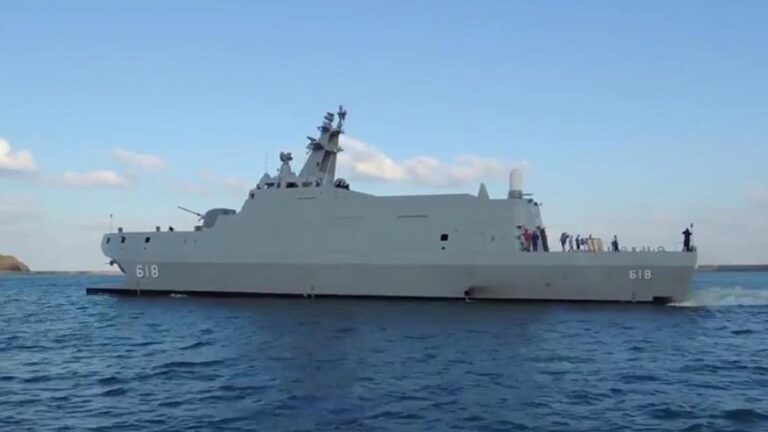
Taiwan Navy’s first stealth ‘carrier killer’ corvette Tuo Jiang
Amidst all this, the US’ Naval Service released an integrated maritime strategy designed to take a “more assertive (approach) to prevail in day-to-day competition (with China) as we uphold the rules-based order and deter our competitors from pursuing armed aggression.” Also, the US secretary of the Navy has called for the reestablishment of the 1st Fleet, a numbered Navy fleet, “in the crossroads between the Indian and the Pacific oceans.”
On Dec. 18, the US began building on the second Quad Foreign Ministers’ Meeting in October by organising a virtual “Quad” meeting of senior diplomatic officials from the US, Australia, India and Japan. The US State Department readout said the four countries discussed “practical ways … to coordinate efforts to support countries vulnerable to malign and coercive economic actions in the Indo-Pacific region.”
There is much speculation about how the [prospective] Biden administration will approach the Indo-Pacific. So far, Biden has not mentioned Quad, but he uses the phrase “Indo-Pacific.” But instead of discussing a “free and open” Indo-Pacific (as Trump does), Biden uses the phrase “secure and prosperous.”
To be sure, given the high stakes involved, China and Russia will not take chances. Their joint aerial patrol Tuesday reflects common concern over the region’s strategic stability. Both countries take note of growing interference by extra-regional powers inciting frictions, potentially posing a major threat to regional peace. Meanwhile, the US is deploying anti-missile systems and keeps talking about a NATO-like military alliance in Asia.
In sum, the joint patrol signals that China and Russia are “the linchpins of peace and stability in the Asia-Pacific region and Eurasia. They have no intention to challenge the regional order. They are propelled to respond to external powers which threaten regional security”, as a prominent think tanker at the Institute of Russian, Eastern European and Central Asian Studies under the Chinese Academy of Social Sciences, Yang Jin, put it.
Chinese pundits have discussed the pros and cons of a Sino-Russian military alliance, the consensus opinion being that in the prevailing security environment, the existing format of strategic partnership serves the purpose of meeting common challenges while giving flexibility to serve the self-interests each side. Having said that, military alliance also remains “a last option for the worst situation – when the US or another country launches a war that forces China and Russia to fight side by side” — to quote Yang.
An editorial in the Chinese Communist Party daily Global Times noted, “China and Russia have no intention of forming a military alliance because it cannot resolve the comprehensive challenges the two countries have to face” but the pressure from the US and its allies have “provided an important external impetus” to the strengthening of the comprehensive strategic cooperation as such, including military cooperation.
“As long as they cooperate strategically and jointly deal with challenges, they can generate effective deterrent, form a joint force to deal with specific problems, resist the attempts to suppress the two countries and curb the US’ international misconduct,” the editorial said.
The US-Russia-China triangle is sure to transform under the [prospective] Biden presidency if Washington sets sights on Moscow as the biggest threat to the US national security. Unsurprisingly, Beijing is signalling that the China-Russia strategic partnership should remain close and continue to be strengthened to handle increasing pressure from the US, even if Biden might ease tensions with Beijing.
This strategic emphasis is the leitmotif of an unusually lengthy report by Xinhua in the People’s Daily on the phone conversation between the State Councilor and Foreign minister Wang Yi with his Russian counterpart Sergey Lavrov on December 22.
Escalation in Cyberspace Raises Risk of Nuclear Attacks, Russia’s General Staff Chief Says
Sputnik – 24.12.2020
MOSCOW – The expansion of military confrontation to cyberspace and space increases risks of interference into control systems and use of nuclear weapons, Valery Gerasimov, the chief of Russia’s armed force’s general staff, said on Thursday.
“Military confrontation is spreading to cyberspace and outer space. As a result, we see increasing risks of incidents due to interference into the functioning of systems of control and nuclear weapons use,” Gerasimov said at a meeting with foreign diplomats.
Nuclear deterrence remains the key element of Russia’s military security, the official stressed.
“Nuclear weapons are seen as means to force potential enemies to abstain from launching aggression against our country. Statements about the ‘escalation for de-escalation’ concept, allegedly adopted by the armed forces, are fake. There is nothing similar to that in the Russian documents,” Gerasimov stressed.
Russia prioritises obligations under international arms control deals in its nuclear deterrence policies, the general staff chief said.
Democracies Don’t Start Wars. But Democrats Do
By Philip Giraldi | Strategic Culture Foundation | December 24, 2020
It may have been President Bill Clinton who once justified his wrecking of the Balkans by observing that liberal interventionism to bring about regime change is a good thing because “Democracies don’t start wars with other democracies.” Or it might have been George W. Bush talking about Iraq or even Barack Obama justifying his destruction of Libya or his interventions relating to Syria and Ukraine. The principle is the same when the world’s only superpower decides to throw its weight around.
The idea that pluralistic democracies are somehow less inclined to go to war has in fact been around for a couple of hundred years and was first elaborated by Immanuel Kant in an essay entitled “Perpetual Peace” that was published in 1795. Kant may have been engaging in some tongue in cheek as the French relatively liberal republic, the “Directory,” was at that time preparing to invade Italy to spread the revolution. The presumption that “democracies” are somehow more pacific than other forms of government is based on the principle that it is in theory more difficult to convince an entire nation of the desirability of initiating armed conflict compared to what happens in a monarchy where only one man or woman has to be persuaded.
The American Revolution, which preceded Kant, was clearly not fought on the principle that kings are prone to start wars while republics are not, and, indeed, the “republican” United States has nearly always been engaged in what most observers would consider to be wars throughout its history. And a review of the history of the European wars of the past two hundred years suggests that it is also overly simple to suggest that democracies eschew fighting each other. There are, after all, many different kinds of governments, most with constitutions, many of which are quite politically liberal even if they are headed by a monarch or oligarchy. They have found themselves on different sides in the conflicts that have troubled Europe since the time of Napoleon.
And wars are often popular, witness the lines of enthusiastic young men lining up to enlist when the Triple Entente took on the Germans and Austrians to begin the First World War. So, war might be less likely among established democracies, but it should be conceded that the same national interests that drive a dictatorship can equally impact on a more pluralistic form of government, particularly if the media “the territory of lies” is in on the game. One recalls how the Hearst newspaper chain created the false narrative that resulted in the U.S.’s first great overseas imperial venture, the Spanish-American War. More recently, the mainstream media in the United States has supported the disastrous invasion of Iraq, the destabilization of Syria, and the regime change in Ukraine, Afghanistan and Libya.
So now we Americans have the ultimate liberal democratic regime about to resume power, possibly with a majority in both houses of Congress to back up the presidency. But something is missing in that the campaigning Democrats never talked about a peace dividend, and now that they are returning the airwaves are notable for Senators like Mark Warner asking if the alleged Russian hacking of U.S. computers is an “act of war?” Senator Dick Durbin has no doubts on the issue, having declared it “virtually a declaration of war.” And Joe Biden appears to be on board, considering punishment for Moscow. Are we about to experience Russiagate all over? In fact, belligerency is not unique to Donald Trump and Mike Pompeo. War is in the air, and large majority of the Democratic Party recently voted for the pork-bloated National Defense Authorization Act (NDAA), endorsing a policy of U.S. global military dominance for the foreseeable future. If you are an American who would like to see national health insurance, a large majority among Democrats, forget about it!
But more to the point, the Democrats have a worse track record than do the Republicans when it comes to starting unnecessary wars. Donald Trump made the point of denouncing “stupid wars” when he was running for office and has returned to that theme also in the past several weeks, though he did little enough to practice what he preached until it was too late and too little. Clinton notoriously intervened in the Balkans and bombed a pharmaceuticals factory in Sudan and a cluster of tents in Afghanistan to draw attention away from his affair with Monica Lewinsky. His secretary of State Madeleine Albright thought the death of 500,000 Iraqi children due to U.S. sanctions was “worth it.” Barack Obama tried to destroy Syria, interfered in Ukraine and succeeded in turning Libya into an ungovernable mess while compiling a “kill list” and assassinating U.S. citizens overseas using drones.
If you want to go back farther, Woodrow Wilson involved the U.S. in World War One while Franklin D. Roosevelt connived at America’s entry into the Second World War. FDR’s successor Harry Truman dropped two atomic bombs on civilian targets in Japan, killing as many as 200,000. Japan was preparing to surrender, which was known to the White House and Pentagon, making the first use of nuclear weapons completely unnecessary and one might call it a “war crime.” Truman also got involved in Korea and John F. Kennedy started the intervention in Vietnam, though there are indications that he was planning to withdraw from it when he was killed. The only Democratic president who failed to start one or more wars was the much-denigrated Jimmy Carter.
So, it is Joe Biden’s turn at the wheel. One has to question the philosophy of government that he brings with him as he has never found a war that he didn’t support and several of his cabinet choices are undeniably hardliners on what they refer to as national security. The lobbies are also putting pressure on Biden to do the “right thing,” which for them is to continue an interventionist foreign policy. The Israeli connected Foundation for the Defense Democracies (FDD) has not surprisingly issued a collection of essays that carries the title “Defending Forward: Securing America by Projecting Military Power Abroad.” If one had to bet at this point “defending forward” will be what the Biden Administration is all about. And oh, by the way, as democracies don’t go to war with democracies, it will only be the designated bad guys who will be on the receiving end of America’s military might. Or at least that is how the tale will be told.
Philip Giraldi, Ph.D. is Executive Director of the Council for the National Interest.
US provides $500m to Israel under national covid relief bill
MEMO | December 22, 2020
The United States has passed a $900 billion COVID-19 relief bill to support industries and workers affected by the ongoing pandemic, of which hundreds of millions of dollars have been granted to Israel and its defence.
In the bill passed by US Congress yesterday – part of an overall $2.3 trillion package – the act under the heading of “Procurement, Defense-Wide” detailed a total of $500 million for the “Israeli Cooperative Programs”.
Of that amount, “$73,000,000 shall be for the Secretary of Defense to provide to the Government of Israel for the procurement of the Iron Dome defense system to counter short-range rocket threats.”
In addition to that, a further “$177,000,000 shall be for the Short Range Ballistic Missile Defense (SRBMD) program, including cruise missile defense research and development under the SRBMD program, of which $50,000,000 shall be for co-production activities of SRBMD systems in the United States and in Israel to meet Israel’s defense requirements consistent with each nation’s laws, regulations, and procedures.”
Meanwhile, the rest of the relief package deals with matters such as tax breaks, the selection of the next Dalai Lama, and providing businesses and the unemployed with benefits to ease their ordeal during the coronavirus pandemic.
In the announcement of the agreement, Senate Majority Leader Mitch McConnell stated that the bill is “another major rescue package for the American people,” referring to the first relief package made in March this year. He promised that the 5,593-page-long bill “is packed with targeted policies to help struggling Americans who have already waited too long.”
Even those policies which help the citizens and unemployed are severely limited, however, with the agreed $300 per week bonus jobless benefit reportedly being half of the federal unemployment benefit given in the previous package. That payment runs for 11 weeks in comparison to the 16 in the last package. To add to that, the direct stimulus payment of $600 to many people is also half of that given in March.
The disparity in relief payments leads to questions relating to the prioritisation of the US defence industry, its affiliated companies, and the Pentagon – which reportedly received $696 billion in the package – as well as the defence industry of a foreign nation such as Israel.
Congress’ justification for the limit in spending on the unemployed and businesses is that billions were allegedly also needed for other essential resources and unfinished business such as water provision and flood control in the country. The defence companies and military sectors which are provided money in the bill were also said to be heavily hit by the pandemic.
What’s actually IN the US “Covid Stimulus Bill”?
The answer to that is nothing like as simple as you’d expect, given the name.
OffGuardian | December 22, 2020
The US congress just passed their Covid stimulus bill, or the “Consolidated Appropriations Act, 2021” to give its official title. So what’s actually inside it? What has just been passed into law?
The answers to that is “nobody really knows”, least of all the members of congress, who passed the law without reading it, as they so often do. It’s the longest bill in US history, at over 5500 pages and it sailed through the voting mostly sight unseen.
We’ve downloaded a copy of the full document and will embed it for those of you patient or masochistic enough to tackle the whole thing. We’ve read some already, and will point out the highlights:
- “Foreign aid” is a big winner. Egypt is getting $1.3 billion, Sudan, Israel and Ukraine get over 500 million each, and many other countries around the world sizeable contributions, much of which will be spent on “defense”. Which is to say sent straight back to America via massive arms purchases.
- Not all the money being sent overseas is for buying weapons, some is for backing coups. Venezuela and Belarus get special mention here, each getting their own section of the bill detailing how terrible their “illegal regimes” are. There’s also a large section on “combating Chinese influence”.
- For some reason there’s another section on copyright law, which makes illegal streaming copyrighted content a federal crime, punishable by up to three years in prison.
- Nearly 300 million is put aside to develop influenza vaccines and prevent a future influenza pandemic.
- 4 BILLION dollars for the Gates-funded GAVI, the Vaccine Alliance.
- Vaccine “misinformation” is also a concern, and the bill provides for a pro-vaccine propaganda campaign – or rather a “PUBLIC AWARENESS CAMPAIGN ON THE IMPORTANCE OF VACCINATIONS”
So – huge amounts of foreign aid, support for various coups, totally irrelevant copyright laws, provisions for pro-vaccine propaganda campaigns… it’s not your typical “stimulus bill” so far, is it?
U.S. plans to build a nuclear plant on the Moon are a major challenge to other Great Powers
By Paul Antonopoulos | December 21, 2020
The U.S., via its Space Policy Directive-6 (SPD-6), announced plans to set up a nuclear power plant on the Moon by 2027. The SPD-6 states that the Moon will be installed with a fission power system that will have a power range of 40 kilowatt-electric (kWe) and higher so that the celestial body can support a sustained lunar presence and allow Mars to be more easily explored.
China’s Global Times reported that the U.S.’ ambitions will lead to future lunar military projects as it seeks space supremacy. According to Song Zhongping, a Chinese military expert, the moon is rich in helium-3, which can be used to produce energy by nuclear fusion. Song warned that by setting up a nuclear power plant, the Americans can theoretically turn the Moon “into a production site of nuclear weapons”.
U.S. President Donald Trump, as Eurasian Times reported, issued the SPD-6, which lays out a national strategy for the responsible and effective use of space nuclear power and propulsion (SNPP) systems.
Li Haidong, a professor at the Institute of International Relations of the China Foreign Affairs University highlighted that the use of SNPP is in the attempt to establish “American unilateralism” over space. As per the Moon Treaty, adopted by the United Nations General Assembly in 1979, celestial bodies and the Moon are “not subject to national appropriation by claim of sovereignty, by means of use or occupation, or by any other means”. Washington has generally adhered to the Moon Treaty, but never formally signed or ratified it.
Earlier this year, Trump attempted to challenge this Treaty by proposing new rules, dubbed the “Artemis Accord”, which would change the status quo. The Artemis Accord would allow for the exploitation of lunar resources for commercial gain and focus on establishing so-called safety zones around landing sites. This could be interpreted as de facto ownership of areas of the moon, forbidden by the Outer Space Treaty that provides a basic framework for international space law.
In addition, on April 6, Trump passed a decree that allows the U.S. to extract mineral resources from outer space. The document, states: “Americans should have the right to engage in commercial exploration, recovery, and use of resources in outer space, consistent with applicable law. Outer space is a legally and physically unique domain of human activity, and the United States does not view it as a global commons”.
It adds: “the United States does not consider the Moon Agreement to be an effective or necessary instrument to guide nation states regarding the promotion of commercial participation in the long-term exploration, scientific discovery, and use of the Moon, Mars, or other celestial bodies”. Finally, the document emphasizes that the U.S. will challenge any attempt by another state or international organization that wants to treat the Moon Agreement as customary international law.
With the U.S. planning to violate international treaties to unilaterally exploit the resources of space and construct a nuclear plant on the Moon, it is understood why Trump established the United States Space Force (USSF), the space service branch of the U.S. Armed Forces. Russia, India and China all have interests on the Moon too, and the USSF was established to ensure U.S. dominance over space rivals.
India in 2019 launched the Chandrayaan 2 mission with the aim to land on the south pole of the Moon to search for water and minerals. No other landing craft has reached this part of the moon before. Unfortunately for India, the landing failed because of a software glitch. This has not deterred Indian ambitions though and Chandrayaan-3 is scheduled to land on the Moon in the second quarter of 2021.
Meanwhile, China launched the Chang’e 5 robotic Moon mission on November 23 from the Wenchang Spacecraft Launch Site and landed on the Moon on December 1. By December 16 it returned to Earth with lunar soil and rock samples. It was China’s first sample-return mission, making it the third country after the U.S. and the Soviet Union to successfully obtain samples returned from the Moon.
Russia will be returning to the Moon after 45 years of inactivity. Vladimir Kolmykov, head of the Lavochkin Scientific and Production Association at the Russian space agency Roscosmos, told Russian President President Vladimir Putin on April 10 that: “The Luna-25 spacecraft is currently in the assembly and first trial stages. Yes, there are some cooperation problems but we are working on them. I hope that the 2021 goal of launching Luna-25 will be achieved.”
With the world’s Great Powers (the U.S., Russia and China), and emerging Great Power, India, all having vested interests in space and the Moon, the construction of a nuclear plant on the celestial body is a major challenge as it will propel a race for its resources and weaponization. All countries will try and claim parts of the moon for mining, resembling something akin to Western Europe’s Scramble for Africa or the race to claim large swathes of Antarctica. The U.S. is trying to dominate space policies from a very narrow U.S.-centric view when space should be viewed as a Common Heritage to Mankind. Russia, China and India could also claim large swathes of the moon in reaction to U.S. unilateral activities, thus kicking off another, more fundamental “Scramble for the Moon.”
Paul Antonopoulos is an independent geopolitical analyst.
Featured Video
From Anthrax to Iraq
or go to
Aletho News Archives – Video-Images
Book Review
New paperback: Butchered by “Healthcare”
Lies are Unbekoming | October 20, 2026
 Butchered by “Healthcare” is Robert Yoho’s plain-spoken account of how American medicine stopped being a profession and became an industry. 341 pages. Over a thousand references. Thirty-eight chapters.
“Screening Tests Are Useless”, on tests that find diseases that would never have hurt you. “The FDA Protects the Big Drug Companies”, on an agency funded by the companies it regulates. “The Journals’ Sins Are the Editors’ Sins”, on ghostwritten studies and captured peer review. “Opioids and ‘Pain Management’”, on how a generation was prescribed its way into addiction. “Prozac and Relatives” and “Antipsychotics Are Disastrous”, on what psychiatry does to adults and children. “Surgery: Money Before Patients”. “Failed Cancer Treatments”. “Futile CPR and Overprescribing”. “Billing Scams & Specialty Warfare”. “Hospitals Are Sharks”. Each with a Patient Tips section at the end on how to survive it.
If you have ever walked out of a doctor’s office with a prescription you didn’t ask for, or watched a parent put through a treatment that made them worse, this is the book you want on your shelf before the next appointment. … Full review
Butchered by “Healthcare” is available on Lulu now.
Blog Roll
 Aletho News
- Undersea Internet cables could be targeted in retaliation for attacks on Iran: IRGC deputy chief
- EU sending ‘biased’ observers to interfere in Serbian election – president
- White House envoy declares kinetic action against Yemen ‘fruitless’
- Ukraine deployed thousands of microdrones in Iraqi Kurdistan: Tasnim
- Iran calls for emergency UNSC meeting over Trump’s ‘brazen’ bomb talk, Israeli threats
- Iranian sources reveal details of Russia-China Hormuz proposal
- Plan for more US-Israel integration puts our military tech at risk
- Another Round Against Iran Will Break What Is Left of the Gulf
- SVR Report on Ukraine’s Mexican Drug Gang Links Could Pressure Zelensky, Won’t Change US Policy
- British Government Employees Were Fact-Checking the News at the BBC. Nobody Told You.
- If Americans Knew
- Israel Denies Entry to French Journalist, U.S. Researcher Amid Rise in Entry Denials
- Gaza’s hospitals are running out of life-saving fuel – Daily Update
- Mysterious bot accounts reportedly spread fake ‘man on the street’ videos for Michigan Senate candidate
- Israeli Defense Minister Katz Says Over 60 Lebanon Villages Have Been Destroyed
- Why Is Israel Running TV Ads in Iowa Ahead of the Midterms?
- Hind Rajab’s Alleged Killer Is in the United States. HRF Demands His Arrest.
- US Officials Face Fresh Pressure After Another American ‘Brutalized’ by Israeli Settlers in West Bank
- Israel-Backed Palestinian Militias Terrorize Displaced Families in Gaza
- FBI subpoenas pro-Palestine activists over Israeli weapons plant disruption
- Fourth winter arrives in wartorn Gaza, too early – Daily Update
- No Tricks Zone
- Predictions Made By Renowned Climate Proifessor Over Past Decades Have Been Proven To Be Poor
- New Study Suggests Large Regions Of The Pacific Ocean Have Been Cooling For The Last 80 Years
- Germany’s Green Energy Debacle: High Energy Costs Force Kahla Porzellan to Close After 182 Years!
- New Study: 50 Years Of The Most Aggressive ‘Net Zero’ Policies Can Only Affect The Global Climate By 0.03°C
- US September “Heat” Was No Record…Many Records Set Decades Ago
- Latest European Green Energy Debacle; Portugal’s Largest Flagship Solar Park Insolvent!
- Green Energy Debacle: German Expert Professor Fritz Vahrenholt Warns Of Severe Economic And Social Consequences
- Two More Paleo Reconstructions Affirm Meters-Higher Sea Levels Across Ireland, Brazil 7000-6000 Years Ago
- New Study: Earth And Venus Surface Warmth Largely Explained By Convection And Lapse Rate, Not CO2 Or Radiation
- 2025 Nature Paper Claiming Worsening Global Drought Gets RETRACTED …Heavily Flawed

