‘Coup’ preparation, or move to stop endless wars? What’s behind Trump’s Pentagon purge
By Nebojsa Malic | RT | November 11, 2020
Democrats and their allies are alarmed that President Donald Trump’s firing of top Pentagon officials could be preparation for a military coup. What looks more likely is that US troops might finally pull out from Afghanistan.
In addition to Defense Secretary Mark Esper, whom Trump “terminated” on Monday, Esper’s chief of staff Jennifer Stewart, acting policy chief James Anderson, and intelligence undersecretary Joseph Kernan have also been shown the door. They were replaced by National Security Council counter-terrorist chief Christopher Miller, former NSC aide Kash Patel, General Anthony Tata, and another former NSC aide Ezra Cohen-Watnick, respectively.
The purge and the appointment of the officials widely described in mainstream media as “Trump loyalists” has led to Democrats and neoconservatives warning that a “coup” might be in the works against Joe Biden, who has claimed victory in the November 3 election.
4. Who knows whether intentions are mostly petty, or domestic election interference, or unimpeded decisions in foreign policy (latter could range from military force to military withdrawals, and from pro-Putin to pro-MBS). But, I’m told, both Esper and Milley are truly worried.
— Bill Kristol (@BillKristol) November 11, 2020
Allowing for the possibility that Trump could just be acting out of spite against people who were disloyal to him, The Nation’s Michael Klare noted that Miller had been involved in covert operations in urban settings of Iraq and Afghanistan with US Special Forces.
Democrats should look for any evidence that the Pentagon purge “signals a covert White House plan to use the US military in support of an illegal drive to subvert democracy and install Trump as dictator,” Klare warned.
Wednesday’s appointment of retired Army Colonel Douglas Macgregor as Miller’s senior adviser, however, points in an entirely different direction. First reported by Axios, it was confirmed by the Pentagon later in the day, with a statement noting that Macgregor’s “decades of military experience will be used to assist in the continued implementation of the President’s national security priorities.”
While that sounds like properly vague Pentagonese, Macgregor is well known for his advocacy of a speedy US withdrawal from Afghanistan – something Trump said last month he wished to see by Christmas this year, ahead of the 2021 timeline envisioned in the peace agreement the US have struck with the Taliban.
The Intercept’s Lee Fang quoted an anonymous Pentagon official who basically confirmed that the Pentagon purge is aimed at overcoming resistance by career bureaucrats and the military-industrial complex to Trump’s policies.
Trump official claims the rapid personnel changes are designed to end the “forever wars” in Afghanistan, withdraw troops by Christmas, which many Pentagon leaders opposed. Others argue moves are designed only to award loyalty and punish dissent.
— Lee Fang (@lhfang) November 11, 2020
“The president is taking back control of DOD. It’s a rebirth of foreign policy. This is Trump foreign policy,” said the official.
“This is happening because the president feels that neoconservatism has failed the American people,” he added.
Trump campaigned in 2016 on ending the ‘endless wars’ in the Middle East. Within a few months, however, he allowed himself to be persuaded by the Pentagon to ramp them up instead, bombing Afghanistan and launching missiles at Syria. Once all the territory held by Islamic State (IS, formerly ISIS) terrorists was liberated, however, he pushed hard for withdrawal from Syria, Afghanistan and Iraq – running into resistance from the Pentagon.
His first Defense Secretary Jim Mattis resigned over Syria at the end of 2018. Most US troops there were withdrawn by October 2019. Some troops were also pulled out of Iraq this year, citing concerns over the coronavirus, though many still remain. A peace treaty with the Taliban was signed in February this year, after nearly 20 years of war that perfectly defined “mission creep.”
There is no denying that the present political situation in Washington, with Biden claiming he won the election and Trump disputing that citing irregularities in key states, is fraught with peril. Whatever the outcome, unless everything is handled above board and with transparency, half the country is going to feel cheated and disenfranchised.
There are two things to keep in mind, however. Whatever one thinks of him, Trump has kept his word, implementing his electoral promises – by working through the system – despite the obstacles thrown before him by the administrative apparatus, legislators and the courts. So far, the current flurry of activity at the Pentagon seems to point towards a withdrawal from the Middle East, rather than a coup at home.
Secondly, it was actually the Democrats – Joe Biden himself – who first brought up the notion of using the US military to forcibly remove Trump from the White House, should he lose but refuse to concede. That was in June, long before the election and its controversies. What did Biden know at the time to make him say that, nobody knows – because nobody in the mainstream US media has bothered to ask, preferring to entertain partisan fantasies based on conjecture instead.
A Biden Administration Makes the Lessons of WWI Newly Relevant
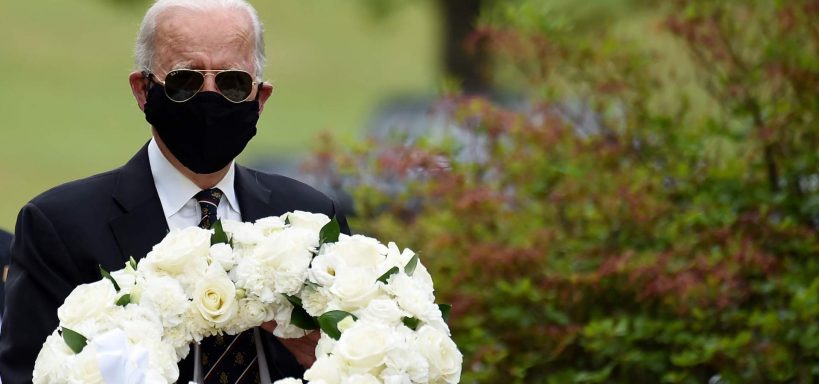
Photo by OLIVIER DOULIERY/AFP via Getty Images
By Kit Knightly | OffGuardian | November 11, 2020
It’s November the 11th again. The poppies are all out, worn by TV personalities (as instructed by their PR department), and politicians who have long forgotten what it was supposed to mean.
“Never Again”, that was the intention. But it happened again. And again and again and again and again.
The wars never stopped, not because of religion or racism or humanity’s bloodthirsty nature… but because of money. Money and power for the very few – the driving force behind almost every war, no matter the thin ideological veneer.
“War is a racket”, that’s how Major General Smedley D. Butler, put it:
I spent thirty- three years and four months in active military service as a member of this country’s most agile military force, the Marine Corps. I served in all commissioned ranks from Second Lieutenant to Major-General. And during that period, I spent most of my time being a high class muscle- man for Big Business, for Wall Street and for the Bankers. In short, I was a racketeer, a gangster for capitalism.
This message is more important than ever now, with a Biden administration being crow-barred into power at the cost of even the facade of democracy. Biden is not “progressive”, no matter what they call him or how many rainbow flags they wave. He is not new. He is old, in more ways than one.
The Warhawks in politics and the press are already salivating at the idea. The BBC is putting out a new “documentary” series about Syria. The Guardian is writing about “US leadership on the world stage”. One year on from his death, the press has decided that Russia is to blame for James Le Mesurier’s “suicide”.
Back in September, Josh Rogin writing in the Washington Post was even more flagrant, demanding Biden:
… increase pressure on President Bashar al-Assad to secure some dignity, safety and justice for the Syrian people.”
It’s not to hard to see where this is going. Whatever Trump may be, there’s no denying he’s been the least militarily aggressive president in recent memory. For the first time in nearly 40 years, a President did not start a new war in his term.
That is likely to change. They will begin drip-feeding propaganda on some “enemy” state soon enough – most likely Syria. The war drums will bang softly at first, they always do, but they will build.
That’s when the lessons of World War I need to be foremost in our minds. When the old lies are busy being given new life.
I leave you with this excellent passage from All Quiet on the Western Front. Read, and remember what was true 106 years ago is still true today:
Tjaden reappears. He is still quite excited and again joins the conversation, wondering just how a war gets started.
“Mostly by one country badly offending another,” answers Albert with a slight air of superiority.
Then Tjaden pretends to be obtuse. “A country? I don’t follow. A mountain in Germany cannot offend a mountain in France. Or a river, or a wood, or a field of wheat.”
“Are you really as stupid as that, or are you just pulling my leg?” growls Kropp, “I don’t mean that at all. One people offends the other
“Then I haven’t any business here at all,” replies Tjaden, “I don’t feel myself offended.”
“Well, let me tell you,” says Albert sourly, “it doesn’t apply to tramps like you.”
“Then I can be going home right away,” retorts Tjaden, and we all laugh, “Ach, man! he means the people as a whole, the State” exclaims Müller.
“State, State” Tjaden snaps his fingers contemptuously, “Gendarmes, police, taxes, that’s your State; if that’s what you are talking about, no, thank you.”
“That’s right,” says Kat, “you’ve said something for once, Tjaden. State and home country, there’s a big difference.”
“But they go together,” insists Kropp, “without the State there wouldn’t be any home country.”
“True, but just you consider, almost all of us are simple folk. And in France, too, the majority of men are labourers, workmen, or poor clerks. Now just why would a French blacksmith or a French shoemaker want to attack us? No, it is merely the rulers. I had never seen a Frenchman before I came here, and it will be just the same with the majority of Frenchmen as regards us. They weren’t asked about it any more than we were.”“Then what exactly is the war for?” asks Tjaden.
Kat shrugs his shoulders. “There must be some people to whom the war is useful.”
“Well, I’m not one of them,” grins Tjaden.
“Not you, nor anybody else here.”
“Who are they then?” persists Tjaden. “It isn’t any use to the Kaiser either. He has everything he can want already.”
“I’m not so sure about that,” contradicts Kat, “he has not had a war up till now. And every full-grown emperor requires at least one war, otherwise he would not become famous. You look in your school books.”
“And generals too,” adds Detering, “they become famous through war.”
“Even more famous than emperors,” adds Kat.
“There are other people back behind there who profit by the war, that’s certain,” growls Detering.
Joe Biden is no empty sheet, may well return US to warmaking – former OSCE vice-president
RT | November 8, 2020
There’s a ‘good chance’ that the US will return to the policy of foreign wars under Joe Biden, which will make its reconciliation with the EU impossible, Willy Wimmer, former vice-president of the OSCE, warned.
The main reasons why the Americans voted for Donald Trump four years ago were their tiredness of constant wars waged by their country and collapsing economy and infrastructure in the US, Wimmer told RT.
Trump has kept his promise and didn’t start any new foreign conflict, but that may well change if a member of the Democratic Party is in the White House, former Vice President of the Organization for Security and Co-operation in Europe (OSCE) Parliamentary Assembly said.
“Joe Biden isn’t an empty white sheet – he represents the Democratic Party, who in the 1990s destroyed the Charter of the UN.”
The German political veteran recalled the US-led NATO bombing of Yugoslavia under Democratic President, Bill Clinton, in 1999. He also pointed out that “in the presidency of [Barack] Obama, Biden was Vice President and he was in absolute accordance with Obama’s drone wars and the wars in the Middle East, therefore there’s a good chance that Joe Biden continues in the same way as the Democratic Party did it in the 1990s and under Obama” before 2016.
“And going back to before 2016 means going back to war” for the US, Wimmer argued.
Relations between Washington and Brussels have deteriorated under Trump over his demands for the EU nations to make larger financial contributions to NATO as well as political and economic pressure on the block to stop dealing with Russia and China.
Hopes that things would improve under Biden will be dashed, “as long as the US and NATO don’t return to the Charter of the UN,” the 77-year-old, who also served as State Secretary to Germany’s Defense Minister, said.
However, he pointed out that it remains a question if the current US economy, which was heavily hit by the coronavirus, would even allow Biden to return to the aggressive policy, which the Democrats used to pursue.
Unlike German Chancellor, Angela Merkel, who already congratulated Biden over beating incumbent Trump in the US presidential election, Wimmer believes that others “should be very-very careful with congratulations.”
The Democratic candidate declared himself the winner on Saturday after several major television networks projected that he was on a path to take more than 270 electoral votes needed to win the presidency after four days of tense vote counts in several battleground states.
“It’s quite unusual… that the result of an election is announced by a news agency or a news channel. We’re used… in all our countries, which belong to the OSCE, that we have Election Committees, who announce results. And this hasn’t been done yet in the US,” he pointed out, describing the events surrounding the American election as “unbelievable.”
With an Eye on China, India Cuts Iran Loose & Embraces the US
By Salman Rafi Sheikh – New Eastern Outlook – 06.11.2020
India, tied as it to the US apron strings, has suffered a major strategic set-back in Iran where not only has it potentially lost exclusive development rights and control of the strategically important port of Chabahar, but has also been kicked out of Farzad-B gas field project. This has potentially meant a physical death of the ambitious 2013 ‘Tehran Declaration’, which had supposedly tied India and Iran in a strong strategic relationship. While India’s deliberate move away from Iran has taken place against the backdrop of US sanctions on Iran, imposed in the wake of Trump’s decision to force-scrap the JCPOA, these moves are fundamentally rooted in a strategic consensus with the US over Iran. It is for this reason that India has not pumped enough money even into the Chabahar port, which otherwise is exempted from US sanctions.
For India, getting close to the US was/is more important in the wake of its on-going military tensions with China than pursuing relatively low-level strategic interests in Iran. The path that the Indian policy makers chose to confront China at a broader level required sacrificing their interests in Iran. As it stands, Indian companies previously involved in Farzad-B are now engaged in a similar gas exploration project in Israel, indicating how India has largely moved to the anti-Iran camp.
India’s move away from Iran has allowed it to deepen its strategic relations with the US. Indeed, the immediate result has been the signing of “Basic Exchange and Cooperation Agreement” (BECA), the third so-called “foundational pact” after the “Logistics Exchange Memorandum Of Agreement” (LEMOA) and “Communication Compatibility and Security Agreement” (COMCASA) which collectively improve these countries’ military interoperability.
As an Indian news report explained, the BECA will help India get real-time access to American geospatial intelligence that will enhance the accuracy of automated systems and weapons like missiles and armed drones. Through the sharing of information on maps and satellite images, it will help India access topographical and aeronautical data, and advanced products that will aid in navigation and targeting.
While one may think that India’s close ties with the US have roots in Trump’s own aggressive China policy, the US policy towards India and India’s relevance for the US against China are unlikely to change even if Trump loses and Biden wins. Let’s not forget that Biden, when he was Obama’s vice president, was one of the main architects of the so-called “Asia Pivot” policy. India was as relevant to the “Asia Pivot” as it is to Trump’s “Indo-Pacific” strategy. “Indo-pacific” strategy is very much a continuation of “Asia Pivot” in as much as it aims at confronting and containing China and Russia in Asia and beyond.
According to Indian defense experts, the agreement signed will directly help India fight China in Ladakh, and Pakistan in Kashmir. Indian experts have been reported to have said that if the deal had been signed earlier, the situation at the Northern border of India could have been different.
Indeed, Mark Esper said that defense agreements between the US and India call for military cooperation and is a check on ‘Chinese aggression’, adding that “Based on our shared values and common interests, we stand shoulder-to-shoulder in support of a free and open Indo-Pacific for all, particularly in light of increased aggression and destabilizing activities by China.”
“Our leaders and our citizens see with increasing clarity that the [Chinese Communist Party] is no friend to democracy, the rule of law, transparency, nor to freedom of navigation, the foundation of a free and open and prosperous Indo-Pacific,” said Pompeo.
Pompeo further categorically said that America would “stand by India” in the fight against China, and paid tribute to the soldiers killed in Ladakh.
With China, rather than Modi-Trump bromance, being the central pillar of US-India strategic relations, it is, therefore, unlikely that the prevalent spirit of deep direct defense ties will die out even if Trump is voted out of the White House.
As India’s former army chief General Nirmal Chander Vij explained, “Over this period we have realized that Indian interests and American interests are [going] in the same direction and for the same purpose – and for that very reason, India has gone ahead and signed the foundational military agreements.”
What is more important for India in the wake of its on-going military tensions with the US is the realization about its lack of military preparedness vis-à-vis China. With no significant arms industry at home, the Indian policy makers see in the US a natural anti-China ally, one they would not find in Russia or anywhere else, and a key source of advanced military hardware.
To maintain and even deepen this alliance and to further the scope of the so-called 2+2 dialogue, Indian policy makers were not reluctant to tell Iran that their country wouldn’t be able to maintain the spirit of the ‘Tehran Declaration.’ It is for this reason that two consecutive visits of India’s foreign and defense ministers to Iran were quickly followed by Iran’s decision to kick India out of the Farzad-B gas project, realizing that India’s strategic realities are clearly at odds with its previously widely propagated and ambitious ‘look East’ policy, an idea that imagined a greater Indian reach to Central Asia and Afghanistan via Iran.
Salman Rafi Sheikh is a research-analyst of International Relations and Pakistan’s foreign and domestic affairs.
Angelina Jolie’s MI6 Interview Shows Just How Connected Hollywood Is To the Deep State
By Alan Macleod | MintPress News | November 4, 2020
With election fever still gripping the U.S., talk of rigging or interference in the democratic process is reaching new levels, high enough that even Hollywood legend Angelina Jolie is talking about it. In an extraordinary interview in Time magazine, the star of “Wanted, Maleficent, and Lara Croft: Tomb Raider,” sat down with the former head of the UK’s MI6 spy network, Sir Alex Younger, to ask how worrying the threat from Russia or China really is.
“Russia feels threatened by the quality of our alliances and, even in the current environment, the quality of our democratic institutions. It sets out to denigrate them, and it uses intelligence services to that end. It is a serious problem, and we should organize to prevent it,” the British spook told the actress.
Younger also went on to discuss the rise of China, and how the West must act to challenge the supposed threat Beijing poses. “We are going to have two sharply different value systems in operation on the same planet for the foreseeable future. We mustn’t be naïve. We need to retain the capacity to defend ourselves,” he told Jolie.
Never challenging him, Jolie even asked the head of perhaps the world’s most notorious spying agency how we can protect ourselves from fake information.
To some, the pairing of a Hollywood star and a veteran spymaster might seem strange. But, in reality, the silver screen and the national security state have always been intimately intertwined. And as much as Jolie presents herself as a leading humanitarian, even being appointed as a Special Envoy for the UN Commission for Refugees, she has spent an inordinate amount of her free time rubbing shoulders with some of the world’s worst human rights abusers.
At World Refugee Day in 2005, Jolie shared a stage with then-U.S. Secretary of State Condoleezza Rice. Rice was a key player in the Bush administration, responsible for the Afghanistan and Iraq invasions, two of the world’s worst humanitarian and refugee crises that continue to plague the planet to this day.
Jolie herself has slowly become a leading member of the U.S. national security apparatus, joining the influential and well-endowed Council on Foreign Relations think tank in 2007, and penning a joint op-ed in The New York Times with John McCain two years ago calling for U.S. intervention in Syria and Myanmar. “Around the world, there is profound concern that America is giving up the mantle of global leadership,” they questionably asserted, decrying America’s “steady retreat over the past decade” that has, “dangerously eroded the rule of law,” and condemned the Trump administration’s inaction in Syria that could have “deterred mass atrocities,” and reduced the refugee crisis.
Salt
Jolie’s collaboration with high-level government officials is not limited to her personal life, however. The 45-year-old Californian has also worked closely, and openly, with CIA officials as part of her movies. A case in point is the 2010 blockbuster Salt, where Jolie plays a CIA agent accused of being a Russian spy. The movie was released at the same time as the real-life Anna Chapman scandal, where the Russian national was caught spying for her country inside the U.S., and marked the beginning of hardening American relations with Moscow, ending up at the point where some have declared the beginning of a new Cold War.
“Salt was the first big cultural product reflecting this geopolitical change, for most of the 2000s Hollywood had no interest in evil Russians,” Tom Secker, an investigative journalist with SpyCulture.com told MintPress. “If you watch the film the Russian politicians are clearly based on Vladimir Putin and Dmitry Medvedev.”

Jolie, playing an evil Russian spy in Salt, chokes out an NYPD officer
“We talked to a lot of the women in the CIA,” said Jolie of her experiences preparing for her role. She appeared to have nothing but admiration for the organization; “One after the other, they are just these lovely, sweet women that you can’t imagine being put in a dangerous situation, but they really are,” she added. Salt even hired a former CIA officer to be an on-set technical advisor.
A CIA document Secker shared with MintPress highlights the extent of CIA involvement in Hollywood and their reasons for doing so. “In an effort to ensure an accurate portrayal of the men and women of the CIA,” it reads. “For years the Agency has worked with creative artists from across the entertainment industry. [The CIA Office of Public Affairs] interacts with directors, producers, screenwriters, authors, documentarians, actors and others to help debunk myths and provide authenticity, and of course to protect Agency equities,” it adds. But perhaps the most important reason stated is, “to help prevent inappropriate negative depictions of the Agency,” in mass media.
Propaganda on an enormous scale
The level of state involvement in Salt is far from abnormal. In fact, Alford and Secker’s book “National Security Cinema” details how, since 2005, documents they obtained showed that the Department of Defense alone had closely collaborated in the production of over 1,000 movies or TV shows. This includes many of the largest film franchises, such as “Iron Man,” “Transformers,” “James Bond,” and “Mission: Impossible,” and hit TV shows like “The Biggest Loser,” “Grey’s Anatomy,” “Master Chef” and “The Price is Right.”
In general, the military or the CIA will offer free services to productions, such as the use of prohibitively expensive military equipment, or technical direction, in exchange for editorial control over scripts. This allows the agencies to make sure the power, prestige, and integrity of these organizations are not challenged. Sometimes entire movies are radically rewritten.
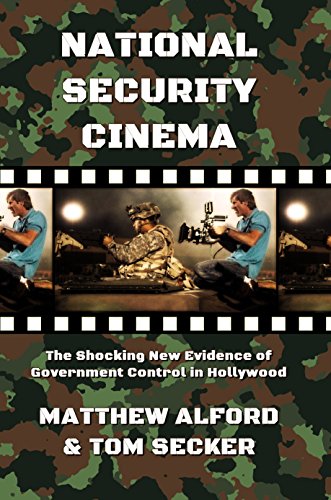 “The Department of Defense actually apologized in their covering letter to the producers of “Hulk” (2003), since the changes they required were so extensive,” Dr. Matthew Alford of the University of Bath told MintPress.
“But really the disturbing thing here is the pattern and the scale… What I suggest is that we focus on the deliberate, major, secretive pressures that rewrite scripts — and we find they’re all on the side of the national security state. Systematically scrubbed from the screen is an unsavoury century of military history including war crimes, illegal arms sales, racism and sexual assault, torture, coups, assassinations, and weapons of mass destruction. It amounts to the airbrushing of an entire mediated culture.”
Thus, the large majority of big-budget productions featuring military or intelligence services have been greenlighted by the national security state, who have negotiated for control over the message in order to better propagandize both Americans and the global public. However, serious antiwar content rarely makes it to network TV or Hollywood drawing boards, so wholescale interference is usually unnecessary.
In 2014, former Deputy Counsel or Acting General Counsel of the CIA, John Rizzo, wrote that his organization “has long had a special relationship with the entertainment industry, devoting considerable attention to fostering relationships with Hollywood movers and shakers—studio executives, producers, directors, big-name actors.” Many of America’s most familiar faces have visited the organization’s headquarters in Langley, VA, including Will Smith, Robert De Niro, Mike Myers, Bryan Cranston, and Tom Cruise.
In recent years, collaboration has become even more overt. The Department of Defense even tweeted out during the Oscars how proud it is to work so closely with Hollywood to further its own image.
Meanwhile, the latest series of the hit spy show “Jack Ryan,” for instance, has the eponymous CIA hero travel to Venezuela to help overthrow tyrannical dictator Nicolas Reyes (a clear allusion to current president Nicolas Maduro). John Krasinski, who plays Ryan, said that he worked closely with the Agency in order to make the show more realistic. Krasinski also described the CIA as amazingly “apolitical.” “They’re always trying to do the right thing,” he said of them, claiming they “care about the country in a bigger, more idealistic way.”
Last month, a real CIA agent, Matthew John Heath, was arrested outside Venezuela’s largest oil refinery carrying explosives, a grenade launcher, a submachine gun, and stacks of U.S. dollars.
“Probably Hollywood is full of CIA agents and we just don’t know it. And I wouldn’t be surprised at all to discover that this was extremely common,” said “Batman” star Ben Affleck in 2012, before going to describe himself, perhaps jokingly, as a CIA agent himself.
Propaganda works
The effect of years of propaganda has been to improve the standing of the deep state and make the American public more conducive to supporting the tactics of the CIA and the military. One academic study found that showing torture scenes from the hit spy series “24” to liberal college students made them far more likely to support the use of it against anyone deemed an enemy of the state.
Democrat-aligned voters’ opinion of the FBI has been steadily rising over the last decade, to the point that 77% hold a favorable view of the institution (and almost two-thirds of the country supports the CIA).
Thus, while the entertainment industry might be liberal in that it largely opposes Trump and donates to the Democratic Party, it works closely to support and uphold the national security state, promotes ultra-patriotism and American aggression throughout the world. While Jolie might present herself as a champion of human rights, working with the very institutions responsible for destroying those rights around the globe undermines this assertion.
Alan MacLeod is a Staff Writer for MintPress News. After completing his PhD in 2017 he published two books: Bad News From Venezuela: Twenty Years of Fake News and Misreporting and Propaganda in the Information Age: Still Manufacturing Consent.
The Return of the Democrats and the Undead Past
By Martin Sieff | Strategic Culture Foundation | November 2, 2020
The partisan swallowing of ridiculous anti-Russia conspiracy theories by Democrats in Congress added to Hunter Biden’s truly sleazy business adventures in Ukraine have created an exceptionally dangerous brew to threaten and demonize Russia if former Vice President Joe Biden wins the U.S. national election on November 3. All the curses and bungles of America’s past 20 years will rise up anew to threaten the nation’s entire future,
If Joe Biden wins the election, we face an unprecedented situation in U.S. and global affairs since the beginning of the Atomic Age in 1945-49:
The problem is far deeper and more dangerous than any personal problem with Biden or his apparently sleazy son (Hunter Biden’s business dealings with both Ukraine and China cry out for serious honest congressional inquiries in the interests of sane and disinterested U.S. future relations with China and Ukraine – as well as with Russia.)
The real problem is that for eight years the Obama administration, in which Joe Biden was the putative Number Two figure engaged on a Helter-Skelter, crazed descent towards mindless confrontation with Russia and also institutionalized a reckless and plain wicked policy of toppling governments around the world in straight defiance of international law.
The true architect of these policies was neither Obama nor Biden but their first secretary of state Hillary Clinton. It was she who ordered the CIA to collect DNA samples of Latin American national leaders, an unprecedented seven of whom contracted cancers, some of them exceptionally rare and virulent, including two democratically elected presidents of Brazil and the late democratically elected president of Brazil Hugo Chavez who died of his.
Clinton also unleashed the dogs of chaos and war across the Middle East by approving the undermining and successful toppling of the government of Libya and the undermining although unsuccessful efforts to topple the government of Syria. This unleashed a ferocious civil war, the greatest catastrophe the Middle East has seen since Iraq’s attack on Iran in 1980, also at the time recklessly supported by an ignorant and incompetent president Jimmy Carter.
Carter, like Obama after him was ludicrously ignorant of international affairs. Both presidents allowed themselves to be led by the nose through the region by Zbigniew Brzezinski who served as Carter’s national security adviser. Brzezinski’s eagerness to embrace and support the very worst Islamist genocidal extremist groups was exceeded only by his lifelong, unwavering hatred of Russia and all Russians.
Clinton was succeeded as secretary of state in Obama’s second term starting in January 2013 by a far more experienced, restrained and responsible figure, Senator John Kerry. Kerry rightly worked hard and well with Russian Foreign Minister Sergei Lavrov to prevent the reckless and destructive policies of the rest of the administration from totally destroying constructive communications between Washington and Moscow.
But Kerry could not control even his own State Department. He proved utterly unable to rein in the neo-conservative and neo-liberal super-hawks with whom Clinton had seeded the State Department led by Assistant Secretary of State for European and Eurasian Affairs Victoria Nuland. They joined forces with crazed right wing warmongers like the late Senator John McCain (now sanctified, but whose uncontrollable screaming rages were legendary in his days on Capitol Hill).
Together with ambitious plotters in the European Commission in Brussels they manipulated the toppling of the stable, democratically elected government of Ukraine in the 2014 violent Maidan coup in Kiev. McCain and Nuland actually addressed the violent revolutionaries and openly exhorted them to topple their own democratic and previously peaceful government.
The Kremlin moved – in reality with careful and considered restraint – to safeguard the democratically expressed wishes of the population of Crimea to rejoin Russia, and of the Russian ethnic majorities in the eastern provinces of Ukraine. But the Obama administration joined forces with the openly neo-Nazi movements that had seized undemocratic control in Kiev.
Over the following six years to the present, successive U.S. congresses have voted enormous sums of financial aid and sophisticated weapons systems to be sent to Ukraine with the express purpose of killing Russian soldiers and Russian-supported forces. It is no wonder that false and entirely undocumented reverse accusations have now been lodged against Russia by the very same individuals who have supported the forces of violence, revolution and aggression for so long in Ukraine.
President Donald Trump, to his great credit, ran on for election in 2016 on a policy of reducing tensions with Russia and restoring a state of stable coexistence with the other main thermonuclear power on the planet. At no point did he advocate stripping the United States of its defenses.
On the contrary, Trump doubled up on Obama’s unprecedented more than $1 trillion nuclear weapons modernization program. He expanded spending on both conventional and strategic weapons on the largest scale seen since the Reagan-Caspar Weinberger buildup 40 years before.
Nevertheless, Trump was then subjected to the most unfounded, ridiculous political witch hunt against a sitting national leader in U.S. history – at least since President John Kennedy was openly and repeatedly accused of treason for seeking to reduce the dangers of nuclear confrontation after the Cuban Missile Crisis.
Through all of this, hatred and unreasoning accusations against Russia were accompanied by attempted efforts even to destroy the property and economic security of the Russian people. Congress imposed punitive sanctions (they failed completely) with Democrats taking the lead.
Why revisit all this history? It is because, as the great and wise American novelist William Faulkner understood, “The past is not dead. In fact, it’s not even past.”
If the Democrats regain power in Washington, they will return with all the dire and insanely dangerous policies and obsessions they displayed for eight years under Obama and Biden. But those hatreds and prejudices will be superheated by four years of Russiagate fantasies and raving accusations against Russia unsupported by any serious evidence. Indeed, they have been coolly exposed and refuted indeed by many courageous and principled former senior U.S. officials and scholars.
Nevertheless, this Undead Past will rise up, more terrible and destructive than any fantasy of werewolves and zombies, to demolish our Present and horrifically curse our Future.
Britain’s Nuclear Weapons: Money for Nothing
By Brian Cloughley | Strategic Culture Foundation | October 27, 2020
On 19 October the BBC reported that “A Royal Navy officer has been sent home from the U.S. after reporting to take charge of a submarine’s Trident nuclear missiles while unfit for duty. Lt Cdr Len Louw is under investigation at Faslane naval base in Scotland amid reports he had been drinking. Colleagues raised concerns when the weapons engineering officer arrived for work on HMS Vigilant last month.”
It must be made clear that there was no possibility this officer or any other single person could in some way commit the submarine to despatch of its weapons. It simply could not happen. But the squalid little incident did draw attention to the fact that a British nuclear submarine was in the United States for some reason and although the UK’s over-staffed and infamously incompetent Ministry of Defence condescendingly announced that “the Royal Navy does not comment on matters related to submarine operations” it was apparent that the boat was in port at the U.S. submarine base in Kings Bay, Georgia, probably to update and recalibrate technical devices and to load a number of Trident II D5 nuclear missiles.
The UK keeps insisting it has an independent nuclear weapons capability, so it has to be asked why the Royal Navy needs to send submarines to the U.S. to pick up missiles. But as with so many defence matters the government tries to keep the British public in the dark as much as possible. According to the U.S. Naval Institute, “Vigilant is one of four U.K. Vanguard-class boomers that the Royal Navy maintains as part of the British nuclear deterrent force. While the MoD maintains its own nuclear warheads, British and U.S. submarines share a common stockpile of Trident II D5 missiles stored at Kings Bay.”
It can also be asked why the United Kingdom government thinks the country needs nuclear weapons at all.
London’s reluctance to provide information to the public about nuclear weapons is likely based on the government’s desire to disguise the vast expenditure involved. When it is demanded by law that information be provided, it is released on a carefully timed basis. The public relations operators have it all planned, and choose a day when more exciting news can be either expected or manipulated, rather like the FBI’s notification of the preposterous allegations that “Iran and Russia Seek to Influence Election in Final Days” that — surprise, surprise! — were headlines on the same day that former President Obama gave a speech in support of presidential candidate Joe Biden.
But the Brits didn’t succeed in one particular case concerning vast expenditure on systems to replace the existing Trident nuclear missiles on its four submarines. It had been stated in the annual update to Parliament by the Ministry of Defence in December last year that “Work also continues to develop the evidence to support a government decision when replacing the warhead” and there matters rested — until in February Admiral Charles Richard, commander of U.S. Strategic Command, “told the Senate defence committee that there was a requirement for a new warhead, which would be called the W93 or Mk7. Richard said ‘This effort will also support a parallel replacement warhead programme in the United Kingdom’.”
The disclosure forced the underhand of the UK government, and on February 25 Defence News reported Defence Secretary Ben Wallace as stating that “To ensure the Government maintains an effective deterrent throughout the commission of the Dreadnought Class ballistic missile submarine we are replacing our existing nuclear warhead to respond to future threats and the security environment” which is a weasel-worded admission that did not mention the colossal sums of money involved.
(But then, Ben Wallace is no stranger to large sums of money, and during the 2009 revelations by the UK’s Daily Telegraph concerning fiddling and greed on the part of politicians it was revealed that in 2008 he had the fourth highest expenses of any Member of Parliament, claiming £175,523 (on top of his £63,000 salary), including £29,000 a year to employ his wife as a part-time research assistant.)
The cost of replacing Trident missiles by the “life extension programme” of the warheads is not known, as the only estimate available, given in a 2006 government paper on ‘The Future of the United Kingdom’s Nuclear Deterrent’, is £250 million which is obviously a small fraction of the true amount.
Not only is the UK committing massive sums to replace the weapons systems of existing nuclear submarines, it has embarked on an enormous programme to build four new ones to replace the Vanguard class vessels. A House of Commons research briefing of June 2020 (produced by the House Library whose researchers are not influenced by sleazy political fandangos) states that the programme involves “design, development and manufacture of four new Dreadnought class ballistic missile submarines (SSBN) that will maintain the UK’s nuclear posture of Continuous at Sea Deterrence” and that “the cost of the programme has been estimated at £31 billion, including defence inflation over the life of the programme.”
The United Kingdom is in a parlous economic state. The International Monetary Fund assesses that the effects of the Covid-19 pandemic will hit Britain’s economy much harder than much of the rest of the world, and while nobody can forecast what will befall the UK if it abandons trade negotiations with the European Union, it is certain that there can be no economic benefit from its current policies.
The last thing the UK needs to do is to commit billions of pounds to nuclear weapons. (Although its Members of Parliament do count the pennies on occasions. They’ve just been told they are to get a pay increase of over 3,000 pounds a year, and on October 21 voted overwhelmingly to reject a plan for poor children to receive midday school meals during school holidays in this period of extreme financial insecurity. They’re all heart.)
At the moment, UK nuclear policy is that “we are committed to maintaining the minimum amount of destructive power needed to deter any aggressor” and as noted by Scientists for Global Responsibility, “The UK’s nuclear warheads are carried on Trident missiles – leased from the USA – in nuclear-powered submarines. Currently, eight missiles can be fired, carrying 40 x 100kT warheads, with a few hours’ notice from a submerged submarine. The UK’s total nuclear weapons arsenal consists of 195 warheads.”
There is no doubt that 195 warheads would destroy enormous areas, but there is no point in going into detail, because if the submarines fired off any nuclear weapons at Russia (the only conceivable target), retaliation would ensure that the UK would cease to exist.
Just who does London imagine is being deterred by its expensive nuclear missiles? America is the only western country that would commit to firing nuclear weapons, and there is no possibility that Washington would consult London about its decision. Once Washington went to nuclear war, all that the UK could do would be to pop off its missiles to pile destruction on destruction. That’s not deterrence, and Britain would be well advised to refrain from spending countless billions on a new set of nuclear toys and commit its resources to betterment of its citizens.
Russia Rejects US Proposals on New START Verification, Ryabkov Says
By Irina Acheeva – Sputnik – 27.10.2020
Last week, Russian President Vladimir Putin suggested extending the last arms control agreement between the United States and Russia for another year without any conditions, stressing that a world without the New START would be worryingly vulnerable.
Moscow maintains active dialogue on the New Strategic Arms Reduction Treaty (New START), but will not make any other concessions, Deputy Foreign Minister Sergey Ryabkov said.
Ryabkov further elaborated that Moscow does not accept the US proposal for verification within the framework of the New START.
“We have the full impression that the Americans do not need any agreements, they only need verification. And verification, in the way proposed by them, is, basically, to establish external control over the most sensitive elements of ensuring the entire systems of our national security. This is unacceptable for us”, the deputy minister said.
According to Ryabkov, Russia “cannot agree to such a proposal for higher reasons”.
“We said and continue to say that any agreement in this area is possible only where both interests are balanced, as a certain compromise. We are ready for this but see no indication that the US side is prepared to compromise. Therefore we conclude that attaining basic agreement in the present segment is, to put it mildly, doubtful”, the diplomat noted.
He added that Moscow is disappointed by the signs it sees from the US regarding an extension of the New START.
“We are having vigorous talks with the US on these issues. The signs we are getting from them disappoint us. The Americans do not seem to understand that we cannot implement proposals, when the US, rather than making requests, keeps piling on demand after demand”, Ryabkov said.
The statement comes after Russian Ambassador to the United States Anatoly Antonov said that Russia is urging the US to stop trying to bargain for benefits in the last days of the New START. Antonov also pointed out that Washington has bluntly rejected to prolong the treaty as it was signed without any conditions.
On 22 October, Russian President Vladimir Putin said “nothing bad will happen” if the New START gets extended for one year, as it would provide both sides with more time to find a compromise. US National Security Adviser Robert O’Brien has commented on Putin’s proposal calling it a “non-starter“.
The United States had previously suggested prolonging the treaty for one year if Moscow and Washington froze the number of their nuclear warheads during that period.
The New START that is set to expire in February 2021, is the last arms control agreement between the United States and Russia.
Pompeo’s ‘Tokyo Kick’ Cannot Start the QUAD
By Salman Rafi Sheikh | New Eastern Outlook | October 26, 2020
Mike Pompeo lashed out at China in his latest visit to Tokyo where he met his counterparts from India, Australia and Japan as part of his efforts to revive the QUAD, a US-centered anti-China alliance of the four countries. Speaking to his counterparts, Pompeo said that there was an urgent need to counter China, adding that “As partners in this Quad, it is more critical now than ever that we collaborate to protect our people and partners from the CCP’s exploitation, corruption, and coercion.” In an interview given to a Japanese news outlet, Pompeo also said that the grouping was a “fabric” that could “counter the challenge that the Chinese Communist Party presents to all of us.” “Once we’ve institutionalized what we’re doing – the four of us together – we can begin to build out a true security framework”, he added further. Mike Pompeo, who was clearly on a mission to persuade his allies to join the military alliance, was obviously trying to make US allies sell the same anti-China discourse that the Trump administration has used at home to start a ‘trade war’ with China. The US, now aiming to expand the war, is recruiting allies; hence, Pompeo’s high-pitched speeches against China.
While Pompeo said what he had to say, prospects of the QUAD’s rise as a powerful military alliance or an ‘Asian NATO’ remain bleak. Its most important reason is the fact that none of the countries—India, Japan and Australia—are interested in picking a military fight with China, while the US has no real allies against China.
While there is no gainsaying that all of these countries—India, Japan and Australia—have tense and uneasy relations with China, they appear not in the least interested in formalizing a US led anti-China military alliance, thus making PRC their official enemy.
It explains why these countries have so far chosen to manage their relations with China on their own and continue to shy away from exacerbating the fault lines by joining the US bandwagon of a ‘global anti-China coalition.’
Consider this: while Japan has its economic ties with China and there is no will in Tokyo to ‘de-couple’, following the US in its footsteps, it, with an eye on China, still is increasing its military strength. Whereas it is already converting two of its existing ships into aircraft carriers, it is going to make a record increase in its defense spending as well. Japan’s Defence Ministry has asked for an 8.3 per cent increase in the defense budget, which is by far the country’s largest rise in last two decades. Interestingly enough, one crucial reason why Japan has decided to increase the budget is the pressure that the Trump administration has been putting on the Japanese to manage their own national security. If Japan is anyway going to spend more and more on defense, increasing its military capability to position itself better in the region, not requiring extensive US military support, and it still wants to continue to have strong economic ties with China, there is no reason why it would want to permanently destabilize its relations with China by joining the ‘Asian NATO.’ Although this was prime minister Abe’s dream, his absence from the government will leave a further dampening impact on the alliance’s future prospects and Japan’s standing therein.
Australia’s government has announced a raft of legislation to curb foreign influence that is clearly (though unofficially) targeted at China. And India is actively engaged in a high-altitude, high-stakes game of chicken with China in the Himalayas—a hot-and-cold conflict in which India is no longer acting passively.
The fact that all of these countries have their specific problems with China and yet they have not been able to fully activate the QUAD shows there is no active and strong desire for a US-led military alliance. As such, the QUAD summit failed yet again to issue a joint statement or a communique.
Notwithstanding the US belligerence, the main focus of Japan, Australia and India remains a politically, economically and militarily balanced relationship with China.
This is the crucial reason that explains why, despite Pompeo’s hype and upbeat assessment of the ‘China threat’, none of the countries’ mentioned China directly in their statements issued after the meeting.
Unlike Pompeo, Japan’s Foreign Minister Toshimitsu Motegi notably did not mention China in his remarks, and the Japanese government was quick to clarify that the talks were not directed at any one country. Indian Foreign Minister Subrahmanyam Jaishankar noted the fact that the meeting was happening at all, given the coronavirus pandemic, was “testimony to the importance” of the alliance. Accordingly, while India like Japan, did endorse the agenda of “free pacific region” and “rule-based system”, it did not mention China either. Certainly, Indian policy makers were not looking to further destabilize the situation in and around the Ladakh region. For Australian foreign minister, who also did not mention China, the essence of the QUAD was to “promote strategic balance” in the Indo-pacific (and not start an Indo-pacific military alliance).
Starting a military alliance against China does not make sense. If the US is these countries’ biggest military and security ally, China is by far one of the largest trading partners, which makes the summit more symbolic than substantive. Accordingly, while Pompeo was talking of creating a ‘security network’, Japanese officials confirmed to local media that the subject was not even raised in the meeting; for, such a venture is unlikely to gain traction in the wake of these countries’ main thrust for balanced ties with China.
In the absence of a clear will and desire for building up military pressure on China, the ‘Asian NATO’ will remain an engine-less rail car, one that even persistent kicks wouldn’t be able to ignite.
Salman Rafi Sheikh is a research-analyst of International Relations and Pakistan’s foreign and domestic affairs.
Featured Video
From Anthrax to Iraq
or go to
Aletho News Archives – Video-Images
Book Review
New paperback: Butchered by “Healthcare”
Lies are Unbekoming | October 20, 2026
 Butchered by “Healthcare” is Robert Yoho’s plain-spoken account of how American medicine stopped being a profession and became an industry. 341 pages. Over a thousand references. Thirty-eight chapters.
“Screening Tests Are Useless”, on tests that find diseases that would never have hurt you. “The FDA Protects the Big Drug Companies”, on an agency funded by the companies it regulates. “The Journals’ Sins Are the Editors’ Sins”, on ghostwritten studies and captured peer review. “Opioids and ‘Pain Management’”, on how a generation was prescribed its way into addiction. “Prozac and Relatives” and “Antipsychotics Are Disastrous”, on what psychiatry does to adults and children. “Surgery: Money Before Patients”. “Failed Cancer Treatments”. “Futile CPR and Overprescribing”. “Billing Scams & Specialty Warfare”. “Hospitals Are Sharks”. Each with a Patient Tips section at the end on how to survive it.
If you have ever walked out of a doctor’s office with a prescription you didn’t ask for, or watched a parent put through a treatment that made them worse, this is the book you want on your shelf before the next appointment. … Full review
Butchered by “Healthcare” is available on Lulu now.
Blog Roll
 Aletho News
- Iraq shuts key border crossing with Iran under US pressure: Report
- Undersea Internet cables could be targeted in retaliation for attacks on Iran: IRGC deputy chief
- EU sending ‘biased’ observers to interfere in Serbian election – president
- White House envoy declares kinetic action against Yemen ‘fruitless’
- Ukraine deployed thousands of microdrones in Iraqi Kurdistan: Tasnim
- Iran calls for emergency UNSC meeting over Trump’s ‘brazen’ bomb talk, Israeli threats
- Iranian sources reveal details of Russia-China Hormuz proposal
- Plan for more US-Israel integration puts our military tech at risk
- Another Round Against Iran Will Break What Is Left of the Gulf
- SVR Report on Ukraine’s Mexican Drug Gang Links Could Pressure Zelensky, Won’t Change US Policy
- If Americans Knew
- An error has occurred; the feed is probably down. Try again later.
- No Tricks Zone
- E-Cars Reduce CO2 Emissions By Only 41% Compared To Internal Combustion Engine Vehicles
- Predictions Made By Renowned Climate Professor Over Past Decades Have Been Proven To Be Poor
- New Study Suggests Large Regions Of The Pacific Ocean Have Been Cooling For The Last 80 Years
- Germany’s Green Energy Debacle: High Energy Costs Force Kahla Porzellan to Close After 182 Years!
- New Study: 50 Years Of The Most Aggressive ‘Net Zero’ Policies Can Only Affect The Global Climate By 0.03°C
- US September “Heat” Was No Record…Many Records Set Decades Ago
- Latest European Green Energy Debacle; Portugal’s Largest Flagship Solar Park Insolvent!
- Green Energy Debacle: German Expert Professor Fritz Vahrenholt Warns Of Severe Economic And Social Consequences
- Two More Paleo Reconstructions Affirm Meters-Higher Sea Levels Across Ireland, Brazil 7000-6000 Years Ago
- New Study: Earth And Venus Surface Warmth Largely Explained By Convection And Lapse Rate, Not CO2 Or Radiation

