Montenegro’s farmers & environmental protesters ruin army’s plans for mortar shelling exercises
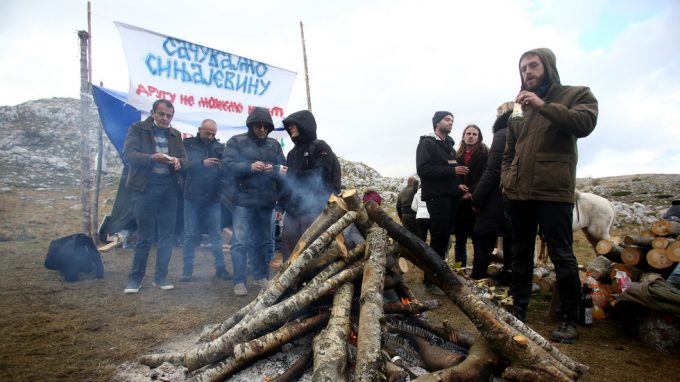
Activists and farmers camp in protest on the mountain Sinjajevina where the army planned a live-fire exercise on October 18, 2020 in Krnja Jela, Montenegro. © Getty Images / Filip Filipovic
RT | October 21, 2020
Montenegro’s Defense Ministry has postponed military training exercises after local shepherds and activists staged a protest over environmental concerns.
The mountain region of Sinjajevina was selected to host military drills including mortar shelling by the Montenegro army. However, the plan didn’t sit well with local farmers and environmental activists, who set up camps in the area and staged non-stop protests to oppose the drills.
The exercise was scheduled for this week, but the army had to retreat. Colonel Aleksandar Pantović, the Chief of Staff of the General Staff, announced that the drills have to be delayed. “We conducted a reconnaissance… the conditions for shooting were not met and that this is not possible,” Pantović told local media. “When all the conditions are met, we will continue with the realization of the exercise.”
A local MP from the URA party supporting the protest, Dritan Abazovic, called the decision a “significant victory” for Montenegro’s citizens and ecology.
The region in question, Mount Sinjajevina, consists of the largest stretch of grassland in the Balkans and makes up part of a location designated a UNESCO biosphere reserve. It was chosen as a place for a military polygon last year – something that triggered public discontent. Farmers and activists argued that explosives risk damaging the delicate environment and would contaminate the water supply.
“We will certainly not clash with the citizens,” the country’s Defense Minister Predrag Boskovic said in an interview. However, he noted that it is impossible to have an army unable to train on its own territory.
Montenegro is a NATO member state currently possessing an armed force of 2,400 active duty soldiers.
US Army Wants To Make COVID Social Distancing ‘Permanent’ Even After Pandemic Ends
By Tyler Durden – Zero Hedge – 10/14/2020
For the majority of Americans wondering when this socially distanced dystopian nightmare of ‘6 feet apart’ and ‘wear a mask!’ and ‘mandatory hand sanitizer’ will finally be over, the Pentagon has just given serious cause for concern. When will it all end?
Perhaps leading the way as an example of where we all might be headed as a country, the United States Army has strongly hinted that it’s looking to make its coronavirus protective measures permanent.
This according to alarming statements reported by the military site Defense News :
In the wake of the COVID-19 pandemic, the defense industry began adjusting its facilities to avoid major outbreaks that could shut down production lines for days or weeks at a time. And now that those changes are in place, the U.S. Army’s top acquisition official thinks they should remain so for good.
Speaking to reporters during the Association of the U.S. Army’s annual conference, Bruce Jette, assistant secretary of the Army for acquisition, logistics and technology, said he sees long-term benefits from maintaining the kind of social distancing protective measures put in place across industry.
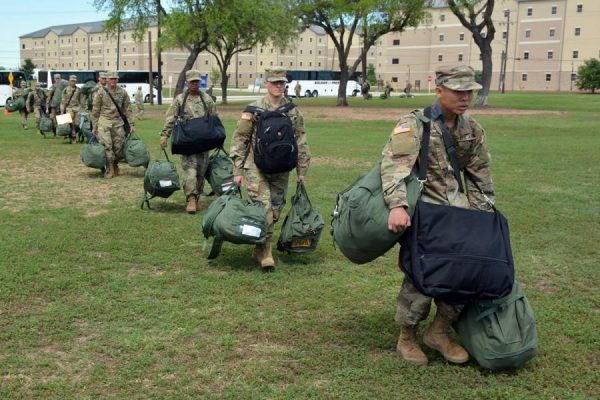
US Army combat medics maintaining social distancing, via U.S. Army Medical Center of Excellence
The DoD has observed a significant drop in cases of the common cold, viral infections, and the flu – and expects this will last so long as troops practice a distancing regimen.
Jette’s comments and predictions of what might come sound downright dystopian and inhuman in terms of the holistic well-being of American troops.
“I don’t know that I would ever say it’s totally back to normal,” Jette was quoted as saying. “I don’t see us backing off of using these same techniques on a contouring basis, even as the vaccine continues to mature.”
This senior Army official is essentially saying that even if an effective vaccine is developed there’s no returning to normal.
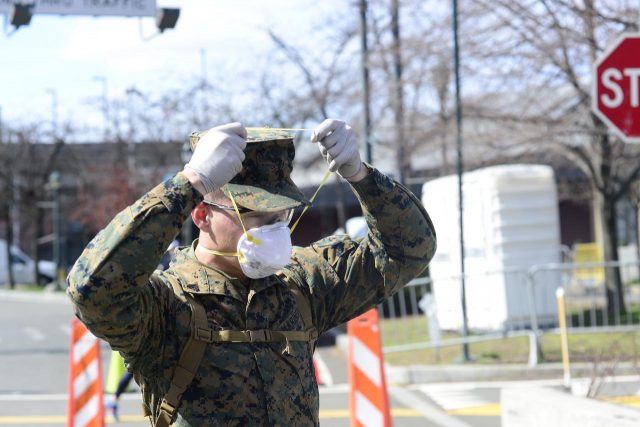
Image via U.S. Navy
“I would say we don’t back off of the COVID-19 standards because it will also reduce the impact of flu and other illnesses,” he added. “We think continuing to apply these same techniques would be further beneficial to the people and to the Army overall.”
Consider this: should the Army and eventually the entire DoD implement “permanent” social distancing measures, which would at the very least mean for years to come, that would put the entirety of American society a mere stone’s throw away from being forced to do the same.
In a sense, US armed forces might be the ‘canary in the coal mine’ in this case, revealing where we’re all headed and what might be forced on the already weary American people, who overwhelmingly are ready to truly return to normal.
Increased Police Killings Linked to Departments Acquiring Pentagon Equipment – Report

By Evan Craighead . Sputnik . 10.10.2020
US police departments taking advantage of the ability to acquire Washington’s surplus military equipment could very well be contributing to unrest and violence in the same communities they are sworn to protect, according to a new analysis.
The Atlanta Journal-Constitution revealed on Thursday that data from the US military and police departments nationwide presented a disturbing relationship between police killings and the US Department of Defense’s 1033 program – an initiative that allows everyday law enforcement to acquire surplus equipment designed for war.
“The results paint a troubling picture: The more equipment a department receives, the more people are shot and killed, even after accounting for violent crime, race, income, drug use and population,” wrote AJC’s Chris Joyner and Nick Thieme.
For example, AJC found that in the US state of Georgia, a mere 7% of law enforcement agencies received the free 1033 gear over a 10-year period. At the same time, 17% of the 261 individuals shot and killed by authorities in that time were traced back to those 1033-equipped departments.
“The statistical correlation doesn’t prove that 1033 gear in a police department causes more fatal police shootings, or that those shootings were unjustified, only that there is a strong relationship between the two,” Joyner and Thieme detailed. “The analysis also doesn’t suggest that every department in the 1033 program displays a strong relationship between the number of people killed and the amount of 1033 funding accepted.”
“The cost that we are dealing with now is a highly militarized police force that is no longer looking like police but [is] looking like they are patrolling a hostile foreign nation,” remarked Wayne McElrath, a senior investigative adviser for the Project on Government Oversight in Washington, DC.
McElrath, experienced in both US law enforcement and the US military, argued that government initiatives such as the 1033 program propagate toxic policing practices that are rooted in war-fighting, rather than public safety.
“They are changing the culture,” he said. “But we are beginning to accept that it is the norm.”Similar research was carried out in 2018 by University of South Carolina professor Edward Lawson and published in the peer-reviewed academic journal Political Research Quarterly.
Lawson, who also serves as a data consultant with the South Carolina Department of Health and Human Services, examined two years’ worth of nationwide data and found the same relationship between 1033 equipment and police killings.
The professor told AJC that department culture, leadership and related factors add a psychological element to the equation.
“You’re not just police officers, you’re soldiers and you’re fighting this war on drugs, war on crime, and eventually the war on terror,” he expressed. “If all of your leaders are telling you that you’re fighting this war, and you’re on the front lines of it, that has to have a psychological effect.”
“Drawing a direct connection from equipment to killings doesn’t make sense, in part because most officers never get to use any of that stuff anyway,” Lawson argued. “But if the agency as a whole is more psychologically militarized, that agency will pursue more military equipment and will also kill more civilians.”
Britain Ready to Supply Lethal Arms to Ukraine, Country’s Presidential Aide Says
By Oleg Burunov – Sputnik – 09.10.2020
Using foreign military hardware is nothing new for the Ukrainian Army, where US-made weaponry, including patrol vehicles, fast boats, and Javelin anti-tank missiles are currently in service.
Senior Ukrainian presidential aide Andriy Yermak said on Friday that the UK had expressed readiness to provide the country with a hefty lethal weapons contract, in addition to a £1 billion ($1.2 billion) loan to the Ukrainian Navy.
The statement came as President Volodymyr Zelensky met UK Prime Minister Boris Johnson in London to sign a spate of bilateral cooperation agreements.
Yermak claimed that recent mass protests in neighbouring Belarus pose a possible threat to Ukraine, which he said is seeking assurances from the EU and the UK about their willingness to help Kiev maintain national security.In this vein, he also referred to a simmering military conflict in eastern Ukraine’s Donbass region, touting the current truce as “a huge achievement”.
Ukraine Conflict
Kiev launched a special military operation in southeastern Ukraine in April 2014, after local residents refused to recognise the new central authorities, who had come to power as a result of a coup. This was preceded by the residents voting for the creation of the independent Donetsk (DNR) and Lugansk (LNR) People’s Republics.
In February 2015, the two sides reached a peace agreement after talks brokered by the leaders of Russia, France, Germany, and Ukraine — the so-called Normandy Four — in the Belarusian capital Minsk.
The deal stipulates a full ceasefire, weapons withdrawal from the line of contact in Donbass, as well as constitutional reforms that would give a special status to the DNR and the LNR.
The ceasefire regime has repeatedly been violated, with both sides accusing each other of multiple breaches, undermining the terms of the accord.
Yermak’s remarks come after the Pentagon reportedly signed off on an additional $125 million in its lethal military aid to Ukraine. The latter had earlier received batches of US military hardware, including patrol vehicles, fast boats, radar systems, and Javelin anti-tank missiles.
The aid is part of a $250 million package appropriated by Congress in its 2020 National Defence Authorisation Act, legislation that committed a whopping $738 billion to American defence spending, including tens of billions for US operations overseas.
Russia has repeatedly warned the global community against supplying weapons to Ukraine, saying that such actions will escalate the military conflict in the Donbass region.
NATO refuses to commit to withdrawal from Afghanistan
Press TV – October 9, 2020
NATO has dismissed US President Donald Trump’s surprise announcement to pull out all of US forces from Afghanistan by the end of the year, saying that members of the military alliance will decide together on when to withdraw forces from the war-ravaged country.
Trump announced on Twitter on Wednesday that he was going to bring all US troops home from Afghanistan by Christmas.
NATO Secretary General Jens Stoltenberg reacted to the president’s remarks on Thursday, saying that the military alliance will end its mission in Afghanistan only when conditions on the ground permit.
“We decided to go into Afghanistan together, we will make decisions on future adjustments together, and when the time is right, we will leave together,” Stoltenberg said at a news conference.
NATO deployed forces to Afghanistan following the 2001 US-led invasion to topple the Taliban-run government, on the pretext of fighting terrorism following the September 11 attacks in New York.
Afghanistan has been gripped by insecurity since the US and its allies invaded the country as part of Washington’s so-called ‘war on terror’ 19 years ago. Many parts of the country remain plagued by militancy despite the presence of US-led foreign troops.
American forces have since remained bogged down in the country through the presidencies of George W. Bush, Barack Obama, and now, Donald Trump.
In an interview on Thursday Trump also said that US forces are “down to 4,000 troops in Afghanistan. I’ll have them home by the end of the year. They’re coming home, you know, as we speak. Nineteen years is enough.”
Analysts say Trump, trailing in polls just weeks ahead of the November 3 presidential election, made the withdrawal announcement to show he is making good on his 2016 promise to end “endless wars.”
Stoltenberg, however, said NATO would only leave Afghanistan when it could do so without the risk of the country once again becoming a haven for militants.
“We will make decisions based on the conditions on the ground, because we think it is extremely important to continue to be committed to the future of Afghanistan, because it is in our interest to preserve the long-term security of Afghanistan,” he added.
Trump’s announcement was, however, welcomed by the Afghan Taliban militant group on Thursday.
A spokesman for the group, Mohammad Naeem, described Trump’s announcement as “a positive step towards the implementation of [the] Doha agreement.”
In a deal reached between the US and the Taliban earlier this year in the Qatari capital, Doha, the United States promised to pull out all its troops by mid-2021 in return for the Taliban to stop their attacks on US-led occupation foreign forces in Afghanistan.
Some 4,500 American troops are currently on the ground in Afghanistan, reduced from over 12,000 when the deal was signed in February.
The Taliban also agreed to negotiate a permanent ceasefire and a power-sharing formula with the Afghan government.
The Afghan government and Taliban last month opened peace talks in Qatar, even as key differences, including over a ceasefire, remain between the two sides.
NATO’s recent refusal to commit to withdrawal, according to observers, puts the complicated peace negotiations in jeopardy at a time when Afghanistan continues to suffer from a series of attacks — claimed either by the Taliban or the Daesh terrorist group — which took dozens of civilians’ lives.
In the meantime, Daesh has also been securing a foothold in Afghanistan.
The US has been largely blamed for relocating remnants of the terrorist group to Afghanistan following their defeat in Iraq and Syria.
The US-led military alliance and NATO are also blamed for turning Afghanistan into one of the world’s main opium producers over the last two decades, as opium has become a source for terrorist financing in the war-ravaged country.
According to the United Nations, more than 80 percent of the world’s opium is produced in Afghanistan and that the bulk of narcotics produced in the country is destined for European states.
A high-ranking Iranian official said earlier this year that the production of narcotic drugs has seen a fifty-fold increase over a span of 17 years in Afghanistan.
Director general of the Iran Drug Control Headquarters, Eskandar Momeni, said American planes as well as those belonging to the US-led military alliance and NATO are engaged in transporting illicit drugs.
Iran, located at the crossroad of international drug smuggling from Afghanistan, has long been fighting armed drug smugglers in its eastern and southeastern borders. Thousands of Iranian security forces have lost their lives in the clashes.
Analysts believe Washington, which has repeatedly named Iran, Russia and China as its enemies, intends to create insecurity and trouble on the borders of these countries through Afghanistan.
Israel sets its sights on the Red Sea and Bab El-Mandeb
Dr Adnan Abu Amer | MEMO | October 6, 2020
Day after day, the magnitude of the Israeli benefits from normalisation with the Gulf become clearer, especially on the military and strategic levels. The latest benefit is talk about establishing Israeli military bases in the Gulf, the Red Sea and Bab El-Mandab, or benefiting from the Emirati bases scattered in these areas, and the military benefits for Israel brought about by controlling these international seaports.
The Emirati-Israeli agreement included many clauses with security and military aspects, which stipulate bilateral cooperation in these areas, and their commitment to take important measures to prevent the use of their territories to carry out a hostile or “terrorist” attack targeting the other party, and that each side will not support any hostile operations in the territory of the other party. It also stipulates bilateral security coordination and strengthening the military security relationship.
These carefully worded texts have increased the assumptions regarding the possibility of Israel benefitting from the Emirati military bases in the region, whether in the Gulf, Bab El-Mandab, or the Red Sea. This may lead to the establishment of Israeli military base in the Emirates, as well as its use of Emirati waters, and the possibility that it will continue down this path to increase its foothold in Socotra, the Bab El-Mandab Strait and Djibouti.
It is worth noting that the possibility of establishing Israeli military bases in the Gulf, or Israel benefiting from the Emirati military bases, is not easy, but very dangerous. This is because as much as it may give hope to the Gulf states, and the UAE in particular, to defend itself against the threat of any imagined attack from Iran, it, at the same time, exposes it to danger. This is because the fulfilment of this premise means that Israel can strike Iranian targets in the Gulf waters, or in the heart of Iran itself, which will be matched by Iran targeting these Israeli bases in the Gulf.
The agreement allows Israel to get geographically closer to Iran and allows it to improve ties with the Gulf which is a strategic area in terms of trade and oil.
Iran will not stand idly by and remain silent regarding the Emirati-Israeli move, which means the situation in the Gulf region is likely to grow tense and suffer. Iran is present everywhere through the Revolutionary Guard and its sleeping armed cells.
Security of maritime navigation in the Gulf is a purely Israeli interest within the strategy of “curbing the Iranian threat” and strengthening the relationship with the Gulf states, former Israeli Foreign Minister, Yisrael Katz, has said.
Israel aims to gain control over the most important sea straits in the region, which belong to the Emirati and Saudi bases, which enhances the expansion of Israel’s military and strategic influence.
A document by the Israeli Ministry of Intelligence revealed that the agreement with Abu Dhabi paves the way for intensifying military cooperation between them in the Red Sea. This is because it is interested in expanding security cooperation in the region, leading to strengthening the military alliance between them. This includes intensive Israeli military movement, especially through the countries of the Horn of Africa, most notably Ethiopia, at a time when Israeli arms companies are seeking to increase their exports to the Emirates.
US Secretary of State, Mike Pompeo, announced that the UAE and Israel had agreed to build a security and military alliance against Iran to protect American interests and the Middle East, and to increase security and intelligence cooperation to confront what he referred to as “terrorism”.
But Israel has not left Yemen out of its view, the country offers a gateway to the Bab El-Mandab Strait. Tel Aviv aims to crack down on the Palestinian resistance to prevent it from receiving the weapons that reach it from Iran through the Red Sea, reaching the Sinai, and then the Gaza Strip.
As long as the most important provisions of the Emirati-Israeli agreement are related to security and military relations, Israel will work to exploit the agreement to increase its influence in the Gulf. Meanwhile, the UAE is looking for control in the Gulf with the support of the US and Israel, so there is joint Israeli and Emirati work in Yemen to establish joint military bases and areas of influence, specifically on the island of Socotra, which would allow it to completely control the path that passes from India to the West, and penetrates into Africa, which is a strategic location for Israel.
Influx of foreign fighters to Nagorno-Karabakh could lead to region wide conflict
By Paul Antonopoulos | October 5, 2020
The war in Artsakh, or more commonly known as Nagorno-Karabakh, is becoming increasingly internationalized as foreigners are arriving to fight on both sides of the conflict. Artsakh, despite being internationally recognized as a part of Azerbaijan, has had a de facto independence since 1994 when Armenian forces won a decisive victory. On September 25, it was first revealed that Syrian militants were being transferred to Azerbaijan via Turkey. This was denied by the Azerbaijani Foreign Ministry on the same day. It must be noted that the war in Artsakh began only two days after it was exposed Syrians were being transferred. Yet, despite photographs, videos, documents and testimonies made by Syrian militants themselves, the Azerbaijani government maintains the position that there are no foreign mercenaries fighting alongside the Azerbaijani army and that it is Armenian propaganda. All major international outlets have reported that these Syrians are not motivated by jihad, but rather money.
In given testimonies, a Syrian militant said “Jihadi, I swear by Allah don’t come, […] we have been deceived, everything is a lie. This is not a war, this is a meat grinder, people are dying, they cannot get the corpses.” Another Syrian militant said “Two days after the start of the war, everybody wants to return but they do not let us and […] they make us stay here.” This was in reference to Turkish military handlers lying to the transferred Syrian militants about the situation in Artsakh and forcing them to stay and fight.
At the same time though, Armenians from across the diaspora, including those in Greece, the Netherlands and the U.S., have already left or a preparing to go and fight in Artsakh, meaning that citizens of Western countries will be embroiled in this conflict. This also comes as it was revealed that ethnic Greeks are volunteering to go and fight in Artsakh, with one source telling Greek City Times that the first batch of volunteers amount to 30 men, while a former non-commissioned officer claimed to Sputnik Hellas that the number is as high as 500. Whatever the truth may be, it is being widely reported in Greek media that tens if not hundreds of volunteers from Greece are going to Artsakh, motivated by religion and solidarity with Armenians, and without receiving a salary. It has also been revealed that the Greek minority in Armenia, mostly descendants of Greek Genocide survivors, are fighting alongside the Armenian army.
This sets a dangerous precedent as this war is becoming increasingly internationalized and threatens to embroil the entire region in conflict if it cannot be contained. The First Artsakh War (1988-1994) saw Greek and Russian volunteers fight alongside the Armenians. Chechens, Afghan Mujahedeen’s, Turkey’s Gladio Gray Wolves, Ukrainian Far Right militants fought on the side of Azerbaijan in the First War. Foreign fighters in Artsakh is not a new phenomenon. With Armenian-Greeks and ethnic Greeks fighting in Artsakh against Turkish-sponsored Syrian militants and the Azerbaijani military, Athens could potentially be dragged into the conflict unwillingly.
Hikmet Hajiyev, aide to Azerbaijani President Ilham Aliyev, told reporters on Friday that Greeks were fighting in Artsakh, describing the volunteers as “mercenaries.” The Greek government has not responded to the statement made by Hajiyev and most likely will not as relations between the two countries remain tense. While accepting the credentials on September 4 from Greece’s newly appointed ambassador to Baku, Nikolaos Piperigos, Aliyev directly told the diplomat:
“I can tell you, and it is no secret, that Turkey is not only our friend and partner, but also a brotherly country for us. Without any hesitation whatsoever, we support Turkey and will support it under any circumstances. We support them [Turkey] in all issues, including the issue in the Eastern Mediterranean.”
The comments by Aliyev are unprecedented when considering the usual formalities of a head of state accepting the credentials of a new ambassador. With these diplomatic tensions already existing between Athens and Baku weeks before Azerbaijan began its offensive against Artsakh, it is unlikely that Greece will try and prevent volunteers from going to Armenia. Some Greek sources claim that many of the volunteers are ex-special forces, meaning it is likely that the Greek military will be indirectly involved to some extent. This also comes as Greek and Cypriot Members of the European Parliament are leading efforts to try and impose sanctions on Azerbaijan for launching a war.
The internationalization of the Artsakh War because of the influx of foreign fighters, especially the Syrian militants, would be a major concern for both Iran and Russia who would be feeling uncomfortable having such radical forces on or close to their borders. The internationalization of the war has the potential to spark conflict across the Caucasus as militants from North Caucasia, particular Dagestan, Ingushetia and Chechnya, could travel to Azerbaijan to fight, and gain invaluable experience to take with them on their return to Russia. Although Russia and Iran have called for a ceasefire and an end to hostilities, they have not made strong efforts to try and end the war, which if not contained and ended soon, could potentially spill over into the North Caucasus or Iran’s northern provinces which is overwhelmingly ethnic Azeri.
The war could also potentially become a part of the wider Greek-Turkish rivalry that already exists in the East Mediterranean, Cyprus and Libya. Greece will not be directly militarily involved, but it is highly probable that there would be constant communication between the Greek military and the volunteers. This comes as Turkey is directly involved in the Artsakh War, not only by transferring Syrian fighters and arms to Azerbaijan, but also using its air force when we remember one of its F-16 fighter jets downed an Armenian Su-25 aircraft last Tuesday.
Without being contained and the front lines having an influx of foreign fighters, there is a real possibility that the internationalization of the conflict through these forces could set the entire region into conflict if a ceasefire agreement is not made quickly.
Paul Antonopoulos is an independent geopolitical analyst.
Featured Video
From Anthrax to Iraq
or go to
Aletho News Archives – Video-Images
Book Review
New paperback: Butchered by “Healthcare”
Lies are Unbekoming | October 20, 2026
 Butchered by “Healthcare” is Robert Yoho’s plain-spoken account of how American medicine stopped being a profession and became an industry. 341 pages. Over a thousand references. Thirty-eight chapters.
“Screening Tests Are Useless”, on tests that find diseases that would never have hurt you. “The FDA Protects the Big Drug Companies”, on an agency funded by the companies it regulates. “The Journals’ Sins Are the Editors’ Sins”, on ghostwritten studies and captured peer review. “Opioids and ‘Pain Management’”, on how a generation was prescribed its way into addiction. “Prozac and Relatives” and “Antipsychotics Are Disastrous”, on what psychiatry does to adults and children. “Surgery: Money Before Patients”. “Failed Cancer Treatments”. “Futile CPR and Overprescribing”. “Billing Scams & Specialty Warfare”. “Hospitals Are Sharks”. Each with a Patient Tips section at the end on how to survive it.
If you have ever walked out of a doctor’s office with a prescription you didn’t ask for, or watched a parent put through a treatment that made them worse, this is the book you want on your shelf before the next appointment. … Full review
Butchered by “Healthcare” is available on Lulu now.
Blog Roll
 Aletho News
- Iraq shuts key border crossing with Iran under US pressure: Report
- Undersea Internet cables could be targeted in retaliation for attacks on Iran: IRGC deputy chief
- EU sending ‘biased’ observers to interfere in Serbian election – president
- White House envoy declares kinetic action against Yemen ‘fruitless’
- Ukraine deployed thousands of microdrones in Iraqi Kurdistan: Tasnim
- Iran calls for emergency UNSC meeting over Trump’s ‘brazen’ bomb talk, Israeli threats
- Iranian sources reveal details of Russia-China Hormuz proposal
- Plan for more US-Israel integration puts our military tech at risk
- Another Round Against Iran Will Break What Is Left of the Gulf
- SVR Report on Ukraine’s Mexican Drug Gang Links Could Pressure Zelensky, Won’t Change US Policy
- If Americans Knew
- Christiane Amanpour exits CNN with a legacy shaped by the debate over Israel
- Israel’s war on Iran is the final move in a decades-old strategy
- Israel Denies Entry to French Journalist, U.S. Researcher Amid Rise in Entry Denials
- Gaza’s hospitals are running out of life-saving fuel – Daily Update
- Mysterious bot accounts reportedly spread fake ‘man on the street’ videos for Michigan Senate candidate
- Israeli Defense Minister Katz Says Over 60 Lebanon Villages Have Been Destroyed
- Why Is Israel Running TV Ads in Iowa Ahead of the Midterms?
- Hind Rajab’s Alleged Killer Is in the United States. HRF Demands His Arrest.
- US Officials Face Fresh Pressure After Another American ‘Brutalized’ by Israeli Settlers in West Bank
- Israel-Backed Palestinian Militias Terrorize Displaced Families in Gaza
- No Tricks Zone
- E-Cars Reduce CO2 Emissions By Only 41% Compared To Internal Combustion Engine Vehicles
- Predictions Made By Renowned Climate Professor Over Past Decades Have Been Proven To Be Poor
- New Study Suggests Large Regions Of The Pacific Ocean Have Been Cooling For The Last 80 Years
- Germany’s Green Energy Debacle: High Energy Costs Force Kahla Porzellan to Close After 182 Years!
- New Study: 50 Years Of The Most Aggressive ‘Net Zero’ Policies Can Only Affect The Global Climate By 0.03°C
- US September “Heat” Was No Record…Many Records Set Decades Ago
- Latest European Green Energy Debacle; Portugal’s Largest Flagship Solar Park Insolvent!
- Green Energy Debacle: German Expert Professor Fritz Vahrenholt Warns Of Severe Economic And Social Consequences
- Two More Paleo Reconstructions Affirm Meters-Higher Sea Levels Across Ireland, Brazil 7000-6000 Years Ago
- New Study: Earth And Venus Surface Warmth Largely Explained By Convection And Lapse Rate, Not CO2 Or Radiation

