US House of Representatives Committee Proposes $3.8 Billion to Fund Anti-Russia Measures in 2021
Sputnik – June 27, 2020
WASHINGTON – The United States House of Representatives Armed Services Committee has proposed allocating $3.8 billion to fund anti-Russia measures in the 2021 fiscal year, according to the committee’s National Defence Authorization Act proposal.
“The proposal provides an additional $3.789 billion for strategic sealift, satellite communications, refueling, submarine, and antisubmarine warfare capabilities that enhance deterrence against Russia”, the document read.
Additionally, officials in Washington are pushing to limit any military cooperation between the US and Russia, although exceptions will be made for the purposes of building dialogue that will reduce the risk of conflict, according to the document.
The committee is also looking to fully fund the European Defence Initiative and provide $250 million to the Ukraine Security Assistance Initiative. One-fifth of these funds can be used to purchase lethal weapons, the committee said.
The proposal, which was tabled by Chairman Adam Smith, would authorize roughly $730 billion in spending for the purposes of national defence.
In December, President Donald Trump approved the 2020 National Defence Authorization Act, which had a topline budget of $738 billion.
Connecting the Dots

By Larry Romanoff • Unz Review • June 24, 2020
It often happens that events we view as isolated occurrences are connected as integral parts of a much larger picture, often as part of a wide-ranging plan, and frequently with important social, economic, and/or political implications which become evident only when seen in total. The several topics of this essay add a necessary context to all major social, commercial, and geo-political events of recent decades, which may help us in connecting dots. For this, it is extremely important to realise and understand that in these matters there are no accidents, that ‘crises’ (other than things like volcanic eruptions) do not just happen, and that the final result of any crisis, however it may appear, was the result intended.
As one example, this many decades ago, we noticed that in our city in Canada one brand of American convenience store seemed to have a habit of opening new stores within a stone’s throw of the existing ‘mom and pop’ variety stores (as they were then called), these shiny and attractive new shops inevitably resulting in the closure of our traditional community stores with the resulting loss of livelihood of the owner-families. It was a surprise to learn later that this practice existed in all cities in Canada and it eventually became clear that each such apparently minor event reflected the gradual execution of an astonishingly predatory plan to not only become established in another country but to progressively eliminate all existing competition in doing so. The dawning of this realisation came too late for authorities to take preventive action, resulting in the destruction of what had been an important part of Canada’s community cultural landscape.
In a different category, and more recently, we learned that during a period of ten or more years ending around 2015, GlaxoSmithKline engaged in an enormous tax and marketing fraud in China[1][2], involving billions of RMB in massive and systemic bribery and falsified accounts, the discovery punctuated by the company’s China CEO Mark Reilly fleeing the country on the first plane to England “on a previously-planned business trip”, and intending to remain there “to help with the investigation from that end”.[3] Lacking additional information, we tend to view this revelation as a domestic issue involving the typical group of ‘a few bad apples’. But with a bit of investigation we discover that GSK carried on a series of virtually identical criminal adventures simultaneously in the US and other countries as well, having been fined billions of dollars in the US alone for repeated occurrences. This additional knowledge substantially amends our perception of the picture. When, with a bit of additional investigation, we discover that all the major pharma companies have repeatedly engaged in a wide range of criminal activities resulting in fines totaling tens of billions of dollars in the US alone, our appreciation of GSK’s activities in China, and of the entire landscape of big pharma, are much altered and more accurate. We now know something we didn’t know before, and we now understand we are not dealing with a few bad apples in an isolated if unfortunate event, but with an industry corrupt to its core, worldwide. [4][5]
Similarly, we learned that Apple, the darling of the US stock market and of iphone fans everywhere, was being hounded by the Chinese commercial authorities, this time over warranty periods, Chinese law categorising Apple’s ipad as a computer requiring a two-year warranty with Apple insisting the ipad was a phone and refusing to comply. Following stringent insistence and a huge public outcry, Apple was eventually forced to conform.[6][7] Reading this as an isolated occurrence, we might judge this as a technical domestic argument of little consequence but, with a bit of investigation, we discover that Apple’s warranties had been under fire for years throughout Europe (and other countries) for precisely the same reasons and with precisely the same outcome – Apple stubbornly flouting the consumer laws of dozens of countries.[8][9] With this additional information, our perception of Apple’s behavior in China assumes a different flavor. We no longer see a simple dispute between a retailer and a socialist government with perhaps sticky laws, but a multinational corporation suffused with sufficient arrogance to not only challenge but attempt to dictate consumer laws and warranty policies to all sovereign nations where it does business. To say nothing of some bold tax dodges.[10] Further investigation reveals that, of all computer and mobile phone companies, only Apple appears to take this position. We now have a more accurate picture of the international IT landscape and Apple’s position within it, our sympathy for Apple’s difficulties in China certainly moderating if not transforming into outright hostility.
In each case, our understanding has been substantially amended because we can see the whole picture and we now know something we did not know before. It is true for a great many occurrences in the world, of many different kinds, that these are not single disconnected events but are related in a set pattern and to a set purpose. Simply put, if one house burns down on a street, that’s unfortunate; if two houses burn down on that street, that’s a coincidence; if five houses burn down on that same street, that’s a plan.
Thus, for many of the world’s events, most especially those containing strong social, economic and/or geo-political effects, it behooves us to bypass the mass media who force-feed us with only carefully-selected sound bytes, and to engage ourselves in a bit of independent research to discover whether these apparently disconnected events are in fact related in a larger context. It is necessary to bypass the media because the absence of connection between these apparently disparate (but related) events is not accidental; the media coverage by design and intent renders it impossible for the general public to connect the dots.
The Official Narrative
In attempting to understand social, economic and geo-political events, there is a second matter demanding our attention, that of the initial mass media coverage, because this often betrays secrets of an event that might otherwise be unknown.
Consider: if there is an explosion in a shopping mall somewhere, at first neither we nor the relevant authorities know anything. It might have been caused a gas line leak, perhaps from faulty maintenance, or stored chemicals, or perhaps a disgruntled citizen set off a bomb. At first, we don’t even know what, much less having a clear idea of who or how, or why, and it takes time to ferret out these details and form a sensible working theory of that event. If it appears that persons were responsible, the authorities require additional time to determine why and who, then begin their search.
But, if we are paying attention, it often happens that immediately upon the occurrence of such an event, the mass media present us with a full-blown story lacking only small details, a more or less complete description of what, how, who and why, a story that could not possibly be known at that stage. Not only is the media description immediate, but it is universal and unanimous, with all apparently unrelated media presenting the same story line, often verbatim, with no disagreement on any significant elements, these uniform storylines sometimes flooding the news for days, weeks, and even months.
Such a unanimous flood can occur only with all participants reading from the same script, prepared beforehand and readied for simultaneous release. In the above case, there are only two possibilities:[1] The story, if true, could be known only by the perpetrators or, [2] the story is a fabricated falsehood, taking the microphone to pre-empt independent rational thought by the public and force the discussion into desired channels, resulting in the elimination of critical public analysis and preventing the truth from escaping confinement.
At one time, not so long ago, this was impossible. But today, with the intense concentration of media ownership across all continents, (and with the increasingly strong censorship of the social media) we have only five or six people, all colleagues, controlling perhaps 90% of all media content and with a powerful financial influence on the remainder.
As one ready example, we could review the unfortunate flight of Korean Airlines 007 in 1983, a Boeing 747 which was shot down by Russian aircraft when it ventured about 500 kilometers off-course and perilously close to some Russian military installations. The media response was immediate and universal that “the Russians” killed hundreds of innocent passengers, and a great deal else. I don’t want to dwell on this here but, if you would like some personal entertainment, you might enjoy doing some thorough research on this event. One of the more entertaining issues was that the water was shallow where the aircraft eventually went down, and the Russians searched thoroughly but located only a few bodies of the crew. No hundreds of innocent passengers. One other discovery was hundreds of pairs of new sneakers and a great deal of new clothing still folded in its original packaging. But no bodies. The official response was that when the aircraft was hit by the missiles, the decompression “sucked all the passengers out of their clothes”, then presumably folding and packaging their clothing. Mother Nature is nothing if not neat and tidy.
The events of 9-11 were certainly one of these, with the entire final version of the “official story” appearing the next day in all the Western media, all verbatim including the who, how and why. SARS and ZIKA fit this pattern in every respect, and COVID-19 also fit very well as do the seven biological pathogens unleashed on China during the past two years alone. With the 2019 swine flu, the entire Western media knew instantly that Chinese “criminal gangs” and “pork speculators” were for unknown reasons infecting all of China’s pigs, although no evidence ever surfaced to support any part of their story. If we review the media coverage for many notable events in our recent history, the pattern is the same. We are then facing the only sensible conclusion that those events were executed as part of a plan with the unanimous media coverage arranged well in advance – and with the knowing participation of the media owners.
Normally, subsequent contradictory theories arise over time as we learn details and assemble the pieces in what might be a more logical and sensible combination but, in these cases, all contradictions are first ignored by the mass media, then condemned as “conspiracy theories”, those presenting them unanimously mocked and derided. The more attention these contradictory theories generate, and the more that serious flaws are exposed in the official story, the louder the derision and more vicious the condemnation, again unanimous and universal. Moreover, as these theories gain traction, the underlying facts are increasingly ignored in exchange for attacking their proponents. If we don’t like the message, we kill the messenger. There is no shortage of examples of historians, authors, various experts, being hounded to bankruptcy, infamy, and even death, merely for publishing (or even attempting to publish) inconvenient truths. This process is now so well-established that whenever we see accusations of ‘conspiracy theories’ we can be certain that a government or a corporation has something to hide.
As time passes, the public become inundated with what we term “the official narrative”, most tending to believe a story repeated daily for weeks from dozens of apparently independent and reputable sources, to the point where the matter is no longer news and dissenting opinions are lost in the haze. It then becomes almost impossible for hidden truths to emerge and, even if they do emerge, it is too late to significantly alter the public conviction or to obtain the required critical mass of dissention for a re-examination of the facts. It is said that if we hear a lie five times, especially from five different sources, we will believe it as true and will later be astonishingly reluctant to alter our opinion even in the face of irrefutable evidence to the contrary. This is one of the fundamental tenets of all propaganda.
In so many past instances, generally involving malfeasance, the US government or some branch of it quickly took the initiative to promulgate an “official story” that it wanted the public to accept, always with widespread media and scientific or other support. It isn’t usually difficult to distinguish between these crafted tales and other situations where the truth of an event innocently emerges as facts are sequentially discovered. One sure sign that we are being told a story is when “the official narrative” appears much too soon – before any actual facts emerge that would support the hypothesis, a ploy necessary to pre-empt independent conclusions and prevent more realistic or more factual versions from gaining traction.
Directed Channels of Discourse
There is one other item that serves to actively prevent our connecting the dots and forming correct conclusions about events, this being an intense and coordinated media focus to direct public discourse into desirable channels and away from the key issues. As a simple example, some years ago there were intense debates about the future of the Euro, with growing public opinion that the group currency was a failed experiment and European nations should revert to their original national currencies. But the mass media spawned a flood of debate centered on a wide range of options more or less titled “What is the best way to save the Euro?”, forcing public debate into a context where continuation of the Euro was assumed as immutable and all discussion focused on methods of preservation. Of course, the real question was “Should the Euro be saved?”, but those raising this question were ignored, mocked, derided, and painted as traitors to Europe.
If we pay attention to the mass media on the occurrence of many events, it is easy to see that we are often being propagandised and programmed to see the world through the same pair of eyes – the pair our masters want us to look through. It is a most effective tool of public manipulation, with most of us unaware this thought control is taking place. As Noam Chomsky noted in discussing propaganda[11], “The smart way . . . is to strictly limit the spectrum of acceptable opinion, but allow very lively debate within that spectrum. That gives people the sense that there’s free thinking going on, while all the time the presuppositions of the system are being reinforced by the limits put on the range of the debate.” In simple terms, if you can focus the public on asking the wrong questions, you needn’t worry about the answers.
A Brief Case Study in Connecting Dots
In 2001, an outbreak of foot-and-mouth disease ravaged the British farming industry. Exports from the UK of live animals, meat and dairy products were banned by other nations, and the government ordered a mass slaughter of millions of animals. The losses to British farmers were nearly incalculable, with a great many farmers going bankrupt or otherwise put out of business, and some farmers committing suicide in anguish over their losses. Within six months, almost 4 million animals had been slaughtered and their carcasses burned. Oddly, in the face of this enormous disaster, the government refused to hold a public inquiry into the outbreak, announcing instead three small separate investigations, the results of which would not be made public. A similar event occurred again a few years later. It was later admitted that the pathogen for this disease had gone “missing” from Porton Down and Pirbright, the UK’s two primary L-4 bio-weapons labs, the government then claiming “animal rights activists” had entered these military-guarded labs, stolen huge amounts of pathogen and released it. No information as to why they might do such a thing. The outcome of the UK foot and mouth disease outbreaks was to eliminate small farmers and turn over the UK’s beef supply to a few billionaire owners of Big Agra.
I won’t provide more detail here, but I have written a brief article covering this, the details of which will shock you.[12] As one example, for months prior to the outbreak the UK government was scouring the country for all loose volumes of timber admittedly to be used to burn the carcasses of the millions of cattle soon to become infected and slaughtered.
But so far, even to a suspicious mind, no clear evidence of malfeasance and no conspiracy. But we have other layers of dots here. It seems that immediately prior to this disastrous outbreak of a deadly biological pathogen, there was a ‘simulation’ dealing with precisely this eventuality, exactly the same as that held prior to the outbreak of COVID-19 and including most of the same players, most notably Pirbright who were the admitted source of the bovine pathogen and also who had developed and held patents on five coronavirus varieties, I believe the same five that infected the US and then the world.
And yet another layer of dots. Dr. Mae-Wan Ho wrote a report in the Institute of Science in Society, dated September 24, 2001, entitled “Foot & Mouth Outbreak, GM Vaccine and Bio-warfare”. It was after her report that investigations by the Evening Chronicle discovered papers leaked from the Canadian Food Inspection Agency that confirmed the simulation which had been secret to that point. Readers may recall this is the same Dr. Ho who called for a full investigation into the possible genetic engineering and dissemination of the SARS virus, the evidence eventually conclusive that SARS emerged from a lab.
Let’s turn to the swine flu outbreak in China in 2019 where the nation’s pork was raised by hundreds of thousands of small farmers much as the beef in the UK. With 50% of the livestock slaughtered, American firms had an open door to take control of China’s pork supply. In this case the effort failed because the Chinese government, not being a party to the pathogen, immediately provided financing and other assistance for the small farmers to rebuild their herds.
However, if we research the outbreaks of animal pathogens around the world – swine flu, bird flu, the evidence seems to indicate that the expansion of Big Agra follows closely on their heels. This is an apparently natural occurrence, given that small competitors have been eliminated while market demand remains constant – unless this occurs more than once or twice. When these outbreaks inexplicably appear repeatedly on all continents with Big Agra in the background, we have dots to connect. I do not possess details of every outbreak of an animal pathogen in all countries for the past ten or twenty years, but I have a powerful suspicion that if we correlate these with the growth in market share of the world’s few Big Agra companies, we would receive a surprise.
Larry Romanoff is a retired management consultant and businessman. He has held senior executive positions in international consulting firms, and owned an international import-export business. He has been a visiting professor at Shanghai’s Fudan University, presenting case studies in international affairs to senior EMBA classes. Mr. Romanoff lives in Shanghai and is currently writing a series of ten books generally related to China and the West. He can be contacted at: 2186604556@qq.com.
Notes
[1] https://www.nytimes.com/2016/11/02/business/international/china-rules-glaxo-bribes-sex-tape-whistleblower-cautionary-tale.html
[2] https://money.cnn.com/2014/09/19/news/china-gsk-bribery/index.html
[3] https://www.reuters.com/article/us-glaxo-settlement-idUSBRE8610S720120702
[4] https://fortune.com/2016/03/31/big-pharma-fines/
[5] https://www.independent.co.uk/life-style/health-and-families/health-news/drug-giants-fined-11bn-for-criminal-wrongdoing-8157483.html
[6] www.china.org.cn/business/2013-03/31/content_28407911.htm
[7] https://www.reuters.com/article/us-china-apple-apology-idUSBRE9300DM20130402
[8] https://discussions.apple.com/thread/2367484
[9] https://apple.stackexchange.com/questions/48730/how-does-apples-two-year-warranty-in-europe-work
[10] https://www.theguardian.com/business/2016/aug/30/apple-pay-back-taxes-eu-ruling-ireland-state-aid
[11] Noam Chomsky [2013]. “How the World Works”, p.234, Soft Skull Press
New York: 16-Term Israeli Warmonger Defeated By Black Leftist In Democratic Congressional Primary
By Eric Striker | National Justice | June 24, 2020
Eliot Engel, a Zionist warmonger who has been in Congress since 1989, has been crushed at the ballot box by Bernie Sanders and Ilhan Omar endorsed black leftist Jamaal Bowman in New York’s majority non-white 16th District.
The outcome is a stunning blow for the Zionist lobby. The Israeli Engel is the chairman of the House Foreign Affairs Committee who voted for the Iraq war and advocates extreme neo-conservative policies. While Engel is a Democrat, he is considered to be an important AIPAC asset in Washington.
Engel touted high powered endorsements from Hillary Clinton, Nancy Pelosi, Chuck Schumer, and even the bought out Congressional Black Caucus over his black insurgent opponent.
Nevertheless, Bowman’s unexpected momentum prompted a massive avalanche of Jewish money to Engel, including from Republican Party Super PACs, in an attempt to try and save his seat.
While Engel and his Super PACs outspent the underdog many times over, Bowman is currently leading him by 25 points with 670 of 732 precincts reporting.
Bowman, who is supported by the Justice Democrats, was able to win an endorsement from the New York Times after moderating his tone and coming out as a supporter of Israel and opponent of BDS, but with the caveat that he does not believe aid to Israel should be unconditional or BDS should be illegal.
Bowman’s campaign made a simple pitch to constituents: spend more on the Bronx, less on foreign wars. This has drawn ire from leaders in the Jewish community, who have chastised him for not being sufficiently concerned with the well-being of Israel.
Like Alexandria Ocasio-Cortez, Bowman is an anti-white demagogue who supports a number of culturally destructive policies. Yet, on this question, Rep. Engel was significantly worse.
In 2018, Engel and fellow Jew Ileana Ros-Lehtinen led efforts to extradite and imprison Julian Assange for the crime of journalism.
In March 2019, Engel used his position at the House Foreign Affairs Committee to compel the State Department to begin arbitrarily classifying nationalist groups around the world as “White Nationalist International Terrorists.” This absurd new policy uses measures meant to fight ISIS and Al Qaeda to open up any American citizen who has knowingly or unknowingly contacted legitimate political organizations like the Russian Imperial Movement to terrorism charges.
It goes without saying that a black man from Yonkers ranting about how the white man is the devil is less dangerous to our rights and freedoms than an asset of the state of Israel with the power and connections to do innocent people harm.
Engel’s departure is welcome news.
US uses arms control summit with Russia for China-bashing, derails talks needed to prevent new arms race
By Scott Ritter | RT | June 22, 2020
While promoting the possibility of bilateral agreements with Russia, the US was only interested in staging a cheap propaganda photo-op attacking China, making the prospects for New START look bleak.
Hope sprang eternal when, less than two weeks ago, the United States and Russia agreed to engage in much-needed arms control negotiations to be held in Vienna, Austria on June 22. Senior delegations of the two countries were led by Special Presidential Envoy for Arms Control Marshall Billingslea and Russian Deputy Foreign Minister Sergei Ryabkov. Two issues pertinent to global security were anticipated to be on the agenda—stability in Europe in a post-INF world (the foundational agreement for modern arms control, signed in December 1987 and which remained in force until the US withdrew in August 2019), and the extension of the New START treaty, the last remaining arms control agreement between the US and Russia which is set to expire in February 2021.)
However, while the New START treaty is a bilateral agreement between the US and Russia, the US made it clear that any extension must take into account China’s strategic nuclear forces. It’s a condition that all but kills any chance of the New START treaty being extended, since a completely new treaty vehicle would need to be negotiated on a trilateral basis. The insistence on a trilateral framework played a major role in the decision by the Trump administration to withdraw from the INF Treaty as well, something that does not portent well for the future of New START.
Even before the June 22 arms control summit, China made it clear that it would not be participating in talks, making any discussion of the extension of the New START treaty appear dead on arrival. The US, however, insisted that the talks go forward, raising the prospects that at least some progress could be made bilaterally between it and Russia.
In the end, however, cheap propaganda trumped substantive discussions, with the US, knowing full well China was not attending, setting out Chinese flags along an empty conference table for a photo that was later tweeted out by Billingslea, accompanied by a caption that read, “Vienna talks about to start. China is a no-show. Beijing still hiding behind #GreatWallofSecrecy on its crash nuclear build-up, and so many other things. We will proceed with #Russia, notwithstanding.”
The flag incident quickly drew the ire of the Russians. Ambassador to Austria Dmitry Lyubinsky said there “could not have been any Chinese flags at Russian-American consultations on strategic stability,” posting a flag-less picture on Facebook.
Billingslea’s tweet was countered by one from prominent Chinese journalist Chen Weihua, who criticized the US predilection for withdrawing from multilateral agreements such as the Iran nuclear agreement and the Paris Climate accords, before pointing out that “China has 300 nukes in contrast to 6,000 by US and Russia. So unless you agree to come down to 300 or even 500, you’re not making sense.” While not a Chinese official per se, Chen’s viewpoints are considered to closely track with official policy.
In the end, the Vienna summit was a bust, a one-day exchange of previously-held views which resolved no outstanding issues and left little hope for any breakthrough in the future. So long as the Trump administration continues to insist on Chinese presence at the negotiating table as a precondition for any new agreements, there is zero chance for progress in arms control talks with Russia, or China. This makes any extension of the New START treaty impossible, and a new nuclear arms race with Russia and China inevitable.
Scott Ritter is a former US Marine Corps intelligence officer. He served in the Soviet Union as an inspector implementing the INF Treaty, in General Schwarzkopf’s staff during the Gulf War, and from 1991-1998 as a UN weapons inspector. Follow him on Twitter @RealScottRitter
US developing stronger military ties with Israel
MEMO | June 22, 2020
Cooperation between the United States and Israel on developing defence technology is increasing in order to “establish a US-Israel Operations-Technology Working Group”.
The “United States-Israel Military Capability Act of 2020” was introduced last month by US members of the Senate Armed Services Committee Senators Gary Peters and Tom Cottonboth.
This bipartisan legislation would require the establishment of a US-Israel operations-technology working group to enhance collaboration on the research and development of technology used for national defence.
As the senators wrote in a letter in February to Secretary of Defence Mark Esper, the working group would help ensure US “warfighters never encounter a more technologically advanced foe.”
According to the US Embassy, this is the “enduring and unshakable commitment” America has to Israel’s security and a bond between the American people and Israel.
The US and Israel already cooperate extensively on security matters. Israel’s big three defence companies, Elbit Systems, IAI and Rafael, have numerous cooperative projects with America.
Elbit Systems, a company which sells weapons to the Israeli military used in attacks on Palestinians, will be supplying a missile warning system to F-16 fighter jets belonging to the US Air National Guard and Air Force Reserve Command.
The company was also awarded a $73.4 million, 15-year contract from the US Marine Corps in March 2015 to supply them with new laser systems.
According to an official Pentagon contracting announcement, the Air Force has already set aside a little more than $17 million to buy these systems, but the complete contract, which covers work to February 2030 at the earliest, could be worth just over $471.6 million.
Last year, the Israeli government revealed for the first time the main points of the plan to increase the volume of Israel’s defence exports, reported Globes.
See also:
UN: 90 Palestinians homeless as Israel demolishes 70 buildings in 2 weeks
Biden And His Ventriloquists Keep Out-Hawking Trump
By Caitlin Johnstone | June 22, 2020
Joe Biden keeps trying to out-warmonger Donald Trump, and by Joe Biden I of course mean the team of handlers who are animating the dementia-ravaged corpse of the Biden campaign like a ventriloquist operating a wooden dummy.
In response to Trump suggesting an openness to scaling back his administration’s murderous Venezuela policy and meeting with President Nicolás Maduro, whoever runs Biden’s Twitter account for him seized upon the moment to assert that the former vice president will be doing no such thing if elected commander-in-chief.
“Trump talks tough on Venezuela, but admires thugs and dictators like Nicolas Maduro,” tweeted Biden Incorporated. “As President, I will stand with the Venezuelan people and for democracy.”
“Translation: if Trump retreats from his current policy of trying to sanction and suffocate Venezuela into submission, Biden will make sure to revive it,” journalist Aaron Maté said in response.
“To be clear, Joe Biden is now attacking Donald Trump from the right on Venezuela,” said journalist Walker Bragman.
As FAIR’s Alan MacLeod accurately observed last year, this phrase “the Venezuelan people” is only ever invoked by the political/media class of the US-centralized empire for sloganeering purposes in support of US-led regime change interventionism in that nation, despite an overwhelming majority of Venezuelans opposing all US interventionism including sanctions.
This tactic of attacking Donald Trump for being insufficiently warlike is nothing new for Biden Inc, nor is it limited to Venezuela.
During the primary debates Biden attacked Trump for being insufficiently hawkish toward North Korea, claiming the president was wrong to meet with Kim Jong Un because it gives the leader “legitimacy”, whatever that means.
An April Biden campaign ad accused the president of being too soft on China by failing to force Beijing to allow US government officials into Wuhan to monitor the governing of a sovereign nation during a pandemic outbreak.
“Trump praised the Chinese 15 times in January and February as the coronavirus spread across the world,” says the ad’s narrator in an ominous voice. “Trump never got a CDC team on the ground in China. And the travel ban he brags about? Trump let in 40,000 travelers from China into America after he signed it. Not exactly airtight.”
Biden has attacked Trump’s partial troop withdrawal from Syria, using talking points from the so-called war on terror to absurdly claim during a primary debate that the president is putting America at risk of a terrorist strike from ISIS.
“We have ISIS that’s going to come here,” Biden said. “They are going to damage the United States of America. That’s why we got involved in the first place.”
And of course Biden & Co have been attacking Trump for being too soft on Russia, despite this administration’s many, many dangerously hawkish new cold war escalations against Moscow.
“We need a President who will stand up to the Kremlin, push back against Putin, and take immediate steps to ensure the security of our elections,” Biden’s Twitter account said last year.
This line of attack is so ubiquitous in the Biden campaign that it sometimes just takes the form of a vague, general swipe at Trump’s unwillingness to be more warlike, with an April tweet reading simply “Donald Trump says he’s a wartime president — it’s time for him to act like one.”
Again, this is Donald Trump these people are talking about. The same president who imprisoned Julian Assange for exposing US war crimes, killed tens of thousands of Venezuelans with starvation sanctions, vetoed attempts to save Yemen from US-backed genocide, is working to foment civil war in Iran using starvation sanctions and CIA ops with the stated goal of effecting regime change, nearly started a full-scale war with Iran by assassinating its top general, occupied Syrian oil fields and implemented devastating sanctions with the goal of preventing Syria’s reconstruction, greatly increased the number of troops in the Middle East and elsewhere, greatly increased the number of bombs dropped per day from the previous administration, killing record numbers of civilians, and reduced military accountability for those airstrikes.
The second-to-last thing the world needs is political pressure placed on Donald fucking Trump to be more warlike. The very last thing the world needs is a US president who ends up being even more warlike than Trump.
America is a war machine on top of a police state on top of a mass media psyop. Only people who are willing to keep these psychopathic mechanisms in place are permitted to ascend to presidential candidacy. While all the news cameras focus on the relatively minor differences between presidents and presidential candidates, you can learn a lot more about America and what drives it by looking at their similarities.
Dozens treated for chlorine exposure as massive fire engulfs hazmat storage at US base in Okinawa
RT | June 22, 2020
A fire broke out inside a chemical compound at a major US Air Force base on the Japanese island of Okinawa, triggering the release of chlorine and affecting multiple people who were treated for exposure to toxic gas particles.
Fire alarms were activated on Monday at a building where hazardous materials are stockpiled, Japanese and US media reported. Located in the central part of Kadena Air Base, the facility burned for a few more hours, though the firefighters didn’t let it spill over the base perimeter.
The base, said to be America’s largest military installation in the region, confirmed on Facebook that the blaze “released chlorine gas particles” into the air. Footage that surfaced online shows thick plumes of black smoke rising from the hazmat facility.
Base command sealed off the roads and evacuated areas both upwind and downwind of the burning site as firefighters put out the flames.
US military media reported later in the day that at least 45 people were treated for exposure to smoke and chlorine, a highly toxic chemical agent.
Those suffering from shortness of breath or coughing, irritation, and runny nose, were urged to consult a doctor. Meanwhile, Kadena’s medical group canceled all routine appointments, apparently bracing for further treatment of those affected.
Kadena Air Base houses over 20,000 service members and their families, along with the USAF’s 18th Air Wing and reconnaissance units.
Okinawa accommodates about half of the American troops stationed in Japan, to the great displeasure of many locals. In recent years, there have been protests against noise pollution, as well as the environmental impact and behavior of US soldiers, who have repeatedly been involved in sexual assaults and even deadly incidents on several occasions.
‘Destructive course’: US seeks space superiority by making up threats – Russian Foreign Ministry
RT | June 19, 2020
Washington’s Defense Space Strategy is provoking an arms race in outer space and threatening international security while trying to blame a nonexistent Moscow threat, the Russian Ministry of Foreign Affairs (MFA) has said.
“To justify the implementation of this destructive course, which provokes an arms race in outer space and destabilizes the international security situation, Washington has resorted to the usual tactics of blaming others,” the MFA said in a statement on Friday.
In the US Defense Space Strategy, the declassified summary of which was published on Wednesday, the Pentagon simply asserts that “China and Russia have weaponized space and turned it into a warfighting domain.” Without offering any evidence or specifics, the Pentagon references the 2014 Russian military doctrine as envisioning the possibility of challenging the US operations in orbit.
“Of course, there is nothing of the kind in the Military Doctrine of Russia,” the MFA says, adding that the document is freely available to anyone who wishes to check that. The doctrine focuses on countering the attempts of other states to achieve military superiority by placing weapons in outer space, which would be in violation of the 1967 Outer Space Treaty.
While the US says it wants to “promote standards and norms of behavior in space” favorable to its interests, Washington has refused to discuss Russian and Chinese proposals for a legally binding international instrument to prevent a space arms race, the MFA added.
According to the Defense Space Strategy, the US “relies on space-based capabilities to project and employ power on a global scale” more than any other country, to the point where “space capabilities not only enhance, but enable our way of life and way of war.”
“US national security and prosperity require unfettered access to and freedom to operate in the space domain.”
President Donald Trump established the Space Force as the sixth service branch of the US military in December 2019. The fledgling operation is currently a subset of the US Air Force.
Featured Video

Iran’s Next Strike May Not Explode. It Could Shut You Down
or go to
Aletho News Archives – Video-Images
Book Review
New paperback: Butchered by “Healthcare”
Lies are Unbekoming | October 20, 2026
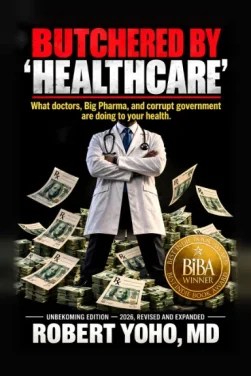 Butchered by “Healthcare” is Robert Yoho’s plain-spoken account of how American medicine stopped being a profession and became an industry. 341 pages. Over a thousand references. Thirty-eight chapters.
“Screening Tests Are Useless”, on tests that find diseases that would never have hurt you. “The FDA Protects the Big Drug Companies”, on an agency funded by the companies it regulates. “The Journals’ Sins Are the Editors’ Sins”, on ghostwritten studies and captured peer review. “Opioids and ‘Pain Management’”, on how a generation was prescribed its way into addiction. “Prozac and Relatives” and “Antipsychotics Are Disastrous”, on what psychiatry does to adults and children. “Surgery: Money Before Patients”. “Failed Cancer Treatments”. “Futile CPR and Overprescribing”. “Billing Scams & Specialty Warfare”. “Hospitals Are Sharks”. Each with a Patient Tips section at the end on how to survive it.
If you have ever walked out of a doctor’s office with a prescription you didn’t ask for, or watched a parent put through a treatment that made them worse, this is the book you want on your shelf before the next appointment. … Full review
Butchered by “Healthcare” is available on Lulu now.
Blog Roll
 Aletho News
- Iran’s Next Strike May Not Explode. It Could Shut You Down /Col Doug Macgregor
- Iran: US political targets legitimate if assassinations return
- Iraq shuts key border crossing with Iran under US pressure: Report
- Undersea Internet cables could be targeted in retaliation for attacks on Iran: IRGC deputy chief
- EU sending ‘biased’ observers to interfere in Serbian election – president
- White House envoy declares kinetic action against Yemen ‘fruitless’
- Ukraine deployed thousands of microdrones in Iraqi Kurdistan: Tasnim
- Iran calls for emergency UNSC meeting over Trump’s ‘brazen’ bomb talk, Israeli threats
- Iranian sources reveal details of Russia-China Hormuz proposal
- Plan for more US-Israel integration puts our military tech at risk
- If Americans Knew
- Americans at National Conservatism Conference held in Israel this year criticize Israel
- Christiane Amanpour exits CNN with a legacy shaped by the debate over Israel
- Israel’s war on Iran is the final move in a decades-old strategy
- Israel Denies Entry to French Journalist, U.S. Researcher Amid Rise in Entry Denials
- Gaza’s hospitals are running out of life-saving fuel – Daily Update
- Mysterious bot accounts reportedly spread fake ‘man on the street’ videos for Michigan Senate candidate
- Israeli Defense Minister Katz Says Over 60 Lebanon Villages Have Been Destroyed
- Why Is Israel Running TV Ads in Iowa Ahead of the Midterms?
- Hind Rajab’s Alleged Killer Is in the United States. HRF Demands His Arrest.
- US Officials Face Fresh Pressure After Another American ‘Brutalized’ by Israeli Settlers in West Bank
- No Tricks Zone
- E-Cars Reduce CO2 Emissions By Only 41% Compared To Internal Combustion Engine Vehicles
- Predictions Made By Renowned Climate Professor Over Past Decades Have Been Proven To Be Poor
- New Study Suggests Large Regions Of The Pacific Ocean Have Been Cooling For The Last 80 Years
- Germany’s Green Energy Debacle: High Energy Costs Force Kahla Porzellan to Close After 182 Years!
- New Study: 50 Years Of The Most Aggressive ‘Net Zero’ Policies Can Only Affect The Global Climate By 0.03°C
- US September “Heat” Was No Record…Many Records Set Decades Ago
- Latest European Green Energy Debacle; Portugal’s Largest Flagship Solar Park Insolvent!
- Green Energy Debacle: German Expert Professor Fritz Vahrenholt Warns Of Severe Economic And Social Consequences
- Two More Paleo Reconstructions Affirm Meters-Higher Sea Levels Across Ireland, Brazil 7000-6000 Years Ago
- New Study: Earth And Venus Surface Warmth Largely Explained By Convection And Lapse Rate, Not CO2 Or Radiation

