France’s test of nuclear-capable ballistic missile inconsistent with NPT obligations: Iran
Press TV – June 20, 2020
Iran has voiced concern over a recent test-firing of an intercontinental nuclear-capable ballistic missile by France, saying the test is in clear violation of the Non-Proliferation Treaty (NPT) and inconsistent with the European country’s commitments vis-à-vis nuclear disarmament.
“The government of the Islamic Republic of Iran expresses its concern over the move and believes that the French government should not overlook its international obligations enshrined in Article 6 of the NPT and the NPT Review Conferences,” Iranian Foreign Ministry Spokesman Abbas Mousavi said on Saturday.
He added that France must fully comply with its international obligations regarding nuclear disarmament.
The Iranian spokesperson emphasized that nuclear weapons pose a threat to global peace and security, and said testing such weapons would undermine the NPT as the basis for international non-proliferation and nuclear disarmament.
The French Ministry of Armed Forces announced on June 12 the launch of an M51 submarine-launched ballistic missile (SLBM) from Le Téméraire, a Triomphant-class nuclear-powered ballistic missile submarine.
“The nuclear-powered Le Téméraire successfully fired an M51 strategic ballistic missile off Finistère,” Defense Minister Florence Parly announced in a Twitter post.
The launch was carried out without a nuclear warhead off France’s Western coastal region of Brittany. The missile was tracked throughout its flight phase by radars and by the missile range instrumentation ship Monge (A601), landing several hundred kilometers away in the North Atlantic.
The M51 – which replaced the M45 in 2010 – weighs 52,000 kilograms with a 12-meter length and a diameter of 2.3 meters. Its operational range is reported to be 8,000 to 10,000 kilometers with a speed of Mach 25. The three-stage engine of the ballistic missile is directly derived from the solid propellant boosters of the European Ariane 5 space rocket.
Moreover, the M51 carries six to ten independently targetable (Multiple Independently targeted Reentry Vehicle) TN 75 thermonuclear warheads which, since 2015, have been replaced with the new Tête nucléaire océanique (TNO or oceanic nuclear warhead) warheads. The new warheads are reportedly maneuverable (Maneuverable Re-entry Vehicle) in order to avoid potential ballistic defenses.
Ukraine receives Javelin anti-tank missiles & other US military aid worth $60mn – embassy
RT | June 17, 2020
Kiev has received military aid worth more than $60 million from Washington, including Javelin anti-tank missiles, the United States embassy said on Wednesday.
The first shipment of Javelin systems worth around $47 million was sent to Ukraine in April 2018, according to Reuters.
Military aid to Ukraine was at the center of a House of Representatives impeachment inquiry in December into US President Donald Trump, on charges of obstruction of Congress and of pressuring Ukraine to investigate the son of Democratic presidential candidate Joe Biden. Trump was acquitted by the Republican-controlled Senate in February.
Pentagon Comptroller Elaine McCusker, who was reported to have questioned the suspension of US military aid to Ukraine, a key element in the inquiry leading to Trump’s impeachment, resigned on Tuesday, Defense Secretary Mark Esper said.
UNHRC joins pile-on against US police’s ‘systemic racism,’ but US military makes police brutality look like amateur hour
By Helen Buyniski | RT | June 15, 2020
The UN Human Rights Council has joined the worldwide protests taking aim at racism and police brutality among US police forces. But where are these voices when the US military kills millions in the Middle East and Africa?
Burkina Faso, speaking on behalf of 54 African nations, requested an urgent debate on “racially motivated human rights violations” – specifically systemic racism and police brutality – in the US, and the UNHRC has agreed to hold the debate on Wednesday. But compared with what US military policy has wrought on the populations of the Middle East and northern Africa, police killings are a blip on the radar.
The UNHRC debate is the latest grand public statement in the wake of the police killing of George Floyd in Minneapolis last month, and speaks to a growing disconnect between what has become a laser-focus on US policing and awareness of the much greater harms caused by Washington’s foreign policy – harms that are just as racialized, if not more so, but which mysteriously fly under the radars of activist groups.
Because this blindness doesn’t just afflict the UNHRC. In the US, groups like Black Lives Matter and the Sunrise Movement are demanding that US cities “defund police” and reallocate that funding to social programs, a solution that divides the American people and ignores the root causes of police violence – over-militarization, lack of accountability, lack of enforcement of existing laws, poor training, and austerity budgets that have slashed services like mental health and social welfare programs.
There’s no doubt US police forces need a dramatic overhaul. But the sudden international focus on domestic policing ignores the much greater casualty numbers among black and brown populations resulting from the ‘War on Terror’, which is nearly two decades old and showing no signs of ending anytime soon, despite the feeble campaign promises of President Donald Trump. In addition to the declared wars in Afghanistan, Iraq, Libya, and Syria, the US has bombed or helped to bomb innocent people in Yemen, Somalia, and Pakistan over the past 19 years, and has covertly extended its military tentacles deep into Africa in a bid to counter Chinese influence.
The result has been millions of deaths and countless more injuries, largely among non-white, Muslim populations. It’s difficult to calculate the true toll of US military violence, but a 2015 report by Physicians for Social Responsibility, Physicians for Global Survival, and International Physicians for the Prevention of Nuclear War concluded at least 1.3 million had died in Iraq, Afghanistan, and Pakistan alone since the 9/11 terror attacks were used as an excuse to launch the US’ holy war on the Middle East. Their report cautioned that the true number could exceed two million – a total which does not include hundreds of thousands (if not millions) more war deaths in Libya, Somalia, Yemen, and elsewhere.
It’s hard to get a reliable count of civilian casualties, as leaked documents from the drone program have shown as many as 90 percent of those killed in US airstrikes are not the intended targets, and the Pentagon labels any unknown bodies as “enemy combatants” if it can’t identify them. As the military itself admitted at the height of the Iraq invasion, “We don’t do body counts.” And some of the worst harm caused by US foreign policy extends beyond simple killing.
With the help of NATO, the US’ ‘humanitarian bombing’ of Libya in 2011 transformed it from the most advanced nation in Africa, where technological advances were literally turning the desert green, to a brutal place where slaves were sold in open markets. Black people in Libya were targeted for the cruelest atrocities by the NATO-supported rebels, and were often arrested for nothing more than their skin color. It’s difficult to forget the horrific photos that emerged from Abu Ghraib prison, or the tales of CIA ‘black spots’ where innocent men were tortured for weeks on a mere tip from a vengeful neighbor.
Even the indirect involvement of the US military causes extensive harm. Ever-tightening sanctions strangle Iran, and the US has severely restricted humanitarian aid flowing to Somalia and Nigeria, blaming terror groups that arose in the power vacuum left by Gaddafi’s gruesome murder. Some 14 million Yemenis are at risk of starvation thanks to aid blockades maintained by US ally Saudi Arabia, and the UN predicted last year that the conflict would claim over 233,000 lives by 2020.
Those institutions that do try to address US military atrocities face significant opposition – the Trump administration just last week announced sanctions on members of the International Criminal Court for having the gall to do their job and attempt to investigate US war crimes. Perhaps this is why an open UN letter signed by 22 African officials this weekend glossed over the devastating history of US military action in perpetuating systemic racism around the world, instead keeping its condemnations politely vague. Yet domestic activist groups are just as silent about the harm US military power causes worldwide, even while claiming they want justice for black and brown populations.
The activists who genuinely want a better world – as opposed to the professional agitators who’d lose their jobs if all human suffering vanished off the face of the Earth – might consider replacing their rallying cry of “defund the police” with “defund the Pentagon.” The $738 billion that institution received in 2020 could buy a lot of social justice. If black lives truly matter, they matter everywhere – not just inside US borders.
Helen Buyniski is an American journalist and political commentator at RT. Follow her on Twitter @velocirapture23
Japan halts plans to deploy Aegis Ashore missile shield, citing costs & technical issues
RT | June 15, 2020
Tokyo has stopped bringing the US-made Aegis Ashore ballistic missile defense sites online on Japanese soil, one month after it suspended plans to deploy an installation in the country’s east following opposition from locals.
The Japanese Defense Ministry has suspended the deployment of the Aegis Ashore systems in Japan, Defense Minister Taro Kono announced on Monday, according to the Kyodo news agency. Without going into detail, Kono attributed the U-turn to overwhelming costs and unspecified “technical problems.”
Kono did not say how long the plans would stay on the backburner. Japan’s military was planning to activate two Aegis Ashore sites, in the Akita and Yamaguchi prefectures, by the year 2023.
The two locations would cover the country’s airspace from both east and west, according to the news agency.
However, residents and local politicians in Akita rebelled against hosting the compound on their lands. They insisted that Aegis operations would take a toll on locals’ health and protested that it would likely become a high-priority target were an armed conflict to break out around Japan
The missile defense systems, designed by a number of American companies including Lockheed and Raytheon, were sold to Japan along with other defense equipment back in January 2019, with the deal totaling an estimated $2.15 billion.
Japan has been one of a few nations tapped to host Aegis Ashore. Far away from the Pacific, one such site has already entered service in Romania, while another is under construction in Poland – right on Russia’s doorstep.
Moscow considered the Aegis deployment an immediate threat to its security, with defense experts claiming the system’s launchers – officially defensive in nature – could easily be converted to fire offensive munitions like Tomahawk cruise missiles.
It also voiced concern over the Japanese deployment plans, saying that placing Aegis Ashore in Japan would “adversely affect the Russian strategic containment arsenal.”
Battle For the Arctic Heats Up
By James Corbett – corbettreport.com – June 13, 2020
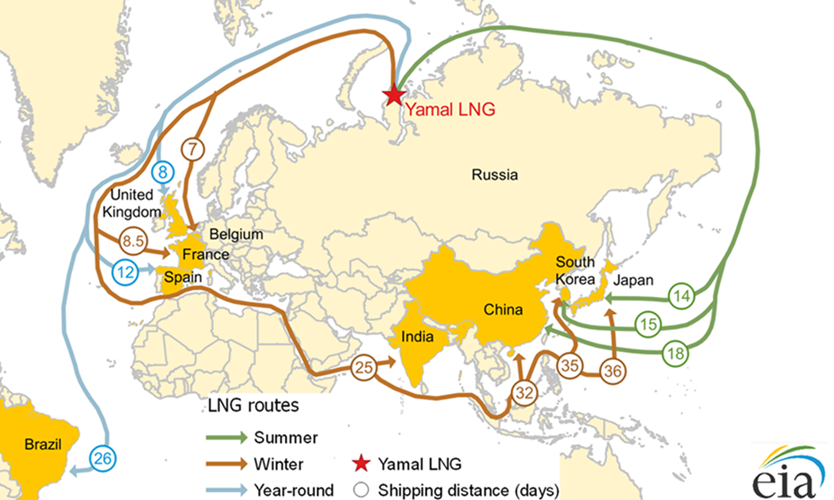
An incredible event took place this week: A Russian tanker docked at the Port of Jiangsu on China’s east-central coast, offloading its cargo of liquefied natural gas from the Yamal LNG plant in Russia’s north.
Now, I know what you’re thinking: “James, that’s not so incredible. Tankers regularly carry LNG from Russia to Asia via the Suez Canal in the winter months!”
Oh, yes, of course, my dear, well-informed reader. But here’s the rub: This was no ordinary tanker, but the Christophe de Margerie, an ice class LNG tanker designed to transport gas along the summer route across the Arctic.
“But James, the summer route doesn’t open until July!”
Exactly. This was a test to see whether the trip could be started nearly two months early. The Christophe de Margerie launched from the Port of Sabetta in Russia’s frozen north on May 18th and hooked up with the Yamal, a nuclear icebreaker, which escorted it through the Arctic passage. Together, the ships were able to trim nearly 4,000 nautical miles off the regular winter shipping route, which takes the cargo on a circuitous journey around Europe and through the Suez Canal before arriving in Asia.
Make no mistake: This event may not have received as much coverage as the other groundbreaking stories of 2020 (or any coverage at all, other than the reports in a handful of sites specializing in such matters), but it is important. In fact, it speaks to the fact that the Arctic is increasingly becoming a geopolitical prize . . . and a potential flashpoint for future military conflict between the superpowers.
The latest sign that the Arctic is the next up-and-coming geopolitical hotspot comes from the chambers of the Arctic Council. While “the Arctic Council” sounds like the fictional body overseeing Santa’s North Pole operations, it is in fact a very real intergovernmental forum that brings together eight Arctic states (Canada, Denmark, Finland, Iceland, Norway, Russia, Sweden and the US) to discuss regional issues. Although the council’s website likes to highlight the group’s work in “enhancing cooperation in the circumpolar North,” it has increasingly become a place for the US and Russia to ramp up their Cold War 2.0 rhetoric.
The council’s latest ministerial meeting in Finland provides a case in point. At the meeting, US Secretary of State Mike “Lie, Cheat and Steal” Pompeo focused on what he sees as the greatest threat to the region’s security: Russian militarization.
“No one denies Russia has significant Arctic interests. [. . .] But Russia is unique. Its actions deserve special attention, special attention of this Council, in part because of their sheer scale. But also because we know Russian territorial ambitions can turn violent.”
If there’s a better case of the pot calling the kettle black, I’m hard-pressed to think of it. Whatever one may make of Russia’s moves in the Arctic of late—Moscow’s attempt to reopen its Arctic bases, its quest to modernize and expand its military deployment in the region, and even (GASP!) its push to build a bigger fleet of icebreaking vessels than the US—Washington can hardly claim that its own intentions in the region are completely peaceful. Ever since Bush signed off on National Security Presidential Directive 66 (NSPD 66) on “Arctic Region Policy” in 2009, there has been no room for doubt about the US government’s intentions in the region.
NSPD 66, issued in the waning days of the Bush presidency, declared that the US has “broad and fundamental national security interests in the Arctic region.” According to the document, these claimed interests include “missile defense and early warning; deployment of sea and air systems for strategic sealift, strategic deterrence, maritime presence, and maritime security operations; and ensuring freedom of navigation and overflight.” Ever since the directive was signed, there has been a concerted push to assert American military dominance throughout the circumpolar North.
This push by Uncle Sam to militarize the region has included such moves as:
- Deploying an aircraft carrier in the Arctic Circle for the first time since the height of the Cold War;
- Deploying attack submarines throughout the region;
- Forming the US’ northernmost F-35 fighter squadron at Eielson Air Force Base, Alaska;
- Signing bilateral deals with allies to increase military cooperation in the region; and
- Expanding NATO operations and exercises in the area.
In fact, as might be noted, every single member of the Arctic Council bar Russia is a NATO ally, so the claim of Pompeo and his fellow NATO warmongers that they are on the defensive in the region is even more preposterous.
But never fear, China (aka the West’s new favorite bogeyman) is here!
. . . Wait, did I say “never fear”? Scratch that, I mean always fear!
Yes, the latest strategy employed by the NATO allies to push their military agenda in the Arctic is to point to the burgeoning Sino-Russian alliance as a menacing force in the region. Just this week Tobias Ellwood, the head of Britain’s Defense Select Committee, warned that “Russia and China’s warming relations in the Arctic are the largest threat to security in the region.” After all, they’re doing horrible things like . . . forming a new Arctic trade route. And shipping natural gas through the Bering Strait in May. (“The horror! The horror!“)
It should come as no surprise to my regular listeners that this move to open up yet another front in the Forever War is also a great excuse to line the pockets of the military contractors in the Military-Industrial-Governmental-Media complex. Defense industry trade organizations like the IDGA are already holding networking events to bring together contractors and government agencies looking to expand Arctic operations, and the armaments industry is just beginning to warm up to the possibilities of conquering the deep freeze.
So far, the Trump administration has continued this boondoggle, with the Dissembler-in-Chief penning a new presidential memo just this week extolling the urgent need for icebreakers and Arctic bases to (say it with me) counter the Russian threat in the region.
As always, we’d better hope that all this talk of militarization is just another excuse to siphon money from Joe Taxpayer to the MilIndGovMed cronies. Because if this isn’t just more hot air from the political puppets in Washington, then a new front has just been opened up in the next ginned up world war scenario.
Better get your long johns ready, just in case.
NATO declares Ukraine ‘enhanced opportunities partner’
RT | June 12, 2020
NATO declared Kiev one of the major contributors to the Alliance cause outside of the military bloc itself, adding Ukraine to the list of “Enhanced Opportunities Partners” – nations that were granted access to the NATO Partnership Interoperability Initiative (PII). Launched in 2014, the program is aimed at “deepening connections built up between NATO and its partner forces.”
Under the PII, nations that “made significant contributions to NATO-led operations and missions” get access to political consultation with NATO members, interoperability programmes and exercises and information sharing. Ukraine made it to the list since it “provided troops to Allied operations, including in Afghanistan and Kosovo, as well as to the NATO Response Force and NATO exercises,” NATO said in a statement.
Kiev becomes the sixth partner on the list that so far includes Australia, Finland, Georgia, Jordan and Sweden.
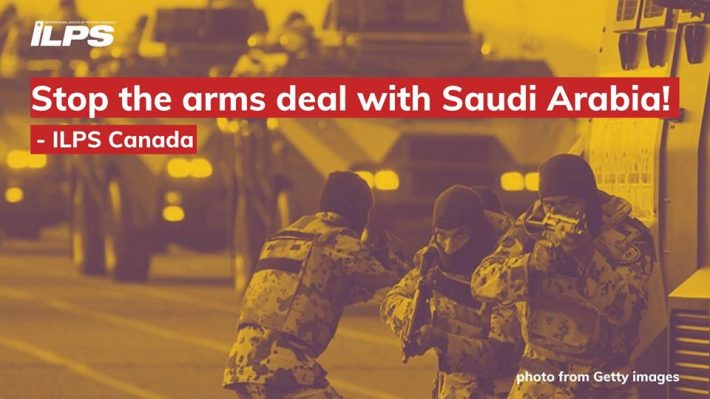
Stop Canada’s arms deal with Saudi Arabia!
International League of Peoples’ Struggle, Canada | June 12, 2020
After stalling for two years, the Canadian government has renegotiated a sale of light armored vehicles to Saudi Arabia for $14 billion. The deal was put on hold in 2018 because of political pressure against Saudi Arabia’s war on Yemen and the murder of Jamal Khashoggi, a journalist. This news is jolting because, in December 2018, Prime Minister Justin Trudeau had said he would not go ahead with the sale. However, the Minister of Foreign Affairs Francois-Philippe Champagne announced that the contract was back on the table on Thursday, April 9, 2020.
The government claims it must proceed with the deal because thousands of jobs and substantial revenues might otherwise be lost. General Dynamics is the supplier building the vehicles to be sold. The government its sales rep. General Dynamics stands to lose profits from the transaction. However, it could be involved in the manufacture of other machinery for domestic and foreign use.
In response to the objection that the items to be sold to Saudi Arabia will likely be used for war, Minister Champagne tells the people not to worry.
“Under our law, Canadian goods cannot be exported where there is a substantial risk that they would be used to commit or to facilitate serious violations of international humanitarian law, international human rights law or serious acts of gender-based violence.” (The Defense Post, April 10, 2020).
If that is the case, then, no military items should be exported. Champagne added that there are protections in that export permits be delayed or canceled if it learns of goods sold not used for the buyers’ stated purposes. Well, it is pretty clear that military items are for military use, just as it is clear that Saudi Arabia is an aggressor who will likely use military equipment in its aggression against Yemen and elsewhere. Saudi Arabia is committing human rights violations and crimes against humanity. The fact that the war inhibits health care and safety responses to COVID-19 is even more reprehensible.
The Canadian Chapter of the International League of Peoples’ Struggles has opposed all military contracts with Saudi Arabia all along. We have stood in solidarity with the people of Yemen who have been suffering under assault after assault by Saudi forces, calling for Saudi Arabia keep its hands off Yemen. According to Dr. Yahyia Mohammed Saleh Mushed of the Union of Arab Academics at Sana’a University, the war has displaced around 200,000 people and left the country in misery (Sanctions Kill webinar, May 31, 2020). We deplore the coalition states (US, UK, France and Canada) that arms and supports these assaults. Furthermore, we find no justify for the blockade against Yemen, and join in the calls for the illegal economic coercive measures against Yemen and all countries to be lifted, especially in view of the humanitarian concerns during a pandemic.
Canada has been on the war path for the past two decades. It stands by the US imperialist war machine steadfastly and plays a deadly role as its most fervent ally. It itself is an imperialist state with ambitions for market expansion abroad. Prime Minister Justin Trudeau voices intolerance against states that dare to follow an independent course away from the dictates and norms set by the US. His negative relations with Venezuela are the starkest example. Also, his government has been increasing the national military budget and expanding the Canadian armed forces, favouring more active engagement. Money for health care and housing has been siphoned for the folly of war.
Now with the determination to rise against domestic militarization and resist its racist blades, let us also decry international militarization and organize to dismantle NATO, the US military bases and imperialist military agreements, and send the troops home. Let us expose and put pressure against the arms trade that encourages instability and feeds off bloody conflict. Let us call for a reduction of military budgets and redirect more tax money into social services and regional economic development.
Stop the Sales of Arms to Saudi Arabia!
Reject the arms trade!
Stop US and Canadian imperialism!
Dismantle NATO!
Close all foreign military bases!
End the coercive economic measures against all targeted countries!
International League of Peoples’ Struggle is an an alliance of organizations and movements that promotes, supports and develops the anti-imperialist and democratic struggles of the peoples of the world against imperialism and all reaction.
US Senate Panel Approves More Funds for Missile Defence in 2021 NDAA Act
Sputnik – 11.06.2020
WASHINGTON The US Senate Armed Services Committee approved additional funding for missile defence, including for hypersonic weapons, in the National Defence Authorization Act (NDAA) for the fiscal year 2021, a summary of the draft bill revealed.
The Armed Services Committee on Thursday voted 25-2 to advance the fiscal year 2021 NDAA to the Senate floor.
“The amended measure provides additional funding for missile defence priorities, including the Hypersonic and Ballistic Tracking Space Sensor, components for an eight Terminal High Altitude Area Defence (THAAD) battery, Homeland Defence Radar-Hawaii, and additional SM-3IIA interceptors”, the summary of the draft bill said.
The bill mandates realigning weapons capabilities in the Indo-Pacific by shifting $75 million for Long-Range Anti-Ship Missiles (LRASM) for the Air Force and adds $59.6 million for 36 Ground-Based Anti-Ship Missiles.
In addition, the bill provides $26 million for ten additional Tomahawk missiles, authorizes procuring 165 missiles and adds $35 million for ten additional LRASM to enhance US capabilities “to blunt a Chinese offensive.”
The 2021 NDAA establishes the Pacific Deterrence Initiative (PDI) “to send China a strong signal” about the United States’ commitment to defend its interests in the Indo-Pacific region.
“The bill authorizes $1.4 billion for PDI in FY21, including $188.6 million above the budget request for Indo-Pacific requirements, such as missile defence, enhancing forward posture, and improving interoperability with allies and partners”, the summary said.
The draft bill also provides $9.1 billion to procure 95 Joint Strike Fighter aircraft, which is 14 aircraft more than the US administration requested.
Featured Video

Iran’s Next Strike May Not Explode. It Could Shut You Down
or go to
Aletho News Archives – Video-Images
Book Review
New paperback: Butchered by “Healthcare”
Lies are Unbekoming | October 20, 2026
 Butchered by “Healthcare” is Robert Yoho’s plain-spoken account of how American medicine stopped being a profession and became an industry. 341 pages. Over a thousand references. Thirty-eight chapters.
“Screening Tests Are Useless”, on tests that find diseases that would never have hurt you. “The FDA Protects the Big Drug Companies”, on an agency funded by the companies it regulates. “The Journals’ Sins Are the Editors’ Sins”, on ghostwritten studies and captured peer review. “Opioids and ‘Pain Management’”, on how a generation was prescribed its way into addiction. “Prozac and Relatives” and “Antipsychotics Are Disastrous”, on what psychiatry does to adults and children. “Surgery: Money Before Patients”. “Failed Cancer Treatments”. “Futile CPR and Overprescribing”. “Billing Scams & Specialty Warfare”. “Hospitals Are Sharks”. Each with a Patient Tips section at the end on how to survive it.
If you have ever walked out of a doctor’s office with a prescription you didn’t ask for, or watched a parent put through a treatment that made them worse, this is the book you want on your shelf before the next appointment. … Full review
Butchered by “Healthcare” is available on Lulu now.
Blog Roll
 Aletho News
- Iran’s Next Strike May Not Explode. It Could Shut You Down /Col Doug Macgregor
- Iran: US political targets legitimate if assassinations return
- Iraq shuts key border crossing with Iran under US pressure: Report
- Undersea Internet cables could be targeted in retaliation for attacks on Iran: IRGC deputy chief
- EU sending ‘biased’ observers to interfere in Serbian election – president
- White House envoy declares kinetic action against Yemen ‘fruitless’
- Ukraine deployed thousands of microdrones in Iraqi Kurdistan: Tasnim
- Iran calls for emergency UNSC meeting over Trump’s ‘brazen’ bomb talk, Israeli threats
- Iranian sources reveal details of Russia-China Hormuz proposal
- Plan for more US-Israel integration puts our military tech at risk
- If Americans Knew
- Americans at National Conservatism Conference held in Israel this year criticize Israel
- Christiane Amanpour exits CNN with a legacy shaped by the debate over Israel
- Israel’s war on Iran is the final move in a decades-old strategy
- Israel Denies Entry to French Journalist, U.S. Researcher Amid Rise in Entry Denials
- Gaza’s hospitals are running out of life-saving fuel – Daily Update
- Mysterious bot accounts reportedly spread fake ‘man on the street’ videos for Michigan Senate candidate
- Israeli Defense Minister Katz Says Over 60 Lebanon Villages Have Been Destroyed
- Why Is Israel Running TV Ads in Iowa Ahead of the Midterms?
- Hind Rajab’s Alleged Killer Is in the United States. HRF Demands His Arrest.
- US Officials Face Fresh Pressure After Another American ‘Brutalized’ by Israeli Settlers in West Bank
- No Tricks Zone
- E-Cars Reduce CO2 Emissions By Only 41% Compared To Internal Combustion Engine Vehicles
- Predictions Made By Renowned Climate Professor Over Past Decades Have Been Proven To Be Poor
- New Study Suggests Large Regions Of The Pacific Ocean Have Been Cooling For The Last 80 Years
- Germany’s Green Energy Debacle: High Energy Costs Force Kahla Porzellan to Close After 182 Years!
- New Study: 50 Years Of The Most Aggressive ‘Net Zero’ Policies Can Only Affect The Global Climate By 0.03°C
- US September “Heat” Was No Record…Many Records Set Decades Ago
- Latest European Green Energy Debacle; Portugal’s Largest Flagship Solar Park Insolvent!
- Green Energy Debacle: German Expert Professor Fritz Vahrenholt Warns Of Severe Economic And Social Consequences
- Two More Paleo Reconstructions Affirm Meters-Higher Sea Levels Across Ireland, Brazil 7000-6000 Years Ago
- New Study: Earth And Venus Surface Warmth Largely Explained By Convection And Lapse Rate, Not CO2 Or Radiation