US marines arrive on Yemen’s Socotra to support UAE forces
MEMO | March 9, 2020
A new batch of US Marines arrived on the Yemeni island of Socotra on Saturday, according to local sources, installing Patriot defence systems.
Sanaa Post reported that the American soldiers were received by the “occupying” UAE forces at their headquarters on the island.
There is speculation that the US intends to establish its own military base amid reports that America had sent military experts to equip observation points to deploy radars and air defence points on the strategically located island overlooking the Arabian Sea and the Indian Ocean.
US forces had previously arrived on Socotra in December of last year and reportedly started installing a Patriot missile system in order to protect the Saudi and Emirati forces on the island at the time.
According to the sources, on 21 December of last year, Saudi Crown Prince Mohammed Bin Salman ordered the UN-recognised, exiled Yemeni government of President Abd Rabbuh Mansur Hadi to lease the entire island to the UAE for a period of about 95 years. Saudi and Emirati forces began to arrive on the island in April 2018, the Saudi deployment was reportedly coordinated with the Yemeni government, whilst the UAE arrived without prior coordination with the Saudi-backed Yemeni authorities.
Saudi arms imports increased by 130%
MEMO | March 9, 2020
The global arms industry has enjoyed a major boon period over recent years with the rise of tension and military conflict across the globe.
The US has seen the largest financial windfall from the sale of arms while Saudi Arabia continues to be the world’s largest importer of arms according to a new report released today by the Stockholm International Peace Research Institute (SIPRI).
According to SIPRI, which keeps the only publicly available database on the transfer of arms, “arms imports by countries in the Middle East increased by 61 per cent between 2010-14 and 2015-19, and accounted for 35 per cent of total global arms imports over the past five years.”
Saudi Arabia has seen a 130 per cent increase compared with the previous five-year period making it the world’s largest arms importer in 2015-19. The volume of weapons purchased by Riyadh accounted for 12 per cent of the global arms imports in that period.
The USA and the UK remain the main source of arms for the kingdom. A total of 73 per cent of Saudi Arabia’s arms imports came from America while 13 per cent of its arsenal were supplied by UK, despite major concerns in both countries over Riyadh’s military intervention in Yemen.
The United Arab Emirates (UAE), which has been militarily involved in Libya as well as Yemen over the past five years, was the eighth-largest arms importer in the world between 2015-19. The US supplied two-thirds of the arms imported by Abu Dhabi.
SIPRI noted that in 2019, when foreign military involvement in Libya was condemned by the United Nations Security Council, the UAE had major arms import deals ongoing with a number of other countries including, the UK, Australia, Brazil, Canada, China, France, Russia, South Africa, Spain, Sweden and Turkey.
Turkish arms imports were 48 per cent lower between 2015-2019 than in the previous five-year period, even though its military was fighting Kurdish rebels and was involved in the conflicts in Libya and Syria. The SIPRI report explained that the reason for this decrease was due to delays in deliveries of some major arms; the cancellation of a large deal with the USA for combat aircraft; and developments in the capability of the Turkish arms industry.
The main supplier of weapons worldwide is still the US, which has increased its arms exports by 23 per cent, according to SIPRI.
Anti-Interventionist Think Tank’s Debut is a Dud
By Gareth Porter | Consortium News | February 28, 2020
Given the current epochal political upheaval against entrenched political-economic elites driven in part by popular discontent over endless U.S. wars, the debut of the anti-interventionist Quincy Institute on Wednesday should have been an explosive event.
But it seemed more like a toy pop gun than a political bombshell.
Perhaps that was the intention of Quincy’s leadership. The organization, whose full name is the Quincy Institute for Responsible Statecraft, has eschewed an all-out attack on the national security elite in favor of the catch-phrase “realism and restraint.” That doesn’t raise the flag of political struggle against the existing policymaking system but rather suggests it will merely nibble at its edges.
So, one shouldn’t be shocked that Quincy’s first policy event was a partnership with Foreign Policy magazine, whose editorial slant is decidedly aligned with the interests of the dominant national security elite. It was Foreign Policy magazine that advanced the idea of having former CIA Director Gen. David Petraeus as the big name draw for the conference, according to people familiar with the origins of the conference.
Quincy needed a way to highlight the weaknesses of the status quo elite’s ideas and the power of its own alternative, and a debate between Petraeus and a highly articulate opponent of his position and argument would have done that. That was a talking point for the defense of Petraeus as a representative of the war system offered by one Quincy officer in advance of the conference.
But Petraeus was not about to agree to any such exercise. He is used to speaking from a position of power and not having to defend against sharp rebuttals and tough arguments. A one-on-one debate with an articulate opponent would have exposed him even more clearly as a vacuous windbag.
Softballs for Petraeus

Foreign Policy’s Editor-in-Chief Jonathan Tupperman. (Twitter)
Instead of witnessing such a riveting confrontation, the audience got Petraeus being fed softball questions from FP Editor-in-Chief Jonathan Tupperman and giving carefully memorized answers, including what he called “five big ideas we should have learned” (examples: “Ungoverned spaces will be exploited by Islamist extremists;” “The United State has to lead.”) [This from Petraeus who once said the U.S. was right to partner with al-Qaeda in Syria.]
That format allowed Petraeus to answer Tupperman’s question whether the United States can continue to use military force to maintain the “liberal world order” in light of the popular support for President Donald Trump and Democratic presidential contender Senator Bernie Sanders by claiming smugly, “I’m for restraint as well,” then adding the lamest line of the day (which he apparently thought was clever): “We should be for more restraint until we shouldn’t be.”
Then the Petraeus segment was over, with Tupperman observing that there was no time left for audience questioning of the man still venerated in a regime of worshipful media coverage of Iraq and Afghanistan as the man that had saved us from defeat in Iraq and had been successful in Afghanistan until he wasn’t successful. The mysterious failure of Tupperman to have left time for questions averted any possibility of someone in the audience recalling how Petraeus had played a crucial role in the unfolding of sectarian violence in Iraq by arming and training a sectarian Shiite militia — the Wolf Brigade — that was then sent into virtually every major Sunni population center in 2004-05.
Then Representative Ro Khanna, the smartest and most articulate congressional advocate for a non-interventionist viewpoint, laid out in an exchange with Cato Institute supporter Will Ruger a sharp critique of U.S. military interventions in the Middle East, starting with the enormous boost that U.S. interventions gave to the previously weak al Qaeda, which went from a presence in three countries before 9/11 to 23 countries today.
Debate Stifled
It was a thoughtful and persuasive case for a sharp turn in U.S. policy. But there was no real debate with Petraeus. In the absence of debate, the conference lacked any dramatic moment announcing the arrival of a powerful new voice for radical change in U.S. policy.
Much of the rest of the conference, moreover, had a tenor and pace reminiscent of many dozens of Washington think tank events on national security policy attended by this writer for years before giving them up a few years ago. That’s because it consisted of brief and almost always polite exchanges between advocates of new policies and representatives of centrist think tanks that are deeply enmeshed in those policies and the institutional interests underlying them.
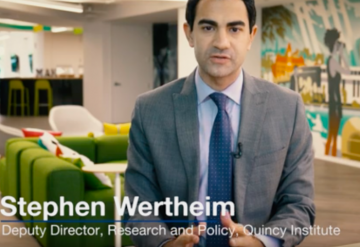 The closing session pitted Quincy Institute Deputy Director Stephen Wertheim against Rosa Brooks of New America and Tom Wright of the Brookings Institution, both of whom rejected the very idea of ending America’s existing wars. They argued that the U.S. troops in Iraq and Syria are really “counter-terrorism operations” rather than “wars.” Brooks even uttered the word identifying her as a member of the national security elite in good standing by calling for a “robust” policy.
The panel billed as “A New Vision for America’s Role in the World” didn’t actually offer that at all. That phrase turned out to be simply a convenient catch-all for the views of foreign policy advisers to both Bernie Sanders (Matt Duss) and former Vice President Joe Biden (former NSC official Julianne Smith), neither of whom articulated anything resembling a new policy vision.
Ironically, on the day that Politico’s “Morning Defense” reported Sanders’ clear lead in the Democratic race had triggered fears among military contractors of “an unprecedented threat to the status quo,” the most daring suggestion from Duss was that Sanders was for diplomacy with Iran.
Military ‘Wants Out’
There were a few moments that unexpectedly elevated the discussion well above the usual humdrum Washington think tank chatter. In a panel on the Middle East independent journalist Mark Perry, who has long had access to senior military officers on background, reported that his military contacts “want out” of the wars in the Middle East.
He added, moreover, that Trump has those officers’ trust, because they believe he wants out, too. But Perry’s most important contribution was to challenge the whole idea that the United States is capable of accomplishing anything positive with its serial military interventions in the Middle East. “We can’t do this,” said Perry, “so what are we doing?”
No Full, Unfettered Analysis
The lesson of Quincy’s debut seems reasonably clear: You can’t hope to disrupt the national security elite’s grip on policy by playing by the establishment’s rules. Foreign Policy was never going to agree to a format that would permit a direct confrontation over the key issues, much less, a full, unfettered analysis of the system of power that underlies that elite’s public role in defending America’s endless wars.
An organization devoted to attacking its illicit and increasingly unpopular policies can only gain traction by offering an analysis that will appeal to the anti-elite sentiments that have already shaken the U.S. political system to its foundations.
That would mean going beyond “realism and restraint” and talking about the need for fundamental change in the system of national security institutions themselves. Of course, taking that lesson on board might not be in line with the thinking of major funders. It could imply a major reorganization and even a much smaller staff. But if it doesn’t heed the lesson of its initial conference, Quincy is likely to find that the real action in bringing about change in U.S. foreign and policy is coming from political forces involved in the larger national power struggle.
Mounting concern over SAS operations in southern Syria
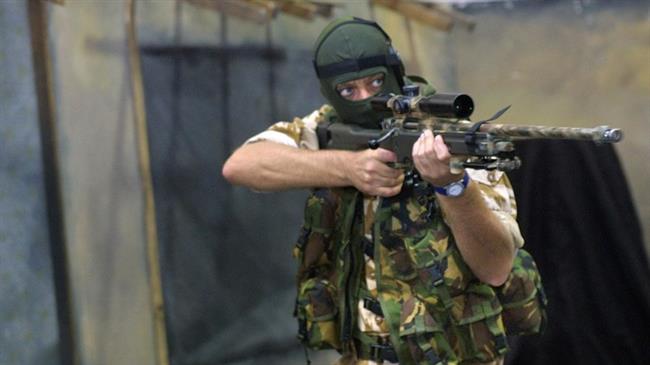
British SAS or SBS soldier in action in Syria
Press TV – March 8, 2020
There is mounting concern in the region about the nature and scale of British Special Forces deployment to southern Syria.
The concern comes in the wake of an exclusive report by the Daily Mirror (March 05) that two RAF Chinook helicopters “packed with special forces” troops and medics had “swooped” into southern Syria to rescue a wounded Special Air Service (SAS) operative.
According to the Mirror, the casualty was airlifted from “deep inside the warzone” to a medical facility in Erbil, northern Iraq.
Whilst the Mirror doesn’t say exactly where in southern Syria the SAS soldier was operating, the reference to “warzone” would suggest Deraa province, in the southwest of the country.
There have been clashes in recent days between Syrian government forces and terrorist groups controlling parts of the town of Al-Sanamayn, situated 50 kilometers south of the capital, Damascus.
Based on the realities on the ground, there is mounting speculation that Britain’s elite SAS could be lending a helping hand to anti-government forces in and around Al-Sanamayn.
British Special Forces, both in the form of the SAS and its allied unit, the Special Boat Service (SBS), have been operating in Syria for seven years.
According to the Mirror, more than 30 British special operatives have been injured in Syria. There has been at least one combat fatality, that of Sergeant Matt Tonroe, who was killed in a joint US/UK operation in March 2018.
Late last year it was reported that British Special Forces in Syria were beating a hasty retreat following US President, Donald Trump’s decision to pull out of Syria.
The latest incident appears to indicate that the SAS and SBS continue to operate in Syria based on the needs of allied Syrian rebel and terrorist groups.
The exfiltration of the injured SAS soldier will cause huge concern as the rescue operation involved RAF choppers taking off from RAF Akrotiri in Cyprus before flying through Israeli airspace to northern Jordan and onto southwestern Syria.
This brazen violation of Syrian sovereignty is likely to aggravate Britain’s outlaw status in Damascus, where both the Syrian government and people take a dim view of Britain’s hostile interference in their internal affairs.
Parliamentary Brawl Marks Erdogan’s Syria Policy
By Anthony Sherwood | American Herald Tribune | March 7, 2020
Needless to say, the punchup in the Turkish parliament on March 4 was a disgrace. Supposedly elected to discuss matters of national importance in a calm and dignified manner, scores of MPs behaved like football hooligans.
The occasion was a debate on the presence of the Turkish army in Idlib. Earlier, President Erdogan had described the opposition’s criticism of Turkey’s Syria operation as “dishonorable, ignoble, low and treacherous.” This was followed by a press conference in which the parliamentary chair of the Republican People’s Party (CHP), Engin Ozkoc, directed exactly the same words against the president personally. He also accused Erdogan of showing disrespect by laughing and joking in a speech he made after 34 Turkish soldiers sent to Idlib were killed in an airstrike.
In a later Twitter message, Ozkoc wrote that “a person who became the co-chair of the Greater Middle East project, who approved of the slaughter of three million Muslims, who calls martyrs ‘heads’ is undignified, dishonorable, without honor. This person cannot be the president of Turkey.”
The brawl broke out when Ozkoc took the rostrum in the Grand National Assembly to talk about Idlib. In a country where a rude hand gesture or a slighting remark about the president can land the speaker in prison, his earlier remarks were inflammatory stuff and the MPs laid into each other. Erdogan launched a civil action against the deputy, demanding one million lira (about $164,000) in damages, and an investigation was launched by the state prosecutor’s office. Under article 299 of the penal code, insulting the president is criminalized.
Ozkoc cannot claim automatic parliamentary immunity as MPs voted to lift it in 2016. The prosecutor’s office quickly sent a brief to parliament with a request that his immunity be lifted so he could be prosecuted. By May 2019, the prosecutor had presented the parliament with 608 requests for the lifting of immunity, so Ozkoc’s name has now been tacked on to a long list. The targeted deputies are mainly from the largely Kurdish People’s Democracy Party (HDP), along with a sprinkling of deputies from the CHP, including the party leader, Kemal Kilicdaroglu.
The parliamentary stoush was hardly an aberration. Brawls in recent years, with deputies swinging punches, standing on desks and hurling various objects at each other, include the melee over a bill of ‘homeland security’ in 2015 that widened the use of force police could use against demonstrators. On that occasion, four MPs were so badly hurt they needed hospital treatment.
The debate over the lifting of parliamentary immunity in 2016 was marked by another furious brawl before the legislation was passed. In 2017 the MPs brawled over the plan to turn the parliamentary rule into an executive presidency. In 2018 the cause was the redrawing of electoral boundaries. The fist-fighting inside the parliament can be seen as a microcosm of the angry atmosphere outside, fuelled by the government, in which criticism is quickly turned into support for terrorism.
Whom the parliamentary deputy Ozkoc meant by three million slaughtered Muslims is not clear but his reference to the ‘Greater Middle East’ project should be noted by attentive readers. Years ago Erdogan described himself as the “co-chair” of the Greater Middle East project without saying who was the other chair. Reporting the occasion, Breitbart thought it was a euphemism for “an Islamic Turkish caliphate,” with Erdogan at its head. Perhaps the other chair was the US, where in the 1990s the neocons had laid their own plans for a ‘Greater Middle East’ but Erdogan undoubtedly would have had his own aspirations as a world-historical Muslim figure in mind.
The phrase ‘Great East’ if not ‘Middle East’ has deep roots in modern Turkish history, arising from the writings of Necip Fazil Kisakurek, whose Islam-based nationalism is clearly the ideological mother lode for the direction in which Erdogan has taken Turkey. Buyuk Dogu (Great East) was Kisakurek’s central contribution and the name of the magazine he founded.
Born into an upper-class family, a student in Paris of the philosopher Henri Bergson, who favored intuition over rational analysis, Kisakurek (1904-83) was simultaneously poet, novelist, university professor, Sufi, Islamist and nationalist who in the 1930s and 40s sought to replace Kemalist nationalism with Islam.
It was, however, a narrow and restrictive Islam. For Kisakurek Islam was only Sunni Islam, with antipathy to Judaism and Christianity added to his hostility to Shia and Turkey’s large Alevi (Alawi) population.
In 1970 Salih Erdis (Salih Mirzabeyoglu) founded the Great Eastern Islamic Raiders’ Front (IBDA-C), which, based on Kisakurek’s teachings, called for the restitution of the caliphate and carried forward Kisakurek’s hostility to non-Sunni Muslims, Christians, and Jews. In 2001 Erdis was sentenced to death for undermining the secular state. The death penalty abolished in 2002, his sentence was commuted to life imprisonment in 2004.
Outside prison, his followers continued with his mission. In November 2003 they exploded truck bombs outside Istanbul’s two main synagogues, killing more than 20 people. Elsewhere a few days later they launched terrorist attacks against the British consulate and the Istanbul headquarters of the HSBC bank.
Having been released from prison in July 2014, Salih Erdis gave a talk later in the year at a congress center in Istanbul. Finding out that Erdogan would be speaking at the same location the same day, Erdis passed on a message that he would like to meet him and the president agreed. What they discussed remained between them but it has to be regarded as significant that the president would agree to sit down for a chat with a man who was both anti-secular and a convicted terrorist.
The parliamentary brawl over the Idlib operation captured in essence growing public disquiet over Turkey’s presence in Syria, especially since the airstrike in late February that killed 34 soldiers (the rumors quickly spread that the real toll was upwards of 200). The disquiet is not sudden, however, and not just over Syria, but has been growing steadily over the years, with a flailing economy among the many causes of disaffection with Erdogan and the AKP government. Beyond Turkey’s borders, Erdogan has fallen out with Russia, the US and the EU over a host of issues. They clearly have run out of patience with him.
Elections and public opinion polls show a consistent downward trend. In June 2015 the ruling party lost its absolute majority in parliament, recovering it only after an election campaign fought around the theme of national solidarity against Kurdish terrorism. In local elections in March 2019, repeated in June after AKP protests of irregularities, the government was defeated by CHP candidates in five of Turkey’s biggest cities (Istanbul, Ankara, Izmir, Adana, and Antalya).
While Turkish opinion polls are not the most reliable, the net result can hardly be ignored. In February 2020 a Metropoll survey showed Erdogan’s popularity (41.1 percent) down by seven percent from October 2019. Disapproval of the president rose to 51.7 percent, compared to 38 percent last October. Turkey’s military presence in Idlib was regarded as unnecessary by 48.8 percent of those surveyed, with only 30.7 percent approving, but as this was before the national outrage generated by the killing of the 34 soldiers, these percentages have no doubt changed. These figures have to set against the 68 percent approval rating for Erdogan after the 2016 coup attempt.
Another February 2020 poll, taken by AREA research in Istanbul, Ankara, Izmir, Antalya, Samsun, Malatya and Gaziantep (conservative, close to the border with Syria and hosting a Turkish-backed proxy Syrian government) showed that only 30.3 percent of respondents would vote for the AKP if elections were held now, with 20.8 choosing the CHP and 10.8 the HDP.
Of the respondents, 57.3 percent favored a return to parliamentary rule and 56.7 percent did not regard the presidential system as “successful.” Only 35.7 percent regarded the presidential system as “successful.” Asked who they would vote for now, in a presidential election, 35.3 said Erdogan, 52.4 percent were against him and 12.3 percent were undecided.
Compounding economic and other problems for the AKP and Erdogan are serious splits within the party, with two influential figures, former economy minister Ali Babacan and former foreign minister and prime minister Ahmet Davutoglu resigning to form parties of their own. Furthermore, the AKP is losing members: membership in 2016 stood at 10.72 million, but by 2018 had dropped to 9.87 million and is bound to have declined further since then because of the state of the economy and the war in Syria and the problems it has created, not just the death of young soldiers but the presence of several million refugees in Turkey.
Elections (presidential and general) are not due again until 2023. Erdogan is an experienced and wily political practitioner so it would be most unwise to count him out but definitely the luster has worn thin if not completely worn off for a lot of people.
The deal with Putin allowed him to save face at home, at the cost of giving up the fight for control of the strategic M4 highway. The government has regularly issued details of Syrian soldiers it says have been “neutralized” along with figures of destroyed artillery and armor but it has taken heavy punishment itself, losing between 10 and 13 large armored drones apart from the death of its soldiers and the army’s “Syrian national army” takfiri auxiliaries.
Ceasefires may put off the evil day of withdrawal but Syria has turned into a cul de sac for Erdogan and a dead-end for his country. To public pain at the death of Turkish soldiers in Syria has been added anger at Erdogan’s almost casual reference to the death of “a few martyrs” in Libya.
In short, 2020 is not opening well for Tayyip Erdogan.
US scraps plans to buy Israeli Iron Dome missile systems
Press TV – March 7, 2020
The United States has decided to scrap its plans to buy two more batteries of the Israeli-made Iron Dome missile system due to concerns about its compatibility with existing American technologies.
The main problem has been Israel’s refusal to provide the US military with Iron Dome’s source code which is needed to integrate the system into American air defenses, according to the army.
General Mike Murray, head of Army Futures Command, said Thursday that based on some cyber vulnerabilities and operational challenges, the army failed to integrate elements of Iron Dome with the US Army’s Integrated Battle Command System.
“It took us longer to acquire those [first] two batteries than we would have liked,” Murray said. “We believe we cannot integrate them into our air defense system based on some interoperability challenges, some cyber challenges and some other challenges.”
In August 2019, the US Defense Department finalized a deal to buy two batteries of the Israeli-made Iron Dome missile system for its interim cruise missile defense capability.
Soon thereafter, army officials repeatedly requested Iron Dome “source code”, according to sources. Israel supplied engineering information but ultimately declined to provide the source code.
“So what we’ve ended up having was two stand-alone batteries that will be very capable but they cannot be integrated into our air defense system,” Murray said.
Because Iron Dome will not be integrated with other elements of the US Army’s air- and missile-defense system, the service is cancelling plans to buy a second pair of Iron Dome batteries by 2023.
“So, we’re working on a path right now… on a way forward,” Murray said. “We anticipate a shoot-off open to US industry, foreign industry, to go after whatever is the best solution to provide that capability.”
The US military has already tested the system. In September 2017, Israel loaned the US an Iron Dome battery, which was flown to the missile range in White Sands, New Mexico.
The US Army has been working with Israeli weapons maker Rafael to develop an American version of the interceptor system since 2017.
In order to integrate the missile system, the US military was going to invest $289.7 million in the missile system in the current fiscal year and another $83.8 million for the next fiscal year.
In total, the US Army would spend $1.6 billion for Iron Dome’s full integration until 2024.
The Iron Dome has been co-developed by American company Raytheon and Israeli defense firm Rafael. It is partly manufactured in the United States.
The Iron Dome is claimed to be capable of detecting, assessing and intercepting a variety of shorter-range targets such as rockets, artillery and mortars.
The system was originally developed to counter small rockets that Hamas and other Palestinian resistance groups fired into Israeli occupied territories in retaliation for the regime’s crimes against Palestinians.
The Iron Dome has proven largely ineffective in serving that purpose.
DNC Scrambles To Change Debate Threshold After Gabbard Qualifies
By Caitlin Johnstone | March 4, 2020
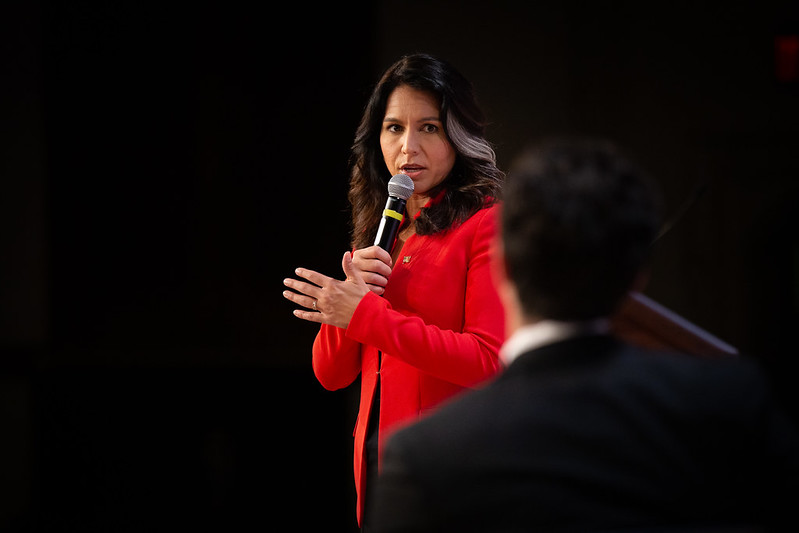
On a CNN panel on Monday, host John King spoke with Politico reporter Alex Thompson about the possibility of Democratic presidential candidate Tulsi Gabbard qualifying on Super Tuesday for the party’s primary debate in Phoenix later this month.
“I will note this, she’s from Hawaii,” King said of Gabbard. “She’s a congresswoman from Hawaii; American Samoa votes on Super Tuesday. The rules as they now stand, if you get a delegate, you’re back in the debates. As of now. Correct?”
“Yeah, they haven’t, I mean, that’s been the rule for every single debate,” Thompson replied. “And the DNC has not released their official guidance for the March 15 debate in Phoenix, but it would be very obvious that they are trying to cancel Tulsi, who they’re scared of a third party run, if they then change the rules to prevent her to rejoin the debate stage.”
And indeed, as the smoke clears from the Super Tuesday frenzy, this is precisely what appears to have transpired.
“The Gabbard campaign said it was informed that it would net two delegates from the caucuses in American Samoa, which will allocate a total of six pledged delegates,” The Hill reports today. “However, a report from CNN said that the candidate will receive only one delegate from the territory on Tuesday evening.”
“Tulsi Gabbard may have just qualified for the next Democratic debate thanks to American Samoa,” reads a fresh Business Insider headline. “Under the most recent rules, Rep. Tulsi Gabbard of Hawaii may have qualified for the next televised debate by snagging a delegate in American Samoa’s primary.”
“If Tulsi Gabbard gets a delegate out of American Samoa, as it appears she has done, she will likely qualify for the next Democratic debate,” tweeted Washington Post‘s Dave Weigel. “We don’t have new debate rules yet, but party has been inviting any candidate who gets a delegate.”
Rank-and-file supporters of the Hawaii congresswoman enjoyed a brief celebration on social media, before having their hopes dashed minutes later by an announcement from the DNC’s Communications Director Xochitl Hinojosa that “the threshold will go up”.
“We have two more debates– of course the threshold will go up,” tweeted Hinojosa literally minutes after Gabbard was awarded the delegate. “By the time we have the March debate, almost 2,000 delegates will be allocated. The threshold will reflect where we are in the race, as it always has.”
“DNC wastes no time in announcing they will rig the next debates to exclude Tulsi,” Journalist Michael Tracey tweeted in response.
This outcome surprised nobody, least of all Gabbard supporters. The blackout on the Tulsi 2020 campaign has reached such extreme heights this year that you now routinely see pundits saying things like there are no more people of color in the race, or that Elizabeth Warren is the only woman remaining in the primary. They’re not just ignoring her, they’re actually erasing her. They’re weaving a whole alternative reality out of narrative in which she is literally, officially, no longer in the race.
After Gabbard announced her presidential candidacy in January of last year I wrote an article explaining that I was excited about her campaign because she would severely disrupt establishment narratives, and, for the remainder of 2019, that’s exactly what she did. She spoke unauthorized truths about Syria, Afghanistan and Saudi Arabia, she drew attention to the plight of Julian Assange and Edward Snowden and said she’d drop all charges against both men if elected, she destroyed the hawkish, jingoistic positions of fellow candidates on the debate stage and arguably single-handedly destroyed Kamala Harris’ run.
The narrative managers had their hands full with her. The Russia smears were relentless, the fact that she met with Syrian president Bashar al-Assad was brought up at every possible opportunity in every debate and interview, and she was scoffed at and derided at every turn.
Now, in 2020, none of that is happening. There’s a near-total media blackout on the Gabbard campaign, such that I now routinely encounter rank-and-file liberals on social media who tell me they honestly had no idea she’s still running. She’s been completely redacted out of the narrative matrix.
So it’s unsurprising that the DNC felt comfortable striding forward and openly announcing a change in the debate threshold literally the very moment Gabbard crossed it. These people understand narrative control, and they know full well that they have secured enough of it on the Tulsi Problem that they’ll be able to brazenly rig her right off the stage without suffering any meaningful consequences.
The establishment narrative warfare against Gabbard’s campaign dwarfs anything we’ve seen against Sanders, and the loathing and dismissal they’ve been able to generate have severely hamstrung her run. It turns out that a presidential candidate can get away with talking about economic justice and plutocracy when it comes to domestic policy, and some light dissent on matters of foreign policy will be tolerated, but aggressively attacking the heart of the actual bipartisan foreign policy consensus will get you shut down, smeared and shunned like nothing else. This is partly because US presidents have a lot more authority over foreign affairs than domestic, and it’s also because endless war is the glue which holds the empire together.
And now they’re working to install a corrupt, right-wing warmongering dementia patient as the party’s nominee. And from the looks of the numbers I’ve seen from Super Tuesday so far, it looks entirely likely that those manipulations will prove successful.
All this means is that the machine is exposing its mechanics to the view of the mainstream public. Both the Gabbard campaign and the Sanders campaign have been useful primarily in this way; not because the establishment would ever let them actually become president, but because they force the unelected manipulators who really run things in the most powerful government on earth to show the public their box of dirty tricks.
The Myth of Moderate Nuclear War
By Brian Cloughley | Strategic Culture Foundation | March 3, 2020
There are many influential supporters of nuclear war, and some of these contend that the use of ‘low-yield’ and/or short-range weapons is practicable without the possibility of escalation to all-out Armageddon. In a way their argument is comparable to that of the band of starry-eyed optimists who thought, apparently seriously, that there could be such a beast as a ‘moderate rebel’.
In October 2013 the Washington Post reported that “The CIA is expanding a clandestine effort to train opposition fighters in Syria amid concern that moderate, US-backed militias are rapidly losing ground in the country’s civil war,” and the US Congress gave approval to then President Barack Obama’s plan for training and arming moderate Syrian rebels to fight against Islamic State extremists. The belief that there could be any grouping of insurgents that could be described as “moderate rebels” is bizarre and it would be fascinating to know how Washington’s planners classify such people. It obviously didn’t dawn on them that any person who uses weapons illegally in a rebellion could not be defined as being moderate. And how moderate is moderate? Perhaps a moderate rebel could be equipped with US weapons that kill only extremists? Or are they allowed to kill only five children a month? The entire notion was absurd, and predictably the scheme collapsed, after expenditure of vast amounts of US taxpayers’ money.
And even vaster amounts of money are being spent on developing and producing what might be classed as moderate nuclear weapons, in that they don’t have the zillion-bang punch of most of its existing 4,000 plus warheads. It is apparently widely believed in Washington that if a nuclear weapon is (comparatively) small, then it’s less dangerous than a big nuclear weapon.
In January 2019 the Guardian reported that “the Trump administration has argued the development of a low-yield weapon would make nuclear war less likely, by giving the US a more flexible deterrent. It would counter any enemy (particularly Russian) perception that the US would balk at using its own fearsome arsenal in response to a limited nuclear attack because its missiles were all in the hundreds of kilotons range and ‘too big to use’, because they would cause untold civilian casualties.”
In fact, the nuclear war envisaged in that scenario would be a global catastrophe — as would all nuclear wars, because there’s no way, no means whatever, of limiting escalation. Once a nuclear weapon has exploded and killed people, the nuclear-armed nation to which these people belonged is going to take massive action. There is no alternative, because no government is just going to sit there and try to start talking with an enemy that has taken the ultimate leap in warfare.
It is widely imagined — by many nuclear planners in the sub-continent, for example — that use of a tactical, a battlefield-deployed, nuclear weapon will in some fashion persuade the opponent (India or Pakistan) that there is no need to employ higher-capability weapons, or, in other words, longer range missiles delivering massive warheads. These people think that the other side will evaluate the situation calmly and dispassionately and come to the conclusion that at most it should itself reply with a similar weapon. But such a scenario supposes that there is good intelligence about the effects of the weapon that has exploded, most probably within the opponent’s sovereign territory. This is verging on the impossible.
War is confusing in the extreme, and tactical planning can be extremely complex. But there is no precedent for nuclear war, and nobody — nobody — knows for certain what reactions will be to such a situation in or near any nation. The US 2018 Nuclear Posture Review stated that low-yield weapons “help ensure that potential adversaries perceive no possible advantage in limited nuclear escalation, making nuclear employment less likely”. But do the possible opponents of the United States agree with that? How could they do so?
The reaction by any nuclear-armed state to what is confirmed as a nuclear attack will have to be swift. It cannot be guaranteed, for example, that the first attack will not represent a series. It will, by definition, be decisive, because the world will then be a tiny step from doomsday. The US nuclear review is optimistic that “flexibility” will by some means limit a nuclear exchange, or even persuade the nuked-nation that there should be no riposte, which is an intriguing hypothesis.
As pointed out by Lawfare,
“the review calls for modification to ‘a small number of existing submarine-launched ballistic missile (SLBM) warheads’ to provide a low-yield option.
It also calls for further exploration of low-yield options, arguing that expanding these options will ‘help ensure that potential adversaries perceive no possible advantage in limited nuclear escalation, making nuclear employment less likely.’ This is intended to address the argument that adversaries might think the United States, out of concern for collateral damage, would hesitate to employ a high-yield nuclear weapon in response to a ‘lower level’ conflict, in which an adversary used a low-yield nuclear device. The review argues that expanding low-yield options is ‘important for the preservation of credible deterrence,’ especially when it comes to smaller-scale regional conflicts.”
“Credible deterrence” is a favourite catch-phrase of the believers in limited nuclear war, but its credibility is suspect. Former US defence secretary William Perry said last year that he wasn’t so much worried about the vast number of warheads in the world as he was by open proposals that these weapons are “usable”. It’s right back to the Cold War and he emphasises that “The belief that there might be tactical advantage using nuclear weapons – which I haven’t heard being openly discussed in the United States or in Russia for a good many years – is happening now in those countries which I think is extremely distressing.” But the perturbing thing is that while it is certainly being discussed in Moscow, it’s verging on doctrine in Washington.
In late February US Defence Secretary Esper was reported as having taken part in a “classified military drill in which Russia and the United States traded nuclear strikes.” The Pentagon stated that “The scenario included a European contingency where you’re conducting a war with Russia and Russia decides to use a low-yield, limited nuclear weapon against a site on NATO territory.” The US response was to fire back with what was called a “limited response.”
First of all, the notion that Russia would take the first step to nuclear war is completely baseless, and there is no evidence that this could ever be contemplated. But even if it were to be so, it cannot be imagined for an instant that Washington would indulge in moderate nuclear warfare in riposte. These self-justifying wargames are dangerous. And they bring Armageddon ever closer.
Russia seeks to ‘create conditions so that NOBODY wants to fight us’ – Putin
RT | March 2, 2020
Vladimir Putin has confided that US President Donald Trump privately lamented the “insane” US military budget. He also says Russia protects itself by making the costs of attacking the country too high for anyone to contemplate.
“The US has outstripped us” in terms of annual defense expenditure, the Russian president said in a new episode of news agency TASS’s ‘20 Questions to Vladimir Putin’ series. But being the world’s largest military spender doesn’t really make Donald Trump particularly happy, Putin said.
“Donald told me that they have adopted an insane [military] budget for the next year, $738 billion.”
The US commander-in-chief, who likes to talk up his country’s military hardware during overseas trips while bragging about the armed forces, tends to be more reserved in private, according to Putin. “He told me that the costs were too high, but he had to do it,” he said, describing his counterpart as “an advocate of disarmament, as he says.”
In terms of military spending, Russia trails behind China, Saudi Arabia, the UK, France, and Japan, with a defense budget worth $48 billion, although its lower cost base gives it more purchasing power than most western states. “Moreover, our annual expenditures are falling. In contrast, other countries’ spending has been rising,” Putin stated.
“We are not going to fight against anyone. We are going to create conditions so that nobody wants to fight against us.”
Putin also explained why Trump – who already dismantled the landmark Intermediate-Range Nuclear Forces Treaty the US signed with the old Soviet Union – is reluctant to talk non-proliferation and arms control.
“That is another question, this is a question which relates to the understanding of security and how to ensure it… We can discuss this topic,” the Russian president replied without going into details.
Another crucial treaty which now hangs in the balance is the Strategic Arms Reduction Treaty (START), which dramatically reduced the number of nuclear warheads and the means of delivery.
The current edition of the pact, known as New START, was signed by former US President Barack Obama and his then-Russian counterpart, Dmitry Medvedev in 2010. It is set to expire in February next year.
While Moscow has signaled its readiness to prolong the treaty immediately, the US has kept silent on the matter.
Featured Video

Iran’s Next Strike May Not Explode. It Could Shut You Down
or go to
Aletho News Archives – Video-Images
Book Review
New paperback: Butchered by “Healthcare”
Lies are Unbekoming | October 20, 2026
 Butchered by “Healthcare” is Robert Yoho’s plain-spoken account of how American medicine stopped being a profession and became an industry. 341 pages. Over a thousand references. Thirty-eight chapters.
“Screening Tests Are Useless”, on tests that find diseases that would never have hurt you. “The FDA Protects the Big Drug Companies”, on an agency funded by the companies it regulates. “The Journals’ Sins Are the Editors’ Sins”, on ghostwritten studies and captured peer review. “Opioids and ‘Pain Management’”, on how a generation was prescribed its way into addiction. “Prozac and Relatives” and “Antipsychotics Are Disastrous”, on what psychiatry does to adults and children. “Surgery: Money Before Patients”. “Failed Cancer Treatments”. “Futile CPR and Overprescribing”. “Billing Scams & Specialty Warfare”. “Hospitals Are Sharks”. Each with a Patient Tips section at the end on how to survive it.
If you have ever walked out of a doctor’s office with a prescription you didn’t ask for, or watched a parent put through a treatment that made them worse, this is the book you want on your shelf before the next appointment. … Full review
Butchered by “Healthcare” is available on Lulu now.
Blog Roll
 Aletho News
- Iran’s Next Strike May Not Explode. It Could Shut You Down /Col Doug Macgregor
- Iran: US political targets legitimate if assassinations return
- Iraq shuts key border crossing with Iran under US pressure: Report
- Undersea Internet cables could be targeted in retaliation for attacks on Iran: IRGC deputy chief
- EU sending ‘biased’ observers to interfere in Serbian election – president
- White House envoy declares kinetic action against Yemen ‘fruitless’
- Ukraine deployed thousands of microdrones in Iraqi Kurdistan: Tasnim
- Iran calls for emergency UNSC meeting over Trump’s ‘brazen’ bomb talk, Israeli threats
- Iranian sources reveal details of Russia-China Hormuz proposal
- Plan for more US-Israel integration puts our military tech at risk
- If Americans Knew
- Americans at National Conservatism Conference held in Israel this year criticize Israel
- Christiane Amanpour exits CNN with a legacy shaped by the debate over Israel
- Israel’s war on Iran is the final move in a decades-old strategy
- Israel Denies Entry to French Journalist, U.S. Researcher Amid Rise in Entry Denials
- Gaza’s hospitals are running out of life-saving fuel – Daily Update
- Mysterious bot accounts reportedly spread fake ‘man on the street’ videos for Michigan Senate candidate
- Israeli Defense Minister Katz Says Over 60 Lebanon Villages Have Been Destroyed
- Why Is Israel Running TV Ads in Iowa Ahead of the Midterms?
- Hind Rajab’s Alleged Killer Is in the United States. HRF Demands His Arrest.
- US Officials Face Fresh Pressure After Another American ‘Brutalized’ by Israeli Settlers in West Bank
- No Tricks Zone
- E-Cars Reduce CO2 Emissions By Only 41% Compared To Internal Combustion Engine Vehicles
- Predictions Made By Renowned Climate Professor Over Past Decades Have Been Proven To Be Poor
- New Study Suggests Large Regions Of The Pacific Ocean Have Been Cooling For The Last 80 Years
- Germany’s Green Energy Debacle: High Energy Costs Force Kahla Porzellan to Close After 182 Years!
- New Study: 50 Years Of The Most Aggressive ‘Net Zero’ Policies Can Only Affect The Global Climate By 0.03°C
- US September “Heat” Was No Record…Many Records Set Decades Ago
- Latest European Green Energy Debacle; Portugal’s Largest Flagship Solar Park Insolvent!
- Green Energy Debacle: German Expert Professor Fritz Vahrenholt Warns Of Severe Economic And Social Consequences
- Two More Paleo Reconstructions Affirm Meters-Higher Sea Levels Across Ireland, Brazil 7000-6000 Years Ago
- New Study: Earth And Venus Surface Warmth Largely Explained By Convection And Lapse Rate, Not CO2 Or Radiation

