Russia ready to extend New START arms control treaty without conditions and further discussions – Putin
RT | December 5, 2019
Moscow is ready to extend the last major nuclear arms control treaty, without conditions or discussions, President Vladimir Putin said as he reiterated Russia’s position on the New START treaty which expires in 2021.
“Russia is ready to immediately, as soon as possible, before the end of the year, extend the New START treaty without any preconditions, so that there would be no double, triple interpretation of our position later. I’m saying this officially,” the Russian president pointed out.
The New START treaty, which obliges Moscow and Washington to reduce the number of its strategic nuclear missile launchers by half, was signed in April 2010. The agreement expires in February 2021, but there’s an option for it to be extended until 2026.
Russia has already filed all the paperwork needed to begin talks on extending the treaty, but the US has not reacted to the proposal. Moscow is concerned that the Trump administration is willing to ditch New START, just like it did with the INF deal.
The Intermediate-Range Nuclear Forces (INF) treaty banned Russia and the US from the fielding ground-based missiles with a range of between 500km (310 miles) and 5,500km (3418 miles) in Europe, and was the cornerstone of security on that continent since 1987. The US’ unilateral withdrawal from the deal left Russia with no choice but to abandon it as well, raising fears of a new arms race between the two countries.
NATO Wants to Dominate Not Only in Euro-Atlantic Region but Also in Middle East – Lavrov
Sputnik – December 5, 2019
A two-day NATO summit dubbed “NATO Engages: Innovating the Alliance” kicked off in London earlier in the week to mark the 70th anniversary of the organisation.
Russian Foreign Minister Sergei Lavrov stated on Thursday following the 26th Meeting of the OSCE Ministerial Council in Bratislava that NATO wants to dominate not only the Euroatlantic region but the Middle East as well.
“NATO continues its reckless expansion, the block’s military infrastructure is moving quickly to the east, close to Russian borders. There’s a permanent fomenting of tension, accusations of aggressive intentions from the part of Russia. All this is happening amid a record increase of military budgets – the decision that was adopted during the recent summit in London,” Lavrov said.
“The facts we see demonstrate us a clear situation: NATO wants to dominate both in the Euro-Atlantic and — if we look at NATO steps in other regions of the world, particularly the Middle East — in the Middle East,” Lavrov said.
Speaking further, the Russian foreign minister noted that Russia has a response to all the threats posed by NATO and will ensure its security without entering an arms race.
“We have a response to all those threats that NATO is multiplying when it directly names Russia and China as targets of these threats. We know how we can respond to these threats and ensure our security without entering an arms race,” Lavrov said.
NATO held its 70th anniversary summit in the UK capital from December 3-4. In its joint statement, the allies reaffirmed their commitment to increasing investment in defence and qualified “Russia’s aggressive actions” and “terrorism in all its forms and manifestations” as threats.
Putin: Russia is against militarization of space but US sees it as theater of war
RT | December 4, 2019
Russia has consistently opposed the idea of space militarization, but the actions of the US and its allies force Moscow to counterbalance this growing threat, President Vladimir Putin has said.
“Russia has always opposed and continues to oppose the militarization of space,” the president told a government meeting on military policies. Putin expressed concern over world powers increasing the capabilities of their space systems which have both military and dual-use applications.
“The US political and military leadership openly consider space a war theater,“ he said.“Developments demand that we pay increased attention to strengthening our orbital group as well as our rocket and space industries.”
Russia’s so-called orbital group is a constellation of more than 150 satellites, two thirds of which have military applications. Most of them are parts of military satellite communication systems, but Russia also has satellites monitoring launches of intercontinental ballistic missiles as well as short-range tactical missiles. This warning system was “significantly enhanced” over the recent years and tested successfully during the large-scale military drills in October, the president said.
His words, meanwhile, came as NATO finally made space its official war domain. During a summit in London on the 70th anniversary of the alliance on Wednesday, its members declared space “the fifth operational domain and committed to ensuring the security of telecommunications infrastructure, including 5G.”
However, nothing has been publicly said regarding concrete steps in this direction or decisions made in this field.
Say No To The US-Israel Mutual Defense Pact
By Eric Striker | National Justice | December 3, 2019
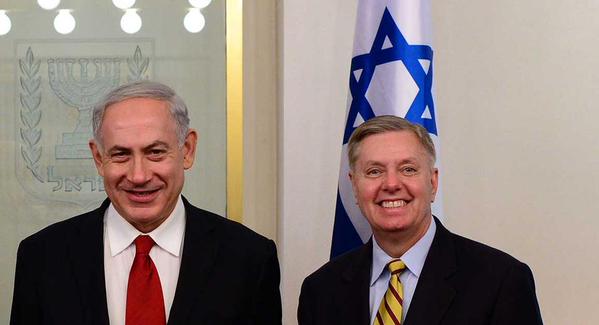
Last September, Donald Trump and Benjamin Netanyahu hinted that they were working on a mutual defense pact. Such a treaty, if signed, would officially and permanently mandate an American military intervention if Israel were to ever start a conflict with its neighbors.
The Trump administration is desperate to get this done, but Netanyahu is having trouble selling the idea to his rival Benny Gantz. The Likud party has so far been unable to form a government and Netanyahu is battling corruption charges. As a side note, two major GOP donors, Sheldon Adelson and Larry Ellison, are defense witnesses in Bibi’s case.
The major reason why some sectors of the Israeli state want Netanyahu gone is that they believe his government’s belligerence is responsible for Iran’s stunning rise. Netanyahu has chosen Israel-above-all unilateralism using Zion’s cats-paws in Washington to try and bully Tehran, but have walked all over Chinese and Russian interests in the process.
Two years into the Trump/Israel “maximum pressure” campaign, Iran is not only more powerful than before, it is participating in joint war games with China and Russia. This has angered competing Jewish factions inside Israel, who preferred the Obama method of passively subverting Iran through its countries pro-US/pro-Europe “moderate” liberal reformists. Hassan Rouhani, who they saw as the Persian “Gorbachev,” has now been fully discredited in the eyes of his people thanks to Trump and Netanyahu.
While all segments of Israeli society are having a public debate on the pros and cons of a military pact for their country, here in the US nobody has consulted with the 1.3 million active-duty American servicemen who will die in a world war to expand Israel’s borders.
JINSA’s Plan
Lindsay Graham has told Jews at private events that he is working on this bill and is confident it will be ratified in the Senate. So far, the only people within US borders participating in this conversation are the Republican Jewish Coalition and JINSA (Jewish Institute for National Security of America). The latter fifth column is writing the terms of the treaty.
Last July, JINSA released details of the pact they want Graham to push through, titled “For a Narrow US-Israel Defense Pact,” which can be obtained online (I will not link to downloads on JINSA’s website for security reasons).
The policy paper demands that Israel be granted special access to intelligence collected by the “Five Eyes Alliance” (Australia, UK, New Zealand, Canada and the US), officially turning the entire Anglo-Saxon world into a global Jewish spy network (which is already unofficially true).
Furthermore, it calls on the war clause be triggered if any country “threatens” to use chemical or nuclear weapons against the Jewish state or physically undermines Israel’s economic activities. This is very open-ended.
The most ludicrous part of the Graham/JINSA treaty is section 3.4, where Israel is under no obligation to notify or seek approval from the United States when it decides to engage in a military attack against another party.
In other words, if Israel decides to start a war with Iran (or China, or Russia, or all of them), it doesn’t have to discuss this with its “ally” first. Israel reserves its right to act unilaterally and America must go along for the ride whether we want to or not.
America gets absolutely nothing from joining such an agreement, except the possibility of a catastrophic world war that can be started by unstable psychopaths like Benjamin Netanyahu without warning, whenever they please.
The US has not signed a mutual defense treaty since 1962.
It’s time the 98% start demanding Donald Trump and Lindsey Graham include us in this debate, and prepare to protest as soon as this bill hits the Senate floor.
NATO’s four crises
By Jan Oberg – The Transnational – December 2, 2019
Political
NATO’s London Summit on December 3 and 4, 2019 displays the deep political crisis of the 70-year-old alliance: Only a dinner and a short meeting, no statement to be issued, quarrels among the leading military members, accusations, substantial differences on Syria and many other issues, the deepest-ever Transatlantic conflict and the usual issues of burden-sharing.
Legal
But the political dimension of NATO’s crisis is only one. There is also a legal crisis. You’ll recognize it if you care to read the NATO Treaty text – something academic and media people don’t generally seem to have done. They would then have noticed that the Alliance of 2019 consistently operates outside – indeed in violation of – its own goals, purposes and values. For instance, the UN Charter which should be NATO’s guideline has been violated on a permanent basis for decades – such as in its out-of-area bombings of Yugoslavia with no UN mandate.
The contempt shown for international law in general and the UN Charter in particular is an integral part of NATO’s existential crisis.
Moral
And, third, there is a moral dimension to NATO’s crisis. Of course, no one talks about it.
It’s the simple fact that no war that individual NATO members states or NATO as NATO have engaged in can be termed anything but predictable fiascos when judged by the alliance’s own stated goals and criteria – just think of Vietnam, Yugoslavia, Afghanistan, Iraq, Libya, Syria… all crystal clear moral catastrophes causing unspeakable suffering, death and destruction to millions upon millions while achieving none of the stated goals that were set to explain and legitimize these wars such as creating democracy, respecting human rights, liberating women or stopping alleged genocides.
By now, the world should have been told enough lies about NATO’s benevolent motives, policies and actions for taxpaying citizens to mobilize resistance to it.
These three crises can all be related to the response of the Western world to the demise of the Soviet Union and the Warsaw Pact 30 years ago – i.e. to the choice to expand NATO and exploiting the weakness of Russia.
Intellectual
The last and perhaps most-hidden-of-all crisis is NATO’s intellectual crisis.
It’s now an alliance that operates in a kind of echo chamber with little, or no, sense of the realities of the world. It’s there for its own sake. When you listen to its Secretary-General – not only Stoltenberg but Fogh Rasmussen and earlier ones – you sense a level of creativity and intellectualism that reminds you of leaders who also happened to be Secretaries-General such as, say, Leonid Breznev.
Irrespective of some little objective analysis of the situation, NATO sings only one tune: There are new threats all the time, we must arm more, we need new and better weapons and we must, therefore, increase military expenditures.
And how is it legitimized?
By uttering mantras. No matter what NATO and its members choose to do, it is simply stated without a trace of argument or documentation that more money will increase four things: Defence, security, stability and peace. And be good for basic Western values such as freedom, democracy and peace.
How come – the small boy watching the Emperor would ask – that no matter what NATO has done the last 70 years, it is still maintaining that it needs more to create that defence, security, stability and peace?
What’s wrong with a system that keeps applying the same medicine decade after decade and gets further and further from achieving the stipulated goal?
Military expenditures in general – no balance and no reality check
NATO’s main enemy is supposed to be Russia. It doesn’t matter that Russia’s military expenditures are about 6-7% of NATO’s total expenditures (29 countries). It doesn’t matter that NATO’s technical quality is superior. It doesn’t matter that Russia’s military expenditures are falling year-by-year – decreased to US $ 64 billion in 2018 from US $ 66 billion in 2017. It doesn’t matter that Russia’s military expenditures averaged only US $ 45 billion from 1992 until 2018.
Only? Yes, NATO’s total budget is US $ 1036 billion of which the US stands for 649.
And it doesn’t matter that the old Warsaw Pact budget were some 65-75% of NATO’s during the first Cold War and we were told back then that some kind of balance was good for stability and peace. Today we are told that the more superiority NATO has, the better it is for world peace.
In short, reality doesn’t matter anymore to NATO.
The 2 per cent goal
And this is where the 2 per cent of BNP comes into play and reveals just how deep NATO’s crisis is. But have you seen anybody questioning this 2 per cent goal as the philosophical nonsense – or forgery – it is?
It resembles the Theatre of the Absurd to tie military expenditures to the economic performance of a country. Imagine a person sets off 10 % of her/his income to buy food. Sudden he or she wins in a lottery or is catapulted into a job that yields a 5 times higher income. Should that person then also begin to eat 5 times more?
The 2 per cent goal is an absurdity, an indicator of defence illiteracy. People who take it serious – in politics, media and academia – obviously have never read a basic book about theories and concepts in the field of defence and security. Or about how one makes a professional analysis of what threatens a country.
If military expenditures are meant to secure a country’s future, do the threats that this country faces also vary according to its own GNP? Of course not! It is a bizarre assumption.
Decent knowledge-based defence policies should be decided on the basis of a comprehensive analysis of threats and contain dimensions such as:
What threatens our nation, our society now and along various time horizons? Which threats that we can imagine are so big that we can do nothing to meet them? Which are such that it is meaningful to set off this or that sum to feel reasonably safe? What threats seem so small or unlikely that we can ignore them?
What threats are most likely to go from latent to manifest? How do we prioritize among scarce resources when we have other needs and goals than feeling secure such as developing our economy, education, health, culture, etc.?
And, most importantly, two more consideration: What threats can be met with predominantly military means and which require basically civilian means? And how do we act today to prevent the perceived threats from becoming a reality that we have to face – how do we, within our means, prevent violence and reduce risks as much as possible.
All these questions should be possible to answer with the new mantra: Just always give the military 2 per cent of the GNP and everything will be fine?
The MIMAC
MIMAC is the Military-Industrial-Media-Academic Complex – the vested interests of small elites in symbiosis with governments which run on and benefit from bizarre standards like the 2 per cent goal.
One purpose of that goal is to make serious, empirical and relevant threat analysis irrelevant. It’s a perpetuum mobile – a way of securing that MIMAC always gets what it needs, no matter what the consequences are for thosee who pay it all, the citizens and their tax money.
Imagine that Russia disappeared from the earth tomorrow. And NATO would quickly find some other “enemy” by which to legitimate that it anyhow needs also 2 per cent of your BNP in the future. At least!
NATO Titanic
It’s Secretary-General Jens Stoltenberg two days ago announced this mind-boggling news, swallowed by media as the most natural thing of the world in need of no questions – read it on NATO’s homepage:
Ahead of the meeting of NATO Leaders in London to mark the Alliance’s 70th anniversary, Secretary General Jens Stoltenberg on Friday (29 November 2019) gave details of large increases in Allied defence spending. Mr. Stoltenberg announced that in 2019 defence spending across European Allies and Canada increased in real terms by 4.6 %, making this the fifth consecutive year of growth. He also revealed that by the end of 2020, those Allies will have invested $130 billion more since 2016. Based on the latest estimates, the accumulated increase in defence spending by the end of 2024 will be $400 billion. Mr. Stoltenberg said: ‘This is unprecedented progress and it is making NATO stronger.’
Read it carefully: NATO’s military expenditure increase 2016-2020 is US $130 billion – that is twice as much as Russia’s total annual budget!
There is only two words for it: Madness and irrationality. Madness in and of itself and madness when seen in the perspective of all the other problems humanity must urgently find funds to solve.
The total regular UN budget for the year 2016-17 was US $5.6 billion. That is, NATO countries spend 185 times more on the military than all the world does on the UN.
Do you find that sane and in accordance with the problems humanity need to solve? This author does not. I stand by the word madness. There exists no rational academic, empirical analysis and no theory that can explain NATO’s military expenditures as rational or in service of the common good of humankind.
*****
The world’s strongest, nuclear alliance is a castle built on intellectual sinking sand. It’s a political, moral, legal and intellectual Titanic.
The only armament NATO needs is legal, moral and intellectual. And unless it now moves in this direction, it deserves to be dissolved.
The inverse proportion between its destructive power and its moral-intellectual power is – beyond any doubt – the largest single threat to humanity’s future.
This challenge is at least as serious and as urgent as is climate change.
Perhaps it is time to stop keeping NATO alive by taxpayers’ money and start a tax boycott in all NATO countries until it is dissolved or at least comes down to – say – one-tenth of its present wasteful military level? Not to speak of its bootprint destruction of the environment…
US gatecrashes into Libyan endgame. But Russia stands in the way
By M. K. BHADRAKUMAR | Indian Punchline | November 29, 2019
The United States has alleged that Russia’s presence in Libya is having an “incredibly destabilising” impact. Washington is stepping out of the shade and making way to the centre stage of the Libyan conflict.
David Schenker, the State Department’s assistant secretary for near eastern affairs said Tuesday in Washington, “The United States is committed to a secure and prosperous future for the people of Libya. For this to become a reality, we need real commitments from external actors… In particular, Russia’s military interference threatens Libya’s peace, security, and stability.”
Schenker explained, “Russian regulars and the Wagner forces are being deployed in significant numbers on the ground and support of the LNA [Libyan National Army]. We think this is incredibly destabilising. And the way this organisation, the Russians in particular, have operated before raises the spectre of large-scale casualties in civilian populations.”
Schenker spoke only days after a delegation of US civilian and military officials led by the high-flying US Deputy National Security Advisor Victoria Coates met with Khalifa Haftar, the supremo of the LNA. A state department readout said Coates expressed serious concern to Haftar over Russia’s “exploitation of the conflict” at the expense of the Libyan people.
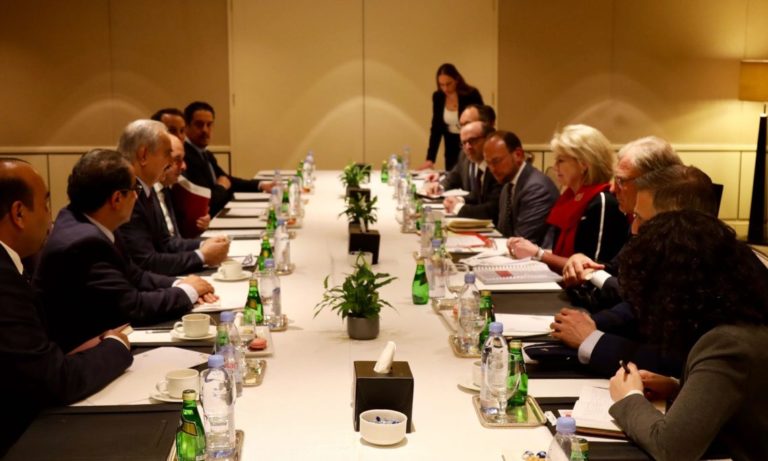
US Delegation meeting with General Khalifa Haftar, Nov 24, 2019
Libya becomes the third theatre after Ukraine and Syria where Washington has locked horns with Moscow in a Cold War-style proxy war. Up until last weekend, two EU members were supposedly conducting a proxy war in Libya over control of Africa’s largest oil and gas resources — France and Italy.
Actually, the alignments in Libya do not warrant a US-Russia standoff, as disparate external powers largely pursue self-interests. Italy, Turkey and Qatar have backed the Government of National Accord (GNA) in Tripoli (also supported by Germany and the UN), while France, Egypt, UAE, Saudi Arabia and Russia backed LNA.
The fight against terrorist groups is a stated common objective of all protagonists, but there are sub-plots too — Libya’s oil and gas (France, Italy, Turkey and Russia); political Islam (Turkey, Qatar, Egypt, UAE); France’s military operations in the five Sahel countries (Mauritania, Mali, Niger, Burkina Faso and Chad), which can end only with the stabilisation of Libya; the migration issue; and geopolitical interests (France, Italy, Russia and Turkey).
Although Haftar was a CIA “asset” for over three decades, Washington largely kept contacts with him under the radar and seemingly watched the struggle between GNA and LNA from the sidelines even after Haftar launched a determined push in April to capture Tripoli. The US policies were incoherent. President Trump apparently viewed Haftar as a factor of stability, while Washington officially pitched for a UN-mediated political settlement in Libya, although that is easier said than done, given the fragmentation in the country.
Washington was marking time, unsure whether Haftar’s military campaign would succeed. Moscow too took a back seat, but in recent months the Kremlin began weighing Haftar’s prospects positively. Moscow (like Cairo) counts on Haftar’s impeccable credentials in the fight against terrorist groups.
Russian military support has decisively helped Haftar’s campaign, which took big leaps lately. Haftar controls something like 80 percent of Libya, whereas, GNA is reduced to a mere rump confined to Tripoli.
Enter Washington. Washington feels alarmed that in the Libyan endgame, with Haftar inexorably gaining the upper hand, thanks to Moscow’s help, the vista opens for cascading Russian influence over the new regime.
Nonetheless, it isn’t easy to find fault with Russia’s military role to stabilise Libya, since NATO intervention in 2011 that wrought havoc and such colossal destruction had enjoyed the backing of Obama Administration. Washington is on weak moral grounds. Geopolitics is dictating its policy trajectory.
Washington’s policy is driven by the project to make Libya the headquarters of the United States Africa Command, one of the eleven unified combatant commands of the United States Armed Forces (which is presently based in Stuttgart, Germany.) Clearly, the rollback of Russian presence and influence in Libya becomes a prerequisite of the US project.
The backdrop, of course, is the big-power struggle erupting over Africa and its vast untapped resources. China has been rapidly expanding its presence in Africa and Russia too is stepping up. Importantly, as the recent Russia-Africa summit in Sochi (October 23-24) signalled, military cooperation is Moscow’s priority.
Russia and China’s growing presence creates space for African leaderships to negotiate with the Western powers. It is a sign of the times that the South African Navy’s first-ever multinational maritime exercise (November 25-30) is exclusively with Russia and China.
Fan Guanqing, the captain of the PLA Navy frigate Wei Fang, said in Cape Town last weekend, “We hope that the exercises will allow China, Russia and South Africa to work together and make an improvement through co-operation and exchanges. This exercise is historical and the first of its kind for these three countries.” Captain Fan said the maritime exercise should help maintain world peace and stability and would also be the starting point of a relationship between the three countries.”
Libya is the perfect gateway for NATO to penetrate the African continent. But a willing government in Tripoli could give the Russian Navy access to the eastern Libyan ports of Sirte and Benghazi on the Mediterranean. If Russia gets ensconced in Libya (in addition to Syria), NATO presence in the Mediterranean is affected. Russia and Libya also have a history of close political, military and economic ties dating back to the Soviet era.
Russia had a traditional presence in Libya’s armaments market and Soviet troops were deployed in Libya. Today, Libya’s reconstruction is the real prize for Moscow in terms of infrastructure (roads, railways, cities). Russia lost heavily due to the NATO-led regime change in Libya in 2011. Moscow had billions of dollars in investments in Libya during Moammar Gadhafi’s rule.
It remains to be seen how far the US pressure tactic on Haftar to sever his links with Russia will work. Russia, France and Egypt are on the same page in helping Haftar militarily. All three countries also bond together. While Moscow’s politico-military relations with Cairo are deepening, France is decoupling from the US’ Russia policies. Washington will be hard-pressed to isolate Russia in Libya. The big question is where indeed Haftar himself stands.
US impeachment furor sabotages Ukraine peace talks
By Finian Cunningham | RT | November 26, 2019
The much-anticipated meeting between Ukraine’s Volodymyr Zelensky and Russia’s Vladimir Putin is in danger of being a lost opportunity for peace. Washington’s political infighting has stacked the odds against a successful summit.
Weeks of impeachment hearings in the House of Representatives, accusing President Trump of abusing his office with regard to Ukraine, have achieved very little except for two things. Ukraine’s international image has been trashed with corruption claims and depiction of the country as having vassal-like dependency on the US, and secondly, demonization of Russia which has been heightened as an “aggressor” supposedly out to destroy Ukraine.
The irony is that Washington purports to be an ally of Ukraine to promote democracy, sovereignty, and independence of the former Soviet republic. But the upshot of the impeachment inquiry is that Ukraine’s independence and sovereignty is gravely undermined.
When President Zelensky holds multilateral talks soon with Putin, the Ukrainian leader will have little room to maneuver as a result of the cacophony back in the US.
The two leaders are due to meet on December 9 in Paris as part of a four-way summit also involving German Chancellor Angela Merkel and French President Emmanuel Macron. The meeting is a return to long-suspended peace talks and an attempt to revive the 2015 Minsk accords for ending conflict in eastern Ukraine.
It is over three years since the so-called Normandy Format last convened. The Minsk peace deal was never implemented, mainly because former Ukrainian president, Petro Poroshenko, refused to fulfill commitments to give regional autonomy to pro-Russian separatists in eastern Ukraine. Consequently the war has dragged on for nearly five years.
Zelensky was elected by a landslide vote in April primarily on the ticket that he would seek a peace settlement. In September, he agreed in principle to grant special status for the Donbas breakaway region of eastern Ukraine. Subsequently, though, Zelensky has appeared to backpedal on how much autonomy he is willing to countenance. Troops under his command have begun withdrawing from the front line with separatists, but it is not clear if that move marks a reliable de-escalation.
Alexander Lukashevich, Russia’s permanent representative to the Organization for Security and Cooperation in Europe, stated on November 21 that forces under Kiev’s command are still violating terms of a truce by not removing combat hardware from the line of contact. “This, to put it mildly, non-constructive approach to preparations for the Normandy meeting causes justified concern,” he added.
In a move seen as a trust-building gesture, Russia recently returned three Ukrainian naval vessels which it had confiscated last year after an infringement of its territory in the Kerch Strait.
The forthcoming meeting in Paris thus holds a fledgling start to finding a peaceful resolution to a conflict which has resulted in over 13,000 dead and millions displaced from their homes.
However, the impeachment debacle in Washington has painted Zelensky as a pathetic politician “who loves Trump’s a**” and “who will do anything” to curry favor with the president. The Democrats and obliging former US diplomats who had worked in Ukraine are claiming that Trump pressured Zelensky to dig dirt on Joe Biden, his would-be Democrat rival in next year’s election.
So zealous are Trump’s political opponents in Washington, together with the liberal media and US intelligence agencies, to pin an impeachable offense on him, that the Ukrainian president has ended up a lame-duck leader in the collateral damage.
This has generated much mockery among Ukrainians of the former comedian-turned-president, who has been nicknamed “Monica” in reference to the impeachment of President Bill Clinton for his sexual affair with White House intern Monica Lewinksy.
Even before the hearings in Congress got under way, Zelensky had been under fire from Ukrainian nationalists who accuse him of “capitulating” to Russia over his willingness to negotiate a peace settlement in eastern Ukraine. Kiev has seen large rallies of up to 20,000 protesting Zelensky’s peace efforts as a betrayal.
In a recent media interview, American professor Stephen Cohen, an astute observer on Russia-Ukraine, says that Zelensky is in a very precarious situation. Despite being overwhelmingly elected to find a peaceful solution to Ukraine’s conflict, the new president, says Cohen, has to contend with far-right paramilitary leaders who view any peace deal negotiated with Russia as treasonous. Zelensky has been subjected to death threats.
As Cohen points out, if the US was genuinely concerned about establishing peace and democracy in Ukraine, then Washington should be fully supporting Zelensky’s overtures to Moscow, to let him and the Ukrainian people know “we got your back.”
But as it is, Zelensky is going into negotiations with Putin as an isolated figure who has been demeaned by Washington’s squabbling and caricatured as a stooge.
Thus, what is being set up for the Ukrainian leader is an almost impossible task. If he were to agree with Putin to a further withdrawal of military forces from the contact line with pro-Russian separatists, or if he commits to implementing Minsk provisions for regional autonomy, then the uproar in Washington is predictable. Zelensky will be cast as selling out to Putin and capitulating to “Russian aggression.”
Such is the delirium of Russophobia in Washington, where Democrats and so-called ‘Russia experts’ like Fiona Hill have labeled Trump a “Kremlin agent” and “Bolshevik,” the next sequence in their narrative is that Trump abused his office in order to get Zelensky to surrender to Putin. Now we’re really talking impeachment, so it goes.
Missing from the political fight in Washington are the following key issues: it was American and European interference in Ukraine, not Russian, that plunged the country into ongoing conflict. That interference peaked with the CIA-backed coup in Kiev in February 2014, which led to Crimea seceding in a referendum and joining the Russian Federation. The coup also led directly to the war in eastern Ukraine by a neo-Nazi regime in Kiev against the ethnic Russian population who understandably have demanded autonomy.
The $400 million in military aid that Trump is accused of using as leverage on Zelensky, obscures the bigger picture of why the US has sent a total of $1 billion in military aid to the country in order to antagonize Russia. This has long been the agenda of Washington’s foreign policy establishment, to destabilize Russia by pushing Ukraine to join the NATO alliance.
The impeachment hearings against Trump have obscured and turned reality on its head. The anti-Trump Democrats, media and ‘deep state’ operatives want to exclude any wider investigation into corrupt dealings by the former Obama administration in Ukraine by asserting that any such claims are merely “Russian disinformation.”
Moreover, not only is the truth about Washington’s corruption in Ukraine being concealed, but the vassal status of Ukraine is complete by it not having any freedom to negotiate its way out of conflict or restoring normal neighborly relations with Russia.
Also on rt.com:
The Real Bombshell of the Impeachment Hearings
By Ron Paul – November 25, 2019
The most shocking thing about the House impeachment hearings to this point is not a “smoking gun” witness providing irrefutable evidence of quid pro quo. It’s not that President Trump may or may not have asked the Ukrainians to look into business deals between then-Vice President Biden’s son and a Ukrainian oligarch.
The most shocking thing to come out of the hearings thus far is confirmation that no matter who is elected President of the United States, the permanent government will not allow a change in our aggressive interventionist foreign policy, particularly when it comes to Russia.
Even more shocking is that neither Republicans nor Democrats are bothered in the slightest!
Take Lt. Colonel Vindman, who earned high praise in the mainstream media. He did not come forth with first-hand evidence that President Trump had committed any “high crimes” or “misdemeanors.” He brought a complaint against the President because he was worried that Trump was shifting US policy away from providing offensive weapons to the Ukrainian government!
He didn’t think the US president had the right to suspend aid to Ukraine because he supported providing aid to Ukraine.
According to his testimony, Vindman’s was concerned over “influencers promoting a false narrative of Ukraine inconsistent with the consensus views of the interagency.”
“Consensus views of the interagency” is another word for “deep state.”
Vindman continued, “While my interagency colleagues and I were becoming increasingly optimistic on Ukraine’s prospects, this alternative narrative undermined US government efforts to expand cooperation with Ukraine.”
Let that sink in for a moment: Vindman did not witness any crimes, he just didn’t think the elected President of the United States had any right to change US policy toward Ukraine or Russia!
Likewise, his boss on the National Security Council Staff, Fiona Hill, sounded more like she had just stepped out of the 1950s with her heated Cold War rhetoric. Citing the controversial 2017 “Intelligence Community Assessment” put together by then-CIA director John Brennan’s “hand-picked” analysts, she asserted that, “President Putin and the Russian security services aim to counter US foreign policy objectives in Europe, including in Ukraine.”
And who gets to decide US foreign policy objectives in Europe? Not the US President, according to government bureaucrat Fiona Hill. In fact, Hill told Congress that, “If the President, or anyone else, impedes or subverts the national security of the United States in order to further domestic political or personal interests, that is more than worthy of your attention.”
Who was Fiona Hill’s boss? Former National Security Advisor John Bolton, who no doubt agreed that the president has no right to change US foreign policy. Bolton’s the one who “explained” that when Trump said US troops would come home it actually meant troops would stay put.
One by one, the parade of “witnesses” before House Intelligence Committee Chairman Schiff sang from the same songbook. As US Ambassador to the EU, Gordon Sondland put it, “in July and August 2019, we learned that the White House had also suspended security aid to Ukraine. I was adamantly opposed to any suspension of aid, as the Ukrainians needed those funds to fight against Russian aggression.”
Meanwhile, both Democrats and Republicans in large majority voted to continue spying on the rest of us by extending the unpatriotic Patriot Act. Authoritarianism is the real bipartisan philosophy in Washington.
Copyright © 2019 by RonPaul Institute
The Civilian Government Doesn’t Owe Deference to Military Officers

By Ryan McMaken – Mises Institute – 11/20/2019
On Tuesday, Congressional impeachment hearings exposed an interesting facet of the current battle between Donald Trump and the so-called deep state: namely, that many government bureaucrats now fancy themselves as superior to the elected civilian government.
In an exchange between Rep. Devin Nunes (R-CA) and Alexander Vindman, a US Army Lt. Colonel, Vindman insisted that Nunes address him by his rank.
After being addressed as “Mr. Vindman,” Vindman retorted “Ranking Member, it’s Lt. Col. Vindman, please.”
Throughout social media, anti-Trump forces, who have apparently now become pro-military partisans, sang Vindman’s praises, applauding him for putting Nunes in his place.
In a properly functioning government — with a proper view of military power — however, no one would tolerate a military officer lecturing a civilian on how to address him “correctly.”
It is not even clear that Nunes was trying to “dis” Vindman, given that junior officers have historically been referred to as “Mister” in a wide variety of times and place. It is true that higher-ranking officers like Vindman are rarely referred to as “Mister,” but even if Nunes was trying to insult Vindman, the question remains: so what?
Military modes of address are for the use of military personnel, and no one else. Indeed, Vindman was forced to retreat on this point when later asked by Rep. Chris Stewart (R-UT) if he always insists on civilians calling him by his rank. Vindman blubbered that since he was wearing his uniform (for no good reason, mind you) he figured civilians ought to refer to him by his rank.
Of course, my position on this should not be construed as a demand that people give greater respect to members of Congress. If a private citizen wants to go before Congress and refer to Nunes or any other member as “hey you,” that’s perfectly fine with me. But the important issue here is we’re talking about private citizens — i.e., the people who pay the bills — and not military officers who must be held as subordinate to the civilian government at all times.
After all, there’s a reason that the framers of the US Constitution went to great pains to ensure the military powers remained subject to the will of the civilian government. Eighteenth and nineteenth century Americans regarded a standing army as a threat to their freedoms. Federal military personnel were treated accordingly.
Article I, Section 8 of the Constitution states that Congress shall have the power “to raise and support Armies …” and “to provide and maintain a Navy.” Article II, Section 2 states, “The President shall be the Commander in Chief of the Army and Navy of the United States, and of the Militia of the several States when called into the actual Service of the United States.” The authors of the constitution were careful to divide up civilian power of the military, and one thing was clear: the military was to have no autonomy in policymaking. Unfortunately, early Americans did not anticipate the rise of America’s secret police in the form of the CIA, FBI, NSA, and other “intelligence” agencies. Had they, it is likely the anti-federalists would have written more into the Bill of Rights to prevent organizations like the NSA from shredding the fourth amendment, as has been the case.
The inversion of the civilian-military relationship that is increasingly on display in Washington is just another symptom of the growing power of often-secret and unaccountable branches of military agencies and intelligence agencies that exercise so much power both in Washington and around the world.
What Republicans Must Ask the Whistleblower
By Peter Van Buren | We Meant Well | November 19, 2019
The whistleblower needs to be front and center in the impeachment proceedings on TV. Here’s why.
As the latest public spectacle unironically displaces daytime soap operas, the picture is starting to become clearer. The people testifying aren’t there to save America. They are a group of neo-somethings inside the administration who disagreed with Trump’s Ukraine policy and decided to derail it.
The plan was unlikely intended to lead to impeachment when things began to move back in May, after then-Ambassador to the Ukraine Marie Yovanovitch was fired. Contrary to the president’s policy the taxpayers paid her to represent, she had her own, and promoted confrontation with Russia over Ukraine and sought more military aid. Bill Taylor was then installed as a figurehead in the embassy and Ukraine policy was taken away from hardliners at the State Department and NSC and handed over to America’s favorite knucklehead, Rudy Giuliani, and the inexperienced, Trump-appointee, Gordon Sondland.
The bureaucracy called a Code Red. They were needed on that wall to stand against Russia. It seemed easy enough. Ukraine was off most of the public’s radar, so some Op-Eds, Trump’s men nudged aside, and the mini-coup over Ukraine policy would have worked. John Bolton, who could have stepped in and told everyone to return to their seats or no snack time, was agog at the amateur efforts by Giuliani, and certainly no fan of a less robust Ukraine policy anyway.
Things got out of the group’s hands when Democrats, desperate for something to impeach on after Russiagate imploded, seized on the objections over Ukraine policy as slightly more than the nothing they otherwise had (the alternative was resurrecting the Stormy Daniels-Michael Avenatti-Michael Cohen sleaze fest.) An objection over policy and who would run it was transformed into a vague smatter of quid pro quo based on that July 25 phone call, using a whistleblower’s undergrad-level prank “complaint” as the trigger.
And that’s why the whistleblower is very relevant. He knows nothing first-hand himself (neither does anyone else, see below, but someone had to go first) admitting in his complaint all his information is second hand. He is not anonymous; Google “who is the whistleblower” and you too can know everything official Washington and the media already know about him, back to his college days. So no one needs to fret about his safety, and no one needs to ask him any questions about the July 25 call.
Here is the question the whistleblower must be asked: how did this jump from policy disagreements among like-minded people (you, Vindman, Taylor, et al) to claims of an impeachable offense? Who engineered that jump? Was it Adam Schiff’s staffers who first met with the whistleblower? Schiff lied about that contact. Or was it a partisan D.C. lawyer who has been trolling Twitter since Trump’s election looking for someone to hand him raw material he’d lawyer into a smoking gun (an organization he is connected with had mobile billboards advertising for whistleblowers circling the White House, the Capitol, the Pentagon, the CIA and the National Security Agency to try to attract clients)?
Did the whistleblower make himself into a pawn, or was he made into a pawn? The answer is very important because at this point how the whistleblower came to be at the ground zero of electoral politics tells us if this is a legitimate impeachment or a political assassination. The voters will have to judge that in about a year independent of the partisan votes (the weakness of the actual impeachment case is explained here) taken in the House and Senate.
The popular impression is men like the whistleblower, Bill Taylor, and Alex Vindman are non-partisan, and there is some truth to that. They came up through a system which strongly emphasized service to the president, whomever that is. But it would be wrong to equally claim they are policy agnostic; in fact, likely quite the opposite. They see themselves as experts, and in Vindman’s case, a native son, who know better. That’s why they were hired, to advise, and under Obama their advice (for better or worse, they wanted to bring us to war with Russia) was generally followed.
They knew they knew better than the Orange Clown who somehow ended up in the Oval Office and ignored them. They knew he was wrong, and talked and texted about it among themselves. That’s OK, normal even. But it appears they came to see Trump not just as wrong but as dangerous. Add in some taint of self-interest on Trump’s part, and he became evil. They convinced themselves it was a matter of conscience, and wrapped their opposition in the flagged courage of a (created?) whistleblower. Certainly if one hadn’t existed it would have been necessary to invent him.
With their testimony focused mostly on their disagreements with Trump’s Ukraine policy, and their own intellectual superiority, it seems such proclamations of conscience have more to do with what outcomes and policy the witnesses support and less to do with understanding that without an orderly system of government with a functioning chain of command all is chaos. The Trump-deranged public is overlooking the dark significance of serving officials undermining the elected president because of policy disagreements. They hate Trump so much they are tolerating insubordination, even cheering it. Now that’ll bite America back soon enough. You don’t join government to do whatever partisan thing you think is right; you serve under a system and a chain of command. There is no Article 8 in the Constitution saying “but if you really disagree with the president it’s OK to just do what you want.”
I served 24 years in such a system, joining the State Department under Ronald Reagan and leaving during the Obama era. That splay of political ideologies had plenty of things in it my colleagues and I disagreed with or even believed dangerous. Same for people in the military, who were told who to kill on America’s behalf, a more significant moral issue than a boorish phone call. But we also knew the only way for America to function credibly was for [us] to follow the boss, the system created by the Constitution, and remembering we weren’t the one elected, and that we ultimately worked for those who did the electing. So let’s hear from the whistleblower and all the witnesses about that, not their second hand knowledge of Trump’s motivations, but their first hand knowledge of their own motivations.
Americans in government and military are mostly decent people. Unlike some who hold power in banana republics, they are unlikely to be convinced to undermine the president for personal gain. But give them a crusade, tell them they are heroes Mueller failed to be, and they will convince themselves anything is justified. Those impure motivations are what transformed the witnesses now driving impeachment from being dissenters to insubordinate, into convincing themselves they needed to make a stand. Vindman gives it away, saying he twice “registered internal objections about how Mr. Trump and his inner circle were treating Ukraine,” out of what he called a “sense of duty.” Duty to what?
The not very anonymous whistleblower is only 33-years-old, but of the mold. Ivy League, CIA, language guy, a Ukraine specialist who found himself and his knowledge embraced by Obama and Biden — the right guy in the right place — until he was set aside by Trump with new policy. Taylor fancies himself the last honest man, shepherding U.S.-Ukrainian policy through rough waters, having been ambassador to Ukraine 2006-2009. Yovanovitch was a partisan, representing her own vision, not that of the elected leadership, because she was sure she knew better after her years at State. Best and the brightest. They were professional, seasoned dammit, look at their resumes! The uniform!
If they came to being whistleblowers and then players in politics honestly, then were simply side-slipped into becoming pawns, they should be quietly retired, this generation’s Colin Powell. But if they are agent provocateurs, they need to be fired. That’s why we need to talk to the whistleblower, to understand that difference.
That’s for them, now for us. If this all was just a hearing on bad policy planning and what happens when knuckleheads like Rudy Giuliani get involved, it would make interesting history. If this was a long-overdue review of U.S. relations with Ukraine, it would be welcome. But as an attempt to impeach the president, it is a sordid, empty, brazen, political tactic hardly worthy of the term coup. It sets a terrible example of what we will tolerate from the bureaucracy if we hate the incumbent president enough. It opens the door to political opportunism, and informs real would-be insubordinates how to proceed more effectively. It signals chaos to our allies and opens opportunity to our enemies.
There’s a fine line between necessary dissent and wicked insubordination, between conscience and disobedience, but there is a line and it appears to have been crossed here. The attack is no longer on policy, on which Taylor and Vindman may lay some claim, it is on the president and only the voters should have that say.
North Korea Says US Should Completely Halt Joint Drills With Seoul Instead of Suspending Them
Sputnik – November 19, 2019
The US should completely stop joint military exercises with South Korea instead of postponing them, Chairman of the North Korean Asia-Pacific Peace Committee Kim Yong Chol said, following Washington and Seoul’s decision to delay the upcoming military drills known as the Combined Flying Training Event, scheduled for November.
“The United States puts the postponement of joint exercises as care and concessions to someone and boasts that they contribute to peace and security on the Korean Peninsula, but what we demand from the United States is not to conduct exercises with South Korea or completely stop the exercises at all,” Kim said, as quoted by the Korean Central News Agency.
According to Kim, Washington-Seoul joint drills do not ensure security on the Korean Peninsula or contribute to a diplomatic solution to the issue. He also reiterated that unless Washington abandons its “hostile policy” toward North Korea, denuclearization talks are impossible.
On Sunday, US Secretary of Defense Mark Esper said that the United States and South Korea agreed to hold off the upcoming joint military air exercises in a show of good faith to promote a denuclearization dialogue with Pyongyang and encourage the latter to reciprocate.
After the first US-North Korea summit in June 2018, US President Donald Trump announced that he intended to suspend the joint military exercises with South Korea, calling them expensive and inappropriate in dialogue with Pyongyang. The allies have since canceled several drills that North Korea deemed as a provocation. Most recently, in early November, Washington and Seoul reportedly agreed to skip the Vigilant Ace military drills, scheduled to take place in December, for the second year in a row. However, later reports indicated that the countries would proceed with the exercise but would hold limited flight drills.
Despite the suspensions, the talks have since reached a deadlock, with Pyongyang calling for more flexibility on the part of Washington, particularly concerning sanctions relief. In October, North Korea gave the US until the end of the year to come up with a mutually acceptable deal to advance the denuclearization process.
U.S. Continues to Draw Lines in Eastern Mediterranean
By Paul Antonopoulos | November 19, 2019
From November 3 to November 14, Israeli, U.S., German, Italian and Greek war jets participated in the “Blue Flag 2019” military exercises out of the Ovda Air Base in Israel’s Negev Desert. The timing of these exercises corresponds with Turkey and a whole host of other countries conducting their own naval exercises in the Aegean and Mediterranean Seas.
Lines are certainly being drawn in the Eastern Mediterranean between pro-U.S. forces and states seeking their own sovereignty away from U.S. hegemony, especially Turkey. Greece proves to be a curious country at the moment, since one of its warships participated in the Turkish-led naval exercises, even though Pakistan twice violated Greek airspace during these exercises and a war of words continues to ensue between Turkish and Greek political leaders over the maritime waters of Cyprus and the Eastern Aegean.
Although Greece was involved in both exercises, there can be no doubt that the Blue Flag 2019 exercises were aimed against Russia, Turkey and Iran. Part of the Blue Flag 2019 was the process and execution of aerial scripts to neutralize Russia’s S-400 Triumph missile defense system. However, since none of the participating countries have an S-400, the Israeli military had deployed U.S.-made Patriot missiles in specific locations to try to simulate the capabilities of the Russian-made systems during the military exercises that occurred near the Gaza Strip.
The simulation of the S-400 rocket launcher demonstrates for the first time that Israel is actively preparing to deal with such a system that exists only in Syrian and Turkish territory. In Syria, the powerful Russian defense system was deployed to protect Russian forces exactly four years ago, ironically because Turkey blew out a Russian jet from Syrian airspace in November 2015.
Meanwhile, the S-300V4 missiles will also be deployed in Egypt. The S-300V4 uses almost similar technology to the S-400 and has great capabilities in handling stealth aircraft. The S-400 has recently been shipped to Turkey, but is not yet operational, while Iran and Saudi Arabia have also shown interest in these systems.
The oldest and least capable S-300PMU-2 was deployed by the Syrian armed forces in late 2018, reducing the frequency of Israeli attacks in the country, but not stopping them. It is unclear what exact development led to Israel’s implementation of the S-400 neutralization training, however it is likely that these systems will also begin appearing elsewhere in the Middle East, putting Israel in a compromised military position.
Whatever the case, a big game is being played in the area with the possession and potential use of strategic weapons, such as Russian missiles and 5th generation American fighter jets.
Turkey, Greece, Israel, the U.S. and Syria have been embroiled in a meltdown of developments over who will eventually have the upper hand in the Eastern Mediterranean, but it is also seen that alliances are forming in the region. Although Greece was involved in both exercises taking place in the Eastern Mediterranean, its warship participating in the Turkish-led exercises took a more observatory position ensuring that its maritime waters were not violated, while it took a very active role in Israel, even winning the war games against the other participants of the exercises, which is unsurprising since Greece has the best pilots in NATO.
While Greece also participated in the Turkish-led naval exercises, it was actively training its pilots alongside the U.S. and conducting drills with Patriot missile batteries modified to imitate the Russian-made systems. However, the Russian systems hit targets twice as fast as the Patriots, and at a longer distance and higher altitude – essentially, attempting to use Patriots to simulate the S-400 would not have been very accurate.
It cannot be forgotten that Saudi Arabia, the world’s largest exporter of oil in the world, on September 14 had its daily supply cut by nearly 50 percent because of drone and missile attacks against state-owned oil company by the Yemeni Houthi-led Ansarullah resistance movement. With Saudi Arabia investing billions of dollars into the Patriot system, it would have been expected that they would have a near 100% success rate in hitting all the missiles launched by the Ansarullah Movement.
It is for this reason that Russian Senate Security and Defense Committee member Franz Klintsevich, in a comedic manner, stated that “if Saudi Arabia had installed the Russian anti-aircraft systems, this would not have happened. The S-300 and S-400 missile systems, supported by the Pantsir S-1 would not have allowed any of the drones and missiles to hit their target. The Saudis should think about it.” Therefore, there is a huge doubt that the modified Patriots could successfully mimic the S-400.
Whether the training against “the S-400” in Israel was successful for the participating countries, it more importantly demonstrates an intent by these countries to be able to overcome the Russian missile defense system. For Israel, it is crucial so that it knows how to respond to any hypothetical war with Iran or Turkey, while for the U.S. it would also be against Russia.
With Russia selling the S-400 system, announcing its intent to also sell fighter jets, and conducting patrols with Turkey in Syria, their ties are becoming much more integrated. It also appears that the U.S., Greece and Israel are strengthening their military coordination in the Eastern Mediterranean. Although Israel is not against Russia, it certainly has an adversarial political and military relationship with Turkey despite their close economic ties, just as Greece does with Turkey. And although Greece might not be against Russia, they certainly are against Turkey. The U.S. intentions for the Blue Flag 2019 exercise are to coordinate an alliance against Russia, and potentially Turkey, while training against the S-400.
Paul Antonopoulos is a Research Fellow at the Center for Syncretic Studies.
Featured Video

Iran’s Next Strike May Not Explode. It Could Shut You Down
or go to
Aletho News Archives – Video-Images
From the Archive
Zionism’s Violent Legacy
By Donald Neff | Washington Report On Middle East Affairs | January 1996
On January 4, 1948, Jewish terrorists drove a truck loaded with explosives into the center of the all Arab city of Jaffa and detonated it, killing 26 and wounding around 100 Palestinian men, women and children.[1] The attack was the work of the Irgun Zvai Leumi – the “National Military Organization,” also known by the Hebrew letters Etzel – the largest Jewish terrorist group in Palestine. The Irgun was headed by Revisionist Zionist Menachem Begin and had been killing and maiming Arabs, Britons and even Jews for the previous ten years in its efforts to establish a Jewish state.
This terror campaign meant that at the core of Revisionist Zionism there existed a philosophical embrace of violence. … continue
Blog Roll
 Aletho News
- Saudi oil boss issues global supply warning
- Riyadh Says Its Oil System Is Intact. The Numbers Say Otherwise.
- Trump and Netanyahu Want to “Finish the Job” on Iran
- US ‘one-sided dictation’ not Iran’s beliefs makes rational talks impossible: Baghaei
- Iran’s Next Strike May Not Explode. It Could Shut You Down /Col Doug Macgregor
- Iran: US political targets legitimate if assassinations return
- Iraq shuts key border crossing with Iran under US pressure: Report
- Undersea Internet cables could be targeted in retaliation for attacks on Iran: IRGC deputy chief
- EU sending ‘biased’ observers to interfere in Serbian election – president
- White House envoy declares kinetic action against Yemen ‘fruitless’
- If Americans Knew
- Trump’s Intensifying Sabotage of the ICC, for Israel’s Sake
- Israeli military detain US and UK volunteers in West Bank including Democratic NY politician Brad Lander
- Americans at National Conservatism Conference held in Israel this year criticize Israel
- Christiane Amanpour exits CNN with a legacy shaped by the debate over Israel
- Israel’s war on Iran is the final move in a decades-old strategy
- Israel Denies Entry to French Journalist, U.S. Researcher Amid Rise in Entry Denials
- Gaza’s hospitals are running out of life-saving fuel – Daily Update
- Mysterious bot accounts reportedly spread fake ‘man on the street’ videos for Michigan Senate candidate
- Israeli Defense Minister Katz Says Over 60 Lebanon Villages Have Been Destroyed
- Why Is Israel Running TV Ads in Iowa Ahead of the Midterms?
- No Tricks Zone
- E-Cars Reduce CO2 Emissions By Only 41% Compared To Internal Combustion Engine Vehicles
- Predictions Made By Renowned Climate Professor Over Past Decades Have Been Proven To Be Poor
- New Study Suggests Large Regions Of The Pacific Ocean Have Been Cooling For The Last 80 Years
- Germany’s Green Energy Debacle: High Energy Costs Force Kahla Porzellan to Close After 182 Years!
- New Study: 50 Years Of The Most Aggressive ‘Net Zero’ Policies Can Only Affect The Global Climate By 0.03°C
- US September “Heat” Was No Record…Many Records Set Decades Ago
- Latest European Green Energy Debacle; Portugal’s Largest Flagship Solar Park Insolvent!
- Green Energy Debacle: German Expert Professor Fritz Vahrenholt Warns Of Severe Economic And Social Consequences
- Two More Paleo Reconstructions Affirm Meters-Higher Sea Levels Across Ireland, Brazil 7000-6000 Years Ago
- New Study: Earth And Venus Surface Warmth Largely Explained By Convection And Lapse Rate, Not CO2 Or Radiation

