Major US-South Korea air exercise postponed, described by US as an ‘act of goodwill’ to Pyongyang
RT | November 17, 2019
The United States and South Korea shelved aerial drills that were set to kick off later in November and were earlier described by Pyongyang as provocative, US Defense Secretary Mark Esper announced on Sunday.
At a press briefing with his South Korean counterpart Jeong Kyeong-doo in Bangkok, Esper insisted the move was not “a concession” to his partner country’s neighbor and argued the postponement was rather a diplomatic gesture in a hope to bring new life into the gridlocked denuclearization talks. “We have made this decision as an act of goodwill to contribute to an environment conducive to diplomacy and the advancement of peace,” Esper said.
No new date for the training has been set. Previously, Seoul and Washington had scaled down the exercise from the grandiose Vigilant Ace drills to a more modest Combined Flying Training Event, for the second year in a row.
US Defense Secretary urged Pyongyang to return to the negotiating table and hinted the delay with the exercise could be considered a part of a deal, term frequently used by Trump’s administration for diplomatic talks. “I see this as a good-faith effort by the United States and the Republic of Korea to enable peace, to facilitate a political agreement, a deal if you will,” he said.
Last month, North Korea walked away from the formal denuclearization talks with the United States in Sweden. Country’s foreign ministry added that it had “no intention to hold such sickening negotiations before the U.S. takes a substantial step to completely and irreversibly abandon the hostile policy” against North Korea.
A less obvious sign of softening of the US policy towards North Korea played out on Thursday in the United Nations, when the assembly adopted a resolution condemning human rights violations in North Korea. The document was sponsored by the European Union and joined by the United States and others. However, South Korea decided to withdraw from the list of sponsors, for the first time since 2008, the period of Seoul’s Sunshine Policy towards North Korea. North Korea dubbed the resolution as “a political provocation” of the US.
North Korea to US: We are not interested in talks aimed at appeasing us
Press TV – November 14, 2019
North Korea rebuffs a recent offer by the United States to resume bilateral talks, saying accepting such negotiations would only help Washington pass a Pyongyang deadline for the former to adopt a more flexible approach.
The proposal came through American negotiator Stephen Biegun to his North Korean counterpart Kim Myong Gil through a third country. It urged that the countries resume their discussions following three rounds of failed talks, which started in Singapore last year and was followed up in Vietnam’s capital Hanoi and Stockholm.
The North has given the US until the end of the year to ease its stance towards the country.
On Thursday, the North Korean negotiator called Biegun’s proposal a “sinister aim of appeasing us in a bid to pass with ease” Pyongyang’s deadline.
“We have no willingness to have such negotiations,” the Korean official asserted.
The Singapore talks came on Washington’s initiative against a backdrop of drawn-out sheer hostility, marked by fiery exchanges between the countries.
After the Hanoi talks, Trump even paid a “surprise” visit to the North as he was staying for a visit in South Korea and became the first US president to take a few steps into the North Korean soil.
However, all the apparent US attempts at rapprochement have fallen far short of Pyongyang’s demands that Washington lift its punishing sanctions against it and halt its joint military maneuvers with the South.
The US has conditioned such measures on the North’s denuclearizing first.
US Secretary of Defense Mark Esper said on Wednesday that he was open to changes in the US military activity in South Korea.
Kim Yong Chol, a senior North Korean official, who led negotiations in the run-up to the Vietnam summit, said late on Thursday that he hoped Esper meant to completely halt the joint drills.
“But if … the hostile provocation against us is carried out, we won’t help but responding with shocking punishment that the United States can’t afford,” he added.
US, South Korea could scale back joint drills: Esper
Press TV – November 14, 2019
US military exercises with South Korea could be scaled back to aid diplomacy with the nuclear-armed North, Defense Secretary Mark Esper signaled on his way to Seoul, as Pyongyang said it was running out of patience.
The North has long protested joint military drills, which it condemns as preparations for invasion, and has set Washington an end-of-year deadline to come up with a new offer in deadlocked negotiations on its weapons programs.
The US and South Korea last year cancelled several joint drills in the wake of the Singapore summit between President Donald Trump and the North’s leader Kim Jong Un, but are due to carry out a combined air exercise next month.
“We will adjust our exercise posture either more or less depending on what diplomacy may require,” Esper told reporters on board his plane to Seoul, where he starts an Asian tour Thursday.
The possible downsizing of the joint drills should not be seen as a “concession” to Pyongyang, he said, “but as a means to keep the door open to diplomacy”.
“I’m all for diplomacy first,” he added.
His comments came after Pyongyang reiterated its demands for the combined exercise to be scrapped.
“The US is not accepting with due consideration the year-end time limit that we set out of great patience and magnanimity,” a spokesman for the State Affairs Commission (SAC) said in a statement carried by the official KCNA news agency.
The SAC is the North’s top governing body and it is unusual for it to issue such declarations.
Holding the drills would be an “undisguised breach” of the Singapore summit declaration, it said, adding: “Betrayal is only what we feel from the US side.”
“We no longer feel the need to exercise any more patience,” it went on, but gave no details of the “new way” it was threatening to pursue if Washington did not meet its demands.
Negotiations have been gridlocked since the Hanoi summit between leader Kim Jong Un and Trump broke up in February disagreement over sanctions relief and what the North would be willing to give up in return.
Working-level talks restarted in Sweden in October only to break down quickly, with the North blaming the US for not giving up its “old attitude”.
Pyongyang has carried out a series of missile tests in recent weeks and months, including one launched at sea, which it said was fired from a submarine — a potential strategic game-changer.
The tests would improve the North’s capabilities, Esper acknowledged.
“Anytime you test, you learn something,” he said. “We take them very seriously and we watch them very closely, but we’re also not going to overreact and do something that, for example, could close the door to diplomacy.”
US, Israel won’t partake in confab on WMD-free Mideast
Press TV – November 12, 2019
The United States will not participate in a conference on establishing a zone free of all types of weapons of mass destruction (WMD) in the Middle East “because of Israel,” Russia has announced.
“The Americans refused to take part because Israel refuses to participate,” said Mikhail Ulyanov, Russia’s permanent representative to international organizations in Vienna, Austria, on Tuesday.
The WMDFZ conference will be held from November 18 to 22, at the United Nations (UN) Headquarters in New York. According to Ulyanov, Russia and China will participate as observers.
Israel is the only possessor of nuclear weapons in the Middle East, but its policy is to neither confirm nor deny having atomic bombs. Estimates show that the regime is currently in possession of 200 to 400 atomic warheads.
The Tel Aviv regime is also believed to possess the capability to deliver its nuclear warheads in a number of methods, including by aircraft, on submarine-launched cruise missiles and the Jericho series of intermediate to intercontinental range ballistic missiles.
Ulyanov also said the Arab countries of the Middle East “proceed from the assumption that Israel has nuclear weapons and does not want to abandon it.”
Last year, the First Committee of the UN General Assembly (UNGA) adopted a decision — submitted by the League of Arab States — that requests UN Secretary General Antonio Guterres to hold a regional conference on the establishment of the WMDFZ in the Middle East by the end of this year.
Israel and the US have already expressed their strong opposition to the initiative, saying it would target Tel Aviv.
However, “practical work will finally begin, though without the Americans,” said the Russian official.
In a June report, the Stockholm International Peace Research Institute (SIPRI) revealed that the Israeli regime has 30 gravity bombs that can be delivered by fighter jets — some of which are believed to be equipped for nuclear weapon delivery.
Israel also possesses close to 50 warheads that can be delivered by land-based ballistic missiles, such as Jericho III, said to have a range of 5,500 km, the global security think tank added.
The institute further said that the Israeli regime has modified its fleet of German-built Dolphin-class submarines to carry nuclear-armed sea-launched cruise missiles, giving it a sea-based strike capability.
Israel is not a member of the Nuclear Non-Proliferation Treaty (NPT), either.
Willy Wimmer: ‘We are on a path of war again’
RT | November 9, 2019
Three decades after the fall of the Berlin Wall, one of the symbols of the Cold War, Europe remains divided because it chose confrontation over a common future, Willy Wimmer, Germany’s former State Secretary for Defense believes.
Germany is marking 30 years since the fall of the Berlin Wall – a symbol of division, perhaps, not just for Germans but for all Europeans, who saw the continent split between the Western and the Soviet bloc. The wall’s destruction has since turned into a symbol of German reunification. Yet, Europe itself has failed to achieve the genuine unity that was a dream of the people who tore it down back on November 9, 1989.
Wimmer is a long-term member of the German parliament and the former vice-head of the OSCE Assembly, who also was a high-ranking official with the German Defense Ministry at the time of reunification and oversaw the integration of West and East Germany’s Armed Forces.
He believes that instead of striving for a “Common House” uniting all the European nations, the politicians drew new lines in the sand, setting their nations on a path to fresh conflict. The hopes that filled the hearts of the people following the end of the Cold War have been ultimately dashed, he said, while calling the present European and NATO policies towards Russia a “disaster”.
Below are some more of his thoughts on the issue, which he shared with RT.
Anglo-Saxon ‘division’ strategy instead of Gorbachev’s ‘Common House’
The reason for the new Cold War is absolutely clear. If we had followed the policies of [the last Soviet leader] Mikhail Gorbachev, [former German Chancellor] Helmut Kohl and even [the former US President] George H. W. Bush, we would have entered an era of cooperation. It is for this reason that I mention the “common European House” – the big idea of Mikhail Gorbachev.
It is a kind of Anglo-Saxon policy not to have cooperation on the European continent – mainly between the Russians, the French, the Poles and the Germans. They want to have a line of confrontation in this area and therefore are against all promises. [As a result] NATO was extended to the East.
I was responsible for the organization of the German Armed Forces on the German territory following reunification. We did not want foreign troops in former East Germany. We did not want to have British or French troops there; we wanted to have only German ones. We wanted to explain to the world that there was no desire to enlarge NATO up to the new borders with Russia that were created in 1992.
It was against all the ideas we had after reunification. What is happening now is some kind of Anglo-Saxon policy that was created even before WWI. We are on the path of war again. That is so much against the will of our people.
This is also against the will of the Dutch, the French, the Spanish and the Italians. We see it as a disaster that a US president that is willing to cooperate with the Russian President Vladimir Putin – President [Donald] Trump – has to face such a disastrous policy organized by the US deep state, which is against our national interests and the national interests of all other western Europeans.
“The remains of the Berlin Wall are not only the symbol of German reunification or the end of the division in Europe. It is a symbol of missed hopes and forgotten expectations when it comes to the great idea of Mikhail Gorbachev to help build a common European House.”
As long as we live, the German people will remember with great gratitude the Soviet Secretary General and its leader, as well as the Russian population. We always said that a key for German reunification was in Moscow. Moscow handed it over to us and therefore we have to face responsibility for the future.
Links to Russia re-established
The role of Mikhail Gorbachev is still akin to that of a saint to the Germans. People in Germany like Mr. Gorbachev and they like his idea of a common European House. We see it as a disaster in Germany that, together with NATO, we are preparing some kind of a common European battleground again.
Gorbachev is a kind of a hero for Germans. I travel a lot in all parts of Germany and when I come to the Eastern part I see another big issue for them. For 20 years after unification, it was very difficult to talk to them about the Russians and their relationship to Russia. They almost ignored such talk because of the past.
But, when you now come to Rostock, Dresden or Leipzig they are learning Russian again, they go to theaters to watch Russian performances and listen to Russian music. They have re-established their links with Russia, and if they could do what they want to do, they would be the big economic partners of Russia these days.
Things have really changed for the Russian Federation and with regard to Russia. People in Dresden, Saxony’s capital, are absolutely proud that Russian President Vladimir Putin once served there. That is the reality these days, despite what the mainstream media say.
Iran is winning strategic struggle for influence, even as US cripples its economy
By Darius Shahtahmasebi | RT | November 8, 2019
A new report has confirmed what some analysts have been saying for some time: that Iran is winning the regional struggle for strategic influence.
The 217-page report, published by the London-based International Institute for Strategic Studies (IISS), is entitled “Iran’s Networks of Influence in the Middle East” and details Tehran’s use of proxy forces and networks throughout the region and the effects and benefits of its “minimum output” foreign policy strategy.
It is probably worth mentioning at this point that H.R. McMaster, Trump’s former national security adviser, was once an employee of the IISS. As was James Steinberg, a former US deputy secretary of state. Furthermore, at the end of 2016, the Guardian revealed that the organization had received £25 million ($32 million) from the Bahraini royal family (apparently almost half of its total income has come from Bahrain). Iran and Bahrain aren’t exactly close friends.
Notwithstanding the potential motives and bias of the IISS, the report definitely arrives at some interesting conclusions.
“The Islamic Republic of Iran has tipped the balance of effective force in the Middle East in its favor,” the report explains.
But here’s the crazy part. Iran is, and has been for years, completely pummeled to the ground by US-imposed sanctions. Many commentators have for some time now been predicting an impending collapse of the Iranian economy.
On top of that, and likely because of this fact, Iran’s military budget has consistently been low (especially when compared to the United States or any of Washington’s major allied powers in the region). This flies completely in the face of allegations that Iran is a regional aggressor and the number-one state sponsor of terrorism (with what money?), but don’t let this get in the way of a good story.
According to the US Defense Department’s annual review of the country, “Iran’s military doctrine is defensive. It is designed to deter an attack, survive an initial strike, retaliate against an aggressor, and force a diplomatic solution to hostilities while avoiding any concessions that challenge its core interests.”
In other words, despite being under the constant threat of war, whether from the US, Israel or Saudi Arabia, Iran is not looking for a fight. It maintains a much lower military expenditure than Saudi Arabia, Israel, and especially Washington, yet as the recent IISS report notes, it has emerged from the rubble of a war-torn Middle East region as a victor.
As Foreign Affairs (the Council on Foreign Relations’ magazine) explained in a recent article:
“Iran now enters its second year under maximum pressure strikingly confident in its economic stability and regional position.”
It is likely with this newfound confidence that Iran is beginning to dictate some shots of its own to the international community, particularly when it comes to the future of uranium enrichment. Foreign Affairs also explains that Iran has essentially weathered the storm of US sanctions and come up trumps all on its lonesome. Many of the people predicted to come to Tehran’s aid during the United States’ maximum pressure campaign have been nowhere to be seen.
According to the IISS report, Iran has been winning the regional geopolitical struggle for influence by developing asymmetric warfare, such as swarm tactics, drones and cyber-attacks. It has relied upon the Quds arm of the Islamic Revolutionary Guard Corps (IRGC) to increase its operations throughout the Middle East, as well as to provide training, support and weapons to other actors allied to Tehran. The report also notes Iran’s relationship with Hezbollah, its role in the conflicts in Iraq and Syria, as well as its role (supposedly) in Yemen.
As my Kung Fu instructor once told me, you serve yourself in a confrontation best by using minimum output for maximum gain. Winning the lottery doesn’t entail that you then go to a casino and put all your money down on your first gamble. Just because you have it, doesn’t mean you have to expend it.
In comparison, Saudi Arabia has expended time, effort, billions of dollars and the lives of many innocent civilians waging a genocidal war in Yemen – and it’s still losing. As Bloomberg once explained:
“Saudi Arabia has better weapons than its enemies in Yemen, no surprise in a war that pits one of the richest Arab countries against the poorest. And still the Saudis are struggling to impose their will.”
Not only is it losing a war, it’s also losing an economic battle. At the beginning of the conflict, Reuters estimated that the war would cost Saudi Arabia approximately $175 million per month. However, even by the end of the first year of the war, the kingdom had to increase its defense spending by $5.3 billion. This trend has continued right throughout the conflict. At the end of 2016, Saudi Arabia had to announce a projected increase of 6.7 percent in defense spending for 2017, bringing its total budget to around $50.8 billion.
If the IISS report’s findings are correct, there may be a deep lesson in here for the US and its allies. Perhaps it’s not that Iran has emerged victorious despite the fact it has not spent billions of dollars invading other nations at any one time; but because it hasn’t been.
At the end of the day, how much influence can you exert when you forcibly invade, occupy and kill those countries you seek to influence?
New START Treaty Extension is Only Way to Avoid Further Erosion of Arms Control – Moscow
Sputnik – 08.11.2019
MOSCOW – Extension of the Russian-US Strategic Arms Reduction Treaty (New START) is the only way to avoid further erosion of arms control and prevent strategic stability degradation, Russian Deputy Foreign Minister Sergei Ryabkov said on Friday, accusing Washington of ignoring Moscow’s concerns.
“We are extremely concerned over the situation around the future of the New START treaty, which expires in February 2021. This is the last instrument in control over the strategic offensive arms of our two countries. We have repeatedly expressed a readiness to address issues related to its possible extension.”
Under the current circumstances, the extension of the New START treaty seems to be the only way to prevent a complete degradation of strategic stability and avoid erosion of control and limitation mechanism in the area of nuclear arms and missiles, as well as win time to continue to study and work on approaches, including on new arms and technologies, and consider methods of their control”, Ryabkov said at the Moscow Non-Proliferation Conference.
While repeatedly raising this issue, the United States has avoided any substantive discussion, the diplomat noted.
“Besides this, Washington clearly ignores our concerns related to the US’ adherence to its commitments under the treaty and refuses to clarify its plans regarding the treaty’s extension”, Ryabkov added.
The diplomat stressed that the US has also suggested that the treaty should cover Russia’s new armaments.
“This is impossible without significant adjustments to the treaty’s text”, Ryabkov emphasised.
In the meantime, China has commented on a previous offer by the US to start trilateral talks on armament issues between Washington, Moscow and Beijing, stating it has no such plans, but noting that nuclear arms might be reduced to a reasonable extent.
The New START is the last remaining arms control accord in force between Moscow and Washington after the suspension of the Intermediate-Range Nuclear Forces (INF) Treaty.
The New START agreement stipulates that the number of strategic nuclear missiles launchers must be cut in half and limits the number of deployed strategic nuclear warheads to 1,550. It is set to expire in February 2021, and Washington has so far not announced plans to extend the accord.
‘Israel’, Gulf States Preparing Non-aggression Pact
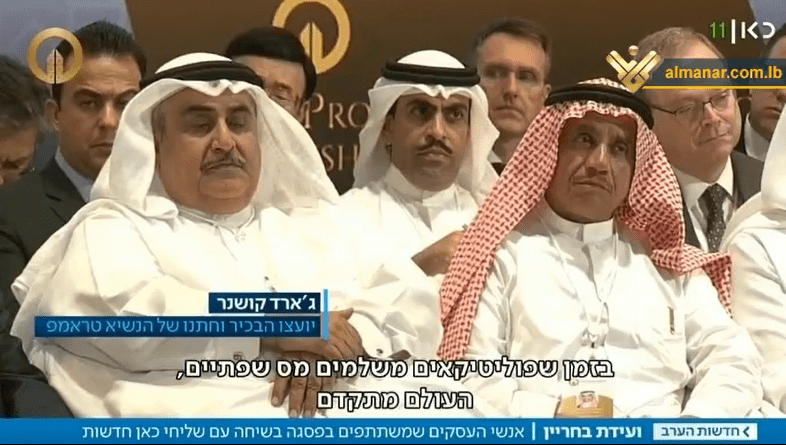
Al-Manar | November 6, 2019
In context of the process aimed at normalizing ties between the Zionist entity and the Gulf States, the Israeli media revealed that the two sides were preparing a non-aggression pact sponsored by the US administration.
Zionist analysts considered that Washington is trying to endorse the non-aggression pact as a substitute for the failed ‘Deal of the Century’, adding that the US Treasury Secretary conveyed the Israeli-prepared draft to the Gulf officials.
The Isralei media also unveiled the enemy’s participation in investment projects and expos in Saudi and Emirates, adding that Tel Aviv specialized hundreds of millions of dollars for this purpose.
Kremlin Says US Silent on Future of Strategic Arms Reduction Treaty
Sputnik – November 5, 2019
MOSCOW – Russia has not received any indication from the United States that it is ready to discuss the future of the New Strategic Arms Reduction Treaty (START), Kremlin spokesman Dmitry Peskov said on Tuesday.
“There are no advancements on START, no signals from the Americans, no signals about being ready to begin discussing an extension of old modalities or new modalities. It is a long process, and, of course, we will inevitably enter a zeitnot [race against the clock]. If the silence continues, we will enter a period where it will be impossible to agree on some new realities of the arms control”, he told reporters.
Peskov stressed the complexity of such talks and refrained from providing a precise time frame for negotiations.
The statement comes after Beijing stated that it saw no reason to engage in trilateral disarmament negotiations with the United States and Russia, especially since conditions for such an arrangement do not exist.
Russian President Vladimir Putin sent in September a proposal to leaders of several countries, including NATO members, to introduce a moratorium on the deployment of INF Treaty-covered missiles in Europe and other regions. Later, NATO confirmed that it had received the letter, but did not consider this proposal credible.
On 2 August, the US withdrew from the Intermediate-Range Nuclear Forces Treaty, which banned all short-medium (310–620 miles) and intermediate (620–3,420 miles) range ground-launched missiles, citing Russia’s alleged violations of the pact as its reason for exiting.
In early 2019, US President Donald Trump floated the idea of drafting a new arms control agreement between Washington, Moscow and Beijing.
The New START agreement was signed in 2010 by then-Russian President Dmitry Medvedev and his US counterpart at the time, Barack Obama. It is currently the only arms control agreement between two countries that is still in force. It is set to expire in February 2021, and so far Washington has shown no inclination to extend it.
Report reveals how Iran destroyed 16 warships in simulated war with US
Press TV – November 5, 2019
As tensions remain high between Iran and the United States in the Persian Gulf region, a new report has shed light on a controversial US military exercise where the American forces famously lost a simulated offensive aimed at destroying Iran’s defenses.
The war games, dubbed Millennium Challenge 2002, involved two groups of forces in blue and red, with the former playing the role of American forces on the offensive and the latter simulating an Iran-like Middle Eastern country that was supposed to defend itself, according to a report published by National Interest on Monday.
The US military reportedly spent more than $250 million on the exercises and as part of it, it would be fielding advanced technology it didn’t plan to implement until at least five years later.
During the exercises, the blue forces first handed red forces commander Lt. Gen. Paul Van Riper a surrender ultimatum and gave him 24 hours to yield.
Van Riper turned down the offer and the blue forces mounted an offensive with the same characteristics as the so-called pre-emptive strikes that were key to then-President George W. Bush’s military doctrine.
At that point, General Van Riper began pounding the US forces using a salvo of cruise missiles and rockets from land-based units, civilian boats, and low-flying planes.
The counter-strike was so heavy that all of the blue forces’ electronic systems and sensors were overwhelmed and General Van Riper’s forces were able to destroy a total of 16 warships, including an aircraft carrier.
Experts said at the time that in a real world scenario of the battle, some 20,000 US forces would have been killed.
But the red forces did not stop there, as soon Van Riper ordered his armada of small boats – similar to ones Iran has deployed to the Persian Gulf – to launch a second wave of attacks and take out another portion of the blue forces’ warships.
The damage from the second attack was aggravated due to the blue forces’ inability to detect the small boats.
“In less than 10 minutes, the whole thing was over and Lt. Gen. Paul Van Riper was victorious,” Blake Stilwell, an American journalist, wrote in a separate article published by We Are the Mighty in mid-September.
Micah Zenko, another journalist, wrote in an article for War on the Rocks that Iran’s “ability to render a US carrier battle group — the centerpiece of the US Navy — militarily worthless stunned most of the MC ’02 participants.”
The embarrassing defeat led US military planners to rig the rest of the drill in a way that would ensure American forces a victory.
General Van Riper complained about the scripted nature of the fighting but was eventually forced to order his forces to follow the war game as it had been pre-defined. Six days into the exercise, van Riper stepped down as commander and served as an adviser until the maneuver ended 17 days later.
David Axe, National Interest’s defense editor, wrote that the US would not have the ability to tweak the rules in a real war scenario.
“If Iran actually were to deploy Van Riper’s brutally effective tactics, it just might inflict even more damage than Van Riper’s own hamstrung forces did in their simulated, and rigged, war,” he wrote.
The United States has been pushing over the past few weeks to form a coalition that would supposedly protect shipping in the Persian Gulf following a series of mysterious attacks on oil tankers in the Strait of Hormuz and the Sea of Oman.
Washington has accused Iran of having a hand in those attacks, a claim Tehran has strongly rejected. Tehran has warned that such sabotage operations may be part of a general ploy to target Iran amid increasing regional tensions.
The US has subsequently sent troops and military equipment to the region, asking its allies to join the coalition.
Aegis makes submarines more important than ever
By Padraig McGrath | November 5, 2019
On October 29th, the Norwegian news-outlet NRK broke the story that between 8 and 10 Russian submarines, including Sierra II class submarines, had begun naval exercises in the North Atlantic. This is one of the largest Russian naval exercises focused on submarine-warfare since the end of the cold war. It is likely that one of the core purposes of this exercise is to test the stealth-capability of the Russian subs, and of NATO forces’ abilities to track them as they push through the Greenland-Iceland-United Kingdom gap (abbreviated “GUIK-gap”), a closely monitored strategic bottleneck. The Sierra II class sub has a titanium hull, enabling it to submerge to greater depths than steel-hulled submarines, and it is also much quieter than most other submarines.
In the event of a conflict, these submarines could be deployed to adopt a defensive posture, in order to protect Russian ports on the Barents Sea or Russia’s strategic holdings in the Arctic, or to threaten the American eastern seaboard. Since activating its 2nd Fleet, the US Navy has significantly increased patrols in the North Atlantic and in the area of the GUIK gap. The United States Navy also operates a detachment of P-8 Poseidon maritime patrol aircraft out of the Keflavik base in Iceland.
The following day, October 30th, the Borei-A-class submarine Prince Vladimir test-fired the Bulava ballistic missile from the White Sea to a target in the Kura missile-range in Kamchatka. This is the first ever test of a Bulava missile. The Bulava has a range of about 8,000 kilometres, and each of its independently targeted warheads delivers a payload the equivalent of 150 kilotons of TNT.
Northern Fleet Commander Vice-Admiral Alexander Moiseyev stated that the submarine Prince Vladimir is completing its state trials this year, during which all its armaments will be tested, before it is scheduled to enter service in December. The submarine will be operational in the Northern Fleet.
So far, the Sevmash shipyard has delivered 3 Borei-class submarines to the Russian navy, serving in the Northern and Pacific Fleets, with 4 more Project 955 Borei-class submarines under construction. Project 955 Borei-class submarines are designed for improved acoustic stealth, and each of them will carry 16 RSM-56 Bulava missiles as standard, with each missile carrying between 4 and 6 nuclear warheads.
The day after that, October 31st, President Putin was in Kaliningrad, inspecting the Yantar naval shipyard and the corvette “Gremyashchy,” launched in 2017.
In addition, 5 tests of the MIRV-equipped RS-28 Sarmat missile are planned for early 2020, with the Sarmat scheduled to enter service in 2021. This intercontinental ballistic missile is reportedly equipped with multiple hypersonic MIRV’s (multiple independently targetable re-entry vehicles), designed to evade missile defense systems. According to Russian government sources, the Sarmat can carry up to 15 warheads, has a range of 10,000 kilometres, and is capable of destroying an area the size of Texas.
All of this has been necessitated by the Aegis Ashore missile defence system, operated by the United States in Poland and Romania. However, let’s set the intercontinental ballistic missile issue aside for the purpose of our discussion here, and focus on the submarine issue, which is an under-emphasized aspect of very many geo-strategic bones of contention.
This hardly needs to be explained with regard to Crimea – losing the naval base in Sevastopol would have been detrimental to Russian geo-strategic interests. At present, there is still a standing agreement between Russia and the western alliance that no submarines carrying nuclear weapons are deployed in the Black Sea. However, if the international security environment were to continue to deteriorate, the Russian Defence Ministry would have to re-evaluate that commitment.
From Crimea, let’s move on to Syria. Tartus is a small base, used by the Russian navy primarily for provisioning, but it would suddenly become a radically more valuable strategic asset in the Mediterranean if the Bosphorus were ever blockaded. The western alliance had many, many reasons for prosecuting its proxy-war in Syria, and Tartus is certainly not the first item in that long list, but it is nonetheless one reason among many. The question arises as to what responses might be provoked from the United States if the Russian Defence Ministry ever decided to expand the Tartus base’s operational capabilities. Even if the defence ministry’s military planners were imprudent enough to consider such a move, President Assad would be unlikely to consent, given the resulting risk of re-igniting the Syrian conflict.
One of the problems common to many of the Russian navy’s most strategically important bases is the narrow sea-corridors to which they have access. Submarine-hunting is easier in small and easily monitored bodies of water such as the Baltic (Kaliningrad), the Black Sea (Sevastopol) and the Sea of Japan (Vladivostok). Even the Mediterranean is not expansive enough to allow Russian subs to disappear. It is hardly surprising, then, that the Russian Defence Ministry is commissioning considerable numbers of new generation, stealthier subs in response to the Aegis game-changer.
This also makes the Northern Fleet in Murmansk particularly key to the effectiveness of Russia’s nuclear deterrent, with no American fleet in immediate proximity. Furthermore, the point cannot be over-emphasized that with 17 million square kilometres of resource-rich territory but a population-density of only 8 persons per square kilometre, maintaining the effectiveness of Russia’s nuclear deterrent is an existential necessity.
In this regard, the strategic role of the Aegis Ashore missile defence system deployed by the United States in central Europe is essentially aggressive. There are many economic and geo-political factors feeding into the current lamentable state of Russia’s relationship with its western partners. However, it is very highly arguable that the deployment of Aegis Ashore in central Europe is singularly the biggest driver of the current geo-political and geo-strategic impasse, and consequently also the most influential driver of new Russian weapons-development.
Featured Video

Iran’s Next Strike May Not Explode. It Could Shut You Down
or go to
Aletho News Archives – Video-Images
From the Archive
Zionism’s Violent Legacy
By Donald Neff | Washington Report On Middle East Affairs | January 1996
On January 4, 1948, Jewish terrorists drove a truck loaded with explosives into the center of the all Arab city of Jaffa and detonated it, killing 26 and wounding around 100 Palestinian men, women and children.[1] The attack was the work of the Irgun Zvai Leumi – the “National Military Organization,” also known by the Hebrew letters Etzel – the largest Jewish terrorist group in Palestine. The Irgun was headed by Revisionist Zionist Menachem Begin and had been killing and maiming Arabs, Britons and even Jews for the previous ten years in its efforts to establish a Jewish state.
This terror campaign meant that at the core of Revisionist Zionism there existed a philosophical embrace of violence. … continue
Blog Roll
 Aletho News
- Trump’s Iran war is on an Israeli leash
- Saudi oil boss issues global supply warning
- Riyadh Says Its Oil System Is Intact. The Numbers Say Otherwise.
- Trump and Netanyahu Want to “Finish the Job” on Iran
- US ‘one-sided dictation’ not Iran’s beliefs makes rational talks impossible: Baghaei
- Iran’s Next Strike May Not Explode. It Could Shut You Down /Col Doug Macgregor
- Iran: US political targets legitimate if assassinations return
- Iraq shuts key border crossing with Iran under US pressure: Report
- Undersea Internet cables could be targeted in retaliation for attacks on Iran: IRGC deputy chief
- EU sending ‘biased’ observers to interfere in Serbian election – president
- If Americans Knew
- Heidi Levine recounts how Palestinian youths helped save her in settler attack
- DAILY UPDATE: Latest essential news on Palestine, Israel, & region
- Trump’s Intensifying Sabotage of the ICC, for Israel’s Sake
- Israeli military detain US and UK volunteers in West Bank including Democratic NY politician Brad Lander
- Americans at National Conservatism Conference held in Israel this year criticize Israel
- Christiane Amanpour exits CNN with a legacy shaped by the debate over Israel
- Israel’s war on Iran is the final move in a decades-old strategy
- Israel Denies Entry to French Journalist, U.S. Researcher Amid Rise in Entry Denials
- Gaza’s hospitals are running out of life-saving fuel – Daily Update
- Mysterious bot accounts reportedly spread fake ‘man on the street’ videos for Michigan Senate candidate
- No Tricks Zone
- E-Cars Reduce CO2 Emissions By Only 41% Compared To Internal Combustion Engine Vehicles
- Predictions Made By Renowned Climate Professor Over Past Decades Have Been Proven To Be Poor
- New Study Suggests Large Regions Of The Pacific Ocean Have Been Cooling For The Last 80 Years
- Germany’s Green Energy Debacle: High Energy Costs Force Kahla Porzellan to Close After 182 Years!
- New Study: 50 Years Of The Most Aggressive ‘Net Zero’ Policies Can Only Affect The Global Climate By 0.03°C
- US September “Heat” Was No Record…Many Records Set Decades Ago
- Latest European Green Energy Debacle; Portugal’s Largest Flagship Solar Park Insolvent!
- Green Energy Debacle: German Expert Professor Fritz Vahrenholt Warns Of Severe Economic And Social Consequences
- Two More Paleo Reconstructions Affirm Meters-Higher Sea Levels Across Ireland, Brazil 7000-6000 Years Ago
- New Study: Earth And Venus Surface Warmth Largely Explained By Convection And Lapse Rate, Not CO2 Or Radiation

