The Globalist Elite Fears Peace, Wants War
By Federico PIERACCINI | Strategic Culture Foundation | 13.07.2018
The announced meeting between Trump and Putin has already produced a good result by revealing the hypocrisy of the media and politicians. The meeting has been branded as the greatest danger to humanity, according to the Western globalist elite, because of the danger that “peace could break out between Russia and the United States”.
Sometimes reality is stranger than fiction. The following so stretches credulity that sources will have to be cited and exact quotations given to be believed.
A case in point is the following title: “Fears growing over the prospect of Trump ‘peace deal’ with Putin.” The Times does not here fear a military escalation in Ukraine, an armed clash in Syria, a false-flag poisoning in England, or a new Cold War. The Times does not fear a nuclear apocalypse, the end of humanity, the suffering of hundreds of millions of people. No, one of the most authoritative and respected broadsheets in the world is fearful of the prospect of peace! The Times is afraid that the heads of two nuclear-armed superpowers are able to talk to each other. The Times fears that Putin and Trump will be able to come to some kind of agreement that can help avert the danger of a global catastrophe. These are the times in which we live. And this is the type of media we deal with. The problem with The Times is that it forms public opinion in the worst possible way, confusing, deceiving, and disorienting its readers. It is not by accident the world in which we live is increasingly divorced from logic and rationality.
Even if the outcome of this meeting does not see any substantial progress, the most important thing to be achieved will be the dialogue between the two leaders and the opening of negotiation channels for both sides.
In The Times article, it is assumed that Trump and Putin want to reach an agreement regarding Europe. The insinuation is that Putin is manipulating Trump in order to destabilize Europe. For years now we have been inundated with such fabrications by the media on behalf of their editors and shareholders, all part of the deep state conglomerate. Facts have in fact proven that Putin has always desired a strong and united Europe, looking to integrate Europe into the Eurasian dream. Putin and Xi Jinping would like to see a European Union more resistant to American pressure and able to gain greater independence. The combination of mass migration and sanctions against Russia and Iran, which end up hurting Europeans, opens the way for alternative parties that are not necessarily willing to [obey] Washington’s marching orders.
Trump’s focus for the meeting will be to convince Putin to put even more pressure on Europe and Iran, perhaps in exchange for the recognition of Crimea and the ending of sanctions. For Putin and for Russia it is a strategic issue. While sanctions are bad, the top priority for Moscow remains the alliance with Iran, the need to further strengthen relations with European countries, and to defeat terrorism in Syria. Perhaps only a revision of the ABM treaty and the withdrawal of these weapons from Europe would be an interesting offer for Putin. However, reality shows us that the ABM treaty is a pillar of Washington’s military-industrial complex, and that it is also Eastern European countries that want such offensive and defensive systems in their own countries, seeing them as a deterrents against Russia. Are they victims of their own propaganda, or are billions of dollars pouring into their pockets? Either way, it does not really matter. The most important point for Moscow will be the withdrawal of the Aegis Ashore ABM systems as well as military ships with the same Aegis system. But this is not something that Trump will be able to negotiate with his military leaders. For the military-industrial complex, the ABM system, thanks to maintenance, innovation and direct or indirect commissions, is a gravy train that too many interests intend to keep riding.
From the Kremlin’s point of view, the removal of sanctions remains necessary for the restoration of normal relations with the West. But this would be difficult to achieve, given that Moscow would have little to offer Washington in exchange. The strategists at the Pentagon demand a withdrawal from Syria, an end to support for Donbass, and a cessation of relations with Iran. There is simply too much divergence to reach a common position. Moreover, Europe’s sanctions against Russia benefit Washington, as they hurt the Europeans and thereby undermine what is a major trading competitor to the US. The US withdrawal from the Joint Comprehensive Plan of Action (JCPOA) can be looked at in the same light, blocking US allies from doing business with Iran.
Putin will keep faith with his commitments to Syria and with his allies, unwilling to betray his word even for the recognition of Crimea. On the other hand, as already mentioned, the priority remains the removal of the ABM; and while Crimea is already under the control of the Russian Federation, Syria remains an unstable territory that risks propelling Islamist terrorism to Russia’s soft underbelly in the Caucasus. For Moscow, involvement in Syria has always been a matter of national security, and this certainly remains the same now, even with Donald Trump’s unrealistic offers.
It should be kept in mind that Putin is aiming for a medium- to long-term strategy in the Middle East, where Iran, Syria and the entire Shiite arc serves to counter Saudi and Israeli aggression and hegemony. This strange alliance has emerged as the only way to deter war and dial down the heat in the region, because the crazy actions from Netanyahu or Mohammad bin Salman are deterred by a strong Iranian military. Preventing a confrontation between Iran and Saudis/Israelis also means not making Tehran appear weak or isolated. Such considerations seem beyond the strategists in Washington, let alone in Tel Aviv or Riyadh.
While it is difficult to achieve a positive outcome from the meeting between Trump and Putin, it is important that there is a meeting in the first place, contrary to what The Times thinks. The media and the conglomerate of power that revolves around the US deep state fear diplomacy in particular. The same narrative that was proclaimed weeks before and after the meeting between Trump and Kim Jong-un is being repeated with regard to Trump’s meeting with Putin.
Washington bases its power on force, both economic and military. But this power also rests on the posture assumed and image projected. The United States and its deep state considers negotiating with opponents to be wrong and counterproductive. They consider dialogue to be synonymous with weakness, and any concession is interpreted as surrender. This result of 70 years of American exceptionalism and 30 years of Unipolarity, has allowed the US the ability to decide unilaterally the fate of others.
Today, in a multipolar world, the dynamics are different and therefore more complex. You cannot always employ a zero-sum mentality, as The Times does. The rest of the world recognizes that a dialogue between Putin and Trump is something positive, but we must not forget that, as in Korea, if diplomacy does not bring significant progress, then the hawks surrounding Trump will again be in the ascendant. The tasks for Rouhani, Putin and Kim Jong-un are complex and quite different from each other, but they share in common the belief that dialogue is the only way to avoid a catastrophic war. But apparently, peace is not the best possible result for everyone.
NATO is a Con Game
By Raúl Ilargi Meijer | The Automatic Earth | July 11, 2018
Okay, well, Trump did it again. Antagonizing allies. This time it was Germany that took the main hit, over the fact that it pays Russia billions of dollars for oil and gas while relying on the US for its defense … against Russia. And yes, that is a strange situation. But it’s by no means the only angle to the story. There are many more.
For one thing, The US has by far the largest military industry. So it makes a lot of money off the billions already spent by NATO partners on weaponry. Of course Raytheon, Boeing et al would like to see them spend more. But once they would have done that, they would clamor for even more after.
At some point one must ask how much should really be spent. How much is enough, how much is necessary. The military-industrial complex (MIC) has every reason to make the threat posed by ‘enemies’ as big as they possibly can. So knowing that, we must take media reports on this threat with tons of salt.
And that is not easy. Because the MIC has great influence in politics and the media. But we can turn to some numbers. According to GlobalFirePower, the US in 2018 will spend $647 billion on its military, while Russia is to spend a full $600 billion less, at $47 billion. And the US Senate has already voted in a $82 billion boost recently.
There are other numbers out there that suggest Russia spends $60 billion, but even then. If Moscow spends just 10% of the US, and much less than that once all NATO members’ expenditure is included, how much of a threat can Russia realistically be to NATO?
Sure, I’ve said it before, Russia makes weapons to defend itself, while America makes them to make money, which makes the latter much less efficient, but it should be glaringly obvious that the Russia threat is being blown out of all proportions.
Problem with that is that European nations for some reason love playing the threat card as much as America does. After all, Britain, France and Germany have major weapons manufacturers, too. So they’re all stuck. The Baltic nations clamor for more US protection, so does Sweden, Merkel re-focused on Putin just days ago, the game must go on.
Another way to look at this is to note that UD GDP in 2017 according to the IMF was $19.3 trillion, while Russia’s was $1.5 trillion. NATO members Germany France, Britain, Italy and France all have substantially higher GDP than Russia as well. European Union GDP was $17.3 trillion in 2017.
If this economically weak Russia were really such a threat to NATO, they would be using their funds so much better and smarter than anyone else, we’d all better start waving white flags right now. And seek their help, because that sort of efficiency, in both economics and defense, would seem to be exactly what we need in our debt-ridden nations.
The solution to the problems Trump indicated this morning is not for Germany et al to spend more on NATO and their military in general, but for the US to spend less. Much less. Because the Russian threat is a hoax that serves the interests of the MIC, the politicians and the media.
And because America has much better purposes to spend its money on. And because we would all be a lot safer if this absurd theater were closed. To reiterate: developments in weapons technology, for instance hypersonic rocket systems make most other weapons systems obsolete. Which is obviously a big threat to the MIC.
Russia attacking NATO makes as much sense as NATO attacking Russia: none whatsoever. Unwinnable. Russia attacking Germany and other European countries, which buy its oil and gas, makes no sense because it would then lose those revenues. From that point of view, European dependence on Russian energy is even a peacemaker, because it benefits both sides.
Can any of the Russiagate things be true? Of course, Russia has ‘bad’ elements seeking to influence matters abroad. Just like the US does, and France, Britain, Germany, finish the list and color the pictures. How about the UK poisoning stories? That’s a really wild one. Russia had no reason to poison a long-lost double spy they themselves let go free years ago, not at a time when a successful World Cup beckoned.
342 diplomats expelled and risking the honored tradition of exchanging spies and double agents from time to time. Not in Moscow’s interest at all. Britain, though, had, and has, much to gain from the case. As long as its people, and its allies, remain gullible enough to swallow the poisoned narrative. Clue: both poisonings, if they are real, occurred mere miles from Porton Down, Britain’s main chemical weapons lab.
And c’mon, if Putin wants his country strong and independent, the last thing he would do is to risk his oil and gas contracts with Europe. They’re simply too important, economically and politically. Trump may want some of that action for the US, understandably, but for now US LNG can’t compete with Russian pipelines. Simple as that.
Let’s hope Trump and Putin can talk sense in 5 days. There’s a lot hanging on it. Let’s hope Trump gets his head out of NATO’s and the US and EU Deep State’s asses in time. There’s no America First or Make America Great Again to be found in those dark places. It’s time to clear the air and talk. America should always talk to Russia.
Funny thing is, the more sanctions are declared on Russia, the stronger it becomes, because it has to learn and adapt to self-sufficiency. Want to weaken Russia? Make it depend on your trade with it, as opposed to cut off that trade. Well, too late now, they won’t trust another western voice anymore for many years. And we’re too weak to fight them. Not that we should want to anyway.
We’re all captive to people who want us to believe we’re still stuck in the last century, because that is their over-luxurious meal ticket. But it’s all imaginary, it’s an entirely made-up narrative. NATO is a con game.
Mexico’s new president wants to scrap $1.36bn helicopter deal with US
RT | July 12, 2018
Mexico’s newly-elected, anti-establishment president is planning to scrap some of the deals his predecessor had signed up to, including a $1.36 billion order for eight MH-60R Seahawk helicopters for the country’s Navy.
Andres Manuel Lopez Obrador, widely known as AMLO, was elected Mexico’s next president on promises to pursue national interests and reduce the country’s reliance on the US. He has vowed to cut government spending as soon as he takes over the top office in December. Amid a number of announced measures, the anti-establishment leader promised to scrap some of the deals outgoing President Enrique Peña Nieto had sealed with the US during his tenure. Among his targets are the Lockheed Martin MH-60R helicopters, which the US State Department green-lighted to sell back in April.
“We know of the order to purchase eight gunship choppers for the Mexican Navy, made to the government of the United States, for a total value of 25 billion pesos, that purchase will be canceled, because we cannot [afford] this expense,” Lopez Obrador said Wednesday.
Washington approved the sale of choppers to the Mexican Navy together with multi-mode radars, night vision devices, and other sensors to help its neighbor combat organized crime and drug-trafficking. The deal, worth some $1.36 billion, also included a package of armaments, such as Hellfire missiles, lightweight hybrid torpedoes, and machine guns.
In addition to the helicopters, the newly elected leader ordered his team to contact Boeing to negotiate selling Peña Nieto’s 787 Dreamliner back to the company. Back in 2016, the plane (named ‘José María Morelos y Pavón’) cost the country $218.7 million, which the government agreed to repay over the next 15 years. “The idea is to sell it, not lose money, sell it for what it’s worth, but I’m not going to get on that plane,” the politician vowed.
Lopez Obrador, an outspoken critic of Donald Trump, received around 53 percent of votes to win the presidential race earlier this month. Honoring his campaign promises, on Wednesday he promised to slash government officials’ salaries, as well as end the practice of lifetime pensions for former presidents. “It is time for the government to tighten its belts,” he stressed.
Helsinki: How About a Fresh START?
By Thomas L. Knapp | The Garrison Center | July 11, 2018
As US President Donald Trump heads to Helsinki for a summit with Russian President Vladimir Putin, Trump’s critics continue to inveigh against what they consider an illicitly close relationship between the two, a perspective stemming from the “Russiagate” scandal drummed up by supporters of Hillary Clinton to explain her defeat in the 2016 presidential election.
Russiagate or not, this summit may represent the two countries’ last, best opportunity to halt or even reverse a decade of backsliding toward frigid Cold War relations. And Trump has a ready template at his disposal for pursuing warmer relations with a formidable, but hopefully former, foe.
In 1986, President Ronald Reagan met with his Soviet counterpart, Mikhail Gorbachev, in Reykjavik. As the non-profit Reagan Vision for a Nuclear-Weapons-Free World describes the summit, “[a] proposal to eliminate all new strategic missiles grew into a discussion, for the first time in history, of the real possibility of eliminating nuclear weapons forever. … Reagan even described to Gorbachev how both men might return to Reykjavik in ten years, aged and retired leaders, to personally witness the dismantling of the world’s last remaining nuclear warhead.”
While the full vision didn’t pan out, a year later the US and the Soviets signed the Intermediate Range Nuclear Forces Treaty. Five years later came the Strategic Arms Reduction Treaty. “New START” arrived in 2010, shortly before relations between the two governments began to deteriorate in a big way.
At this point, the US is working on “modernizing” its existing nuclear arsenal, while Russia touts an advancing hypersonic missile program. We’re moving back toward the days of American schoolchildren practicing “duck and cover” drills under constant threat of nuclear war.
The best possible outcome of the Trump-Putin summit would be a new treaty that I’ll call “Fresh START.” Under such a treaty, the two governments would commit to getting back on the track laid down by Reagan and Gorbachev, actively working to meet their existing obligations under Treaty on the Non-Proliferation of Nuclear Weapons (NPT):
“Each of the Parties to the Treaty undertakes to pursue negotiations in good faith on effective measures relating to cessation of the nuclear arms race at an early date and to nuclear disarmament …”
Nuclear weapons are weapons of terror and of Mutual Assured Destruction. They’re not militarily useful outside those two ways of thinking. It’s time for the two countries with the largest stockpiles of such weapons to move together toward decommissioning and destroying those stockpiles. We may never again live in a world without nuclear weapons, but we can aspire to a world with as few of them as possible.
If Trump and Putin can deliver a Fresh START toward that goal, their summit will have been a resounding success.
Thomas L. Knapp (Twitter: @thomaslknapp) is director and senior news analyst at the William Lloyd Garrison Center for Libertarian Advocacy Journalism (thegarrisoncenter.org).
NATO wary about summit with Trump days before he meets Putin
Obama’s posturing of Russia as ‘the enemy’ after its assistance to Ukraine and Crimea means little to Trump; a warming of US/Russia ties could force NATO to rethink its entire outlook
By M.K. Bhadrakumar | Asia Times | July 9, 2018
The summit meeting of the North Atlantic Treaty Organization this week – on Wednesday and Thursday – is a landmark event. It will be the first summit the alliance hosts in its new $1.2-billion headquarters in Haren district in Brussels. It ought to be a happy get-together. However, the event is becoming a somber occasion.
The blame for this is being put squarely on the shoulders of President Donald Trump, who has questioned whether the US’ European allies spend 2% of their GDP on defense and making that a key issue of his security and defense agenda. The American think-tank German Marshall Fund of the United States said in a report last Thursday: “The big question is how the showdown will play out around the table when Trump raises the issue.”
The think tank made an astonishing allegation: “Even greater damage could be done at the Trump-Putin meeting four days later [in Helsinki on July 16]. Among European Allies, but also in a staunchly Russia-critical U.S. Congress, suspicion about why the President wanted to meet with his [Russian] counterpart now is rampant. Observers are fearful that the notoriously unpredictable and diplomatically idiosyncratic Trump might sell out NATO security interests by agreeing to some deal with Putin … Should such fears prove justified, expect the European security architecture to become seriously unhinged, maybe to a historic degree.”
The old warhorse fears Trump could sell them out. Simply put, the US’ NATO allies are horrified at the prospect of an easing of tensions between Russia and the West. And there is a congruence between them and forces arrayed against Trump in US politics today. A profound contradiction has arisen.
Unless this contradiction is resolved, the western alliance cannot continue turbo-charged on the path that was set at its historic summit in Wales in 2014 under Barack Obama’s watch when it formally cast Russia as the “enemy” and embarked on hostile military posturing along Russia’s border regions in a wide arc stretching from the Baltics to the Mediterranean.
NATO expansion broke vow to Gorbachev
NATO members at the Wales summit claimed they were reacting to Russia annexing Crimea and Moscow’s intervention in eastern Ukraine in 2014. But in reality it was fast-forwarding an agenda that can be traced to back to the Clinton presidency – 1994, to be exact. When Bill Clinton ordered in 1994 the expansion of the alliance into the former territories of the Warsaw Pact, he jettisoned solemn Western assurances held out to the former Soviet leader Mikhail Gorbachev that NATO would not expand even by an inch following the reunification of Germany.
American diplomat George Kennan had warned then and there that it was an epochal mistake that would alienate Russia forever, but Clinton’s intention was to keep America in Europe and keep Russians out. By March 1999, Hungary, Poland and the Czech Republic had signed up; and over the next five years, NATO incorporated a further seven states – Bulgaria, Estonia, Latvia, Lithuania, Romania, Slovakia and Slovenia. Then in 2009, Croatia and Albania joined, and in June 2017 Montenegro followed. Indeed, NATO had to commission Madeline Albright for a project to provide an intellectual construct to the NATO enlargement.
Again, the petard of a “Russian threat” was raised at NATO’s 2014 summit but the plain truth is that the crisis in Ukraine was caused by clumsy Western meddling with the aim of turning that country into a military adversary of Russia through a half-baked offer of EU and NATO membership.
The US Assistant Secretary of State in the Obama administration, Victoria Nuland, has admitted that since 1991, Washington had spent upwards of $5 billion on “pro-democracy initiatives” in Ukraine.
Putin scoffs at ‘Russia threat’
On the ground, NATO enjoys vast military superiority over Russia. Putin has scoffed at the talk of a Russian threat to NATO members being “the type of thing that only a crazy person thinks, and only when dreaming”. Suffice to say, without an honest introspection by NATO of how it reached the present point on the so-called “Russia threat”, the alliance is in a cul-de-sac. It has nothing to do with Trump.
Where Trump really differs from Clinton or Barack Obama is that he is a political outsider. Not being an Establishment figure, unlike his two predecessors, he sees that NATO’s real predicament is that it is all dressed up with nowhere to go. As Trump sees it, the alliance’s contrived posturing of a war footing imposes a set of financial and military burdens on the US, which is unacceptable.
Trump framed the paradigm at a rally in Montana on Wednesday: “And I said, ‘You know, Angela, I can’t guarantee it, but we’re protecting you and it means a lot more to you than protecting us ’cause I don’t know how much protection we get by protecting you.” And, if Trump constructively engages with Putin, NATO’s anti-Russia animus becomes unsustainable and the alliance loses its purpose.
Plan to counter a Russian attack
Curiously, the summit in Brussels next week – just four days before the Helsinki summit – is slated to formalize a “30-30-30-30” NATO plan to counter a Russian attack – 30 land battalions, 30 air fighter squadrons and 30 ships to be kept in readiness for deployment within 30 days of being put on alert. Poland is pushing for a new US military base on its soil and the Baltic States have also requested a permanent stationing of American troops.
Meanwhile, there are growing divergences among the NATO allies in regard to threat perception. The Baltic States, Poland and Romania see Russia as a national security threat and foreign policy challenge. But for France or Germany, Russia doesn’t pose any such threat and although they disapprove of aspects of Russian policies, they also underscore the importance of a productive relationship with Russia.
The countries of southern Europe – Hungary, the Balkans, Greece, Italy, etc – are outright disinterested in sanctioning against Russia and keenly seeking opportunities of cooperation. As for Turkey, it has become Russia’s strategic partner. Even for the US, selective engagement with Moscow has been a necessity during the Clinton and Obama administrations. Clearly, shoring up Euro-Atlantic solidarity on the Russia question is becoming difficult. And a confrontational approach toward Russia as a default position becomes illogical.
It is not that Trump fails to see NATO’s political significance. It is rather that he sees the alliance for what it is – old fraying knots tying the US to its Cold War-era allies at such heavy cost without commensurate benefit. He feels that the US is being taken advantage of by free riders. Basically, Trump has never been caught up in NATO’s existential need for Russia to be the enemy from the east.
Germans concerned about Trump
Senior German officials have openly complained that NATO states were not included in the planning for the Trump-Putin summit at Helsinki. Peter Beyer, trans-Atlantic coordinator for Chancellor Angela Merkel’s ruling coalition, told the Funke Mediengruppe newspaper chain on Saturday: “There are great concerns in the alliance about what agreements Trump and Putin could reach.” That sentiment echoes Trump’s political adversaries and the large corpus of Russophobes in the US.
This is the first time in a half-century after Dwight Eisenhower, that the US has a president who is convinced of the imperatives of cooperative – even friendly – relations with Russia. Eisenhower failed to push through the planned May 1960 summit with Nikita Khrushchev following the controversial U-2 affair and the Soviet arrest of spy pilot Gary Powers.
When he vacated the presidency, he was an embittered man warning starkly in his farewell speech against the machinations of his country’s “military-industrial complex”. Where the war hero of the beaches of Normandy failed, can Trump succeed? Unlike Eisenhower, Trump also has to tackle the curious line-up between the US’ NATO allies and his enemies in Washington. That makes the Brussels summit a momentous run-in for Trump.
German officials join UK and US establishment worried how Trump-Putin summit will affect NATO
RT | July 7, 2018
German politicians are nervous over the meeting between Donald Trump and Vladimir Putin, fearing the US president could take actions that are not in line with NATO, echoing concerns across the channel and the Atlantic.
Ahead of the meeting on July 16 in Helsinki, several German officials expressed their worry in interviews with newspapers throughout the country. The transatlantic coordinator for Chancellor Angela Merkel’s ruling coalition, Peter Beyer, told the Funke Mediengruppe newspapers that “there are great concerns in the alliance about what agreements Trump and Putin could reach” during the summit, and he lamented that NATO member states had not been included in the planning.
He said that Trump would let Putin “put one over on him” during the meeting in Helsinki, using the US president’s recent meeting with North Korean leader Kim Jong-un as justification for his rather frank comment.
“Kim has only made promises thus far. We don’t know if he has stopped enriching uranium. Only Trump has billed the summit as such as a success,” said Beyer, a member of Merkel’s Christian Democrats Union (CDU).
Beyer isn’t alone when it comes to concerns surrounding the meeting and the apparent belief that the two leaders can’t simply meet in the same way that other world leaders meet every day – and the same way German Chancellor Angela Merkel has met with both Trump and Putin on numerous occasions.
Christian Lindner, the head of Germany’s Free Democrats, told Deutschlandfunk in an interview that he did not trust Trump, and that his actions in the areas of trade and security were not in Washington’s long-term interest.
“He is too volatile…within 24 hours, Mr. Trump can change his position by 180 degrees,” Christian Lindner, the head of the Free Democrats, told Deutschlandfunk. He called for Europe, as the world’s largest single economic zone, to take a united stance and act as a counterweight to Trump and Putin. The EU is currently in loggerheads with the US over tariffs on aluminum, steel and other goods.
And then there’s Wolfgang Ischinger, the head of the Munich Security Conference and a former German envoy to Washington, who expressed concern that Trump might refuse to sign a communique at next week’s NATO summit in Brussels. “It cannot be ruled out,” he told Die Welt in a clear reference to Trump refusing to sign the document from G7 meeting in June.
Amid all this scaremongering, Merkel herself said in a Saturday video address that Germany “would like to have reasonable relations with Russia. That is why we will always have discussions in the NATO-Russia Council.” She expressed her support for NATO in the next breath, saying it is needed in the 21st century “as a guarantor of our transatlantic alliance,” and stating that it “must show determination to defend itself.”
The comments come as Trump continues to pressure NATO states to pay their fair share towards the alliance, as Washington currently accounts for more than two-thirds of all defense spending by NATO members. It is one of only six countries to meet the two percent GDP quota.
A page out of Britain’s book
The comments by German officials come less than two weeks after The Times reported that the UK also fears that Trump will undermine NATO by striking a “peace deal” with Putin during the meeting. It cited cabinet ministers who are worried that the Russian president could persuade Trump to downgrade US military commitments in Europe, thus compromising NATO countries’ defense against so-called “Russian aggression.”
Alexander Bartosh, a military expert and former Russian diplomat, told RT that such concerns would come as no surprise, as the UK “has been one of the most active supporters of a hard line towards Russia.” He added that the UK feels “a certain loss of its weight in Europe and tries to turn Russia into a kind of boogeyman, seeing the ‘Russian threat’ as a unifying factor for nations, looking for closer ties with London.”
Bartosh also noted that the meeting between the two leaders will merely include trying to find a “unifying agenda for the US and Russia because the relations of the two countries affect not only their own well-being, but international security as a whole… none of the sides will be aiming to undermine the integrity of NATO.”
Trouble on the homefront
It’s not just Europe that fears what could happen in the meeting between Trump and Putin. Even former CIA director John Brennan told MSNBC last week that Trump “is not sophisticated enough” to deal with Moscow.
“I must tell you the Russians will feign sincerity better than anyone I’ve ever dealt with in my life. So I would be very careful about being swept in and I think Mr. Trump is not sophisticated enough, unfortunately, to deal with these foreign leaders in a manner that is going to protect US national security interests. I think he’s naive in these issues,” he said.
In fact, many within the US establishment dread the possibility of the summit succeeding, political analyst and media and government affairs specialist Jim Jatras wrote in an op-ed for RT.
Jatras noted that Trump’s desire to actually get along with Russia sounded alarms long before he won the 2016 election. “US reconciliation with Russia would yank the rug out from under the phony justifications for spending hundreds of billions of dollars annually to counter a ‘threat’ that ceased to exist over a quarter century ago,” he wrote.
Journalist Neil Clark voiced a similar point in his own op-ed for RT, stating that a successful summit simply won’t do, because Russia “must always be regarded as the enemy – unless of course it does absolutely everything the West demands of it.” And while he noted that positive moves between Moscow and Washington would be celebrated by ordinary folks, he stated that defense industry lobbyists wouldn’t be nearly as enthused.
Read more:
No Trump, No Clinton, No NATO
By Craig Murray | July 7, 2018
Marina Hyde’s vicious and spiteful attack on Susan Sarandon and the Green Party points to the real danger of anti-Trump protest next week being hijacked by the neo-con warmonger franchise. The idea that those of us who do not want arch warmonger Clinton in power are therefore supporters of Trump is intellectually risible and politically dishonest.
Yesterday the OPCW reported that, contrary to US and UK assertions in the UN security council, there was no nerve agent attack on jihadist-held Douma by the Syrian government, precisely as Robert Fisk was execrated by the entire media establishment for pointing out. The OPCW did find some traces of chlorine compounds, but chlorine is a very commonly used element and you have traces of it all over your house. The US wants your chicken chlorinated. The OPCW said it was “Not clear” if the chlorine was weaponised, and it is plain to me from a career in diplomacy that the almost incidental mention is a diplomatic sop to the UK, US and France, which are important members of the OPCW.
Trump’s reaction to yet more lying claims by the UK government funded White Helmets and Syrian Observatory, a reaction of missile strikes on alleged Syrian facilities producing the non-existent nerve agent, was foolish. May’s leap for British participation was unwise, and the usual queue of Blairites who stood up as always in Parliament to support any bombing action, stand yet again exposed as evil tools of the military industrial complex.
Hillary Clinton, true to form, wanted more aggressive military action than was undertaken by Trump. Hillary has been itching to destroy Syria as she destroyed Libya. Libya was very much Hillary’s war and – almost unreported by the mainstream media – NATO bombers carried out almost 14,000 bombing sorties on Libya and devastated entire cities.
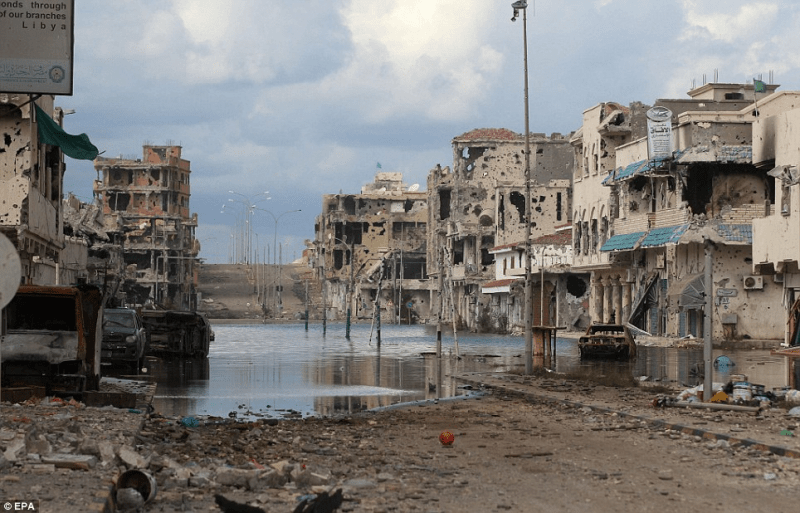
Sirte, Libya, after NATO bombing
The destruction of Libya’s government and infrastructure directly caused the Mediterranean boat migrant crisis, which has poisoned the politics of much of the European Union.
Donald Trump has not started any major war. He has been more restrained in military action than any US President since Jimmy Carter. My own view is (and of course it is impossible to know for sure) that, had Hillary been in power, Syria would already have been totally destroyed, the Cold War with Russia would be at mankind threatening levels, and nuclear tension with North Korea would be escalating.
“He hasn’t destroyed mankind yet” is faint praise for anyone. Being less of an existential danger to mankind than Hillary Clinton is a level achieved by virtually the entire population of the planet. I am not supporting Trump. I am condemning Clinton. I too, like Susan Sarandon, would have voted for Jill Stein were I an American.
So do protest against Trump. But do so under the banner No Trump! No Clinton! No NATO! And if any Clintonite or Blairite gets up to address you, tell them very loudly where to get off. I remember the hijacking of the Make Poverty History campaign by Brown, Darling and Campbell on behalf of their banker friends. Don’t let that happen again.
Or here is an even better idea.
Escape the Trump visit completely. Rather than stand penned in and shouting slogans at a police van parked right in front of you, turn your back on all of that and come join me at the Doune the Rabbit Hole Festival from 13 to 15 July. As our regulars know, this blog has been intimately connected with running the Festival from the start. This year is much bigger, with the Levellers, Akala, Atari Teenage Riot, Peatbog Faeries, and literally scores of other bands, and a great array of other festival activities too, including for kids, who come free and get free drinks.
DTRH has no sponsorship, no advertising, no government money and no rip-offs – beer and cider from £3.50 a pint at the bars. It is very much an alternative lifestyle gathering, and I find spiritual renewal there in the glorious Stirlingshire countryside. (I know that sounds corny, but I do). Tickets are £90 for full weekend including camping, which I think makes it the cheapest festival on this level around. Or you can buy a cheaper day ticket and drop in just for the day. If tickets are too expensive or you fancy a different kind of fun, you can volunteer, including to come and work with me in the bar, though there are a whole range of other tasks to be done if you don’t fancy that. Volunteers get in free and get fed in return for one six hour shift a day.
I really do hope I will see some of you there – it looks set to be a glorious weekend. Forget stress, forget Trump and hang out with nice people!
Italy will not buy F-35s anymore, mulls walking out of existing contracts – Defense Minister
RT | July 7, 2018
The anti-establishment Italian government’s defense minister has said that the country won’t purchase any more Lockheed Martin F-35 fighter jets from the US and will review the existing order for 90 planes.
Elisabetta Trenta, the country’s new minister of defense from the Eurosceptic Five Star Movement, has ruled out new contracts with the US for the purchase of F-35 stealth fighter jets, adding that the order for 60 F-35A and 30 F-35B jets, which concluded in 2012, might be placed under review.
“We won’t buy any more F-35s,” Trenta said in an interview with Italian broadcaster La7’s Omnibus program on Friday.
“We are assessing what to do regarding the contracts already in place,” she added, noting that while her party has always been a vocal critic of the program, she said that scrapping it altogether may “cost us more than maintaining it.”
The fact that the cancellation of the bulk deal and the resulting “strong financial penalties” might cost the Italian budget a hefty sum is one of the main reservations that is holding the government back, she explained.
The termination of the contract can negatively impact Italian workers who are employed in the production, she said, listing other merits of the deal such as “technological activity” and “important research” in a Facebook post accompanying the interview
Italy became the only country with an F-35B assembly line outside the US. In May 2017, it rolled out the first jets. However, they had to be delivered to the US Navy base in Maryland for certification and crew training.
The line in Cameri is set to produce a total of 30 F-35Bs to be delivered to the Italian Navy, Italian Air Force and the Royal Netherlands Air Force.
Back in 2012, Italy already downsized its initial order for 135 jets to 90 as it was battling with a sovereign debt crisis.
The March general election in Italy, following weeks of uncertainty and political bickering, propelled a new government of the right-wing Lega Nord and anti-establishment Five Star Movement to power. The fact that it is now a part of the ruling coalition might have put some constraints on the party’s policy, which has always been in stark opposition to the costly program.
As the party presented its defense manifesto in May last year, Tatiana Basilio, then a Five Star MP in the parliament, said that “there will be no ifs or buts about leaving the F-35 program” if her party clinched the vote.
“€14 billion for 90 F-35s is too costly and we are putting ourselves in the hands of the US,” Basilio said at the time.
One aircraft currently costs Italy €51.3 million, while, overall, it has to spend some €14 billion on the jets.
Meanwhile, the program has been bogged down by unresolved technical issues, such as faulty helmets, malfunctioning ejector seats and overblown costs.
US establishment in hysterics that Trump-Putin summit might succeed
RT | July 6, 2018
There are many reasons the bipartisan US establishment hates Trump. His heresies from neoliberal orthodoxies on immigration and trade are prominent. But top among them is his oft-stated intention to improve relations with Russia.
That’s fighting words for the Deep State and its mainstream media arm, for which demonizing Russia and its president Vladimir Putin is an obsession.
The fact that Donald Trump made his intention to get along with Moscow a priority during his 2016 campaign, both against his Republican primary rivals and Hillary Clinton (who has compared Putin to Hitler) was cause for alarm. This is because far more than even the frightening prospect that the 70-year state of war on the Korean Peninsula might end, US reconciliation with Russia would yank the rug out from under the phony justifications for spending hundreds of billions of dollars annually to counter a “threat” that ceased to exist over a quarter century ago. Absent hostility to Russia that money has no reason to keep sustaining the power, privilege, and prosperity of a horde of moochers and profiteers, both at home and abroad.
That’s why when it was reported soon after his January 2017 inauguration that Trump was seeking to open dialogue with the Kremlin and set an early summit with Putin there was a hysterical counteraction. As described just over a year ago by conservative columnist and former presidential candidate Patrick Buchanan:
Trump planned a swift lifting of sanctions on Russia after inauguration and a summit meeting with Vladimir Putin to prevent a second Cold War. The State Department was tasked with working out the details. Instead, says Daniel Fried, the coordinator for sanctions policy, he received ‘panicky’ calls of ‘Please, my God, can you stop this?’. Operatives at State, disloyal to the president and hostile to the Russia policy on which he had been elected, collaborated with elements in Congress to sabotage any detente. They succeeded.
“It would have been a win-win for Moscow,” said Tom Malinowski of State, who boasted last week of his role in blocking a rapprochement with Russia. State employees sabotaged one of the principal policies for which Americans had voted, and they substituted their own.
Back then, constitutional government and the rule of law took a back seat to bureaucratic obstructionism, atop months of a phony “Russian collusion” story that even anti-Russian Republican Congressmen are now calling to “finish the hell up.” But now, in the aftermath of the successful Singapore summit and with the collusion narrative looking ever more threadbare, Trump is back on track. The summit with Putin will finally take place on July 16 in Helsinki, Finland, the site of earlier meetings between American and Russian leaders.
Today the assaults on Trump are no less frenzied than a year ago, but they seem to pack less of a punch with the critics’ glum awareness that, aside from some extraordinary provocation, little can be done to stop the summit from taking place. The Beltway Swamp’s flagship bulletin board Washington Post accused Trump of “kowtowing” to Putin by merely agreeing to meet with him. Trump’s one-on-one with the “autocrat” Putin will be a “meeting of kindred spirits,” warned the conceited New York Times. Putin has “devoured” Trump grumbled über-Russophobe Ralph Peters on CNN. Trump wants to “Finlandize” the US moaned Max Boot. Officials in the United Kingdom, a key culprit in ginning up “Russiagate” in the first place, are particularly scared that – horror! – there could be a “peace deal” between Trump and Putin.
Major worries are voiced by useless freeloader countries we call “allies,” whose governments fret that the US will become “less reliable” – to their rulers’ interests of course, not to those of the American people. This specifically means the members of NATO, whose summit Trump will attend prior to Helsinki. As former US ambassador to Moscow and to NATO Alexander Vershbow suggests, “allies are wondering whether they will be in for nothing more than a tongue lashing by President Trump over insufficient defense spending, further inflaming transatlantic divisions over trade, the Iran deal, and other issues.”
Indeed, Trump’s hammering on the NATO deadbeats’ treating the US as a “piggy bank” that will no longer be at their disposal exposes the biggest fraud at the heart of the long-obsolete alliance: there is no threat of Russian military “aggression” and they all know it. If these countries really thought they were in danger of invasion from Russia (and not from Third World migrants, regarding which NATO is totally worthless) they wouldn’t need Trump to nag them about spending, they’d commit more money because they knew they had to. The proof is in noting which NATO member, after the US, consistently spends the largest GDP share on its military: Greece. Is that because the penniless Greeks are terrified of Russia? No, they’re afraid of a genuine threat from their fellow NATO “ally,” Turkey.
In the absence of an actual military menace from the east, NATO advocates are scrambling to come up with ever more imaginative justifications. As described by one member of Latvia’s parliament on the website of the Atlantic Council, a leading Washington establishment think tank, the real Russian threat comes from “hybrid warfare, with an increased focus on asymmetric and nontraditional military capabilities, has made it considerably more difficult for NATO to counter destabilization efforts, information operations, cyber-attacks, disinformation, propaganda, and psychological operations.” Yeah sure, maybe Trump will fall for that! Anything to save the Atlantic Council’s $30 million budget provided by a Who’s Who of US government agencies, NATO and Gulf Arab governments, and military contractor firms.
However, it should not be thought that the US and NATO establishment’s hostility to Russia is entirely venal. There is also a strong ideological component. Whereas during the first Cold War much of the western establishment, especially on the Left, felt an affinity for the materialist goals of communism (if not its methods), Russia’s reemergence under Putin as a conservative country in which national traditions and the Orthodox Church are respected has led to a bitter sense of betrayal. That makes Putin, as articulated by Hillary Clinton, leader of the worldwide “authoritarian, white-supremacist, and xenophobic movement” who is “emboldening right-wing nationalists, separatists, racists, and even neo-Nazis.” No Soviet leader, not even Joseph Stalin, was ever portrayed in such diabolical fashion in US media and government circles the way Putin is.
It is no coincidence that Trump himself is vilified in the same dire Hitlerian terms once reserved for foreign targets of regime change like Slobodan Milosevic, Saddam Hussein, and Muammar Gaddafi. Together with the rising elements of anti-establishmentism in Europe, most recently in the installation of a patriotic Lega/Five-Star government in Rome, the post-modern, neo-liberal elite on both sides of the Atlantic feels its dominance slipping away.
For some Democratic partisans and Never-Trump neo-conservative Republicans, horror at improved US-Russia relations competes with the loathing of Trump personally. But for other Americans, both supporters of the President and people who find him objectionable, the summit should not be seen as a litmus test about their attitudes toward the current occupant of the White House. Rather, the issue is what the summit can mean for Americans’ safety and security – and perhaps our very survival.
Claims of Russian collusion and attitudes toward Trump have obscured the fact that Russia is the only country on the planet with a nuclear establishment on a par with ours. Even during the worst periods of the first Cold War with the USSR, US administrations of both parties kept in mind that a minimum of mutual respect and open communication was not just prudent, it was literally a matter of life and death – for the American people and for the world.
During the past few years as we have entered what has been called a second Cold War, this time with post-communist Russia, the seriousness with which the US used to regard the old Soviet Union has been lacking. The bipartisan foreign policy consensus became a closed, incestuous loop in which Republicans and Democrats vied for who could be most strident in their anti-Russian attitudes: let’s poke the bear and see if he growls!
NATO expansion right in Russia’s face became an end in itself, continuing with induction of Montenegro in 2017, plans to welcome Macedonia (or “North Macedonia” or whatever other silly name is concocted to appease Hellenic pride) – even Ukraine, Georgia, and Bosnia-Herzegovina remain formally on track for joining.
Color revolutions and disastrous wars of regime change toppled Moscow-friendly governments, justified as supposed “democracy promotion.” Risk of confrontation between US and Russian military personnel – studiously avoided during Cold War 1 – takes place with reckless glee in Russia’s Black and Baltic Seas littorals, in Ukraine, and especially in Syria, where earlier this year American forces reportedly slaughtered many Russian contractors – to the delight of some of those now warning darkly against the Trump-Putin meeting. Perhaps most dangerously, the painfully constructed complex of arms control agreements has atrophied as both sides build up stocks of new hypersonic, cyber, and space weapons.
It is perhaps beyond the power of either Trump or Putin to reverse this dangerous trend with one stroke, but maybe they can at least make a start in arresting it. The usual suspects warn of failure, but their real worry is that the summit might be a success. Let’s hope their worst nightmare comes true and peace breaks out.
Jim Jatras is a Washington, DC-based attorney, political analyst, and media & government affairs specialist.
Read more:
Losing Military Supremacy: The Myopia of American Strategic Planning by Andrei Martyanov
The Saker • Unz Review • July 5, 2018

The fact that the US is facing a profound crisis, possibly the worst one in its history, is accepted by most observers, except maybe the most delusional ones. Most Americans definitely know that. In fact, if there is one thing upon which both those who supported Trump and those who hate him with a passion can agree on, it would be that his election is a clear proof of a profound crisis (I would argue that the election of Obama before also had, as one of its main causes, the very same systemic crisis). When speaking of this crisis, most people will mention the deindustrialization, the drop in real income, the lack of well-paid jobs, healthcare, crime, immigration, pollution, education, and a myriad of other contributing factors. But of all the aspects of the “American dream”, the single most resilient one has been the myth of the US military as “the finest fighting force in history”. In this new book, Andrei Martyanov not only comprehensively debunks this myth, he explains step by step how this myth was created and why it is collapsing now. This is no small feat, especially in a relatively short book (225 pages) which is very well written and accessible to everyone, not just military specialists.
Martyanov takes a systematic and step-by-step approach: first, he defines military power, then he explains where the myth of US military superiority came from and how the US rewriting of the history of WWII resulted in a complete misunderstanding, especially at the top political levels, of the nature of modern warfare. He then discusses the role ideology and the Cold War played in further exacerbating the detachment of US leaders from reality. Finally, he demonstrates how a combination of delusional narcissism and outright corruption resulted in a US military capable of wasting truly phenomenal sums of money on “defense” while at the same time resulting in an actual force unable to win a war against anything but a weak and defenseless enemy.
That is not to say that the US military has not fought in many wars and won. It did, but in the words of Martyanov:
Surely when America fought against a third-rate adversary it was possible to rain death from the skies, and then roll over its forces, if any remained by that time, with very little difficulty and casualties. That will work in the future too against that type of adversary—similar in size and flimsiness of Iraqi Forces circa 2003. But Ledeen’s Doctrine had one major flaw—one adult cannot continue to go around the sandbox constantly fighting children and pretend to be good at fighting adults.
The main problem for the US today is that there are very few of those third-rate adversaries left out there and that those who the US is trying to bring to submission now are either near-peer or even peer adversaries. Martyanov specifically lists the factors which make that kind of adversary so different from those the US fought in the past:
- Modern adversaries have command, control, communications, computers, intelligence, surveillance and reconnaissance capabilities equal to or better than the US ones.
- Modern adversaries have electronic warfare capabilities equal to or better than the US ones
- Modern adversaries have weapon systems equal to or better than the US ones.
- Modern adversaries have air defenses which greatly limit the effectiveness of US airpower.
- Modern adversaries have long-range subsonic, supersonic and hypersonic cruise missiles which present a huge threat to the USN, bases, staging areas and even the entire US mainland.
In the book, all these points are substantiated with numerous and specific examples which I am not repeating here for the sake of brevity.
One could be forgiven for not being aware of any of these facts, at least if one considers the kind of nonsense written by the US corporate media or, for that matter, by the so-called “experts” (another interesting topic Martyanov discusses in some detail). Still, one can live in an imaginary world only as long as reality does not come crashing in, be it in the form of criminally overpriced and useless weapon systems or in the form of painful military defeats. The current hysteria about Russia as the Evil Mordor which is the culprit for everything and anything bad (real or imaginary) happening to the US is mostly due to the fact that Russia, in total contradiction to all the “expert” opinions, not only did not crash or turn into a “gas station masquerading as a country” with her economy “in tatters”, but succeeded in developing a military which, for a small fraction of the US military budget, whose armed forces are in reality far more capable than the US forces.
I realize that this last statement is quite literally “unthinkable” for many Americans and I submit that the very fact that this is so literally unthinkable greatly contributed to making this possible in the first place: when you are so damn sure that by some kind of miracle of history, or God’s will, or Manifest Destiny or any other supernatural reason, you are inherently and by definition superior and generally “better” than everybody else you are putting yourself in great danger of being defeated. This is as true for Israel as it is for the US. I would also add that in the course of the West’s history this “crashing in of reality” in the comfy world of narcissistic delusion often came in the form of a Russian soldier defeating the putatively much superior master race of the day (from the Crusaders to the Nazis). Hence the loathing which western ruling elites always had for everything Russian.
In this book, Martyanov explains why, in spite of the absolutely catastrophic 1990s, the Russians succeeded in developing a modern and highly capable combat force in a record time. There are two main reasons for this: first, unlike their US counterparts, Russian weapons are designed to kill, not to make money and, second, Russians understand warfare because they understand what war really is. This latest argument might look circular, but it is not: Russians are all acutely aware of what war really means and, crucially, they are actually willing to make personal sacrifices to either avoid or, at least, win wars. In contrast, Americans have no experience of real warfare (that is warfare in defense of their own land, family and friends) at all. For Americans warfare is killing the other guy in his own country, preferably from afar or above, while making a ton of money in the process. For Russians, warfare is simply about surviving at any and all cost. The difference couldn’t be greater.
The difference in weapons systems acquisition is also simple: since US wars never really put the people of the US at risk, the consequences of developing under-performing weapons systems were never catastrophic. The profits made, however, were immense. Hence the kind of criminally overpriced and useless weapons system like the F-35, the Littoral Combat Ship or, of course, the fantastically expensive and no less fantastically vulnerable aircraft carriers. The Russian force planners had very different priorities: not only did they fully realize that the failure to produce an excellently performing weapons system could result in their country being devastated and occupied (not to mention their families and themselves either enslaved or killed), they also realized that they could never match the Pentagon in terms of spending. So what they did was to design comparatively much cheaper weapons systems which could destroy or render useless the output of the multi-trillion dollar US military-industrial complex. This is how Russian missiles made the entire US ABM program and the US carrier-centric Navy pretty much obsolete as well as how Russian air defenses turned putatively “invisible” US aircraft into targets or how Russian diesel-electric submarines are threatening US nuclear attack subs. All that at a tiny fraction of what the US taxpayer spends on “defense”. Here again, Martyanov gives plenty of detailed examples.
Martyanov’s book will deeply irritate and even outrage those for whom the US narcissistic culture of axiomatic superiority has become an integral part of their identity. But for everybody else this book is an absolute must-have because the future of our entire planet is at stake here: the question is not whether the US Empire is collapsing, but what the consequences of this collapse will be for our planet. Right now, the US military has turned into a “hollow force” which simply cannot perform its mission, especially since that mission is, as defined by US politicians, the control of the entire planet. There is a huge discrepancy between the perceived and the actual capabilities of the US military and the only way to bridge this gap is, of course, nuclear weapons. This is why the last chapter in the book is entitled “The Threat of a Massive American Military Miscalculation”. In this chapter, Martyanov names the real enemy of both the Russian and the American people – the US political elites and, especially, the Neocons: they are destroying the US as a country and they are putting all of mankind at risk of nuclear annihilation.
The above summary does not do justice to Martyanov’s truly seminal book. I can only say that I consider this book an absolutely indispensable “must read” for every person in the US who loves his/her country and for every person who believes that wars, especially nuclear ones, must be avoided at all costs. Just like many others (I think of Paul Craig Roberts), Martyanov is warning us that “the day of reckoning is upon us” and that the risks of war are very real, even if for most of us such an event is also unthinkable. Those in the US who consider themselves patriots should read this book with special attention, not only because it correctly identifies the main threat to the US, but also because it explains in detail what circumstances have resulted in the current crisis. Waving (mostly Chinese made) US flags is simply not an option anymore, neither is looking away and pretending that none of this is real. Martyanov’s book will also be especially interesting to those in the US armed forces who are observing the tremendous decline of US military power from inside. Who better than a former Soviet officer could not only explain, but also understand the mechanisms which have made such a decline possible?
You can also get both versions of the book (paper & electronic) here: http://claritypress.com/Martyanov.html
The book is also available on Amazon as a pre-order here: https://www.amazon.com/Losing-Military-Supremacy-American-Strategic/dp/0998694754/
It is scheduled to become available on September 1st.
Imperial Hubris Redefined
By Philip M. GIRALDI | Strategic Culture Foundation | 05.07.2018
There have been two developments in the past month that illustrate clearly what is wrong with the White House’s perception of America’s place in the world. Going far beyond the oft-repeated nonsense that the United States is somehow the “leader of the free world,” the Trump Administration has taken several positions that sustain the bizarre view that such leadership can only be exercised if the United States is completely dominant in all relevant areas. Beyond that, Washington is now also asserting that those who do not go along with the charade and abide by the rules laid down will be subject to punishment to force compliance.
The first issue has to do with outer space. There is an international treaty agreed to in 1967, the so-called Outer Space Treaty, which has been signed by 107 countries including most Europeans, Russia, China and the United States. Conventional weapons or electronic systems designed to protect orbiting satellites from attack are permitted over where the atmosphere ends 62 miles above the Earth’s surface, but outer space is supposed to be free to all. The treaty also forbids any colonization or appropriation of the moon or planets by any national authority.
President Donald Trump apparently is not familiar with the treaty. Speaking before an audience at the National Space Council on June 18th, he said that he was, on his own presidential authority “… hereby directing the Department of Defense and Pentagon to immediately begin the process necessary to establish a space force as the sixth branch of the armed forces… our destiny, beyond the Earth, is not only a matter of national identity, but a matter of national security. It is not enough to merely have an American presence in space. We must have American dominance in space.”
The idea that the US would seek to have a major presence in space would probably surprise no one, but Trump is saying something quite different. He is creating a military command for space, the moon and the planets and is intent on using that to support an offensive capability that provides dominance in those areas. As no one in his right mind would allow Washington to militarily dominate outer space based on its track record of irresponsible leadership since 9/11, the Trump proposal should be and will be opposed by virtually the entire world.
A fantasy of space dominance is a symptom of a governing class that cannot distinguish between what is important and what is not. It is rooted in a nation that has been constantly fed fear since 9/11 even though it is not threatened. Iran, the second issue surfaced recently, is part of that alleged threat matrix, with the United States and its barking dog Israel repeatedly claiming that the country is both a terrorism supporter and is involved in a secret nuclear weapons program. Both claims are basically false.
Trump has complied with Israel’s demands to withdraw from the Joint Comprehensive Plan of Action (JCPOA) restricting Iran’s nuclear program even though Tehran was in complete compliance. On June 26th, the White House announced Iran’s punishment, declaring that it would sanction anyone buying Iranian oil, starting on November 4th. The “zero tolerance” global Iranian oil ban deliberately seeks to devastate most sectors of the country’s economy to force it to comply with Israeli, Saudi and US demands that it should effectively disarm.
The threat of sanctions is blatant bullying as the United Nations and all other signatories of the JCPOA continue to support the agreement and have no reason to punish Iran, but there is also an appreciation that sanctions would include being blocked from US financial markets, meaning that the warning must be taken seriously. There are reports that a number of European and Asia refiners and their financial backers are already moving to cut purchases and exit the Iran market well before November.
But there also has been some pushback. Turkey is refusing to go along with the American demand and it is unlikely that China, Russia and India will comply, even if threatened with sanctions. If the European Community were to unite and develop a backbone to take a stand against submitting to US pressure it might actually force Washington to save face by issuing waivers to mitigate the impact of its demand.
There is no rational US interest that compels a hubristic American government to establish a space military or to create a global sanction against Iran, but it is clear that the Trump Administration does not care much for genuine interests as it huffs and puffs to show its power and determination. It is time for the rest of the world to wake up to the danger posed by Washington and mobilize to stand up against it.
Featured Video
Trita Parsi: Israel Set a Trap for Total War in the Region
or go to
Aletho News Archives – Video-Images
From the Archive
Zionism’s Violent Legacy
By Donald Neff | Washington Report On Middle East Affairs | January 1996
On January 4, 1948, Jewish terrorists drove a truck loaded with explosives into the center of the all Arab city of Jaffa and detonated it, killing 26 and wounding around 100 Palestinian men, women and children.[1] The attack was the work of the Irgun Zvai Leumi – the “National Military Organization,” also known by the Hebrew letters Etzel – the largest Jewish terrorist group in Palestine. The Irgun was headed by Revisionist Zionist Menachem Begin and had been killing and maiming Arabs, Britons and even Jews for the previous ten years in its efforts to establish a Jewish state.
This terror campaign meant that at the core of Revisionist Zionism there existed a philosophical embrace of violence. … continue
Blog Roll
 Aletho News
- Trita Parsi: Israel Set a Trap for Total War in the Region
- Trump’s Iran war is on an Israeli leash
- Saudi oil boss issues global supply warning
- Riyadh Says Its Oil System Is Intact. The Numbers Say Otherwise.
- Trump and Netanyahu Want to “Finish the Job” on Iran
- US ‘one-sided dictation’ not Iran’s beliefs makes rational talks impossible: Baghaei
- Iran’s Next Strike May Not Explode. It Could Shut You Down /Col Doug Macgregor
- Iran: US political targets legitimate if assassinations return
- Iraq shuts key border crossing with Iran under US pressure: Report
- Undersea Internet cables could be targeted in retaliation for attacks on Iran: IRGC deputy chief
- If Americans Knew
- The Israel Lobby’s Changing Fortunes
- AIPAC has become such a political liability that it’s shifting to a more “nimble” approach to buying politicians
- At least 160 Israeli settler attacks in 2 weeks
- Will Gaza’s Ancient Christian Community Disappear Forever?
- Israel’s vision of regional security rests on keeping Arab states weak
- Heidi Levine recounts how Palestinian youths helped save her in settler attack
- DAILY UPDATE: Latest essential news on Palestine, Israel, & region
- Trump’s Intensifying Sabotage of the ICC, for Israel’s Sake
- Israeli military detain US and UK volunteers in West Bank including Democratic NY politician Brad Lander
- Americans at National Conservatism Conference held in Israel this year criticize Israel
- No Tricks Zone
- E-Cars Reduce CO2 Emissions By Only 41% Compared To Internal Combustion Engine Vehicles
- Predictions Made By Renowned Climate Professor Over Past Decades Have Been Proven To Be Poor
- New Study Suggests Large Regions Of The Pacific Ocean Have Been Cooling For The Last 80 Years
- Germany’s Green Energy Debacle: High Energy Costs Force Kahla Porzellan to Close After 182 Years!
- New Study: 50 Years Of The Most Aggressive ‘Net Zero’ Policies Can Only Affect The Global Climate By 0.03°C
- US September “Heat” Was No Record…Many Records Set Decades Ago
- Latest European Green Energy Debacle; Portugal’s Largest Flagship Solar Park Insolvent!
- Green Energy Debacle: German Expert Professor Fritz Vahrenholt Warns Of Severe Economic And Social Consequences
- Two More Paleo Reconstructions Affirm Meters-Higher Sea Levels Across Ireland, Brazil 7000-6000 Years Ago
- New Study: Earth And Venus Surface Warmth Largely Explained By Convection And Lapse Rate, Not CO2 Or Radiation

