Democrats Put Partisanship Before Prospects for Peace
By Joe Lauria | Consortium News | June 13, 2018
When Richard Nixon returned to Washington after his historic 1972 trip to China, he was welcomed with strong support from Democrats.
“From the initial Congressional reaction, it was apparent that the President, home from his China trip, would find broad bipartisan support for his move toward closer relations with Peking,” The New York Times reported on Feb. 29, 1972.
Even Democratic Senate leaders Edward Kennedy and Mike Mansfield praised Nixon’s diplomatic gamble.
Forty-six years later President Donald Trump took a similar political risk in agreeing to the first ever summit with a North Korean leader. Cautious optimism emerged from the summit that peace on the Korean peninsula may finally be within reach 65 years after a truce silenced the guns of the Korean War.
But instead of the support Nixon received from the opposition party, Trump has been blasted by Democrats, who’ve put any prospect for peace behind their partisan quest to regain power.
“It sure looks as if President Trump was hoodwinked in Singapore,” wrote liberal New York Times columnist Nicholas Kristoff on Tuesday. “Trump seemed to believe he had achieved some remarkable agreement, but the concessions were all his own.”
“Kim seems to have completely out-negotiated Trump, and it’s scary that Trump doesn’t seem to realize this,” Kristoff wrote.
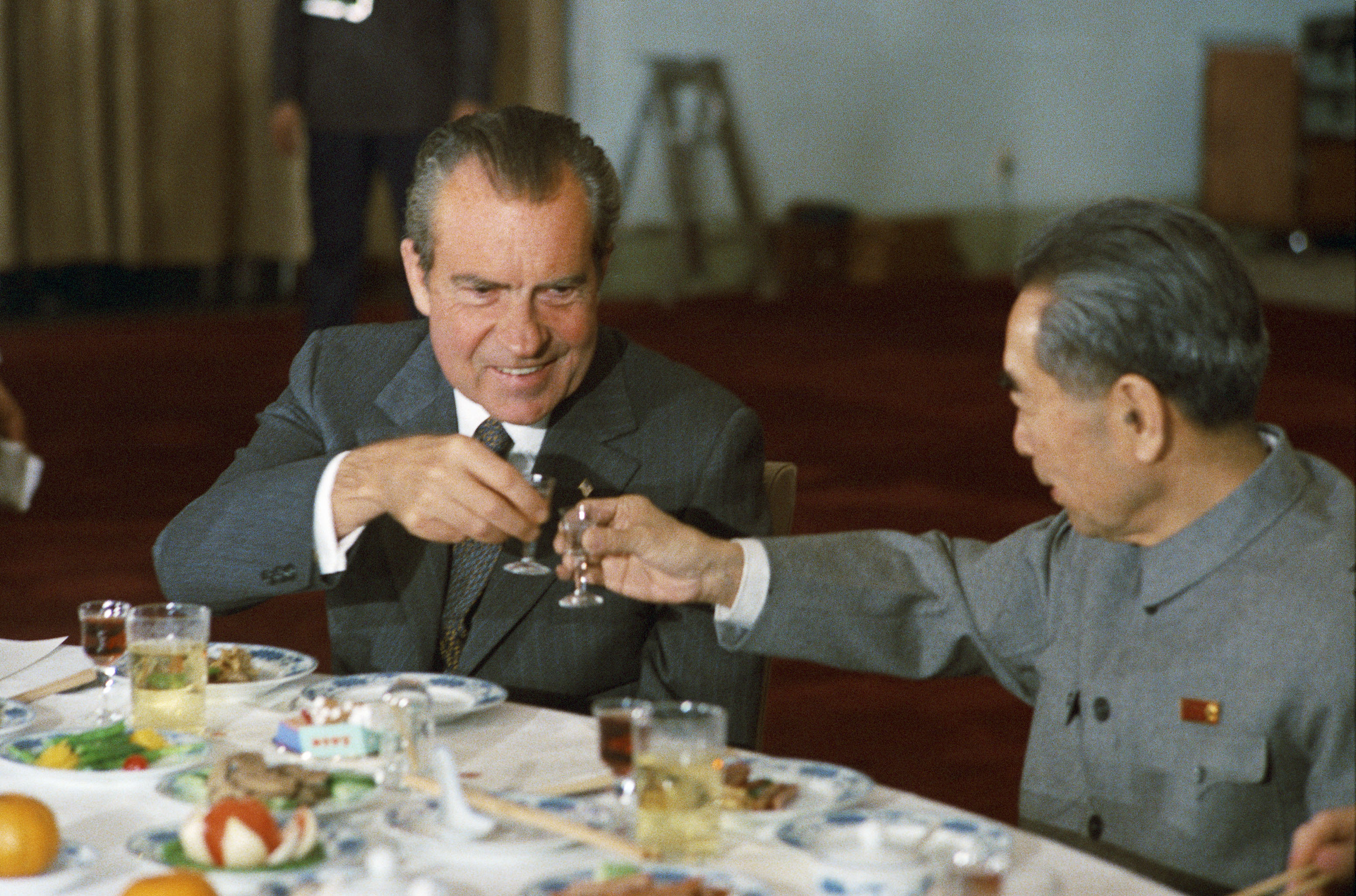
Nixon toasting Zhou
The Times editorial board was even harsher. “President Trump was on his best behavior, as is so often the case when he is dealing with dictators,” it wrote. “Mr. Trump was even more effusive about Mr. Kim after their session, sounding more like he was deconstructing a blind date than analyzing a diplomatic meeting.”
In case the reader didn’t get the message the editorial went on: “Whatever he does or does not understand about history or policy or statecraft, Mr. Trump has a keen sense of how to engage authoritarian thugs who crave respect and legitimacy. It’s how he’s wired.”
And then it piled on: “Mr. Trump has a deep and abiding fondness for strongmen … The more ruthlessly they have had to act to hold on to power, the more he respects them.”
“Dealing with men like Mr. Kim is, on some level, comfortable ground for Mr. Trump,” the Times editorial said. “Such negotiations are a higher-stakes, global version of the world he came up in, one of cutthroat real estate developers and shady businessmen and mobsters. … The world sneers at strongmen like Mr. Kim, Mr. Putin and Rodrigo Duterte, the president of the Philippines, regarding them as uncivilized thugs, and Mr. Trump feels similarly disrespected. Dispositionally speaking, these are Mr. Trump’s people.”
A Beginning, Not an End
There wasn’t a word about what the two leaders agreed to in Singapore, namely the start—not the end—of what Trump called “an arduous process” that could lead to peace on the Korean peninsula. Trump could not have been clearer. He even said he could be wrong if the agreement is not realized.
The Times editorial never mentioned the agreement. In essence both sides agreed to work towards a peace treaty to end the Korean War, and the U.S. agreed to provide security guarantees to North Korea in exchange for the denuclearization of the peninsula. This was always meant to be a broad agreement on principles at the summit to kick start the indeed arduous negotiations to follow.
That the Times editorial board purposely ignored this fact to score cheap partisan points could not be clearer. The risks inherent in war on the peninsula, which should be of bi-partisan concern, were apparently of no concern to the editors on Eighth Avenue who decidedly took the low road.
Senate Democrats were no less uncharitable, seizing what they thought was an opportunity to score partisan points, while ignoring the promise the summit holds. “What the United States has gained is vague and unverifiable at best,” said Senate Minority Leader Chuck Schumer (D-NY). “What North Korea has gained, however, is tangible and lasting. By granting a meeting with Chairman Kim, President Trump has granted a brutal and repressive dictatorship, the international legitimacy it has long craved.”
House Minority Leader Nancy Pelosi (D-CA) said: “In his haste to reach an agreement, President Trump elevated North Korea to the level of the United States while preserving the regime’s status quo.”
The questions asked at Trump’s post-summit press conference is illustrative of the partisan nature of today’s press. He was repeatedly asked about giving away the store without getting anything in return. But Trump made clear he had already gotten the return of three American prisoners, had gotten a commitment for the remains of Americans killed in the Korean War to be returned, and most crucially, a promise to begin the task of denuclearization.

US devastation of N. Korea (Keystone/Getty Images)
Yes it’s a promise. But the process has to begin somewhere. The very hard work to make that happen will begin now, and no peace-loving person would not want to give it a chance instead of seeking to gain short-sighted partisan advantage.
Trump said sanctions would remain and that war games with South Korea could resume if the deal does not materialize. After the devastation wrought by the United Sates on North Korea 65 years ago Trump incredibly agreed that those war games were seen as provocations by the North. He is being roasted for putting himself in the position of his adversary and seeing things as they do—a fundamental principle of diplomacy, and presumably journalism too.
The press also badgered Trump about North Korean human rights. They wanted to know how he could make a deal with such a repressive country. Would the alternative be war to enforce human rights? Trump said human rights were raised with Kim but were separate from the imperative of denuclearization. He felt that if peace were achieved and the North Korean economy improved (with the likely participation of U.S. corporations) that human rights would improve.
Turning the Tables
“I’m disappointed Kim Jong-un did not take the opportunity to raise with Trump the utterly dismal US human rights record, from mass incarceration of millions to rampant police murder of Black citizens,” tweeted Ali Abunimah, co-founder of the website The Electronic Intifada. “Any credible deal must be predicated on US respecting its own people.”
Journalist Max Blumenthal tweeted: “The US committed genocide during the Korean War, killing 20% of North Korea’s population, burning literally all of its cities to the ground w/ napalm, & nearly nuking it. Today it threatens w extermination. Reporters must ask Kim how he can make peace with such a brutal country.”
“Democrats attacking Trump from the Right on Korean Summit,” added writer and filmmaker Tariq Ali in a tweet. “Pity Obama didn’t have the guts to visit Teheran.”
What we are witnessing is an inability, or unwillingness, to break down Trump’s positions and examine each one individually, something that Democrats like Ted Kennedy were able to do with Nixon. But we are in a totally different era. A non-partisan approach to Trump would be able to decry his positions on climate, torture, health insurance, taxes, Iran and Palestine, and yet welcome his stated desire to lessen tensions with Russia and North Korea.
Instead we get tweets like this from former Republican Congressman Joe Walsh: “America is the brightest, most benevolent nation on earth. North Korea is the darkest, most horrific regime on Earth. We just gave them equal billing. We just sat at a table with them. There had better be something really, really good coming in return.”
Clearly some criticism of Trump for meeting Kim is bipartisan, but none of the praise is. Such an attitude of Walsh’s, and The New York Times, rests on a misunderstanding of America that is intended to reflect well on those who conveniently leave out the darkest chapters of America’s history, of which there have been far too many. The napalming and destruction of North Korea is among them, but hardly alone.
Deleting the context of decades of election meddling, coup plotting, assassinations and invasions of sovereign lands in the reporting and editorials of august organs like the Times, indeed in the entire corporate media, leaves Americans with a comic book understanding of their history, cast adrift in a bubble from the reality of the rest of the world.
Attacking other nations’ human rights record while ignoring one’s own, or one’s allies, such as Saudi Arabia and Israel, is classic projection designed to wash one’s conscience clean. It helps to hold a position in the post-War Western-dominated international system making it easy to convince oneself of one’s righteousness, though self-reflection would reveal that that system has become a grotesque image of its former self.
Joe Lauria is editor-in-chief of Consortium News and a former correspondent for The Wall Street Journal, Boston Globe, Sunday Times of London and numerous other newspapers. He can be reached at joelauria@consortiumnews.com and followed on Twitter @unjoe.
North Korea: Pelosi versus Peace
By Thomas L. Knapp | William Lloyd Garrison Center | June 12, 2018
Which is worse: The specter of nuclear war, or giving US president Donald Trump credit for a significant diplomatic accomplishment?
In her official statement on Trump’s Singapore summit with North Korea’s Kim Jong-un, US House Minority Leader Nancy Pelosi makes it clear that a few million incinerated human beings are a small price to pay to keep the 68-year-old Korean War going. Maybe not forever, but at least until there’s a Democrat in the White House.
“[T]he President handed Kim Jong-un concessions in exchange for vague promises that do not approach a clear and comprehensive pathway to denuclearization and non-proliferation,” Pelosi complains.
What were these dangerous “concessions?”
First, the US armed forces will, conditional upon progress toward North Korean denuclearization, stop conducting the threatening military exercises that they’ve conducted on North Korea’s border and off its coast since the 1953 ceasefire. Some “concession.” If US and South Korean forces aren’t prepared for a new outbreak of hostilities after 65 years of training, they never will be.
Secondly, again conditional upon North Korea holding up its end of the developing bargain, the US will provide “security guarantees.” Which means, the US and South Korea won’t invade North Korea, just like they haven’t invaded North Korea since 1953. Again, some “concession.”
Would a Democratic president, at the kind of summit with North Korea’s ruler that Trump managed to swing — unlike any past president, Democrat or Republican — have refused those two obvious first-step “concessions?” Not a chance. They were the bare minimum, and if a Democrat had offered them, Pelosi would have publicly celebrated them as like unto the Second Coming.
“President Trump elevated North Korea to the level of the United States while preserving the regime’s status quo,” Pelosi continues, ignoring the fact that every president since Eisenhower has “preserved the regime’s status quo” — until Trump, who recognized, diplomatically speaking and in relation to the issue at hand, that North Korea is already at “the level of the United States.”
If the Korean War is going to be sorted out, it will be the belligerents — North Korea, South Korea, China and the United States, likely with significant input from Russia — doing the sorting.
But Pelosi, the Democratic Party, and the party’s allies in the media, would rather it NOT get sorted out.
That’s disgusting.
Posturing America as “the exceptional nation,” Kim as a supplicant in rags, and those other governments as mere hangers-on could have had only two possible outcomes. One was the status quo ante. The other — a danger faced by then-president Barack Obama in negotiating the Iran nuclear deal — was those other parties negotiating their own deal, leaving a petulant, marginalized America to watch their parade from the sidelines.
A genuine and durable peace on the Korean peninsula may or may not be achievable, but Trump seems to be giving it the old college try. Pelosi and her party, having proven unable to lead and unwilling to follow on the matter, should at least have the decency to get the hell out of the way.
Thomas L. Knapp (Twitter: @thomaslknapp) is director and senior news analyst at the William Lloyd Garrison Center for Libertarian Advocacy Journalism (thegarrisoncenter.org).
‘Civilians deaths increased due to rise in use of US assassination drones’
Press TV – June 9, 2018
Delegation of authority to field level military commanders to use “US assassination drones” has resulted in a surge in the number of innocent civilians being killed.
Media sources reported recently that US President Donald Trump has delegated to battlefield commanders the authority to order lethal drone strikes.
The authority to call for assassination drone strikes was limited to the White House or Washington security officials when Trump’s predecessors, namely, George Bush and Barack Obama were in office.
Trump’s decision to delegate the decision-making process to the military resulted in the number of drone strikes increasing, and in turn, the number of innocent civilians getting killed going up, according to Michael Burns, a political and military analyst in New York.
Burns made the remarks in an interview with Press TV on Friday while commenting on the US military’s illegal extrajudicial killings by using assassination drones in some Muslim states, and now planning to expand the practice to other regions across the globe.
“The reason it [the use of assassination drones] has increased so substantially is because more decision-making authority is being given to military commanders to use these systems.”
Burn says the increase in the use of drones aims to project US military power worldwide.
“The increase in the use of drones — which are officially known as ‘unmanned aerial systems’ to mask their vicious ability — to project power in other regions of the world has increased substantially under the Trump administration.”
The analyst also links the increase in the use of drone systems to other reasons including the cost-effectiveness of the weapon compared to other means available to the US government to project its military power across the globe.
Forever AUMF Stalls at Senate Foreign Relations Committee
“War is not meant to be won, it is meant to be continuous.”
By Renee Parsons | OffGuardian | June 7, 2018
As the Forever AUMF 2018 (SJRes 59) (Authority for the Use of Military Force) continues to await action by the Senate Foreign Relations Committee, one can only imagine the extent of the behind-the-scene efforts underway to sway those few wavering Senators who may be reluctant to go down in American history as voting to eliminate Congress’ sole, inviolate Constitutional authority ‘to declare war’. Article 1, Section 8, Clause 11.
The law would remove Congress from its statutory authority as it transfers “uninterrupted” authority on “the use of all necessary and appropriate force” to one individual, allowing the President of the United States to pursue the Taliban, al Qaeda, ISIS and other ‘associated forces” including a proverbial too little-too late report to Congress 48 hours after the use of military force in a “new foreign country,” presumably in the Middle East (other than Afghanistan, Iraq, Syria, Somalia, Yemen or Libya).
In addition to pressure within the Committee itself, it can be expected that those who will benefit most from a Forever State of War are currently pounding the Senate’s marble halls, perhaps even stalking members of the Committee as lobbyists from the MIC, AIPAC and other enthusiasts for war, will do whatever it takes to bring adoption of the AUMF to a favorable committee vote.
Since more than half the Committee, fourteen of its twenty one members received a grand total of $3,397,755 from pro-Israel PAC’s as identified by the Center for Responsive Politics, whenever and if ever the final vote comes, it will be positively titillating to compare the vote and the money.
In an interesting reversal of common legislative procedure, the House of Representatives has, as yet, no pending AUMF comparable to the Foreign Relations Committee version while the Senate Committee appears eager to act; perhaps at the behest of one of those aforementioned aficionados of war. If we assume that the Senate Committee adopts the AUMF with the next logical step being a vote by the full Senate, will the Senate create an awkward legislative conundrum without a comparable Forever AUMF 2018 being on a legislative track in the House?
One factor in pushing for speedy AUMF approval might be that there is some new military escapade about to unfold with the need for an unwieldy Constitutionally mandated Congressional debate and vote too onerous, requiring too much effort and consuming a colossal amount of time whereas the Section 8 clause might better inform the American public whether their tax dollars are being efficiently used to improve their lives or might even threaten a halt to the steady drumbeat of war.
Perhaps the delay may be attributed to ongoing negotiations of the finer points in an attempt to create a more perfect air-tight vehicle. Whether there is a sunshine date or some i’s are not dotted or t’s not crossed makes little real difference in the final outcome since the ultimate goal is to allow war to go forward without meaningful Congressional participation while failing to provide the pesky public with information about why their sons and daughters are losing their limbs or lives in some far-away country that is no threat to our national security.
It is difficult to recognize a more ill-considered, reactionary vote of enormous global consequences as adoption of a Forever AUMF which will surely hasten the Final Chapter of the American Empire.
As if the Constitutional violations are not sufficient reason for opposition and while Congress has been less than attentive to its Section 8 duties, a functioning AUMF will not only deny a full and thorough public Congressional debate and roll call vote on the merits of military action but will prevent creation of a historic Congressional record, a journal of which began in 1789 as necessary to providing a formal documentation of all official parliamentary proceedings essential to any operative democracy.
In mid April when the AUMF 2018 draft was introduced, retiring Committee Chair Sen. Bob Corker (R-Tenn) was optimistic that the AUMF would be approved within a few weeks indicating that a potential Senate floor vote depends on the strength of AUMF support within the Committee. Corker suggested that a wide margin in favor would facilitate Senate floor passage which makes it curious that approval appears to have stalled and brings us back to question why the haste for rapid adoption of a new AUMF.
During the May 24th Committee hearing with Secretary of State Mike Pompeo, Sen. Tim Kaine (D-Va) who was HRC’s running mate in 2016, serves on the Senate Armed Service Committee and is a driving force in favor of the AUMF, referred to adoption as little more than a ‘necessary update’ repealing AUMF 2001 and AUMF 2003.
Kaine, who apparently sees no contradiction with an active-service son in the Marines and adoption of the Forever AUMF, stated that there is ‘near unity” on the Committee regarding a bi-partisan effort, military engagement against ISIS and the desire to do a ‘good job,’ none of which should be confused with real-time support for adoption of the AUMF.
While Kaine and other members of the Committee may be untroubled by the discomfort of a contradictory, cognitive dissonance belief system as necessary qualities in order to function as a Senator, the US has become the most violent country on the planet as its legislative representatives exhibit the lack of any functioning global consciousness.
Renee Parsons served on the ACLU’s Florida State Board of Directors and as president of the ACLU Treasure Coast Chapter. She has been an elected public official in Colorado, an environmental lobbyist for Friends of the Earth and a staff member of the US House of Representatives in Washington DC. She can be found on Twitter @reneedove31
Putin: US, S Korea’s Military Drills Near Korean Peninsula Not ‘Easing Tensions’
Sputnik – June 6, 2018
Russian President Vladimir Putin said in an interview with the China Media Group that Pyongyang was taking practical steps toward denuclearization, which is the common primary aim.
“It [North Korea] has announced termination of its nuclear and missile tests, first of all. Moreover, one of its major nuclear test sites was dismantled. These are, certainly, practical steps toward denuclearization, which is our common aim,” Putin said in an interview.
The president noted that Pyongyang’s demands for security were logical. The next step in settlement of the North Korean problem will be development of security guarantees by all the involved states, Putin added.
However, Moscow regrets that United States and South Korea did not halt their military drills which did not contribute to easing tensions on the Korean Peninsula, Russian President Vladimir Putin said.”We regret that our western partners, the United States and, unfortunately, South Korea, continue their military drills and maneuvers, which do not contribute to easing tensions,” Putin said in an interview with the China Media Group.
In May, South Korean Defense Ministry’s spokeswoman Choi Hyun-soo said that Seoul had ruled out the possibility of halting or scaling down the annual joint military drills with the United States.
The next US-South Korean joint military exercises, the Ulchi-Freedom Guardian, are reportedly set to be held in August.
NATO Sabre Strike Exercise: Scaring Russia with Multiple War Games of Unparalleled Scale
By Alex GORKA | Strategic Culture Foundation | 06.06.2018
This year, NATO has already organized about 100 exercises, 20 percent more compared to the same period in 2017. Saber Strike-2018, a large-scale US-led exercise involving 18,000 soldiers from 19 NATO members and partner nations, kicked off on June 3 to last till June 15. The scope of the exercise has been steadily expanding with every year. It was 11,000 troops in 2017, 9,000 in 2016, 6,000 in 2015, 4,700 in 2014 and 2,000 in 2013 – that’s how a relatively small drill turned into the regular deployment of substantial force in the proximity of Russia’s borders. Moscow expressed its concern about it at the NATO-Russia Council’s session held on May 31.
The annual multination training event organized every year since 2010 is being held across the training areas in Poland, Latvia, Lithuania and Estonia. Non-NATO countries taking part are Finland and Macedonia. Air assault landings are part of the scenario to hone the skills for launching offensive operations.
Sabre Strike is timed with Swift Response airborne drill in Latvia to culminate on June 8. It involves 800 paratroopers from US, Latvia, Lithuania, Israel and Poland.
There will be more exercises held in 2018 near Russia’s borders, including Trident Juncture, a really big one to take place in late October-early November to involve 35,000 troops from 30 nations along with 70 ships and about 130 aircraft and Anakonda organized by Poland in November. The latter will involve 100,000 servicemen, 5,000 vehicles, 150 aircraft and 45 warships. The scale is mind-boggling. One can imagine how much it costs! The Anakonda scenario includes preemptive strikes. If it’s not an open preparation for war then what is? US Army Chief of Staff Gen. Mark Milley believes it is. According to him, “Having large-scale NATO forces in the Baltic States and Poland, as well as the lack of transparency – we see serious preparation for a great war.” He knows what is talking about.
In May, NATO held a large Siil (Hedgehog) exercise in Estonia and northern Latvia involving more than 15 thousand troops. The series of training events are conducted against the background of the proposal put forward by Poland to deploy US troops on its soil with Warsaw shouldering the financial burden of base construction. A NATO annual summit in July will consider the issues related to further reinforcement of forces in Europe, including the eastern flank.
It has been revealed recently that the alliance plans to create an addition to the NATO Response Force (NRF) increasing its strength from 20,000 to about 50,000 by creating a pool of 30,000 troops with organic aviation and ships ready to be operationally deployed within 30 days. The initiative belongs to the US with Germany to take the lead. The bloc’s defense chiefs will discuss the issue at their upcoming meeting on June 8-9 before putting it on the agenda of NATO summit to be held on July 11-12. NATO war preparations against Russia include the new crisis response command center in Ulm, southern Germany, and another one in the US state of Virginia.
This force as well as other units will become part of training events and the soldiers will be deployed on temporary basis but holding regular exercises presupposes the creation of infrastructure to be used by troops upon arrival for launching offensive actions. Correspondingly, logistics are being beefed up.
There is fresh news to hit headlines before the July summit. Discussions are underway to deploy US THAAD air defense system in Germany. The move would plug a radar gap that emerged as a result of postponing the deployment of a second Aegis Ashore system in Poland. The Polish government has announced plans to purchase US Patriot PAC-3 MSE air defense systems.
Both the THAAD and Patriot have rather limited capability against sophisticated ICBMs but Aegis Ashore is more effective.
Modernization will take place, advanced missiles and systems will be moved to the already existing sites. The main thing is that the infrastructure, the foundation to build ballistic missile defense and surface targets strike capability on, will be in place. And the only target is Russia. The Aegis Ashore can launch intermediate range surface-to-surface missiles against Russian territory in violation of the INF Treaty. In a couple of years, Poland will host it. The THAAD’s radar can greatly enhance the Aegis Ashore capabilities by relaying data to them. The AN/TPY-2 has an estimated range from 1,500km (932mi) to 3,000km (1,864mi). The maximum instrumented range is 2,000km (1242mi) to enable it to monitor large chunks of Russia’s territory.
The INF Treaty is teetering on the brink of collapse. If torn up, the infrastructure in question would be just the thing the US would need to station intermediate range forces in Europe with the means to protect them already in place. F-35s incorporating B61-12 nuclear precision guided munitions would also be under the umbrella of air defense systems in place formally deployed to counter the non-existent threat coming from Iran.
The NATO summit in July is to focus on the “Russia threat”. The extraordinary scale of military exercises conducted so intensively with scenarios that include bringing in reinforcements to advance, not take defensive positions, the creation of infrastructure at Russia’s door and preparing the logistical base to provide for offensive operations will be described as the least the bloc can do while facing the superior enemy. Provoking Russia to take steps it would not take otherwise is the sure way to return Europe to the Cold War days.
NATO could have chosen a different approach of solving the problems at the round table but it did not. The European Security Treaty (2009) and the Agreement on Basic Principles Governing Among NATO-Russia Council Member States in the Security Sphere (2009) proposed by Russia were rejected off the cuff without any attempts to seriously negotiate the proposals. The 2016 German initiative to launch talks on a new European security agreement was greeted to be swept under the rug afterwards. The May 31 NRC meeting was devoted more to the Skripal case than European security and arms control issues. Actually, NATO has not lifted a finger to dissipate tensions. Instead, it is rapidly increasing the tempo of military activities near Russia on an unprecedented scale, undermining whatever is left of European security. The alliance has made its choice, giving preference to the policy of provocations.
Israel intelligence minister proposes ‘military coalition’ against Iran
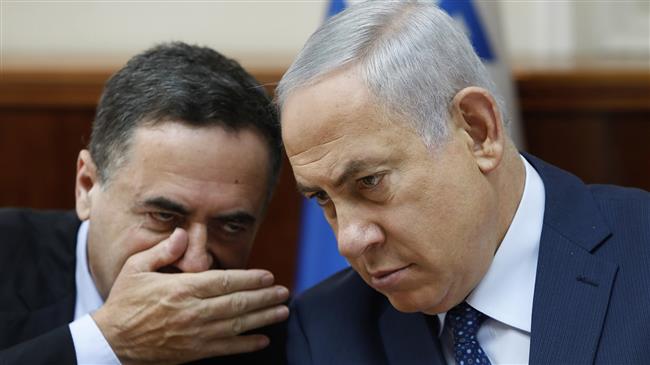
Israeli Intelligence Minister Yisrael Katz (L) and Israeli Prime Minister Benjamin Netanyahu
Press TV – June 5, 2018
Israel has proposed that “a military coalition” be formed against Iran in case Tehran pursues “military-grade” uranium enrichment, suggesting that the military force would comprise of the Israeli regime, the US, the Western states and their Arab allies.
Speaking to media on Tuesday, Israeli Intelligence Minister Yisrael Katz claimed that Iran had once been running an “unsupervised” enrichment scheme with the potential of arming the country with nuclear weapons.
The allies will need to issue a statement against the Islamic Republic “if the Iranians don’t surrender now, and try to return,” he said, adding that the statement would be threatening Iranians that “a military coalition will be formed against them.”
“There should be a clear statement by the president of the United States and all of the Western coalition” if Iran returns to enriching “military-grade” uranium, the minister said. “The Arabs and Israel surely would be there too,” he added.
Washington and Tel Aviv, and to a lesser extent their Western and Arab partners, have claimed that Tehran’s nuclear energy program harbors military aspects.
Iran has strictly and in all circumstances denied pursuing any military ambitions through its nuclear work.
The country asserts that under a fatwa (religious decree) issued by Leader of the Islamic Revolution Ayatollah Seyyed Ali Khamenei, its long-established policy is to oppose the acquisition, production, stockpiling, and use of nuclear weapons.
In December 2015, the International Atomic Energy Agency’s governing board voted overwhelmingly in favor of a draft resolution, which closed the so-called possible military dimensions (PMD) case in Iran’s nuclear program.
The vote brought an end to a 12-year investigation into the “past and present issues” regarding Iran’s nuclear activities, which the United Nations nuclear watchdog had been probing under pressure from the Israeli regime, the US and their allies.
The vote came after Iran and the P5+1 group of countries signed a nuclear agreement in 2015.
The US, however, withdrew from the accord last month, emboldening Israel in its efforts to try to kill the deal and rally more support for its anti-Iran campaign.
Despite Tel Aviv and Washington’s hostile endeavors, European states have vowed to keep respecting the deal and try their utmost to preserve it.
The Israeli minister’s comments come as Prime Minister Benjamin Netanyahu has embarked on a tour of Europe to persuade European leaders to follow the US and ditch the Iran deal.
This is while Iran is currently in talks with the other signatories on the future of the deal. Tehran has said it will stay in the JCPOA if the Europeans give guarantees that a deal without the US would still protect the Iranian interests.
Senate Democrats threaten to block Trump-North Korea deal
Press TV – June 5, 2018
US Democrats have warned President Donald Trump that they will block any deal with North Korea that does not guarantee a “verifiable” dismantlement of the country’s nuclear weapons and ballistic missile programs.
In a letter to Trump on Monday, Senate Minority Leader Chuck Schumer and Senator Bob Menendez said their party was not going to support a deal to ease sanctions on North Korea if the White House failed to meet their conditions.
“Sanctions relief by the US and our allies should be dependent on dismantlement and removal of North Korea’s nuclear weapons and ballistic missile programs,” the two Democrats wrote. “Any deal that explicitly or implicitly gives North Korea sanctions relief for anything other than the verifiable performance of its obligations to dismantle its nuclear and missile arsenal is a bad deal.”
An acceptable deal in Schumer and Menendez’s view had to ensure a “complete and verifiable denuclearization of North Korea,” an end to Pyongyang’s ballistic missile tests, and “robust compliance inspections.”
Pointing to the important role that Congress had in enacting a sanctions relief, the opposition leaders warned that they would opt for “tougher sanctions and oversight” if they thought the Republican head of state was moving in the wrong direction.
“If we think the president is veering off course, we won’t hesitate to move, but let’s see where he’s headed,” Schumer told reporters later in the day.
The letter came days ahead of a highly-anticipated summit between Trump and North Korean leader Kim Jong-un in Singapore on June 12.
Trump called of the meeting a short while back, after a brief war of words broke out between the two countries over the terms of a possible deal.
“Now that the meeting will proceed as planned, we want to make sure the president’s desire for a deal with North Korea doesn’t saddle us… with a bad deal,” Schumer said. “The president needs to be willing to walk away from the table if there isn’t a good deal to be had.”
Israel joins NATO drill in Europe for the first time

RT | June 4, 2018
Israeli troops have joined NATO war games in Eastern Europe for the first time. One of the scenarios includes crushing an armed rebellion.
Soldiers from a paratrooper brigade are participating in the NATO exercise ‘Swift Response’, which “simulates combating military uprisings in Europe,” the Israeli spokesperson said on Monday.
The annual drill led by the US European Command takes place across Germany, Poland, Lithuania and Latvia, with 10 nations involved in the maneuvers. Troops from non-NATO member Israel will train alongside the US 173rd Airborne Brigade and the Texas National Guard. According to the Pentagon, the maneuvers include “rapid response infiltration”, air assault operations and the evacuation of non-combatants.
The exercise takes place simultaneously with two other NATO drills in Europe. The two-week war game ‘Saber Strike’ amasses 18,000 soldiers from 19 countries, with troops deployed in Poland and the Baltic States. They will master the deployment of military convoys to defend NATO’s eastern flank, as well as operations across rivers and bridges.
Additionally, 37 warships are docked at the Lithuanian port city of Klaipeda for an ongoing naval drill ‘BALTOPS’. All in all the exercise led by US 6th Fleet Vice Admiral Lisa Franchetti will involve 60 aircraft and 42 ships from 22 nations.
All three drills are taking place close to the Russian border, and Moscow has been regularly warning that NATO military buildup at its doorstep undermines the stability and security climate on the European continent.
Russia is “closely observing” the war games and undertaking all “necessary measures” to ensure Russia’s own security during the maneuvers, the president’s spokesman Dmitry Peskov said Monday. Commenting on the largest of its exercises in the region, US Army Europe has claimed that ‘Saber Strike’ “is not a provocation of Russia.”
Israel had been an active NATO partner since the 90s, and the cooperation with the Bloc intensified in recent years, particularly in the field of combating terror threats. Israeli diplomatic mission at NATO HQ in Brussels was opened in 2016, with several cooperation agreements following. However, as NATO General Secretary Jens Stoltenberg confirmed last week, the Bloc’s security guarantees “do not apply” to Israel since it is not a member of the alliance.
Read more:
US mulls expanding military intervention in Yemen: Report
Press TV – June 4, 2018
The United States is considering a request from the UAE to provide direct support for an attack to seize the Houthi-held port of Hudaydah, a major lifeline for Yemen, officials say.
US officials said Secretary of State Mike Pompeo has asked for a prompt assessment of the UAE’s appeal for assistance such as surveillance drone flights to help a Saudi-led coalition capture Hudaydah.
The debate over increasing US support to the UAE and Saudi Arabia comes amid escalating military operations around the Yemeni port despite UN warnings of catastrophic effects on the impoverished country.
Eighty percent of commercial and humanitarian supplies flow through Hudaydah, a central gateway. Since May 27, forces supported by Saudi Arabia have been closing in on the port, claiming that Yemen’s Ansarullah movement uses it for weapons delivery.
American officials say the UAE and Saudi Arabia have assured Washington that they won’t attempt to take the Red Sea port until they get support from the US.
“We continue to have a lot of concerns about a Hudaydah operation,” said one senior US official, quoted by The Wall Street Journal.
“We are not 100% comfortable that, even if the coalition did launch an attack, that they would be able to do it cleanly and avoid a catastrophic incident,” the official added.
Senior Yemen specialists in the US administration were expected to meet on Monday to discuss what to do, the newspaper said.
According to the Journal, Riyadh and Abu Dhabi have long sought to get backing from the US.
Last year, the Saudi-led coalition unsuccessfully sought to secure American intelligence, surveillance and direct support from elite US military forces for an attack on Hudaydah, former US administration officials said.
For now, prominent administration officials involved in the debate harbor reservations about expanding the American military role in Yemen, but some back providing assistance to the UAE, officials said.
“We have folks who are frustrated and ready to say: ‘Let’s do this. We’ve been flirting with this for a long time. Something needs to change the dynamic, and if we help the Emiratis do it better, this could be good,’” the senior US official said.
Some administration officials are also increasingly disappointed that both military and diplomatic efforts have bogged down, which is fueling efforts to cut US support for the fighting, the report said.
The US has been lavishing sophisticated weaponry upon Saudi Arabia since March 2015, when the latter attacked Yemen to restore its Riyadh-allied former government. Washington also helps to refuel Saudi and UAE warplanes that conduct airstrikes on Yemen.
According to figures released by the Yemeni Ministry of Human Rights, more than 600,000 people have been killed or injured in the Saudi war since 2015. Yemen has also turned into the scene of the world’s worst humanitarian crisis.
The Red Cross and the United Nations have warned against the dangers of the Saudi-led operations in Hudaydah.
“The push for Hudaydah is likely to exacerbate an already catastrophic security situation in Yemen,” said François Moreillon, head of the International Committee of the Red Cross delegation in Yemen.
United Nations’ new special envoy on Yemen, Martin Griffiths, is to present his proposal for reviving peace talks to the UN Security Council in the next two weeks. He has publicly warned that an assault on Hudaydah “would take peace off the table.”
“We are all very concerned about the possible humanitarian consequences of a battle for Hudaydah,” he said.
Featured Video

Death Spikes & Rising Cancer In Our Youth Explained
or go to
Aletho News Archives – Video-Images
From the Archives
Politicians lie
By Mazin Qumsiyeh | Popular Resistance | August 18, 2013
There is no way to say this truth nicely: Politicians lie. That includes Japanese, American, Egyptian, Israeli, and Palestinian politicians! Is there something more common sense than that? Yet, so many citizens around the world believe their own politicians or wistfully acknowledge lies but think it is part of the job needed to run things. They believe even when politicians contradict themselves blatantly. This phenomenon is rather remarkable. It is a dissonance and disconnect from reality that many seem oblivious to. It is very dangerous because it can lead to accepting rationales for going to war. These can be deadly wars that lead to millions of lives lost as happened in what was called World War 1 and WW2. Even when incredible and declassified evidence abound, politicians continue to lie and old mythologies refuse to die. Here are just a few of the countless lies told to us over the past few decades… continue
Blog Roll
 Aletho News
- RSF military group defects, joins Sudanese army: State media
- Ireland goalkeeper refuses to play ‘Israel’ as squad weighs boycott
- China pushes back against US on Cuba, Iran
- Ukrainian Soldiers, Potential Mercenaries: Have Gun, Will Travel!
- Burnham’s UN debut… A masterclass in British disinformation
- Iran flights continue despite US aviation sanctions
- Global Tipping Points Lead the World Into a State of Entropy
- The day-after at the White House: USA and Xi Jinping
- The Geopolitical Balance in the Red Sea: The UAE Being Displaced by New Players
- Iraqi resistance group vows to stage airport sit-ins over Iran aerial blockade
- If Americans Knew
- Deconstructing Netanyahu’s pants-on-fire UN rant – Daily Update
- Trump betrayed voters with his campaign lies and prioritized a foreign country once he took office
- Netanyahu calls Israel’s war in Gaza ‘opposite of genocide’ in UN speech to near-empty hall
- Settler Kidnappings: Torture, Sexual Abuse and Terrorisation of Palestinian Abductees as Israel Deepens Annexation of West Bank
- Gaza winter nears as 162,000 tents become unusable, raising fears of humanitarian crisis
- Netanyahu says, “It’s the opposite of genocide”; UN says Gaza economy is world’s ‘most severe crisis on record’ – Daily Update
- Israel’s US-Backed Assault on Gaza Has Created the ‘World’s Most Severe Economic Crisis on Record’: UN
- ‘Protecting U.S. Citizens’… From Israel
- ‘This is where I live now, the back of a truck’: a day in the life of a grandmother in Gaza
- In UN Speech, Iran’s President Displays Pictures of Children Killed by US, Brings Attention to Israel’s Nuclear Arsenal
- No Tricks Zone
- New Study: Earth And Venus Surface Warmth Largely Explained By Convection And Lapse Rate, Not CO2 Or Radiation
- 2025 Nature Paper Claiming Worsening Global Drought Gets RETRACTED …Heavily Flawed
- New Study: ‘Global Drought Shows No Detectable Recent Acceleration Under Climate Warming’
- Economic Masterminds: German Socialists Suggest Taxing Productivity Gains Stemming From Using AI
- The South China Sea Has Not Been Cooperating With The Climate Change Narrative
- Energy Crisis: Germany Enters Heating Season With Historically Low Gas Reserve Fill Levels
- New Study: The Antarctic Ice Sheet Gained Mass From 2020-2024 Due To Staggering Snow And Ice Accumulation
- Study: Ocean Heating Rates From Thousands Of Years Ago ‘Dwarf’ Modern Ocean Heating Rates
- Climate Extremists Target, Attack Large-Scale Power Grid Infrastructure In Germany!
- New Study: Antarctic Ice Melt Has Contributed Less Than 1 Centimeter To Sea Level Rise In The Last 30 Years

