US tries to stop S-400 deal with India
By Frank Sellers | The Duran | June 27, 2018
In much the same manner as the US attempted to kill the S-400 deal with Turkey, they are now setting out to end India’s defense relationship with Russia, especially if they can manage to undermine this SAM deal. The idea is to utilize sanctions to get the job done. If the US can manage to dissuade India from buying their SAM systems from India over fear that they might contravene some sanction issued by Washington, then that’s what they aim to do, while simultaneously offering America’s THAAD system to New Delhi as a replacement.
The Economic Times reports:
NEW DELHI: The United States may try to persuade India to consider its ballistic missile defence options in an attempt to keep it from pressing ahead with the S-400 deal with Russia.
ET has learnt that the US could make ballistic missile defence an agenda point in the upcoming Indo-US 2+2 dialogue on July 6 for which external affairs minister Sushma Swaraj and defence minister Nirmala Sitharaman will be in Washington.
The likely option on the table would be the Terminal High Altitude Area Defense (THAAD) system. It is a sophisticated missile defence system which is believed to be particularly effective against long-range missiles.
The S-400 missile defence system is, however, said to be effective against a larger array of aerial attacks, particularly fighter aircraft such as the F-18s and F-35s.
The latest version of the Russian made S-400 has a longer range but the jury is out on whether it’s more effective than the THAAD against intermediate range and intercontinental ballistic missile systems. ET has gathered that India’s proposed S-400 purchase from Russia has prompted a reassessment within Trump administration on whether India would have gone ahead with the nearly Rs 39,000-crore deal with Russia had the US moved faster with the THAAD offer.
Now, the S-400 deal has become a politically sensitive issue with the US. The US Congress is debating a Bill to allow for sanctions against Russian defence entities which could cover entities in recipient nations as well.
Given India’s strong defence partnership with Russia, the Trump administration, through secretary of defence James Mattis, has pitched for a waiver for countries such as India on the condition that it progressively reduce its military dependency on Russia.
The Congress has still not provided satisfactory relief despite hectic lobbying within Washington. The problem is compounded by the fact that the Countering America’s Adversaries through Sanctions Act (CAATSA) covers the S-400 system in the category of technologically sophisticated equipment which must be specifically targeted for this purpose.
India has argued that its S-400 deal with Russia was in the works before the US started debating the subject. In any event, it will predate the CAATSA if and when it’s written into law.
Besides, people close to the negotiations told ET, it is unreasonable for US to expect India to decouple its defence relationship with Russia, which has been a proven reliable partner through several conflicts.
The US, senior government officials said, must appreciate that unlike many of the other countries which purchase defence equipment from Russia, India does not target Russian armament against American interests and will not do so in future.
India is likely to elaborate on these lines at the inaugural 2+2 dialogue between the foreign and defence ministers of the two countries, while the US might urge India to first exhaust options the American industry can offer.
With the deal to purchase Russia’s S-400 SAM system predating America’s CAATSA sanctions act, the US is short on its options for blocking the deal. But sanctions are still playing a role in complicating its consummation as sanctions against Russia are rendering it somewhat difficult to relay compensation to the Russians for equipment and services rendered, therefore forcing both parties to find a way to deal outside of the dollar and outside of financial systems with exposure to Western markets. This particular moment in time for relations between India and the US is marked by trade tensions, as India finds itself in a position to dodge not just sanctions on its trade partners Russia and Iran, but also Trump’s trade wars, which affect goods sold in the American market, where India is imposing reciprocal tariff measures against the United States.
The Myth of Barack Obama as the Great and Noble Nobel Global Statesman
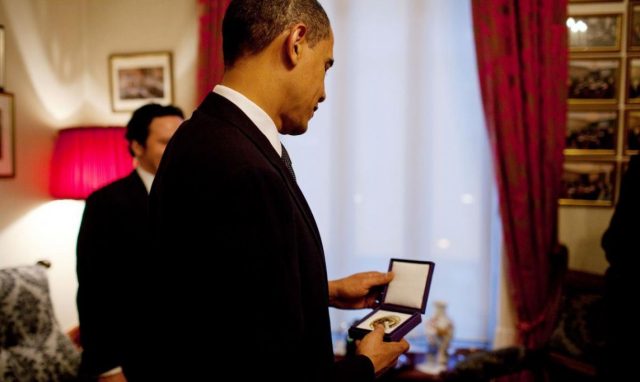
By Martin SIEFF | Strategic Culture Foundation | 27.06.2018
It is no coincidence that the Sword, Sorcery and Dragons Fantasy Games of Thrones – filmed in large part on location in my native Northern Ireland – has entranced the American viewing public over the past decade: For the early 21st century has seen US policymakers and opinion-shapers plunging ever deeper into one fantasy after another. But even Game of Thrones pales in incredibility and absurdity next to the fantasy still believed by most Americans — That Barack Obama was a wise and responsible, peace-loving statesman.
In truth, Obama, casually and with evident self-satisfaction, unleashed series of catastrophic foreign national security policies that sent the world careening to the brink of nuclear war and inflicted needless suffering on scores of millions of people. No Game of Thrones villain ever did anything like that damage.
I have no doubt that the ludicrous award of the 2009 Nobel Peace Prize to Obama will go down in history as the most ridiculous such award in the entire history of the institution.
What in reality was Obama’s record as President of the United States?
He authorized a totally unnecessary and strategically meaningless $1 trillion nuclear build up over the coming generation that will play a major role in bankrupting the United States. It was also a move guaranteed to set off a ruinous global thermonuclear arms race with Russia, China and other powers who understandably fear being made defenseless before a succession of ever more unilateral and unpredictable US leaders.
Obama claimed to be deeply concerned about nuclear nonproliferation and hosted a Nuclear Safety Summit in Washington whose only real achievement was to feed his already enormous and delusional appreciation of his own self-worth.
However, as analyst Rebecca Heinrichs of the conservative Hudson Institute in Washington concluded, “If one actually looks at the risks of nuclear war as well as the likelihood of proliferation at the start of the President’s term compared to now, the Obama’s nonproliferation record earns a failing grade.”
In 2011, Obama a fecklessly allowed his warmongering, hyper-aggressive secretary of state Hillary Clinton to arrange with Britain and France the use of NATO air power to destroy the state of Libya by giving tactical support and protection to rebels against veteran leader Muammar Gaddafi.
Gaddafi’s previous decade of consistent cooperation with the US and its allies in the struggle against extreme Islamist terror and his monitored compliance with demands to scrap Libya’s nascent nuclear [program] were all for naught. Obama and Clinton’s reckless and even clownish policies ensured the complete disintegration of Libya, creating an infernal anarchy in which Islamist terror groups could thrive and metastasize throughout sub-Saharan Africa.
Far from encouraging nations to scrap their nuclear programs as Gaddafi in fact had done, Obama’s childish approval of the destruction of Libya sent precisely the opposite message to nations around the world: “Scrap your nuclear deterrents and there will be nothing to stop the United States from destroying you whenever its leaders feel like it.”
It was the same story in Syria where Obama and Clinton eagerly approved the flow of half a billion dollars a year to such groups including, incredibly the Nusrah Front, the Syrian franchise of al-Qaeda, heirs to the conspirators who [are said to have] killed nearly 3,000 Americans on September 11, 2001.
Obama’s utter ignorance and his clueless ignorance of diplomacy and the conduct of international relations was memorably exposed in his casual approval of the absurd and clownish Michael McFaul as US ambassador to Moscow.
The idea that an accredited ambassador could pass his days in sending out public abusive Twitter messages insulting the head of the state to which he was accredited was ludicrous even if that state was Mauritius, Lichtenstein or Tahiti let alone one of the world’s two thermonuclear superpowers.
McFaul openly worked overtime to give aid and encouragement to domestic opposition to the undermine the legitimate government of Russia: His activities would have provoked calls for full-scale war from the US Congress had any Russian envoy to Washington, DC presumed to act in such a way. None of this bothered Obama for a second.
Even worse was to follow: In 2014, US Assistant Secretary of State Victoria Nuland, the wife of leading neocon ideologue Robert Kagan and also the favored subordinate of Hillary Clinton when she was secretary of state openly paraded in the streets of Kiev, handing out cookies to violent protestors as they overthrew with mob riots and terror the constitutionally democratically elected government of a European nation of 45 million people. Obama fully – albeit, as usual, passively approved.
East-West relations were reduced to a state of chaos and distrust unseen in 52 years since the Cuban Missile Crisis. Obama does not appear to have noticed or even been concerned.
Obama was not totally ignorant and uninterested in international relations. During his casual and ill-attended, poorly documented student years at Columbia University in New York City, he attended only one course in international relations. It was given by none other than Zbigniew Brzezinski, former National Security Adviser to President Jimmy Carter.
Brzezinski was a descendant of the displaced minor Polish aristocracy who through his long career consistently fought to lock the United States into a set policies designed to weaken, disintegrate and encircle Russia with hostile powers and alliances. He was a major foreign policy influence on US Presidents Ronald Reagan, Bill Clinton and George W. Bush.
Brzezinski was Obama’s personal guide and guru to what little the 44th US president dimly grasped of strategic orientation and world affairs. Obama’s near-total ignorance of non-American history and diplomacy gave Brzezinski full scope to manipulate him into accepting all his own most virulent anti-Russian prejudices.
Thanks to Obama, superpower diplomatic relations collapsed to their most parlous state in the entire Nuclear Age. When Obama took office in January 2009, the Doomsday Clock of The Bulletin of the Atomic Scientists journal was set at two minutes to midnight and the journal soberly warned: “The world stands at the brink of a second nuclear age.”
Yet after eight years in power, when Obama left the White House in January 2017, as ignorant, complacent and filled with unearned self-regard as when he came to Washington, the Doomsday Clock stood at three minutes to midnight – two minutes closer than when he had taken office.
We do not need to wait to know the Verdict of History on Barack Obama’s eight years as a global statesman. That verdict is in and it is damning: The Nobel committee should rescind his 2009 Peace Prize. Perhaps it can be given instead to a harmless fantasy TV show like Game of Thrones.
US to Create a Sixth Branch of Its Armed Forces
By Arkady SAVITSKY | Strategic Culture Foundation | 26.06.2018
President Donald Trump has signed an executive order directing the Defense Department to create a Space Force that will constitute a sixth independent branch of the US armed forces. The goal is to ensure American supremacy in space, outstripping other world powers, such as Russia and China. According to him, a mere US presence is not enough. “We must have American dominance in space,” the president emphasized. “We don’t want China and Russia and other countries leading us. We’ve always led,” he added. Once the president’s order has been carried out, the Air Force would likely turn over its space duties to the new branch.
The move meets the provisions of the National Security Strategy. The Joint Vision 2020 states that the US should dominate and control the military use of space.
The idea has substantial backing. It is fairly popular in Congress. A fully-fledged force, complete with a new, four-star general position, new uniforms, and a budget requires congressional action. Congress approves funds and can mandate specific requirements. Rep. Mike Roger (R-Ala.), chairman of the House Armed Services Strategic Forces Subcommittee, rushed to back the president on the issue.
The Air Force is not pleased by the policy, and some military leaders do not support it. Defense Secretary James Mattis opposed it last year. Is he in the loop today? There will be a lot of problems with funds, allocating responsibilities, and reorganizing the other services, each of which has its own component that already deals with space missions. Will a position of space secretary be created? Will the top commander of the new force become a member of the Joint Chiefs of Staff? There will be many questions to answer and problems to tackle.
But in any event, the executive order has been signed, launching the process of creating a new military branch, all of which is yet more evidence that the US is looking aggressively at its future in space and viewing it as a potential war-fighting domain.
The United States already has a very substantial presence there, including unclassified and classified satellites and space planes, such as the classified X-37B. In 2008, it demonstrated its capability to attack space objects by firing sea-based missiles. Back then, the US Navy successfully shot down a nonfunctional spy satellite traveling in space at more than 17,000 mph and 150 nautical miles above the earth over the Pacific Ocean. A cruiser based in Pearl Harbor hit it using a Standard Missile-3.
In 2010, the Air Force launched its first X-37B space plane. Since then, it has been sent up regularly on hush-hush missions lasting for many months. The Dream Chaser reusable space planes will add to this picture. The ballistic missile defense (BMD) system is shifting to air- and space-based systems. And there are other space-based capabilities we don’t know about as yet. Putting weapons into space to achieve global supremacy is high on the US agenda.
According to publicly accessible sources, the Air Force spends around $15 billion every year on space research and activities. The space-operations budget of the classified National Reconnaissance Office is an estimated $10 billion, bringing this total to at least $25 billion.
For many years now outer space has been used as an operational domain for military spacecraft, such as imaging and communications satellites. As yet, however, no weapons have been stationed in space. The US, Russia, China, and other space-faring nations are signatories to the Outer Space Treaty (OST) of 1967, an arms-control deal reached at the height of the Cold War. Recognized by 107 nations (as of April 2018), the OST bars countries from stationing nuclear weapons or weapons of mass destruction anywhere in outer space, including in orbit around Earth. No military bases, tests of any kind, including conventional weapons, or exercises are allowed, but the treaty doesn’t specifically ban the use of conventional weapons in open space or on space stations.
The first-ever draft Treaty on the Prevention of the Placement of Weapons in Outer Space, the Threat or Use of Force against Outer Space Objects (PPWT) was prepared by Russia and introduced to the UN in 2008 with China’s backing. The document was rejected with the US leading the opposition. The Americans claimed the paper did not address the security concerns over space assets. In December 2014, the UN General Assembly adopted a Russian resolution, “No First Placement of Weapons in Outer Space”. America, along with Ukraine and Georgia, voted against it. Moscow has expressed its readiness to discuss the issues related to the prevention of space militarization in its role as a participant in the EU-initiated activities on a draft International Code of Conduct for Outer Space. Washington has never displayed any interest.
Through resolutions and discussions within the United Nations, a general agreement has evolved that an arms race in outer space should be prevented. However, due to the structure of the international legal system and the objection of a small number of states, like the US for example, a treaty has not yet been negotiated that would comprehensively prevent the deployment of space-based weapons. The United States argues that an arms race in outer space does not exist and it is therefore unnecessary to take action to prevent it. It is true that such a race may not exist as yet, but the US appears to be very much willing to start one.
Washington believes that space accords would be too difficult to verify. But it has never come up with any initiative of its own to curb a space arms race. The idea to put weapons in space has been floated by the current administration. In his March 1 address to parliament, Russian President Putin unveiled some details about Russia’s new weapons. The domination of space could change the balance of forces in the US favor.
Creating a Space Force would most certainly prompt other nations to respond, which would in turn trigger a destabilizing form of competition. The weaponization of space will undermine international security and disrupt whatever is left of the eroding arms-control regime.
Hopefully this issue will be on the agenda of the Trump-Putin summit slated for July 15 in Vienna, Austria. A dialog on curbing the militarization of space might be a more efficient way to safeguard US national security than by challenging Russia in space. The problems related to arms control and non-proliferation have received very little attention recently, having been eclipsed by other issues impacting the US-Russia relationship. This top-level meeting is a chance to turn the tide.
The War in Afghanistan is Killing More People Than Ever
By Edward Hunt | Lobe Log | June 20, 2018
Seventeen years into the war in Afghanistan, the longest war in U.S. history, violence has never been worse. In 2017, more than 20,000 Afghans died, a new record.
The dead include an estimated 10,000 Afghan security forces, 10,000 Taliban forces, and 3,438 civilians. Although there is no reliable data on Afghan casualties available to the public, reports published by the Costs of War Project at Brown University indicate that the annual death toll for the Afghan population has never been higher than it was in 2017.
For civilians, the last four years of the war have been the deadliest, with more than 3,400 civilians killed each year from 2014-2017, according to data from the United Nations and the Costs of War Project.
“We are concerned that we will see greater harm this year unless necessary steps are taken by all parties to prevent civilian casualties,” said Tadamichi Yamamoto, the UN Secretary General’s special representative for Afghanistan.
The record violence comes as the Trump administration has intensified the war against the Taliban. Although President Trump repeatedly indicated before he was president that he opposed the war and wanted to end it, he has instructed U.S. military forces to take more aggressive action.
“In Afghanistan, I’ve lifted restrictions and expanded authorities for commanders in the field,” Trump acknowledged last year. The new approach, according to Brigadier General Lance Bunch, means that “the gloves are off.” U.S. military forces are now looking for “any opportunity to target the enemies of Afghanistan wherever we find them in the theater.”
With the new authorities, the U.S.-led coalition has been waging a more aggressive war. In 2017, U.S. forces tripled the number of airstrikes against enemy forces. They also helped Afghan security forces intensify offensive operations against the Taliban.
“In the last year, we’ve seen offensive operations, kind of unprecedented over the last few years, by the Afghan security forces,” U.S. General John Nicholson, the commander of coalition forces in Afghanistan, has commented.
Administration officials acknowledge that they expected the Taliban to respond to the increase in military pressure with more violence. “And so we anticipated this,” Secretary of Defense James Mattis has said. In March, State Department official Alice Wells remarked that “it will not come as a surprise if we see more terrorist tactics addressed at urban audiences.”
The increase in violence has been devastating for the Afghan people. According to the UN Assistance Mission in Afghanistan, which tracks civilian casualties, more than 3,400 Afghan civilians have died and more than 6,800 Afghan civilians have been injured in each of the past four years of the war.
Afghan officials quietly acknowledge that about 10,000 Afghan security forces died last year, a significant increase from previous years. Fearing that the publication of the numbers could undermine morale and hinder ongoing recruitment efforts in Afghanistan, the U.S. military has begun censoring the records.
Although U.S. and Afghan officials estimate that about 10,000 Taliban forces were killed in 2017, Gen. Nicholson has said that “enemy casualty rates have been much higher.” Either way, last year’s combined death toll for Afghan combatants is about 20,000 people.
Despite the record death toll, the Trump administration remains committed to its strategy. “Progress and violence coexist in Afghanistan,” Secretary Mattis recently commented.
The U.S. military’s primary objective is to bring at least 80 percent of the Afghan population under the control of the Afghan government. According to a classified study, the Afghan government might prevail in the war if it achieves this goal. “The focus of our military operations is on increasing and expanding population control by the government of Afghanistan,” General Joseph Votel, the commander of U.S. Central Command, told Congress earlier this year.
The Trump administration’s approach is failing. Not only are record numbers of Afghans dying, but the Afghan government has been losing control of the population. In its latest report to Congress, the Special Inspector General for Afghanistan Reconstruction confirmed that the Afghan government’s control has dropped from 69 percent in August 2016 to 65 percent in January 2018.
Last year, the U.S. intelligence community largely predicted the failures. Director of National Intelligence Daniel Coats told the Senate Armed Services Committee that “the political and security situation in Afghanistan will almost certainly deteriorate through 2018 even with a modest increase in military assistance by the United States and its partners.”
Former Secretary of Defense Chuck Hagel has said that the war has reached a new low. “After 17 years in Afghanistan the situation is worse than it’s ever been,” Hagel commented earlier this year.
Perhaps the best hope for Afghanistan now lies with a growing Afghan peace movement, which has been calling for an immediate ceasefire and talks to end the war. Not only has it succeeded in getting Afghan President Ashraf Ghani to announce a temporary ceasefire, but the Taliban announced its own ceasefire, leading to a few days of peace and celebrations throughout the country.
“I think President Ghani is responding to and indeed reflecting the desire of a wide cross-section of Afghans… in desiring to see a reduction in violence and a way forward to an end to the conflict,” a senior State Department official said.
The Afghan government plans to maintain the ceasefire for the immediate future, despite the recent decision by Taliban officials to resume fighting.
Edward Hunt writes about war and empire. He has a PhD in American Studies from the College of William & Mary.
Analyst Suggests US Can No Longer Use UNHRC to Justify Global Military Ops
Sputnik – 22.06.2018
The United States can no longer use the United Nations Human Rights Council (UNHRC) to justify its military interventions around the globe, now that it has withdrawn from the world body, US Ron Paul Institute for Peace and Prosperity Executive Director Daniel McAdams told Sputnik on Thursday.
“Human rights as an issue is often a cover for foreign interventionism. The US used ‘human rights’ as an excuse to destroy Libya and to launch a seven year proxy war in Syria,” McAdams said. “In fact, it was the UN Human Rights Council that first put the wheels of the US-led attack in Libya in motion.”
McAdams recounted how in the days leading up to NATO’s intervention in Libya, non-governmental organizations petitioned the UN Human Rights Council to demand action in response to alleged atrocities being committed by then-Libyan leader Moammar Gaddafi. As a result, the issue was then taken up by the Security Council, which adopted Resolution 1973, a measure that paved the way for NATO’s airstrikes in Libya. Several of the NGOs’ allegations — which formed the basis for NATO’s intervention — later turned out to be false.
“The human rights abuses that Libyans have suffered since their ‘liberation’ far outweigh any they suffered under the rule of Gaddafi,” McAdams said.
On Tuesday, US Ambassador to the United Nations Nikki Haley announced that the United States decided to suspend its membership in the UNHRC. Haley denounced the organization as hypocritical, saying it was biased against Israel and protected countries that abused human rights, such as Cuba, the Democratic Republic of Congo, China and Venezuela.
“The UN Human Rights Council, like most of the UN, has long ago strayed away from its original purpose,” McAdams said. “When you have notorious human rights abusers like Saudi Arabia — and the US among others — playing a prominent role in determining human rights abuses in other countries, the whole exercise becomes a farce.”
McAdams went on to say that the US withdrawal from the UNHRC would “hopefully reduce” its importance and restrain its ability to be used as a forum to promote conflict.
“The UN’s adopting the ‘Responsibility to Protect’ (R2P) doctrine in 2006 has been an unmitigated disaster. The UN was founded as a body of sovereign states seeking to work together as such to eliminate war,” he said. “The destruction of national sovereignty caused by the R2P doctrine means that countries with aggressive foreign policies can use the UN as a fig leaf as a cover. The result is more war, not less. And that is what we are already seeing.”
The US decision to quit the council comes a month after the UNHRC decided to form an independent mechanism to investigate the Israeli Defense Forces’ killings of more than 100 Palestinian protesters along the border with the Gaza Strip since March. Palestinians in Gaza have been staging protests along the border to demand the right to return to their homes now inside Israel. The UNHRC has said that the killings could be considered war crimes and need to be investigated.
According to UNHRC President Vojislav Suc, the UN General Assembly will now decide on a candidate to replace the United States on the Council, which consists of 47 members elected directly by the General Assembly.
Prior to its withdrawal, the United States’ mandate in the UNHRC was expected to last till the end of 2019. It was the country’s second three-year term, after which the US did not have the right to be re-elected.
Korean Voices Missing From Major Papers’ Opinions on Singapore Summit

The Washington Post‘s Jennifer Rubin (6/17/18) epitomized the zero-sum takes of US pundits.
By Adam Johnson | FAIR | June 21, 2018
In major-paper opinion coverage of the Singapore summit, the people with the most to lose and gain from the summit, the people whose nation was actually being discussed—Koreans—were almost uniformly ignored.
Three major US papers—the New York Times, Washington Post and Wall Street Journal—had only one Korean-authored op-ed out of 41 opinion pieces on the subject of the Korean peace talks.
The Post had 23 total opinion pieces, the Times had 16 and the Journal four. The only op-ed by a Korean was a pro-summit piece on June 12 by Moon Chung-in, an aide to South Korean President Moon Jae-in. Of the 41 editorials or op-eds only four (9 percent), were broadly positive about the Trump/Kim summit, 29 (70 percent) were negative and eight (21 percent) were mixed or ambiguous. The full list, current as of June 19, is here.
As FAIR noted in May (5/7/18), there’s a huge chasm between how recent peace efforts are being received in ostensible US ally South Korea and how they’re being covered in US media. As we noted at the time, polling shows 88 percent of South Koreans in favor of these efforts, while the person spearheading them, President Moon, holds an 86 percent approval rating. But the bulk of US coverage ranged from snide dismissal to outright opposition (FAIR.org, 6/14/18).
Similarly, a poll taken after the Singapore summit found that 66 percent of South Koreans were pleased with the results, and only 11 percent opposed them. This contrasts sharply with the reaction in US newspapers, which has been overwhelmingly negative in tone, and dominated by NatSec-centered horse race takes over who “won.”
The New York Times published one pro-summit piece, by Victor Cha (6/12/18), and it was a very qualified and conflicted. The Washington Post was mostly negative and skeptical, with three exceptions: predictable partisan cheerleading from reliable Trump apologist Marc Thiessen (6/15/17); a measured “wait and see” take from Michael O’Hanlon, a fellow at the Brookings Institution (6/13/18); and the aforementioned piece by President Moon’s aide. The Wall Street Journal’s commentary was uniformly negative.
The US media’s reaction to the summit is almost a mirror image of that of the South Korean public: 70 percent of major US papers’ opinion columns disapproved of the summit, whereas 66 percent of South Koreans approved. Eleven percent of South Koreans disapproved, whereas only 9 percent of professional opinion-havers at the Times, Post and Journal thought the summit was a good thing.
This raises an important question: Why? What do US pundits know that those with something actually at stake—Koreans—don’t know?

Trump showed “reckless disregard for the security concerns of America’s allies,” argued Kori Schake of the International Institute for Strategic Studies–funded by Boeing, Northrop Grumman and Lockheed Martin (New York Times, 6/15/18)
One factor is that our media system turns to professional “experts” at a small handful of establishment think tanks, and these are often funded by monied interests with a vested interest in particular kinds of policy (Extra!, 7/13). On international questions, this often means the arms industry, who are major funders of think tanks like the Center for Strategic and International Studies (CSIS) and the International Institute for Strategic Studies (IISS). These think tanks produced predictably hawkish putdowns of the summit, such as CSIS’s Sue Mi Terry, who told MSNBC’s Nicolle Wallace, in a rare moment of candor:
A peace treaty is not OK. That should come at the end of the process, because a peace treaty, while it sounds great and could be historic, also undermines the justification of our troops staying South Korea.
The “justification” for troops also happens to be the justification for the weapons systems they come with, namely those of CSIS’s major donors Northrop Grumman, Lockheed Martin and Boeing (FAIR.org, 5/8/17).
Another part of the problem is partisanship. US pundits overwhelmingly view the Kim/Trump summit as a Trump-led or US-directed event, rather than an essential but limited part of a broader peace effort being undertaken by the Koreas themselves. … Full article
New UK Army Chief Lists Russia Among ‘Imminent’ Threats to Country
Sputnik – 21.06.2018
General Mark Carleton-Smith has given his inauguration speech, becoming the new army chief shortly after replacing General Sir Nick Carter, who has moved on to become chief of the defense staff.
The new British chief of the general staff, General Mark Carleton-Smith, has stated that the UK faces imminent threats from multiple states that he described as “rogue,” including Russia, during a speech at the Royal United Services Institute (RUSI). He also noticed that Russia is currently in “revisionist mode” and that it possesses a “growing arsenal of long-range precision capabilities.”
“The misplaced perception that there is no imminent or existential threat to the UK, and that even if there was, it could only arise with long notice, is wrong,” he said.
He also warned against cutting army’s funding, noting that if the country falls behind, the UK might lose its “unquantifiable advantage” over its adversaries.
Information earlier surfaced regarding an alleged conversation between the UK prime minister and the UK defense secretary, where Theresa May had suggested that the army needs to enhance its cyber warfare capabilities in order to deter modern threats coming from other states, including Russia. She also reportedly questioned whether the UK had lost its “top tier” status as a military power.
Relations between the UK and Russia have been trapped in a downward spiral following the poisoning of former Russian intelligence officer Sergei Skripal and his daughter Yulia in Salisbury, England. The UK declared that the substance used in the attack is similar to the Novichok-class of nerve agents developed by the Soviet Union and accused Russia of organizing the attack, expelling 23 of its diplomats as a punitive measure. Both Skripals later regained consciousness, despite their alleged poisoning with a nerve agent. Moscow has rejected the UK’s accusations, also expelling British diplomats, as well as closing the British Council in Saint-Petersburg.
UK Worried NATO to be Hurt if Trump Meets Putin Before Bloc’s Summit – Reports
Sputnik – 21.06.2018
US President Donald Trump may sit down for talks with Russia’s President Vladimir Putin during his trip to Europe next month.
The British government fears that the two presidents could meet before NATO’s upcoming summit in Brussels and Trump’s official visit to London.
“It’s unclear if this meeting is after or before the NATO and UK visit. Obviously after would be better for us,” the Times quoted a Whitehall source as saying.
“It adds another dynamic to an already colorful week,” the official added.
According to the newspaper, London is alarmed that the possible talks between the US and Russian presidents could have an impact on Trump’s commitment to NATO’s “shared goals” and the outcome of his July 13 visit to Britain.
The Times also quoted a Western diplomatic source as saying that if Trump and Putin meet before the July 11 NATO summit in Brussels, this would be viewed as a highly negative development.
On Friday, Donald Trump told reporters that it was possible that he would meet Vladimir Putin this summer.
Trump, who had two meetings with Putin during last year’s G20 summit in Germany, has shown keen interest in restoring Russia’s place in the international community.
At the G7 summit in Quebec earlier this month, he proposed that Russia should be re-admitted to the Group of Eight countries.
Here’s Why Pro-Migrant Protesters Changed US Policy While Anti-War Protesters Didn’t End America’s Recent Wars
By Adam Garrie | EurasiaFuture | June 20, 2018
Donald Trump has just signed an executive order reversing the Clinton era policy of separating children from their illegal migrant parents at the southern border of the United States. While this policy has been in operation since the 1990s, it was only in the last month that it caught the attention of American media and the political class.
Ultimately, the issue is one for the leaders of the US to decide and under immense media and political pressure, the US President has taken the matter into his own hands and changed a policy based entirely on a public pressure campaign rather than his own apparent line of thinking which favours an increasingly tough border policy.
What this proves is that on issues effecting the well being of humans who happen not to be US citizens, public pressure campaigns can in fact get policies changed, especially in an election year. When one thinks that George W. Bush illegally invaded Iraq just over a year before facing re-election while Tony Blair did the same only two short years before facing the UK electorate, it beggars belief that anti-war campaigns have been so ineffective at reversing policies that slaughter millions, destroy entire regions and all the while unleashing the most barbaric forms of terrorism in places where there once was little or none.
Irrespective of one’s views of America’s border policy, even those who believe it to be inhumane must admit that it did not result in the deaths, terrorism and destruction of the US led wars on Yugoslavia, Iraq, Libya and the hybrid war against Syria.
While millions of people marched against the Iraq war throughout the world in 2003, far more than have gone on demonstrations against the controversial child separation policy of the US border authorities, it nevertheless had no effect on US policy in the Middle East. In fact, the amount of wars and number of troops committed across the Middle East by the US and its partners only increased since 2003.
Why then did the anti-war marches fail while the pro-migrant movement accomplished its goal? The reason is simple. While masses of protesters can control the streets and non-corporate air waves, the corporate media in the United States that is willing to take a side on issues like migration is unwilling, unable or not wanting to go up against the pro-war factions of Washington. The same is true even for most so-called independent minded politicians in the US, almost all of whom lose their independent streak when it comes to war, with retired Congressman Dr. Ron Paul, his son Senator Rand Paul and Senator Bernie Sanders being exceptions in the wilderness.
While corporate media is losing viewership at a rapid pace among the wider public and the young in particular, among the policy making class, there is still a tendency to literally view the world through a bubble and refuse to look at non-corporate or non-western originated media for any other purpose than to mock, sneer and at times, attempt to censor.
It is because of this, that the kind of invisible connection between the narrative of mainstream media pundits and politicians can lead to meaningful policy change while this is not the case when it comes to anti-war issues that the mainstream media in the US tends to either ignore or berate (before ignoring).
In this sense, the political-media complex has worked to insure that the issues that are important to the boardrooms of CNN and MSNBC are those which are important to the politicians who can then pressure a reluctant President to change a policy he previously appeared to support.
It is only when politicians begin to take non-corporate western media sources at face value rather than look for conspiracies (aka Russian meddling) which do not exist, that the growing number of people opposed to war might be able to affect policy change. Until then, the anti-war voices of millions will be ignored, while the loud but comparatively quieter thousands of voices raised against America’s border policies will be heeded.
The solution for anti-war protesters is to not give up but to shame the part-time humanitarians who cried at the thought of strangers in a strange land being separated from their families, yet who say nothing when families living in their ancestral homes are separated from one another by the force of a bomb – never to be reunited. If you think that America’s long standing border policy was inhumane but do not feel similar things towards the families America’s military slaughters in their own home – then you do not have a heart after all… but you probably have a high definition television.
Featured Video

Trita Parsi: Israel Set a Trap for Total War in the Region
or go to
Aletho News Archives – Video-Images
From the Archive
Zionism’s Violent Legacy
By Donald Neff | Washington Report On Middle East Affairs | January 1996
On January 4, 1948, Jewish terrorists drove a truck loaded with explosives into the center of the all Arab city of Jaffa and detonated it, killing 26 and wounding around 100 Palestinian men, women and children.[1] The attack was the work of the Irgun Zvai Leumi – the “National Military Organization,” also known by the Hebrew letters Etzel – the largest Jewish terrorist group in Palestine. The Irgun was headed by Revisionist Zionist Menachem Begin and had been killing and maiming Arabs, Britons and even Jews for the previous ten years in its efforts to establish a Jewish state.
This terror campaign meant that at the core of Revisionist Zionism there existed a philosophical embrace of violence. … continue
Blog Roll
 Aletho News
- Trita Parsi: Israel Set a Trap for Total War in the Region
- Trump’s Iran war is on an Israeli leash
- Saudi oil boss issues global supply warning
- Riyadh Says Its Oil System Is Intact. The Numbers Say Otherwise.
- Trump and Netanyahu Want to “Finish the Job” on Iran
- US ‘one-sided dictation’ not Iran’s beliefs makes rational talks impossible: Baghaei
- Iran’s Next Strike May Not Explode. It Could Shut You Down /Col Doug Macgregor
- Iran: US political targets legitimate if assassinations return
- Iraq shuts key border crossing with Iran under US pressure: Report
- Undersea Internet cables could be targeted in retaliation for attacks on Iran: IRGC deputy chief
- If Americans Knew
- The Israel Lobby’s Changing Fortunes
- AIPAC has become such a political liability that it’s shifting to a more “nimble” approach to buying politicians
- At least 160 Israeli settler attacks in 2 weeks
- Will Gaza’s Ancient Christian Community Disappear Forever?
- Israel’s vision of regional security rests on keeping Arab states weak
- Heidi Levine recounts how Palestinian youths helped save her in settler attack
- DAILY UPDATE: Latest essential news on Palestine, Israel, & region
- Trump’s Intensifying Sabotage of the ICC, for Israel’s Sake
- Israeli military detain US and UK volunteers in West Bank including Democratic NY politician Brad Lander
- Americans at National Conservatism Conference held in Israel this year criticize Israel
- No Tricks Zone
- E-Cars Reduce CO2 Emissions By Only 41% Compared To Internal Combustion Engine Vehicles
- Predictions Made By Renowned Climate Professor Over Past Decades Have Been Proven To Be Poor
- New Study Suggests Large Regions Of The Pacific Ocean Have Been Cooling For The Last 80 Years
- Germany’s Green Energy Debacle: High Energy Costs Force Kahla Porzellan to Close After 182 Years!
- New Study: 50 Years Of The Most Aggressive ‘Net Zero’ Policies Can Only Affect The Global Climate By 0.03°C
- US September “Heat” Was No Record…Many Records Set Decades Ago
- Latest European Green Energy Debacle; Portugal’s Largest Flagship Solar Park Insolvent!
- Green Energy Debacle: German Expert Professor Fritz Vahrenholt Warns Of Severe Economic And Social Consequences
- Two More Paleo Reconstructions Affirm Meters-Higher Sea Levels Across Ireland, Brazil 7000-6000 Years Ago
- New Study: Earth And Venus Surface Warmth Largely Explained By Convection And Lapse Rate, Not CO2 Or Radiation

