Fifty Years Ago the United States Government Killed Dr. Martin Luther King, Jr.
A Review of The Plot to Kill King by William Pepper
By Edward Curtin | April 4, 2018
Very few Americans are aware of the truth behind the assassination of Dr. Martin Luther King, Jr. Few books have been written about it, unlike other significant assassinations, especially JFK’s. For fifty years there has been a media blackout supported by government deception to hide the truth. And few people, in a massive act of self-deception, have chosen to question the absurd official explanation, choosing, rather, to embrace a mythic fabrication intended to sugarcoat the bitter fruit that has resulted from the murder of the one man capable of leading a mass movement for revolutionary change in the United States. Today we are eating the fruit of our denial.
In order to comprehend the significance of this extraordinary book, it is first necessary to dispel a widely accepted falsehood about Dr. Martin Luther King, Jr. William Pepper does that on the first page.
To understand his death, it is essential to realize that although he is popularly depicted and perceived as a civil rights leader, he was much more than that. A non-violent revolutionary, he personified the most powerful force for the long-overdue social, political, and economic reconstruction of the nation.
In other words, Martin Luther King was a transmitter of a non-violent spiritual and political energy so plenipotent that his very existence was a threat to an established order based on violence, racism, and economic exploitation. He was a very dangerous man.
Revolutionaries are, of course, anathema to the power elites who, with all their might, resist such rebels’ efforts to transform society. If they can’t buy them off, they knock them off. Fifty years after King’s assassination, the causes he fought for – civil rights, the end to U.S. wars of aggression, and economic justice for all – remain not only unfulfilled, but have worsened in so many respects. And King’s message has been enervated by the sly trick of giving him a national holiday and urging Americans to make it “a day of service.” Needless to say, such service does not include non-violent war resistance or protesting a decadent system of economic injustice.
Because MLK repeatedly called the United States the “greatest purveyor of violence on earth,” he was universally condemned by the mass media and government that later – once he was long and safely dead – praised him to the heavens. This has continued to the present day of historical amnesia.
 But William Pepper resurrects the revolutionary MLK, and in doing so shows in striking detail why elements within the U.S. government executed him. After reading this book, no fair-minded reader can reach any other conclusion. The Plot to Kill King, the culminating volume of a trilogy that Pepper has written on the assassination, consists of slightly less text than supporting documentation in its appendices, which include numerous depositions and interviews that buttress Pepper’s thesis on the why and how of this horrible murder. It demands a close reading that should put to rest any pseudo-debates about the essentials of the case.
Pepper, an attorney who represented the King family in the 1999 trial that found U.S. officials of the federal (in particular, the FBI and Army Intelligence), state, and local governments responsible for King’s assassination, has worked on the King case since 1977. He met MLK in 1967, after King had read his Ramparts’ magazine article, “The Children of Vietnam,” that exposed the hideous effects of U.S. napalm and white phosphorous bombing on young and old Vietnamese innocents. The text and photos of that article reduced King to tears and were instrumental in his increased opposition to the war against Vietnam as articulated in his dramatic Riverside Church speech (“Beyond Vietnam: A Time to Break Silence”) on April 4, 1967, one year to the day before his execution in Memphis. That speech, in which King so powerfully and publicly linked the war with racism and economic exploitation, foretold his death at the hands of the perpetrators of those abominations.
Devastated by King’s death, and assuming the alleged assassin James Earl Ray was responsible, Pepper retreated from the fray until a 1977 conversation with the Rev. Ralph Abernathy, King’s associate, who raised the specter of Ray’s innocence. After a five hour interrogation of the imprisoned Ray in 1978, Pepper was convinced that Ray did not shoot King and set out on a forty year quest to uncover the truth.
Before examining the essentials of Pepper’s discovery, it is important to point out that MLK, Jr., his father, Rev. M. L. King, Sr., and his maternal grandfather, Rev. A.D. Williams, all pastors of Atlanta’s Ebenezer Baptist Church, were spied on by Army Intelligence and the FBI since 1917. All were considered communist sympathizers and dangerous to the reigning hegemony because of their espousal of racial and economic equality. When MLK, Jr. forcefully denounced unjust and immoral war-making as well, and announced his Poor People’s Campaign and intent to lead a massive peaceful encampment of hundreds of thousands in Washington, D.C., he set off panic in the bowels of government spies and their masters. Seventy-five years of spying on black religious leaders here found its ultimate “justification.” As Stokely Carmichael, co-chairman of the Student Non-violent Coordinating Committee, said to King in a conversation secretly recorded by Army Intelligence, “The man don’t care you call ghettos concentration camps, but when you tell him his war machine is nothing but hired killers, you got trouble.”
It is against this “trouble” that Pepper’s investigation must be set, as that “trouble” is also the background for the linked assassinations of JFK, Malcolm X, and RFK. Understanding the forces behind the military, the spies, and the gunmen who, while operating in the shadows, are actually the second layer of the onion skin, is essential. The government and mainstream corporate media form the outer layer with their collusion in disinformation, lying, and truth suppression, but Pepper correctly identifies the core as follows.
Bombastic, chauvinistic, corporate propaganda aside, where the slaughter of innocents is, and always was, justified in the name of patriotism and national security, it has always and ever been about money. Corporate and financial leaders trusted with the keys to the Republic’s treasure moved from boardrooms to senior government positions and back again. Construction, oil and gas, defense industry, and pharmaceutical corporations, their bankers, brokers, and executives thrive in a war economy. Fortunes are made and dynasties created and perpetuated and a cooperating elite permeates an entire society and ultimately contaminates the world in its drive for national resources wherever they are …. Vietnam was his [King’s] Rubicon …. Here, as never before, would he seriously challenge the interests of the power elite.
MLK was assassinated on April 4, 1968 at 6:01 PM as he stood on the balcony of the Lorraine Motel in Memphis, Tennessee. He was shot in the lower right side of his face by one rifle bullet that shattered his jaw, damaged his upper spine, and came to rest below his left shoulder blade. The U.S. government claimed the assassin was a racist loner named James Earl Ray, who had escaped from the Missouri State Penitentiary on April 23, 1967. Ray was alleged to have fired the fatal shot from a second-floor bathroom window of a rooming house above the rear of Jim’s Grill across the street. Running to his rented room, Ray allegedly gathered his belongings, including the rifle, in a bedspread-wrapped bundle, rushed out the front door onto the adjoining street, and in a panic dropped the bundle in the doorway of the Canipe Amusement Company a few doors down. He was then said to have jumped into his white Mustang and driven to Atlanta where he abandoned the car. From there he fled to Canada and then to England where he was eventually arrested at Heathrow Airport on June 8, 1968 and extradited to the U.S. The state claims that the money Ray needed to purchase the car and for all his travel was secured through various robberies and a bank heist. Ray’s alleged motive was racism and that he was a bitter and dangerous loner.
When Ray, under extraordinary pressure, coercion, and a payoff from his lawyer to take a plea, pleaded guilty (only a few days later to request a trial that was denied) and was sentenced to 99 years in prison, the case seemed to be closed, and was dismissed from public consciousness. Another hate-filled lone assassin, shades of Lee Harvey Oswald and Sirhan Sirhan, had committed a despicable deed.
In the years leading up to Pepper’s 1978 involvement, only a few lonely voices expressed doubts about the government’s case – Harold Weisberg in 1971 and Mark Lane and Dick Gregory in 1977. The rest of the country put themselves and the case to sleep. They are still sleeping, but Pepper is trying with this last book to wake them up. Meanwhile, the disinformation specialists continue with their lies.
While a review is not the place to go into every detail of Pepper’s rebuttal of the government’s shabby claims, let me say at the outset that he emphatically does so, and adds in the process some tentative claims of which he is not certain but which, if true, are stunning.
As with the assassinations of President Kennedy and his brother, Robert (two months after MLK), all evidence points to the construction of patsies to take the blame for government executions. Ray, Oswald, and Sirhan all bear striking resemblances in the ways they were chosen and moved as pawns over long periods of time into positions where their only reactions could be stunned surprise when they were accused of the murders.
It took Pepper many years to piece together the essential truths, once he and Abernathy interviewed Ray in prison in 1978. The first giveaway that something was seriously amiss came with the 1979 House Select Committee on Assassinations’ report on the King assassination. Led by Robert Blakey, suspect in his conduct of the other assassination inquiries, who had replaced Richard Sprague, who was deemed to be too independent, “this multi-million dollar investigation ignored or denied all evidence that raised the possibility that James Earl Ray was innocent,” and that government forces might be involved. Pepper lists over twenty such omissions that rival the absurdities of the magical thinking of the Warren Commission. The HSCA report became the template “for all subsequent disinformation in print and visual examinations of this case” for the past thirty-seven years.
Pepper’s decades-long investigation, not only refutes the government’s case against James Earl Ray, but definitively proves that King was killed by a government conspiracy led by the FBI, Army Intelligence, and Memphis Police, assisted by southern Mafia figures. He is right to assert that “we have probably acquired more detailed knowledge about this political assassination than we have ever had about any previous historical event.” This makes the silence around this case even more shocking. This shock is accentuated when one is reminded (or told for the first time) that in 1999 a Memphis jury, after a thirty day trial and over seventy witnesses, found the U.S. government guilty in the killing of MLK. The King family had brought the suit and William Pepper represented them. They were grateful that the truth was confirmed, but saddened by the way the findings were buried once again by a media in cahoots with the government.
The civil trial was the King family’s last resort to get a public hearing to disclose the truth of the assassination. They and Pepper knew that Ray was an innocent pawn, but Ray had died in prison in 1998 after trying for thirty years to get a trial and prove his innocence (shades of Sirhan Sirhan who still languishes in prison). During all those years, Ray had maintained that he had been manipulated by a shadowy figure named Raul, who supplied him with money and his white Mustang and coordinated all his complicated travels, including having him buy a rifle and come to Jim’s Grill and the boarding house on the day of the assassination. The government has always denied that Raul existed.
Blocked at every turn by the authorities and unable to get Ray a trial, Pepper arranged an unscripted, mock TV trial that aired on April 4, 1993, the twenty-fifth anniversary of the assassination. Jurors were selected from a pool of U.S. citizens, a former U.S. Attorney and a federal judge served as prosecutor and judge, with Pepper serving as defense attorney. He presented extensive evidence clearly showing that authorities had withdrawn all security for King; that the state’s chief witness was falling down drunk; that the alleged bathroom sniper’s nest was empty right before the shot was fired; that three eyewitnesses, including the NY Times Earl Caldwell, said that the shot came from the bushes behind the rooming house; and that two eyewitnesses saw Ray drive away in his white Mustang before the shooting, etc. The prosecution’s feeble case was rejected by the jury that found Ray not guilty.
As with all Pepper’s work on the case (including book reviews), the mainstream media responded with silence. And though this was only a TV trial, increasing evidence emerged that the owner of Jim’s Grill, Loyd Jowers, was deeply involved in the assassination. Pepper dug deeper, and on December 16, 1993, Loyd Jowers appeared on ABC’s Primetime Live that aired nationwide. Pepper writes, “Loyd Jowers cleared James Earl Ray, saying that he did not shoot MLK but that he, Jowers, had hired a shooter after he was approached by Memphis produce man Frank Liberto and paid $1,000,000 to facilitate the assassination. He also said that he had been visited by a man names Raul who delivered a rifle and asked him to hold it until arrangements were finalized …. The morning after the Primetime Live broadcast there was no coverage of the previous night’s program, not even on ABC …. Here was a confession, on prime time television, to involvement in one of the most heinous crimes in the history of the Republic, and virtually no American mass-media coverage.”
In the twenty-five years since that confession, Pepper has worked tirelessly on the case and has uncovered a plethora of additional evidence that refutes the government’s claims and indicts it and the media for a continuing cover-up. The evidence he has gathered, detailed and documented in The Plot to Kill King, proves that Martin Luther King was killed by a conspiracy masterminded by the U.S. government. Much of his evidence was presented at the 1999 trial, while other was subsequently discovered. Since the names and details involved make clear that, as with the murders of JFK and RFK, the conspiracy was very sophisticated with many moving parts organized at the highest level, I will just highlight a few of his findings in what follows. A reader should read the book to understand the full scope of the plot, its execution, and the cover-up.
- Pepper refutes the government account and proves, through multiple witnesses, telephonic, and photographic evidence, that Raul existed; that his full name is Raul Coelho; and that he was James Earl Ray’s intelligence handler, who provided him with money and instructions from their first meeting in the Neptune Bar in Montreal, where Ray had fled in 1967 after his prison escape, until the day of the assassination. It was Raul who instructed Ray to return to the U.S. (an act that makes no sense for an escaped prisoner who had fled the country), gave him money for the white Mustang, helped him attain travel documents, and moved him around the country like a pawn on a chess board. The parallels to Lee Harvey Oswald and Sirhan Sirhan are startling.
 He presents the case of Donald Wilson, a former FBI agent working out of the Atlanta office in 1968, who went with a senior colleague to check out an abandoned white Mustang with Alabama plates (Ray’s car, to which Raul had a set of keys) and opened the passenger door to find that an envelope and some papers fell out onto the ground. Thinking he may have disturbed a crime scene, the nervous Wilson pocketed them. Later, when he read them, their explosive content intuitively told him that if he gave them to his superiors they would be destroyed. One piece was a torn out page from a 1963 Dallas telephone directory with the name Raul written at the top, and the letter “J” with a Dallas telephone number for a club run by Jack Ruby, Oswald’s killer. The page was for the letter H and had numerous phone numbers for H. L. Hunt, Dallas oil billionaire and a friend of FBI Director J. Edgar Hoover. Both men hated MLK. The second sheet contained Raul’s name and a list of names and sums and dates for payment. On the third sheet was written the telephone number and extension for the Atlanta FBI office. (Read Jim Douglass’s important interview with Donald Wilson in The Assassinations, p.479-491.)
- Pepper interviewed four other witnesses who confirmed that they had seen Raul with Jack Ruby in Dallas in 1963 and that they were associated.
- Pepper shows that the alias Ray was given and used from July 1967 until April 4, 1968 – Eric Galt – was the name of a Toronto operative of U.S. Army Intelligence, Eric St. Vincent Galt, who worked for Union Carbide with Top Secret clearance. The warehouse at the Canadian Union Carbide Plant in Toronto that Galt supervised “housed a top secret munitions project funded jointly by the CIA, the U.S. Naval Surface Weapons Center, and the Army Electronics Research and Development Command …. In August 1967, Galt met with Major Robert M. Collins, a top aide to the head of the 902nd Military Intelligence Group (MIG) Colonel John Downie.” Downie selected four members for an Alpha 184 Sniper Unit that was sent to Memphis to back up the primary assassin of MLK. Meanwhile, Ray, set up as the patsy, was able to move about freely since he was protected by the pseudonymous NSA clearance for Eric Galt.
- To refute the government’s claim that Ray and his brother robbed the Alton, Illinois Bank to finance his travels and car purchase (therefore no Raul existed), Pepper “called the sheriff in Alton and the president of the bank; they gave the same statement. The Ray brothers had nothing to do with the robbery. No one from the HSCA, the FBI, or The New York Times had sought their opinion.” CNN later reiterated the media falsehood that became part of the official false story.
- Pepper proves that the fatal shot came from the bushes behind Jim’s Grill and the rooming house, not from the bathroom window. He presents overwhelming evidence for this, showing that the government’s claim, based on the testimony on a severely drunk Charlie Stephens, was absurd. His evidence includes the testimony of numerous eyewitnesses and that of Loyd Jowers, the owner of Jim’s Grill, who said he took the rifle from the shooter in the bushes and brought it into the bar where he hid it. Thus, Ray was not the assassin.
- He presents conclusive evidence that the bushes were cut down the morning after the assassination in an attempt to corrupt the crime scene. The order to do so came from Memphis Police Department Inspector Sam Evans to Maynard Stiles, a senior administrator of the Memphis Department of Public Works.
- He shows how King’s room was moved from a safe interior room, 201, to balcony room, 306, on the upper floor; how King was conveniently positioned alone on the balcony by members of his own entourage for the easy mortal head shot from the bushes across the street. (Many people only remember the iconic photograph taken after-the-fact with Jesse Jackson, Andrew Young, et al., standing over the fallen King and pointing across the street.) Pepper implicates that Reverends Billy Kyles, Jesse Jackson, and, to a lesser extent, Ralph Abernathy were involved in these machinations. He uncovers of the role of black military intelligence agent Marrell McCollough, attached to the 111th MIG, within the entourage. McCollough can be seen kneeling over the fallen King, checking to see if he’s dead.
- Pepper confirms that all of this, including the assassin in the bushes, was dutifully photographed by Army Intelligence agents situated on the nearby Fire House roof.
- He presents evidence that all security for Dr. King was withdrawn from the area by the Memphis Police Department, including a special security unit of black officers, and four tactical police units. A black detective at the nearby fire station, Ed Redditt, was withdrawn from his post on the afternoon of April 4th, allegedly because of a death threat against him. And the only two black firemen at Fire Station No.2 were transferred to another station.
- He names and confirms the presence of Alpha 184 snipers at locations high above the Lorraine Motel balcony.
- He explains the use of two white mustangs in the operation to frame Ray.
- He proves that Ray had driven off before the shooting; that Loyd Jowers took the rifle from the shooter who was in the bushes; that the Memphis police were working in close collaboration with the FBI, Army Intelligence, and the “Dixie Mafia,” particularly local produce dealer Frank Liberto and his New Orleans associate Carlos Marcello; and that every aspect of the government’s case was filled with holes that any person familiar with the details and possessing elementary logical abilities could refute.
- So importantly, Pepper shows how the mainstream media and government flacks have spent years covering up the truth of MLK’s murder through lies and disinformation, just as they have done with the Kennedy and Malcom X assassinations that are of a piece with this one.
But since this is a book review and not a book, I will stop listing Pepper’s very detailed and convincing findings. While he may not have answered every aspect of the case, and may be mistaken in some small details, he has proven beyond a shadow of a doubt the basic fact that James Earl Ray did not kill Martin Luther King, but that this great and dangerous leader was killed by a conspiracy organized at the highest levels of government.
The Plot to Kill King will mesmerize any reader seeking the truth about MLK’s assassination. Even when Pepper, towards the end of the book, offers circumstantial and non-corroborated testimony from witnesses Ronnie Lee Adkins and Johnton Shelby, the reader can’t help but be intrigued and to consider their stories highly plausible given all that Pepper has proven. Adkins claims that his father, a friend of Clyde Tolson, FBI Director J. Edgar Hoover’s deputy, and then he himself, were part of the plot to kill King. This involved politicians, the FBI, MPD, and mafia, including the aforementioned produce dealer Frank Liberto and others, making payoffs with FBI money to various people, including Jesse Jackson (whom Adkins, Jr. claims was a paid FBI informer) and working closely on the details of the assassination. Johton Shelby’s story as recounted in his deposition (2014) to Pepper (reproduced, together with Adkins’ (2009), as appendices in the book), is that his mother, who was working as an emergency room aide at St. Joseph’s Hospital when King was brought there, inadvertently witnessed men spitting on Dr. King as he lay in the emergency room and a doctor putting a pillow over his head and suffocating him to death. Pepper tends to accept these accounts, but says he isn’t completely convinced of all aspects of them. The reader is offered plenty of food for thought concerning these claims.
Besides clearly proving the government’s part in killing Martin Luther King, this book is very important for the way Pepper links the case to those of JFK and RFK, who was murdered two months after King. At the center of all these murders is a trinity of men who were devoted to ending the Vietnam War and all wars, restoring economic justice for all Americans, and eliminating racial inequality. That their goals were the same provides a motive for their murders by forces opposed to these lofty objectives. That their murders clearly involved highly sophisticated operations and cover-ups that could never have been pulled off by “crazed lone assassins” points to powerful forces with those means at their disposal. And when it comes to opportunity, when did the shadowy forces of the deep state ever lack for that?
The ramifications of the MLK assassination profoundly inform our current condition. For anyone who truly cares about peace, love, and justice, The Plot to Kill King is essential reading. William Pepper should be saluted. He has carried on Martin King’s noble legacy.
This is an updated review first published on 28 November 2016 at Global Research.
France Joins Syria Fight: Goals and Consequences
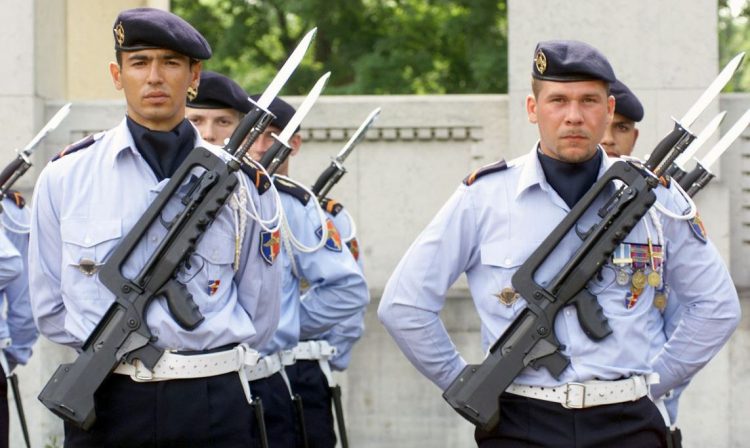
French Armed Forces, armed with FAMAS F1 assault rifles, participate in the Memorial Day ceremony at the LaFayette Escadrille Monument in Paris, France.
By Peter KORZUN | Strategic Culture Foundation | 05.04.2018
French President Emmanuel Macron kept his word. On April 1-2, French troops moved into northern Syria. This is the first time France deployed substantial forces there to turn Paris into a new actor actively involved in the war. The troops advanced toward Manbij and Remelin to join American allies and did it hastily.
The move was made at the time Ankara warned about the plans to control this territory with Russia, Turkey and Iran working together to define Syria’s future. It significantly changes the situation and makes one ask questions about the goals pursued by the US and France and the prospects for war and peace in the conflict-torn country. Summing up the recent events leads to the conclusion that the US and France have a hidden agenda to expand the conflict, wreak havoc and stymie the Russia-led peace efforts.
The news about French deployment came just before the April 4 Russia-Turkey-Iran summit in Ankara stated the goal to “speed up their efforts to ensure calm on the ground” in Syria. On April 3, US President Donald Trump said he would “decide very quickly” to remove forces from that country. The statement was made right after about 300 US Marines accompanied by armored vehicles and engineering equipment were moving toward Manbij as reinforcements to repel possible Turkish inroads. The construction of two bases in Syria’s northern Manbij region is underway.
The Marines have already launched daily patrols along the Sajur River, a tributary that feeds the Euphrates River from sources in Turkey, with observation posts built to monitor the area. This is unheard of – two leading states of the North Atlantic Alliance blocked the other NATO member’s land access to Manbij! On April 3, CNN reported that plans to send reinforcements have been discussed for several days before Trump’s remarks on leaving Syria soon.
The US also wasted no time to press Iraq into sending its 5th Army Division to Sinjar province and line the forces on the Iraqi-Syrian border to obstruct the possible advance of Turkish army from Syria into Iraq.
Obviously, the US is trying to partition Syria while creating a quasi-state on the eastern bank of the Euphrates and up to the Iraqi border. In Deir-ez-Zor, the US-led coalition resists the restoration of Syrian government institutions. It makes one think that the words about “leaving soon” may be nothing more than wishful thinking or an attempt to baffle those who are trying to predict further steps America will take.
The list of goals includes controlling the oil fields and chunks of the territory. Donald Trump wants Saudi Arabia to pay for US operations in Syria and it probably will. If the decision to leave were taken, he wouldn’t raise the question. According to the president, Saudi Arabia is interested in America staying in Syria.
That’s what the US “rocking from side to side” foreign policy is like. Rex Tillerson is fired to make the world know about it from tweets. The US wants to leave Syria but will stay if Saudi Arabia pays. Donald Trump invited the Russian leader to visit him in Washington against the background of Russia diplomats expelled and the consulate office in Seattle closed. Is it being short-sighted or far-sighted? Is this swinging back and forth a well-thought over policy or no policy at all? Is it done on purpose to keep everyone guessing with no predictions possible? You never know. Donald Trump once denounced Saudi Arabia as extremist and then sold a huge package of weapons while calling the kingdom a great friend and close ally against Iran.
The Syrian forces are preparing an offensive in the Daraa – Quneira – Suweida area in the south while denuding other fronts. The territory is huge and the terrain is hard to cross. There are at least 25 heights to fire at advancing forces from. The Free Syrian Army and other rebel groups are much more numerous than the ones being defeated in Eastern Ghuta. Their defenses are strong. Unlike in other places, the rebel forces can easily get logistical support from Jordan. That’s where the US and Saudi Arabia can contribute greatly. Israel has been involved in such activities since 2015. It took roughly six months to liberate Eastern Ghuta, with an active phase to dislodge rebel fighters launched in mid-March. It’s easy to surmise that it will take at least a year, may be much more, to liberate the area in question.
A conflict is easy to provoke. The operations of Syria’s government forces aimed at cutting off supplies coming from Jordan could be presented as an act of aggression against the Hashemite Kingdom. Chemical substances could be transported from Jordan to stage another provocation used as a pretext to attack Syria.
The operation could become a war of attrition to make Syria concentrate more and more of its forces in one place at the expense of other battlefields. They will be stuck there for a considerable period of time. That’s when the US-coalition will be in good position to attack anywhere it wants using the base of Al-Tanf as a springboard. Manbij as well as the Al-Tabka air base located to the south of Raqqa are perfect places for launching an offensive to drive Syria out from Aleppo. Then the country will plunge again into an “all-against-all” fight.
The efforts applied so far by Russia, Turkey and Syria will go down the drain. This time the US will not be alone to have substantial presence on the ground. It’s hard to imagine that the French forces arrived in Syria could be anything but the start of broader NATO presence with other members of the bloc to follow the French example. Russian military personnel and NATO soldiers will be looking at each other through the sights of guns. This scenario will be fraught with a great risk of international military conflict and a real tragedy for Syrian people but those who are provoking it don’t care.
King’s Legacy Betrayed
By Margaret Kimberley | Consortium News | April 4, 2018
Dr. Martin Luther King, Jr. was the preeminent leader of the black liberation movement in the 1950s and 1960s. Millions of people engaged in the struggle against America’s shameful apartheid system but King was the most influential. His actions are remembered, his words are quoted by activists, politicians, and pundits. His birthday is a national holiday. Only the worst and most retrograde racists dare to speak ill of King.
But the lionizing is mostly a sham. In fact there are very few people who remember the importance of what King said, what he did or why and how they should replicate his work. His legacy has been subverted and is now understood only by the most conscious students of history.
Nothing illustrated this state of affairs more clearly than the use of King’s words in a Ram truck commercial broadcast during the 2018 Super Bowl football championship. Viewers were told that Ram trucks are “built to serve.”
The voice over is provided by King himself speaking exactly 50 years earlier, on February 4, 1968. The Drum Major Instinct sermon was a call to reject the ego driven desire for attention in favor of working for more altruistic pursuits. “If you want to say that I was a drum major say that I was a drum major for justice.”
The commercial’s creators deliberately ignored the portion of the sermon in which King derided the influence of advertising. He even mentioned vehicle advertising specifically. He warned that “gentleman of massive verbal persuasion” can influence people to act against their own interests. “In order to make your neighbors envious you must drive this type of car.”
A Nation Going Backwards
Corporate interests are not alone in pretending to honor King while actually attacking him. King’s legacy is severely diminished because it has been used by cynical individuals for corrupt purposes. As we commemorate the 50th anniversary of his assassination we see a nation that has moved backwards on nearly every front. Legalized discrimination was eliminated but powerful forces undermined progress and America in 2018 is devoid of the change that King fought to make real.
Much of the blame lies at the feet of the Democratic Party, who have an undeserved reputation for enacting progressive policies. In reality, Democrats actively targeted black people for joblessness, poverty, imprisonment and disenfranchisement. Democrats became the party of corporate interests and aligned themselves with every neoliberal initiative. They forsook the union movement, working hand in hand with finance capitalists to take living wage jobs out of the country. Bill Clinton oversaw the end of public assistance as a right, destroying what Franklin Roosevelt enacted 60 years earlier. He built on the work of Ronald Reagan and massively increased the prison population.
Barack Obama offered a “grand bargain” of austerity to Republicans and continued the George W. Bush policy of tax cuts for the wealthiest. The banks which created the 2008 financial collapse were rewarded with huge bailouts of public funds. Black people ended up losing the small bit of wealth they held before the crash and now lead only in the negative measurements of quality of life.
Democrats destroy public education through charter schools and refuse to raise the minimum wage even when they control Congress and have the power to act. They were never the party of peace and they are now most outspoken in encouraging an anti-Russian resumption of the Cold War and supporting imperialist interventions.
After the legislative victories of the 1960s black Americans were ignored, subjugated or co-opted. It is true that there are thousands of black elected officials, when in King’s day there were hardly any. But this political class is a traitorous one and works for its own benefit, its patrons in corporate America and the civil rights organizations that are subsidiaries of the Democratic Party. The black political class went along with every sordid deal that Jimmy Carter, Bill Clinton and Barack Obama pursued. Their positions are secure but the rest of black America is anything but.
Prison Population Explodes
A glaring example is the enormous increase in incarceration rates. When Martin Luther King was alive there were only 300,000 incarcerated Americans. There are now more than 2 million. The exponential increase is not coincidental. Mass incarceration was a direct reaction to the freedom movement. Segregation put black people under physical control and the system devised new ways to secure the same result when it ended.
Black men became the face of drug dealing, or deadbeat fatherhood or anything else that the press and politicians told white Americans to fear and hate. The ripple effect is terrible and damages family life, the ability to earn a living and even to vote. In 48 states felons either lose the franchise permanently or are prevented from voting until all supervision is lifted. In Florida alone 1.5 million people cannot vote because of past convictions. A recent court case declared this rule unconstitutional and if a November 2018 ballot measure passes they may have their voting rights restored. That will be a happy result but there are 5 million more Americans, disproportionately black, who elsewhere lose the ability to vote due to criminal convictions.
Until incarceration becomes a mass movement, political issue, the Voting Rights Act amounts to very little. Actually the act already amounts to little because the Supreme Court nullified its most important provisions requiring southern states to seek permission before changing voting rules. The Democrats are less concerned with getting out the vote than in making their wealthy patrons happy and protecting the Senate majority and federal judiciary they claim is so important.
Of course the Democrats are in a bind. They don’t want to get out the vote because that would mean fighting for the issues that the masses need addressed. The wishes of wealthy, corporate America don’t dovetail with those of working people. Fat cat funders don’t want an increased minimum wage. Getting out the vote would mean biting the hand that feeds. So the people be damned.
King’s Challenge to Militarism Defied
King began his fight for the particular needs of black people in a uniquely oppressive system. As years went by he also opposed the economic system itself and the war in Vietnam. In 2017 the Democrats, including most Congressional Black Caucus members, went along with Donald Trump’s request for a 10% increase of an already huge military budget. They will go through the pretense of complaining when that increase inevitably restricts federal spending for social needs, but they are connivers who hope we miss their charade.

Martin Luther King Jr. with President Johnson in 1966
The liberation movement succeeded against great odds. Most black people then as now lived in the southern states and could not vote. Yet their coordinated mass action won them the franchise anyway. That lesson must not be forgotten as the juggernaut of neoliberal plots threatens everyone.
Every major American city is undergoing an onslaught of gentrification which displaces millions of black people at the whim of finance capital. The politicians who will speak in praise of King today do nothing to stop them. In fact they depend upon their largesse to stay in office.
They do nothing to stop the continued terror of billionaire rule. Instead they assist the richest in grabbing more and more. Amazon CEO Jeff Bezos this year became the richest person on the planet. His plans for a new Amazon HQ could be funded entirely by his corporation. Instead cities across the country scramble to give away property and tax dollars to help fund the race to the bottom for workers.
Hollow Admiration
Dr. Martin Luther King, Jr. should be remembered for his tremendous courage in speaking out against the power of money and the military industrial complex. The poseurs who go along to get along should be silent today. The past 50 years have been so tragic because the hard won victories were deliberately destroyed.
King inspired the people to fight for their needs. He did so when the New York Times and Washington Post vilified him. He spoke against the Vietnam war when his compatriots feared angering Lyndon Johnson. The mass action movement that he led forced LBJ to act when he didn’t want to. If politicians act on behalf of the people it is never because they have the right motives.
That is what we must remember about King. The admiration is hollow unless we do as he and millions of others did and commit ourselves to challenging the system. That will mean openly and loudly denouncing the people committed to destroying what they worked and died to achieve. The worst traitors are the most prominent and well respected. But the respect is undeserved and quite dangerous. The night before he was killed King spoke of getting to the promised land. That won’t happen until the scoundrels are named and opposed. Honoring King’s legacy demands that we do just that.
Margaret Kimberley is Editor and Senior Columnist at Black Agenda Report. Ms. Kimberley serves on the Administrative Committee of the United National Antiwar Coalition (UNAC), the Coordinating Committee of Black Alliance for Peace (BAP) and the Advisory Board of ExposeFacts.org. She is writing a book about racism and the American presidency. She is a graduate of Williams College and lives in New York City.
NATO Plotted ‘Skripal Case’ to Justify Their Defense Spendings – Moscow
Sputnik – April 3, 2018
The Russian Foreign Ministry says it can’t discern how to convene a NATO-Russia Council in the current climate, considering absurd NATO’s statements regarding a readiness for dialogue while expelling Russian diplomats.
“Yes, indeed, seven people have been declared undesirable. And they (in Brussels) have announced that they will not issue visas to three other employees,” Deputy Foreign Minister of the Russian Federation Alexander Grushko stated at the Valdai Discussion Club’s event.
According to the diplomat, the next meeting of the Russia-NATO Council (NRC) cannot be convened under the conditions of Russian diplomats being expelled.
“NATO, expelling Russian diplomats, cuts the branch on which it sits. This contradicts the numerous statements made by the Secretary-General and other representatives of the alliance about NATO being interested in a political dialogue and the convening of a regular meeting of the NRC… How can it be convened under these conditions?” the Alexander Grushko said.
Moscow does not rule out that the poisoning of former Russian intelligence officer Sergei Skripal in the United Kingdom has been designed to justify the growing defense spending of NATO among other reasons, Russian Deputy Foreign Minister Alexander Grushko stated.
“I think that all this was planned, including due to the fact that it would be necessary to explain to the public in the near future where the money is going because it is colossal spending,” Grushko said when asked whether Moscow expected NATO to increase defense spending over the so-called Skripal case.
Euro-Atlantic solidarity around Skripal case has become a direct danger to European security, according to the Russian Deputy Foreign Minister.
Moscow does not exclude that the Skripal case was plotted as the argument for NATO’s increase in defense expenditures, a great enemy is needed, the deputy minister said.
“NATO has crossed the line when it continued to expand its defense presence at Russia’s borders. Today, the situation along our borders has changed dramatically and in fact, not only in terms of politics but also in the field of military development, NATO has resorted to Cold War schemes that should have remained in the past and today cannot provide security… without Russia,” the Deputy Foreign Minister of the Russian Federation noted.
London decided to follow a provocative path to support an atmosphere of Russophobia, Grushko said.
“It is obvious that this is a provocation. The whole situation was turned upside down, an ideological campaign was built in such a way as to exclude a normal dialogue, professional, in fact, what happened. The UK refused to use legally binding instruments, which are fixed in the Convention on the Prohibition of Chemical Weapons. Therefore, these are all signs that this is a provocation chosen at a special moment in order to further aggravate the relations between Russia and the West, worsen the prospects for a return to normalcy, and prevent the transition to cooperation schemes in the areas of common interest,” Alexander Grushko stated.
Western countries, making claims over Russia on the “Skripal case”, should have understood that it is impossible to speak with Moscow in the language of ultimatums, Grushko emphasized.
“An ultimatum was delivered, which was not intended to be answered because the people who formulated this ultimatum could not fail to understand beforehand that this is not the language in which one can speak,” he said.
Moscow will answer in an asymmetric way to any unfriendly NATO move in order to protect our interests, Grushko noted.
RT, Sputnik Facing Pressure in West Due to Effective Work
“By the way, why are they closing Sputnik and Russia Today? For one simple reason – because they [media outlets] carry out their function effectively, they really influence public opinion,” Grushko said.
Tensions between Russia and Western countries began to grow after the Salisbury incident, where Sergei Skripal, former Russian intelligence officer and his daughter Yulia were harmed by a nerve agent. The UK accused Russia of orchestrating the attack and expelled 23 Russian diplomats. The move has been supported by more than 25 countries, despite of the fact that Russia has repeatedly denied the accusations and cited the lack of proof.
Iran: Israel must be forced to join NPT
Press TV – April 3, 2018
Iranian Ambassador to the United Nations Gholamali Khoshroo has stressed that the Tel Aviv regime’s warlike policies are hampering efforts to denuclearize the Middle East.
“Forcing Israel to join the Non-Proliferation Treaty and putting all of its nuclear activities and facilities under the safeguard of the International Atomic Energy Agency must be one of the commission’s main recommendations,” said Khoshroo while addressing the disarmament committee in New York on Monday.
He further called for an increase in international action aimed at protecting global peace and security in the face of the nuclear arms race.
Khoshroo noted that all nuclear weapons must be destroyed before they are used to destroy the human race.
Israel is estimated to have 200 to 400 nuclear warheads in its arsenal. The regime, however, refuses to either accept or deny having the weapons.
It has also evaded signing the NPT amid staunch endeavor by the United States and other Western states on international levels in favor of its non-commitment to the accord.
Trump is the most peace-loving US president Putin will ever know
By M K Bhadrakumar | Indian Punchline | April 1, 2018
A fortnight after sacking Rex Tillerson as Secretary of State and a week after kicking out Lt. General HR McMaster from the National Security Council in the White House, President Donald Trump has made his first major foreign policy move. He announced on Thursday in front of cheering supporters at a rally in Richfield, Ohio,
- “We’ll be coming out of Syria, like, very soon. Let the other people take care of it now. By the way, we’re knocking the hell out of ISIS. We’re going to be coming out of there real soon. We’re going to get back to our country, where we belong, where we want to be.”
In sheer power play, Trump has shattered the coalition between the US foreign and defence establishments, which Tillerson and Defence Secretary James Mattis assiduously built to usurp policymaking. (Read my column in Asia Times dated March 15, Deconstructing the sacking of Rex Tillerson.)
Trump made his announcement on Thursday without consulting the state department or Pentagon. The state department spokesperson admitted ignorance. The Pentagon spokesperson mumbled that “important work remains to guarantee the lasting defeat of these violent extremists” in Syria. But, on Friday, the White House chief of staff John Kelly in a phone call to Deputy Secretary of State John Sullivan conveyed Trump’s decision ordering a hold on more than $200 million in recovery funds earmarked for infrastructure projects in northeastern Syria in territories under US military control. This freezes a pledge made by Tillerson in support of Pentagon’s plans for an open-ended military presence in Syria.
Trump’s move may gain traction with 2 American soldiers reportedly killed and four injured in an IED explosion near Manjib on Thursday. Mattis won’t undermine Trump’s decision. That is simply not the military man’s style, which is always to use “front men” (like Tillerson.)
John Bolton, McMaster’s replacement, isn’t a military man. Bolton has a terrible reputation in the Beltway, which will sap his effectiveness. But Bolton is a rank opportunist who’ll know what is good for him under a Boss who is moody and volatile in turns. Also, Mike Pompeo, the incoming secretary of state, is a close pal of Trump’s and there is no daylight possible between the two.
Thus, Trump’s foreign policy agenda is becoming “kinetic”, finally. The speech in Ohio is vintage Trump. He has returned to his golden theme of mending America’s decaying infrastructure “with American heart, and American hands, and American grit.” (White House readout) This is also Trump’s campaign plank in the 2020 election: No more wars abroad unless US interests are directly threatened.
My gut instinct says that an overall easing of tensions with Russia is also to be expected. Trump is not seeking a fight with Russia. Arguably, he is the most peace-loving American president Vladimir Putin will ever know.
The exact circumstances of the Skripal spy case will never be known but following a phone call Trump made to British PM Theresa May on March 28, some sort of a cooling off period may have begun. The White House readout said,
- Both leaders agreed on the importance of dismantling Russia’s spy networks in the United Kingdom and the United States to curtail Russian clandestine activities and prevent future chemical weapons attacks on either country’s soil.
The above formulation by no means constitutes an “anti-Russian” articulation. Rather, it is a statement on national security priorities.
Hasn’t Britain begun “soft-pedaling” already? Contrary to the gloomy news Wednesday that the chances of Yulia Skripal, the ex-spy’s daughter, surviving was only 1 percent, London announced on Friday that she is “out of danger”, is eating and drinking. And Skripal himself, though “critical”, is “stable”.
Equally, the British FO said on Saturday, “We are considering requests for consular access in line with our obligations under international and domestic law, including the rights and wishes of Yulia Skripal.” The Russian embassy has sought consular access. (Yulia is a Russian citizen.)
Moscow must be sensing new stirrings in the air. The latest remarks by the Russian ambassador to the US Anatoly Antonov were spoken more in sorrow than in anger. Antonov said on Saturday,
- “We want everybody to understand that we (US and Russia) are destined to become friends again. Only close interaction between our countries can help maintain international strategic stability and find mutually beneficial solutions to global and regional challenges.”
- “Relations between ordinary people shouldn’t suffer. We’ll do everything in our capacity to make sure that Americans have zero problems with trips to Russia.”
Winston Churchill once compared Russian politics to a “dogfight under a carpet”. That is an apt description of Trump-era Russian-American spats as well.
Featured Video
Trita Parsi: Israel Set a Trap for Total War in the Region
or go to
Aletho News Archives – Video-Images
From the Archive
Zionism’s Violent Legacy
By Donald Neff | Washington Report On Middle East Affairs | January 1996
On January 4, 1948, Jewish terrorists drove a truck loaded with explosives into the center of the all Arab city of Jaffa and detonated it, killing 26 and wounding around 100 Palestinian men, women and children.[1] The attack was the work of the Irgun Zvai Leumi – the “National Military Organization,” also known by the Hebrew letters Etzel – the largest Jewish terrorist group in Palestine. The Irgun was headed by Revisionist Zionist Menachem Begin and had been killing and maiming Arabs, Britons and even Jews for the previous ten years in its efforts to establish a Jewish state.
This terror campaign meant that at the core of Revisionist Zionism there existed a philosophical embrace of violence. … continue
Blog Roll
 Aletho News
- Trita Parsi: Israel Set a Trap for Total War in the Region
- Trump’s Iran war is on an Israeli leash
- Saudi oil boss issues global supply warning
- Riyadh Says Its Oil System Is Intact. The Numbers Say Otherwise.
- Trump and Netanyahu Want to “Finish the Job” on Iran
- US ‘one-sided dictation’ not Iran’s beliefs makes rational talks impossible: Baghaei
- Iran’s Next Strike May Not Explode. It Could Shut You Down /Col Doug Macgregor
- Iran: US political targets legitimate if assassinations return
- Iraq shuts key border crossing with Iran under US pressure: Report
- Undersea Internet cables could be targeted in retaliation for attacks on Iran: IRGC deputy chief
- If Americans Knew
- The Israel Lobby’s Changing Fortunes
- AIPAC has become such a political liability that it’s shifting to a more “nimble” approach to buying politicians
- At least 160 Israeli settler attacks in 2 weeks
- Will Gaza’s Ancient Christian Community Disappear Forever?
- Israel’s vision of regional security rests on keeping Arab states weak
- Heidi Levine recounts how Palestinian youths helped save her in settler attack
- DAILY UPDATE: Latest essential news on Palestine, Israel, & region
- Trump’s Intensifying Sabotage of the ICC, for Israel’s Sake
- Israeli military detain US and UK volunteers in West Bank including Democratic NY politician Brad Lander
- Americans at National Conservatism Conference held in Israel this year criticize Israel
- No Tricks Zone
- E-Cars Reduce CO2 Emissions By Only 41% Compared To Internal Combustion Engine Vehicles
- Predictions Made By Renowned Climate Professor Over Past Decades Have Been Proven To Be Poor
- New Study Suggests Large Regions Of The Pacific Ocean Have Been Cooling For The Last 80 Years
- Germany’s Green Energy Debacle: High Energy Costs Force Kahla Porzellan to Close After 182 Years!
- New Study: 50 Years Of The Most Aggressive ‘Net Zero’ Policies Can Only Affect The Global Climate By 0.03°C
- US September “Heat” Was No Record…Many Records Set Decades Ago
- Latest European Green Energy Debacle; Portugal’s Largest Flagship Solar Park Insolvent!
- Green Energy Debacle: German Expert Professor Fritz Vahrenholt Warns Of Severe Economic And Social Consequences
- Two More Paleo Reconstructions Affirm Meters-Higher Sea Levels Across Ireland, Brazil 7000-6000 Years Ago
- New Study: Earth And Venus Surface Warmth Largely Explained By Convection And Lapse Rate, Not CO2 Or Radiation

